Category: Uncategorized

  • AeroVironment launches joint venture for solar high-altitude long-endurance UAS

    AeroVironment launches joint venture for solar high-altitude long-endurance UAS

    AeroVironment Inc., a maker of unmanned aircraft systems (UAS) for defense and commercial applications, has formed a joint venture to develop solar-powered high-altitude long-endurance (HALE) UAS for commercial operations.

    This category of unmanned aerial systems (UAS) is also referred to as high-altitude pseudo-satellites, or HAPS.

    The joint venture will fund the development program up to a net maximum value of $65,011,481.

    The joint venture, HAPSMobile Inc., is a Japanese corporation that is 95 percent funded and owned by Japan-based telecommunications operator SoftBank Corp. and 5 percent funded and owned by AeroVironment.
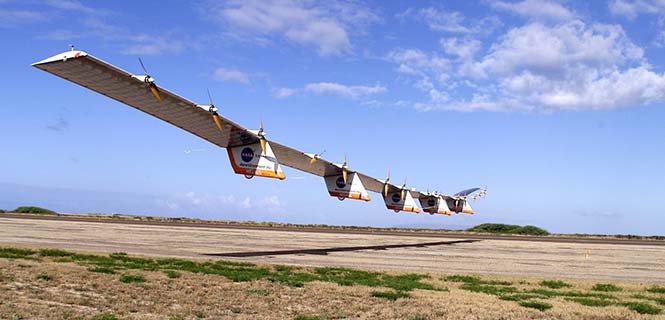
    The solar-powered Helios in flight.(Photo: NASA)

    AeroVironment is committed to contribute $5 million in capital for its 5 percent ownership of the joint venture, and has an option to increase its ownership stake in HAPSMobile up to 19 percent at the same cost basis as its initial 5 percent purchase.

    “This is a historic moment for AeroVironment. For many years, we have fully understood the incredible value high-altitude, long-endurance unmanned aircraft platforms could deliver to countless organizations and millions of people around the world through remote sensing and last mile, next generation IoT connectivity,” said Wahid Nawabi, AeroVironment chief executive officer.“We were searching for the right strategic partner to pursue this very large global opportunity with us.Now we believe we are extremely well-positioned to build on the decades of successful development we have performed to translate our solar UAS innovations into long-term value through HAPSMobile Inc. Our entire team is excited, and we look forward to transforming this strategic growth opportunity into reality.”

    AeroVironment pioneered the concept of high-altitude solar-powered UAS in the 1980s, and developed and demonstrated multiple systems for NASA’s Environmental Research Aircraft and Sensor Technology, or ERAST program, in the late 1990s and early 2000s.

    In August 2001, the AeroVironment Helios prototype reached an altitude of 96,863 feet, setting the world-record for sustained horizontal flight by a winged aircraft.

    In 2002, the AeroVironment Pathfinder Plus prototype performed the world’s first UAS telecommunications demonstrations at 65,000 feet by providing high-definition television (HDTV) signals, third-generation (3G) mobile voice, video and data and high-speed internet connectivity.

    Multiple U.S. government agencies funded the development of the hybrid-electric Global Observer unmanned aircraft system from 2007 through 2011. Global Observer represents a solution for extended operation over high northern and southern latitudes during local winters, when the sun’s energy is insufficient to maintain continuous solar aircraft operation at high altitude.

    SoftBank Corp. and AeroVironment, Inc. have agreed to license certain background intellectual properties to HAPSMobile, which will own the newly developed UAS intellectual property and possess exclusive rights for commercial applications globally, and non-commercial applications in Japan.AeroVironment will possess exclusive rights to the resulting intellectual property for certain non-commercial applications, except in Japan.AeroVironment will also possess exclusive rights to design and manufacture all such aircraft in the future for HAPSMobile, subject to the terms of the Joint Venture Agreement.

    For additional information, please see AeroVironment’s Form 8-K, filed with the Securities and Exchange Commission on Jan. 3.

  • Drone completes 100-km flight for oil and gas market

    SkyX Systems Corporation has successfully completed an unmanned data-collection flight of 100 kilometers (km), one of the longest journeys in its class.

    The firm flew its SkyOne unmanned aerial system (UAS) on an autonomous data mission over more than 100 km of gas pipeline in Mexico. The robotic flight was programmed and monitored remotely from the company’s Greater Toronto Area SkyCenter mission control, with a support crew of engineers on the ground in Mexico.

    Using high-resolution imagery, the longest of multiple flights identified more than 200 potentially significant anomalies along the remote pipeline, ranging from unauthorized buildings and cultivation, to a fissure possibly caused by seismic activity.

    More than $38 billion is spent annually monitoring oil and gas pipelines using less efficient means. The SkyX System flight gathered data in a little more than an hour that would have taken a person well over a week. It identified more than 200 georeferenced anomalies the customer was unaware existed, pinpointing precise coordinates for rapid investigation and remediation.

    The SkyX System consists of a vertical takeoff and landing (VTOL) drone, the SkyCenter control room, which allows for real-time and secure mission monitoring from remote locations, as well as the company’s proprietary SkyBoxes that enable SkyOne to recharge and continue long-range missions without having to return to home, a factor that limits many drones.

    Using the system, a client doesn’t need a trained pilot to operate a remote-control unit — the entire mission is programmed and carried out autonomously, from takeoff to landing. Plus, the VTOL drone eliminates the need for runways, launchers or capture devices.

  • Sierra Wireless integrates GNSS, SIM, security into multi-mode LPWA modules

    Sierra Wireless, a provider of fully integrated device-to-cloud solutions for the Internet of Things (IoT), has introduced multi-mode, low-power wide-area (LPWA) cellular modules.

    The modules are targeted at rapidly growing markets in asset tracking and connected industrial equipment, smart cities, healthcare, agriculture and wearables.

    AirPrime HL78 modules, featuring Altair Semiconductor’s integrated ALT1250 chipset, deliver power performance that extends the life of battery-operated devices by 5-10X compared to older LTE-M/NB-IoT modules.

    The new level of power saving modes was designed for power-constrained IoT applications, and includes improved wake-up and sleep-mode responsiveness, as well as ultra-low sleep-mode power.

    The modules also integrate GNSS tracking capability, security and an embedded SIM in a new compact CF3 size (18  x 15 millimeters) that is pin-to-pin compatible with other HL Series modules.

    Customers have the flexibility to deploy the same device on global LTE-M (Cat-M1/eMTC) and NB-IoT (Cat-NB1) networks, with support for more than 20 LTE frequency bands in addition to optional 2G fallback.

    Built-in security, including HTTPS, secure socket, secure boot and free unlimited firmware over-the-air (FOTA) updates from the AirVantage device management IoT Platform, helps customers ensure HL78 deployments are future proof and secure.

    LTE-M and NB-IoT LPWA networks deliver a new class of wireless technology specifically designed for low-power IoT applications. LPWA technologies combine lower cost, broader coverage and better battery life with globally available and secure cellular networks ready to connect hundreds of millions more things to the internet.

    “With the HL78 modules, OEMs and system integrators have the most scalable, lowest power module platform to build their global IoT applications on,” said Dan Schieler, senior vice president and general manager, OEM solutions, Sierra Wireless. “And to make it even simpler for our customers, we’ve integrated the SIM and cloud, as well as GNSS and security features, to drive down the size of LPWA connected devices while enhancing tamper resistance and security.”

    “More than 690 million LTE-M and NB-IoT connected devices are expected by 2022, and the market needs a low-power, compact embedded module to connect their industrial, smart city, smart home and simpler static sensor applications,” said Dan Shey, managing director and vice president at ABI Research. “With the addition of the HL78 product line, Sierra Wireless has amassed a broad portfolio of low power devices to drive the billions of advanced IoT connections we expect in the next decade.”

    “The ability to switch seamlessly between any commercially deployed LTE-M or NB-IoT frequency band gives HL78 customers the flexibility to choose which network they want to deploy their low bandwidth application on. And for those regions where LPWAN coverage is not as widely available, optional 2G fallback ensures their devices stay online,” said Ilan Reingold, vice president, business development and marketing at Altair Semiconductor (a Sony Group company). “Incorporating Altair’s advanced IoT chipset, HL78 devices will also enjoy an extended life of up to 15 years on a single battery.”

    The AirPrime HL78 modules are fully compliant with the 3GPP Release 13 standard and are Release-14-ready to support NB2 features in the future.

    Sierra Wireless AirPrime HL and WP Series modules are interchangeable across 2G, 3G, 4G and LPWA technologies. They use the CF3 form factor, which is footprint compatible across product lines, providing customers with the option to develop smarter by building their connected IoT product or service on a single module.

    HL7800 and HL7802 modules are sampling with lead customers now, with general availability in the third quarter of this year.

  • Drone Delivery Canada to expand testing to the US

    Drone Delivery Canada (DDC) is expanding its commercial testing program to the United States at the New York Griffiss International Airport unmanned aircraft systems (UAS) test site in Rome, New York.

    DDC anticipates that the U.S. Pilot Program will begin in this quarter of 2018 and run through the balance of the year.

    The new initiative expands DDC’s testing program to include geographies within the U.S. using its Sparrow X1000 drone, which achieved Compliant UAV Status with Transport Canada in December 2017.

    For testing, DDCs will use its proprietary FLYTE management software to support semi-autonomous flight, as well as BVLOS (beyond visual line of site) flights designed for commercial drone deliveries.

    The Griffiss International Airport UAS test site in Rome is a Federal Aviation Administration (FAA)-approved facility designated to conduct research vital to integrating UAS into the national airspace system. The site is the fifth of six test sites that are operational in the U.S.

    The U.S. testing initiatives will complement DDC’s extensive Canadian testing program scheduled for 2018, which will include testing its BVLOS capabilities at the Transport Canada-approved UAS Centre of Excellence in Alma, Quebec.

  • A look at LocationTech open source geospatial solutions

    LocationTech open source project provides core technology for geospatial big-data analytic solutions.

    LocationTech has released five open source projects that provide core technology used to build geospatial big data analytics solutions.

    A working group of the not-for-profit Eclipse Foundation, the LocationTech community builds software for geospatial technology. The Eclipse Foundation enables collaboration on open source software. Besides geospatial technology, the foundation’s 300-plus open source projects include tools for software developers, system engineers and scientific research.

    LocationTech provides technology for the $500 billion in worldwide geospatial industry. Its projects can be used to efficiently process satellite images, analyze maps for the agriculture industry, visualize smart-city sensor data, and in many other geospatial use cases.

    The LocationTech community has grown to include nine open source projects, 18 member organizations and more than 100 developers.Collaborating geospatial organizations include Boundless, Red Hat, Radiant Solutions, IBM and Oracle.

    “Geospatial big data analytics technology is becoming more and more important across all industries, such as agriculture, transportation, and government,” said Mike Milinkovich, executive director of the Eclipse Foundation. “LocationTech is delivering on the promise of providing key technology for companies that enable large-scale analytics of geospatial data. Having an open source community, like LocationTech, that accelerates adoption and innovation of geospatial technology will have a significant impact on the entire industry.”

    The new project releases include the following:

    GeoWave is a software library that connects the scalability of distributed computing frameworks and key-value stores with modern geospatial software to store, retrieve, and analyze massive geospatial datasets. GeoWave takes multidimensional data, such as spatial or spatial-temporal, and indexes it into a key-value store such as Apache Accumulo or Apache HBase. These distributed storage technologies, in addition to complementary distributing processing frameworks such as Apache Hadoop and Apache Spark, have proven capabilities to unlock the potential of massive datasets across a variety of domains.

    GeoGig 1.2 is a tool for geospatial data versioning. It enables users to leverage versioning of their geospatial data and to enable replication and synchronization workflows, in addition to supporting end-to-end data management workflows. The new GeoGig 1.2 release improves the collaborative version workflow by improving cloning and push/pull performance and provides an updated Web API to align with the latest version of GeoServer.

    GeoGig-sample-W

    GeoTrellis 1.2 is a geographic data processing Scala library designed to work with large geospatial raster datasets. The tool provides developers with a set of utilities to help create useful, high performing web services that load and manipulate raster data (data normally used to represent satellite or aerial images). The new release includes a number of optimizations and new features including distributed computation support for viewshed and Euclidean distance through Apache Spark.

    GeoTrellis-example-W

    GeoMesa 1.3.5 is a distributed, spatio-temporal database built on a number of distributed cloud data storage systems, including Apache Accumulo, Apache HBase, Apache Cassandra, and Apache Kafka. The suite of tools brings spatial-temporal data, real-time IoT, and sensor workloads to the cloud. GeoMesa’s novel indexing schema enables efficient queries resulting in rapid access to large data stores for any client application.

    GeoMesa-taxi-casestudy

    Java Topology Suite (JTS) 1.15 is a Java library for vector geometry providing spatial data types, spatial relationships and spatial operations. JTS is an established open source project that recently moved to the LocationTech community. New technical features for JTS 1.15 include K-Nearest Neighbor search for STR-Tree, improved handling of Quadtree queries, support for GeometryCollection, and a new JTSTestRunner command-line application. This initial LocationTech release the project is changing from LGPL to a dual license of Eclipse Distribution License (EDL) / Eclipse Public License (EPL) . This license change opens up JTS to a wider range of organizations and applications.

    “LocationTech is becoming the critical nexus for organizations looking to develop and deploy geospatial Big Data solutions,” says Eddie Pickle, Managing Director of Open Source Programs at Radiant Solutions.

    “The latest release of GeoGig to LocationTech represents a huge leap forward. Not only does it support versioning workflows for traditional geospatial data, but it is now optimized for spatio-temporal analysis of big data and streaming datasets from IoT sensors,” says Anthony Calamito, Chief Geospatial Officer and Vice President of Products

    The LocationTech Working Group is also organizing the annual FOSS4G NA conference May 14-16, 2018, in St. Louis, Missouri, followed by a Community Day on May 17. Members of the LocationTech community will be speaking and showcasing their open source projects at this conference.

    The vision of the LocationTech community is to be the leading provider of core technology for geospatial big data analytics. The five projects being released reflect the growing investment towards achieving this vision.

  • Air-directed UAV completes first flight trials

    BAE Systems and the University of Manchester has successfully completed the first phase of flight trials with MAGMA — a small-scale unmanned aerial vehicle (UAV) that uses a blown-air system to maneuver. The UAV design paves the way for future stealthier aircraft designs, according to BAE Systems.

    The new concept for aircraft control removes the conventional need for complex, mechanical moving parts to move flaps that control the aircraft during flight. The new design could provide greater control as well as reduce weight and maintenance costs, allowing for lighter, stealthier, faster and more efficient military and civil aircraft.

    The two technologies to be trialed using the jet-powered MAGMA, are:

    • Wing Circulation Control, which takes air from the aircraft engine and blows it supersonically through the trailing edge of the wing to provide control for the aircraft.
    • Fluidic Thrust Vectoring, which uses blown air to deflect the exhaust, allowing for the direction of the aircraft to be changed.

    The flight trials are part of an ongoing project between the two organizations and wider long-term collaboration between industry, academia and government to explore and develop innovative flight-control technology.

    Further flight trials are planned for the coming months to demonstrate the flight control technologies with the ultimate aim of flying the aircraft without any moving control surfaces or fins. If successful, the tests will demonstrate the first use of such circulation control in flight on a gas turbine aircraft and from a single engine, BAE Systems said.

    “The technologies we are developing with the University of Manchester will make it possible to design cheaper, higher performance, next-generation aircraft,” said Clyde Warsop, engineering fellow, BAE Systems. “Our investment in research and development drives continued technological improvements in our advanced military aircraft, helping to ensure UK aerospace remains at the forefront of the industry and that we retain the right skills to design and build the aircraft of the future.”

    “These trials are an important step forward in our efforts to explore adaptable airframes. What we are seeking to do through this programme is truly ground-breaking,” said Bill Crowther, a senior academic and leader of the MAGMA project at The University of Manchester.

    Additional technologies to improve the performance of the UAV are being explored in collaboration with the University of Arizona and the NATO Science and Technology Organisation.

  • Harxon releases frequency-hopping OEM modem

    Harxon has launched the HX-DU2017D, a frequency-hopping OEM modem designed to provide strong anti-jamming and signal receiving capability for complex data-intensive applications.

    HX-DU2017D is a miniature, dual-frequency, software-selectable 840 MHz and 900 MHz data link modem. It provides a power switching of 0.5 W, 1 W and 2 W, 20 ms/30 ms/40 ms/50 ms/ frequency hopping interval, and supports point-to-point, point-to-multipoint network.

    Its full duplex mode ensures secure data transferring and stable long-range communication, the company said.

    HX-DU2017D also provides short latency of data transmission and communication recovery in millisecond level.

    According to Harxon, HX-DU2017D allows fast and secure, simultaneous data communication for mission-critical applications, especially in the fields of precision agriculture and UAVs, including unmanned plant surveys, UAV plant protection and automatic mowers.

    It could easily be placed on a UAV with its extremely small footprint for tight OEM integration and design flexibility. Meanwhile, its frequency hopping transmission ensures the data security and flight stability.

  • UAV sensor package detects methane

    Pergam gas sensor aboard the Microdrones md4-1000 UAV.

    The professional aerial methane detector mdTector1000 CH4 from Microdrones makes it easy to detect methane gas via a fully integrated aerial package for professionals responsible for methane gas infrastructure.

    The mdTector1000 CH4 has a Pergam gas sensor, mounted and integrated with the Microdrones md4-1000 UAV. In real time, users can see aerial shots of detection with the laser sensor, the company said. The carbon-fiber built UAV goes into dangerous areas unsuitable for workers.

    The mdTector1000 CH4 can be used for natural gas line surveys, tank inspections, gas well testing, plant safety and landfill emission monitoring.

    The mdCockpit Android App allows users to maintain visualization in flight. A special mdTector app allows users to visualize and present all post-flight data on one map.

  • Satellite imagery aids rescue efforts for Hurricanes Harvey, Irma and Maria

    MODIS Image of Hurricane Harvey. This natural color image of Hurricane Harvey was acquired by the Moderate Resolution Imaging Spectroradiometer on NASA's Terra satellite as the hurricane reached the Gulf Coast of Texas at 12:25 p.m. local time on Aug. 25, 2017. (Image: USGS)
    MODIS Image of Hurricane Harvey. This natural color image of Hurricane Harvey was acquired by the Moderate Resolution Imaging Spectroradiometer on NASA’s Terra satellite as the hurricane reached the Gulf Coast of Texas at 12:25 p.m. local time on Aug. 25, 2017. (Image: USGS)

    Free and rapid imagery was provided through the USGS Hazard Data Distribution System.

    The calls for assistance started days before Hurricane Harvey came barreling across America’s doorstep this summer. First responders and government officials needed answers to prepare and protect communities.

    How strong is this storm going to be? What kind of damage occurred on its path through the Caribbean? How might it impact southeast Texas once it makes landfall?

    Remotely sensed imagery was provided — at no cost and almost daily — through the U.S. Geological Survey’s (USGS) Hazard Data Distribution System (HDDS) for analysis on the extent, severity and evolution of hurricanes Harvey, Irma and Maria.

    “USGS staff worked around the clock to keep HDDS populated with satellite and aerial imagery,” said Brenda Jones, who is the disaster response coordinator for the USGS Earth Resources Observation and Science Center (EROS).

    15,000 images were downloaded from HDDS following the three storms. Requests came from 48 government agencies, including the U.S. Senate, Foreign Agricultural Service, Department of Homeland Security and the Centers for Disease Control and Prevention.

    For example, Harvey dropped as much as 52 inches of rain in Houston. The Federal Emergency Management Agency used data from HDDS to identify roads and other infrastructure that were under water in an effort to better direct rescue efforts.

    “Quick, easy and centralized access to high-quality imagery made it possible to create maps that were useful to disaster management authorities,” Jones said. “We haven’t had a hurricane season like this for a very long time, and the HDDS system proved invaluable to rescue efforts.”

    In addition to hurricanes, HDDS is useful for numerous hazard situations. For example, following the recent earthquake near Mexico City, imagery provided through HDDS allowed first responders to see collapsed buildings, blocked roads and damaged infrastructure.

    During fire season, HDDS makes it possible for first responders to have wide-scale pictures of situations.

    HDDS acquires imagery and data from several sources, including the International Charter for Space and Major Disasters, of which the USGS is a member. Once the hurricane season began, USGS EROS staff began pulling data acquired by space and aerial systems and loading them into HDDS.

    GEOS-13 Image of Hurricane Maria and Tropical Storm Jose. Image of Hurricane Maria and Tropical Storm Jose acquired by the Geostationary Operational Environmental Satellite 13 at 1:15 p.m. local time on Sept. 19, 2017. The satellite is operated by NOAA while NASA helps develop and launch the GOES series of satellites. (Image: USGS)
    GEOS-13 Image of Hurricane Maria and Tropical Storm Jose. Image of Hurricane Maria and Tropical Storm Jose acquired by the Geostationary Operational Environmental Satellite 13 at 1:15 p.m. local time on Sept. 19, 2017. The satellite is operated by NOAA while NASA helps develop and launch the GOES series of satellites. (Image: USGS)
  • ESA investigates high-altitude pseudo-satellites for Earth observation

    News from the European Space Agency

    High-altitude pseudo-satellites (HAPS) are platforms that float or fly at high altitude like conventional aircraft but operate more like satellites. (Image: ESA Earth Observation Graphics Bureau)

    The European Space Agency (ESA) is considering extending its activities to a new region of the sky via a novel type of aerial vehicle, a missing link between drones and satellites.

    High-altitude pseudo-satellites, or HAPS, are platforms that float or fly at high altitude like conventional aircraft but operate more like satellites — except that rather than working from space, they can remain in position inside the atmosphere for weeks or even months, offering continuous coverage of the territory below.

    The best working altitude is about 20 kilometers, above the clouds and jet streams, and 10 kilometers above commercial airliners, where wind speeds are low enough for them to hold position for long periods.

    From such a height they can survey the ground to the horizon 500 km away, variously enabling precise monitoring and surveillance, high-bandwidth communications or back up to existing satellite navigation services.

    Several ESA directorates have teamed up to investigate their potential, explains future-systems specialist Antonio Ciccolella.

    “For Earth observation, they could provide prolonged high-resolution coverage for priority regions, while for navigation and telecoms they could shrink blind spots in coverage and combine wide bandwidth with negligible signal delay,” Ciccolella said.

    “ESA is looking into how these various domains can be best brought together.”

    “We’ve been looking into the concept for the last 20 years but now finally it’s becoming reality,” explained Earth observation specialist Thorsten Fehr.

    “That’s come about through the maturing of key technologies: miniaturised avionics, high-performance solar cells, lightweight batteries and harness, miniaturisation of Earth observation sensors and high-bandwidth communication links that can deliver competitively priced services.”

    Navigation engineer Roberto Prieto Cerdeira added, “There’s obvious potential for emergency response. They could also be employed semi-permanently, perhaps extending satnav coverage into high, narrow valleys and cities.”

    The QinetiQ-designed and Airbus-owned Zephyr-7 solar-powered unmanned aircraft holds the world flight endurance record at 14 days. (Photo: Airbus)

    European companies have already unveiled product lines. For instance, Airbus has developed the winged, solar-powered Zephyr, which in 2010 achieved a world record 14 days of continuous flight without refuelling.

    The Zephyr-S is designed to fly payloads of a few tens of kilograms for up to three months at a time, with secondary batteries employed to keep it powered and aloft overnight. A larger Zephyr-T version now in preparation will support larger payloads and power needs.

    The first flight is projected for 2021 for Thales Alenia Space’s Stratobus airship. (Artist’s rendering: Thales Alenia Space/Briot)

    Meanwhile, Thales Alenia Space is preparing the lighter-than-air Stratobus, with its first flight expected in 2021.

    The buoyant Stratobus airship can carry up to 250 kilograms, its electric engines flying against the breeze to hold itself in position, relying on fuel cells at night.

    Many other firms are also developing vehicles, payloads and services. Last month saw them gathered at ESA’s inaugural workshop, together with representatives of potential customers, including the European Defence Agency, Frontex — the EU agency tasked with Europe’s border management — and EU Copernicus environmental monitoring services.

    Airbus’s double-tailed Zephyr-T variant HAPS aircraft is designed to support larger payloads, keeping them aloft for months at a time. (Image: Airbus)

    “This was the first meeting of its kind in Europe, with more than 200 HAPS experts” explains Juan Lizarraga Cubillos, from ESA’s telecoms area.

    “We heard from them on the needs, opportunities and critical issues within the field, particularly as a complement for existing satellite services, to start preparing a future ESA programme.”

    ESA regards the vehicles as a valuable way of establishing applications that complement its satellites while also accelerating space technologies through early, high-altitude flight testing.

    The point was also made that market acceptance of HAPS would come down to their efficiency and cost-effectiveness — and the best way to show that would be through demonstration projects.

    “We have to fly them,” remarked Alvaro Rodriquez of the EU’s Satellite Centre. “The technology is there, all the ingredients are there, now it’s time to mix them into a nice recipe.”

    Thales Alenia Space’s Stratobus is topped with solar panels, powering its propellers to fly against the wind at 20 km for prolonged periods of service. (Image: Airbus)
  • ESA investigates high-altitude pseudo-satellites

    ESA investigates high-altitude pseudo-satellites

    News from the European Space Agency

    High-altitude pseudo-satellites (HAPS) are platforms that float or fly at high altitude like conventional aircraft but operate more like satellites. (Image: ESA Earth Observation Graphics Bureau)

    The European Space Agency (ESA) is considering extending its activities to a new region of the sky via a novel type of aerial vehicle, a missing link between drones and satellites.

    High-altitude pseudo-satellites, or HAPS, are platforms that float or fly at high altitude like conventional aircraft but operate more like satellites — except that rather than working from space, they can remain in position inside the atmosphere for weeks or even months, offering continuous coverage of the territory below.

    The best working altitude is about 20 kilometers, above the clouds and jet streams, and 10 kilometers above commercial airliners, where wind speeds are low enough for them to hold position for long periods.

    From such a height they can survey the ground to the horizon 500 km away, variously enabling precise monitoring and surveillance, high-bandwidth communications or back up to existing satellite navigation services.

    Several ESA directorates have teamed up to investigate their potential, explains future-systems specialist Antonio Ciccolella.

    “For Earth observation, they could provide prolonged high-resolution coverage for priority regions, while for navigation and telecoms they could shrink blind spots in coverage and combine wide bandwidth with negligible signal delay,” Ciccolella said. “ESA is looking into how these various domains can be best brought together.”

    “We’ve been looking into the concept for the last 20 years but now finally it’s becoming reality,” explained Earth observation specialist Thorsten Fehr. “That’s come about through the maturing of key technologies: miniaturised avionics, high-performance solar cells, lightweight batteries and harness, miniaturisation of Earth observation sensors and high-bandwidth communication links that can deliver competitively priced services.”

    “There’s obvious potential for emergency response,” added Navigation engineer Roberto Prieto Cerdeira. “They could also be employed semi-permanently, perhaps extending satnav coverage into high, narrow valleys and cities.”

    The QinetiQ-designed and Airbus-owned Zephyr-7 solar-powered unmanned aircraft holds the world flight endurance record at 14 days. (Photo: Airbus)

    European companies have already unveiled product lines. For instance, Airbus has developed the winged, solar-powered Zephyr, which in 2010 achieved a world record 14 days of continuous flight without refuelling.

    The Zephyr-S is designed to fly payloads of a few tens of kilograms for up to three months at a time, with secondary batteries employed to keep it powered and aloft overnight. A larger Zephyr-T version now in preparation will support larger payloads and power needs.

    The first flight is projected for 2021 for Thales Alenia Space’s Stratobus airship. (Artist’s rendering: Thales Alenia Space/Briot)

    Meanwhile, Thales Alenia Space is preparing the lighter-than-air Stratobus, with its first flight expected in 2021.

    The buoyant Stratobus airship can carry up to 250 kilograms, its electric engines flying against the breeze to hold itself in position, relying on fuel cells at night.

    Many other firms are also developing vehicles, payloads and services. Last month saw them gathered at ESA’s inaugural workshop, together with representatives of potential customers, including the European Defence Agency, Frontex — the European Union (EU) agency tasked with Europe’s border management — and EU Copernicus environmental monitoring services.

    Airbus’s double-tailed Zephyr-T variant HAPS aircraft is designed to support larger payloads, keeping them aloft for months at a time. (Image: Airbus)

    “This was the first meeting of its kind in Europe, with more than 200 HAPS experts,” said Juan Lizarraga Cubillos, from ESA’s telecoms area. “We heard from them on the needs, opportunities and critical issues within the field, particularly as a complement for existing satellite services, to start preparing a future ESA programme.”

    ESA regards the vehicles as a valuable way of establishing applications that complement its satellites while also accelerating space technologies through early, high-altitude flight testing.

    The point was also made that market acceptance of HAPS would come down to their efficiency and cost-effectiveness — and the best way to show that would be through demonstration projects.

    “We have to fly them,” said Alvaro Rodriquez of EU’s Satellite Centre. “The technology is there, all the ingredients are there, now it’s time to mix them into a nice recipe.”

    Thales Alenia Space’s Stratobus is topped with solar panels, powering its propellers to fly against the wind at 20 km for prolonged periods of service. (Image: Airbus)
  • OGC seeks participants for 'interoperability plugfest'

    Open Geospatial Consortium (OGC) is calling for interested participants in its Geospatial to the Edge Interoperability Plugfest.

    OGC Plugfests, initiatives of the OGC Innovation Program, provide a venue for sponsors and technology implementers to come together to solve geospatial interoperability challenges in a collaborative, agile process.

    A plugfest is organized around scenarios and a testing environment to advance the implementation of OGC standards and profiles of OGC standards in commercial and open source software products. A plugfest allows organizations to test and validate implementations of OGC standards in their software products, verifying that they can interoperate with other products implementing the same standards.

    The Geospatial to the Edge Interoperability Plugfest is co-sponsored by Army Geospatial Center and the National Geospatial-Intelligence Agency (NGA/CIO&T). The Plugfest will assist tool enhancement and provide guidance to improve the delivery of enterprise geospatial data to end users. The Plugfest will test profiles and extended capabilities of the GeoPackage, WMS, WMTS, and WFS standards for the end user.

    Examples of end user communities that will benefit include:

    • first responders, relief workers, and firefighters preparing for and operating in limited network environments;
    • emergency planners and managers in their efforts to support hurricane, wildfire, and earthquake preparedness, relief/response activities, and damage assessment;
    • soldiers/warfighters planning and executing operations, specifically in disconnected, intermittent, and limited network environments.

    What is an OGC profile?

    An OGC profile is a subset of a standard that helps better share information within a community of interest. A profile is a specification that imposes additional constraints on an existing standard to make that standard more focused to the needs of the user community. A profile can also be extended to offer specialized functionality, for example, make previously optional capabilities mandatory, or define extensions where permitted by the base standard.

    The profiles that are planned to be used in the Plugfest include: raster and vector NSG GeoPackages, NSG WMTS, NSG WMS, and NSG WFS.

    Interested parties can respond to the Call for Participation by filling in the web form  (due Jan 8).

    For more information on the Plugfest, visit  the websitte, or contact Luis Bermudez, executive director, Innovation Program.