Tag: autonomous vehicles

  • AUVSI showcases Xponential growth of UAV market

    AUVSI showcases Xponential growth of UAV market

    AUVSI's newly christened "Xponential" show drew together hundreds of commercial UAV products and services. (Photo: Joelle Harms, GPS World)
    AUVSI’s newly christened “Xponential” show drew together hundreds of commercial UAV products and services. (Photo: Joelle Harms, GPS World)

    The Association for Unmanned Vehicle Systems International (AUVSI) hosted another big UAV show this month. Renamed Xponential, to denote the rapid growth in unmanned systems, the May 2-5 gathering in New Orleans was up to its billing — with 8,000 attendees from 55 countries, and 650 exhibitors.

    The morning plenary sessions notably included a pitch from Amazon for a low-level, high-speed transit zone for delivery drones and associated tight operational controls. FAA Administrator Michael Huerta announced the formation of an industry advisory group to speed up integration of drones into the National Airspace and relaxation of rules to allow students to operate UAS for educational and research purposes.

    However, there was much corridor discussion of the FAA’s intransigence as the introduction of regulations for drones continue to be delayed. The feeling seemed to be that other nations are already adapting quickly to accommodate drone applications in their airspace, while the FAA is felt to be holding back the development of a multi-billion-dollar industry in the U.S.

    The Ernest N. Morial Convention Center is huge, with several large exhibit halls, and the AUVSI show floor used every bit of the space, filling it with booths and exhibits. Almost every company had something to announce about their growing business in unmanned aircraft systems (UAS), or in unmanned ground or water vehicles.

    Global Hawk advancements

    I’ve always been interested in Global Hawk and its ups and downs as it progressed through U.S. and European start-and-stop programs, so I was delighted when I got an invitation to talk with the Northrop-Grumman team at their booth.

    Global Hawk (Photo: USAF)
    Global Hawk (Photo: USAF)

    With a declared operational ceiling of 50,000 feet and various payloads, Global Hawk is an ideal high-altitude reconnaissance platform. While the 2011–12 U.S. budget cuts threw a wrench into their programs with the U.S. military, Global Hawk found other places to demonstrate its capability — like over Japan’s crippled Fukushima Daiichi nuclear plant and with NASA flying into heavy weather.

    X-47B UCAS
    X-47B UCAS

    Things are now much better, with many systems in U.S. inventory, several operational bases around the world and with at least one Global Hawk airborne 24/7. With 34-hour endurance, store and forward capability and a huge 1,200-pound payload option, this UAS program is now really airborne. And anyone into UASs must have seen clips of the X-47B UCAS carrier landings and aerial refueling — hopefully this program will also soon extend past the demonstration phase.

    UAS equipment suppliers

    There were plenty of UAS equipment suppliers at the show. Here’s just a sample:

    • Embention has developed its UAS autopilot (Veronte Autopilot) so that it is certifiable to aviation hardware and software standards, anticipating equipment regulations similar to those for manned aircraft. It is Do178 and Do254 compliant.
    • Epiq Solutions has a large number of wireless solutions from cellular to 6 GHz.
    • VectorNav introduced the MEMS-based Tactical Series, including the VN-110inertial measurement unit and attitude heading reference system (IMU/AHRS), the VN-210 GPS-aided INS (GPS/INS), and the VN-310 dual-antenna GPS/INS.
    • Spectracom brought its new VersaSyn all-in-one time-and-frequency GPS master clock ND network time server to the show, for UAS on-board payload sync solutions. In addition, all the latest in GNSS simulation tools were on display at the Spectracom booth.
    • Freewave displayed a range of wireless solutions, including a long-range 900-MHz control and data link for UAS.
    • The Sensonor iMAR iNAT-M200.
      The Sensonor iMAR iNAT-M200.

      Amimon again presented its “zero-latency” HD video-link system. Its Connex product is apparently becoming the standard for movie-making using drones, as well as for high-definition inspection applications.

    • FLIR announced the Vue Pro R thermal-imaging camera series for commercial drones.
    • Gladiator Technologies (LKD Aerospace) showed its extensive range of gyro, inertial and GPS/INS products.
    • Sensonor announced the integration of its STIM300 IMU within the iMAR iNAT-M200 inertial navigation system and for the iATTHEMO-C high-precision heading, attitude, position and velocity reference product.
    • KVH has partnered with Geodetics to provide high-performance positioning and navigation products for commercial applications requiring high levels of precision for unmanned platforms and ground navigation. The KVH 1750 IMU that Geodetics is integrating provides highly accurate six-degrees-of-freedom angular rate and acceleration data, contributing to a high-performance commercial off-the-shelf (COTS) solution.
    • Geodetics is integrating the KVH 1750 IMU into both a GPS-aided inertial navigation system (Geo-iNAV Advanced) and a high-accuracy relative navigation, positioning and orientation system (Geo-RelNAV). These COTS products are available for commercial applications such as manned and unmanned platforms for land, air and sea — surface or subsea — mobile mapping systems, photogrammetry and terrestrial navigation. Also featured at Exponential was Geodetics’ Geo-MMS Lidar Mobile Mapping System, which can achieve 10-25 centimeter point-cloud georeferencing when using real-time kinematic positioning.

    Videos from the Xponential show floor


    Three major GNSS OEM companies were also at the show:

    • Septentrio is apparently avoiding the need for ground control points for surveying. The ReProcessed Kinematic (RPK) GeoTagZ solution on the AsteRx-m UAS OEM board eliminates the need for a real-time fixed station datalink while still guaranteeing RTK centimeter-level accuracy. This simplifies set-up, reduces the power drain from the on-board radio, and eliminates the loss of data due to unreliable radio links — things that often plague UAV operations. GeoTagZ software uses GNSS data recorded by the receiver and combines it with the base station reference file to calculate centimeter-level RTK positions for georeferencing photographs taken by the UAV.
    • NovAtel came to AUVSI Exponential to meet the company’s many customers in the UAS business — a large number of different UAS applications integrate NovAtel OEM receivers on-board. With a great first quarter in the bag, NovAtel is also building a new, bigger facility not too far from its existing location in Calgary, Alberta, Canada. Its UAS business is holding steady, despite some cutbacks on existing military programs. NovAtel also announced its latest correction-service offering for Terrastar C (4 centimeter) and Terrastar A (40 centimeter).
    • Trimble introduced the MB-Two GNSS module, which delivers highly accurate GNSS-based heading plus pitch or roll in an advanced industry-standard form factor for system integrators. The MB-Two features an enhanced dual-core GNSS engine with 240 channels capable of tracking L1/L2 frequencies from the GPS, GLONASS, Galileo and BeiDou constellations. The GNSS engine supports Trimble RTX correction services, including CenterPoint RTX and RangePoint RTX, delivered worldwide via L-band satellite. The MB-Two is designed for a wide variety of applications such as unmanned vehicles, agriculture, automotive, marine and military systems.

    UAV teams form, expand

    PrecisionHawk announced teaming arrangements at AUVSI Xponential with Harris Corporation, Insitu and DJI. PrecisionHawk is in the business of providing highly accurate geospatial data to its customers for a number of different applications. Its software packages process aerial data into 2D or 3D products, include a library of on-demand analysis tools, and enable sharing and collaborating.

    DJI has teamed up with PrecisionHawk to offer a complete agricultural analytics solution by linking DJI’s commercial-grade drone hardware to PrecisionHawk’s drone software platform, DataMapper.

    The ADS-B tower with the Xtend antenna. (Photo: Harris Corp.)
    The ADS-B tower with the Xtend antenna. (Photo: Harris Corp.)

    At the same time, Harris and PrecisionHawk have expanded their existing relationship to provide the UAS industry with tools that will enhance operational and situational awareness for drone pilots. The two companies are also moving toward the deployment of a UAS airspace management system using technologies like PrecisionHawk’s LATAS platform.

    Harris’ real-time surveillance database of manned and unmanned traffic is being built into the LATAS platform to give drone pilots a clear picture of their surroundings, while Harris is also integrating LATAS into its systems to provide visibility of drones that may be sharing the airspace to customers such as UAS test ranges and airports, and potentially to manned aircraft pilots.

    Announcements from Insitu

    Insitu announced a strategic alliance with PrecisionHawk to offer expanded aerial technology services across commercial and enterprise markets. The two industry leaders will offer small and large-scale services by integrating hardware and software platforms to deliver more comprehensive data capability to customers.

    The companies will also leverage their participation in the FAA’s Pathfinder Program to collaborate on the research and test of new technologies to enable safe drone flight for extended and beyond-visual-line-of-sight (BVLOS) operations.

    Insitu's Flying Launch and Recovery System (FLARES).
    Insitu’s Flying Launch and Recovery System (FLARES).

    Insitu made a number of other announcements at the Xponential show. Its FLARES launch and recovery system is an innovative solution for both launch and capture of the Insitu ScanEagle UAS. The huge quadcopter with a ScanEagle UAV hung underneath climbs to a few hundred feet, begins forward flight and the UAV is released and initiates independent powered flight.

    For recovery, a cable attached to the ground is carried aloft by FLARES and tensioned by the hovering octocopter. ScanEagle then flies into the cable and is captured by a hook on the leading edge, and the UAS is recovered by ground operators. FLARES is designed to overcome use of the bulky ground catapult, which is normally used to launch ScanEagle.

    Insitu also announced the formation of a separate business unit through which it will address the commercial market. The commercial unit will leverage the company’s 20-plus years of experience in unmanned systems to deliver value to the emerging unmanned commercial aerial data-collection market.

    Insitu also recapped earlier activities off Alaska with Conoco-Philips in 2013 researching ice-flow and whale movements, and operations over the Paradise Fire in Washington’s Olympic National Park in September 2015. Flying in Olympic National Park, ScanEagle delivered more than 37 hours of real-time infrared video to fire incident personnel, which enabled them to pinpoint the fire’s perimeter and areas of intense heat. ScanEagle also assisted helicopter assets to evaluate water-drop locations.

    Insitu is heavily involved with the FAA Pathfinder program and has been developing techniques for UAS beyond visual line of sight operations with BNSF Railway for track inspection. In its first day of operations, ScanEagle provided real-time video covering 64 miles of the 132-mile stretch of track that BNSF has designated for the exercise. ScanEagle is capable of flying for up to 24 hours at speeds of up to 80 knots.

    In summary, Xponential 2016 was a huge conference with a large number of exhibitors representing a good cross-section of the UAS industry, including lots of suppliers from the navigation and guidance sector — actually, just too many to mention everyone. The exhibitors included start-up drone manufacturers and veterans alike, all seemingly motivated by the movement toward opening up airspace to commercial operations. This is an exploding industry in the U.S., but its still waiting for rules from the FAA under which to operate on a regular basis, while other countries are already soaking up market share of the emerging commercial drone business.

    Tony Murfin
    GNSS Aerospace

  • PNT Roundup: Self-driving cars need FOG, inertial

    New products come to market poised for take-off

    KVH high-precision fiber-optic gyro. The red illumination in the photo represents light moving through the FOG’s optical circuit of coiled fiber. This circuit is the FOG’s sensing unit, mounted with power and processing electronics within a driverless car to provide precise data for the car’s navigation systems.
    KVH high-precision fiber-optic gyro
    The red illumination in the photo represents light moving through the FOG’s optical circuit of coiled fiber. This circuit is the FOG’s sensing unit, mounted with power and processing electronics within a driverless car to provide precise data for the car’s navigation systems.

    Fiber-optic gyros (FOGs) and FOG-based inertial measurement units (IMUs) form key parts of the integrated sensor systems essential for highly accurate autonomous car performance. For example, FOGs provide precise azimuth measurements that an autonomous car’s logic processing unit and control systems need to determine motion through a curve.

    An IMU — which can include FOGs and accelerometers in one compact package — also provides highly accurate six-degrees-of-freedom angular rate and acceleration data to precisely track the position and orientation of the car even when GPS is unavailable, helping the car stay on course.

    KVH Industries is developing a FOG-based, low-cost inertial sensor for self-driving cars. The company has also released a Developer’s Kit to assist design engineers with integrating FOG technology into driverless car control systems.

    “Extremely precise heading based on fiber-optic gyro technology is absolutely essential for autonomous vehicle performance,” said Martin Kits van Heyningen, KVH’s chief executive officer. “This is something we learned from having been involved with more than a dozen driverless car development programs over the years.”

    “What we are seeing now is that each driverless vehicle concept in development around the world is being designed in a unique way,” van Heyningen continued. “With so many different possibilities, developers can accelerate their progress by working with a proven technology such as KVH’s FOGs and FOG-based IMUs and leveraging our experience to ensure their success.”

    Developer’s Kit

    The new Developer’s Kit includes the user interface software and all components needed to connect a KVH FOG or FOG-based IMU to a computer to configure, analyze and test a unit. “The kit is designed to help engineers get up and running in minutes, making it easier to run diagnostics and accelerate their system development,” said Roger Ward, KVH’s director of FOG product development.

    “We have successfully produced more than 90,000 fiber-optic gyros for an extensive range of unmanned applications, in part because of our ability to tailor size, performance and cost to meet different design needs,” said Jeff Brunner, KVH’s vice president for FOG operations. “Controlling the entire FOG design and manufacturing process gives us that advantage, and makes it possible to produce a low-cost sensor when driverless cars enter full-scale production.”

    KVH’s FOGs and FOG-based IMUs are in use in prototype programs not only for autonomous cars, but also for production programs for underwater unmanned vehicle navigation and rail/track geometry measurement systems, to name just a few. In addition, KVH’s inertial products have been widely adopted for commercial applications such as land-based street-mapping platforms, unmanned aerial systems, camera-stabilization systems and remotely operated subsea systems.

    KVH’s 1750 IMU was an integral part of 11 of the 23 humanoid robot finalists in last year’s DARPA Robotics finals, a competition designed to showcase robots capable of intervening for and even replacing humans in high-risk situations such as fires, earthquakes and other natural disasters.

  • Harris, Esri partner to modernize foundational data production

    Esri and Harris Corporation are embarking on a broad strategic relationship to develop modernized foundation GEOINT data production, apps and tools within a WebGIS environment, for federal agencies.

    The partnership will advance the state-of-the-art in automated GEOINT (geointelligence) production methods leveraging commercial-off-the-shelf (COTS)-based solutions.

    The collaborative effort will help programs across multiple security domains to meet the expected surge of commercial imagery from small satellites, unmanned aerial system (UAS) platforms and open-data sources.

    Visit Esri and Harris Corporation at GEOINT Symposium 2016 this week: booth 828 Harris; Booth 600 Esri.

  • Commercial drone market to grow at CAGR 27 percent to 2021

    According to a new TechSci Research report, the commercial drone market is projected to grow at a CAGR of 27 percent until 2021, with North America anticipated to continue its dominance as the largest commercial drone market through 2021.

    The report, “Global Commercial Drone Market By Drone Type, By Application, By Region, Competition Forecast and Opportunities, 2011-2021” considers use and growth of rotary-blade and fixed-wing drone types.

    According to the report, the rotary-blade drone segment dominated the global commercial drone market in 2015 because of its various technical features and benefits that enable these drones to perform intensely in photography, mapping, oil and gas sector and mining industry.

    Moreover, continuing growth of the global mining market, which was valued at around $1.5 trillion in 2015 and is projected to grow at a CAGR of more than 7 percent during 2016-2021, is expected to further boost the prospects of commercial use of drones in the mining sector over the next five years. Rotary blade drones are designed to fly in all directions as well as hover at a fixed position.

    In 2015, these drone types accounted for a market share of more than 75 percent in the global commercial drone market because of their versatility and increasing application areas.

    Fixed-wing drones are the other major drone type, and these drones are being widely used in precision agriculture and aerial mapping. Precision farming utilizes several technological advancements such as geo location tracking, data management, and crop health analysis in order to ensure better productivity as compared to conventional farming methodology.

    Higher profitability and productivity, coupled with expanding global demand for crop yield are few of the factors poised to drive the global precision agriculture market at a CAGR of over 11 percent during 2016-2021, thereby propelling demand for drones used in the precision agriculture industry.

    A sample report is available.

  • Simulyze joins global group for UAS air traffic standards

    Simulyze joins global group for UAS air traffic standards

    Range and bearing reading using Mission Insight.
    Range and bearing reading using Mission Insight.

    Simulyze Inc., a provider of operational intelligence technology and applications that empower both federal and commercial organizations, today announced its participation as a founding member of the newly launched Global UTM (Unmanned Aircraft Systems Traffic Management) Standardization Group, based in Geneva, Switzerland.

    The group’s founding members include regulators, air navigation service providers, drone manufacturers, drone operators, infrastructure service providers and academic experts from 10 nations.

    A not-for-profit stakeholder organization, the Global UTM Standardization Group will work on drafting and distributing an interoperability blueprint for traffic management of unmanned aircraft systems (UAS). The global initiative is intended to provide input on a harmonized, scalable and future-proof system that can be quickly defined and implemented by regulators worldwide.

    “For unmanned aircraft to be truly commercially viable, a common global architecture and set of operational standards and practices need to be developed to ensure the safe integration of drones into international airspace,” said Kevin Gallagher, CEO and president of Simulyze. “By fostering international cooperation and sharing expertise amongst UAS stakeholders, the Global UTM Standardization Group will play a key role in defining the best way forward for UAS. We are honored to be a part of this prestigious group of thought leaders around the world and look forward to collaborating closely to harmonize air traffic management systems.”

    The Global UTM Standardization Group was launched on April 27 at the first European UTM Day held in Geneva, Switzerland. More than 60 organizations from the U.S., Europe and China participated in the day’s activities, which included discussions about what actions need to be taken to safely and efficiently integrate remotely piloted and autonomous aircraft into national airspace systems.

    Simulyze’s proprietary operational intelligence platform powers Mission Insight, the company’s packaged, commercial off-the-shelf application that processes and analyzes large streams of data from disparate sources in real-time. It provides UAS operators with a common operating picture in a customized graphical interface.

    On April 19, Mission Insight was successfully deployed in support of the National Aeronautical and Space Administration’s (NASA) Technical Capability Level 1 UAS testing. In the first and largest demonstration of its kind, NASA and operators from six UAS test sites across the country flew 22 drones simultaneously during a three-hour test to assess line-of-sight, rural operations of NASA’s UTM research platform.

    Simulyze directly supported operations at two UAS test sites and provided simulated flights. Mission Insight was the only enterprise-level solution used that integrated all aspects of multiple flight operations into a single interface.

  • FAA tests FBI drone detection system at JFK

    FAA tests FBI drone detection system at JFK

    The United States Federal Aviation Administration (FAA) and its government partners are expanding research on ways to detect “rogue” drones around airports. Together, they are evaluating drone detection technology at John F. Kennedy International Airport (JFK) in New York.

    Over the last two years, the FAA has received numerous reports from pilots and residents about unmanned aircraft systems — UAS, or “drones” — around some of the nation’s busiest airports, including JFK.

    “We face many difficult challenges as we integrate rapidly evolving UAS technology into our complex and highly regulated airspace,” said Marke “Hoot” Gibson, FAA senior advisor on UAS integration. “This effort at JFK reflects everyone’s commitment to safety.”

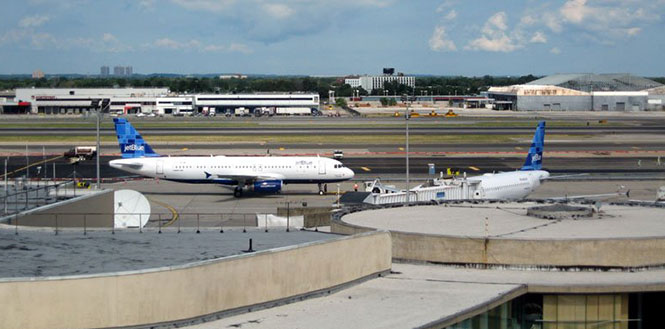
    Terminal 6 at JFK Airport. (Photo: New York Photo Gallery)
    Terminal 6 at JFK Airport. (Photo: New York Photo Gallery)

    Beginning May 2, the FAA conducted evaluations at JFK to study the effectiveness of a Federal Bureau of Investigation (FBI) UAS detection system in a commercial airport environment.  Five different rotorcraft and fixed-wing UAS participated in the evaluations, and about 40 separate tests took place.

    The JFK evaluation involved extensive government inter-agency collaboration, and cooperation from industry and academia. The tests expanded on research performed earlier this year at Atlantic City International Airport.

    In addition to the FAA and the FBI, the agencies combining forces in this research included the Department of Homeland Security (DHS), Department of Justice, Queens District Attorney’s Office and the Port Authority of New York and New Jersey. DHS and the FBI want to identify unauthorized UAS operators for law enforcement purposes, and the FAA’s mission is to provide a safe and efficient airport environment for both manned and unmanned air traffic.

    “We applaud the FBI and FAA for their efforts to detect and track unmanned aerial systems (UAS),” said Thomas Bosco, Port Authority aviation director.  “We look forward to supporting continued U.S. government efforts to identify and deploy countermeasures to neutralize the threat posed by rogue UASs.”

    The team evaluating the FBI’s detection system also included contributions from one of the six FAA-designated UAS test sites. The Griffiss International Airport test site in Rome, New York, provided expertise in planning the individual tests as well as the flight commander for the tests and two of the UAS used.

    The FY 2016 Appropriations law mandates that the FAA continue research into detection of UAS in airport environments. The agency is continuing to formulate an inter-agency strategy to evaluate detection systems in a variety of airport environments.

  • Putting UAVs to work in construction

    Putting UAVs to work in construction

    uavs-in-construction-report-coverDiversified Communications has published a free report, “Putting UAVs to Work in Construction.”

    Drones are making construction projects vastly more efficient and more safe, according to a media release from Diversified Communications.

    “While the benefits of UAV technology are clear, knowing what information to capture isn’t always obvious. Then there are the legislative challenges. This report addresses these topics, and also provides insight into:

    • How drones have changed the approach construction professionals can take in terms of gathering data.
    • The many ways UAVs are making projects safer.
    • What sort of new opportunities will be opened up by the technology.”

    Jeremiah Karpowicz, executive editor of Commercial UAV News, interviewed construction professionals from The Beck Group, Hensel Phelps and IMCO General Construction for the report, which is available via download.

  • Trackimo showcases IoT tracking devices at AUVSI’s Xponential 2016

    Trackimo, a U.S.-based IoT (Internet of Things) solution provider enabling worldwide connectivity for M2M (Machine to Machine) devices, showcases its tracking devices at the Association for Unmanned Vehicles Systems International’s Xponential show, held May 2-5 in New Orleans.

    Trackimo’s technology integrates GPS, GSM, an accelerometer and sensors that provide smart data. Cellular network signaling manages the devices and dispatches information to systems and apps.

    Trackimo covers both consumer and businesses sectors including fleet tracking and logistics management solutions, customizable and scalable IoT platform, remote gateways and consumer tracking devices.

  • Systron Donner talks SDI500 tactical grade MEMS IMU at AUVSI’s Xponential 2016

    David Hoyh of Systron Donner Inertial talks about the company’s SDI500 tactical grade MEMS IMU at the Association of Unmanned Vehicles International‘s Xpontential 2016 show, held May 2-5 in New Orleans. The company also featured its INS/GPS SDN500 for use in GPS-denied situations.

  • Draganfly highlights new handheld ground control system at AUVSI’s Xponential 2016

    Draganfly Innovations launched its new handheld Ground Control System (GCS) at the Association for Unmanned Vehicle Systems International‘s Xponential show, held May 3-5 in New Orleans.

    Ben Miller, in sales engineering for the company, talks about the system’s mission planning capability for surveying.

  • Velodyne features VLP-16 Puck mobile mapping system at AUVSI’s Xponential 2016

    Velodyne‘s Frank Bertini talks about the company’s new 3D lidar VLP-16 Puck at the Association for Unmanned Vehicle Systems International‘s Xpontential show, held May 3-5 in New Orleans.

    The sensor offers real-time data, 360-degree scanning, 3D distance and calibrated reflectivity measurements for the mapping, automotive, UAV, security and robotics markets.

  • Spirent Federal focuses on robust PNT at AUVSI’s Xponential 2016

    Paul Crampton, senior systems engineer for Spirent Federal Systems, highlights the company’s GSS9000 Constellation Simulator and GSS6425 GNSS Record and Playback Test System at the Association for Unmanned Vehicles International‘s Xponential show, which is being held May 2-5 in New Orleans.