Tag: Expert Advice

  • Expert Advice: Positioning Protocol for Next-Gen Cell Phones

    Expert Advice: Positioning Protocol for Next-Gen Cell Phones

    Lauri_Wirola
    Lauri Wirola, Nokia Services Location

    by Lauri Wirola, Nokia Services Location

    As cell phones move into the next generation called Long-Term Evolution (LTE), also sometimes called 4G, and the methods of wireless transmission change, so too must the methods of providing location information over those new wireless interfaces. LTE Positioning Protocol (LPP) and Secure User Plane Location (SUPL) 2.0 and 3.0 are the key players in this new picture.

    Cellular industry location standards first appeared in the late 1990s, with the 3rd Generation Partnership (3GPP) Radio Resource Location Services Protocol (RRLP) Technical Specification (TS) 44.031 positioning protocol for GSM networks. Today RRLP is the de facto standardized protocol to carry, for instance, GNSS assistance data to GNSS-enabled mobile devices.

    A major update of RRLP began in 2007, when RRLP Release 7 added support for assisted-Galileo, and Release 8 for the rest of the GNSS including GLONASS, modernized GPS, QZSS, and the various SBASs.

    RRLP Releases 7/8 set high expectations in terms of performance improvements. The initial idea was to go beyond the native capabilities of GNSSs to achieve tangible accuracy, time-to-first-fix (TTFF), and availability improvements. Contributors proposed introducing local ionosphere and troposphere models as well as carrier-phase-based relative positioning — in cell phones!

    However, legacy implementations, architecture limitations, and the lack of a business case hindered this development. In the end, RRLP support was limited more or less to the native assistance data types such as global Klobuchar and NeQuick models for the ionosphere. The same approach was also mapped to 3GPP TS 25.331 Radio Resource Control (RRC) protocol, which defines the positioning procedures and assistance data delivery for Universal Mobile Telecommunications System Terrestrial Radio Access (UTRA) — that is, wideband code-division multiple-access (WCDMA) and time-division synchronous CDMA networks.

    Long-Term Evolution Networks

    A fresh push for location services in 3GPP started in 2009 for LTE Release 9 technologies. LTE is sometimes called 4G, but to be precise only a further evolution of LTE, called LTE Advanced (LTE-A), will be 4G, together with WiMAX evolution 802.16m.

    The starting point for LTE location services work was to enable similar positioning capabilities in the LTE networks as are present in GSM, UTRA, and CDMA networks. This meant that there was a need to define assisted-GNSS positioning as well as introduce positioning methods, such as enhanced cell ID (ECID) and hyperbolic time-difference-of-arrival (TDOA) methods for non-GNSS devices, hybrid use, and for GNSS-denied environments. The underlying driver of all this work was the U.S. Federal Communications Commision (FCC) Wireless E911 mandate.

    LTE Location Architecture

    LTE location architecture is shown in Figure 1. The evolved serving mobile location center (E-SMLC) is the server component in charge of positioning activities. The mobility management entity (MME) gives the positioning request to E-SMLC, which then controls the user equipment (UE, the LTE device to be positioned) and, possibly, LTE base stations (eNodeBs), to perform positioning.
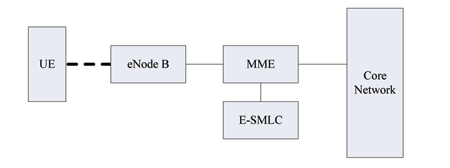
    Figure1-W
    Figure 1. Long-Term Evolution (LTE) location architecture.

    LTE Positioning Protocol. The actual positioning and assistance protocol between E-SMLC and UE is called LTE Positioning Protocol (LPP). In overview, LPP consists of three independent elementary procedures: capability exchange, assistance data exchange, and location information exchange, which refers to both measurement and position. The associated messaging is shown in Figure 2. In addition to the six message types shown, there are LPP Error and LPP Abort messages to handle abnormal situations.

    Figure 2. LPP elementary procedures and messages. In LPP terminology, “target” is the end user device to be positioned.
    Figure 2. LPP elementary procedures and messages. In LPP terminology, “target” is the end user device to be positioned.

    Figure 3 shows a sample positioning session using all the procedures. Assume that the server has received a location request for a given target (UE) and that the server can exchange messages with the UE — that is, lower protocol layers can provide the transport for the LPP-level messages. The first transaction of the location session is the capability exchange (LPP Request/Provide Capabilities). This information exchange makes the server aware of the UE positioning capabilities (GNSS support, supported cellular network measurements). Based on this information, the server can make a decision on the positioning method to be used, based on both UE capabilities and the requested quality-of-position (response time, accuracy).
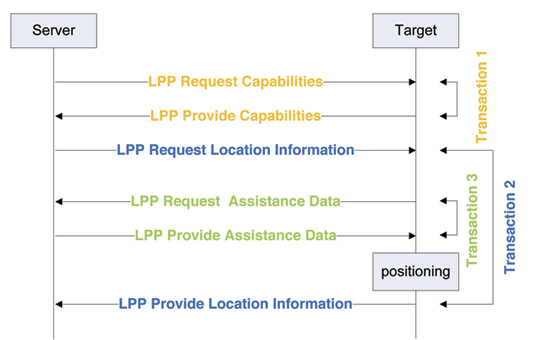
    Figure 3. Example of a typical LPP positioning session.
    Figure 3. Example of a typical LPP positioning session.

    The actual location information request is carried in LPP Request Location Information message: whether position or measurements are requested and/or allowed and, for instance, which GNSSs are allowed to be used. It also carries other reporting instructions such as periodicity and required response time.

    Having received this message, the target begins its positioning activities. In a typical scenario, this activity triggers a request for the assistance data. For instance, if the server requests the GNSS-based position, and the target does not have the latest ephemerides, the target will request those with the LPP Request/Provide Assistance Data mechanism (transaction 3). Having received the ephemerides, the target can position itself quickly, without needing the data broadcasts from the satellites, and report the location information back to the server in LPP Provide Location Information message. Other supporting information, such as reference location, reference time and ionosphere model, may also be provided to the target.

    Figures 4 and 6 summarize the contents of LPP Provide Location Information and LPP Provide Assistance Data messages, respectively, in the gray boxes. The LPP Provide Location Information contents can be roughly divided into four categories: one category for each positioning method (assisted GNSS, observed TDOA, and ECID) and one category for providing the location estimate. In the A-GNSS category, the UE, based on the server commands, either reports the raw code and carrier-phase measurements (UE-assisted mode) or information regarding the provided PVT estimate (OTDOA and ECID function only in UE-assisted mode in LPP).
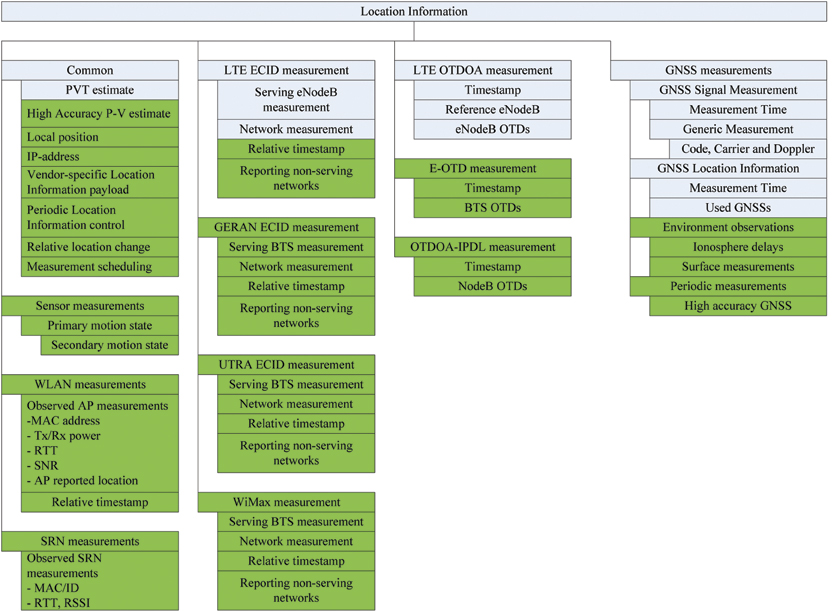
    Figure 4. LPP/LPPe Provide Location Information content. 3GPP LPP shown in gray; OMA LPP Extensions shown in green. (Click too enlarge.)
    Figure 4. LPP/LPPe Provide Location Information content. 3GPP LPP shown in gray; OMA LPP Extensions shown in green. (Click too enlarge.)

    The LPP Provide Assistance Data reflects the same structure and categorization. Similarly, to Provide Location Information message, one can see in the assistance data message GNSS-specific assistance as well as OTDOA-specific assistance. However, there is no ECID-specific assistance due to it being available only in UE-assisted fashion. For OTDOA there is assistance, but only to assist the UE in the measurement process, not for positioning purposes — for instance, eNodeB positions cannot be transferred in the assistance data.

    User Plane and Applications. RRLP, RRC, and LPP are natively control-plane positioning protocols. This means that they are transported in the inner workings of cellular networks and are practically invisible to end users. In the control pla
    ne, their main purpose is to reliably provide the emergency-call positioning capability. However, there is obviously demand for positioning services for location-based end-user applications. To address this, in 2003 the Open Mobile Alliance started to work with Secure User Plane Location (SUPL) 1.0 protocol that brings the same location capabilities to user plane (application domain) over IP-networks as RRLP/RRC/LPP bring to control plane. One design principle of SUPL was not to re-invent the wheel; thus RRLP/RRC/LPP are being re-used in the user plane domain for positioning. OMA SUPL specifies a bearer protocol that carries a 3GPP-defined positioning protocol and provides security, authentication, privacy, and charging mechanisms. SUPL 1.0 is already commercially deployed, and SUPL 2.0 is now being deployed globally.

    Figure 5 shows the OMA SUPL 2.0 protocol stack, which illustrates the re-use of 3GPP positioning protocols over IP networks. The security is provided by the standard transport layer security (TLS), and the user plane location protocol (ULP) is the wrapper for the 3GPP positioning protocols. The vast majority of SUPL 2.0 deployments will use RRLP as the positioning protocol. SUPL 3.0, currently being defined, will no longer support RRLP/RRC; LPP will gradually replace RRLP as the dominant standardized positioning protocol.
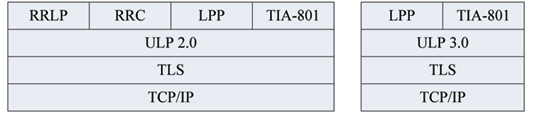
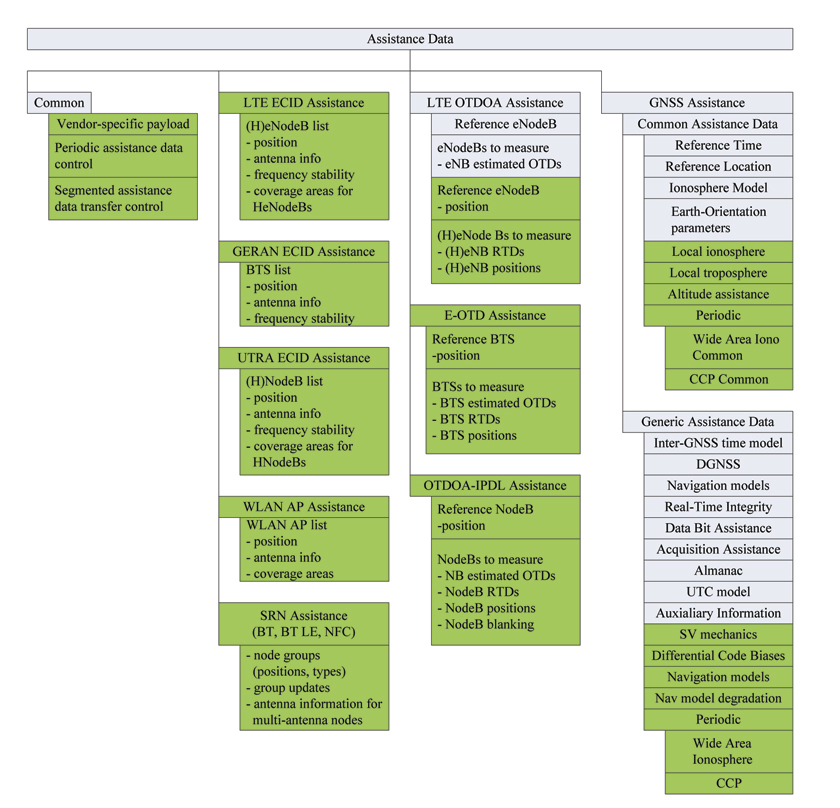
    Figure 5. OMA SUPL 2.0 and 3.0 protocol stacks. TIA-801 is the 3GPP2-defined positioning protocol for the CDMA networks. Note that ULP 1.0 (not shown) supports RRLP, RRC, and TIA-801.
    Figure 5. OMA SUPL 2.0 and 3.0 protocol stacks. TIA-801 is the 3GPP2-defined positioning protocol for the CDMA networks. Note that ULP 1.0 (not shown) supports RRLP, RRC, and TIA-801.
    Figure 6. Assistance data content of LPP and LPP Extension. 3GPP LPP shown in gray; OMA LPP Extensions shown in green. (Click too enlarge.)
    Figure 6. Assistance data content of LPP and LPP Extension. 3GPP LPP shown in gray; OMA LPP Extensions shown in green. (Click too enlarge.)

    LPP Extensions

    From the beginning, it was clear that the contents of the LPP would largely reflect that of the RRLP and would be limited to the native capabilities in the GNSS domain, and in other positioning methods to the methods strictly needed to fulfill the emergency-call positioning requirements. For example, in the GNSS domain the ionosphere models are limited to the (global) broadcast models as obtained from GPS, QZSS, and Galileo; there is no support for local ionosphere models. Other potential performance improvements including troposphere models and pressure-based altitude assistance are not in the scope of the 3GPP LPP work. Furthermore, a plethora of other positioning methods ranging from GSM- and WCDMA-based positioning (ECID, hyperbolic TDOA methods) to utilizing WLAN and short-range nodes such as Bluetooth are beyond the scope of current LPP development.

    During the LPP Release 9 work, the industry was at a crossroads. On one hand, it was known that the 3GPP-defined LPP would become the de facto standardized protocol to do basic positioning not only in the LTE control plane, but also in IP networks over SUPL 2.0 and 3.0. On the other hand, it was also known that it would lack some key features including WLAN-based positioning, which would essentially force vendors to introduce proprietary protocols to augment LPP. Further, a serious drawback for use of LPP in the IP-network domain is that it does not support GSM- and UTRA-specific positioning methods (ECID, OTDOA). Thus, LPP could not completely replace legacy positioning protocols, including RRLP.

    These considerations led to discussion of introducing extension hooks in LPP messages, so that the bodies external to 3GPP could extend the LPP feature set. In 2009, Qualcomm contributed extension containers to the LPP messages, and the way was open to start work on OMA LPP Extensions Release 1.0 in 2010.

    The mandate of the OMA LPP Extensions (LPPe) is to build on top of the 3GPP LPP, re-using its procedures and data types as far as possible. This means that the message types are fixed; new messages cannot be defined, only extensions to existing ones can be formulated. Whenever possible, OMA should re-use information elements from 3GPP LPP to avoid duplicate definitions, compatibility, and maintenance issues. LPPe is supported in SUPL 3.0, which will be the primary transport protocol of LPPe.

    Procedure Extensions. OMA LPP Extensions Release 1.0 not only defines new positioning methods and assistance data types, but also defines new procedures for improved performance. These include the following:

    ◾ Capability exchange and location-information exchange reversed mode, illustrated in Figure 7, with the LPPe Request/Provide Capabilities/Location Information messages flowing in the opposite directions as compared to Figure 2. This reversed mode is only allowed in the context of LPPe. In the context of assistance data support, capabilities in the reversed case refer to the assistance data that the server can provide, as opposed to the assistance data the target can utilize in normal mode-capability exchange.
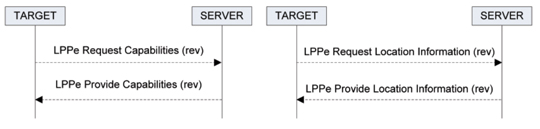
    Figure 7. LPPe reversed mode for capability and location information exchange.
    Figure 7. LPPe reversed mode for capability and location information exchange.

    The interpretation of reversed mode for location information exchange is somewhat more delicate. When the UE sends LPPe Request Location Information to the server, the UE does not request the server position, but the UE position. In the request the UE may define the quality-of-position, which then guides the positioning method selection by the server.

    • Periodic assistance data is a completely new feature to the assistance-data protocols. Periodic assistance can be used with selected assistance-data types that require updates at short intervals. Such data types include short-term real-time ionosphere correction from GNSS networks and carrier phase — assistance for high-accuracy relative positioning. The periodic assistance procedure also includes the possibility for the target and server to update the periodic session-control parameters (duration, rate of delivery) intra-session. This control is carried in the common part of the LPPe Request/Provide Assistance Data message (Figure 6).
    • Periodic location information reporting is included in 3GPP LPP, but the similar capability in the OMA LPPe is specifically designed for continuous measurements including continuous carrier-phase measurements for high-accuracy purposes. The 3GPP LPP does specify periodic measurements, but in such a way that, say, the GNSS measurement engine can be powered off between measurement deliveries, which is obviously unacceptable in the view of carrier-phase-based relative high-accuracy GNSS. The periodic location information procedure also includes the possibility for the target and server to update the periodic session-control parameters (duration, rate of delivery) intra-session. This control is carried in the common part of the LPPe Request/Provide Location Information message as shown in Figure 4.
    • Segmented assistance-data transfer procedure allows for partitioning a large assistance-data delivery into smaller segments as well as resuming such a segmented session after an active-inactive-active cycle in the LPPe session. This control is carried in the common part of the LPPe Request/Provide Assistance Data message as shown in Figure 6.
    • Measurement scheduling/windowing allows the server to request measurements (GNSS, ECID, TDOA) to be made within a certain time window that can be expressed in terms of GNSS time or cellular network time. This control is carried in the common part of the LPPe Request/Provide Location Information message as shown in Figure 4.

    Extensions. OMA LPPe introduces several enhancements for various positioning methods as well as completely new methods:

    • Additions in the A-GNSS domain include local atmosphere models. In 3GPP LPP, the models are limited to ionosphere ones and therein to the broadcast types as in GPS, Galileo, and QZSS broadcasts. The OMA LPPe introduces a localized Klobuchar model, which allows for presenting the delay corrections in the well-known Klobuchar model, but for a limited-validity area and time for more accurate delay compensation. In addition, ionosphere storm warnings can be carried to the UE at the chosen resolution. This information allows UE to deduce the reason for high measurement residuals.

    Troposphere models have not previously been in the scope of the standardized assistance protocols. The troposphere model in LPPe carries the hydrostatic and wet zenith delays, their change rates in the height dimension for approximating the zenith delays at the UE altitude, Niel mapping functions for hydrostatic and wet components, and composite spatial gradients. Alternatively, the surface meteorological parameters (pressure, temperature) can be carried to the UE, and the calculation of the troposphere delay is left for the UE.

    Another troposphere model is the altitude-pressure relationship for the UEs with a barometer. This altitude assistance increases availability by introducing an independent source of altitude information.

    Whereas the 3GPP LPP carries the ephemerides, almanacs, signals supported by the satellites, and the GLONASS frequency mappings, OMA LPPe introduces satellite mechanical informational, differential code biases, and new navigation models. The mechanical information consists of mass, effective reflectivity-area, and phase-center offsets for the in-UE orbit prediction purposes. In the navigation model domain, the additions include SP3-type orbit representation and the orbit/clock model degradation models for improved error modeling. Practically all the new assistance data types support precise-point positioning approaches for future GNSS services.

    Lastly, one of the major LPPe A-GNSS features is the continuous carrier-phase (CCP) assistance for real-time kinematic applications. The CCP data format supports straightforward mapping from RTCM 10403.1 to ensure interoperability. The LPPe CCP mechanism utilizes the LPPe-level periodic assistance data procedure and supports multiple reference stations as well as mobility, that is, changes in the set of active reference stations on-the-fly.

    • To enable the use of LPP/LPPe in all the networks, the legacy hyperbolic methods E-OTD and OTDOA-IPDL for GSM and UTRA networks, respectively, are supported, and the data content are copy/pastes from RRLP and RRC to ensure interoperability. Support for UE-based LTE OTDOA is also included.
    • A major part of LPPe specification is devoted to the various ECID methods. These cover GSM, UTRA, LTE, and WLAN networks both in UE-assisted and UE-based modes.
    • In LPPe terminology, the short-range nodes (SRNs) refer to Bluetooth, Bluetooth Low-Energy, and near-field communication (NFC) tags, which are considered separately from the primary communications networks (cellular networks and WLAN). Similarly to the ECID methods, the SRNs can be used for positioning in either UE-assisted or UE-based modes. In the UE-based mode, in which the SRN locations need to be carried to the UE, the philosophy is that the SRNs are logically arranged into groups – one group of SRNs can be the set of SRNs in one building or in one floor in the building. The assistance data is considered in the units of these groups in conjunction with the group data version that allows for handling situations, in which the arrangement of the SRNs in the building changes, and the data in the UE needs to be refreshed.
    • Finally, no single positioning and assistance protocol can address all needs. Thus, both LPPe assistance data exchange and LPPe location information exchange include black-box containers for vendors and operators to carry their own proprietary assistance data and location information in a standardized framework. The benefit of this approach is that the same standardized protocol framework used in commercial deployments can be used for rapid prototyping and providing differentiating positioning performance, without the need for defining proprietary protocols from scratch.

    Conclusion

    The framework introduced by 3GPP LPP and extended in LPPe brings long-sought convergence in the control- and user-plane positioning protocols. This ensures that in the user-plane domain, the dominant domain for positioning services in consumer LBS, vendors can utilize exactly the same protocol as in the control plane. This reduces implementation, testing, and deployments costs, and will make the LPP/LPPe the de facto standardized positioning protocol in the mobile domain.


    Lauri Wirola has a Ph.D. in electrophysics from Tampere University of Technology in Finland. He manages indoor positioning activities at Nokia Services Location.

  • Expert Advice: Why Geodesy Matters, Now More than Ever

    Expert Advice: Why Geodesy Matters, Now More than Ever

    Rizos_HiResBy Chris Rizos

    Geodesy is a suite of powerful Earth-observation techniques, associated methodologies, and analysis tools that today are making a vital contribution to science and society. Yet geodesy is not a new, child-of-technology sciaence. It dates back hundreds of years — some would claim thousands of years, and that the ancient Greeks and other pre-Christian cultures shaped its direction. This is illustrated by its classical definition as the science of measuring and mapping the geometry, orientation in space, and gravity field of the Earth; these days we also include their variations over time. At a practical level, geodetic practice forms the foundation for surveying, navigation, and mapping, and the digital datasets underpinning these activities.

    What has enabled geodesy to change from an esoteric natural science that underpins the making of maps to today’s cutting-edge geoscience? There are a number of reasons for this transformation. Firstly, modern geodesy relies on space technology, and enormous strides have been made in accuracy, resolution, and coverage due to advances in satellite sensors and an expanding portfolio of satellite missions. Secondly, geodesy can measure Earth parameters that no other remote-sensing technique can, such as the position and velocity of points on the surface of the Earth and the shape and changes of the Earth’s ocean and land surfaces, and it can map the spatial and temporal features of the gravity field.

    These geodetic parameters are in effect the “fingerprints” of many dynamic Earth phenomena, including those that we now associate with global change (due to anthropogenic as well as natural causes). The challenge is to invert the outward expressions of these global-change phenomena in order to measure and monitor over time the underlying physical causes.

    Finally, what relentlessly drives geodesy into the future is the innovative use of signals transmitted by global satellite navigatiaon systems such as GPS and GLONASS.

    Space-geodetic techniques such as GNSS, satellite, and lunar-laser ranging; very-long-baseline interferometry; Doppler orbitography and radiopositioning integrated by satellite (DORIS); satellite sea and ice altimetry; satellite gravity mapping; and satellite interferometric synthetic aperture radar mapping have revolutionized the geosciences. They have significantly improved our understanding of how the solid Earth, atmosphere, and oceans work as a system, giving us new insights into atmospheric and oceanic circulation, the global water cycle, the waxing and waning of ice and glaciers, sea-level rise, global tectonic motion and local earthquake fault mechanisms, to name a few of geodesy’s Earth-observation applications.

    Global Geodetic Observing System. GNSS today plays a crucial role in geodesy; however, we will see a massive increase in capability. Geodesy strives to increase the level of accuracy in the determination of these geodetic parameters by a factor of 10 over the next decade.

    The Global Geodetic Observing System (GGOS) is an important component of the International Association of Geodesy (IAG). GGOS will integrate all geodetic measurements in order to monitor the phenomena and processes within the Earth system at far higher fidelity than at present. This integration implies the inclusion of all relevant information for parameter estimation, the combination of geometric and gravimetric data, and the common estimation of all the necessary parameters representing the solid Earth, the hydrosphere (including oceans, ice caps, continental water), and the atmosphere. GGOS is geodesy’s contribution to the Global Earth Observing System of Systems (GEOSS) initiative.

    Although GPS is popularly associated with the WGS84 datum, an important GNSS contribution to geodesy is its role in the definition of the International Terrestrial Reference Frame (ITRF, itrf.ensg.ign.fr). In addition, high-accuracy differential GNSS techniques — which have been refined over several decades — provide the day-to-day means of determining point coordinates in the ITRF. This reference frame is nowadays the basis for most national and regional datums for mapping and science.

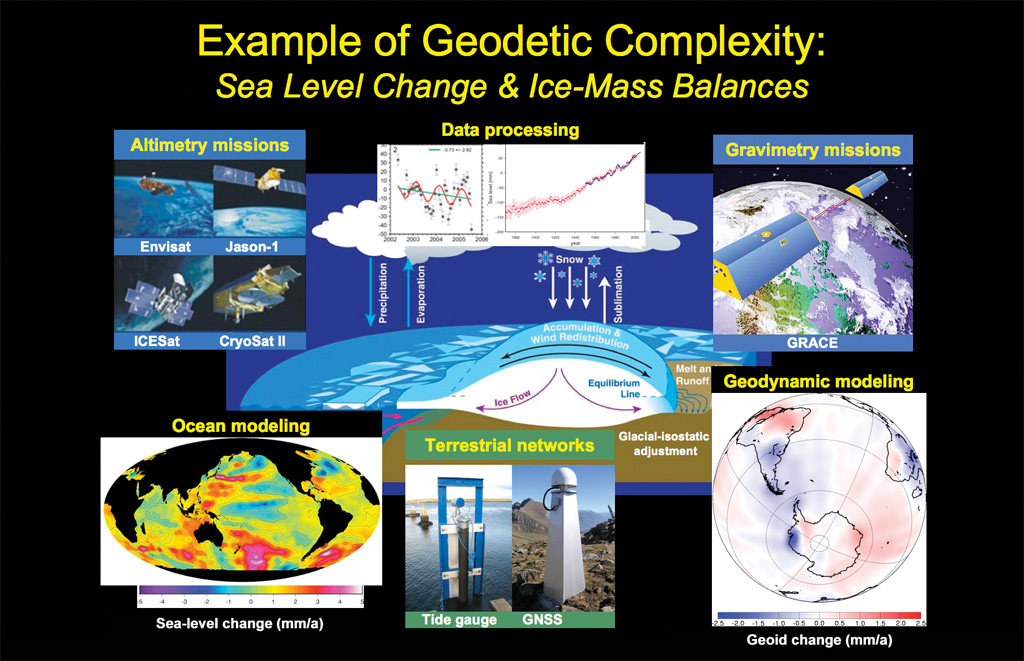
    slide_sealevelchange
    Photo: GNSS

    The International GNSS Service (IGS, igs.org) was established in 1994 as an IAG service to the geosciences, providing high-accuracy orbit and clock products as well as open (and free) access to measurements made by a dense ground network of continuously operating GPS/GNSS tracking stations. The IGS therefore supports ITRF maintenance and densification. The IGS nowadays supports many more user communities, such as navigation, surveying, machine guidance, atmospheric remote sensing, and others, both directly and indirectly.

    GNSS’s utility includes the role that it plays in precise orbit determination of Earth observation, geodetic, and environmental satellites. GPS receivers onboard almost all such satellites ensure that the data from the satellite sensors can be correctly processed and interpreted. Consider how sea-level rise is measured by satellite-borne radar altimeters. The measurement of the time taken for a radar pulse from satellite to the ocean surface and back is made by the altimeter and converted to distance, but it is knowing where the satellite is in three dimensions to centimeter accuracy that allows the ocean surface to be mapped to extraordinary resolution. Millions of such measurements, over many years, referenced to the ultra-stable ITRF, enable scientists to determine with confidence the 3D position of a grid of points on the ocean surface and its rate of change, not just as a single average rise in sea height, but in its full spatial complexity.

    The Challenge. Can GNSS and the IGS rise to the GGOS challenge? Although GPS is currently the only fully operational GNSS, the Russian Federation’s GLONASS is being replenished, and the IGS currently also generates GLONASS products. The European Union’s Galileo is planned to be deployed and operational by 2014 (although that date may slip several years), and China’s Compass is likely to also join the club by 2020, after first deploying a regional navigation satellite system by 2012. Together with dozens more satellites from other countries and agencies, it is likely that the number of GNSS satellites useful for geodesy will increase to almost 150, with perhaps six times the number of broadcast signals on which geodetic measurements can be made.

    Simultaneously, the IGS is evolving to a multi-GNSS service, and at the same time improving the quality and timeliness of its products. Real-time IGS products will soon be available to all users.

    In summary, geodesy faces an increasing demand from science, engineering applications, the Earth-observation community, and society at large for improved accuracy, reliability and access to geodetic services, measurements, and products. Thus, geodesy must maintain the ITRF at the level that allows, for example, the determination of global sea-level change at the sub-millimeter per year level; determination of the glacio-isostatic adjustments due to deglaciation since the last glacial maximum and to modern mass change of the ice sheets, at millimeter-level accuracy; pre-, co-, and post-seismic displacement fields associated with large earthquakes at the sub-centimeter accuracy level; early warnings for tsunamis, landslides, earthquakes, and volcanic eruptions; millimeter- to centimeter-level deformation and structural monitoring; and more.

    In response, the IAG established in 2007 the GGOS, to unify all the geometric
    and gravity services of the IAG so as to support the ambitious goals of modern geodesy. Through the IGS, GNSS will play an indispensible role in GGOS. However, the Earth-observing techniques of modern geodesy are but one — albeit under-appreciated — set of applications of GNSS technology. As GNSS performance improves, and as it becomes more and more pervasive, our society’s reliance on this critical utility grows exponentially.


    CHRIS RIZOS is professor and head of the School of Surveying & Spatial Information Systems, University of New South Wales, Sydney, Australia. He is vice president of the International Association of Geodesy. He will assume the presidency from mid-2011 for a four-year term.

  • Expert Advice: The Strategic Significance of Compass

    Scott Pace.
    Scott Pace

    By Scott Pace

    On November 1, 2010, China’s state news agency reported that the sixth Compass satellite was launched from the Xichang Satellite Launch Center. This was the fourth Compass satellite put into orbit this year, following launches in January, June, and August. Joining the United States, Russia, and the European Union, China is deploying is own global navigation satellite system of five geosynchronous satellites, 27 in medium Earth orbit (MEO) and three in highly inclined geosynchronous orbits (IGSO).

    Sometimes referred to as Beidou-2, Compass is a global RNSS (radio-navigation satellite system) that broadcasts one-way precision time signals to enable receivers to calculate their position. An earlier Chinese satellite navigation system, Beidou-1, was an RDSS (radio-determination satellite system) that provided regional coverage and required two satellites to get a position fix using two-way communications with a centralized ground station.

    Like the U.S. GPS and the European Galileo system, signals from Compass use the CDMA (code-division multiple access) channel access method as distinct from the FDMA (frequency-division multiple access) method used by GLONASS. CDMA enables more precise positioning as compared to FDMA, and GLONASS is planning to shift to CDMA for its future satellites.

    Compass is designed to operate on three primary L-band frequencies:

    • 1559.052–1591.788 MHz,
    • 1166.22–1217.37 MHz,
    • 1250.618-1286.423 MHz

    while offering both an open service and an authorized service. The latter is expected to require cryptographic keys for access and will be reserved for military and public safety-related uses. Compass is intended to provide service to the Asia-Pacific region sometime in 2012 and to attain global-service levels around 2020.

    Reasons for Compass

    The Russian GLONASS was developed to support the Soviet Navy, and the U.S. GPS arose from the merger of previously separate Air Force and Navy satellite navigation efforts. China began researching satellite navigation and positioning technologies in the 1960s, but it was not until 1983 that a plan for satellite navigation and positioning system was developed. The “Double Star Rapid Positioning System” was the basis for the Beidou-1 two-satellite RDSS system that was formally approved for development in 1994. The impetus for the Compass systems is not fully known, but press reports attribute it to military requirements for more accurate missile targeting.

    The Chinese were close observers of the role of GPS in the first Gulf War. Chinese writings on military doctrine began to talk of “war under informationalized conditions” and how information from space-based systems such as GPS was changing the nature of modern warfare. Exploiting these new information sources required not just space capabilities but changes in how military forces were organized, trained, and equipped.

    Chinese security interests encompass not only China itself and nearby areas, but also the sea lanes that enable the import of raw materials and export of finished goods. In recent years, China has shown an increasing interest in “maritime domain awareness,” in which satellite navigation is used for monitoring the transit of ships in the Indian Ocean (for example, oil from the Middle East) and the South China Sea (minerals from Australia, fishing zones). Satellite navigation is a dual-use, commercial and military, interest for China, and this may have prompted support for the more advanced, independent GNSS that would become Beidou-2 or Compass.

    Regardless of the cause, People’s Liberation Army officials have said that China needs it own satellite positioning system to ensure its ability to conduct independent military actions. The later 1990s saw continued Beidou-1 satellite deployments while design of the newer Beidou-2/Compass satellites began. China joined the Galileo consortium in 2003 but abandoned it in 2006 in dissatisfaction over access to technology and work share arrangements. Efforts on Compass accelerated, and the first experimental satellite of the new system was launched in 2007.

    In a September 2010 interview with Chinese press, Duan Zhaoyu, vice president of BDStar Navigation, said that there are currently more than 20,000 civilian users of the Beidou-1 navigation system, 60 percent of whom use products from his company. More than 10,000 of these users are fishermen in the South China Sea. Not surprisingly, the Chinese government and military constituted the majority of users as it was also reported that as of August 2009, there were only 60,000 Beidou users in total. The number of registered terminal users amounted to only 1 percent of the system’s capacity, leaving the satellite resource seriously under-used.

    The underutilization of Beidou-1 is both a challenge and an opportunity for the Compass system in both domestic and international applications. The designer of the first Chinese satellites and current Beidou chief designer, Sun Jiadong has stressed the importance of actual utilization in arguing that “satellites in the sky should be coordinated with ground applications” and “pushing China’s Beidou satellite navigation system to bring as much economic and social benefit as early and as quickly as possible.” In order to do this, “…the state should promulgate corresponding policies, regulations, and systems as soon as possible to support development of the new satellite navigation application industry. It should guide, encourage, and attract even more Chinese enterprises and public institutions to actively participate in the construction of an industrial chain for ground applications.”

    Internationally, China has stressed cooperation with other GNSS systems. At the June 2010 meeting of the Asia-Pacific Economic Cooperation (APEC) organization, the Chinese presentation said that Beidou-2 (Compass) would “provide high-quality open services free of charge from direct users, and worldwide use of Beidou is encouraged,” and that Beidou-2 will “pursue solutions to realize compatibility and interoperability with other satellite navigation systems.”

    While satellite deployments have been accelerating, there continue to be delays in the public release of interface control documents (ICD) for incorporating Compass signals into GNSS receivers. The technical preparation of Beidou-2 Signal-in-Space ICD (version 1.0) has reportedly been finished but has not yet been posted on the Chinese government website for the program at www.beidou.gov.cn. In October 2009, Cao Chong, the director of the consulting center at the China Technical Application Association for Global Positioning System, gave a speech at Stanford University where he said that English and Chinese versions of the ICD have already been completed. But their release had been postponed due to pressure from domestic companies in China.

    The point of an open ICD, as done with GPS, is that as soon as it is released, anyone can use it on an equal basis. Reported opposition from Chinese companies seeking to gain a head start on foreign competitors would seem to indicate a domestic misperception of RNSS systems and an internal contradiction in Chinese policy toward Compass. Like other RNSS systems, Compass does not use a two-way signal for which direct users fees can be easily assessed; thus the idea of “head start” is illusionary. The necessary technologies for RNSS receivers are all found in consumer electronics and software — areas in which C
    hina is already capable.

    In addition, efforts to discourage or delay foreign adoption of Compass signals poses the risk of the system being of limited relevance to global markets, as is the situation of Beidou-1 today. This is contrary to the stated intent of the Chinese government that Compass be a world-class GNSS system.

    ITU System Coordination

    A primary concern of all GNSS users and operators is compatibility, that is, the ability of multiple satellite navigation systems to co-exist in the same international spectrum allocations without causing harmful interference to any individual service or signal. The signals may or may not be interoperable but they should not harm each other. In the case of Compass, its signals do overlap some Galileo frequencies, particularly with respect to the Galileo Publicly Regulated Service (PRS) and to a lesser extent the edges of the GPS M-Code that is used exclusively for defense purposes. In general, however, Compass signals do not overlap the GPS or GLONASS frequencies. Informal Chinese comments suggest that they consider GPS and GLONASS to be well-established “legacy” systems that new arrivals should seek to avoid overlapping. On the other hand, Galileo and Compass are seen as having equal standing as new RNSS systems within the terms of the International Telecommunications Union (ITU).

    Chinese presentations have identified several Compass signals that would overlap those of other GNSS providers. These include the Compass B1 at 1575.42 MHz with the GPS L1 signal, B2a at 1176.45 MHz with the GPS L5 signal, and B2b at 1207.14 MHz with the Galileo E5b signal. The Chinese believe that “the frequency spectrum overlap of open signals is beneficial for the realization of interoperability for many applications” and makes it easier to develop and manufacture interoperable receivers. While these claims are true to a point, GNSS providers experiencing the overlap may not agree.

    Even if signals do not experience harmful interference from an overlap, the signal provider may suffer constraints on its ability to control the service it provides to specific users, as in public safety or military applications. The long negotiations between the United States and the European Union over Galileo proposals to overlay major portions of the GPS M-Code eventually resulted in the 2004 US-EU Agreement on GPS-Galileo Cooperation. More recently, the European Union has raised its concerns with China’s plans to overlay Compass signals on the Galileo signals used for the PRS service.

    Within the ITU, RNSS operators (which includes the GNSS system providers) engage in direct coordination under what is known as a Resolution 609 process. This process was adopted at the 2003 World Radiocommunication Conference in Geneva, Switzerland and calls for “Consultation Meetings between administrations operating or planning to operate systems in the aeronautical radionavigation service (ARNS) and systems in the radionavigation satellite service (RNSS) in the 1164–1215 MHz frequency band.” It should be noted that the resolution does not encompass all GNSS signals, but does focuses on those at the GPS L5, Galileo E5, and Compass B2. The most recent meeting was the 7th Consultation Meeting of Resolution 609, June 23–25, 2010 in Toulouse, France.

    EPFD Levels. As the Resolution 609 process has continued, calculations of aggregate, equivalent power flux density levels (epfd) show that levels from filed RNSS systems (some operational, some planned) are nearing the allowable maximum aggregate epfd level. This level is specified in Resolution 609 itself, as revised at the last World Radiocommunications Conference (WRC-07). The United States position is that it is important to discuss methods to ensure that this limit is not in fact exceeded.

    The Toulouse Consultation Meeting discussed three potential methods to achieve this important objective:

    • use of actual operational characteristics (for example, maximum operational power levels, instead of filed parameters);
    • use of the actual number of satellites in orbit, instead of the filed number; and
    • technical revisions to the epfd calculation methodology (per ITU-R Recommendation M.1642-2).

    The meeting also considered proposals in the case where calculations show the aggregate epfd level would be exceeded, to perform a second aggregate epfd calculation including only satellites that are in actual operation, or are planned to be in operation before the next Resolution 609 Consultation Meeting is scheduled to occur (that is, within the next 12 to 16 months). The point of the second calculation would determine that epfd actually being produced from RNSS satellites in the 1164–1215 MHz band will not in fact exceed the allowable epfd limit.

    In addition to the Resolution 609 multilateral meetings, the United States and China have also engaged in five operator-to-operator coordination meetings under ITU auspices from 2007–2010. The United States has also offered the possibility of direct bilateral talks with China on GNSS services and applications — as was done with Japan, Russia, and the European Union.

    Europe similarly has sought to have direct talks with China to coordinate their concerns over Compass-Galileo. There have been at least six meetings on frequency compatibility and interoperability during 2007–2010, alternating between Beijing and Brussels. While both sides continue to express support for compatibility and even interoperability, the European side continues to oppose Compass overlays of the Galileo PRS while China shows no indication of being willing to change its frequency plans.

    Finally, with respect to Russia, a Beidou-GLONASS frequency compatibility meeting was held in Moscow in January 2007, but there seems to have been little follow-up. Given the lack of overlap between the frequencies used by the two systems, this is not surprising.

    International GNSS Coordination

    Compass is represented in broader GNSS coordination activities, not just those involving the ITU. The most important of these is the International Committee on GNSS (ICG) that was established in 2005 as an outgrowth of the United Nations Committee on the Peaceful Uses of Outer Space (COPUOS). The most recent, and fifth, meeting of the ICG was held in October 2010 in Turin, Italy.

    The purpose of the ICG is to “promote the use of GNSS infrastructure on a global basis and to facilitate exchange of information.” Through meetings of the ICG, GNSS providers have adopted various principles such as transparency for open services, that is, every provider should publish documentation that describes signal and system information, policies of provision, and minimum levels of performance for its open services.

    On a regional basis, China participates in the APEC GNSS Implementation Team. This team was established by the APEC Transportation Working Group in 2000 with a mission of promoting regional GNSS augmentation systems to enhance inter-modal transportation. The United States hosted the 14th APEC GIT meeting this past June in Seattle, Washinmgton; the next meeting is tentatively scheduled for Brisbane, Australia, in May 2011. The significance of the APEC meetings on GNSS is their recognition of the value of such systems to states at greatly varying levels of development, not just the providers of GNSS or major GNSS augmentations. Although the group has a transportation focus, the productivity, safety, and environmental benefits of GNSS uses provide an incentive for common efforts across the Asia-Pacific region.

    In addition, the group calls for cooperating with non-APEC organizations (such as the ITU) as necessary to provide for seamless implementation.

    Strategic Significance of Compass

    Unlike Galileo, Compass is not a multinational cooperative program nor did it ever consider being a public-private partnership. Like GPS and GLONASS, Compass was created as an independent strategic effort by
    a national government for military and economic benefits.

    Unlike the history of GPS and GLONASS, however, the Chinese government from the beginning recognized the dual-use nature of Compass signals. Like GPS today, Compass plans to deploy CDMA signals at multiple frequencies to support a full range of application, from transportation to precision positioning and timing.

    Like Galileo, Compass still has to demonstrate that its signals are stable, operationally reliable, and accurately represented by published interface control documents to attract manufacturers to build the capability into their products. Galileo, Compass, and GLONASS all have the challenge of meeting the expectation of the existing installed base of billions of GPS users — whether or not they know they are reliant on GPS.

    The technical management of Compass is clearer than its policy management. Compass and Beidou-1 are the responsibility of the China Aerospace Science and Technology Corporation (CASC), the administrative holding company for the China Academy of Spaceflight Technology (CAST), the primary state-owned contractor for the Chinese space program. The military plays a large role in all Chinese space activities, and in recent years there has been uncertainty as to who is the government policy leader for space. In particular, the role of the China National Space Agency (CNSA) appears to have diminished in recent years. CNSA leaders scheduled to speak at major international conferences, such as the International Astronautical Federation, have cancelled at the last minute, while PLA speakers have presented instead.

    When U.S. President Barack Obama and China’s President Hu Jintao met in Beijing in 2009, their joint summit statement included a call for the NASA administrator to meet with an unspecified Chinese counterpart. Some of this may be coincidence due to other time demands such as launch schedules, but the Chinese decision-making hierarchy for space remains as opaque as it does in so many other areas.

    The opaqueness of Chinese political decision-making prompts speculation as to what China’s long-term strategic intent is with respect to Compass. The advent of open Compass signals would be potentially positive for the current installed base of GPS users — providing interoperable signals that improved the availability of positioning solutions. Internationally, the Chinese presence helps secure the international use of the RNSS spectrum and could be a potential ally in suppressing commercial sales of GNSS jamming devices — some of which are manufactured in China today. The view from Russia with respect to GLONASS is likely to be similar to that of GPS; Compass is largely a complementary system.

    From a European perspective, however, Compass is more problematic, both technically and commercially. The signal overlay on the Galileo PRS is a potential complication for Europe being able to deny PRS access in times of emergency.

    Perhaps more importantly, the rapid pace of Compass satellite deployments means that Compass may reach an initially operational capability sooner than Galileo. This is highly probable for coverage in Asia and increasingly likely on a global basis as Galileo faces criticism over cost increases and schedule delays. While Galileo has published an open service ICD and China has not, it would be a simple matter for China to time the release of an official Compass ICD one product cycle (that is, 18 months) before the 2012 completion of Asia-Pacific coverage. This would make Compass potentially very attractive to manufacturers looking to decide what would be of most benefit to the existing installed base.

    In general, China pursues its space activities as part of broad approach to what might be termed “comprehensive national power” to include military power, economic power, diplomatic influence, scientific and technological capabilities, and even political and cultural unity. This need not necessarily mean that such power will be used for aggressive purposes.

    If China’s strategic intent is to ensure its own independence and a place at the global table, then it is possible that Compass will not be harmful to U.S. interests. This outcome will depend on whether China continues to work with the international community in forums such as the ITU, the ICG, APEC, and so on, maintains open markets, and does not use Compass in military efforts to force changes in the status quo regarding Taiwan, the South China Sea, or the Indian Ocean.

    Since China’s strategic intentions are unclear, it makes sense for the United States to seek bilateral discussions with China on Compass and to maintain a close strategic dialog with other countries in the region, notably Japan, Australia, Korea, Russia, and India. These countries are not only militarily and economically important, but also have their own GNSS-related systems and equities to consider.

    The choices for China are whether Compass will be part of its “peaceful rise” and will serve truly national interests. Those interests could be seen as harnessing the kinds of dramatic IT productivity benefits other economies have seen in GNSS applications — enhanced by open, market-driven innovation and competition.

    Alternatively, it is possible to imagine China closing off its domestic market, protecting domestic state-owned enterprises, and focusing on the space and military aspects of Compass rather than market-driven civil and commercial applications.

    The question for Chinese leaders is whether they should measure the success of Compass just by the success of Chinese firms at home or by the global acceptance of Compass as a reliable brand name for GNSS services and signals.

    Compass is like China itself, where there are both great promise and some concerns. The signs to date for Compass are positive and will hopefully continue on the path of engagement and cooperation. The United States and the global GPS community should continue to encourage those positive signs in working with China, commercially, diplomatically, scientifically, and (perhaps especially) with more direct military-to-military contacts. All of these efforts can increase the chances that China will join the United States as another good steward of GNSS.


    SCOTT PACE is the director of the Space Policy Institute and a professor at George Washington University’s Elliott School of International Affairs. His research interests include civil, commercial, and national security space policy. From 2005–2008, he served as the associate administrator for program analysis and evaluation at NASA. Previously, he was the assistant director for space and aeronautics in the White House Office of Science and Technology Policy.

  • Expert Advice: Block IIR Lifetimes and GPS Sustainment

     Willard Marquis (left) and J. David Riggs
    Willard Marquis (left) and J. David Riggs

    In 2009, a Government Accountability Office (GAO) report claimed that the GPS constellation was extremely vulnerable to failure, and a recent September 2010 GAO follow-up continues to make that assertion. In this article, we present the technical data to contradict some of the GAO report conclusions.

    Fifty-nine GPS space vehicles (SVs) have been put into orbit since 1978. From 1997 to 2009, 13 IIR and eight IIR-M SVs were launched to replenish the GPS constellation, and eight Block II SVs and four Block IIA SVs were deactivated. Three other SVs were put into spare status, meaning that the navigation signal is not currently in use, it has no pseudo-random number (PRN) assigned, but some future capability may still remain if that SV is required. This has led to a robustly populated, but increasingly old, GPS constellation.

    A robust constellation is important in many ways. An increased number of SVs provides higher likelihood of an available signal for the user. The greater the number of available satellites visible in the sky at a particular time reduces the measure called dilution of precision (DOP). DOP feeds directly into the accuracy equation such that accuracy improves (reduces) as DOP is reduced with better SV availability and sky geometry. Since Full Operational Capability (FOC) in 1995, the constellation size has grown from the minimum required 24 SVs to a very full constellation of 31 SVs plus a few spares.

    GAO Report

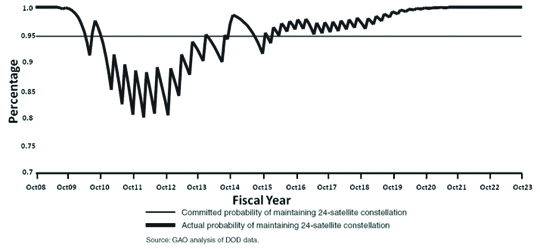
    The April 2009 GAO report focused on the most conservative (that is, pessimistic) predictions, including the so-called cliff of multiple, nearly simultaneous SV failures. Figure 1 shows the most pessimistic curve of likelihood of GPS constellation outages, 2010–2013. The report states “[I]n 2010, as old satellites begin to fail, the overall GPS constellation will fall below the number of satellites required to provide the level of GPS service that the U.S. government commits to.” The analysis in the body of the report clarifies that this refers to fiscal year 2010, ending in September 2010. In fact, as this magazine goes to press, there is virtually no likelihood of a sudden collapse of GPS service. There will not be an end-of-the-world loss of 10 SVs in a single year.

    ▲ Figure 1. GAO failure analysis: “Probability of Maintaining a constellation of at least 24 GPS satellites” — an overly pessimistic view.
    Figure 1. GAO failure analysis: “Probability of Maintaining a constellation of at least 24 GPS satellites” — an overly pessimistic view.

    The warnings of the GAO report are not new to the United States Air Force. The USAF, in particular, Air Force Space Command (AFSPC), has been concerned with constellation sustainment and has managed this issue for many years. AFSPC acknowledged the potential for an availability gap years ago. This was part of the reason for changing Block IIR SVs from launch-on-schedule to launch-on-demand back when they were first being launched. This led to a 13-year launch span for IIR instead of just five years.

    Causes of Satellite Failure

    The primary reasons for final failure of GPS satellites have varied widely. An early cause on a few Block Is was failure of the last of three atomic frequency standards (AFS). Indeed, the older designs of the rubidium AFS on GPS Block I, Block II, and Block IIA SVs have had a noticeably shorter life span (1–4 years) compared to the cesium AFS added to later Block I SVs, which became the clocks of choice on Block II and IIA.

    The myth persists today that GPS SVs, regardless of block number, ultimately fail due to the on-board clock. The facts show that only nine of 24 older SVs experienced final failure due to AFS failure. It may be the most common single cause of final failure to date, but it applies to less than half of the SVs. It is not likely that clock failure will be so prominent for newer SV blocks.

    Thus, a culture change was required once Lockheed Martin and its navigation payload subcontractor, ITT, were unable to find a space-qualified cesium AFS for Block IIR and chose to have just three next-generation Rubidium Atomic Frequency Standards (RAFS) on each SV. It was feared that the IIR SVs would only operate for a few years, but it turns out that many on-orbit IIR RAFS will remain unused, as they evidence an extremely long and accurate life.

    Solar array failure was the final failure mode on only three Block I SVs and no other GPS SVs to date. Solar arrays in medium-Earth orbit degrade in a substantially different manner than those placed in low orbit or geosynchronous altitudes. This may be from contamination, or from the severe radiation environment. Several degradation models have been developed for the GPS orbit. This has led to strengthened specifications to assure adequate power on later-model GPS satellites. In fact, both IIR and IIR-M show no SV life limitations to date due to solar array degradation. Power limitations due to degraded solar array performance have forced a change in SV operations for a few older Block II and IIA SVs, but they have maintained the navigation mission.

    Thus, the GAO report states the issue incorrectly: “[E]xcluding random failures, the operational life of a GPS satellite tends to be limited by the amount of power that its solar arrays can produce.” The evidence concludes just the opposite.

    Reaction wheels (used to gently control SV pointing attitude) have been the cause of eight of 24 final failures. Early reaction-wheel designs on older GPS SVs contained inadequate lubricant for the pre-launch storage and on-orbit life of the SV. This led to premature failure of one or more of the four wheels. Several SVs had to be monitored closely for several years in three-wheel or even two-wheel mode. Two Block I and six Block II SVs were deactivated due to wheel failure. Again, newer SVs have applied lessons learned to ensure robust wheel life.

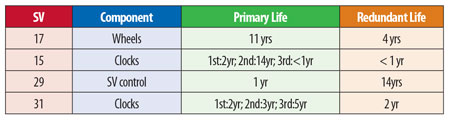
    “One component [away] from total failure,” a commonly cited cause for concern, primarily indicates that the designed redundancy on the SV is being employed. Many SVs operate for many years on the redundant component. It does not signify the navigation mission will fail tomorrow. See Table 1.

    Table 1. Years on primary versus redundant component.
    Table 1. Years on primary versus redundant component.

    The list is not comprehensive, but shows a few examples of primary component and redundant component life at the time of final failure of that redundant component. Sometimes the redundant components show significant life when taking over for the primary components, sometimes they do not. In fact, SVN-24 has been single-string for more than 10 years. It has been on the watch list for replacement for almost that long. Though no longer in a primary slot, it continues to provide a valued navigation signal to the users.

    Mean Mission Duration

    Mean mission duration (MMD) specifies and measures the longevity of an SV in on-orbit operation. The strict definition of MMD is the area under the probability of success curve (the reliability curve), integrating from time zero (launch) up to the contractual design life (also called mission durat
    ion). It is the initial pre-launch estimate of how long the SV is expected to survive, given that it fails completely at its design life. MMD is usually imposed as a requirement on the SV design, guiding parts selection, systems design, SV assembly, and pre-launch test to ensure that the SV is robust and will provide service for many years.

    Once the SVs for that build are all launched, MMD has less value. Over time, the MMD requirement must be shown to have been met on-orbit, but it is not a good number to estimate how long a specific SV will actually last. Several years ago, Aerospace realized that the MMD was too conservative to use as an on-orbit lifetime estimate. In recent years, another measure called the Mean Life Estimate (MLE) has attempted to better define the SV longevity that can be expected.

    Mean Life Estimate. MLE attempts to incorporate the actual projected end-of-life into the reliability calculations, where end-of-life is based on consumables and/or component wearout, such as solar array power degradation. On GPS III, assemblies that potentially have a life limit must be life tested to 2X design life. This almost guarantees that they will live beyond design life. MLE was proposed as a method of improving the estimate of how long the SV will survive. These calculations typically use a normal (Gaussian) distribution with a mean and sigma to predict when individual assemblies wear out. A Monte Carlo simulation then calculates the life of each assembly and the probabilistic loss of the same component due to random failure. The shortest of these times represents the failure time for the assembly for that specific simulated mission. The average of all these runs produces the composite curve for the vehicle that considers real wearout limits for each assembly.

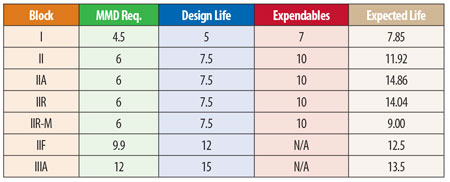
    Thus, MMD estimates should be limited to prelaunch estimates that are based on the contractual design life. After launch, any adjustments to lifetime limits or wearout life should employ MLE. Table 2 lists the MMD requirement, design life, and current life estimate (MLE, when available) for all GPS versions to date.

    Table 2. GPS SV life requirements and prediction.
    Table 2. GPS SV life requirements and prediction.

    II and IIR Lifetime

    GPS Block II SVs have exceeded all MMD and lifetime requirements with one exception. With several SVs still on-orbit, GPS Block IIA SVs have already exceeded all MMD and lifetime requirements, with one exception.

    All 13 Block IIR SVs have been launched. To date, no on-orbit IIR SVs have been disposed due to final failure. The oldest Block IIR SV, SVN-43, is now more than 13 years old. The youngest, SVN61, is almost six years old.

    The lifetime prediction of the IIR SVs has been examined, incorporating component failures into the reliability prediction. The original MMD requirement was specified at six years, with a design life of 7.5 years and an expendables life of 10 years. Analysis suggests that the GPS Block IIR SVs will exceed all MMD and lifetime requirements.

    When analyzed for an expected 15-year lifetime, the current IIR MLE exceeds 14 years. This incorporates all the on-orbit failures experienced to date. As of this writing, there have only been a few failures resulting in components being reconfigured to the redundant sides. Only one of these has been for a RAFS. Thus, 35 RAFS clocks remain on 12 IIR SVs. This bodes well for IIR lifetime: clocks will not be a life-limiting item.

    So far, only two IIR SVs have experienced reaction-wheel assembly (RWA) problems. These issues were of an electrical nature as opposed to the lubrication issues on earlier vehicles. The wheels stuck when transitioning through null regions while reversing spin direction. Subsequently, these wheels have been revived through a software modification. A patch to the bus computer software enabled recovery of the stuck RWAs. Thus, there was no loss of reaction wheel redundancy on these SVs.

    For IIR, excluding random failures, current evidence suggests the most likely life-limiting item will be battery capacity, or the combination of battery capacity and solar-array output power. This limitation of IIR SV life will not occur any time soon. During eclipse seasons — twice per year with the GPS orbit — solar arrays must support normal vehicle power requirements, in addition to fully recharging the batteries prior to entering the next eclipse. Though estimating future battery performance is difficult, recent studies conclude an expected battery life of up to 18.5 years for IIR and 12 years for IIR-M.

    The IIR robust lifetime comes from following military standards, employing tight limits on parts selection, and executing a thorough testing program.

    IIR-M Lifetime

    All eight Block IIR-M SVs have been launched. To date, no IIR-M SVs have been disposed due to final failure. The oldest is SVN-53 at just over five years of age; the youngest is the recently launched SVN-50 at just over one year. SVN-49, on orbit, awaits being set healthy to users. Optimism remains that it will eventually have a long successful life serving the user community.

    IIR-M MMD, design life, and expendables requirements are the same as for IIR SVs. However, the life longevity is expected to be shorter than IIR due to the higher transmitter power requirements on IIR-M for the new modernized signals and the associated higher electrical power demands and thermal profile. Analysis (summarized in the next section) suggests that the GPS Block IIR-M SVs will exceed all MMD and lifetime requirements. The IIR-M expected life (MLE) exceeds nine years when analyzed for a 10-year lifetime.

    IIR Special Study Results

    Three recent studies have shown increased lifetime prediction for Block IIR: the Limited Life Components Analysis (LLCA) study, conducted with the Aerospace Corporation, the Power Consumption study, and the updated IIR Reliability analysis.

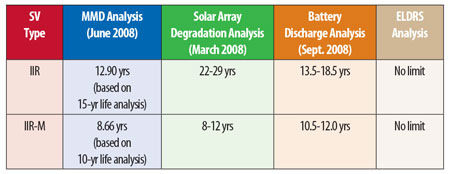
    The 2007–2008 LLCA sought to determine possible areas that might limit the maximum life of the vehicle. It analyzed solar array degradation, battery charging capacity degradation, orbital environment degradation of certain transistors in the RAFS units, and the general reliability analysis of the IIR and IIR-M as expressed in the MLE. Table 3 summarizes study results.

    Table 3. LLCA study results.
    Table 3. LLCA study results.

    There was no issue with environmental radiation due to the shielding on select transistors within the RAFS. The solar-array degradation model tracks well, with the trend showing adequate power supply for 15–20 years, and battery capacity still exceeds the expected SV reliability.

    Enhanced Low-Dose Radiation Sensitivity (ELDRS) is a concern for the degradation of certain types of transistors when held in an unpowered state on-orbit. This situation has been suspected for GPS Block IIA AFS units when they are not powered on for many years in the severe radiation of the MEO environment. Redundant AFS (2–3 per GPS SV) are kept in an unpowered condition until required to replace the primary unit. The ELDRS analysis performed in this study showed no vulnerability of the IIR RAFS to this degradation due to the presence
    of adequate radiation shielding in the unit.

    Another limiting factor examined during the LLCA study focused on battery degradation. The study developed a degradation model showing adequate battery performance margin for the SV life. But it is acknowledged that the IIR low-level trickle charge rate employed during the non-eclipse portion of the year may heat the battery cells somewhat more than optimal. It would be preferred to cut the trickle charge rate in half. The battery degradation model, developed by the Aerospace Corporation, suggests that this reduction in charge rate would add two years of life to each IIR and IIR-M SV, except the few oldest. A study is currently underway to demonstrate the feasibility of this change.

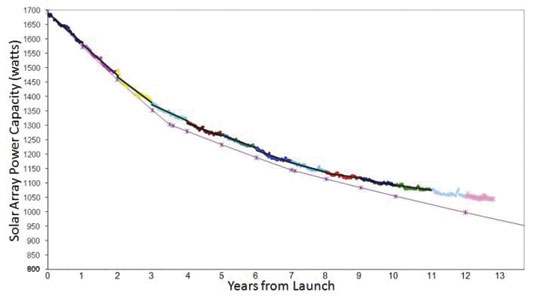
    The updated solar array degradation model developed during the study suggests that the power production will be more than adequate over the predicted lifetime of both the IIR and IIR-M SVs. On-orbit solar array capability tests on several SVs has begun, with results confirming the predictive analysis. It is expected that this on-orbit capability test will eventually be expanded to all IIR SVs as part of normal on-orbit monitoring. See Figure 2 for a plot of the solar array power capacity trend for SVN-43 over 13 years. The power capacity degradation per year decreases as the arrays age.

    Figure 2. IIR solar array power capacity trend.
    Figure 2. IIR solar array power capacity trend.

    The Power Consumption Study tracked actual on-orbit box-level power use on several SVs, in order to advance from the designed power consumption predictions to actual on-orbit values. This was compared with the solar-array degradation seen on-orbit to update the possible life limitation due to solar array capacity.

    Finally, the on-board fuel budget shows more than adequate margin to fully meet mission needs for all SVs, including station-keeping maintenance and disposal operations. Thus, component failure — failure of a final redundant box — is still the primary concern for IIR and IIR-M final failure. Random component failures represent the most likely cause of IIR and IIR-M SV loss.

    IIF Lifetime Requirement

    The first IIF SV was launched in May 2010. Eleven others will be launched in the next four years. The Block IIF will primarily replace well-used and over-age IIA SVs. For each new IIF launched, a PRN must be taken away from an on-orbit asset. The old SV may be disposed due to final failure, or it may be maintained in its GPS orbit as a spare, should it have capability remaining.

    The IIF SV has MMD and design life requirements of 9.9 and 12 years, respectively. This is several years beyond that required of all earlier GPS SVs. Obviously, the new IIF SV has no track record yet, but analysis by the contractor and USAF suggests that the GPS Block IIF SVs will exceed all MMD and lifetime requirements.

    IIIA Lifetime Requirement

    The GPS IIIA contract was awarded in May 2008, and the Critical Design Review was completed in August 2010, two months ahead of schedule. Long lead part acquisition and subsystem build have started. The first launch is still targeted for May 2014. Analysis presented at the GPS IIIA SV CDR currently predicts that the GPS IIIA SVs will exceed all MMD and design life requirements of 12 and 15 years.

    The GPS IIIA System Design Review occurred in March 2007, just prior to the expected release of the final RFP. The delay of the final RFP release until July and contract award decision postponement until May 2008 were two final delays which directly affect the tight schedule for first launch. The IIIA schedule suffered from these delays on top of the extended proposal activity from 2002–2008.

    Despite these delays, IIIA benefits now from the numerous risk reduction and systems engineering efforts performed in the interim. Also, the IIIA design leverages significant design maturity from the A2100 satellite bus, the IIR-M SV heritage, and the fact that Lockheed Martin’s navigation payload subcontractor, ITT, has provided navigation payload components on every GPS SV to date.

    Since the GPS III production looks to be on schedule, the worst thing that could happen would be an acquisition delay or reduction of the SVs necessary to keep the constellation robust. This could well bring the GAO report’s worst-case predictions to pass in a few years.

    Another primary GAO conclusion was that “[the GPS IIIA development] schedule is optimistic, given the program’s late start, past trends in space acquisitions, and challenges facing the new contractor.” But Lockheed Martin and ITT built 21 IIR and IIR-M SVs and bring significant GPS experience to the GPS III design and development — a major benefit to keeping the program on schedule.

    Constellation Sustainment

    The 20 IIR SVs will form the backbone of the constellation for many years to come. But GPS constellation sustainment will depend on all GPS SV types operating together. The 12 IIF SVs will generally replace the older IIA SVs, and the new GPS IIIA SVs will begin launching in 2014 to initially replace older IIR SVs and eventually supplement the constellation beyond 32 SVs. GPS IIIA SVs will be able to broadcast on PRNs as high as 63, though there may be some delay before the Control Segment (CS) can monitor these modernized capabilities and before users are equipped to use them.

    Figure 3 shows a projection of GPS constellation size over the next decade as Block IIR provides the foundation, while IIF and IIIA replace older SVs or add to the size. This figure gives a prediction of constellation health over the next 10 years, considering IIA failures, IIF life, IIR failures, and III life. It suggests a busy operations tempo of disposing of at least one old SV to free up a PRN in time for the launch of a new SV, to maintain constellation strength while reducing the number of extremely old SVs. Moving an SV to spare status slightly relaxes this tempo. Should GPS III SVs be unavailable or significantly delayed (for example, due to boosters), the constellation health will definitely suffer.

        Figure 3. GPS constellation size projection.
    Figure 3. GPS constellation size projection.
     

    In addition to the general long-life predictions, on-orbit SVs can have their operational life extended through employment of various options. Power management is available to extend SV useful life for the navigation and timing community. On Block IIA and Block IIR SVs, this is limited to turning off non-navigation boxes. This is always an option if the available solar array power or battery capacity threatens limiting the legacy signal capabilities. This has been employed on Block IIA SVs with the benefit of extending the SV life by several years. It is expected that this technique will be used periodically on all SV versions in the future.

    On Block IIR-M SVs, reducing the L-band broadcast power (that is, turning off the modernized signals) is an option. Analysis in a recent MMD report shows that this would add several years (2–4) to IIR-M SV life. This would probably be the first step of several available to extended IIR-M life.

    Current Operations

    Regular IIR and IIR-M operati
    ons start with the normal daily navigation data uploads, routine telemetry collection, and memory dumps as for all GPS SVs. Other on-orbit support for IIR and IIR-M SVs consists of a variety of periodic operations from orbital repositioning and minor hardware reconfiguring, to data and computer program updates of the on-board processors. When necessary, anomaly investigation support is provided for any issue or event with causes or could potentially cause an SV outage.

    To maintain proper constellation coverage and proper relative spacing of the SVs, orbital repositioning maneuvers are performed regularly on almost all SVs to counteract the effects of the normal orbital perturbations and natural in-plane acceleration. Occasionally, rephasing maneuvers are performed to move an SV to a new orbital location. Approximately 15 orbital maneuvers are performed per year for the 20-SV IIR/IIR-M subconstellation.

    The SV communication mode for command and telemetry is occasionally modified temporarily to avoid communication conflicts with nearby SVs. Also, certain heaters must be enabled during a portion of the year to avoid excessive cooling.

    The bus and the navigation processors on the IIR/IIR-M SVs are both reprogrammable on-orbit. This includes program updates and data changes. Flight computer maintenance has required an update every year or so. The bus computer has seen eight sets of patch updates to date. The navigation computer has been reprogrammed approximately every two years (patches are not used here). These updates have provided adjustments to current capability, including accommodating degraded hardware component performance, allowing them to perform nominally. Other updates have enabled enhanced capabilities on the SVs.

    The navigation computer program was updated for a number of items including time-keeping system (TKS) loop stability and data collection for offline performance analysis. This has avoided numerous outages due to clock jumps. RAFS frequency drift adjustments must be performed occasionally. All clocks are monitored and uploaded as required.

    Data parameter updates to the bus computer occur occasionally to accommodate Earth/lunar eclipse pair issues and other purposes. Backup ephemeris data uploads are performed on every IIR/IIR-M SV every 10 months. Occasional events caused by the space weather environment must be tracked and addressed using data provided by on-board data monitors. Memory dumps and buffer dumps are performed daily on every SV.

    The bus computer processing was enhanced by adding a rolling buffer for telemetry data collection when out of contact with the CS. This high-fidelity data collection recently has been used to collect battery performance information during an investigation into battery performance degradation.

    The IIR-M SV provides legacy signals just like a IIR SV, and many of the operations are similar, but modernized signals require unique operations for
    IIR-M. To date, these capabilities have been accomplished on the non-modernized CS by using work-arounds. Full modernized capability and signal monitoring will come online with the GPS Advanced Control Segment (OCX).

    The new M-code signal has only been used to date for MUE development and test, but L2C-capable civilian receivers have been sold on the market since before the first IIR-M SV launch in 2005. Users equipped with such recievers now have seven IIR-M and one IIF SV to provide half of the ionospheric correction from tracking the new signal. The remainder of the correction may not be available until the OCX deployment, when regular inter-signal correction (ISC) data gets modulated on the L2C signal.

    Users generally do not think much about GPS SV operations unless it affects the performance they experience. Block IIR and IIR-M SVs have shown significant performance improvement to users in accuracy and availability over the years, indicating that longer IIR life will benefit users by providing good-performing SVs which will last a long time.

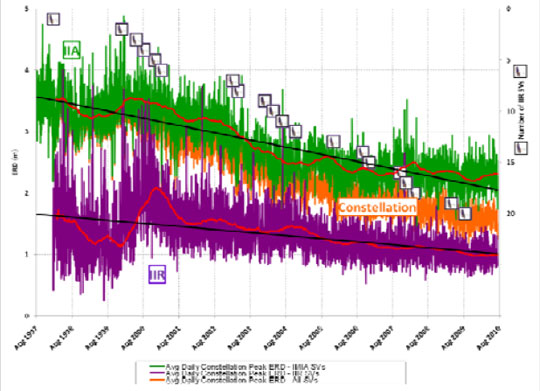
    Figure 4 shows GPS accuracy over 13 years, tracking the daily peak estimated range deviation (ERD) trend. The trend has improved partly due to system improvements (both CS and Space Segment), partly due to more IIR RAFS and fewer older AFS, and partly due to RAFS maturation (the guess is that this is due to physics package stabilization within the RAFS). The full constellation accuracy has also improved from using additional National Geospatial-Intelligence Agency (NGA) monitor stations, and other Accuracy Improvement Initiative (AII) improvements to the CS.

    Figure 4. IIR, IIA, and full constellation average ERD trend.
    Figure 4. IIR, IIA, and full constellation average ERD trend.

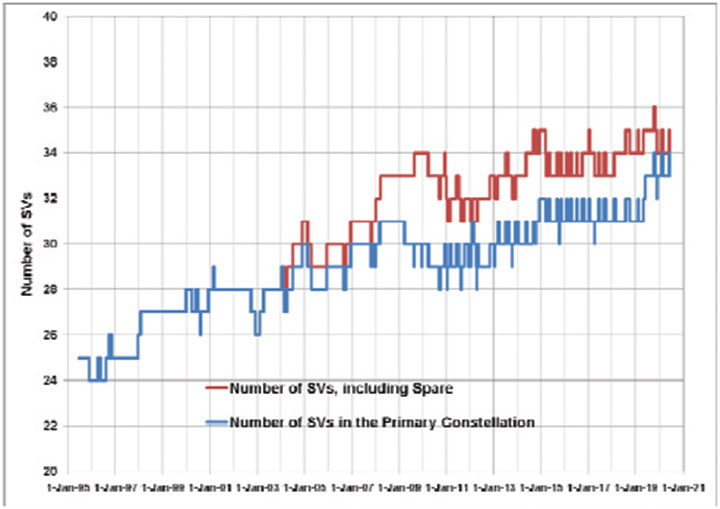
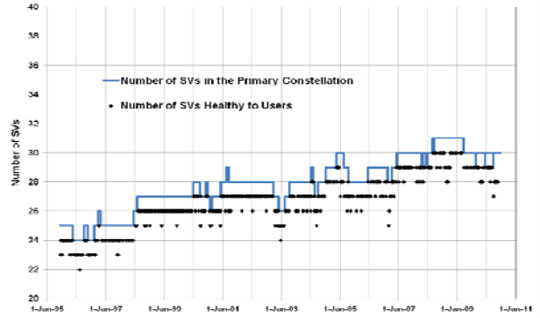
    Concerning SV availability, General Kehler, commander, AFSPC, stated at the congressional hearing on the GAO report, “[S]ince we declared Full Operational Capability in 1995, the Air Force has maintained the constellation above the required 24 GPS satellites on orbit at 95 percent.” Figure 5, a plot of the number of SVs from 1995 FOC to present day, shows this claim is accurate.

     Figure 5. GPS constellation availability, 1995 to present.
    Figure 5. GPS constellation availability, 1995 to present.

    There have been no occasions when the constellation size dipped below 24 SVs, and there were only a few times in the mid-1990s with a few SVs briefly set unhealthy due to maintenance or anomalies when there were fewer than 24 available SVs. Very rarely has it been as low as 25 SVs. Only once since late 2006 has the number of available SVs dropped as low as 27. This doesn’t take into account the spare SVs that may still have some life left, if required.

    Future Operations

    Consideration of options for future operations include assistance for aging IIR SVs and any CS changes that could help the older SVs. Ideas have been explored, such as crosslinking clock timing data from other SVs if all clocks fail on a particular SV.

    It is expected that the past flight software update pace will need to continue into the future, both for the bus computer and for the navigation computer. This will likely be necessary to address SV hardware issues, CS updates (Architecture Evolution Plan [AEP] and the OCX), as well as compatibility with other future SVs (IIF and III). The OCX will bring to the IIR-M SVs command of the full modernized capabilities. This includes modulation of modernized data on the new signals, full employment of the new signal structure, and signal monitoring of the new signals at the USAF monitor stations. It is expected that most IIR-M SVs will be around for this.

    As has been seen with earlier SV blocks, future IIR and IIR-M availability may degrade somewhat as the SVs age, but the quality support from the Second Space Operations Squadron (2SOPS) and the flexibility of the SVs should minimize any significant outage periods.

    Having Block IIR SVs last longer will potentially allow for more SVs on-orbit providing greater coverage. More SVs will also allow for additional lower elevation SVs to be masked by the user equipment and thus avoid local obstructions.

    Conclusion

    The data and analysis presented here show no single point of vulnerability for the existing IIR and IIR-M on-orbit SVs. Lessons learned from older SVs have been applied to make later
    blocks more robust. IIR SVs have been studied thoroughly with no obvious life-limiting mode identified at this point. Robust and flexible SV design suggests long life for these SVs.

    Based on this analysis and performance, it is expected that IIR and IIR-M SVs will meet and exceed MMD and design life requirements, with some SVs lasting more than 20 years. This will form the backbone of the constellation well into the next decade and mesh well with GPS III.

    While the dire forecast of the GAO report will not come to pass, it is important to follow the guidance of the new National Space Policy of June 2010 to maintain U.S. preeminence in space: “The United States must maintain its leadership in the service, provision, and use of global navigation satellite systems (GNSS).” This can be accomplished by maintaining the steady course which has proven so fruitful to date. If more SVs are wanted, then there might be the option to build the simplified GPS III, the “IIIS,” as recommended by Brad Parkinson.

    Acknowledgments

    The authors thank Pete Barrell, Jim Martens, Joe Trench, Don Edsall, Kim Kruis, Amanda Keith, Wayne Rasmussen, Mark Merwin, Sam Bryant, Jeff Holt, and Chris Krier all of Lockheed Martin, Jeff Harvey of ITT, and Mike O’Brine of Aerospace for their contributions and comments on this work. A longer version of this article was presented at the ION-GNSS 2010 conference.


    WILLARD MARQUIS is a senior staff systems engineer with Lockheed Martin’s GPS IIR and GPS III Flight Operations Group. He has a masters degree in aeronautics and astronautics from the Massachusetts Institute of Technology.

    J. DAVID RIGGS is a staff systems engineer with Lockheed Martin Space Systems GPS IIR Flight Operations Group. He has an M. S. in electrical engineering from Colorado Technical University.

  • Expert Advice: An EPIC Start for Coordination

    John Wilde
    John Wilde

    By John Wilde

    The new European Positioning, Navigation, and Timing (PNT) Industry Council (EPIC) will be a forum for organizations with an interest in all PNT systems including Global Navigation Satellite Systems (GNSS). EPIC shall serve as an information and distribution portal between all stakeholders in the PNT community. Its mandate includes all GNSS constellations and related augmentation systems worldwide, both operational and in development/modernization.

    EPIC will undertake to serve the interests of all stakeholders within Europe, and on behalf of Europe on the global stage, recognizing that understanding and cooperation between the world’s stakeholders is key to the successful deployment of new and improved GNSS applications. We also envision that EPIC will become a thriving forum for the exchange of new ideas and best practices, as well as becoming a knowledge center hosting working groups and task forces focusing on specific GNSS issues. EPIC would thus not only serve as a gateway but actually assist stakeholders in developing common solutions to common problems in-house.

    Representation

    GNSS has applications in many commercial and non-commercial fields: academia, agriculture, airline operators, civil aviation authorities, air navigation service providers, emergency services, energy suppliers, logistics, manufacturing, maritime, communications, petrochemical, rail, surveyors, and more. Therefore, EPIC will work on behalf of all GNSS stakeholders regardless of their application or business model and represents the whole community, integral to the ongoing success of GNSS. In addition it will represent the needs of users and developers of downstream applications.

    International

    EPIC stands with sister organizations in North America and Asia:

    • United States GPS Industry Council
    • Japan GPS Council
    • Korean GNSS Technology Council

    EPIC will maintain close ties to these organizations and will profit from shared practices and knowledge when mutually beneficial. Joint representation with these organizations to government GNSS authorities will be a key coordination activity.

    Communication

    EPIC will encourage communication and cooperation among its membership to develop new associations and partnerships to create new applications or share ideas and expertise. It will organize regional meetings, workshops, focus groups and social gatherings.

    The organization will update members on the latest developments within GNSS and work to ensure that information is made available in a sensible, secure manner and shared as publicly as possible. We intend to keep EPIC a dynamic organization, reflecting the world of GNSS, responsive and adaptable to the needs of its members. Therefore, active involvement from the membership of EPIC will be crucial to its success in both setting the agenda and then realizing it. It is no accident that EPIC is intended as a forum — not just a place for debate but literally a marketplace of ideas where real transformative change can take place.

    To get the ball rolling, EPIC will conduct a market survey over the next few months with potential members to clarify their requirements and ensure that EPIC starts with the issues and people that matter.

    For further details, visit www.epicforum.org, or contact [email protected].


    John Wilde has great experience in the GNSS field, specializing most recently in aviation requirements. He is the founder of EPIC. See also his February 2008 interview on the same subject.

  • Expert Advice: Location Changes Everything Mobile

    Charles Abraham
    Charles Abraham

    By Charles Abraham

    As today’s handsets and consumer devices become more sophisticated, manufacturers continue to incorporate more and more functionality into a small and sleek form factor. Today’s range of smartphones incorporate voice and data transceivers, GPS, Bluetooth, Wi-Fi, cameras, music, touchscreen interfaces, compasses, motion sensors, cameras, storage cards, and many other technologies. Free turn-by-turn navigation services, such as offered on Google Android phones and iPhones, have created a compelling reason for many of us to own a GPS-equipped smartphone.

    The pressure on manufacturers to integrate so many functions into one small printed circuit board has fueled a race among semiconductor suppliers to offer new solutions combining GPS and wireless connectivity. Phones that are small and comfortable to hold mean less and less space available for the internal electronics. Large screen sizes and the trend to thinner and thinner devices means smaller, less efficient antennas, placing pressure on chip designers to improve integrated circuit (IC) performance to make up for antenna constraints.

    Finally, cost competition in these markets is intense, as operators compete to bring more users online.
    These forces have shaped several changes in the wireless semiconductors found in new smartphones. Three important enabling technologies are:

    • reduced-geometry semiconductor technologies,
    • wafer-scale packaging, and
    • combo chip integration.

    Let’s look at the trends in each area.

    Semiconductor transistor sizes have been shrinking for decades. GPS processors in the market today use transistor geometries with gate widths of 0.18 micrometers, 0.13 micrometers, 90 nanometers (nm), and 65 nm, the latter showing up in the newest handsets on the market. 40-nm-based ICs have been announced as well, and will find their way into the market in the next year or two.

    Each generation of technology offers a 50–100 percent increase in density for pure digital circuits. This so-called shrink has allowed designers to both reduce the size of chips and to pack in more performance — in GPS chips this usually means more tracking channels and more correlators for faster signal search. The area for non-digital circuits such as the radio receiver in a GPS has not been shrinking as fast as the digital portion. This had led to changes in architecture, with more and more functions going digital. Examples include digital band-shaping filters, digital gain adjustment, and sigma-delta analog- to-digital converters.

    Wafer-scale packaging has moved into the mainstream for GPS and other wireless ICs. Traditional ball-grid array (BGA) packaging requires placing a semiconductor die on a substrate. The substrate carries the balls (pins) and some interconnects, and the semiconductor die is connected to the substrate via wire bonds. For small ICs the overall package size may be 50 percent larger than the die itself, because of overhead of the space needed for wire bonds.

    By contrast, wafer-level ball grid array (WLBGA) packaging yields a finished packaged part with the same dimensions as the underlying die. Wire bonds are not used; a redistribution layer (RDL) is bonded to the silicon wafers and carries interconnections from the silicon to the balls. This type of packaging yields the smallest possible board footprint. It also places strict limitations on the number of package pins, since the pins must all fit under the chip and cannot be spaced too closely, due to board manufacturing constraints. Often designers struggle to provide the features customers seek while abiding by package pin-count limitations. Pins are shared or multiplexed to preserve flexibility.

    Combo-chip integration offers the ultimate solution for small size. A single IC with multiple functions will almost always be considerably smaller than several ICs on a printed board. The last two years have seen the introduction of several combo ICs containing GPS, including the Broadcom’s BCM2075 Bluetooth-FM-GPS combo IC. Combo ICs like this allow manufacturers to build cellular handsets that would be difficult or impossible to create using discrete chip sets. Since GPS, FM, and Bluetooth have become standard features across many product lines, manufacturers not only benefit from small size but also economies of scale, designing a single part into dozens of devices.

    The benefits of combo ICs are easy to understand, but making these devices brings unique challenges. First and foremost, these ICs are wireless devices containing multiple sensitive radios, where every fraction of a decibel of performance counts. With few exceptions, handset manufacturers and their wireless operator customers are not willing to sacrifice radio performance in their quest for miniaturization and cost reduction. Each function on the wireless combo IC must perform as well as its counterpart function in a stand-alone IC.

    However, in a combo IC the radios are at most a few millimeters apart from each other. Designing for this type of integration requires engineering attention at multiple stages of the design. Up front, during the system engineering phase, component specifications must be set that minimize interference between radio subsystems, considering not just the radios on the combo IC but the influence of other radios in a handset as well. For example, in setting the specification for the second-order intercept point of the GPS receiver, system engineers must consider the fact that transmissions in 825 MHz cellular band can mix with Bluetooth transmissions at 2400 MHz to yield an intermodulation product at 1575 MHz, right in the middle of the GPS receive band. Designers also choose clock frequencies to avoid interference; for example, a GPS baseband processor that clocks at 100 MHz might be changed to 75 MHz to avoid the FM receive band. These are just a couple of examples of the many scenarios and considerations that must be examined early in the design process.

    Once the system engineer has done his or her job, the next level of interference mitigation falls on the analog designers. They choose where to place circuits, how to structure the semiconductor layers, how to drive and load interconnects, and how to properly filter supply voltages to avoid undesired interactions. Keeping spurious products off local oscillator signals is a key challenge. GPS receivers have 100 dB or more of gain to amplify very weak GPS signals to a usable level. Due to this high gain, even a tiny spurious product on a local oscillator can have the effect of tuning in an undesired cellular transmitter. For example, a spurious product offset 135 MHz will tune a cellular transmitter at 1710 MHz down to 1575 MHz, again right in the middle of the GPS band. Avoiding these interactions requires experienced designers who can anticipate complex issues. Mistakes can be costly, with each mask for each IC iteration going into seven figures.

    As the challenges of combo ICs are overcome, it’s likely the future will bring even more in the way of wireless technology integration. This in turn will provide even more opportunities for GPS to penetrate a broader set of handsets and cellular devices, making this exciting technology available to more consumers every day.


    CHARLES ABRAHAM is senior director of engineering for the GPS Business Unit at Broadcom, which he joined via acquisition of Global Locate, a company he co-founded in 2000. Previously, he worked at Ashtech, Magellan, Trimble, and Hughes Electronics.

  • Expert Advice: Remembering. And Resolving

    profile_shadow_mask

    By The Masked Engineer

    In a few weeks, we will again observe the tragic anniversary of the 9/11 attacks on the United States. This will mark nearly a full decade since that terrible day that changed the lives of people around the world, forever. Many will remember. Many will mourn. Many will work to ensure that such an event never again threatens any nation. That is a good thing.

    Few outside the position, navigation, and timing (PNT) community will also recall that the day before the 9/11 attacks, the U.S. government released a landmark document that described the vulnerabilities of services provided by GPS to disruption, whether by attack or inadvertent interference. The Department of Transportation Volpe Center’s GPS vulnerability assessment recommended that services utilizing GPS-provided PNT seek alternative sources of these services. What decisions and actions have the findings and recommendations of this report promoted? The answer is most disturbing.

    The U.S. government has sealed the fate of Loran-C and kept the decision on an enhanced Loran system (eLoran) in limbo for more than 10 years. The government has spent hundreds of thousands (if not millions) of dollars studying the problem over and over again and either ignoring or classifying the results. The Department of Homeland Security (DHS), a direct outcome of the 9/11 attacks, has done nothing to address the need for a national backup other than study and re-study the problem and disregard the findings and warnings of world-class PNT experts.

    On the positive side, a recent paper from the Federal Aviation Administration (FAA) attempts to address the problem by proposing to investigate alternative PNT (APNT). While the FAA does this under its Title 49 responsibility and authority to ensure the safety, security, and efficiency of our National Airspace System (NAS), and the alternatives it is looking at are certainly aviation-centric, it is admirable that somewhere in this government someone is finally moving forward to define and implement a real, operational PNT alternative to GNSS and its augmentations. [An abridgement of the FAA paper appeared in the July GPS World; the full paper is available here.]

    I applaud the FAA’s actions and only hope that bureaucrats and bureaucratic processes don’t penalize it for its efforts.

    But the question remains: When will a decision on the U.S. national PNT backup be made? The urgency of this issue can be highlighted by posing some simple questions about another current threat to the U.S. infrastructure and economy.

    To what extent are GNSS-provided PNT services being used to identify the amount and movement of the oil in the Gulf of Mexico? What level of information exactness/integrity would be lost if GNSS-provided PNT services were not available?

    Remember, not only navigation, but communications and surveillance rely on GNSS. See UK/Ireland General Lighthouse Authority’s report on GPS jammers and effects on maritime operations.

    To what extent are GNSS-provided PNT services being utilized by cleanup crews and other impact-mitigation services? How would the efficiency of the cleanup/mitigation activities be impeded if GNSS-provided services were not available?

    Finally, what is the opportunity cost of not having a national PNT backup? Why has this decision been so hard to make? One would intuit that it has encountered political obstacles, not scientific ones. What are they, exactly?

    While the FAA is doing what it must to ensure a safe, secure, and efficient national airspace, what about the rest of us? The boaters, the truckers, the farmers, the power transmission people, the telecom providers, the cell-phone users? The list goes on and on.

    It has been nine years. Why is this so hard?

    As we take time on September 11 to remember where we were when we heard the news, to mourn those lost, and to do, each in our our way, something to ensure that such a thing never happens again, we should also take time on September 10 to thank the folks at the Volpe Center for their important efforts. And we should try, each in our own way, to do something to ensure that the effects of a loss of GNSS-provided services will be once and for all properly mitigated.


    The masked engineer harbors strong convictions, matched by a desire to hold onto a day job.

  • Expert Advice: Moore’s Law and GNSS

    Greg Turetzky
    Greg Turetzky

    by Greg Turetzky

    I started my relationship with GNSS and Moore’s Law in 1985, writing software for GPS tracking loops on the Advanced Range Instrumentation Aircraft program at the Applied Physics Laboratory of Johns Hopkins University for the U.S. Air Force. The project’s purpose was to navigate a large jet to accurately fly a pattern to drop buoys into the ocean. That receiver had seven circuit boards (six trackers and one navigator) mounted on a VME backplane in a 19-inch rack mount in the back of a C-130, and was about the size and weight of suitcase.

    In 1988, I helped design and build a single-board Swordfish receiver at Stanford Telecom that went into a two-man portable pseudolite for Trident missile testing. This was considerably smaller and lighter: about the size and weight of a desktop computer. Moore’s law — which, by the way, states that the number of transistors that can be placed inexpensively on an integrated circuit doubles approximately every two years — helped mostly by allowing much better CPUs and memories so we could put it all on a single board. I actually carried this beast off a landing ship tank (LST) onto a small island in the South Pacific called Kwajalein.

    With Moore’s law in full swing in 1990, I moved to the commercial sector at Trimble Navigation and worked on the NavTrac, a lunchbox-sized complete GPS receiver for marine navigation, and then onward to timing receivers and eventually credit-card-sized modules. It became clear that Moore’s Law was a great friend of GNSS and was going to enable a whole new slew of applications by moving from the board level to the chip level.

    I went to SiRF Technology, Inc., very soon after it was founded in 1995, to help develop the first commercially successful GPS chipset, the SiRFstarI (see photo).

    chip1-W
    Photo: SiRF Technology, Inc.
    chip2-W
    Photo: SiRF Technology, Inc.
    SiRFstarI-based module, both sides, with representative AA battery to scale.


    You can see that this module still had separate chips for the CPU, flash, SRAM, GPS correlator chip, the GPS RF ASIC,  and a lot of other components.

    Last year, we introduced the SiRFStarIV architecture and the GSP4e chip. The module made from this chip has the same basic functionality (RF in, position out) but at a much higher performance level in terms of sensitivity, time to first fix, accuracy, and much lower power consumption. The photo at right shows a 4e module. Also note how few external components are required.

    SiRF 4e module. A hearing-aid battery shows scale and represents the relative power requirements of this module. Photo: SiRF Technology, Inc.
    SiRF 4e module. A hearing-aid battery shows scale
    and represents the relative power requirements of this module. Photo: SiRF Technology, Inc.

    To really understand the impact of Moore’s law on GNSS today, we have to break down the impact on the various parts of the receiver. The measurement of each section (area, power, or bytes) was then normalized to a starting point of 100 in 1995. The time span of 14 years is about seven Moore’s law doublings (every 2 years), producing an expected decrease of 1/128. We can see that the power and digital silicon area have tracked very well over that time period. However, it is also apparent that RF has not even come down by half in that time frame (although it has swallowed a lot of external components as seen in the pictures) — and the code size (ROM + RAM) has grown by 2.5 times.

    This has turned Moore’s law into a bit of a foe in the current timeframe, as the costs associated with silicon products are clearly known to customers (die size is easy to measure) and has driven the prices for GPS receiver downwards accordingly. However, as one can see, more and more software is needed to enable the new features and functions, and with dropping prices due to decreased silicon size, it becomes harder and harder to pay to feed all the hungry engineers here at CSR. This is the crossroad at which our segment of the industry has arrived: how do we continue to add innovation and still make a profit selling silicon when Moore’s Law is not helping anymore? I am not sure I know the answer yet, but we have a lot of good ideas that we are working on.

    Most of these ideas come from expanding the notion of location determination to extend beyond using just GPS and its currently available augmentations. Adding support for other GNSS constellations requires more hardware; the amount is highly dependent on which constellation(s) we are talking about. GLONASS, because of its different frequency, requires more RF silicon, requiring more total area because the existing area is not shrinking as fast. Galileo and COMPASS will require more digital area for their complex coding schemes, but these can be more easily handled with shrinking process geometry. All will require significant software effort to bring in new acquisition schemes, tracking loops, and navigation algorithms.

    But location determination will not be a GNSS-only problem for much longer. Hybrid navigation using other signals of opportunity and MEMS sensors will play a large role in expanding the ability to provide accurate location to consumers wherever they go. The integration of these technologies into a coherent location determination system is a large software effort, and one that CSR has been working on for years in automotive applications.

    Clearly, the need for accurate location continues to grow in consumer devices. At CSR we feel we are in the best position to deliver that, with or without help from Moore’s law.


    Greg Turetzky is senior marketing director for SiRF Technology Inc., a member of the CSR Group of companies.
  • Expert Advice: Quasi-Coherent Delay Lock Loop Tracking and Generalized Binary Coded Symbols in Multipath

    James Spilker
    James Spilker

    By James J. Spilker, Jr.

    The original GPS signals, and indeed most GPS signals including L5, utilize conventional pseudonoise (PN) signal code division multiple access (CDMA), some with both in-phase and quadrature-phase modulation. In the late 1990s, I generalized Manchester PN symbol-spreading by defining split-spectrum binary square wave symbol-spreading, in a series of limited-distribution papers for the Air Force GPS Independent Review Team (IRT). These split-spectrum signals have been developed and analyzed much more fully by many others, and they are now termed binary offset carrier (BOC) modulation. The BOC codes can provide a noise-error advantage by placing more of their spectral energy at an offset frequency, thereby increasing the Gabor bandwidth. They can also provide spectral separation from other GNSS signals in the same frequency band, for example, L1.

    Efficient GPS/GNSS satellite power amplification dictates constant envelope signaling. After power amplification, however, signals are generally filtered by a cavity or other filter before broadcast through the antenna. In some instances, the cavity filter has an RF bandwidth of 24 MHz or 30 MHz. Receiver filtering removes out-of-band noise interference and permits signal-sampling rate reduction.

    Objectives

    Our first objective is to analyze performance of an assisted quasi-coherent delay-lock loop (QCDLL), a differentially coherent tracking receiver that employs the same discriminator channel as the optimal coherent DLL for noise and multipath performance advantages.

    The second objective is to generalize the BOC symbol-spreading codes by employing other families of well-known finite-length codes and spreading techniques, and to compute some measures of their multipath and noise performance and spectral-shaping capabilities. We focus on general filtered binary coded symbol (BCS) signals using time-multiplexed Walsh codes that have potential advantages for multipath performance, along with more general spectral control. They may have applications for future GNSS signals and pseudolite transmitters where multipath is a serious concern. Time- or other multiplexed versions can perhaps be useful in permitting legacy signals to operate while upgrading to new signals with perhaps different and longer PN sequences.

    QCDLL

    Optimal digital communications signal processing in Gaussian noise employs a matched filter or correlator where the reference is the waveform itself. In contrast, for optimal tracking of small changes in signal time-delay, key information content is carried, not by the waveform itself, but by the changes in the waveform with time, that is, the time derivative. Focus on the changes in the waveform is consistent with my original 1961 paper on the delay lock loop (DLL), which showed that the optimum tracking estimator uses a delay discriminator reference signal that is the differentiated signal. The derivation of the maximum likelihood estimator of delay for small delay error in Gaussian noise is not repeated here, but we note that the Taylor’s series expansion of a differentiable baseband signal p[t] received with delay T+e delay for sufficiently small e after acquisition at estimate T is

    EA-E1

    We track various PN and BCS PN carrier modulated signals using an aided QCDLL. The QCDLL operates on a PN or other coherently modulated carrier. The QCDLL has two channels.

    The upper channel in Figure 1 is the punctual autocorrelation carrier channel, where the received signal is correlated with the reference waveform, p[t+e], the PN waveform itself with delay error e. The punctual channel is also used for initial acquisition and data recovery. It provides both a reference carrier, data, and autocorrelation weighting for the lower discriminator channel. If there is no data modulation, the bandpass filters can be made more narrow. Also note that the QCDLL can operate on multiple I/Q or other multiplexed BCS signal by using composite reference codes.

    FIGURE 1. Simplified quasi-coherent delay-lock loop (QCDLL) block diagram. The number-controlled oscillator (NCO) generates a continuous phase sine wave.
    FIGURE 1. Simplified quasi-coherent delay-lock loop (QCDLL) block diagram. The number-controlled oscillator (NCO) generates a continuous phase sine wave.

    The lower channel is the delay error discriminator carrier channel where the reference, p’[t1e], is the time derivative of the PN signal p with the same delay error e. The filters in both channels have matched group delay and assisted digital tunable narrow-band filters for noise and Doppler removal. Thus, this QCDLL is a special type of assisted-GPS receiver that receives Doppler information from an external communications link. Both channels can also be assisted by an inertial measurement unit (IMU), for example a MEMS device, to estimate velocities (Doppler offset) and further reduce the tracking-filter bandwidth. The filtered product of the two carrier channels is termed the discriminator output, and it provides an estimate of the delay error. By multiplying the discriminator channel with the punctual channel, the discriminator output versus time error is narrowed in width while maintaining the sharp slope versus delay error, as well as removing carrier and data.

    The QCDLL is the generalization of the Costas loop, just as the DLL is the generalization of the phase lock loop (PLL); for example, if p is a sine wave, then p’ is a cosine wave. For a trapezoidal signal waveform, the QCDLL has been shown to produce a similar but not identical output to a non-coherent DLL.

    In Figure 1, the upper bandpass filter recovers the punctual channel, and the lower channel is the discriminator channel. The product of the two removes the carrier and data, and provides a delay error cross-correlation-autocorrelation product, the discriminator output.

    Figure 2 shows an example PN trapezoidal waveform and its derivative as a simple example of a filtered PN pulse punctual channel reference and the differentiated filtered pulse as the discriminator channel reference. It can easily be shown that the discriminator channel (not the discriminator output) is equivalent to an early-late DLL with a early-late separation equal to the rise time of the trapezoidal pulse. Figure 3 shows the discriminator channel and output.

    EA-2A

    EA-2BFIGURE 2. Trapezoidal PN (1 Mcps) waveform pulse and its time derivative with a 0.1-microsecond rise time.

    FIGURE 2. Trapezoidal PN (1 Mcps) waveform pulse and its time derivative with a 0.1-microsecond rise time.

    FIGURE 3. Discriminator channel, d[e], and (bottom) discriminator output, R[e] Rd[e], for the 1.0 Mcps PN with the optimum 0.1-microsecond reference and the 0.1-microsecond rise-time trapezoidal waveform.
    FIGURE 3. Discriminator channel, d[e], and (bottom) discriminator output, R[e] Rd[e], for the 1.0 Mcps PN with the optimum 0.1-microsecond reference and the 0.1-microsecond rise-time trapezoidal waveform.
    For comparison, Figure 4 shows the step response of a 4-pole Butterworth filter with a 12-MHz bandwidth and its derivative. We also show a two-step approximation to this analog step response, which can be used to optimize a weighted multiple early-late DLL or multiple correlator approximation to the QCDLL.

    EA-4A

    EA-4B

    FIGURE 4. Step amplitude response and slope for a 4-pole Butterworth filter with a 3-dB bandwidth of 12 MHz (one-sided). The time derivative of this step response is shown on the lower plot along with a rectangular approximation.

    Although not proven, the QCDLL appears to have several advantages in both noise and multipath performance as compared to the more conventional early-late gate (that I first presented in 1963):

    The QCDLL discriminator channel reference is the differentiated pulse. Although for the trapezoidal pulse waveform, the conventional early-late DLL can in effect use the same discrimiantor reference if the early-late separation is set equal to the rise-time, for more general filtered waveforms, the early-late DLL can only approximate the optimal reference. Properly weighted multiple early-late DLLs offer a better approximation as shown in Figure 4, but still only an approximation.

    The QCDLL discriminator output of Figure 3 is the product of the correlator channel and the discriminator channel. When tracking precisely, the correlator channel output is at its peak correlation. In contrast, a noncoherent early-late DLL only produces correlator outputs that are by definition early and late. Thus neither of these is at their peak, and the noise performance suffers accordingly. By the same token, the noncoherent early-late DLL discriminator output must be wider than that of the QCDLL, and the QCDLL multipath performance is improved in the same manner.

    From a computational point of view, the early-late DLL is computing the small difference between two large numbers, namely the small difference between the ealy and late correlator channels. In contrast, the QCDLL is only computing the correlation of the received waveform with the narrow differentiated waveform used as the discriminator reference. For the simple example of the trapezoidal PN waveform, this reference is simply a narrrow time gate of width equal to the rise time.

    Generalized BCS Techniques

    My 2010 ION ITM paper, upon which this article is based, discusses a number of generalized symbol coding techniques including Neuman-Hofman, Barker, and Generalized Multiphase Barker, each of which provides minimal autocorrelation sidelobes. Various chirp-coded symbols with linear variation in chip-rate with time are analyzed and provide reduced sidelobes and spectral shaping. Rademacher and Walsh codes, time-multiplexed and properly weighted, form further generalizations. These can be time- or IQ-multiplexed, and the time-multiplexing can in turn be pseudorandomly permuted. In the limited space of this article we only discuss time-multiplexed (TM) Walsh Code symbols.

    TM Walsh Codes. Walsh functions form a complete orthonormal set of binary functions of dimension 2n. Walsh codes are generated as products of Rademacher codes. There are 2n Walsh function of 2n binary elements. Thus a weighted sum of Walsh functions can approximate any discrete-time, time-limited waveform. Each PN symbol is coded with a Walsh code. Then time-multiplex two or more different Walsh-coded symbols in a sequential or time-weighted manner. We can then tailor the autocorrelation function and its sidelobes and spectra by using selected members of this set and appropriate weighting. The resulting combined autocorrelation function is then the sum or weighted sum of the individual autocorrelation functions, since we assume independence of the PN chips. The 8-dimensional binary Walsh codes (Walsh order) are the rows in the matrix:

    The 8-dimensional binary Walsh codes (Walsh order) are the rows in the matrix:

    Figure 5 shows the trapezoidal filtered version of Walsh 7 for the dimension-8 Walsh functions.

    FIGURE 5. Finite rise time trapezoidal Walsh coded symbol for Walsh code 7 with rise-time 0.03 microseconds and 1 Mcps.
    FIGURE 5. Finite rise time trapezoidal Walsh coded symbol for Walsh code 7 with rise-time 0.03 microseconds and 1 Mcps.

    Each Walsh sequence time multiplex modulates a separate and independent pseudorandom PN chip in sets of PN chips beginning from a PN epoch time; for example, the defined beginning of the PN sequence. Note that the equally weighted sum of all 8 Walsh functions is the vector {8,0,0,0,0,0,0,0}, which is equivalent to a single high-amplitude pulse of narrow width. Thus if we sum all of the Walsh functions, we obtain the equivalent of a single narrowband pulse where the autocorrelation sidelobes disappear. Even with filtering of the spreading waveform, the sidelobes can still be small. Likewise, the equally weighted sum of codes 5,6,7,8 is {4,4,0,0,0,0,0,0}, the Manchester code.

    Since the Walsh functions form a complete orthonormal set, a weighted sum of Walsh functions can approximate any finite-duration signal of the same dimension, just as the Fourier series can approximate any periodic function. Thus a weighted sum of the Walsh functions in TM fashion can tailor the signal power spectral densities and autocorrelation functions to closely match a desired realizable function. Weighted TM BOC signals and Rademacher codes can also create useful approximations, but are not as general since they are not a complete orthonormal set.

    The spectrum and autocorrelation functions of the individual Walsh functions vary markedly from one another. Figure 6 shows two different selections of Walsh functions to illustrate an example of spectral separation. The wider-frequency spectra signal is a TM of Walsh codes 5, 6, 7, 8 and has improved autocorrelation with lower sidelobes compared to a single BOC signal. The lower-frequency spectrum represents the 0 Walsh, which is conventional PN.

    FIGURE 6. Shaped power spectra for two TM trapezoidal Walsh signals.Blue solid curve Walsh 1, dashed curve TM Wash 5,6,7,8.
    FIGURE 6. Shaped power spectra for two TM trapezoidal Walsh signals.Blue solid curve Walsh 1, dashed curve TM Wash 5,6,7,8.

    Figure 7 shows the multipath error envelope of the TM Walsh spreading waveform for TM of all 8 codes in comparison, with TM of 5,6,7,8 in the presence of multipath amplitude 0.5 versus multipath delay. These results for TM of all 8 Walsh correspond closely to that of PN waveform of 8 Mcps and rise time of 0.03 ❍s as expected.

    FIGURE 7. Envelope of the multipath delay error when using the Walsh spreading function of dimension 8 and a trapezoidal signal rise time of 0.03 microseconds.
    FIGURE 7. Envelope of the multipath delay error when using the Walsh spreading function of dimension 8 and a trapezoidal signal rise time of 0.03 microseconds.

    The envelope of the error increases as one would expect, to approximately 0.03-microsecond multipath delay. The solid blue curve is the result where all TM 8 Walsh codes are used. The dashed curve is for the TM 5,6,7,8 used to generate the spectral separation shown in Figure 6.

    We can permute TM of Walsh functions and transmit each of these permutations in a pseudorandom sequence. There are 8! 5 40,320 different permutations of 8 Walsh functions. Thus we can use a different arrangement of the 40,320 patterns every 8 PN chips and do so with a different PN sequence to prevent a jammer from time-synchronizing the jammer spectrum to the Walsh multiplexing spectra with time. Weighted time-multiplexing can also be augmented with I/Q multiplexing. Pseudorandom permutation of the Walsh codes can also diminish spectral lines of the basic PN sequence if the two PN sequences are relatively prime.

    Conclusions

    This discussion first examines the QCDLL and its performance for conventional PN signals, and then generalizes the family of symbol coding/spreading techniques. The BOC signal, first called the split-spectrum signal, has a limited but important ability to shape the spectrum. It also increases its Gabor bandwidth and corresponding noise performance as indicated by the Cramer-Rao bound. However, the BOC signal has large autocorrelation sidelobes that when operating on both sidelobes simultaneously can cause limitations. There are BOC receivers which avoid that issue by operating separately on upper and lower frequency components. However, our focus is on more
    general symbol-coding techniques that reduce autocorrelation sidelobes and provide good multipath performance.

    The assisted QCDLL may improve performance as compared to the more conventional early-late non-coherent DLL in at least these respects:

    • The non-coherent early-late DLL autocorrelation is by definition offset by D/2 in the early–late DLL when locked rather than a perfect punctual channel.
    • The conventional early-late reference is not equal to the differentiated signal except for a trapezoidal signal with rise time of D/2.
    • The QCDLL uses an optimal reference for the discriminator channel.
    • The discriminator output of the QCDLL is the product of the punctual channel correlator with the discriminator channel, and thus has a narrower width than that of an early-late DLL and c better multipath performance.
    • The early-late DLL computes the small difference between two large correlator outputs, whereas the QCDLL computes that difference directly.

    QCDLL performance in multipath is not claimed optimum; I and others have shown other techniques for reducing multipath by estimating and subtracting multipath components to reduce bias error on the direct signal. The results shown here with the trapezoidal wave-shapes may approximate the best performance possible, since the trapezoid has no precursor/tail that would be removed by a multipath-estimating receiver.

    The optimal discriminator channel reference waveforms (the differentiated pulse waveform) defined for the QCDLL for any filtered received signal can be approximated by a sequence of pulses. These sequences of pulses define a quasi-optimal set of weighted conventional early-late DLL or multi-correlator tracking receiver configuration that approximate the optimal reference, the differentiated signal.

    More general symbol coding techniques include: NH, Barker, generalized Barker, chirp, and TM Rademacher and Walsh codes. Barker, Generalized Barker, and NH codes have greatly reduced autocorrelation sidelobes and excellent multipath performance. These can also be time and I/Q multiplexed. Variants of chirp and TM Rademacher, Walsh can provide both spectral shaping and improved multipath performance. Weighted TM Walsh-coded symbols can be designed to synthesize any discrete-time, time-limited realizable function. Ordinary legacy PN can be time-multiplexed with any of these BCS symbols, with perhaps another longer PN sequence to generate a composite signal where a tracking receiver can operate on both simultaneously and yet leave legacy receivers still operational. Although we have only shown equal weighting in the TM multiplexing, clearly the weighting can be varied by changing the duty factor.

    Acknowledgments

    I wish to acknowledge the suggestions of Chris Hegarty of MITRE, J.K. Holmes, Aerospace Corporation, and Per Enge and Grace Gao, Stanford University. I give special recognition to Hegarty, Betz, and Saidi for their generalized BCS work on NH and Barker codes, and the thesis of J. A. A. Rodriguez, University FAF Munich, also on generalized BCS. The detailed version of this article appears in the 2010 ION International Technical Meeting Proceedings, and contains about 50 references.

    James Spilker is a consulting professor in electrical engineering, aeronautics, and astronautics at Stanford, and co-author of Global Positioning System: Theory and Applications, Volumes I, II.

  • Expert Advice: Jamming: A Clear and Present Danger

    SallyBasker_120By Sallie Basker

    A packed audience attended the National Physical Laboratory in the United Kingdom for a February 23 meeting titled, “GPS Jamming and Interference: A Clear and Present Danger,” organized by the Digital Systems Knowledge Transfer Network.

    In his keynote address, David Last described a dark, silent and dangerous world without GPS. He regaled attendees with tales from his experience as a GPS forensic expert, assisting the police who beat a path to his door bearing interesting boxes that turned out to be all sorts of jammers: of GNSS, of mobile phones, and of other radio systems. Last pointed to the near future when he believes that spoofers will undoubtedly make an appearance. The defences are limited: detection, prosecution, and the use of alternative sources of positioning, navigation, and timing information, perhaps eLoran.

    His final insight was this: “Navigation is no longer about how to measure where you are accurately. That’s easy. Now it’s how to do so reliably, safely, robustly.”

    Jim Doherty, from the U.S. Institute of Defense Analyses, discussed the use of existing resources for time and frequency backup. Drawing on his experience, Doherty delivered three overarching thoughts:

    • use all available means;
    • re-use existing systems where possible; and
    • produce integrated time and navigation.

    He advised the audience to be conservative with their designs and not to go too close to the boundary conditions. He also noted that there is an important trade-off between independence and cost when considering complementary systems. Finally, he identified a potential need for eLoran to support synchronisation in aviation’s multi-lateration systems.

    Moving on, Alan Grant of the UK General Lighthouse Authorities (GLA) described recent GPS jamming trials. He demonstrated that GPS jamming has wildly different effects, ranging from total denial to hazardously misleading information (HMI). HMI was particularly problematic: it caused the ship’s GPS receivers to report a realistic course and speed well away from the truth that was provided by the GLA’s eLoran system. He noted that the impact depends on the ship’s bridge design.

    Professor and consultant Martyn Thomas spoke on an ongoing Royal Academy of Engineering study on GPS vulnerability, which brings together experts from across the UK and will report in early June.

    This was followed by three presentations on coverage prediction by Robert Watson of Bath University, on interference detection using the U.S. National Geospatial Intelligence Agency’s GPS Jammer Location (JLOC) system by Alison Brown of NavSys Corporation, and on the GNSS Availability, Accuracy, Reliability anD Integrity Assessment for Timing and Navigation (GAARDIAN) interference detection system by Charles Curry of Chronos Technology.

    The conference audience learned that any system can be jammed, that JLOC detects thousands of jammers on a daily basis — nearly all of them unintentional — and that the GAARDIAN system has integrated GPS, eLoran, and clocks for interference detection and mitigation.

    Tom Willems from Septentrio and Peter McIlroy from Raytheon gave a good overview of what can be done with receivers and antennas. Willems focused on pulse blanking and adaptive notch filtering. He saw a clear trend towards hybridization, and confirmed that manufacturers recognise that GNSS is not a golden bullet — they can mitigate some interference but not all.

    Peter McIlroy told listeners to “defeat interference and jamming before you detect it.” This included hybridization with inertial systems, putting some form of barrier between the antenna and the jammer, and the use of controlled pattern-reception antennas. He suggested that controlled pattern-reception antennas might become available for civil use.

    Finally, Paul Groves from the University College London gave a very useful overview on positioning without GNSS. He addressed radio and non-radio systems and presented a fascinating chart that related the various radio systems in terms of range and lifecycle (Figure 1). The message was very timely given the need for complementary systems expressed by all speakers.


    FIGURE 1. Range and lifecycles of current radio systems (courtesy Paul Groves).


    I then chaired a lively panel discussion with David Last, Martyn Thomas, Charles Curry, Jim Doherty, and Tom Willems. I led off by focusing the discussion on resilient PNT, referring to the UK Center for the Protection of National Infrastructure’s definition for resilience: the equipment and architecture used are inherently reliable, secured against obvious external threats, and capable of withstanding some degree of damage.

    The panel agreed on the need for hybrid solutions with multiple technologies. It expressed concerns that cheap GPS receivers are components in many systems, and it is too easy to overlook them. Martyn Thomas brought insight from the computing world and noted that we need to avoid single points of failure and to demonstrate independence.

    Do our governments understand and should they do more? The panel thought that different governments are at different points on a journey, and that very few policymakers understand how a loss of GPS impacts critical national infrastructure. It was suggested that the European Union lags behind, due to the focus on Galileo.

    This led to an interesting discussion about economics and funding. Martyn Thomas said that GPS vulnerabilities have grown, and that GPS competitors have disappeared for economic reasons, leaving us dependent on GPS. He pointed out that there are limited mechanisms for sharing funding and questioned whether there are many (any) organisations that are prepared to take the risk.

    If you have limited funding, should it be used for detection or mitigation? The panel agreed that both were needed, but the prevailing view was that mitigation is more important, and that this needs to be supported by human factors activity.

    In Summary. GNSS interference is a real and present danger. It is probably more widespread than generally assumed, and it is here to stay. We can harden our GNSS systems with improved receiver and antenna design, but this will mitigate only some interference, not all. The problem is cost. Cheap — and vulnerable — GNSS receivers will inevitably find their way, unseen, to the heart of our critical infrastructure. We need resilient positioning, navigation, and timing based on independent and complementary systems and sensors. Demonstrating independence is vital but not necessarily straightforward, and true independence costs money. The greatest challenge is helping policymakers understand the risks of relying on vulnerable systems and the need for resilience.

    Finally, I return to Jim Doherty’s overarching thoughts: use all available means; re-use existing systems where possible; and produce integrated time and navigation.

    eLoran, anyone?


    SALLY BASKER is director of research and radionavigation for the General Lighthouse Authorities of the United Kingdom and Ireland.
  • Expert Advice: Are We There Yet?

    The State of the Consumer Industry

    By Frank van Diggelen

    Frank van Diggelen
    Frank van Diggelen

    At the start of a new decade, let’s examine the state of the GNSS consumer market and technology. In the December 2009 issue of GPS World, I described the developments that put GPS in cell phones over the last decade. That technology revolution has brought GPS a very long way. Having come this far, we can ask that most famous of all navigation questions:

    Are we there yet?

    In this column, I focus on the question for the consumer segment of GNSS. Has the consumer market reached the point we expected it to be by now? Has the technology reached levels we anticipated?

    The cell-phone GPS revolution began with the catalyst of U.S. E911 legislation, which mandated that when an emergency (911) call is made from a cell phone, the location of the cell phone must be provided. Among several competing location technologies, GPS proved to be the big winner, thanks to seven technology enablers: assisted GPS, massive parallel correlation, high sensitivity, coarse-time navigation, low TOW, host-based GPS, and RF-CMOS.

    All of these together enable very low-cost implementation of GPS in cell phones, even phones on networks such as GSM and W-CDMA that do not have fine-time synchronization (that is, they are not precisely synchronized with the GPS system). GPS is now found in roughly 500 million phones in use today.

    Four Milestones. From a consumer market perspective, we have exceeded forecasts. From a technology perspective, we have kept track with Moore’s law. Chips and receivers are cheaper than expected — because, as well as Moore’s law, we have seen greatly increased volumes and competition. Low-cost chips have not come at the expense of performance; in fact, the opposite — as chips have evolved, they have become less costly and better performing.

    Small, cheap antennas have affected performance, but given the same antenna, I will demonstrate that a receiver with a single-die GPS chip costing less than $4 can outperform a $19,000 receiver.

    This sounds paradoxical, even impossible — indeed many of you may be penning letters to the editor right now! But the time-to-first-fix, sensitivity, and urban-accuracy data will prove my point.

    As a consequence of chip evolution, we are reaching plateaus of development for GPS-only systems. However, there remain many problems to solve, especially in urban canyons and indoors. These problems may never be solved with GPS alone, or with any single system alone. This decade will be characterized by GPS-plus; the days of GPS-only will soon recede into the past.

    Don’t interpret this as a failing of GPS — quite the opposite. Because GPS-only systems have worked so well, they have found their way into half a billion cell phones, and we are boldly taking GPS to places no navigation has gone before. As we do, we start to encounter the limitations of GPS-only performance.

    We will see the proliferation of GPS-plus: GPS+MEMS, GPS+Wi-Fi, GPS+NMR, and GPS+GLONASS, Compass, QZSS, and Galileo. The winners will be those with the greatest levels of integration. To paraphrase Winston Churchill, this is not the end of GPS, it is not even the beginning of the end. But it is, perhaps, the end of the beginning.

    GNSS Consumer Market

    For market forecasts made a few years ago, we can look at summaries provided in GNSS Markets and Applications, by Len Jacobson: a 2006 Frost & Sullivan report estimated the market for PNDs and handheld devices (not including cell phones) in 2010 would be $2.7 billion, with 8.3 million units, at an average selling price (ASP) of $325. In fact, this market today is approximately $6 billion, with 40 million units, at an ASP of $150.

    Twice the Size. The consumer market, not including cell phones, is twice as big (in dollars) as forecast just a few years ago, even though prices are less than half forecast. Unit sales are more than four times forecast.

    For the cell-phone market segment, in 1999 when the E911 rules were enacted in the United States, it was anticipated that A-GPS would be adopted only in fine-time (synchronized) networks, such as Verizon and Sprint CDMA. In coarse-time (non-synchronized) networks such as GSM, the expectation was that terrestrial wireless location techniques, such as time-difference-of-arrival (TDOA) and enhanced-offset-time-difference (E-OTD), would dominate. Today, only a few niches use TDOA, E-OTD is extinct, and GPS rules in coarse-time networks worldwide, including GSM in Europe and North America, and W-CDMA in Japan.

    The consumer market, in particular the cell-phone market, has grown so rapidly that more receivers have been built in cell phones in the last three years than all other GPS built, ever. Today, L1 C/A-code GPS accounts for more than 99 percent of all GNSS receivers manufactured each year.

    From a consumer market perspective, have we reached the point we expected to be by now?

    Yes! 

    Not only have we arrived, we have far surpassed expectations.

    GPS and Moore’s Law

    Moore’s law says that for a given number of transistors, the chip size will halve every two years. Table 1 shows what this looks like in practice. For a particular class of GPS chip, the A-GPS receiver with massive parallel correlation, it shows release dates of different generations of these chips, and the technology process, which is the linear dimension of a single gate on the silicon die. As this dimension reduces to 70 percent of the previous value, the 2-dimensonal chip size reduces by 2 times. You can see Moore’s law in action here: approximately every two years, the technology process moves to the next level, and the chip size reduces by 2X. People are now talking about GPS chips in 45 nanometers, the next step.

    EA-table1

    For a comparison, consider the Broadcom BCM 4751 chip, designed for cell phones. This chip is 2.9 X 3.1 millimeters, the size of the letter B on this page. This is a single-die host-based GPS/SBAS receiver, including RF front end, low-noise amplifier, baseband, and power management unit. Ten iterations of Moore’s law have passed in the last 20 years. The same chip, had it been built 20 years ago, would have been 210 times (a thousand times) bigger.

    There were never chips that big. GPS chips aren’t just getting smaller with Moore’s law, they are getting vastly more complex and more capable.

    Performance

    At an elemental level, a GPS receiver does just three things: it starts, it tracks weak signals, and it computes position, 
velocity, and time. Strip away the 
obfuscating details, and performance may be summed up by: how fast, how sensitive, how accurate.

    Since the 1990s, time to first fix ( TTFF) and sensitivity have improved dramatically, thanks to the seven technology enablers discussed earlier. TTFF for assisted cold starts, or unassisted warm starts, is now as good as one second, even without fine-time. This is a 45X improvement on typical GPS performance of the 1990s. Sensitivity increased roughly 30X (to -150 dBm)  in 1998, then another 10X, (to -160 dBm) in 2006, and perhaps another three times to date, for a total of almost 1,000X extra sensitivity.

    What about accuracy?

    Some perceive low-cost chips as synonymous with low accuracy. This is not true. It is true that small, cheap antennas reduce accuracy; but given the same antennas, the lowest cost receivers on the market today will outperform the most expensive in typical environments where cell phones are used. The following figures show data to prove this point.

    First we connect one of the smallest, lowest cost GPS receivers t
    o one of the best antennas, a choke ring, on a rooftop with a clear view of the sky. Figure 1 shows the scatter of positions. The blue circle shows the median distribution, which is 0.9 meters for this dataset of 2000 fixes.

    FIGURE 1. Low-cost GPS with large, rooftop antenna.
    FIGURE 1a. Low-cost GPS with large, rooftop antenna.
    FIGURE 1b. Survey-grade GPS with large, rooftop antenna.
    FIGURE 1b. Survey-grade GPS with large, rooftop antenna.


    The adjacent plot shows the positions obtained from a $19,000 survey-grade GPS receiver, connected to the same antenna. The survey-grade GPS, with a median distribution of 0.3 meters, shows a 60-centimeter advantage over the cell-phone GPS, or maybe a 3X advantage depending on how you look at it. But don’t get too hung up on this result, because this is neither the typical consumer scenario (on a rooftop with choke-ring antenna), nor the main challenge facing us today.

    Next we look at the accuracy achieved with a more typical consumer antenna, in a more typical environment. Figure 2 shows the positions obtained in downtown San Jose with an active patch antenna, such as found in PNDs. San Jose is a fairly typical U.S. city, not the hardest place to use GPS, but not the easiest either. Lightstone Alley, adjacent to tall buildings, is only five meters wide.

    FIGURE 2. Performance of cell-phone GPS (white) versus truth-reference system (blue). Median accuracy 4.4 meters, 67 percent 5.6 meters, 95 percent 11.2 meters.
    FIGURE 2. Performance of cell-phone GPS (white) versus truth-reference system (blue). Median accuracy 4.4 meters, 67 percent 5.6 meters, 95 percent 11.2 meters.

    To evaluate accuracy we used a truth-reference system combining GPS and a tactical-grade IMU with ring laser gyro to produce the blue dots on the figure. The white dots are the low-cost GPS positions. Most of the time, the white dots appear to be on top of the blue, but occasionally you see some separation, and there the red lines show the horizontal error. The median horizontal error is 4.4 meters.

    Figure 3 shows the comparison of low- and high-cost receivers, with the survey-grade receiver connected to the same patch antenna as the cell-phone GPS. There are many position gaps from the survey-grade receiver, and the position walks around when the vehicle is stationary (at the intersections, bottom left and top of the figure). This is because of the weak signals available in the urban environment. But don’t get too hung up on this result either, since we are still not at the real challenge of consumer GPS: location in severe urban canyons, such as San Francisco, New York, Chicago, Shanghai, Taipei, Shinjuku, and similar. In these, typically, only one or two GPS satellites can be seen directly. Other satellites may be tracked, but only by observing purely reflected signals. This is not classic GPS multipath, the combination of a direct and reflected signal; instead this is the combination of nothing but reflected signals. The direct signals are usually completely blocked by many buildings, and are not observable at all. So the whole premise of GPS — observing range from time of flight — breaks down, and it is very difficult to get good accuracy.

     FIGURE 3. Comparison of cell-phone (left) and survey (right) receivers, both with patch antenna
    FIGURE 3. Comparison of cell-phone (left) and survey (right) receivers, both with patch antenna

    Figure 4 compares the cell-phone GPS with the survey-grade GPS, connected to the same small antenna, under such circumstances in San Francisco’s Financial District. There are no fixes at all from the survey-grade receiver. Why?

     FIGURE 4. Cell-phone (left) and survey (right) receivers, in severe urban canyon
    FIGURE 4. Cell-phone (left) and survey (right) receivers, in severe urban canyon

    In Montgomery Street, there was only one directly visible satellite, with a signal strength of -132 dBm. All the other satellites were at -140 dBm or weaker, and traditional GPS receivers cannot acquire signals at this level. Hence the only receivers that work in this environment are modern high-sensitivity receivers most commonly found in cell phones.

    You can see that the move to lower-cost receivers has not come at the expense of performance. In fact, the opposite: TTFF and sensitivity have improved dramatically, while accuracy has not been compromised, and is in fact much better in urban environments than legacy receivers, and even modern survey-grade receivers.

    But are we there yet?

    Although the consumer GPS market has irrefutably arrived, from a technical perspective the answer is more nuanced. Consumer GPS technology has made tremendous leaps forward. But precisely because of these improvements, we are taking GPS where it was never expected to go. It is no longer enough for GPS to work indoors (which it can). The demand is now for it to work as well as if it were outdoors (which, presently, it cannot).

    Performance improvements seen with GPS-only will almost certainly not continue at the recent rate. We do not anticipate yet another 45X improvement in TTFF, or another 30 dB of sensitivity, for GPS alone. However, we do expect order-of-magnitude performance increases with the addition of other technologies. Figure 5 shows data from a TomTom 950, a GPS+MEMS containing the same GPS chip used in the earlier tests, MEMS accelerometers, and MEMS rate gyros. When tightly integrated and tested in the same deep urban canyons of San Francisco, the effect on position is good: median accuracy improved by 30 percent, worst-case errors are more than halved. But the result on heading accuracy is especially dramatic.

     FIGURE 5.  PND position accuracy (left), and heading accuracy (right), San Francisco
    FIGURE 5. PND position accuracy (left), and heading accuracy (right), San Francisco

    The bar graph shows the worst-case heading accuracy in each street. With GPS-only (red), the worst-case error is around 45 degrees, a familiar result to anyone who has used any GPS-only device in a similar environment: sooner or later the map will veer erroneously. However, with the integration of the MEMS rate gyros (blue), the worst-case heading errors drop to around 3 degrees, a 15X improvement in a key metric, similar to the improvements of the last decade, but now thanks to the effect of GPS-plus.

    We will soon see GPS-plus many other technologies: Wi-Fi, NMR/MRL (power measurements from GSM and 3G phones), and of course GPS+GLONASS, Compass, QZSS, and Galileo. Because many mobile devices now include GPS, Wi-Fi, and 3G, there is a natural path for the evolution of GPS technology to include Wi-Fi and MRL measurements.

    There is a also natural trend to source different radios from the same chip supplier. After all, why would you wish to undertake a do-it-yourself effort at removing co-existence issues in different radios, when a chip supplier has already done it for you?

    Looking forward, it is very likely that this new decade will be characterized by GPS-plus other technologies, and the winners will be those with the greatest levels of integration.


    Frank van Diggelen is senior technical director of GPS systems and chief navigation officer for Broadcom Corporation. He holds more than 45 U.S. patents, has a Ph.D. in electrical engineering from Cambridge University, and is the author of A-GPS: Assisted GPS, GNSS & SBAS.

  • Expert Advice: Integrity: Lessons from the 2008 Financial Collapse

    Sam Pullen
    Sam Pullen

    By Sam Pullen

    Deterministic risk modeling, the basis of the Efficient Market Hypothesis (EMH) at the core of modern quantitative finance, is known to be fundamentally flawed, but its elegance and convenience has blinded researchers to growing evidence of its weaknesses. The near-complete acceptance of the EMH led to models that dramatically accentuate its flaws, which in turn led to absurd but eagerly accepted conclusions for loan-default risk. These models proved dramatically vulnerable to changes in the housing market in 2007–2008 and led directly to the ensuing crash.

    The gross inattention to potential anomalies and violations of nominal behavior that characterize quantitative finance fortunately do not apply to satellite navigation integrity assurance. Similar techniques and probability distributions are used, but understanding what can go wrong leads to detailed emphasis on modeling and mitigating rare events. Where significant uncertainty exists, conservative assumptions try to be robust to it. Thus, certification of satellite- and ground-based augmentation systems (SBAS and GBAS) likely demonstrates that these systems meet their integrity risk requirements with substantial margin.

    Despite this, the predominant use of deterministic models for risk assessment is dangerous because it purports to provide guaranteed bounds on uncertainty that do not apply in practice. The conservative nature of satellite navigation risk assessment greatly reduces but cannot eliminate the underlying integrity risk, while it leads to performance losses with potentially unmeasured safety impacts. Given the uncertainty that is present, probabilistic models are much better suited to providing “illusion-free” risk assessments that enable realistic system-level design trade-offs.

    Economics. Decades of financial theory are based upon the assumption that the normal (Gaussian) distribution applies to financial markets. In spite of common-sense arguments to the contrary, assuming that it does is too convenient to give up, and the theories it gives rise to are so useful that it was thought better to force-fit the model to financial processes. Academic and professional preference for tractable, analytical, easy-to-use models trumped the search for truth.

    The simplification of correlation into a single parameter made it easier to fit historical data on mortgage default risk correlation to a tractable model. Despite this, the relative rarity of defaults prior to 2000 made any correlation model based on historical default data highly uncertain. An EMH-based market-driven model for default risk correlation became instantly popular, enabling the creation of complicated mortgage-backed derivatives without in-depth analysis.

    The simplicity of the Value-at-Risk output that encouraged its widespread use in corporte risk assessment allowed managers to forget that it was only useful to, at most, the 99th percentile. It quickly became thought of as an actual worst-case bound on losses and treated as such in portfolio optimization. Loss reserves throughout the economy fell far short of what was needed. In retrospect, such approaches that oversimplify risk to the point where managers think they fully understand it are worse than useless, as they are so likely to be abused. Experts should understand risk in all its complexity and communicate that risk to decision-makers as fully as possible.

    Mathematics. This financial experience suggests that, as Albert Einstein said, “As long as the laws of mathematics refer to reality, they are not certain; and as far as they are certain, they do not refer to reality.”

    Deterministic models provide precise quantification of uncertainty whose accuracy and precision are illusory because they depend wholly on the assumptions used to generate the results. Probabilistic models also produce imprecise outputs, but the imprecision is real, and the goal of these models is to identify this lack of precision, rather than cover it up.

    Because the probabilistic approach is so philosophically different from the deterministic one, it is likely that more traditional deterministic risk models will remain dominant. These require multiple assumptions regarding uncertain behavior and simplifications to make the resulting model tractable and useful for analysis. Danger lies in forgetting how these models were created and growing to believe in them too strongly while ignoring all contrary data, as happened with the EMH.

    To avoid this, assumptions and simplifications on which deterministic risk models are based should be highlighted not only during the modeling process but also when results are presented. If these shaky foundations are consistently emphasized, fewer people will be tempted to willfully or accidentally misinterpret the results, and researchers will be less likely to extrapolate from one flawed model to another.

    Lessons for SatNav Integrity

    We must first recognize that integrity or safety assurance for satellite navigation is a unique application of risk assessment in which the aim is to protect passengers from the consequences of very rare but potentially hazardous threats. As in the financial world, the Gaussian probability distribution is used extensively to model nominal error behavior and to compute position-domain protection levels intended to bound worst-case user position errors at the integrity-risk probabilities required for user safety. The Gaussian model is a convenient, efficient means to communicate ground-system errors to SBAS and GBAS users in a single parameter: the standard deviation (or sigma) of range-domain errors.

    Great care is taken in using the tails of the Gaussian assumption to bound rare-event errors under nominal conditions (so-called rare-normal errors). Extensive studies of GPS, SBAS, and GBAS data show that, while the Gaussian distribution approximately holds in many cases and is usually a good model within the 99th percentile of errors, it is not a good description of rare-event behavior. In particular, rare-event tails of actual data often considerably exceed what is predicted by the Gaussian distribution. Several reasons exist, but the dominant one is the phenomenon of mixing of errors with different underlying actual distributions. This makes sense: rare-normal errors are not really normal but are instead combinations of off-nominal conditions that have different causes.

    Because use of the Gaussian distribution is built into the SBAS and GBAS standards, the primary defense against its inapplicability at low probabilities is to inflate the sigmas broadcast by SBAS or GBAS (or assumed in user equipment) such that the assumed distribution overbounds the actual, unknown (and likely very complex) error distribution at the probabilities that matter for user safety. This is a difficult problem. No matter what approach to deriving bounding inflation factors from collected data is used, no means of proving rare-event error bounding by Gaussian distributions exists or can exist, given that the required assumptions cannot be proven. Despite this, conservatism and common sense in deriving inflation factors (and then applying additional margin for “unknown unknowns”) should sufficiently cover the underlying uncertainty.

    Even after inflation has been applied, reliance on Gaussian error models becomes much more critical when they are extrapolated to derive distributions for squares of errors, as is done in receiver autonomous integrity monitoring (RAIM) and in real-time monitoring of the broadcast sigma parameters. Errors in the Gaussian error model are greatly magnified when squared and then assumed to follow a chi-square distribution.

    History. Using GPS performance to build models of failure probabilities and anomaly behaviors suffers from a lack of data since GPS was not fully commissioned until 1995. Estimating the prior probability of sudden, unpredictable failures in GPS satellites is mostly based upon the observed failure history of GPS satellites in orbit — but such failures are quite rare and are not consistent across all satellites. They occur more frequently as satellites approach end-of-life, and they change as different satellite blocks deploy over time. There is no guarantee that future satellite or Operational Control Segment performance will correspond to that observed in the past. It is risky to estimate one failure rate across all satellites.

    For SBAS and GBAS, conservatism and common sense must again be applied to limit the impact of these uncertainties. Failure-rate estimates are made from data where different satellites are combined, but significant margin is applied to account for differences among satellites. The resulting prior probabilities for failures are conservative for all fault types and extremely conservative for faults where limited or no data exists. The problems of relying on limited historical data are even more severe when threat models are created to represent possible system behaviors when a particular fault or anomaly (for example, satellite signal deformation, ionospheric storms) occurs. In the case of satellite signal deformation, deterministic threat models have been extrapolated from a single observed event, the fault on SVN19 discovered in 1993.

    Errors and Failures. The problem of modeling uncertain and potentially time-changing correlations breaks down into error correlation and anomaly correlation. Correlation among nominal errors is relatively easy to deal with because significant data exists; one does not have to wait for anomalous conditions. However, even when truly uncorrelated data is present, the statistical noise inherent in correlation coefficients estimated from data is almost always non-zero. Since the designer cannot tell whether real correlation exists or not, the resulting error sigmas must conservatively allow for significant non-zero correlations.

    In GBAS, ground-system reference-receiver antennas are sited far enough apart (100–200 meters) that diffuse multipath (and most specular multipath) should be statistically independent from receiver to receiver. However, this cannot be guaranteed, and even if it is true at a given site, statistical correlation estimates will be non-zero. Therefore, the assumption that nominal error sigmas in the resulting pseudo-range corrections are reduced by a factor of two when averaging measurements across four reference receivers is not strictly valid. Conservative handling of the estimated correlation at a given site can properly de-weight the assumed credit given for averaging, or the designer can choose to take no averaging credit at all.

    On the other hand, modeling correlations among rare-event anomalies is very difficult. GNSS satellite failure correlations are hard to foresee because of our limited understanding of their causes. The temptation to ignore correlations and to treat all failures as statistically independent is very high, as this allows the use of simplified probability models and produces probabilities of multiple failures that are usually small enough to be ignored.

    This dangerous trap can lead to neglecting important sources of integrity risk. Avoiding it requires assuming some non-zero degree of failure correlation, but without detailed failure cause-and-effect information, it is very difficult to know how much correlation is sufficiently conservative in a deterministic risk model. Here, probabilistic models are far superior, as our degree of uncertainty regarding actual failure correlations can be handled directly by representing different correlation scenarios, or possible states of reality, and assigning probability weights (themselves random variables) to each.

    Worst Case. Since the uncertainty inherent in the development of deterministic failure models is well understood, the resulting threat models are usually applied in terms of the worst-case fault within the bounds of the threat model. Once one agrees to ignore the possibility of faults exceeding the threat-model bounds, this worst-case-fault assumption is the most conservative one possible. The worst-case fault is judged from the user’s point of view rather than that of the GNSS or service provider. For example, the worst-case C/A-code signal-deformation on a GPS satellite depends upon the design of the reference receiver providing differential corrections (if any) and the design of the user receiver. SBAS and GBAS users are allowed a pre-specified receiver design space. Given the reference receiver chosen by a given SBAS or GBAS installation, finding the worst-case signal-deformation fault requires error maximization over all possible deformations in the threat model and all possible user receiver design parameters.

    Another class of anomalies, large ionospheric spatial gradients, can be used to illustrate this procedure. Figure 1 shows a simplified, linear model of a large, wedge-shaped ionospheric spatial gradient affecting a GBAS installation, and Figure 2 shows a graphical summary of the parameter bounds of the associated threat model developed for the FAA LAAS based on CONUS data. The geometry assumed in Figure 1 is a simplification of reality and cannot be assumed to hold precisely, even though the threat model assumes that it does. Fortunately, the resulting risk assessment is not very sensitive to small deviations from a perfectly linear front slope. This kind of sensitivity analysis is required to test our vulnerability to violations of deterministic models whose underlying assumptions cannot be verified.

    FIGURE 1. Geometry of GBAS (LAAS) ionospheric threat model
    FIGURE 1. Geometry of GBAS (LAAS) ionospheric threat model

    The parameter bounds in Figure 2 cover the worst validated ionospheric gradients observed since 1999. They cannot be guaranteed to cover future anomalies; thus, ongoing monitoring of ionospheric anomalies is required to see if these bounds need updating in the future. However, the outer bounds of the existing threat model appear to be very conservative because they are driven by a single ionospheric storm on a single day (20 November 2003) in a small region (northern Ohio). This storm appears much worse than the other observations shown in Figure 2. The vast majority of anomalous gradients discovered, most of which are not shown in Figure 2, have slopes under 200 millimeters/kilometer (mm/km) and are generally not threatening to GBAS users.

    FIGURE  2. Parameter bounds on GBAS (LAAS) ionospheric threat model for continental United States (CONUS
    FIGURE  2. Parameter bounds on GBAS (LAAS) ionospheric threat model for continental United States (CONUS

    Therefore, in a probabilistic model, the vast majority of the weighting (given that an anomaly condition exists) would go toward non-threatening gradients with tolerable slopes, a small fraction would go to the 200–300 mm/km slope range, a much smaller fraction to the 300–425 mm/km range, and then a very small but non-zero fraction to gradients above 425 mm/km (the upper bound in Figure 2) that have not been observed to date but cannot be ruled out.

    Given this uncertainty within a deterministic model, the worst-case gradient of 425 mm/km (for high-elevation satellites) is assumed to be present at all times, and its hypothetical presence is simulated, with the worst possible approach geometry and timing relative to a single approaching aircraft, on all pairs of satellites otherwise approved by a LAAS ground facility (LGF). The largest resulting vertical position error over all potential user satellite geometries represents the maximum ionospheric error in vertical position (MIEV) that must be protected against. Before mitigation by LGF geometry screening, this worst-case error can be as large as 40–45 meters.

    Figure 3 illustrates the potential magnitude of vertical errors under near-worst-cas
    e ionospheric anomaly conditions based on a limited probabilistic model that varies front slope (above 350 mm/km), speed, satellites impacted, and approach direction relative to that of the aircraft for a user approaching the LAAS facility at Memphis International Airport with the SPS-standard 24-satellite GPS constellation (only subset geometries with two or fewer satellites removed are considered). The worst-case position error, or MIEV, prior to LGF geometry screening is about 41 meters, but the relative likelihood of this result is very low. Much more common are errors in the 5–15 meter range. This figure does not show the majority of cases where the LGF detects the anomaly before any error occurs. LGF geometry screening acts to remove potential subset geometries (make them unavailable by inflating the broadcast parameters) whose worst-case error exceeds 28.8 meters, but the price of this is substantially lower availability for CAT I precision approaches.

    FIGURE  3. Near-worst-case ionosphere-induced vertical position errors at Memphis
    FIGURE  3. Near-worst-case ionosphere-induced vertical position errors at Memphis

    Figure 3 shows the extreme level of conservatism that typically results from deterministic worst-case threat model impact analysis. This level of conservatism is so great that it is hard to imagine that the actual user integrity risk is somehow worse than what is modeled in this manner. However, “hard to imagine” does not equate to “is guaranteed not to happen.” The goal of worst-case analysis is to eliminate uncertainty (by assuming the worst possible outcome of the uncertain variables) and thus prove that a given probabilistic integrity risk requirement is met. However, the limited knowledge upon which threat models are based means that such proof is illusory at best and dangerously misleading at worst. Meanwhile, a great deal of performance (in terms of user availability and continuity) is sacrificed. As shown by the example in Figure 3, probabilistic analysis makes it possible to trade off risk reduction and performance benefit in a coordinated manner. The illusion of guaranteed bounds on risk is abandoned, but as the financial crisis illustrates, it is just that — an illusion.


    SAM PULLEN is a senior research engineer at Stanford University, where he is the director of the Local Area Augmentation System (LAAS) research effort. He has a Ph.D. from Stanford in aeronautics and astronautics. This article passes quickly over economic details included in his ION-GNSS 2009 paper, “Providing Integrity for Satellite Navigation: Leassons Learned (thus far) from the Financial Collapse.”