Tag: Expert Advice

  • Expert Advice: Location Privacy Rights Upheld

    Janice Partyka
    Janice Partyka

    But Google and Facebook Signal Their Intent to Capture Users’ Location

    The biggest international mobile-phone show ever, Mobile World Congress 2013, took place early this month in Barcelona, Spain. It came at an interesting time. Attendees learned it no longer makes sense to think about which device, or screen, is of primary importance to users. Google reports findings that 90 percent of users move sequentially between several screens — TV, phone, desktop computer and tablet — to accomplish tasks.

    Google, wanting to more fully exploit ad opportunities across all devices, has revamped its AdWords program to be one platform that advertisers will use to control ads on all types of devices. In the past, advertisers could choose to advertise on desktops and no other devices.  The new rule requires mobile advertising. Although it is an integrated platform, advertisers can use parameters like the device’s location or type to send specially crafted messaging.

    The GPS-based fitness watch market looks like it is on a steep curve upwards, and feasible smartphone GPS watches are available.
    Rumor says Facebook is going to start tracking users’ locations at all times, to be able to cull more ad revenue from individuals’ preferences and geo life.

    Finally, and most importantly in the long run for all location-enabled users, the Federal Trade Commission took a stand on location privacy.

    Google Requires Mobile Advertising. Citing concerns that the shift from desktop to smartphones and tablets is damaging its bottom line, Google is revamping its AdWords advertising platform to integrate ad campaigns across all device screens. In fact, Google indicated that it will require all advertisers to pay for mobile ads even if they only wish to reach consumers on desktops. The revamp will allow customers to use contextual factors like location, time of day and device type to control integrated campaigns.

    Google provides an example of how a user’s location and device type could change the advertising message. “For example, a pizza restaurant probably wants to show one ad to someone searching for ‘pizza’ at 1pm on their PC at work (perhaps a link to an online order form or menu), and a different ad to someone searching for ‘pizza’ at 8pm on a smartphone a half-mile from the restaurant (perhaps a click-to-call phone number and restaurant locator),” reads Google’s blog.

    Will Apple Grab Your Wrist? Rumors continue that Apple will release a GPS-based fitness watch in 2013. Whether Apple enters the market or not, the GPS fitness market is huge and growing. The GPS fitness watch market is set to reach $1.07 billion in 2013, predicts ABI Research. Cellular-connected GPS fitness watches like the I’m Watch may further speed this market.

    “There have already been unfounded rumors around Apple in 2013, so let’s wait and see. If an Apple watch did feature integrated GPS, it would no doubt significantly boost shipment forecasts in 2013,” asserts Dominique Bonte of ABI. Some start-ups in the GPS Watch category have joined the action including Leikr, Pebble, Basis and others.

    Facebook Is Watching. Is it possible for the relationship between Facebook and Google to get tenser? According to a Bloomberg article, Facebook is developing a smartphone application that will track the location of its users. The app is said to be scheduled for release by mid-March, and would run on handsets in the background, even when the Facebook app or the phone isn’t open or in use.

    The location data would help Facebook capture more advertising revenue as ads can be more targeted with information about a user’s location and habits. The project is said to be headed by an ex-Googler and talent from Glancee and Gowalla, both of whom were purchased by Google.

    Location privacy Is Covered. Privacy concerns with Facebook location tracking would undoubtedly be raised. Currently Facebook records the GPS coordinates of users when they post status updates or photos from their phones, or check into a venue. Tracking users 24/7 is another thing. Facebook’s current location sharing policy seems to cover them carte blanche. It allows the use of data “to serve you ads that might be more relevant,” and “to tell you and your friends about people or events nearby, or offer deals to you that you might be interested in.”

    Also-Rans. Will Windows and BlackBerry smartphones succeed? Will there be a crack, even a tiny one, in the duopoly of iOS and Android? The biggest worry for Microsoft and BlackBerry is if initial sales of their smartphones are too small to excite developer interest. Without abundant applications, consumers won’t continue to buy these phones. ABI Research is predicting that the demand will be strong enough and is forecasting a BlackBerry installed base of 20 million and Windows smartphone base of 45 million by year end.

    Location Standards for Next Generation LBS. The Open Geospatial Consortium (OGC) held a free session and reception at the Mobile World Congress for mobile developers, location data providers, network operators and LBS service users. Attendees learned the latest in open standards development.

    Path Social Network Charged on Privacy Infringement. The operator of the Path social networking app has agreed to settle Federal Trade Commission (FTC) charges that it deceived users by collecting personal information from their mobile device address books without their knowledge and consent. The settlement requires Path, Inc. to establish a comprehensive privacy program and to obtain independent privacy assessments every other year for the next 20 years. The company also will pay $800,000 to settle charges that it illegally collected personal information from children without their parents’ consent.

    The settlement with Path is part of the FTC’s ongoing effort to make sure companies live up to the privacy promises they make to consumers, and that kids’ personal information isn’t collected or shared online without their parents’ consent.

    “Over the years the FTC has been vigilant in responding to a long list of threats to consumer privacy, whether it is mortgage applications thrown into open trash dumpsters, kids information culled by music fan websites, or unencrypted credit card information left vulnerable to hackers,” said FTC Chairman Jon Leibowitz. “This settlement with Path shows that no matter what new technologies emerge, the agency will continue to safeguard the privacy of Americans.”

    Path operates a social networking service that allows users to keep journals about “moments” in their life and to share that journal with a network of up to 150 friends. Through the Path app, users can upload, store, and share photos, written “thoughts,” the user’s location, and the names of songs to which the user is listening.

    In its complaint, the FTC charged that the user interface in Path’s iOS app was misleading and provided consumers no meaningful choice regarding the collection of their personal information. In version 2.0 of its app for iOS, Path offered an “Add Friends” feature to help users add new connections to their networks. The feature provided users with three options: “Find friends from your contacts;” “Find friends from Facebook;” or “Invite friends to join Path by email or SMS.”

    However, Path automatically collected and stored personal information from the user’s mobile device address book even if the user had not selected the “Find friends from your contacts” option. For each contact in the user’s mobile device address book, Path automatically collected and stored any available first and last names, addresses, phone numbers, email addresses, Facebook and Twitter usernames, and dates of birth.

    The FTC alleged that Path’s privacy policy deceived consumers by claiming that it automatically collected only certain user information such as IP address, operating system, browser type, address of referring site, and site activity information. In fact, version 2.0 of the Path app for iOS automatically collected and stored personal information from the user’s mobile device address book when the user first launched version 2.0 of the app and each time the user signed back into the account.

    The agency also charged that Path, which collects birth date information during user registration, violated the Children’s Online Privacy Protection Act (COPPA) Rule by collecting personal information from approximately 3,000 children under the age of 13 without first getting parents’ consent. Through its apps for both iOS and Android, as well as its website, Path enabled children to create personal journals and upload, store and share photos, written “thoughts,” their precise location, and the names of songs to which the child was listening. Path version 2.0 also collected personal information from a child’s address book, including full names, addresses, phone numbers, email addresses, dates of birth and other information, where available.

    The COPPA Rule requires that operators of online sites or services directed to children, or operators that have actual knowledge of child users on their sites or services, notify parents and obtain their consent before they collect, use, or disclose personal information from children under 13. Operators covered by the Rule also have to post a privacy policy that is clear, understandable, and complete.

    The FTC charged that Path violated the COPPA Rule by:

    • not spelling out its collection, use and disclosure policy for children’s personal information;
    • not providing parents with direct notice of its collection, use and disclosure policy for children’s personal information; and
    • not obtaining verifiable parental consent before collecting children’s personal information.

    In addition to the $800,000 civil penalty, Path is prohibited from making any misrepresentations about the extent to which it maintains the privacy and confidentiality of consumers’ personal information. The proposed settlement also requires Path to delete information collected from children under age 13 and bars future violations of COPPA. Path has already deleted the address book information that it collected during the time period its deceptive practices were in place.

    The FTC also introduces “Mobile App Developers: Start with Security,” a new business guide that encourages developers to aim for reasonable data security, evaluate the app ecosystem before development, and includes tips such as making someone responsible for data security and taking stock of the data collected and maintained.

    The commission vote to authorize the staff to refer the complaint to the Department of Justice and to approve the proposed consent decree was 5-0. The DOJ filed the complaint on behalf of the Commission in U.S. District Court for the Northern District of California on January 31, 2013. The proposed consent decree will be filed with the same U.S. District Court today and is subject to court approval.


    Janice Partyka is contributing editor for wireless at GPS World. Subscribe free to her monthly e-newsletter, Wireless Pulse, at www.gpsworldcom/subscribe.


  • Expert Advice: BeiDou, How Things Have Changed

    John Lavrakas
    John Lavrakas
    Economically, the System Differs Significantly from Its GNSS Cousins

    John W. Lavrakas

    In May 2007, I authored an article in GPS World looking ten years into the future and envisioning how the GNSS field would operate at that then-distant time. Reviewing my assessments, I see that I was both accurate and wide of the mark with my predictions.

    The prediction that has proved accurate was that the GNSS world would be hybrid, with no one system as the sole provider of satellite-based positioning and timing services. This was hardly a risky prediction. Most in the GNSS community would have come to the same assessment.

    But what I did not see coming were the advances China would take with its BeiDou program. My original assessment was based on three GNSSs only: GPS, GLONASS, and Galileo, and did not include BeiDou.

    When I did my analysis in 2006, China was pretty quiet on BeiDou: no technical descriptions, no interface control document (ICD); no presentations at conferences of the Institute of Navigation. What little we knew about BeiDou was that it was a limited system, offering at best a regional solution. The original design was an active system using geosynchronous satellites, requiring each remote unit to request position from the satellite, which was calculated and sent back to the remote station.

    How things have changed.

    Since 2007, China has reshaped the BeiDou concept into a full-fledged modern GNSS, offering CDMA codes, navigation messages, and data rates comparable to GPS and Galileo — and lots of satellites. The ICD states in section 3.1, “When fully deployed, the space constellation of BDS consists of five geostationary Earth-orbit (GEO) satellites, twenty-seven medium Earth-orbit (MEO) satellites, and three inclined geosynchronous satellite orbit (IGSO) satellites.” No dates are provided, however, regarding attaining these numbers. So the BeiDou system promises to be on par with the other GNSSs.

    Why does this matter?

    While technically the BeiDou system resembles its cousins, economically it presents quite a different animal. Unlike other nations offering GNSS, China has a huge capacity for manufacturing at low cost. Considering this situation from a business perspective, a possible scenario could be that China offers GNSS chipsets that operate with BeiDou (either solely or as a hybrid with another GNSS)at extremely low prices. In doing so, China could corner the market for general purpose LBS applications (setting aside specialty receivers, such as for surveying and aviation applications). The price point would be so attractive that LBS services would employ Chinese devices in preference to the GPS ones, much like consumers purchase television sets: most come from China, and none are made in the United States any more.

    China offers something, then, in this scenario that neither Russia, Europe, nor the United States can currently match. This may not be the scenario that eventually occurs, but it is possible. Other factors such as local terrestrial PNT solutions and dual-frequency improvements will come into play, but what I have described is one possible scenario. While the signal is free, the equipment is not, and when we are talking about a billion or more installations, cost is going to be a big driver.

    Am I going out on a limb and saying that BeiDou will be the system of choice in another ten years or so? No, I would not go this far.

    But I do say that serious competition for GNSS users (read “market share”) is now in play. Further, it is important for each GNSS operator to recognize this as they consider the services and features they choose to offer, and the impact these have in capturing their share of the market. GNSS providers now must factor the business aspect of their services as much as the technical, scientific, or safety of life. The U.S. government, for one, has gotten a bit complacent in upgrading GPS services to meet user needs, operating from a basis that it is the only GNSS on the block. It could wake up one day and find this no longer to be the case.


    John Lavrakas is president of Advanced Research Corporation, where he provides consulting services on satellite navigation and fishery information systems. He has spent 32 years in GPS, supporting development of the GPS Control Segment, GPS user equipment, GPS performance analysis capabilities, and developing and marketing location-based systems. He is past president of the Institute of Navigation and an ION Fellow.

  • Leadership Awards 2012: Real-Time Kinematic in Your Palm

    Technology to Be Cheap and Pervasive by 2020


    Editor’s Note: This article reproduces the acceptance speeches given by the winners of GPS World’s 2012 Leadership Awards, at the Leadership Dinner in Nashville in September. The Leadership Dinner was sponsored by Lockheed Martin and Deimos Space.


    Remarks by Todd Humphreys, Radionavigation Laboratory (director), University of Texas at Austin (assistant professor), winner in the Signals category. He is the leader of several seminal studies on spoofing and jamming, and he testified this summer before Congress on the subject.


    It’s a genuine honor to receive this award. I’d like to thank Alan Cameron and all the contributors to GPS World. GPS World plays an essential role in building our GNSS community and keeping it together, providing GNSS news, instruction, and, indispensably, gossip!

    I’d also like to thank my students at the University of Texas Radionavigation Lab. Much of the credit for this award goes to them.

    The futurist Ray Kurzweil spoke at a conference I attended back in 2001. Maybe some of you have heard of Ray. He’s regarded variously as a prophet, or a crackpot. He’s taking hundreds of vitamins every day to keep himself alive until the singularity arrives, at which point he’ll download himself onto a robot and live forever, or at least he’ll have his head cryogenically frozen so that he can be downloaded and live forever later on.

    In that 2001 talk, Ray made some bold predictions. One, in particular, I remember well. “Within the decade,” Ray assured us, “we’ll all be wearing special contact lenses that give us a permanant Internet feed directly to our eyeballs.”

    Nonsense, I thought, and indeed it was nonsense. Here we are in 2012 and no such contact lenses exist, nevermind their being in widespread use.

    I resolved back then that if I were ever called on to peer into the future and tell what I see, as Alan has asked me to do tonight, I’d be more modest about it.

    So tonight I’m going to make a modest prediction, and only one of them. I predict that by the GPS World dinner in 2020, carrier-phase differential GNSS, or, if you prefer an adjective for what should be a noun, Real-Time Kinematic, will be cheap and pervasive. We’ll have it on our cell phones and our tablets. There will be app families devoted to decimeter- and centimeter-level accuracy. The consequences will be fantastic. And this will be enormously disruptive to the current precision navigation industry. This will be the commoditization of centimeter-level GNSS.

    Now you may very well object to this prediction. You might point out that integer ambiguities will be difficult to resolve in the face of the near-field effects around and poor placement of the GNSS antenna in handheld units. You might also argue that the increased power requirements of carrier-phase techniques will be a dealbreaker for mobile devices. That’s all fine. I agree that those are hard problems. My students and I are looking into them, trying to overcome them.

    But please don’t make as one of your objections the one that I’ve heard so many times: “Why would anyone ever want centimeter-accurate positioning in their cell phone?” Because I’ll object that your objection lacks imagination.

    To see one example of what could be done with commoditized centimeter-accurate GNSS, I invite you all to a presentation by my students Daniel Shepard, Ken Pesyna, and Jahshan Bhatti tomorrow in the F5 Session (Millimeter-accurate Augmented Reality Enabled by Carrier-Phase Differential GPS). They’ll show off a crude box that we’ve built, through which, if you peer, you can see a sandcastle that’s not really there. And you can walk around the sandcastle and see it from all sides with centimeter accuracy.

    Imagine when this technology is in our tablets! Or, better yet, when it’s in our glasses — or, I suppose, our contact lenses. Not that I’m making any predictions about contact lenses.

    [Ed. For a short video demonstration of the RTK-enabled augmented reality box built by Todd Humphreys’ students, visit this site.]

  • Expert Advice: PNT for the Nation

    Headshot: Willie Shelton
    Headshot: Willie Shelton
    Three Key Attributes and Nine Druthers

    By Brad Parkinson.

    Position, navigation, and time (PNT) are essential enablers for warfighter capabilities. They are used in virtually every weapons system of the Department of Defense. The GPS system has become the ubiquitous provider of this military service. In addition, GPS is the backbone of scores of civil applications that have provided startling improvements in safety, productivity, and convenience.

    Credit for this achievement should go to the thousands of developers, researchers, and operators. In particular, Air Force Space Command under the leadership of Gen. Willie Shelton has consistently recognized its global stewardship for GPS, the stealth utility.

    That said, the job is far from over. New threats, needs, and challenges must be met. The essential overarching goal is PNT Assurance. While GPS is an outstanding system, there are still areas for improvement. In providing PNT assurance, what should be the highest priorities for those improvements? Of course an answer to this question could involve many aspects or dimensions. The GPS Independent Review Team (IRT) focused on a number of attributes it designated as The Big Five.

    Instead of the Big Five, for the purpose of this discussion, I would like to examine three key attributes. These could be applied to GPS or any other, alternative, PNT system.

    I call these three essential attributes the Three As. They are:

    • Availability
    • Affordability
    • Accuracy

    I will discuss each briefly and then add some improvement goals for each attribute. I call these improvements my personal Druthers.

    Availability of Position, Navigation and Time

    Without assured PNT availability, the warfighter cannot depend on the effectiveness of his weapon systems. Neither can civilian users count on their attendant benefits. To achieve GPS availability, the first requirement is adequate satellite geometry. Fewer than four satellites in view implies that the user will not have a PNT solution. A military user in the middle of a desert does not stress this geometry problem. More difficult is warrior support in mountainous or urban terrain. The steep mountains of Afghanistan can cause availability outages exceeding 10 hours per day for the currently specified 24-satellite constellation. The Department of Homeland Security has similar challenges in urban areas. Many effects-based studies have shown that 30 active satellites plus three spares are the knee in the availability curve.

    A 30-satellite constellation plus three spares (optimally distributed) greatly increases availability for the sky-challenged user. Special Operation Forces in mountainous areas or Army forces in villages have precision location and can promptly designate fleeting targets of opportunity. A 30-satellite constellation assures civilian emergency service providers that they can meet their obligations in domestic urban canyons.

    There are two new GNSS programs being developed that emulate GPS, named Galileo and Compass. They have made similar availability calculations and both are nominally sized at 30 satellites or more.

    To maintain GPS as the gold standard, I therefore propose my first druther:

    Druther One. The Department of Defense (DoD) should define the GPS constellation to be 30 satellites plus 3 spares distributed in an optimal manner.
    The second aspect of availability is that the user must be able to receive the signal. Independent advisory groups have repeatedly called for increased interference-resistant solutions for the last 14 years. The technical solutions to produce virtually jam-impervious receivers are well-known. More than 33 years ago, the GPS Joint Program Office, allied with a creative program at Wright Patterson Air Force Base, demonstrated over 100 DB of J/S or anti-jam (AJ) resistance. This is enough resistance to defeat any jammer less than 1 kW in effective power. The techniques included deep integration with inertial units, controlled reception pattern antennas (CRPA), and averaging using low-phase noise clocks. To counter the problem of blinking jammers, the CRPA should be beam steering rather than null steering. This leads us to:

    Druther Two. The installed GPS user equipment in both commercial and military aircraft should be able to fly directly over a 1 kW jamming source with no effect.

    This is readily achievable with technology we understand. We need not employ high anti-jam techniques in all receivers; however, both the DoD and the Federal Aviation Administration (FAA) need to focus on GPS jamming resistance as a requirement. That said, the developers and manufacturers still must focus on affordability for these AJ solutions (see below).

    To ensure availability, and to discourage the use of enemy jammers, the U.S. government should deploy augmentation, that is, backup systems. Recently, psuedolites (ground-based transmitters of GPS ranging signals) have become a focus for augmentation. I remain deeply skeptical concerning psuedolites in a fluid battlefield situation. Psuedolites do not perform well for attributes two and three: affordability (including operational complexity and support structure) and accuracy.

    Alternatively, low-cost or navigation-grade inertial units are potentially viable augmentations, and the FAA is investigating enhanced versions of distance-measuring equipment (DME) and tactical area navigation systems (TACANs). In addition, a recent study highlighted the value of an enhanced long-range navigation (eLoran) system with its high-power, low-frequency signal. These augmentation alternatives deserve further study.

    Spectrum Threats. Federal Communications Commission- (FCC-) licensed jammers are an emerging threat to GPS. Somehow, a myth has grown up that the GPS band is underutilized, and that additional services should be licensed in adjacent frequency bands. With well over a billion users, the GPS spectrum is definitely not underutilized.

    An example of the licensing threat is the FCC tentative approval for high-powered, terrestrial, communication transmitters in the band immediately adjacent to GPS. This band had previously been reserved for quiet communication signals from satellites (including GPS corrections). Extensive independent testing has shown that high-powered terrestrial transmitters would have an immediate and devastating effect on military receivers, aviation and commercial receivers, including those used for precision applications such as farming. Fortunately this threat has been, at least temporarily, postponed. Many inquire why GPS is so fragile that it cannot tolerate high-powered transmitters in adjacent bands. Unfortunately, because the proposed 15 kW transmitters/jammers are not those of an enemy, we cannot bomb them. An enemy jammer of such magnitude would not get off so lightly. This leads to:

    Druther Three. Ensure the Federal government, particularly the FCC, maintains the frequency bands adjacent to GPS as a quiet neighborhood as they are now.

    Affordability of the PNT System

    All Federal discretionary programs are under enormous budget pressure. With the threat of sequestration, the DoD is particularly susceptible. The doomsday budget may be rapidly approaching.

    For GPS, the most visible segment is spacecraft. Many advocate dual-launch capability, for GPS launches. Launch costs are roughly half the cost of a satellite on orbit. Thus, dual launch could eliminate 25 percent of the cost for this capability. Of course, the real issue is the total cost of a satellite operationally deployed on orbit. A triple-launch capability, or satellite size reductions compatible with more affordable space launch vehicles, will help reduce this total on-orbit cost. This leads us to:

    Druther Four. Total on-orbit GPS satellite cost should be less than $175 million.

    The GPS program office recently initiated an affordable satellite design study to reduce satellite cost. The affordable satellite should broadcast all GPS signals, with no extra payloads except a laser reflector (a small passive device, added for accuracy).

    Additionally, the radio frequency (RF) chain should be improved to create greater efficiency with either gallium nitride power amplifiers or traveling wave tube amplifiers (TWTAs). With the 30+3 orbital configuration, military power should be specified at a 15° Earth mask angle (rather than the standard 5°), which would significantly reduce the amount of RF power required. With an affordable 30+3 SV constellation, users should easily lock on to four, full-power satellites above a 15 degree elevation mask. No flex-power capability need be included since the advantages of the few DB that flex power offers are more easily obtained with user equipment modifications. The net result of these modifications could produce a reduction of approximately 75 percent in the power needs of an operational GPS satellite. Such reductions generate significant savings in satellite weight and cost, as well as making dual or triple launch much more easily achievable.

    The military GPS user equipment (UE) program has come under considerable and warranted criticism because military UE does not afford the user the flexibility nor ease-of-use found in less-expensive commercial and/or civil GPS receivers. The current UE program office initiative to demonstrate the advanced design of front-end chips seems a good initial step. In addition to demonstrating representative military applications, the JPO should develop a simple, intuitive, GUI interface similar to existing commercial handheld devices such as Apple, Magellan, Trimble, Garmin, or TomTom. Further, to attain affordable jam resistance, the CRPA costs must be reduced using digital electronics and commercial practices.

    This background leads to:

    Druther Five. The military GPS user equipment (UE) program should include front-end interfaces conversant with the best commercial devices including small handheld receivers.

    Druther Six. The AJ program should leverage modern advances in commercial digital electronics, producing more affordable CRPAs and using the state-of-the-art micro-electromechanical systems (MEMS).

    Additionally, the GPS Control Segment should re-examine current and future requirements, particularly those related to training the relatively inexperienced military cadre. A shift to a more permanent, technically-sophisticated, civilian cadre is probably warranted, retaining a military operational commander to direct the essential warfighter capabilities.

    Accuracy

    In this discussion, accuracy includes bounded inaccuracy: limiting the probability of errant weapons and inaccurate positioning.

    For the military, weapons delivery accuracy is usually parsed into three contributors:

    • target location error (TLE),
    • weapon location error (WLE), and
    • weapon guidance error (WGE).

    All three components can be affected by GPS accuracy. Focusing on the Special Operations, Army, and Marine operators, the TLE today is limited by the ability of the target designator to determine azimuth. To ensure weapon delivery accuracy is 5 meters or better, we need:

    Druther Seven. The DoD should develop and deploy an affordable azimuth-determination device for forward observers with an accuracy that is better than one milliradian.

    For GPS, accuracy and bounded inaccuracy is a combination of geometry and user ranging error for all users. Druther One assures the geometry for virtually all users, but it bears repeating here:

    Druther Eight. The GPS operational on-orbit constellation size requirement should be set at 30 satellites plus 3 spares. This repeat of Druther One greatly improves both accuracy and availability for many users.

    Further improvements can be made in the inherent GPS ranging error through more accurate and sustainable atomic reference systems (clocks) and more accurate measurement of GPS satellite positions (ephemeris) by the user segment. This leads to:

    Druther Nine. The GPS program office should pursue a vigorous effort to improve spacecraft atomic reference systems (clocks) and provide retroreflectors onboard all operational GPS satellites.

    This will prove particularly beneficial to all users because long-range ephemeris accuracy and clock predictions will improve significantly.

    As a longtime participant and observer of the GPS program, I would like to submit this wish list (see sidebar) of druthers to government decision-makers. In particular, if the Department of Defense were to act on these requests, I would regard it as a wonderful Christmas present for all users. Hopefully it will be for an immediate Christmas rather than a Christmas in the indefinite future, which I may not be around to see.

    Thank you for your attention.

    Brad Parkinson’s Wish List

    Availability of PNT  

    1.   The DOD should define the GPS constellation to be 30 satellites plus 3 spares distributed in an optimal manner.
    2.   The installed GPS user equipment in both commercial and military aircraft should be able to fly directly over a 1 kW jamming source with no effect.
    3.   Ensure that the federal government, particularly the FCC, maintains the frequency bands adjacent to GPS as a quiet neighborhood.

    Affordability of PNT

    4.    Total on-orbit cost of a GPS satellite should be less than $175 million.
    5.    The user equipment program must include front end interfaces conversant with the best commercial devices including small handheld receivers
    6.    The AJ program should leverage modern advances in commercial digital electronics, producing more affordable CRPA’s and using the state-of-the-art MEMS.

    Accuracy, Bounded Inaccuracy

    7.  DoD should develop and deploy an affordable azimuth determination device for forward observers with an accuracy that is better than one milliradian.
    8.  The GPS operational constellation requirement should be set at 30 satellites plus 3 spares.
    9.  The GPS program office should pursue a vigorous effort to improve spacecraft atomic reference systems (clocks) and provide retroreflectors on all operational GPS satellites.

    Bradford w. Parkinson was the original chief architect, advocate and Program Director for GPS. His numerous awards include the Draper Prize, sometimes considered the Nobel for engineering.

    He adds, “All thoughts are mine, and should not be assumed to be the views of the GPS Independent Review Team, the Department of Defense, or any GPS manufacturer.”

  • Expert Advice: GNSS in the Global Economy

    By Irving Leveson.

    The $100 billion GNSS industry is already stressed. How deeply and how long the pressures persist depends to a great extent on the performance of the world economy. In a time of extraordinary uncertainty and change, the industry faces great challenges over the next 2–3 years and beyond: potential delays in availability of satellites and ground support, adaptation to multiple constellations, shifts associated with the proliferation of portable electronics, and fluctuating demands from governments, businesses, and consumers. Vulnerabilities are already increased with the weakening of the slow U.S. recovery, with recession in Europe, and slowdowns in many other nations. Potential shocks could cause economic conditions to deteriorate further.

    Outcomes for the GNSS industry will depend very much on developments in the U.S. and global economy and associated government decisions. Effects on the industry will be far-reaching. Of course, non-economic factors will weigh in as well, but are beyond the present scope.

    At mid-summer 2012, the economic environment is too fluid to rely on a single forecast. To explore the issues, I compare four scenarios in a discussion that considers what the scenarios depend on, their likelihood, and their consequences for the GNSS industry.

    At the time of this writing, the consensus is that the U.S. and Europe will muddle through and that economic growth will be somewhat higher in 2013 than in 2012. This is evident in the forecasts of the Organization for European Cooperation and Development (OECD) and the International Monetary Fund (IMF). For example, the IMF in its July report expects world gross domestic product (GDP) growth to slow to 3.5 percent in 2012 from 3.9 percent in 2011, but then to rise to 3.9 percent in 2013. It expects GDP in advanced economies to be up to 1.9 percent in 2013 from 1.4 percent in 2012. This is in spite of a greater decline in public consumption.

    I consider global recession scenarios to be more probable than such a rebound. Moreover, there is a risk of a severe world recession led by developments in both Europe and the United States. In all four scenarious outlined here, serious long-run problems remain unresolved.

    Scenario Traits and Probabilities

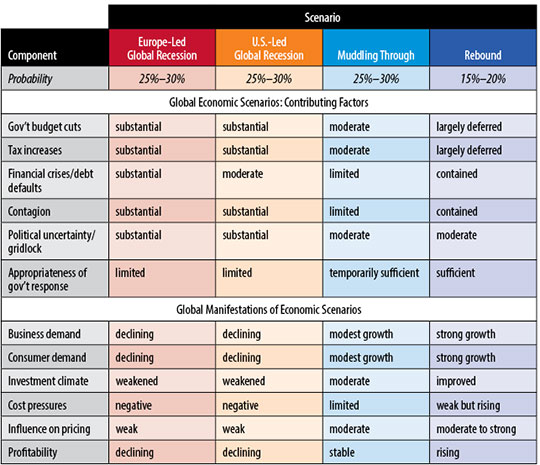
    Table 1 lists the four scenarios and suggested probabilities, contributing factors, and global manifestations. A fuller description of each scenario comes in the next section.

    In the two Global Recession scenarios, the problems in the United States and/or Europe lead to worldwide recession, which is defined by a sharp slowdown in global growth. The Europe- and U.S.-led global recession scenarios are associated with greater government budget cuts and tax increases than in the other scenarios, and with greater political uncertainty, gridlock, and substantial contagion effects. Governments are less able to act, and some policies may be ineffective or counterproductive. Output declines in the U.S., Europe, and Japan, and slowdowns in growth occur in developing countries.

    The recession scenarios are negative for consumer spending, business investment, hiring, and risk-taking. Information technology spending is cut back. While cost pressures abate, companies have little ability to influence pricing; profitability declines.

    In the Muddling Through scenario, crises go to the brink, and little is done to immediately solve fundamental problems, but policies temporarily prevent severe economic and financial disruption. The Rebound scenario is facilitated by the most extensive delays in spending cuts and tax increases, together with increased confidence from agreement on long-term solutions. Serious but incomplete efforts are made to reduce impediments to growth and adjustment.

    As of mid-summer, I rate the probability of a Europe-led global recession and a U.S.-led global recession each at 25–30 percent, with global recession most likely fully underway some time in 2013 in each case. The probability of a more severe global recession led by both Europe and the United States I put at 30–40 percent. The probability for muddling through is 25–30 percent, and for the rebound scenario it is 15–20 percent.

    Developments and impacts are not quantified here, nor are longer-term prospects considered. More extreme possibilities are not addressed; these include wars, a major breakup of the euro in the next two or three years, a large energy price shock, massive immediate U.S. budget cuts beyond the sequester, extensive increases in U.S. regulation after the election, or a Chinese economic collapse.

    I now turn to elaboration and discussion of each scenario.

    Europe-Led Global Recession

    Efforts by European institutions and the IMF to prevent debt defaults by southern European countries by extending credit only delay financial crises into 2013 or early 2014. With a major problem of insolvency (liabilities greater than assets) and not simply liquidity, a Europe without a fiscal union, common banking rules or even deposit insurance is unable to implement new structures in time to forestall severe adjustment. Increased bank capital requirements on January 1, 2013 also restrain lending. Financial market contagion spreads with rising interest rates on debt of already stressed countries, accelerated bank runs, and capital flight.

    These problems spill over to the United States and the rest of the world through declining securities values, losses of financial institutions that are then less able to lend, and declining trade. U.S. business is adversely affected by a strong currency as investors seek relative safety in the dollar. This slows U.S. exports and eventually expands exports from Europe and other countries into the United States. It also leads to lower overseas earnings for U.S. companies as a result of less favorable currency translation.

    Efforts to reduce debt in Europe create ongoing financial pressures on many countries, including Brazil, India, and China, and other countries whose economies are already slowing. While the greatest problems are in southern Europe, many other impacted countries including the United States take years to return to pre-crisis levels of growth.

    Source: GPS
    Table 1. Global economic scenarios.
    Source: GPS
    Figure 1. General government gross financial liabilities as a percent of gross domestic product (GDP), with OECD projections to 2013.

    U.S.-Led Global Recession

    The U.S. economy is thrown into recession by a combination of tax increases and budget cuts (the sequester) that together constitute the January 1, 2013 so-called fiscal cliff. Tax and spending changes are modified, but the remaining tax increases from the end of the Bush tax cuts, together with those in the Affordable Care Act, weaken incentives to save, invest, and take risks. Additional pressures come from increased bank capital requirements and other financial regulations that restrain lending.

    The recession in Europe and slowdowns in other countries further weaken the U.S. economy. High debt and unfunded obligations limit the ability to stimulate the economy with additional spending and limit the effectiveness of additional stimulation. Congressional gridlock prevents strong action, and the Federal Reserve has little additional room to stimulate the economy. The U.S. recession exacerbates the recession in Europe and weakens the global economy. U.S. and European recovery is very slow.

    Muddling Through

    The U.S. manages to “kick the can down the road” with enough policy changes to avoid the worst crises, but is unable to stimulate much growth. Tax increases and budget cuts are largely delayed in response to high and rising levels of unemployment but hold back recovery when they return. Economic and policy uncertainty and high levels of financial and business regulation continue to restrain growth and employment. However, underlying technological change is strong and enables continuation of modest growth, along with very low interest rates. Recovery in construction is limited.

    Europe also is able to delay the worst crises, such as would occur if there were insufficient resources to prevent major bank failures or one or more countries abandoning the euro. However, it must work through a recession that is severe in some countries and dampening growth in others. The United States, France, Japan, India, and China institute additional economic stimulus.

    Rebound

    In this scenario the United States temporarily avoids a recession by delaying most tax increases and budget cuts and delaying or modifying some of the most intrusive regulations. A new round of stimulus measures that includes major tax restructuring and infrastructure spending is instituted. A bipartisan plan for long-term fiscal discipline increases confidence. Businesses and consumers take advantage of technological opportunities, low interest rates, and moderated energy prices. Construction begins to recover with renewed housing demand and increased government spending on infrastructure. U.S. banks, with strong balance sheets and modest amounts of loans to Europe, are not heavily affected by the European financial crises and recession. Strong equity prices, bolstered by demand from foreigners seeking a safe haven, boost confidence and add purchasing power. Businesses are willing to take more risks.

    Improved U.S. growth somewhat tempers problems in Europe and elsewhere. Europe manages to implement policies to get through its challenges without a deep crisis or creating severe contagion effects. Counterproductive labor rules in Europe are modified, and tax avoidance is reduced. Austerity is modified and more emphasis is place on growth. The slowdown in the world economy abates, facilitated by the temporary resolution of problems and increased public and private investment in several countries.

    Implications for GNSS

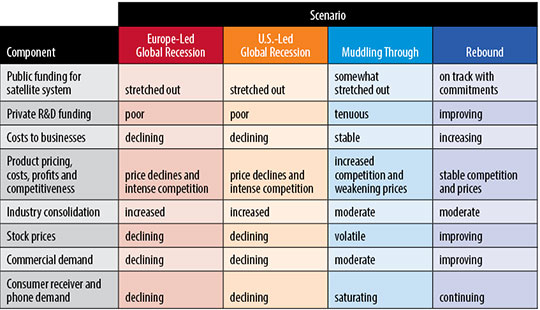
    The most severe consequences for the GNSS industry come in the case of combined U.S.-led and Europe-led recessions, a prospect with a 30–40 percent probability. The reduced contribution of the GNSS industry will in turn impact economies, for which GNSS benefits are great. The effects of deep recession can be seen in the behavior of GPS equipment revenues in North America, which grew 7.9 percent in 2008 and declined by 3.6 percent in 2009, after earlier increases of 17.3 percent in 2006 and 14.5 percent in 2007. Table 2 summarizes the broad implications of the current possibilities for the industry.

    Source: GPS
    Table 2. Implications of global economic scenarios for GNSS.

    Overall Influences

    Even if the budget cuts from the U.S. sequestration are delayed or reduced, the Department of Defense faces severe pressures from the remaining 2013 budget and in out years that are likely to cause launches of GPS satellites to be stretched out. Efforts by House and Senate Appropriations Committees to dramatically reduce the civilian portion of GPS funding in the Federal Aviation Administration FY2013 budget, threatening the timing of civil signals and the ground support system, are a sign of things to come. Delays and modifications are greatest in the recession scenarios. In global recession, plans for GPS III crosslink and spot beam capabilities are dropped.

    The Air Force has requested funding to develop dual-launch capability for GPS III in its 2013 budget. Budget pressures could lead to a more final decision to proceed with dual-launch within the next two or three years if it can be shown to reduce costs. That could make up for the delays later on, but not before several years of falling behind schedules. Budget-induced delays in other programs could alleviate a shortage of launch capacity in the United States, offsetting some of the impacts of shortages on GPS. However, a slowdown in ordering launch vehicles could negate the lessening of delays. Budget pressures also could result in a reduction in the number of satellites in the GPS constellation below 30, as satellites age and replacement slows. Only 24 GPS satellites are guaranteed. Only in the rebound scenario could launches be on track for the next couple of years.

    Budget stringency also affects research and development and production for capabilities that are planned for later years. Military GPS user equipment purchases are stretched out by funding constraints to various degrees depending on budget levels. Military developments could change any aspects of the outlook.

    Budget pressures from the European recession could cause Galileo satellite launches to be stretched out and/or the constellation to stop short of 30 satellites. Russia’s GLONASS program is unaffected by budget pressures as long oil prices do not fall dramatically below the $80 level. China’s Compass program is not likely to be subjected to delays due to funding even if the Chinese economy slows dramatically. However, economic weakness does cause delays in Japan’s QZSS system and India’s IRNSS system.

    Government budget pressures on both sides of the Atlantic, which are greatest in the recession scenarios, could make resolution of the MBOC patent dispute on the common GPS-Galileo civil signal more difficult and drawn out, adding uncertainty and delaying efforts to take advantage of the common signal.

    The impact of economic weakness on private R&D funding for user equipment and services could be substantial in all countries. The private GNSS investment climate is favored by low interest rates, rapid technological change in the industry and in information technology generally, by the evolution of several GNSS systems, and by the growth of markets in developing countries. However, with economies slowing, investment risk remains high.

    In the United States, investment in GNSS product and production process development is hampered by political/policy uncertainty, including satellite deployment, spectrum issues, and European licensing demands. Capital investment and merger and acquisition incentives depend significantly on prospects for scheduled tax increases on capital gains and dividends, and for investment and R&D tax credits, but the composition of tax revisions is not predictable in the present political climate. In Europe, private investment is adversely affected by recession and uncertainty about the economic and policy outlook.

    Business costs decline in the recession scenarios as demand for materials weakens from many industries and the labor market loosens. Company borrowing costs remain low from low interest rates but can rise because of higher risk premiums from lender concerns about the health of borrowers. Costs start to increase in the recovery scenario.

    Percentage swings in profits are much greater than those in revenue, and some firms move from profit to loss when economic conditions deteriorate. Profits fall sharply in the recession scenarios as effects of weakening demand on revenue and unit costs greatly exceed the benefits of lower input costs.

    Prices of products such as chips, antennas, and receivers that have been declining over time fall more rapidly in recession. In the early stages of recession, inventories can pile up, but production cutbacks are incomplete at first because of uncertainty about demand. This contributes to declining profits. More extensive cutbacks that follow are insufficient to offset the allocation of fixed costs over a smaller production base for most companies. Competition intensifies as companies adjust inventories and vie for a shrinking market or one that is growing less rapidly than expected.

    Mergers and acquisitions tend to be most prevalent at the ends of the economic spectrum. When the industry is in recession, some companies merge to obtain cost savings. In early stages of recovery, it is less expensive for companies to acquire existing assets and companies than to build new. When times are good, mergers often occur because the value of the more successful acquirer’s stock is high relative to the stock of the acquired company, and because of a desire to obtain scarce technology and talent. There may be greater interest in bringing a product that has had a limited market to the acquiring company’s larger customer base when the market is growing more rapidly. Over the last century, merger booms in the United States have largely occurred during stock market booms. Initial public offerings of stock also are more frequent during periods of generally high stock prices.

    Mergers and acquisitions can permanently alter the structure of the industry, leading to fewer, more dominant players and redefining customer, partner, and supplier relationships. Some acquisitions may increase pricing power in the long run. More GNSS companies will be owned by firms providing instrumentation, information technology, and other products. Some companies such as Trimble and Hexagon have strategies of making numerous strategic acquisitions; their pace of acquisitions may not vary as much with business conditions as those of more opportunistic acquirers.

    Prices of stocks in companies in the industry tend to move with trends in overall stock markets, but also reflect specific industry developments such as product cycles, technology shifts, and sources of competition. For example, some companies that have thrived with GPS may not be the same ones that are most successful in offering GPS+GLONASS receivers to industry. Some European companies may get a head start in making user equipment that takes full advantage of Galileo. However, a slow product market may give some suppliers a chance to catch up in product development.

    The shift from consumer receivers to smartphones has reduced the stock prices of consumer receiver manufacturers such as Garmin and TomTom. The Navteq division of Nokia and the TeleAtlas division of TomTom that supply maps have had to face great pressures from new sources of competition from Google, Microsoft, Apple, and others just when they had to deal with economic slowdowns.

    Application Sector Impacts

    Both business and consumer demand for user equipment decline in the global recession scenarios. In the muddling through scenario, consumer demand for receivers and smartphones is saturating. Commercial demand continues at a moderate pace, spurred by opportunities for multi-constellation equipment. Demand from both businesses and consumers improves in the rebound scenario.

    Recession scenarios adversely impact demand for GNSS equipment for survey and construction around the world. A U.S. recession would reverse the mid-2012 fledgling start of a housing recovery, but increased spending on infrastructure would raise public construction spending. In the rebound scenario, U.S. private construction picks up along with other investments. Greater construction spending increases demand for survey and construction applications, with public construction heaviest on road paving and building, and private construction heavier on energy and other engineering construction projects. Telecommunications and information technology are encouraged as part of the emphasis on infrastructure.

    A severe outcome for the European economy in the Europe-led global recession scenario stalls growth. Demand for equipment to take advantage of Galileo is slow in the next 2–3 years. In the rebound scenario, European stimulus has only limited impacts on construction because of financial constraints and an overhang of supplies from overbuilding and weakened demand. Financial problems of regional and local governments, for example in the United States, Germany, and Spain, adversely impact construction, especially in recession scenarios. Demand for GIS systems depends both on construction and on government use and is especially sensitive to economic and government budget conditions.

    Economic rebound raises commodity prices, increasing demand for agricultural and mining GNSS equipment. In a stronger U.S. subsidy-cutting environment and/or if there are large declines in commodity prices from economic weakness, demand for GNSS agricultural equipment is reduced. Demand for GNSS mining equipment is closely aligned with the behavior of commodity prices, which are very sensitive to economic conditions.

    Demands for aviation and marine systems are subject to cyclical influences in both transportation and recreation uses. Demand for scientific uses is heavily influenced by government budgets.

    In the rebound scenario, the shift from consumer receivers to smartphones is accelerated as more households are able to afford data plans, and more businesses take advantage of mobile connectivity. In the recession scenarios, receiver markets become saturated more quickly as demand ebbs. Some consumers switch to smartphone use of GPS where it is free, to avoid the cost of purchasing receivers. Nevertheless, smartphone use of GPS grows less rapidly because of a slower shift from unconnected phones to connected smartphones. Purchase of new or upgraded vehicle GNSS systems is more cyclical than the already highly cyclical demand for vehicles, and is further impacted in recession by the availability of phone-based alternatives. Location-based services continue to grow rapidly in all scenarios, with the rate of growth moderated by conditions in the various economies.

    Conclusion

    The overall outlook is cautious in the face of large potential threats and uncertainties. However, the industry has weathered many storms before, and its long-term outlook remains strong.


    Irving Leveson of Leveson Consulting is an economist and strategic planner who has worked extensively on GNSS markets, benefits, and financing. He previously served as director of economic studies of the Hudson Institute and senior vice president and director of research of Hudson Strategy Group. He received his Ph.D. from Columbia University.


  • Expert Advice: Mobile Computing on the Rise

    This discussion of current trends in location-enabled mobile devices takes as its foundation the different operating systems (OSs) for those devices. Why? For GPS/GNSS hardware units to be useful, there have to be software applications — apps — also riding on those units. Apps are totally dependent on the operating system. An analogy is that the operating system is the foundation of a house and the app is the house itself. The type of foundation you have drives what type of house you can build.

    For example, no one is going to write an app today for Palm OS because that OS is essentially dead. While that’s an obvious one, a not-so-obvious one is Microsoft Windows Mobile. Most apps written for professional users are written in Windows Mobile, but Microsoft hasn’t done a good job of communicating its intentions regarding Windows Mobile, so users and developers think Microsoft may abandon it.

    On the other hand, Android is gaining so much momentum. Will developers rewrite their apps from Windows Mobile for Android? Or for Apple’s iOS? Can they afford to? Can they afford not to? If they don’t, that would mean that fewer professional apps will be available for Android and iOS users. Will that mean Windows Mobile will be the OS for professional GPS/GNSS users, and conversely, will Android/iOS be the OS for consumer-level GPS/GNSS users? Taking it to a practical conclusion, according to the type of mobile computing device that you purchase, what kind of location application will you be able to use?

    Photo: Apple
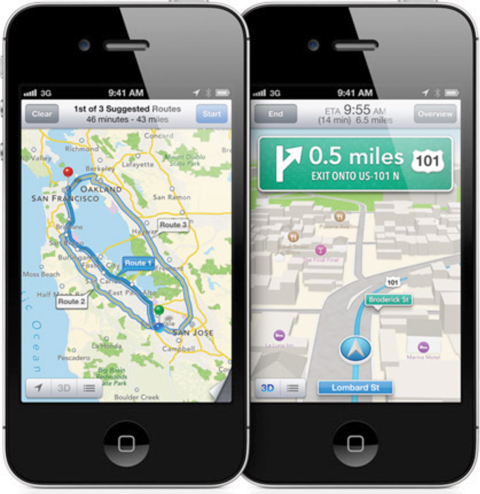
    Smartphones. Apple iOS’s new Maps app will likely be the largest scale crowd-sourced app ever introduced.


    PNDs Out-Smarted

    For the past decade, GPS personal navigation device (PND) sales have burned white-hot. In 2007, Garmin experienced double- and triple-digit growth, selling more than 10 million units. TomTom grew from zero to hero and sold more than 9.5 million units in that same year. During that brief golden era, every consumer electronics company who was anyone took a stab at introducing a PND to get a piece of the action. As unlikely as it seems, Garmin and TomTom stayed on top, fighting off consumer electronic giants like Sony, Panasonic, Hewlett-Packard, and Philips, all orders of magnitude larger. PNDs ruled the GPS world during that era.

    Credit: GPS World
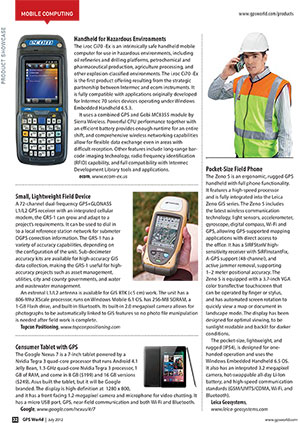
    Download a PDF of our Mobile Computing Product Showcase.

    At the height of that period of explosive GPS PND growth, Apple introduced a new generation of smartphone, the iPhone, in January 2007. At that time, there were approximately 17 million smartphones on the market. Nokia with its Symbian operating system led the pack at 63 percent of worldwide market share, Blackberry was the rising smartphone of choice, while Microsoft Windows Mobile operating system captured 18 percent. Google’s Android operating system had not yet debuted.

    It’s amazing how a mass-market technology, so personal to us all, can change so quickly. Today, Google’s Android operating system dominates the smartphone market (roughly144.4 million smartphones were sold in Q1 alone of 2012, according to Gartner Research) with a 56.1 percent share. Apple’s iOS follows at 22.9 percent; Symbian (Nokia) has fallen from leader to bit player at 8.6 percent, and keeps company in the low rungs with RIM/BlackBerry (6.9 percent), Samsung’s Bada (2.7 percent), and Microsoft Windows (1.9 percent).

    The trend is clear. Android and iOS are cleaning up at the expense of all the others. Is it any coincidence that these two are the ones making the most of their maps and nav? More on this in a moment.

    By the way: every one of the 144.4 million smartphones that shipped in the first three months of 2012, no matter what operating system it ran on, carried a GPS receiver inside, typically a chipset from Broadcom, CSR/SiRF, u-blox, Qualcomm, or Texas Instruments. That spells trouble for Garmin and TomTom. Google and Apple are doing to Garmin and TomTom what Microsoft did to NetScape with Internet Explorer.

    Even with GPS PND prices at an all-time low, Google’s Navigator, with high-quality, PND-like turn-by-turn street navigation, is included on Android smartphones free of charge. Apple is following suit. Just last month, Apple introduced the Maps app for turn-by-turn street navigating as well as real-time traffic information. With more than 100 million iPhones behaving like traffic sensors, Apple’s Maps app will likely be the largest scale crowd-sourced app ever introduced.

    What does this mean to Garmin and TomTom? The numbers don’t lie. In February 2012, TomTom reported a 40 percent decrease in GPS PND sales for Q4 2011 compared to Q4 2010.


    Tablet Computers

    For another wild ride, take a look at the tablet-computer market. The tablet has been around for many years. I remember playing with them in the 1990s when they were horribly expensive ($3,000–$5,000). The price, a limited outdoor-viewable display, and power usage all combined to squash unit sales. Only a few manufacturers such as Fujitsu had the determination to stay. That all changed in 2010 when Apple introduced the iPad.

    Prior to the iPad rollout, tablet computer sales were limited primarily to business users. Healthcare provided a particular arena for Fujitsu and others to focus on, and there were a few other markets that were not very price-sensitive, and so receptive to the tablet. The iPad blew away that $3–5K price point (iPad 2, $629) and brought the tablet experience to the average consumer. The result? Roughly 67 million units sold since its introduction, far surpassing all tablet computer unit sales in history in just two years. Apple hit a sweet spot, for sure.

    The iPad catalyzed the tablet industry for two reasons:

    • It opened the eyes of the consumer to the applications of a tablet computer.
    • It drove the price-point expectation of all tablets down.

    Of course, the iPad has its limitations. It runs Apple’s proprietary operating system, iOS, so you are limited to the number of apps written for that platform. It also lacks horsepower to run more challenging programs that an Intel or AMD-based computer can breeze through. From a GPS/GNSS perspective, certain models of the iPad sport a GNSS chipset (from Broadcom) similar to mobile phones; however, because of the way the GPS functionality is designed into the system, accuracy is limited to a few meters at best. Power GPS/GNSS users would love it if Apple would implement serial port profile (SPP) in its Bluetooth software. Then, GPS/GNSS users could attach any Bluetooth-compliant GPS/GNSS receiver they like, even RTK-capable receivers for centimeter-level accuracy. But Apple doesn’t seem interested.

    As in the mobile-phone market, Google is making a strong tablet play with its Android operating system. Google’s device-agnostic operating system is attracting tablet hardware makers in droves with iPad-like tablet computers, notably Samsung Galaxy (with GPS) and Amazon Kindle Fire (no GPS). Also, there’s an interesting link between mobile phones and tablets. Gartner reports that 40 percent of user apps run on both mobile phones and a corresponding tablet computer. This is significant because the operating system may well drive the tablet purchase. For example, a person with an iPhone is more likely to buy an iPad than a Samsung Galaxy, which runs Google Android.

    However, Android has not achieved the dominance in the tablet computer space that it has in smartphones. iOS (iPad) held 67 percent market share in 2011, falling to 61 percent in 2012,but still retaining the pole position. Android is a strong second with 29 percent in 2011, rising to 32 percent in 2012, according to Gartner. No other operating system even comes close.

    Gartner forecasts show that Android will eventually approach iOS in market share, and my guess is that it will overtake iOS within five years. Apple’s proprietary system will catch up to it. While GPS/GNSS chipsets aren’t as widely integrated in tablets as they are in mobile phones, that will change as GPS/GNSS use becomes even more ubiquitous. Further, there are plenty of ways to add GPS to a non-GPS model via Bluetooth, PCMCIA, and USB.

    Android supports Bluetooth SPP, or a derivation of it, so you can connect any Bluetooth SPP-compliant GPS receiver that you like and not be limited to the receiver chipset the tablet engineer decided to design into the system.

    ]Although PDAs have an embedded receiver, they are lower-precision systems, in the 1- to 5-meter range, largely due to poor antennas. For higher precision requirements, these are used as field data collectors connected to an external antenna and/or a high-precision GPS/GNSS receiver.Handheld PDAs

    Handheld personal digital assistants (PDAs) were all the rage 10 years ago when Compaq Computer Corp. introduced the iPAQ H3100 running Microsoft’s PPC2000 (Pocket PC) operating system, the precursor to Microsoft’s Windows Mobile operating system. The iPAQ made a strong run through 2009, with the last models running Windows Mobile 6 before smartphones became powerful enough to negate the purpose of the PDA.

    While we probably will never see another introduction of a new iPAQ-branded PDA, it was a useful device and an inexpensive handheld for interfacing to GPS/GNSS receivers. Albeit a niche market, there’s still a demand for such handhelds for field data collection.

    According to the nature of capitalism, where there’s a demand, suppliers will show up. Since the iPAQ has faded, and smartphones aren’t yet well-suited as field data-collection devices, a new breed of semi-rugged and rugged PDAs has emerged in the past year from small, niche-oriented companies. Examples include the SXPad from Geneq, Juno 3 series from Trimble, and the Mesa/Rampage 6 from Juniper Systems/SDG Systems.

    These devices, with GPS/GNSS receivers embedded, are not built for the average consumer. Their prices are higher — but coming down — and they are more rugged; some are water-resistant, some waterproof.

    In a nutshell, PDAs went professional, targeting organizations that need maximum data-collection productivity from field personnel. Although they have an embedded receiver, they are lower-precision systems, in the 1- to 5-meter range, largely due to poor antennas. For higher precision requirements, these are used as field data collectors connected via Bluetooth to a high-precision GPS/GNSS receiver.

    Although the professional PDA market is not immune to the operating-system wars we’ve seen in mobile phones and tablet computers, it’s a bit stickier. Professional data-collection apps have been written almost exclusively around the Microsoft Windows Mobile operating system. These niche software programs are written for relatively small audiences (compared to the mass-market apps on smartphones), and it can be economically tough to justify porting the apps to iOS or Android. Therefore, the professional PDA market has been slower in adopting iOS and Android.

    Microsoft hasn’t helped the cause. It stopped certifying new products with the Windows Mobile operating system, creating confusion in the user community. Is Microsoft exiting the mobile device business? Not according to the company. It appears that it has split the mobile device business into two operating systems. Smartphones will run Windows Phone, and other mobile devices will run Windows Embedded Handheld, which is compatible with Windows Mobile.

    The problem, the confusion, and the frustration come from the fact that the Windows Phone operating system is not compatible with Windows Mobile (or Windows Embedded Handheld). Microsoft split the market between smartphones and other Microsoft-driven mobile devices. Given Gartner’s research that 40 percent of users’ smartphone apps also run on a tablet device, this means that Microsoft is going to either change that dynamic or suffer the consequences.

    No matter which direction mobile devices take, be it phone, handheld, or tablets running Android, iOS, Windows, or something we haven’t yet seen, embedded GPS/GNSS functionality will remain the centerpiece of location technology in all mobile devices. Even more exciting are the new GNSS signals and constellations in the next five years that will bring unprecedented accuracy to all mobile devices, driving the development of a tremendous number of new apps to exploit the improving accuracy.


    Eric Gakstatter is contributing editor for survey at GPS World magazine and the editor of Geospatial Solutions. He has spent the past 20 years in the GPS survey/mapping industry, using many brands of GPS equipment and software. He is a non-partisan advocate for the GPS user community, and a frequent speaker at user and technical conferences.

  • Expert Advice: Location by Database

    Expert Advice: Location by Database

    Tarun Bhattacharrya, Hassan El-Sallabi, Jian Zhu, Jeff Wu, and Per Enge.

    Radio-Frequency Pattern Matching

    By Tarun Bhattacharrya, Hassan El-Sallabi, Jian Zhu, Jeff Wu, and Per Enge

    Radio-frequency pattern matching (RFPM) is the engine that enables the use of mobile-phone signals to locate wireless devices in any environment, including dense downtown areas and indoors. This exciting technology leverages the power of the database to improve location accuracy to within 50 meters in even the toughest signal environments. Significant advances in RFPM technology have been made over the last 10 years. The system described here is deployed in more than 24 wireless networks to provide the location of E-911 callers and help save lives. For simplicity, we focus on the RFPM using signal strengths even though the technology also works with arrival times, signal-to-noise ratios, differential signal strengths and any signal parameter that varies in a predictable fashion over the coverage area.

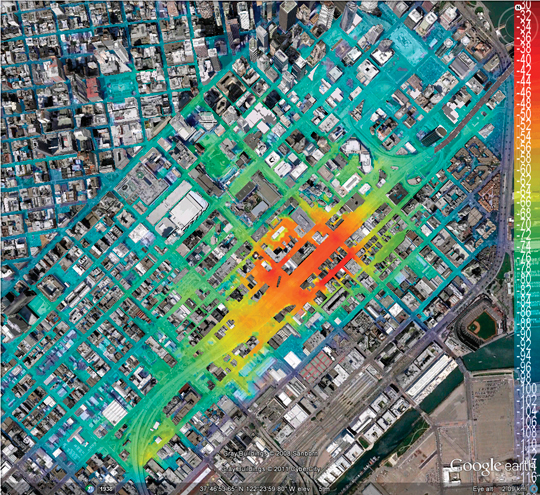
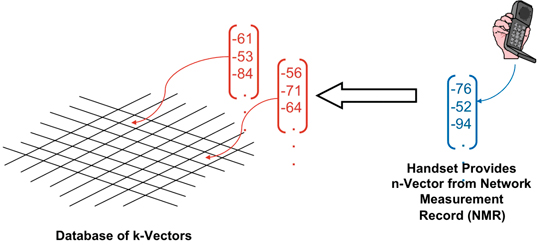
    Like GPS, RFPM is based on correlation. However, it does not correlate a received spread-spectrum code with a replica code stored in the receiver. Rather, it correlates the signal strength of cell-phone signals measured by the roving phone to a database that contains a map of those signal strengths for the covered area. Consider Figure 1. It shows this key correlation operation. As shown, the database contains a k-vector for each location within the covered area, where the k elements give the estimated strength for the k mobile phone signals that can be received at the given grid point. These k-vectors are typically stored over a 10- or 30-meter grid. This grid of predicted signal strengths is built in advance and is updated only when the topography of the wireless network changes. Thankfully, base stations do not generally move!

    Figure 1. Radio-frequency pattern matching of n-vector from mobile user to k-vectors within database.

    The mobile phone provides the network measurement report (NMR) in real time. This report does not require any network hardware or on-phone software beyond that required by the 2G, 3G and LTE standards for all mobile phones. Thus, the Polaris Wireless solution is capable of locating any mobile phone over any air interface. The NMR is also shown in Figure 1. It contains an n-vector of received signal strengths, where k ≥ n. A multiplicity of n-vectors are backhauled to the server that contains the database. They are correlated with the k-vectors, and the estimated location of the mobile phone is the location associated with the maximum correlation.

    For Example, San Francisco

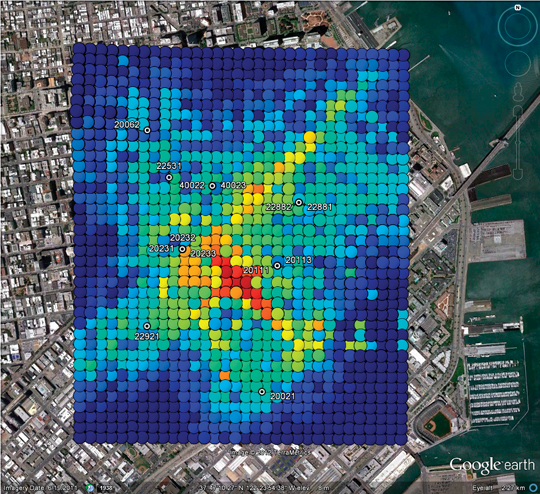
    Figures 2, 3, and 4 explode the RFPM database for the financial district of San Francisco. Figure 2 is the top view, and the Bay Bridge is shown heading northwest across the Bay. The numbered black dots are some of the base stations in action for this area. Figure 3 digs down one level. It shows the individual k-vectors contained within the database. As shown, this database is based on a 30-meter grid. Figure 4 is a super-zoom that explodes the individual k-vectors. As shown, each of these vectors contains an element for each base station that can be received at the given location. In Figure 4, each element is color coded to correspond to the strength for the signal from the given base station.

    Figure 2. Coverage area of an RFPM database within San Francisco.
    Figure 3. Zoomed view of San Francisco database showing a multiplicity of k-tuples.
    Figure 4. Radio-frequency pattern matching of n-vector from mobile user to k-vectors within database.

    Building the Database

    RFPM accuracy depends strongly on the quality of the database, which needs to be built with great care. In fact, signal propagation depends on the network topology including:
    ◾    antenna location, heights, patterns, effective radiated power, tilt, and azimuth
    ◾    cell type, such as micro-cell, macro-cell, indoor or distributed antenna systems.

    Signal propagation also depends on information available     from geographical information systems such as:
    ◾    tree canopy
    ◾    height of buildings and terrain
    ◾    topography (water, open area, suburban, urban)
    ◾    roads.

    With this data, the signal strength radiating from a base station can be estimated. This is not a simple business. For example, the calculation must identify the points where terrain or buildings interrupts the ray from the transmitter to the receiver. It must also identify the points where these obstacles break the Fresnel zone that surrounds the ray.

    Finally, these open-loop predictions are tuned based on a sparse set of measurements. Once tuned, the database is time invariant or nearly so. If minor changes are made to the network topography, the open loop predictions alone are sufficient to accommodate the changes. If network changes are significant, such as the building of many new base stations, then the open-loop predictions must be updated, and a new set of measurements used to tune the predictions.

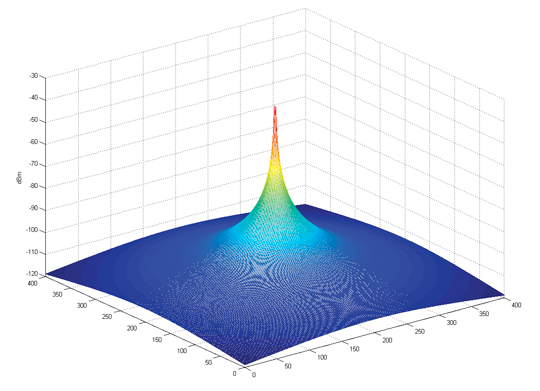
    Figure 5 shows a typical map of signal strengths surrounding one mobile phone in a completely open area. Absent terrain and buildings, the signal strengths vary rather smoothly. Figure 6 is for one of the transmitters in the San Francisco financial district, which is a much more complicated urban environment due to the dense concentration of high-rise buildings and uneven terrain. In this case, the signal-strength signature has a gratifying abundance of detail. This detail enables RFPM to work very well in the complicated signal environments that we find in downtown areas and also indoors. In short, RFPM benefits from the buildings and terrain that hinder satellite measurements.

    Figure 5. Predicted signal strength for a transmitter surrounded by open ground.
    Figure 6. Predicted signal strength for one transmitter in the San Francisco financial district.

    Performance and Summary

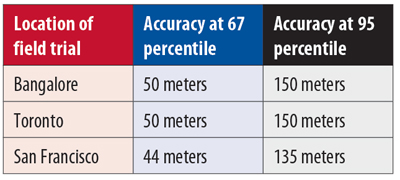
    RFPM works well. It provides high accuracy in a in a wide variety of environments. Polaris Wireless routinely tests the accuracy of its solution in urban settings. Table 1 shows the results of such evaluations, based on measurement sets that are not used to tune the database.

    Table 1. Evaluations based on routine accuracy tests of RFPM in urban settings.

    These days, robust navigation for downtown and indoors is based on an expanding suite of location technologies. These include: assisted GPS, new satellite constellations (Galileo, GLONASS, Compass, and so on), inertial measurements, Wi-Fi ranging, and signals from low-Earth orbit. RFPM, and its unique reliance on database-derived location, should remain an important part of this mix.


    Tarun Bhattacharrya is vice president of research at Polaris Wireless. He earned his Ph.D. in electrical engineering from the Indian Institute of Science.

    Hassan El-Sallabi received his D.Sc. in electrical and communications engineering from Helsinki University of Technology, Finland. At Polaris he works on RF propagation modeling.

    Jian (JET) Zhu received his Ph.D. in electrical engineering from Georgia Institute of Technology; he is a research engineer at Polaris.

    Jeff Wu focuses on algorithm development for propagation modeling at Polaris, and is a Ph.D. candidate in electrical engineering at Stanford.

    Per Enge is the Kleiner Perkins professor of engineering at Stanford University, where he directs the Stanford Center for Position, Navigation, and Time. He is also a technical advisor to Polaris Wireless.

  • Expert Advice: What You Need to Know about Testing

    Five experts share what original equipment manufacturers need to know about testing their GNSS devices during product development.


    System Health

    Headshot: John Pottle
    John Pottle, Spirent Positioning Technology

    Most people are aware that simulation forms a key part of GPS receiver development and testing.

    However, simulators are also used as critical tools in other areas, from the development of a new GNSS system to testing system problems and effects of interference.

    From the beginning of the Galileo program, simulators have been used to enable development of the ground segment monitoring receivers. These Ground Sensor Stations continuously monitor the performance of the Galileo satellites and provide information to the Galileo Control Centre in Fucino, Italy, from where correction messages are generated.

    Galileo RF Constellation Simulators were also used for research and development testing of the initial user segment receivers for the Galileo system. These included not only the Open Service receivers but also development of the initial Public Regulated Service receivers that include the encryption algorithms.

    Similarly, simulators have been used for many years to test receivers that actually fly in space, including on the GPS satellites themselves as well as missions like the Space Shuttle.

    When GPS has a problem, the industry oftentimes relies on simulators to recreate the problem in the laboratory to help understand the issues and find fixes.

    For example, when SVN-49 satellite issues were first noticed in April 2009, simulator scenarios were generated and made available to the industry in co-operation between Spirent Federal and the GPS Directorate. These scenarios helped with the characterization of the problems on board the satellite and also with looking at possible fixes.

    More recently, simulators and other receiver test approaches were widely used to help with the understanding and quantification of the impact of the proposed LightSquared broadband network on GPS systems.

    A wide range of simulators was deployed in the testing that was led by the Technical Working Group set up under the auspices of the FCC. The sub-groups of the TWG used not only RF constellation simulators but also live sky sample and playback systems for testing. A wide range of test approaches was adopted, including conducted testing (from the RF simulator via co-axial cable into the receiver front-end, bypassing the antenna and with antenna effects being modeled as part of the simulation where required) and over-the-air test approaches in small and large chambers.

    Following the LightSquared testing the current debate is whether it would be helpful to have certification or standardization of GPS and other GNSS receivers in some form. Standards for GPS systems already exist in the safety critical areas such as aviation and maritime as well as in areas such as emergency location (E-911). Discussion on extending current A-GNSS standards to include other positioning methods such as Wi-Fi positioning and MEMS sensor-based positioning are also underway in various standardization forums.

    Whatever the problems the industry and systems face today and into the future, one thing seems assured — simulation will remain a key tool to help create a repeatable and controllable environment to enable understanding and continuous improvements in navigation and positioning technology.

    John Pottle has more than 20 years of experience in technical, marketing, and business development positions in communications and navigation. He is responsible for marketing at Spirent Communications’ Positioning Technology division in Paignton, UK. He trained as a communications engineer and holds a master’s degree in business administration.


    Debug, Verify

    Headshot: Paul Myers, Spectracom
    Paul Myers, Spectracom

    The affordability, shrinking size, and power requirements of GPS and GNSS receivers are accelerating their integration into a multitude of products: personal navigation, safety devices such as alarms systems and cell phones, telematics devices, camera systems, and timing and control systems. But the additional capabilities of position, navigation, and time/frequency synchronization come with an increased cost of test and verification.

    Traditional lab bench development and field testing demonstrate operational capabilities. However, these methods alone may not reveal the subtle issues and fatal flaws found in the real world. Lab testing often demonstrates only the best or worst your test cases can offer. Furthermore, field testing only checks conditions and GNSS constellation operation for your location at specific times. Most integrators do not have the luxury of testing their product in the multitude of places their customers might use their product. This is where the application of a GNSS simulator adds value. GNSS simulators allow repeatable testing of real-world situations under a variety of test conditions and in a diverse set of simulated places at different times.

    The first step of GNSS integration is to define requirements based on the product use cases. The prudent test designer realizes lab tests, field tests, and simulation all have a place in the product development cycle, and later in maintenance.

    Once the product requirements and use cases are known, the type of GNSS receiver can be selected, and supporting software and hardware design can begin. High-level test design is best performed as you design your product. This allows you to better schedule and estimate project time and costs.

    Your type of product dictates your test plan design. You will need to allocate some testing to the lab, some to the field, and some to GNSS simulation. The right test case allocation depends on your product type.

    Depending on your product requirements, you may have to define navigation test cases, positioning test case, or time and frequency synchronization performance test cases. Position and navigation products require a GNSS receiver with sufficient accuracy and update rates to provide accurate position and navigation data. Time and frequency products, whether mobile or stationary, require a 1PPS output with a serial time code output and sufficient stability and precision to discipline an oscillator to generate precise time and frequency.

    Identify which test cases require execution in the lab setting, which require GNSS simulation, and which demand field testing, then allocate them in the test plan to project phase. The old adage that lab testing can’t catch everything that field testing finds can be cheated by the use of GNSS simulation. GNSS simulations reduce cost and schedule time by avoiding repetitive field testing and integration cycles. Plus, simulation testing allows iterative development and retesting by virtually testing in the field.

    For example, positioning and time and frequency products can initially utilize lab testing to iteratively develop features and accurately measure system performance. The GNSS simulation can then be leveraged to model the field environment under many different conditions, locations, and times. Finally, field beta testing then can validate the lab and simulation results with real-world beta site experience.

    Similarly, mobile navigation or time/frequency products benefit less from lab bench testing and require more in field testing to verify operation under real-world navigation scenarios. Solution accuracy can be baselined in the lab, but accuracy in the field is vital for product success. A GNSS simulator can be used to test conditions, remote locations, and time/dates impossible to achieve using the real GNSS signals. This reduces some of your testing to defining use cases and making simulator configuration files. Without simulation you can only develop, ship, and then fix bugs found by your customers — all the while sweating bullets waiting for users to report problems found from untested situations or when leap seconds occur.

    Finally, don’t forget to create regression tests from the verification testing already performed; this enables you to continue to maintain and re-verify product performance. Again, leverage the lab environment, GNSS simulator test cases, and your shipping product to create a product maintenance process. Remember, a smart designer develops the requirements, use cases, and test cases before completing design and development. And a smart integrator uses a GNSS simulator to field test the product before it ever leaves the lab!

    Paul Myers is a principal engineer at Orolia USA. He has more than 20 years of experience in embedded systems development in defense and commercial applications. He has a BSEE from Clarkson University, an MSEE from Syracuse University, and is a graduate of General Electric’s Advanced Course in Engineering.


    Modern Requirements

    Headshot: Markus Lörner,
    Markus Lörner, Rohde & Schwarz

    Receivers for satellite-based navigation systems such as GPS and GLONASS can be found nowadays in many electronic devices to support location-based services. The faster and more accurately the actual position can be determined, the better the user experience will be. The devices are typically used not only in open space, where the reception conditions would be ideal, but more often in densely populated cities, where harsh conditions such as urban canyons with obscuration and multipath propagation are prevalent. To ensure optimal performance, the receiver needs to be tested and verified with repeatable scenarios that can only be provided by a GNSS simulator.

    Standard tests such as time-to-first-fix and location accuracy need to be conducted for all GNSS receivers and modules.

    When using a GNSS simulator, this is a straightforward task. The definition of harsher scenarios with multiple obstacles that generate obscuration and reflections is already much more complex, as there are no common test procedures defined. As a result, vendors must specify and generate their own test plans. This requires very flexible GNSS simulation solutions that allow direct access to the satellite constellation configurations.

    Many of today’s state-of-the-art receivers are multimode receivers, which means that they support, for example, both GPS and GLONASS. They can therefore use satellites from both systems and still provide a location fix, whereas a single system receiver does not see enough satellites to obtain a stable 3D fix. Each of the two systems must be verified on its own, of course, but additional tests with both systems active are also required to make sure the receiver works properly with these hybrid scenarios. One additional test is to verify receiver performance when the system time of the different GNSS systems is drifting, since these system clocks are controlled and monitored separately.

    Increasingly more important is receiver performance in the simultaneous presence of many other signals, such as Bluetooth or WLAN, at a much higher signal level. Another aspect is that cross-correlation distortion from other GNSS systems degrades the desired GNSS signal. Again, no official test requirements are defined in general. The Federal Aviation Administration instructs aviation receiver manufacturers to perform tests with additive noise and CW interferer. Ideally, these tests can be done inside the GNSS simulator.

    To summarize, GNSS systems are used more often in especially harsh reception conditions, but users expect perfect location information almost everywhere. To ensure optimal user experience, greater emphasis must be put on testing. Addressing these needs requires a full-featured GNSS simulator, which ideally can also be used as an interference generator for Bluetooth and other standards.

    Markus Lörner is a product manager for RF signal generators and power meters at Rohde & Schwarz headquarters in Munich, Germany. He joined the company in 2000 after receiving his degree in electrical engineering from the University of Erlangen-Nürnberg.


    Success Factors

    Headshot: Mark Sampson, RaceLogic
    Mark Sampson, RaceLogic

    With more devices now using mobile location-based services and the completion of the GLONASS constellation, it has become more important than ever that companies who incorporate multi-GNSS engines into their products have a reliable, cost-effective way of accurately testing these devices and applications.

    Developing GNSS-enabled products within budget and to timescale has, however, always been a challenge. The traditional methods of repetitive field testing and expensive signal laboratory simulation have proved ineffective at offering engineers the repeatability and realism required to test how their devices perform in everyday, real-world scenarios.

    Introduction of multi-constellation GNSS simulators has enabled R&D departments to effectively record and replay real-world signals in testing facility conditions, all at a cost-effective price. Providing engineers with the repeatability, consistency, and reliability required to effectively test a range of GNSS-enabled devices, these compact and light-weight systems cut development times by reproducing genuine satellite signals, all from the comfort of your desk.

    Before you begin to see how your device performs, there are a number of factors to consider to assure successful GNSS testing is carried out. One of these considerations is the need to clearly pre-define objectives depending on the device or application to be tested and the stage in the product’s development cycle. These can include specific tests for the development of the product chipset, its module, and verification testing to ensure the product meets targets before it is released.

    The other consideration is having to test signal reception from multiple satellite constellations to a single GNSS receiver — a special challenge for R&D departments, with system-specific reference frames, system-specific propagation models, timing offsets, date rollover, and cross-system impacts all having to be taken into consideration before successful GNSS testing can be implemented.

    After these points have been resolved, using a simulator to simulate scenarios via live-sky signals couldn’t be easier. Connecting directly to an RF antenna input of a GPS engine and simulating the signals associated with navigation using GPS/ GLONASS / Galileo and satellite-based augmentation systems (SBAS), you can carry out highly repeatable tests without leaving the office.

    Working alongside a simulation software, engineers can generate a data file that can be replayed on a simulator based on a user-generated trajectory file. This allows you to simulate almost any kind of dynamic profile, at a set time and date, anywhere in the world.

    Mark Sampson has more than 15 years of experience in GNSS technology. He works closely with businesses such as Bosch, Intel, Samsung, and Telefonica, providing expertise in testing GNSS devices, applications, and integrations.


    Why Test?

    Headshot: John F. Clark, CAST Navigation
    John F. Clark, CAST Navigation

    Testing the operation and performance of a GPS receiver can be a time-consuming and complicated process. To achieve this effort, some receiver manufacturers and system integrators use a combination of receiving live sky GPS signals with an outside antenna as well as receiving signals produced from a GPS simulator.

    While you may think that it is easy enough to just go out and put up an antenna to receive the GPS signals from the live sky, you need to ask yourself what it is that you are actually evaluating. Are you evaluating a position solution that contains the effects of local variations such as antenna shading due to placement of the antenna in relation to an existing structure? Are you seeing some effects of multipath being induced to the receiver solution? Is the placement of the antenna causing a larger than expected error? Will you get different navigation results by testing at different times of day? How do you test your receiver under dynamic conditions that contain vehicle motion? Due to the volatility of the GPS constellation, a satellite simulator provides you with repeatable and customizable test conditions.

    A GPS simulator must model all transmission paths, anomalies, satellite motion, and user motion to provide you with the ability to control all aspects of the GPS signal to accomplish repeatable testing under known environmental conditions. A GPS simulator should also be capable of allowing you to define a specific time, date, and almanac to be utilized during the simulation, thus enabling you to reproduce the same GPS constellation characteristics as seen from a live-sky antenna for a specific time and location.

    You can also use a GPS simulator to assist with the evaluation of new software builds for receivers, characterize a receiver, or evaluate multiple GPS receivers under identical operating conditions. A few simulators also provide the ability to drive an inertial interface, to assist with aircraft avionics integration and testing in a dynamic environment without leaving the laboratory for expensive flight testing.

    Using a GPS simulator provides you with the ability to evaluate some operational specifications like time-to-first-fix, time-to-subsequent-fix, low signal-to-noise ratios, receiver loss of RF, reacquisition after signal loss, tracking of rising and setting SVs, and more.

    Some GPS simulators also allow you to define and simulate multipath signals. The ability to define the characteristics of multipath signals provides you with a very precise and repeatable signal source to accurately measure and quantify the effects of multipath signals on carrier-phase measurements and receiver performance. This allows you to accurately characterize multiple types of GPS receivers, enabling you to select the appropriate receiver for use in different types of applications and operating environments.

    John F. Clark is vice president, engineering, for CAST Navigation, LLC. He has more than 25 years of experience in the GPS industry, and has worked at CAST since 1991.

  • Expert Advice: Soldiers and Civilian GPS: Dangerous (and Deadly?) Expediency


    Headshot: Jules McNeff
    Headshot: Jules McNeff

    By Jules McNeff

    An old adage says, “Be careful what you wish for, you might get it.” That is particularly relevant in today’s world of GPS and the positioning, navigation, and timing (PNT) dependencies it has created. In business, it’s all about location, and in military circles, something called real-time situational awareness, driven by the ready availability of PNT from GPS. However, it has been reported (and validated by experience) that U.S. soldiers believe that the GPS equipment they are issued through official channels is too big, too heavy, uses too many batteries, and is old-looking and not sexy like the multi-color, multi-app personal electronics and smart phones they are accustomed to at home.

    Furthermore, they reportedly feel encumbered by Department of Defense (DoD) policies that require the use of encrypted military GPS signals when executing combat mission command-and-control or performing combat-related actions such as synchronizing tactical networks, designating targets, and calling for fire support when in contact with an adversary force. They wish they could just use their iPhone, or iPad, or similar smart device with its integral location-based apps and ready communication capabilities, and not have to deal with what many see as obsolescent gear and antiquated policies. Unfortunately, were that wish to really come true across the joint force and mission domain, it could have disastrous and deadly consequences.

    This is not intended to be a defense of the DoD requirements and acquisition processes, for there is much that could be improved within both. Adherence to those processes in the procurement of PNT equipment means that it will take longer to develop and produce the equipment than comparable commercial units, and that the equipment will probably be heavier and less user-friendly than commercial products.

    However, those processes exist and are rigorously followed, first because they are required by statute, but also for practical reasons of justifying investments of taxpayer resources and ensuring as much as possible that whatever is procured will withstand the rigors of service in its intended military application. For GPS equipment, this includes not only the rigors of the physical environment but also those of the electronic environment, including threats of both unintentional and hostile interference and signal imitation. It is precisely that threat environment that presents the greatest danger to reliance on commercial GPS products in military applications.

    The U.S. military and coalition forces have been fortunate from a PNT perspective over the last couple of decades in facing relatively unsophisticated adversaries with either limited access to or limited desire to routinely employ PNT countermeasure technology. Consequently, we have seemingly become complacent to the risks posed by overreliance on commercial-derivative PNT products. This complacency is apparent in the recent reporting from the Army’s forward-leaning Network Integration Evaluation (NIE) program, in which the Army assesses leading-edge commercial technologies and identifies those with great promise in order to fast-track them into operation, bypassing as much as possible the aforementioned DoD requirements and acquisition processes. 

    At the same time, the Army gives a wink and a nod to the GPS security policies requiring use of encrypted military GPS signals for combat operations. It is a virtual certainty that if GPS drives the location-based applications in the commercial-derivative technologies evaluated by NIE, those applications are all powered by civilian GPS and not the encrypted military GPS. As noted, civilian GPS is frequently seen by those not thoroughly familiar with PNT technology as the cheap, expedient choice because more secure or integrated PNT sources are too expensive, too heavy, too much bother, and so on. 

    It is also apparent, though not confirmed, that during NIE field testing, the opposing force toolkit does not include navigation warfare (NAVWAR) techniques for GPS jamming and spoofing. If it did, and if the test scenarios included active GPS jamming and spoofing, then the commercial location-based apps with civilian GPS as their input would not work or would derive erroneous solutions. In that case, the Army might have to reconsider its rapid deployment decisions for these vitally important devices. Clearly, it is not doing that.

    The highly touted Rifleman Radio, advertised by the Army as a success, uses civilian GPS as its source of PNT information. The Army is planning to deploy tens of thousands of these radios for operational use over the next several years. While soldiers may be told or even admonished not to use the position and timing solutions derived from these radios for other than situational awareness — in other words, not to use them for direct combat or combat-support tasks — the likelihood of that policy being followed in the real world is nil. Either of necessity or for convenience, soldiers will use what is made available to them for whatever purposes they deem appropriate. That will be true whether the commercial-derivative PNT solution is in a smartphone or a Rifleman Radio. 

    For the near term, that may not be a problem. However, at some point, in a contested environment against a knowledgeable adversary, mission effectiveness will be compromised and soldiers’ lives will be endangered by such devices. Further, proliferation of these devices will constrain our own commanders in their ability to employ offensive NAVWAR techniques that might be necessary to disrupt adversary use of open civilian GPS signals against our forces in the combat theater.

    These statements are not mere speculation. The vulnerability of civilian GPS signals to unintentional interference and intentional jamming is well known. Reports of personal privacy devices interfering with reception of civilian GPS signals at Newark Airport provide a recent example (see “Personal Privacy Jammers,” page 28 in this issue). What is less well understood, but even more sinister in a combat environment, is civil GPS susceptibility to spoofing: the intentional creation of false, but believable, signals. 

    In a recent interview with Fox News, Todd Humphreys, a well-regarded GPS researcher from the University of Texas, stated, “The civil GPS signal is completely open and vulnerable to a spoofing attack, because they have no authentication and no encryption. It’s almost trivial to mimic those signals to imitate them and fool a GPS receiver into tracking your signals instead of the authentic ones.” In a combat environment, such deception could result in mission failure or loss of life through loss of command-and-control communications in high tempo lethal actions, erroneous target designations, or misdirected fires.

    All those who recommend providing soldiers in combat situations with PNT capabilities derived from civilian GPS, whether via smart phone, iPad, or Rifleman Radio, in lieu of or even in addition to their less convenient but more reliable military GPS devices, should reconsider that recommendation in light of the above. 

    There is no argument to the statement that the DoD owes the warfighter more modern, integrated, compact, battery-efficient PNT devices incorporating military GPS. Those will come through the acquisition process, though not as fast as we all would like. In reality, a proliferation of civil PNT devices in military operations will likely delay further the availability of more suitable integrated military equipment. 

    In the meantime, we should not be misled because of our experience in today’s war. Instead, we must plan for future actions in anti-access/area denial situations against knowledgeable adversaries. We cannot afford to undermine the warfighters’ cause in advance by advocating reliance on vulnerable and exploitable commercial GPS equipment that can get them killed.


    Jules McNeff is vice president for strategy and programs for Overlook Systems Technologies. He served 20 years in the U.S. Air Force, and then was responsible for Defense Department management and oversight of the GPS program. He is a charter member of GPS World’s Editorial Advisory Board.

  • Expert Advice: Thank Your Lucky Stars

    Eric Gakstatter
    Eric Gakstatter

    In my 20-plus years of involvement in the GPS/GNSS industry, nothing has come close to the LightSquared debate for technical and political complexity, nor for potential effects on nearly every high-precision GPS/GNSS user in the United States. The industry’s destiny is somewhat controlled by a federal agency that is not very knowledgeable about how, when, and where GPS is used — although I’m sure they’ve learned a lot in the last 14 months.

    While receiver manufacturers have a firm grip on the technical complications of what LightSquared proposed, they have jockeyed for market position, as information released to the public is filtered through their marketing heads. Finally, media coverage is all over the place, from “LightSquared is doomed” to “this will happen.”

    On January 13, as we all know, the U.S. deputy secretaries for defense and transportation wrote, on letterhead of the Space-Based Positioning Navigation & Timing National Executive Committee (PNT EXCOM), to the head of the National Telecommunications Information Administration (NTIA), declaring that “there appear to be no practical solutions or mitigations that would permit the LightSquared broadband service, as proposed, to operate in the next few months or years without significantly interfering with GPS.”

    On February 14, the NTIA director wrote to the Federal Communications Commission (FCC) chairman in a similar vein with nearly the same language. That same day, the FCC stated its intent to “not lift the prohibition on LightSquared,” and to “vacate the Conditional Waiver Order, and suspend indefinitely LighSquared’s Ancillary Terrestrial Component authority.”

    It just so happens that LightSquared cannot accomodate military GPS users nor aviation GPS users. Those of you who use high-precision GPS can thank your lucky stars that the military and aviation folks are standing in your corner. Otherwise, as I warned back in May of last year, high-precision users would have been thrown under the onrushing bus of national broadband.

    In testimony to a House of Respresentatives subcommittee meeting on GPS and aviation in early February, the Transportation deputy secretary revealed that the Federal Aviation Administration (FAA) spent more than $2 million of taxpayer dollars with two different independent labs to conclude that LightSquared proposals were not compatible with several GPS-dependent air safety-of-flight systems.

    Don’t expect the Department of Defense (DoD) ever to provide similar testimony. The Pentagon played its veto card off-air and out of the public eye.

    LightSquared has continued to complain about GPS receivers “looking into our spectrum” as the reason for the interference GPS receivers are suffering. If you missed Richard Keegan’s December 2011 article in GPS World, you should take a look. He succinctly addresses this issue, as I did in my November 2011 Survey Scene column.

    As LightSquared has clearly lost the engineering argument, it has taken a very creative approach in an attempt to convince the FCC that this isn’t an engineering problem, but rather all about the FCC rules. LightSquared petitioned the FCC to confirm that “GPS devices are not entitled to protection from interference.”

    Crazy statement? If you think so, see if you recall reading this statement on equipment such as GPS receivers. It is on almost every electronic device that relies on radio signals.

    “This device complies with Part 15 of the FCC Rules. Operation is subject to the following two conditions:

    “(1) This device may not cause harmful interference, and (2) this device must accept any interference received, including interference that may cause undesired operation.”

    What if LightSquared can convince the FCC that GPS receivers do, indeed, fall within the confines of Part 15 of the FCC rules and aren’t entitled to interference protection? That’s what the company is trying to do, and that’s why this fight ain’t quite done.

    Don’t underestimate the power of the White House pushing the National Broadband Plan, or of commercial interests — of which there are myriad — seeking to turn a buck on the hunger, whether real or only perceived, for limitless broadband. Even the transportation depsec allowed in his testimony as how “in the Obama administration, we believe deeply in what LightSquared is attempting to do, which is to make the Internet more accessible to more people all across the country. This is an urgent national priority.”

    Communications for My RTK

    Some people in the GPS industry who believe that the LightSquared service will do wonders for RTK operations, somehow replacing the communications methods we currently use (UHF/VHF, 900MHz, GSM/GPRS, CDMA, Wifi/Mifi, etc.). I disagree.

    LightSquared was relying on Sprint’s infrastructure (~31,000 towers) for its terrestrial operations, supplementing them with ~3,400 LightSquared towers at some point. I’ve used Sprint’s mobile phone service for about 12 years and I used Sprint’s data card service for several years (not any longer). I pretty much know that Sprint is good for metro areas and poor for rural areas. Like other wireless providers (AT&T, Verizon, T-Mobile, etc.), Sprint is strong in some geographic areas, and weak in others. Since LightSquared is focused on serving people (densely populated areas) rather than geographic areas (e.g., farmlands), their terrestrial service is not going to be even close to being nationwide. LightSquared’s solution for areas not covered by their terrestrial service is to use satellite communications for Internet connectivity.

    If you think you would enjoy ubiquitous coverage with satellite communications for your RTK operations, consider OmniSTAR’s service, which is in the same spectrum as what LightSquared proposed. OmniSTAR works great when there’s a clear view of the sky to one of OmniSTAR’s satellites (ironically, operated by LightSquared) such as in the agriculture industry. But I’ve used it a bit and — just like GPS — it doesn’t work in buildings, in vehicles, under trees, or in other obstructed-sky locations.

    Can you imagine using a LightSquared mobile phone that doesn’t work in buildings, in cars, or under trees? You wouldn’t. Anyone who’s ever used RTK knows that spotty base/rover communications is the quickest way to spoil an RTK party. With GPS/GLONASS receivers allowing us to use RTK in places where we’ve rarely ventured before, the limitation wouldn’t be the number of navigation satellites in view, but rather if the LightSquared satellite was in view.

    For those of you who heard that LightSquared might have been a good idea in order to make wireless mobile Internet access more affordable, I seriously doubt that statement as well. Documents in a huge Freedom of Information Act release by the FCC reveal what LightSquared was planning to charge its wholesale customers (not retail) when they were out of range of the terrestrial system and forced to use LightSquared’s satellite for wireless broadband. The wholesale cost of their satellite broadband service was to be $10 per megabyte (not gigabyte), an astonishingly high price for a company that’s been touting affordable, nationwide wireless broadband Internet service.

    Upgrade Costs

    A cool $2.4 billion was the official estimate given for aviation industry upgrades, should LightSquared have gone forward. I think that’s conservative because I doubt it covers the infrastructure upgrade cost (WAAS, GBAS, and so on) or the cost of NextGen program delays.

    How about something closer to home? I queried the administrator of a statewide RTK network of 103 GNSS reference stations, and used his estimates to extrapolate national costs in that regard: 7,000 CORS receivers across the United States. They look like this: optimistic scenario, $64 million; likely,$92 million; worst-case scenario, $120 million.

    Keep in mind that this is only the high-precision GPS/GNSS infrastructure in the United States. There are still hundreds of thousands of high-precision GPS/GNSS receivers owned by users across the country that would have to be upgraded. For many GPS receivers (think handheld), there will be no upgrade solution, so the manufacturer might offer trade-in credit for a new GPS receiver.

    After spending time to understand the actual costs of accomodating LightSquared, one state legislator who initially voiced his support for LightSquared said “we can’t afford it.”

    New Beginnings

    Included in the NTIA report was a recommendation that, with time, GPS receivers could be redesigned in order to accomodate LightSquared’s 10L signal.

    NTIA also reported that during the January 13 EXCOM meeting, it was agreed that “federal agencies will move forward this year to develop and establish new GPS spectrum interference standards that will help inform future proposals for non-space commercial uses in the bands adjacent to the GPS signals and ensure that any such proposals are implemented without affecting existing and evolving uses of space-based PNT services vital to economic, public safety, scientific, and national security needs.”

    In summary, GPS/GNSS receiver designs will change in the coming years and move towards more efficient use of spectrum. To me, a critical statement in the NTIA letter to the FCC is “without affecting existing and evolving” — meaning that not only should GPS be considered, but also GPS-like systems from other countries such as Russia’s GLONASS, Europe’s Galileo, and other developing satellite navigation systems and applications.


    ERIC GAKSTATTER is contributing editor for survey of GPS World, and editor of Geospatial Solutions.

  • Expert Advice: Location Context, Relevance for Revenue

    Headshot: Chris Peralta
    Chris Peralta

    By Christopher Peralta

    Mobility’s first phase saw fixed-line communications go mobile. The next phase saw the Internet go mobile. We now behold a paradigm shift in the third phase, where real world communication bridges to the virtual world, via richer communications on smartphones.

    For device manufacturers and location-aware service and app creators, it’s no longer about creating unique standalone experiences, it’s about enhancing real-time experiences by enriching everyday consumer behavior with virtual content and relevant information to a particular place and point in time. Location is an important canvas to a series of components that will unlock the possibilities of a more fulfilling, spontaneous — and sometimes amazing — mobile experience. By bringing together the quality of positioning and maps, enabling personalization with places and recommendations, evolving the simple check-in, and enhancing the experience with augmented reality, we activate a seamless, immersive experience that adds value to consumers’ daily life adventures.

    Most importantly for wireless operators, location, as a key part of context and relevance, provides a unique opportunity to create revenue.

    Location Positioning and Maps

    As we create advanced mobile positioning technologies, consumers increasingly become accustomed to location-aware services. Outdoor positioning was our entrée into the market, and it has becoming more and more accurate via new satellite systems in addition to GPS (GLONASS, SBAS, QZSS), use of motion sensors, assisted-GNSS enhancements, and software algorithms to enable instant time to first fix (TTFF), and seamless fixes. On the other hand, pinpointing your location indoors still presents challenges from an accuracy standpoint.

    At Nokia, we support Open Mobile Alliance Secure User Plane Location (OMA SUPL, incorporating AGPS and cell-ID) standards for our devices, and enhance our proprietary Nokia Positioning Service (NPS) based on leading-edge assisted-GNSS (GPS+GLONASS) technologies. Our NPS service supports global crowd-sourced databases for cellular tower and Wi-Fi access-point location information. These provide virtually instant TTFF everywhere and enable always-on location awareness — even on devices without an integrated GPS receiver or data connectivity.

    3-D Building overlay for real-world representation. Credit: Chris Peralta
    3-D Building overlay for real-world representation.
    NY Heat Map .Credit: Chris Peralta
    Heat map. to see where the action is: concentrations of location-enabled mobile phone users that can provide data on places where others are dining, dancing, or shopping.

    We’re also setting our sights on the next frontier: research concept around high accuracy indoor positioning (HAIP) technologies. Nokia’s current HAIP trial system relies on a dedicated positioning beacon, which acts as an indoor satellite when placed on the ceiling. It can accurately locate your position in a room and how far you are from your desired destination in real-time, with an accuracy of up to 30 centimeters. In this manner, we could direct a potential customer to a physical store front, and further to a specific product on the shelf inside the store.

    HAIP beacon from Nokia, for high-accuracy indoor positioning. Credit: Chris Peralta
    HAIP beacon from Nokia, for high-accuracy indoor positioning.

    Another example comes from Shopkick, with its own proprietary solution for indoor positioning that utilizes a similar beacon placed inside a retail store. On the device side, the ShopKick app listens via the mobile device microphone and alerts a company when a valued customer physically walks into its store. According to TechCrunch, one of Shopkick’s partner retailers “is estimating $50 million in measurable incremental revenue as a result of the Shopkick mobile app.”

    The business opportunity is clear: retailers can now directly connect to the consumer for one-to-one marketing and engagement. Consumers are rewarded instantly, on the spot, and enticed to collect further rewards through loyalty programs.

    Imagine enhancing this experience further with a visual representation of your position on a map in an outdoor situation, which can offer a wealth of functionality and create a 3D representation of the real world. At Nokia we are further enhancing our NavTeq maps that deliver accurate 360-degree panoramic street-level imagery, 3D building overlays and a point-of-interest (referred to as a place in this article) interface as individual layers. The map data collection provides individual high-density content layers that enable more fluid animation and 3D mesh building overlays. Users can highlight and select buildings and places to interact with in 3D within their surroundings. This merges the real and virtual world, allowing physical and digital objects to co-exist and interact in real time. Imagine the endless opportunities: zoom in on a 3D map of a restaurant storefront, click the menu on the window to see the special of the day, or receive a discounted offer based on something you have liked in the past.

    Places and Recommendations

    The way we interact with our mobile device is evolving to mimic the way we exist in the real world. When we refer to a place or to a location, for example, we don’t talk in terms of coordinates or an address, rather we say “the Starbucks around the corner from MOMA.” In building devices and applications, we build the place with the foundation of core data (name, address, longitude and latitude, contact details) and layer on top of that an ever-expanding amount of rich data that comprises ratings and reviews, hours of operation, wheelchair access and spatial data extended to entrances, and more. Thus, we begin to layer in context and we no longer need to know the Boolean constructs that we learned in Web 1.0 to talk to a search engine and find exactly what we want.

    Managing this rich, evolving set of place data in a relevant manner will increase in importance. It will also open the door to getting recommendations outside of your normal social community. For example, heat maps that allow you to instantly see where the action is in cities around the world, quickly sharing insight into where locals eat, dance, and shop. Check out examples from Nokia (maps.nokia.com) and mobile apps like AroundMe or Foursquare Radar. Providing locally relevant content to end users also extends the opportunity to connect local merchants to their specific target audience or entice new ones.

    JiWire reported in August that “53 percent of the on-the-go U.S. audience revealed they are willing to share their location to receive more relevant content. Mobile consumers under the age of 34 are more eager to share, with 60 percent offering their location for better information.” Focusing on the qualifier, “offering their location for better information,” is where places and recommendations become a powerful medium, and advertisements and offers become another valuable piece of the rich data set offered via your mobile device.

    Consider a restaurant search that returns a result for a Chinese restaurant your friend has rated 5 stars for its Mongolian beef, which in the past, you have indicated you liked. As part of the information presented, you see a 15-percent off promotion when you view the menu prices. Or perhaps you’ve searched for a children’s museum, and navigation finds the destination and starts directing you from your current location. Upon arrival, you might receive an offer for discounted membership. As more consumers gravitate towards location-based or location-incorporating services on their smartphones, there’s a great opportunity for developers and business owners to integrate place and recommendation experiences.

    Consumer Engagement

    Utilizing positioning, maps, places and recommendations are the building blocks on which you can create contextually relevant experiences that consumers will find engaging and sticky and which can open the door to business opportunities. Research shows that consumers are willing to check-in to a location, either by text messaging or by using a mobile application on a smartphone; the application will use the phone’s GPS to find the current location. Many social networking services, such as Foursquare, Google+, Facebook, and Gowalla allow users to check in to a physical place and share their location with their friends. Comscore reported that “16.7 million U.S. mobile subscribers used location-based check-in services on their phones in March 2011, representing 7.1 percent of the entire mobile population.”

    I still believe check-in remains a niche as it’s not a natural human behavior but is a good starting point for interacting with a location. Check-in needs to be bundled with offer redemption to encourage people to check-in. Also, check-in data can add a new layer of behavior that may not be reflected in recent purchases. For example, a check-in at a gym adds valuable lifestyle information about a consumer, which can aid in ad-targeting efforts.

    Now more than ever, as we explore and engage with the world around us, we want to experience amazing everyday adventures. We can enhance this adventure further by augmenting the rich content associated with places in a visual representation that can be consumed through your mobile device in the real world. Imagine you’re in Times Square in Manhattan and you open an augmented-reality experience like Nokia City Lens or Yelp’s Monocle and start panning around you. Icons might pop up to indicate you have a loyalty card for a particular chain of coffee shop; a consumer electronics store has your favorite Wii game on sale; a good friend just gave a nearby restaurant a 5-star review. Perhaps you’ll even find you can get home in less than half an hour if you take a new suggested route that accounts for traffic that’s moving a little slower than usual on your typical drive.

    The Opportunity Ahead

    In this third phase of mobility, our mobile devices will be a bridge to enriching our lives with virtual content, as long as it is relevant and engaging. Location is a catalyst to enhance virtual interaction with real-world places, enticing people to visit such real-world places. For developers and marketers, business opportunities lie in using highly accurate positioning to drive consumers into storefronts and directly to the products they want; in enabling highly personalized experiences with places that present the right offer at the right time to the right consumer; and in elevating the check-in to engage and reward the consumer. Context, relevance, and consumer engagement will all provide unique monetization opportunities as location technology continues to evolve.


    Christopher Peralta is head of location and advertising services for Nokia in North America, responsible for mobile navigation and location-aware services that connect users to locally and socially relevant personalized content and experiences.

  • Expert Advice: Getting to Accurate Everywhere Location

    Brock Butler
    Brock Butler

    By Brock Butler

    In the next two to four years, mobile device location platforms will be able to provide positioning performance that enables emergency call (E911) and location-based services (LBS) with excellent accuracy (5–10 meters) in all locations. We call this accurate everywhere location, and it will be a significant enabler of indoor navigation applications and for even wider adoption of consumer LBS.

    In fact, we may eventually forget how we ever lived without it. This technology can enhance our lives by enabling our mobile devices to know precisely where we are at all times. Armed with this information, our devices can behave in a way that suits our specific situation, and they can do this without us having to do anything other than keep the phone with us.

    Text and images will get significantly bigger while driving or walking. Facebook notifications can be automatically disabled while at work. Shopping lists can be automatically displayed when approaching a store that has an item on the list. The potential benefits are endless — provided that the privacy issues associated with location are handled appropriately.

    GNSS is the superior technology when a mostly unobstructed sky is available, but it can’t deliver accurate position fixes in all environments — at least not at a cost and in a form factor that works for consumer mobile devices. Accurate everywhere location requires some form of advanced hybrid location technology. Because its definition is constantly evolving, the term hybrid can mean different things to different people. This article aims to clear that up.

    Here is an overview of the hybrid positioning technology currently used in mobile devices, as well as what is coming in the next two to four years that will enable accurate everywhere location:

    GPS + GLONASS. Multiple GNSS technologies are starting to be more common in new chipsets aimed at mobile devices, and assisted-GPS (A-GPS) + A-GLONASS is right around the corner. The benefit from this hybrid GNSS approach is that with more satellites in the sky, devices are likely to receive more line-of-sight signals in challenging environments where a significant portion of the sky is obstructed (like urban canyons). While this might improve performance on a street in downtown Manhattan, it does not help when you are in the middle of a building or in the subway.

    Cellular Multilateration + A-GNSS. Mobile devices with CDMA cellular radios have supported hybrid A-GPS + advanced forward-link trilateration (AFLT) for more than a decade. This concept is now being applied to long-term evolution (LTE) devices, with support for A-GNSS + observed time difference of arrival (OTDOA) being written into the 3GPP standards. Both AFLT and OTDOA are forms of cellular multilateration, which means that devices can make measurements of relative timing offsets between multiple downlink cellular signals, and those measurements can be used in a hyperbolic multilateration formula to compute a position (one signal acts as reference and hyperbolic intersection of 2+ signals are used for position).

    Does this sound familiar? It happens to be very similar to GNSS location computation, so it is possible to combine measurements from cellular signals and measurements from GNSS satellites to compute a hybrid position. For example, 2 satellites + 2 cellular measurements can be combined to compute a position, which makes this technique very attractive. Although it is used for both E911 positioning in North America and LBS worldwide, this technology will become even more widespread as LTE adoption increases.

    A-GNSS + Wi-Fi Positioning + eCID. Many popular smartphones today support Wi-Fi positioning and enhanced cell ID (eCID) in addition to A-GNSS. This hybrid solution allows coarse positioning in indoor environments where A-GNSS does not work. Solutions for Wi-Fi and eCID positioning are currently very fragmented and proprietary. However, this is the reason you are able to get a semi-accurate position fix on your Android or iOS mobile device when GNSS satellites are impossible to measure (many other devices support this as well). These technologies are going to provide more accurate information as time goes on, but we don’t believe they will achieve accurate everywhere location on their own.

    A-GNSS + Wi-Fi Positioning + Cellular Positioning + Sensors. You might have guessed it, but we think accurate everywhere location will be enabled by a combination of all the above hybrid techniques plus one more important technology: sensors. Integrated sensors like accelerometers, magnetometers, and barometers enable devices to sense changes in direction, orientation, and elevation. Given an accurate starting location (for example, GNSS position fix), sensors can track location accurately for several minutes (and this will continue to get better). Location error will accumulate over time, but this can be minimized when Wi-Fi, cellular, and GNSS positioning are used in conjunction to constrain the error. Furthermore, barometers can be used to track elevation changes, thereby allowing devices to know exactly what floor of a building a user is on. Other technologies, or signals of opportunity, may be used in the future to further improve performance, but we think this mix of A-GNSS, Wi-Fi, cellular, and sensor positioning is the key to accurate everywhere location in mobile devices.

    With substantial R&D dollars being spent now, and standardized testing for hybrid positioning emerging this year, our best estimate is that the accurate everywhere technology will become commercially widespread by 2015.


    Brock Butler is director of Spirent’s Wireless Location Technologies, part of a team that has made major contributions to development of the LBS standards in the 3GPP: Spirent filled the editor and rapporteur roles for the TS 51.010 and TS 34.171 A-GPS Terminal Conformance Specifications, as well as the editor role for the Enabler Test Specification for SUPL in the OMA. Butler holds a BSc in electrical engineering from Villanova University.