Tag: Federal Communications Commission

  • Capitol Hill event spotlights urgent need for GPS backup systems

    Capitol Hill event spotlights urgent need for GPS backup systems

    Government, industry and public safety leaders call for action on PNT resiliency as threats escalate.

    GPS is the invisible backbone of modern life, supporting America’s national and economic security in ways both recognized and overlooked. While other countries have developed competing systems, GPS remains far ahead of its rivals. Yet that dominance is also a vulnerability. GPS is a single point of failure, and the U.S. lacks complementary positioning, navigation and timing (PNT) solutions. A successful disruption could cost the U.S. economy $1.6 billion per day and impact everything from first responders to our energy grids.

    As threats to GPS reliability mount, policymakers and industry leaders gathered on Capitol Hill to underscore the urgent need for backup systems to protect America’s PNT infrastructure.

    Last month, I hosted an event on Capitol Hill called: “The Race to GPS Resiliency: What the US Can Do Today to Strengthen National Security.” It brought together senior officials from the Department of Defense (DOD), the Federal Communications Commission (FCC), Congress and industry to make the case for a layered approach to PNT resiliency. These experts examined the technical vulnerabilities of GPS, the increasing frequency of jamming and spoofing incidents, and the policy measures required to expedite the deployment of complementary technologies.

    GPS: Foundational and Fragile

    The first panel focused on how federal agencies are addressing growing vulnerabilities in GPS. Thomas Rondeau, Ph.D., principal director for FutureG at DOD, shared some eye-opening insights, including how a DARPA project demonstrated that, for less than $300 in parts from Amazon, one could “create a very bad day for the American military.” He called GPS disruption one of the easiest threats to develop and warned that adversaries are already exploiting this vulnerability as part of modern conflict.

    From left to right: Diego Areas Munhoz, Reporter, Punchbowl; Dr. Thomas Rondeau, Principal Director for FutureG, U.S. Department of Defense; Arpan Sura, Senior Counsel, Chief AI Officer, FCC.
    From left to right: Diego Areas Munhoz, reporter, Punchbowl; Thomas Rondeau, Ph.D., principal director for FutureG, DOD; Arpan Sura, senior counsel, chief AI officer, FCC.

    Rondeau shared how GPS disruption is now a feature of modern warfare, as he witnessed firsthand during his time at DARPA: “We were seeing massive loss of capabilities, and ordnance, because they were dependent on GPS. And as soon as they flew there, the tent turns on, capability goes away, we lose… assets.”

    Arpan Sura, senior counsel and chief AI officer at the FCC, walked through the FCC’s process for evaluating GPS alternatives and discussed how the agency is considering complementary PNT technologies.

    “National security is one of his (Chairman Carr’s) top priorities. And we recognize, as Tom mentioned, that GPS remains vulnerable to jamming and spoofing. But also, non-national security threats like solar flares, environmental risks like orbital debris. And there is heavy reliance on it in the U.S. economy,” Mr. Sura said.

    Lives on the Line
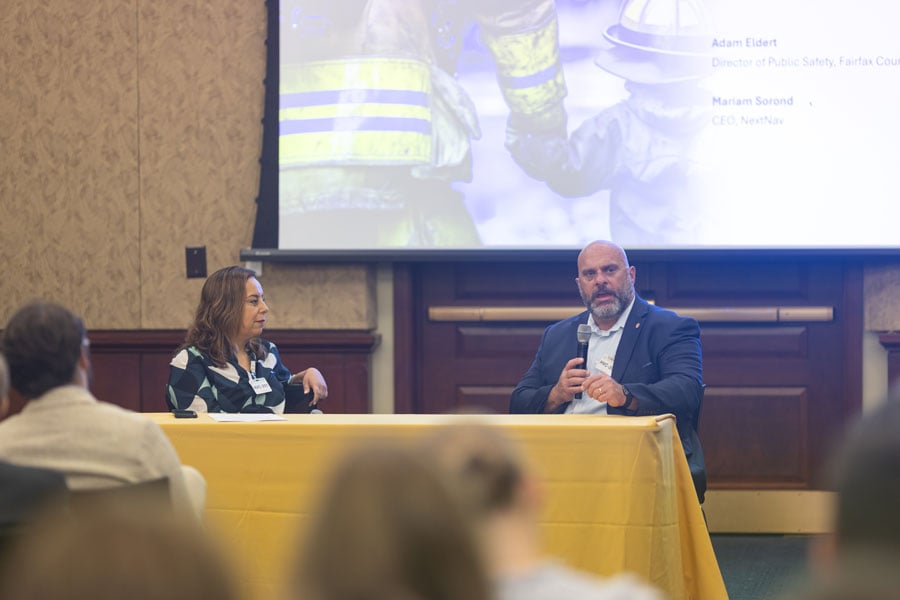
    From left to right: Mariam Sorond, Board Chair & CEO, NextNav; Adam Eldert, Director of Public Safety for Fairfax County, Virginia.
    From left to right: Mariam Sorond, board chair and CEO, NextNav; Adam Eldert, director of public safety for Fairfax County, Virginia.

    During the second panel, the conversation shifted from global conflict zones to local communities. Adam Eldert, director of public safety for Fairfax County, Virginia, emphasized the life-saving value of resilient PNT technologies in emergency response.

    “Technology should be carrying us forward, allowing us to make better decisions with the information we have to affect life-saving measures faster, get to places quicker and avoid any sort of potential problems,” said Eldert.

    Mariam Sorond, CEO and president of NextNav, pointed out that GPS limitations can delay locating 911 callers and responding to active threats like a mass shooting situation she and Eldert had previously discussed. “It’s not just to save somebody’s life, but it’s also about preventing disasters.”

    She then highlighted the company’s 5G-powered 3D terrestrial PNT solution, which is currently being considered by the FCC’s ongoing Notice of Inquiry on PNT and in a separate Petition for Rulemaking specific to NextNav. She explained that the company is working to address a national security challenge with a near-term, future-proof solution that delivers a widescale terrestrial PNT solution without relying on taxpayer funding.

    Congressional Support

    The closing panel featured Rep. Richard Hudson (R-NC), Chairman of the House Energy & Commerce Subcommittee on Communications and Technology, and former Rep. Greg Walden (R-OR), who previously chaired the full committee.

    Both Hudson and Walden warned that the United States is lagging behind adversaries such as China and Russia in deploying terrestrial backup systems to GPS.

    Chairman Hudson reflected on how the issue hits close to home: “I represent Fort Bragg, the largest army base in the world. We call it the epicenter of the universe. Our special forces and airborne troops that deploy out of Fort Bragg rely on GPS for almost everything they do. So, real-life scenarios with them keep me awake at night.”

    Chairman Walden spoke about another high-profile case in San Diego. “[T]here was a naval exercise between two ships, and they jammed GPS… which caused some issues, ” said Walden. “It also speaks to the problem we have, in America, where, unlike China and Russia, two of our adversaries, they have terrestrial-based systems for GPS backup.”

    What Comes Next

    The event made clear that action is needed — and possible. Mr. Sura told the crowd that he believes the FCC’s Notice of Inquiry will help drive a conversation about a holistic approach to PNT resiliency, exploring the economics of how these systems will work, and how to foster competition in a way that will yield multiple outcomes. When asked about next steps, Mr. Sura encouraged the group to “stay tuned.”

    Speakers throughout the event called for continued public-private collaboration to accelerate development of a more resilient PNT system — one that combines space-based and terrestrial technologies to safeguard national security, critical infrastructure, and public safety.

    Congressman Hudson closed with a note of urgency and optimism: “It’s clear the FCC understands the urgency, and they’re conducting thorough reviews right now.”

    Full event details and videos are available here.


    Diane Rinaldo of Peake Advisors, which sponsored the event, is one of the country’s leading authorities on 5G, telecommunications supply chain security and privacy. She served as Acting Administrator of the National Telecommunications and Information Administration and Acting Assistant Secretary of Commerce for Communications and Information in the first Trump Administration.

  • FCC opens door to GPS alternatives, but risks undermining its greatest strength

    FCC opens door to GPS alternatives, but risks undermining its greatest strength

    On March 27, the Federal Communications Commission (FCC) unanimously approved a Notice of Inquiry (NOI) to explore GPS alternatives, amid escalating threats to security and system resiliency. The move signals growing federal concern about the reliability of space-based navigation and timing infrastructure amid rising global interference and spoofing incidents.

    But while the FCC’s broad consideration of alternative technologies is a welcome step forward, its framing also risks weakening one of GPS’s most important defenses: the growing adoption of multi-constellation strategies across the commercial sector.

    Rising Threats, Broader Mandates

    The FCC’s decision follows the release of the International Air Transport Association’s (IATA) latest safety report, which documented a 175% increase in GPS interference and a 500% rise in spoofing attacks year-over-year. These incidents pose critical challenges to aviation safety, emergency services, telecommunications, and countless other sectors that rely on Positioning, Navigation, and Timing (PNT) services.

    Against this backdrop, the Commission’s vote reflects a bipartisan sense of urgency. The NOI invites public comment on a range of technologies that could serve as complements or alternatives to GPS, including low-Earth orbit (LEO) satellites, terrestrial signals, and enhanced end-user devices. This broad framing is encouraging and acknowledges the multifaceted nature of PNT resilience.

    A Multi-Layered Approach to PNT

    The FCC’s focus on diversification — across space-based, terrestrial, and user-level technologies — is not only prudent, but essential. Enhancing national security and system redundancy requires more than a single backup solution. It demands layered resiliency that integrates complementary modalities into a cohesive ecosystem.

    It is very encouraging that the NOI outlines a wide array of candidate technologies that could play a role in improving the U.S. PNT infrastructure. These range from inertial navigation systems and time transfer services to novel terrestrial radio signals and commercial LEO constellations. By casting a wide net, the FCC opens the door to innovation and allows market forces to contribute meaningfully to PNT modernization.

    Commercial Reality vs. Government Narrative

    However, the FCC’s discussion notably underplays a key reality: few commercial technologies today rely solely on GPS. The commercial PNT landscape has already moved beyond single-source dependency, with the vast majority of systems integrating multiple GNSS constellations (such as GPS, Galileo, BeiDou and GLONASS) alongside additional sensor and signal data to ensure robust coverage and accuracy.

    This multi-constellation approach is arguably the single most powerful tool we have to strengthen the resilience of GPS-dependent systems. By allowing receivers to pull data from multiple GNSS sources, users gain spatial and signal diversity, enabling them to cross-check signals, reject spoofed or erroneous data, and maintain accurate position and timing even in degraded environments. It’s important to remember that a device can’t selectively use GNSS networks depending on the user’s geography. If U.S. device makers disable BeiDou and GLONASS, then anywhere in the world that receiver goes it will be less performant and competitive. In recent field tests, we found that disabling the BeiDou constellation decreased a device’s positioning accuracy by 30% to 40%.

    This accuracy and resilience are especially important in sectors like aviation, autonomous systems, and emergency response, where signal fidelity and redundancy can be life-saving. Multi-constellation GNSS use isn’t theoretical: it’s already the industry standard.

    The International Tightrope

    Despite this, key elements of the NOI, as well as comments during the meeting, reflect a growing U.S. government skepticism toward the inclusion of foreign GNSS systems, especially BeiDou and GLONASS. While geopolitical caution is understandable, overly rigid restrictions on international signals could do more harm than good.

    These systems are not merely foreign-owned alternatives. They are integral components of the modern GNSS environment. Many U.S. commercial devices — ranging from smartphones to augmented reality, fleet tracking systems, drones, and more — already leverage multiple GNSS sources by default. Future technologies such as autonomous vehicles, robotics and urban air mobility will also require multiple GNSS signals to function. Prohibiting or restricting their use could mean rolling back years of progress in signal resilience, not to mention stymying future technologies, and all for a speculative and largely unquantified national security risk.

    While there are some valid concerns about adversarial control over PNT infrastructure, the FCC must weigh these carefully against the real, measurable benefits of an open and interoperable GNSS ecosystem. An overcorrection risks introducing new vulnerabilities in the name of mitigating others. In reality, the more vulnerable elements of the threat surface are GNSS receivers and mobile networks, particularly 5G systems, where user location is actually determined and tracked. Unlike the largely speculative and technically unproven threats tied to adversarial GNSS constellations, there are well-documented cases of compromised receivers and nation-state exploitation of mobile infrastructure – the very reason several countries have banned Chinese 5G providers. The FCC should focus on these clear and active risks, rather than reacting to theoretical scenarios that experts argue are not technically feasible.

    Innovation at Risk

    There is a significant opportunity at this moment. The NOI rightly identifies emerging technologies that can enhance U.S. resiliency, including advanced chipsets, LEO-based positioning, crowd-sourced signal verification, and next-generation timekeeping tools.

    However, that innovation cannot thrive in isolation. If the U.S. limits the ability of domestic systems to take full advantage of all available GNSS sources, it will undermine both resiliency and competitiveness. Even worse, it could widen the gap with foreign alternatives, especially China’s BeiDou system, which is already surpassing GPS in both accuracy and global coverage. GNSS has always thrived on multi-national cooperation and the opportunity of soft power influence. Both of which are diminished by exclusion, which is likely why there have not been bans by other countries to date.

    A Path Forward

    The FCC is right to prioritize this issue. It is urgent for the U.S. to build a more robust and secure PNT infrastructure in the face of these mounting threats. But its long-term success will depend on whether or not it embraces the full complexity of the PNT landscape.

    This means supporting:

    • Open, multi-constellation GNSS access for commercial users.
    • A flexible, layered approach that integrates space, terrestrial, and user-level technologies.
    • Public-private collaboration to accelerate innovation and deployment.
    • Clear regulatory guidance that balances national security concerns with commercial realities.

    The future of secure and reliable PNT lies not in isolating GPS, but in augmenting it through interoperability, diversity, and resilience at every layer of the system.

    If the FCC’s inquiry can steer the country in that direction, it will be a pivotal moment not just for GPS, but for the entire space-based infrastructure upon which modern life depends.

  • NextNav proposes a GPS complement and backup in the lower 900 MHz band

    NextNav proposes a GPS complement and backup in the lower 900 MHz band

    A year after NextNav shared a new vision for the Lower 900 MHz band, the Federal Communications Commission (FCC) collected additional comments seeking to bolster positioning, navigation and timing (PNT) resilience by exploring terrestrial and space-based technologies, including NextNav’s, that could complement and back up GPS. The FCC’s PNT Notice of Inquiry (NOI) is a level set on PNT issues, and seeks to engage stakeholders across government and industry to advance a “whole-of-government approach” to building resiliency to safeguard America’s critical infrastructure, national security and public safety.

    We caught up with NextNav’s Vice President of Regulatory Affairs, Renee Gregory, to hear more about how the company is thinking about a terrestrial complement and backup to GPS. Its technology is one of the solutions being discussed within the FCC and the broader industry.

    Why is it important to create a complement and backup to GPS? 

    Renee Gregory: GPS is an incredible technology that underpins national security, public safety and American commerce. However, GPS signals have physical limitations indoors and in urban canyons (i.e. big cities), plus the signals are vulnerable to intentional spoofing, jamming and unintentional interference. With GPS contributing more than $1 trillion to the U.S. economy since its inception, and a potential outage costing $1.6 billion per day, relying on a single system leaves us exposed. As Rear Admiral USN (ret.) David Simpson recently wrote, “If GPS goes down, critical infrastructure fails and our nation plunges into chaos.”

    What is the Federal Government doing about the problem?

    Gregory: Leaders, from President Donald Trump to Chairman Ted Cruz and Senator Ed Markey, have all advocated for the government to take action to ensure that a resilient PNT system of systems is in place. During President Trump’s first term, he signed an Executive Order establishing a comprehensive national policy to promote the responsible use of PNT services to strengthen critical infrastructure resilience. Earlier this year, the FCC adopted a NOI to promote the development of PNT technologies and solutions. It marked an important acknowledgment by the FCC of the seriousness of GPS vulnerabilities and limitations. It also reinforced the need for a system-of-systems approach that includes terrestrial PNT.

    What should our readers know about the NOI?

    Gregory: NextNav fully supports the FCC’s focus on resilient PNT. The FCC’s stated goal in the NOI is to build a record on specific actions the FCC can take to incentivize and support industry efforts to develop resilient and secure PNT technologies and solutions. The FCC intends to focus its efforts on utilizing its authority over non-Federal use of spectrum to rapidly support PNT solutions that could serve as complements or backups to GPS. NextNav has urged the FCC to enable at least one future-proof option that relies on market forces to deliver a terrestrial, wide-scale PNT solution that is broadly available to critical infrastructure, public safety, and consumers, and has a clear path to incorporation in consumer devices, like the smartphones we all use every day.

    What is the solution NextNav is proposing?

    Gregory: NextNav has a proven track record of providing accurate, reliable vertical location information to support first responders. Building on that legacy, NextNav’s next-generation 5G-based 3D PNT solution will leverage preexisting 5G networks and network capabilities, as well as the established and vibrant 5G device ecosystem, to enable a broadly available, widescale terrestrial complement and backup to GPS in partnership with one or more mobile network operators with experience in deploying newly-available spectrum and services within a relatively short period of time. This partnership model will rely on market forces and not taxpayer funding. NextNav brings not only its expertise in PNT technology but also its extensive spectrum licenses in the Lower 900 MHz band to address the critical need for resilient PNT.

    What are other technologies under consideration in the NOI?

    Gregory: The FCC is considering a range of terrestrial and space-based technologies as part of a system-of-systems approach to resilient PNT. Because different technologies and deployment models bring different strengths — and different weaknesses — truly resilient PNT requires multiple layers of redundancy and both space and terrestrial-based technologies. There is no single solution. We need an all-of-the-above approach.

    Is NextNav trying to replace GPS? 

    Gregory: No. NextNav’s efforts to develop a complement and backup to GPS will not diminish the role of GPS, which will remain vital to national and economic security.

    Is NextNav asking for new spectrum to enable its terrestrial PNT solution?

    Gregory: Some opponents have suggested that NextNav is asking the FCC to give it 15 megahertz of spectrum, but that’s simply not true. After acquiring extensive spectrum licenses at auction and in the secondary market, NextNav is the largest licensee in the lower 900 MHz band and is one of only two active geographic license holders in that band, which is today dedicated to terrestrial positioning services. In 2024, NextNav reached a commercial agreement to acquire the remainder of the licenses from the only other active geographic licensee in the band.

    NextNav is suggesting a reconfiguration of the existing licensing scheme to ensure that the lower 900 MHz band can support next-generation 5G-based 3D PNT solutions that require multiple 5 MHz blocks of spectrum, for a total of one more megahertz than the amount of spectrum currently dedicated for geographically-licensed terrestrial positioning services. To enable this band configuration, and the availability of a terrestrial PNT complement and backup, NextNav has proposed a “swap” in which NextNav will return all its current and pending license holdings in exchange for a 15 MHz nationwide license, consistent with the technical characteristics of 5G networks.

    How much does this plan cost?

    Gregory: The market-based NextNav solution will not require any taxpayer funding or legislation.

    What about those opposed to NextNav’s proposal? 

    Gregory: NextNav is focused on solving an urgent national security problem by enabling a complement and backup to GPS to advance resilient PNT. While some parties have raised objections based on claims of interference to current uses of the Lower 900 MHz band, they have not provided detailed technical analyses to support their claims that NextNav would interfere with their operations, or offered solutions beyond suggesting that the FCC reject NextNav’s proposal. Simply opposing one proposal without offering credible, fact-based solutions undermines the FCC’s goal of building a resilient, system-of-systems approach. 

    As a leader in PNT innovation, NextNav is looking forward to working closely with the Chairman, Commissioners and broader stakeholder community to accelerate the deployment of resilient PNT, building important redundancies into a system we rely on every day. 

  • Satellite Safety Alliance urges reversal of FCC Ligado Order

    Satellite Safety Alliance urges reversal of FCC Ligado Order

    A new letter protesting the Federal Communications Commission’s (FCC)  Ligado Order marked the fifth anniversary of the controversial decision.

    In the letter, the Satellite Safety Alliance (SSA) and 93 companies and organizations stated the need for the Ligado Order to be overturned by President Trump and Congressional leadership.

    “The proposed network is designed to inappropriately use spectrum reserved for satellite communications, causing significant interference to other services,” the SSA stated. Interference with GPS is a major concern of the group.

    The letter urges the president and the chairs and ranking members of the House and Senate armed services and commerce committees to work with the FCC on granting petitions for reconsideration that will help prevent the building of Ligado’s terrestrial wireless network.

    “Ligado’s network would threaten a wide range of critical government and commercial services, including military communications, private satellite communication, GPS, agriculture, aviation, weather forecasting, and more,” the SSA stated.

    “For over two decades, Ligado and its predecessors have tried and failed to build a

    terrestrial network that wouldn’t harm GPS, national security, and other critical interests,” commented the SSA. “The FCC’s Ligado Order has faced unprecedented opposition, including from 14 federal agencies and over 90 organizations representing huge swaths of the economy — from aviation and agriculture to science and manufacturing. Rarely does any issue garner

    agreement from such a wide and divergent group of constituencies.”

    Congress found through independent analysis that the Ligado Order poses unacceptable risks of interference to GPS, satellite communications, weather forecasting, and other services, the SSA explained. “Countless federal staff hours and resources have gone to reviewing, debating, and litigating this issue. It is past time the FCC put the issue to rest by granting the pending petitions for reconsideration.”

    Copies of the letters are availble here.

  • FCC seeks public input to strengthen alternative PNT

    FCC seeks public input to strengthen alternative PNT

    The Federal Communications Commission (FCC) has issued a Notice of Inquiry (NOI) seeking public input on positioning, navigation and timing (PNT) systems and policies. While GPS is crucial for the United States’ economic and national security, its dependency as a single point of failure renders it vulnerable to disruption or manipulation by adversaries. Recognizing this vulnerability, leaders such as President Trump, Chairman Cruz, and Senator Markey have advocated for developing alternative systems to ensure resilient PNT capabilities.

    PNT data is integral to countless military, public safety, agricultural, and commercial activities. Given the dependence of the American economy and national security on GPS as the sole PNT source, the agency states that the U.S. government is prioritizing efforts to create robust backup systems that can safeguard essential functions in the event of GPS signal disruptions.

    The FCC’s NOI examines how the agency can foster the development of alternative and complementary PNT. It seeks feedback on various emerging PNT technologies being developed by broadcasters, wireless operators, satellite constellations and startups utilizing FCC-licensed spectrum. The inquiry also addresses tradeoffs among these technologies based on performance, scalability, geographic coverage, durability, cost and commercialization potential.

    The Commission aims to establish a comprehensive record to guide its actions in enhancing GPS resilience and promoting alternative PNT solutions. Potential measures include regulatory changes, public-private partnerships, testbeds, Innovation Zones and other initiatives.

    Two PNT-related petitions are currently under FCC consideration. NextNav has proposed allocating approximately $5 billion worth of spectrum to collaborate with telecom providers in establishing a PNT network. Meanwhile, the National Association of Broadcasters (NAB) has suggested adopting a new TV signal format capable of transmitting PNT information without requesting additional spectrum allocation. Insights from the NOI will help inform decisions on these proposals.

    The FCC’s inquiry reflects growing concerns about reliance on GPS as a single system for PNT data. By fostering alternatives like terrestrial networks or broadcast-based solutions such as NAB’s Broadcast Positioning System, the Commission seeks to strengthen national resilience against potential disruptions to critical infrastructure and services.

  • FCC to Meet on GPS Alternatives

    FCC to Meet on GPS Alternatives

    Federal Communications Commission (FCC) Chair, Brendan Carr announced in a March 5 blog post that the commission would be addressing GPS alternatives along with Next Generation 911 issues at its next meeting.

    Pledging that “…public safety and national security will be top priorities for us at the FCC” along with quick action on related issues, Chairman Carr said the commission’s March 2025 open meeting will start “… with an inquiry that explores alternatives to GPS.”

    Describing GPS as indispensable but not infallible, Carr’s post showed a substantial appreciation of PNT and GPS alternative issues as well as much of the related policy history.

    It also cites President Trump, Senator Cruz, and Senator Markey as advocating action to “… ensure we have a resilient system in place.”

    In 2020, President Trump issued Executive Order 13905 on “Strengthening National Resilience Through Responsible Use of Positioning, Navigation, and Timing Services.” Designed to stimulate adoption of open market commercial solutions, it does not seem to have made the nation’s PNT substantially more resilient in the intervening five years. This may be because GPS is free and time and navigation have been provided by the government as free utilities for hundreds of years. Also, many GPS users may be unsure about the need for alternatives since the federal government has not yet acted to protect itself with an alternative system. Potential users are also reluctant to purchase commercial PNT services as they are unsure which commercial services will have the longevity to make the cost and effort of adoption and integration worthwhile.

    President Trump also supported the need for GPS alternatives in Space Policy Directive 7, “The United States Space-Based Positioning, Navigation, and Timing Policy.” It called for the government to “…identify and implement, as appropriate, alternative sources of PNT for critical infrastructure, key resources, and mission-essential functions.”  This directive was issued shortly before the end of the first Trump administration and, though the directive still stands, this provision has not yet been acted upon.

    Carr’s mention of Senators Cruz and Markey undoubtedly refers to their joint sponsorship of the National Timing Resilience and Security Act of 2018. The act called for the Department of Transportation to ensure establishment of at least one terrestrial timing system as a backup for GPS signals. The first Trump administration and the Biden administration never requested funding for such an effort, so the mandate has yet to be implemented.

    Regarding GPS alternatives Carr’s post also says “…it is important that we catch up to other countries that are looking at robust alternatives of their own.” This is likely a reference to a memo ADM Allen, the chair of the National Space-based Positioning, Navigation and Timing Advisory Board, sent to the deputy secretaries of Defense and Transportation in July of last year. It warns about the U.S. falling behind in PNT, especially compared to China.

    An FCC meeting on GPS alternatives is also timely as the commission has received two petitions related to provision of nation-wide PNT services. One is from NextNav, seeking spectrum to underwrite its proposal to work with telecom providers. The other is from the National Association of Broadcasters (NAB), asking to mandate and accelerate implementation of the new ATSC 3.0 television broadcast format. NAB says its Broadcast Positioning System signals will be included as part of that format.

    While GPS alternatives will be discussed at the upcoming meeting, no decisions on systems is contemplated. Carr says the commission:

     “… will vote on an inquiry to explore other Positioning, Navigation, and Timing (PNT) systems that can be complements or alternatives to GPS. Beyond answering technical questions, we hope this effort will engage stakeholders across government and industry to encourage the development of new PNT technologies and solutions.”

    On March 6, the commission released a fact sheet with an attached draft Notice of Inquiry (NOI). The 24-page draft seeks public input on a wide variety of PNT policy and technical issues. The NOI is intended to:

    • Discuss current PNT technologies and efforts, both from governmental and private sector entities, for developing complementary and resilient PNT technologies.
    • Seek comment on various space-based solutions for resiliency of PNT, such as medium Earth orbit (MEO) satellite systems and low Earth orbit (LEO) satellite systems.
    • Seek comment on various terrestrial solutions for resiliency of PNT, such as leveraging TV broadcast infrastructure, ground-based transmitters, and/or user equipment positioning.
    • For all technologies, ask commenters for information on the benefits and challenges of particular PNT technologies or solutions based on factors such as: geographic coverage; availability of existing equipment; use of spectrum resources; the extent to which the technology should be viewed as a complement to or substitute for GPS and other PNT technologies; performance characteristics such as range and precision; durability; international considerations; and the cost and incentives to develop, deploy, and maintain the technology or solution.
    • Seek comment on additional actions that the Commission could take to facilitate the security of PNT technologies available to consumers.
    • Seek comment on whether to amend the Commission’s existing rules or adopt new rules to promote adoption of complementary and alternative PNT technologies.
    • Ask questions about what role public-private partnerships, testbeds, or Innovation Zones may play to test and develop PNT technologies.

    The FCC open meeting’s agenda also includes two items about 911 services. One of those is “Strengthening 911 Location Accuracy Rules” especially for the vertical (z) axis. This seems to be a separate and distinct issue from the PNT agenda item with the burden of performance and response placed on telecom providers. That said, some eventual linkage cannot be entirely discounted.

    The meeting will take place on March 27 from 10:30 to 12:30 EDT. A formal agenda will be posted approximately a week in advance. The meeting can be live streamed at https://www.fcc.gov/March2025 and a recording will be available on YouTube shortly thereafter.

  • NextNav petitions FCC for new spectrum band

    NextNav petitions FCC for new spectrum band

    NextNav has petitioned the Federal Communications Commission (FCC) to add a new spectrum solution in the Lower 900 MHz band (902-928 MHz band) to complement and backup GPS. The Lower 900 MHz band plan aims to give access to 15 MHz of low-band spectrum for 5G services.

    The company filed a rulemaking petition to the FCC, proposing to rearrange the band to facilitate a terrestrial positioning, navigation and timing (PNT) network and broadband. The petition specifically asks the FCC to reconfigure the band plan and adopt new rules, including enabling a high-quality terrestrial complement and backup to GPS for essential PNT services and providing 15 MHz of low-band spectrum for use by mobile broadband networks.

    The proposal, according to the filing, “enables high-quality terrestrial PNT, with the potential for widespread and inexpensive adoption in many use cases because it will use the 5G standard.” Because the company’s NextGen PNT solution uses a small amount of capacity in the 10 MHz downlink, mobile network providers can use most downlink capacity for broadband, “making the spectrum appealing for integration into existing networks and thereby accelerating the availability of terrestrial PNT services.”

    According to the filing, “The 15-megahertz band plan is necessary for this broadband deployment, which enables an at-scale PNT network to be deployed efficiently, providing a unique path to resolving the coverage, cost, and user device issues that have prevented broad terrestrial PNT usage to date.”

    NextNav recently signed an agreement to acquire spectrum licenses covering an additional 4 MHz in the lower 900 MHz band from Telesaurus Holdings GB and Skybridge Spectrum Foundation. In March 2024, the Superior Court of the State of California, County of Alameda, issued an Order approving the Receiver’s request to sell all of its Lower 900 MHz spectrum holdings to NextNav, allowing the parties to move forward with obtaining FCC approval.

    The company plans to partner with mobile network operators or others interested in commercial deployment in the band for 5G and will ensure incumbent operations are protected. According to the company, it has used its existing licenses to develop PNT expertise and products, but, because of a legacy band plan and rules that limit the use of the spectrum for 5G, much of this band is underused.

    The NextGen PNT technology and network are designed to use 5G and offer a 3D positioning solution with single-digit accuracy. The positioning solution is available indoors and outdoors and in urban corridors. It also seeks to provide wireless distribution of precise, resilient timing.

    The current Lower 900 MHz Band is “not conducive for either terrestrial PNT or mobile broadband,” according to the filing, with shortcomings that include fragmented geographic licensing arrangements, outdated command-and-control requirements and other restrictions. Consolidating the geographically licensed spectrum blocks into a 15MHz nationwide configuration for both PNT and 5G broadband changes. This allows the band to support better use cases and serve as a high-performing complement and backup to GPS.

  • FCC warns of security risks

    FCC warns of security risks

    Image: FCC logo
    Image: FCC logo

    The Federal Communications Commission (FCC) is investigating whether the use of Russian and Chinese foreign satellite systems by U.S. mobile phones and other devices poses security threats.

    The FCC has concerns that U.S. handheld devices are receiving and processing GNSS signals from satellites controlled by foreign adversaries in violation of commission rules.

    The FCC is seeking answers from handset manufacturers Apple, Google, Motorola, Nokia, Samsung and others that collectively cover more than 90% of the U.S. smartphone marketplace.

    “There is no established record of what security threats, if any, these signals carry and whether the manufacturers of handheld devices are processing these signals in violation of the Commission’s rules,” an FCC spokesperson said in a statement.

    Representative Mike Gallagher, chair of the U.S. House Select Committee on the Strategic Competition Between the United States and the Chinese Communist Party, wrote FCC Chair Jessica Rosenworcel earlier this week raising concern about reports that U.S. cell phones were receiving and processing signals from Chinese and Russian satellites.

    The FCC has only approved U.S. phones to receive and process signals from the U.S. Global Positioning System (GPS) and the European Galileo GNSS.

  • uAvionix receives FCC/FAA approval for C-band BVLOS operations

    uAvionix receives FCC/FAA approval for C-band BVLOS operations


    Image: uAvionix
    Image: uAvionix

    uAvionix has received Federal Communications Commission (FCC) approval, coordinated with the Federal Aviation Administration (FAA), to operate its SkyLink C-band command and control (C2) radios for beyond visual line of sight (BVLOS) operations at the Choctaw Nation of Oklahoma Emerging Technology test site.

    The radios — operating on aviation-protected C-band frequencies — will be controlled by uAvionix’s SkyLine cloud-based C2 network solution that supports fleet management, network health monitoring, detect and avoid, and roaming between multiple radio networks and ground stations.

    According to uAvionix, with the BVLOS Waiver, businesses looking to use aviation-protected C-band and other radio networks for assured control and non-payload communications can now develop, test and implement solutions for business initiatives such as package delivery and medical resupply.

    With over 200,000 tribal members and more than 11,000 employees, the Choctaw Nation is the third largest Indian nation in the United States. It is developing an aviation test facility in southeastern Oklahoma that utilizes more than 44,600 acres of remote land it tribally owns to support the innovative research, development, test and evaluation of emerging manned and unmanned aerial system technologies in a safe and low-risk environment.

    Interested businesses should contact the Choctaw Nation and uAvionix to support implementation and scaling of uncrewed aerial system operations with multiple C2 links including aviation protected C-band.

  • Vast coalition seeks reversal of Ligado Order

    Vast coalition seeks reversal of Ligado Order

    Credit: YinYang/E+/Getty Images
    Credit: YinYang/E+/Getty Images

    The same 91 signers also sent an identical letter to President Biden.

     April 24, 2023 

    Dear Senators and Members of Congress:

    Last year, many of the undersigned wrote in reflection of the unprecedented opposition to the Federal Communications Commission’s (FCC’s) Ligado Order (1) across the vast federal and commercial user base of Global Positioning System (GPS), satellite communications and weather forecasting services. Three years after adoption of the Order, as eight petitions for reconsideration remain pending, (2) we again urge you to work together with the FCC to stay and ultimately set aside the Order. (3) Critically, this is now necessitated by the crucial, previously unavailable information that was produced at the direction of Congress: the independent technical review undertaken by the National Academies of Sciences, Engineering, and Medicine (NAS) (4) analyzing the potential interference issues related to the Ligado Order.

    We greatly appreciate your administration’s opposition to the Ligado Order and commitment that the National Telecommunications and Information Administration (NTIA), on behalf of the executive branch, will continue to actively pursue its petition for reconsideration of the Order. (5) As you know, the pending petitions for reconsideration convincingly demonstrate that the Ligado Order is legally and factually deficient. In the pending petitions, parties showed that the Ligado Order is fundamentally flawed, incompatible with the FCC’s rules and inadequate in protecting incumbent services from the harmful interference from Ligado’s proposed operations. This substantial documentation, among many other concerns from federal and commercial users, resulted in Congress enacting bipartisan legislation in consecutive years after the FCC’s adoption of the Ligado Order, mandating NAS’s independent technical review and requiring the Department of Defense (DoD) to brief federal representatives across the government “at the highest level of classification” on the potential for widespread harm from Ligado’s proposed terrestrial operations. (6) On this basis alone, the FCC should stay the Order in an acknowledgement that it clearly did not account for the full, real-world risk of harm associated with a nationwide terrestrial deployment in the L-band.

    While the pending petitions have a strong likelihood of success on their own merits, the FCC’s rules and the public interest now require the FCC to reconsider the Order in response to the extensive analysis in the NAS Report. (7) This new, previously unavailable information presented in the Congressionally-mandated independent technical review confirms that Ligado’s proposed terrestrial operations would cause harmful interference (8) at significant ranges to incumbent L-band services across a broad range of deployment scenarios. This is consistent with the well-supported and robustly documented analyses and determinations of the federal government, (9) including fourteen federal agencies and departments, (10) and commercial parties (11) alike. Importantly, as concisely stated by DoD and detailed in the NAS Report, “[t]he terrestrial network authorized by [the Ligado Order] will create unacceptable harmful interference for DoD missions. The mitigation techniques and other regulatory provision [sic] in [the Ligado Order] are insufficient to protect national security missions.”(12)

    The unequivocal conclusions of the NAS Report constitute the exact type of previously unavailable information that the FCC’s rules (13) dictate must be addressed on reconsideration. Indeed, NTIA stated on behalf of the executive branch that the NAS Report “offers the [FCC] an important opportunity to reconsider Ligado’s Authorization.”(14) We therefore urge you to work with the FCC to address the harm from Ligado’s proposed terrestrial network to critical GPS, satellite communications, and weather forecasting services by staying the Order, addressing the previously unavailable information contained in the NAS Report, and resolving the pending petitions for reconsideration.

    Sincerely,

    AccuWeather, Inc.

    Aerospace Industries Association

    Agricultural Retailers Association

    Airborne Public Safety Association

    Aircraft Electronics Association

    Aircraft Owners and Pilots Association

    Airlines for America

    Alabama Agricultural Aviation Association

    ALERT Users Group

    Allied Pilots Association

    Air Line Pilots Association, International

    American Geophysical Union

    American Meteorological Society

    American Rental Association

    American Road & Transportation Builders Association

    American Weather and Climate Industry Association

    Arizona Agricultural Aviation Association

    Arkansas Agricultural Aviation Association

    Associated Equipment Distributors

    Association for Uncrewed Vehicle Systems International

    Association of Aerial Applicators Washington

    Association of Equipment Manufacturers

    Association of Marina Industries

    Association of Montana Aerial Applicators

    Aviation Spectrum Resources, Inc.

    BoatU.S.

    California Agricultural Aircraft Association

    Cargo Airline Association

    CNH Industrial

    Coalition of Airline Pilots Associations

    CoBank

    Colorado Agricultural Aviation Association

    EarthScope Consortium

    Florida Agricultural Aviation Association

    General Aviation Manufacturers Association

    GeoOptics, Inc.

    George Washington University

    Georgia Agricultural Aviation Association

    Helicopter Association International

    Idaho Agricultural Aviation Association

    Illinois Agricultural Aviation Association

    Indiana Agricultural Aviation Association

    International Air Transport Association

    Iowa Agricultural Aviation Association

    Iridium Communications Inc.

    Kansas Agricultural Aviation Association

    Land Improvement Contractors of America

    Lockheed Martin Corporation

    Louisiana Agricultural Aviation Association

    Marine Retailers Association of the Americas

    Michigan Agricultural Aviation Association

    Microcom Environmental

    Minnesota Agricultural Aircraft Association

    Mississippi Agricultural Aviation Association

    Missouri Agricultural Aviation Association

    Narayan Strategy

    National Agricultural Aviation Association

    National Air Carrier Association

    National Business Aviation Association

    National Cotton Council

    National Society of Professional Surveyors

    National Weather Association

    Nebraska Aviation Trades Association

    NetJets Association of Shared Aircraft Pilots

    New Mexico Agricultural Aviation Association

    North Carolina Agricultural Aviation Association

    North Dakota Agricultural Aviation Association

    Northeast Agricultural Aviation Association

    Ohio Agricultural Aviation Association

    Oklahoma Agricultural Aviation Association

    Oregon Agricultural Aviation Association

    Pacific Northwest Aerial Applicators Alliance

    PlanetiQ

    Recreational Boaters of California

    Resilient Navigation and Timing Foundation

    Seafarers International Union

    South Dakota Aviation Association

    Southeast Aero Cultural Fair

    Space Science and Engineering Center at the University of Wisconsin-Madison

    Subsurface Utility Engineering Association

    Tennessee Aerial Applicators Association

    Texas Agricultural Aviation Association

    The Airo Group, Inc.

    The Semaphore Group

    Trimble Inc.

    U.S. Geospatial Executives Organization

    University Corporation for Atmospheric Research

    USA Rice

    Vertical Flight Society

    Westwind Helicopters

    Wisconsin Agricultural Aviation Association


    (1) Ligado Amendment to License Modification Applications, IBFS File Nos. SES-MOD-20151231-00981, SAT-MOD-20151231-00090, and SAT-MOD-20151231-00091, Order and Authorization, 35 FCC Rcd 3772 (2020) (“Ligado Order” or “Order”).

    (2) More than twenty parties in total signed petitions for reconsideration of the Ligado Order and all of these petitions remain pending before the FCC. See Petitions for Reconsideration of the National Telecommunications and Information Administration; the Air Line Pilots Association, International; the American Road & Transportation Builders Association, the American Farm Bureau Federation, and the Association of Equipment Manufacturers; the Joint Aviation Petitioners; Iridium Communications Inc., Flyht Aerospace Solutions Ltd., Aireon LLC, and Skytrac Systems Ltd.; Lockheed Martin Corporation; Trimble Inc.; and the Resilient Navigation and Timing Foundation, IB Docket Nos. 11-109 & 12-340 (all filed on or about May 22, 2020). The ten “Joint Aviation Petitioners” consist of the Aerospace Industries Association, the Aircraft Owners and Pilots Association, Airlines for America, Aviation Spectrum Resources, Inc., the Cargo Airline Association, the General Aviation Manufacturers Association, the Helicopter Association International, the International Air Transport Association, the National Air Transportation Association and the National Business Aviation Association.

    (3) The Commission should also not proceed with any companion rulemakings causing harmful interference to weather forecasting and hydrology services that could result in Ligado deployments, particularly in light of the analysis and recommendations presented in the “Spectrum Pipeline Reallocation 1675–1680 MHz Engineering Study (SPRES) Program Report. See Allocation and Service Rules for the 1675-1680 MHz Band, Notice of Proposed Rulemaking, 34 FCC Rcd 3352 (2019); U.S. Department of Commerce. National Oceanic and Atmospheric Administration. National Environmental Satellite Data Information Service. Spectrum Pipeline Reallocation 1675–1680 MHz Engineering Study (SPRES) Program Report. Silver Spring, MD: NESDIS, October 2020 (public release August 2022).

    (4) National Academies of Sciences, Engineering, and Medicine, Analysis of Potential Interference Issues Related to FCC Order 20-48 (2022), https://doi.org/10.17226/26611 (“NAS Report”).

    (5) Letter from Gina Raimondo, Secretary of Commerce, U.S. Dept. of Commerce, to The Honorable James M. Inhofe, ranking member, U.S. Senate Committee on Armed Services (June 22, 2021) (reiterating the NTIA’s position opposing the Ligado Order).

    (6) William M. (Mac) Thornberry National Defense Authorization Act (“NDAA”) for Fiscal Year 2021, Pub. L. 116-283, 134 Stat. 4074 § 1663; NDAA for Fiscal Year 2022, Pub. L. 117-81, 135 Stat. 1541 § 1613.

    (7) These statements are based on the publicly available portions of the NAS committee’s work. In addition, NAS prepared a classified annex, which further details the risks of Ligado’s proposed terrestrial network and additionally warrants FCC action.

    (8) The term “harmful interference” is herein used to describe the results of the NAS Report. In turn, the undersigned believe the results of the NAS Report dictate that the FCC must reach the legal conclusion that Ligado’s operations would cause harmful interference under the FCC’s rules.

    (9) See, e.g., National Telecommunications and Information Administration Reply to Ligado Networks LLC’s Opposition to Petitions for Reconsideration or Clarification, IB Docket Nos. 11-109 & 12-340, at 10 n.26 (filed June 8, 2020); U.S. Department of Transportation, Global Positioning System (GPS) Adjacent Band Compatibility Assessment, Final Report (Apr. 2018) (“DOT ABC Report”),

    (10) See Memorandum from Thu Luu, Executive Agent for GPS, Department of the Air Force, to IRAC Chairman (Feb. 14, 2020).

    (11) See, e.g., Letter from J. David Grossman, Executive Director, GPSIA, to Marlene H. Dortch, Secretary, FCC, IB Docket Nos. 11-109 et al., at 6 (Sept. 17, 2020); Letter from Bryan N. Tramont, Counsel to Iridium Communications Inc., to Marlene H. Dortch, Secretary, Federal Communications Commission, IB Docket Nos. 11-109 et al. (Jan. 19, 2022); Update to 2016 Technical Assessment of Ligado User Terminal Interference to Iridium attached to Iridium Communications Inc. et al., Petition for Reconsideration, IB Docket Nos. 11-109 et al. ( May 22, 2020).

    (12) NAS Report at 6, 73.

    (13) 47 C.F.R. § 1.106(c)(2).

    (14) Press Release, NTIA, NTIA Statement on National Academies of Sciences Report (Sept. 9, 2022).

  • National Academies to reveal FCC-Ligado study results Friday

    National Academies to reveal FCC-Ligado study results Friday

    The latest chapter of the decades-long Lightsquared/Ligado saga will be revealed this week

    NAS logoThe National Academies of Science, Engineering and Medicine (NASEM) will hold a public online briefing at 11 a.m. ET on Sept. 9 to present the results of its Ligado interference study. The committee’s report will be available at National Academies Press at that same time.

    The decision by the Federal Communications Commission (FCC) to grant Ligado Networks permission to operate a terrestrial service in a frequency band adjacent to that used by GPS has been controversial since it was announced in April 2020.

    The Executive Branch has formally objected to the decision because of its potential to interfere with various kinds of GPS receivers and requested its reversal. So have numerous industry groups.

    The satellite communications company Iridium and some weather organizations also formally objected.

    Seven different “Petitions for Reconsideration” were filed with the FCC in May 2020 reflecting a variety of engineering- and process-based objections. None have been acted upon and all are still open issues for the commission.

    As a result of the long dispute over the potential for interference, the National Defense Authorization Act for 2021 required the Department of Defense (DOD) to contract with NASEM to examine the issue. The study effort began almost exactly a year ago with the announcement of a proposed study team.

    According to the NAESM website:

    This study will review Federal Communications Commission order FCC 20-48, which authorized Ligado Networks LLC to operate a low-power terrestrial radio network adjacent to the Global Positioning System (GPS) frequency band. It will consider how best to evaluate harmful interference to civilian and defense users of GPS, the potential for harmful interference to GPS users and DOD activities, and the effectiveness and feasibility of the mitigation measures proposed in the FCC order.

    Specific results were intended to include:

    • which of the two prevailing proposed approaches to evaluating harmful interference concerns — one based on a signal-to-noise interference protection criterion and the other based on a device-by-device measurement of the GPS position error — most effectively mitigates risks of harmful interference with GPS services and DOD operations and activities
    • the potential for harmful interference from the proposed Ligado network to mobile satellite services — including GPS and other commercial or DOD services, and including the potential to affect DOD operations and activities
    • the feasibility, practicality and effectiveness of the mitigation measures proposed in the FCC order with respect to DOD devices, operations and activities.

    Other relevant issues the study committee found are also expected to be discussed.

    The NASEM committee has been meeting regularly since the end of September 2021 and has heard from numerous industry and interest groups on both sides of the issue. Materials presented as well as videos of the public portions of all the meetings are available at the group’s website.

    Both a classified and an unclassified version of the report are supposed to be produced. No information has been released about whether the classified report has been completed and provided to the Department of Defense.

    Based on previous NASEM reports, some observers predict the results of the study will not strongly support either side of the dispute. “Most of these kind of reports say, ‘On the one hand this, but on the other hand that.’ Usually they are not really conclusive. I expect both sides will find something in it to support their assertions and the dispute will continue as it has to date,” said one stakeholder.

    Members of the public interested in viewing the on-line release and briefing can register at https://www.eventbrite.com/e/the-national-academies-review-of-fcc-order-20-48-report-release-webinar-tickets-398176525707


    Dana A. Goward is president of the Resilient Navigation and Timing Foundation.

  • Inhofe, Reed urge FCC to stay and reconsider Ligado order

    Inhofe, Reed urge FCC to stay and reconsider Ligado order

    A bipartisan group of eight U.S. senators has sent a letter to the Federal Communications Commission (FCC), urging the agency to stay and reconsider the Ligado Networks order.

    U.S. Senators Jim Inhofe (R-Okla.) and Jack Reed (D-R.I.), ranking member and chairman of the Senate Armed Services Committee, led the group in sending the letter to FCC Chairwoman Jessica Rosenworcel, urging her to reconsider granting Ligado’s license modification request.

    Ligado wants to use a part of the communications spectrum in a way that risks interference with GPS reception, a move that has been decried by many industry insiders as well as other government agencies, including the departments of Defense and Transportation.

    The timing of the letter is critical, as Ligado has announced its intention to deploy a terrestrial network as soon as Sept. 30. The National Academy of Sciences plans to release a report on the FCC’s order at a public online briefing at 11 a.m. ET Sept. 9. The report will be available at National Academies Press at that same time.

    Imminent Risks

    Joining Inhofe and Reed were Sens. Tammy Duckworth (D-Ill.), Mazie Hirono (D-Hawaii), Mark Kelly (D-Ariz.), Mike Rounds (R-S.D.), Kyrsten Sinema (D-Ariz.) and Dan Sullivan (R-Alaska).

    The senators write: “Staying and reconsidering the Ligado Order is necessary to address the imminent risks associated with Ligado’s intention to ‘commence operations in the 1526-1536 Mhz band on or after September 30, 2022.’ We remain gravely concerned that the Ligado Order fails to adequately protect adjacent band operations — including those related to GPS and satellite communications — from harmful interference impacting countless military and commercial activities.

    “We urge you to set aside the Ligado Order and give proper consideration to the widely held concerns across the Executive Branch, within Congress, and from the private sector regarding the expected impact of the Ligado Order on national security and other systems,” the senators continued.

    A copy of the letter can be found here and below.

    Dear Chairwoman Rosenworcel:

    We write to you today to urge the Federal Communications Commission (FCC) to stay and reconsider the FCC’s order granting the applications of Ligado Networks LLC (Ligado) to deploy a terrestrial wireless network in the L-band satellite spectrum neighborhood, FCC 20-48, adopted April 19, 2020 (the Ligado Order). We remain extremely concerned that terrestrial L-band operations would cause unacceptable risk to Department of Defense (DOD), the Federal Government Global Positioning System (GPS), and Satellite Communications (SATCOM) operations.

    Prior to the issuance of the Ligado Order, fourteen federal agencies and departments expressed strong opposition to the applications sought by Ligado over concerns about potential harmful interference with GPS operations. In May 2020, shortly following the issuance of the Ligado Order, on behalf of the executive branch, the National Telecommunications and Information Administration (NTIA) petitioned the FCC to reconsider its decision. That filing requested that the FCC “rescind its approval of the mobile satellite service (MSS) license modification applications” granted to Ligado, which the NTIA asserted would “cause irreparable harms” to federal government GPS users.

    Staying and reconsidering the Ligado Order is necessary to address the imminent risks associated with Ligado’s intention to “commence operations in the 1526-1536 Mhz band on or after September 30, 2022.” We remain gravely concerned that the Ligado Order fails to adequately protect adjacent band operations—including those related to GPS and satellite communications—from harmful interference impacting countless military and commercial activities. We urge you to set aside the Ligado Order and give proper consideration to the widely held concerns across the Executive Branch, within Congress, and from the private sector regarding the expected impact of the Ligado Order on national security and other systems.

    We look forward to continuing to work with you to ensure that federal spectrum policy adequately protects the millions of military and commercial users who rely on L-band satellite services every day.

    Feature photo: Brian Kinney/Shutterstock.com