Tag: GNSS simulator

  • SDX release 17.1 adds fine level of control on signal multipath

    Skydel SDX Release 17.1 adds a fine level of control on signal multipath to the software-defined GNSS simulator.

    SDX 17.1 introduces a powerful multipath simulation option, enabling users to create less-than-ideal signal propagation conditions for GNSS testing. Multipath echoes can be added and fined-tuned for each satellite, per signal. Control is possible via four fundamental attributes: pseudorange offset, power loss, Doppler shift and carrier-phase offset.

    It’s now convenient to create simplified test conditions otherwise impossible to achieve with the live sky. The new options are fully controllable through the SDX application program interface (API), and can be modified on the fly while the simulation is running.Release 17.1 also adds L2C navigation message modification. Besides the usual conditions such as start and stop time and PRN number, users can specify the message type, and the message content to match.

    Because the CNAV message is 300 bits long and not subdivided in words like the NAV message, managing the modifications as a per-bit fashion would be tedious. The interface solves this by letting you add modifications for portions of the message — and lets users add as many as they need.

    Software-defined radios (SDR) can take a few seconds to initialize when starting the simulation. To improve software synchronization performance, Skydel has added an armed state. Upon clicking the arm button (or issuing the command through the API), the armed state prepares all hardware. When the start command is later received, the delay to emit the GNSS signals is minimal.

    Other updates have also been made. See the release notes for the full list. As always, existing licensees benefit from an immediate upgrade.

    Among the next items on SDX’s development agenda is the release of advanced jamming capabilities through an innovative integration with the GNSS simulator.


  • Jackson Labs enters GNSS simulation market with CLAW

    Jackson Labs enters GNSS simulation market with CLAW

    Jackson Labs Technologies Inc. (JLT) has entered the GNSS simulation and synthesis market with the small size, weight and power (SWAP) CLAW GPS/GNSS simulator. The CLAW is only slightly larger than a standard deck of cards.

    CLAW targets applications that require small, low-power and low-cost GNSS synthesis with repeatable and highly accurate GNSS RF signals such as production testing of GNSS receivers, simulating GNSS anomalies such as leap-second events, 1023 GPS Week roll-overs, simulated operation in inaccessible locations around the world, real-time transcoding of different GNSS systems, and testing using dynamically user-configured RF signal levels.

    jackson_labs-claw-wWith nanosecond-accurate encoding, CLAW is particularly suited to allow easy stress-testing of GPSDO Frequency and Timing Reference products such as JLT’s GNSDOs under various different mission scenarios, the company said.

    The CLAW GNSS simulator is a no-frills solution that contains real-time processing hardware to simulate GPS constellations without the need to connect any external equipment other than a USB power source or power supply.

    Providing a real-time computed RF output signal rather than an offline file-playback differentiates CLAW from competitive solutions that are only capable of recording and playback operation in non-real-time, or require offline computation of data files using external computers that are played back on the simulation device.

    CLAW is a completely self-contained, ruggedized, miniature, real-time hardware GPS simulator.

    Navigation coordinates and 1PPS timing pulses can be provided in real-time through the NMEA and SCPI compatible USB interface or via the built-in RS-232 interface, and are encoded in the CLAW into RF GPS signals in real-time with nanosecond-level accuracy and minimal delay.

    Position, velocity and timing (PVT) information may be provided as a simple NMEA stream from an external source such as an inertial navigation system (INS), Galileo/GLONASS/BeiDou/SAASM GNSS receiver, and CLAW will encode this PVT data into standard L1 C/A GPS RF signals in real-time with minimal phase/position shifts. This allows real-time GNSS transcoding of any other GNSS standard simply by connecting an external GNSS receiver, INS system or PVT source to the RS-232 inputs of the CLAW, allowing retrofit of existing legacy equipment with the latest GNSS systems.

    CLAW includes glueless drivers for Rockwell Collins Remote Secure Receiver (RSR Puck) among others, allowing transcoding of assured, secure L2 P(Y) code into legacy L1 C/A code in real time to retrofit commercial receivers with military P(Y) capability. CLAW also allows user-entry of ephemeris and almanac information, providing a means to simulate any past or future GPS constellation and time/date event.

    CLAW was designed with a particular emphasis to encoding the optional externally-provided 1PPS GPS system time with nanosecond-level accuracy targets, allowing accuracy testing of GPS timing and frequency devices on top of simply providing a positioning/velocity reference. CLAW initially will support GPS L1 C/A code encoding with up to 12 satellites, and later versions will support additional GNSS systems such as L2 GPS, GLONASS, BeiDou and Galileo.

    A comprehensive cost-free optional user application for Windows will be offered that allows control and monitoring of the unit, creation of simulation scenarios using Google Earth and manual waypoint entry, among other options. The unit also can be controlled via simple serial terminal commands, or various other available public-domain freeware programs.

    Once position information is stored in the units’ NVRAM, the unit will generate GPS RF constellations within seconds upon power-up and thus does not require any user interaction other than plugging in the power supply.

    CLAW contains a highly accurate and stable internal 10-MHz reference oscillator that may optionally be synchronized by an external 1PPS reference, 10-MHz reference, or both. CLAW supports a user-selectable RF signal attenuation range of 63 dB in 0.5-dB steps, allowing a wide range of RF signal levels to be generated with high accuracy and power-level resolution. Antenna DC power consumption also can be controlled via software command.

    CLAW can be powered by its USB interface, or by a 6.5V to 28V DC power feed, and consumes less than 1.7W allowing extended operation of 24 hours or more from low-cost ubiquitous USB consumer battery packs.

    CLAW pre-production GPS simulator evaluation units are shipping to select customers, and are priced at $2,995 each.

  • Launchpad: Simulate signals from GNS, regional navigation

    Launchpad: Simulate signals from GNS, regional navigation

    Constellation Simulator

    Simulate signals from all GNSS and regional navigation

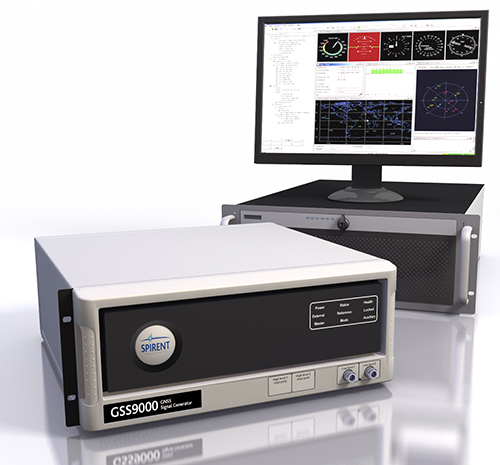
    Spirent's GSS9000 constellation simulator.
    Spirent’s GSS9000 constellation simulator.

    The Spirent GSS9000 Multi-Frequency, Multi-GNSS RF Constellation Simulator can simulate signals from all GNSS and regional navigation. It offers a four-fold increase in RF signal iteration rate (SIR) over Spirent’s GSS8000 simulator.

    The GSS9000 SIR is 1000 Hz (1 ms), enabling higher dynamic simulations with more accuracy and fidelity. It includes support for restricted and classified signals from the GPS and Galileo systems, as well as advanced capabilities for ultra-high dynamics. It can evaluate resilience of navigation systems to interference and spoofing attacks, and has the flexibility to reconfigure constellations, channels, and frequencies between test runs or test cases.

    Hardware changes can be made in the field, supported by the new on-board calibrator module. The GSS9000 is extensible and can support the widest range of carriers, ranging codes, and data streams for the Galileo, GPS, GLONASS and BeiDou systems, as well as regional/augmentation systems. Multi-antenna/multi-vehicle simulation for differential-GNSS and attitude determination, and interference/jamming and spoofing testing are also supported.

    GSS9000 Attributes

    • 1000-Hz simulation iteration rate (SIR) and hardware update rate (HUR) enabling real-time remote control and trajectory delivery with extremely low latency and simulation of ultra-high dynamic motion
    • 160 channels plus 640 embedded multipath channels across 10 independent frequencies in one chassis
    • Single RF version and dual RF version for differential GNSS and multi-vehicle simulation
    • 0.3 mm RMS pseudorange accuracy, 120,000 m/s relative velocity
    • Highly flexible configurations selectable via a “cabinet” of license keys
    • Complete portability of Spirent SimGEN scenarios
    • In-field upgradeability
    • Future-proofed for all advances in GNSS technology

    Spirent Federalwww.spirentfederal.com


  • Launchpad: GNSS simulator developed with JAXA

    The Replicator by IP Solutions  is a multi-frequency, multi-system GNSS simulator for advanced research and development, equipment testing and education. It can also function as a recording, playback and signal analysis instrument.

    IP Solutions is exhibiting this week at ION GNSS+, in Portland, Oregon.

    The Replicator is the result of a collaboration with the Japan Aerospace Exploration Agency (JAXA).

    mfr3-ipsolutions-replicator-wComponents include the Simceiver hardware device, the ReGen control software for real-time simulation, Streamer control software for recording and playback, and ARAMIS software receiver for signal analysis.

    The 24-channel Replicator provides real-time generation of GNSS signals, recording and playback of dual-frequency GNSS RF signals, and GNSS RF signal analysis with JAXA COSMODE ionospheric scintillation monitor.

    The Replicator offers real-time simulation of dual-frequency GPS, GLONASS, BeiDou or GPS+GLONASS, GPS+BeiDou, GPS+Galileo signals.

    Comprehensive simulation models include atmosphere, multipath, and more. Also available is signal analysis based on JAXA COSMODE ionospheric scintillation monitor.

    Two or more units can be used to simulate, record and playback more signals at the same time. Simulated and recorded signals can be stored in digitized format, analyzed by a MATLAB software receiver and played back as RF at any time.

    Replicator Advantages

    • User defined models with ANSI C API
    • Real-time simulation
    • Record and playback
    • GNSS signal analysis
    • Upgradable to more features , signals and frequencies for the difference in price.

    IP-Solutions, www.ip-solutions.jp

  • Racelogic launches wideband system at ION GNSS+

    Racelogic launches wideband system at ION GNSS+

    LabSat 3 by Racelogic is a lightweight and portable system for GNSS testing, capable of recording and replaying the raw radio signals including GPS L1, GLONASS L1, Galileo E1, BeiDou B1, QZSS and SBAS. LabSat 3 records real-world data, reproducing all GNSS artefacts on the laboratory bench, including multipath, ionospheric effects and signal dropouts. There is no limit to the number of satellites that can be logged.

    The ION GNSS+ 2016 Exhibition will include the launch of the new LabSat 3 Wideband system, which offers significantly higher bandwidth and enhanced frequency range. With three RF channels and up to 50 MHz bandwidth per channel, LabSat 3 Wideband will record and replay most current GNSS signals including GPS L1, L2 and L5, all in one file.

    labsat-real-time-wFeatures include RF data recording up to 3-bit quantization together with bandwidth up to 50 MHz. A removable battery pack offers more than two hours of record time. All of the fetures come in a compact, lightweight package weighing under 1.2 kilograms.

    One-touch control, data capture to removable media, dual CAN, RS232 and Digital I/O record and replay capability ensures that the LabSat 3 range is a convenient system for any developer who requires realistic testing at a competitive price.

    Also available is SatGen, the simulation software that allows for the creation of user-generated scenarios to be replayed through the LabSat. SatGen has recently been upgraded so that not only can it provide GPS, GLONASS and BeiDou signals, it now includes a real-time capability. This allows for GNSS RF signals to be created with a current time stamp. SatGen is a powerful tool for those wishing to test new GNSS devices with any dynamics, location or time.

  • IFEN launches cost-effective NCS TITAN GNSS simulator

    IFEN launches cost-effective NCS TITAN GNSS simulator

    IFEN GmbH has launched its new NCS Titan GNSS simulator. The NCS Titan has up to 256 channels (and 1024 multipath channels) and up to 4 RF outputs per chassis, providing flexibility and outstanding performance, according to IFEN.

    The extra complexity and cost of using multiple signal generators is avoided, improving reliability without compromising on functionality, IFEN said in a news release.

    The innovative design of the NCS Titan allows users configure channels for any GNSS signals and allocate those channels to any of the RF outputs fitted. This flexibility enables the same simulator hardware to be used for an extensive range of tests, for all types of GNSS applications.

    The NCS Titan GNSS simulator by IFEN.
    The NCS Titan GNSS simulator by IFEN.

    The NCS Titan sets new standards in the field of GNSS Simulation, in terms of fidelity, accuracy, dynamics, iteration rates and reliability, the company said.

    “The launch of our brand new NCS Titan GNSS Simulator represents another milestone for our NCS GNSS simulator products,” explained Günter Heinrichs, head of customer applications. “This shows clearly once again our commitment to ongoing product enhancement and dedication to providing our customers with best GNSS test equipment on the market.”

    The NCS TITAN GNSS Simulator has been developed in cooperation with WORK Microwave GmbH, Germany.

  • Spirent GSS200D automates monitoring and analysis of RF interference

    Spirent GSS200D automates monitoring and analysis of RF interference

    Spirent's new GSS200D Interference Detection and Analysis solution.
    Spirent’s new GSS200D Interference Detection and Analysis solution.

    Spirent Communications has rolled out its new GSS200D Interference Detection and Analysis solution. The GSS200D was developed as part of Spirent’s partnership with Nottingham Scientific Limited.

    The GSS200D comprises field-based hardware and a secure data server for automatic capture and analysis of GNSS radio-frequency interference. Deployments of GSS200D probes readily provide users with a thorough understanding of the RF interference environment at sites of interest.


    Spirent will demonstrate the GSS200D at its booth during ION GNSS+ 2016, held Sept. 14-16 in Portland, Oregon.


    Spirent has already detected thousands of disruptive GPS L1 interference events with its global network of GSS100D detectors. By adding support of additional frequencies and constellations, as well as improving the analysis and reporting, the GSS200D responds to the demand of critical infrastructure and civil aviation customers.

    v1-02-capture-detail-2-w

    “The GSS200D is the first automated solution to identify and securely store multi-constellation GNSS RF interference. The GSS200D data server tools enable trend analysis and event identification over time, as well as re-generation of real world events,” said Romain Zimmermann, product manager at Spirent. “Our solution offers unique value because it enables informed decision making in areas such as site selection and approaches to make devices and systems more robust in the face of increasing threats that simply cannot be eliminated. It’s a truly end-to-end test solution which provides access to detected events through to the ability to regenerate and analyze results with real hardware.”

    The GSS200D is a detection system that operates simultaneously on GPS, GLONASS and Galileo in the L1 band. This functionality enables a wide range of users, such as critical infrastructure communications, broadcast and power distribution, civil aviation, road user charging and autonomous vehicles to detect, characterize and classify RFI sources that may affect their services.

    v1-01-analytics-priority-1-wCaptures of RFI events are logged and stored on PT Cloud, Spirent’s secure cloud infrastructure, allowing the end user confidential access to the results via a web portal. Advanced analytics and reporting features include visualization of both spectrogram and spectrum, as well as characterization of the type and priority of interferences, enabling monitoring over time and in-depth trend analysis. On-premise server options are also available.

    For more information, visit http://www.spirent.com/Solutions/Robust-PNT.

  • Racelogic demos LabSat real-time simulator at AUVSI’s Xponential 2016

    Mark Sampson of Racelogic demonstrates the company’s LabSat GPS, GLONASS and BeiDou simulator at the Association for Unmanned Vehicle Systems International‘s Xponential 2016 show, held May 2-5 in New Orleans. Watch as the simulator produces signals in real time.

  • Prize for GNSS opinions

    Geomatics specialist Larry Tinney won the $50 gift card in our January drawing among takers of the Reader Poll. You can win too! Take the poll below by Feb. 22 to answer the question: What is the biggest challenge in simulating GNSS environments for testing products under development? All poll takers will be entered in a drawing for a $50 gift card.

  • ION GNSS+ 2015: Spectracom presents GPS, GNSS simulator product line

    Rohit Braggs, vice president of sales and marketing for Spectracom, talks about the company’s GPS and GNSS simulator product line at ION GNSS+ 2015 in Tampa, Fla.

  • ION GNSS+ 2015: IFEN features GNSS simulator

    Dr. Günter Heinrichs, head of customer applications for business development at IFEN, talks about the new features of Ifen’s GNSS simulator at ION GNSS+ 2015.

  • ION GNSS+ 2015: Skydel showcases GNSS simulator

    Stéphan Hamel, CEO and co-founder of Skydel, describes Skydel’s GNSS simulator, which runs on an SDR, at ION GNSS+ 2015. Hamel also touches on the company’s partnership with Averna, a test engineering software, solutions and services company.