The bipartisan RETAIN GPS and Satellite Communications Act seeks to compensate all GPS and satellite communications users harmed by the April 2020 Ligado Order from the FCC.
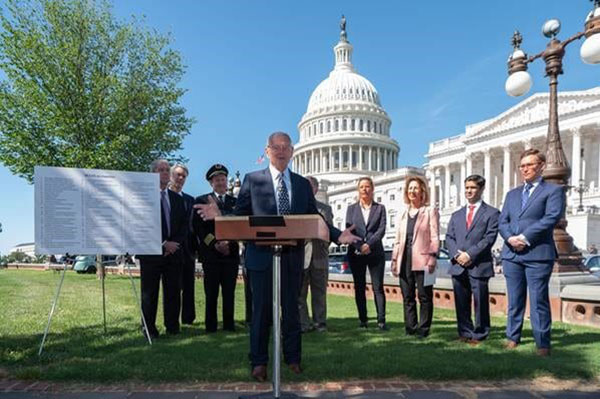
Sen. Inhofe introduces the RETAIN GPS and Satellite Communications Act. (Photo: RNTF)
On June 23, Senator Jim Inhofe (R-OK) held a press event on the lawn of the U.S. Capitol. There he announced his introduction of the “Recognizing and Ensuring Taxpayer Access to Infrastructure Necessary for GPS and Satellite Communications Act” or the “RETAIN GPS and Satellite Communications Act.”
Inhofe is the ranking member of the powerful Senate Armed Services Committee. That committee’s chair, Senator Jack Reed (D-RI), is a co-sponsor, as are Senators Tammy Duckworth (D-IL) and Mike Rounds (R-SD).
The bill has several provisions, all of which are aimed at ensuring anyone using the frequencies the Federal Communications Commission (FCC) allocated Ligado in April 2020 will compensate all GPS and satellite communications users that are harmed.
This would pose a significant increase in financial liability for Ligado. Under the current FCC order, is only responsible for reimbursing the federal government for costs to modify systems and replace equipment.
Many see this provision as manifestly unfair. “The FCC is requiring Ligado to pay damages to federal equipment, so the company should also pay damages to equipment owned by ordinary Americans,” said George Washington University economics professor Diana Furchtgott-Roth.
“With Ligado 5G transmitters overwhelming GPS signals, pipeline maintenance and systems operations would be affected. Plus, private pilots might find that navigation technology does not operate, joggers might find that their health trackers ceased to work, and firefighters might not be able to get to their destinations.”
She estimates the cost of damage to non-federal entities to run into the billions of dollars. Furchtgott-Roth previously served as and Acting Assistant Secretary for Economic Policy at the Department of Treasury and Deputy Assistant Secretary at the Department of Transportation.
The FCC decision was, and remains, controversial. Seven different petitions to reconsider were filed by various organizations and coalitions, including the National Telecommunications Information Agency (NTIA) on behalf of the entire executive branch.
The FCC has yet to respond to any of the petitions, though it has denied requests to stay its order pending resolution of concerns.
Inhofe has long been concerned about the FCC’s action. As then-chair of the Senate Armed Services Committee, he held hearings, issued press releases, and made public statements aimed at Ligado’s financial backers and potential backers. All warn of disastrous consequences should Ligado’s plan for transmissions in the bands adjacent to GPS be put into operation.
Inhofe also ensured several provisions were included in the 2021 National Defense Authorization Act (NDAA) that addressed the FCC’s action. These include:
A requirement for the Department of Defense (DOD) to estimate and report to Congress the cost of damage to department systems as a result of the FCC order.
Prohibiting use of department funds to upgrade or modify military equipment to make it resilient to interference caused by broadcasts in the spectrum allocated (the FCC order requires this to be funded by Ligado).
Prohibiting DOD from contracting with any entity using the frequency bands allocated to Ligado unless the Secretary of Defense certifies the use will not interfere with GPS services.
Requiring the Secretary of Defense to contract with the National Academies of Sciences, Engineering, and Medicine for an independent technical review of the FCC order.
Dana A. Goward is President of the Resilient Navigation and Timing Foundation. The foundation has petitioned the FCC to reconsider its decision regarding Ligado Networks.
In letters sent today to the White House and U.S. Congress, more than 90 organizations representing a broad range of industries urged President Biden and members of Congress to set aside the Ligado Order approved during the previous administration.
The industries urged the president and lawmakers to work with the Federal Communications Commission (FCC) to “stay and ultimately set aside the Ligado Order,” saying that it “poses significant threats to the reliability of GPS for millions of Americans.”
“The risk to American lives and to the American economy are simply too great,” the group wrote in the letters.
“A year ago today, the FCC made the dangerous and misguided decision to allow Ligado Networks to operate a terrestrial network on frequencies adjacent to GPS despite threats to GPS reliability and the concerns of Congress and virtually all federal agencies that rely on GPS to protect our national and economic security,” said Dale Leibach, spokesman for the Keep GPS Working Coalition.
“We are hopeful that under the new administration, something can be done to stop Ligado from proceeding with its plan and we are extremely thankful to the many members of Congress and government officials who have rightly pointed to the very harmful impact this decision will have on countless consumers, farmers, ranchers, pilots, boat owners, surveyors, engineers and construction companies if it is not reversed,” Leibach said.
Two recent reports from the Organization for Security and Co-operation in Europe (OSCE) have described a recent increase in GPS jamming, presumably by Russian or pro-Russian forces in Ukraine. This comes as Russia has increased its troop numbers and activity along its border with Ukraine.
OSCE is charged with a Special Monitoring Mission (SMM) in Ukraine which observes and reports on how well both sides are adhering to the Minsk Protocol agreement. The agreement was signed in September 2014 by participants in the conflict in an effort to end open hostilities.
One of the ways the OSCE mission monitors activity and compliance in the region is with long range UAVs. As early as November 2014, the organization reported UAV operations being thwarted by interference with GPS signals.
Two recent OSCE spot reports have highlighted a resurgence in jamming.
An April 7 report described interference that prevented a UAV takeoff the previous day. While the organization’s UAVs had been experiencing increased interference since March, this was the first time since October 2014 that it had thwarted a mission before takeoff.
The report also documented an increasing level of jamming activity.
“Over the last two months, 62.5 percent of SMM long-range UAV flights encountered GPS signal interference and on 75 percent of the affected flights it occurred more than once.”
A second report on April 9 outlined continuing problems that caused missions to be aborted. It emphasized that this was a violation of the agreement signed by all parties and greatly hampered OSCE’s mission.
“Any GPS signal interference hinders the Mission’s ability to conduct effective monitoring and reporting of the security situation in line with its mandate. Long-range UAVs are an essential part of SMM operations, especially at night and in areas where the Mission’s monitoring and freedom of movement are restricted.”
GPS jamming and spoofing are important parts of Russia’s arsenal to counter any technological advantage the west may have over their forces. A 2015 Sputnik article bragged their electronic warfare kept U.S. cruise missiles from hitting their targets at the start of the 2003 invasion of Iraq. Also, that this advanced capability “renders aircraft carriers useless.”
Interference with GPS signals is a regular feature of Russian military and internal security operations.
The United States has formally expressed concerns about the recent increase in the number of Russian troops and their activity at the Ukrainian border. It has been reported that two U.S. Navy ships are on their way to the Black Sea to help monitor the situation.
Dana A. Goward is president of the Resilient Navigation and Timing Foundation.
The Keep GPS Working Coalition issued the following statement in support of the inclusion of provisions related to GPS in the William M. “Mac” Thornberry National Defense Authorization Act (NDAA) for Fiscal Year 2021. Provisions included are intended to protect GPS signals against interference, specifically against any caused by Ligado Networks.
The coalition was formed in response to a Federal Communications Commission (FCC) order allowing Ligado Networks to operate a terrestrial wireless network that the coalition says will threaten the reception of millions of GPS devices.
The coalition stated,
“The Keep GPS Working Coalition applauds this year’s NDAA, which includes important provisions addressing the potential for interference to GPS caused by the use of the L-band spectrum owned by Ligado Networks. The inclusion of these provisions signals a clear understanding by Congress that preventing GPS interference is a matter of safeguarding our national security. First and foremost, the legislation provides for a thorough, independent review of the Federal Communications Commission decision allowing Ligado to operate its planned terrestrial wireless network.
“The FCC’s Ligado order, which relies heavily on inaccurate and incomplete technical submissions by Ligado, was issued despite national and economic security concerns raised by the Department of Defense, along with the Departments of Commerce, Interior, Justice, Homeland Security, Energy and Transportation, as well as NASA, the National Science Foundation, the Coast Guard and the Federal Aviation Administration. Independent review is an important first step in ensuring that Ligado’s operations will not damage the nation’s critical GPS based infrastructure or the hundreds of millions of GPS devices used in critical activities. This review and the other NDAA provisions included will also help ensure that appropriate safeguards are in place to hold Ligado accountable for all costs to U.S. taxpayers, businesses and consumers that will result from these operations.
“We are particularly grateful to Senators Inhofe and Reed and Representatives Smith, Thornberry, Turner and Cooper for their leadership on this critical issue.”
More than 50 organizations signed a Nov. 20 letter urging the chairmen and ranking members of the House and Senate Armed Services Committees to continue their support for provisions aimed at protecting GPS from harmful interference from Ligado Networks’ planned network.
According to the Senate Armed Services Committee, “The bill protects both critical military applications and numerous civilian uses of the Global Positioning System (GPS) from potentially harmful interference, and outlines a path forward following the Federal Communications Commission’s (FCC) decision to approve Ligado Networks’ request for bandwidth for a terrestrial-based cellular network that put critical GPS signals at risk. The bill prohibits the use of DOD funds to comply with the FCC Order on Ligado until the Secretary of Defense submits an estimate of the costs associated with the resulting GPS interference, and directs the Secretary of Defense to contract with the National Academies of Science and Engineering for an independent technical review of the order to provide additional technical evaluation to review Ligado’s and DOD’s approaches to testing. The bill also prohibits the Secretary of Defense from entering into or continuing a contract with any entity engaged in commercial terrestrial operations within the frequency bands specified in the Ligado FCC order.”
Several agriculture groups have been added to the Keep GPS Working Coalition, which was launched in June to protect GPS users from harmful interference resulting from the Federal Communications Commission’s (FCC) decision to permit Ligado Networks to operate a terrestrial wireless network in the band adjacent to GPS.
The new members from the agriculture sector join the Association of Equipment Manufacturers, American Farm Bureau Federation, American Road & Transportation Builders Association, Aircraft Owners & Pilots Association and Boat Owners Association of The United States in urging the reversal of the FCC’s Ligado order.
“The FCC’s decision represents a sweeping governmental and regulatory assault on farmers who are already facing unprecedented challenges including severe weather, low commodity prices and supply chain vulnerability as a result of COVID-19,” said Dale Leibach, spokesperson for the Keep GPS Working Coalition. “The order must be stopped. The FCC’s decision must be reversed.”
According to the coalition, farmers are increasingly relying on precision agriculture applications that deliver centimeter-level accuracy that enables farmers to maximize crop yields while lowering costs and environmental impact. Precision farming also reduces costs for consumers, delivers economic benefits for rural economies and enables the efficient production of the foods required to meet a growing global demand for food, fiber and fuel, the coalition added.
“Ag retailers often fill a role as trusted advisor to their farmer customers, suggesting new and emergent technologies in the precision ag space,” said Daren Coppock, president and CEO of the Agricultural Retailers Association. “Without the GPS location services needed for proper planning and implementation of these resources, farmers may not have the tools they need to increase crop yields, lower input loads and decrease inefficacies. ARA stands behind the coalition’s work to protect GPS as a valuable resource to farmers.”
Agriculture industry leaders and a member of the House Committee on Agriculture will participate in a conversation discussing how the FCC’s decision to allow Ligado Networks to operate a terrestrial wireless network will threaten the reliability of GPS receivers used in precision agriculture at 11 a.m. EDT on Oct. 1. Details can be found here.
Last week, 27 members of the U.S. House Agriculture Committee sent a letter to Federal Communications Commission (FCC) Chairman Ajit Pai. In it, they urged him to reconsider the FCC’s decision to allow Ligado Networks to operate a terrestrial nationwide network that the executive branch says will cause harmful interference to GPS signals for many users.
This concern and opposition from a sector not traditionally engaged in GPS or positioning, navigation and timing (PNT) issues is just one example of how the FCC’s decision — rather than putting the issue to rest — has instead recruited a whole new set of actors from across multiple sectors for the opposition.
Many observers don’t see this as surprising.
According to one observer, previously it was easy for many to assume the FCC would reject Ligado’s proposal. The entire executive branch had been vehemently opposed for years. So had aviation groups, the weather community, geospatial interests and some satellite communications concerns. With such opposition from so many important quarters, it was reasonable for many to assume they need not become involved. Now that the FCC has acted to the contrary, these interests have become well energized.
The FCC decision also empowered opponents to educate and recruit others who don’t normally think or worry about GPS and PNT issues, folks like farmers and agricultural interests.
As one insider said, “The existing opposition can now go to just about anyone in any sector and say, ‘This is going to happen and it will harm your operation. There are no ifs, ands, or buts. The FCC has decided’.”
Photo: Avalon_Studio/E+/Getty Images
Agriculture’s reliance on GPS
Agriculture is a good example. While not the sector that first springs to mind when most people think about GPS, farming has become dependent on augmented GPS for precisely and automatically driving machinery, minimizing fertilizer and pesticide use, and a wide variety of other productivity gains over pre-GPS operations.
“GPS is critically important to the commercial agriculture, mining, forestry and rural manufacturing industries. In fact, GPS has become the single most significant technological advancement for American farm equipment in the past two decades… [A 2019 RTI study] found that during planting season, if GPS were interrupted, the economic impact to the agriculture sector could amount to losses of $15 billion due to lower crop yields. Moreover, an earlier study suggested GPS-enabled precision agriculture could save farmers an estimated 10 to 15 percent in operating costs and purchased inputs. This same study estimated the benefits of GPS to precision agriculture between $10 and $17 billion.”
Department of Transportation studies have shown that high-precision GPS receivers, such as those used in agriculture, could be impacted within 3,000 meters of a Ligado transmitters. With tens of thousands of transmitters deployed in a nationwide network, this could pose a real problem for American farming.
Other sectors have also become involved in the opposition. The recently formed Keep GPS Working Coalition has members representing aviation, surface transportation, maritime, agriculture and equipment manufacturing.
This formal and public coalition, though, seems to be just the tip of the opposition iceberg.
Almost 100 dissenting organizations
According to some involved with protesting the FCC’s decision, there are nearly a hundred organizations and companies that are working in some way to have it overturned. These include multiple aviation, delivery service, agriculture, surface transportation, geospatial, weather, maritime, space and technology interests.
One sign of the influence they are having is an increase in concerns being expressed by members of Congress.
In addition to the agriculture letter, some of the most powerful recent examples are statements made during meetings of the influential House Committee on Appropriations. Rep. Ken Calvert (R-CA), ranking member of the Defense Appropriations subcommittee, spoke at length in opposition to the FCC’s action. His comments were followed in a similar vein by the vice chair of the Appropriations Committee, Rep. Peter Aguilar (D-CA).
Many of the questions being asked by the public and members of Congress alike were reflected in the letter from the Agriculture Committee members:
How did the FCC know that “its” tests were representative and valid?
Why does the FCC find that some degradation of GPS reception is acceptable?
Why did the FCC reject the executive branch’s testing criteria?
Was there a cost/benefit analysis?
The letter also asked the question that is on almost everyone’s mind: If and when there are problems, who is going to fix them?
Coalition’s first action is to endorse Inhofe-Reed legislation forcing Ligado to provide financial relief to consumers, industries and other end users
Five organizations representing thousands of companies and millions of Americans have launched a new coalition to protect end users of GPS following the Federal Communications Commission’s (FCC’s) April 22 decision to permit Ligado Networks to operate a terrestrial wireless network using its satellite spectrum.
Ligado’s planned use of its L-band spectrum — adjacent to bands used by GPS — would threaten the reception capability of hundreds of millions of GPS devices, according to the coalition.
American Road & Transportation Builders Association (ARTBA)
Aircraft Owners & Pilots Association (AOPA)
Boat Owners Association of The United States (BoatU.S.)
As its first action, the Keep GPS Working Coalition will endorse the Recognizing and Ensuring Taxpayer Access to Infrastructure Necessary for GPS and Satellite Communications Act, which is expected to be formally introduced this week by Sens. Jim Inhofe (R-Okla.) and Jack Reed (D-R.I.).
GPS IIIF’s M-Code can be broadcast from a high-gain directional antenna in a concentrated, high-powered spot beam, in addition to a wide-angle, full-Earth antenna. (Artist rendering: Lockheed Martin)
The coalition explained in a press release,
The FCC’s decision threatens GPS reliability for countless consumers, farmers, ranchers, pilots, boat owners, surveyors, construction companies and other private GPS users who will be forced to suffer interference to their GPS devices or to pay to replace them.
The FCC admits in its order that there are cases where both government and private GPS receivers — including those that power aviation, agriculture and other key industries — will suffer harmful interference, but failed to provide a technically feasible and adequate remediation solution for consumer and business end users.
The FCC also failed to conduct an open and comprehensive rulemaking process before issuing the Ligado order, instead circulating a final decision only among FCC commissioners while major stakeholders grappled with the COVID-19 pandemic.
Notably, the FCC ignored established technical standards determining whether GPS devices would suffer harmful interference, instead relying on limited studies using vague and impractical criteria to assess interference with the GPS signal, while disregarding mountains of evidence on the topic under the established methodology.
“In issuing the Ligado order, the FCC threw millions of Americans who depend on GPS in their everyday lives under the bus with undue haste and inadequate consideration,” said Dale Leibach, spokesperson for the Keep GPS Working Coalition. “Alarmingly, the commission also ignored concerns raised by Congress and federal agencies — the experts that rely on GPS to protect our national and economic security — including the Departments of Defense, Transportation, Commerce, Interior, Justice and Homeland Security, as well as NASA, the National Science Foundation, the Coast Guard and the Federal Aviation Administration. DOD has even argued before Congress that the interference from Ligado’s network would put missions and troops at risk. It is a highly questionable decision that benefits a single company and its Wall Street investors at the expense of national and economic security.”
“The Keep GPS Working Coalition will ensure that the concerns of end users are represented in this critical public policy debate, joining the chorus of experts sounding the alarm over the Ligado order’s existential threat to GPS technology and urging the FCC to reverse its decision,” the press release stated.
“In the interest of the agriculture, construction, and other off-road equipment manufacturers, the Association of Equipment Manufacturers is taking a firm stance against the recent FCC Ligado decision,” said Kip Eideberg, Senior Vice President of Government and Industry Relations for AEM. “The FCC decision impacts millions of private GPS devices, many of which are used by farmers, contractors and consumers who depend on a reliable connection to plant, harvest, construct and move goods. We thank Senators Inhofe and Reed for their leadership and for introducing this legislation that will begin to address the wrongdoings the Ligado order will cause, and we urge the FCC to reconsider their imprudent decision.”
“America’s farmers and ranchers rely on precision agriculture technology and GPS so their farms and ranches can be more efficient, economical and environmentally responsible. Expanding broadband access is a top priority for Farm Bureau but not at the expense of losing the accuracy of GPS,” said Zippy Duvall, President of AFBF.
“The FCC’s actions threaten the profound improvements GPS has made possible in the construction industry, including increased efficiency, productivity and improved safety,” said Dave Bauer, President and CEO of the American Road & Transportation Builders Association. “ARTBA stands with our fellow Keep GPS Working Coalition members as we aim to reverse the FCC’s decision.”
“Reliable GPS is critical to aviation safety, a fact that was not adequately weighed by the FCC before reaching its decision. AOPA is grateful for the opportunity to represent aviation stakeholders as part of the Keep GPS Working Coalition,” said Jim Coon, Senior Vice President for Government Affairs for the Aircraft Owners & Pilots Association.
“The GPS technology that America’s boaters rely on every day is once again threatened by the FCC’s recent decision,” said David Kennedy, Government Affairs Manager of BoatU.S. “BoatU.S. is honored to be part of the Keep GPS Working Coalition and looks forward to working with the coalition’s other members to protect this critical technology.”
According to the coalition, in addition to requiring Ligado to satisfy additional conditions prior to the order becoming effective, the bipartisan Inhofe-Reed legislation would ensure the costs incurred by businesses and consumers as a result of the FCC’s decision would be covered by the licensee benefiting from the decision — in this case, Ligado.
“The Keep GPS Working Coalition thanks Senators Inhofe and Reed for introducing the Recognizing and Ensuring Taxpayer Access to Infrastructure Necessary for GPS and Satellite Communications Act, which acknowledges the potential harm to GPS end users caused by the Ligado order and ensures the burden of cost sits squarely where it belongs — on Ligado, rather than our farmers, pilots, boat owners, surveyors or construction companies,” said Leibach. “While we strongly urge the FCC to reconsider its position on this matter, we are deeply grateful to Senators Inhofe and Reed for recognizing the tremendous expense and burden the Ligado order places on American businesses and consumers and providing clear and immediate relief to critical stakeholders.”
For more information about the Keep GPS Working Coalition, visit www.keepgpsworking.com.
U.S. Federal Communications Commission (FCC) Chairman Ajit V. Pai has responded to a congressional letter expressing objections to the April 20 FCC decision to allow Ligado to establish a broadband network.
In a May 27 email sent to GPS World, the FCC wrote, “Given your interest in the Ligado order that the Commission adopted unanimously last month, we wanted to share with you the text of the letter Chairman Pai recently sent to members of Congress on this topic.”
The five-member FCC voted unanimously in April to approve an order to allow Ligado Networks to deploy a low-power nationwide 5G network. Experts and policy makers have said the broadband network could — or likely would — interfere with reception of GPS signals.
On May 7, a bipartisan group of 23 members of the House Armed Services Committee (HASC) sent a letter to the FCC questioning the decision, and this is the letter the FCC is now responding to.
The letter from Committee Chairman Adam Smith (D-Wash.) and Ranking Member Mac Thornberry (R-Texas) says the FCC order did not comply with Section 1698 of the National Defense Authorization Act for Fiscal Year 2017. That act prevents the commission from approving commercial terrestrial operations in certain portions of the L-band spectrum until 90 days after the commission resolves concerns of harmful interference to GPS devices.
The Senate Armed Services Committee held a hearing on the topic on May 6 with Department of Defense officials, and on May 15, 32 senators asked the FCC to address their concerns and stay the Ligado approval order while doing so.
“GPS has no right to operate in the spectrum in question, so there is nothing for Ligado to share.” — FCC Chairman Pai
The letter insists that GPS will remain protected. “Although your letter references the shared use of spectrum, the Commission’s L-band decision does not authorize any spectrum sharing between Ligado and GPS. In fact, spectrum in this band has been licensed to Ligado and predecessor companies for over 30 years — with those companies authorized to deploy terrestrially since 2004. And as mentioned above, one of the FCC’s conditions require separation of Ligado’s operations from GPS spectrum by means of a 23-megahertz guard band. Thus, any implication that the Commission has authorized Ligado to “share” spectrum that is currently allocated to GPS is incorrect. GPS has no right to operate in the spectrum in question, so there is nothing for Ligado to share.”
Download the full letter to Rep. Smith here. Download HASC letter to the FCC here.
The email to GPS World included the following statement: “The FCC is required by law to make its decision based on the facts in the record, and federal agencies, including the Department of Defense, were provided with multiple opportunities to put whatever facts they believed to be relevant into the record, including classified information, which the Commission has a process in place to protect.
“The Commission based its decision on all of the information in the record. Moreover, we are not aware of the FCC refusing any request by the Department of Defense to provide a briefing related to this matter.
“To the extent any federal agency opposed to the Ligado application chose not to share information with the Commission, that was the agency’s decision and suggests that it did not believe that the information in question would bolster its case.”
The national time system at Israel’s National Physics Laboratory (INPL) in Jerusalem is now protected by a GPSdome unit for cyber protection of GPS/GNSS signals, according to Israel’s Homeland Security, a private company established in 2012.
Microchip partner Focus Telecom installed the GPSdome cyber protection system under a support and maintenance contract. GPSdome was developed by infiniDome, an Israeli startup.
INPL’s Nadya Goldovsky will now test and measure the system for its ability to protect the GPS/GNSS satellite signals from jamming and other interference. Over the course of several months, Goldovsky will test the system’s ability to protect its four independent atomic clocks, which continuously supply Israel’s national time.
The cyber protection system is designed to enable continuous, uninterrupted GPS/GNSS service, which allows for full operation of the clocks. During a GPS cyber-attack, infiniDome’s Communication Module will report it to infiniDome’s Cyber Security Cloud.
“GPSdome is a cyber protection system developed based on military technologies and principals which was adapted to non-military, commercial use,” said Omer Sharar, infiniDome’s CEO. “Our systems are already deployed and operational in Israel at multiple sites in the defense/HLS sector, border protection, financial sector and telecom sector.”
The company has signed a global distribution contract with an international PNT solution provider to sell its GPSdome systems in more than 120 countries, Sharar said.
Dozens of parties cite evidence of harmful interference and vast economic harm that FCC ignored in favor of dubious 5G marketing claims
Dozens of private-sector interests will file Petitions for Reconsideration of the Federal Communications Commission’s (FCC) recent order to allow Ligado Networks to rezone its satellite spectrum holdings for terrestrial mobile use and “flip” them for a profit, according to the Washington, D.C.-based communications firm Glen Echo Group.
Petitioners will ask the FCC to reconsider its decision, which has generated widespread opposition within the administration, on Capitol Hill and from other aviation and satellite spectrum users. Petitioners include:
Airline Pilots Association
Association of Equipment Manufacturers
Aviation interests (including the Cargo Airline Association, the International Air Transport Association and Airlines for America)
Iridium Communications
Lockheed Martin
Trimble
RNT Foundation
The petitioners argue the FCC’s Order ignored or improperly disregarded the great majority of evidence, including technical analyses submitted by parties showing harmful interference, and relied instead on “easily disproven claims that Ligado will provide a so-called 5G service,” the Glen Echo Group stated in a press release.
“The L-band is not included in any internationally recognized 5G standard, the spectrum is not harmonized regionally or globally for 5G, FCC’s 5G FAST Plan does not include Ligado or L-Band spectrum nor does the company have enough contiguous spectrum,” the release stated.
Airlines for America. “Airlines for America (A4A) strongly supports a broad industry coalition that has led at least 32 U.S. Senators from both sides of the aisle to urge the FCC to stay and reconsider granting Ligado Networks’ petition to repurpose critical frequency spectrum for ‘5G’ terrestrial communications services. The FCC’s rushed order in April ignored testing protocols intended to protect critical users likely to be impacted, including aviation uses of Global Positioning Systems (GPS) for navigation, and satellite communications. Beyond industry opposition, the U.S. Department of Defense also strongly opposed the FCC’s action.
“A4A is joining other industry constituents in directly petitioning the FCC to reverse its course, the effects of which could impact the safety of the flying public and impact operations, especially harmful outcomes in the recovery period following the COVID-19 pandemic.”
Aerospace Industries Association. The association represents more than 300 companies.
“Uninterrupted access to GPS is essential not only for our industry, but also for the American people, our national security, and the strength of the U.S. economy. This access is now threatened by the FCC’s decision to grant Ligado Networks’ application, despite years of evidence and the concerns outlined by several federal agencies about potential interference. With this motion, we are banding together to urge the FCC to reconsider this decision and allow safety and data to drive their decision-making on spectrum.”
The International Air Transport Association (IATA), which represents some 290 airlines or 82% of global traffic said, “Approving Ligado’s spectrum for 5G poses a strong risk of interference with GPS signals, including the potential interruption of GPS signals at low altitudes. The FCC should reverse this decision.”
Air Line Pilots Association (ALPA). President Capt. Joe DePete said, “Throughout its report and order, the FCC uses words like ‘possible’ and ‘feasible’ when talking about whether Ligado can operate. These are not the words you would want to hear your Captain use when talking about successfully completing your flight the next time you are sitting in the cabin. Aviation requires certainty and guaranteed performance from its systems. The FCC’s hasty, arbitrary, and incorrect decision will set a disastrous precedent that will impede ongoing work on spectrum sharing. The Ligado decision must be reversed immediately.”
Aviation Spectrum Resources Inc. “In jointly filing a petition for reconsideration of the FCC’s recent decision on Ligado Networks’ proposal, ASRI joins the wider aviation community in expressing our view that the decision is based on a fundamentally flawed interpretation of the data that have been presented to the Commission. Among other deficiencies, the FCC’s decision ignores the FAA’s reservations cited by the Department of Transportation, having implications for many low-level aircraft operators including helicopters and UAVs. The FCC Order also seems to acknowledge the mounting evidence that aviation safety satellite communications will receive interference, but it relies on the completion of private negotiations to resolve these questions while giving Ligado a green light to proceed, rather than requiring specific mitigations itself. ASRI believes the FCC should revisit its decision in conjunction with aviation experts to ensure the safety of air transport, medivac and other essential aviation operators are not affected by this decision.”
Iridium Communications. CEO Matt Desch said, “The FCC’s Ligado action prioritizes economic windfalls to a few speculators over safety of life, national security and important private sector companies whose customers would be most upended by their harmful interference.”
RNT Foundation. President and Director Dana A. Goward said, “The FCC treated this like a commercial communications issue instead of a decision about safety-of-life navigation. They didn’t even consider the overall cost to the public in lost lives and property.”
In addition to private sector interests, 14 federal agencies and numerous Republican and Democratic members of Congress oppose the FCC’s decision in favor of Ligado.
Leaders in the GNSS/PNT community are reacting to the Federal Communications Commission (FCC) decision to approve an order to allow Ligado Networks to deploy a low-power nationwide 5G network. The departments of Defense and Transportation have criticized the decision, concerned about interference with GPS signals.
Below are statements we have received from our readers.
Logan Scott, LS Consulting
Logan Scott
Spectrum regulation is much like land use zoning in that certain services are kept separate so as to avoid disturbing the neighbors. The FCC has in effect allowed Ligado to build an outdoor concert venue next to a monastery and by way of compensation, they offer free earplugs. GPS / GNSS signals are extremely weak and the receivers are extremely sensitive. To give some perspective, by the time they get to the GPS receiver, GPS signals are about a factor of 20 less powerful than cosmic background noise. Ligado’s spectrum is/was licensed for mobile satellite services (MSS) and so was not likely to interfere with GPS.
With their new, and much more valuable license, Ligado now has a legal right to build a terrestrial cellular service. Exhaustive testing over the last 10 years has repeatedly demonstrated that such a system will interfere with high precision GPS/GNSS receivers used in surveying, timing, and earth observation. The DoD has also made strong claims that such a system will cause harm to their systems. In all cases, the effect is much like riding a bicycle at night. You can see fine until someone comes around the corner with the high beams on and blinds you.
The FCC has in effect allowed Ligado to build an outdoor concert venue next to a monastery and by way of compensation, they offer free earplugs.
In their earlier filings, Ligado had asked for permission to transmit at a power level of 1500 Watts. In an amazing piece of legerdemain, they convinced the FCC, but not the DoT or DoD, that by reducing transmit powers to 10 Watts, there would be no harm. This is a stunningly erroneous claim. As you lower the transmit power, you need many more cellular basestations to cover a given area. To use an analogy from my backyard, I can install one high flow sprinkler head to cover the entire yard or a bunch of low flow heads, each covering a small portion. Either way, the grass doesn’t care about anything other than inches of water and I’m gonna get wet if I run across the yard. Ligado’s core argument is equally wet. Nonetheless, it has great appeal to people who don’t understand how cellular systems work.
So, moving forward and assuming the license stands, interference events will become more prevalent and GPS will be deemed “less reliable”. Because interference sources are largely untraceable, blame will rarely attach to Ligado. I expect that GNSS receiver vendors will incorporate improved filters into receivers and pass the cost along to buyers. Ligado, or more likely whoever they sell the spectrum to, will quickly move to petition for increase transmit powers so as to lower capital costs; after all more basestations cost more. And so, the Visogoths have arrived, 4G in hand with a 5G label.
John Fischer, Orolia
John Fisher. (Photo: Orolia)
At Orolia, we support the position of the DOT, DHS and DOD and the measures they are taking to protect the GNSS band. However, interference is a fact of life in this band as the GNSS signals are very weak, so additional measures must be taken for resiliency, especially for critical infrastructure. Adversarial interference is much worse than this, so a range of solutions are possible: from the simple – for example, a horizon blocking antenna that shields energy from a nearby tower – to full multi-layer defenses that include RF filtering, advanced DSP filtering/detection, alternative PNT from STL signals, atomic clock and IMU backup, and CRPA antennas. No one solution covers every case, but the problem can be managed.
Mitch Narins, Strategic Synergies
Mitch Narins
It is quite concerning when a panel of lawyers makes a decision, despite the results of years and years of studies, and over the objections of our nation’s technical and operational Position, Navigation and Timing (PNT) experts. While I have championed the need for a complementary and resilient PNT system for many, many years, one cannot dispute the worldwide benefits that GPS and other GNSS have brought — from safety, security, and economic perspectives.
As noted in the FCC’s press release, “The order also requires Ligado to protect adjacent band incumbents by reporting its base station locations and technical operating parameters to potentially affected government and industry stakeholders prior to commencing operations, continuously monitoring the transmit power of its base station sites, and complying with procedures and actions for responding to credible reports of interference, including rapid shutdown of operations where warranted.” I believe that it is imperative that GPS users, both within the Government and in the private sector, understand:
How base station location information will be disseminated, what power levels and radiation patterns will be utilized, and what recourse GPS users will have to object to the proposed location and service;
How the service will be monitored for each base station location, what systems will be used to do the monitoring, and how the monitoring information will be publicly disseminated;
How reports of interference will be filed, how and by whom they will be determined to be “credible”, how and in what timeframe will a “rapid shutdown of operations” be accomplished, and how appropriate mitigations will be identified and implemented; and
Given the importance and concern associated with this action, what special oversight mechanisms, involving civilian and military participants, should be put in place to avert potential safety, security, and economic impacts to our nation’s critical infrastructure.
While one can model, and even test problems based on the location of facilities where aircraft would be expected to be operating close to the ground (e.g., airports and heliports), one can never be sure where a medevac or other first responder helicopter may have to set down in response to an accident or incident site. In keeping with the FCC’s own press release, it is unclear how a pilot experiencing problems with GPS (if, in fact the pilot could recognize such a problem) would be able to report the issue and have it mitigated in real time to support a safety or security mission — unless all areas around all ground transmitters were mapped and first responders could request specific ones to be turned off when operations were expected in a known area. Unfortunately, the limits of these operating areas are, many times, unknown or rapidly changing (e.g., forest fires) and any delay in reaction to unforeseen events could prove detrimental to safety, security, and economic wellbeing.
Mitre conducted a test wherein small Unmanned Aerial Systems (sUAS) could detect and avoid an aircraft based on receipt of its ADS-B squits. Perhaps these ground transmitters should include ADS-B receivers and automatically go off-air if a helicopter comes within a certain distance. I have no doubt that Ligado would not appreciate this solution …
I would hope that those who disagree with this decision will seek out a means to correct this through either the legislative or judicial branches or both. Personally, I cannot see how this either “promotes the general welfare” or “provides for the common defense” (I didn’t have to go to law school to come to those conclusions). I also believe that (1) the ever growing importance and criticality of PNT services should provoke the Congress to modify the makeup of the FCC to include PNT expertise at the very top; and (2) the FCC Office of Chief Engineer needs to become an independent point of expertise akin to the Office of Inspector General to preclude undue pressure and potential political “bending” of technical analyses.
Finally, regardless of whether one agrees or disagrees with the FCC’s order, no one can possibly believe that this decade-long tale of woe is an example of governmental “best practice.” As it took the energy and significant resources from so many more important PNT initiatives, I hope that a quality/leadership body (perhaps GAO and/or a group of IGs) take up the task to do an independent “lessons learned” assessment of this decade-long tale of woe needs to be carefully examined, as it took the energy and significant resources from so many more important PNT initiatives — we should never have to go through this ever again.
Mitch Narins is the principal consultant and owner of Strategic Synergies, LLC, a technical and management consulting firm that he formed after retiring following over four decades of U.S. government service with the FCC, US Navy/Marine Corps, and the Federal Aviation Administration.
Alison Brown
Allison Brown
GPS user equipment needs to be designed to be more resilient to interference. The threat to GPS has been well understood for many years but agencies and vendors have been slow to respond to improve national resiliency against jamming threats. The President signed into law the National GPS Timing Resilience and Security Act in 2018 and on 2/12/2020 signed an Executive Order on Strengthening National Resilience through Responsible Use of Positioning, Navigation, and Timing Services recognizing “the disruption or manipulation of these services has the potential to adversely affect the national and economic security of the United States.” The onus is now on vendors and agencies to develop resilient solutions that can operate in the presence of intentional and unintentional interference. These solutions would also mitigate any potential impact from the use of adjacent bands by operators such as Ligado to deploy 5G and Internet of Things services.
Ellen Hall
Ellen Hall
Overall, the GPS industry should be encouraged to do more to protect themselves from harmful interference. While it is too late for today’s receivers, the next generation needs to introduce more resilience. I agree with the House Armed Services Committee Chairman in saying, “While I strongly support development of the world’s most robust, safe and secure network, using L-band spectrum in such close proximity to critical GPS, as Ligado’s proposal requires, carries an unacceptable risk….”
The FCC said the approval order included stringent conditions aimed at ensuring that GPS would be vulnerable to harmful interference. It seems the only way to prevent harmful interference, would be to permanently fund an oversight commission to monitor Ligado’s system. I believe only Congress can appropriate funding for this effort, therefore the FCC’s decision should be a recommendation to Congress to implement. It is not enough to leave it to a five-person committee to “encourage” that “stringent conditions” are implemented. Enforcement is crucial. Critical infrastructure should be regulated to ensure that we can cope better with “noisy neighbors.”
The five-member Federal Communications Commission (FCC) voted unanimously to approve an order to allow Ligado Networks to deploy a low-power nationwide 5G network.
The approval comes despite objections from the U.S. Defense Department (DOD), other federal agencies and major U.S. airlines, all of whom are concerned about near-band interference with GPS.
The FCC said the approval order included stringent conditions aimed at ensuring GPS would not experience harmful interference.
“After many years of consideration, it is time for the FCC to make a decision and bring this proceeding to a close,” said FCC Chairman Ajit Pai in an April 16 news release. “We have compiled an extensive record, which confirms that it is in the public interest to grant Ligado’s application while imposing stringent conditions to prevent harmful interference.”
Ligado is seeking to repurpose a swath of L-band spectrum for a 5G network focused mainly on connecting smart devices and other internet-of-things services. According to the FCC, the order will “promote more efficient and effective use of our nation’s spectrum resources and ensure that adjacent band operations, including the Global Positioning System (GPS), are protected from harmful interference.”
In response, members of both the Senate and House Armed Services Committees and other defense advocates are considering legislative action to overturn the order.
Two areas that rely heavily on the integrity of GPS signals include defense and transportation. The DOD issued a joint statement with the Department of Transportation (DOT) criticizing the FCC ruling.
“Americans rely on our Global Positioning System (GPS) each day for many things: to locate citizens in need of emergency assistance through our E-911 system, to secure our financial system, to order and receive shipments, to travel by car for work and leisure, to facilitate commercial trucking and construction work, and even to make a simple cellphone call. Our departments rely on GPS each day for all those reasons as well to coordinate tactical national security operations, launch spacecraft, track threats, and facilitate travel by air and sea. The proposed Ligado decision by the Federal Communications Commission will put all these uses of GPS at risk.”
House Armed Services Committee Chairman Adam Smith (D-Wash.) released a letter he sent to Defense Secretary Mark Esper and FCC Chairman Ajit Pai raising concerns about Ligado’s 5G network.
“While the United States must be a leader in the implementation of 5G networks, our creation of these networks must not hamper our military’s operational capacity in any way. China’s aggressive, global promotion of its 5G companies presents a considerable security challenge that must be addressed. However, Ligado’s proposal, which seeks a portion of spectrum adjacent to that used for Global Positioning Systems, poses an even larger security risk.
“The Department of Defense has been clear and direct: providing this license to Ligado would cause unacceptable operational impacts and adversely affect the military’s use of GPS. The military’s seamless use of GPS is vital to our national security. Our service members rely on GPS satellites for critical precision timing and navigation, and thousands of weapons systems are embedded with GPS signals.
“While I strongly support development of the world’s most robust, safe and secure network, using L-band spectrum in such close proximity to critical GPS, as Ligado’s proposal requires, carries an unacceptable risk that far outweighs the possibility of a 5G network.”
‘Risk of crippling’ GPS
Defense Secretary Mark Esper said via Twitter on Friday that the “Ligado proposal would needlessly imperil GPS-dependent national security capabilities. The Department continues to support domestic 5G options, but not at the risk of crippling our GPS networks. Nearly a dozen other federal agencies have joined us in opposing this proposal.”
“Although I appreciate the concerns that have been raised by certain Executive Branch agencies, it is the Commission’s duty to make an independent determination based on sound engineering. And based on the painstaking technical analysis done by our expert staff, I am convinced that the conditions outlined in this draft order would permit Ligado to move forward without causing harmful interference. For example, the draft order would authorize downlink operations at a power level that represents a greater than 99% reduction from what Ligado proposed in its 2015 application.”
Image: A-Digit/DigitalVision Vectors/Getty Images
The release also provided this background about the Ligado proposal, and the “conditions” under which the FCC decided to approve it.
In recent years, Ligado has amended its application to significantly reduce the power levels of its base stations from 32 dBW to 9.8 dBW (a reduction of 99.3%). Ligado has also committed to providing a significant (23 megahertz) guard-band using its own licensed spectrum to further separate its terrestrial base station transmissions from neighboring operations in the Radionavigation-Satellite Service allocation. As such, Ligado is now only seeking terrestrial use of the 1526-1536 MHz, 1627.5-1637.5 MHz, and 1646.5-1656.5 MHz bands. The Order is conditioned to reflect these technical requirements. It also requires Ligado to protect adjacent band incumbents by reporting its base station locations and technical operating parameters to potentially affected government and industry stakeholders prior to commencing operations, continuously monitoring the transmit power of its base station sites, and complying with procedures and actions for responding to credible reports of interference, including rapid shutdown of operations where warranted.
However, The decision “appears to ignore the well-documented views of the expert agencies charged with preserving the integrity of GPS, specifically on the critical issue of what constitutes harmful interference to users of Global Navigation Satellite Systems (GNSS),” said J. David Grossman, executive director of the GPS Innovation Alliance (GPSIA). He continued,
J. David Grossman
“GPSIA has consistently advocated for adoption of the 1-dB Standard as the only reliable mechanism that provides the predictability and certainty to ensure the continuation of the GPS success story, with the support of the Department of Defense, the Department of Transportation and numerous other federal agencies. The 1-dB Standard for radiofrequency-based services is critical for GNSS. The FCC’s press release refers to conditions placed on Ligado’s application to prevent harmful interference, and GPSIA and its members intend to carefully review the details of today’s order while continuing to vigorously advocate for promoting, protecting and enhancing GPS.”
Ligado Networks President and CEO Doug Smith issued this statement in reaction to the approval.
“Ligado thanks the Commissioners for moving promptly to approve the order regarding our applications. We greatly appreciate their unanimous support as well as the expert engineering analysis determining that a terrestrial network can be deployed in the L-band to advance our country’s economic and security interests while fully protecting GPS. Our spectrum can be very instrumental in the transition to 5G, and we look forward to utilizing satellite and terrestrial services to deploy customized private networks and deliver innovative, next-generation IoT solutions for the industrial sector.”
Positive reactions to the decision
On April 20, the FCC released a compilation of responses to the decision, all of them in support.
Attorney General Bill Barr: “I applaud FCC Chairman Pai’s proposal to make available L-band spectrum, to be used together with C-band spectrum, for deployment of advanced wireless services, including 5G. As I said in my speech at the Center for Strategic and International Studies, swift FCC action on spectrum is imperative to allow for the deployment of 5G. This is essential if we are to keep our economic and technological leadership and avoid forfeiting it to Communist China.” (Statement, 4/16/2020)
Secretary of State Mike Pompeo: “I commend Federal Communications Commission (FCC) Chairman Pai’s draft order that would release the L-Band spectrum. Quick action on this order, in conjunction with the allocation of a portion of the C-Band for 5G, is vital to our national security and will help ensure that the United States is the global leader in advanced technologies such as AI, the Internet of Things, edge computing, and the next generation of telemedicine. Accelerating the deployment of 5G is essential to our country’s growth, and global economic security.” (Statement, 4/16/2020)
Sen. Ron Johnson (WI): “In a time when connectivity is and will continue to be more important than ever, it’s great to see @AjitPaiFCC move forward with freeing up critical spectrum resources for #5G.” (Tweet, 4/16/2020)
Sen. Mark Warner (VA): “As the U.S. works to lead the world in 5G innovation and promote wider high-speed internet coverage, it’s all the more important to put our valuable mid-band spectrum to use. I urge the @FCC to follow the Chairman’s lead and approve Virginia-based @LigadoInsights’s application.” (Tweet, 4/16/2020)
Rep. Billy Long (MO): “I applaud @AjitPaiFCC and the @FCC for taking action to unlock vital L-band spectrum that has been held hostage by bureaucratic slow-walking for far too long. Jobs and 5G is a win-win for the country.” (Tweet, 4/16/2020)
Rep. Doris Matsui (CA): “I called on the @FCC to move forward with new, innovative uses of L-band spectrum to advance 5G. Glad to see the Commission take action on this front today to encourage efficient use of our spectrum.” (Tweet, 4/16/2020)
Former Rep. Bob Barr (GA): “Federal Communications Commission Chairman Ajit Pai’s decision to circulate a draft FCC Order would at long last move forward the process of opening up a segment of mid-band satellite spectrum for commercial use in 5G technology deserves praise. … If adopted by the five-member Commission headed by Pai, the draft Order would tangibly signal to the country and the world that the United States is committed to seize the leadership in deployment of 5G technology, a role China openly covets.” (Statement, 4/16/2020)
American Action Forum: “More good news from the FCC! 5G is incredibly important and this is yet another example of actions that will enable innovation in 5G and support the growing number of connected devices.” (Tweet, 4/16/2020)
American Enterprise Institute Visiting Scholar Mark Jamison: “@FCC approval of Ligado petition should accelerate 5G, bring diversity to marketplace, and increase efficient spectrum use. … Good leadership and bipartisan effort!” (Tweet, 4/20/20)
American Enterprise Institute Visiting Scholar Roslyn Layton: “Kudos @AjitPaiFCC for unlocking more vital mid-band spectrum for #5G. Record of 10 years shows @LigadoNetworks took many steps with agencies and firms to address potential issues with GPS. We must move quickly on 5G!” (Tweet, 4/16/2020)
Citizens Against Government Waste: “The FCC has the engineering expertise to determine the best use of this spectrum and whether alternative uses would cause undue interference. The adoption of the Chairman’s draft order will promote 5G and IoT development, while providing the necessary safeguards for services using adjacent bands, including GPS positioning. … The L-band would not be used at all for the foreseeable future unless the FCC takes action. Freeing up the spectrum requested by Ligado will not only expand the use of 5G, it will also help to prevent other countries, particularly China, from getting ahead of the U.S. in 5G deployment.” (Blog, 4/17/2020)
Competitive Carriers Association: “[We] commend Chairman Pai for circulating a draft order to approve Ligado’s applications, which will make much-needed mid-band spectrum, specifically L-band spectrum, available for terrestrial use. This long-awaited, positive progress comes at a critical time for all Americans, particularly those in rural areas, who are relying on mobile connections and services more than ever before. Mid-band spectrum provides real opportunities for deploying next-generation technologies, and competitive carriers are eager to access this valuable resource to expand and enhance their networks.” (Statement, 4/16/20)
Competitive Enterprise Institute: “Access to spectrum is crucial for our modern economy, connecting everything from radios, to cellphones, to satellites. But for too long, turf-wars between federal regulatory agencies have left spectrum bands largely unavailable for valuable commercial applications. Today’s FCC decision wrests spectrum away from bureaucratic waste and delivers it into the hands of people who will aide our economic recovery and resiliency in the aftermath of the COVID-19 pandemic.” (Statement, 4/16/2020)
CTIA—The Wireless Association: “We’re pleased to see that the FCC has managed to cut through the red tape to make a decision on Ligado. This multi-year process reveals the challenges at play in our nation’s spectrum policy and the need for stronger support for new commercial wireless services. We need to all learn lessons from this process and ensure that decisions on key spectrum bands like lower 3 GHz occur in a more expedited and collaborative manner.” (Statement, 4/16/2020)
FreedomWorks: “Freeing up broadband spectrum will make America a global technological leader and will lead to innovations and developments that will improve quality of life across the country. Chairman Pai and the FCC should be applauded for their work resolving these matters[.]” (Blog, 4/15/2020)
Free State Foundation: “Chairman @AjitPaiFCC has made a commendable decision to act on @LigadoNetworks’ proposal to put L-band spectrum into use for next-gen wireless services. This move takes seriously the @FCC’s responsibility and the urgent need for more commercial spectrum.” (Tweet, 4/16/2020)
Georgetown Law Institute for Technology Law & Policy Distinguished Fellow Gigi Sohn: “This decision was a long time coming, but it’s the right one. … Kudos to @AjitPaiFCC for having the fortitude to move this forward.” (Tweet, 4/16/2020)
Information Technology & Innovation Foundation: “Great to see @FCC taking steps to finally approve @LigadoNetworks waiver for terrestrial use of their spectrum. This will be a boon to industrial IoT connectivity, bringing more productivity, safety, and resiliency for users of the network.” (Tweet, 4/16/2020)
International Center for Law & Economics: “Promoting deployment of 5G & next-gen IoT devices means finding new ways for incumbents to responsibly operate in ever-closer proximity. The @FCC’s Ligado order does that. Credit to @AjitPaiFCC for finding a way fwd that promotes innovation while limiting the risk of interference.” (Tweet, 4/16/2020)
Lincoln Network: “Access to spectrum is an essential feature in any working 5G plan. Frankly, one key barrier in opening up this vital resource is government’s stronghold on ‘beachfront’ spectrum whether they own it or not. … This proceeding has been in regulatory limbo for several years due in large part to government stakeholders’ speculative interference claims regarding GPS-applications. … The FCC’s draft order in this proceeding provides enough protection for incumbents in adjacent bands, adds more competition into the 5G-IoT space, and allows consumers to have more access to broadband. Everybody wins.” (Blog, 4/16/2020)
Mercatus Center Senior Fellow Brent Skorup: “Too often new tech is stalled by FCC regulation and incumbents. Chairman Pai pledged to breathe new life into Sec. 7. It’s great to see Chairman Pai and the FCC act on that pledge, liberalize spectrum, and expedite the deployment of new wireless services.” (Tweet, 4/16/2020)
National Security Institute: “Big move by @FCC Chairman @AjitPaiFCC today to support US 5G availability. This is a key nat sec issue w/ threat posed by China + econ benefits of broad 5G deployment in US.” (Tweet, 4/16/2020)
New America Foundation’s Open Technology Institute: “Kudos to @AjitPaiFCC @FCC for again standing up to Fed agencies trying to hoard spectrum they are not using – or, in this case, which is licensed to @LigadoNetworks! A big plus for #5G wireless ecosystem if it’s built out.” (Tweet, 4/16/2020)
R Street Institute: “If you can change your business model to be more productive and profitable, without hurting anyone else, then regulations shouldn’t stand in your way. Well done, @FCC!” (Tweet, 4/16/2020)
Progressive Policy Institute: “We applaud the FCC’s ongoing efforts to accelerate the deployment of 5G. Repurposing this commercial spectrum for a mobile broadband network is another step in the right direction.” (Tweet, 4/16/2020)
Public Knowledge: “The Chairman’s proposed Order reveals how the FCC has worked to both protect incumbent GPS users while allowing for pro-competitive commercial licensing of spectrum. … Congress has entrusted the FCC to strike the proper balance between the needs of incumbents and the potential benefits to new entrants or new users, and here, the FCC gets it right. In approving Ligado’s license, the FCC has taken an important step forward in its role as the sole arbiter of spectrum disputes and, in this instance, has correctly sided on behalf of the public interest to help deliver the potential of 5G to more Americans.” (Statement, 4/16/2020)
Technology Policy Institute: “Allowing the Ligado spectrum to lie fallow would represent a waste of valuable resources that could provide substantial benefits for consumers in the form of new Internet of Things and other uses. … Failure to approve the Ligado license modifications would have the opposite effect, transferring a large block of spectrum from the commercial sector back to the government. The Commission’s action today will avoid that outcome.” (Statement, 4/16/2020)
Wireless Infrastructure Association: “WIA applauds Chairman Pai for circulating a draft order to approve Ligado’s plans to deploy a nationwide network that would primarily support 5G and IoT services. After years of diligence, study, and discussion, today’s action is further evidence that the FCC bases its decisions on science and engineering. Freeing up more spectrum, especially mid-band spectrum, is vital to 5G deployment. Ligado’s proposal offers an enormous opportunity for infrastructure investment, deployment, and connectivity for Americans across the country right when we need it most.” (Statement, 4/16/2020)