Tag: u-blox

  • CTIA SMW Features Large Connected Car Presence

    CTIA’s Super Mobility Week featured machine-to-machine technology, connected vehicle vendors, and a few location-based services companies. While combining its spring and fall conferences, which drew a big crowd, CTIA also tried to be everything to everyone in wireless. Meeting planners also placed the conference with conflicting dates — as the Institute of Navigation, Berlin IFA and ITS World Congress were held in the same week. One of my goals as a reporter was to make sense of a big trade show — and to limit the times an interviewee said “Internet of Things.”

    LAS VEGAS — Outside of the announcement by GM and AT&T to expand OnStar to Europe, the CTIA Super Mobility Week here featured several connected car panels, but limited location news. The action seemed to be in company backroom meetings with existing clients — or trying to find additional niche opportunities for location products.

    One company, Annapolis, Maryland-based TeleCommunication Systems, said it is proving its navigation product for the Atlanta-based AT&T Drive Studio. The company is involved in most location markets, now ranked No. 2 in terms of units deployed (second to Ericsson, according to one source), said Jay Whitehurst, TCS president, commercial software group.

    TCS’ Location ToolKit, which will be used in the 5,000-square foot AT&T Drive Studio, offers navigation, with automatic map updates, traffic, real-time gas prices, weather, movies and showtimes.

    Whitehurst said a market that is growing is e-health and mobile payments, which are both big topics at CTIA SMW and at the Barcelona Mobile World Congress. “We are developing a new product in conjunction with physicians to allow first responders to be able to reach patients who are not responsive. We are working the system into clinical workflows to provide diagnosis,” he said.

    Standards, particularly for connected vehicles and handsets that control functions, will be important as new systems and vehicles offer this technology, said Alan Ewing, Car Connectivity Consortium president and executive director.

    “Having a proprietary service is okay until someone says, ‘Hey, we don’t want to do this anymore,’ then there is a button in a car that does nothing,” he said. “We want to ensure that button is meaningful. While a lot of cars have MirrorLink built in, what happens when it disappears and consumers don’t know where to buy a compatible phone? [Consumers] don’t want three different phones for their vehicles.”

    Ewing said that despite proponents’ arguments that autonomous vehicles are here to stay, he believes it is a generational issue. “I don’t want to give up control of a vehicle. But it is a surprise to hear younger people are not even getting driver’s licenses.”

    Ford, which is not a MirrorLink member, had its inaugural developer’s conference at CTIA SMW. The developer’s conference was a big hit, with more than 200 application developers, said Douglas VanDagens, Ford global director, connected services solutions organization.


    u-blox Rolls Out New Module, Outlines Marketing Strategy

    Several companies at CTIA SMW are attempting to find niche opportunities in the crowded machine-to-machine market — and Switzerland-based u-blox is no exception. The company is focusing on the mobile, industrial and consumer-location markets, said Thomas Seiler, u-blox CEO.

    While Seiler says there is no one dominant market for u-blox, the fleet market has been very good for the company. In addition, asset tracking has been a good market, he said.

    “We are also seeing consumer markets such as e-bikes, golf carts, commercial helicopters and drones growing,” Seiler said.

    While many location companies are fretting about government regulation, u-blox is taking the position that most agency requirements have actually helped build the market. “Regulatory requirements have been driving business for us. The [National Highway Traffic Safety Administration] proposes that vehicles report location, speed and direction,” said Nikolaos Papadopoulos, u-blox America president. “The collision avoidance regulations have helped to create an ecosystem that drives business.”

    The company recently rolled out its ODIN-W160 multi-radio module for automotive, industrial, medical and security applications.

    Nick Papadopoulos, president of u-blox America, tells CTIA Super Mobility Week show-goers what they should see at the u-blox booth.

    Numerex Exec Talks Omnilink Purchase

    The recent $37.5 million purchase of offender-monitoring company Omnilink allowed Numerex to boost its presence in the tracking of prisoners, Alzheimer’s patients and children, said Kelly Gay, Numerex president, security solutions.

    “Our strategic focus is on M2M solutions — the Omnilink purchase is a perfect fit. Both companies are based in Atlanta and we have a lot of products we are working on together,” she said. “It’s been a great four months [since the acquisition].”

    Gay said Numerex is focusing on four markets, or “battlefields” for growth: solutions as a service; asset identification and tracking; supply chain delivery; and remote monitoring, which includes oil and gas, tank monitoring, water systems and tracking weather.

    LBS Companies Few and Far at CTIA…

    While there were only a handful of LBS companies at CTIA SMW, one company, Mexia Interactive, mapped the exhibit hall in the Sands Convention Center. The Winnipeg, Canada-based company is offering indoor location beacons — and has installations in four airports, with six more under contract.

    “We set up 80 sensors in this area to capture data from mobile devices, every 10 seconds, to place the information on a heat map. With this heat map, retailers can see how many people are in a registration area, patterns of who is going to booths — and who is not,” said Glenn Tinley, Mexia president and CEO.

    While Tinley says his company, which was founded in 2010, can work with both Apple and Android systems, he believes Apple is pushing Android out of the indoor market.

    At airports, both security and airlines can see how long lines are with the technology to open up new lines and distribute personnel to meet the need, Tinley said. “We can instantly send a text alert to have a new check-in line established. Retailers can do the same thing at check out,” he said. “At retailers, [long lines] represent potentially billions in losses each year.”

    Iridium Expanding M2M Market Demand

    Iridium recently reduced the price of its short-burst data receivers by 50 percent to allow its OEMs and value-added resellers to offer a product that works worldwide in areas with no cellular coverage.

    “The machine-to-machine market is one of our fastest growing [segments]. We see a combination of new services being developed,” said David Wigglesworth, Iridium vice president and general manager. “By the end of the year, we should have a push-to-talk service like the old Nextel phone.”

    Big changes are coming to Iridium and its satellite constellation. The Iridium NEXT satellite network will consist of 66 in-orbit satellites and several in-orbit spares. The constellation is expected to begin launching in 2015 and will offer greater bandwidth and data speeds when fully operational in 2017.

    “We are replacing the whole Iridium system. Space X is our launch partner — and they have been great,” Wigglesworth said. “The new constellation will allow new services. We see aviation as being a big market. The satellite industry has many niche markets.”

    In other CTIA SMW news:

    • One of a handful of antenna companies exhibiting at SMW was Ireland-based Taoglas, which says there is growth in distributed antenna systems, said Dermot O’Shea, Taoglas president. “We are seeing a huge movement to LTE,” he said. One of Taoglas’ customers is Omnilink, which uses a custom GPS antenna in its offender-monitoring product.
    • Stockholm-based Birdstep is getting into the connected car market, based on its defense experience, with future data plans that turn off when a car is stationary. “Why should consumers pay for a data plan when a car is parked 90 percent of the time?” asked Lonnie Schilling, Birdstep CEO.
    • Spirent Communications launched its Elevate Test Framework for M2M devices and services. Because of the surge in smartphone and M2M devices, the new testing device allows evaluation and performance tests to enable faster development cycles, the company said.
    • Fleet Freedom rolled out a new mobile resource-management product that works with Android, iOS and Magellan’s RoadMate fleet units at SMW. “This unit is the fourth generation. It features dispatch integrated, while most of our competitors view this as a separate product,” said Andrew Singer, Fleet Freedom general manager.
  • Holux Launches Touchscreen Bike Computer with u-blox GPS

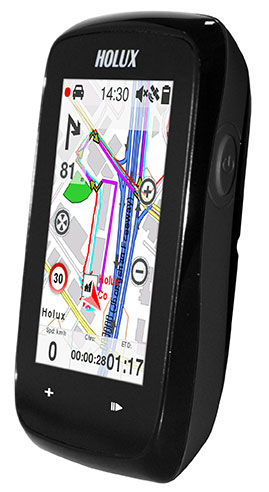
    The Holux SporTrek 1305 for avid cyclists features a u-blox positioning module. Photo: Holux SporTrek
    The Holux SporTrek 1305 for avid cyclists features a u-blox positioning module. Photo: Holux

    Holux Technology, a maker of professional and consumer GPS products, has launched its next-generation bike computer, the SporTrek 1305, which integrates a u-blox MAX GPS/GNSS module. The new device delivers GPS and wireless health-monitoring features on a compact, three-inch color touchscreen display.

    The device delivers a variety of useful information such as speed, heart rate, distance, altitude, map, and route, and comes with a calendar and stopwatch. SporTrek 1305 is the designed for touring, competitive cycling and mountain biking.

    The device integrates a compact u-blox MAX GPS/GNSS module that supports GPS as well as GLONASS, QZSS and all SBAS. The module is targeted at applications requiring small size, low power, fast acquisition, and reliable operation in GPS hostile environments.

    “Since 1994, Holux has been manufacturing a wide range of battery-operated GPS products for sports, automotive and safety devices. We count on extremely fast, low-power and accurate global positioning technology to deliver the features our customers demand,” said Eddy Huang, director, Marketing & Sales at Holux. “u-blox’ advanced satellite positioning module provides us with the performance, small size, and low power consumption that we need in a consistent, future-proofed form factor.”

    u-blox MAX GPS/GNSS module. Photo: Holux
    u-blox MAX GPS/GNSS module. Photo: Holux

    The SportTrek 1305 is shock and water resistant able to operate in all weather conditions. Equipped with Bluetooth Smart for accessories (such as heart-rate straps), it can also connect to heart-rate monitor / combo (speed and cadence) sensors and smartphone connection and notification, providing navigation and performance training data.

    It also integrates a patented “carbon reduction” feature that informs the user about the amount of equivalent carbon emissions saved compared to driving, and converts the data into the corresponding number of trees planted to achieve the same effect.

    SporTrek 1305 can be integrated with ezTour Plus software to share track route and analysis of physical states, and it can also be used to plan routes using the ezTour Planner feature. Users can integrate their own paper maps and third-party application as well.

  • u-blox Launches Online Shop for GPS/GNSS Modules, Tools

    u-blox Launches Online Shop for GPS/GNSS Modules, Tools

    Swiss u-blox, a provider of cellular, short-range radio and GPS/GNSS semiconductor components, has launched a new online shop in the U.S. and Canada, with expanded features and reduced prices.

    u-blox’ Online Shop is a fast and secure way to obtain module samples and pre-production quantities of the company’s comprehensive line of cellular modem and GPS/GNSS positioning modules, u-blox said. Support tools such as evaluation kits and wireless module adapters can also be ordered.

    All module products and support tools are typically shipped within 24 hours directly from the u-blox U.S.-based warehouse in Reston, Virginia, near the Washington Dulles International Airport. Technical support for all products are provided from one of u-blox America’s three technical support centers in Virginia, Minnesota, and California.

    For convenience and improved production planning, customers can also request a specific delivery date at no extra cost. Customers with an established line of credit with u-blox America can order against invoice. Credit card and pre-payment options are available.

  • Trax Personal Tracker Integrates u-blox GNSS and Cellular Technologies


    Swedish WTS (Wonder Technology Solutions) and u-blox have announced that WTS has launched Trax, a personal tracking device for children and pets. Based on u-blox’ GNSS smart antenna and cellular module, the tiny tracker can be located anywhere, anytime via a free Android or iPhone mobile phone app.

    In addition to real time tracking, Trax provides flexible geofence alerts, and can even monitor how fast your teenager is driving. It also works indoors thanks to a proprietary dead reckoning algorithm that delivers a position even when satellites are out of sight. Accurate down to 1.5 meters, the robust, water-resistant device also provides an “augmented reality” mode that helps users locate their trackers using a Smartphone’s built-in camera view.

    To achieve the smallest possible size, Trax takes advantage of u-blox’ CAM-M8Q GNSS receiver module, which has a built-in antenna.  CAM-M8Q (chip antenna module) provides both small size (9.6 x 14.0 x 1.95 mm) and multi-GNSS capability. It is based on a u-blox M8 chip and incorporates a chip antenna, SAW filter, LNA, TCXO and RTC crystal. The surface-mount module is also extremely low in height, making thin customer designs possible.

    “Trax is the world’s smallest and most versatile personal tracking device available, packed with features designed to provide peace of mind to parents and pet owners almost anywhere in the world,” said Fredrik Danelius, managing director at WTS. “By combining the leading GNSS and cellular technologies from u‑blox, we have designed a tiny, reliable, low-cost device that protects our most valuable family members: children and pets.”

    Trax comes with an integrated SIM-card and two years of free data and roaming in 33 countries. It is charged via USB and typically lasts between two and four days on a full battery. For wireless connectivity, the device contains u‑blox’ SARA-G3 GSM/GPRS module which is footprint compatible with u-blox’ 3G SARA-U2 module for easy 2G to 3G upgrade.

    “Trax is an elegant and sophisticated example of our embedded GNSS and cellular modules combined to protect people’s loved ones”, said Pasi Alajoki, area sales manager at u-blox. “It is an important application of our mobile communications and global positioning technology where performance, size and power consumption play a critical role. We are proud WTS chose u-blox for Trax.”

  • u-blox GNSS Antenna Module Supports All Satellites

    u-blox GNSS Antenna Module Supports All Satellites

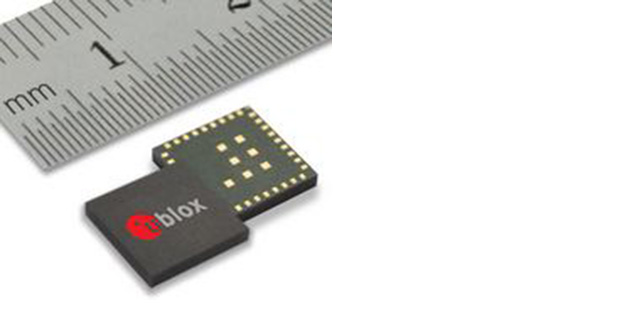
    The u-blox CAM-M8Q.
    The u-blox CAM-M8Q.

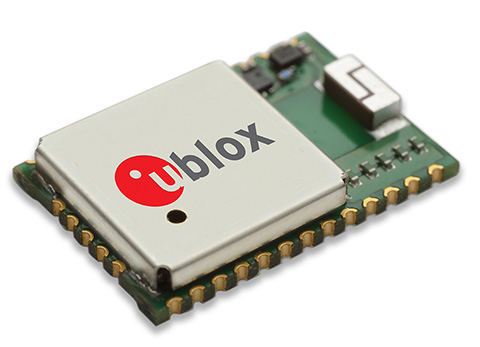
    u‑blox has introduced the CAM-M8Q GPS/GLONASS/BeiDou/QZSS antenna module. The module integrates a u-blox M8 satellite receiver IC plus SAW filter, LNA, TCXO, RTC, passives and a pre-tuned GNSS chip antenna in an ultra-small 9.6 x 14.0 x 1.95 mm package. The new module requires only a power source for reliable and accurate satellite positioning anywhere in the world.

    Combining low power consumption with high-sensitivity, high jamming immunity and concurrent GNSS operation (GPS/GLONASS, GPS/BeiDou, or GLONASS/BeiDou) the surface-mount CAM-M8Q provides a drop-in solution for satellite positioning in an ultra-small form factor, u-blox said.

    “Our u-blox CAM-M8Q is perfect for customers designing highly compact products who want to speed up product development while freeing resources for core activities,” explains Thomas Nigg, vice president of product marketing at u-blox. “The CAM-M8Q is a pre-tuned, performance and cost optimized module providing satellite positioning on an extremely small footprint. It is literally an ‘instant’ positioning solution.”

    The u-blox CAM-M8Q module is designed for a wide range of applications such as personal locators, handheld navigators, and wearable electronics as well as vehicle telematics systems used for emergency call, anti-theft, insurance and road pricing. Consistent omni-directional antenna performance helps ensure excellent performance regardless of module orientation.

    In addition, the CAM-M8Q allows the internal chip antenna to be used as a backup antenna if the design incorporates an external antenna. This benefits companies where there is a risk that the primary external antenna may malfunction or suffer damage, for example in vehicle tracking systems where damage is possible to the external antenna.

    The CAM-M8Q module uses the latest u-blox M8 GNSS receiver chip qualified according to AEC-Q100 and is manufactured in ISO/TS 16949 certified sites. Qualification tests are performed as stipulated in the ISO16750 standard: “Road vehicles – Environmental conditions and testing for electrical and electronic equipment.”

    The CAM‑M8Q is form-factor compatible to predecessor modules UC530 and UC530M, allowing the upgrade of existing designs with minimal effort.

  • u-blox Introduces 3D Automotive Dead Reckoning

    u-blox Introduces 3D Automotive Dead Reckoning

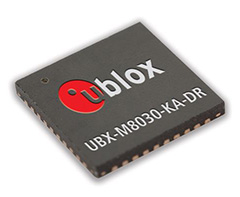
    The u-blox ADR chip.
    The u-blox ADR chip.

    u-blox has introduced its next-generation semiconductor technology dedicated to advanced in-dash navigation, emergency call (including eCall, a European rapid response initiative, and ERA-GLONASS, Russia’s Government Accident Emergency Response System), usage-based insurance, road-pricing, and stolen-vehicle recovery systems.

    The UBX-M8030-Kx-DR chip integrates 3D Automotive Dead Reckoning (3D ADR) technology, which enables it to calculate a vehicle’s position, speed, and elevation in areas of poor or no satellite visibility, a common scenario in high-density urban environments, stacked highways, or parking garages.

    Here is a two-minute YouTube video demonstration.

    “Drivers expect car navigation systems to be fast, accurate, and work everywhere, regardless of satellite visibility. As cities expand, construction of more tunnels, multi-level overpasses and park garages is increasing,” said Thomas Nigg, VP Product Marketing at u‑blox. “Our solution meets this challenge head-on; regardless of satellite visibility, our 3D ADR chip shows movement in three dimensions to maintain continuous and accurate positioning in tunnels, stacked highways, multi-level or underground parking facilities.”

    The technology aids traditional GNSS navigation systems such as GPS, GLONASS and BeiDou by blending them with individual wheel speed, gyroscope and accelerometer information to maintain accurate 3D positioning even when satellite signals are completely lost.

    The UBX-M8030-Kx-DR chip is self-calibrating to compensate for sensor aging and temperature effects. It is compatible with virtually all vehicles and drive trains (i.e. front-, rear-, all-wheel drive), and supports a variety of sensor combinations. Sensor information can be derived from the vehicle’s sensors for the most cost-efficient implementation, or from external sensors for after-market solutions.  The chip is AEC-Q100 qualified and is produced in ISO/TS Automotive certified production sites.

    The chip requires minimum host integration or customization resulting in no risk, low cost, and fast time-to-market, u-blox said. Installation is uncritical thanks to automated software calibration. 3D ADR is accurate even at low speeds.

    The chip allows for easy testing, simple and modular production set-up, and minimal BOM. The chip comes in a 40-pin QFN package measuring only 5 x 5 mm and includes I2C, SPI, UART and USB interfaces.

  • u-blox Launches 8th-Generation GNSS Modules

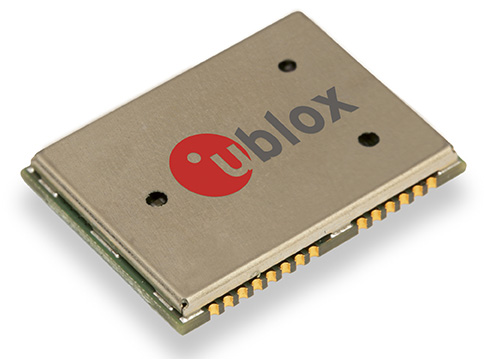
    The u-blox Lea module.
    The u-blox Lea module.

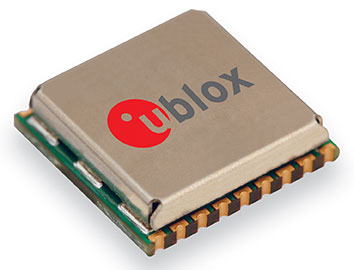
    u‑blox has introduced its MAX, NEO and LEA GNSS modules in its next-generation, multi-constellation positioning platform u‑blox M8.

    The new module series satisfies a wide range of requirements by providing a scalable range of features including antenna management, integrated filters, data logging, crystal or TCXO, and rich set of interfaces, u-blox said.

    The modules can acquire and track all visible GPS, GLONASS, BeiDou, QZSS and SBAS satellites and can track any two GNSS systems simultaneously for increased reliability, accuracy and faster acquisition time. For an overview of all modules, click here to download u-blox’ GNSS module selector guide.

    “Our advanced u-blox M8 modules are the result of u-blox’ in-house GNSS chip design expertise and end-to-end ownership of the entire IC and module manufacturing processes. This gives us full control over features, quality and production allowing us to react quickly to customer requirements,” said Thomas Seiler, u-blox CEO. “Being independent of third-party GNSS chip suppliers means we offer our customers exactly the right feature set, chip and module options, smooth upgrade path and a clearly defined product roadmap extending years into the future.”

    u-blox’ online assisted-GNSS service, AssistNow, has also been radically improved to support an unbeatable level of global positioning performance. The free service is available in online and offline versions and supports both assisted GPS and GLONASS.

    The MAX-M8, NEO-M8 and LEA-M8 modules provide cutting edge positioning performance and -167 dBm tracking sensitivity for a wide range of applications including vehicle and asset tracking, eCall / ERA-GLONASS emergency call systems, vehicle telematics for insurance, road pricing and anti-theft devices, navigation, security, and point-of-sales terminals.

    u-blox continues to offer u-blox 7 based modules MAX, NEO and LEA-7 which remain optimal for low-power, cost-efficient, single-GNSS designs. The new u-blox M8 modules maintain hardware and software compatibility with u-blox 7 modules to allow easy upgrade or product variants utilizing the same PCB layout.

    u‑blox’ capability of delivering u-blox 7 and u-blox M8 GNSS technologies in both module and integrated circuit form-factors provides maximum design flexibility and protects customers’ development investments over successive product generations.

    First samples and evaluation kits for u-blox M8 modules are available for customer evaluation.

  • New Report on Global Military GPS/GNSS Market Looks at Next Decade

    Reportstack has announced a new report on The Global Military GPS/GNSS Market 2013-2023.  This report offers the reader detailed analysis of the global military GPS/GNSS  market over the next 10 years, alongside potential market opportunities to enter the industry, using detailed market size forecasts, Reportstack said.

    A satellite navigation system provides GPS positioning from a global perspective, and is therefore of utmost importance for modern-day military operations, which rely on accurate real-time data on hostile forces in order to carry out precision attacks, Reportstack said. It is here that GPS/GNSS devices assume an important role, as they are imperative to transfer signals from these satellites back to earth.

    The U.S. is the highest spender on military GPS/GNSS navigation, and is responsible for 42.9% of the global military GNSS devices market. Others major spenders in this sector include Russia, the UK, China and India. In July 2013, India launched the IRNSS-1A, the first of seven satellite constellation to be deployed under the Indian Regional Navigation Satellite System (IRNSS) program to be completed between 2015-2016. And China’s BeiDou is scheduled to be operational by 2020.

    Another factor driving the market is the integration of satellite navigation technology with other navigation systems, such as the inertial navigation system (INS) and gyro, as GPS devices are to be used in order to decipher data correctly, Reportstack said.

    The increasing demand for satellite navigation and communications is driven primarily by the desire of militaries to monitor more areas and derive accurate information by a range of GNSS receivers/sensors in the shortest time possible. Major military aircraft and helicopters are dependent on GPS embedded INS systems for effective navigation. Similarly, naval vessels and guided munitions are increasingly relying on the collaboration of laser, gyro, INS, and satellite navigation technologies to derive accurate real time data.

    Furthermore, it has been observed that the usage of standard positioning services/open service receivers, which use unencrypted signal for non-combat purposes has increased, and is expected to drive demand and encourage expenditure, Reportstack said. The military GPS/GNSS technology is expanding its horizon beyond the basic characteristics of navigation and tracking. The use of GPS, in conjunction with a number of software applications, has expanded its use in military operations. A number of new technologies are now embedded with GPS receivers to produce a more sophisticated military tool.

    Recently, a Swiss-based company developed a device called GPS Log Book based on u-blox technology. The new device has extended the scope of GPS technology to the administrative side of military operations. It provides an easy way for military drivers to automatically keep an accurate travel log book which can be securely accessed later from anywhere via a web interface. Information logged includes route, speed, and distance traveled. It also keeps a close record of fuel used by the vehicle, based on the distance traveled at various speed levels.

    The advent of Differential GPS (DGPS), an enhancement to GPS, which provides improved location accuracy, from the 15-meter nominal GPS accuracy to approximately 10 cm, has further expanded the scope of GPS in missile technology. The intercontinental ballistic missiles, which are capable of hitting targets across thousands of miles navigation, use inertial navigation with DGPS receivers. The advent of DGPS is expected to be one of the most significant steps in accurate missile targeting for militaries across regions.

    The companies mentioned in this report are Northrop Grumman, Raytheon, Rockwell Collins , Lockheed Martin, ITT Exelis, Thales, and BAE Systems. More details and table of contents about this report can be found by visiting The Global Military GPS/GNSS Market 2013-2023 report.

  • u-blox Launches Precision Timing Module for Cellular Networks

    u-blox Launches Precision Timing Module for Cellular Networks

    u-blox module LEA-M8F.
    u-blox module LEA-M8F.

    Swiss-based u‑blox has unveiled the LEA-M8F precision timing GNSS module. The compact, surface-mount module generates a precise 30.72 MHz reference clock crucial for synchronizing industrial data and communication systems such as small, femto and macro-cell mobile networks. High accuracy is achieved by disciplining a local oscillator or other clock source with timing signals received from satellite-hosted atomic clocks.

    To ensure satellite availability, LEA-M8F is able to acquire and track all 50+ GPS, GLONASS and BeiDou satellites. High sensitivity enables quick autonomous start-up even inside structures with limited sky-view.

    “A reliable, compact and cost-effective precision reference clock is a crucial component used in many systems in the Critical Infrastructure and Key Resource sectors (CIKR),” said Thomas Nigg, vice president of product marketing at u-blox. “Our LEA-M8F GPS/GNSS satellite-disciplined timing module enables the proper operation of many mission-critical infrastructure systems including mobile and fixed-line communication networks, power generation and distribution systems, gas and chemical processing plants, banking, postal and goods distribution processes.”

    Measuring 17 x 22 mm, the LEA-M8F module includes a low-noise 30.72 MHz VCTCXO (voltage and temperature controlled oscillator), meeting the master reference requirements for LTE Small Cells while providing 100 parts-per-billion autonomous hold-over accuracy. The module is also suitable for TD-LTE, LTE-Advanced and other applications requiring extended hold-over times when integrated with small cell platforms.

    External sources of synchronization are supported through time-pulse and frequency inputs and a message interface. This allows measurements from macro-sniff, Sync-E or packet timing to be combined with measurements from GNSS to extend the availability of accurate synchronization and in doing so maximize cellular service availability.

    LEA-M8F can track signals from satellites from any two constellations simultaneously (e.g. GPS and GLONASS, GPS and BeiDou, GLONASS and BeiDou). Compatibility with multiple GNSS systems gives the LEA-M8F access to a large number of satellites, allowing synchronization even in urban or indoor areas with limited sky view. For stationary applications, once a location is known, accurate timing can be maintained based on the signal from just a single satellite.

    For more information, download the u-blox whitepaper “GNSS Timing and the Rise of Small Cells”. Detailed information about the LEA-M8F and evaluation kit EVK-M8F can be found on the u-blox website. Samples of the LEA-M8F will be available in Q1 2014.

    Also, the LEA-M8F will be demonstrated at the Small Cells Americas exhibition in Dallas, Dec. 3-4, at u-blox stand number 3.


  • u-blox Launches EVA-7M Standalone GNSS Module

    u-blox Launches EVA-7M Standalone GNSS Module

    u-blox EVA-7M.
    u-blox EVA-7M.

    Swiss-based u‑blox has introduced its smallest standalone GNSS positioning module, the EVA-7M. Designed for cost and space sensitive applications, the highly integrated 7 x 7 x 1.1 mm LGA module comprises all necessary components, including crystal and passives: only an  antenna is needed for global positioning capability.

    The module supports GPS, GLONASS, QZSS, and all SBAS augmentation systems. Based on u-blox’ advanced GNSS technology u‑blox 7, the module achieves -160 dBm sensitivity when tracking GPS satellites (-158 dBm with GLONASS satellites), fast acquisition time and the lowest power of any u-blox 7 module (16.5 mA at 3 V), thanks to an innovative high-efficiency power converter.

    The EVA-7M eases implementation in end-products because RF and digital domains are kept well separated, and the LGA pads are configured in single rows. EVA is a standalone GNSS receiver which provides a position without the need for host integration or extra RF components. It is optimized for keeping eBOM and system costs to an absolute minimum.

    “The EVA-7M brings embedded satellite positioning to the next level of portability. The module has been developed with ease-of-manufacturing as a high priority. Its QFN-like footprint with connections along four sides and high-level of component integration makes it a perfect solution for medium and high volume production runs. This ensures high first-pass production yield, crucial criteria especially for cost-sensitive, high-volume industrial and consumer applications,” said Thomas Nigg, VP Product Marketing at u-blox.

    A UART, USB, SPI and I2C interface provide flexible connections to a host processor. EVA-7M can also communicate directly with u‑blox’ SARA 2G, LISA 3G and TOBY LTE cellular modules to support advanced tracking and location-aware applications.

    The module is suitable for consumer, industrial, and after-market vehicle applications. First samples will be available in Q1 2014.

  • u-blox, ARM Join Forces on Location-Aware Prototyping Kit

    u-blox, ARM Join Forces on Location-Aware Prototyping Kit

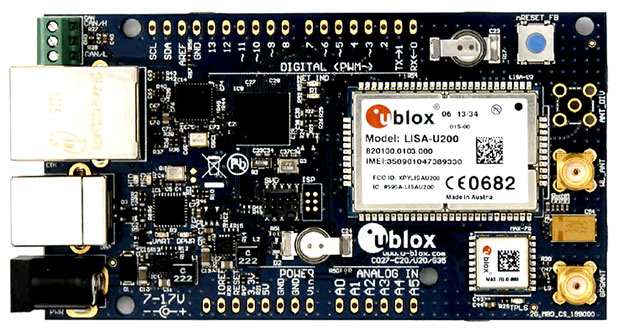
    Photo: u-blox
    Photo: u-blox

    u‑blox and ARM, a semiconductor IP company, have joined forces to create a prototyping kit for designing wirelessly connected, location-aware Internet devices: the ARM mbed-enabled u‑blox C027 “Internet of Things (IoT) Starter Kit.”

    “The Internet is reaching into every aspect of our lives, connecting everything from smartphones and tablets to devices for security, safety, surveillance, navigation, healthcare, convenience, and fun,” said Michael Amman, vice president of Platform Partnerships at u-blox. “To help engineers jump start their design of these types of Internet-connected devices, the C027 delivers out-of-the-box wireless Internet connectivity based on a compact u-blox 2G, 3G or CDMA cellular modem plus global positioning module. Together with the ARM Cortex-M3 32-bit processor and access to all the resources of the ARM mbed project, this is an extremely powerful and flexible prototyping tool.”

    “This new kit will enable developers to join the ARM ecosystem and quickly move prototypes of intelligent ARM-based technology into production-ready designs,” said Charlene Marini, Vice President, Embedded Segment, ARM. “It brings together u-blox’s embedded cellular wireless and global positioning modules with the energy-efficient, high-performance ARM Cortex-M3 processor and the ARM mbed development platform. This exciting combination can drastically reduce the time required by manufacturers to build carrier-certified gateways, which will help to accelerate the Internet of Things.”

    The compact C027 kit, measuring 54 x 98 millimeters, contains a u-blox “SARA” GSM or “LISA” UMTS/CDMA cellular modem, “MAX” GPS/GNSS positioning module, and an ARM 32-bit Cortex-M3 microcontroller with 512k of Flash Memory and 64kB RAM, user programmable via USB. CAN bus and Ethernet interfaces are provided. The board also provides direct connector with 22 GPIOs to access components via I2C, SPI, UART, and I2S digital audio. The C027 is an mbed-enabled board with Arduino-compatible connectors which can be easily stacked with additional expansion boards. A complete circuit diagram is provided with the kit.

    To make development easier, the hardware is supported by the powerful and flexible open-source ARM mbed development platform, which provides free software libraries, hardware designs and online tools for professional and rapid prototyping of ARM-based designs. The platform gives access to a high-level standards-based C/C++ SDK for developing applications on the u-blox C027, a large component database of drivers for peripheral components that can be connected to it, and online compiler and developer tools for efficient reuse and collaboration on designs to create products quickly.

  • u-blox M8 Multi-GNSS Platform Offers Concurrent Tracking

    u-blox M8 Multi-GNSS Platform Offers Concurrent Tracking

    Photo: u-blox M8
    Photo: u-blox M8

    u‑blox has announced the launch of its newest core positioning platform, the u-blox M8. The new chip forms the basis of u-blox’ upcoming line of positioning modules, which are able to acquire and track different satellite systems concurrently to achieve higher accuracy and reliability.

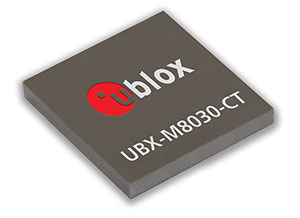
    Supporting all deployed as well as upcoming GNSSs, the platform is based on the UBX-M8030 concurrent multi-GNSS receiver IC which is able to track American GPS, European Galileo, Japanese QZSS, Russian GLONASS, and Chinese BeiDou satellites.

    Concurrent tracking of GPS (QZSS) and GLONASS or BeiDou, or concurrent tracking of GLONASS and BeiDou satellites increases performance for applications requiring maximum availability and accuracy. The chip is prepared for the European Galileo system through a future firmware upgrade once the constellation is fully available.

    The new platform will ultimately support special functions such as Automotive Dead Reckoning and precision timing to support a wide variety of vehicle, industrial and consumer applications.

    To further improve acquisition performance, u-blox’ globally available “AssistNow”assisted-GNSS service for accelerated positioning has been extended for u-blox M8 products; the service supports both GPS and GLONASS, and the validity of downloaded assistance data is now able to support offline operation for up to 35 days.

    “With the proliferation of multiple new GNSS systems beyond GPS, our u-blox M8 platform is designed to take full advantage of the increasing number of visible satellites to further increase accuracy and availability, particularly in urban and vehicle-based applications,” said Daniel Ammann, executive vice president, head of the Positioning Product Centre, and co-founder of u-blox, “At the same time we realize the ongoing requirement for extremely low-power and cost-sensitive portable applications where operation with a single GNSS system is more than sufficient. That is why we will continue to offer both u-blox M8 and u-blox 7 based products to the market.

    The new u-blox M8 chip is at the heart of u-blox’ next generation of positioning modules based on the company’s popular MAX, NEO and LEA module form factors.

    u-blox M8 chips feature low power consumption in concurrent reception mode, thanks to an innovative single-die architecture combined with sophisticated software algorithms. The extended supply voltage supply range and 1.8 V/3.0 V I/O compliance supports a wide variety of system architectures. Sophisticated radio architecture and interference suppression using active jamming detection ensure maximum performance even in GNSS hostile environments. UBX-M8030 chips are available in miniature WL-CSP (2.99 x 3.21 x 0.36 mm) and QFN (5.00 x 5.00 x 0.59 mm) packages. The chip is also available in automotive quality grade according to AEC-Q100.

    The new platform maintains backwards compatibility with u-blox 7 modules and QFP chip products which remain in the company’s portfolio as the industry’s lowest power standalone satellite positioning receivers. u‑blox’ capability of delivering GNSS technology in both integrated circuit and form-factor consistent modules provides maximum design flexibility and protects customers’ development investments over successive product generations.

    First samples of the multi-GNSS receiver chip UBX-M8030 are available for customer evaluation. Soon, module customers can easily migrate to the MAX, NEO, and LEA form factors, u-blox’ popular, industry-standard module form factors.