Tag: u-blox

  • U-blox to be bought by Advent International

    U-blox to be bought by Advent International

    U-blox has entered into a binding transaction agreement with ZI Zenith, a subsidiary of Advent International, for $1.3 billion. Under the agreement, ZI Zenith will launch a public tender offer to acquire all publicly held registered shares of u-blox at a price of CHF 135.00 per share in cash.

    Founded in 1997 as a spin-off from the Swiss Federal Institute of Technology in Zurich, u-blox is best known for its affordable and accessible modules that combine microcontrollers, wireless connectivity, and multi-constellation GNSS receivers. Its communications products have also ensured it a slice of the Internet of Things (IoT) market — the company recorded a net profit of SFr101.8 million (around $126 million) in 2021.

    “U-blox is a recognized leader in high-performance positioning and short-range communication technology solutions. We are excited about the opportunity to partner with the u-blox management team and co-founders, and support this innovative technology champion through its next chapter of growth,” said Ronald Ayles, managing partner at Advent. “We are deeply committed to invest in the long-term success of u-blox, using our extensive experience and resources in automotive and industrial end-markets to accelerate innovation and expand its global reach. Advent has a long and successful track record of partnering with founders and management teams to deliver sustainable value creation.”

    The offer represents a 53% premium to the undisturbed volume-weighted average share price of the last 6 months until August 14, 2025, and a 32% premium to the undisturbed volume-weighted average share price of the last 60 trading days of u-blox shares until August 14, 2025, before the media first reported on a potential transaction.

    U-blox’s board of directors has unanimously concluded that the transaction is in the best interests of the company, its shareholders and other stakeholders. It therefore recommends that shareholders accept the offer and has committed, along with the management team, to tender all their shares.

    The board’s recommendation is supported by an independent fairness opinion stating that the offer price is fair from a financial point of view. In addition, u-blox’s largest individual shareholder, SEO Master Fund LP, holding approximately 9% of the outstanding shares, has committed to tender all of its shares.

    The tender offer is subject to terms and conditions as well as regulatory approvals customary for this type of transaction and is expected to be settled within the next six months. The intention is to then delist u-blox shares from the SIX Swiss Exchange.

    The pre-announcement of the offer, which has been published today, is available at www.takeover.ch and www.zenith-offer.com and includes the material terms and conditions of the public tender offer.
  • u-blox launches triple-band GNSS module for fast-scaling robotics

    u-blox launches triple-band GNSS module for fast-scaling robotics

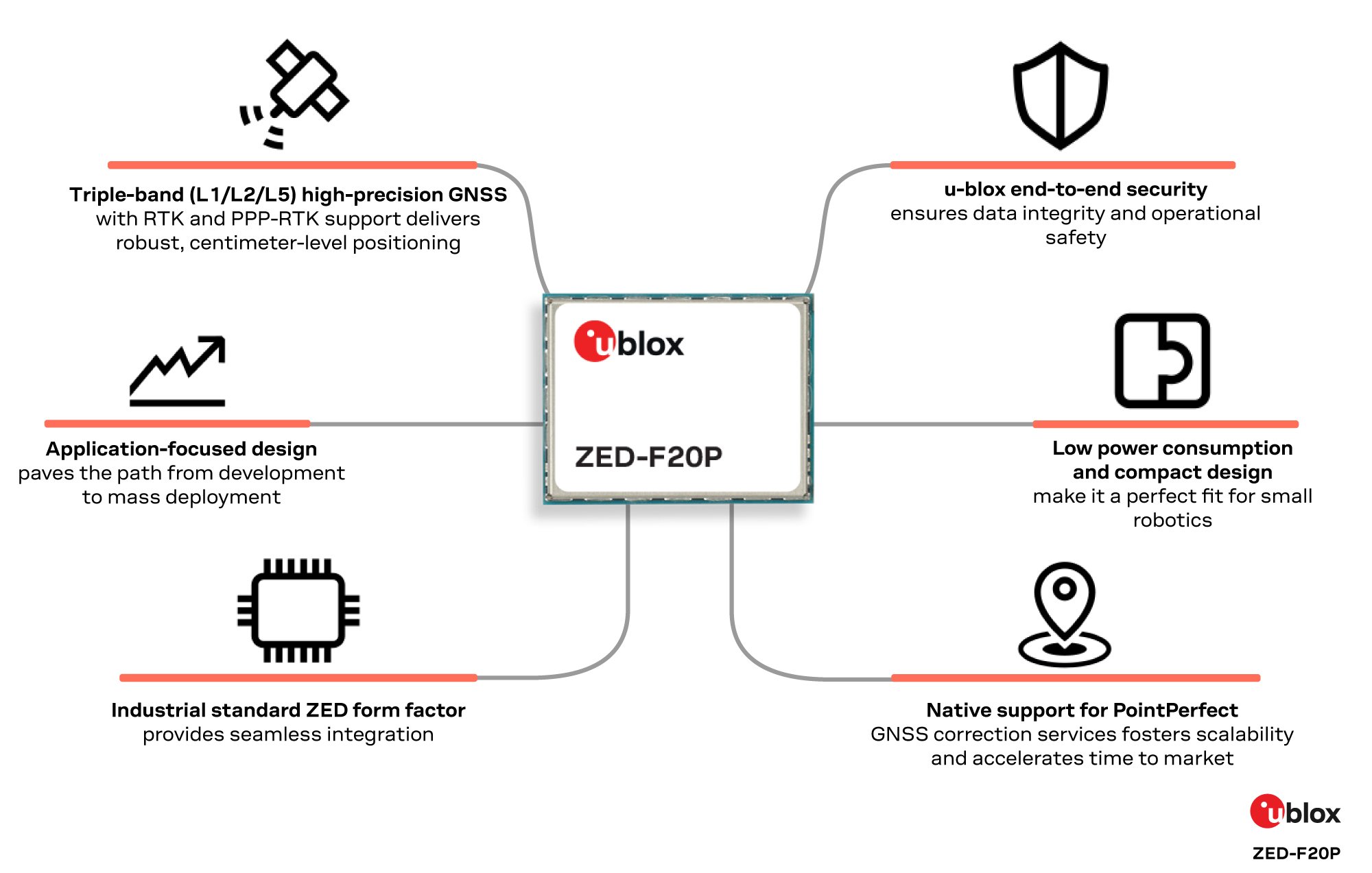
    u-blox has expanded its ZED form-factor portfolio with the ZED-F20P, a L1/L2/L5 triple-band GNSS module designed for high precision applications in ground and air robotics.

    The ZED-F20P provides OEMs deploying fleets of ground robots, drone light shows, and other dynamic autonomous platforms with centimeter-level RTK and PPP-RTK positioning, fast convergence times, and integrated security features.

    Within the u-blox high precision receiver family, the ZED-F20P is a dedicated L1/L2/L5 triple-band specialist. It delivers deterministic, centimeter-level RTK and PPP-RTK accuracy tailored to the needs of lightweight and dynamic platforms. Its end-to-end silicon-to-firmware architecture supports 25 Hz update rates, robust security features, and low power consumption in a streamlined design.

    These capabilities combine to deliver industrial-grade reliability and enable smooth scaling from proof-of-concept to high-volume deployment without increasing system cost, power consumption, or integration complexity.

    Compatible with the established ZED footprint and UBX protocol, the ZED-F20P fits directly into existing layouts. The expanded ZED portfolio now covers dual-, triple- and all-band GNSS options, giving developers the flexibility to select the best fit while reusing the same board layout. This enables both flexible design choices and a straightforward upgrade from earlier products.

    The ZED-F20P pairs with the u-blox ANN-MB2 all-band high precision antenna to ensure optimal RF performance, offering a one-stop solution for streamlined evaluation and integration. This consistent design approach accelerates time to market while preserving hardware and software continuity.

    PointPerfect Flex and Live native support:

    When combined with u-blox PointPerfect Flex and Live GNSS correction services, the ZED-F20P becomes a complete, production-ready GNSS solution that delivers centimeter-level accuracy in seconds, without the need for a local base station. The triple-band L1/L2/L5 architecture ensures rapid convergence and resilience in challenging environments, while PointPerfect provides reliable corrections across key regions. This tight integration simplifies development and accelerates time-to-market for mass-market autonomous platforms. 

    “The ZED-F20P delivers the precision and reliability required for today’s ground and air robotics,” said Mårten Ström, director of product management at u-blox. “It strikes a rare balance between performance, integration simplicity, and application-specific focus, enabling engineering teams to move from prototype to fleet deployment with confidence. We’re already seeing strong interest from robotic lawnmower markets preparing for large-scale rollout.”

    Engineering samples of the ZED-F20P are available now. Developers can evaluate the module using the EVK-X20P evaluation kit, with a simple configuration.

  • u-blox launches PointPerfect Global, completing GNSS correction portfolio with worldwide coverage

    u-blox launches PointPerfect Global, completing GNSS correction portfolio with worldwide coverage

    u-blox has introduced PointPerfect Global, its new high-precision GNSS correction service designed for applications that require sub-decimeter positioning accuracy, such as precision agriculture, UAV-based mapping and autonomous outdoor robotics. The service offers global coverage, including remote areas, through both internet and L-band satellite broadcast.

    PointPerfect Global is engineered to provide convergence times under two minutes and accuracy of less than 10 cm. It uses Precise Point Positioning with Ambiguity Resolution (PPP-AR) corrections and is optimized for products built on the X20 platform. The u-blox ZED-X20P GNSS receiver will be the first device to support the new service, offering integrated L-band support for use in areas without cellular connectivity.

    PointPerfect Global expands the u-blox PointPerfect portfolio, which also includes PointPerfect Live, a regional nRTK service for the most demanding applications, and PointPerfect Flex, the original PPP-RTK service designed for flexible IoT deployments. Together, these services provide scalable, high-performance positioning solutions tailored to a range of technical and commercial requirements.

    The broadcast-based architecture of PointPerfect Global allows for scalable deployment across continents without the need for complex regional integration. This approach is intended to simplify logistics and operational complexity for OEMs and solution providers, supporting a variety of sectors including agriculture, robotics, UAVs, industrial automation, and automotive. The service is designed to deliver reliable performance with minimal infrastructure dependency, which is critical for mass-market autonomy and global scalability.

    Early access to PointPerfect Global is scheduled for late 2025, with general availability expected in the first half of 2026.

  • u-blox unveils GNSS chip for wearable devices

    u-blox unveils GNSS chip for wearable devices

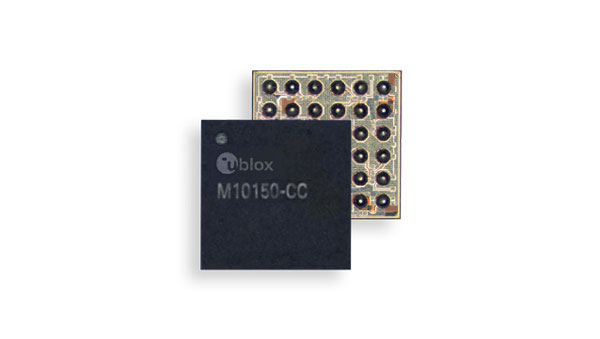
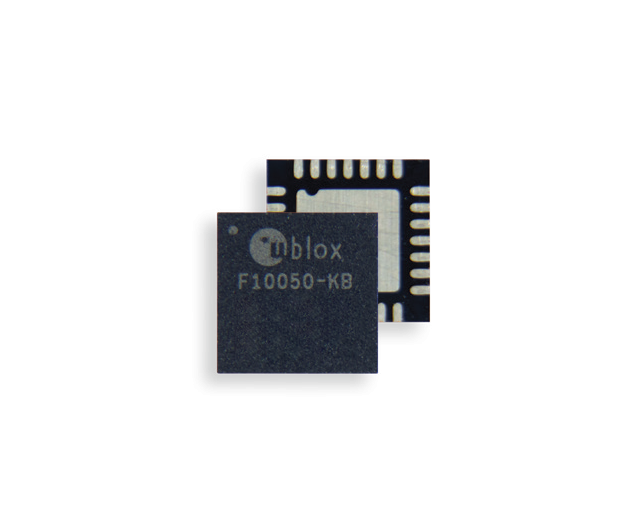
    u-blox has launched the UBX-M10150-CC, a GNSS chip designed for wearable devices. It offers advancements in size, power efficiency and performance for battery-powered devices.

    The chip measures 2.39 x 2.39 x 0.55 mm, making it suitable for integration into small wearable devices such as sports watches and smartwatches — it also includes a mode specifically designed for open water swimming. The UBX-M10150-CC utilizes low energy accurate positioning technology, which achieves power consumption as low as 10mW. This technology, combined with smart adaptation to signal conditions, allows for a 50% reduction in power consumption compared to previous M10 chips, according to u-blox.

    It incorporates multipath mitigation technology, which enhances position accuracy, particularly in urban environments where signal reflections are common. This feature can be beneficial for maintaining accurate tracking in challenging signal conditions, u-blox said.

  • u-blox launches GNSS platform for industrial and automotive use

    u-blox launches GNSS platform for industrial and automotive use

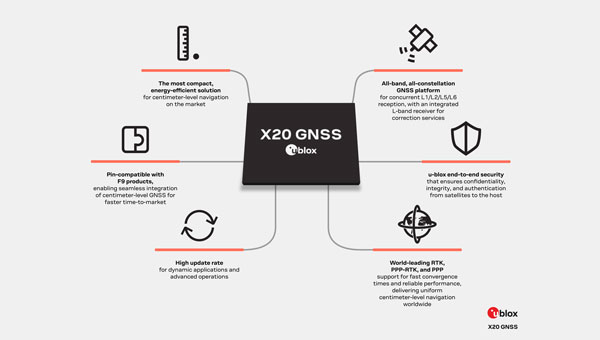
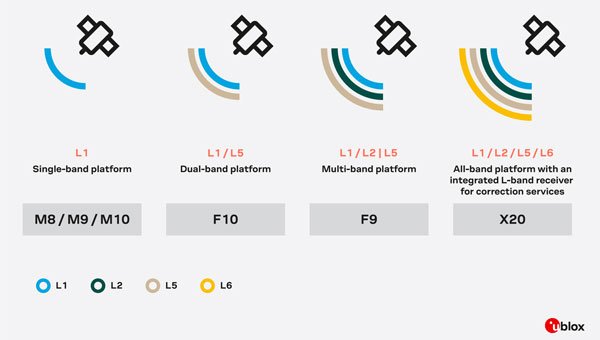
    u-blox has introduced the X20, a new high-precision GNSS platform that builds upon its previous F9 platform. The X20 is designed to meet global demands for high-precision GNSS capabilities while accommodating future technologies and standards.

    The X20 operates across all GNSS frequency bands (L1/L2/L5/L6) and includes an integrated L-band receiver. The L5 band operates at lower frequencies, which can improve signal robustness, while the L6 band is used for navigation and correction services to enhance positioning accuracy. This comprehensive coverage allows for high-precision positioning even in challenging signal environments.

    The platform supports various correction services, including local base stations, real-time kinematics (RTK), network RTK, precise point positioning (PPP) corrections and PPP-RTK.

    It is suitable for applications requiring centimeter-level positioning accuracy under challenging environments, such as port logistics, construction machine control, UAVs, autonomous ground robotics (e.g., lawnmowers) and time synchronization for critical infrastructure systems.

    The X20 platform incorporates comprehensive security measures such as end-to-end security functions, system authentication via secure boot and firmware updates, message authentication and encryption with a built-in secure root of trust (RoT).

    It supports Galileo OSNMA authentication and features advanced jamming and spoofing detection and mitigation. The X20 platform is designed to be software upgradeable, allowing users to adapt to future developments in GNSS technologies and standards.

    Photo:
    Photo: u-blox
  • Topcon, u-blox to offer comprehensive GNSS positioning services

    Topcon, u-blox to offer comprehensive GNSS positioning services

    Photo: spainter_vfx / iStock / Getty Images Plus / Getty Images
    Photo: spainter_vfx / iStock / Getty Images Plus / Getty Images

    u-blox and Topcon Positioning Systems have formed a strategic partnership to develop a high-precision GNSS positioning service for the mass market.

    The partnership was formed in response to the increasing demand for GNSS precise positioning across various applications. According to a recent EUSPA report, services enabled by GNSS devices are projected to generate approximately 80% of total GNSS revenues by 2033.

    The comprehensive GNSS correction services will serve a wide range of applications requiring precise positioning, including automotive, industrial, robotics, construction, precision agriculture and mobility sectors. These services will integrate with u-blox’s current and future hardware products, as well as existing services such as PointPerfect.

  • u-blox introduces ultra-low-power asset tracking service for IoT

    u-blox introduces ultra-low-power asset tracking service for IoT

    Photo: u-blox
    Photo: u-blox

    u-blox has introduced CloudTrack, an end-to-end asset tracking service designed specifically for Internet of Things (IoT) applications. This comprehensive solution integrates ultra-low-power positioning, global connectivity and cloud integration into a single platform. CloudTrack aims to simplify IoT asset tracking by offering flexible, contractless per-location-request plans available worldwide, allowing users to manage their assets effortlessly.

    CloudTrack offers six times the energy savings compared to a standalone GNSS fix with a cold start while securely transmitting data over the internet. The system intelligently calculates position using a combination of data from GNSS, cellular, and Wi-Fi sources. This capability allows users to locate assets even in areas with poor or non-existent GNSS signal conditions and indoors, where obtaining a location fix can be challenging.

    With a single Thingstream SIM card operating globally, IoT devices can utilize one stock-keeping unit (SKU), eliminating the need for regional SKUs. The Thingstream cloud platform seeks to make it easy for businesses to transform and integrate their data with tracking dashboards, major cloud platforms and enterprise backend systems.

  • u-blox, Nordian enhance GNSS correction service in Brazil

    u-blox, Nordian enhance GNSS correction service in Brazil


    Photo: u-blox
    Photo: u-blox

    u-blox and Nordian have significantly enhanced the PointPerfect GNSS correction service in Brazil by introducing L-band satellite delivery.

    Previously, the PointPerfect GNSS correction service in the country was only available via cellular connectivity, which was limited by insufficient national network coverage. Users in Brazil can now access PointPerfect through L-band satellite and accelerate time-to-market using Nordian’s Precisio OEM Board. This allows users to access GNSS correction data streams reliably and cost-effectively in regions without cellular coverage, enabling advanced navigation applications requiring centimeter-level positioning accuracy.

    PointPerfect is a PPP-RTK GNSS correction service that delivers 3 to 6 cm accuracy and convergence, making it ideal for autonomous farming activities such as operating automated machinery, field mapping and monitoring or navigating autonomous mobile robotics.

  • u-blox module receives OSNMA firmware update

    u-blox module receives OSNMA firmware update


    ZED-F9P.png 
    Image: u-blox

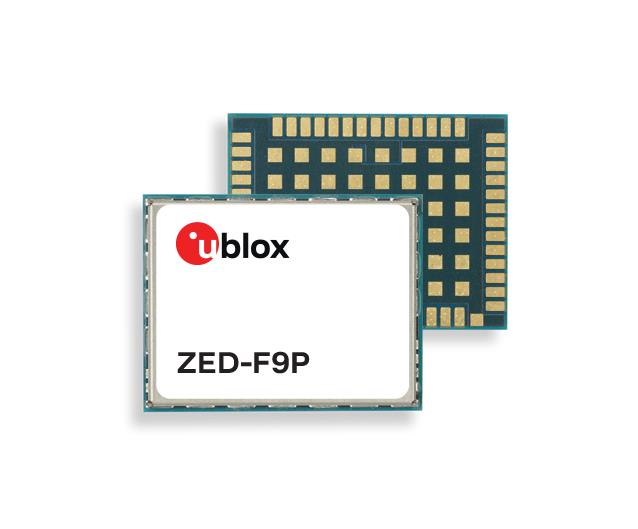
    u-blox has released the first firmware update of its ZED-F9P GNSS module to support Galileo Open Service Navigation Message Authentication (OSNMA).

    The upgrade enhances the multi-band GNSS module’s spoofing and jamming detection capabilities, offering robust and reliable performance for various applications, such as robotic lawnmowers, UAVs and surveying and mapping.

    The module also features improved real-time kinematic (RTK) convergence to reduce the risk of incorrect readings, which are important to surveying-related applications.

    According to u-blox, the SPARTN Beidou satellite constellation support boosts the capabilities of GNSS receivers and enhances the performance of the u-blox PointPerfect GNSS correction service in certain regions. The receivers are equipped with an advanced ionospheric model for more reliable performance during elevated ionospheric activities.

  • SparkFun, u-blox release GNSS L1/L5 Breakout

    SparkFun, u-blox release GNSS L1/L5 Breakout

    Image: SparkFun
    Image: SparkFun

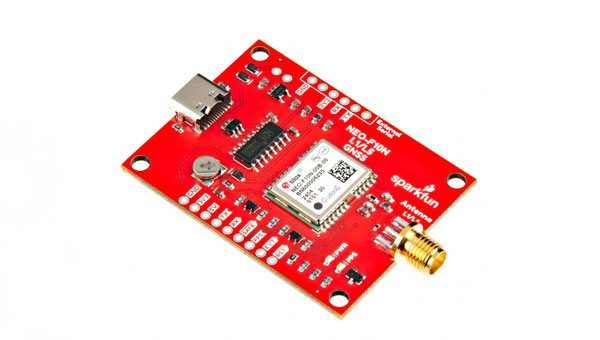
    SparkFun Electronics has released the NEO-F10N GNSS L1/L5 Breakout board. This GNSS breakout board features the u-blox NEO-F10N module and a dual-band L1/L5 configuration designed to add precision to GNSS projects operating in urban and rural environments. Additionally, the L5 signal falls within a protected frequency band, which reduces RF interference on the incoming signal.

    This breakout supports the concurrent reception of three GNSS constellations: GPS, Galileo, and BeiDou. The proprietary dual-band multipath mitigation technology from the u-blox F10 allows the module to choose the best signals from both bands to achieve a significantly better position accuracy in challenging urban environments than with the L1 band alone.

    It has an integrated rechargeable battery that powers the RTC on the NEO-F10N, which reduces the time-to-first fix from cold to hot starts. The battery also maintains RTC and GNSS orbit data without external power to offer uninterrupted performance.

    u-blox-based GPS products are configurable using u-center. This offers users extensive customization options such as baud rates, update rates, spoofing detection and more.

  • u-blox launches GNSS platform for urban environments

    u-blox launches GNSS platform for urban environments

    Image: u-blox
    Image: u-blox

    u-blox has introduced the F10 dual-band GNSS platform. It combines L1 and L5 bands to offer enhanced multipath resistance and meter-level positioning accuracy. The platform caters to urban mobility applications, such as aftermarket telematics and micro-mobility.

    Applications that use GNSS receivers for accurate positioning are on the rise. Yet, current receivers do not fully perform in urban areas. Accurate and reliable positioning in dense urban environments — where buildings or tree foliage can reflect satellite signals — requires GNSS receivers to mitigate multipath effects. The L5 band’s resilience to these effects aims to improve positioning accuracy. Combined with the well-established L1 band, an L1/L5 dual-band GNSS receiver can deliver a less than 2 m positioning accuracy (CEP50), against about 4 m with the L1 band only. The u-blox team has conducted driving tests in several urban areas and reported significant improvement over GNSS L1 receivers.

    The F10’s firmware algorithm prioritizes L5 band signals in weak signal environments to provide reliable positioning accuracy, even when paired with small antennas. The platform is also equipped with protection-level technology that provides a real-time positioning accuracy estimate.

    When a cellular modem is extremely close to a GNSS receiver, it can interfere with the receiver’s reception. Some F10 module models, such as NEO-F10N, MAX-F10S, and MIA-F10Q, are equipped with a robust RF circuit that allows the GNSS and the cellular modem to operate without interference.

    The u-blox F10 platform is pin-to-pin compatible with the previous u-blox M10 generation for easy migration. It also supports u-blox AssistNow, which offers real-time online A-GNSS service with global availability to reduce GNSS time-to-first fix and power consumption.

    The u-blox EVK-F101 evaluation kit will be available in April 2024.

  • u-blox, CTT collaborate on penguin conservation effort

    u-blox, CTT collaborate on penguin conservation effort

    Image: u-blox
    Image: u-blox

    u-blox has partnered with Cellular Tracking Technologies (CTT), a specialist in wildlife telemetry and Internet of Things (IoT) solutions, in an initiative aimed at conserving Antarctic wildlife.

    The collaboration has introduced a cloud-based positioning solution to monitor the activities of Adélie penguins in Ross Island, Antarctica. The venture began when Point Blue, an American wildlife conservation organization, reached out to CTT to create a tracking mechanism that could study the movements of young Adélie penguins. These birds are among the five penguin species inhabiting Antarctica and are considered crucial for environmental studies due to their sensitivity to ecological shifts caused by climate change and human activities, such as commercial fishing.

    Due to the challenging conditions in Antarctica, tracking penguins required a device that was lightweight, non-intrusive, energy-efficient, and cost-effective in terms of data transmission. This was particularly important given the small size of the penguins, their rapid movement, and their extended underwater dives.

    u-blox provided its CloudLocate positioning service to meet these stringent requirements, which led to the development of CTT’s Penguin Iridium GNSS tracker. The tracker is fixed to the penguins’ backs and uses one of u-blox’s compact GNSS modules. The CloudLocate service processes the positioning calculation in the cloud rather than on the device to save energy and enable prolonged monitoring periods without the need for frequent device replacements.

    The tracker operates by sending a concise 50 B message, which captures essential location data during the brief moments when a penguin surfaces for air. This level of efficiency is critical in minimizing the costs associated with satellite connectivity, which is often prohibitively expensive in such remote regions.

    This partnership marks an advancement in wildlife conservation technology by allowing for non-invasive, continuous monitoring of Adélie penguins and providing vital data for assessing the impacts of environmental changes. CTT aims to extend this tracking solution to a wider range of wildlife research and conservation projects to demonstrate the potential for technological innovation to contribute significantly to ecological preservation efforts.