Blog

  • Letters to the Editor – October 2006

    Constellation Viability

    We recently discovered that in a 5-day period three GPS satellites were taken off line indefinitely with no explanation as to possible return to service. This is significant in that the constellation that remains is “non-optimal” in terms of providing more than four satellites at all locations and so on. Specifically we have concerns about RNP Aviation operations that rely on excellent satellite availability to achieve the lower RNP, less than 0.2 capability for final approaches. This seriously impacts airline operations as our calculations indicate that RNP 0.18 operations have been reduced (worldwide) to an availability of about 86 percent. This is a very significant loss of availability. This potentially also impacts LPV and other FAA certified GPS approaches as well.

    Do you have any information as to what has happened to these satellites and whether or not they may be returned to service? May the constellation be “rebalanced” — with satellites being moved to new orbits to make the remaining 26 satellites provide a more optimal configuration that would also substantially improve RNP and other aviation operations availability?

    Any insights or references as to where I may go to learn more about this situation would be greatly appreciated.

    —David Vacanti Aerospace Fellow,
    RF Navigation Surveillance IPSC Lead, Honeywell

    Editor’s reply: As of September 4, three on-orbit GPS satellites had been taken out of service. PRN 15 was taken off line on 21 August; PRN 3 off on 24 August, and PRN 29 off on 26 August. PRNs 15 and 3 were reportedly undergoing clock swaps. PRN 3 had a previous clock swap in June. See “Clipped Birds” in The System news coverage for constellation status as of press time, September 22.

    NDGPS Budget

    Eric Gakstatter’s on line article on NDGPS (Nationwide Differential GPS) is a very poor framing of the issues. I have two main problems with GPS World’s on-line and hardcopy reporting of this issue.

    One, the print article relegates an issue that is one of the most important in more than five years for GPS to a “down-at-the-bottom-of-page-20-issue.”

    Secondly, it allows a pro-WAAS policy wonk such as Mr. Gakstatter to report on it. Very disappointing. This issue should not be framed as an NDGPS vs. WAAS issue as Gakstatter continually tries to make it. This is not the reason that NDGPS funding is an issue. It is much more complicated than that. Additionally, Mr. Gakstatter undermines his own credibility by making light of the user community that requires NDGPS for real-time, 1–5 meter, differential corrections and cannot use WAAS reliably.

    Both of these points illustrate the lack of understanding by him and GPS World of real-world problems that face the GPS user community and policy issues in Washington.

    In an article titled “Managing the GPS Constellation for Today’s Needs” in this month’s GPS World publication (September 2006), Mr. Lavrakas states that “Accuracy is the thing, and real-time accuracy is the most important thing.” I wholeheartedly agree. The NDGPS funding issue concerns a fantastically reliable augmentation system that is both efficient and fiscally responsible. My hope is that some sanity will return to this debate and the right path will be taken for the betterment of the GPS user community and the U.S. taxpayer (“Let’s not forget whose money makes all of this possible,” A. Cameron, Editor, same issue of the magazine).

    Please, GPS World is a great publication, let’s have some accurate and complete reporting rather than opinion being floated as fact.

    —Tim Smith
    GPS Program Coordinator, National Park Service

    Eric Gakstatter replies: Clearly when valuable programs are threatened, emotions run high.

    For the record, I did not claim there were no unique applications for NDGPS. I wrote that the primary threat to NDGPS is the lack of a “killer app” and that WAAS is a key technology that is putting pressure on NDGPS. I think it would be difficult to argue that it is not.

    GPS World’s editor and I invite you to write a more substantive, detailed essay to make “The Case for NDGPS.” I think it would be in the best interest of the GPS user community to hear it.

    Finally, I am neither pro-WAAS nor anti-NDGPS. I am pro-user community. I have used — and own — both WAAS and NDGPS equipment extensively in the field and am very familiar with the capabilities and limitations of both technologies.


    Air Traffic

    It was gratifying to read about the result of so many years of hard work to make the vision of GBAS a reality. As Honeywell’s former partner [Pelorus Navigation Systems] in the development of the current systems at SEA-TAC and Moses Lake [Bremen, Malaga, Spain and other locations] I was delighted to read the results of what I knew would be found. My congratulations to Tim and the others at Boeing that had the courage to support LAAS/GBAS/ GRAS from the beginning. It has been a road far too long but the proverbial ILS light at the end of the tunnel will soon be replaced with GBAS.

    —Mike Beamish
    President, Analysis Unlimited
    Calgary, Alberta, Canada


    I so much enjoyed the August news story “Next Generation Air Traffic Controlled by GPS.” As I wrote in my October 1991 GPS World article titled “GPS, Aviation, and Airport; The Integrated Solution,” this was the future. The 1991 article includes then-revolutionary concepts of seamless airport operations, Automatic Dependent Surveillance in the terminal area, computer automated safety logic, and precise digital maps used for navigation and air traffic control. ADS-B is an integral part of the 21st century aviation infrastructure modernization.

    The recent Comair, Louisville, Kentucky, disaster could certainly have been prevented with a moving map display showing the right travel path or even a set of navigational waypoints used during the departure taxi and take off. As experienced in the FAA’s Safe Flight 21 and Capstone programs, this technology saves lives, reduces delays, hence lowering airline operating costs, and reduces fuel consumption, thereby reducing pollution, while providing superior cost-effective performance for the air traffic controller and pilot over legacy systems of yesterday.

    There are still hurdles to fully realize the aviation infrastructure of the 21st century and an FAA request for ADS-B funding is certainly a major step. A change in FAA management or a change in the U.S. administration could impact or delay vital enhancements to the country’s aviation infrastructure.

    —Bob Pilley


    Race FX

    Just wondered why your article “IndyCar Series Supplements Broadcast with GPS Data” concerns an open wheel racing series, but your photos are from the NASCAR Nextel Cup series. Probably both series use the same technology, but Dale Jarrett, Bobby Labonte and Dale Earnhardt, Jr., drive stockcars, not IndyCars.

    —John Webster
    Selma, Alabama

    Editor’s reply: Good catch. Photos from the IndyCar Series weren’t available, but as you state, both series use the same technology, which was the focus of the article.

  • Blue Marble Offers Applied Geodesy Training in Houston After the GIS for Oil and Gas Show

    September 9, 2006 — Blue Marble Geographics will be offering applied geodesy training in their Geographic Calculator class after the GIS for Oil and Gas Conference on Friday, September 22, 2006. The day-long session is an in-depth training course using the Geographic Calculator, a flexible data-conversion application.

    The course also features education on the basics of geodesy and mapping. Blue Marble will also be exhibiting at the Geographic Information & Technology Association GIS for Oil and Gas Conference at booth number 502.

    The Geographic Calculator converts individual coordinates, point database files, and vector map files from virtually any coordinate system to any other. Users can transform between coordinate systems, calculate the distance and azimuth between two coordinates, and calculate new coordinates at a known distance and azimuth from known coordinates. The Geographic Calculator also automatically computes grid convergence, point scale factor, datum shifts, and grid shifts.

    Call toll free 800-616-2725 to reserve a spot in the class.

  • Troubleshoot Before Takeoff

    Modeling and simulation, two separate but related activities conducted prior to flight tests of high-performance military navigation systems, can reduce costs, shorten timelines, and remove some uncontrollable variables from the process, to deliver more accurate, verifiable results.

    Flight tests on an outdoor range provide engineers with an abundance of data to improve performance of weapon navigation systems. Whether the guidance package is hosted on a fighter jet, a cruise missile, an artillery shell, or a hypersonic kill vehicle, the navigation performance of a weapon during flight trials closely reflects its suitability for combat. The roar of jet engines, the percussion of a gun barrel, live video feeds, or a radio link to the cockpit can make live flight tests exciting — and sometimes unpredictable.

    While these activities are critical for weapon system qualification and validation, live tests nonetheless have significant limitations. Lengthy flight trials can be quite expensive. The rising price of aircraft fuel combined with test-range costs, travel expenses and data analysis can easily exceed millions of dollars for extended operational test and evaluation (OT&E). Also, test results can vary widely between trials due to a number of uncontrolled variables such as flight dynamics, RF interference, and atmospheric effects. Finally, the tests themselves often involve safety and technical risks and usually require careful planning and coordination, often months in advance.

    For these and other reasons, military navigation system flight tests are generally limited in number and are preceded by extensive modeling and simulation in the lab, where a methodical and disciplined test approach can produce substantial savings and more detailed insight. Successful completion of these activities provides system developers and integrators with the confidence required to proceed to the next stage of testing. This phased approach is useful for a broad range of weapon systems including GPS-guided ground-, sea- and air-launched munitions; high-performance aircraft; and long-range interceptors.

    Model, Then Simulate. Evaluating weapon navigation systems in the lab prior to outdoor testing usually consists of two sequential activities. First, performance of the GPS/inertial navigation system (INS) throughout the flight trajectory is modeled in software using representative data for the satellite constellation, RF signal environment, body masking, antenna pattern, receiver processing algorithms, and other parameters.

    Second, the GPS/INS flight hardware is exercised with controlled inputs to collect data relating to the operation of its code- and carrier-tracking loops, its susceptibility to interference, and the performance of the navigation filter under simulated highly dynamic conditions. Changes in vehicle velocity along its three axes are represented by inertial delta-V (ΔV) terms that are delivered to the INS navigation filter, while changes in attitude are delivered as delta-q (Δθ) terms. For normal flight operations, accelerometer and gyro sensors within the INS measure and report these forces, but in test mode the inertial simulator PC generates these terms based on translational and rotational motion described within the simulated trajectory. Computing these terms involves mathematical translation between the sensor frame and the vehicle body frame, and includes all errors due to sensor bias, drift, and misalignment. The inertial simulator PC delivers these terms to the INS via appropriate electrical interface.

    The fighter aircraft flight discussed here is based on a flight model overlaid on a map of the Fort Worth, Texas, area (FIGURE 1).

    Figure 1 Simulated tactical fighter aircraft flight trajectory over north Texas
    Figure 1 Simulated tactical fighter aircraft flight trajectory over north Texas

    Mod/Sim Process


    Before discussing the simulation results, it’s important to understand modeling and data analysis in its proper context. Disciplined performance analysis is like the scientific method — it begins before the test is initiated and concludes by validating preliminary assumptions using results of the experiment.

    Analysis of military navigation system performance begins with software modeling as shown in FIGURE 2, first panel. In this example, software tools predicted, among other things, SV carrier-to-noise values; azimuth and elevation angles; constellation dilution of precision (DOP) values; and GPS receiver acquisition/tracking performance. If required, software may also predict jammer-to-signal (J/S) ratios at the weapon GPS antenna.

    Figure 2 Navigation system performance analysis
    Figure 2 Navigation system performance analysis

    The next step (second panel in Figure 2) enhances software models with hardware-in-the-loop (HWIL) simulations, replacing predictions with actual performance data. Conclusions from RF and computer simulation stage will often aid significantly in field-test set-up. Benefits of simulation include isolating design flaws, validating algorithm performance, and exercising the GPS/INS system with realistic and stressful inputs. These activities may reduce the number of flight trials required, which in turn reduces the potential for program cost and schedule slips.

    Modeling Results


    FIGURES 3 AND 4 show predicted results from the commercially available Navigation Tool Kit (NavTK) regarding the navigation performance of the unaided GPS receiver within the fighter aircraft during its highly dynamic flight. STK generated the 6-degree-of-freedom (6-DOF) trajectory used in this test. This trajectory is based on the dynamic limits of the aircraft; representative roll/pitch/yaw rates; typical climbing; cruising and descent speeds; takeoff and landing distances, and so on. This data was subsequently passed to NavTK. Figure 3 shows number of satellites tracked throughout the flight while Figure 4 predicts East-North-Up errors given actual GPS performance (clock data, ephemeris data, and system performance) for July 1, 2005. This detail is possible because NavTK can accept archived GPS constellation data from the GPS Operations Center (GPSOC) to fully represent the effects of geometry, satellite health, ephemeris errors, and clock variations for individual SV signals.

    rder=”0″ align=”left” class=”content_image” src=”/files/gpsworld/nodes/2006/6535/i4_t.jpg” alt=”Figure 3 Number of signals tracked” />
    Figure 3 Number of signals tracked

    Figure 3 highlights flight portions when loss of lock is expected due to platform orientation and accelerations. When the aircraft initiates a steep turn, the accelerations cause cycle slips that result in loss of lock. These results are useful for isolating discrete periods of time during which performance of the INS-only solution can be scrutinized during hardware simulation. At these times the INS navigation filter relies exclusively on ΔV and Δθ terms from the inertial simulator to compute a fix.

    Figure 4 Predicted navigation errors
    Figure 4 Predicted navigation errors

    When PRN 25 disappears below the horizon approximately 25 minutes into the flight, we see a noticeable shift in predicted accuracy. This suggests that DOP values may worsen noticeably at this point, or that clock/ephemeris errors for this satellite had a noticeable effect on the GPS-only solution. These results depend on inputs provided for the receiver models, constellation behavior and tracking loop algorithms, and provide a start point for pre-HWIL evaluation. Again, results from this modeling exercise highlight a unique moment in time in which the performance of the GPS/INS navigation filter can be tested with a hardware simulator.

    Software modeling tools can also provide valuable inputs to the simulation process with trajectory modeling. STK can create flight simulations for military applications including missiles, rockets, spacecraft, and airborne platforms. In this example, software created a 6-DOF fighter trajectory which was stored as a file on a SimGEN PC.

    GPS/INS Simulation


    HWIL GPS/INS simulation of many military flight trajectories consists of generating a composite GPS RF signal synchronized with inertial ΔV and Δθ terms. Precise synchronization is achieved via a 1 PPS interface between the RF signal generator and the inertial simulator PC. Latency of the IMU motion data is also specified in microseconds. Together, these RF and inertial inputs are delivered to the navigation system under test.

    FIGURE 5 illustrates the GPS/INS test equipment in more detail. Platform dynamic motion (in this case from STK), GPS constellation data, signal parameters, and GPS/INS error sources are defined within the simulation application (SimGEN). Signal control commands are issued continually from the simulator PC to the RF signal generator via IEEE-488 (GPIB). The RF signal is typically connected to the GPS receiver antenna port via coaxial cable. INS ΔV and Δθ terms are calculated to the vehicle trajectory on a separate PC (SimINERTIAL) and are delivered to the GPS/INS device in test mode via the appropriate interface. The SimINERTIAL PC and signal generator are synchronized via a 1 PPS signal. Barometric altimeter aiding and instrumentation are achieved via MIL-STD-1553B.

    Figure 5 GPS/INS simulation block diagram
    Figure 5 GPS/INS simulation block diagram

    Realistic simulation requires many unique components of the navigation solution to be carefully specified in advance. These include but are not limited to:

    • 1. Trajectory
    • 2. Antenna pattern
    • 3. Constellation geometry
    • 4. Codes and frequencies
    • 5. G-sensitivity
    • 6. Gyro and accelerometer errors
    • 7. Atmospheric effects
    • 8. Multipath
    • 9. Interference


    Trajectory. As mentioned earlier, a flight trajectory is usually expressed as a series of time-stamped translational and rotational motion terms. Rotational motion is typically described by Euler angles or quaternions. The GPS/INS simulator uses this trajectory as the basis for calculating SV pseudoranges, Doppler values, and inertial delta-V and delta-q terms. This flight trajectory can be delivered to the simulator remotely via a high-bandwidth interface such as IEEE-488, SCRAMnet or TCP/IP, or, as in this example, may reside as a file on the simulator PC hard drive. Flight times may range from a few minutes to several hours or even days.

    For this simulation, the 45-minute flight over Fort Worth includes take-off, landing, and several steeply banked high-g turns. The airspeed for the majority of the flight is approximately 500 mph.

    Antenna Pattern. If the simulator’s RF signal is injected directly into the antenna port of the GPS/INS system under test, the gain and phase characteristics of the receive antenna must be modeled. For best results, the effects of the body on which the antenna is mounted must be included. Gain and phase pattern measurements are typically collected in an anechoic chamber or outdoor range and are generally available to test engineers evaluating GPS/INS system performance.

    Constellation Geometry. A simulated flight can occur at any time or location to test the effects of constellation geometry on the navigation solution. Historical GPS almanac information is available from the GPSOC and can be loaded into the simulation scenario. This example used historical almanac parameters from July 1, 2005.

    Codes and Frequencies. Most U.S. military GPS/INS systems operate at both L1 and L2 frequencies and track the encrypted P(Y) and unencrypted C/A codes. Future military receivers will also track the M-code on L1 and L2. To fully evaluate unique features of the weapon navigation system including direct-Y acquisition, SAASM functions, and resistance to interference, the simulator must support all modes of classified and unclassified operation.

    G-Sensitivity. Acceleration force can alter the performance of a crystal oscillator. Specifically, changes to the local acceleration vector stemming from high-g maneuvers will change the output frequency of the oscillator. Airframe vibrations may cause frequency modulations of the oscillator output that affect the performance of the tracking loops. To a certain extent, the effects of these forces on the code- and carrier-signal offsets can be modeled. For this scenario, the oscillator G-sensitivity is specified as 2 × 10-11 sec/sec/G per axis, typical for a military-grade oven-controlled crystal oscillator (OCXO).

    Gyro and Accelerometer Errors. Note that GPS/INS simulation does not test the performance of the sensor elements themselves; this exercise is generally conducted with mechanical spin tables or centrifuges. Rather, military INS manufacturers typically include a test interface that allows simulated motion terms to be directly injected into the navigation system. This allows test engineers to evaluate the performance of the Kalman filter during high-dynamic or stressed conditions. For one manufacturer’s system, this in
    terface is proprietary to the Inertial Sensor/Recorder Simulator (ISRS-2); another’s systems accept these test inputs via RS-422. A non-proprietary inertial interface known as NATO Standard Agreement (STANAG) 4572 also accepts simulated ΔV and Δθ terms via RS-422.

    Embedded gyro and accelerometer sensors are imperfect and are subject to a variety of errors. Stochastic errors may be modeled by random walk or by a Gauss-Markov noise estimator, while deterministic errors such as biasing, axis misalignment, and scale- factor errors should also be specified. For this simulation, a second-order Gauss-Markov model is used as described in STANAG 4572 for gyros and accelerometers with unique values for the natural frequency, damping factor, and power spectral density.

    Atmospheric Effects. After Selective Availability was set to zero in May 2000, the primary contributor to GPS ranging error remains ionospheric delay. Dual-frequency receivers can effectively eliminate this effect by processing both carriers, but range measurements at L1 and L2 are still subject to multipath errors. Furthermore, ionospheric scintillation is a complex phenomenon that can affect the tracking performance of dual-frequency receivers. This simulation specifies the historical broadcast Klobuchar coefficients for July 1, 2005, and modifies the SV code and carrier offsets to approximate the effects of the ionosphere for the time, date, and location of the scenario.

    Tropospheric delay varies by latitude and elevation angle and is a function of temperature, humidity, and atmospheric pressure. For more realistic results, the effects of this ranging error can also be simulated. For this simulated flight over Texas the surface refractivity index is set to 324.8.

    Multipath. While the aerial environment is generally free of the same satellite obscuration effects more common on the ground, signals may still be reflected off wings, stabilizers, and flight control surfaces. These path delays affect the performance of the GPS receiver correlators and may introduce position and velocity errors into the navigation solution. GPS simulation allows the tester to specify reflective effects including fixed-delay multipath, Doppler multipath, and vertical plane multipath on a per-satellite basis.

    Interference. Over the last 10 years a variety of techniques have been developed to mitigate the effects of intentional interference on military navigation systems. Adaptive antenna arrays may steer nulls in the direction of jammers or beams in the direction of satellites. Spectral filtering divides the L1 and L2 bandwidths into discrete bins in which interference can be excised using fast Fourier transform (FFT) techniques. Polarization filters attempt to reject interference from sources that are not right-hand circularly polarized (RCHP). Regardless of the mitigation technique, the performance of antijam GPS systems is generally evaluated in the lab prior to conducting flight tests.

    Simulation allows the tester to specify a variety of interference waveforms including broadband Gaussian noise, continuous wave (CW) and swept-CW, AM, FM, and coherent jammers. The relative signal strength of these sources will vary as a function of the distance between the navigation system under test and the jammer.

    HWIL Simulation Results


    Military navigation engineers are usually interested in the following performance characteristics:

    • 1. Accuracy
    • 2. Availability
    • 3. Resistance to interference


    FIGURE 6 shows example results that can be obtained using this equipment to test INS devices under these simulated highly dynamic test conditions. The results presented here are for illustrative purposes only and show the type of data obtainable to fully characterize the performance of a specific INS under all possible conditions. In this example, latitude (black), longitude (green), and height (blue) errors are plotted separately. Discontinuities in the calculation of latitude and longitude may be observed when high-g turns are initiated. Errors in the height component may correspond to rapid climbs and descents. RMS error for this entire illustrative mission was slightly higher than 16 meters. Again, these results are based on the specific inputs for this simulation. Navigation engineers would need to determine whether similar inputs represent their own flight environment and whether these results will satisfy their operational objectives. In practice, results will vary as a function of simulated gyro/accelerometer errors, oscillator g-sensitivity, pre-flight calibration time, flight dynamics, barometric aiding, and SV visibility.

    Figure 6a INS simulation results: latitude upper left, longitude upper right, height lower left
    Figure 6a INS simulation results: latitude upper left, longitude upper right, height lower left

    As expected, availability of the navigation solution was 100 percent. In contrast to the GPS-only performance modeled in Figure 3, the INS solution used ΔV and Δθ inertial inputs to compute a solution whenever a GPS fix was temporarily unavailable.

    Figure 6B Close-up look at latitude (black), longitude (green) and height errors (blue) from lower right panel
    Figure 6B Close-up look at latitude (black), longitude (green) and height errors (blue) from lower right panel

    Intentional RF interference was not created for this HWIL simulation. However, adding this component to the RF signal is possible with additional equipment, and a similar chart could be created to illustrate the effects of jamming on the INS solution.

    In addition to this simple error plot, truth data from the GPS/INS SimINERTIAL simulator were also delivered in WGS-84 ECEF coordinates to STK for graphical performance analysis. Time-stamped latitude, longitude, and height data extracted from the military GPS/INS MIL-STD-1553B interface were also provided to STK. Several key performance parameters were then analyzed including carrier-to-noise levels (C/N0), tracking states, pseudorange error per channel, and instantaneous position/velocity errors. FIGURE 7 and the opening graphic compare truth location at a single moment in time as prescribed by the simulator (gray aircraft) versus the actual GPS/INS computed location (color-coded per figure of merit, or FOM). STK can be used to visualize these outputs in real time. Instantaneous position error is projected on the red vector between the aircraft centers of gravity. Vectors pointing toward each SV tracked may be color-coded to J/S, while line type may be selected based on tracking state. Instantaneous pseudorange error for each channel is also provided. Many other data items can also be displayed graphically or in text.
    =”articlecaption”>
    Figure 7 INS simulation results
    Figure 7 INS simulation results


    Conclusion


    Field tests generally provide the most indisputable evidence of military navigation system performance. When a GPS/INS-guided gravity weapon is released above a test range and impacts the ground near its target, we may physically measure the miss distance. We may also assume a similar weapon released at a future time under similar conditions will achieve approximately the same results. But how can we be sure? One approach would be to perform hundreds of trials, if costs and schedules were of no concern.

    However, this is rarely the case. GPS receiver performance models used with the HWIL SimINERTIAL simulator allow the test engineer to minimize flight tests while achieving the same level of confidence. As we have shown, modeling and simulation activities may be tailored for a specific objective — for example, highly dynamic aircraft motion with a fixed satellite constellation geometry while using inertial sensors with known bias and drift characteristics. This simulation may be valuable in conducting analysis of alternatives for different user equipment mixes (receivers, antennas, inertial sensors, platforms, and so on) or to ensure the system meets requirements for all missions.

    Other modeling and simulation objectives may differ from those described in this article. FIGURE 8 enhances our aircraft flight test model to include intentional jamming, an advanced digital antenna, and future modernized GPS space capabilities. Similar enhancements can be added to the RF simulation.

    Figure 8 Real-time 4D data display
    Figure 8 Real-time 4D data display

    Whatever the application, a variety of commercial products allow navigation engineers to prepare for live flight trials on the test range. GPS receiver performance analysis models can be used to create specific GPS/INS simulations that focus on key performance characteristics and environmental challenges. Graphical analysis software can simplify the task of combing through thousands of data records to isolate specific periods during which performance is most important. With careful planning and a disciplined test approach, military and defense industry engineers can use these tools to ensure their weapon systems will deliver at the most critical times on the battlefield.

    Manufacturers


    Analytical Graphics, Inc. developed the Navigation Tool Kit and STK commercial software products used for this simulation. GPS/INS test results were collected using the Spirent GSS7700 simulator with SimINERTIAL.

    CURTIS HAY is director of GPS business development for Spirent Federal Systems. He has master’s degrees in electrical engineering and business administration and served eight years as an officer in the United States Air Force in a variety of GPS-related assignments.

    COLIN FORD is a senior software engineer at Spirent Communications and is the lead architect for the SimINERTIAL navigation test suite.

    GREG GERTEN supports satellite navigation and electronic warfare programs for Analytical Graphics, Inc. He received a master’s degree in electrical engineering from the University of Dayton and has completed graduate courses in GPS at the Air Force Institute of Technology.


  • Expert Advice: Managing the GPS Constellation for Today’s Needs

    Expert Advice: Managing the GPS Constellation for Today’s Needs

    John Lavrakas
    John Lavrakas

    In a recent editorial in GPS World’s Survey & Construction e-newsletter entitled “No Joy in Surveyville,” Eric Gakstatter lamented the performance of the GPS constellation for surveying. He is not alone. In June, the Australian Broadcasting Company reported that farmers in Australia were experiencing major problems with GPS because two satellites had been removed from service.

    For many, GPS is at its best performance ever, with 29 satellites in orbit and user range errors at their lowest levels in years. Yet for others, GPS performance falls short of expectations. What is the real issue here? Is it the number of usable satellites in the constellation — or have the demands of the user community grown?

    Today’s Performance

    Let’s first take a look at the performance relative to the current constellation. The GPS Standard Positioning Service (SPS) Performance Standard identifies 24 nominal orbital slots for a 24-satellite constellation. In this article, I refer to these as the 24 primary slots. My source material for the slot allocations is the U.S. Coast Guard operational advisories.

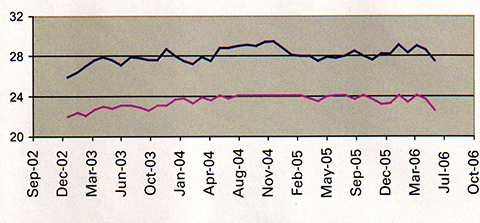
    Examining GPS performance over the past three years with respect to satellites in the key orbital slots, we see some interesting trends. Figure 1 presents the average number of satellites on orbit as well as the average number of healthy satellites in the 24 primary slots. A healthy satellite is one that has not been removed from service either due a scheduled outage (satellite and clock maintenance) or from an unscheduled anomaly (for example, degraded clock operation or problems with the spacecraft bus).

    Figure 1. Average number of healthy satellites on orbit (blue) and average number of healthy satellites in the 24 primary slots (red).
    Figure 1. Average number of healthy satellites on orbit (blue) and average number of healthy satellites in the 24 primary slots (red).

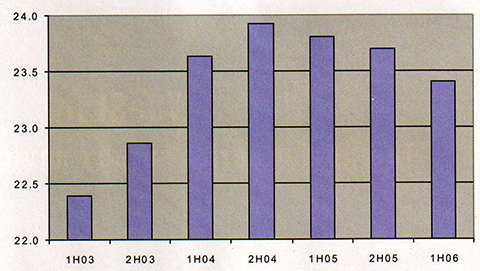
    The number of usable (healthy) satellites grew from 26 to about 28 on average, but this has not changed substantially in the past three years. It has varied between 27 and 29 satellites, with no significant upward or downward trend over this period. The number of satellites in primary slots, however, does show a noticeable trend, growing steadily through 2003 until late 2004 when it leveled off, after which it began to decrease. This trend recurs in Figure 2, where we view the same metric in half-year increments.

    Figure 2. Average number of healthy satellites in primary slots, shown in half-year increments.
    Figure 2. Average number of healthy satellites in primary slots, shown in half-year increments.

    The reduced number of filled primary slots stems from unscheduled outages. Scheduled outages have no significant impact on number of satellites usable since the operators typically remove a satellite from service for only a few hours, and such maintenance is performed on the order of once a month per satellite. Unscheduled outages, however, can last days and may require significant effort on the part of the satellite operators to resolve.

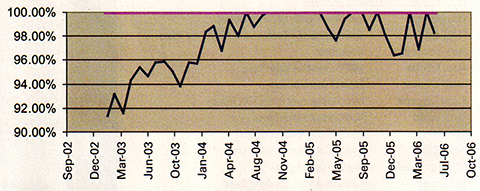
    The SPS Performance Standard states that 24 operational satellites must be available on orbit with 0.95 probability (averaged over any day). We see this figure has been met at the 100 percent level over the past three and a half years.

    The SPS Performance Standard further states that at least 21 satellites in the 24 nominal plane/slot positions must be set healthy and transmitting a navigation signal with 0.98 probability (yearly average). This figure is met.

    Figure 3 presents the monthly availability of the primary 24-satellite constellation (blue plot), that is, the percent of time over a month that there is a full set of 24 usable satellites in their primary slots. Here we see a marked trend, showing a steady growth from the beginning of 2003 up to the end of 2004, followed by a reduction, but still above the 95 percent level. Figure 3 also shows the monthly availability of 21 or more satellites assigned to the 24 primary slots (red plot), which has been at 100 percent over the past three and a half years.

    Figure 3. Monthly availability of the primary  24-satellite constellation (bue) and of 21 or more satellites assigned to the 24 primary slots (red).
    Figure 3. Monthly availability of the primary 24-satellite constellation (bue) and of 21 or more satellites assigned to the 24 primary slots (red).

    So What’s the Problem?

    If the U.S. government is meeting its commitments, why do users see degraded performance?

    Part of the issue is that the government manages the constellation to a set of metrics that is not up with the times, so to speak. The SPS Performance Standard has a legacy dating from prior to May 2000 when the government imposed Selective Availability, the intentional degradation of the positioning and timing accuracy for civilian users.

    Surveyors back then were considered eccentrics, as it were, living off the crumbs that fell from the table of the basic service. They took advantage of carrier phase tracking, but were content to post-process the data. Work that took days and weeks prior to GPS could now be done in hours. Well, those days are gone, and the push is now to get work done in minutes.

    The familiar adage “Give GPS users a yard and they’ll want an inch” has a corollary: “Give GPS users a process that takes them hours and they’ll want it done in minutes — or seconds!” Users have found they can do their processing much faster, as long as the constellation performance is well above the levels set in the SPS Performance Standard. This has indeed been the case since 2000.

    The GPS program has placed into orbit more satellites than originally anticipated. The general thought was that 27 satellites were sufficient to support the 24 satellite constellation. With 28, 29, and even 30 satellites in orbit, GPS has exceeded expectations, yet now the new expectations are that the government will sustain this level of performance.

    Improvements Happen

    The U.S. Air Force has made significant improvements in GPS operations as well in recent years. The satellite operators have become more user-focused. Prior to taking a satellite offline for maintenance, operators examine the effect of its removal to users worldwide. Also, they have adjusted operational procedures such that anomalies that once took hours to correct are now resolved within minutes. These improvements have directly benefited users, yet despite this, the mindset of the GPS operators is still to provide the service identified in the SPS Performance Standard, which is not the same as day-to-day service that users have come to expect.

    The Presidential Policy on National Space-Based Position, Navigation and Timing (PNT), issued in December 2004, provides high-level guidance on what service users can expect. Among its goals for space-based PNT, the policy states:

    • provide uninterrupted availability of positioning, navigation, and timing services
    • meet growing national, homeland, economic security, and civil requirements, and scientific and commercial demands.

    What “availability” is assumed in the first goal? Is it availability for users employing the 5-degree mask angle (as defined in the SPS Performance Standard), or is it the more stringent demand of mask angles at 10 degrees or higher? Is it availability of four satellites in view to support the generic user or that of six satellites in view to support receiver autonomous integrity monitoring with fault detection and exclusion?

    What “demands” mentioned in the second goal are to be met? Are they the demands of the precision farmer and surveying community? Or perhaps the tighter requirements of the urban user?

    This policy also states that the government will improve the performance of space-based positioning, navigation, and timing services. This implies that the service identified in the SPS Performance Standard will need to be changed to accommodate these improvements.

    To some extent, the U.S. government can only go so far in meeting user needs with the current system. The maximum number of satellites today’s operational control system can support is 30. As of the time of this article, GPS had 29 operational satellites on orbit, although at any given time not all are usable, due to necessary maintenance or unscheduled downtime. Whenever satellites are set unusable, the satellite operators look at the resulting performance, comparing it to the SPS Performance Standard. This is where the issue lies. The SPS Performance Standard assumes a generic user with only a 5-degree mask angle, yet this one assumption no longer represents a significant class of GPS users: the precision users.

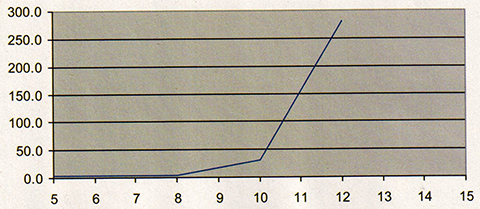
    If there are 29 satellites available, why is a reduction to 27 such a big issue? Today’s GNSS users are more demanding than the users were even five years ago. Accuracy is the thing, and real-time accuracy is the most important thing. Today GNSS is used in precision applications such as agriculture, surface mining, and seismic drilling. To get the needed accuracy, users of GNSS exclude low-elevation angle satellites to mitigate the effects of the atmosphere. They set the mask angle in their receivers to 8, 10, even 12 degrees. This higher mask angle reduces the number of available satellites to the users, and correspondingly the dilution of precision and associated positioning error goes up, as illustrated in Figure 4.

    Figure 4. Picture of DOP performance over various mask angles for June 5, 2006.
    Figure 4. Picture of DOP performance over various mask angles for June 5, 2006.

    Is GPS Properly Managed?

    So the issue becomes, is the U.S. Air Force managing the constellation in the best interests of all of its users? Is keeping older satellites in orbit the best policy, and asking the satellite operators to do the best they can with the constellation provided to them? Or is it better to expend taxpayer dollars to replace the older, yet still operational, satellites with newer satellites?

    From a user’s perspective, the newer satellites are better — far better than the older satellites in range accuracy, health, and resistance to integrity failures. The increased reliability produced by their redundant systems also acts as insurance against longterm failures of GPS.

    Today’s users do expect more from GNSS. While today they have but one choice, in the future they will have at least two others, as Galileo and GLONASS come online. So it is important for the U.S. government to continue to adapt GPS operations to support its current user base.

    Recommendations

    There is no easy solution to the problem of ensuring that GPS continues to meet today’s user’s needs, since the field of users and applications is becoming more diverse and demanding. For many, the preferred answer is to launch more satellites, keeping the level at 30 satellites, but there are significant cost implications with this approach.

    On the other hand, relying on an aging constellation to remain operational is also fraught with peril. Many satellites are on their final legs, with key components on a single point of failure. The clocks onboard the satellites are not as stable as they used to be, and require considerable attention from the satellite operators. The cost of losing satellites is significant for certain sectors in our economy, the sectors that employ precision GNSS. In the distant future this problem will be eliminated through the diversity of fully operational Galileo and GLONASS constellations, but for now the issues are immediate and real.

    The U.S. government can and should take several steps to better address the increasing demands on GPS:

    • The government should update the SPS Performance Standard to accommodate other classes of users and bring the metrics up to date with respect to current performance.
    • The satellite operators should refine their assessments of user impact to include a view of how special classes of users are impacted. In particular this should include precision users and aviation applications. This involves using higher mask angles in their assessments and incorporating receiver autonomous integrity monitoring (RAIM) availability.
    • The decision-making authorities in GPS should continue to support an aggressive program to replace aging satellites.

    Such improvements will continue to benefit GPS users worldwide, and help ensure the U.S. government’s goal of providing the best PNT service available.


    John W. Lavrakas is a consultant in satellite navigation. He has spent the past 26 years in GPS, working in satellite command and control, user operations, GPS receiver development, and satellite navigation performance analysis. Contact him at [email protected].

  • Leadership Talks: Is Galileo Real, or Not?

    Leadership Talks: Is Galileo Real, or Not?

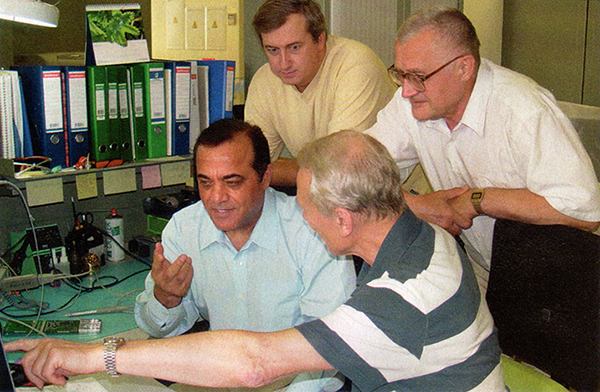
    Javad Ashjaee, front left, with colleagues in his Moscow office.
    Javad Ashjaee, front left, with colleagues in his Moscow office.

    Javad Ashjaee (JA) is president and CEO, Javad Navigation Systems. Alan Cameron (AC) interviewed him by phone at his Moscow office.

    AC: What details can you give us about the “new beginning” you mentioned in your May profile?

    JA: Things have changed a lot during the past six years. ASICs, microprocessors, and electronic technology in general have progressed significantly. These advances give us much better fundamental tools to implement new signal processing innovations and to design better and smaller products, while at the same time reducing their cost. With new GPS signals, improved GLONASS, and Galileo on the horizon, there are lots of opportunities and challenges to get me going for many years again. I phrased it as a “new beginning” because in the past six years I was not as productive as I wanted to be, due to situations beyond my control.

    AC: How do you see your “complete independence” playing out in the marketplace?

    JA: Now I can start working on GNSS technology again and hope to make a difference in this field again. The last six years were the darkest years of my professional life. The partnership that I had hoped would be a complementary force in pursuing the most innovative technologies turned out mostly frustrating, and it put stumbling blocks in the way of what I wanted to accomplish. By “complete independence” I mean the contractual limitations have expired, and I am free to pursue new technologies on my own and bring innovations to the marketplace that my team and I feel proud of.

    We have just started this new round of technical development and we are trying to define the technical directions. I hope to bring a completely new generation of GNSS products to the market in the second half of 2007. What keeps me motivated and as excited as my first attempts of 25 years ago is the level of support and encouragement that I receive from all my colleagues, friends, and even some of my competitors.

    AC: What technology challenges are you and your team tackling?

    JA: One of my technology challenges is to bring high-end Galileo into the GPS/GLONASS picture. My first decade of GNSS involved GPS, the second decade GPS+GLONASS, and in the third decade I hope for GPS+GLONASS+Galileo. Of course there are also innovations in signal processing in every one of these navigation systems. As I said earlier, enhancements in the electronic industry, as always, keep pushing us to come up with new products, similar to what you see in the computer and mobile communications industries. The life of any product cannot be longer than two years.

    I’m waiting for the Europeans to tell us what is really their plan for Galileo. I want to focus a lot on Galileo but I should admit that with Galileo I’m partially hopeful, but partially disappointed, too.

    AC: Why are you disappointed about Galileo?

    JA: I basically do not know, or I should say do not understand, the current plan of Galileo as presented; and I could not find anyone who could give reasonable answers to my questions. It is not obvious who the forces behind the Galileo project are, who is going to fund it, and who needs it to the extent that they are willing to pay for it. On several occasions, in different forums I tried to raise such questions and subsequently became convinced that unfortunately my worries and questions regarding Galileo were valid. Let me raise these questions once again here with you. I hope all my worries and suspicions regarding Galileo prove to be false and sincerely hope that Galileo to become a reality soon.

    Despite all the questions and uncertainties about Galileo, but due to good publicity, in many communities Galileo has received much more attention than GLONASS, which already has about 20–25 years of on-orbit history and currently about 16 operational satellites on orbit — and recently, with current oil prices, a solid plan to complete the system soon. Until recently many companies were trying to fight or ignore GLONASS, believing that it was not likely that Russia would complete the system. Now Trimble, NovAtel, and Leica have recently announced that they have GLONASS in their receivers, too.

    The attention given to Galileo, even before they have a first real satellite, is because of the credibility that the Europeans have earned. I hope this credibility continues to grow by providing open information to the public. Unfortunately, in my belief, so far they have not done so.

    One of the issues confronting Galileo is the explanation of its funding and management. It has been said that Galileo will be funded as a private business, but no one has ever provided a business model. When I try to guess about the structure of any business plan based on the information I have received, I conclude that it is very unlikely that it can be funded as such. The fate of Iridium — which did have a detailed business plan but overestimated its number of subscriptions — makes us more worried about Galileo, which does not even have a business plan. Iridium had the support of large, experienced industrial names like Motorola.

    Any company whose stock is being traded publicly will suffer a lot as soon as they announce involvement in any project that does not have a solid business plan. The larger the company, the more vulnerable they are to close scrutiny by stock-market analysts.

    Funding in Doubt

    In providing details on Galileo funding, it was said that most of the Galileo funding will come from bank loans. This makes the issue of a business plan much more urgent and critical for Galileo, especially given the fate of Iridium. Alternatively, the money could come from specific governments. This would easily put an end to the discussion of private funding and give much hope to all of us. I hope this will happen soon.

    There are several other flaws in Galileo’s private financial planning. First, GPS tried to make itself a self-funded program but quickly concluded that it was not feasible. Second, if GPS authorities were wrong, and it could have been done as a self-funded project, now with GPS being offered for free, Galileo has a much tougher time to make it as a private enterprise. Note that GLONASS is also there for free. Can you start a pizza business, when you know the guy next door is giving away pizza for free?

    Third, it is extremely unlikely that anyone will buy Galileo-only receivers, which means Galileo wants to piggy-back itself on GPS and receive money from the operational GPS. In our pizza example, imagine that your pizza shop can sell its pizza only if it can add slices of pizza from the free shop next door! Clearly the shop next door will stop providing you free pizza if it sees you are making money — or it will at least want its share of the profit.

    The progress in GLONASS, also offered free of charge, makes it even harder for Galileo’s private plan to succeed. With 30 GPS and 24 GLONASS satellites, at any given instance we have more than 14 visible satellites. The critical number to have reliable and robust RTK is something like 10 satellites. The additional Galileo satellites are a plus, but the European system cannot survive if it bases its financial plan on riding on the shoulders of GPS (or GPS+GLONASS).

    It short, the Galileo private funding scheme assumes free support from GPS — which means Galileo assumes that U.S. tax payers will continue to fund Galileo.

    I am certain that even if GPS authorities do not object, the U.S. taxpayers will. U.S. citizens and organizations like the U.S. GPS Industry Council will take the issue to the proper authorities.

    By collecting the first license fee from users or manufacturers, Galileo authorities open the door for large international disputes that put the fate of Galileo in question and raise the issue of customer liability, if it is going to be modeled financially as I mentioned earlier.

    In the private business model of sharing profit with GPS, Galileo will be at a disadvantage for many years until they have operational satellites comparable to GPS.

    The current situation of Galileo, as I see it, is that some independent and mostly research-oriented organizations have been able to collect enough money to define signals. We have seen some published information, such as Günter Hein’s article in GPS World (“Galileo Signal and Frequency Design,” June 2003) on the signal structure. But now when the ICD is published, the signal structure is drastically different.

    The Military Question

    Similar to GPS and GLONASS, the need for Galileo mostly comes from military establishments and markets. The two recent wars showed that the benefits of satellite navigation systems are no longer a luxury, but a necessity for any country that possesses a certain level of modernized military. The French government needs its own navigation system to independently market its Exocet missiles and Mirage 2000, for example. The Chinese government also has need for such systems, and this could be the reason that they push to fund and participate in the Galileo project.

    Does this mean France will break from NATO and join forces with China? This brings us to the very difficult question of international alliances, much more serious than the financial and funding issues that I raised earlier. I find it unlikely that the United Kingdom may want an independent navigation system separate from the United States. France may be the only major country that is willing and can afford to fund such system. This is an extremely difficult issue. I cannot think of any country in Western Europe that is pushing for the breakup of NATO.

    This is an order of magnitude more difficulty than money. This is an issue of East-West alignment, and the breakup of NATO, which has many more consequences.

    It is very simple-minded if we think Paris taxi drivers are pushing to have their own system because they do not trust the United States!

    Although the European military should be most concerned about the future of Galileo, they have been absent from all the Galileo conferences that I have attended. The only European military uniforms I have seen were those of a German Air Force brass band that played Mozart songs at the Munich ENC-GNSS conference.

    At best, it seems that some large European companies have teamed up to lead the Galileo project and keep space, control, and user segments under their management and control, and then try to attract money from military sources. This scenario also does not seem to have much chance of success. It is unlikely that military organizations will allow leadership and control of their vital navigation systems to remain in private-sector hands. Under any circumstances, the military organizations will be the real force behind the Galileo even though they may hide it publicly, at least for a while.

    Galileo’s best chance of success is for the French government to pay all or at least most of the costs, and not depend on support from other countries who do not have much vital interest and dependence on a new navigation system. I hope this will happen sooner rather than later.

    Galileo is not going to delay because of technical issues. There is no problem for the Europeans to have a good signal structure, or to launch good satellites. There is enough intelligence in Europe, they can solve those quickly. Financial and, more important, political issues will determine the future of Galileo.

    Will Galileo happen or not? I have no answer. I had a chance to share my thoughts with several prominent authorities. They mostly agreed with my concerns but they said it was politically incorrect for them to even discuss these sensitive issues.

    To go forward, I will work on Galileo and will assume that the Galileo authorities will work with the GPS authorities and will make a playing field such that U.S. GPS manufacturers can have the same benefits from Galileo that Europeans have from GPS. Previously we followed the information that was released unofficially by Galileo (by semi-official authorities) and we made chips to track those signals. Next we will follow the new ICD and we will make receivers based on it.

    Meanwhile we will try to tap whatever legal authorities, the GPS authorities in the U.S., to help us make the playing field level, to make the Europeans give us the same prompt access to information that they give to European organizations, without any charge.

    The United States has been so generous and so open in providing complete and honest GPS information to all, that the first GPS satellite was actually tracked in the UK. Dr. Brad Parkinson noted this point in his keynote speech at the European Navigation Conference in Manchester.

    I was so hopeful and supportive of Galileo in the article I wrote for you some months ago. But as I tried to find information regarding the future of Galileo, I developed serious concerns. I pray for Galileo to become a reality soon.

    AC: What percentage of Javad Navigation Systems’ annual budget is devoted to research and development?

    JA: We do not have a fixed percentage. Developing technology is our first priority and has always been a priority for me. We spend whatever it takes to have the best technology, even if we have to borrow money — though we have never had to. Probably this has been the reason that in all my history of involvement with GPS, the past 25 years, we were profitable every single quarter, because our focus was spending on technology, and giving priority to it. I don’t think there is any other GPS company in the world that can claim profitability for every quarter for 25 years. Our cumulative annual growth in each company was 45 percent. Currently we have a staff of over 100. Our Advanced Theoretical Design team alone consists of more than twelve professors and scientists with more than 200 person-years of experience.

    AC: How can we best navigate the next years of new signals, structures, and so on?

    JA: The main thing is that we request all U.S. GPS authorities to help to make this a level playing field.

    If the Galileo authorities really intend to combine GPS with Galileo for commercial markets, they’d better be as gracious and open as GPS authorities were to them.


    Iridium

    Iridium communications service was launched on November 1, 1998, and went into Chapter 11 bankruptcy on August 13, 1999.

    The system was originally to have 77 active satellites (later reduced to 66) to enable worldwide voice and data communications using handheld devices. Its financial failure was largely due to insufficient demand for the service. The system is currently being used extensively by the U.S. Department of Defense for its communication purposes.

  • NDGPS Heads Toward the Budget Chop Block

    Nationwide Differential GPS (NDGPS) heads toward the budget chop block. Its 2007 allocation has been scaled back to zero.  As in aught, nought, zot.

    NDGPS, also referred to as the Coast Guard differential system, made its first NDGPS broadcast in the early-to-mid-90s. After years of industry talk about real-time DGPS, NDGPS was the first, mostly reliable source of real-time corrections that was free of charge (via your tax dollars).

    Support from the mapping and non-aviation navigation markets pushed the government (the Department of Transportation took the lead) to continue the build-out of the NDGPS network. Each year, more sites were added, and NDGPS became a solid resource for folks wanting a free source of DGPS corrections that delivered meter-level accuracy. They just had to buy the hardware (beacon receiver and antenna) to use it. Today, more than ten years later, there are more than 80 broadcasting sites — and more planned — spread out over the continental United States, Alaska, and Hawaii, providing free DGPS coverage used by hundreds if not thousands of users on a daily basis.

    A successful program?

    Up to and including FY 2006, Congress and the President allocated a substantial annual budget for NDGPS improvements, operations, and maintenance. For example, the FY 2006 budget came to approximately $10 million — half of what was originally requested. Almost $100 million more is needed to complete the network build-out. After that, about $9.2 million is needed annually to operate and maintain the system.

    However, unlike years past, this years budget (FY2007) for NDGPS improvements, operations and maintenance is………………….$0 (zero). The rumor mill says that since there’s no money to operate and maintain, some sites may actually be shut down. That’s not the case according to the Department of Transportation, however.

    “The FY06 budget provides approximately $10 million for the NDGPS program.  These funds will be used to operate and maintain the existing NDGPS system through October 1, 2007”, says Steven Kulm, Director, Office of Pubic Affairs for the DOT’s Federal Railroad Administration.

    So that means no money for new sites that were planned for FY 20007, and no money for developing new technologies such as High Accuracy (HA)-NDGPS.

    Wow, what went wrong?

    The problem facing NDGPS today, in my opinion, is the lack of a “killer app.” In other words it’s a neat tool and serves hundreds (if not thousands) of people on a daily basis, but if it disappeared tomorrow, life would go on. Therefore, when it comes to cutting the budget during tight times, programs like NDGPS are prime targets.

    Now, I’m guessing the DOT may say that PTC (Positive Train Control) may be the killer app for NDGPS because it reportedly will save the railroad industry “billions” each year. That may be so, but if it was that easy to sell, then no one would be hacking away at the relatively puny NDGPS budget.

    Putting the pressure on NDGPS is the Federal Aviation Administration’s (FAA) Wide Area Augmentation Service (WAAS) program. Like NDGPS, WAAS is a free government service providing corrections to improve accuracy and reliability of GPS positioning. The FAA began developing WAAS in the mid-90s and it was declared operational in July 2003.

    WAAS has two things going for it that NDGPS doesn’t.

    • A killer app. The future of aviation navigation is based squarely on GPS, and WAAS is an integral part of that program. The FAA is banking so heavily on GPS and has so many initiatives based on GPS, that there is no way it can back its way out of the program…and it shouldn’t. There are so many valuable uses for GPS in aviation that it boggles the mind. Some applications are focused on efficiency (e.g. better traffic control and throughput) and others are safety-of-life driven (e.g. situational awareness such as ADS-B). Because of this, the FY 2007 budget for WAAS is close to $100 million.

    • WAAS is easy to use for non-aviation folks like us. It’s a no-brainer and it comes standard on every GPS receiver you purchase today. Whereas NDGPS requires the use of additional hardware (a 300khz receiver) and a separate antenna, no additional hardware or software is required to use WAAS. Using WAAS is virtually automatic. NDGPS receivers will never reach that level of simplicity. Good quality NDGPS antennas, by their nature, are bulky and I have serious doubts that any company will attempt to design an NDGPS receiver-on-a-chip (some have tried and failed), especially at this late stage of the game. With those two strikes, consumer GPS units will never incorporate NDGPS technology. And thus NDGPS will never achieve mass-market status like WAAS already has.

    Availability

    The foothold that NDGPS-supporters are hanging onto is the issue of the correction availability. Whereas WAAS is satellite-based and is dependent on line-of-sight between the user and the broadcast satellite, NDGPS broadcasts corrections on the 283-325khz band and does not require line-of-site between the user and the transmitter. It can even be received inside some buildings. However, signal propagation is interrupted by rough terrain and in metro areas, and ambient radio interference can interrupt the signal too. Although it’s not a true national service, there are certainly areas where the NDGPS can be received and WAAS can’t. The reverse can be stated also.

    Accuracy

    The NDGPS vs. WAAS debate in the surveying/mapping community has been a lively one this past year. This is due largely to major GPS manufacturers introducing professional mapping GPS receivers that use WAAS to achieve meter-level accuracy. Although NDGPS has the capability of being more accurate than WAAS, meter-level accuracy seems to be good enough for most mapping applications given the additional expense and equipment overhead required to use NDGPS. Think about it: Garmin discontinued their NDGPS receiver product line and now every GPS product they sell is WAAS-enabled.

    Fate

    Clearly, from a funding perspective WAAS has won the battle for now and has NDGPS back on its heels. The next twelve months (or less) will determine the direction of the NDGPS program.

    “At this time, the U.S. Department of Transportation is deliberating how to administer the program in the future.  We anticipate the Administration’s proposed FY08 budget (to be released in early 2007) will provide guidance on what the future of NDGPS will be,” says Kulm.

    The challenge for NDGPS-supporters in the next few months is to not let the purse-string holders forget about NDGPS and its niche applications. If it’s business-as-usual in FY 2007 and the purse-string holders don’t feel the pain, what are the odds they’ll throw money at NDGPS in FY 2008?

    — Eric Gakstatter

  • Make Every Shot Count

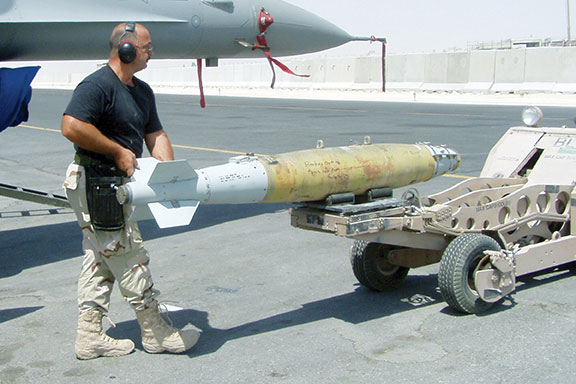
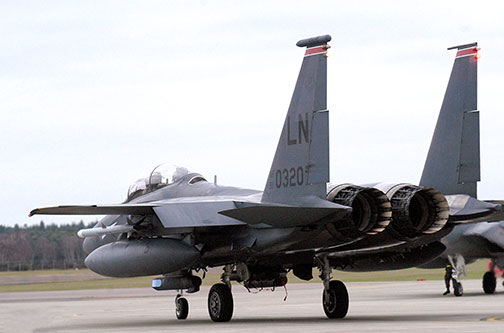
    A JDAM being transferred to a fighter jet.
    A GBU-38 is transferred to an F-15 fighter jet. Photo: US Air Force

    GPS technology helped the U.S. Air Force take out al-Qaeda leader Abu Musab Al-Zarqawi in a June 8 airstrike.

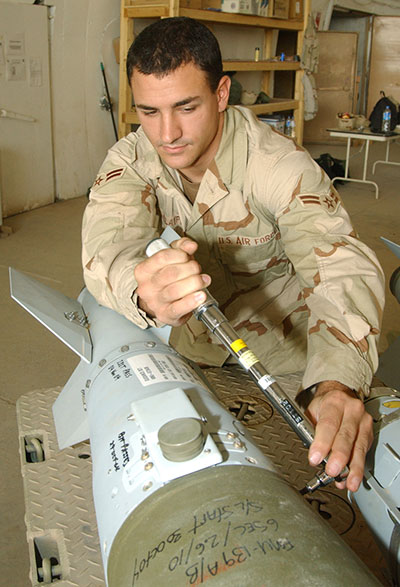
    An airman assembles a GBU-38 500-pound Joint Direct Attack Munition, the same weapon that destroyed Zarqawi's safe house.
    An airman assembles a GBU-38 500-pound Joint Direct Attack Munition, the same weapon that destroyed Zarqawi’s safe house. Photo: US Air Force

    A GBU-38 Joint Direct Attack Munition (JDAM) equipped with GPS guidance was one of the two munitions used in the bombing of Zarqawi’s safe house outside the city of Baqouba, 30 miles northeast of Baghdad.

    Air Force Space Command delivered space combat effects for the precision strike that resulted in the death of Zarqawi, said Brigadier General Donald Alston, director of Air and Space Operations.

    “Once again, GPS-aided munitions played a significant role in the success of an important operation,” he said. “When you’re after an elusive, high-value target, you’ve got to make every shot count.”

    Alston said the military is depending on satellite technology like GPS more than ever in conducting the war in Iraq. “GPS provides the precision timing and navigation absolutely instrumental in both protecting our troops on the ground and taking out the bad guys.” Alston recently returned from Iraq as the Multinational Force-Iraq Director of Communications.

    In the attack, a single F-16 fighter jet fired two precision-guided 500-pound munitions sequentially, first a laser-guided GBU-12 and then a GPS-guided GBU-38. The GBU-38 is a traditional gravity bomb, which in this case had an added tail kit — the JDAM —with a GPS guidance package to increase both range and accuracy.

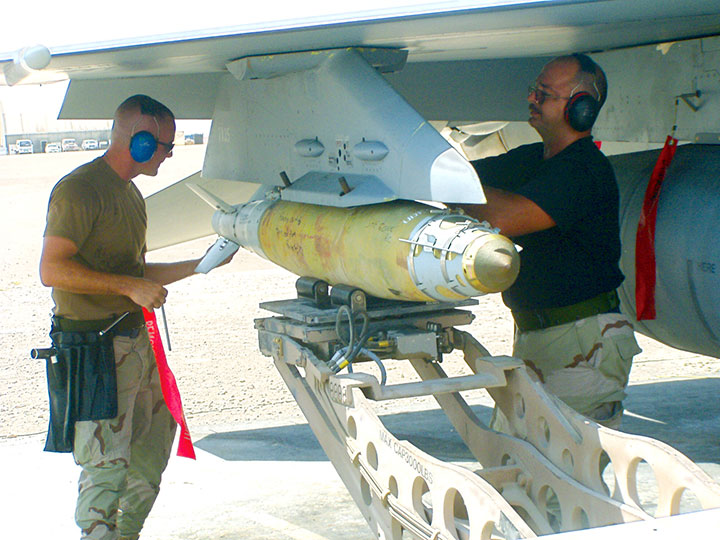
    A GBU-38 is being detached from an F-16 Fighting Falcon. Photo: US Air Force
    A GBU-38 is being detached from an F-16 Fighting Falcon. Photo: US Air Force
    GPSBomb-3-W Photo: US Air Force
    Photo: US Air Force

    JDAM: Military’s Smart Choice

    Since its debut in 1999, the Joint Direct Attack Munition, or JDAM, has been used more than 15,000 times.

    JDAM is a tail kit that turns an unguided dumb munition into an accurate smart bomb. With a range of about 15 nautical miles, the autonomous JDAM can be released from almost every aircraft in the Air Force and Navy inventory from a low or high altitude in almost any type of weather. Once in the air, the weapon uses GPS and inertial navigation to find its target.

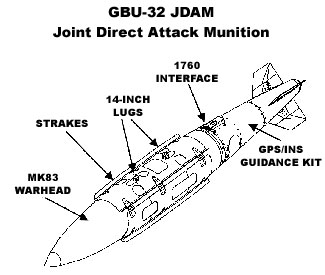
    The JDAM.
    The JDAM kit is at the tail of the munition.

    In 1991, the United States used much less accurate, unguided munitions during Operation Desert Storm. The few laser-guided weapons used were only effective in near-perfect weather and were very expensive, at $120,000 apiece. After the conflict, research and development of an “adverse-weather precision-guided munition” began.

    In 1995, McDonnell Douglas, which later merged with Boeing, was chosen to develop the low-cost JDAM. The first JDAMs were delivered in 1997 with operational testing conducted in 1998 and 1999. More than 450 JDAMs were dropped during testing, recording an unprecedented 95 percent system reliability while achieving a 9.6-meter accuracy rate. JDAM performance has been demonstrated in operationally representative tests including drops through clouds, rain and snow.

    As a result, the Air Force and Navy ordered 87,000 tail kits at $18,000 a piece, which has since increased to more than 200,000 units because of the weapon’s affordable price and operational success. The first international sale was made to Israel in 2000. Since then, 12 additional international customers have purchased JDAMs.

    The JDAM was first used during Operation Allied Force in the Balkans in 1999. In Operation Enduring Freedom in Afghanistan, B-52 Stratofortresses loaded with 2,000-pound JDAM-equipped bombs provided close air support in addition to their regular missions. In Operation Iraqi Freedom, warfighters first used the smaller 500-pound version of the weapon, which has allowed its use in urban environments.

    Bomb Cutaway Labels

    Tail Kit. The JDAM tail kit includes adjustable tail fins, a control computer, an inertial guidance system, and a GPS receiver. Before dropping a bomb, the aircraft uses its own GPS receiver to pinpoint particular targets on the ground. Just before releasing the bomb, the aircraft’s computer feeds the bomb’s computer its current position and velocity vectors and the GPS coordinates of the target.

    In the air, the JDAM’s GPS receiver updates the weapon’s trajectory all the way to impact, adjusting the flight fins to “steer” the bomb to the target coordinates. Target coordinates can be loaded into the aircraft before takeoff, manually altered by the aircrew before weapon release, or automatically entered through target designation with onboard aircraft sensors.

    When GPS data is available, the JDAM system is accurate to within 40 feet during free flight, generally hitting within a few feet of the target.

    Retasking. The pilots who struck Zarqawi’s safe house were in the air on a sortie in support of ground forces and were retasked while in flight. This “rapidly changing battlespace” demands agile forces that can deliver lethal effects before an enemy can move, Alston explained. “GPS is essential to success in this challenging environment.”

    General Kevin P. Chilton assumed command of Air Force Space Command on June 27, succeeding General Lance W. Lord who retired April 1.

    Manufacturers

    Boeing produces the JDAM kits, with Rockwell Collins providing the GPS receiver and Honeywell Inc. supplying the inertial measurement unit.

  • No Joy in Surveyville

    I have something to say about our mainstay — GPS — and its troubles of late. So many people in the survey/mapping community have asked me when this problem is going to be resolved. The problem is there aren’t enough healthy satellites for surveying community to use.

    I think the GPS decision makers don’t believe there is a problem because
    with a clear sky, you still get a 3D position, anytime, anywhere in the world.
    Herein lies the problem: we don’t usually work in clear-sky environments.
    Neither do consumer GPS users. My Honda Odyssey GPS navigation system doesn’t
    get a GPS position fix nearly as much as it used to.

    (Just to clarify: I’ve spent the past 16 years in the GPS survey/mapping
    industry using many brands of GPS equipment and software. My first ten years
    in GPS were spent as a product manager and the last six years as a GPS user
    and consultant. I’m a non-partisan advocate for the GPS user community.)

    The fact is that GPS has suffered more outages to key satellites (or satellites
    in key orbital slots) in the past year than it has since GPS was declared operational
    in the early 90’s.

    PRN 25 has behaved like a legacy Jaguar automobile for the past 6+ months:
    an hour shut down for maintenance for every hour it has spent operational.
    Of course I’m exaggerating, kind of, but I’m sure you understand
    my point if you’ve been using RTK with any frequency for the past 6+
    months. I reported last month that the next GPS satellite launch (scheduled
    for September ’06) would most likely replace PRN 25 according to the
    Chief GPS Liaison at the USCG, Doug Louden. But I’m beginning to doubt
    this, given the precarious slot that PRN 30 occupies and its surprisingly rapid
    decline in health. PRN 30 is on its last clock from what I understand. It isn’t
    as old (9.5 yrs) as PRN 25 (14 yrs), but it’s still two years past its
    design life.

    Other GPS satellites are significantly past their design life and heading
    for failure. You can’t use RTK a full day with the current GPS constellation
    even with every satellite healthy. Take one out that’s in a key slot
    like PRN 25 or PRN 30 and it gets really ugly.

    I think it’s not unreasonable to ask the GPS JPO for a healthy, reliable
    constellation of GPS satellites.

    Delays in launching replacement satellites have been so significant that GPS
    users have quit asking me about new launches. It looks like only one will be
    launched in 2006 and only one will be launched in 2007 — if the schedule
    doesn’t slip further. This is a far cry from the “three-a-year” launch
    plan laid out a few years ago.

    I don’t believe the GPS JPO thinks there is a problem, but you only
    have to look at the new product introductions to understand that there is.  For
    years, most survey-grade GPS manufacturers ignored GLONASS and thought it would
    go away, and GPS would fill the bill. However, in the last 12 months, the number
    of survey-grade GPS manufacturers offering GPS/GLONASS products has at least
    doubled.

    Meanwhile, GLONASS is pushing forward with an aggressive launch schedule.
    Three in December ‘06, three in Q3 ’07 and three in Q4 ’07.
    Furthermore, the two new GLONASS satellites that are already in orbit are reportedly
    to be declared operational in the next 60 days. Granted, only time will tell
    if they can honor that schedule, but even launching half of what they plan
    would be significant.

    So, I’d like to raise my hand from the back of the classroom and say
    the Survey, Construction and GIS industry segments aren’t happy with
    the way GPS is performing these days.

    — Eric Gakstatter

  • Letters to the Editor – July 2006

    Flex Power

    See “Potential Problems for Users of Modernized GPS Signals in Mixed-Mode Operations” by Eric Gakstatter in The System news section, page 15, June issue.

    Dear Mr. Gakstatter,

    The Navstar GPS Joint Program Office (JPO) appreciates receiving inquiries regarding GPS signals, because it often helps us improve the signal documentation. We are particularly glad to field questions from GPS World because of your ability to “spread the word.”

    We have entered a new era. During the 27 years since the first GPS satellite was launched in 1978, there have been only three navigation signals. When the first Block IIR-M satellite was launched on 25 September 2005, the number of navigation signals doubled with the addition of L2C and M codes on L1 and L2. Block IIF satellites will add L5, and Block III satellites will provide L1C. From the original three signals the number will grow at least to eight, not including the fact that L1C, L2C, L5, and the M codes each have two separate components, a pilot carrier and data. Further complicating the mix is the need to multiplex more than the two original signals on L1 and L2 while maintaining a constant total amplitude but permitting power to be shifted from one signal to another, that is, flex power. Also, instead of only two fixed message structures, now there are many, and the new ones are more flexible than before.

    All of these changes are designed to improve performance, and they will. However, it is inevitable that in the process some confusion will result. For example, IS-GPS-200D addresses the phase relationship between L2P(Y) and L2C in one of the notes in Table 3-III (and similarly in paragraph 3.3.1.5) by stating: “The two carrier components on L2 [L2P(Y) and L2C] may not have the phase quadrature relationship. They may be broadcast on the same phase.” It was expected that this would inform users of the two possible phase relationships. However, only when receivers actually observed a phase change during on-orbit testing of the first IIR-M did the full implication of these few words sink in.

    The purpose of such phase flexibility is to optimize a satellite’s power efficiency throughout its life and for each of its signal configurations. Unlike the past where the C/A and P(Y) phase relationship was defined and fixed, the multitude of new signals and their components may take on different phase relationships from time to time and from satellite generation to generation. This flexibility is needed to achieve the best overall results from signal modernization, but it may impose new tasks on user equipment and on differential messaging services.

    For example, the JPO was not aware that L2C user equipment would employ cross-mode phase measurements between legacy (code-aided cross correlation) phase measurements and direct L2C phase measurements. In a common mode system, a very rare phase shift should cause little or no problem. (One question to commercial users is whether the satellite should be taken out of service briefly during such a phase change.) If cross-mode measurements are used, then the phase relationships must be known. This can be done by messaging, such as having the information in an almanac. However, it probably is better and certainly faster for the user equipment to monitor these relationships.

    The JPO has had a long-standing process for dealing with such issues. It is called the Interface Control Working Group (ICWG). Information about the ICWG, including how to join, is available at: http://gps.losangeles.af.mil/engineering/icwg/. The JPO has long wanted more commercial participation so these types of questions can be discussed and resolved and the specifications improved. We invite you and your readers to participate, especially during this time of rapid signal modernization. Thank you.Respectfully, best regards,

    — Mark C. Crews

    U.S. Air Force, Navstar GPS Chief Engineer

  • Potential Problems for Users of Modernized GPS Signals in Mixed-Mode Operations

    PRN 17, the first IIR-M satellite launched in September 2005, began broadcasting the second GPS civil signal, L2C, in December 2005. PRN 17 is the first in the new generation of GPS satellites with a new feature called flex power. According to the U.S. Air Force, flex power adds the capability for the Department of Defense to increase power on both P- and M-code (both military) signals to defeat low-level enemy jamming.

    When flex power was enabled for testing (for a very short period of time), a problem was observed by certain GPS users. This problem was associated with the definition of the phase relationship between L2C and legacy L2 P/Y. In this scenario, users who are operating L1/L2/L2C GPS equipment, in conjunction with legacy L1/L2 GPS equipment, could have a problem maintaining carrier-phase ambiguity resolution with any modernized satellite operating in modes where signal phase relationships are changing or are unknown.

    This is not just a flex power issue, but a potential issue with any new modernized GPS signal if provisions are not included to inform users in real time of signal phase relationships. This is potentially a long-term problem because there will be a mixed set of modernized/legacy signals for an extended period of time, as well as a mixed set of modernized/legacy user equipment. The important thing is that these potential problems can be fixed by broadcasting appropriate data in the GPS navigation messages in a timely manner.

    This fix to this potential problem would slightly change the GPS user interface specifications and add bits for defining the phase relationship between the modernized and legacy signals. This data would have to be added to both the L1 and L2C signals since, for the time being, there is no data on the L2C signals. For L1C, (in the draft L1C specification) the phase relationship between L1C and L1 C/A has been defined. For L2 and L2C interoperability during modernization, a similar parameter to provide the phase relationship between the L2 P/Y and L2C is needed for mixed equipment processing. (Refer to Section 3.5.4.6 subframe 3, page 7 signal phase of the newly released Draft IS-GPS-800 L1C specification dated April 19, 2006.)

    Another possible solution is for L2C-capable receivers in a network to track both L2C and L2 P/Y simultaneously, to directly measure the phase difference between the two phases. However, the drawback is that the more robust L2C signal will be tracked at times when the legacy L2 P/Y cannot &#151 the main reason for implementing L2C in the first place.

    — Eric Gakstatter
    Contributing editor of the Survey & Construction newsletter

  • Tech-Transfer Event Showcases New UAV

    A low-cost, man-portable, reusable unmanned aerial vehicle (UAV) was one of several emerging technologies highlighted at the “Homeland Security: Detect and Protect, Novel Military Technologies for Commercial Use” technology-transfer and federal marketplace event held at the U.S. Army’s Aberdeen Proving Ground (APG) in Aberdeen, Maryland, on April 20.

    Hosted by APG, the Maryland Technology Development Corporation (TEDCO), and the Tech Council of Maryland, the event showcased technologies under development in APG?s research labs and testing facilities that can be commercialized by local companies. The UAV garnered interest from the Department of Defense Technology Transfer and Commercialization National Center of Excellence for First Responder Technologies at the University of Pittsburgh; American Aerospace Advisors, Inc.; and CTRL Systems, Inc.

    John Condon, mechanical engineer at the Weapons and Materials Directorate, U.S. Army Research Laboratory, led the presentation about the Switchblade UAV, which uses real-time video, infrared imagery, and Global Positioning System technology for surveillance applications. The UAV can conduct overhead intelligence-surveillance-reconnaissance of infrastructure while carrying such payloads as day/night video, high-resolution snapshots, and chem-bio detectors. It can also deliver remote sensors and warheads to preselected areas on the battlefield. The UAV was developed in collaboration with AeroVironment, Inc., a Monrovia, California-based developer of small UAV solutions.

    The one-day homeland security program also included presentations focused on available joint research and patent license opportunities, such as Cooperative Research and Development Agreements, and examples of successful partnerships with APG. More than 250 business executives, entrepreneurs, and researchers from 13 states attended the event. Technology-transfer officials from TEDCO were on hand to provide information about state and federal funding programs that support technology-transfer projects.

    For more information about this and upcoming technology programs, visit www.marylandtedco.org.

  • Potential Problems for Users of Modernized GPS Signals inMixed-Mode Operations

    When the new flex power feature aboard PRN 17, the first IIR-M GPS satellite,
    was enabled for testing (for a very short period of time), a problem was observed
    by certain GPS users.

    PRN 17, the first IIR-M satellite launched in September 2005, began broadcasting
    the second GPS civil signal, L2C, in December 2005. PRN 17 is the first in
    the new generation of GPS satellites with a new feature called flex power.
    According to the U.S. Air Force, flex power adds the capability for the Department
    of Defense to increase power on both P- and M-code (both military) signals
    to defeat low-level enemy jamming.

    When flex power was enabled for testing (for a very short period of time),
    a problem was observed by certain GPS users. This problem was associated with
    the definition of the phase relationship between L2C and legacy L2 P/Y. In
    this scenario, users who are operating L1/L2/L2C GPS equipment, in conjunction
    with legacy L1/L2 GPS equipment, could have a problem maintaining carrier-phase
    ambiguity resolution with any modernized satellite operating in modes where
    signal phase relationships are changing or are unknown.

    This is not just a flex power issue, but a potential issue with any new modernized
    GPS signal if provisions are not included to inform users in real time of signal
    phase relationships. This is potentially a long-term problem because there
    will be a mixed set of modernized/legacy signals for an extended period of
    time, as well as a mixed set of modernized/legacy user equipment. The important
    thing is that these potential problems can be fixed by broadcasting appropriate
    data in the GPS navigation messages in a timely manner.

    This fix to this potential problem would slightly change the GPS user interface
    specifications and add bits for defining the phase relationship between the
    modernized and legacy signals. This data would have to be added to both the
    L1 and L2C signals since, for the time being, there is no data on the L2C signals.
    For L1C, (in the draft L1C specification) the phase relationship between L1C
    and L1 C/A has been defined. For L2 and L2C interoperability during modernization,
    a similar parameter to provide the phase relationship between the L2 P/Y and
    L2C is needed for mixed equipment processing. (Refer to Section 3.5.4.6 subframe
    3, page 7 signal phase of the newly released Draft IS-GPS-800 L1C specification
    dated April 19, 2006.)

    Another possible solution is for L2C-capable receivers in a network to track
    both L2C and L2 P/Y simultaneously, to directly measure the phase difference
    between the two phases. However, the drawback is that the more robust L2C signal
    will be tracked at times when the legacy L2 P/Y cannot — the main reason
    for implementing L2C in the first place.