Blog

  • The System — January 2007

    And Not Fade Away

    Old Block IIA Sat Reactivated for Tests

    SVN23, the first Block IIA satellite to be launched (as PRN23), has been reactivated as PRN32. This satellite was launched on November 26, 1990, and initially decommissioned on February 13, 2004, after more than 13 years of service. SVN23/PRN32 is in slot E5 and is operating on its Rb2 clock.

    PRN32 was last used by SVN32. It used that code until January 28, 1993, when its code was switched to PRN01.

    It is believed that SVN23 was initially reactivated with a non- standard code that cannot be tracked by standard GPS receivers. However, on December 2, it started to transmit the standard PRN32 code. Nevertheless, the satellite was set unhealthy as it reportedly had been reactivated only for test purposes.

    Richard Langley provided this information in a footnote to his Navstar GPS Constellation Status report of November 4, 2006, posted to users of the CANSPACE list service (contact [email protected] to subscribe). As reported by Stephan Schaer of the Center for Orbit Determination in Europe, some “all-in-view” stations of the IGS tracking network (which can track both healthy and unhealthy satellites) began receiving SVN23/ PRN32 signals on December 2. However, it seems that some manufacturers’ receivers were unable to track a satellite with a PRN number of 32.

    On December 7, the GPS Operations Center at Air Force 2nd Space Operations (2SOPs) issued this Notice Advisory to Navstar users (NANU): “An initial assessment period for SVN 23 utilizing PRN 32 was accomplished 1 December to 6 December 2006; SVN 23 is no longer transmitting L-band.

    “During this assessment period SVN 23 was broadcasting L-band and set unhealthy. SVN 23 was not included in the operational constellation almanac.

    “Any users that experienced unusual performance from GPS user equipment during this period should contact the GPS Operations Center.

    “Approximately 10 January 2007, SVN 23 utilizing PRN 32 will be turned on; transmitting L-band and kept unhealthy. SVN 23 will still not be included in the operational constellation almanac. The GPS Operations Center will transmit a General NANU reminding users of this activity.”

    Testing, Testing. As reported in the November, 2006 issue of this magazine, the Air Force issued an earlier memorandum stating that the November 17 launch of SVN58/PRN12 would set a new mark of 31 operational satellites, and that operational control could go beyond 32 satellites. As most current civil receivers are set at 31, this has important ramifications that manufacturers should consider.

    The GPS Operations Center continues to seek feedback on potential impacts the largest-ever GPS constellation may have on users and equipment. “Although future versions of our interface spec, IS-GPS-200, will accommodate a larger constellation for the next-generation GPS, the most pressing concern is with potential impacts to existing fielded GPS receivers that may not properly account for up to 32 operational PRNs.”

    The early December and January L-band broadcasts by SVN 23 may represent tests to assess various aspects of that future eventuality.

    This One’s for Real. Meanwhile, the new GPS IIR-M satellite SVN58/ PRN12 was declared operational on December 13.


    Galileo Guess Who

    EU States Vie to Host Supervisory Authority

    No fewer than eleven European Union (EU) member states have their hands in the ring to grab hosting of the Galileo Supervisory Authority, tasked to take over from the Galileo Joint Undertaking on January 1, 2007, and manage the EU satellite navigation program. Ministerial meetings among the candidate states could not resolve the matter, nor could the EU leaders’ summit, December 11-12, make the politically charged decision.

    Deliberations were postponed until the incoming German presidency in January and the next Transport Council meeting in February. Discussion focused on whether the decision should respect an agreement reached in 2003 providing for the new member states to be given priority in hosting new agencies.

    Race Card. Eleven countries have ponied up their candidate sites: Belgium (Brussels), the Czech Republic (Prague), France (Strasbourg), the Netherlands (Noordwijk), Italy (Rome), Malta (Valetta), Germany (Munich), Greece (Athens), Slovenia (Ljubljana), the United Kingdom (Cardiff), and Spain (Barcelona).

    According to the EU protocol, new “decentralized” agencies should go to new member states, that is, predominantly those in Eastern Europe. Only Poland currently hosts one of these, and all the founding 15 states already have an agency. So, presumably, Malta, Slovenia, and the Czech Republic would appear to have pole position. They are truly dark horses, however, as national contributions to the Galileo budget run much higher in the industrialized, space-age West, and these commitments come with significant quid pro quo.

    Security. Concern has surfaced from some old member states about the security of the site, since the agency will oversee highly sensitive information. The Czech Republic is making a particularly strong push for host designation, witha Czech spokesperson later stating “Prague has fulfilled the security conditions.” Angered by the debate — which may or may not represent a stalking horse for more real economic motives — the Czechs could block a move to host in an old member state city, with the UK’s Cardiff seen a strong candidate. Germany and France have already landed plum Galileo sites, and Italy and Spain have secured backup/secondary hostings. Only the UK, of the Galileo Big Five, remains out in the cold.

    Agency hosting brings jobs, direct economic benefits, and enhanced prestige. It also entails correlative conference hosting attracting international participation — and closer contact for national industry that could lead to further contracts.

    Governments compete by offering the best buildings with desirable, largely metropolitan locations, and requiring only token rent. The model was set in this regard a few decades ago, when a farsighted mayor of Noordwijk, the Netherlands, offered a substantial plot of ground virtually free to the nascent European Space Agency (ESA).

    Whether the EU will stick to its principles or opt pragmatically remains to be seen. Meanwhile, some observers recall Italian prime minister Silvio Berlusconi’s pouting when the EU food agency appeared headed for Helsinki: “They don’t know prosciutto” — or words to that effect.

    The agency ended up in Parma.

    GPS III Faucet Opened

    $50M Design Contracts Awarded

    Co-competitors Lockheed Martin Space Systems Corp. and Boeing Co. each received a $49,999,000 cost-plus-fixed fee contract modification to accomplish a GPS III system design review (SDR) in March 2007, towards a key decision point B in June, 2007: the award of a multi-billion dollar development contract for building GPS III. Headquarters Global Positioning Systems Wing, Los Angeles Air Force Base, California, is the contracting entity. Lockheed Martin leads a team that includes ITT and General Dynamics.

    The next-generation GPS Block III “will address the challenging military transformational and civil needs across the globe, including advanced anti-jam capabilities and improved system security, accuracy, and reliability.”

    In early 2005, the GPS III program was restructured from an FY12 first launch to no later than an FY13 first launch.

    In September, 2006, the U.S. Air Force announced plans to offer a “healthy incentive” to the prime GPS III contractor for launching the first III satellite in 2011, instead of the current projected 2013 date. Lieutenant General Michael Hamel, Commander, Space and Missile Systems Center, stated “We believe speed-to-market is a key element of our future success.”

    GPS III contract incentive fees will shift from qualitative to a quantitative basis, structured around cost, schedule, and technical performance.

    Co-competitors Lockheed Martin Space Systems Corp. and Boeing Co. each received a $49,999,000 cost-plus-fixed fee contract modification to accomplish a GPS III system design review (SDR) in March 2007, towards a key decision point B in June, 2007: the award of a multi-billion dollar development contract for building GPS III. Headquarters Global Positioning Systems Wing, Los Angeles Air Force Base, California, is the contracting entity. Lockheed Martin leads a team that includes ITT and General Dynamics.

    The next-generation GPS Block III “will address the challenging military transformational and civil needs across the globe, including advanced anti-jam capabilities and improved system security, accuracy, and reliability.”

    In early 2005, the GPS III program was restructured from an FY12 first launch to no later than an FY13 first launch.

    In September, 2006, the U.S. Air Force announced plans to offer a “healthy incentive” to the prime GPS III contractor for launching the first III satellite in 2011, instead of the current projected 2013 date. Lieutenant General Michael Hamel, Commander, Space and Missile Systems Center, stated “We believe speed-to-market is a key element of our future success.”

    GPS III contract incentive fees will shift from qualitative to a quantitative basis, structured around cost, schedule, and technical performance.


    Modern Space Receiver

    ITT Corporation and General Dynamics each received a contract from the GPS Wing to develop a modernized space receiver (MSR) to operate in space on low-earth orbit satellites and capable of receivng new, modernized GPS signals. Each will prepare a proposal for full-scale development of the MSR, to be presented to the GPS Wing in mid-2007, and one will be chosen to complete the project.

  • The Business — January 2007

    » AVIONICS & TRANSPORTATION

    Pay As You Drive Insurance Gets Brit Road Test

    Under a plan offered by British insurer Norwich Union, GPS helps determine how much drivers pay for their auto insurance.

    The company’s Pay As You Drive plan uses GPS to calculate monthly insurance premiums based on how often, when, and where a person drives, basing the premium on the individual’s driving habits — rather than everyone else’s — and potentially saving the customer some money.

    A black-box GPS unit provided by Trafficmaster is installed in the trunk or under the dashboard so it cannot be disturbed or tampered with. Once the unit is fitted on the car, the insured motorist’s journeys are monitored to see what types of road they drive on, and whether they drive at peak or off-peak times. This generates a price per mile that is totaled on their monthly bill.

    The objective is to help drivers control insurance costs by making informed choices about when to use the car. Examples of pricing might be 1 penny per mile for off-peak motorway driving for 24 to 65 year olds, and as much as £1 per mile for an under 24-year-old driver at night.

    Norwich Union has been piloting the project since 2004, with 5,000 customers recording data on 100 million miles from more than 10 million trips.

    The program especially targets young motorists. “We tested young drivers because they have an issue with high insurance charges so we wanted to find ways to help them,” said Norwich Union’s product development manager Sue Rowland. “On average, they saved 30 percent on their premium.”

    The Pay As You Drive bill looks similar to a mobile phone bill, with premiums for each journey calculated and totaled. According to Iain Napier, director of Pay As You Drive insurance, this transparent approach to motor insurance will help customers control insurance costs.

    “We’re confident that Pay As You Drive insurance is simply a fairer way of calculating premiums and gives customers greater control, flexibility, and choice,” Napier said. “That is why we expect this unique UK proposition to be a huge success with motorists.”

    The Association of British Drivers (ABD) is not fond of the plan. “Aside from the obvious implications for privacy and civil liberties, the ABD warns drivers that this information can also be used for the government’s planned road charging scheme.” In that proposal, aimed at cutting congestion, “pay-as-you-go” road charges would replace road and gas taxes. Every vehicle would be equipped with a GPS black box to track its journey. Costs would range from as little as 2 cents per mile in rural areas to £1.34 per mile for peak time in city areas.

    An ABD spokesman who participated in the initial 5,000-vehicle trial said, “Insurance premiums are already based on a driver’s accident/ conviction history, age, the number of miles traveled annually, and the vehicle’s insurance group. Why do we need to attempt a micro-managed premium calculation? We don’t. The government’s own research shows that they are not trusted with an individual’s personal journey details by the majority of the British public. The use of service providers, such as insurance companies, is seen as a way around the problem.”

    Norwich Union is the UK’s largest general insurer with a market share of around 14 percent, and a focus on insurance for individuals and small businesses.


    » LOCATION-BASED SERVICES

    Philips Exits PND Market Before Entry

    Philips Electronics, the Netherlands-based electronics giant that is Europe’s largest consumer electronics company, said in June, 2006, that it would enter the personal navigation device (PND) market in the fall, to compete with Garmin, TomTom, Magellan, and other PND makers. But it abruptly pulled the plug on that effort in early December, stating that it was no longer interested. A spokesperson confided that the company had watched the market closely and decided it was too crowded.

    This marks the second time Philips has retreated in this sector. Although its Carin system was an early dedicated in-vehicle nav system (circa 1990), and the company was an early investor in NavTeq, it later abandoned that market.

    The booming European PND market, which analysts say could double to about 5 million units, has attracted Japanese consumer-electronics giants as well as many smaller Taiwanese manufacturers. Hardly a day goes by without a trumpeting of a new PND, often from a company heretofore unheard of in GPS and nav circles.

    “It’s a very competitive market and it puts a lot of pressure on profit margins,” stated the Philips spokeperson. “We decided we need some focus, and navigation devices like these don’t fit within this focus.”

    The company remains interested in GPS in general, but not for stand-alone products. “We don’t want to go further with GPS as a single device, but it’s an interesting technology to implement in other products,” she added. Mobile phones or digital music players remain as possible candidates for GPS capabilities.


    » TRANSPORTATION & AVIONICS

    Trimble Acquires @Road, Spacient

    Trimble will acquire @Road, Inc. of Fremont, California for $496 million. This expands Trimble’s role in mobile resource management (MRM), formerly known as fleet tracking. Trimble acquired Spacient Technologies, an MRM software supplier, in November.

    An early sector pioneer, @Road has a scalable software infrastructure, relationships with telecom carrier partners, system integrators, and a strong field presence in transportation, distribution, telecommunications, utilities, facilities management, and public works. This complements Trimble Mobile Solutions division’s business in construction supply, store delivery, and public safety.

    Frost and Sullivan forecasts MRM growth to $2.6 billion by 2010, from $1.2 billion in 2006.


    Carnegie Mellon’s Sandstorm racer, veteran of both Mojave and
    Grand Challenges

    » MILITARY & GOVERNMENT

    Driving for Dollars: Urban Challenge Purse Put at $3.5 Million

    The Defense Advanced Research Projects Agency (DARPA) will award $2 million, $1 million and $500,000 awards to the top three robotic finishers who complete its new Urban Challenge course in November 2007.

    Under Secretary of Defense for Acquisition, Technology and Logistics Kenneth J. Krieg approved the cash prizes, evidencing the Department’s interest in making one-third of all combat vehicles — principally supply vehicles — driver-less by 2015.

    DARPA has staged two desert Grand Challenges, in 2004 and 2005 in the Mojave, with significant difficulties posed by geography and terrain. The 2007 Urban Challenge will feature fully autonomous ground vehicles conducting simulated military supply missions in a mock urban area. The race will take place on November 3, 2007, at a location to be announced later, in the western United States.

    Robotic vehicles will attempt to complete a 60-mile course through traffic in less than six hours, operating under their own computer-based control. Vehicles must obey traffic laws while merging into moving traffic, navigating traffic circles, negotiating busy intersections, and avoiding obstacles.

    Learning Curve. Participants in past Grand Challenges have truly risen to the occasion, learning and innovating as they go. The number of sensors and software applications integrated into most of the experimental vehicles increased dramatically between the first and second races. Inertial sensors proliferated, with cost, size, and power consumption going down, while performance went up. Inertial systems, along with various camera/vision apparati, function as the workhorses covering the ground in most of the vehicles. GPS generally teams with a central processing unit (CPU) to act as the brain guiding the process.

    William “Red” Whittaker of Carnegie Mellon University’s Robotics Institute and Louis Nastro of Applanix Corporation co-authored a detailed technical article in September 2006 GPS World on their experience with the students of Carnegie Mellon’s Red Team Racing effort, designing and outfitting two vehicles that competed and placed in the 2005 race.

    To qualify for the race or simply watch, see the Grand Challenge website for additional information and rules for the Urban Challenge.


    » AGRICULTURE & NATURAL RESOURCES

    Accuracy on the Move

    The American Society of Agricultural and Biological Engineers (ASABE) announced an effort to develop a standard on the dynamic accuracy of GPS equipment used in precision agriculture. In unveiling Project X587, Assessment and Reporting of GPS Receiver Dynamic Accuracy, in its October 2006 newsletter, the Society states: “GPS receivers are used in many agricultural field operations. There are standards in place to guide assessment of the static accuracy of GPS receivers, but static performance is not always indicative of the performance when the receiver is used dynamically.”

    The ASABE seeks to develop such dynamic accuracy standards to enable evaluation of moving GPS units. Farmers spend thousands of dollars on mobile, high-precision GPS units that are components of tractor guidance systems, variable-rate application equipment, and crop- yield monitoring equipment. The proposed standards will provide prospective purchasers with a benchmark to compare the specifications of units for accuracy.


    Current specifications assume that GPS units that monitor satellite signals five times per second deliver greater positional accuracy than units that monitor the signals one time per second. The proposed ASABE standards will provide a more definitive measurement on the way GPS units must function on moving vehicles.


    » LOCATION-BASED SERVICES

    Cingular TeleNavs Mobiles

    Cingular Wireless has launched its first generally available, location-based service with TeleNav Inc’s GPS Navigator. Cingular business and government customers can get turn-by-turn voice and onscreen GPS directions, while driving or walking, on Cingular business devices including the HP iPAQ hw6920 and hw6500 Mobile Communicators, the Cingular 8125 Pocket PC, and the Palm Treo 650. The latter two devices require a Bluetooth GPS receiver. A GPS receiver is built into the Mobile Communicators. Features include:

    • full-color moving maps
    • a “Biz Finder” for locating nearby businesses such as cash machines, restaurants, hotels, and gas stations
    • a spot marker for locating a parked car
    • a fuel finder for finding low gas prices
    • pedestrian mode.

    Pricing is $5.99 per month for up to 10 trips, or $9.99 per month for unlimited trips.

    “Location-based services on wireless phones have disrupted the navigation market and created a more versatile solution for both businesses and consumers,” said Ken Hyers, principal mobile wireless analyst at ABI Research, of the launch of TeleNav GPS Navigator.

  • Seen + Heard: GPS Adventure Game Out the Window

    Seen + Heard: GPS Adventure Game Out the Window

    GPS DATA maintains a 3D model that keeps a car correctly positioned while passengers hunt down werewolves.
    GPS DATA maintains a 3D model that keeps a car correctly positioned while passengers hunt down werewolves.

    Looking out the window during a long car trip becomes an interactive adventure with a new GPS-based game developed by The Interactive Institute in Stockholm, Sweden. The Backseat Playground uses GPS to turn passing sights such as forests, buildings, and rivers into locations for in-game characters and events, reports New Scientist magazine. Backseat Playground consists of a GPS receiver, a handheld computer, and headphones connected to a laptop in the trunk of the car.

    A geographical database extending over an area of 35 square kilometers in Stockholm matches events in the game to suitable locations. Game characters and events are all generated dynamically during the car trip. As the car travels its route, the player receives phone calls and messages from in-game characters. The team has received positive initial feedback and hopes to add voice recognition to the set-up. “Being able to talk directly to the characters would be great,” said co-creator John Paul Bichard.

    GPS tagging will help determine the size of protected area the snow leopard needs.

    In the Know Over Snow Leopards

    In the first study of its kind, a female snow leopard received a GPS collar that will provide researchers with precise data on the endangered animal’s movements and habitat use, reports BBC News.

    The 78-pound snow leopard was captured November 17 in Chitral Gol National Park in northern Pakistan.

    Their solitary nature, the steep, rocky terrain they inhabit, and typical twilight activity make snow leopards extremely difficult to study, say researchers. The project, carried out jointly by the Snow Leopard Trust, the Northwest Frontier Province Wildlife Department, and WWF-Pakistan, seeks to collar as many as five of the rare, elusive cats with GPS over the next several months.

    Geotagging: Giving Photos Context

    The New York Times highlighted the value of geotagging in a lengthy November 2 feature story, “Pictures, With Map and Pushpin Included.” Geotagging enables users to plot where they have taken their pictures.

    “It’s kind of a geek obsession,” said Kathleen Bennett, a software engineer and amateur photographer. “But it’s also a combination of the geek aspect, the community aspect, and the love of good old-fashioned travel photography.”

    Stewart Butterfield, co-founder of the photo-sharing website Flickr, says linking pictures to maps lends a new dimension to photography, helping people make sense of the mounds of photos accumulating on their hard drives.

    “The value may not be immediately apparent,” Butterfield said. “But 10 years from now, nobody who’s geotagging their photos is going to regret it. Most people have just one or two or three iconic photos of their grandparents. Now people are going to have tens of thousands of photos, and when that happens, every little bit of context helps.”

  • Update: GNSS Accuracy: Lies, Damn Lies, and Statistics

    By Frank van Diggelen, Global Locate, Inc.

    This update to a frequently requested article first published here in 1998 explains how statistical methods can create many different position accuracy measures. As the driving forces of positioning and navigation change from survey and precision guidance to location-based services, E911, and so on, some accuracy measures have fallen out of common usage, while others have blossomed. The analysis changes further when the constellation expands to combinations of GPS, SBAS, Galileo, and GLONASS. Downloadable software helps bridge the gap between theory and reality.

    “There are three kinds of lies: lies, damn lies, and statistics.” So reportedly said Benjamin Disraeli, prime minister of Britain from 1874 to 1880. Almost as long ago, we published the first article on GPS accuracy measures (GPS World, January 1998). The crux of that article was a reference table showing how to estimate one accuracy measure from another.

    The original article showed how to derive a table like TABLE 1. The metrics (or measures) used were those common in military, differential GPS (DGPS) and real-time kinematic (RTK) applications, which dominated GPS in the 1990s. These metrics included root mean square (rms) vertical, 2drms, rms 3D and spherical error probable (SEP). The article showed examples from DGPS data.

    Source: Frank van Diggelen, Global Locate, Inc.
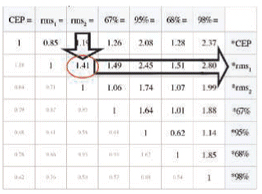
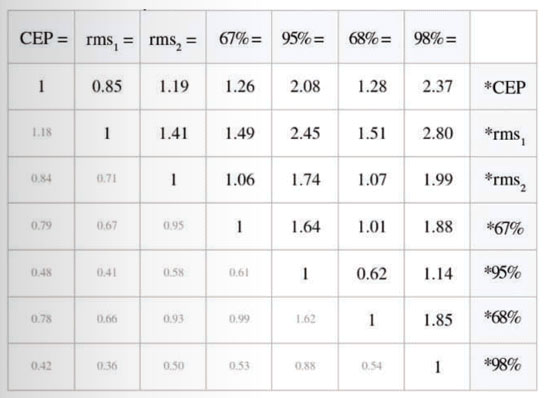
    Table 1. Accuracy measures for circular, Gaussian, error distributions.
    Source: Frank van Diggelen, Global Locate, Inc.
    Figure 1. Using Table 1.

    Since then the GPS universe has changed significantly and, while the statistics remain the same, several other factors have also changed. Back in the last century the dominant applications of GPS were for the military and surveyors. Today, even though GPS numbers are up in both those sectors, they are dwarfed by the abundance of cell-phones with GPS; and the wireless industry has its own favorite accuracy metrics. Also, Selective Availability was active back in 1998, now it is gone. And finally we have the prospect of a 60+ satellite constellation, as we fully expect in the next nine years that 30 Galileo satellites will join the GPS and satellite-based augmentation systems (SBAS) satellites already in orbit.

    Therefore, we take an updated look at GNSS accuracy.

    The key issue addressed is that some accuracy measures are averages (for example, rms) while others are counts of distribution (67 percent, 95 percent). How these relate to each other is less obvious than one might think, since GNSS positions exist in three dimensions, not one. Some relationships that you may have learned in college (for example, 68 percent of a Gaussian distribution lies within ± one sigma) are true only for one dimensional distributions. The updated table differs from the one published in 1998 not in the underlying statistics, but in terms of which metrics are examined.

    Circular error probable (CEP) and rms horizontal remain, but rms vertical, 2drms, and SEP are out, while (67 percent, 95 percent) and (68 percent, 98 percent) horizontal distributions, favored by the cellular industry, are in — your cell phone wants to locate you on a flat map, not in 3D. Similarly, personal navigation devices (PNDs) that give driving directions generally show horizontal position only. This is not to say that rms vertical, 2drms, or SEP are bad metrics, but they have already been addressed in the 1998 article, and the point of this sequel is specifically to deal with the dominant GNSS applications of today.

    Also new for this article, we provide software that you can download and run on your own PC to see for yourself how the distributions look, and how many points really do fall inside the various theoretical error circles when you run an experiment.

    Table 1 is the central feature of this article. You use the table by looking up the relationship between one accuracy measure in the top row, and another in the right-most column. For example (see FIGURE 1), let’s take the simplest entry in the table: rms2 = 1.41× rms1

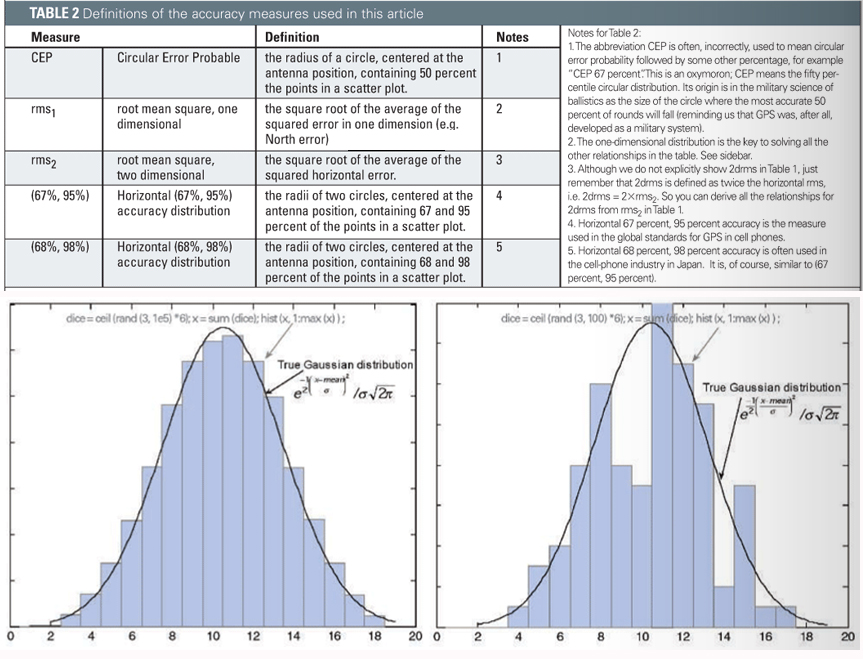
    TABLE 2 defines the accuracy measures used in this article.

    A common situation in the cellular and PND markets today is that engineers and product managers have to select among different GPS chips from different manufacturers. (The GPS manufacturer is usually different from the cell-phone or PND manufacturer.) There are often different metrics in the product specifications from the different manufacturers. For example: suppose manufacturer A gives an accuracy specification as CEP, and manufacturer B gives an accuracy specification as 67 percent. How do you compare them? The answer is to use Table 1 to convert to a common metric. Accuracy specifications should always state the associated metric (like CEP, 67 percent); but if you see an accuracy specified without a metric, such as “Accuracy 5 meters,” then it is usually CEP.

    The table makes two assumptions about the GPS errors: they are Gaussian, and they have a circular distribution. Let’s discuss both these assumptions.

    Source: Frank van Diggelen, Global Locate, Inc.
    Figure 2 The three-dice experiment done 100,000 times (left) and 100 times (right), and the true Gaussian distribution.

    Gaussian Distribution

    In plain English: if you have a large set of numbers, and you sort them into bins, and plot the bin sizes in a histogram, then the numbers have a Gaussian distribution if the histogram matches the smooth curve shown in FIGURE 2. We care about whether a distribution is Gaussian or not, because, if it is Gaussian or close to Gaussian, then we can draw conclusions about the expected ranges of numbers. In other words, we can create Table 1. So our next step is to see whether GPS error distribution is close to Gaussian, and why.

    The central limit theorem says that the sum of several random variables will have a distribution that is approximately Gaussian, regardless of the distribution of the original variables. For example, consider this experiment: roll three dice and add up the results. Repeat this experiment many times. Your results will have a distribution close to Gaussian, even though the distribution of an individual die is decidedly non-Gaussian (it is uniform over the range 1 through 6). In fact, uniform distributions sum up to Gaussian very quickly.

    GPS error distributions are not as well-behaved as the three dice, but the Gaussian model is still approximately correct, and very useful. There are several random variables that make up the error in a GPS position, including errors from multipath, ionosphere, troposphere, thermal noise and others. Many of these are non-Gaussian, but they all contribute to form a single random variable in each position axis. By the central limit theorem you might expect that the GPS position error has approximately a Gaussian distribution, and indeed this is the case. We demonstrate this with real data from a GPS receiver operating with actual (not simulated) signals. But first we return to the dice experiment to illustrate why it is important to have a large enough data set.

    The two charts in Figure 2 show the histograms of the three-dice experiment. On the left we repeated the experiment 100,000 times. On the right we used just the first 100 repetitions. Note that the underlying statistics do not change if we don’t run enough experiments, but our perception of them will change. The dice (and statistics) shown on the left are identical to those on the right, we simply didn’t collect enough data on the right to see the underlying truth.

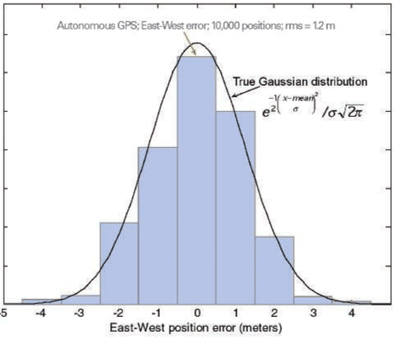
    FIGURE 3 shows a GPS error distribution. This data is for a receiver operating in autonomous mode, computing fixes once per second, using all satellites above the horizon. The receiver collected data for three hours, yielding approximately ten thousand data points.

    Source: Frank van Diggelen, Global Locate, Inc.
    Figure 3. Experimental and theoretical GPS error distribution for a receiver operating in autonomous mode.

    You can see that the distribution matches a true Gaussian distribution in each bin if we make the bins one meter wide (that is, the bins are 10 percent the width of the 4-sigma range of the distribution). Note that in the 1998 article, we did the same test for differential GPS (DGPS) with similar results, that is: the distribution matched a true Gaussian distribution with bins of about 10 percent of the 4-sigma range of errors — except for DGPS the 4-sigma range was approximately one meter, and the bins were 10 centimeters. Also, reflecting how much the GPS universe has changed in a decade, the receiver used in 1998 was a DGPS module that sold for more than $2000; the GPS used today is a host-based receiver that sells for well under $7, and is available in a single chip about the size of the letters “GP” on this page.

    Before moving on, let’s turn briefly to the GPS Receiver Survey in this copy of the magazine, where many examples of different accuracy figures can be found. All manufacturers are asked to quote their receiver accuracy. Some give the associated metrics, and some do not. Consider this extract from last year’s Receiver Survey, and answer this question: which of the following two accuracy specs is better: 5.1m horiz 95 percent, or 4m CEP?

    In Table 1 we see that CEP=0.48 × 95 percent. So 5.1 meters 95 percent is the same as 0.48× 5.1m = 2.4 meters CEP, which is better than 4 meters CEP.

    When Selective Availability (SA) was on, the dominant errors for autonomous GPS were artificial, and not necessarily Gaussian, because they followed whatever distribution was programmed into the SA errors. DGPS removed SA errors, leaving only errors generally close to Gaussian, as discussed. Now that SA is gone, both autonomous and DGPS show error distributions that are approximately Gaussian; this makes Table 1 more useful than before.

    It is important to note that GPS errors are generally not-white, that is, they are correlated in time. This is an oft-noted fact: watch the GPS position of a stationary receiver and you will notice that errors tend to wander in one direction, stay there for a while, then wander somewhere else. Not-white does not imply not-Gaussian. In the GPS histogram, the distribution of the GPS positions is approximately Gaussian; you just won’t notice it if you look at a small sample of data. Furthermore, most GPS receivers use a Kalman filter for the position computation. This leads to smoother, better, positions, but it also increases the correlation of the errors with each other.

    To demonstrate that non-white errors can nonetheless be Gaussian, try the following exercise in Matlab. Generate a random sequence of numbers as follows:

    x=zeros(1,1e5); for i=2:length(x), x(i)= 0.95*x(i-1)+0.05*randn; end

    The sequence x is clearly a correlated sequence, since each term depends 95 percent on the previous term. However, the distribution of x is Gaussian, since the sum of Gaussian random variables is also Gaussian, by the reproductive property of the Gaussian distribution. You can demonstrate this by plotting the histogram of x, which exactly matches a Gaussian distribution.

    In some data sets you may have persistent biases in the position. Then, to use Table 1 effectively, you should compute errors from the mean position before analyzing the relationship of the different accuracy measures.

    Distributions and HDOP

    Table 1 assumes a circular distribution. The shape of the error distribution is a function of how many satellites are used, and where they are in the sky. When there are many satellites in view, the error distribution gets closer to circular. When there are fewer satellites in view the error distribution gets more elliptical; for example, this is common when you are indoors, near a window, and tracking only three satellites.

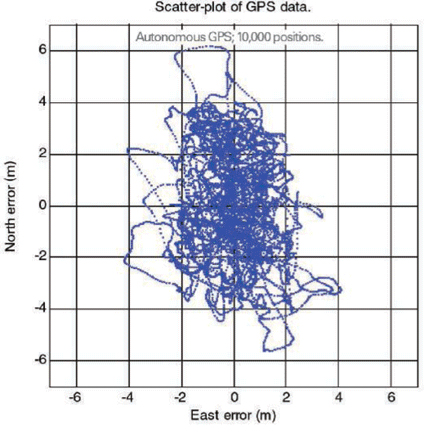
    For the GPS data shown in the histogram, the spatial distribution looks like FIGURE 4:

    You can see that the distribution is somewhat elliptical. The rms North error is 2.1 meters, the rms East error is 1.2 meters. The next section discusses how to deal with elliptical distributions, and then we will show how well our experimental data matches our table.

    Source: Frank van Diggelen, Global Locate, Inc.
    Figure 4. Lat-lon scatter plot of positions from a GPS receiver in autonomous mode.

    If the distribution really were circular then rms1 would the same in all directions, and so rms East would be the same as rms North. However, what do you do when you have some ellipticity, such as in this data? The answer is to work with rms2 as the entry point to the table. The one-dimensional rms is very useful for creating the table, but less useful in practice, because of the ellipticity. Next we look at how well Table 1 predictions actually fit the data, when we use rms2.

    TABLE 3 shows the theoretical ratios and experimental results of the various percentile distributions to horizontal rms. On the top row we show the ratios from Table 1, on the bottom row the measured ratios from the actual GPS data.

    Source: Frank van Diggelen, Global Locate, Inc.
    Table 3. Theoretical ratios and experimental results using actual GPS data.

    For our data: horizontal rms = rms2 = 2.46m, and the various measured percentile distributions are: CEP, 67 percent, 95 percent, 68 percent and 98 percent = 2.11, 2.62, 4.15, 2.65, and 4.74m respectively.

    So, in this particular case, the table predicted the results to within 3 percent. With larger ellipticity you can expect the table to give worse results. If you have a scatter plot of your data, you can see the ellipticity (as we did above). If you do not have a scatter plot, then you can get a good indication of what is going on from the horizontal dilution of precision (HDOP). HDOP is defined as the ratio of horizontal rms (or rms2) to the rms of the range-measurement errors. If HDOP doubles, your position accuracy will get twice as bad, and so on. Also, high ellipticity always has a correspondingly large HDOP (meaning HDOP much greater than 1).

    Galileo and Friends

    Luckily for us, the future promises more satellites than the past. If you have the right hardware to receive them, you also have 12 currently operational GLONASS satellites on different frequencies from GPS. Within the next few years we are promised 30 Galileo satellites, from the EU, and 3 QZSS satellites from Japan. All of these will transmit on the same L1 frequency as GPS. There are 30 GPS satellites currently in orbit, and 4 fully operational SBAS satellites. Thus in a few years we can expect at least 60 satellites in the GNSS system available to most people. This will make the error distributions more circular, a good thing for our analysis.

    Working with Actual Data

    When it comes to data sets, we’ve seen that size certainly matters — with the simple case of dice as well as the more complicated case of GPS. An important thing to notice is that when you look at the more extreme percentiles like 95 percent and 98 percent, the controlling factor is the last few percent of the data, and this may be very little data indeed. Consider an example of 100 GPS fixes. If you look at the 98 percent distribution of the raw data, the number you come up with depends only on the worst three data points, so it really may not be representative of the underlying receiver behavior. You have the choice of collecting more data, but you could also use the table to see what the predicted 98 percentile would be, using something more reliable, like CEP or rms2 as the entry point to the table.

    Statistics-2-sidebar

    Conclusion

    The “take-home” part of this article is Table 1, which you can use to convert one accuracy measure to another. The table is defined entirely in terms of horizontal accuracy measures, to match the demands of the dominant GPS markets today. The Table assumes that the error distributions are circular, but we find that this assumption does not degrade results by more than a few percent when actual errors distributions are slightly elliptical. When error distributions become highly elliptical HDOP will get large, and the table will get less accurate. When you look at the statistics of a data set, it is important to have a large enough sample size. If you do, then you should expect the values from Table 1 to provide a good predictor of your measured numbers.

    Manufacturers

    GPS receiver used for data collection: Global Locate (www.globallocate.com) Hammerhead single-chip host-based GPS.


    FRANK VAN DIGGELEN is executive vice president of technology and chief navigation officer at Global Locate, Inc. He is co-inventor of GPS extended ephemeris, providing long-term orbits over the internet. For this and other GPS inventions he holds more than 30 US patents. He has a Ph.D. E.E. from Cambridge University.

  • Out in Front: Best Intentions

    The magazine has not carried much GLONASS news in recent months, yet we continue to cover Galileo with some assiduousness and we devoted several pages to Beidou in December. In all three cases, we find an absence of real news in the sense of verifiable happenings, satellite launches, new applications by users, or releases of products you can wrap your hands around.

    No, in all three systems we have pronouncements, prognostications, and promises of satellites future. Ongoing deliberations, budget wrangling, internal disputes, delays, cost overruns, turf squabbles, and discussions postponed until the next round of meetings. Hmmm. These young upstarts sound remarkably akin to their older cousin, GPS.

    Aha — but! GPS launched a satellite in November, and declared it operational for users on December 13. Not only a new satellite, a new kind of satellite, with new codes. That may not be news on the order of "man bites dog," but it is undeniably authentic, progressive, practical, and actually useful news you can use.

    Why cover Galileo and Beidou, while devoting scant attention to GLONASS?

    Well, Beidou is new, only very recently and suddenly being talked about as a truly global NSS. It is all talk at this point, but it’s fascinating talk, and comes from a region that has long held itself mysterious, aloof. Hard information is extremely difficult to come by. We’re reduced to scrutinizing the inscrutable, reading the tea leaves of government releases and newspaper stories within China, where the government controls the press. Even the analysts whom we canvass haven’t much better sources. So, play hard to get, you Beidou designers . . .

    Galileo is completely another story. Or six or seven other stories. A soap opera, it keeps unfolding, plot-twisting, introducing new characters and controversies, and leaving you cliffhanging from one episode to the next. Politics play a very overt role, as 151 constituencies try to resolve issues to everyone’s satisfaction. While continuing — here’s the real trick — to move forward. That keeps us tuning in.

    Meanwhile, Russia bravely carries on its own tradition, promising three new, longer-lived satellites by Christmas and 18 or 24 by 2008, an upgraded service freely available anywhere in the country and soon (or later) the world, a new Five-Year Plan better than the old Five-Year Plan, which went unattained. Not through lack of trying, but through lack of money, and a crumbling infrastructure. This may be lamentable and the new optimism estimable, but is it news? Can I use it?

    The Kremlin has no lock on inflated goals and blue-sky promises. This desk receives plenty of that from industry. Yes! In this country! And others. Our intent is to filter that out, to deliver only that which may truly affect our readers.

    News doesn’t exist in a vacuum. It requires people, and a demonstrable effect on those people, to become news.

  • Letter to the Editor: Who Invented GPS?

    In your August 2006 issue, you raised the question: Who was first with GPS? And you concluded that a debate may not be useful. You may be right. In spite of Richard Easton’s Internet claim that his father, Roger Easton, invented GPS by filing an enabling U.S. patent number 378 9409 in 1974, he must have had his doubt. For he preceded his article with a quote by Alexander von Humboldt, who had observed that the third stage of scientific discovery “finally credits the wrong person.”

    From its very beginning, the invention of GPS was teamwork. First and foremost among them were the rivaling research teams of the U.S. Air Force and the U.S. Navy.

    In the 1940s, the navigation system LORAN, still in use by ships today, was developed by an MIT research team while Ivan A. Getting was a researcher at MIT’s Radiation Laboratory. In 1951, Getting became the head of research and engineering at Raytheon Corp. in Waltham, Massachusetts. They developed a mobile ballistic missile guidance system, called MOSAIC. In 1960, Getting was asked by the Air Force to create a nonprofit military systems development organization and became president of Aerospace Corp. While planning new ballistic missile systems, space-launch systems and high powered chemical lasers, he focused on and became an evangelist for Navstar. “GPS was incubated in the mind of Ivan Getting,” noted the National Inventors Hall of Fame when it inducted him and Colonel Bradford Parkinson.

    Everybody agreed, however, that many others were part of the several inventor teams and deserve credit as well.

    Back in 1991, as president of ACSM, I had the opportunity to speak to Col. Bradford Parkinson’s GPS expert, Col. Gaylord Green. He told me that their small team of six or seven scientists had built the GPS architecture in 1972, in less than a month. Air Force team members included Mel Birnbaum, Bob Rennard, and Jim Spilker. The GPS concept and theory had been established earlier as a Transit system, and has always been an “institutional endeavor,” said Green.

    Richard Easton also mentioned James Buisson, Thomas McCaskill, Don Lynch, Charles Bartholomew, Randolph Zirn and “an important outsider,” Robert Kern, as talented team members of his father, Roger, at the Naval Research Lab (NRL). It turns out that the important outsider, Robert Kern, became the founder of Frequency & Time Systems, Inc. (FTS), a manufacturer of atomic clocks for GPS satellites, in Beverly, Massachusetts, in 1971.

    He may or may not be a descendant of the famous Swiss instrument manufacturer Kern A.G., which is related to Wild Heerbrugg of Switzerland, now Leica. In its website, Milestones of Technology, it describes that it had conducted the first feasibility study for the GPS program 621B of the U.S. Air Force in 1967. Likewise, in 1971, it defined, designed, and built early prototype receivers for the Navy’s GPS program Timation. As Gaylord Green pointed out, GPS has always been an institutional endeavor.

    To sum it up, the diverse teams of GPS inventors and designers were led by at least three outstanding American scientists. They are Ivan A. Getting of Raytheon and Aerospace Corporation, who in the 1950s “incubated GPS in his mind;” Bradford Parkinson of the U.S. Air Force, who helped create GPS in 1972; and Roger Easton, of the U.S. Navy Research Laboratory, who filed the enabling patent in 1974.

    Thanks to their joint effort, simultaneously or in succession, we can today look at GPS applications, both military and commercial, where the sky is truly the limit.

    – Gunther Greulich, PLS, PE,
    Former president ACSM

  • Driving for Dollars: Urban Challenge Purse Put at $3.5 Million

    The Defense Advanced Research Projects Agency (DARPA) will award $2 million, $1 million, and $500,000 awards to the top three robotic finishers who complete its new Urban Challenge course in November 2007.

    Under Secretary of Defense for Acquisition, Technology and Logistics Kenneth J. Krieg approved the cash prizes, evidencing the Department’s interest in making one-third of all combat vehicles — principally supply vehicles — driver-less by 2015.

    DARPA has staged two desert Grand Challenges, in 2004 and 2005 in the Mojave, with significant difficulties posed by geography and terrain. The 2007 Urban Challenge will feature fully autonomous ground vehicles conducting simulated military supply missions in a mock urban area. The race will take place on November 3, 2007, at a location to be announced later, in the western United States.

    Robotic vehicles will attempt to complete a 60-mile course through traffic in less than six hours, operating under their own computer-based control. Vehicles must obey traffic laws while merging into moving traffic, navigating traffic circles, negotiating busy intersections, and avoiding obstacles.

    Learning Curve. Participants in past Grand Challenges have truly risen to the occasion, learning and innovating as they go. The number of sensors and software applications integrated into most of the experimental vehicles increased dramatically between the first and second races. Inertial sensors proliferated, with cost, size, and power consumption going down, while performance went up. Inertial systems, along with various camera/vision apparati, function as the workhorses covering the ground in most of the vehicles. GPS generally teams with a central processing unit (CPU) to act as the brain guiding the process.

    William “Red” Whittaker of Carnegie Mellon University’s Robotics Institute and Louis Nastro of Applanix Corporation co-authored a detailed technical article in September 2006 GPS World on their experience with the students of Carnegie Mellon’s Red Team Racing effort, designing and outfitting two vehicles that competed and placed in the 2005 race.

    To qualify for the race or simply watch, see the Grand Challenge website for additional information and rules for the Urban Challenge.

  • Letters to the Editor – December 2006

    Need Clear Vision

    Well done on the editorial this month (“Skies Cloudy All Day,” October). I totally agree with you regarding the lack of clear vision for our GPS future. And I’m not saying there is not vision at the Air Force, but the GPS programs must be backed by the full Congress and its funding. We must put government funding behind that vision to make it a reality. When we as U.S. citizens say GPS is critical to our national security, and even our livelihood more and more each day, we must back that with the bucks to keep it healthy and strong as the utility that it has become.

    Ellen Hall
    President, Spirent Federal Systems Inc.

    NDGPS Killer App

    This is in response to the October 2006 letter “NDGPS Budget” by Tim Smith and the reply by Erik Gakstatter. There will be a killer application for NDGPS, for ground vehicles to know their position precisely to the meter, especially in the urban canyon setting where satellite reception can be very poor. This effort is spearheaded by the Department of Transportation (DOT) for the Intelligent Transportation System (ITS). In addition, the Vehicle Infrastructure Integration (VII) consortium consists of several state agencies, automobile manufacturers, and vendors to implement vehicle-to-vehicle-to-roadside communications via Dedicated Short Range Communications (DSRC). The primary purpose is to enhance vehicle safety using communications for collision avoidance, signal violation warning, near instantaneous traffic information, and road hazard warnings. In this case accurate GPS positioning is very important and where NDGPS can fill the need. Secondary purposes are to provide a wide range of applications starting with local electronic signage, navigation aids, traveler information, electronic payments (fuel, parking, tollway), ramp metering, and a wide variety of potential consumer applications in the vehicle.

    The article “Safe in Traffic” in the very same issue of GPS World describes the whole project and the use of GPS for ground vehicle transportation, but not the need for accurate GPS positioning which could be provided by NDGPS.

     – Neal W. Probert
    President, ProbeStar Technical Systems

    WAAS in the East

    Could you please tell me when WAAS will be up and running in Eastern Canada?

     – Kenneth Lewis
    Government of New Brunswick


    Editor’s Reply: There have been some changes due to geostationary satellite repositioning. See the web page of the University of New Brunswick’s Wide Area Augmentation System Monitoring Station and the Federal Aviation Administration’s “New WAAS GEO Status as of 11/9/06” PDF file.

  • DIRECTIONS 2007: Survey & Construction

    Momentum is a powerful phenomenon. When thought of in terms of a moving object, its mass and velocity can be measured. In other respects, it’s immeasurable. Feelings of confidence, trust, and faith can’t be hard-coded — but can make the difference between winning and losing. Whether in the context of a football game, the stock market, or a presidential election, positive momentum builds confidence, and confidence feeds the momentum. The Big Mo.

    In 2006, GPS constellation health has declined, but a well-timed presentation by Brad Parkinson at the ION GNSS 2006 conference has injected renewed enthusiasm into the GPS program. Parkinson’s call for a 30-plus satellite constellation may constitute a boon for GPS survey/mapping users in 2007. More satellite signals and healthier satellites mean increased productivity. While 2006 saw two IIR-M satellite launches, look for double that in 2007. Even if new launches don’t improve the PDOP spikes, we’ll have more reliable hardware in orbit. The Big Mo is rolling.

    The short-term benefit of the IIR-M launches is a healthier constellation. Another, longer-term benefit comes from the addition of the second civil frequency. L2C may bring some value to L1/L2 users in 2007, but with only eight IIR-Ms even potentially operational by year’s end (assuming five are launched in 2007), plus the requirement to have an L2C-capable reference station, the bennies will be limited.

    GLONASS is still a crapshoot and may likely continue that way into 2007, but it doesn’t matter because its value is augmenting GPS. Up until a few months ago, it had The Big Mo on its side. Then GLONASS headed south in a hurry in September, when nearly a half dozen satellites were declared unusable “due to maintenance.” This continued for 30-plus days. The good news is that the Russians are launching GLONASS satellites at a pretty good clip, and GPS/GLONASS users don’t need a full GLONASS constellation for it to be useful. Three more are scheduled to launch this month and six are scheduled for launch in 2007.

    Even if only half of those become operational, GPS/GLONASS users will feel the love in 2007. Worldwide GLONASS usage will increase significantly in 2007 now that all major survey instrument manufacturers have introduced and will begin rolling out their GPS/GLONASS-capable products. The Big Mo will return.

    Galileo won’t do anything for the survey/mapping user in 2007, but that doesn’t mean you don’t keep tabs on it. Galileo has the potential to deliver Huge Mo for survey/mapping — just not in 2007. The business model will continue to receive scrutiny, and the discussion of military use will spin things around a bit, but development and testing will continue. The key news to look for in 2007 will be any significant delays. 2008 should be a Big Mo year for Galileo if the program can stay on target, and if tight GPS interoperability is realized.

    Satellite-based augmentation systems (SBASs) like the United States’ WAAS, Europe’s EGNOS, Japan’s MSAS, and India’s GAGAN also have Big Mo on their side. Virtually every GPS receiver shipped today is SBAS-capable. WAAS will finally stabilize with respect to the communication satellite adjustments made in 2006, and EGNOS should be declared operational. The worldwide SBAS user base will continue to show strong double-digit if not triple-digit growth.

    NDGPS (National Differential GPS), another GPS augmentation system, will encounter the most significant crossroad in its decade-long history of service in 2007. Lack of support threatens the program’s existence. The worst-case scenario is that NDGPS will shut down as early as October 2007, leaving the U.S. Coast Guard to operate only 40 or so maritime DGPS broadcast stations along coastlines and major waterways. Big Mo left some time ago, and No Mo has moved in.

    Reshaping the Marketplace. The most interesting GPS survey/mapping innovation for 2007?

    L1 RTK.

    While not the most innovative technology because it’s been possible for many years, it holds great interest because of its potential to reshape the survey/mapping marketplace. It will fill a gap between L1 static systems and high-end L1/L2 RTK systems. Those L1 static users who could not overcome the financial jump to an L1/L2 RTK system costing several tens of thousands of dollars will now have the productivity of RTK within reach.

    Why now, and not five years ago? Follow the money to find the answer. L1/L2 RTK systems still run in the US$25-45,000 range. Competition among high-end GPS manufacturers is heating up, so they’re looking for opportunity. L1 RTK systems will be half that price — maybe even one third. Yes, baseline lengths will be limited to a few kilometers, and initialization times will be measured in terms of minutes rather than seconds, but the accuracy will be the just as good as high-end L1/L2 RTK systems.

    Satellite constellation health will be the wildcard for L1 RTK. 2006 was not a good year for the GPS constellation. With L1 RTK and a weak constellation, productivity would be an issue, especially if you aren’t operating in a really clear open-sky environment. However, the good news is that it seems GPS Wing of the U.S. Air Force is in giddy-up mode again. If they share Parkinson’s vision of a 30-plus satellite constellation, L1 RTK could end up being a very productive tool — with Big Mo on its side.

    Eric Gakstatter is editor of GPS World’s Survey & Construction e-newsletter. Free subscription available.

    More DIRECTIONS 2007

    Every December GPS World invites experts to share insights on what the new year holds. Here are additional views in the Directions 2007 feature:

    SYSTEM DESIGN & TEST
    Opportunity, Innovation — and Choice
    By Charles F. Trimble and F. Michael Swiek

    MILITARY & GOVERNMENT
    Through a Glass, Darkly
    By John T. Kelly

    AVIONICS & TRANSPORTATION
    Modernizing, Expanding GNSS Use
    By Bill Thompson

    LOCATION-BASED SERVICES
    As Navigation Goes, So Goes LBS
    By Mike Sheldrick

  • Brian Soliday Joins TerraGo Technologies

    TerraGo Technologies, provider of GeoPDF and the MAP2PDF family of products, announced that Brian Soliday has joined the company as vice-president of sales. Soliday will be responsible for expanding use of the company’s geospatial data distribution format known as GeoPDF.

    Prior to signing on with TerraGo, Soliday spent almost 20 years in various sales, consulting, and business development management roles with Space Imaging, Autodesk, LizardTech, and Trimble, as well as start-up geospatial technology vendors.

    “Brian has successfully grown and managed all kinds of sales organizations in other GIS solutions companies. We expect that his broad base of experience as well as his in-depth knowledge of the geospatial market will help us execute effectively while we’re experiencing rapid expansion of our customer base across multiple vertical markets,” said James Davis, TerraGo president and CEO.

    Adoption of TerraGo’s MAP2PDF products and GeoPDF technology has steadily increased in the last year. Unit sales of products are up almost 500 percent, while the TerraGo customer base has grown more than 300 percent. The company’s employee base has more than doubled.

    The MAP2PDF family of products allows customers to publish and collaborate on GeoPDF files that contain robust cartographic data and mapping capabilities, including layers and embedded feature attributes. GeoPDF files can be easily distributed and used in connected or disconnected modes. Because the product leverages Adobe Reader, most non-GIS pros already have viewing software installed and are familiar with how to use it.

    WithGeoPDF, users are able to view finished digital maps, turn layers on and off, query attributes, display coordinates, measure distances, and track locations via GPS without the need for specialized geospatial knowledge or training.

    “TerraGo has gained momentum quickly because the product set addresses problems that organizations have long struggled with,” said Soliday. “Being able to open up their GIS data to anyone in the enterprise anywhere in the world gives GIS professionals vast new capabilities and opportunities to create greater value while serving constituents more effectively. It’s a unique value proposition and the user community is already embracing the possibilities GeoPDF brings to this market space.”

    In addition to his professional experience in the GIS industry, Soliday is an active member of the American Society of Photogrammetry and Remote Sensing, serving as the Rocky Mountain Region President in 2004. Soliday also serves on the editorial advisory board of Geospatial Solutions magazine. A practicing conservationist, habitat partner and life member of the Rocky Mountain Elk Foundation (RMEF), Soliday currently serves the RMEF as Colorado State Volunteer Chair. He graduated from the University of Nebraska at Omaha with Bachelors and Masters Degrees in Geography with specialties in GIS and Remote Sensing.

  • Geo-Enabling the IC with GeoPDF

    This week, TerraGo Technologies announced that it has entered into a strategic agreement with In-Q-Tel – an independent venture capital fund tasked with identifying new technologies for the Central Intelligence Agency (CIA) and the larger intelligence community (IC) – to spark the development of new mapping solutions needed by such IC leaders as the National Geospatial-Intelligence Agency (NGA).

    For several years now, many government agencies (including the US Army Corps of Engineers, USACE), have relied on TerraGo’s innovative GeoPDF proprietary data-sharing format to exchange geospatial data between users of varying skills levels – from engineers on the scene of natural disasters like Hurricane Katrina to soldiers in the field who can use Adobe Reader to manipulate maps. The agreement between TerraGo and In-Q-Tel is expected to advance the development of GeoPDF and related technologies to meet the operational demands of these organizations, as they continue tackling such challenges as the Global War on Terror and emergency response for major natural and manmade disasters.

    Since its first MAP2PDF for Adobe Acrobat product was introduced seven years ago, TerraGo has evolved the technology that allows for the creation and sharing of digital map display files in a user-friendly format. Today’s GeoPDF format allows users to convert raster and proprietary CAD and GIS mapping and database information to text-searchable, georeferenced PDF files. It also allows for the creation of both georegistered and GIS database-embedded PDF files – hence the term GeoPDF.

    With GeoPDF, users can send complex, georegistered maps as PDF files with layers and embedded feature attributes. A GeoPDF can be distributed and used in connected or disconnected modes with the free Adobe Reader and GeoPDF Toolbar software. Users can view finished digital maps, turn layers on and off, query attributes, display coordinates, measure distances, and track locations via GPS . . . all without the need for specialized geospatial knowledge or training.

    For an example of how USACE is using the GeoPDF file format, we can look to the corps’ Topographic Engineering Center (TEC). Currently, TEC is creating unclassified/for official use only digital map displays for regions of the world where the Global War on Terror is being fought. TEC has created DVDs for five countries in support of the war, and it has distributed these DVDs to the military. The project has included taking all of the NGA standard map sheets of Korea, having them scanned and converted to GeoPDFs, and packaging them with an index sheet. By the end of the year, TEC anticipates having created 30-plus country DVDs that consist of all NGA standard products in raster GeoPDF format. The center is also awaiting NGA’s delivery of vector-based GeoPDFs for inclusion in the country DVDs.

    It’s abundantly evident that TEC and NGA have bought into the GeoPDF concept in a big way. Whether TerraGo will be the only GeoPDF name in town remains to be seen, but I think it’s inevitable that the technology itself is here to stay, in both the private and the public sector. In the intelligence community, GeoPDF is clearly a smart way to share geospatial information quickly and easily, especially when the nation’s welfare – and American lives – might be on the line.

    Editor’s Note: Eric Gakstatter, a GPS/GIS consultant with Discovery Management Group LLC, and Ray Caputo, a geographer with the US Army Corps of Engineers Topographic Engineering Center, contributed to this editorial.

  • NDGPS Abandoned?

    The Federal Railroad Administration has relinquished responsibility for national differential GPS (NDGPS), saying that it no longer supports NDGPS for positive train control. DOT’s Research and Innovative Technology Administration (RITA) now has sponsorship of NDGPS, and will hold a meeting on October 4 to assess.

    The outlook for NDGPS appears bleak. “Without funding, the system faces tough choices.” Options reportedly under consideration include moth-balling the system for $2 million or shutting it down for $10 million. NDGPS supporters claim that a large mass of users of NDGPS have not yet been heard.