Author: Allison Kral

  • Augmented satnav meeting focuses on future development

    The 6th Satellite-Based Augmentation Systems Interoperability Working Group (SBAS IWG) took place Feb. 5-7 in Delhi, India.

    During the meeting, SBAS developers and operators were joined by users of the systems, with representatives of airlines, aircraft makers and avionics manufacturers. About 50 people in total attended the meeting.

    “Satellite-based augmentation systems deliver the necessary accuracy, integrity, availability and service continuity for aircraft to be able to rely on them though all phases of flight, from cruising in the air to being guided down for landing,” said navigation engineer Didier Flament, head of the European Space Agency’s (ESA) EGNOS and SBAS division, representing ESA at the SBAS IWG.

    The meeting covered the Southern Positioning Augmentation Network (SPAN), which had been born since IWG’s previous gathering six months ago. SPAN, a regional SBAS program, covers Australia and New Zealand.

    The meeting also covered the progress of the four SBAS currently under definition or development: China’s Beidou SBAS, BDSBAS, represented by the China Satellite Navigation Office; South Korea’s KASS, represented by the Korea Aerospace Research Institute; the African and Indian Ocean SBAS, represented by the Agency for Aerial Navigation Safety in Africa and Madagascar; and the Russian Federation’s System for Differential Corrections and Monitoring (SDCM), represented by Russian Space Systems, RSS.

    Current systems are mostly based around the U.S. GPS system (except for SDCM using Russia’s Glonass and BDSBAS using China’s Beidou) but plans are being laid to move to a dual-frequency, multi-constellation version making use of Europe’s Galileo, China’s Beidou and Russia’s Glonass satnav systems later this decade, IWG said.

    Finally, the meeting touched on SBAS research and development, including applying SBAS to Europe’s railways.

    Today, there are 10 satellite-based augmentation systems for satnav that are either in operation or active development, IWG added. The group is working to ensure that the future evolutions of all these systems will operate on a similar basis with common technical requirements, allowing the easy transition of continent-crossing air traffic from one system to another.


  • Ecometrica Platform to help share NASA Earth data

    This image shows the Global Ecosystem Dynamics Investigation Lidar (GEDI) being assembled NASA’s Goddard Space Flight Center. (Photo: NASA)
    This image shows the Global Ecosystem Dynamics Investigation Lidar (GEDI) being assembled NASA’s Goddard Space Flight Center. (Photo: NASA)

    Under a contract with the University of Maryland, Ecometrica, a sustainability and space data company, will be helping disseminate data from NASA’s latest “Global Ecosystem Dynamics Investigation” (GEDI) lidar instrument.

    According to Ecometrica, the Ecometrica Platform will make processed maps more widely available to end users and reduce the need for additional processing of highly technical remote sensing lidar data.

    GEDI is led by the University of Maryland, in collaboration with NASA Goddard Spaceflight Center, and deploys a multibeam lidar instrument onboard the International Space Station to measure the forest vertical structure and biomass. Carried from Earth to the International Space Station atop a reusable SpaceX Falcon 9 rocket, it is already providing valuable raw data, which will be crucial in better understanding climate change and the Earth’s ecosystems, Ecometrica said.

    “The value of downstream satellite data in managing climate and environmental risks is significant and it is important that this is available and easily accessible to users all over the world,” said Richard Tipper, executive chairman at Ecometrica. “Projects such as Forests 2020, the global forest monitoring initiative that is part of the U.K. Space Agency’s international program, and managed by Ecometrica, are already proving very successful in using data from space to protect ecosystems on Earth. Importantly, this has also helped create an international skills-base and infrastructure across tropical forest countries, which can now benefit from the results of the very latest Earth observation instruments from NASA.”

    The lidar instrument is operated by the university, which is working with Ecometrica to make data available globally in a format that is easy to use for environmental monitoring and protection purposes. According to Ecometrica, its platform will display key findings on rapidly updating maps, allowing conservation organizations and government agencies around the world to tap into the findings and use the real-time data to monitor forest canopies and cover.

    The partnership is set to continue as part of the latest three-year contract.

  • Raven Industries partners with Razor Tracking for ag retailers, enterprise growers

    Raven Industries partners with Razor Tracking for ag retailers, enterprise growers

    Logo: Raven Slingshot

    Raven Industries has partnered with Razor Tracking, an SaaS and mobile application-based fleet tracking and management system, to provide ag retailers and enterprise farms with an expanded fleet and asset tracking suite through the company’s Slingshot platform.

    As a result of this partnership, Slingshot Fleet Tracking will be available as the integrated logistics tracking component of the Raven Slingshot platform. According to Raven, Slingshot Fleet Tracking allows users to seamlessly and wirelessly connect their office to the field by providing accurate location and machine running data in real-time. This partnership gives ag retailers and growers immediate fleet information — including work, idle and transit times — to better manage their equipment, assets and operations, the companies said.

    “This agreement enables Raven to quickly expand unmatched value to our growing ag retailer and grower customer base,” said Paul Welbig, director of Slingshot services & logistics for Raven Applied Technology. “From machine performance to diagnostics, and now expanded tracking of both in-field and operation support assets, users of Raven’s Connected Workflow can expect 20% efficiencies gained when using the technology delivered through the integrated Slingshot platform. This partnership continues our focus to offer efficiency-driving solutions that help reduce variability and increase profitability for our customers.”

    By leveraging Razor Tracking’s capabilities, Slingshot Fleet Tracking provides users with accurate real-time data on where their vehicles and assets are located to better maintain schedules for dispatching and increase overall efficiency, the companies added. Through the partnership, users will now also be able to monitor non-Raven equipped assets, including other battery-connected equipment and non-powered equipment.

    Customers will be able to subscribe to Slingshot Fleet Tracking to use it in their own operations beginning June 2020.

  • Korec, NCTech launch KlearView360° visual asset inspection system

    Korec, NCTech launch KlearView360° visual asset inspection system

    Check out the KlearView360° system collecting inspection information. (Photo: NCTech)
    Check out the KlearView360° system collecting inspection information. (Photo: NCTech)

    Korec and NCTech launched KlearView360°, a streamlined, hosted system designed for the identification of assets, defects or changes within images collected by vehicle or backpack.

    According to the companies, KlearView360° makes vehicle-mounted asset inspection accessible to local authorities and many others. KlearView360° combines NCTech’s iSTAR Pulsar+ high resolution camera with Korec’s K-Portal cloud-based hosting solution for live progress monitoring.

    KlearView360°, which is accessible through a standard web browser, enables work management instructions to be communicated to mobile workers for issue resolution via Korec’s K-Mobile data capture software.

    “Historically these types of solutions have been very expensive, but the KlearView360° integration with the iSTAR Pulsar+ means that we can put vehicle mounted inspection into the hands of local authorities, highways engineers and consultants, utilities and many more in an affordable and effective way,” said Richard Gauchwin, business area manager at Korec.

    KlearView360° also offers a cost-effective and simple way to add the iSTAR Pulsar’s high resolution 360-degree imagery to existing GIS datasets hosted within ArcGIS or QGIS via K-Portal’s dynamic link, and provides rapid video playback to review driven routes, the companies added.

  • NVS Technologies debuts NV216C-RTK-A GNSS receiver at Intergeo 2019

    NVS Technologies discusses its NV216C-RTK-A multi-frequency GNSS receiver at Intergeo 2019, which took place Sept. 17-19 in Stuttgart, Germany.

  • ION calls for abstracts for ION GNSS+ 2020

    ION calls for abstracts for ION GNSS+ 2020

    Illustration: ION
    Illustration: ION

    The Institution of Navigation (ION) is asking for abstracts for ION GNSS+ 2020, which is set to take place Sept. 21-25 in St. Louis.

    ION GNSS+ 2020, themed “GNSS + Other Sensors in Today’s Marketplace,” will feature two tracks: commercial and policy tracks and research tracks. The commercial and policy tracks will include high performance and safety critical applications; status and future trends in GNSS; and mass market and commercial applications. The research tracks will include multi sensor and autonomous navigation; algorithms and methods; and advanced GNSS technologies.

    In addition, authors whose abstracts are accepted in these sessions (either as a primary or as an alternate presenter) will have the option to have their paper peer reviewed.

    The deadline for submitting abstracts is March 5. Submit your abstract here.

  • Concept3D reveals 2019 innovative map award winners

    Concept3D reveals 2019 innovative map award winners

    Logo: Concept3D

    Concept3D named the winners of its “Most Innovative Map” awards, which recognize higher education institutions for unique applications of the Concept3D platform.

    The five award categories included Best Data Feed Integration, Best Campus Safety Initiative, Best Admissions Integration, Most Digitally Accessible Campus Map and Best Interior Mapping. In addition, honorable mentions were given for the Best Virtual Tour, Best Green Initiative, Most Prepared Initiative and Best Use of Webcams.

    Here are the award winners:

    • Penn State University won the Best Data Feed Integration Award for its interactive campus maps for the main University Park campus and 21 of the Commonwealth Campuses.

    • Boise State University won the Best Campus Safety Initiative Award for its commitment to safety and security with the integration of a new toggle-on Night Map feature, a 3D map overlay that makes it easy for students, staff and visitors to find preferred, well-lit night routes, as well as resources including emergency phones.

    • Occidental College won the Best Admissions Implementation Award for integrating a new feature — the “Locate Your Admissions Counselor” option — to the platform to help students around the country find the right point of contact for the Los Angeles-based campus.

    • Texas A&M University won the Most Digitally Accessible Campus Map award for integrating a new wheelchair accessible wayfinding feature into its interactive campus map, which helps identify the most efficient and easiest routes for those using a wheelchair.

    • Finally, the University of Colorado, Boulder won the Best Interior Mapping Award for adding a new feature that gives map users the ability to view the building interiors, floor by floor.

    In addition, the University of Texas, Arlington received a Best Virtual Tour honorable mention; Skidmore University received a Best Green Initiative honorable mention; the University of Denver received a Most Prepared Initiative honorable mention and Michigan Tech University received a Best Use of Webcams honorable mention.

    “It was quite a challenge to pare it down to the final award winners because there are so many unique applications happening in the higher education space, where interactive campus maps can be used for a wide variety of uses and by different departments,” said Gordon Boyes, CEO of Concept3D. “It’s really exciting to see how the higher education professionals are able to use the technology to serve their communities and to note how the awards reflect higher education trends that we’re seeing across the board, from greater digital accessibility to IoT.”

  • FAA, AUVSI to co-host fifth annual FAA UAS Symposium

    FAA, AUVSI to co-host fifth annual FAA UAS Symposium

    Logo: FAA UAS SymposiumThe Federal Aviation Administration (FAA) and Association for Unmanned Vehicle Systems International (AUVSI) will co-host the 5th Annual FAA Unmanned Aircraft Systems (UAS) Symposium June 16-18 in Baltimore. The event will take place at the Baltimore Convention Center.

    The symposium will bring together representatives from the FAA, other government agencies, the industry and academia. According to the show organizers, the presenters and panelists will discuss the latest information and advancements related to the diverse uses of unmanned aircraft, and how these new entrants are being safely integrated into the National Airspace System.

    The show will include four primary educational tracks, including public safety, technology and innovation, international and policy. The public safety track will explore topics such as addressing community concerns, security, and using drones to conduct safer and more effective public safety missions. The technology and innovation track will cover how drones and drone technologies are innovating rapidly and fundamentally changing aviation. The international track will feature discussions on how national and international UAS experts, industry representatives, civil society stakeholders, non-governmental organizations and policy makers are working to integrate and use drones across the globe. Finally, the policy track will allow attendees to hear directly from policy decision makers and get their thoughts on regulatory, operational and technical concerns.

    In addition, the FAA will operate as an on-site resource center to answer questions from UAS owners and operators. Subject matter experts will be on hand to answer questions about airspace authorizations, waivers, the Part 107 small UAS rule, changes in hobbyists’ drone operations, the Remote Identification rulemaking, and other policies and regulations, the organizers added.

  • Mobile World Congress 2020 canceled due to coronavirus concerns

    Mobile World Congress 2020 canceled due to coronavirus concerns

    Logo: Mobile World Congress 2020

    Mobile World Congress, which was set to take place Feb. 24-27 in Barcelona, has been canceled as a result of coronavirus concerns. The cancellation comes after several exhibitors backed out of the show.

    “With due regard to the safe and healthy environment in Barcelona and the host country today, the GSMA has cancelled MWC Barcelona 2020 because the global concern regarding the coronavirus outbreak, travel concern and other circumstances, make it impossible for the GSMA to hold the event,” said GSMA CEO John Hoffman in a statement. “The host city parties respect and understand this decision. The GSMA and the host city parties will continue to be working in unison and supporting each other for MWC Barcelona 2021 and future editions. Our sympathies at this time are with those affected in China, and all around the world.”

    GSMA, which organizes Mobile World Congress, represent the interests of mobile operators worldwide, uniting more than 750 operators and nearly 400 companies in the broader mobile ecosystem, including handset and device makers, software companies, equipment providers and internet companies.

  • Routescene 3D mapping solution reveals hotspots at Chernobyl

    Routescene 3D mapping solution reveals hotspots at Chernobyl

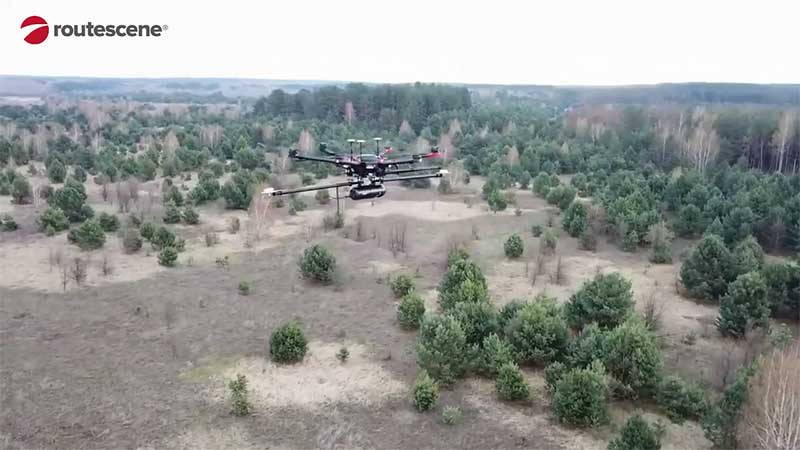
    Photo: Routescene
    Photo: Routescene

    Researchers from the U.K.’s National Centre for Nuclear Robotics (NCNR) are using Routescene’s UAV lidar technology to map radioactive hotspots in Chernobyl’s Red Forest.

    Professor Tom Scott, from the School of Physics at the University of Bristol, U.K., led a group of researchers from NCNR to conduct surveys on multiple sites of interest, including the Buriakivka village, a settlement abandoned following contamination from the power plant accident, and the “Red Forest,” a natural woodland area located the closest to the reactor.

    Working closely with local Ukrainian authorities, the team operated unmanned aerial vehicles (UAVs) — Routescene’s LidarPods flown on DJI M600 hexacopter drones — to perform a series of radiation mapping surveys over the course of 10 days.

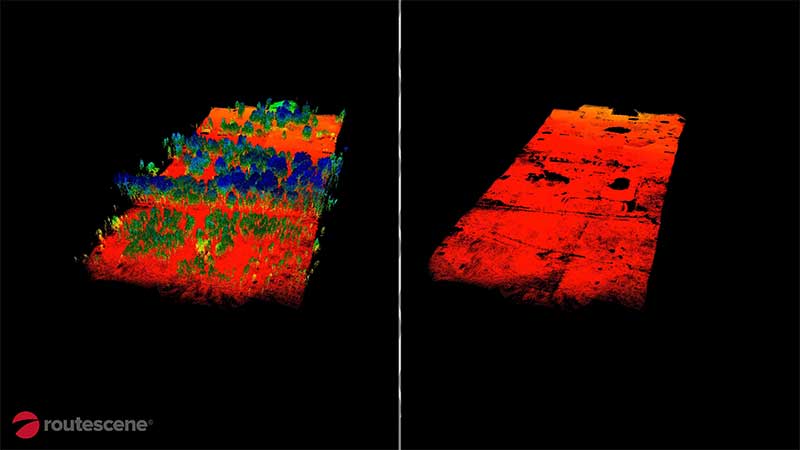
    According to Routescene, the point cloud data collected was processing using its LidarViewer Pro software to generate a detailed digital terrain model. It was then overlaid with the results from a gamma spectrometer survey, undertaken to measure radiation intensity, to locate the exact sites of the radiation hotspots.

    “The algorithm converts the aerial radiation intensity recorded by a UAV survey into a ground intensity map,” said Kieran Wood, senior research associate at the University of Bristol. “This process is heavily affected by the distance between the airborne radiation sensor and the ground/buildings. Hence, high accuracy lidar-based models were essential.”

    Photo: Routescene
    Photo: Routescene

    Results

    While the general widespread radiation contamination in the Red Forest was already known, the results revealed that the radioactivity was unevenly disturbed. Although radiation intensity had reduced in some areas, other areas remain highly contaminated confirming continued danger to anyone accessing those areas, Routescene reported.

    In addition, the researchers detected one unexpected hotspot in the ruins of a facility that was used to separate contaminated waste during clean-up efforts immediately after the accident.

    This expedition was the first in a series of surveys NCNR will conduct in Ukraine over the next year. The new maps will help officials prevent risks to visitors to the area and the full results will be published soon, Routescene said.

  • Xag creates fund for drones disinfection program to fight coronavirus

    Xag creates fund for drones disinfection program to fight coronavirus

    Photo: Xag
    Photo: Xag

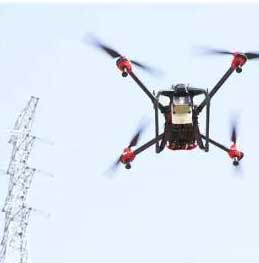
    Xag is setting up a 5-million-yuan fund on coronavirus response, calling for voluntary drone disinfection operations in China.

    According to Xag, the 5-million-yuan fund is committed to providing Xag’s agricultural drone users with technical support to properly carry out aerial disinfectant sprays that help curb the spread of virus, especially in rural villages with weaker health system and poorer sanitation condition.

    Operations will target densely populated outdoor public places and those communities having confirmed or suspected cases of coronavirus, the company added. Another focus of the initiative is to clean and disinfect medical and epidemic prevention vehicles moving between affected and unaffected areas.

    According to Xag, it will cover all the spare parts and maintenance expenses for those who voluntarily engage, and disinfection actions would be taken under the permission of Centre for Disease Control and Prevention and relevant government authorities.