Author: Alan Cameron

  • GNSS Manufacturing and Purchase Decisions Outlined in Thursday’s Webinar

    GNSS Manufacturing and Purchase Decisions Outlined in Thursday’s Webinar

    The two GLONASS stumbles in May prompted industry leaders to again promote multi-GNSS user equipment and the development of of reliable back-up/redundant positioning, navigation, and timing (PNT) systems to cope with potential drop-outs of space-based services due to jamming, unintentional interference, spoofing, or other disruptions. But neither multi-GNSS nor back-up/alternative PNT fully exists at this time, effectively for all users. When will reliable, robust, consistent, and continuous positioning become a reality?

    The two concepts of multi-GNSS, at both high-precision and mass-market levels, and alternative, non-space-based PNT, will come into widespread availability sometime over the next five to 15 years — that much can be assumed with a degree of confidence. But more precision as to when is completely lacking, and the uncertainty affects product design and life-cycles, and user decisions on equipment purchase.

    Should manufacturers and users rely on whatever technology we currently possess until the perfect system comes available, or should they continuously upgrade at each iterative step along the way?

    I will moderate an expert panel discussion this week, featuring informed viewpoints from GNSS high-precision and mass-market manufacturing, signal simulation, and alternative PNT providers. Visit env-gpsworld-integration.kinsta.cloud/webinars to register for this free, insightful presentation. The webinar takes place Thursday, June 5, at 10 a.m. Pacific time / 1 p.m. Eastern U.S. Time / 5 p.m. Greenwich Mean Time.

    Speakers

    Host/Moderator:

    Alan Cameron

    Alan Cameron, group publisher, GPS World and Geospatial Solutions

    Cameron was recently promoted to publisher of two North Coast Media brands. He was previously editor-in-chief and publisher of GPS World magazine, where he has worked since 2000. He also writes the monthly GNSS System Design & Test e-mail newsletter and the Wide Awake blog, both of which can be found on this site.

    s_aultSteve Ault, Product Manager, NavCom Technologies

    Steve Ault has 13 years of experience in the GNSS market, having previously worked for Magnavox and Leica in the 1990s before joining NavCom in late 2006. He has also worked on a wide variety of radio-based technologies dating back to the early 1980s, which include cellular phone infrastructure, VSAT systems, and military command and control communications systems. Steve holds a B.S. in Business Management and is a six-year veteran out of the U.S. Air Force. He is currently the product manager for NavCom Technologies and oversees all of NavCom’s marketing activities.

    jpottleJohn Pottle, Fellow, Institute of Engineering Technology and Royal Institute of Navigation

    John Pottle is marketing director at Spirent’s Positioning Technology division, based in the UK. Spirent leads the world in enabling its customers to build robust, resilient, positioning, navigation and critical infrastructure systems. Before joining Spirent, Mr. Pottle spent 12 years in satellite communications and broadcasting, first with BT International in London and later with Intelsat in the USA. Mr. Pottle holds a Bachelor of Science degree in Communication Engineering and an MBA. He is a Fellow of the Institution of Engineering Technology and a Fellow of the Royal Institute of Navigation.

    p_mattosPhilip Mattos is an R&D scientist for several GNSS companies.

    Philip Mattos was the chief architect of STMicroelectronics GPS/GNSS chipsets since a software receiver in the 1980s and dedicated silicon from the early ’90s, adding Galileo, GLONASS and BeiDou. He is now a consultant to chip manufacturers and agencies. He holds Masters degrees in electrical engineering from Cambridge and telecomms and computer science from the University of Essex, was awarded an external Ph.D. on his GPS work from Bristol University, where he is a Research Fellow, and is a visiting professor at University of Westminster. He has contributed to the design of the Galileo system for many years, and continues to advise on its future evolution.

    p_benshoofPaul Benshoof, Global Business Development Manager, Locata Corporation

    Paul Benshoof is currently the Global Business Development Manager of Locata Corporation, a company that has invented terrestrial positioning networks which function as local ground-based replicas of GPS, fully capable of providing accurate PNT in user-defined regions. He spent the last 22 years working in GPS with duties that include procuring military GPS receivers, developing assets to support navigation warfare advanced technology demonstrations, supervising international test programs for NATO and allied forces, coordinating guidance and navigation test & evaluation infrastructure improvement programs, and directing GPS Test Center of Expertise.

    Register for the webinar today.
  • Expanding Our System of Systems

    Putting GNSS into use within much larger aggregates of systems shows the greatest promise yet for earthly good. Goodness knows, we have experienced plenty of benefit from GPS applied over 25+ years, from back-up and fill-in provided by GLONASS, and with further synergy anticipated from Galileo and BeiDou.  But we ain’t seen nothing yet. Two presentations this month at the Geospatial World Forum in Geneva show that teamed with other, non-navigation satellite systems and the ensuing big data sets, GNSS leads the way into 21st-century illuminated knowledge and enlightened action. The European GNSS Agency supports many innovative prototypes to drive Galileo market penetration, and the International Centre for Earth Simulation envisions building a Virtual Earth to better understand the real world.

    Galileo and EGNOS Seek Market Penetration

    Carlo des Dorides, executive director of the European GNSS Agency (GSA), presented experience, results, and a broad call for proposals for future application developers in the “geoSMART + Infrastructure Development” plenary session of the Geospatial World Forum, held May 6–9 in Geneva, Switzerland. The GSA is tasked with market development for the European GNSS programs, EGNOS and Galileo, and its viewpoint is of necessity rosy on user uptake.

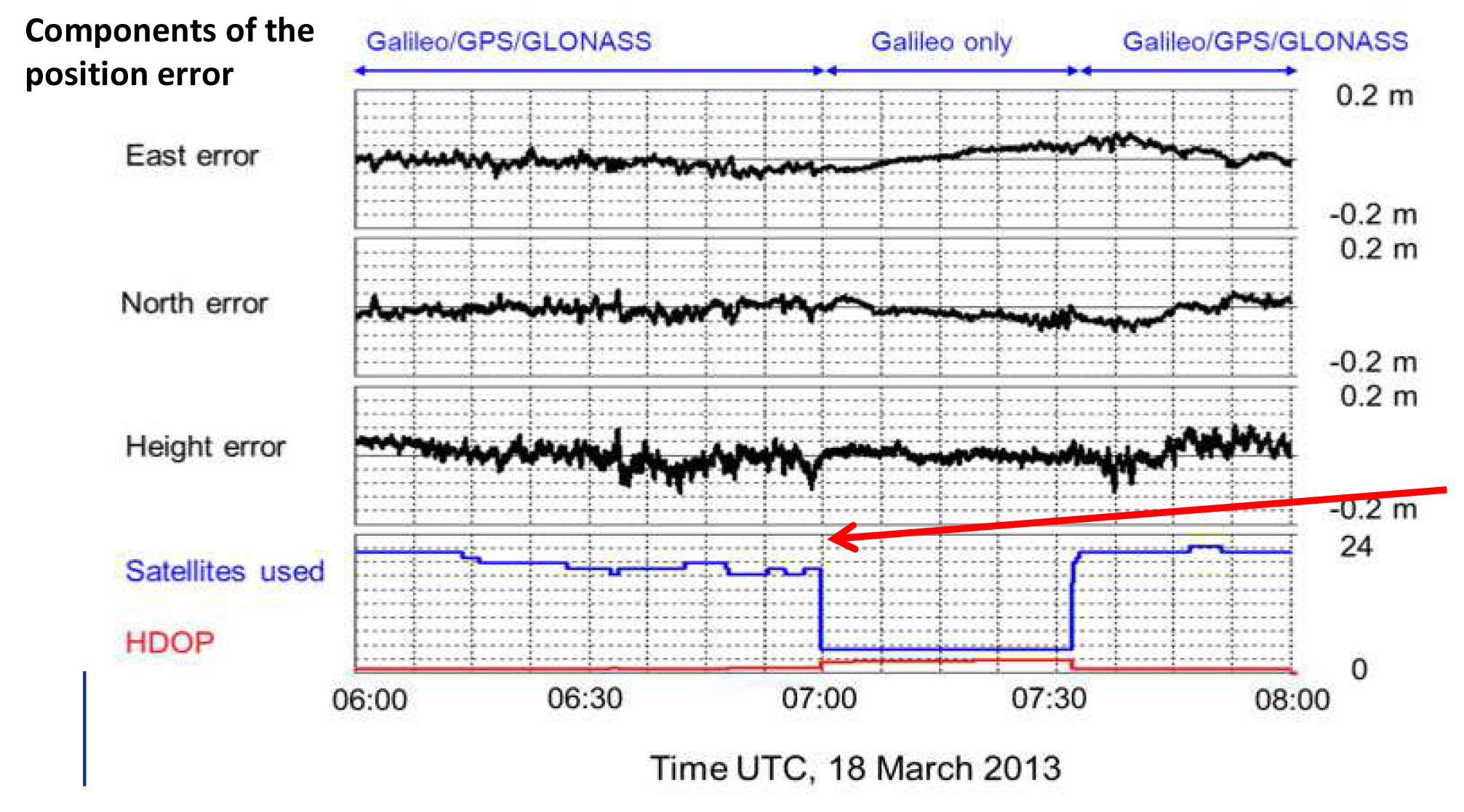
    In a side note before we look at these market-development efforts, des Dorides showed a figure that I had not seen before, one which claims that signal noise from the four orbiting Galileo satellites is noticeably less than that encountered on current GPS and GLONASS combined solutions. Another piece of the portrait we began at the magazine with post-processing PPP using two Galileo GIOVE and two IOV satellites as reported here, and then using four IOV satellites to do differential carrier-phase positioning as reported here.

    Geospatial-world-forum-10
    chart: Galileo GIOVE

    The GSA has funded many small-to-medium enterprise projects, and some of these may actually take off, that is, achieve sustainability through consumer or industry payment. The double edge of stimulus spending such as this is that products may or may not be created, and corresponding business models may or may not be built, with a truly hardened eye towards cash flow. Such a product or service’s only sustainable mode may turn out to be, after all, through government funding. Nevertheless, these are valiant efforts.

    To be fair, the primary goal of these projects is to get Galileo and EGNOS into more widespread use, thus encouraging manufacturers of receivers, smartphones, tablets and so on to include Euro GNSS capability in their products. Establishing self-sustaining downstream enterprises is secondary.

    Emerging from three successive stages of the current framework program for R&D spending, des Dorides cited “10 Patents or registered trademarks,

    33 commercialized products/services, 69 working prototypes, an overall portfolio of roughly 90 R&D projects with a budget of around €70 million.”

    “And more is expected!” he added.

    Among the GSA projects he singled out for further description:

    • SAFEPORT: Safe Port Operations using EGNOS safety-of-life services for vessel traffic management, with a successful prototype demonstration in Dublin port. SAFEPORT has been in the market since January 2013. As commercial-targeted service, or perhaps a government agency (such as a port authority)-targeted one, this may have a return-on-investment prospect.
    • WalkEGNOS, a social web 2.0 mapping solution with a web site following the social network approach, enabling hikers and bikers to share theirs tracks. This produces “new opportunities for high-quality leisure/ touristic services, and value for search and rescue operations.” I am dubious, myself, as to whether hikers or commercial tour services would pay for such services, but it’s certainly worth the effort (and the government money) exploring the possibility through application development. The service is now available; you must register to use (free of charge).
    • GOLDEN-ICE, applying EGNOS GPS corrections to enhance accuracy for precise salt-spreading for road safety. On the market.
    • INCLUSION, a location-based service offering motor-impaired persons, such as those confined to a wheelchair, improved mobility in safe conditions, helping them navigate traffic safety problems and limited accessibility of public transport. On the market.

    Other applications available for use include ASPHALT for high-precision paving, SCUTUM for transportation of dangerous goods, and COSUDEC for surveying of coastal waters. Further programs and results are here.

    The Whole Earth

    In easily the most mind-blowing presentation of the conference, founder and president Bob Bishop of the International Centre for Earth Simulation spun a vision of Big Data Earth Science, using the world’s largest computing resources (talk of exoflops and exobytes and “the human mind cannot comprehend these large volumes of data” supplied by many orbiting imagery satellites and other sensor inputs) to model the Whole Earth: surface, subsurface, ocean, atmosphere, and social economics.

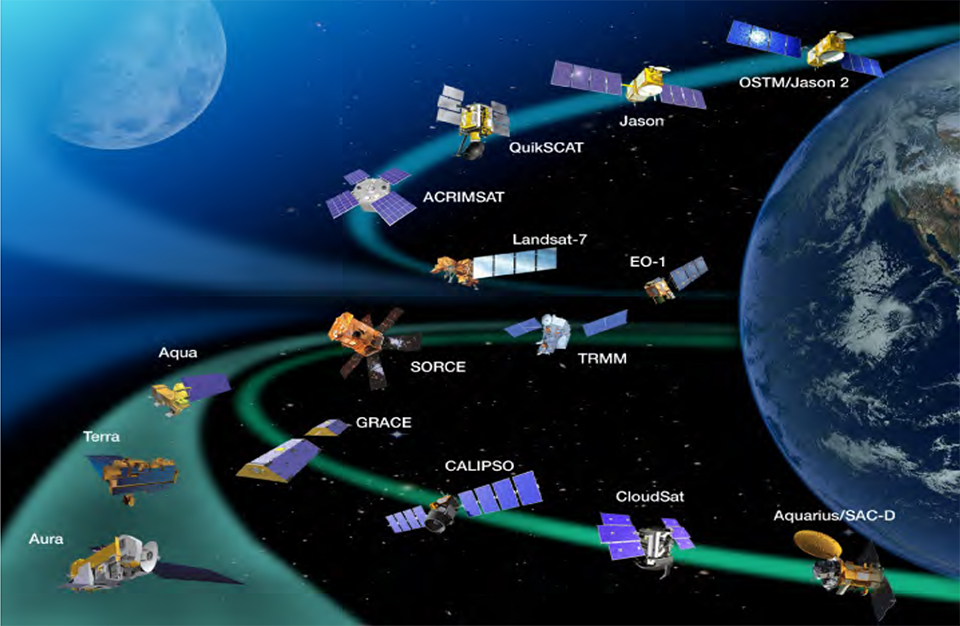
    Earth observing satellites are generating big data sets.
    Earth observing satellites are generating big data sets.

    The Centre’s mission is “Helping guide the successful transformation of human society in an era of rapid climate change and frequent natural disasters.”

    In its prospectus, Bishop writes “The key to solving problems in weather, climate and environmental science is high performance computing. Nature can only be accurately described and computed from equations that take account of complex, non-linear interactions between multiple natural systems, i.e. rivers, lakes, oceans, mountains, forests, dust, pollution, cloud cover, snow cover, ice, polar regions, etc. Such equations of motion are so interconnected and intertwined that they can only be managed when all aspects are held in big memory and computed simultaneously. Only then can we begin to address the systemic risks associated with natural disasters and planetary change.”

    The ICES Foundation supports Open Science, which incorporates a combination of open data files, open source code, and open access publications. Much of the data supplied by the following organizations, upon whose resources ICES draws, is either directly produced by or referenced to GPS/GNSS data:

    Global Observing Systems Information Center and the U.S. National Oceanic and Atmospheric; the European Space Agency and Centre for Space Records; the U.S. Geological Survey; the U.S. National Aeronautics and Space Administration; the European Union’s Joint Research Centerthe U.S. National Center for Atmospheric Research; the U.S. Naval Research Laboratory; the European Commission’s Infrastructure for Spatial Information in the European Community (INSPIRE); and many more.

    Slides from Bishop’s Geneva presentation are available here. These however of necessity lack some of the video and Flash Player simulations that he showed at the conference, revealing truly a dynamic planet in all aspects.

    Bishop warned of both sequential and synchronous collapse of natural systems, leading to cascading crises. His language and message bear some resemblance to Al Gore’s An Inconvenient Truth, but Bishop, whose previous 40-year professional career had him responsible for building and operating the international aspects of Silicon Graphics Inc., Apollo Computer Inc., and Digital Equipment Corporation, has assembled some actual practical tools to apply to the many problems.

    The immediate goal is modeling, simulation, visualization, and ultimately understanding of the whole, leading to new forms of civic engagement and insights as to risk, safety, food, water, and energy.


  • Presenting Now — the Whole Earth!

    Earth observing satellites are generating big data sets.
    Earth observing satellites are generating big data sets — Really Big!

    I’m stepping in just for this month as a self-invited guest columnist, giving a brief look at the trailblazing work of the International Centre for Earth Simulation.

    Look for both Eric Gakstatter and me at the ESRI User Conference in July, where Eric will also host a webinar on the hottest trends in mapping.  We hope to accommodate a live audience at the webinar. If you’re not attending ESRI, attend the webinar anyway! For a top-level look at conference doings, register free.

    In easily the most mind-blowing presentation of the Geospatial World Forum held recently in Geneva, Bob Bishop of the International Centre for Earth Simulation spun a vision of Big Data Earth Science, using the world’s largest computing resources (talk of exoflops and exobytes and “the human mind cannot comprehend these large volumes of data” supplied by many orbiting imagery satellites and other sensor inputs) to model the Whole Earth: surface, subsurface, ocean, atmosphere, and social economics.

    The Centre’s mission is “Helping guide the successful transformation of human society in an era of rapid climate change and frequent natural disasters.”

    In its prospectus, Bishop writes “The key to solving problems in weather, climate and environmental science is high-performance computing. Nature can only be accurately described and computed from equations that take account of complex, non-linear interactions between multiple natural systems, i.e. rivers, lakes, oceans, mountains, forests, dust, pollution, cloud cover, snow cover, ice, polar regions, etc. Such equations of motion are so interconnected and intertwined that they can only be managed when all aspects are held in big memory and computed simultaneously. Only then can we begin to address the systemic risks associated with natural disasters and planetary change.”

    The ICES Foundation supports Open Science, which incorporates a combination of open data files, open source code, and open access publications. Much of the data supplied by the following organizations, upon whose resources ICES draws, is either directly produced by or referenced to GPS/GNSS data: Global Observing Systems Information Center and the U.S. National Oceanic and Atmospheric Adminisration; the European Space Agency and Centre for Space Records; the U.S. Geological Survey; the U.S. National Aeronautics and Space Administration; the European Union’s Joint Research Center; the U.S. National Center for Atmospheric Research; the U.S. Naval Research Laboratory; the European Commission’s Infrastructure for Spatial Information in the European Community (INSPIRE); and many more.

    Slides from Bishop’s Geneva presentation are available here. These, however, of necessity lack some of the video and Flash Player simulations that he showed at the conference, revealing truly a dynamic planet in all aspects.

    Bishop warned of both sequential and synchronous collapse of natural systems, leading to cascading crises. His language and message bear some resemblance to Al Gore’s An Inconvenient Truth, but Bishop, whose previous 40-year professional career had him responsible for building and operating the international aspects of Silicon Graphics Inc., Apollo Computer Inc., and Digital Equipment Corporation, has assembled some actual practical tools to apply to the many problems.

    The immediate goal is modeling, simulation, visualization, and ultimately understanding of the whole, leading to new forms of civic engagement and insights as to risk, safety, food, water, and energy.

  • GPS/GLONASS Dispute: CEO Clarifies Misunderstandings

    GPS/GLONASS Dispute: CEO Clarifies Misunderstandings

    Javad Ashjaee
    Javad Ashjaee

    “Use any opportunity to create friendship and peace,” urged Javad Ashjaee, president and CEO of JAVAD GNSS, in a May 23 conversation with journalists. He decried the recent controversy about monitoring stations on both U.S. and Russian soil, saying it was based in misinformation and misinterpretations, inflated by a political crisis in a completely different area. “This [GNSS] is a good thing, that for 25 years kept us together. And if you see, there are lots of high-level meetings between U.S. and Russian officials, they are all very friendly meetings.”

    A transcription of his remarks appears here, below the following main points and clarifications that he wished to make:

    • Earlier this year, Russia sought GLONASS monitoring stations in the United States, not for uploading any data, but for monitoring GLONASS satellites to provide more accurate orbit and clock information, for the free and open benefit of all users.

    • The Russian general who threatened to close down monitoring stations on Russian soil that contribute data to the International GNSS Service was immediately and roundly criticized by Russian scientists and surveyors.  The general subsequently retracted his remarks.

    • The 11-hour GLONASS outage on April 1 was not due to a wait for all satellites to pass over ground control stations on Russian soil to receive a fresh upload of data.  GLONASS has the capability (as does GPS) to make such updates via inter-satellite communication. The delay was caused by the time it took to find the bug in the erroneous software that had been uploaded, and to correct it.

    • Ashjaee also noted that “No military activity requires millimeter accuracy. It is only scientific applications for humanitarian tasks that require millimeter accuracy.  Needing more monitoring stations, such as the IGS stations, is only for that purpose.”

    The Background

    Javad Ashjaee, founder and CEO of JAVAD GNSS, contacted GPS World on May 20 with a message: “I had a discussion today with the head of the GLONASS program in RosKosmos regarding the tracking sites that they wanted to establish in the United States, and the subsequent events. What has been published in most U.S. media is far from the truth. It is time that we contribute to defusing problems rather than putting more fuel on the fire. The world has enough problems already.”

    The Full Statement

    This is the story of GPS/GLONASS. It also gives some insight as to how things get out of control, and much, much bigger issues like war and things like Ukraine  get created. It is just a tiny, simple example.

    When I first heard the issue of GLONASS about 25 years ago and was invited by RosKosmos to Moscow, I didn’t think of Communism or anything political, I thought “30 satellites free, that they’re willing to give to the world, free of charge.” That’s how I got excited. Recently, GPS World published a wonderful history of the growing development of GLONASS and GPS.

    What bothers me now is some negative reactions that I see towards GLONASS. It seems that when they see something negative about GLONASS, they enjoy it. In the reports, read between the lines. When there is a problem with GLONASS, you sense some sort of happiness. There is something of “them versus us.”

    There was the question, “Why do they need things in our country? Don’t they have them in their country?”

    When people don’t know each other, they fear and they create fear.

    One thing we should look at: GLONASS is good for all of us. As President Reagan offered GPS free of charge to the world, and everybody applauded him — the Russians have done the same thing. In Oklahoma, California, everywhere, farmers and surveyors are using GLONASS free of charge, the same as GPS.  And GLONASS has been better, and I emphasize, it has been better because they didn’t encrypt their code so that we had to go behind and decipher and decrypt and all the trouble that we went to during the past 20 years, because GPS didn’t think that we need carrier phase.

    GLONASS is good for America, for the world, as is GPS. If there is a problem with GLONASS, we must be unhappy, as we are unhappy when there is a problem with GPS. And if we can help GLONASS, we must help GLONASS. There is nothing to fear about war, nobody needs [millimeter-level] accuracy of GPS or GLONASS if there is a war between super-powers.

    We should all want GLONASS to give precise information. We care about centimeter-level accuracy, the military doesn’t. Five-meter accuracy is good enough for them. To improve the precise-orbit information of GLONASS is the concern of surveyors and those that need precision GPS.

    Now, what’s the issue? GLONASS needs 50 reference stations all around the world to monitor the orbits of its satellites, to make the precise-orbit information [furnished to users] better. Not to upload information to the satellites. For this, one station is enough, for both GPS and GLONASS, because both have inter-satellite connections that can do this.

    There was speculation in early April that it took GLONASS 11 hours to correct a software bug because it took that long for all the satellites to pass over a control station on Russian soil. This was not the case, I have learned from conversations with their engineers and with the head person responsible for all of this. One engineer made a mistake and uploaded the wrong software. Until they could find it and debug it — and it took them 11 hours to do so — they could not upload correct software to the satellites.

    What they are asking for from the United States is not an upload station. They need as many [globally-distributed] monitoring stations as possible; 50 is good.

    The International GNSS Service (IGS) has 300. To have a good orbit determination for scientific work, to get to the depth of centimeter- or millimeter-level accuracy, the objectives of IGS reports is to have 200 or 300 monitoring stations.  For military work, three or four is enough.

    Russia already has more than 50 monitoring stations. They use IGS stations. They didn’t need to ask for anything. Even [data from] the units we have in our San Jose office is available to everybody.

    So I asked the GLONASS people, “Why did you ask? You have [access to more than] 200 monitoring stations!”

    This was the issue: it was only political. When RosKosmos made internal presentations in Russia to their [government and military] decision-makers, they were asked, “OK, these stations are controlled by who?” By the IGS, they answered. They were told “You must have stations under Russian control.”

    I explained to them that IGS stations, for them, are more convenient and more secure. If President Obama told the IGS, told Stanford University and 200 other universities, to turn off their IGS stations, there would be a lot of disagreement!  President Obama could turn off Russian stations on U.S. soil.  I told them, IGS stations are more convenient and more secure for you than your own stations, and they understood.  They are not pushing for it, they said those officials on the top, they know nothing. They were asking that we must have five stations under our control.

    If you understand this: that the issue was [Russian internal] political, that they don’t need anything.  They already get the precise orbit data from IGS stations.

    Now, the second part or episode of this problem: when a Russian general heard that the United States said “No” to the request for Russian-controlled monitoring stations on U.S. soil, he said “Oh, now they don’t let us do this? We will turn off their stations in Russia.” All surveyors and all scientists in Russia jumped at that general, and he retracted what he had said.

    But people who didn’t understand this [that IGS-participating stations in Russia have nothing to do with controlling GPS satellites or supplying GPS data to users], they put their own statements in the press, they added fuel to the fire.

    The Q&A

    When asked how surveyors in Oklahoma could help GLONASS, as he had urged, Ashjaee replied “They can write to their senators and ask, why didn’t you let monitoring stations be in the heart of Oklahoma too?”

    Afterthought

    Once the first version of this online story was posted, Javad Ashjaee sent in this further comment:

    “Part of my admiration for the GLONASS team is that they managed to pull this project off amidst their worst economical, social, and political times. Compare their situation with GPS that had a huge budget (and still ran way over budget) and with Galileo that took several rich countries to put the budgets and technology together. GLONASS also offered this free and unrestricted service to the world without making any political gestures. No encryption of codes and no selective availability either.

    “There is an abundance of opportunities to create hostility, and there are enough people to promote it. Situations like this are rare that we can grasp the opportunity to promote friendship.”


  • Out in Front: How Much Farther?

    For some years now, we have been talking about GNSS interoperability. The concept has received so much careful attention at conferences, in R&D laboratories, in international working group forums, and behind closed high-level government and military doors, that one might understandably conclude that we have talked interoperability into existence.

    Not quite. Not nearly. Not by the farthest, if measuring into the next decade constitutes far, reach of our actual, real-world grasp.

    “If you can imagine it, you can achieve it.” William Arthur Ward, a professional inspirer of the 20th century, said that.

    For nearly as many years now, we have been talking about GPS and GNSS backup. Similarly, the concept has undergone careful examination and much repeated (’til blue in the face) urging and warning and alarum-
    sounding and planning and conjecturing and running through the halls of Congress. One might understandably conclude that we have conjured backup for critical infrastructure into actual, tangible, effective existence.

    Again, not quite.

    “Everybody talks about GPS backup, but nobody does anything about it.” Mark Twain said that.

    April’s GLONASS downfall prompted distinguished industry leaders to again take up cudgels for multi-GNSS and for redundant PNT. They deserve and require our support, on all fronts, whether in the public arena, the lab, or the marketplace. But neither concept yet exists, truly and pervasively, that is to say effectively for all users.

    When will reliable, robust, consistent and continuous positioning, navigation, and timing become a reality?  Should we rely on whatever technology we currently possess until the perfect system comes available, or should we continuously upgrade at each iterative step along the way?

    We take up this topic in our June 5 webinar, “How Much Farther to the Promised Land? Purchase Decisions in the Evolving Landscape of GPS, Multi-GNSS, and Alternative PNT.”

    Four speakers will present:

    • a high-precision GNSS manufacturer,
    • a mass-market GNSS manufacturer,
    • an alternative PNT provider,
    • a design and manufacturing firm,

    followed by questions from you, our audience. Come for a glimpse into the future, and estimations of its distance and time of travel from current location.

    Among the key insights: technology changes too fast to wait until the next generation of a product to add new capabilities, when doing so risks loss of competitive edge or, worse, risks introducing a new product already obsolete. A mid-lifecycle component change can deliver both greater performance and cost savings. For details on this prior to June 5, visit the White Paper section of our website.

  • GNSS Backup Delivers 5-Meter Accuracy

    The North Sea fairly boils with GNSS activity recently. Trials of the eLoran back-up for GNSS, Galileo maritime trials, Brad Parkinson’s Protect, Toughen, and Augment sermon at the European Navigation Conference in Rotterdam, and also at that conference, the dramatic release of news concerning an even newer Loran system, enhanced differential Loran, that not only backs up GNSS in the event of disruption or jamming, but delivers 5-meter accuracy in the process. Imagine that — the back-up matching the first team in performance!

    Durk van Willigen, René Kellenbach, and Cees Dekker of the Dutch consulting firm Reelektronika, and Wim van Buuren of the Dutch Pilots’ Corporation authored the ENC presentation about enhanced differential Loran, with results that greatly — and pleasantly — surprised many in the audience. A full technical article by these authors, describing the equipment, methodology, and test results of eDLoran, will appear in the July issue of GPS World. This column delivers a brief summary of the highlights.

    The new Loran project arose from the need of harbor pilots responsible for bringing large and super-large freight ships into dock. These pilots require GNSS-level accuracies of 5 meters for such work, and all parties concerned — pilots, captains, ship owners, harbor management — need some form of robustness, that is, back-up for the GNSS systems in case of jamming, unintentional interference, system failure, or other disruption.

    As extensive research had established that 5-meter accuracy cannot be met by the currently tested DLoran system, which cannot get better than 10-meter accuracy. Reelektronika developed a new differential Loran system called enhanced differential Loran, or eDLoran. A full prototype eDLoran system was built and extensively tested in the Europort (Rotterdam) area. The tests achieved accuracies of 5 meters.

    For maritime applications, eLoran is considered as the most promising backup for GNSS in case the use of satellite-based navigation signals is denied. The Dutch Pilots’ Corporation askedReelektronika to investigate whether differential Loran could meet the pilots’ 5-meter accuracy requirement for a harbor navigation. This proved to be an enormous challenge as preliminary tests showed that even 10 meters was difficult to achieve with differential Loran (DLoran) as promoted by the UK’s Trinity House/General Lighthouse Authority (see item below about Harwich UK tests by GLA and ACCESS). The challenge had led to a thorough investigation of all possible error sources of a complete differential Loran system.

    Differential techniques developed and implemented for Loran are comparable with differential GPS. Although the error sources of GPS and Loran are quite different, the major common error source in both systems is the lack of accurate propagation models.

    This led to a new research project to find a more accurate differential Loran technique. All possible error sources have been investigated again where possible, which resulted in some unexpected results regarding accuracies and costs.

    Enhanced Differential Loran: eDLoran

    The new concept of differential Loran had to fulfill two important primary improvements. The first is a significant reduction in the latency of the data in the data channel; the second is that a large number of reference stations should be capable of receiving the data channel, without saturating the data channel. The simple conclusion was that Eurofix could not meet these two improvements. However, Eurofix is still the prime GNSS backup candidate for distributing accurate UTC over very large parts of Europe. Further, Eurofix has the capability to send short messages that might be encrypted for secure communication purposes which might then form a terrestrial backup, for example, Galileo PRS.

    Instead of using the Eurofix channel, eDLoran uses the public mobile GSM (Global System for Mobile) network to send the differential corrections to users. eDLoran receivers therefore contain a simple modem for connection to the GSM network. The eDLoran reference stations are also connected to the Internet which may be implemented via a cabled access or also via a GSM modem.Fortunately, today many GSM networks are robust in respect of GPS outages.

    The eDLoran infrastructure is not connected with any eLoran transmitter station and operates completely autonomously. An eDLoran reference station is connected to a central eDLoran server by its connection to the network.

    eDLoran Results

    Both static and dynamic tests have been carried out. Here, only the final result of the dynamic test is presented. For full details on both sets of tests, see the upcoming full-length technical article in the July issue of GPS World magazine.

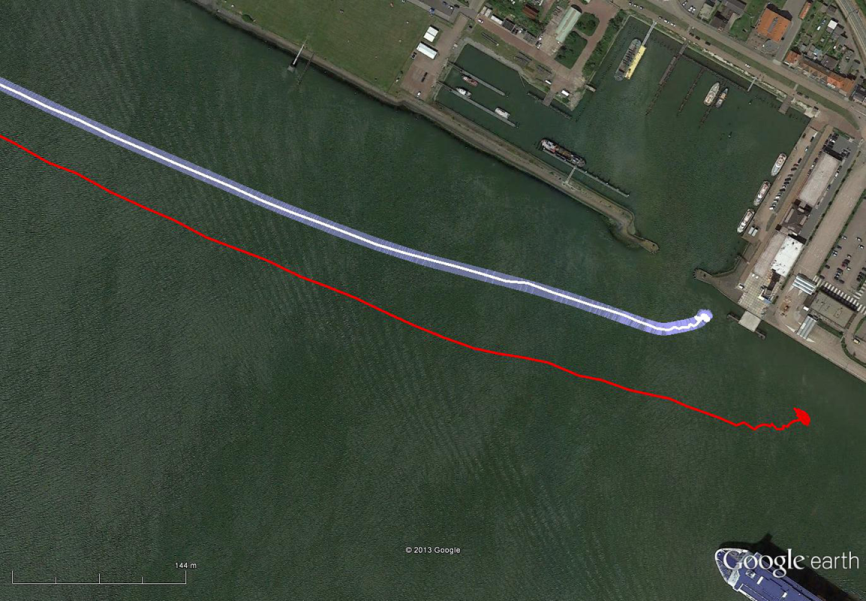
    The results have been demonstrated to the harbor authorities in real-time on the laptop of the pilots on which the GPS-RTK and the eDLoran position were simultaneously shown. The logged GPS-RTK data is plotted on a Google Earth map shown in the accompanying figure. The track was widened to 10 metres as the accuracy requirements are 5 metres on either side of the track. The raw eLoran track is also shown, as well as the final white eDLoran track.

    The red track is based on raw eLoran data without any corrections. The transparent blue line is made by GPS-RTK and is widened to 10 metres giving the required ± 5 metre limits of eDLoran. The white line is output from the eDLoran receiver which stays within the borders of the 10-meter-wide transparent blue line.
    The red track is based on raw eLoran data without any corrections. The transparent blue line is made by GPS-RTK and is widened to 10 metres giving the required ± 5 metre limits of eDLoran. The white line is output from the eDLoran receiver which stays within the borders of the 10-meter-wide transparent blue line.

    Conclusions

    The outcome of the research opens some new and quite surprising possibilities for multiple applications. Only a few of the authors’ conclusions appear here:

    1. eDLoran offers the best possible eLoran accuracy as it does not suffer from swaying wire antennas, sub-optimal timing control of the transmitter station and differential data latency.
    2. There is no need to replace older Loran-C stations with eLoran transmitters saving large amounts of money. The existing Loran stations have a proven reliability track record. Further savings may be obtained by containerising the transmitter and operating the stations unmanned.
    3. Installing eDLoran reference stations is fast, simple and very cost effective.
    4. As there is no data channel bandwidth limitation, multiple reference stations can be installed which offers increased reliability and makes the system more robust against terrorism and lightning damage.
    5. A single or multiple eDLoran servers can be installed in a protected area. There is hardly a practical limit in the number of differential reference stations to serve.

    To round out our North Sea reporting, here is other recent news:

    Enhanced Loran

    In March, the UK General Lighthouse Authority (GLA) and Accessibility for Shipping, Efficiency Advantages and Sustainability (ACCSEA) announced that on several excursions aboard the THV Galatea out of Harwich, UK, they successfully demonstrated a prototype resilient positioning, navigation and timing (PNT) system using enhanced Loran (eLoran) technology to automatically and seamlessly step in to transmit mission-critical data in the event of GPS loss or failure. (Note that in the preceding Reelektronika section of this column, the GLA enhanced Loran is referred to as differential Loran, while the Dutch system is called enhanced differential Loran.)

    Building on two previous trials conducted by the GLA in 2008 and 2010 which investigated the impact of GPS service denial, this latest demonstration is the first time that an automatic and seamless solution has been demonstrated in a real-world scenario. The prototype system was integrated into the bridge of the vessel and monitored the performance of independent PNT sources in order to provide the ‘best’ available. As such, when GPS was deliberately jammed, the system switched automatically to eLoran and provided eLoran-derived PNT information to the connected bridge systems, allowing them to maintain operation and enabling the mariner to continue to navigate safely and efficiently.

    ACCSEAS is taking advantage of the availability of the prototype eLoran transmitter at Anthorn and eight other Loran stations around the North Sea Region, but few vessels currently have receivers. Most recently, in January 2013, a differential Loran station was installed at Dover, UK, one of the busiest shipping lanes in the world, enabling mariners to obtain port approach level accuracies using eLoran within this area; and a receiver was fitted on a P&O Ferries vessel. The successful demonstration of the prototype resilient PNT system is a significant step towards gaining traction for the technology in the shipping industry worldwide.

    By 2014, eLoran Initial Operational Capability is expected in seven major ports along the East Coast of the UK, with full operational capability covering all major ports expected by 2019.

    Galileo Maritime Trials

    Results are being processed from the first Galileo maritime trials outside of mainland Europe. The long-range, high-latitude testing spanned the North Sea aboard Belgian frigate Leopold I-F930, carrying multiple Galileo receivers for both Galileo’s public Open Service (OS) and secure Public Regulated Service (PRS).

    Protect, Toughen, Augment GNSS

    “What can we do to reduce the vulnerability [of GPS] and ensure that the expectations of the public are going to be met?” asked Dr. Bradford Parkinson as he opened his keynote presentation at the European Navigation Conference, ENC-GNSS 2014 in Rotterdam, The Netherlands.

    Parkinson went through his 61-slide, 50-minute briefing on what he called “PTA” — Protect, Toughen, and Augment — a proposal concerning not only GPS but PNT systems globally. An article by Parkinson based on this talk will highlight the special 25th Anniversary edition of GPS World, to appear in conjunction with this year’s July issue. A brief outline appears here.

  • GLONASS Failure Inconsequential to Users, Says Russian Press

    Reports in the semi-official Russian news daily Izvestia indicate that finger-pointing has gotten underway regarding the April 1 GLONASS systemic blackout, which followed two other high-profile disasters, the destruction-upon-launch of three new GLONASS satellites in July 2013, and the Pacific drowning of three other satellites in December 2010.

    While we have neither full nor fluent translations from the Russian, we have done the best we can, aided and abetted by Google, with the following passages.

    “Temporary GLONASS failure has not led to tangible consequences for consumers of services for the reason that chip manufacturing exclusively GLONASS, the mass market is practically no: there are chips that work only with the signal GPS, and there are those that see both systems GPS and GLONASS.”

    Clarification: there are practically no mass-market devices, even in Russia, that use exclusively GLONASS.

    “In any case, the failure of the entire system for a long period a serious blow to the image of GLONASS, especially in a situation where Russia has made efforts to promote domestic navigation system to external markets. Plus in 2012, the Russian government officially promised to maintain the characteristics of the international community GLONASS at the proper level for 15 years.

    “The following statement was distributed at the XII International Forum ICAO Air Navigation in Montreal by the Head of the non-governmental organization ‘Promoting the development and use of navigation technologies.’ Alexander Gurko believes that now GLONASS is not controlled properly, causing increased risks of such failures.

    “There should be a system operator who is responsible for the quality of its operation, development and use, Gurko said. GLONASS still not officially put into operation, although it was promised two years ago and settled in many protocols, the Interagency Working Group. But it is still unclear who is responsible for the general quality of service.

    “GLONASS system is not commissioned by the Ministry of Defence and officially still under development.

    “Where to users with questions and explanations about the operation or development of the system? Asks questions Gourko. The Defense Ministry, Roscosmos? How are civil user requirements and market trends in the formation positioning system development plans?”

    Izvestia further notes that in March of this year, the Russian government cut the GLONASS budget by 16 billion rubles ($450 million). “Signal quality and composition of the orbital constellation sequestration will not affect, say Roscosmos. It is important to reduce not touched the ground part, experts say.”

  • GLONASS Blackout Coincides with Loran Authorization-in-Progress

    Russia’s April 1 GLONASS blackout occurred, ironically, only hours after the U.S. House of Representatives passed legislation to preserve infrastructure that could support a back-up system for GPS that could be used for critical infrastructure and applications in the event of a similar disaster occurring in the United States.

    The 2014 Coast Guard Authorization Act requires the Department of Homeland Security (DHS) to halt dismantling and disposal of infrastructure that could be used for a terrestrial system during times and in places where GPS is not available.

    DHS had announced in 2008 that it would build such a back-up system, but it never did so, and actually began dismantling, destroying, and divesting itself of Loran equipment and properties. The equipment, facilities, and sites could be used to implement a new-generation eLoran system for GPS back-up, among other applications. Despite strong recommendations to the contrary by its own panel of experts, the Obama administration, DHS, and the Coast Guard moved in 2009 to kill the Loran program.

    Ever watchful, Congress has lately become more visibly concerned about the vulnerability of the nation’s space systems. The 2014 National Defense Authorization Act tasked the administration with reporting on how it was going to provide necessary national security capabilities when space systems were disrupted. More recently, Congressmen Duncan Hunter (Republican, California), chair of the House Coast Guard and Marine Transportation Subcommittee, held a hearing at which he expressed his concern that the nation has no back-up for GPS. He also expressed his frustration with the Department of Homeland Security, reporting that “They said they need to do a study about their study.”

    Congressman John Garamendi (Democrat, California), commented “GPS will go down one day. The question is, is there a backup?”

    The legislation passed by the House authorizes DHS to partner with public or private entities to build a system that would not only backup GPS, but also work indoors, underground and underwater — all characteristics of long-wave Loran technology.

    Dana Goward, president of the Resilient Navigation and Timing Foundation, said such a project would be relatively inexpensive. “If the existing equipment and infrastructure are preserved and reused, the system could be restored and put into operation for less than half the cost to dispose of it.”

    “It isn’t an issue of money,” Goward continued. “It is a question of the government taking this problem seriously and acting on it.”

    The foundation has as offered to partner with the government to build the system.

    “Our government has known about this issue for a long time,” Goward said. “At least since 2001. And there has been a standing presidential direction to obtain back-up capability since 2004. But for some reason, it hasn’t yet happened.”

    The U.S. government’s official information website about GPS has recently updated its page on eLoran and Loran-C with a tracking log for Coast Guard and Maritime Transportation Act of 2014, which now goes to the Senate.

  • Altus Positioning Systems Pinpoints Cause for GLONASS Default

    Regarding the April 1–2 11-hour downtime for the full GLONASS constellation, president and CEO Neil Vancans of Altus Positioning Systems provides this additional information:

    “From the reports on GLONASS problems, we have an explanation that may be used in our technical support replies:

    “Our analysis reveals the GLONASS integration algorithms skipped an interval of around 1.5 minutes at the control centre software.

    “At 21:00 UTC April 1, all GLONASS satellites received an orbit state (ephemeris) which was clearly several minutes ahead of the current orbit shape without actually changing the applicable reference time stamp. In other words, future orbit-position, velocity and accelerations were assigned to a current reference timestamp.

    “This led to incorrect orbit positions for all GLONASS satellites and subsequent problems with receiver using GLONASS measurements.

    “In our receivers, RAIM rejected the solutions because of the large GLONASS errors, and could only work with GPS only and the recently revised RAIM settings for a Base (SRL,ON,-6,-4,-4).

    “The issue is now rectified, and the GLONASS constellation is back to normal.”

  • How to Survive a Total Constellation Outage

    How to Survive a Total Constellation Outage

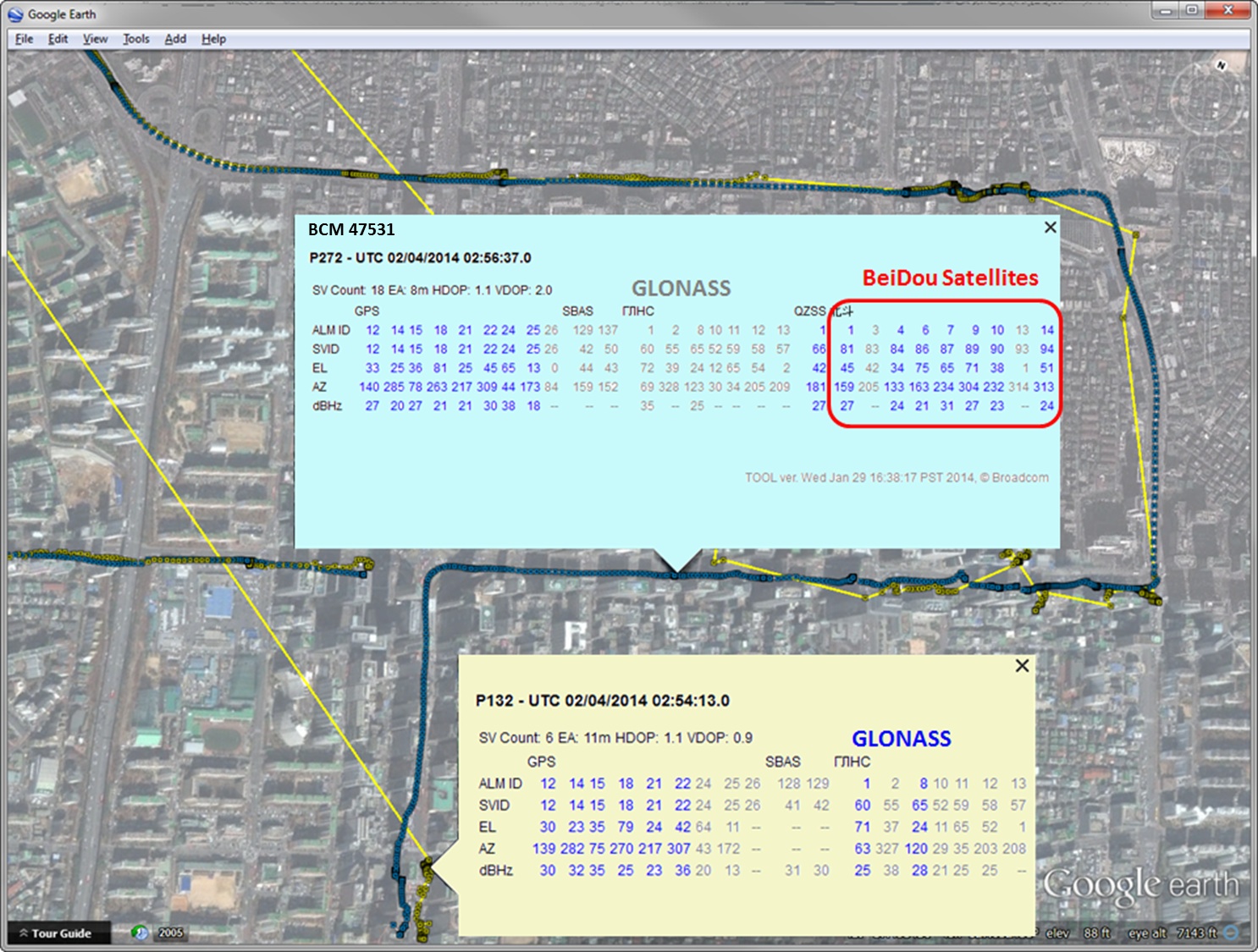
    Yesterday we posted news of an 11-hour downtime for the full GLONASS constellation, due to an upload of bad ephemerides. Coincidentally, during that 11-hour period, the mass-market chip company Broadcom was conducting multi-constellation receiver tests in Asia. Frank van Diggelen, Broadcom’s chief GNSS scientist and vice president says, “We have definitive data to show how a multi-constellation receiver survives such an outage.”

    Here are the pictures, and the story they tell.

    Test data coincident with the GLONASS ephemeris disruption of April 1 and 2 showing conclusively how a GPS/GLONASS/QZSS/BEIDOU receiver survives the complete disruption of one of the constellations.

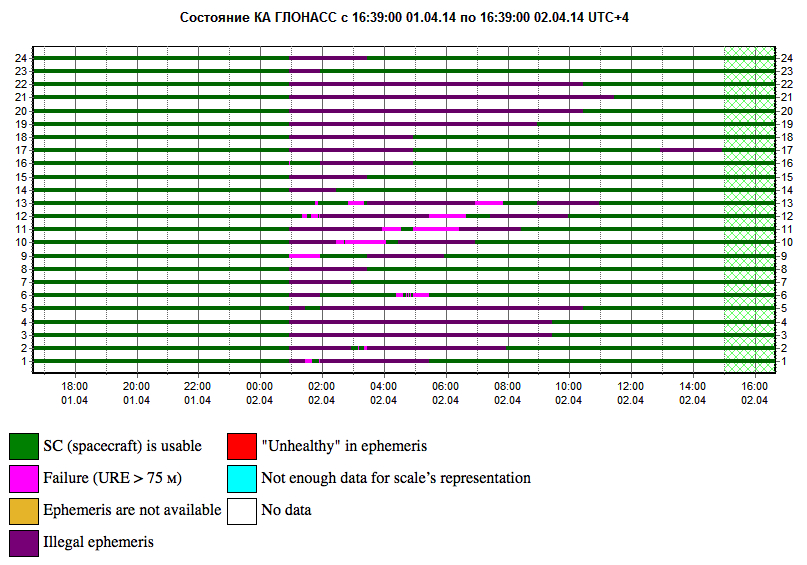
    On April 2 at 1:00 a.m. Moscow time, bad ephemeris was uploaded to all satellites (see chart at the bottom of this story).

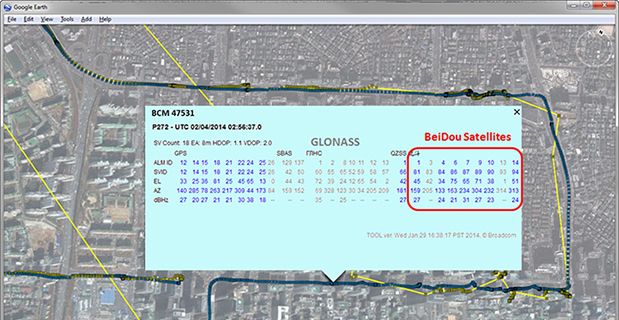
    There are two receivers shown here, from two different manufacturers, both in smartphones. The yellow dots are for a GPS/GLONASS receiver; the blue dots are from the Broadcom 47531 receiver which tracks GPS/GLONASS/QZSS/BeiDou signals simultaneously. The 47531 receiver includes logic to use redundant measurements to check the validity of all measurements. It successfully identified and removed the bad GLONASS ephemeris 100 percent of the time, as can be seen by the continuity and accuracy of the positions.

    Broadcom2

    Here is the satellite outage chart from yesterday’s story.  All GLONASS satellites were restored to healthy state after the 11-hour interruption.

    Current plot from the Roscosmos GLONASS Information-Analytical Centre. Things are almost back to normal this morning.
    Current plot from the Roscosmos GLONASS Information-Analytical Centre. Things are almost back to normal this morning.


  • GLONASS Gone . . . Then Back

    GLONASS Gone . . . Then Back

    In an unprecedented total disruption of a fully operational GNSS constellation, all satellites in the Russian GLONASS broadcast corrupt information for 11 hours, from just past midnight until noon Russian time (UTC+4), on April 2 (or 5 p.m. on April 1 to 4 a.m. April 2, U.S. Eastern time). This rendered the system completely unusable to all worldwide GLONASS receivers. Full and correct service has now been restored.

    “Bad ephemerides were uploaded to satellites. Those bad ephemerides became active at 1:00 am Moscow time,” reported one knowledgeable source. For every GNSS in orbit, the navigation messages include ephemeris data, used to calculate the position of each satellite in orbit, and information about the time and status of the entire satellite constellation (almanac); this data is processed by user receivers on the ground to compute their precise position.

    According to another source, a GLONASS fix could not take effect until each satellite in turn passed back over  control stations in the Northern Hemisphere to be reset, thus taking nearly 12 hours.

    During the outage, CEO Neil Vancans of Altus Positioning Systems reported “We are currently experiencing calls from customers all over the world who are experiencing GLONASS ‘outages’ and we have advised customers to switch GLONASS tracking off on our receivers. We don’t have any better information on when normal service is likely to resume from GLONASS satellites. If you do, let me know!”

    Such a — possibly human, possibly computer-generated — error could conceivably occur with GPS, Galileo, or BeiDou. “Another reason to have backups,” mused Richard Langley of the University of New Brunswick. “And not just other GNSS.”

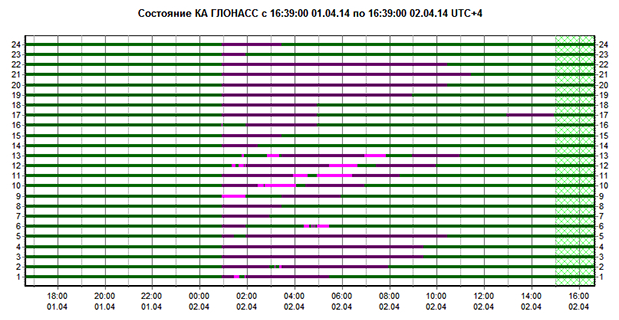
    A recent plot shows all satellites restored to normal service:

    Current plot from the Roscosmos GLONASS Information-Analytical Centre. Things are almost back to normal this morning.
    Current plot from the Roscosmos GLONASS Information-Analytical Centre. Things are almost back to normal this morning.


  • EGNOS, European Superiority, and the Need to Get ‘Very, Very Busy’

    The European GNSS scene received an early Easter present with the successful launch of two new-generation transponders for the European Geostationary Navigation Overlay Service (EGNOS) satellite-based augmentation system (SBAS). The two geostationary transponders, GEO-2, rose on board the SES ASTRA 5B satellite from the European Space Port in Kourou, French Guiana, on March 22 via an Ariane 5 lifter. The new transponders will provide higher accuracy positioning signals to those citizens and professionals using EGNOS enabled receivers.

    Together with the previous transponder replenishment on the SES-5 satellite launched in July 2012, GEO-2 will ensure the continuity and quality of the EGNOS open service and safety-of-life services for the next 15 years. Once validated in orbit, the signals will be introduced in current EGNOS operations and will support the new EGNOS generation (EGNOS V3). EGNOS V3 will provide dual-frequency signals on L1 and L5 bands and augment both GPS and Galileo constellations as part of the Multi-Constellations Regional System (MRS) concept.

    EGNOS is currently made up of transponders on board three geostationary satellites (Artemis, Inmarsat 3F2, Inmarsat 4F2), and an interconnected ground network of forty positioning stations and four control centres which cover most of the territory of the European Union. The ASTRA 5B payload for EGNOS will essentially extend transponder capacity and geographical reach over Eastern Europe and neighbouring potential markets.

    Europe’s first venture into satellite navigation, EGNOS represents a major stepping-stone towards Galileo. EGNOS improves the accuracy of GPS by providing a positioning accuracy to within three metres together with system integrity messages. The system offers three services: an Open Service that is free of charge; a Safety-of-life Service (SoL) that was certified for civil aviation in 2011; and a Commercial Service – the EGNOS Data Access Service (EDAS) that disseminates EGNOS data in real time.

    Since the beginning of 2014 the European GNSS Agency (GSA) has been responsible for the operation and service provision of EGNOS. “The successful launch is an important achievement in view of the enhanced performance that EGNOS will provide both today and in the future,” said Carlo des Dorides, GSA executive director.

    EGNOS Extension

    Future extension of EGNOS was discussed at the recent Munich Satellite Summit (see below and other articles in this issue of EAGER).

    While GSA is now EGNOS exploitation manager, the European Commission is responsible for the overall programme, said Ignacio Alcantarilla Medina, deputy EGNOS project manger at the Commission. With medium-term finances for the service secured, through a budget of € 1,580 million for the period 2014 to 2021, the main aim for service extension was to ensure complete coverage of all EU territories.

    “Coverage of Member States is the priority; that is what budget is for,” said Alcantarilla Medina. This essentially means reinforcing coverage in the east of Europe and extreme north and overall increase robustness.

    Currently (March 2014) there are 100 EGNOS-enabled LPV procedures for the civil air space published in Europe. During 2014 a further 150 LPV procedures should be completed, he stated.

    Once all EU territory is adequately served, then further extension might be possible. International projects in terms of demonstration were being undertaken under the European Commission’s FP7 and Horizon 2020 research programmes and funding for international extensions could come from third party or Commission sponsored development funding.

    Interestingly, in the light of recent political events, funding for extension of EGNOS to the Ukraine has already been allocated in the European Commission’s budget by DG Development. Other countries could benefit from this type of funding or from other international development aid. An ambitious flight test campaign over Moldova, Poland, Romania, and Ukraine was carried out in the second quarter of 2013 under the auspices of the EGNOS Extension to Eastern Europe: Applications (EEGS2) project. Full demonstration of EGNOS performances and capabilities was performed flying Instrument Landing System (ILS) overlay procedures and by providing real guidance to the pilots during final approach. In total, 19 flight trials were performed between April and June 2013.

    European Showcase at Munich Summit

    Perhaps the good EGNOS news created the warm glow bathing the Munich Satellite Summit in late March. While input arrived from all parts of the world and all major satellite navigation programmes — except Russia and GLONASS — the majority of the discussions focused on the European programmes, Galileo/EGNOS and Copernicus/Earth Observation, and thus by extension on European technological accomplishment.

    Matthias Petschke, Director of EU Satellite Navigation Programmes at the European Commission proclaimed: “Galileo is a reality. We are on track again!” But he stressed that infrastructure does not automatically generate services, and the focus must now be on service provision. On integration, Petschke emphasised that in most cases services meant applications, and few current applications relied on only one source of data. This meant it was not a question of “whether” for integration, but “what else” can be gained from integration of data.

    The big challenge is to transform space infrastructure into commercial service platforms that provide clear benefits to users and society. The introduction of Galileo Early Services, possibly as early as Q4 2014, would herald this move to service platforms and that was when Europe needed to “get very, very busy.”

    Galileo Boasts of Superiority. The plenary audience heard repeated statements from leading European figures on the ‘superiority’ of the Galileo system over current GPS satellites. The grinding of teeth from the various U.S. delegates was almost audible on some occasions but, in the spirit of world peace, they deigned to publicly challenge such statements.

    Typical was Jean-Jacques Dordain, director-general of ESA, who proclaimed Galileo as a success with technologies much better than GPS. Although he did concede that with 22 satellites still to launch this “was not the end of the process – but a real good start.”

    Evert Dudok of Airbus Defence and Space stated, “To develop from scratch a system significantly better than GPS is not easy, but we are creating the best system.” A number of delegates supported this, indicating Galileo’s better-quality code and phase measurement signals that were particularly important for higher-accuracy applications. The excellent, over-specification performance of the initial four in-orbit satellites was often quoted.

    From a commercial point of view, Carlo des Dorides of the GSA claimed that effectively the European Union already had a 25 percent share of the sat nav market and that one-third of the existing global receiver base was already Galileo compatible. He saw a great future for the system.

    “Galileo is unique compared to other GNSS due to its civil nature,” said des Dorides. And the user was at centre of the system’s evolution, with developments in Galileo moving from technology push to demand pull. The clear role of GSA was to ensure that both Galileo and EGNOS delivered the valuable services they are designed to deliver.

    Galileo’s public regulated service (PRS) should be a key factor in growing market share in secure civilian applications with its enhanced ability to counter intentional and unintentional signal interference – another main topic of the Summit. In a dedicated session on combating interference, the introduction of a ‘PRS-lite’ authentification signal on the Galileo open service was mooted, which could be a very interesting development.

    The absence of any Russian input to the Munich SatNav Summit — save for a small pile of the unexpectedly glossy GLONASS Herald publication outside the registration hall — brought the chill of geopolitics into the usually apolitical space arena.

    Does Augmentation Have a Future?

    Another interesting question raised at the Summit – given the near-future fact of four compatible GNSS constellations on station – was whether there will be a role for augmentation systems such as EGNOS and WAAS?

    Deborah Lawrence of the FAA was clear that her organisation was working to take advantage of the multi-constellation future and that the role of SBAS might change, but that the FAA is already looking towards what the requirements for SBAS in 2040 might be.

    European Commission spokespersons agreed with the need for multi-constellation, globally interoperable SBAS for the foreseeable future, not least because the currently installed receiver base in the aviation sector would likely have a 20-year replacement horizon.______________

    Tim Reynolds is director of Inta Communication Ltd. and a long-term Brussels observer writing on many aspects of European government policy and implementation for a range of clients and publications. The material presented here was first prepared in a somewhat different form for the GSA.
       He is the contributing editor for GPS World’s new quarterly e-newsletter, EAGER: the European GNSS and Earth Observation Report. Subscribe free at env-gpsworld-integration.kinsta.cloud/subscribe.