Author: Tracy Cozzens

  • ICD published for Galileo High Accuracy Service

    ICD published for Galileo High Accuracy Service

    HAS SIS ICD

    Galileo High Accuracy Service one step closer to initial launch

    The EU Agency for the Space Programme (EUSPA) has published the first Galileo High Accuracy Service Signal in Space Interface Control Document (HAS SIS ICD). The document can be downloaded here.

    The HAS SIS ICD was published by EUSPA together with the European Commission and the European Space Agency (ESA).

    By providing free-of-charge, high-accuracy precise point positioning (PPP) corrections through both the Galileo signal (E6-B) and via the internet, the HAS will offer users improved positioning performance with an accuracy of less than two decimeters.

    “Galileo will be the first GNSS constellation capable of providing a high-accuracy service directly through the signal in space,” explained Guerric Pont, Galileo Services, EUSPA program manager. “This is unique in that, typically, high-accuracy services are based on accurate satellite and atmospheric data provided from a third party, but not directly from the GNSS.”

    According to Pont, high-accuracy services are experiencing a massive boost in interest, thanks in large part to new capabilities of GNSS receivers and the rapid emergence of new applications that require accurate location data.

    “Currently, high accuracy is primarily used in such professional applications as surveying, precision agriculture and civil engineering, among others,” he said. “However, new and emerging applications, including autonomous driving, unmanned vehicles, robotics and a range of location-based services, will all welcome high accuracy.”

    Pont also notes that, when used in synergy with Copernicus, the Galileo HAS will open up market possibilities and help design new services.

    An ongoing process

    In 2021, EUSPA, in coordination with the European Commission and ESA, published an Information Note on the Galileo HAS. The note provided an overview of the service’s main characteristics, along with information on such key features as service levels, targeted performance and markets, and a roadmap for implementation.

    This was followed by a call for Expression of Interest for High Accuracy Service Testing, which invited external stakeholders to participate in a testing campaign of the Galileo HAS Signal in Space broadcasting. The goal of the campaign was to collect relevant feedback, not only on the HAS SIS ICD structure and implementation at the receiver level, but also on service-related aspects and specifications.

    “The Galileo program has been performing a long set of HAS testing activities since 2019, which cumulated in the first-ever HAS signal broadcast in May 2021,” said Javier de Blas, EUSPA Commercial and HAS manager. “Based on the feedback gained during the joint efforts conducted by EUSPA, the European Commission and ESA, with the key support of European aerospace industry during the testing phase, we are now able to publish the first Galileo High Accuracy Service Signal in Space Interface Control Document.”

    Following the publication of this HAS SIS ICD, the Galileo Program will continue deployment and service validation of HAS over the next months, in view of an operational declaration of HAS initial service, or HAS Phase 1, by the end of 2022. This will enable development of products in parallel to the gradual entry into full operational service in the next few years.

  • HawkEye 360 adds satellites to geolocation constellation

    HawkEye 360 adds satellites to geolocation constellation

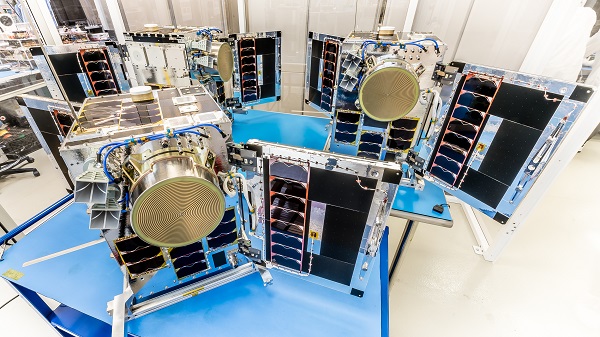
    Three HawkEye 360 radio-frequency geolocation microsatellites were launched May 25. The satellites, launched aboard SpaceX Transporter-5 mission, were built by Space Flight Laboratory (SFL) of Toronto. Three SFL-built satellites for greenhouse gas monitoring were also launched.

    The HawkEye 360 constellation detects and geolocates RF signals for maritime situational awareness, emergency response, national security and spectrum analysis applications.

    Once Cluster 5’s on-orbit checkout is complete, the HawkEye 360 constellation will be expanded to 15 satellites, doubling capacity and revisit rates. This significantly boosts the constellation’s ability to serve global customer demand and to monitor activity across places such as Ukraine.

    “Every enhanced satellite cluster we launch helps us deliver a higher density of valuable data to our government, commercial and humanitarian customers and partners – advancing our efforts to monitor global activities for a safer and more secure world,” said HawkEye 360 John Serafini. “Launch by launch, these space-based innovations are analyzing the knowns and uncovering the unknowns of the RF spectrum across the globe.”

    Cluster 5 includes enhanced antenna functions introduced with Cluster 4, which allow greater flexibility in geolocating signals across a wide range of frequencies important to customers.

    Cluster 4, launched April 1, has been completing checkout and moving into final formation to begin collecting data in late June. Cluster 5 is slated to achieve initial operating capability in August.

    Cluster 4 on orbit. (Image: HawkEye 360)
    Cluster 4 on orbit. (Image: HawkEye 360)

    HawkEye 360 plans to continue to grow the constellation to achieve revisit rates of about 15 minutes to support timely defense, national security and commercial applications.

    SFL has now developed 15 microsatellites for HawkEye 360 of Herndon, Virginia. SFL was selected for these missions due to the importance of formation flying by multiple satellites for successful RF geolocation.

    Other missions developed by SFL in the past two years include 16 communications CubeSats and three microsatellites designed for Earth observation, maritime tracking and atmospheric monitoring.

    In its 24-year history, SFL has developed cubesats, nanosatellites and microsatellites that have achieved more than 191 cumulative years of operation in orbit.

    HawkEye 360 Cluster 5. (Photo: HawkEye 360)
    HawkEye 360 Cluster 5. (Photo: HawkEye 360)
  • Leica lidar sensor improves bathymetric lidar surveys

    Leica lidar sensor improves bathymetric lidar surveys

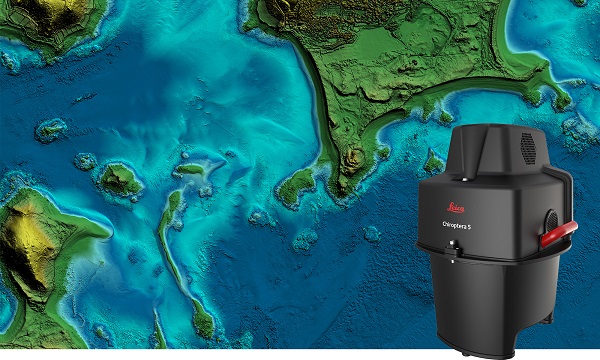
    Image: Leica Geosystems
    Image: Leica Geosystems

    The new Leica Chiroptera-5 is a high-performance airborne bathymetric lidar sensor for coastal and inland water surveys.

    Offered by Leica Geosystems, Chiroptera-5 provides 40% higher point density, a 20% increase in water-depth penetration, and improved topographic sensitivity for generating more detailed hydrographic maps.

    The technology increases the depth penetration, point density and topographic sensitivity of the sensor compared to previous generations. It delivers high-resolution lidar data supporting applications such as nautical charting, coastal infrastructure planning, environmental monitoring and landslide and erosion risk assessments.

    Chiroptera-5 combines airborne bathymetric and topographic lidar sensors with a four-band camera to collect seamless data from the seabed to land. With a higher pulse repetition frequency (PRF), the new technology increases point density by 40% compared to the previous generation system, collecting more data during every survey flight.

    Improved electronics and optics increase water-depth penetration by 20% and double the hydrographic sensitivity to capture larger areas of submerged terrain and objects with greater detail. The high-performance sensor is designed to fit a stabilizing mount, enabling more efficient area coverage, which decreases operational costs and carbon footprint of mapping projects.

    Leica Geosystems’ signature bathymetric workflow supports the sensor’s performance. Introducing near real-time data processing enables coverage analysis immediately after landing, allowing operators to quality control the data quickly before demobilizing the system.

    The Leica Lidar Survey Studio (LSS) processing suite provides full waveform analysis and offers automatic calibration, refraction correction and data classification, as well as advanced turbid water enhancement.

    Supporting environmental research

    Combining superior resolution, depth penetration and topographic sensitivity, Chiroptera-5 provides substantial benefits for various environmental applications such as shoreline erosion monitoring, flood simulation and prevention, and benthic habitat classification.

    Bundled with the FAAS/EASA-certified helicopter pod, the system enables advanced terrain-following flying paths for efficient river mapping and complex coastlines surveys. Owners of previous-generation systems are offered an easy upgrade path to Chiroptera-5 to add capabilities to their existing sensor and leverage their initial investment.

    “The first-generation Chiroptera airborne sensor was flown in 2012. During its 10 years of operation, the system has seen constant evolution that continuously improved the productivity and efficiency of the entire bathymetric surveying industry,” said Anders Ekelund, vice president of airborne bathymetry at Hexagon. “By collecting detailed data of coastal areas and inland waters, Chiroptera-5 provides an invaluable source of information that supports better decision making, especially for environmental monitoring and management, in line with Hexagon’s commitment to a more sustainable future.”

  • Focus Telecom’s GPS Resilient Kit protects against timing threats

    Focus Telecom’s GPS Resilient Kit protects against timing threats

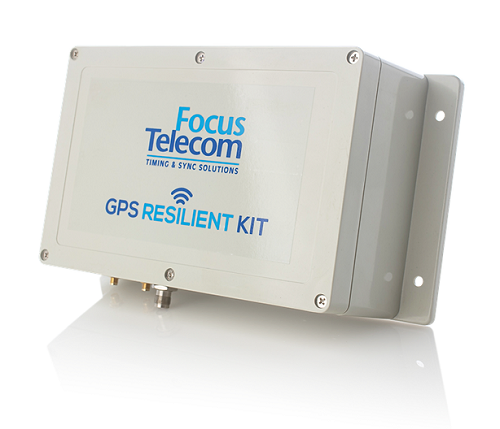
    Photo: Focus Telecom
    Photo: Focus Telecom

    Focus Telecom has installed its GPS Resilient Kit (GRK) cyber protection system in the national time systems of the State of Israel at the National Physics Laboratory in Jerusalem.

    “A cyber protection system like the one installed in the National Laboratory, as well as many other systems we have developed to protect critical infrastructure, enable our customers to deal with the growing global threat and ensure the function of GPS-based systems, on which their business activity is based — even under jamming and spoofing attacks of various kinds,” said Shlomi Mazor, vice president of sales, Focus Telecom.

    The company has developed a holistic model made up of several layers that can protect a GPS-based organization, according to the company.

    Focus Telecom has been a leader in the field of synchronization and atomic clocks since 1995, and serves as Israel’s national timekeeper.

    The company’s technology can detect an attack on an organization’s time sources, neutralize the threat of intrusion into the organization, provide alternative time from a secure highly accurate source, and protect internal organizational time distribution through a fiber-optic protection system through which time protocols are transmitted. It provides alerts for spoofing or jamming attacks as they happen.

    Focus Telecom provides solutions in several layers, including secure NTP/PTP time servers, grandmaster atomic clocks, and radio frequency firewalls. These are protected by an active protection system that can detect and neutralize disruptions before they reach timing servers, and by additional technological solutions that provide effective protection against threats.

    Focus Telecom cites recent jamming and spoofing incidents as highlighting the need for protection. For instance, pilots reported  disruptions of GPS signals in June 2019, making it difficult to access Ben Gurion Airport. These disruptions resumed in January 2022 and pose a renewed challenge to pilots.

    In a May 2021 incident, farmers on the northern border and in the Gaza Envelope reported disruptions affecting the GPS-based guidance system installed in tractors used for sowing and harvesting.

    Focus Telecom’s systems are successfully integrated into the Israel Defense Forces, defense industries, financial institutions, communications companies, and Israel’s transportation, electricity and water infrastructure.

    Learn more about cyber threats on the company’s website.

  • GNSS companies aid drones in upcoming tournament

    GNSS companies aid drones in upcoming tournament

    The Drone Tournament has relaunched following the COVID pandemic, and will take place June 8-10 in Helsinki, Finland.

    In the competition, drones will compete to prove precision-control drones over land and sea. GNSS companies Septentrio, Spirent and u-blox will take part.

    Sponsored by Ultrahack, the competition seeks to boost use of drone technology, including for 5G networks and satellites. The challenges are especially related to landing and precision flight in demanding and changing environments. Contestant drones will use a wide spectrum of navigation and sensor technology, including GNSS.

    U-blox, Spirent and Septentrio are offering their GNSS technology for the participants.

    Septentrio and u-blox will provide GNSS services that teams can use to increase performance as they land their drones on a moving boat. To help improve performance, Septentrio and u-blox will provide access to data streams from a base station on the shore and on the boat.

    The streams will  provide raw observations in RTCM3 format via NTRIP (which can be used to compute a real-time kinematic, or RTK, position of the drone). The stream from the boat will also provide position, heading and speed of the boat over an IP connection in NMEA or binary format.

    Using these streams can help to obtain an RTK solution on the drone or to know the relative position between the drone and the boat.

    The winners will receive monetary prizes and the possibility of negotiating commercial agreements for further development of their solutions.


    Feature photo: PhonlamaiPhoto/iStock/Getty Images Plus/Getty Images

  • ADVA launches GPS backup service to help combat cyberattacks

    ADVA launches GPS backup service to help combat cyberattacks

    ADVA logoADVA is enabling service providers to offer GPS/GNSS-backup-as-a-service (GBaaS) to answer the need for operators to safeguard services that rely on positioning, navigation and timing (PNT) information.

    Along with spoofing and jamming of GNSS, in-network timing based on network time protocols (NTP) and precision time protocols (PTP) are also increasingly vulnerable to cyber threats.

    As a response, ADVA is now empowering service providers to offer GBaaS and enable end users to address new guidelines and standards for redundant PNT architectures. GBaaS meets the latest recommendations for PNT homeland security, including U.S Executive Order 13905. Leveraging ADVA’s aPNT+ technology, GBaaS eliminates the risks and costs associated with GNSS dependence.

    “Threats to hamper PNT capabilities are growing, and much of the world’s critical infrastructure is still without adequate protection from GNSS vulnerabilities,” said Gil Biran, general manager of Oscilloquartz, ADVA. “All of that can change when service providers are able to offer GBaaS.”

    GBaas is based on ADVA’s aPNT+ platform, which leverages a suite of technologies, including multi-band GNSS receivers and management software based on artificial intelligence and machine-learning.

    Service providers can offer ADVA’s aPNT+ protection as a subscription-based service as part of their service-level agreements.

    ADVA’s GBaaS solution employs a combination of multi-layer detection, multi-source backup and fault-tolerant mitigation to render timing networks more secure. Embedded in all timing devices, ADVA’s Syncjack technology provides comprehensive and precise synchronization performance monitoring and analytics, enabling the Ensemble Sync Director network management suite to intelligently operate and prioritize multi-source timing feeds across the network.

    Onboard multi-band GNSS receivers boost timing accuracy and also protect against attacks like jamming and spoofing. When GNSS is either unavailable or compromised, a dispersed network of autonomous cesium atomic clocks and network backup timing feeds is ready to deliver highly accurate network timing over long periods of GNSS unavailability.

  • Fifth GPS satellite set healthy for operational use

    Fifth GPS satellite set healthy for operational use

    The fifth GPS III satellite is now set healthy for initial operational  use, according to the U.S. Coast Guard Navigation Center (NAVCEN). GPS III 05 (SVN-78/PRN-11) was launched June 17, 2021, from Space Launch Complex-40 at Cape Canaveral Air Force Station, Florida.

    Constellation Changes

    The U.S. Space Force Second Space Operations Squadron (2 SOPS) indicates that GPSIII 05 replaced SVN-61/PRN-28 in the D plane at slot D1.

    SVN-61 is being rephased to optimize its position in the D plane, and is expected to complete its journey on or about July 14.

    SVN-44/PRN-28 was moved to GLAN 31.64 to optimize its position within B plane.

    GPS III space vehicle 05 (GPS III-SV05) launched in June 2021 from Cape Canaveral Space Force Base, Florida, aboard a SpaceX Falcon 9 launch vehicle. (Photo: SpaceX)
    GPS III space vehicle 05 (GPS III-SV05) launched in June 2021 from Cape Canaveral Space Force Base, Florida, aboard a SpaceX Falcon 9 launch vehicle. (Photo: SpaceX)
  • Trimble introduces high-accuracy GNSS module for autonomous applications

    Trimble introduces high-accuracy GNSS module for autonomous applications

    Photo: Trimble
    Photo: Trimble

    Trimble Autonomy has introduced the Trimble BD9250, a dual-frequency OEM GNSS receiver module that supports Trimble RTX correction services.

    The receiver is designed to deliver high-accuracy positioning for a range of high volume, autonomous-ready applications used in the agriculture, construction, robotics and logistics industries worldwide.

    The BD9250 is a compact receiver with an industry-standard form factor and pinout, allowing for easy system integration and configuration. Equipped with Trimble’s advanced ProPoint positioning engine, the BD9250 delivers robust and accurate positioning.

    The BD9250 receiver is compatible with Trimble RTX correction services or real-time kinematic (RTK) and supports all major GNSS constellations, including GPS, Galileo, GLONASS, BeiDou, QZSS and NavIC. Support for the Indian NavIC S-Band signal is also available with the Trimble BD9250s version.

    The receivers include the capability to enable system integrators to choose either the L2 orL5 frequency to optimize signal performance and maximize the number of measurements available to the GNSS engine.

    “The BD9250 provides centimeter-level RTX accuracy without the need of a base station,” said Finlay Wood, general manager, off-road, Trimble Autonomy. “This OEM GNSS board is ideal for high-volume autonomy applications that require precise positioning, without sacrificing accuracy, availability or integrity — enabling integrators to bring systems to market faster.”

    The Trimble BD9250 and BD9250s evaluation receiver modules and the Trimble RTX correction service subscription are available now through Trimble’s OEM GNSS sales channel.

  • WingXpand’s expandable-wing drone stretches to 7 feet

    WingXpand’s expandable-wing drone stretches to 7 feet

    Photo: WingXpand
    Photo: WingXpand

    WingXpand has debuted a 7-foot expandable-wing drone that fits in a backpack. The drone was first revealed to the special forces community at the Special Operations Forces Industry Conference (SOFIC 2022) held May 16-19 in Tampa, Florida.

    WingXpand is U.S. made with a patented design that takes the small size and simplicity of a quadcopter and combines it with the horsepower of an airplane. WingXpand maximizes capability, efficiency and safety for the military and public safety officials. It can also be used  by farmers, surveyors and inspectors.

    WingXpand expands in less than 2 minutes. Though the full system weighs less than 10 pounds, it flies five times longer and carries ten times more weight than other drones of its size class, according to WingXpand. It can carry high-resolution cameras and other modular payloads such as a real-time pattern analysis system.

    WingXpand can reduce or replace the need for more costly, scarce or dangerous options. More than 10 WingXpand UAS can fit in a public safety vehicle, more than 30 in a pickup, and 250 on a standard airlift pallet.

    The WingXpand team provides end-to-end services, including pilot services, training, data analysis and sustainment.

  • Septentrio rides for climate data on Nanok Arctic expedition

    Septentrio rides for climate data on Nanok Arctic expedition

    Two Belgian adventurers are crossing Greenland on a triathlon including ski, kayak and a vertical rock climb. On the ride, they are using Septentrio’s AsteRx-SB receiver, collecting valuable data for climate research in collaboration with the Royal Observatory of Belgium.

    The data will help build a precise elevation profile of the Greenland Ice Sheet as well as to calibrate existing elevation models, which are based on satellite altimetry. In addition, the multi-frequency capability of the AsteRx-SB receiver will enable monitoring of ionospheric activity as well as Galileo signals at high latitudes.

    “The AsteRx-SB receiver provides accurate and reliable positioning data even in the world’s harshest environments,” said Nicolas Bergeot of the Time-Ionosphere section, Royal Observatory. Data collected will help research of arctic ice caps, ionospheric activity and other topics.

    The expedition is called Nanok, which is an Inuit word for polar bear. Adventurers Gilles Denis and Nathan Goffart started the triathlon with a 600-km ski with a pulk sled along the Arctic Circle. The second part of the triathlon is a 1,000-km sea kayak along the Greenland east coast, and finally a 1-km vertical rock climb.

    The AsteRx-SB receiver is accompanying the two explorers along their journey, so that data can be collected at various locations along the way. (Photo: Nanok Expedition)
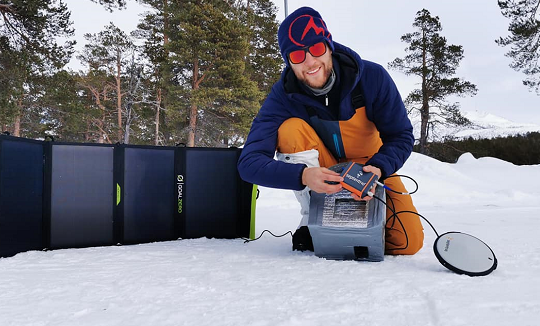
    Gilles Denis shows the AsteRx-SB receiver and the PolaNt-x MF antenna that are accompanying the explorers for the entire journey, so that data can be collected at various locations along the way. The receiver is powered by solar panels. (Photo: Nanok Expedition)
  • HERE Technologies collaborates with AWS on location services for developers

    HERE Technologies collaborates with AWS on location services for developers

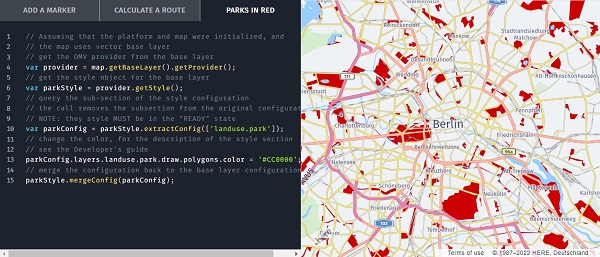
    A sample of code in HERE Maps API. (Screenshot: HERE Technologies)
    Screenshot: HERE Technologies

    HERE Technologies is collaborating with Amazon Web Services (AWS) to offer developers access to an array of location services through the recently launched AWS Serverless Application Repository.

    Through the collaboration, HERE and AWS are increasing the speed and ease in which developers can access and integrate core location services into their applications.

    Because HERE location services are available in the AWS Serverless Application Repository, developers can rapidly deploy AWS Lambda into their own AWS account that serve as proxies to HERE location services, and thus allows for a microservices approach to calling the HERE locations services. This approach also provides developers with benefits from Amazon API Gateway and AWS Lambda capabilities such as cache, throttling and authentication.

    Developers on the AWS Serverless Application Repository have access to a suite of HERE location services, including:

    • map images and tiles
    • geocoding
    • positioning
    • routing
    • road toll costs
    • road traffic conditions
    • public transit information
    • weather conditions.

    With credentials from developer.here.com, developers can access the location services on the AWS Serverless Application Repository, now available in Preview.

  • U-blox and Geespace join on automotive high-precision positioning

    U-blox and Geespace join on automotive high-precision positioning

    The partnership will help to grow global adoption of the u-blox PointPerfect high-precision positioning service, in particular for automotive applications.

    Logo: u-bloxU-blox and Geespace have signed a memorandum of understanding (MOU) on the expansion of their respective augmentation services for high-precision applications.

    Geespace is a provider of aerospace information and communications infrastructure and application solutions. Both partners will be able to extend their service offering to the U.S., European and Chinese markets, primarily in the automotive sector.

    The rise of reliable and cost-effective high-precision positioning has improved the accuracy of GNSS solutions to the order of tens of centimeters, enabling a plethora of new applications in automotive, as well as industrial and robotics segments. Global adoption has, however, been hampered by a fragmentation of the augmentation services landscape, thee companies said.

    For global adoption to become a reality, worldwide coverage is required, as is unified pricing and business models designed to serve mass-market high-precision solutions for automotive and industrial customers operating on a global scale. The resulting differences in technical specifications have also made development of such solutions requiring different services complex.

    The MoU between u-blox and Geespace seeks to create a combined offering that will enable both companies to offer full-stack high-precision positioning software and hardware solutions to customers across the U.S., European and Chinese markets.

    Also, it will enable Geespace, which provides automotive GNSS augmentation services to its parent company Geely Group, to use the u-blox PointPerfect GNSS augmentation service to grow its coverage to serve Geely’s automotive brands. Headquartered in Hangzhou, China, Geely Group brands include Geely Auto, Lynk & Co, Zeekr, Volvo Cars, Polestar, Lotus, London Electric Vehicle Company, Farizon Auto and CAOCAO Mobility.

    The MOU also will enable u-blox to expand coverage of PointPerfect to offer customers a comprehensive high-precision solution for products sold in China, and benefit from simplified development and logistics efforts.