Category: Applications

  • Qualitative Motion Analysis: INS/GNSS in Care-Giving Applications

    By Pere Molina, Ismael Colomina, Markus Troger, Bernhard Hofmann-Wellenhof, and Carmen Aguilera

    A pocket tracker for elderly people and Alzheimer’s patients consists of a smartphone using GNSS, WLAN, RFID, and GSM for basic positioning, communication channels, and an accelerometer triad for collapse and motion detection. It seeks to determine not only the quantitative where but the qualitative how: has the user lost balance, fallen, or ceased moving?

    Accidents involving senior citizens and handicapped people have increased dramatically over recent years. Elderly people, especially those with Alzheimer’s disease, often get in situations where they need assistance due to disorientation or after a physical collapse. The Infrastructure Augmented Galileo/GNSS Receiver for Personal Mobility (IEGLO) project incorporates seamless indoor and outdoor positioning and emergency call services for healthcare applications.

    Positioning is very important in such applications, but this target group has another key requirement: 30 percent of elderly people fall at least once per year. Furthermore, falls are responsible for 70 percent of accidental deaths in persons more than 75 years old. 71 percent of falls had physical consequences: 7.7 percent caused broken bones, and 21.7 percent needed medical aid. Moreover, 64 percent of fallers feared of falling again.

    IEGLO seeks to establish automatic and reliable fall detection, through a personal device that can indicate a loss of balance of the carrier. This navigation enhancement — traditional orientation plus information about the personal behavior — has been called qualitative motion analysis (QMA).

    System Overview

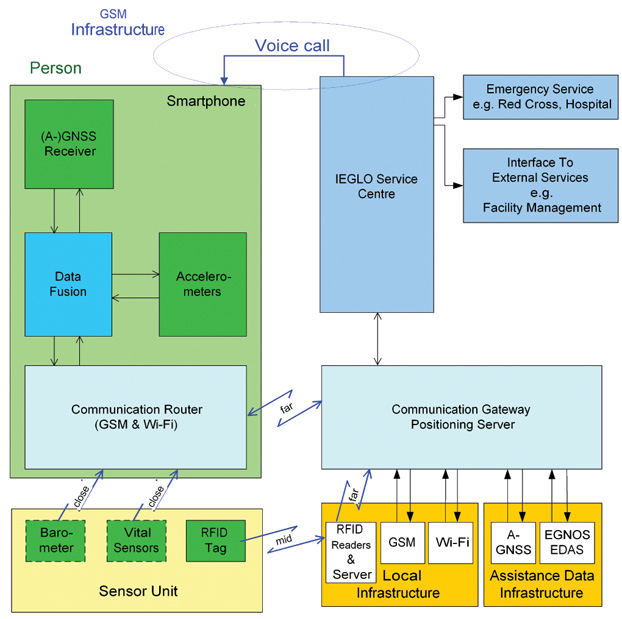
    The IEGLO system concept, shown in Figure 1, consists of three parts: a mobile unit with an external sensor unit; a communication gateway/positioning server (CG/PS), and a service center.
    figure_col_1. Pere Molina, Ismael Colomina, Markus Troger, Bernhard Hofmann-Wellenhof, and Carmen Aguilera
    Figure 1. Overview of Infrastructure-Augmented Galileo/GNSS Reciever (IEGLO) system concept.

    A commercial-off-the-shelf smartphone with integrated sensors and an RFID transponder represent the components of the mobile unit located at the monitored person. The mobile device cannot be fixed to the body in an precise initial attitude, but must move along with the person in order to capture his/her movements. Distress situations are detectable and alert messages can be generated manually or automatically at the mobile unit.

    The mobile unit includes a GPS receiver able to process assisted-GPS data. A Wi-Fi adapter provides additinal communication when Wi-Fi access points are available, or if a determined access point is self-monitored. However, the main communication function in the mobile unit is provided by the GSM module. Both Wi-Fi adapter and GSM module, are also used for positioning purposes. An orthogonal accelerometer triad is integrated in the device and provides accelerometer measurements. For near-field communication, a Bluetooth interface is available. Through it, other sensors such as barometers or vital-signs sensors could be polled.

    The RFID transponder forms together with the smartphone the mobile unit. RFID information including the transponder ID is sent to an RFID reader when the person passes by an RFID gate. Several pieces of RFID data are gathered on an RFID server, which sends the information necessary for positioning to the CG/PS.

    The CG/PS is responsible for the position calculation. Through a TCP/IP interface, it recieves sensor data from the mobile device and processes it with additional reference information from Wi-Fi, GSM, and RFID positioning. A filter/fusion module calculates one integrated IEGLO position from the different determined positions. That position, together with quality information, is transmitted to the service center. The CG/PS also instantly forwards alarm and status messages from the mobile device to the service center.

    The service center forms the interface between IEGLO operator and users. It stores databases of position information and personal information. The geo-database contains all information about the positions of the monitored person. The personal database contains user information, emergency contacts, and nursing staff.

    The user interface at the service center is Internet-based. A standard desktop PC with web browser relays alarm messages from the different mobile devices and manages user data and nursing staff information. In cases of alarm, the event is instantly displayed via the user interface. Information such as body behavior, position, and location of the user are visualized for the operator, who can then start the alarm chain, which includes as a first measure contacting the mobile user. As further measures, emergency services can be contacted and guided to the person in distress.

    Quantitative and Qualitative Nav

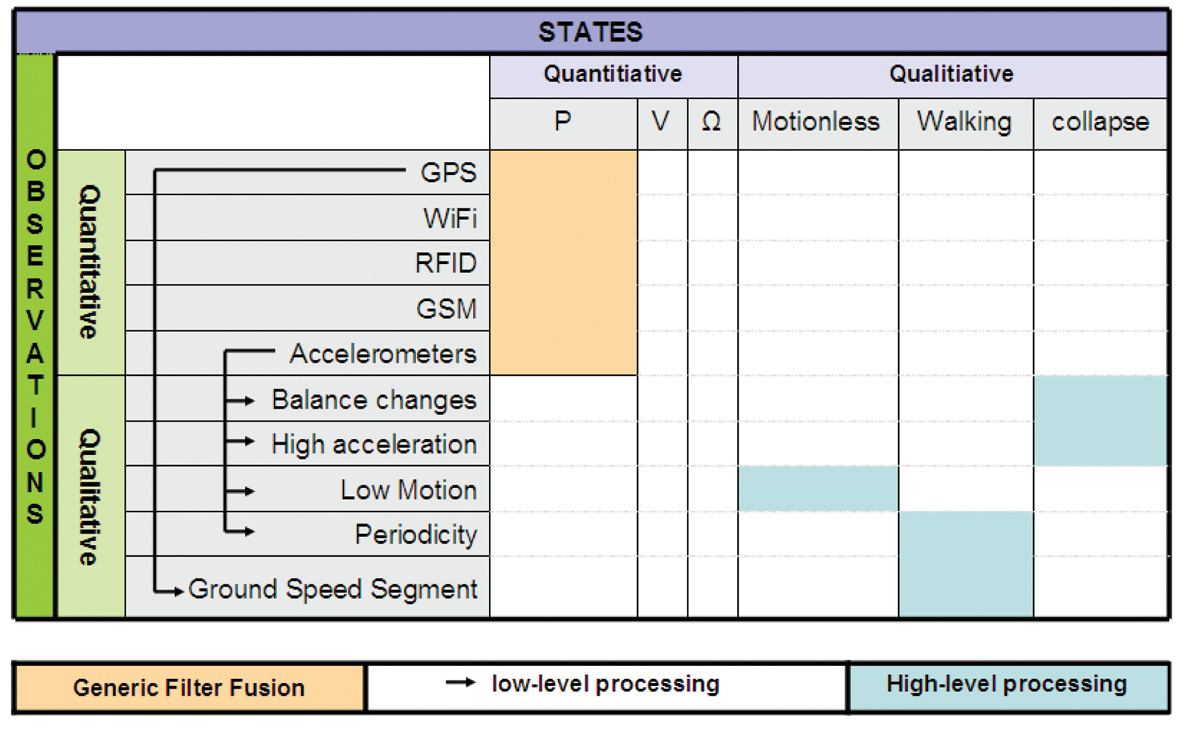
    In this article, non-conventional INS/GNSS integration refers to classical, or quantitative navigation, combined with what we have named qualitative navigation. Roughly speaking, quantitative navigation provides the where, while quantitative navigation furnishes the how. Qualitative navigation was a key requirement for IEGLO, as the patient’s primary information of interest is her or his safety status. Figure 2 summarizes the relationships between quantitative and qualitative observations.
    Source: Pere Molina, Ismael Colomina, Markus Troger, Bernhard Hofmann-Wellenhof, and Carmen Aguilera
    Any type of navigation, particularly quantitative navigation, is characterized by a navigation space. For example, in INS/GNSS navigation the navigation space N or state space is P × V × Ω (the set of position, velocity and attitude vectors) and the navigation function

    T → P×V×Ω

    t → (p,v,ω)

    maps the time t into a particular navigation state (p(t),v(t),ω(t)). Typically,

    T ⊂ R, P = R3, V = R3 and Ω = [0,2π]3. It is well known that there are various choices for the navigation space, from the simple point navigation where N = P to the complex N = P × V × Ω × B, where B includes time-dependent calibration and other ancillary states.

    Qualitative navigation differs from classical quantitative navigation in the navigation space and, clearly, in the navigation function T → N. To illustrate the idea, let us compare and describe the classical quantitative navigation space P × V × Ω with one possible P′ ×V′ × Ω′ qualitative navigation space. While for quantitative navigation we have

    tT ⊂ R,

    p = (x,y,z) ∈ P ⊂ R3

    v = (vx , vy , vz) ∈ V ⊂ R3

    ω = (ωx, ωy, ωz) ∈ Ω = [0,2π]3,

    for qualitative navigation we might have

    tT ⊂ R,

    p′P′ = {hospital, home, park}

    v′V′ = {not moving, walking, running}

    ω′ ∈ Ω′ = {standing, lying, sitting}.

    Quantitative navigation is not just about providing estimations of the navigation states; the stochastic figures describing the precision of the estimated states are also provided. Thus, quantitative and qualitative navigation spaces are extended in dimension to include the precision space component, namely ΣP ×V ×Ω and ΣP ×V ′ ×Ω′ .

    Navigation theory claims that navigation states might be estimated from observations through the appropriate dynamic and static models (differential and ordinary stochastic equations). Such a statement applies for both proposed navigation approaches, quantitative and qualitative. Thus, the relation model-observation-parameter can be written as l → h(l, X ) for the quantitative case, where:

    • the quantitative observations l are usually obtained by performing the navigation sensor measurements (INS, GNSS, and so on).
    • X P × V × Ω × ΣP×V×Ω
    • h represents the model that relates l with X (INS mechanization equations, GNSS position models, and so on)

    and for the qualitative case, the relation can be written as f → q(f,M), where:

    • the qualitative observations f are obtained from quantitative observations by performing low-level processing.
    • MP′ × V′ × Ω′ × ΣP′×V′×Ω′
    • q represents the model that relates f with M, based on high-level processing.

    In the IEGLO project, this theoretical approach has been materialized by defining the appropriate quantitative and qualitative observation and navigation spaces.

    Quantitative Navigation

    Quantitative navigation in IEGLO is based on positioning; thus, no quantitative velocity or attitude determination is performed. This leads to a very specific navigation space:

    tT ⊂ R

    p = (x,y,z) ∈ P ⊂ R3,

    IEGLO uses different positioning technologies for indoor and outdoor positioning; GPS serves as the main positioning method outdoors, while Wi-Fi and RFID are used primarily for indoor positioning.

    A GPS position augmentation service has been developed to augment GPS-only position solutions using European Geostationary Navigation Overlay Service (EGNOS) information acquired via the local area network and the Internet. The augmentation service is useful for receivers which are not capable of processing EGNOS data, but also for receivers which cannot receive EGNOS signals due to signal shadowing by urban canyons or the like. In this case, the GPS-only position is transmitted to the augmentation server, which corrects the position solution and retransmits the EGNOS Data Access System/signal-in-space through the Internet (EDAS/SiSNeT)corrected position. Figure 3 shows the functional modules of the augmentation server. EDAS provides access to the wide-area differential correction of EGNOS. SiSNeT is a free service that provides EGNOS widea-rea differential corrections and integrity information over the Internet.
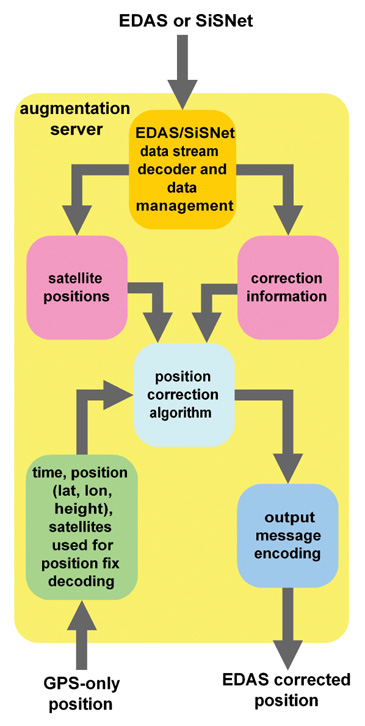
     Figure 3. Position augmentation server functional modules.  Source: Pere Molina, Ismael Colomina, Markus Troger, Bernhard Hofmann-Wellenhof, and Carmen Aguilera
    Figure 3. Position augmentation server functional modules

    The augmentation server accesses EGNOS information from EDAS or SiSNeT, decodes the data, and stores it in a database. As a backup solution, if EDAS cannot be accessed, the augmentation server can also interface to an EGNOS receiver to decode the EGNOS signal in space. The augmentation server is provided with ephemeris and ionospheric information from EDAS/SiSNeT. The GPS position is received from the correction requesting unit together with its time and used satellites. It is corrected at the augmentation server and retransmitted back to the requesting unit.

    From the mobile device, sensor information is transmitted to the CG. The sensor data is processed into positioning messages with additional reference information for Wi-Fi, RFID, and GSM positioning. A generic filter method determines a reliable IEGLO position from the different determined positions, which is transmitted to the service center together with the accuracy and time information. The choice of the position depends on its accuracy and its age.

    Qualitative Navigation

    Positioning is, indeed, the main navigation component in IEGLO. A main goal of the project is to be able to contact a person in case of an emergency anytime, anywhere, and thus position is sufficient. But beyond this sufficiency, a broader navigation concept can be developed using two of the available sensors in the IEGLO system: the GPS receiver and the 3-axial accelerometer. As described earlier, these two sensor measurements (quantitative observations) would yield some motion features of the person (qualitative observations) with which to estimate the motion context of the person (qualitative states). This is a two-step processing: low-level and high-level.

    Low-Level Processing: from quantitative to qualitative observations. As depicted in Figure 2, the qualitative observations used in IEGLO are: ground speed segment, balance changes, high accelerations, low motion, and periodicity. These qualitative observations are low-level processed in two steps. First, robust and non-robust statistical estimators (based in order statistics like the median, median absolute deviation normalized (MADN), α-trimmed mean and deviation, or least-squares like the mean, standard deviation, respectively), and deterministic analyzers (such as the fast Fourier transform (FFT), velocity transformation (VT), equidistant maxima search (EMS) are applied to estimate some intermediate values, like the first and second statistical moments, maximum and minimum values, and FFTs. Secondly, these intermediate quantities are evaluated using propositional calculus to decide if a situation is finally detected. All the qualitative observations’ extraction in IEGLO are described as follows.

    On one hand, GPS positions are used to compute the ground speed segments of the device. That is, given a sample of GPS positions P = {(ti , pi )}Ni=1 , the ground speed sample is extracted through a finite difference-based technique called velocity transformation (VT). Thus, a speed sample S = {(ti, si = ||pi − pi-1||ground)}Ni=2 is obtained. In addition, this sample is statistically through robust and non-robust estimators yielding E(S) and, thus, deriving the person’s ground speed profile.

    On the other hand, accelerometers are the key sensors to enable qualitative observation computation to later derive a qualitative attitude, that is, the detection of a collapse. Accelerations are involved in the computation of four types of qualitative observations, and its use is based on the following three statements:

    • Independence of any initial attachment or placement of the device on the body is fundamental to ensure a loose and easy start-up of the device.
    • Independence of any sensor error-calibration should not be an issue.
    • Balance is the key observable to perform collapse detection.

    First, balance changes are extracted from accelerometers as they sense the gravity vector projection on each axis, and any change on these projections is interpreted as balancing the device. Indeed, balance is not exactly attitude: the gravity vector defines a normal plane, called equilibrium plane, which is a 2-degree-of-freedom object. Nevertheless, the left degree-of-freedom not sensed in this approach corresponds to the heading changes, which do not contribute to collapse situations. Therefore, given a 3-axis acceleration sample AN = {(ti , aix , ai sup>y , aiz)}Ni=1, an analysis is performed using robust and non-robust statistical estimators, as monitoring the first and second statistical moments of this sample enables detection of variations on the gravity distribution among the axes. Finally, thresholding is performed on the propositional calculus to obtain balance change extraction.

    Second, given an acceleration sample AN , high accelerations are extracted using the distance operator di = || aiE {AN} || and a threshold-based propositional calculation.

    Third, accelerations are also used for low-motion detection. Given an acceleration sample, AN, first and second moments of the acceleration norm sample (E( || AN || )) and V ar(AN ) = E(( || AN || − E( || AN || ))2)) are computed and evaluated through threshold-based propositional calculations to detect norm-wise low-acceleration profiles.

    Finally, accelerations are the key observations to perform periodicity detection. Given a set of accelerations AN, two deterministic analyzers are used to extract periodicity patterns: EMS and FFT. The first technique enables computing j local maximum values, one for each sub-sample ANj, j = 1…m, where AN = Umj=1 ANj. Evaluating the j local maximum values interdistance along time against some thresholds enables periodicity detection. The FFT analysis complements the periodicity detection achieved by the EMS technique.

    In addition to the extraction itself, a figure of merit (FOM) is computed for each qualitative observation. Consisting of a rational number between 0 and 1, it is an empirical magnitude describing how many extractions have been done for a certain observation in relation to the maximum possible amount of extractions. This figure enables a reliability computation similar to a discrete probability function. Nevertheless, at this stage of development we do not claim completeness and therefore do not state that FOM computation is a discrete probability function.

    High-Level Processing: from qualitative observations to qualitative states. So far, one may think that the navigation requirements are already fulfilled: a person can be localized, in a seamless indoor and outdoor way, and thus can be feasibly reached if needed. But IEGLO seeks to enhance this navigation concept to provide contextual information about the person, and eventually activate automatic warning messages in case of undesired motion behavior. To do this, the qualitative navigation concept has been developed by analogy of the quantitative navigation: [qualitative or quantitative] observations are used to estimate [qualitative or quantitative] states.

    The qualitative states in IEGLO are:

    t ∈ R

    V′ ∈ {motionless, walking}

    Ω′ ∈ {collapse}

    This particular choice of the navigation state is fully driven by the user requirements. With the estimation of the collapse and motionless states, IEGLO can provide the user with an automatic distress detection system. These two states specially represent the type of undesired behaviors that IEGLO seeks to detect and respond to. In addition to the distress states, walking is useful to support the pedestrian navigation concept, which is based on single point navigation.

    As can be seen in Figure 2,

    • collapse estimation is performed by means of the balance change and high-acceleration qualitative observations
    • motionless estimation is performed by means of the low-motion qualitative observation
    • walking estimation is performed by means of the ground-speed segment and periodicity qualitative observations

    In all cases, the weighted combination of the qualitative observation FOMs is performed to determine the qualitative state FOM, as a degree of truth. The role of the FOMs is crucial when generating automatic alarms in case of eventual distress situations. The more accurate the FOM, the fewer false alarms are generated.

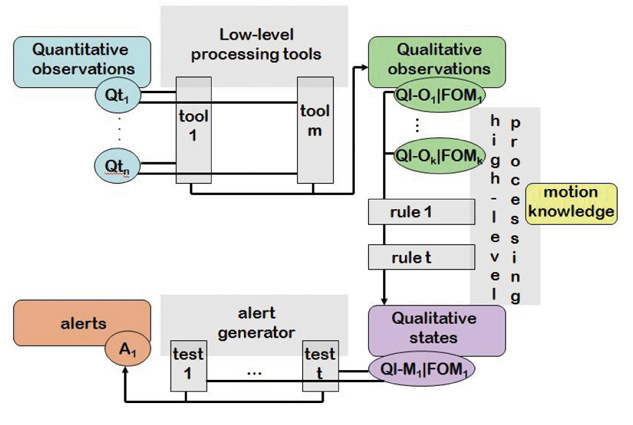
    Note that in this high-level processing approach, every model q(f,M) must be fed by values that are external to the process. These values help to fine-tune the adjustment of the model to the user carrying the device. In pedestrian navigation, values like step strength and time-to-step play a role in the walking model and fully depend on the individual’s way of walking. In IEGLO, the knowledge of the individual user is a key piece to properly perform qualitative-state estimation. The IEGLO approach is implemented architecturally to allow to input and removal of data about a specific individual’s motion habits. Figure 4 depicts the architecture of the kinesic behavior detection (KBD) module, the software platform where these qualitative navigation concepts have been implemented.
    figure_col_6  (Source: Pere Molina, Ismael Colomina, Markus Troger, Bernhard Hofmann-Wellenhof, and Carmen Aguilera)
    Figure 4. IEGLO KBD module architecture.

     Position Augmentation Tes

    To test the augmentation service, a test user terminal (TUT) has been specified and assembled. The TUT uses two identical GPS/EGNOS receivers, interfaces directly with the augmentation server, and processes the position response. One receiver has been configured to output GPS-only position information, the other to use EGNOS corrections for the position computation. The position of the GPS-only receiver was forwarded to the augmentation server. The EDAS/SiSNeT corrected position information was routed to the EDAS file database. In this manner, three different calculated positions of one point per epoch are available: GPS-only, GPS/EGNOS, and GPS/EDAS/SiSNeT (see Figure 5).
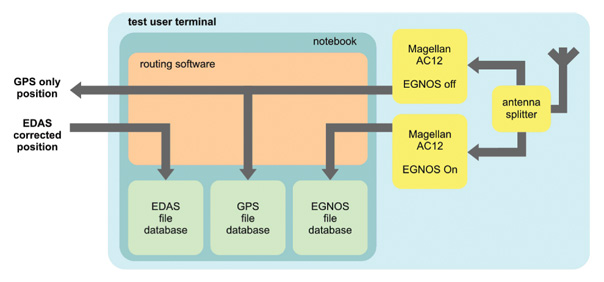
     Figure 5. Modules of Test User Terminal.   (Source: Pere Molina, Ismael Colomina, Markus Troger, Bernhard Hofmann-Wellenhof, and Carmen Aguilera)
    Figure 5. Modules of Test User Terminal.

    A low-cost patch antenna providing single-frequency (L1) output was used for the tests, connected to an antenna splitter. A notebook computer provided an interface to a GSM/GPRS module and to the receivers.

    An April 2010 test was conducted in the area surrounding an assisted living home. Figure 6 shows the number of satellites used for positioning during the measurement campaign. The area around the building was very hilly, so satellite signals were exposed to shadowing effects at the beginning and at the end of the measurements. The middle of the campaign had good satellite visibility.
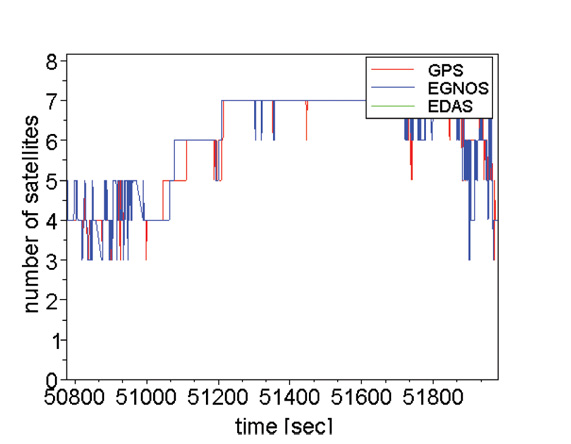
     Figure 6. GPS/EGNAS/EDAS: Number of satellites.   (Source: Pere Molina, Ismael Colomina, Markus Troger, Bernhard Hofmann-Wellenhof, and Carmen Aguilera)
    Figure 6. GPS/EGNAS/EDAS: Number of satellites.

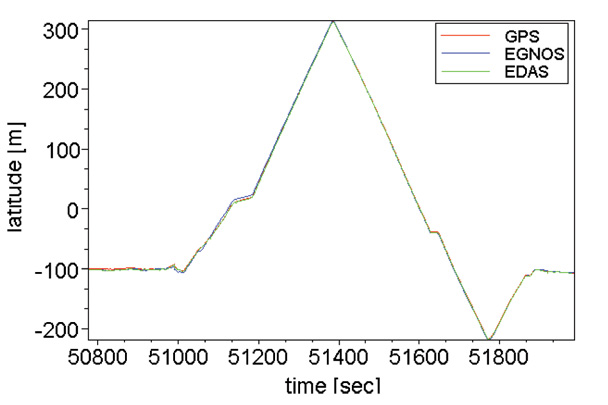
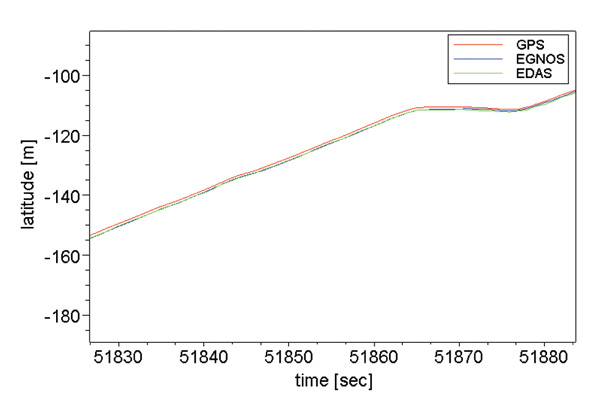
    Figures 7–11 show the user trajectory during the dynamic measurement. For better readability, longitude, latitude, and height values were reduced by the mean value of the corresponding coordinate. Therefore, the zero line in the y-axis of each plot symbolizes the mean value of the whole measurement. The same configuration is used for the five plots.

    Figure 7 demonstrates the good performance of the augmentation server concept regarding the height solution. The ionospheric delay, which can be corrected with the EGNOS signal, particularly influences the height component of the position. Thus, the potential of the EDAS/SiSNeT-based correction is seen in the height plot.
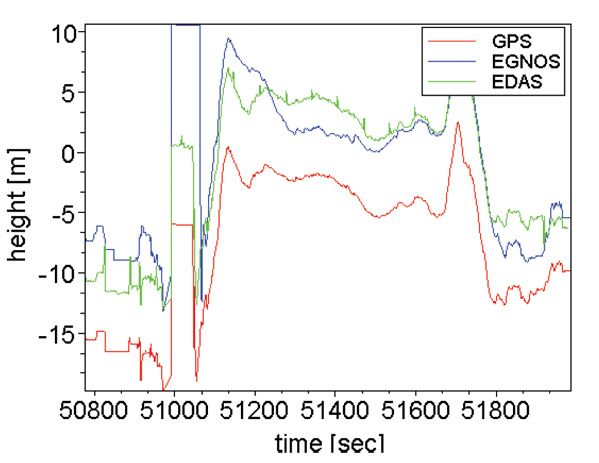
    Figure 7. GPS/EGNOS/EDAS: Height plot.   (Source: Pere Molina, Ismael Colomina, Markus Troger, Bernhard Hofmann-Wellenhof, and Carmen Aguilera)
    Figure 7. GPS/EGNOS/EDAS: Height plot.

    Figures 8 to 11 show the longitude and the latitude of the different solutions. Two plots of each coordinate were used: the first one shows the coordinates during the whole measurement, and the second one emphasizes the time interval between second 51820 and second 51890. Here, the EGNOS and EDAS/SiSNeT solution are very similar. In some other parts of the measurement, the EDAS/SiSNeT solution is closer to the GPS-only solution.
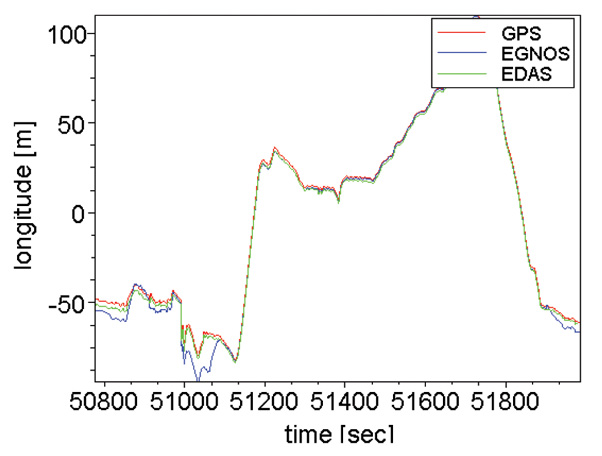
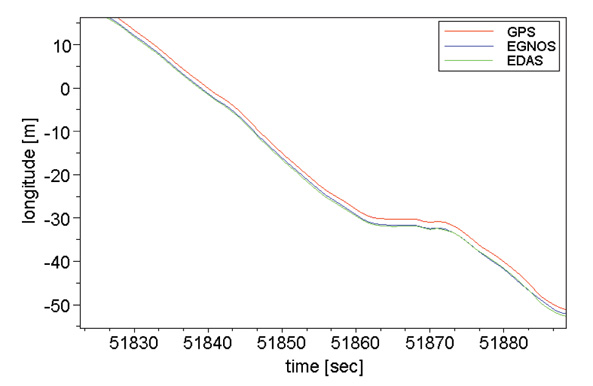
     Figure 8. Longitude overview for the GPS, GPS-EGNOS and GPS-EDAS position solutions.   (Source: Pere Molina, Ismael Colomina, Markus Troger, Bernhard Hofmann-Wellenhof, and Carmen Aguilera)
    Figure 8. Longitude overview for the GPS, GPS-EGNOS and GPS-EDAS position solutions.
     Figure 9. Longitude zoom for the GPS, GPS-EGNOS and GPS-EDAS position solutions.   (Source: Pere Molina, Ismael Colomina, Markus Troger, Bernhard Hofmann-Wellenhof, and Carmen Aguilera)
    Figure 9. Longitude zoom for the GPS, GPS-EGNOS and GPS-EDAS position solutions.
    figure_col_12   (Source: Pere Molina, Ismael Colomina, Markus Troger, Bernhard Hofmann-Wellenhof, and Carmen Aguilera)
    Figure 10. Latitude overview for the GPS, GPS-EGNOS and GPS-EDAS position solutions.
     Figure 11. Latitude zoom for the GPS, GPS-EGNOS and GPS-EDAS position solutions.   (Source: Pere Molina, Ismael Colomina, Markus Troger, Bernhard Hofmann-Wellenhof, and Carmen Aguilera)
    Figure 11. Latitude zoom for the GPS, GPS-EGNOS and GPS-EDAS position solutions.

    Note that during the whole test, the EDAS/SiSNeT solution was determinable, meaning that even during blockage of the EGNOS signal-in-space, a position augmentation was possible. However, the quality of position augmentation always depends on the quality of the GPS-only position. The test shows a diverse image of the performance of the augmentation server.

    • The functionality of the augmentation server could be shown.
    • All positions transmitted to the augmentation server have been processed and transmitted back in corrected form.
    • Some measurements clearly show the benefit of position correction of the augmentation server, where the EDAS/SiSNeT solution tends to the EGNOS solution
    • Some measurements show a better height solution than the GPS solution (Figure 7).
    • The quality of the augmented position strongly depends on the quality of the GPS-only position.
    • Any receiver only capable of processing GPS but not of EGNOS would benefit from the augmentation server concept.

    Collapse, Motionless, Walking Tests

    To validate the proposed qualitative navigation approach proposed, a test pattern was specially designed to test the KBD module for two different purposes. On one hand, and by definition, the test pattern should represent all the situations in which detection must be tested, that is, the defined qualitative states: collapse, motionless, and walking. At the same time, the test design should provide means to prove the KBD module resilient against these issues:

    False alarms: Users of similar systems have stated that false-alarm generation is the key problem of automatic-detection-based systems of any kind. False alarms are generated when a situation is misunderstood and treated as a undesired situation, causing the system to generate an alarm. In the IEGLO case, some situations such as sitting, walking up or down stairs, or picking up the phone are, motion-wise, similar to the collapse situation. Therefore, the test design includes sitting and picking up the phone, to assess KBD module robustness against false alarms.

    Initial Attitude. Many pedestrian navigation systems are constrained by the initial placement and/or attachment to the user. Some systems integrates gyroscopes, and therefore their initial attitude with respect to a person-relative frame needs to be known quite precisely. Other systems based on step detection and gait analysis rely on foot-mounted or hip-mounted accelerometers. The IEGLO approach, driven by the user needs of elderly people and Alzheimer’s patients, cannot assume such constraints. An inconspicuous, yet at the same time, familiar system is desired, and no specific initial attitude is required. Therefore, carrying the phone in a pocket (which turns out to be a preferred placement) shall be sufficient, and its actual initial attitude shall not be relevant.

    The test design shown in Figure 12 therefore consists of walking to Point 2, where a collapse situation and a motionless period lying on the floor are performed. After standing up, those actions are duplicated to reach Point 3. There, after standing up, the phone is taken out of the pocket and replaced upside down with respect to the previous attitude. The sequence is repeated to return to the start. Finally, the design leads to Point 5, where a sitting action is performed. After standing up, the end point is reached, and the phone is taken out of the pocket.
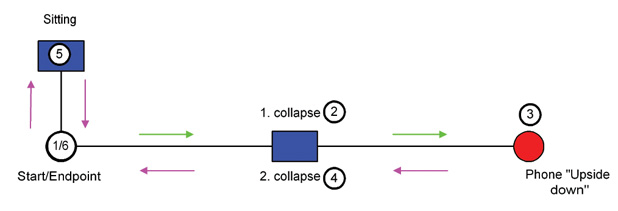
     Figure 12. Sample correlation function showing two peaks.   (Source: Pere Molina, Ismael Colomina, Markus Troger, Bernhard Hofmann-Wellenhof, and Carmen Aguilera)
    Figure 12. Sample correlation function showing two peaks.

    Data was collected on four tests. Basically, the inputs of the IEGLO KBD module show that the GPS trajectories are quite discontinuous and different among them. Different visibility conditions, eventual multipath, low-cost receiver performance, and phone position in the pocket are just some examples of causes for the GPS trajectories’ discontinuities. But in any case, these are the conditions that pertain in real use, and therefore draw a very realistic test frame.

    Estimation of Qualitative States. Each data acquisition is composed of 16 different possible qualitative states: two collapses, four motionless periods, five walking periods, and five other misleading situations (sitting, taking the phone out of the pocket).

    The KBD module estimates the collapse and motionless states perfectly; that is, there were no missed detections (thus no risk on the user’s side) and no false alarms (no risk on the system side) were generated during the execution of the KBD module in the four tests.

    For walking detection, two modalities were tested: the accelerometer-only detection and the combined accelerometer/GPS combination. The first mode used qualitative observations only, derived from accelerations, and the second mode used qualitative observations derived from both accelerations and GPS positions. In the first mode, 66 percent of the walking time was properly detected, with 2 percent of false alarms, and 32 percent of missed detections. The acceleration-only approach seemed to work well in very evident walking situations, but at the start or end of walking action, when there is a increase or decrease of motion, the approach was not able to capture a proper walking situation. Nevertheless, when GPS-based observations were used, the results improved up to 80 percent, and missed detections were reduced to 18 percent. Note that the walking state was the only non-distress situation. Therefore, missed detections in that case were definitely not critical for personal safety.

    Conclusions and Next Steps

    IEGLO uses GNSS technology as the main positioning method in caregiving applications. As healthcare assistance is not a core GNSS application, this potentially expands GNSS adoption.

    The combination of indoor/outdoor location technologies using mass-market off-the-shelf devices was the key innovation of the project. Different localization methods were used to obtain a reliable user position.

    During the project phase, the position augmentation server was used to enhance the GNSS positions on the server side. If signal blockages occurs or if the mobile units are not able to receive and process the EGNOS signal-in-space, position corrections can be still accomplished. Tests showed that augmented positions provide higher accuracies in the majority of measurements, particularly in the vertical dimension.

    With respect to qualitative navigation, the KBD module enhances the navigation domain to gauge user context in addition to user position. Some qualitative states were selected for the KBD as of particular interest for u
    ser requirements: collapse, motionless, and walking situations. Results show nearly perfect detection of the first two qualitative states and an 80-percent correct detection of the third.

    Further research on qualitative navigation should address the personal signature issue: it is of the utmost importance to determine the biometric characteristics of each user. Customizing the KBD for each user, can provide a deeper analysis of user motion and behavior, such as fatigue, leading to proactive prevention of distress situations.

    We may also anticipate GPS receiver improvements in smartphones, as navigation technology gets cheaper, smaller, and better. Potential improvements in walking detection may thus occur through reduction in the number of missed detections. Finally, it is of great interest to investigate other scenarios in which the KBD makes sense: indeed, motion analysis is of interest for many applications such as videogames and personal safety. User requirements must be gathered to contextualize such concepts and to determine KBD software modularity and extendibility.

    Acknowledgments

    This research received funding from the European Community’s Seventh Framework Programme (FP7/2007-2013) under grant agreement n226971.

    The authors thank all IEGLO consortium partners (OECON GmbH, Germany; PIAP, Poland; Tele+ Italia S.A.S, Italy) for their contributions, and a special mention to M. Eulàlia Parés for her work on the qualitative navigation concept and general support.

    Manufacturers

    The Magellan AC12 served as the GPS/EGNOS receiver in the tests.

    Pere Molina is a research assistant at the Institute of Geomatics in Barcelona, where he obtained an MSc in airborne photogrammetry and remote sensing.


    Ismael Colomina is the director of the Institute of Geomatics. He holds a PhD in mathematics from the University of Barcelona and is a mem-ber of the Editorial Advisory Board of GPS World.

    Markus Troger works for TeleConsult Austria GmbH as system engineer and project manager in positioning and navigation. He received a master’s degree in geomatics science from Graz University of Technology, Austria.

    Bernhard Hofmann-Wellenhof received his Dipl.- Ing. and doctoral degree from Graz University of Technology, where he is a professor of navigation and satellite geodesy. He is a founder and managing director of TeleConsult Austria GmbH.

    Carmen Aguilera is market development officer at the European GNSS Supervisory Authority. She holds a masters degree in telecommunication sciences.

  • Top Five Events in GPS/GNSS for 2010: A Year-End Review

    With this being my last column in 2010, I’m going to look back at the five significant GPS/GNSS events in 2010 that affected the surveying, mapping, engineering, construction, and natural resource users. Each of these had, or could’ve had, a significant effect on your GPS activities.

    These are listed in order of importance with #1 being the most important.


    1. GPS 24+3 constellation. The most important GPS/GNSS event in 2010 occurred back in January, when the Air Force announced it was implementing a new GPS 24+3 configuration. You can read about it in in more detail here, but the idea behind it was to eliminate GPS “brownouts.” These are periods in which there are fewer GPS satellites in view, and when combined with obstructions such as rugged terrain or trees or buildings, make GPS difficult to use.

    It’s especially an issue with real-time, high precision users (RTK) because RTK technology is satellite-hungry. It needs six or more satellites to provide a robust position solution.

    If you recall, in the new 24+3 configuration, there were three satellites moving significantly from their original slots (SVNs 24, 26 and 30). SVN 26 is already at its destination. SVN 26 is scheduled to reach it destination in January 2011. SVN 30 should have arrived at its destination in the past few days.

    In addition, three other satellites (SVNs 46, 55, and 56) are being shifted slightly. SVN 55 should arrive at its destination this month. SVNs 46 and 56 are scheduled to begin transitioning in January 2011 and should be complete in May/June 2011.

    By now, you should be seeing some improvements in GPS satellite visibility as the 24+3 configuration is almost complete. From the scenarios I plotted in this article, you can see that although you’ll see fewer peaks (high number of GPS satellites in view), you’ll also see fewer valleys (low number of GPS satellites in view). This should increase productivity for RTK users and users in environments where satellites signals are obstructed (such as under tree canopy).


    2. Launch of the first GPS Block IIF satellite. Although it doesn’t really help users at this point other than being another satellite to enter service, the Block IIF satellite launched in May is the first to broadcast the third civil signal, L5. The L5 civil signals marks the beginning of a new era in high-precision GPS positioning. The Block IIF launch was the catalyst for the article I wrote I entitled “What’s Going to Happen When High-Accuracy GPS is Cheap?

    It’s just a teaser though, the launch of the next Block IIF isn’t until next summer at the earliest. Then, the next one is ???. They are being launched at a snail’s pace. Remember though, it costs upwards of $200 million to launch a satellite and since there’s already 30+ operational GPS satellites in orbit, it’s hard for the U.S. Congress and the U.S. Air Force to justify speeding up the launch schedule. During the last Air Force briefing I attended, the target was to have 24 satellites broadcasting L5 by 2019.

    Block IIF GPS satellite (Courtesy: The Boeing Co.)

    3. Continued development of GLONASS. Despite the recent launch failure (three GLONASS satellites crashed into the Pacific Ocean), the Russian Federation was still able to launch six new GLONASS satellites into orbit in 2010, and with another launch scheduled for later this month of the new GLONASS-K1 satellite, that will test the new CDMA capability for better compatibility with GPS.

    As it stands, there are 20 operational GLONASS satellites in orbit, with four more offline for maintenance and two reserved as spares. That’s 26 total. Furthermore, after the Dec. 5 launch failure, Russian Federal Space Agency Director Anatoly Perminov vowed to return the GLONASS constellation to 24 operational satellites by March 2011, something that hasn’t been accomplished since the mid-1990s (albeit briefly).

    A consistent and healthy number of GLONASS satellites in orbit has given receiver manufacturers more confidence to develop GPS/GLONASS receivers. Just this year, we’ve seen new receivers from several manufacturers that have taken GPS/GLONASS a step further in integrating them into handheld receivers as well as OEM board products.

    For users, the benefits are clear, with the new 24+3 GPS configuration and a healthy number of GLONASS satellites in orbit, GPS/GLONASS users are seeing the most satellites in view ever in the history of GPS/GLONASS. Signals from more satellites typically results in more robust positioning and improved productivity due to decreased down-time.

    Rocket launch containing three GLONASS satellites


    4. Solar activity affect on GPS. Solar activity was eerily quiet in 2010. The big news is that there was no news. There were some minor solar events in 2010, but despite what you may have read, none of them were strong enough or the type that would affect GPS operations.

    So, if your GPS receiver didn’t work at times this year, it wasn’t due to solar activity.

    With the peak of the current Solar Cycle (SC 24) estimated to occur in May 2013, solar activity should be ramping up in 2011. In August, I conducted a webinar that discussed, among other things, the subject of solar activity on GPS. You can read a summary of it here and even download the webinar presentation.

    You can be sure I’m closely monitoring solar activity for any events that look like they will have an effect on your GPS operations. I’m still working on my notification system and will keep you updated on that. Otherwise, the GPS World website is a good source for news in this area.

    Finally, I’ll be attending the Space Weather workshop in April 2011. Most, if not all, of the really smart space weather people from around the world gather and confer on space weather. I’ll be writing about what I hear and learn from these folks. But, the sun is a mysterious creature. I like to get definitive answers to my questions, but even some of the brightest scientists I know will answer with “I really don’t know” when I ask them about a certain behavior of the sun. Mother Nature is humbling at times.

    Solar Cycle 24 Prediction (Courtesy: NOAA Space Weather Prediction Center)


    5. The GEO failures of GAGAN and WAAS. Both the Indian Space Research Organisation (ISRO) and the U.S. Federal Aviation Administration (FAA) were delivered a hard lesson in SBAS GEO satellite management. The SBAS GEO satellites are the ones that broadcast the integrity and correction information to users. They are the critical communications link that connects the SBAS ground infrastructure to the end users. Without them, SBAS doesn’t work.

    In April, the ISRO rocket launch of their GAGAN GEO satellite failed, sending the critical GAGAN GEO satellite splashing into the Bay of Bengal. GAGAN is still in testing phase, so no users were affected, but it set back the GAGAN program. However, it didn’t delay GAGAN as much as I thought it might. Another GAGAN GEO is set to launch later this month (as of December 29, the launch date has now been pushed out to Q1 2011) with a second due to launch in the first part of 2012. The ISRO completed its Preliminary System Acceptance of GAGAN just a few days ago. The aviation-certified system is expected to be operational by June 2013. As with other SBAS, test signals usable by non-aviation users will likely be available during the testing phase, as early as 2011.

    Also in April 2010, it was reported that the contractor operating one of the FAA WAAS GEO satellites lost communication with the satellite (PRN 135). It was reportedly an unprecedented event. Initially, it was thought that PRN 135 would drift out of usable orbit within a few weeks, leaving North America with only a single WAAS GEO until a new one was brought into service (PRN 133 was already under testing). Things weren’t quite as bad as they seemed as PRN 135 ended up staying in a usable orbit up until PRN 133 testing was concluded.

    However, the defunct PRN 135 was at 133° west longitude and PRN 133 is at 98° west longitude. With the remaining GEO (PRN 138) at 107° west longitude, users in northwest Alaska do not have WAAS service. Since none of the GEO satellites are actually owned by the FAA, they have little say in the location of the GEO satellite. The FAA says they are working on putting two more GEOs into service, but that takes time, and it’s not measured in months, but rather years.

    I think the hard lesson is not to skimp on SBAS GEO satellites. Perhaps this event will make it easier for the FAA to sell the concept to Congress (for funding).

    If you’re an SBAS user, don’t let this bring you down. SBAS is here to stay, and likely you were not affected by any of the above. These past few days, I’ve been looking at SBAS data (and DGPS data) collected over a 24-hour period. The accuracy and stability is pretty impressive.


    That leads me into my last subject which is a webinar I’m conducting on January 26, 2011.

    It’s entitled: SBAS, DGPS or Post-processing? Which Should You Use?

    If you are using or plan on using GPS for mapping or surveying, you should seriously consider attending this webinar.

    Learn the real story behind each of these technologies without a marketing or salesperson’s bias.

    Tens of thousands of users around the world utilize GPS/GNSS receivers for mapping, surveying and navigating. Since autonomous GPS/GNSS typically does not provide the needed accuracy, users must rely on a source of GPS/GNSS corrections. There are three sources of GPS/GNSS corrections available to users who desire reliable GPS/GNSS accuracy in the sub-meter to three meter range: SBAS, DGPS and post-processing. Dr. Michael Whitehead, VP of Technology at Hemisphere GPS, will join me in presenting a background on the three technologies as well as the strengths and weaknesses of each.

    I’ve known Mike for a number of years. He was an early innovator in the development of SBAS technology at Satloc as well as SBAS and DGPS receiver technology at Hemisphere GPS. He is one of the leading GNSS engineers in the world. I’m particularly excited about this event and promise a lively discussion that’s full of useful information, data, and concepts that anyone using or considering using GPS/GNSS for mapping, surveying, or navigating will find useful.

    Have a safe and happy holiday and a Happy New Year. See you next year.

    Click here to follow me on Twitter.


  • Rocket City GIS and I/ITSEC Conferences

    Two Seemingly Unrelated Conferences Linked by GIS and GISP

    By Art Kalinski, GISP

    In November I attended the Rocket City GIS Conference and the seemingly unrelated Interservice / Industry Training, Simulation, and Education Conference (I/ITSEC).

    Rocket City GIS

    The Rocket City GIS Conference was organized by Joe Francica of Directions Media. As Conference Chairman, Joe picked an impressive venue, the U.S. Space and Rocket  Center, Huntsville, Alabama. The facilities are quite extensive, housing the Saturn and other boosters, the shuttle, and countless historic artifacts including space capsules, space suits, and all manner of test equipment, even a real SR-71. The Rocket Center holds Space Camp for youngsters as well as a team-building program for adults and corporations.

    SaturnHuntsville is the home of the original rocket scientists led by Werner von Braun, and home to the NASA Marshall Space Center and Redstone Arsenal. The city has become an extensive technology center with the Rocket Center as a focal point. If you visit, plan on a full day to see it all.

    Although not a large assembly, the Rocket City GIS Conference was very well organized and the meeting facility at the Rocket Center was superb. The keynote speaker for the conference was David DiBiase, the director of the John A. Dutton E-Education Institute for the online GIS program at Pennsylvania State University. In addition, David is a URISA board member and president of the GIS Certification Institute.

    In his opening, David cited two interesting facts. First, according to Forbes magazine, Jack Dangermond, founder of ESRI, is the 164th richest person in the United States. Donald Trump is 153rd. Second, according to the Bureau of Labor there are now 857,000 geo-spatial employees in the United States with expected growth of an additional 350,000 over the next eight years. No one guessed the number was that high.

    In 2003 I was in the first group of GIS professionals to receive the GISP certification. Like many other GIS professionals, I participated in the planning and formulation of the GISP program. I felt that it would help hiring managers in the GIS community by identifying GIS professionals who had achieved a certain level of education and experience. I also felt that it would help URISA since the conferences and courses offered by URISA would take on greater importance as candidates looked to build their professional point totals. The program has proven itself over the past seven years, but some believe that it may need to evolve.

    David caused a bit of a stir by presenting his desire and others to have an exam for future GISP candidates. He indicated that his opinion was not shared by all board members, but there was a growing interest in the prospect. In 2002 we considered an exam as part of the GISP process, but the general consensus was that it would be impossible to come up with an exam that was comprehensive, fair, and a good indicator of a candidate’s qualifications. I’m not sure that the situation is much different in 2010, but I’d like to hear the pros and cons. Time didn’t permit that, and without further discussion I don’t have an opinion yet.


    I/ITSEC 2010
    The I/ITSEC conference was held in Orlando and is fairly large. As I reported last year, I/ITSEC continues to evolve from training and gaming technology to much more sophisticated modeling and mission-rehearsal technology. This is a large conference with participation by all the big players such as Lockheed, Boeing, BEA, Raytheon, Northrop Grumman, General Dynamics, and many others.
    VRSIM Display
    The Keynote speaker, Air Force General Edward Rice, summed up the prospects for the training and simulation community. Even with feared budget cuts, funding expectations looked good since modeling and simulation are proving to be so cost effective.
    Most of us think of flight simulators training pilots, and those are still key systems, but other skills are proving equally cost effective. The general cited fuel-boom operators as one example. There is a real art to operating an in-flight fueling boom, and it takes hours and hours to train operators. The new simulators are so realistic that 95% of training leading to qualification is done on simulators with only 5% actual in-flight time need to qualify operators.
    ESRI had a good-size booth demonstrating work of partners such as Precision Light Works 3D models and systems such as Geoweb 3d. The growing evolution from training to actual mission planning and mission rehearsal is driving the need for accurate geospatial data and GIS environments. It’s no longer good enough to just “look good;” the systems also have to reflect reality in a way that wasn’t even attempted a few years ago.
    As a retired naval officer and ship handler, I couldn’t resist testing the Navy bridge simulators by CSC. The navigation charts, GPS, radar, out-the-window graphics, physics, and response were dead-on accurate as I piloted a destroyer through Narragansett Bay. Even the small boat simulators by Kongsberg had hydraulic systems that simulated the motion of the small boat through moderate seas. The only thing missing was the salt spray in the face.
    Sythetic bodyRegrettably, realism of medical simulators had also evolved. They want medical personnel to get over the shock factor of real injuries so they can react efficiently during real emergencies. Some were so realistic with spurting blood and missing limbs that the exhibits were not for the faint-hearted. Here is an example of one company that manufactures realistic bodies to train surgeons.
    GIS is found in medial simulators as well. The spatial and topological tools of GIS are seeing their way into medical simulators that mimic the circulatory systems and other networks.
    At large conferences I always like to visit the small perimeter booths for two reasons. The exhibitors in the outlying sections generally don’t have the budgets that the big companies have, so I try to give them their money’s worth by providing some traffic and visibility. But more importantly, this is where the new technologies are being introduced and some of the booth are quite interesting. One example is this paint booth simulator by VRSim, Inc. The trainee holds a spray gun and wears a helmet with a 3D video display. Using the gun, the trainee sees paint being applied, but even more important, the simulated surface is mapped to later show how heavy the paint was applied. Red = too heavy, Blue = too light, Green = just right.

    Paint booth simulator by VRSim. The user holds a spray gun and wears a helmet with a 3D video display.
    Paint booth simulator by VRSim. The user holds a spray gun and wears a helmet with a 3D video display.
    The simulated surface is mapped to later show how heavy the paint was applied.
    The simulated surface is mapped to later show how heavy the paint was applied.
    Here again spatial data mapping is the basis for the system, and the cost to train an operator is a fraction of the real thing, not to mention wasted paint and fumes.
    Orator Plus, Inc. had as robust multimedia data fusion software that permits the simultaneous display of GIS, PowerPoint, video, live web links, imagery, etc. in one elegant environment that also has a common “whiteboard” annotations and sharing capability. The company even developed a portable hardware display to optimize its system. The display is a rear projection multi-touch screen of light-weight Plexiglas. It’s difficult to explain how nice the system works.  You need to see it in operation.
    Orator Plus's multimedia data fusion software permits the simultaneous display of GIS, PowerPoint, video, live web links, and imagery.
    Orator Plus’s multimedia data fusion software permits the simultaneous display of GIS, PowerPoint, video, live web links, and imagery.
    The second keynote speaker was Dr. R. Bowen Loftin, president of Texas A&M University. His degrees are in physics and he worked extensively for NASA developing virtual environments. His keynote topic was a desire by many to create a certification system / institute for modeling and simulation professionals. This sounded a lot like our GISCI and the GISP program.
    I spoke with Dr. Loftin briefly after his session to see if he was familiar with our GISP certification program.  He was and had used it as one example for discussions.  I later thought to myself that the one advantage we had with the GISP program was our starting point. Although the GISP qualification was not ESRI centric, the common ESRI environments that most of us were operating in created a sense of community and a good foundation for GISP.  There is no such common operating environment for the Modeling and Simulation people, not even close.  There are many competing companies with no over-arching system, which is a big hurdle.  Wait until someone suggests a qualification exam.


  • Dude, We’re Working in the Cloud

    Last week, I wrote about the unpredictable software development landscape for tablet computers and smartphones. The iOS (iPhone/iPad) has firmly established its presence, Android is picking up steam like locomotive, and Windows Phone 7 is making its debut.

    I heard from a few readers. One in particular was an employee in a larger enterprise. He bent my ear about “working in the cloud.” He said their office apps were all heading towards being cloud-based, and he suspected that mobile GIS apps were headed that way, too. Essentially, he said that if your tablet or smartphone or whatever runs a compatible web browser, you’re ready for mobile GIS.

    “Dude, we’re working in the cloud.”

    That said, let’s cover the basics…


    What Is “the Cloud” and Where Is It?

    The cloud is essentially internet servers (computers) that run the applications your computer uses. These servers reside at companies that offer cloud services. Users connect to those servers via the Internet. For example, instead of installing Microsoft Office on your computer, you would access Microsoft Office applications on the cloud servers using your web browser. All you would need on your computer is a compatible web browser. Essentially, it’s off-loading the IT tasks to someone else. There’s no need to install application software on each desktop computer. With cloud computing, a lot of IT department overhead just disappears. In a true cloud environment, all of your apps reside on servers similar to the diagram shown below.

    Source: Wikipedia.org

    Some of you may be working in “the cloud” already with some of your apps. In my case, the vast majority of the apps on my computer are resident on my computer (I installed them). However, I’m writing this article with an app running in the cloud. I’m not even sure where the server is located. I connect to the cloud server(s) and log in using a standard web browser (Google Chrome at the moment).

    I’m still uneasy with using cloud computing.

    In my limited experience, I’ve had a few negative experiences:

    1. The application responsiveness is dependent on Internet connection and cloud server capacity. I’ve experienced occasions where the app was running very slow (especially when integrating images) due to the server capacity and/or my Internet connection speed. It’s even worse when I’m accessing the Internet using my wireless data card while traveling.
    2. I’ve had occasions when I’ve accidently pressed the wrong key on my keyboad and the application backed up to the previous screen, losing my work.
    3. I’ve accidentally used the web browser running the app to perform a Google search, again losing my work.

    In all fairness, I think #2 and #3 are a function of the app software rather than cloud computing. It should have an “Are you sure?” warning before taking the user away from the app screen.

    Another major concern is information privacy. With cloud computing, every keystroke is sent out into Internet land. That makes the hairs stand up on the back of my neck. Now, I’m sure cloud app providers like Microsoft and Google have thought this out pretty thoroughly, but I’m still hesitant about this. A New York Times article published in 2009 summarized my attitude the best: “Don’t put anything in the cloud you wouldn’t want a competitor, your government, or another government to see.”

    Lastly, the pricing structure is much different than purchasing a CD with your application(s). Cloud computing typically charges a monthly per user fee. For example, Microsoft Office 365 (targeted at small businesses) is US$6 per month per user.


    How Is Cloud Computing Going to Affect GIS Data Collection (Mobile GIS)?

    The readers who contacted me in response to last week’s article all believe that cloud computing will dominate mobile GIS in the future. For the most part, they said that the operating system of the device, whether it’s iOS (Apple), Android (Google), or Windows Phone 7 (Microsoft), won’t be a major factor as long as the smartphone (or other mobile device) can run a web browser. Notice I haven’t mentioned BlackBerry much. I’m not sure they are a long-term player in this game.

    Esri has already made its push into GIS cloud computing with its introduction of arcgis.com earlier this year, and then subsequent introductions and updates of its iOS ArcGIS app and API and plans for an Android app, and I imagine, Windows Phone 7, too. Cloud computing was, obviously, a major topic at the Esri International User Conference last summer.

    I believe there will be many, many GIS apps for smartphones. It’s hard to debate that. One of our readers, Larry Evans, manages the GIS unit, among other things, for the State of West Virginia Department of Environmental Protection. He also teaches undergraduate- and graduate-level courses on GIS at Marshall University.

    Larry was kind enough to send some compelling slides from his course that illustrate the emerging smartphone boom. It’s no secret, but certainly makes one think about where we will be in five years with respect to mobile GIS.

    Mobile Devices: Next Computing Cycle? (Courtesy: Larry Evans)


    Wireless data growth (Courtesy: Larry Evans)


    Mobile data growth (Courtesy: Larry Evans)


    New Kids in Town (Courtesy: Larry Evans)


    Larry writes:

    The one thing I’m certain about in all this is that as the mobile side technology matures we’ll see much more powerful mobile apps that bridge that gap to professional mapping/surveying. As mobile begins to tap better into the potential of sensory networks, things get really interesting in a hurry. Future GPS chips, as we all know, will be an order of magnitude more accurate because of the greater number of SVs (GPS satellites) overhead and our ability to improve antennas and receiver sensitivities. I seem to recall you did a great little write-up of that not long ago. To sum up where my head’s at, I guess I’m in the “they will build it and it will come” camp on professional geospatial apps. Once I have the tools, then I’ll build my own solutions customized for the kinds of things I want to do geospat
    ially.

    While I’m sold on the fact that mobile GIS apps will experience tremendous growth on smartphones over the next few years, I’m not so sure about professional geospatial apps like ArcPad, TDS Solo, Carlson SurvCE, Trimble Terrasync, Topcon Topsurv, CMT Field CE, etc. I’m not convinced for a couple of reasons.

    First of all, the market size for those apps is really not very big, which makes it difficult to justify the development cost of moving to an iOS or Android. However, the bright spot would be Windows Phone 7, because that would be a migration of software (Windows Mobile to Windows Phone 7) rather than a rewrite.

    Secondly, smartphones aren’t going to eliminate the industrial handheld data-collector market. Data collectors from TDS/Trimble, Juniper Systems, Handheld, Getac, Leica, Topcon, etc., will still have a place in the professional geospatial fields such as forestry, surveying, engineering, GIS, and construction. In those applications, smartphones are not robust enough (physically) to be trusted when a hardware failure can cost thousands of dollars in lost data and/or productivity.


    Webinar (January 26, 2011): GPS SBAS, DGPS or Post-processing? Which One Should You Use?

    If you are using or plan on using GPS for mobile GIS, you should seriously consider attending this webinar.

    Learn the real story behind each of these technologies without a salesperson’s bias.

    Tens of thousands of users around the world utilize GPS/GNSS receivers for mapping, surveying and navigating. Since autonomous GPS/GNSS typically does not provide the needed accuracy, users must rely on a source of GPS/GNSS corrections. There are three sources of GPS/GNSS corrections available to users who desire reliable GPS/GNSS accuracy in the sub-meter to three meter range: SBAS, DGPS and post-processing. Dr. Michael Whitehead, VP of Technology at Hemisphere GPS, will join me in presenting a background on the three technologies as well as the strengths and weaknesses of each.

    I’ve known Mike for a number of years. He was an early innovator in the development of SBAS technology at Satloc as well as SBAS and DGPS receiver technology at Hemisphere GPS. He is one of the leading GNSS engineers in the world. I’m particularly excited about this event and promise a lively discussion that’s full of useful information, data, and concepts that anyone using or considering using GPS/GNSS for mapping, surveying, or navigating will find useful.


    Geospatial Solutions Weekly holiday schedule

    We won’t be publishing the Geospatial Solutions Weekly newsletter for the next two weeks. The next issue will be emailed to you the week of January 3, 2011. However, we will continue to post news items on our website and I will continue to “Twitter” when I come across something interesting.

    Have a safe and happy holiday season.

    Follow me on Twitter at http://twitter.com/GPSGIS_Eric

  • Location Privacy Is Heating Up

    Last month, the Management Association for Private Photogrammetric Surveyors (MAPPS) issued a position letter to the Federal Communications Commission (FCC) urging the FCC to “use extreme caution and not implement any enforcement or broad regulation that would have a harmful affect on the broad private geospatial community.”

    The concern MAPPS has is valid and I support their position stated in their letter.

    MAPPS references an Associated Press article published November 10 that states that the FCC is investigating Google’s activities, including photographing neighborhoods for its Street View mapping feature.

    Google Street View

    The MAPPS announcement also references H.R. 5777, introduced in Congress earlier this year, according to MAPPS. If it is passed, MAPPS is concerned it would create “havoc in the geospatial marketplace and community.”

    The issue of location privacy is not a simple one. In fact, it’s a complex subject that has far-reaching implications. To compound the issue, it’s a highly technical subject that easily exceeds the capacity of the average state/federal legislator and administrator to understand. Therefore, they will rely on legislative assistants, industry folks, and lobbyists to guide them. That being the said, it’s important that the professional geospatial folks have a chair at the table.

    Notice I wrote “professional” geospatial folks. I did that intentionally. The reason is because surveying, GIS, engineering folks, and other people who create, manage and/or use geospatial data in the course of their daily professions will be affected by the fallout of legislative action taken in this area. In short, we will become collateral damage in a much larger battle.

    Whether you’re an engineer, surveyor, GIS professional, county planner, or CAD technician, the geolocation privacy battle being fought has nothing to do with what you do for a living. The privacy issue would be easy to address if it was only just one or two companies that need an attitude adjustment. However, that’s not the case. The big kahuna is LBS (location-based services).

    I’m super-excited about LBS applications. At least for me, I think it has a tremendous potential to make my life a lot more efficient and productive. Just think of what GPS and digital maps has done for you in the last five years. Getting lost is a thing of the past with your trusty Magellan/Garmin/TomTom on the dashboard. I don’t know how to calculate the number of hours it has saved me (and my wife) since I started using GPS navigation on a daily basis in 2004, but I know the number is big and I know hundreds of dollars I’ve spent on GPS navigation devices has paid for itself easily a hundred times over.

    Given that, I start salivating when I think of how a new breed of LBS apps will provide me new tools to help manage my life more efficiently. For me, the value is connecting my friends/family and my stuff. I’ve got a wife and four kids, with three of them playing school sports and one in college. Being able to text message them helps, but that requires an action on their part. If they’re in class, at practice, at home, out with friends, etc. and don’t see the text message (or there’s a delay in the wireless network), I don’t hear back. Being able to know where they are, without action on their part, is worth a lot to me. Ok, I realize you may think I’m a control-freak of sorts, but actually I’m far from it. I’m more of an efficiency-freak. I’m consistently over-committed and always looking for ways to save time, and I see LBS apps as huge time-savers.

    I wrote an article about the value of LBS to me (and privacy) earlier this year, and then a couple of months later I wrote an article after some idiot stole my car. If I’d had my car wire up with an LBS app, it would have saved me a lot of time and grief and would have provided a lot of satisfaction in seeing the thief in handcuffs. LBS goes way farther than connecting people and tracking my stuff. In fact, we don’t understand how far it’s going to go yet.

    One example is a technology called augmented reality. I’ve written about this in the past. From the safety aspect alone, it’s a tremendous technology. Look at this video from General Motors. Location is only part of the solution, but it’s a critical part and goes way beyond what the GM video discusses. Think about if a spatial database was accessible and you would be warned of accident-prone intersections or dangerous curves ahead of time via the Head-Up-Display (HUD). In a more efficiency-oriented application of augmented reality, check out this video from BMW.


    For those of you who enjoy shopping on Black Friday (the day after Thanksgiving), this year you could have used an app from Dealmap.com on your iPhone or Android phone to access a map of deals at more than 52,000 retail store locations.

    Dealmap.com Android app

    Ok, enough said about the up side of LBS apps.

    Of course, the core technology behind LBS apps is the L word: location. The apps generally make decisions based on where you are. If you’re driving down the street, a coupon may pop-up on the screen of your phone for a fast-food restaurant you are approaching, or a map might be displayed on your phone of all the bargain prices of LCD TV’s within three miles of your current location.

    This type of technology frightens people a lot. They assume that if their phone knows where they are, someone is watching. It really depends on what kind of app is running on your phone.

    Stealing from the article I wrote last February:

    Of course, a major concern by regulators and potential users is how personal location information will be used by the LBS application software. Will this be just another way that your personal information will be collected and sold to spammers? In addition to spammers, do you really want your family/friends knowing where you are 24/7? These are not unreasonable concerns.

    I don’t worry about privacy with LBS applications and I’ll tell you why.

    There is a lot of hyper-sensitivity about privacy with LBS applications (House congressional hearing
    this week on the subject) so I think LBS software vendors are well aware that a line has been drawn in the sand and a sort of zero-tolerance policy has been established. Secondly, leading LBS companies were involved with CTIA (The Wireless Association) in developing a document titled “Best Practices and Guidelines for Location-Based Services,” so they are intimately aware of the privacy issue.

    There are two guiding principles in the Best Practices guidelines mentioned above:

    1. LBS providers must inform users about how their location information will be used, disclosed, and protected so that a user can make an informed decision whether or not to use the LBS or authorize disclosure.
    2. Once a user has chosen to use an LBS, or authorized the disclosure of location information, he or she should have choices as to when or whether location information will be disclosed to third parties and should have the ability to revoke any such authorization. Read the entire CTIA Best Practices guideline here.

    The Final Analysis on LBS Apps

    One consideration I will give when subscribing to a LBS app in the future is to make sure I subscribe either through my wireless service provider (Sprint, AT&T, Verizon, etc.) or through an established, reputable LBS app provider. This kind of due diligence is no different from when you consider purchasing an application for your personal computer. Common sense tells you not to download an app from Nigeria. You’ll need to practice the same diligence when selecting an LBS application.

    I also wouldn’t consider an LBS application where I don’t have the opportunity to control my personal network of people who are granted access to my current whereabouts. In fact, I’d want the ability to shut off broadcasting my location altogether. Again, I think that any mainstream LBS application will have these features due to the high-profile sensitivity to privacy.

    I know the LBS applications are already available to accomplish the people-connecting that I want. But, like I wrote earlier, I don’t live on the bleeding edge of technology. I live a step back from the edge. I wasn’t the first to join Facebook (although I’m glad I eventually did) and I won’t be the first to run a people-connecting LBS application, but there’s no doubt in my find that it will eventually be an important tool for me and, most likely, you, too. The upside is just too big to ignore.

    What about the Geospatial Professional?

    I think it’s very important that the geospatial professional, whether a surveyor, an engineer, a GIS’r, or a CAD technician, not be loaded up with unreasonable liability by the FCC or other governing body as a result of the fall-out from LBS apps. It will be very easy for legislators (and voters), who are uneducated on this matter, for geospatial professionals to be tossed into the LBS barrel.

    This subject had me thinking about a measure that voters just passed in the State of Oregon. The title of the measure was “Requires Increased Minimum Sentences for Certain Repeat Sex Crimes, Incarceration for Repeated Driving Under Influence.” Of course, like privacy, this is a very emotional issue. Given the title of the measure, without further study, most people would vote in favor of such a measure. Who wouldn’t? With further study, you might find it wasn’t such a good measure to pass into law (it passed). This opinion piece ran in the Portland newspaper, The Oregonian, and spells out why it’s not such a good idea. Among other things, there’s collateral damage.

    Likewise, the public and the industry can’t afford for geospatial professionals to be swept into the privacy dustpan with LBS apps.
    Thanks, and see you next week.

    Follow me on Twitter at http://twitter.com/GPSGIS_Eric

  • Down and Deep

    More Satellites, More Sensors Take Urban Navigation Downtown and Deep Indoors

    By Frank van Diggelen

    As we all know, GPS is practically perfect in every way — as long as it’s outside and unobstructed. Even cell phones can now produce meter-level accuracy under open sky. There are still many deficiencies in state-of-the-art location, particularly in deep urban canyons and inside large buildings. Which technologies will lead personal navigation into the future?

    As we all know, GPS is practically perfect in every way . . . so long as it’s outside and unobstructed. Even cell phones can now produce meter-level accuracy under open sky. And, with Assisted GPS (A-GPS), those cell phones have mitigated the two great deficiencies of the original GPS: slow time to first fix (TTFF), and outdoor-only operation. A-GPS receivers can produce TTFF as fast as one second after a cold start, and (sometimes) work indoors.

    However, there are still many deficiencies in the state of the art of location, particularly in deep urban can yons and inside large buildings. In the latter you will soon notice that even if your A-GPS operates in your house, it does not operate everywhere. The term “indoor GPS” is rather like “off-road vehicle”: your four-wheel drive may let you cruise down the beach, but you certainly cannot use it to climb every mountain nor ford every stream. Similarly “indoor GPS” denotes the presence of a capability — not the absence of all limitations.

    And so what is the future of urban and indoor navigation, and which technologies will prevail? The short answer is: more satellites and more sensors. In this article we’ll look at the technologies that will move us from the era of GPS-only into the future of GPS-plus.

    Source: Frank van Diggelen
    This is Manhattan.
    Source: Frank van Diggelen
    This is Manhattan on Wi-Fi.

    Other GNSS

    The most likely addition to GPS will be the other global navigation satellite systems, and all GPS receivers will be replaced by true, multi-system, GNSS over the next two to three years. Not because this will ever fully solve indoor location, but because of the outdoor problem in deep urban canyons.

    When asked why he wanted to climb Everest, George Mallory famously said “because it is there.” Of the various GNSS systems, those with the most influence in the next few years will be GLONASS, because it is there, and QZSS because (as Mallory might have added) it is high. The first QZSS satellite recently began functional transmission. So let’s use QZSS as an example of why extra satellites are so important in the deep urban canyon.

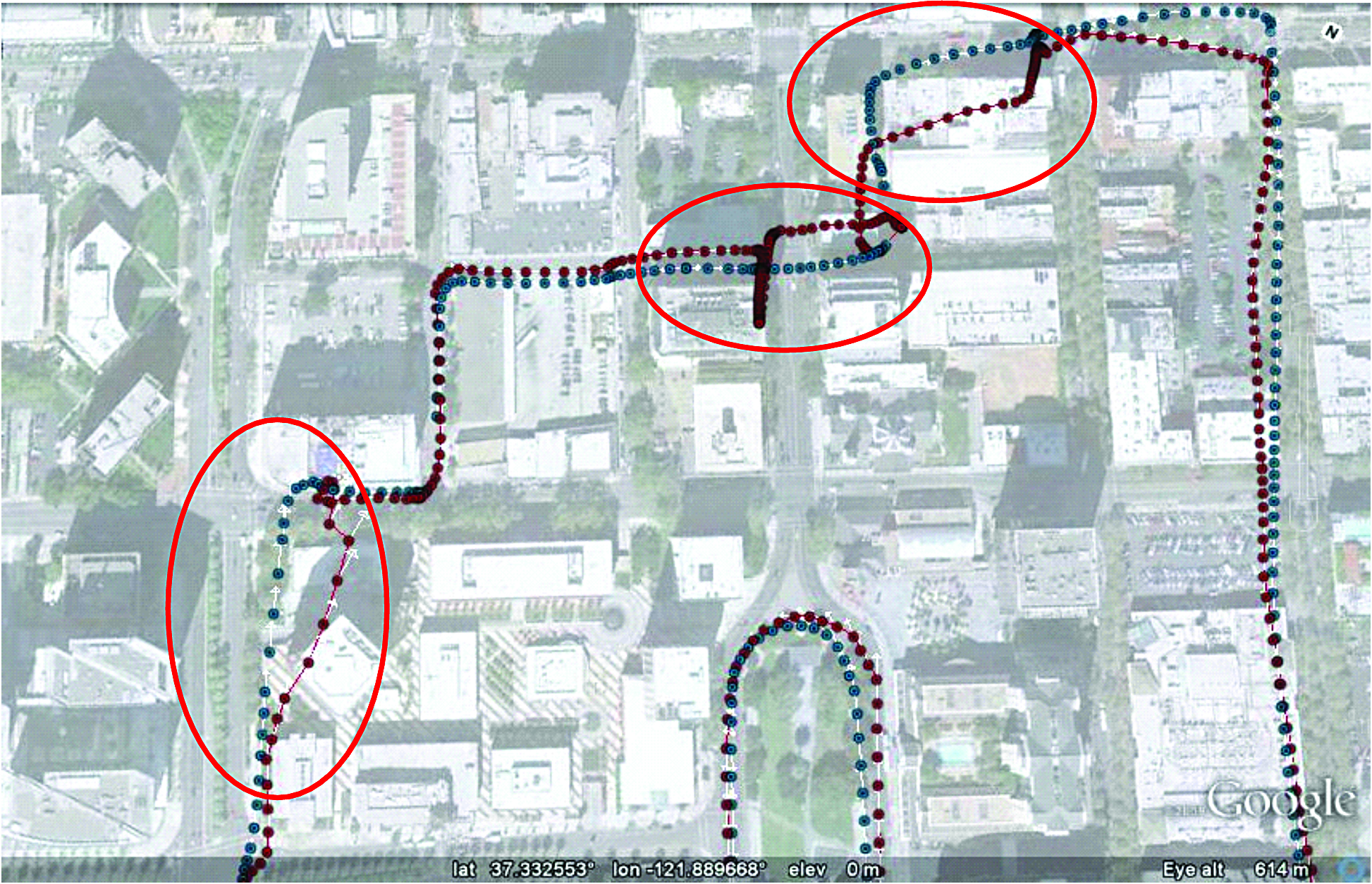
    Figure 1 shows Shinjuku, Japan, a typical deep urban canyon and a terrible place for GPS. The blue dots show the positions of a GPS receiver. The white and orange lines show the actual line-of-sight vectors to the GPS satellites. The white lines are to GPS satellites in direct view. The orange lines are to satellites behind buildings. However, the high-sensitivity A-GPS receiver tracks all these satellites, by acquiring and tracking reflected signals. Thus the whole concept of GPS — of measuring distance by time-of-flight — breaks down. The reflected measurements are inaccurate because of the extra path length. And even if the receiver could somehow tell orange lines from white, the horizontal dilution of precision (HDOP) of the white-only lines is 58 in this real-life example. Now add two high-elevation satellites, shown by green lines, and things are much better. The green lines show the location of two QZSS satellites, and the HDOP of the five green + white satellites is 3.

    Figure 1 shows the problem of the deep urban canyon, and the value of extra satellites. The problem is that there are not enough satellites in direct view. This puts receiver designers in an insoluble dilemma: Track only strong satellites, and you will not have enough; or track weak satellites, and you will measure reflections with large measurement errors because of the extra path length of the reflection. Moreover, the reflected signals can be indistinguishable from direct signals in their characteristics, especially in mobile phones where the antennas are poor, and directional — so that signal strength is not a reliable indicator of whether a signal is direct or not.

    This example should put to rest the false notion that extra high satellites will not improve HDOP. In this case the HDOP improves by about 20 times, from 58 to 3. It is easy to find many similar examples using GPS + GLONASS or any other GNSS combination. More often than not, extra satellites improve the situation significantly.

    The QZSS system uses inclined geostationary orbits to provide high elevation coverage above Japan (and, as a by-product, neighboring regions.) In this respect it is unique amongst the major GNSS: it is exclusively designed to provide good urban coverage of its home region. Compass has a similar component, but ultimately it, like GPS, GLONASS, and Galileo, has global ambitions.

    Some other satellite systems, such as satellite radio, use inclined geostationary orbits like QZSS. With QZSS providing an alternative example of a new GNSS, European taxpayers might well ask why Galileo should provide medium-Earth orbit satellites that spend more time over America and Asia than over Europe. As a U.S. taxpayer, I’m all in favor of the current Galileo plan — after all, the United States has been sending GPS satellites over Europe for the last 30 years, so a little reciprocation seems only fair.

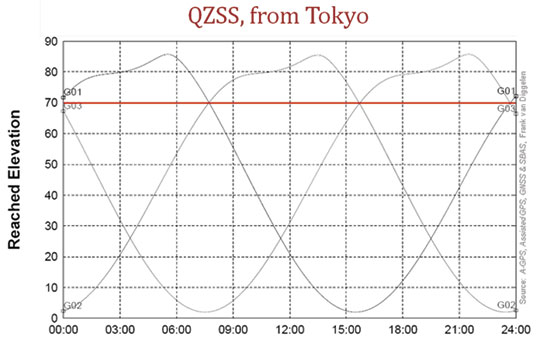
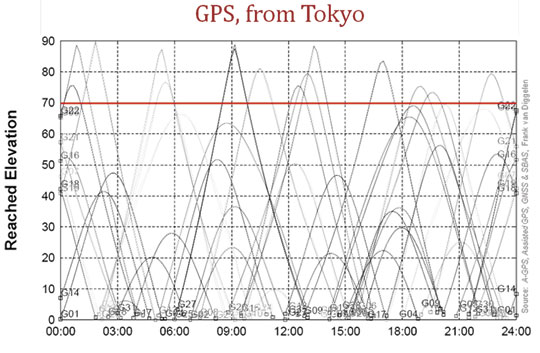
    Figures 2 and 3 show how the three satellites of QZSS provide better high-elevation coverage over Tokyo (and neighboring regions), than all of the 30 GPS satellites combined.

    QZSS-capable chips are already found in mobile phones and tablets available in the Asian market. As this article was being written, a Broadcom BCM4751 chip in Tokyo was computing the first-ever GPS+QZSS position.

    Source: Frank van Diggelen
    Figure 2. Elevation above horizon of the QZSS satellites, as seen from Tokyo. Note that the inclined-geostationary orbits of the QZSS system have been designed so that there is always one satellite above 70°.
    Source: Frank van Diggelen
    Figure 3. Elevation of GPS satellites as seen from Tokyo. About half the time none of the 30 GPS satellites is above 70° elevation, a quarter of the time one GPS satellite is above 70°, a quarter of the time two GPS satellites are, and for half an hour three GPS satellite are. The three satellites of the QZSS constellation provide better high-elevation coverage in Tokyo than the 30 GPS satellites.

    Wi-Fi

    After GNSS, the second-leading location technology is wireless local area networks, commonly known as Wi-Fi. Wi-Fi location works by using a database of media access control (MAC) addresses and locations. When a mobile device senses a Wi-Fi access point, the MAC address and database give the location of the access point (AP). A simple average of many APs gives position accurate to tens of meters.

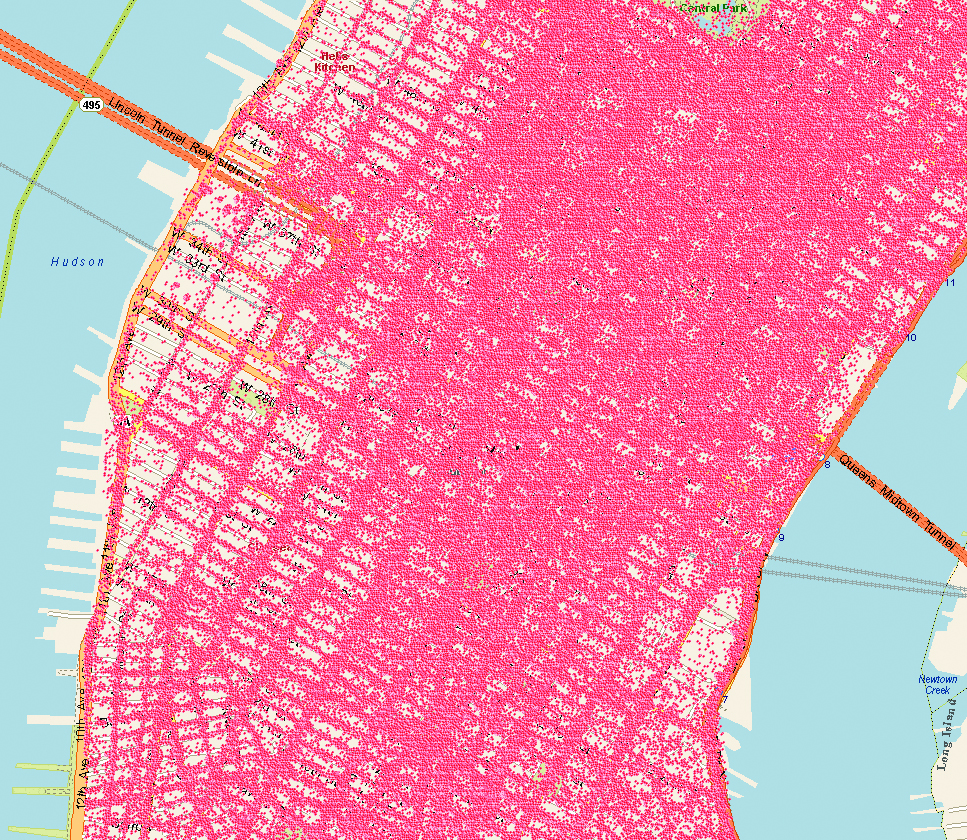
    Wi-Fi location is already tightly integrated with GPS in many smartphones. Wi-Fi location accuracy is good enough that it is often mistaken for GPS, especially in cities where the density of APs is large. In Manhattan, for example, there are more than 25,000 APs per square kilometer (see opening figure.)

    Several major companies, including Apple, Broadcom, and Google, have worldwide databases of Wi-Fi AP

    locations that are used in mobile devices, especially smartphones and tablets.

    MEMS, Accelerometers, and Gyros

    The micro-electromechanical systems (MEMS) technique etches the silicon on a chip to exploit its mechanical and electrical properties. A MEMS chip, such as a chip-level accelerometer or rate gyro, thus has tiny moving parts that can sense acceleration or rate of turn, respectively. Both sensors are already common in smartphones, where they are used to set the correct screen orientation (portrait or landscape), and for gaming. Because they are already there, they are a natural addition to location technologies, and many companies are moving rapidly to integrate motion sensors with GPS for improved accuracy indoors and in urban canyons.

    As an example of the benefits of MEMS motion sensors, Figure 4 shows a test case where GPS was deliberately degraded by denying it the high direct-view satellites discussed earlier, and then adding nothing but low-cost MEMS sensors.

    Source: Frank van Diggelen
    Figure 4. GPS-only positions and GPS + MEMS. The red circles show where poor GPS-only performance was dramatically improved by the addition of low-cost MEMS accelerometers and rate-gyros such as those already found in certain smartphones and PNDs.

    Magnetic Compasses

    Like accelerometers and gyros, magnetic compasses are already found in many smartphones. The technology is rapidly evolving, and different techniques are used by different suppliers to determine magnetic north, including Hall effect sensors, fluxgate compasses, and MEMS. Performance is dramatically affected by nearby metal and severely affected by magnets. You may not think that you are surrounded by magnets, but you are — especially in your car where every speaker of your sound system is a magnet — and the better the speaker, the larger the magnet. Thus magnetic sensors alone are not a reliable location technology, but integrated with other sensors, such gyros or accelerometers, they can be and are very useful, especially for pedestrian applications.

    Altimeters

    Altimeters are another MEMS technology. Typically a hermetically sealed cavity on the chip is used to measure change in atmospheric pressure — the surface of the cavity is deformed as the outside pressure changes, and the deformation can be measured using piezoelectric strain gauges. The integration of altimeters with GPS is already well established for such applications as hiking receivers. Similar integration is likely in other consumer devices, especially smartphones.

    AFLT, MRL, and Cell-ID

    The three cellular-wireless technologies of AFLT, MRL, and Cell-ID are all components of A-GPS.

    AFLT (Advanced Forward Link Trilateration) is a technique used in CDMA phone systems, where the cell towers are precisely synced to GPS time. Because of this precise time synchronization, one can use the cellular signal to measure range from the cell tower, using time-delay just like GPS. CDMA phones with GPS are usually using AFLT when providing position indoors.

    MRL (Measured Results List), is the UMTS analogy of AFLT for non-synchronized systems. The MRL provides a list of neighboring cell towers and received power. Received power is used to estimate range, and from this, position. Accuracy is not nearly as good as AFLT, but can be decent, especially in cities where accuracy may be better than 100 meters, good enough for emergency location applications such as E-911.

    Cell-ID is simply the technique of looking up location in a cell ID database. This is analogous to Wi-Fi location, but not nearly as accurate since cell tower ranges are much greater than Wi-Fi. However, although perhaps the least exciting, this technique is the foundation of many important technologies. The AFLT and MRL techniques require Cell-ID as a necessary component. A-GPS usually uses Cell-ID for providing the assistance position, a necessary component of the high sensitivity that A-GPS provides. And Cell-ID alone is necessary for E-911 location, when A-GPS fails.

    Digital TV and Radio

    Location from digital TV works by measuring ranges from DTV towers, analogous to GPS and AFLT. However, DTV towers are not precisely synchronized to each other, and so DTV location requires the build out of fixed site infrastructure to deal with individual tower clock offsets.

    DTV location is in a way the opposite of Cell-ID. While Cell-ID is intellectually boring, the technique is practically very important and widely used. DTV, by contrast, is an exciting idea, because it can be accurate like GPS but with much more powerful signals. However, it has been a commercial failure.

    DTV location, or related technologies, may enjoy a resurgence in the future once mobile TV or digital radio (HD Radio and DAB — digital audio broadcasting) become more widely adopted.

    Pseudolites

    Well known to precison-location cognoscenti, pseudolites provide GPS-like signals from ground-based transmitters. They typically use a transmit frequency that is offset from GPS, but otherwise their signals are like GPS so that they can be used with a receiver with the same baseband as GPS.

    Pseudolites can be very accurate, as good as five centimeters when using carrier-phase measurements. They require local, fixed transmitters which are fairly sophisticated (since they must maintain time and phase coherency to work properly.) This makes them prohibitively expensive for widespread applications. However, pseudolites are highly valued and widely used in niche markets, and will probably remain so.

    IMES and Local Beacons

    IMES stands for indoor measurement system, and it, or something like it, could be the most interesting new location technology of all. IMES is a local-beacon system — it works by providing a very weak signal that is exactly like GPS, but is meant for data-transmission only, not ranging. Thus it is fundamentally different from pseudolites, which are designed for ranging. The power of each IMES transmitter is so low (0.1 to 0.4 nanowatts) that it can only be acquired within about 10 meters of the transmitter. The signal is modulated with a PRN code (PRN numbers 173 to 182) and data: the data contains the location of the transmitter. The system technology may be summarized as “if you can hear me, here you are.” And the accuracy is inherently about 10 meters.

    A fascinating detail of the IMES data message is that it contains (in message type 000): latitude, longitude and floor number.

    IMES is designed to work with any GPS receiver that can decode PRNs 173 through 182. And, because they are not intended for ranging, the transmitters do not have to be precisely synchronized with GPS or with each other. This makes them cheap to build and install. However, they do still need to be deployed in large numbers (at least one every 10 meters), and will require a government-sized effort to become reality. Interestingly, they might just get it: The IMES system is defined in an annex to the QZSS interface specification from JAXA, the Japan Aerospace Exploration Agency. But it is not clear how much funding is available for IMES, or if there is any mass deployment schedule.

    Even if IMES is never deployed, other, similar local-beacon systems may emerge. They will require a government-level (or similar) effort for the mass deployment required to make a system a reality for consumers.

    Thus IMES or similar local-beacon technology may amount to nothing, or it may be a complete game-changer, depending on how the game is played and how the cards fall.

    Summary

    We have seen that GPS is practically perfect, when outdoors. And because A-GPS has worked so well over the last decade, it has become the predominant location technology in consumer platforms such as smartphones and tablets. But, precisely because of this success, GPS is more challenged than ever as consumers expect it to work where it was never meant to: indoors, in deep urban canyons, and with very small, cheap, antennas.

    These challenges have led us to other technologies, in particular more satellites, sensors, and other wireless location techniques. The most prevalent and valuable additions to GPS in the next few years will be GLONASS and QZSS, as well as MEMS technologies, magnetic sensors, Wi-Fi, and cellular wireless technologies.

    Roughly speaking, the 1960s and ’70s were the decades of GPS conception, the 1980s the decade of development and delivery, and the 1990s the introduction to the world. Since 2000 we have had the decade of mass-market adoption, and the 2010s will be the decade of GPS-plus: other GNSS and other sensors.


    FRANK VAN DIGGELEN is senior technical director for GNSS, and chief navigation officer of Broadcom Corporation. He is the author of the bestselling textbook A-GPS: Assisted GPS, GNSS and SBAS, and holds more than 50 U.S. patents on A-GPS. He received his Ph.D. in electrical engineering from Cambridge University and is a consulting assistant professor at Stanford University.


  • Death of a Smartphone, Birth of an Ad Trend

    Kevin Dennehy
    Kevin Dennehy

    From a distance, the Garmin-Asus partnership to produce GPS-enabled smartphones looked pretty good — particularly during the market erosion for portable navigation devices. However, published reports indicate that the companies will not renew their partnership in January 2011.

    Switzerland-based Garmin and its Dutch competitor TomTom have seen steeply declining sales for personal navigation devices (PNDs) since the high point of the market two years ago, industry observers say.

    “[The Garmin-Asus divorce] was predictable. The product didn’t sell very well and no partnership can survive forever if there’s no revenue coming,” said Marc Prioleau, Technology Growth Advisors principal. “The smartphone market is incredibly competitive and navigation is a pretty standard feature. So you’ve got small revenues, limited differentiation…not much to build a long-term partnership around.”

    Since the Garmin-Asus strategic alliance in February 2009, the companies said they have developed and marketed six devices. These products are available through carrier and retail channels in several countries. One of the phones, the Garmin-Asus A10, a touchscreen smartphone running on the Android platform, is optimized for pedestrian navigation.

    Location-Based Advertising. TeleNav, which now has 17 million subscribers, recently launched a navigation-based mobile advertising platform that allows businesses to place a sponsored listing at the top of the search results located in its mobile navigation applications. The company says users can click on a sponsored listing to receive additional information such as coupons or menu information.

    The user can call, map, or receive turn-by-turn directions to the business — all of which are actions TeleNav measures and reports as metrics to advertisers. Sounds like an interesting concept — but are carriers committing to it?

    “We see location-based advertising (LBA) as a natural and important extension of our business. As an industry, I feel that we are only at the tip of the iceberg on advertising within the intersection of location and mobile,” said Ky Tang, TeleNav director of marketing. “This is new for us and for the industry as a whole. While it’s difficult to speak on behalf of a carrier, in general, I’d say that they too see a significant opportunity here.”

    TeleNav released data saying which brands are winning the battle for the attention of the mobile consumer. Through analyzing keyword searches of millions of its mobile users, the company is able to identify where consumers are looking to go while on the road.

    “We do not in any way, shape, or form provide user-specific information to our advertisers,” Tang said. “We only provide aggregate information of how our users are engaging with their ads within our application. So in addition to the traditional impressions and clicks, we let advertisers know how many people conducted a ‘drive to’ to a specific business.”

    Tang said that, in regard to the company’s data analysis, it does provide aggregate data on what users are searching for when using the application. “We believe that this type of information is insightful for brands to really understand how users who are on the go remember and prefer certain brands over others,” he said. “For those whose brand equity isn’t as strong — as measured by how often our users search for their specific name — we give them the ability to promote their brand to the top of the list. One of the implications behind this is that in the mobile, location-based arena, perhaps there’s an opportunity for more brand equality.”

    While it remains to be seen whether the LBA space is close to seeing rapid growth, some advertising agencies are taking notice. “Some leading, innovative ad agencies see it and get it right away. But by and large, there’s still a lot of education that is required in this space,” Tang said. “Location-based advertising is very powerful and we see it to represent the next major wave of digital advertising. But in the same way that it took online advertising some time to blossom and become more mainstream, we see the same thing here for location-based advertising.”

  • What Do Your Colleagues Think? Part 2

    In my last column, I presented the poll results from my November 16 webinar “A Buyer’s Guide to GPS/GIS Mapping Equipment.” I’ve conducted many webinars over the years, and the audiences have been comprised of hundreds (if not thousands) of participants who have the ability to ask questions and also participate on various polls I conduct during the webinars. This column continues the look back at previous polls conducted during the various webinars in 2010 to give you an understanding of what your colleagues are thinking.


    August 31, 2010 Webinar: “Solar Activity, SBAS, and 24+3 GPS Constellation Updates”

    Poll #1 (Aug. 31, 2010 webinar): How concerned are you about solar activity affecting your GNSS operations?


    Gakstatter comment: These numbers don’t surprise me. Personally, I probably fall in the “Somewhat” category, but my GPS/GNSS field work is pretty flexible so I can easily adjust without much inconvenience. However, if I had several crews using GPS/GNSS on a daily or near-daily basis or I had equipment relying on GPS/GNSS, I think I’d be in the “Very” category because the $$ impact would be much higher.

    Poll #2 (Aug. 31, 2010 webinar)If it was available, would you be interested in receiving alerts/warnings of solar activity that may affect GNSS operations?


    Gakstatter comment: I’m not surprised at these results either. When I initially considered this poll, I was thinking about asking which type of platform you would prefer to receive alerts/warnings with the choices being Droid app, iPhone app, Blackberry app, text message, e-mail, etc. If you have a preference on that, fire off a quick e-mail to me. Secondly, a few of you pointed out that NASA has an app for this, but keep in mind that the system I’m considering is focused specifically on high-performance/precision GPS/GNSS users, which would eliminate a lot of the baggage of the alert/warning systems available today.

    Poll #3 (Aug. 31, 2010 webinar): Do any of your GPS receivers use SBAS (WAAS/EGNOS/MSAS) as a primary source of corrections?


    Gakstatter comment: Not much to say here except that a substantial number of commercial GPS users are relying on SBAS. This has definitely been the trend over the past five years.

    Poll #4 (Aug. 31, 2010 webinar): Do you expect that the GPS 24+3 configuration will improve your GPS productivity?

    Total votes: 172

    Gakstatter comment: Like most of you, I have great expectations for the 24+3 configuration. While launching more satellites with L5 would be nice, that’s a long-term effort, whereas the 24+3 configuration is something we will benefit from in a few months and are seeing some marginal benefit now. In January 2011, once all the satellites have arrived at their destination slots, I’ll plot new visibility charts and see where we stand.

    June 24, 2010 Webinar: “GIS Mapping for Forestry, Agriculture, and Other Natural Resource Professionals”

    Poll #1 (June 24, 2010 webinar): What kind of mapping data do you primarily collect?


    Gakstatter Comment: These results don’t surprise me. The only note I’d like to make is that some people collect point data in the field and then connect the points in the office to generate line and polygon data.

    Poll #2 (June 24, 2010 webinar): Is having an aerial photo or satellite imagery in the background important?


    Gakstatter Comment: Again, these results don’t surprise me. My feeling is that if imagery was easier to locate and integrate, nearly 100% of users would prefer them. The challenge is finding accessible, affordable imagery that is easy to integrate.

    Poll #3 (June 24, 2010 webinar): How much are you willing to spend on a GPS receiver? I’m going to list the possible answers here because they don’t fit in the bar graph.

    1. $0 – No thanks.
    2. $200-500. I’m satisfied with 3-5 meter accuracy, limited use under forest canopy and limited data collection functionality.
    3. $500-1,500. I’m satisfied with 3-5 meter accuracy and limited use under forest canopy, but want more mapping data collection functionality.
    4. $1,500-$3,000.  I want a sub-meter accurate GPS receiver that will perform well under forest canopy and I’m willing do a little work to put together my own mapping system.
    5. $3,000-6,000. I want an out-of-the-box, sub-meter accurate GPS receiver that’s ready to go and works well under forest canopy.
    6. $6,000-10,000. I want a high-performance GPS receiver that will give me centimeter-level horizontal and vertical accuracy, but also work well under forest canopy (not centimeter-level).

    height=”261″ alt=”” src=”/files/gpsworld/nodes/2010/10757/0624Poll3.jpg” />


    Gakstatter Comment: I was surprised at the number of respondents who selected the “high-end” system.

    Poll #4 (June 24, 2010 webinar): Select the three most important features you need in mapping software. I’m going to list the possible answers here because they don’t fit in the bar graph.

    1. Ability to draw points, lines and polygons on your computer using a mouse.
    2. Ability to manage digital photos associated with features on the map.
    3. Ability to plot a professional-looking map.
    4. Ability to import aerial/satellite imagery.
    5. Ability to measure distances between points and calculate areas of features.
    6. Ability to import a wide variety of vector data (including GPS).


    Gakstatter Comment: This is about what I expected. Of course, the ability to draw using a mouse is highly related to the ability to import imagery.

    April 22, 2010 Webinar: “GPS, GLONASS, and SBAS Constellation Updates”


    Poll #1 (April 22, 2010 webinar): Have you or your work crews had to stop or alter your work pattern due to the lack of GPS satellites?


    Gakstatter comment: This is consistent with other polls I’ve conducted regarding GPS satellite availability. The great majority of you (73%) expressed that you have to adjust your work pattern due to lack of satellites. The new GPS 24+3 configuration will help mitigate this problem (and the new configuration is largely complete). Read more about the new GPS 24+3 configuration in a three-part series I wrote earlier this year.


    Poll #2 

    (April 22, 2010 webinar): How often do you upgrade your GPS equipment?


    Gakstatter comment: There’s no clear pattern here except to say that 46% of the users wait until at least 3 years before they consider upgrading their GPS equipment. That makes sense to me.


    Poll #3 

    (April 22, 2010 webinar): Does any of your GNSS equipment utilize GLONASS?


    Gakstatter comment: When considering the result of this poll, keep in mind that there are very few “mapping-grade” receivers that are designed to utilize GLONASS (but that is changing). For example, there are very few, if any, sub-meter receivers that utilize GLONASS, primarily due to the lack of correction sources. SBAS doesn’t support GLONASS, DGPS (radiobeacon) doesn’t support GLONASS, and most CORS do not support GLONASS. Only recently did OmniSTAR begin supporting GLONASS. I think this trend in mapping-grade receivers supporting GLONASS will continue, although I doubt that SBAS or DGPS (radiobeacon) will support GLONASS in the foreseeable future.

    However, manufacturers have developed methods to utilize GLONASS measurements to augment GPS positioning without the need of an SBAS or DGPS correction.


    Poll #4 (April 22, 2010 webinar): Does any of your GNSS equipment utilize SBAS (WAAS/EGNOS/MSAS) as a primary source of corrections?


    Gakstatter comment: This poll result doesn’t surprise me. Given that SBAS corrections are widely available, free of charge, reasonably accurate, and require no action by the user, it makes a lot of sense they are being used.

    February 18, 2010 Webinar: “GPS for GIS Data Collection — 101”


    Poll #1 (February 18, 2010 webinar): Do you currently use GPS for collecting GIS data?


    Gakstatter: No comment of significance. Sort of a dumb question now that I look at it again. Sorry :-)


    Poll #2 (February 18, 2010 webinar): What accuracy do you require in a GPS mapping system?


    Gakstatter: I’ve asked this same question in more than one webinar. The
    response from this particular audience, which was substantially GIS-oriented, was that sub-meter (33.1%) and cm-level (28.4%) were the most preferred levels of accuracy, with 1-3 meters accuracy at 22.3%.


    Poll #3 (February 18, 2010 webinar): Select the three most important items to you in a GPS mapping system. 

    Gakstatter: This was a multi-answer question with the top three answers clearly being; collecting attribute data (selected by 88.1%), accuracy (selected by 87.1%), and cost (selected by 71%).

    Thanks, and see you next time.

    Follow me on Twitter at http://twitter.com/GPSGIS_Eric

  • What Do Your Colleagues Think?

    Over the past several years, I’ve conducted many webinars on different GPS/GNSS and other geospatial technologies. The audiences have been comprised of hundreds (if not thousands) of participants who have the ability to ask questions and also participate on various polls I conduct during the webinars.The poll results are a powerful tool that illustrates what your colleagues think about GPS/GNSS, their field practices and general attitude about geospatial technology.

    In this column, I’ll published the poll results from last week’s webinar as well as some select polls from previous webinars in an effort to paint a picture of what your colleagues are thinking.


    Poll #1 (Nov. 16 webinar): What’s your budget, per unit, for GPS/GIS data collection systems this year?


    Gakstatter comment: “It is what it is” in this economy. 32.2% of you have no budget for this., 22%, 11.9%, 16.9% and 16.9% respectively. The good news is that if you scrape and scrap and are able to use some existing hardware/software you might have, you may be able to put together a good quality GPS mapping system a lot less than buying a new system off-the-shelf.


    Poll #2 (Nov. 16 webinar): Which ergonomic form factor do you prefer?


    Gakstatter comment: This is the first time I’ve asked this question in a poll. The reason I asked is because traditionally, the manufacturers have been focused on all-in-one handheld systems, but in the past several years with the emergence of PDA’s, smartphones and tablet computers, there’s a definitely trend towards separating the GPS receiver and the data collector to increase flexibility. For example, with a separate GPS receiver, you can choose to use a PDA or a tablet depending on the project task. With an All-in-One handheld, you don’t have that flexibility. However, an All-in-one handheld certainly has the advantage of being simpler and more ergonomical. The poll result shows almost an even split with Modular at 52.9% and All-in-one handheld at 47.1%


    Poll #3 (Nov. 16 webinar): Which category of data collection software do you prefer?


    Gakstatter comment: Like Poll #, this is really about flexibility vs. simplicity. In this case, maximum flexibility means that you are selecting software that is not tied to the hardware (hardware-independent). These types of software, like ArcPad, SurvCE, Field CE GIS, etc. work on several hardware platforms and with several different manufacturers of GPS receivers. The risk is that when there’s a problem, there might be finger pointing between hardware and software vendors. The advantage of a single vendor, of course, is that you have a single point of contact for technical support. In the poll, 58.2% of you chose hardware-independent software (Max flexibility) and 41.8% of you chose hardware-dependent software (Single vendor).


    Poll #4 (Nov. 16 webinar): What accuracy do you require from a GPS/GIS data collection system?


    Gakstatter comment: This is sort of a loaded question because the webinar was marketed more towards surveyors/engineers rather than general GIS. I think it skewed the results a bit on this poll, but nonetheless, there is a definite trend towards high-accuracy GIS. The poll results show that 34.5% require 1-2cm accuracy, followed by 23% requiring sub-meter, 20.7% requiring sub-foot, 17.2% requiring 1-3 meters, 3.4% requiring 3-5 meters and only 1.1% are happy with 5-10 meters.


    Poll #5 (Nov. 16 webinar): How much of your data collection work is under tree canopy?


    Gakstatter comment: This is another question I asked for the first time. I didn’t know what to expect. Nearly 70% of you work under tree canopy 25% of the time or less.


    Poll #6 (Nov. 16 webinar): For a data collection device, I prefer a:


    Gakstatter comment: This is also the first time I’ve asked this question in a poll. The result surprises me a bit due to the emergence of tablet computers and smartphones. However, after thinking about, it’s going to take some time for people to become comfortable with tablets and smartphones for GIS data collection. It’s also going to take time for the industry software vendors to settle down and choose a platform (or develop for all) such as Apple, Windows, Droid, etc. The poll results show that users still prefer handhelds (57.7%) with tablet computers following at 26.9%, then notebook computers a 9%, then smartphones at 6.4%. There is a definite trend, though, towards smartphones. I think we’ll see a substantial increase in popularity over the next couple of years.


    Thanks, and see you next time.

    Follow me on Twitter at http://twitter.com/GPSGIS_Eric


    Read PART 2 here.


  • GSA Releases First GNSS Market Monitoring Report

    The European GNSS Agency (GSA) has published a 2010 GNSS Market Monitoring report, providing key information in support of entrepreneurship in the satellite navigation sector.

    GNSS market forecasting is of great interest to private and public GNSS stakeholders, for business and strategic planning and policymaking, said the GSA. According to the new report, the market for GNSS will grow significantly over the next decade, at a compound annual growth rate (CAGR) of 11 percent, reaching €165 billion for the core GNSS market in 2020. Delivery of GNSS devices will exceed one billion per year by 2020.

    “This Report confirms that the market potential of GNSS is significant,” said Gian Gherardo Calini, head of the GSA Market Development Department. “The information should be useful to researchers, market players and decision makers who want to grasp the GNSS market opportunities today and tomorrow.”

    Report Highlights

    Road leads the way: The report shows that the road transport sector is still the leading GNSS segment, accounting for more than 50% of market share. The penetration of receivers in road vehicles, today at 30%, will exceed 80% over the next decade. However, after a period of fast growth, market saturation and competition in the form of ‘smartphones’, often equipped with free navigation capabilities, have resulted in a slowdown in the car-based navigation market.

    Price erosion has been high, driven by declining costs and strong competition. Vendors are using innovation as a differentiator resulting in ‘converged’ products with both communication and multimedia functionalities. Some Personal Navigation Device (PND) vendors are also tapping into new distribution channels, including car dealerships and smartphone application stores.

    GNSS for road transport: The road transport sector is facing major challenges, such as the demand for increasing safety and for reduced congestion and pollution. These problems are particularly acute in highly populated zones, including big cities and suburban areas. GNSS represents a powerful tool for improving road transport. Not only does it help get drivers where they want to go more quickly and efficiently, but it also promises fairer road-pricing schemes, for example, to automatically charge drivers for the use of road infrastructure.

    GNSS in your hands. Mobile location-based services (LBS) are taking off as progress is being made in different areas. More and more mobile phones now have GNSS capabilities, the result of both increasing consumer and developer awareness and an improvement in navigation services and performance.

    All major mobile phone operating system vendors now provide application programming interfaces (API) with location functions. In 2009, in the UK, France and Germany, 5 out of the 10 best-selling iPhone applications were related to navigation or location-based applications. Also, 30% of Android developers’ contest winners used location capabilities in their applications.

    A promising future for location-based services.
    The integration of accurate hand-held positioning signal receivers, within mobile telephones, personal digital assistants (PDAs), mp3 players, portable computers, even digital cameras and video devices, brings GNSS services directly to individuals, making possible a fundamental transformation of the way we work and play. The penetration of GNSS in mobile phones is therefore expected to increase very quickly, from some 20% today to above 50% within the next five years.

    The GSA says Galileo in the future and EGNOS today open up new and exciting prospects for economic growth, benefiting citizens, businesses and governments throughout the EU and beyond.

    Just the beginning. The GSA underlines that the GNSS Market Monitoring process is ongoing and future reports are planned to update information presented in this first report and to cover other sectors. The Agency welcomes stakeholder contributions.

    The 2010 GSA Market Monitoring Report can be downloaded free.


  • GEOINT 2010

    By Art Kalinski, GISP

    It’s not what you look at, it’s what you see. (Thoreau)

    GEOINT is “the” conference of the year for geospatial intelligence professionals. This year’s attendance was even stronger than last year, with more than 3,3000 attendees and 225 exhibitors.

    Originally scheduled for Nashville, the significant flooding of May third caused severe damage to the Gaylord Opryland Conference Center. The damage was so extensive that the facility will not reopen until late November, too late for the originally scheduled GEOINT 2010. The nimble USGIF staff did a rapid about-face and rebooked GEOINT at the Earnest N. Morial Convention Center in New Orleans. The conference and all related activities went off without a hitch, a testament to the hard work of the folks at USGIF.

    GEOINT Awards Ceremony.
    GEOINT Awards Ceremony.

    There is no way to cover the entire conference in this column, but there is extensive coverage available online from USGIF.  One of the useful features of GEOINT was the publication of a timely and professional-looking show daily that was authored by KMI and USGIF during the day/evening, printed overnight, and slipped under hotel room doors of attendees each morning. The daily laid out the schedule and highlights for the day as well as summaries of key speakers the day before. Reading the show daily publication online is a good way to review the conference for those of you that weren’t able to attend. Following are links to the show daily.

    GEOINT – Show Daily Day One

    GEOINT – Show Daily Day Two

    GEOINT – Show Daily Day Three

    GEOINT – Show Daily Day Four

    GEOINT – Show Daily Wrap Up

    USGIF also produced a daily video show that played on hotel room TVs. This was yet another way to view topics that may have been missed due to conflicting schedules. I always found it frustrating to attend large conferences with competing exhibits and multiple-track break-out sessions. The combination of video shows, daily news, and online information helped mitigate this frustration. You can view the GEOINT TV presentations by clicking here.

    USGIF videographer.
    USGIF videographer.

    Describing the conference title, GEOINT 3.0 in the opening session, K. Stuart Shea, CEO of USGIF paraphrased a definition of geography that I first heard from Dr. Jerry Ingalls of UNCC. He stated that old geography merely focused on locating features, but with analytic tools such as statistics and GIS, new geography had evolved into a broad definition simply stated as “why what is where.” And knowing that, one could then perhaps predict “where the next what would be.”

    That summed up my general take on the conference. GEOINT is rapidly evolving to meet the needs of warfighters. Without going into detail, you could “smell” the difference in just one year. There was a greater emphasis on integrating GIS, imagery, multispectral, FMV (full motion video), SIGINT (signals intelligence), HUMINT (human intelligence), human terrain, and crowd-sourced and open-source information into a cohesive temporal picture that could be quickly and easily visualized and understood by troops in the field.

    There was a sense of urgency, as explained by General Koziol who heads up the ISR Task Force. He spoke of the rapid evolution of enemy tactics driving the need for faster response to ISR requirements. He detailed needs for software with deliveries in less than 30 days and hardware deliveries in less than one year. Any longer means that the solutions will be obsolete by the time they get implemented.

    One example that demonstrated the rapid intel environment was explained in a FMV breakout session. One of the indicators of a potential suicide bomber was the observation that frequently two vehicles were involved, a lead vehicle carrying the explosives with a suicide bomber and a trailing vehicle with a remote detonator. Seems like many of the suicide bombers are not volunteers that will self detonate, so the trail vehicle makes sure the act is carried out. If the driver “chickens out,” the vehicle is detonated anyway, and the driver’s family receives no reward money, just shame. You can easily see how time-critical identifying a similar event and acting on it can be.

    There was a general consensus among the speakers that sharing data rapidly with our coalition partners was critical to success. Our tendency to over-classify and restrict our data makes the perishable data less useful. However, that opinion was tempered at this conference with the yellow flags sent up by WikiLeaks.

    General Clapper, the director of National Intelligence, was the opening keynote speaker. Having held every key position in the intelligence community including NIMA director during 9/11, he showed a keen understanding of geospatial technology. He indicated that GEOINT was the most integrative environment to visualize and understand the complex data sources we have. He also felt that GEOINT would be equally valuable in the emerging cyber threat arena by mapping the virtual environment coincident with real physical locations and acting as a visualization tool to understand and combat the threat.

    General Clapper seems to have a wry sense of humor with little patience for games. During his interview with the president, he stated that with “one foot in assisted living” he didn’t have the time nor desire for a lot of “Oval Office carpet time.” This must have been quite off-putting for most politicos within earshot. General Clapper also indicated that the SECDEF efficiency review was going to affect all defense communities with the possibility of seeing similar cuts that we saw in the early 90’s, in the range of 20%. He further elaborated that “What I’d look to do is profit from what happened to us in the 1990s, and lay out a strategy for this and absorb the pain smartly.”

    The new National Geospatial-Intelligence Agency director, Letitia A. Long, shared her vision for NGA. She stated that “I want to put the power of GEOINT directly in the hands of our users.” She wants to change the user experience by providing online, on-demand access to GEOINT data. She also wants to expand the analytic capabilities by providing contextual analysis of geographic features and imagery enhanced with temporal and human terrain geography.

    The expo was quite extensive, with elaborate booths by all the major players. The show daily did a good job highlighting new products and capabilities of the majors firms. One thing I like to do at conferences is look at the small booths on the fringes of the exhibit hall. There is always a gem or two to be found with these small emerging companies. One example at GEOINT 2010 was GCS research with TerraEchos. This company was demonstrating a simple underground sensor that was covert, sensitive, and could accurately detect sounds, foot, or vehicle traffic while mapping the location on a GIS. The device, based on early U.S. Navy passive sonar work, consists of a ¼-inch rubber cable housing a thin fiber-optic line fed with a laser. The cable is buried 6 to 18 inches below ground, could be thousands of feet long, and displays the vibrations though micro distortion of the laser-illuminated fiber optic line.

    GCS Research Display.
    GCS Research Display.
    TerraEcho2
    GCS Research Display.

    USGIF also announced and presented a well-deserved Lifetime Achievement Award to Esri’s Jack Dangermond. The only surprise was that it didn’t happen sooner.

    In several years of attending GEOINT, the environment is clearly getting more complex and “squishy” with the integration of many different intel sources in a rapidly changing world and a greater need for speed. Intelligence and the need to understand and act rapidly is paramount. A quote by Henry David Thoreau used by one speaker was spot on describing what the GEOINT community is tasked with accomplishing: “It’s not what you look at that matters, it’s what you see.”

  • J911: Fast Jammer Detection and Location Using Cell-Phone Crowd-Sourcings

    By Logan Scott

    Inexpensive, readily available GPS jammers constitute a threat to safety, national infrastructure, and industry revenue streams. Cell phones could incorporate GPS jam-to-noise (J/N) ratio detectors to provide timely interference detection and effective localization, with a flexible and updateable system since the crowd processing function resides in software.

    Events in early 2010 at Newark Liberty International Airport demonstrate the vulnerability of civil GPS infrastructure to interference. Over a period of several weeks, sporadic outages of the GPS Ground Based Augmentation System (GBAS) located at the airport to provide precision approach services occurred, due to radio-frequency (RF) interference from unknown sources. Analysis showed that certain vehicles on a nearby freeway were the likely culprit(s), and an interdiction effort was launched to catch an offender. Using advanced interference detection equipment and multiple surveillance cameras, an offender — a truck driver — was caught and arrested. In his possession: a widely available $33 GPS jammer.

    For sale over the Internet, the jammer emits 200 mW and plugs directly into a vehicle’s cigarette lighter (see photo). To prevent future incidents, the FAA is relocating the airport’s GBAS system to a more protected location away from the freeway.

    Such an approach to jammer detection, localization, and enforcement, while successful in this instance, ultimately serves only as a stopgap. It took tremendous resources and several weeks to find one offender.

    Increasing use of GPS jamming and spoofing to cover both licit and illicit activities is likely, given the general public’s desire for privacy and the general lack of awareness of how devastating GPS jamming can be. The $33 jammer in this instance could have affected critical flight operations 10 miles away. Currently, most jammers are not even detected; we simply have an unidentified GPS outage. It was only because of the technical sophistication of the FAA’s GBAS that the outage’s underlying cause was identified as jamming.

    GPS Jammer. A $33, 200mW jammer for sale over the Internet.
    GPS Jammer. A $33, 200mW jammer for sale over the Internet.

    At the ION-GNSS 2010 plenary session, Phil Ward advanced the notion that cell phones could incorporate GPS jam-to-noise (J/N) ratio detectors to provide timely interference detection. Having an extensive background in cellular communications as well as GPS, I found the idea intriguing. In this article, I explore the viability of this concept, whether jammer location can be determined, and what it would take to implement such a system.

    In urban and suburban areas, it appears feasible to provide warning of jamming in less than 10 seconds while providing real-time jammer location to better than 40 meters. Such a capability would aid immensely in mitigating jamming events by enabling effective law-enforcement action. Potential jammers will know they are likely to be caught and that the penalties are severe. They won’t do it after a few well publicized interdictions. The cost for this nationwide system can be relatively modest. It won’t take billions of dollars and decades to implement; it will take an act of national will similar to the phase II wireless E911 effort. IOC could happen as early as 2015, with full national coverage by 2017.

    J911 System Architecture

    Figure 1 depicts the automatic gain control (AGC, the process by which RF front-end gain is controlled so as to present the analog-to-digital (A/D) converter with appropriate signal levels) loop found in some form in virtually all GPS receivers. The core objective is to set the gain GA so a set percentage of 2-bit A/D converter outputs correspond to large values of 3 and -3. Typically, VT percentage is set to 35 percent in a Gaussian noise environment to hold A/D conversion losses to ~0.5 dB. In another popular variation, the 1.5 bit A/D converter, the zero threshold is not implemented and three possible values are output (-1, 0, and -1). Such a converter has about 0.9 dB of conversion loss if VT percentage is set to 40 percent, and considerably simplifies correlator processing.

    J-1
    Figure 1. Adaptive A/D converter with jamming-to-noise (J/N) meter output. Knowing you are jammed is the first step.
    J-2
    Figure 2. J/N as a function of position relative to a 200 mW jammer. phones located closer to the jamming source will see higher J/N than those further away.

    Of particular interest for interference detection purposes, the control voltage to the AGC amplifier can also be used to measure jammer-to-noise power (J/N). Under unjammed onditions, the nominal input power to an L1 C/A receiver is about -110 dBm, most of this due to naturally occurring thermal and amplifier noise. The C/A code signal at -130 dBm is a factor of 100 weaker and does not influence AGC operation. If, however, interference starts rising above the thermal noise floor, the AGC will respond by decreasing gain GA so as to maintain the correct percentage in large outputs. Response times to a change in input power level are very fast, typically less than 1 millisecond, and so pulse jamming characteristics can be determined as well.

    If the receiver knows the control characteristics of the AGC amplifier (β,α) then the receiver can determine the change in J/N given V1. Additionally, if the receiver knows the quiescent V1 associated with a thermal noise-only input, it can obtain J/N on an absolute scale. To obtain the quiescent value, the receiver can short the antenna on power-up as part of built-in test prior to operation. Alternatively, it can maintain and refine a historical value during normal operations, the caution being that spoofers and jammers may try to manipulate history-based values.

    Even with relatively small jammers, front-end saturation can be a problem when the jammer is nearby. The thermal noise floor in a 1.7 MHz bandwidth is about -110 dBm, and so a J/N of 60 dB corresponds to jamming signal strength of -50 dBm. Accurate J/N measurements are possible at this level, but likely require adding a switchable input step attenuator in the down-conversion chain. Measuring J/N above this level gets problematic for a low-cost GPS front-end.

    In a further refinement, receivers can include additional comparators set at -1.2 VB and + 1.2 VB. If a constant envelope (CE) jammer (CW, swept CW, or Gold code jammer types) is present, this threshold will be crossed 16 percent of the time given CE jamming, versus 32 percent of the time for Gaussian distributed jamming if VT percentage is set to 40 percent, as is typical for a 1.5 A/D converter. With the jammer type identified, the receiver can adapt V<su
    b>T percentage if it is seeing CE jamming to obtain several dB of additional jamming resistance. The TI-420 L1 C/A receiver developed by my team at Texas Instruments in 1986 routinely outperformed P-code receivers against CE jammers using this technique. The takeaway from this discussion is that with very simple hardware, an L1 C/A receiver can measure J/N and also determine the approximate type of jamming that it sees: pulse, constant envelope, and Gaussian.

    Can this information be used to detect and locate jammers? In Figure 2, a 200 mW jammer is located at the origin [0,0] and J/N (dB) is plotted as a function of relative location. Conceptually, phones located closer to the jamming source will see higher J/N than those further away. The aggregate of phones, each reporting J/N and own position, provides a basis for locating the jammer. Some phones may also report the type of jammer they are seeing. Information about phone type and its physical orientation would also be of use in interpreting and correcting raw J/N information with regards to antenna gain and accuracy.

    Structurally, the J911 system would be very similar to the E911 system and would heavily leverage existing infrastructure and standards already in place. When a wireless E911 call is placed, the serving base-station(s) routes the call through a mobile switching center (MSC) where the call is identified as a 911 call. The MSC then connects the call to a local exchange carrier (LEC) who then connects the call to a public safety answering point (PSAP).

    In the United States, 6,149 PSAPs are distributed around the country.Wireless E911 calls are connected to a specific PSAP usually based on the location of the caller as determined by the cellular carrier. Under Phase II requirements, E911 call takers receive both the caller’s wireless phone number and their location information. Currently, 95 percent of PSAPs have some Phase II E911 capability.

    Using the E911 system as a basis, creating a federal J911 PSAP to process J/N measurements into jammer location estimates would not be all that problematic. Software upgrades to phones, base stations, MSCs, and so on, are routine and often include new or modified message provisions and capabilities. Adding a Jamming Report message type would use existing message transport and routing facilities already part of the infrastructure. The main infrastructure addition would be a facility to process jamming reports, either at the federal level or as an adjunct to existing PSAPs.

    Adding a J/N measurement capability to phones is a straightforward hardware issue, but modifying extant phones is not feasible. Fortunately, cell phones typically have a two-year lifecycle before being replaced. Adding a jammer reporting capability can be accommodated through the normal replacement cycle.

    J911 System Performance

    Given the location and J/N measurements obtained by a crowd of randomly located cell phones, one approach to determining the jammer’s location is to perform a series of curve fits for a grid of hypothetical jammer locations and see which location provides the best fit. Figure 3 illustrates this process; for the moment, the cell phones (observers) are assumed to provide exact J/N and location measurements.

    Here, a 200 mWatt jammer is located at xy = [0,0]. 1,000 cell phones are uniformly distributed over a surrounding 1-square-kilometer area. A hypothetical jammer location grid of points 5 meters apart is created over a span of ±150 meters in x and y. At each hypothetical point, the 250 highest non-saturated J/N reports are used in a least-squares curve fitting process that assumes jamming strength falls off as 1/Rα. (In the ground mobile environment, α is usually in the range of 2 to 4. α = 2 is consistent with a free space propagation model.)

    Specifically, J/N (dB) is presumed to be a linear function of log10 (R) where R is the range from reported observer position to hypothetical jammer location. At each hypothetical jammer location point, the norm of the residuals is collected as a metric of how closely the jamming reports (J/N + location) matched the least squares curve fit. The smaller the norm of the residuals, the better the curve fit. This metric is plotted in Figure 3 and shows that the best fit is obtained at the true jammer location.

    ▲ Figure 3. Location metric as a function position relative to true jammer position (no observer errors).
    Figure 3. Location metric as a function position relative to true jammer position (no observer errors).

    In practice, knowledge of cell-phone locations is imperfect, and for those phones near to the jammer, GPS will be unavailable. There are several alternatives for determining location. Cellular carriers use a plethora of location determination techniques based on round-trip timing between the cell phone and observing base stations. Another very good option is to use Wi-Fi-derived location based on visible access points (AP). Companies such as Skyhook and Google have commercialized this technology, and it is available now in most areas. Positioning accuracies of 30 meters are typical, absent GPS. Looking down the road a bit, many phones now have integral accelerometers and could in the future propagate position with good accuracy even when GPS is unavailable.

    Another very important factor is that J/N observations are going to be highly variable.

    Three major effects to consider:

    • Cell phone errors in measuring J/N due to quiescent V1 errors, imperfect AGC amplifier characterization, and uncompensated receive antenna gain directionality.
    • Variability in J/N due to large-scale shadowing due to buildings, hills, bridges, etc.
    • Variability in J/N due to small-scale multipath effects. Jamming signals may follow multiple paths to the cell phone and add up constructively or destructively. Moving the cell phone a few inches may yield a very different J/N.

    To model these effects, a log normal model of J/N measurement deviation from ideal free-space propagation is used. In this model, free-space propagation represents median signal strength and σ log normal, expressed in dB, describes Gaussian random deviation from the median signal strength. Such models are widely used in predicting statistical cellular coverage and have a strong correlation with real-world observations.

    Figure 4 shows a jammer location metric manifold computed using the same process as in Figure 3, except now with observer location errors of
    σx = σy = 30 meters and σ log normal = 6dB. Basically this says that the cell phones have Wi-Fi-based locations, and that the measured J/N is within ±6 dB of the free space value 68 percent of the time, and, within ±12 dB of the free-space value 95 percent of the time. These are relatively modest performance goals for the cell phones.

    ▲ Figure 4. Location metric as a function position relative to true jammer position (observer errors: 30 meter 1 /6 dB 1 J/N).
    Figure 4. Location metric as a function position relative to true jammer position (observer errors: 30 meter 1 /6 dB 1 J/N).

    In this particular run, the hypothetical jammer position yielding smallest residual norm is at xyjammer = [10,45] meters. Even though the individual measurements are of poor quality, the crowd consensus yields a fairly accurate estimate of the jammer’s position.

    Before continuing, a few words on crowd size and cell phone densities. Assuming a cellular penetration rate of 70 percent, Table 1 shows approximate cell-phone densities for select suburban and urban municipalities. No doubt there is considerable variation in cell phone densities even within a municipality, but as a rough order of magnitude, 1,000 cell phones per square kilometer is not an unreasonable number.

    Table1
    Table 1. Density of 1,000 phones/square kilometer Is common in urban areas.

    Figure 5 shows statistics of jammer location accuracies, presuming a uniformly distributed cell phone density of 1,000 cell phones per square kilometer. Based on a simulation of 500 independent runs, this figure plots jammer location radial error statistics assuming 25, 100, 500, or 1,000 measurements are processed in the curve-fitting process where radial error is given by:

    J-EQ.

    Processing the full crowd yields 14-meter or better radial errors in 50 percent of the trials and better than 27 meters in 90 percent of the trials. So why process less than the full set of measurements obtained by the cell phones? In practice, if all cell phones observing a jamming event were to report everything they see, the cellular infrastructure could be overwhelmed. To limit traffic surges and to limit false alarms, a jamming event is likely to be processed in two distinct phases; the detection phase and the locating phase.

    J-5A
    Figure 5. Radial error statistics with 1,000 phones/sq km crowd density.

    Jammer Detection

    In the detection phase, cell phones would report relatively infrequently based on which page group they are in. In current practice, to minimize cell-phone power consumption while in standby, each cell phone belongs to a particular page group based on its supposedly unique International Mobile Equipment Identity or IMEI. (As a bit of trivia, most cell phones display their IMSE if you dial *#06#). In GSM there may be 50 distinct page groups. Depending on which page group the phone belongs to, the phone knows when to wake up to listen to the paging channel (PCH) and see if there is an incoming call for it. By limiting jammer reporting based on which page group the phone is a member of (or IMEI), the size of the initial traffic surge can be limited.

    During the detection phase, the system will also need to determine the type of interference event being seen. A solar event may trigger large numbers of phones, but the flat J/N versus location response can be used to rule out a localized jamming event. A real jamming event will tend to have a geographic center with many high J/N values over a fairly restricted area. Also, if CE interference is reported as opposed to Gaussian interference, there is good confidence the event is human originated, and the source can be located.

    Jammer Localization

    If jamming is determined to be the cause of interference, then the system transitions to a jammer localization phase. Tentatively, the jammer location process would seem to be better served by using phones near the jammer, but not those phones with saturated J/N meters. The non-saturated phones provide good RSSI (received signal strength indicator) information that is correlatable with distance, and those cell phones closest to the jamming source (high J/N) tend to experience fewer propagation anomalies. To control traffic loads during a jamming event, the J911 PSAP may restrict which phones report by requesting that only phones seeing a J/N value of greater than J/Nmin report.

    Returning to Figure 5, processing the full set of data yields better snapshot jammer location accuracy as opposed to results obtained using a trimmed subset. Processing the full crowd yields 14 meter or better radial errors in 50 percent of the trials and better than 27 meters in 90 percent of the trials. Relying on only the subset of the 250 strongest J/N values adversely affects jammer snapshot location accuracy; yielding 47 meter or better radial errors in 50 percent of the trials and better than 110 meters in 90 percent of the trials.

    The upside is that the traffic generated on the cellular network is one quarter as much. Stated another way, for a given traffic handling capacity, we could update jammer location at four times the rate. Using page group membership, general location, or IMEI as an additional reporting criteria, we can sample different cell-phone populations at each snapshot interval.

    If a Kalman filtering approach is used to track/smooth jammer location estimates, the reduced set of observations may ultimately yield better performance, especially considering that individual phones can move around considerably over time. Also, geographical centroiding using phones with saturated or very high J/N indications may be another viable jammer locating technique, and perhaps combining approaches would be good. If the jammer is determined to be in a vehicle, substantial accuracy improvements in location accuracy may also be obtained by limiting the hypothetical jammer location grid to include only roads based on map input. These are all open issues for further study.

    Figure 6 repeats the analysis of figure 5 except now, cases of much reduced cell-phone density are considered. In all cases, the full set of data is reported and processed. Not surprisingly, with more observers, the jammer locating accuracy is better, but even with low cell-phone densities, the performance is not bad: 50 meters 50 percent of the time, and 100 meters 90 percent of the time with 100 phones per square kilometer. Jamming detection and location is feasible in modestly populated areas.

    J-6
    Figure 6. Radial error statistics with crowd densities of 50, 100, 250 and 1,000 phones per square kilometer

    Figure 7 shows radial accuracy statistics for σlognormal = 4, 6, 8 and 10 dB. As expected, as J/N measurement reliability deteriorates due to increased propagation variability and/or cell phone measurement errors, the accuracy of jammer location estimates also deteriorates but not catastrophically so.

    J-5
    Figure 7. Radial error statistics with σlog_normal =[4,6, 8, 10] dB crowd densities of 1,000 phones per square kilometer.

    Similarly, simulation runs with larger cell-phone location errors showed modest performance losses in jammer location accuracy. In aggregate, Figures 5 through 7 point towards crowd size and crowd selection algorithm, not the accuracies of individual measurements, as the main driving factors in jammer-location accuracy.

    Putting J911 in Place

    Initially, wireless operators had little enthusiasm for implementing wireless E911 as it introduced substantial hardware requirements for mobile station (MS) position reporting (a cell phone is an MS). Now, E911 provides the technical underpinning for numerous revenue streams, most notably the location-based services (LBS) industry. GPS jamming is a direct threat to this revenue stream.

    As GPS becomes integrated with vehicle navigation systems and intelligent highway systems, cellular carriers will play an important role in provisioning needed communications facilities. GPS jamming is a direct threat to this future revenue stream.

    Cellular signal jamming is also a threat to national infrastructure (and carrier revenue). The approaches described above are readily adaptable to detecting and locating cellular frequency band interference sources in a timely manner. By emphasizing the potential benefits of a J911 system to the cellular carriers, there is better potential for buy-in by industry.

    Using the wireless E911 experience as a model, J911 could be made a reality using a three-step process:

    Rulemaking. After validating the requirement, the FCC would issue a Notice of Proposed Rulemaking (NPRM) stating the system functional requirements. Industry would comment, and through an iterative process the J911 requirements regarding performance and mandated deployment schedules would be established. This process would take about two years.

    Standards Setting. Well established wireless, LEC, and PSAP standard-setting bodies would create detailed standards for implementing J911. The bulk of the work would be done by collaborating representatives from industry. Standards would be issued for various system portions — for example, MS standards, BSS standards, and so on — to permit manufacturers to build interoperable equipment. The standards setting process would take one to two years.

    Rollout. With the exception of the MS portions, J911 does not require hardware modifications to the cellular infrastructure. J911 would be implemented and deployed as part of the normal update and release cycle. Under the mandate, new mobile stations would have to meet the requirements of the FCC rulemaking and standards setting processes. Over a two-year period, mobiles would transition to J911 capable models and the J911 system would be in place.

    Crowdsourcing

    In the March 7, 1907, issue of Nature, Francis Galton reports on an experiment where, at a county fair, he had 787 people guess the dressed weight of a fatted ox, charging them six-penny a guess. Individual estimates varied wildly, as did the expertise of the guessers. However, the median estimate of the crowd was within 0.8 percent of the correct value.

    Conclusions

    Creating a national infrastructure for detecting and locating GPS and cellular jammers is needed. Such a capability would provide the underpinnings for rapid and effective enforcement actions. Crowdsourcing approaches using a multitude of opportunistic cell phone based observers appears a plausible solution providing timely and location specific alerts. Even though the individual measurements are of poor accuracy, the crowd consensus yields good accuracy. While this system would not reliably detect purpose-built precision power-controlled spoofers, it could detect coarser cell-phone apps-style spoofers that might, for example, be seen in road-use tax avoidance.

    Numerous open issues remain. Jammer antenna gain patterns can adversely affect locating accuracy. To what extent can this be mitigated by mapping out antenna gain contours? How can multiple simultaneous jammers be resolved? Can map and propagation modeling based aiding algorithms improve jammer location accuracy?

    Significant research is needed, but the proposed system is open for continual improvement, even after it is fielded, since the crowd processing function resides in software.


    Logan Scott is a consultant specializing in radio frequency signal processing and waveform design for communications, navigation, radar, and emitter location. He has more than 32 years of military and civil GPS systems engineering experience. As a senior member of the technical staff at Texas Instruments, he pioneered approaches for building high-performance, jamming-resistant digital receivers. He is currently active in location-based encryption and authentication, high performance/low bias adaptive array technologies, and RFID applications. He teaches Navtech Seminars’ New Signals course and holds 32 U.S. patents.