Arianespace and the European Space Agency (ESA), acting on behalf of the European Commission, have signed a contract for three launch services with Ariane 5 ES to step up deployment of Galileo satellites.
With this new launch contract and thanks to the performance of Ariane 5 ES, a total of 12 Galileo FOC (Full Operational Capability) satellites will be launched using three dedicated Ariane 5 ES launch vehicles, each carrying four satellites. The Ariane 5 ES launches will take place from 2015 onwards.
Arianespace will be responsible for ensuring all of the 22 FOC satellites manufactured by the German group OHB System alongside the British company Surrey Satellite Technology Ltd. are taken into circular orbit at an altitude of 23,522 km using a combination of five Soyuz launch vehicles (two satellites per launch) and three Ariane 5 ES launch vehicles (four satellites per launch). The 22 operational satellites will join the four IOV satellites launched successfully by Arianespace from the Guiana Space Center in 2011 and 2012.
Arianespace and its subsidiary Starsem were responsible for launching in 2005 and 2008 from the Baikonur Cosmodrome the initial satellites in the Galileo constellation, GIOVE-A and GIOVE-B, which were able to secure the frequencies allocated to the constellation.
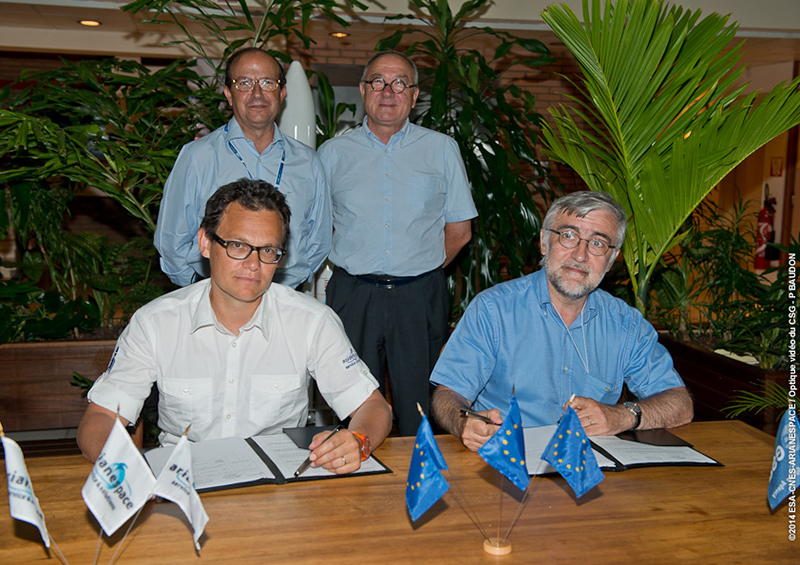
The contract for Arianespace’s three Ariane 5 launches to orbit a total of 12 Galileo FOC satellites was signed at the Guiana Space Center by Chairman and CEO Stéphane Israël (seated, at left) and Didier Faivre, ESA director of the Galileo Program and Navigation-related Activities. Joining them were ESA Director General Jean-Jacques Dordain and Daniel Calleja Crespo, director general for Enterprise and Industry, European Commission.
Once the contract had been signed, Stéphane Israël, chairman and CEO of Arianespace, made the following statement: “With its Ariane 5 ES heavy-lift launch-vehicle, Arianespace is able to provide the most appropriate solution for stepping up the deployment of the entire Galileo constellation. Ariane has once again demonstrated its excellence as it lends its expertise to Europe’s ambitions in space. With the three Ariane, Vega and Soyuz launch-vehicles operated from the Guiana Space Center, European spaceport, Arianespace is giving Europe guaranteed access to space and suitable solutions to meet its wide-ranging needs. I would like to extend my heartfelt thanks to the European Commission and European Space Agency (ESA) for their continued trust. Being the launch operator of the Galileo program is an immense source of pride for Arianespace, its employees and its partners.”
“Aeroptic is a commercially available mapping system that supports every mission in which the National Guard engages, ranging from incident assessment and disaster response in Domestic Operations (DOMOPS) to reconnaissance and situational awareness on the OCONUS battlefield,” said Kevin Gunde, executive vice president, Surveillance and Exploration Systems. “Aeroptic can be deployed on a variety of fixed- and rotor-wing platforms, including the National Guard UH-60 Blackhawk.”
KEYW developed the Aeroptic solution with image quality, positional accuracy and ease of use in mind. The system integrates a full-color electro-optical (EO) camera, GPS/IMU, and user-friendly geo-processing software based on non-proprietary open standards. The system is compact, light-weight and ruggedized for deployment in harsh environments.
The rapid-refresh EO camera captures imagery of extraordinary quality by employing advanced noise reduction, image sharpening algorithms and high-end lenses with innovative configurations, the company said. The interchangeable lenses offer multiple focal length options that enable the Aeroptic camera to acquire high-resolution visible-band imagery with sub-meter geo-positional accuracy from varying flight altitudes without surveyed ground control points.
Aeroptic offers the option of processing imagery in the air or on the ground, producing unclassified, wide-area ortho-mosaic maps in near real time. Generated imagery products are ready for immediate ingest into standard commercial viewing tools and GIS packages.
“No expertise in GIS or cartography is needed to make full use of the Aeroptic system,” said Kevin Gunde, executive vice president, Surveillance and Exploration Systems. “With just eight hours of training, the typical user can produce content-rich image maps ready for distribution within minutes after acquisition.”
KEYW will be discussing the Aeroptic Mapping System and its many mission applications in booth #512 at the NGAUS General Conference & Exhibition being held August 22-25, 2014, in Chicago’s McCormick Place.
The Japan News is reporting that the Japanese Committee on the National Space Policy has compiled a draft proposal that includes increasing the number of quasi-zenith satellites (QZSS), Japan’s satellite navigation system, from the current single satellite to a total of four.
Currently, Japan is operating only one quasi-zenith satellite, named Michibiki.
The increase would be made to strengthen Japan’s overall surveillance systems, in light of developments such as China’s maritime expansion. “China’s high-pressure maritime advances have become a menace to the security of countries in Asia. Continued vigilance is also required against North Korea’s missile launches and nuclear weapons development program,” according an editorial published by The Japan News.
The additional QZSS satellites would presumably supplement Japan’s surveillance satellites with positioning information. Japan currently has four information-gathering satellites, which lack the flexibility to boost the accuracy of ground surveillance activities and swiftly grasp movements of objects such as vessels at sea.
“For surveillance activities, acquisition of high-precision positioning information using space technology is also important. Only the global positioning system (GPS) run by the United States is currently reliable for this purpose,” the editorial said.
A four-satellite QZSS system will allow positioning surveillance of all regions around the clock. Based on the proposal, the government is expected to revise the Basic Plan on Space Policy within the year.
The proposal also stipulates that the country should aim to operate seven quasi-zenith satellites as early as possible, which would allow stable management of the system, according to The Japan News.
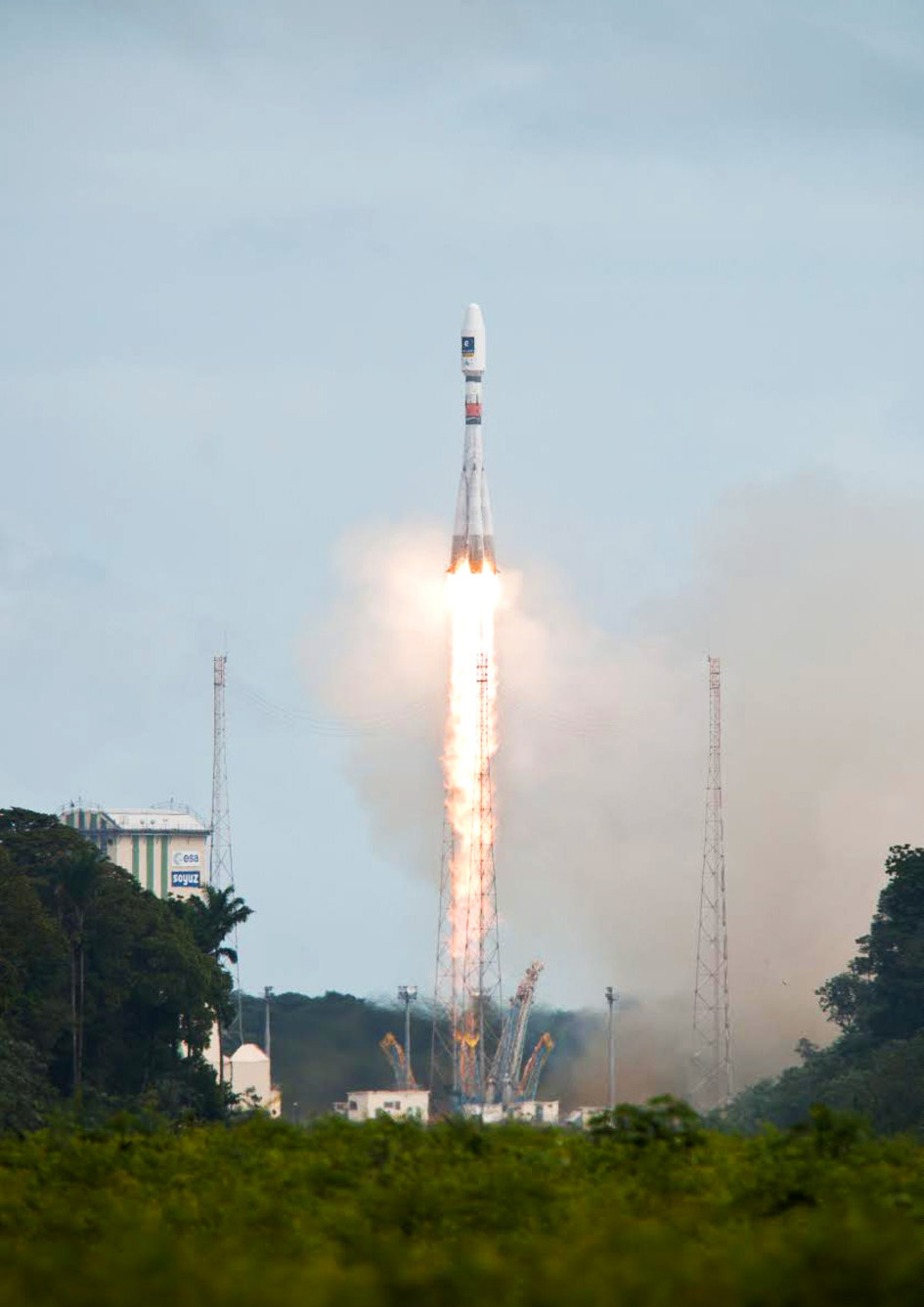
Soyuz Flight VS09, carrying Europe’s fifth and sixth Galileo satellites, lifts off from Europe’s Spaceport in Kourou, French Guiana.
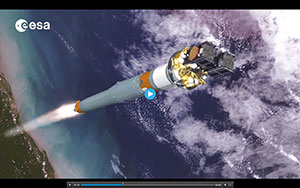
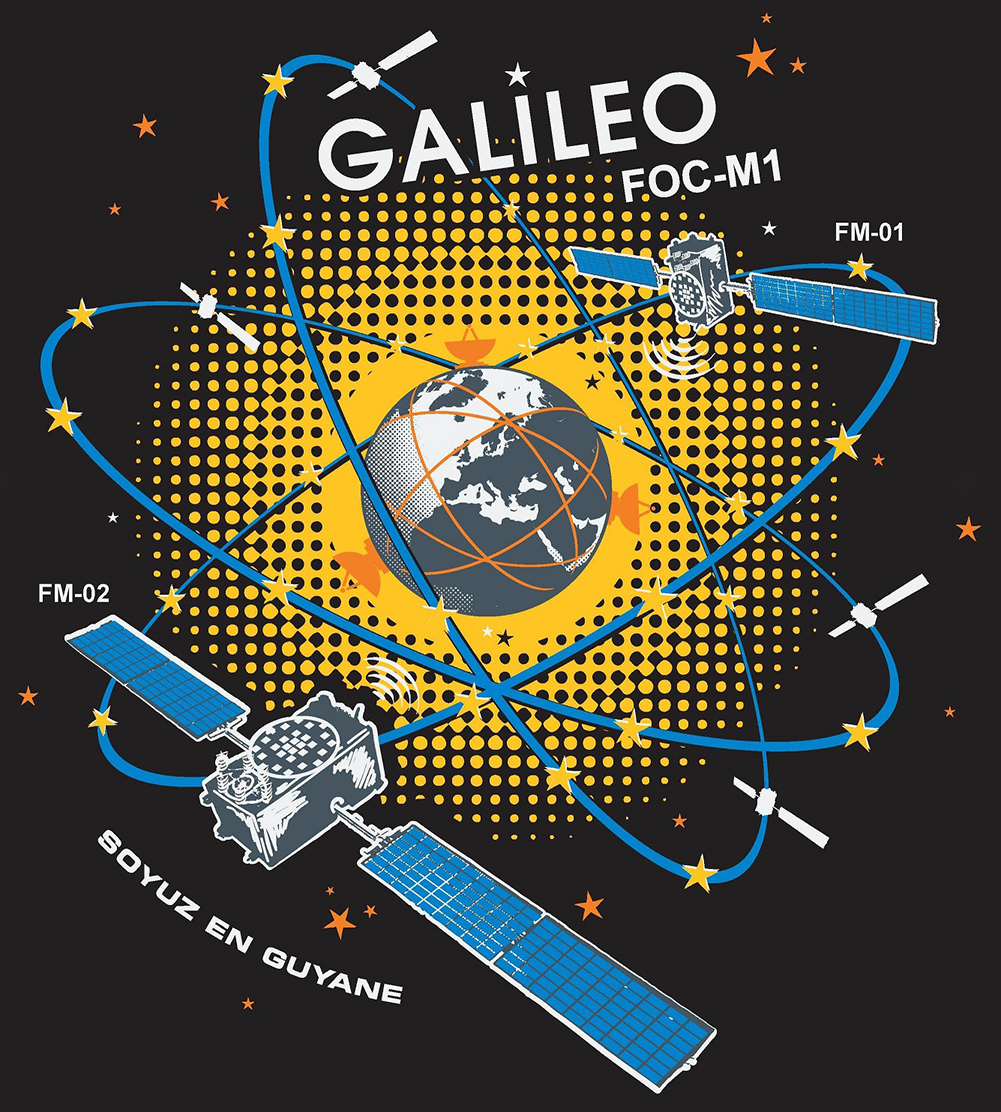
Soyuz Flight VS09, carrying Europe’s fifth and sixth Galileo satellites, lifted off from Europe’s Spaceport in Kourou, French Guiana, today (August 22, 12:27:11 UTC/14:27:11 CEST.)
All the stages of the Soyuz vehicle performed as planned, with the Fregat upper stage releasing the satellites into their target orbit close to 23,500 km altitude, 3 hours 47 minutes after liftoff.
These new satellites joined four Galileo satellites already in orbit, launched in October 2011 and October 2012 respectively. This first quartet were In-Orbit Validation (IOV) satellites, serving to demonstrate the Galileo system would function as planned.
Satellites 5 and 6, the first Full Operational Capability (FOC) satellites, are significant as the first of the rest of the Galileo constellation. This launch marks the start of a new phase in the European satellite navigation program where the full constellation will be deployed with short intervals between launches. A steady stream of launches will follow to build the complete Galileo constellation.
Watch a video of the launch here:
On completion of the initial checks, run jointly by the European Space Agency (ESA) and the French space agency CNES, the two satellites will be handed over to the Galileo Control Centre in Oberpfaffenhofen, Germany, and the Galileo in-orbit testing facility in Redu, Belgium, for testing before they are commissioned for operational service in the autumn.
The deployment of the constellation will now move more quickly, with six to eight satellites launched per year using a series of Soyuz and Ariane launches from the CSG, along with finalization of the remaining elements of the ground network.
The final constellation will consist of 24 satellites expected to be ready in 2017 and complemented by six in-orbit spares.
This deployment phase of the Galileo program is being managed and funded by the European Commission, with ESA acting as design and procurement agent on behalf of the Commission.
UPDATE: The next launch attempt for Soyuz VS09 with Europe’s fifth and sixth Galileo satellites is Friday, August 22, at 12:27 GMT, 14:27 CEST. Arianespace had decided to postpone the launch of Soyuz flight VS09 carrying Europe’s fifth and sixth Galileo satellites, because of unfavorable weather conditions over the Guiana Space Centre.
During the European Space Agency (ESA) audio press conference held Wednesday morning in advance of Thursday’s launch of two Galileo satellites, there was extended discussion on the problem with the fourth in-orbit validation or IOV satellite (FM4 or GSAT0104 with PRN code E20). The satellite suffered a power anomaly on May 27 as previously reported by GPS World.
The root cause of the problem has still not been identified despite looking at more than 40 possible failure scenarios so far. ESA has conducted extensive analyses of telemetry from the satellite as well as reviews of pre-launch tests. It has been determined, however, that the E5 and E6 frequencies have had a permanent loss of power. E1 appears to be OK and can be switched back into normal operation at any time. Currently, the satellite is transmitting on E1 but using a non-standard test code.
It was also revealed that FM2, the second IOV satellite, suffered a power drop of 2 dB about a year ago, and FM1, the first IOV satellite, has also seen a power drop. In the case of FM1, the problem is in the primary solid-state power amplifier, and there is a plan to switch shortly to the back-up unit. However, there doesn’t appear to be a common-mode of failure relating the power losses on the various satellites.
While the FM4 anomaly investigations are ongoing, the power on all of the IOV satellites has been backed off 1.5 dB.
Concerning the two full operational capability or FOC satellites to be launched tomorrow, ESA is not yet revealing into which orbit plane and slots the satellites will be placed. Nor are they saying yet which pseudorandom noise codes will be used by the satellites. Once the satellites are launched into their preliminary orbits, it will take about two weeks for them to drift to their assigned locations. At that time, we should be able to deduce their locations using, for example, United States Strategic Command (USSTRATCOM) tracking data. And once they begin transmitting standard PRN codes, all-in-view receivers, such as those participating in the International GNSS Service Multi-GNSS Experiment, will be able to identify their codes.
The satellites will undergo testing for 73 days, after which they will be declared operational. ESA intends to use the passive hydrogen maser clocks on the satellites as the primary clocks, with the rubidium clocks used as back-ups.
Arianespace has decided to postpone the launch of Soyuz flight VS09 carrying Europe’s fifth and sixth Galileo satellites. This is due to unfavorable weather conditions over the Guiana Space Centre.
Another launch date will be decided depending on the evolution of the weather conditions in Kourou.
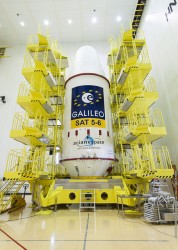
Europe’s latest Galileo satellites have been sealed within their launch fairing, atop the Fregat upper stage that will carry them into their final orbit on August 21, ushering in the system deployment phase and paving the way for the start of initial services. Galileo SATs 5-6 are scheduled to lift off at 12:31 GMT from Europe’s Spaceport in French Guiana on top of a Soyuz rocket.
The two Galileo satellites had been attached together on the dispenser that secures them during flight, and then delivers them into orbit. Then August 14 saw the follow-on installation of the stack — the two satellites plus dispenser — onto the Fregat stage. The following day was the last time the two Galileo satellites were seen by human eyes, as the two halves of the protective launch fairing were sealed around the satellites and their upper stage.
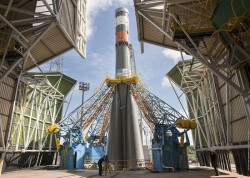
Meanwhile, on August 18, the satellites’ three-stage Soyuz launcher was moved by rail onto its launch pad then lifted to the vertical position. The launcher’s mobile gantry was then moved into position around the upright launcher. This allows the next step of the launch campaign to take place, the hoisting up and attachment of the entire upper composite — the launch fairing containing the Galileo satellites, their dispenser and the Fregat fourth stage. At three hours, 47 minutes and 57 seconds after liftoff, the satellites will then be deployed from their Fregat by the dispenser’s pyrotechnic separation system, once their final 23,500 km altitude is reached.
These new satellites will join four Galileo satellites already in orbit, launched in October 2011 and October 2012 respectively. This first quartet were in-orbit validation satellites, serving to demonstrate the Galileo system would function as planned. Now that work has been done, the Full Operational Capability (FOC) satellites being launched on Thursday are significant as the first of the rest of the Galileo constellation.
The payloads generating navigation signals to Earth have been manufactured by Surrey Satellite Technology Ltd in the UK, while the satellites carrying them have been built by OHB in Germany.
A steady stream of launches is planned for the next few years, with two Galileo satellites flown per Soyuz launch and four Galileo satellites flown per launch of an Ariane 5 variant currently in preparation.
The definition, development and in-orbit validation phases of the Galileo program were carried out by ESA and co-funded by ESA and the EU. The Full Operational Capability phase is managed and fully funded by the European Commission. The Commission and ESA have signed a delegation agreement by which ESA acts as design and procurement agent on behalf of the Commission.
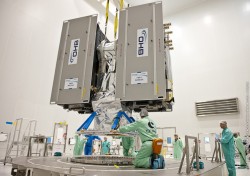
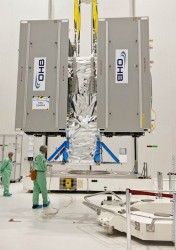
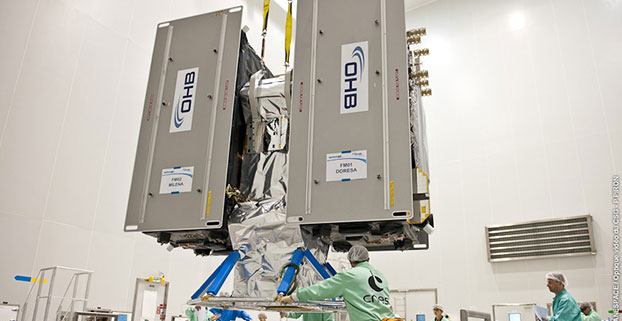
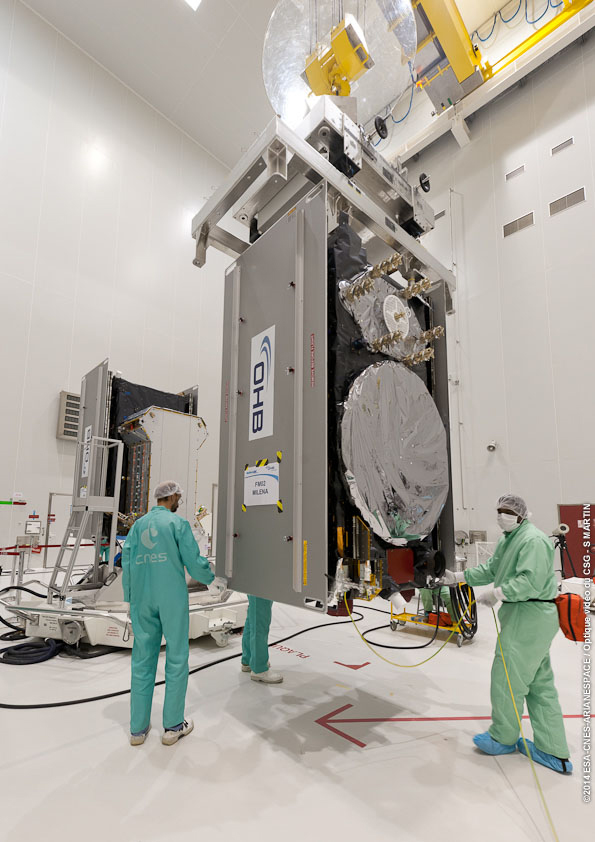
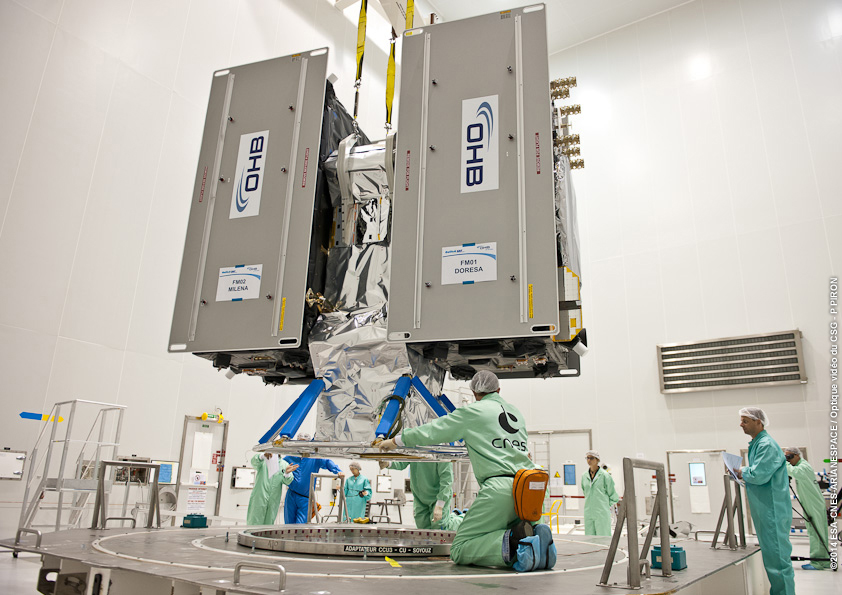
The Galileo FOC satellite named “Milena” is mated on its Soyuz dispenser unit, joining the already-installed “Doresa” satellite.
The fifth and sixth Galileo satellites met on their dispenser on August 11 in the S5 payload preparation facility of the Guiana Space Centre.
The completed dispenser unit is ready to be transferred from the S5 payload preparation facility for its integration atop Soyuz’ Fregat upper stage.
The fifth and sixth satellites meet for the first time, attached to the dispenser that will carry them into medium-Earth orbit (August 11).
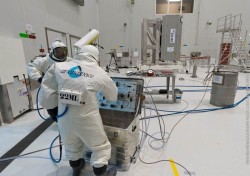
Fueling of the two satellites (August 7-8) allows them to fine-tune their orbits and maintain their altitude over the course of their 12-year lifetimes.
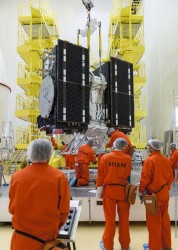
Galileo satellites fastened to upper stage.
Galileo satellites lowered onto upper stage.
Galileo mission logos have been applied to the payload fairing, which encapsulates the two-satellite payload and their dispenser system.
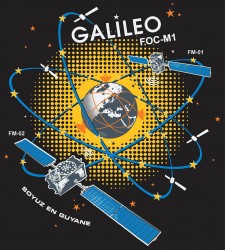
The local (Kourou) poster of the launch.
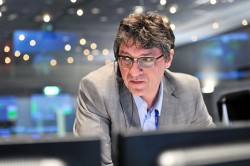
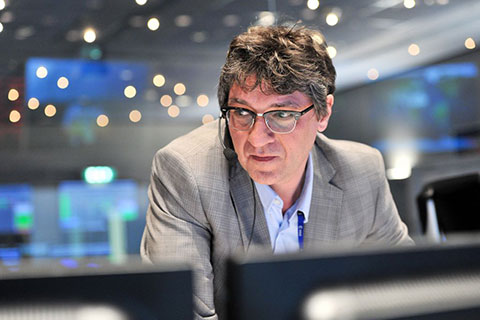
Flight Operations Director Hervé Côme at ESOC.
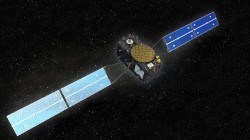
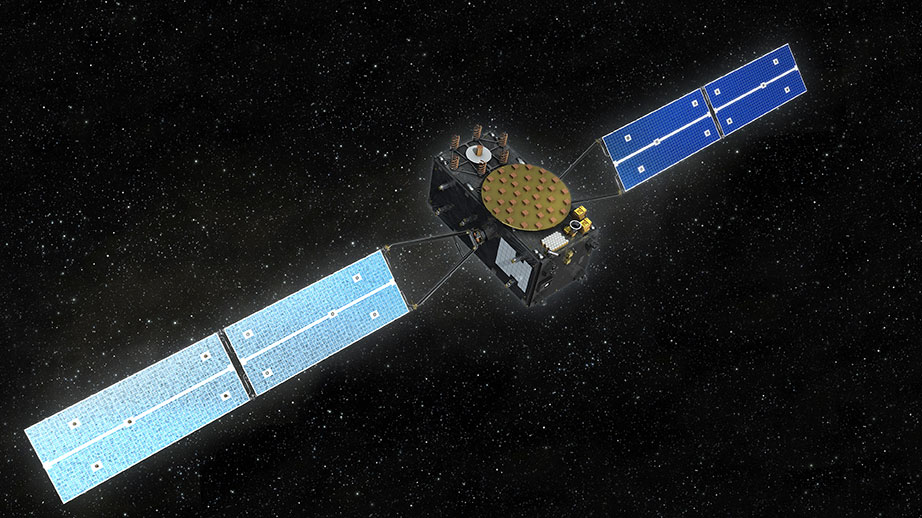
Artist’s rendering of an OHB-designed Galileo satellite. OHB in Germany and SSTL in the UK are building the next 14 Galileo satellites.
Photo: European Space Agency
The medium-lift workhorse has been raised into a vertical orientation as the mobile gantry is moved into position.
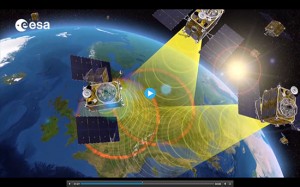
This video by the European Space Agency recalls the success of Galileo’s in-orbit validation phase and explains what will be the mission of the fifth and sixth Galileo satellites, set to launch August 21.
Included is an interview with Sylvain Loddo, Galileo ground segment manager. The launch itself can be watched live here.
The special significance of next Thursday’s launch for the Galileo system as a whole is highlighted in a new video by the European Space Agency, with an interview with Didier Faivre, Galileo Program director.
On August 21, ESA will launch two more Galileo satellites on a Soyuz rocket from Europe’s Spaceport in Kourou, French Guiana. The satellites mark the beginning of a new phase for Galileo, the deployment phase, which will secure the completion of the constellation thanks to accelerated production of satellites and supported by regular launches.
At the same time, ESA and the European Union also look toward the future and are preparing the evolution of Galileo.
A new draft version of the Galileo Open Service Signal in Space Interface Control Document (OS SIS ICD), issue 1, revision 2, was published by the European Commission (EC) on June 30, and is available for download.
The European Commission has launched an open public consultation process in order to improve and consolidate the current draft document and to ensure that any further development of the Galileo OS SIS ICD takes into account the views of key GNSS stakeholders.
The OS SIS ICD contains the publicly available information on the Galileo Signal In Space. It is intended for use by the Galileo Open Service (OS) user community and specifies the interface between the Galileo Space Segment and the Galileo User Segment.
The public consultation process provides stakeholders with an opportunity to improve the quality and clarity of the document and to suggest new elements to be included in future versions, for instance, inclusion of multi-GNSS products and services. According to the European Commission, the public consultation process will contribute towards a smooth and rapid rollout of Galileo equipment and applications, and the earliest possible delivery of user benefits.
Research and Markets has announced the addition of the “GNSS Market Outlook 2020” report to its offerings.
Research and Markets explained that GNSS has developed its applications across various industries worldwide. Some applications are simple, such as determining a position, whereas others are complex blends of GNSS with communications and other technologies. Over the past few years, the rapid growth in GNSS commercial applications has been observed by the firms building navigation satellites and equipment. According to the report, the GNSS market is expected to flourish with new technological applications and is anticipated to grow at a CAGR of 9.4 percent during 2014-2020.
The report “GNSS Market Outlook 2020” is an outcome of the research company’s exhaustive research and comprehensive analysis of the worldwide GNSS market. “Our report provides a complete overview of the GNSS market globally. Over and above, all the current trends and drivers coupled with the potential growth areas of the GNSS industry have been evaluated in the report,” the company said in a statement.
The report analyzes the GNSS market by its major application areas such as location-based services, transportation, surveying, and agriculture, over a period of eight years (2013-2020). In addition, the transportation section covers the GNSS market by road, rail, air, and marine navigation segments, which are creating a wide opportunity to the overall GNSS market, according to the report.
The report provides extensive analysis of the GNSS market by each of these segments up to 2020.
Topics Covered:
1. Analyst View
2. Research Methodology
3. Global Navigation Satellite Systems (GNSS) – Overview
Arianespace has decided to postpone the launch of Soyuz flight VS09 carrying Europe’s fifth and sixth Galileo satellites, because of unfavorable weather conditions over the Guiana Space Centre.
Another launch date will be decided depending on the evolution of the weather conditions in Kourou.
The next satellites in Europe’s Galileo satellite navigation system will be launched on August 21, ushering in the system deployment phase and paving the way for the start of initial services, according to the European Space Agency (ESA).
Galileo SATs 5-6 are scheduled to lift off at 12:31 GMT (14:31 CEST, 09:31 local time) August 21 from Europe’s Spaceport in French Guiana on top of a Soyuz rocket. They are expected to become operational, after initial in-orbit testing, in autumn.
The two satellites will join the four Galileo in-orbit validation satellites already in space. Launched in pairs in October 2011 and October 2012, these four satellites — the minimum required to obtain a position fix — served to demonstrate and validate the space and ground segments of the system.
Galileo SATs 7-8 are scheduled to follow end of year 2014. Then the constellation will be gradually deployed with six to eight satellites launched per year using a series of Soyuz and Ariane launches from Kourou, along with remaining elements of the ground network.
Satellite “Midwives”
Galileo’s post-launch team at ESA has finalized its preparations for taking control of the twin satellites. Following launch, the most crucial point in the flight comes when the two satellites separate from their upper stage — and the Launch and Early Operations, or LEOP, phase begins, run from ESA’s Space Operations Centre, ESOC, in Darmstadt, Germany.
If the moment of separation is the point when satellites are born, then the LEOP team can be thought of as midwives.
Any tumbling from the satellites being pushed away pyrotechnically must be corrected, and their positions stabilized in space. Next, they have to deploy their solar wings, to ensure a steady flow of power.
Flight Operations Director Hervé Côme at ESOC.
Then comes time to switch on and check out all the satellite systems one by one, to ensure everything has endured the launch in working order.
If all goes well, LEOP should take about a week before control of the satellites can be handed over to the Galileo Control Centre in Oberpfaffenhofen, overseeing the satellites, and ESA’s Redu centre in Belgium, for detailed payload testing.
Galileo’s LEOP team has been in training for months, explained Hervé Côme, flight director for Galileo at ESOC, with preparations stretching back two and a half years. “A simulation campaign has been running since March and the system and its operators have performed flawlessly,” Côme said. “To date, 20 simulations, in both nominal and contingency cases, have been conducted.”
Testing Teams and Technology
The satellites themselves participated in multiple end-to-end system compatibility tests to ensure that they are fully compatible with the various elements of the Galileo ground segment, extending to far-flung ground stations variously belonging both to ESA and to France’s CNES space agency, the Agency’s partner for LEOP.
A joint team from ESA and CNES oversaw LEOP for the first four Galileo satellites, similarly launched in pairs in 2011 and 2012. That work was carried out from CNES’s LEOP and Network Operations Control Centre in Toulouse, France.
This time, ESOC is hosting the LEOP team, with mission control and flight dynamics systems inherited from the first four in-orbit validation satellites adapted for these new Full Operational Capability (FOC) Galileo models.
The LEOP procedures and timeline have been fully validated, and system configurations frozen. From here on in, ESOC’s Mission Control Team — following a short summer break — will concentrate on further fine-tuning their organization and procedures in advance of next month’s launch.
The Galileo FOC satellite named “Milena” is mated on its Soyuz dispenser unit, joining the already-installed “Doresa” satellite.The completed dispenser unit is ready to be transferred from the S5 payload preparation facility at the Spaceport in French Guiana for its integration atop Soyuz’ Fregat upper stage.The local (Kourou) poster of the launch.