Category: GNSS

  • GPS III Payload Arrives, Platform Acceptance Tests Next

    Enter GPS III. The long-awaited navigation payload for the next-generation satellite pulled into its new temporary home over the September 13 weekend, the Lockheed Martin Space Systems facility in Littleton, Colorado. Lockheed is the U.S. Air Force’s  prime contractor for the first batch of eight GPS III satellites.

    Exelis Geospatial Systems has committed to delivering the payloads for the second, third, and fourth GPS III satellites “right on the heels” of the first, according to Gen. John Hyten, commander of Air Force Space Command. “If that’s the case, in the not-too-distant future GPS III will be in good shape,” he added. The first GPS III launch is now scheduled for 2016.

    Exelis has built GPS payloads since the beginning of the program, but found new challenges over the last two years posed by advanced features of the modernized version. “First-time development and integration issues, including design changes to eliminate signal crosstalk” have set back the schedule.

    According to reports, Lockheed Martin has a group of initial platforms readied on its production line to take the incoming payloads.

    Still ahead, completion of acceptance testing following integration with the first satellite platform.

    Earlier this year, Lockheed Martin issued a request for information on alternate payload providers, and received responses from five companies. In June, the Air Force issued a call for contractors interested in building the next batch of GPS IIIs. Northrop Grumman and Boeing have responded.

  • Seventh GPS IIF Satellite Set to Healthy and Usable

    The seventh GPS-IIF satellite, SVN-68/PRN-09, launched on August 2, was set to healthy and usable Sunday night, according to Rick Hamilton, CGSIC executive secretariat of the USCG Navigation Center. The change brings the number of satellites transmitting the L2C signal to 13, and those transmitting the L5 signal to seven.

    The next GPS-IIF satellite, IIF-8/SVN-69, is tentatively scheduled for launch on October  29.

    Below is the full text of the Notice Advisory to Navstar Users (NANU).


    NOTICE ADVISORY TO NAVSTAR USERS (NANU) 2014071

    SUBJ: SVN68 (PRN09) USABLE JDAY 260/2026

    1.     NANU TYPE: USABINIT

            NANU NUMBER: 2014071

            NANU DTG: 172024Z SEP 2014

            REFERENCE NANU: N/A

            REF NANU DTG: N/A

            SVN: 68

            PRN: 09

            START JDAY: 260

            START TIME ZULU: 2026

            START CALENDAR DATE: 17 SEP 2014

            STOP JDAY: N/A

            STOP TIME ZULU: N/A

            STOP CALENDAR DATE: N/A

    2.  CONDITION: GPS SATELLITE SVN68 (PRN09) WAS USABLE AS OF JDAY 260

         (17 SEP 2014) BEGINNING 2026 ZULU.

    3.  POC: CIVILIAN – NAVCEN AT 703-313-5900, HTTP://WWW.NAVCEN.USCG.GOV

         MILITARY – GPS OPERATIONS CENTER at HTTPS://GPS.AFSPC.AF.MIL/GPSOC, DSN 560-2541, COMM 719-567-2541, [email protected]HTTPS://GPS.AFSPC.AF.MIL

         MILITARY ALTERNATE – JOINT SPACE OPERATIONS CENTER, DSN 276-3514, COMM 805-606-3514, [email protected]

  • Talks on Placing GLONASS Stations in the U.S. Not Renewed

    RIA Novosti is reporting that negotiations regarding the placement of a differential correction and monitoring GLONASS station in the United States have not yet been renewed. The news agency quotes remarks by Grigory Stupak, first deputy general designer of Russian space systems, during the Fourth International School on Satellite Navigation.

    In all, 40-50 GLONASS stations are planned for placement around the world, Stupak said. “As for the United States, we now consider the option of placing a station in Alaska, but the lack of it does not significantly affect the performance of our system,” he said, adding that Russia has worked with the southern African region and South America on placement of GLONASS stations, with one station in Brazil already operational. “There also have Cuban colleagues to host GLONASS stations,” he said.

    According to Stupak, taking into account developments in the world, it does not make sense to force the negotiation situation by placing a station in Alaska.

    GLONASS Satellites Based Mainly on Russian Component Base
    The prevailing share of the payload for both GLONASS-M and GLONASS-K spacecraft is created by JSC Russian Space Systems (CSW), but contains an element base of both domestic and foreign production, Stupak said, according to the the GLONASS Herald.

    “If you take onboard equipment [for] GLONASS-M, a significant portion of its designers develop mainly on electronic components of domestic production,” Stupak said.

    Including onboard equipment, while a significant portion of the GLONASS-M design is based on domestic electronic components, for the GLONASS-K, most of the components are Russian, but some foreign components are also being used.

  • Langley’s Student Wins ION Parkinson Award

    Langley’s Student Wins ION Parkinson Award

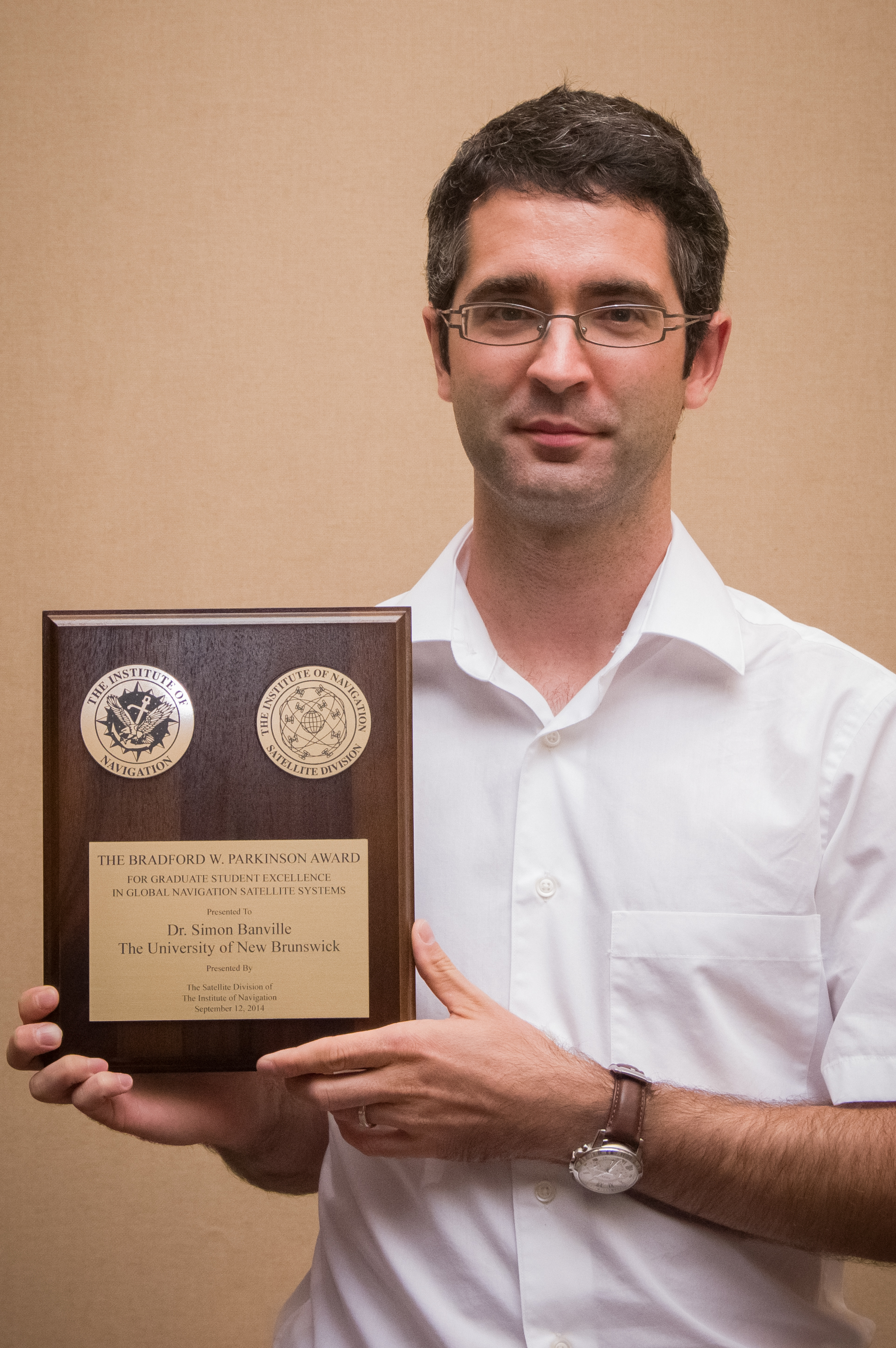
    Simone Banville-1.jpg
    Simon Banville

    Simon Banville, a Ph.D. geodesy and geomatics engineering student at the University of New Brunswick, was awarded this year’s Institute of Navigation Bradford W. Parkinson Award.

    The $2,500 honorarium and plaque was presented recently during The Institute of Navigation’s GNSS+ meeting in Tampa, Florida.

    The Parkinson Award recognizes an outstanding graduate student in the field of global navigation satellite systems, such as the Global Positioning System. The winner is selected based on the theses and dissertations submitted by supervisors from the global GNSS research community.

    Banville was selected for his outstanding contributions that represent truly significant innovations in the technology, application, or policy of modern satellite navigation systems.  Supervised by UNB’s Dr. Richard Langley, his dissertation is entitled Improved Convergence for GNSS Precise Point Positioning.

    The award honors Dr. Brad Parkinson for his leadership in establishing both the U.S. GPS and the Satellite Division of the ION.

    Ph.D. student Simon Banville and Prof. Richard Langley.
    Ph.D. student Simon Banville and Prof. Richard Langley.

    Precise Point Positioning or PPP is a relatively new single-receiver positioning technique that uses precise information on the orbits of navigation satellites and the atomic clocks they carry along in a rigorous mathematical model for analyzing receiver measurements. It permits positioning accuracies down to the few-centimetre level and Mr. Banville’s improvements to the technique will have significant economic benefits for those using GNSS in high-precision applications.

    Banville will receive his Ph.D. degree at UNB’s Fall Convocation next month.

  • ESA Releases Diagrams Showing Galileo 5 and 6 Orbit

    ESA Releases Diagrams Showing Galileo 5 and 6 Orbit

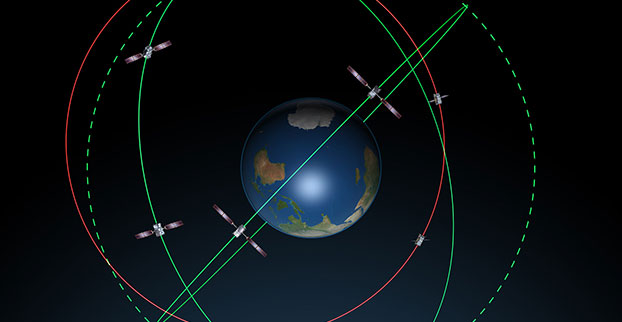
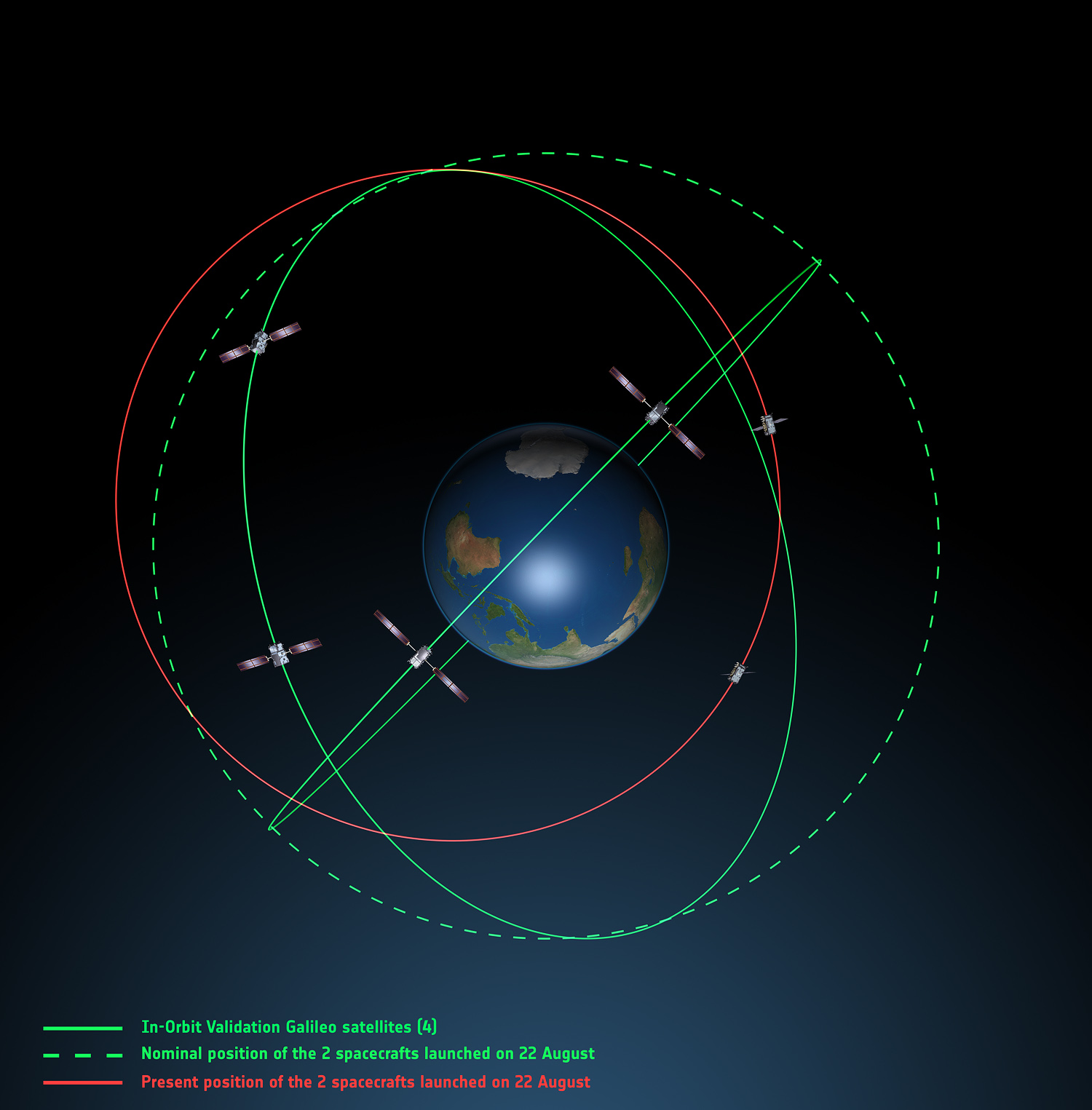
    Galileo orbits viewed from above: Orbits of the fifth and sixth satellites in red, compared to their intended position in dashed green, and the position of the four satellites launched in 2011 and 2012 in solid green. This view looks down over the South Pole to illustrate how the inclination relative to the equator is less than intended. The satellites are in an elliptical rather than circular orbit, with a maximum altitude of about 25,900 km and a minimum altitude of about 13,700 km, compared to a planned circular orbit of 23,222 km altitude.  Photo: ESA
    Galileo orbits viewed from above: Orbits of the fifth and sixth satellites in red, compared to their intended position in dashed green, and the position of the four satellites launched in 2011 and 2012 in solid green. This view looks down over the South Pole to illustrate how the inclination relative to the equator is less than intended. The satellites are in an elliptical rather than circular orbit, with a maximum altitude of about 25,900 km and a minimum altitude of about 13,700 km, compared to a planned circular orbit of 23,222 km altitude. Photo: ESA

    The fifth and sixth Galileo satellites have been in a safe state since August 28, under control from ESA’s center in Darmstadt, Germany, despite having been released on August 22 into lower and elliptical orbits instead of the expected circular orbits. The European Space Agency has released two diagrams showing the orbits.

    ESA said that the potential of exploiting the satellites to maximum advantage, despite their unplanned injection orbits and within the limited propulsion capabilities, is being investigated. Various ESA specialists, supported by industry and France’s CNES space agency, are analyzing different scenarios that would yield maximum value for the program, and safeguard — as much as possible — the original mission objectives.

    More detailed analysis, alongside consultations with industry, is under way, checking for a potential “improved orbit” where the satellites could both provide operational services.

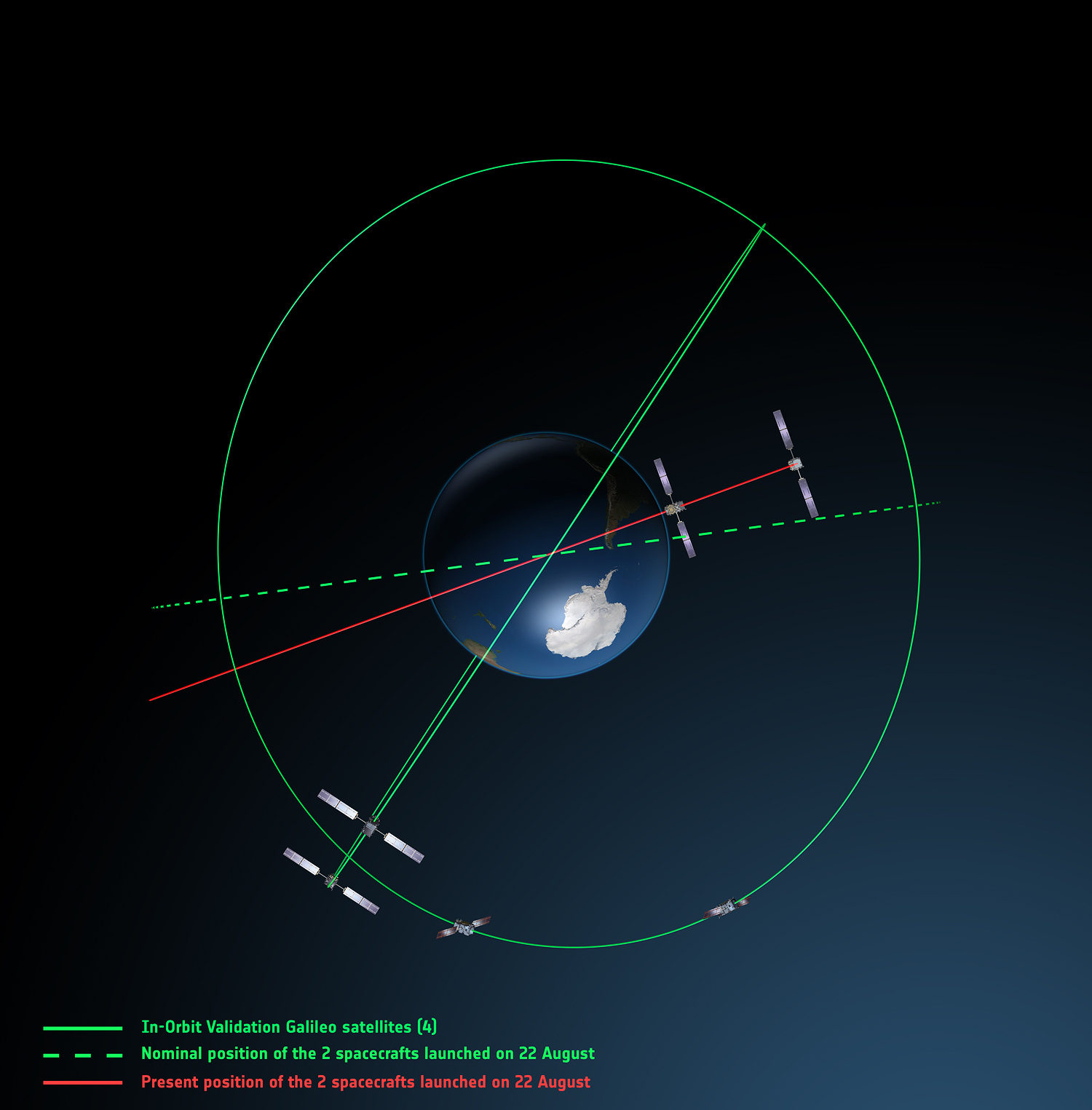
    Galileo orbits viewed side-on: The fifth and sixth Galileo satellites in red, compared to their intended position in dashed green, and the position of the four satellites launched in 2011 and 2012, in solid green. This view looks side on to the two satellites’ orbital plane, which is off-center relative to Earth. The targeted orbit was circular, inclined at 55º to the equator at an altitude of 23,222 km.They are in a safe state, correctly pointing towards the Sun, properly powered and fully under control of an ESA–CNES team. Photo: ESA
    Galileo orbits viewed side-on: The fifth and sixth Galileo satellites in red, compared to their intended position in dashed green, and the position of the four satellites launched in 2011 and 2012, in solid green. This view looks side on to the two satellites’ orbital plane, which is off-center relative to Earth. The targeted orbit was circular, inclined at 55º to the equator at an altitude of 23,222 km.They are in a safe state, correctly pointing towards the Sun, properly powered and fully under control of an ESA–CNES team. Photo: ESA
  • Regional Event in Jordan to Focus on Road, Freight with EGNOS

    On October 21, Jordan will host a Euro-Mediterranean Partnership (EUROMED) regional event focused on the use of GNSS, particularly European GNSS, for freight and road transport. The Euromed GNSS II/MEDUSA meeting will be held in Amman, Jordan, at the Sheraton Al Nabil Hotel.

    Jordan-Transport-Ministry-TOrganized by the Euromed GNSS II/MEDUSA project, under the auspices of the Ministry of Transport of Jordan, the event will aim to share experiences and best practices, and to discuss strategies and possible ways forward in relation to the use of the satellite navigation for freight and road transport in the region.

    At the event, MEDUSA will present the results of its case study, which was conducted with Royal Jordanian Customs and with the aid of the Ministry of Transport of Jordan. Since April, supported by European companies involved in MEDUSA, Royal Jordanian Customs have had the opportunity to test and validate the use of European GNSS, and specifically of EGNOS, for tracking and tracing containers shipped across the Mediterranean Sea and vehicles transporting goods in Jordan.

    The case study is one of the technical assistance actions implemented by MEDUSA, and it represents the first life experience of EGNOS services’ usage in areas distant from Europe.

    MEDUSA belongs to the EU Euromed Transport Program. Its objective is to promote the adoption of the European GNSS by the Euromed countries, which include Algeria, Egypt, Israel, Jordan, Lebanon, Libya, Morocco, Palestine, Syria (suspended due to political unrest), and Tunisia.

    GNSS technology is applied to several user applications, and transport is one of the most important, including aviation, road, maritime, rail, freight transport and logistics. The MEDUSA project includes a program of specific technical assistance actions for the Euromed countries, to facilitate the introduction and exploitation of GNSS services in their markets.

    The wide adoption of advanced technology, also including satellite navigation, for freight and road transport applications (such as Intelligent Transport Systems, or ITS) enables the implementation of smart mobility and the enhancement of goods transportation/traffic volumes increasing.

    During the event, the participants from the Euromed countries will share lessons learned from the Jordan case study, and learn about relevant best practices in Europe and in the Euromed region, as well as debate strategies and possible ways forward in the light of national interests and common regional perspectives.

    Opened by an institutional panel, with representatives of the Jordan Ministry of Transport and the European Commission, the event will consist of a session dedicated to the case study and a session addressing opportunities in other Euromed countries, including the presentation of European success cases as examples of suitable paths to guide the GNSS operational introduction and adoption.

    At the conclusion of the event, the participants will elaborate guidelines and recommendations, to be possibly translated into action plans for the Euromed countries.

    The meeting agenda is available to download.
  • Rockwell Tracks Galileo Signal with Secure Software Receiver

    Rockwell Collins has successfully received and tracked a Galileo satellite signal using a prototype GNSS receiver designed for secure military use.

    In 2013, Rockwell Collins received a $2 million contract from the Air Force Research Laboratory (AFRL) and the GPS Directorate to develop and demonstrate a Secure Software Defined Radio (S-SDR) GNSS receiver capability. By using multiple available satellite signals, improved and more robust signal availability can be obtained, enabling a compatible GNSS receiver to deliver superior position determination that can improve navigation performance and signal availability.

    Hosted in a software-defined radio, the S-SDR program will develop the security architecture required for receiver equipment approvals and certifications. The arrival of modernized GPS signals and other global constellations is changing the way the U.S. military and its allies accomplish secure GNSS-based positioning, navigation and timing. The European Galileo constellation coming on line during 2015, including its open signals and secure Public Regulated Service, is expected to provide an opportunity for improved robustness in satellite based navigation, in both commercial and government applications.

    “This milestone reinforces our belief that Rockwell Collins is uniquely positioned to produce a navigation receiver that will meet global needs,” said John Borghese, vice president of the Advanced Technology Center for Rockwell Collins. “With decades of experience developing GPS systems and leading edge security architectures, our company continues to be a top innovator in this field.”

    More than 35 years ago, Rockwell Collins assisted the U.S. Air Force in developing GPS technology. That legacy continued when the company created the world’s first all-digital miniature GPS receiver under contract with DARPA. Over the years, Rockwell Collins has produced more than 50 GPS products and delivered more than 1 million GPS receivers for commercial avionics and government applications. The GNSS receiver technology being provided for the S-SDR program will continue this legacy of providing leading edge GNSS solutions.

  • InnovateUK Makes Available £1.3M for Space and Satnav Tech

    Innovate UK (formerly the Technology Strategy Board) and the Natural Environment Research Council (NERC) plan to jointly invest up to £1.3 million to establish new Knowledge Transfer Partnerships in or related to the space sector to help United Kingdom companies to grow in the expanding global space market.

    Knowledge Transfer Partnership projects are Europe’s leading program to help businesses improve their competitiveness and productivity through better use of knowledge, technology and skills that reside within the UK knowledge base, according to InnovateUK.

    The investments will provide support for 10 to 12 Knowledge Transfer Partnership projects of between six and 36 months, helping to translate the UK’s academic strengths in this area into commercial success.

    The competition opens September 15 and is open on a rolling basis for applications until noon on February 11, 2015.

    A briefing/launch event for potential applicants will be held at the National Space Centre, Leicester, on September 23, 2014.

    For more information about the space sector investments, visit this InnovateUK page.

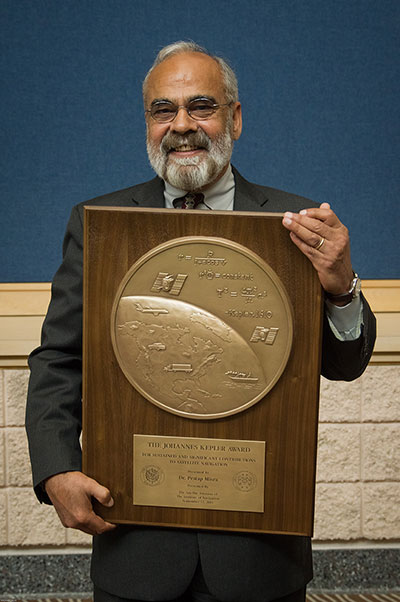
  • Pratap Misra Honored with ION Kepler Award 

    Pratap Misra Honored with ION Kepler Award 

    Pratap Misra, 2014 Kepler Award recipient.
    Pratap Misra, 2014 Kepler Award recipient.

    The Institute of Navigation’s (ION) Satellite Division awarded Pratap Misra its Johannes Kepler Award on September 12 at the ION GNSS+ Conference in Tampa, Florida, for his contributions to satellite navigation education, the understanding of GLONASS, and receiver autonomous integrity monitoring.

    Misra is credited with tracking GLONASS satellites using the AF Deep Space Tracking Network to determine their orbits in the coordinate frame used by GPS, while the satellites broadcast their positions in the Soviet coordinate frame. Misra is recognized for his ground-breaking work on navigation with combination of GPS and GLONASS signals and is the western world’s leading expert on what’s now the Russian satellite navigation system. He was a technical advisor to the Federal Aviation Administration for many of the bilateral and multi-lateral committees that worked on the development of GPS/GLONASS spectrum sharing and avionics.

    Additionally, Misra has worked on receiver autonomous integrity monitoring (RAIM), and contributed a novel approach that does not require the simplifying assumption of Gaussian errors. He was also the first to provide a RAIM algorithm that leveraged the receiver clock to put a bound on the vertical position error. These algorithms are expected to play a significant role in the upcoming multi-constellation environment.

    Misra is a research associate professor of Mechanical Engineering at Tufts University, and is well known for the textbook that he co-authored with Professor Per Enge of Stanford University, Global Positioning System: Signals, Measurements and Performance. Misra is a past chair of the ION Satellite Division and has held numerous volunteer positions within ION, most recently focusing on the support of student programs. He is both an ION Fellow (2003) and IEEE Fellow (2007).

    The Kepler Award recognizes and honors an individual for sustained and significant contributions to the development of satellite navigation. It is the highest honor bestowed by the ION’s Satellite Division.

  • GSA, EuroControl Sign Agreement on GNSS for Aviation

    In the presence of the European Commission, the European GNSS Agency (GSA) and EuroControl have signed a new cooperation agreement to jointly contribute to the implementation of European Union GNSS policies as they apply to the field of aviation.

    As Europe’s skies and major airports become increasingly congested, there is need for Air Traffic Management (ATM) technologies to evolve from ground-based infrastructures to more advanced systems based on new technologies. EuroControl and the GSA have a shared objective in developing and exploiting European GNSS technology to improve accessibility, efficiency and safety to European operators, pilots and airports.

    To accomplish this objective, the agreement focuses on a range of activities, including:

    • Definition of aviation user requirements for EGNOS and Galileo
    • Introduction of European GNSS services for aviation within the European Civil Aviation Conference (ECAC) area
    • Coordination in aviation research and development
    • Aviation-specific GNSS performance monitoring
    • Promotion of European GNSS aviation activities at the international level

    “This is another example of European Commission support of the aviation sector,” said Daniel Calleja Crespo, director general of DG Enterprise and Industry at the European Commission. “I am confident that a strong cooperation between the GSA and EuroControl will benefit aviation, the European GNSS Programs and indeed European citizens.”

    “The full deployment of GNSS offers unprecedented opportunities to further improve air traffic management safety and capacity, while reducing costs at pan-European level,” said GSA Executive Director Carlo des Dorides. “EuroControl’s activities in this field will complement those of the GSA to ensure that the development and implementation of satellite-based navigation provides an optimal solution for European airspace users.”

    “EuroControl and the GSA share a common objective — the secure and safe implementation of European satellite navigation policies in the aviation sector. The enhanced cooperation between our two organizations means that EuroControl will now bring its unequaled capacity to understand, coordinate and represent the needs of the civil and military airspace users to the promotion and development of GNSS,” said Frank Brenner, director general of EuroControl.

    EGNOS is Europe’s first venture into satellite navigation and has been providing a certified safety service for aviation users since 2010. EGNOS is owned by the European Union and, since January 1, 2014, the GSA is responsible for its exploitation, ensuring service provision, operations, maintenance and evolution.

  • Air Force Shares GPS Status at CGSIC at ION GNSS+

    News courtesy of CANSPACE Listserv.

    Two U.S. Air Force officers provided a GPS program update at Tuesday morning’s Civil GPS Service Interface Committee meeting plenary session at the ION GNSS+ 2014 conference in Tampa, Florida. Here are some key points from the presentations by Colonel Matthew Smitham, deputy director, GPS Directorate, and Lieutenant Colonel Todd Benson, Commander, Second Space Operations Squadron:

    • 31 primary satellites on orbit, 7 satellites in residual status, 1 satellite in test status
    • 1+ billion civil/commercial GPS users now; perhaps several billion GPS devices worldwide
    • recent performance of GPS (global averages):
      •    best daily URE of 46.6 cm on 8 June 2013
      •    best weekly URE of 58.7 cm during week of 18 August 2014
      •    newer satellites typically perform better than older ones
      •    anticipate URE dropping to about 30 cm in a few years as more modern satellites come on line
    • 60-70 navigation data uploads to the satellites are performed each day; average of about two per satellite per day
    • IIFs:
      •  SV 3 and SVs 5-12 have improved rubidium clocks; one of the IIFs is running on a cesium clock
    • 14 SVs are currently broadcasting L2C (set healthy); 7 SVs are broadcasting L5 (set unhealthy)
    • CNAV:
      • Data uploads are currently being done about twice per week to each satellite; daily updates expected by December 2014
      • average UREs currently about 1.4 m (data ages quickly with few uploads per week); expect CNAV URE to be marginally better than LNAV (Legacy NAV) when daily uploads begin
    • Continued progress in bringing M-code on line; expect early use by 2017
    • GPS III:
      • satellites will use three improved rubidium clocks
      • although the program is behind schedule, SV 1 will be available for launch starting in January 2016
      • the Block 0 version of the OCX (Next Generation Operational Control System), currently under test, will be needed to support the GPS III satellites
  • Roscosmos Chief Discusses Plans for GLONASS Stations in China

    The chief of Russia’s space agency Roscosmos has discussed plans for bilateral cooperation in space with his Chinese counterparts in Beijing, according to the ITAR-TASS news agency.

    “On Thursday, the chief of Roscosmos held a meeting with the head of China’s Satellite Navigation Office Ran Chengqi. The officials discussed Russian-Chinese cooperation on navigation satellite systems GLONASS and Beidou, in particular, the placement of Russian stations in China and Chinese stations in Russia,” the Roscosmos press service said.

    The two sides agreed to establish a sub-commission for cooperation in the sphere of satellite navigation under the bilateral commission in charge of preparing regular meetings of the two countries’ prime ministers.

    Earlier, Roscosmos deputy chief Sergei Savelyev said that Moscow this year would sign an agreement with Beijing on deploying GLONASS and Beidou stations in China and Russia respectively. Each country will accommodate three such facilities.