Category: GNSS

  • Looking High in the Sky from Down Under

    A few months ago I wrote in the magazine’s Out in Front column about the surprising abundance of BeiDou-centric papers to be presented at the upcoming ION GNSS+ conference, to which I very much look forward — both the abundance and the conference as a whole. With GLONASS encountering stormy weather of late, and Galileo plugging steadily along but not quite making up time, it seems increasingly possibly that the first GNSS of choice may constitute GPS+BeiDou, if certain spectrum questions can be worked out. News of an advance in Australia further heralds this likelihood.

    Researchers at Curtin University in Perth, Western Australia, have put forth a method integrating GPS and BeiDou signals, in an effort particularly aimed at urban canyons. In Australia at least, the visibility of BeiDou’s five geostationary and five inclined geosynchronous orbit satellites hovering above the Asia-Pacific region can bring added punch to any receiver experiencing skyviews obscured by skyscrapers. The same problem occurs in open-pit mines, said Curtin University professor Peter Teunissen. Open-pit mines are a very big thing in Australia.

    For those surprised to find this flying Dutchman, the inventor of the LAMBDA method for GNSS carrier phase ambiguity resolution, popping up in Australia, it appears he has a secondary appointment at Curtin University.  He remains based, as he has for 20 years, at the Delft University of Technology in the Netherlands, where he is head of the Department of Earth Observation and Space Systems.

    I wish I had a secondary appointment somewhere.

    “By combining GPS with Beidou,” announced Teunissen and colleagues at the Cooperative Research Centre for Spatial Information, “we are making use of Beidou’s 14 new satellites that cross our sky at a high angle, increasing satellite availability, improving positioning capability and ultimately creating a system that is perfect for both urban and mining environments.”

    Beidou of course has a ways to go to achieve its fullness at 35, perhaps as soon as 2020. Combining all and sundry GNSS, more than 100 GNSS satellites are expected to be operational by 2016, so algorithms making use of multiple signals and systems have moved to the fore. As we well know.

    “The emergence of new GNSSs, together with the linking of different systems, has enormous potential for improving the accuracy, integrity and efficiency of positioning worldwide, enabling much more reliable data,” Teunissen added.

    Precise positioning services could boost Australia’s gross domestic product by $13.7 billion by 2020, according to a recent report by a consultant for the Department of Industry, Innovation, Climate Change, Science, Research and Tertiary Education. (Maybe that’s where I should seek my secondary appointment; they’ve got a lot on their plate.)

    In January of this year, Teunissen’s Curtin University group and Dr Dennis Odijk, from the Western Australian School of Mines (WASM), also announced a methodology integrating GPS with Galileo signals. Both projects were funded by the Australian Space Research Program.


  • Norwegian Company Gives Galileo Its Voice

    Norwegian Company Gives Galileo Its Voice

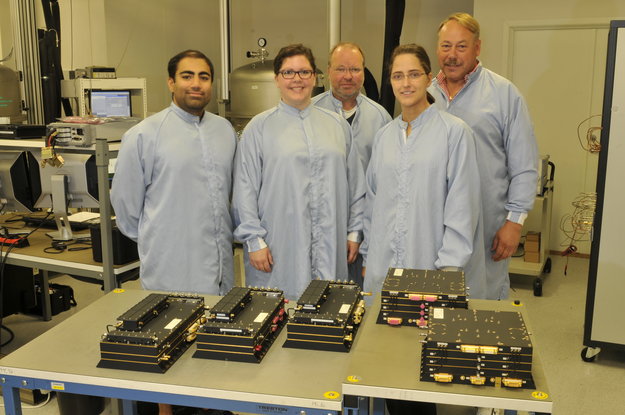
    Galileo hardware ready for delivery. The last three Search and Rescue Transponders (SARTs), left, and the last two Frequency Generator and Upconverter Units (FGUUs), right, units produced by Kongsberg Norspace under the first work order for the first 14 Galileo Full Operational Configuration (FOC) satellites being prepared for shipment to Surrey Satellite Technology Ltd, seen together with some of the key project team members.
    Galileo hardware ready for delivery. The last three Search and Rescue Transponders (SARTs), left, and the last two Frequency Generator and Upconverter Units (FGUUs), right, units produced by Kongsberg Norspace under the first work order for the first 14 Galileo Full Operational Configuration (FOC) satellites being prepared for shipment to Surrey Satellite Technology Ltd, seen together with some of the key project team members.

    A trans-European production line is progressively transforming the Galileo satnav system into a working reality, according to the European Space Agency (ESA). The 22 satellites so far contracted to join the four already in orbit are having their payloads manufactured at Surrey Satellite Technology Ltd. in the UK, which are then integrated to their satellite platforms at OHB in Germany. Finally, each complete satellite is tested at ESTEC in the Netherlands for launch from Europe’s Spaceport in French Guiana.This main manufacturing process is fed by smaller but no less crucial production lines all across the continent, run by specialized companies supplying essential building blocks to Galileo’s prime contractors, ESA said.

    The old Norwegian naval town of Horten, just south of Oslo, is home to Kongsberg Norspace, a 95-strong company contributing two key elements to these next 22 Galileo Full Operational Capability satellites.

    “We won the contracts to supply the Frequency Generator and Upconverter Units (FGUUs) and Search and Rescue Transponders (SARTs) for all the Galileo FOC satellites,” explains Sverre Bisgaard, CEO of Kongsberg Norspace.

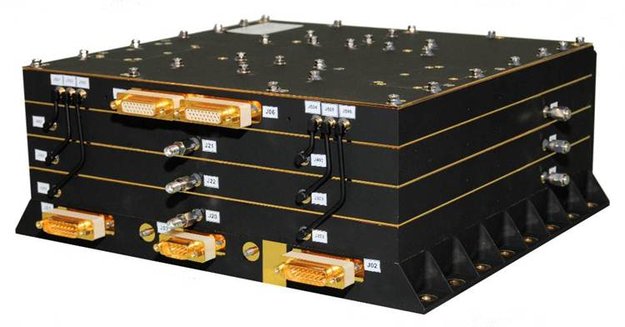
    The shoebox-sized Frequency Generator and Upconverter Units (FGUU) is a pivotal item of equipment that takes the outputs of the satellite’s adjacent Navigation Signal Generator Unit and converts them into L-band signals across Galileo’s three spectral bands. It is these signals that end up guiding Galileo users through their receivers.
    The shoebox-sized Frequency Generator and Upconverter Units (FGUU) is a pivotal item of equipment that takes the outputs of the satellite’s adjacent Navigation Signal Generator Unit and converts them into L-band signals across Galileo’s three spectral bands. It is these signals that end up guiding Galileo users through their receivers.

    The shoebox-sized FGUU is a pivotal item of equipment, effectively giving Galileo its voice. “It takes the outputs of the satellite’s adjacent Navigation Signal Generator Unit and converts them into L-band signals across Galileo’s three spectral bands. It is these signals that end up guiding Galileo users through their receivers,” Bisgaard said.

    “These signals end up being very low power by the time they reach the ground, so maintaining the signal quality is key, in terms of power range, frequency shape and low noise. The FGUU actually relies on Galileo’s atomic clocks to keep accurately locked on its set frequency. It also actively determines which of the clocks and other redundant subsystems it should employ at any one time for optimal operations,” Bisgaard said.

    Kongsberg Norspace’s second, similarly sized contribution is the SART, which picks up emergency distress calls from the ground or sea and relays them to the nearest rescue centre, while also sending a return-link message that help is on the way. Galileo’s search and rescue capability marks a significant enlargement of the international Cospas–Sarsat system, which has been active for more than three decades and rescued thousands of lives.

    The company won the SART contract having previously supplied similar transponders to ESA’s Meteosat Second Generation satellites.

    “The SART’s job as a transponder is just to relay messages, theoretically a simple task but requiring clever design to make it work,” adds Mr Bisgaard. “The SART is operating across noisy frequencies, and has to recognise, filter and amplify the very weak messages in question without missing anything.

    “So both FGUU and SART have a need for effective filtering in common, to ensure that they are processing the right frequencies with the right signal shape without any garbling. This filtering is performed physically, based on ‘Surface Acoustic Wave’ (SAW) technology.

    “SAW makes use of the physical effect called ‘piezoelectricity’ – if an electrical field is applied to quartz it is converted to a mechanical or acoustic wave. By converting our electrical signal in this way then converting it back again the signal can be filtered and shaped as desired. This is one of our key technologies and in fact ESA recognises us as a preferred supplier for SAW systems.”

    While the FGUU has embedded redundancy and the SART is a non-redundant unit, one of each design is being supplied for each Galileo satellite, a total of 44. Batch production is a shift from how the space industry traditionally operated, with bespoke designs for each individual satellite, but Kongsberg Norspace has had a lot of experience working in such a way.

    “We’ve had similar series contracts in the past, for instance contributing 48 identical units to five satellites of the Russian Express-AM series and up to 12 units per satellite for the 64-satellite Globalstar low-Earth orbit telecom constellation.

    “We’ve already delivered units to SSTL for the first 14 satellites, which was the first contract won, with the next eight in production. It is SSTL who set the technical requirements and give us information on the interfaces with the other items of equipment, such as the clocks and navigation signal generator unit. We deliver directly to SSTL where the integration is performed.”

    Norspace has been doing business for just under three decades, originally formed as a subsidiary of another company before being spun out. In 1986 it won its first ESA contract, supplying systems for the Agency’s ERS-1 remote sensing missions, subsequently diversifying into the US telecommunications market under the ownership of Alcatel.

    A decade ago a management takeover took place, with the company bought by Kongsberg in 2011. Upwards of 150 satellites rely on hardware supplied by the company.

    “Telecom missions remain an important part of our business, but Galileo is becoming more important – it represented 40% of our sales during the last couple of years.

    “We have been involved with Galileo since the start, supplying equipment for the initial testbed systems, then the GIOVE-A and -B test satellites and the initial In-Orbit Validation quartet of satellites. We hope to maintain our involvement into the future as Galileo evolves, so we are discussing about joining with primes to prepare for future bids.

  • ArcPad 10 Workshop at Oregon State University Campus

    GeoMobile Innovations announced they are conducting an ArcPad 10 workshop on the Oregon State University campus September 12-13, 2013. Taught by ArcPad  “guru” Craig Greenwald, the workshop will provide an extensive overview and hands on training opportunity for new and current ArcPad users or GIS administrators who manage and support field crews using ArcPad.

    GeoMobile_ArcPad10_Training1

    “We will review the new features in the newly-released ArcPad 10.2  such as integration with ArcGIS Online as well as cover the entire soup-to-nuts ArcPad workflow,” said Greenwald, a 7-year veteran of the ArcPad team. “We will also discuss integrating high-accuracy GIS data collection in ArcPad, an increasingly popular trend.”

    The workshop will be conducted in Corvallis, Oregon on the beautiful Oregon State University campus. Corvallis is nestled in the heart of Oregon’s Willamette Valley, within 60-90 minutes of the Portland Metropolitan area, mountains, and the spectacular Oregon coast.

    Those interested are encouraged to inquire/register quickly.  Class size is limited.

    For more details, please visit:

    ArcPad 10 Training at Oregon State University – Sept. 12-13, 2013

    About GeoMobile Innovations

    GeoMobile Innovations Inc., located in Corvallis, Oregon USA, specializes in ESRI Mobile GIS platforms and has years of experience in field to office data workflow projects, with a forte in high quality Mobile GIS application development. An ESRI Business Partner (reseller, developer, and consultant),  GeoMobile’s mission is to work as a partner with clients, empowering them to improve return on investment by implementing quality Mobile GIS and field data collection solutions.

  • IFEN and WORK Microwave Offer BeiDou-2 Support, Enhancements for NavX-NCS GNSS Simulators

    IFEN and WORK Microwave Offer BeiDou-2 Support, Enhancements for NavX-NCS GNSS Simulators

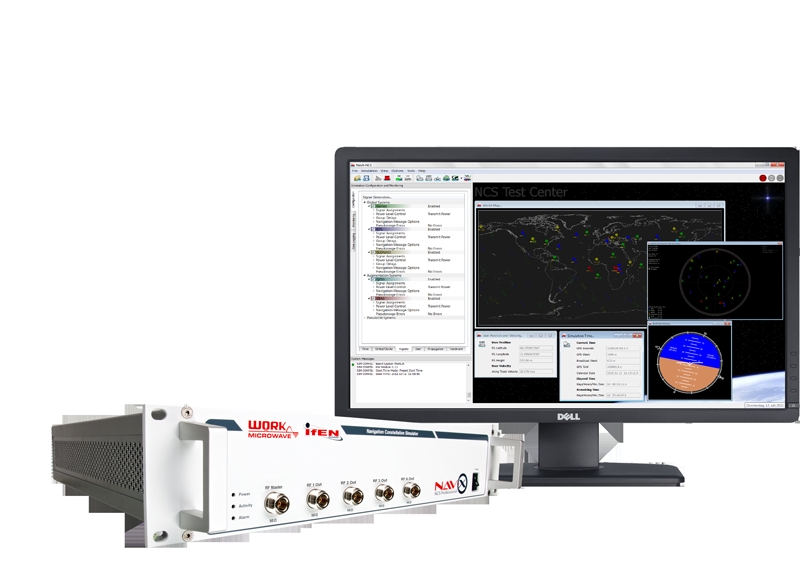
    photo: IFEN  and  WORK Microwave.

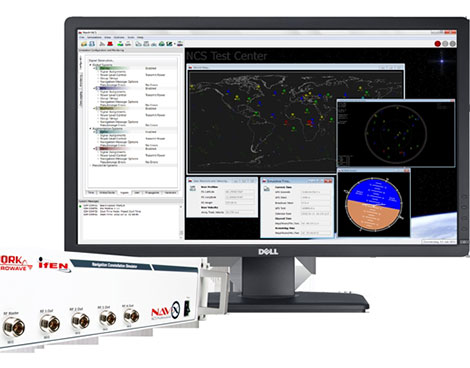
    The NavX-NCS GNSS multi-frequency simulator now supports China’s BeiDou-2 navigation satellite system. BeiDou support is a key enhancement in software update V.1.9 for the NavX-NCS GNSS multi-frequency simulator product line, by IFEN  and  WORK Microwave.

    Leveraging new features and functionalities, users have the flexibility to support a wide range of constellations, frequencies, and channels for research and development of GNSS safety and professional applications, as well as system integration and production testing of mass-market applications, such as automotive satellite navigation, mobile-phone applications, chipsets, and handheld personal navigation devices, the companies said.

    By enabling real-time simulation of second-generation BeiDou satellite signals, also referred to as BeiDou-2, NavX-NCS expands a user’s GNSS signal capability beyond GPS, Galileo, GLONASS, and SBAS constellations.

    “Through a simple software update, NavX-NCS customers can automatically generate signal capabilities for phase two of the BeiDou constellation,” said Dr. Günter Heinrichs, head of customer applications, IFEN GmbH. “Adding BeiDou-2 support to our NavX-NCS simulator comes at the perfect time given the recent release of the BeiDou-2 ICD specification, which outlines interface control requirements for BeiDou-2 B1 satellite signals within the B1 frequency band.”

    A powerful new multi-user functionality enables the simulation of up to four different users, or one user with up to four antennas, in different locations simultaneously, IFEN said. Possible use scenarios include simulating a static user such as a reference station at the same time as a roving user, or simulating multiple docking maneuvers on an oil rig. In addition, the NavX-NCS GNSS simulators now include a new 6DOF functionality that makes it possible to simulate six degrees of freedom (three dimensions of space plus yaw, pitch, and roll). This allows even more true-to-life simulations of ships, airplanes, and cars. A new monitoring widget makes it easier to monitor the current state of simulation.

    Optimized to perform advanced lever arm calculations, the NavX-NCS GNSS simulators ensure accurate navigation for users. In simulation environments where the antenna is not located in the center of the moving object, such as the external of an airplane wing, lever arm calculations compensate for the fact that acceleration and GPS measurements are not made at the same point. By calculating the lever arm measurement between the PAR antenna and GPS position reference for every epoch of observation, this new feature guarantees that the most accurate signal simulation is achieved.

    The NavX-NCS GNSS simulators are available in Professional and Essential versions, both now optionally Export License-Free (LF), speeding up the approval process and delivery time to users abroad. With the Export LF version, users can now limit the simulated user velocity of their simulator equipment to 600 meters per second, eliminating the need for an export license. If an export license should be applied for and be granted later on, it is also upgradeable to a full version meaning the simulation of higher user velocities will be available.

    All NavX-NCS GNSS simulators feature up to nine L-band frequencies and 108 channels, offering users more than twice the number of channels compared with standard GNSS simulators. The platform includes a two-year maintenance contract, the broadest range of frequencies and satellite navigation systems per chassis, as well as the flexibility for users to easily install software updates when they become available.

  • ESA’s Next Galileo Satellite Passes Trial by Noise

    ESA’s Next Galileo Satellite Passes Trial by Noise

    Galileo-LEAF
    Galileo satellite in LEAF for acoustic testing.

    Courtesy of the European Space Agency

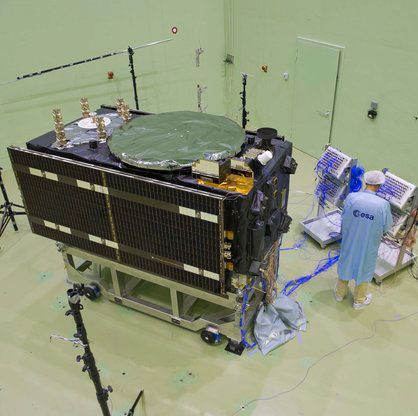
    There might seem to be a hole in the side of this Galileo satellite — in fact its folded solar wings are simply reflecting a noise horn in the wall, about to recreate the deafening roar of a rocket lifting off.

    Anyone witnessing a rocket launch will be struck by the noise levels, even when observing from several kilometres away. A satellite on top of its launcher is exposed to much higher levels, of course. So testing is essential to ensure that the satellite structure can withstand such a sustained loud sound.

    This first Galileo Full Operational Capability (FOC) satellite, successor to the four Galileo navigation satellites already in orbit, underwent acoustic testing in July, part of a full-scale test campaign taking place at ESA’s ESTEC Test Centre in Noordwijk, the Netherlands.

    The satellite was placed in the Large European Acoustic Facility, LEAF, effectively the largest sound system in Europe. A quartet of noise horns are embedded in one wall of this 11 m wide by 9 m deep and 16.4 m high test chamber.

    Noise is generated by passing a carefully modulated flow of gaseous nitrogen through the horns, following the predetermined test profile — this inert gas selected to avoid any contamination of any delicate onboard systems, the satellite having been placed in flight configuration for the purpose of the test.

    “The acoustic noise level reached during the test was 140.7 decibels, about the same noise as standing 25 m away from a jet taking off,” explained Georg Deutsch of European Test Services, the company operating the Test Centre for ESA.

    “This involved a maximum liquid nitrogen flow in this case of 3.5–4 kg per second. Liquid nitrogen delivered by tanker is vaporised to pass through the horns. More or less, we were able to finish this test campaign with one full tank of liquid nitrogen — about 18.5 tons.”

    Galileo in flight configuration for acoustic testing.
    Galileo in flight configuration for acoustic testing.

    Once the massive door of the LEAF is closed, its 0.5 m-thick steel-reinforced concrete walls serve to safely contain the sound. These are coated in turn with thick epoxy resin whose reflectivity increases internal reverberation.

    The chamber itself is supported on rubber bearing pads to isolate it from its surroundings.

    The Galileo satellite itself was similarly isolated — its support structure being borne on air-based “vibration isolators” to make sure any vibration that ensues is due to direct acoustic noise as opposed to resonance from the ground.

    The satellite had to be fitted with dozens of accelerometers to detect internal vibration — large items such as batteries are most prone. The blue cables shown relay accelerometer data. It was also surrounded with microphones to check the acoustic noise around the satellite followed the planned profile, providing around 250 data channels in all.

    This second FOC satellite arrived at ESTEC on 9 August from manufacturer OHB in Bremen, Germany.

    A total of 14 FOC satellites are being produced as part of the first work order for Galileo FOC, which will involve a continuous round of testing at ESTEC as an integral part of their path to orbit. A second work order of eight satellites has been also released to OHB and their production will follow the production of the first batch.

    ESA-LEAF
    LEAF.

    This first Galileo FOC satellite has since had its delicate solar wings removed as part of its preparation for ‘thermal vacuum’ testing. It will stay in a vacuum chamber for weeks on end and be subjected to the same temperature extremes it will experience in orbit.

    Once unboxed, the second FOC satellite will undergo a similar acoustic testing and then a System Compatibility Test Campaign

    will be performed, linking it up with the Galileo Control Centres in Germany and Italy and ground user receivers as if it was already in orbit.

  • Esri Releases ArcPad 10.2

    Esri has released ArcPad 10.2. ArcPad is mobile mapping and field data collection software designed for GIS professionals. The new version of ArcPad improves synchronization with the ArcGIS platform and speeds data collection in the field with new automation options.

    Esri’s reported its latest release of ArcPad gives users the ability to directly open ArcGIS feature services in ArcPad and synchronize edits with hosted or on-premises GIS. The new capability significantly improves mobile workflows by enabling disconnected editing of published services. In addition, ArcPad gives users the ability to automate edits with a Quick Fields option, which can be customized to autopopulate any field during data collection.

    According to the announcement, for users who rely on desktop workflows that revolve around file sharing and distribution, ArcPad 10.2 includes new ArcGIS Online integration. With this option, users can store their ArcPad projects and QuickProject templates as an ArcPad package in their ArcGIS Online accounts for sharing with members of their group. ArcGIS Online subscribers can also browse ArcGIS Online from inside ArcPad with the ability to select and download a project or template, creating an easy, collaborative workflow.

  • Trimble Adds DigitalGlobe Satellite Imagery to Mobile Apps and Printed Maps

    Trimble announced it has entered into an agreement with DigitalGlobe Inc. to license its satellite imagery for offline use in Trimble Outdoors mobile apps, allowing outdoor enthusiasts to view and store imagery on their smartphones and tablets. In addition, DigitalGlobe imagery will be available for high-resolution, large-format custom prints at MyTopo.com, a Trimble company.

    “Our customers use Trimble apps in remote areas where network data coverage doesn’t exist. Armed with smartphones loaded with memory, they�re increasingly asking for map content to be stored locally on the handset for off-the-grid use. We’re excited to enable our customers to cache DigitalGlobe’s high-resolution imagery on their smartphones to address these needs,” said Mark Harrington, vice president of Trimble. “In addition, providing our MyTopo customers with the ability to create large format print maps with DigitalGlobe’s high-resolution imagery allows them to have the convenience of a traditional paper map that matches their handset experience in the field. By partnering with DigitalGlobe, Trimble can significantly enhance the quality of satellite photography available in our products.”

    According to the announcement, DigitalGlobe will provide imagery down to a 30-centimeter resolution for the continental U.S. and 50-centimeter resolution globally, effective immediately. The 30-centimeter resolution means one pixel on the image equals 30 centimeters on the ground.

    “By partnering with Trimble we can showcase how our imagery can be used in new and unique ways for location-based services companies,” said Bert Turner, senior vice president of sales at DigitalGlobe. “Outdoor enthusiasts will now have access to DigitalGlobe’s vast imagery library—the largest and most up to date of its kind—in order to harness the power of mapping and location intelligence even in the most remote locations.”

    Mobile Apps with DigitalGlobe Imagery

    According to the announcement, outdoors enthusiasts will be able to use DigitalGlobe’s worldwide imagery in five apps:

    Trimble Outdoors Navigator (iPhone, Android), designed for in-the-field navigation for hikers, backpackers, mountain bikers, and general outdoor use
    Trimble Outdoors MyTopo Maps (iPad, Kindle Fire, Android tablets), designed for outdoor trip planning
    Trimble GPS Hunt (iPhone, Android), smartphone app built for hunters
    Trimble GPS Fish (iPhone, Android), smartphone app built for anglers
    Trimble GPS Maps (iPad), tablet app designed to plan hunting and fishing trips
    To save maps on their mobile device, customers need to select the area and zoom levels of the DigitalGlobe imagery using the Offline Maps tool found in the supported apps. The ability to store offline satellite imagery will require an Elite membership ($29.99 per year) to TrimbleOutdoors.com (trimbleoutdoors.com/elite) or GPSHuntFish.com (www.gpshuntfish.com/elite).

    Printed Maps with DigitalGlobe Imagery

    Customers can order the new Premium Satellite Image prints in five sizes ranging from 18″ x 24″ to 60″ x 96″ on MyTopo.com, which has a simple five-step process to design custom maps. In addition, users can select the map scale down to 1:1K, plus overlay GPS coordinates, navigation grids and exclusive map layers like public land boundaries, hunt units, forest roads, and lake contours. The imagery can be printed on several paper formats, including waterproof and glossy.

    High-resolution prints will be available in the U.S. and Canada to start, and expand to worldwide coverage later in 2013.

  • The System: IRNSS Success, GLONASS Bellyflop

    IRNSS Success

    The Indian Regional Navigation Satellite System (IRNSS) successfully launched its first satellite on July 1 from the Satish Dhawan Space Centre at Sriharikota spaceport on the Bay of Bengal. An Indian-built Polar Satellite Launch Vehicle PSLV-C22, XL version, carried the 1,425-kg satellite aloft.

    IRNSS-1A is the first of seven satellites that will make up the new constellation: four satellites in geosynchronous orbits inclined at 29 degrees, with three more in geostationary orbit. IRNSS-1A is one of the geosynchronous satellites.

    Following launch, the master control facility conducted five orbit maneuvers to position the satellite in its circular inclined geosynchronous orbit (IGSO) with an Equator crossing at 55 degrees east longitude. Reports indicate that orbit-raising maneuvers have been completed, and all the spacecraft subsystems have been evaluated and are functioning normally.

    IRNSS-1A’s drift eastward from 47 degrees east longitude on July 10 was gradually slowed, and the satellite achieved its assigned inclined geosynchronous orbit, with a 55-degree East equator crossing, by July 18. The orbit inclination is 27.03 degrees.

    Payloads. IRNSS-1A carries two types of payloads, navigation and ranging. The navigation payload will operate in L5 band (1176.45 MHz) and S band (2492.028 MHz), using a Rubidium atomic clock. The ranging payload consists of a C-band transponder that facilitates accurate determination of the range of the satellite. IRNSS-1A also carries corner-cube retro-reflectors for laser ranging. Its mission life is 10 years.

    GLONASS Bellyflop

    A Russian Proton-M rocket carrying three GLONASS navigation satellites crashed soon after liftoff on July 2 from Kazakhstan’s Baikonur cosmodrome. About 10 seconds after takeoff at 02:38 UTC, the rocket swerved, began to correct, but then veered in the opposite direction. It then flew horizontally and started to come apart with its engines in full thrust. Making an arc in the air, the rocket plummeted to Earth and exploded on impact close to another launch pad used for Proton commercial launches.

    Despite the loss, GLONASS still has a full operating constellation of 24 satellites.

    The crash was broadcast live across Russia. Fears of a possible toxic fuel leak immediately surfaced following the incident, but no such leak has been confirmed. The rocket was initially carrying more than 600 tons of toxic propellants. No casualties or damage to surroundings structures or the town of Baikonur have been reported.

    The crashed Proton-M rocket employed a DM-03 booster, which was being used for the first time since December 2010, when another Proton-M rocket with the same booster failed to deliver another three GLONASS satellites into orbit, crashing into the Pacific Ocean 1,500 kilometers from Honolulu.

    A Russian government investigation revealed that at least “three of six angular rate sensors [on the booster stage] were installed incorrectly,” to be specific, upside-down. Examination of the wreckage discovered traces of forced, incorrect installation on three sensors. Assembly-line testing at the factory failed to detect the faulty installation.
    Several videos of the crash are viewable online (YouTube).

    First Live Broadcast of GPS CNAV Messages

    By Oliver Montenbruck, Richard B. Langley, and Peter Steigenberger

    Over the past several years, some users of the GPS navigation system have already benefitted from the addition of various new signals in addition to the legacy C/A- and P(Y)-code. With the introduction of the Block IIR-M satellites in 2005, a new civil signal (L2C) was transmitted on the L2 frequency, and a new signal on a new frequency (L5) was introduced as a standard signal with the Block IIF satellites beginning in 2010. These new signals provide direct access to dual-frequency observations and thus enable improved ionospheric corrections for civil, including aeronautical, users. In addition, a new Civil Navigation (CNAV) broadcast message has been defined in the GPS Interface Specifications (IS-GPS-200 and IS-GPS-705).

    This message will be transmitted jointly on the L2C and L5 signals and provides a variety of useful new parameters. Compared to the legacy L1 C/A-code navigation message, the CNAV message also offers an increased flexibility concerning the type, sequence, and repeat rate of specific messages.

    CNAV messages have already been broadcast over the past two years by the Michibiki (QZS-1) satellite of the Japanese Quasi-Zenith Satellite System (QZSS), which shares many aspects of the GPS signal design. In contrast to this, Block IIR-M and IIF GPS satellites have only transmitted dummy messages so far and a fully operational CNAV transmission is only foreseen once the ongoing modernization of the GPS control segment has been completed.

    Triggered by various interest groups, the Global Positioning Systems Directorate has just conducted a first test campaign with live CNAV transmissions on L2C and L5 over the two-week period from June 15 to 29 (see Global Positioning System Modernized Civil Navigation (CNAV) Live-Sky Broadcast Test Plan.) It served as a first opportunity for end users and receiver manufacturers to test the decoding and use of the new messages under a wide range of different configurations.

    CNAV messages have a common length of 300 data bits and are identified by a message type number that signifies their contents. The messages presently defined for GPS are summarized in Table 1. For QZSS, complementary messages have been established, which enable, among other features, a rebroadcast of GPS-specific data to QZSS users.

    Table 1. Summary of CNAV message types transmitted by space vehicles (SVs). Messages marked by an asterisk were transmitted during the recent CNAV test campaign.

    Message

    Type

    CNAV Message Title

    Function/Purpose

    0*

    Default Default message (transmitted when no message data is available)

    10*

    Ephemeris 1 SV position parameters for the transmitting SV

    11*

    Ephemeris 2 SV position parameters for the transmitting SV

    12*

    Reduced Almanac Reduced almanac data packets for seven SVs

    13

    Clock Differential Correction SV clock differential correction parameters

    14

    Ephemeris Differential Correction SV ephemeris differential correction parameters

    15*

    Text Text (29 eight-bit ASCII characters)

    30*

    Clock, Iono & Group Delay SV clock correction parameters, ionospheric and group delay correction parameters (inter-signal correction parameters)

    31

    Clock & Reduced Almanac SV clock correction parameters, reduced almanac data packets for four SVs

    32*

    Clock & EOP SV clock correction parameters, Earth orientation parameters; Earth-centered, Earth-fixed to Earth-centered inertial coordinate transformation

    33*

    Clock & UTC SV clock correction parameters, Coordinated Universal Time parameters

    34

    Clock & Differential Correction SV clock correction parameters, SV clock and ephemeris differential correction parameters

    35*

    Clock & GGTO SV clock correction parameters, GPS to GNSS time-offset parameters

    36

    Clock & Text SV clock correction parameters, text (18 eight-bit ASCII characters)

    37

    Clock & Midi Almanac SV clock correction parameters, midi (mid-accuracy) almanac parameters

    Other than the legacy L1 navigation message, which adheres to a fixed order of subframes, the sequence of CNAV messages can be varied widely to provide users with an optimized set of low latency information and parameters that change infrequently. As a baseline, the two ephemeris message types 10 and 11 are combined with any of the clock-and-auxiliary data messages (types 30 through 37) to provide users with the orbit and clock data of the received satellites. With a transmission duration of 12 seconds per CNAV message on L2C, a minimum of 36 seconds is required to transfer this information to the user if no other messages are transmitted. On L5, which operates at twice the data rate, a new frame is transmitted once every 6 seconds yielding a minimum of 18 seconds for the broadcast of ephemeris and clock data.

    The recent test campaign started at 18:00 GPS Time on Saturday, June 15, 2013, with the transmission of message types 10, 11, 15, and 30 on a first space vehicle (PRN24) and included PRN12 from 18:42 onwards. Other space vehicles were sequentially phased in until all active IIR-M and IIF satellites (except for the recently launched IIF-4 satellite) transmitted CNAV on the supported signals. When the test ended exactly two weeks later (June 29, 18:00 GPST), all participating satellites were transmitting a complex master frame of 15 x 4 = 60 individual messages, which was repeated once every 12 minutes (on L2C). Each minor frame comprised the two ephemeris messages and at least one clock-data message (see Table 2).

    Table 2. Sequence of message types in a CNAV master frame.

    Message Types

    10

    11

    15

    30

    10

    11

    32

    33

    10

    11

    12

    35

    10

    11

    12

    30

    10

    11

    12

    33

    10

    11

    12

    35

    10

    11

    12

    30

    10

    11

    32

    33

    10

    11

    15

    35

    10

    11

    32

    30

    10

    11

    12

    33

    10

    11

    12

    35

    10

    11

    12

    30

    10

    11

    12

    33

    10

    11

    12

    35

    Other messages included a reduced almanac (message type 12) and a text message (message type 15) with dummy content (“THIS IS A GPS TEST MESSAGE.”)

    The CNAV data were recorded by selected multi-GNSS monitoring stations of the German Aerospace Establishment (Deutsches Zentrum für Luft- und Raumfahrt or DLR) and the University of New Brunswick (UNB), which were specifically configured to record raw GPS navigation frames in addition to the normal observation data. The stations are located at Singapore (SIN0); Sydney, Australia (UNX2); Maui, U.S.A. (MAO0); and Hartebeesthoek, South Africa (HRAG); as well as Fredericton, Canada (UNB) and are equipped with either Javad Delta-G2/G3TH or NovAtel OEM6 receivers. Following initial validation, the raw and decoded data from the CNAV test will be made available to interested users through the Multi-GNSS Experiment (MGEX) of the International GNSS Service (see http:/igs.org/mgex/) to facilitate the development of user software and suitable data formats (such as an extended RINEX navigation message format).

    The CNAV orbit and clock data were updated once every two hours and offer a slightly higher bit resolution than their legacy counterparts. However, the accuracy of the ephemeris data has not yet been evaluated nor compared to that of the L1 C/A-code navigation data.

    As indicated above, the CNAV data can also provide a particularly compact form of almanac data known as the reduced almanac. It does not offer clock information (that is not normally required for a signal search) and assumes a circular orbit, which reduces the overall accuracy. Still, it can be transmitted (and repeated) in a much shorter time interval than the legacy almanac, which requires a total of 12.5 minutes. Each reduced almanac message (message type 12) provides orbit information for a total of seven satellites and it takes a set of five such messages to convey information for a complete constellation. For the master frame layout described above, the full constellation reduced almanac is repeated twice within 12 minutes on L2C (and half this time on L5).

    Novel types of CNAV data not covered by the legacy navigation message include the differential code biases (also known as inter-system corrections or ISCs), which are required for pseudorange-based positioning with signals other than the legacy P(Y)-code (in addition to the established Timing Group Delay parameter or TGD). An overview of TGD and ISC values broadcast by the various satellites participating in the CNAV test is given in Table 3.

    Table 3. Differential code biases (in nanoseconds) of GPS Block IIR-M and IIF satellites broadcast during the test campaign as part of the message type 30 CNAV messages.

    SV Type

    SVN

    PRN

    TGO

    ISC L1CA

    ISC L2C

    ISC L5I5

    ISC L5Q5

    IIR-M

    48

    07

    -10.71

    -0.84

    6.52

    IIR-M

    50

    05

    -10.24

    -0.32

    5.41

    IIR-M

    52

    31

    -13.04

    -0.55

    7.36

    IIR-M

    53

    17

    -10.24

    -0.84

    6.17

    IIR-M

    55

    15

    -10.24

    -0.47

    5.62

    IIR-M

    57

    29

    -9.31

    -0.76

    5.06

    IIR-M

    58

    12

    -12.11

    -0.76

    6.64

    IIF

    62

    25

    5.59

    -2.07

    -5.24

    -0.38

    -0.87

    IIF

    63

    01

    8.38

    -2.30

    -7.57

    0.38

    2.15

    IIF

    65

    24

    2.79

    -0.26

    -2.27

    2.27

    3.70

    Another important achievement is the provision of Earth orientation parameters (EOP) in message 32, which provides GPS users with access to the celestial reference frame. EOPs were transmitted during the second test week and updated on a daily basis (see Table 4). Knowledge of these parameters is of particular interest for GPS-based orbit determination and navigation of spacecraft (in low Earth orbit), which is preferably referred to an inertial rather than an Earth-fixed coordinate system.

    Table 4. Daily Earth orientation parameters from the CNAV test campaign (pole coordinates and dUT1 (UT1-UTC) time differences and derivatives).

    Epoch (GPST)

    x_p

    (arcseconds)

    x_p_dot

    (arcseconds per day)

    y_p

    (arcseconds)

    y_p_dot

    (arcseconds per day)

    dUT1

    (seconds)

    dUT1_dot

    (seconds per day)

    June 22, 0:00

    0.13517

    0.00104

    0.39657

    -0.00054

    0.06341

    -0.00046

    June 23, 0:00

    0.13621

    0.00102

    0.39604

    -0.00056

    0.06295

    -0.00049

    June 24, 0:00

    0.13740

    0.00101

    0.39535

    -0.00058

    0.06231

    -0.00053

    June 25, 0:00

    0.13815

    0.00099

    0.39487

    -0.00060

    0.06164

    -0.00063

    June 26, 0:00

    0.13846

    0.00096

    0.39443

    -0.00062

    0.06078

    -0.00067

    June 27, 0:00

    0.13885

    0.00094

    0.39381

    -0.00064

    0.06004

    -0.00067

    June 28, 0:00

    0.13947

    0.00093

    0.39310

    -0.00066

    0.05909

    -0.00063

    June 29, 0:00

    0.13987

    0.00090

    0.39246

    -0.00068

    0.05842

    -0.00053

    Overall, CNAV offers exciting prospects for improved GPS utilization and users may look forward to the next test campaigns, which will tentatively be conducted once every six months.

    As a side note, it should be mentioned that individual satellites could be observed to transmit various types of non-standard CNAV messages as well as CNAV messages with improper data (such as an invalid week count) after the end of the main test campaign. Various receivers in the MGEX network, which were processing the received CNAV messages internally and which put full confidence in their proper contents, were mislead by such information. During the actual test campaign, all data appeared fully valid and no problems were reported by the stations.


    OLIVER MONTENBRUCK is the head of the GNSS Technology and Navigation Group at DLR’s German Space Operations Center in Oberpfaffenhofen, Germany.

    RICHARD B. LANGLEY is a professor in the Department of Geodesy and Geomatics Engineering at the University of New Brunswick, Fredericton, New Brunswick, Canada.

    PETER STEIGENBERGER is a staff member in the Institut für Astronomische und Physikalische Geodäsie of the Technische Universität München (TUM) in Munich, Germany.
  • Russian Officials Concerned over Reduced GLONASS Funding

    Plans to reduce funding for GLONASS is causing concern among deputies of the State Duma. The government officials predict a loss of trust in the world by the Russian navigation system, according to a July 29 Roscosmos article.

    Reduced funding of GLONASS will lead to a reduction of the orbital grouping system below acceptable levels, according to the first deputy chairman of the Committee on Industry, Vladimir Gutenev. The U.S. GPS system is functioning and both Europe and China are developing systems, Galileo and COMPASS respectively. This will “lead to the loss of confidence of the international community in the GLONASS system and, consequently, to a reduction in its use globally. Russia will lose a strategic global instrument of political and economic prestige,” Gutenev warned.

    The proposal is to reduce budget funding of the state space program in 2014 by 11.7 billion rubles, in 2015 by 13.5 billion rubles, and in 2016 by 40 billion rubles, according to the ITAR-TASS news agency. In addition, the federal space program of Russia for 2006-2015 already lacks 10.5 billion rubles funding, and this year there has been a 2.3-billion-ruble additional reduction in R&D.The funding was in part intended to build and put into operation phase 1 of the Vostochny booster side building, which would use the Soyuz-2 space rocket system.

    The State Duma, according to the ITAR-TASS news agency, has recommended that the government of the Russian Federation maintains funding of federal programs on space matters in the amount provided by an approved state program.

  • Esri Releases ArcGIS 10.2

    Esri released the new version of ArcGIS, marking a major milestone in the history of the Esri platform. With ArcGIS 10.2, Esri has taken advantage of the significant changes in IT that magnify the power and accessibility of GIS. The new release improves ease of use, real-time data access, and integration with existing infrastructure. It allows people to more easily deploy web GIS—the key component for implementing GIS as a platform. Web GIS helps users organize their work and simplifies geographic information discovery, access, sharing, and collaboration.

    ArcGIS 10 dot 2 MapTourTemplate_3

    More Online Analysis Tools

    According to the announcement, ArcGIS 10.2 extends the analytic functionality of GIS to everyone via ArcGIS Online. Advanced analysis tools have been added to ArcGIS Online for investigating geographic relationships, patterns, and trends within data. New tools in ArcGIS Online include overlay layers for combining two or more layers into one single layer; enhanced hot-spot analysis; and data enrichment resources to glean information about the people, places, and businesses in a specific area or drive time.

     ArcGIS Online Access

    To ensure that ArcGIS for Desktop users have access to ArcGIS Online capabilities, Esri entitles every customer organization that has ArcGIS for Desktop (Basic, Standard, or Advanced) to receive an ArcGIS Online subscription. The number of named users will be equal to the total number of ArcGIS for Desktop licenses current on maintenance. This will enable users to easily get started with ArcGIS Online. It will also give access to all Esri apps—such as Esri Maps for Office, Collector for ArcGIS, and Operations Dashboard for ArcGIS—as well as numerous app templates hosted in ArcGIS Online. Esri will notify ArcGIS for Desktop customers about the details of this new entitlement in the coming weeks.

    Portal for ArcGIS

    At ArcGIS 10.2, Esri gives people the ability to deploy ArcGIS Online capabilities on-premises for tighter content security and control. Portal for ArcGIS provides a secure front end for ArcGIS for Server, with dozens of easy-to-use apps and full integration with ArcGIS for Desktop. It includes geographic viewers and analysis tools designed for people without any GIS knowledge. Experienced GIS users can connect to Portal for ArcGIS from ArcGIS for Desktop, developer APIs, and other Esri applications. The Portal for ArcGIS extension software is included with ArcGIS for Server Advanced (Enterprise or Workgroup) and is licensed and priced based on the number of named users.

    Real-Time Data Access

    Esri’s new release of ArcGIS introduces a number of new technologies that enable the real-time collection and sharing of data with GIS. It includes ArcGIS GeoEvent Processor for Server, a new ArcGIS for Server extension that gives users the power to access live data streams. People can analyze and send processed results to other users or into other systems. This capability transforms GIS applications into powerful frontline decision tools, refining data quickly for consumption and enabling fast response in any situation.

    Expanded Business Intelligence Support

    With business intelligence (BI) being relied on even more in an increasingly competitive marketplace, the new ArcGIS release expands Esri’s support for major BI systems. ArcGIS 10.2 includes new MicroStrategy BI and Microsoft Dynamics Customer Relationship Management tools, allowing users of those platforms to perform location analytics on their business data and focus their marketing. Core BI tools Esri Community Analyst and Esri Business Analyst Online also get productivity-enhancing face-lifts and major customization capability.

    For more information on the dozens of other improvements in the latest release of ArcGIS, visit esri.com/whatsnew.


  • Public Interface Control Working Group Meeting Set for September

    The Air Force has issued a Federal Register Notice regarding an upcoming Public Interface Control Working Group (ICWG) meeting, set for September 24-25. Here is the notice:

    Public ICWG Announcement—2013

    This notice informs the public that the Global Positioning Systems (GPS) Directorate will be hosting a Public Interface Control Working Group (ICWG) meeting for the NAVSTAR GPS public signals in space (SiS) documents and ICD-GPS-870; IS-GPS-200 (Navigation User Interfaces), IS-GPS-705 (User Segment L5 Interfaces), IS-GPS-800 (User Segment L1C Interface), and the Navstar Next Generation GPS Operational Control Segment (OCX) to User Support Community Interfaces (ICD-GPS-870).  Dates and times can be found below.

    The purpose of this meeting will be twofold: (1) To resolve the comments against the public signals-in-space (SiS) documents with respect to the six issues outlined below, and (2) to collect issues/comments outside the scope of the issues outlined below for analysis and possible integration into the following release. The ICWG is open to the general public. For those who would like to attend and participate in this ICWG meeting, we request that you register no later than August 6, 2013. Please send the registration to [email protected] or [email protected] and provide your name, organization, telephone number, address, and country of citizenship.

    Please note that the Directorate’s primary focus will be the disposition of the comments against the following GPS related topics:

    1.      L1C Week Number of Operation (WNOP)
    2.      Removal of Obsolete Information from the Public Signals-in-Space (SiS) Documents
    3.      CNAV Reference Times
    4.      PRN Mission Assignments 211-1023
    5.      CNAV Broadcast Intervals
    6.      Document Baseline for User Community & Zero AOD User Interfaces

    All comments must be submitted in Comments Resolution Matrix (CRM) form. These forms along with the Was/Is Matrix, current versions of the documents, and the official meeting notice will be posted at http://www.gps.gov/technical/icwg/.

    Comments outside the scope of the above issues will be collected, catalogued, and discussed during the public ICWG as potential inclusions to the version following this release. If accepted, these changes will be processed through the formal Directorate change process for IS-GPS-200, IS-GPS-705, IS-GPS-800, and ICD-GPS-870.

    There will also be a special topic that will be discussed at the Public ICWG.

    1.      Adjacent Band Compatibility (ABC) Study Group Kickoff

    Please provide comments in the CRM form and submit to the SMC/GPER mailbox at [email protected] or to Mark Marquez at [email protected] by August 7, 2013.

    Public Interface Control Working Group Meeting (ICWG)
    Date(s) and Times: 24-25 Sep 2013 (0800-1700) (Pacific Daylight Time P.D.T)
    Dial-in Information and Location: 1-800-366-7242, Code: 1528652
    Address: SAIC Facility 300 North Sepulveda Blvd, 2nd Floor, Conference Room
    2060 El Segundo CA 90245

    * Identification will be required at the entrance of the SAIC facility (Passport, state ID, or Federal ID). SAIC Facility phone number: 310-416-8300.

  • Satelles Announces Patent and Technology License Agreement with Boeing

    Satelles, a division of iKare Corporation, has entered into a patent and technology license agreement with The Boeing Company. This license allows Satelles to provide timing and location solutions to commercial markets delivered over the Iridium constellation of 66 low-Earth-orbiting satellites.

    The timing and location signals are available anywhere on Earth, without the need for local infrastructure, making the system perfect for augmenting GPS and other location-based technologies, Satelles said. Unlike standard GPS, the high-power signals can reach into many building structures. The signal-in-space provides a location-specific signature that can reliably prove (or authenticate) the location of a mobile device or other equipment, while being virtually impervious to spoofing and other attacks, Satelles said.

    Gregory Gutt, CEO of iKare Corporation, stated, “After working closely with Boeing for years to create a global indoor-positioning solution, we are thrilled to be entering this license agreement, which includes over 30 issued and pending patents.”

    Michael O’Connor, CEO of the Satelles business, agreed. “We see tremendous dual use potential for the technology going forward. Indoor location is an exciting area, and we are seeing keen commercial interest in a solution that delivers trusted location for secure network communication or network transaction security.”

    Satelles is headquartered in Silicon Valley, in Redwood City, California, with an office in Ashburn, Virginia.