Category: GNSS

  • European Ground Stations Enable Galileo Search and Rescue Training

    European Ground Stations Enable Galileo Search and Rescue Training

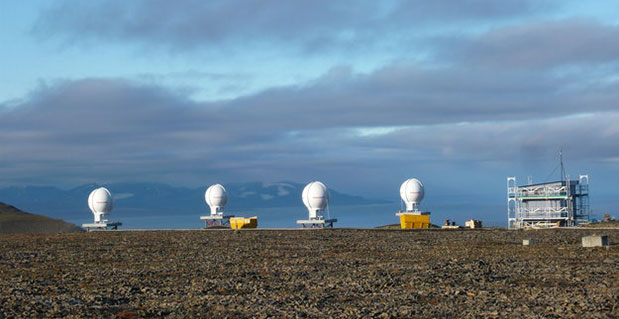
    Svalbard station on Spitsbergen in the Norwegian Arctic.
    Svalbard station on Spitsbergen in the Norwegian Arctic.

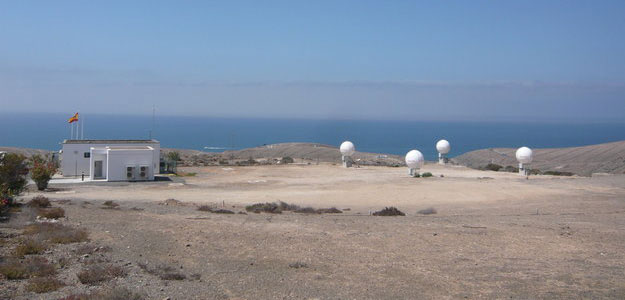
    The European Space Agency’s completion of a pair of dedicated ground stations at opposite ends of Europe has enabled Galileo satellites in orbit to participate in global testing of the Cospas–Sarsat search and rescue system.The Maspalomas station, at the southern end of the largest island of the Canary Islands, at the southern fringe of European waters, was activated in June. And this last month has seen the Svalbard site on Spitsbergen in the Norwegian Arctic come on line — the two sites can already communicate and will soon be performing joint tests.

    This speedy progress has enabled the participation of the latest two Galileo satellites in an international  demonstration and evaluation program — a worldwide test campaign for a new expansion of the world’s oldest and largest satellite-based rescue system, Cospas–Sarsat.

    The Maspalomas station in the Canary Island has an ESA-built Maspalomas Medium-Earth Orbit Local User Terminal (MEOLUT).
    The Maspalomas station in the Canary Island has an ESA-built Maspalomas Medium-Earth Orbit Local User Terminal (MEOLUT).

    Founded by Canada, France, Russia and the U.S., Cospas–Sarsat has assisted in the rescue of tens of thousands of souls in its three decades of service. Distress signals from across the globe are detected by satellites, then swiftly relayed to the nearest search and rescue (SAR) authorities.

    Now the program is introducing a new medium-orbit SAR system to improve coverage and response times, with the Galileo satellites in the vanguard of this major expansion.

    Supporting search and rescue is a separate function to Galileo’s main task of providing global navigation and timing services, but no less important.

    The second pair of Europe’s Galileo satellites — launched together on 12 October last year — are the first of the constellation to host SAR payloads. These can pick up UHF signals from emergency beacons aboard ships, aircraft or carried by individuals, which are then relayed to ground stations. There, the source is pinpointed and automatically passed on to a control center, which then routes it to local authorities for rescue.

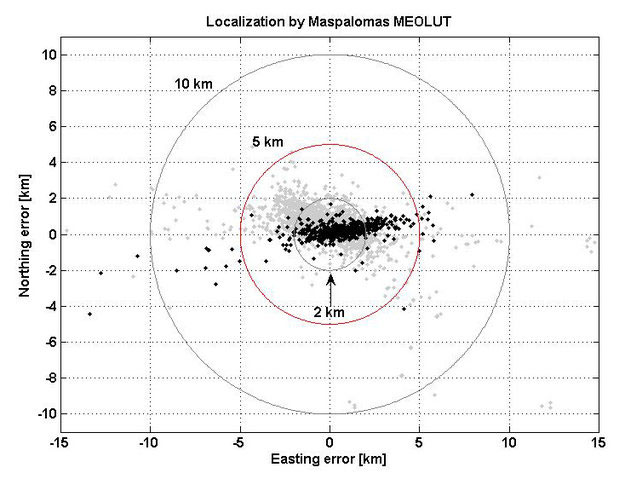
    “The Galileo satellites, tested in combination with the same SAR payloads on Russian Glonass satellites as well as compatible repeaters on a pair of US GPS satellites, showed an ability to pinpoint simulated emergency beacons down to an accuracy of 2-5 km in a matter of minutes,” explained ESA’s Galileo SAR engineer, Igor Stojkovic.

    “Our in-orbit validation tests so far have been in line with expectation and beyond, giving us a lot of confidence in the performance of the final system, once completed.

    “And using a combination of satellites is just how the upgraded system will operate in practice, in order to localise distress signals.”

    Localization test performed from the Maspalomas MEOLUT on 29-30 July 2013 as part of Galileo's search and rescue in-orbit validation. Beacon locations obtained with four satellites are shown in black, while those using three satellites are shown in grey. More than 93% of all beacon locations, after only a single beacon burst has been received, are within the required 5 km from the actual beacon position.
    Localization test performed from the Maspalomas MEOLUT on 29-30 July 2013 as part of Galileo’s search and rescue in-orbit validation. Beacon locations obtained with four satellites are shown in black, while those using three satellites are shown in grey. More than 93% of all beacon locations, after only a single beacon burst has been received, are within the required 5 km from the actual beacon position.
  • Topcon Announces Expanded Features, Connectivity Options with Magnet v2.0

    Topcon Positioning Group announces a multitude of new features and enhanced functionality to the entire Magnet suite of connected workflow software. The Magnet suite includes solutions for the field personnel, the office designers and managing supervisors.

    The release of Magnet v2.0, a Topcon enterprise solution for the geomatics industry, provides more than 30 substantial additions or upgrades to the Enterprise, Field and Office packages. Enterprise is a cloud service designed for the supervising manager that connects the Field and Office products and provides a collaborative web-based interface to company data. Cloud-based collaboration and real-time data exchange makes Magnet a productivity enhancing solution for virtually any operation.

    Magnet v2.0 is now available.
    Magnet v2.0 is now available.

    “Magnet is the industry leader in cloud computing and real-time data exchange,” said Jason Hallett, Topcon vice president for software product management. “Now with v2.0, the total product suite has been elevated to a new level. Not only does Magnet allow for real-time collaboration between the project manager, job foreman, job site crews, office personnel, engineers and consultants, it also introduces myriad new features that will increase productivity in every aspect of every job.”

    Key new developments are expanded functionality for BIM and GIS applications.  Magnet v2.0 now has customized packages designed for building layout and high accuracy GIS application.

    A unique new feature is Hybrid Positioning technology, available in the Magnet Field solution package. It provides the option to simultaneously connect to GNSS signals and robotic measurements on a single rover pole. “This is a powerful feature that is easily managed in Magnet,” Hallett said.

    “Topcon continues to bring efficiencies in productivity by providing the ability to maintain simultaneous connections to a robot and a GPS rover when using the Hybrid Positioning module.”

    Other key features available to enhance data workflow and automation include:

    • AutoCAD 360 cloud surfing: Allows user to visualize, edit and share field projects with non-Magnet users.
    • AutoCAD Civil 3D support: Single-click ability to convert 3D line work generated in Magnet to DWG and launch seamlessly in AutoCAD Civil 3D for review or continued design, and vice versa.
    • Real-time sessions: An office user can log in and connect to any active project, select a field crew and view the field activity and data in real timeMagnet Field-enabled rovers to work from a single cellular-enabled RTK base.
    • Asset manager: Ability to show all active field assets (crews and equipment) in Map View with satellite image background.
    • Third-party file format support: Enlarged library of supported file formats of all major positioning equipment providers, and third-party vendors to Magnet.

    “With Magnet a company can manage its positioning data and field information to ensure maximum efficiency in all facets of each project. The exciting new BIM and GIS features makes it the most productive workflow solution for almost every precise positioning and mapping professional,” Hallett said.

    Magnet v2.0 is available for use with Topcon and Sokkia instruments and is available through subscription service so the user has continuous access to the latest features. Magnet Field and Office products can also be purchased for stand-alone use.

  • GIS 2go for Offline Maps to Be Demonstrated at Intergeo

    Disy_GIS2go_3_Tablet_Anzeige-Intergeo

    Disy Informationssysteme GmbH will present GIS 2go at Intergeo 2013, being held this week in Essen, Germany. GIS 2go transfers maps from ArcGIS Desktop to an iPad or Android tablet. With the associated app, users can access their own maps without a network connection while they are on the road.

    Intergeo is the world’s largest conference and trade fair for geodesy, geoinformation and land management. From October 8-10, visitors to stand D1.045 in hall 1 can experience GIS 2go live and meet with experts and developers in person.

    GIS 2go allows maps to be taken along with the user, from Esri’s ArcGIS Desktop to a tablet (iPad or Android). With the GIS 2go Add-in, the data selection, the map export and the re-import are controlled via the cloud in ArcGIS Desktop. On the tablet, the “Cadenza Mobile GIS 2go App” allows access to the maps with all feature data — be it with or without a network connection. Even graphic notes and media created on the go are taken over into ArcGIS Desktop.

    On the tablet, users can move interactively on the map; display feature attributes; add points, lines and areas with the graphic notebook; or track via GPS; augment the map with photos and audio/video clips or simply use text to comment on it. The information recorded remotely will be imported later into ArcGIS Desktop and taken over into the data storage.

  • International Colloquium Focuses on Galileo Fundamentals

    The Fourth International Colloquium – Scientific and Fundamental Aspects of the Galileo Programme will be held December 4-6, 2013, in Prague, Czech Republic.

    This colloquium intends to bring together leading members of the European scientific community and their international partners. One of its aims is to propose those in charge of Galileo operations and development means of enhancing the scientific use of Galileo and to contribute to GNSS development based on scientific approaches.

    The colloquium will address four major areas of research:

    • Scientific applications in meteorology, geodesy, geophysics, space physics, oceanography, land surface and ecosystem studies, using either direct or reflected signals, differential measurements, phase measurements, radio occultation measurements, using receivers placed on the ground, in airplanes or on satellites.
    • Scientific developments in physics, dealing with future GNSS, particularly in testing fundamental laws in astronomy and in quantum communication. Relativistic reference frames and relativistic positioning will be addressed.
    • Aspects of metrology, such as reference frames, on board and ground clocks as well as precise orbit determination
    • Scientific aspects of satellite navigation and positioning such as signal propagation, tropospheric and ionospheric corrections and means to model and mitigate multipath and interference

    During this colloquium, the various possibilities to use navigation satellites such as Galileo satellites for scientific purposes shall be reviewed and the question be answered how these scientific applications can contribute to make the most of the present systems, and define their future evolution. The conference will be organized as a series of plenary talks and two parallel half-day sessions.

    To learn more about the colloquium, visit the event’s website.

  • NovAtel Awarded Contract to Supply WAAS Receivers for FAA System

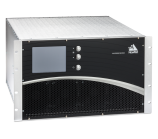
    NovAtel's WAAS G-III receiver.
    NovAtel’s WAAS G-III receiver.

    NovAtel, an OEM provider of high-precision GNSS positioning products, has been contracted by the Federal Aviation Administration (FAA) to produce and deliver 176 Wide Area Augmentation System (WAAS) third-generation reference receivers (G-III).

    The contract includes engineering support for the receiver as well as support for the current generation reference receiver (G-II), Geostationary Earth Orbit Uplink Subsystem – Type 1 (GUST) receiver, and Signal Generator (SIGGEN).

    The third-generation WAAS program is a technology refresh of the highly successful, currently operating second generation WAAS Satellite-Based Augmentation System (SBAS).  WAAS provides integrity monitoring, correction data, and increased satellite availability to users of GPS within its coverage area.  The integrity monitoring features of the WAAS allow the use of GPS L1 C/A for safety-of-life applications and in particular for the civil aviation industry.   The third-generation WAAS will monitor and augment the modernized GPS L5 signal, allowing aviation receivers to operate in two protected aviation frequency bands with assured integrity.

    NovAtel's WAAS G-II receiver.
    NovAtel’s WAAS G-II receiver.

    NovAtel’s reference receivers and uplink station equipment have been a central element of the WAAS since its inception. The G-III reference receiver uses fully updated hardware and tracks all GPS signals including the legacy GPS L1 C/A, L2P(Y) (semi-codeless), and the modernized L2C, L5, L1C signals as well as the WAAS L1 C/A  and L5 signals.

    The WAAS G-III reference receiver provides a rich set of range measurement data, signal integrity metrics, and logs for processing by the system’s data communication processor. The receiver architecture is designed to facilitate future expansion and reconfiguration to support the evolving needs of WAAS and other SBAS systems worldwide, including multi-constellation augmentation systems.

    “We have a long relationship with the FAA and have worked very closely with the WAAS program team to develop a third-generation ground reference receiver that carries over the pedigree of our first and second generation products, while adding features and processing capacity required for the modernized system,” said Jason Hamilton, director of marketing for NovAtel. “The WAAS G-III was designed and tested specifically for ground reference networks requiring reliable continuous operation, high-longevity components, and DO-178B design assurance.”

  • The System: Ground Control Readied for GPS III

    The System: Ground Control Readied for GPS III

    rtn_iis_gps-ocx_banner4.jpg

    Raytheon Company reached several milestones recently in its development of the GPS Next -Generation Operational Control System (GPS OCX). Lockheed Martin’s GPS III Non-flight Satellite Testbed (GNST) — a full-sized, functional satellite prototype currently residing at Cape Canaveral Air Force Station — successfully established remote connectivity and communicated with OCX during pre-flight tests.

    GNST proved that it could connect with and receive commands from Raytheon’s Launch and Check Out System (LCS), a part of OCX that supports the satellite and mitigates risks prior to launch. The GNST received commands from Lockheed Martin’s Launch and Checkout Capability (LCC) node in Newtown, Pennsylvania via the OCX servers at Raytheon’s facility in Aurora, Colorado; the system then returned satellite telemetry to the control station. The tests mirror launch and early orbit testing planned for all flight vehicles.

    “While we have connected OCX with ground-based simulators before, these tests were the first time that OCX and a GPS III satellite have actually communicated,” said Keoki Jackson, vice president for Lockheed Martin’s Navigation Systems mission area.

    Ahead of Schedule. Raytheon received Interim Authorization to Test (IATT) security certification from the U.S. Air Force for OCX LCS four months ahead of schedule. The company received a one-year certification with no liens, meaning the government does not require any changes.

    “Typically, IATT certification is given for six-month increments,” said Matthew Gilligan, Raytheon’s GPS OCX program manager and a vice president in Raytheon’s Intelligence, Information, and Services business. “The LCS one-year accreditation speaks to the quality of the information assurance design and threat protection.” The IATT not only includes the LCS, but also Lockheed Martin’s GPS III satellite support systems, Exercise and Rehearsal Training Tool, and Upload Generation Tool.

    OCX is being developed in two blocks. There are seven iterations in Block 1 and one in Block 2. LCS is the fifth Iteration of Block 1; it successfully completed Critical Design Review in June 2013.

    Early Orbit Exercises. Lockheed Martin and Raytheon also completed the third of five planned launch and early orbit exercises to demonstrate launch readiness of GPS III and OCX.

    Exercise 3 demonstrated space-ground communications; first acquisition and transfer orbit sequences; orbit-raising maneuver planning and execution; and basic anomaly detection and resolution capabilities. In addition, the industry and Air Force GPS Directorate teams jointly executed mission planning activities, such as orbit determination and the generation of upload command files.

    Two additional readiness exercises and six 24/7 launch rehearsals are planned before launch of the first GPS III satellite. The first flight GPS III space vehicle (SV-01) is expected to be available for launch in 2014, and launched by the U.S. Air Force in 2015.

    Exelis Encryptors. Exelis delivered the first three of a planned 14 ground-based encryptors to Raytheon Company for OCX. Designed to automatically code and decode GPS signals, encryptors facilitate the exchange of user information by securely transmitting navigation payload data between the OCX ground station and the orbiting constellation of satellites.

    Delivery followed successful thermal, electromagnetic interference and security verification testing. Exelis provides critical elements of software in the navigation processing subsystem that will enable controllers to better understand the exact position of GPS satellites. This helps ensure accurate navigation information is securely broadcast to users. In addition to encryptors, Exelis is building high-precision receivers for use in GPS ground monitoring stations and satellite signal simulators for testing purposes.

    Exelis is also on contract with Lockheed Martin to provide the payloads for the GPS III satellites.


    Fire_engine_galileoEurope Tests Galileo Public Regulated Service

    European Union member states began their independent testing of the Public Regulated Service (PRS) broadcast by the four Galileo navigation satellites in orbit. Transmitted on two frequency bands with enhanced protection, PRS offers a highly accurate positioning and timing service, with access strictly restricted to authorized users, such as government defense, security, and emergency services.

    PRS access was initially considered for Galileo’s Full Operational Capability phase, but it has been enabled in 2013 in response to the strong interest of member states in this service. To allow early access to PRS during the current phase, the European Commission and ESA began the joint project PRS Participants To IOV (PPTI) in July 2012.

    ESA ensured the availability of several tools developed under ESA contracts, including test receivers and other qualification equipment. ESA’s PRS Laboratory, based at the Agency’s ESTEC technical centre in Noordwijk, the Netherlands, provided training, demonstrations and sample data.

    “Belgium, France, Italy, and the UK have now performed independent PRS acquisition and positioning tests. In parallel, ESA, through collaboration with Dutch and Italian authorities, is conducting PRS fixed and mobile validation in several locations in the Netherlands and Italy,” said Miguel Manteiga Bautista, head of ESA’s Galileo Security Office.

    The PRS tests have demonstrated a current autonomous positioning accuracy of less than 10 meters when in the correct geometrical configuration. This is an impressive result considering the small number of Galileo satellites in orbit and the limited ground infrastructure so far deployed.

    Italy has developed its own PRS receiver, and tests have confirmed the feasibility of independent PRS receiver development and verification based on specifications provided by ESA.

    “The PPTI project is still ongoing to test more advanced functionalities this coming autumn and to run the first aeronautical PRS tests in collaboration with the Dutch authorities. Other member states have also expressed their willingness to join the IOV PRS experimentation campaigns soon,“ concluded Miguel Manteiga.

    The project is a first step to ensure use of the PRS as soon as it becomes operational. It will be complemented by PRS pilot projects, focused on PRS applications, which are currently under definition in a common effort between European agencies.

    The United States has submitted a request to be able to use Galileo’s PRS. Other non-EU countries have also expressed a desire to be associated with the program.


    System Briefs

    Way to Go GAO, Part II. The Air Force should come up with better cost estimates and options for new GPS satellites, according to a September 9 report from the U.S. Government Accountability Office (GAO). The GAO was responding to an Air Force study on lower-cost space solutions for GPS.

    “More information on key cost drivers and cost estimates, and broader input from stakeholders would help guide future investment decisions,” the GAO concluded. Specifically, the key cost drivers include dual-launch capability, navigation satellites (smaller GPS-type satellites yet to be developed), and a nuclear detection capability.”

    New Birds by Fall. Galileo satellite-builder OHB AG said it should know by late September whether tests of the first Full Operational Capability (FOC) Galileo satellites are proceeding well enough to permit their delivery later this year. The first FOC satellite began testing at ESA’s European Space Research and Technology Centre in May, and the second arrived August 9.

    The OHB satellites either “bear a strong resemblance” or “are identical” to the four in-orbit validation spacecraft now in medium-Earth orbit, depending on the source. However, the on-board power of the OHB spacecraft exceeds that of the validation satellites built by a different manufacturer. According to one source, Galileo managers made the modification in part to enable Galileo’s encrypted Public Regulated Service signal to overcome a signal frequency overlap issue with China’s BeiDou constellation.
  • ENC-GNSS 2014 Issues Call for Abstracts

    ENC-GNSS-2014-logo

    The Netherlands Institute of Navigation will be hosting the European Navigation Conference (ENC-GNSS 2014) in Rotterdam, the Netherlands, April 15-17, 2014. The conference will cover all aspects of positioning, navigation and timing (PNT) developments and applications. Special sessions will be organized for innovations and their commercialization.

    Abstracts can be submitted until December 31, 2013, at www.enc-gnss2014.com. Topics include, but are not limited to

    – Algorithms and Methods: Navigation and Positioning
    – Algorithms and Methods: Receiver Signal Processing
    – Alternatives and Backups to GNSS
    – Atmosphere and Space Weather
    – Augmentation Systems
    – Aviation Navigation
    – eLoran and other LF Systems
    – Emerging GNSS
    – Galileo IOV Results
    – Galileo Public Regulated Service (PRS)
    – GNSS Programs, Status and Modernization
    – GNSS Vulnerabilities
    – Indoor Navigation
    – Integrated Systems
    – Integrity
    – Interoperability and Multi-Constellation Results
    – Location Based Services
    – Maritime Navigation
    – MEMS
    – Network RTK, Surveying and Hydrography
    – New Products and Services/Business, Economic and IP Aspects
    – Precise Point Positioning
    – Receiver and Antenna Technology
    – Signals of Opportunity
    – Simulation
    – Spectrum, Interference, Interference Detection and Localisation, Spoofing
    – Timing, Time and Frequency Transfer
    – TRANSMIT
    – Unmanned Aerial Vehicles
    – Unmanned Vehicles
    – Urban Navigation

    Further details about the conference, the venue, and the hosting City of Rotterdam can be found on www.enc-gnss2014.com. Note that the conference is the week before Easter, which is a great opportunity to stay a few days longer and visit the Dutch windmills, tulip fields (they will be in full bloom), and the Port of Rotterdam, one of the greatest in the world.

  • Europe Tests Galileo Public Regulated Service

    European Union member states began their independent testing of the Public Regulated Service (PRS) broadcast by the four Galileo navigation satellites in orbit. Transmitted on two frequency bands with enhanced protection, PRS offers a highly accurate positioning and timing service, with access strictly restricted to authorized users, such as government defense, security, and emergency services.

    PRS access was initially considered for Galileo’s Full Operational Capability phase, but it has been enabled in 2013 in response to the strong interest of member states in this service. To allow early access to PRS during the current phase, the European Commission and ESA began the joint project PRS Participants To IOV (PPTI) in July 2012.

    ESA ensured the availability of several tools developed under ESA contracts, including test receivers and other qualification equipment. ESA’s PRS Laboratory, based at the Agency’s ESTEC technical centre in Noordwijk, the Netherlands, provided training, demonstrations and sample data.

    “Belgium, France, Italy, and the UK have now performed independent PRS acquisition and positioning tests. In parallel, ESA, through collaboration with Dutch and Italian authorities, is conducting PRS fixed and mobile validation in several locations in the Netherlands and Italy,” said Miguel Manteiga Bautista, head of ESA’s Galileo Security Office.

    The PRS tests have demonstrated a current autonomous positioning accuracy of less than 10 meters when in the correct geometrical configuration. This is an impressive result considering the small number of Galileo satellites in orbit and the limited ground infrastructure so far deployed.

    Italy has developed its own PRS receiver, and tests have confirmed the feasibility of independent PRS receiver development and verification based on specifications provided by ESA.

    “The PPTI project is still ongoing to test more advanced functionalities this coming autumn and to run the first aeronautical PRS tests in collaboration with the Dutch authorities. Other member states have also expressed their willingness to join the IOV PRS experimentation campaigns soon,“ concluded Miguel Manteiga.

    The project is a first step to ensure use of the PRS as soon as it becomes operational. It will be complemented by PRS pilot projects, focused on PRS applications, which are currently under definition in a common effort between European agencies.

    The United States has submitted a request to be able to use Galileo’s PRS. Other non-EU countries have also expressed a desire to be associated with the program.

  • Ground Control Readied for GPS III

    Raytheon Company reached several milestones recently in its development of the GPS Next -Generation Operational Control System (GPS OCX).  Lockheed Martin’s GPS III Non-flight Satellite Testbed (GNST) — a full-sized, functional satellite prototype currently residing at Cape Canaveral Air Force Station — successfully established remote connectivity and communicated with OCX during pre-flight tests.

    GNST proved that it could connect with and receive commands from Raytheon’s Launch and Check Out System (LCS), a part of OCX that supports the satellite and mitigates risks prior to launch. The GNST received commands from Lockheed Martin’s Launch and Checkout Capability (LCC) node in Newtown, Pennsylvania via the OCX servers at Raytheon’s facility in Aurora, Colorado; the system then returned satellite telemetry to the control station. The tests mirror launch and early orbit testing planned for all flight vehicles.

    “While we have connected OCX with ground-based simulators before, these tests were the first time that OCX and a GPS III satellite have actually communicated,” said Keoki Jackson, vice president for Lockheed Martin’s Navigation Systems mission area.

    Ahead of Schedule. Raytheon received Interim Authorization to Test (IATT) security certification from the U.S. Air Force for OCX LCS four months ahead of schedule. The company received a one-year certification with no liens, meaning the government does not require any changes.

    “Typically, IATT certification is given for six-month increments,” said Matthew Gilligan, Raytheon’s GPS OCX program manager and a vice president in Raytheon’s Intelligence, Information, and Services business. “The LCS one-year accreditation speaks to the quality of the information assurance design and threat protection.” The IATT not only includes the LCS, but also Lockheed Martin’s GPS III satellite support systems, Exercise and Rehearsal Training Tool, and Upload Generation Tool.

    OCX is being developed in two blocks. There are seven iterations in Block 1 and one in Block 2. LCS is the fifth Iteration of Block 1; it successfully completed Critical Design Review in June 2013.

    Early Orbit Exercises. Lockheed Martin and Raytheon also completed the third of five planned launch and early orbit exercises to demonstrate launch readiness of GPS III and OCX.

    Exercise 3 demonstrated space-ground communications; first acquisition and transfer orbit sequences; orbit-raising maneuver planning and execution; and basic anomaly detection and resolution capabilities. In addition, the industry and Air Force GPS Directorate teams jointly executed mission planning activities, such as orbit determination and the generation of upload command files.

    Two additional readiness exercises and six 24/7 launch rehearsals are planned before launch of the first GPS III satellite. The first flight GPS III space vehicle (SV-01) is expected to be available for launch in 2014, and launched by the U.S. Air Force in 2015.

    Exelis Encryptors. Exelis delivered the first three of a planned 14 ground-based encryptors to Raytheon Company for OCX. Designed to automatically code and decode GPS signals, encryptors facilitate the exchange of user information by securely transmitting navigation payload data between the OCX ground station and the orbiting constellation of satellites.

    Delivery followed successful thermal, electromagnetic interference and security verification testing. Exelis provides critical elements of software in the navigation processing subsystem that will enable controllers to better understand the exact position of GPS satellites. This helps ensure accurate navigation information is securely broadcast to users. In addition to encryptors, Exelis is building high-precision receivers for use in GPS ground monitoring stations and satellite signal simulators for testing purposes.

    Exelis is also on contract with Lockheed Martin to provide the payloads for the GPS III satellites.

  • New GLONASS Navigation Message Proposed

    Russian scientists and engineers are at work on a new code-division multiple-access signal format to be broadcast on a new GLONASS L3 signal. Taking an approach similar to that implemented on the newly designed GPS L5 signal, this will, once implemented across the constellation by new satellite launches, facilitate interoperability with and even eventually interchangeability among other GNSS signals, including of course GPS.

    An article in the November issue of GPS World, authored by Alexander Povalyaev, the deputy head of division in JSC Russian Space Systems and a professor at the Moscow Aviation Institute, will give an outline and provide some details on a new flexible navigation message format proposed for use in the GLONASS CDMA signal under development. The format allows for relatively easy upgrades in the navigation message, if required.

    Navigation messages developed and broadcast so far, by both GPS and GLONASS, are  fixed, regular structures including pages (frames), subframes (rows), and words. Despite their simplicity, “such structures  are very conservative  indeed,” says Professor Povalyaev. The only possibility to update such navigation messages is restricted to the use of previously allocated backup frames. Increasing numbers of such frames make for ineffective use of navigation message transmission capacity. Conversely, the relatively small number of backup frames restricts the potential for future  navigation message upgrades.

    Prof. Povalyaev states that a comparison of data transmission via GLONASS and GPS, respectively, reveals that the data transmission rate in GLONASS is 5 times greater than in GPS. This explained by the higher redundancy of the GPS navigation message. In addition to approximately 11 percent of its subframes in backup, the GPS signal reserves fields for transmission of 32 satellite almanacs. As a result, Povalyaev believes that the GPS navigation-message transmission channel used inefficiently.

    For GLONASS, the situation is different, with fewer backup bits in the navigation message, and fields reserved for transmission of only 24 satellite almanacs. This increases transmission channel efficiency but creates problems when it comes to updating the system, particularly in maintaining backward compatibility for previously manufactured user equipment. From this point of view, he says, a large number if backup frames in preferable.

    He proposes a GLONASS navigation message with flexible row structure, as was used for the first time in the design of the GPS L5 signal. In this structure, the navigation message is formed as a variable row flow of different types. Each row type has a unique structure and contains specified information type, for example, ephemeris, almanacs of specific satellites, parameters of Earth pole movement models, parameters of    ionospheric delay models, and so on. He goes on to describe how signal-processing disruptions in legacy user equipment can be avoided.

    A flexible row structure of the navigation provides more effective use of transmission channel capacity. The main advantage of the flexible row structure is the possibility of its evolutional upgrade, meeting the requirements of backward compatibility.

    Currently GLONASS uses signals with frequency separation in L1 (1592.9 – 1610 MHz) and L2 (1237.8 – 1256.8  MHz).  The foreseen upgrade, already underway with one recently launched GLONASS satellite transmitting an L3 signal, will permit, in the long term, signals with code separation in L1, L2, and L3 (1190.35 – 1212.23 MHz).

    Look for further details in the November issue of GPS World magazine.


  • GPS III Prototype Successfully Integrated with OCX Ground Control Segment

    GPS III Prototype Successfully Integrated with OCX Ground Control Segment

    During the August test, the GPS III Non-flight Satellite Testbed (GNST) proved that it could connect with and receive commands from the Launch and Check Out System.
    During the August test, the GPS III Non-flight Satellite Testbed (GNST) proved that it could connect with and receive commands from the Launch and Check Out System.

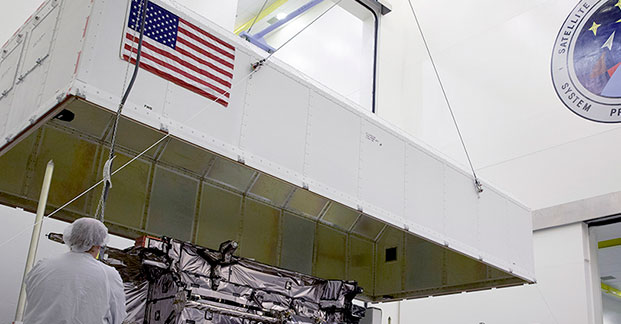
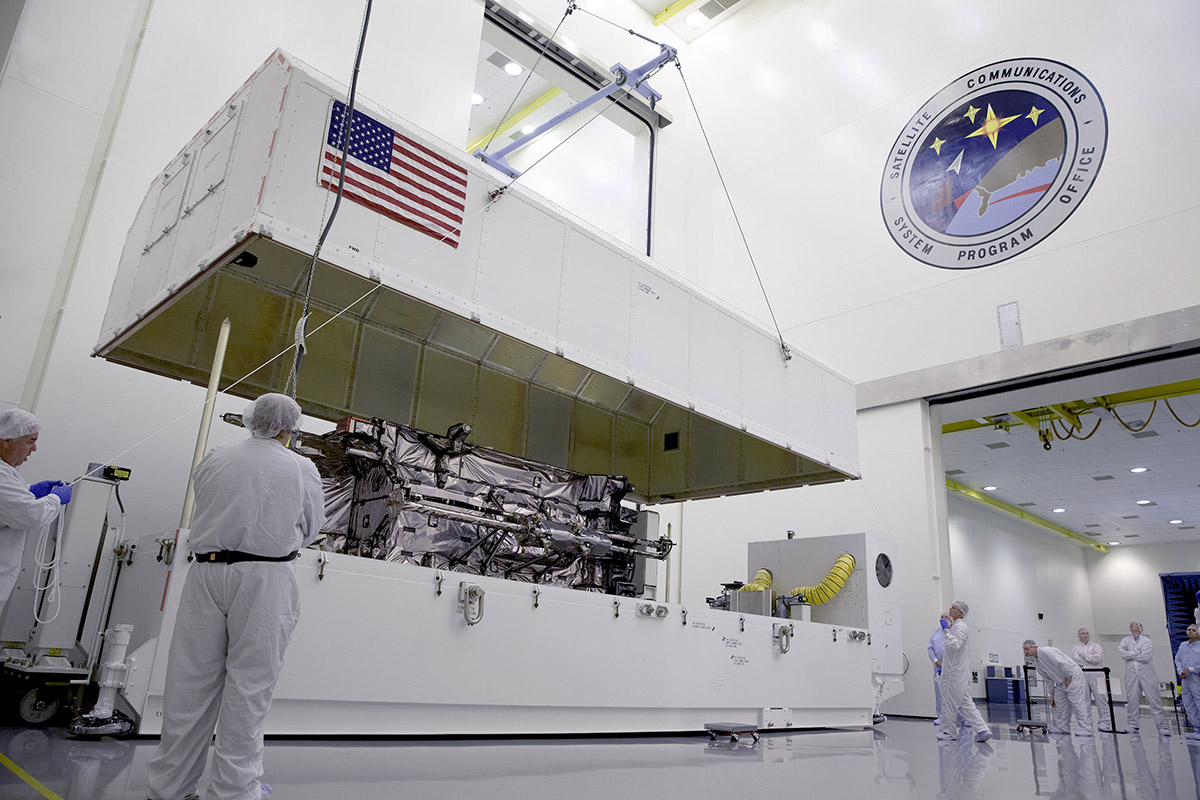
    The prototype for Lockheed Martin ‘s next generation GPS III satellite reached a major milestone on August 30 when it successfully established remote connectivity and communicated with the GPS Next Generation Operational Control System (OCX), being developed by Raytheon, during a series of pre-flight tests.

    During the Compatibility and Integration (C&I) Tests, Lockheed Martin’s GPS III Non-flight Satellite Testbed (GNST) — a full-sized, functional satellite prototype currently residing at Cape Canaveral Air Force Station — proved that it could connect with and receive commands from Raytheon’s Launch and Check Out System (LCS), part of the next-generation OCX that supports the satellite and mitigates risks prior to launch.

    The GNST received commands from the LCC node at Lockheed Martin’s facility in Newtown, Pennsylvania, via the OCX servers at Raytheon’s facility in Aurora, CO, the system then returned satellite telemetry to the control station. The tests mirror launch and early orbit testing planned for all flight vehicles.

    “The GNST is essentially a non-flying, functional GPS III satellite. While we have connected OCX with ground-based simulators before, these C&I tests were the first time that OCX and a GPS III satellite have actually communicated,” explained Keoki Jackson, vice president for Lockheed Martin’s Navigation Systems mission area.

    Matthew Gilligan, a vice president with Raytheon’s Intelligence, Information and Services business and Raytheon’s GPS OCX program manager, stated, “This was an invaluable early opportunity to demonstrate command and control of the GPS III satellite with LCS, proving the end-to-end system capabilities well before putting an actual GPS III in orbit. The positive results tell us that we are right on track for the first GPS III launch.”

    The LCS works hand-in-hand with Lockheed Martin’s Launch and Checkout Capability (LCC) contract, which brings online some of OCX’s GPS III-specific capabilities early to provide on-orbit checkout and control of the satellites.

    The GNST has been at the Cape since July dry-running launch base space vehicle processing activities and pre-launch testing that all future flight GPS III satellites will undergo. The first flight GPS III space vehicle (SV-01) is expected to be available for launch in 2014, and launched by the U.S. Air Force in 2015.

    Prior to shipment to the Cape, the GNST was developed and then completed a series of high-fidelity activities to reduce program risks, improve efficiencies and pathfind the integration, test and environmental checkout that all production GPS III satellites undergo at Lockheed Martin’s new GPS III Processing Facility in Denver, Colo.

    An innovative investment by the Air Force under the original GPS III development contract, the GNST has helped to identify and resolve development issues prior to integration and test of SV-01. Following the Air Force’s rigorous “Back-to-Basics” acquisition approach, the GNST has gone through the development, test and production process for the GPS III program first, significantly reducing risk for the flight vehicles, improving production predictability, increasing mission assurance and lowering overall program costs.

    The Lockheed Martin-developed GPS III satellites and Raytheon’s OCX are critical elements of the U.S. Air Force’s effort to modernize the GPS enterprise more affordably while improving capabilities to meet the evolving demands of military, commercial and civilian users worldwide.

    GPS III satellites will deliver three times better accuracy; provide up to eight times more powerful anti-jamming capabilities; and include enhancements which extend spacecraft life 25 percent further than the prior GPS block. The GPS III also will carry a new civil signal designed to be interoperable with other international global navigation satellite systems, enhancing civilian user connectivity. The spacecraft bus and antenna assemblies for the first GPS III satellite have been delivered to Lockheed Martin’s GPS III Processing Facility and are in the integration and test flow leading to the planned space vehicle delivery in 2014.

    Lockheed Martin is currently under contract for production of the first four GPS III satellites (SV 01-04), and has received advanced procurement funding for long-lead components for the fifth, sixth, seventh and eighth satellites (SV 05-08).

    OCX will revolutionize GPS command and control and mission management capabilities, controlling all legacy and new military and civil signals, providing protection against evolving cyber threats and ensuring continuity of operations during cyber attacks, and reducing operation and sustainment costs through efficient software architecture, automation and performance-based logistics. OCX represents a quantum leap in capabilities over the current Operational Control System and provides flexibility and adaptability to meet future GPS mission needs. Raytheon is the OCX prime contractor and is on track to deliver the final Launch and Checkout System in 2014.

    The GPS III team is led by the Global Positioning Systems Directorate at the U.S. Air Force Space and Missile Systems Center. Lockheed Martin is the GPS III prime contractor with teammates ITT Exelis, General Dynamics, Infinity Systems Engineering, Honeywell, ATK and other subcontractors. Raytheon is the GPS OCX prime contractor with teammates ITT Exelis, Boeing, Braxton, Infinity Systems Engineering, and NASA’s Jet Propulsion Laboratory. Air Force Space Command’s 2nd Space Operations Squadron (2SOPS), based at Schriever Air Force Base, Colo., manages and operates the GPS constellation for both civil and military users.

  • Esri Announces ArcGIS Marketplace, Apps for GIS

    Esri announces the launch of ArcGIS Marketplace, a new destination that allows ArcGIS Online subscribers to search, discover, and get apps and data from qualified providers for use within their organization. ArcGIS Marketplace provides data from organizations such as DigitalGlobe, RapidEye, AccuWeather, and Esri, as well as apps created by Esri and its distributors and partners, such as Latitude Geographics, Azteca Systems, and con terra that are built specifically to work with ArcGIS Online. All apps and data can easily be shared with ArcGIS Online groups and users within your organization.

    Esri_Marketplace“While there are app marketplaces that serve consumer audiences, only ArcGIS Marketplace is specifically designed to serve the needs of GIS users, making it truly unique,” says Johan Herrlin, senior business strategist at Esri. “ArcGIS Marketplace is another facet of the ArcGIS platform. Now you can easily find apps and data services that integrate with your ArcGIS Online subscription, allowing you to get more value out of the platform.”

    According to the announcement, anyone can browse the listings in ArcGIS Marketplace, but you need to be an ArcGIS Online subscriber to get free trials or make purchases. Because all apps in ArcGIS Marketplace require an ArcGIS Online login, users can access their organization’s maps via the apps. Data services acquired via ArcGIS Marketplace are also fully integrated with ArcGIS Online, so you can add them to your basemap gallery or other apps.

    For apps and data service providers, ArcGIS Marketplace provides a mechanism to generate leads, provide free trials, grant access to listings, and manage subscriptions. If you have a great app or data that you would like to make available to the ArcGIS community, find out what it takes to qualify as an ArcGIS Marketplace Provider.

    ArcGIS Marketplace is now available globally.

    Photo: Esri