Category: GNSS

  • Telit Chosen as Representative of Italian Tech Industry for Galileo

    Telit Wireless Solutions has been selected among various applicant members of the Italian Technology Industry as one of the nation’s key representatives in the global roll-out of Europe’s Galileo satellite positioning system. The selection reflects the high degree of credibility demonstrated by the Italian government in the strategic plan proposed by Telit to accelerate global adoption of the Galileo technology, Telit said.

    Telit is a global enabler of machine-to-machine (M2M) communications providing cellular, short range and positioning module products. Telit’s positioning technology R&D center is an integral part of the company’s R&D function headquartered in Trieste, Italy.

    Telit also received a grant to execute its proposed strategic plan. The grant offers Telit the opportunity to accelerate its activities in development of projects for the positioning technology market. It bolsters human and financial resources required to enable Telit to quickly advance in this market area and achieve leadership in product performance with services to match. This achievement is likely not only to enhance the company’s competitiveness but is also provide measurable boost for the Italian economy, concretely contributing tangible progress in the strategic and very high growth segment of m2m.

    The inclusion of positioning expertise stems from the company’s mergers and acquisitions over the past few years, which have made it a leading designer and manufacturer of innovative GNSS solutions for OEM applications, from personal and asset tracking to automotive solutions. Telit has sold millions of high-performance GPS modules sold worldwide.

    Galileo is Europe’s global navigation satellite system, designed to provide a highly accurate, guaranteed global positioning service under civilian control. It is inter-operable with GPS and GLONASS, the U.S. and Russian global satellite navigation systems. By offering dual frequencies as standard, Galileo delivers real-time positioning accuracy down to the meter range. It ensures availability of the service under all but the most extreme circumstances and informs users within seconds of any satellite failure, making it suitable for safety-critical applications such as guiding cars, running trains and landing aircraft. A range of services will be extended as the system is built up from initial operational capacity (IOC) to reach the Full Operational Capability (FOC) by this decade’s end. The fully deployed Galileo system consists of 30 satellites (27 operational + 3 active spares), positioned in three circular Medium Earth Orbit (MEO) planes at 23 222 km altitude above the Earth, and at an inclination of the orbital planes of 56 degrees to the equator.

    “Achievement of a leading position in now in Galileo technology not only boosts Telit’s global stance and strength, and consequently that of the Italian technology industry but also extends the reach of our leadership in positioning which already includes two decades of pioneering work in GPS in the United States,” said Dominikus Hierl, chief marketing officer at Telit Wireless Solutions. “The planned work-force expansions in support of this new effort will create extraordinary value-add, not only in terms of project acceleration but also in innovation, vision and new relationships for Telit.”

  • Indian Regional Navigation Satellite Starts Signal Transmissions

    Indian Regional Navigation Satellite Starts Signal Transmissions

    By Richard B. Langley

    Update (July 29, 2013): The spectrum recorded by the German Aerospace Center researchers appears to be consistent with a combination of BPSK(1) and BOC(5,2) modulation. This is the signal structure that ISRO announced would be used for IRNSS transmissions in the L-band:

    “The IRNSS signals consist of two special services namely Standard Positioning Service (SPS) and a Restricted Service (RS) [that] will be carried on L5 and S bands. The SPS will be modulated by a 1 MHz BPSK signal and RS will use BOC(5,2) modulation.”

    (“Spectral Compatibility of BOC(5,2) Modulation with Existing GNSS Signals” by S.B. Sekar, S. Sengupta, and K.Bandyopadhyay in Proceedings of IEEE/ION Position Location and Navigation Symposium (PLANS) 2012, Myrtle Beach, SC, April 23–26, 2012, pp.886–890, doi: 10.1109/PLANS.2012.6236831.)


    Scientists from the German Aerospace Center’s Institute of Communications and Navigation in Oberpfaffenhofen, Germany, have received signals from IRNSS-1A, the first satellite in the Indian Regional Navigation Satellite System.

    Launched on July 1, 2013, the satellite reached its designated inclined geosynchronous orbit by July 18 with an inclination of 27 degrees and an equator crossing of 55 degrees east longitude. Indian Space Research Organisation (ISRO) chairperson Dr. K. Radhakrishnan announced on July 18 that testing of the satellite’s navigation payload would begin within a week.

    On July 23, the German Aerospace Center scientists pointed their 30-meter dish antenna at Weilheim towards the satellite and found that it was already transmitting a signal in the L5 frequency band.

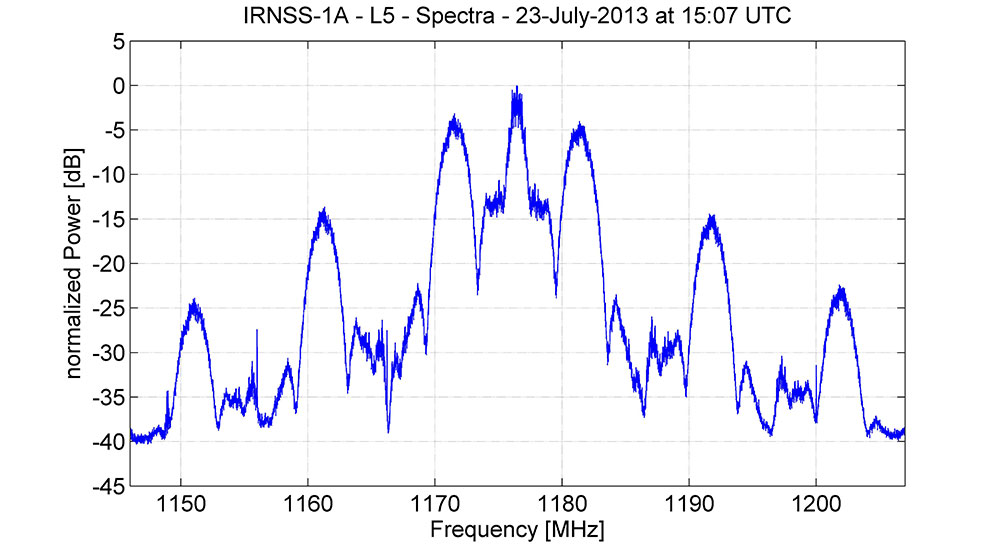
    FIGURE 1. Spectrum of IRNSS-1A L5 signal.
    FIGURE 1. Spectrum of IRNSS-1A L5 signal. Source: Richard B. Langley

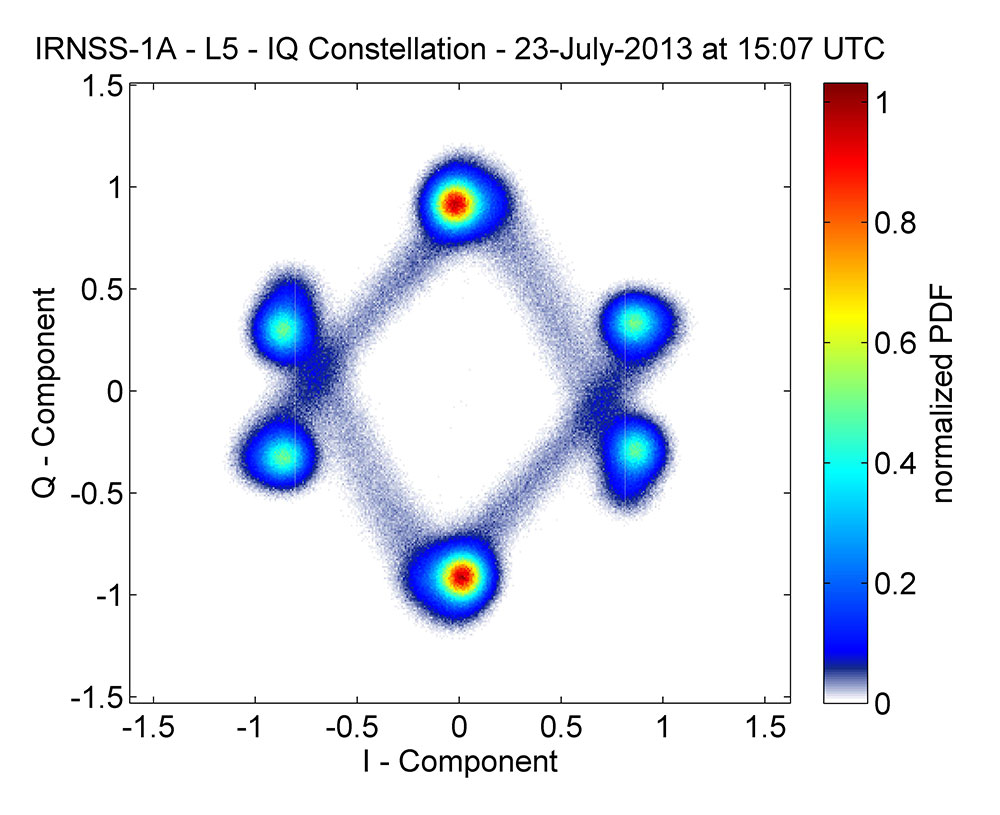
    Figure 1 shows the spectrum of the received signal. Centered at 1176.45 MHz, the signal has a single symmetrical main lobe and a number of side lobes characteristic of a spread-spectrum signal. The corresponding IQ constellation diagram is shown in Figure 2. The signal structure appears to be unlike those used by the GPS, GLONASS, Galileo, or BeiDou constellations. Further analysis will be required to sleuth the signal details as ISRO, so far, has not publicly released an IRNSS interface control document (ICD). ICDs characteristically describe a satellite system’s signal structure in detail.

    FIGURE 2. IQ constellation diagram of IRNSS-1A L5 signal.
    FIGURE 2. IQ constellation diagram of IRNSS-1A L5 signal. Source: Richard B. Langley

    The German scientists caution that “this is a very early snapshot of the current signal transmission and probably both the signal power and the signal quality will change and possibly improve during the in-orbit-testing phase of the satellite’s operation.”

  • IEEE/ION PLANS 2014 Issues Call for Abstracts

    Abstracts are now being accepted for the IEEE/Institute of Navigation (ION) Positioning, Location and Navigation Symposium (PLANS) 2014 to be held May 5-8 at the Hyatt Regency Monterey Hotel in Monterey, California. The deadline for submitting abstracts is November 1, 2013.

    Instructions on submitting your abstract can be found at www.plansconference.org.

    PLANS 2014 is the fifth biennial conference co-sponsored by the IEEE, AESS and the ION. The conference features researchers and engineers from around the globe who present their latest work in positioning and navigation technologies. Presentations range from fundamental research, to applications, to field test results with a particular emphasis on inertial navigation. Technical sessions cover a range of subjects for both beginners and seasoned professionals.

    IEEE/ION PLANS 2014 technical program will be centered around four technical tracks including Inertial Sensing and Technology, GNSS Technologies and Systems, Integrated Applications of Sensors and Technology and Systems Technology.

    Technical papers will be presented on current position, location and navigation issues:

    • High-Performance Inertial Sensor Technologies
    • Low-Cost Inertial Sensor Technologies
    • Multisensor Integrated Systems and Sensor Fusion Technologies
    • Sensor Manufacturing, Error Modeling & Testing
    • Emerging Atom-Based Sensor Technologies
    • Micro-technology for PNT
    • Receiver and Antenna Technology
    • High Assurance GNSS
    • Interference, Spectrum Issues and Robust Navigation
    • Precise Positioning, Weak Signal, and Advanced Processing
    • Algorithms
    • Modernized GNSS
    • GNSS Augmentation Systems
    • Indoor Personal and First-Responder Navigation
    • Urban Personal and Vehicular Navigation
    • Vision/Integrated Navigation Systems
    • Adaptable Navigation System Technology
    • Environmental Features and Novel Navigation Sensors
    • Terrestrial Radionavigation and RF-Positioning
    • Commercial Aviation Positioning and Navigation Applications
    • Small UAV Positioning and Navigation Applications
    • Consumer, Smartphone and Personal Navigation Applications
    • Marine Positioning and Navigation Applications
    • Terrestrial and Automotive Positioning and Navigation Applications
    • Robotic Guidance, Navigation and Control Applications

    In addition to a commercial exhibit, this year’s program includes half-day, pre-conference tutorials on:

    • Fundamentals of Inertial Navigation
    • Sensor Integration for Personal Navigation
    • Fundamentals of Kalman Filtering
    • Alternative Navigation Methods
    • NonLinear Kalman Filtering
    • Multi-constellation GNSS – Similarities/differences between GPS, Galileo, BDS, and GLONASS
    • Image-Aided Navigation

    The deadline for submitting abstracts is November 1, 2013. Submit your abstract today at www.plansconference.org.

  • Lockheed Martin Prototype to Help Prep for GPS III Launch

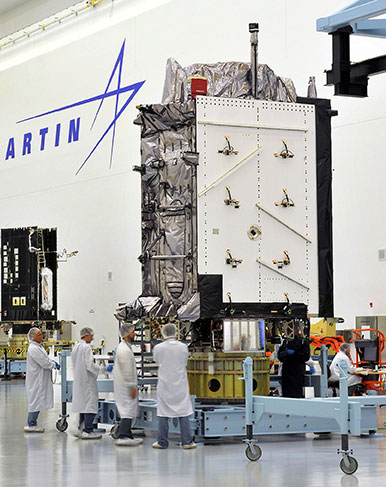
    The GPS III Non-Flight Satellite Testbed completed pathfinding activities at Lockheed Martin’s GPS III Processing Facility outside of Denver prior to it shipping to Cape Canaveral Air Force Station to test facilities and pre-launch processes there in advance of the arrival of the first GPS III flight satellite.
    The GPS III Non-Flight Satellite Testbed completed pathfinding activities at Lockheed Martin’s GPS III Processing Facility outside of Denver prior to it shipping to Cape Canaveral Air Force Station to test facilities and pre-launch processes there in advance of the arrival of the first GPS III flight satellite. Photo: Lockheed Martin

    Lockheed Martin has delivered a full-sized, functional prototype of the next-generation GPS satellite to Cape Canaveral Air Force Station to test facilities and pre-launch processes in advance of the arrival of the first GPS III flight satellite.

    The GPS III Non-Flight Satellite Testbed (GNST) arrived at the Cape on July 19 to begin to dry run launch-base space-vehicle processing activities and other testing that future flight GPS III satellites will undergo. The first flight GPS III satellite is expected to arrive at the Cape in 2014, ready for launch by the U.S. Air Force in 2015.

    The GNST arrived at the Cape by Air Force C-17 aircraft from Buckley Air Force Base near Lockheed Martin’s GPS III Processing Facility (GPF) in Denver, Colorado. Prior to shipment, the GNST was developed and then completed a series of high-fidelity activities to pathfind the integration, test and environmental checkout that all production GPS III satellites undergo at Lockheed Martin’s new satellite manufacturing facility.

    An innovative investment by the Air Force under the original GPS III development contract, the GNST has helped to identify and resolve development issues prior to integration and test of the first GPS III flight space vehicle (SV 01).  Following the Air Force’s rigorous “back-to-basics” acquisition approach, the GNST has gone through the development, test and production process for the GPS III program first, significantly reducing risk for the flight vehicles, improving production predictability, increasing mission assurance and lowering overall program costs.

    “We call the GNST a ‘pathfinder’ because it has truly blazed the trail for every one of our GPS III processes from initial development, production, integration and test, and now pre-launch activities,” explained Keoki Jackson, vice president for Lockheed Martin’s Navigation Systems mission area. “All future GPS III satellites will follow this same path, so the GNST was a smart initiative to help us discover and resolve any issues in advance, implement production efficiencies, and ultimately save a tremendous amount of time and money in the long run.”

    GPS III is a critically important program for the Air Force, affordably replacing aging GPS satellites in orbit, while improving capability to meet the evolving demands of military, commercial and civilian users. GPS III satellites will deliver three times better accuracy, include enhancements which extend spacecraft life 25 percent further than the prior GPS block, and a new civil signal designed to be interoperable with international global navigation satellite systems.

    Lockheed Martin is currently under contract for production of the first four GPS III satellites (SV 01-04), and has received advanced procurement funding for long-lead components for the fifth, sixth, seventh and eighth satellites (SV 05-08).

  • Russia to Launch Two GLONASS Satellites After Proton Disaster

    Ria Novosti reports that Russia will launch two GLONASS navigation satellites later this year to make up for the loss of three satellites in the recent Proton rocket explosion after launch from the Baikonur space center in Kazakhstan, according to a senior space industry official.

    “We are planning to launch two satellites from the Plesetsk space center [in northern Russia] to replenish the GLONASS orbital grouping following the recent Proton-M accident,” said Nikolai Testoyedov, the head of the Information Satellite Systems (ISS) company, which manufactures satellites for the GLONASS project.

    The first GLONASS is scheduled for launch in the beginning of September, and the second at the end of October, according to Testoyedov. The official added that both satellites will be launched on board the Soyuz carrier rockets, which has proven to be more reliable than ill-fated Protons.

    A group of 29 GLONASS satellites is currently in orbit, with 24 spacecraft in operation, three spares, one in maintenance, and one in test flight phase, according to Russia’s space agency, Roscosmos.

  • Rohde & Schwarz GNSS Simulator Creates Real-World Scenarios

    Rohde & Schwarz GNSS Simulator Creates Real-World Scenarios

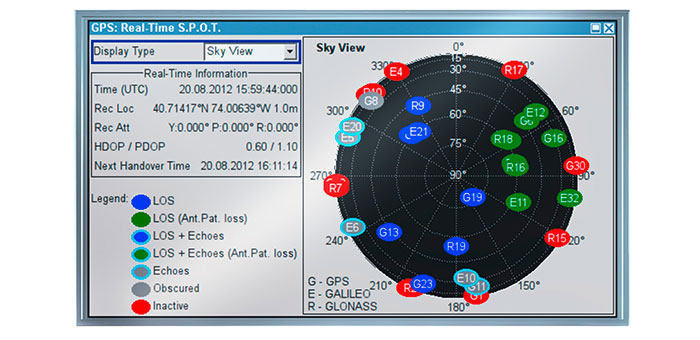
    Rohde & Schwarz provides developers of satellite-based navigation instruments with a global navigation satellite system (GNSS) simulator, which runs on the R&S SMBV100A vector signal generator. The new R&S SMBV-K101 option allows developers in the automotive and wireless communications industries, for example, to test GNSS receivers for specific effects such as obscuration and multipath propagation. Buildings, tunnels and bridges as well as reflections from concrete and glass surfaces affect the GNSS signal, regardless of whether the receiver is stationary or in motion. This option makes it easy to configure these kinds of scenarios.

    If the GNSS receiver of a navigation instrument or smartphone is located inside a vehicle, testing must also take into account the obscuring effect of the vehicle’s metal body. The R&S SMBV-K102 option can simulate this obscuration and, if required, also the additional antenna pattern.

    In addition to test scenarios for A-GPS, smartphone developers also have the Assisted Galileo (R&S SMBV-K67) and Assisted GLONASS (R&S SMBV-K95) options at their disposal. (Mobile radio networks transmit location-specific information to wireless devices via A-GNSS so that they can determine the current position faster.)

    In many cases, navigation instruments handle signals of digital communications standards other than GNSS. As the first GNSS simulator of its kind on the market, the R&S SMBV100A also supports these standards. Now, manufacturers of mobile phones and car radios with integrated GNSS receivers need just one signal generator to test multiple functionalities. The R&S SMBV100A can also be used to perform interference tests on the DUT.

    Users in the aerospace and defense industry can use the R&S SMBV-K103 option to simulate the relative position of a flying object as well as its rotation at a rotation rate of up to 400 Hz. This allows developers to perform lab tests to determine how a flying object’s different positions, the ground reflection of GNSS signals and rotary movements affect reception quality.

    The GNSS simulator in the R&S SMBV100A uses up to 24 satellites to generate signals in realtime for GPS with civilian C/A code and military P code as well as for Glonass and Galileo in different constellations. In just a few steps, users can define their  own scenarios for testing their GNSS receivers under various conditions. The R&S SMBV100A is the only GNSS simulator on the market that does not require an external PC. As a result, it is easier to automate, and test setup is simple.

    The new options for the GNSS simulator in the R&S SMBV100A are now available from Rohde & Schwarz.

  • Lockheed Martin Delivers Antenna Assemblies for First GPS III Satellite

    Lockheed Martin has completed and is preparing to install the navigation, communication, and hosted payload antenna assemblies for the first satellite of the next-generation GPS III.

    Seven antenna assemblies, produced at Lockheed Martin’s Newtown, Pennsylania, facility were delivered to the company’s GPS III Processing Facility (GPF) near Denver, Colorado, on June 14.  The antennas will be installed on the first GPS III space vehicle (SV01), which Lockheed Martin will deliver to the U.S. Air Force on schedule, “flight-ready,” in 2014.

    The new antennas for GPS III SV01 will provide the satellite’s capability to send and/or receive data for Earth-coverage and military Earth-coverage navigation; a UHF crosslink for inter-satellite data transfer; telemetry, tracking and control for satellite-ground communications; and data acquisition and communication for the nuclear detection system hosted payload. The antenna designs enable three to eight times greater anti-jamming signal power to be broadcast to military users across the globe when compared to previous GPS generations.

    “These antennas on the next generation of GPS III satellites will transmit data utilized by more than one billion users with navigation, positioning and timing needs,” explained Keoki Jackson, vice president of Lockheed Martin’s Navigation Systems mission area. “We have become reliant on GPS for providing signals that affect everything from cell phones and wristwatches, to shipping containers and commercial air traffic, to ATMs and financial transactions worldwide.”

    GPS III is a critically important program for the Air Force, affordably replacing aging GPS satellites in orbit, while improving capability to meet the evolving demands of military, commercial and civilian users. GPS III satellites will deliver three times better accuracy, include enhancements which extend spacecraft life 25 percent further than the prior GPS block, and a new civil signal designed to be interoperable with international global navigation satellite systems.

    The production of the first GPS III satellite continues on schedule. Recent testing of the SV 01 bus — the portion of the space vehicle that carries mission payloads and hosts them in orbit — assured that all bus subsystems are functioning normally and that they are ready for final integration with the satellite’s navigation payload.
    This milestone follows February’s successful initial power on of the SV01 spacecraft bus, which demonstrated  the electrical-mechanical integration, validated the satellite’s interfaces and led the way for functional electrical hardware-software integration testing.

    Lockheed Martin is under contract for production of the first four GPS III satellites (SV01-04), and has received advanced procurement funding for long-lead components for the fifth, sixth, seventh and eighth satellites (SV05-08).

    The GPS III team is led by the Global Positioning Systems Directorate at the U.S. Air Force Space and Missile Systems Center. Lockheed Martin is the GPS III prime contractor with teammates ITT Exelis, General Dynamics, Infinity Systems Engineering, Honeywell, ATK and other subcontractors. Air Force Space Command’s 2nd Space Operations Squadron (2SOPS), based at Schriever Air Force Base, Colorado, manages and operates the GPS constellation for both civil and military users.

  • Galileo Spreads Its Wings in Pre-Flight Test

    Galileo Spreads Its Wings in Pre-Flight Test

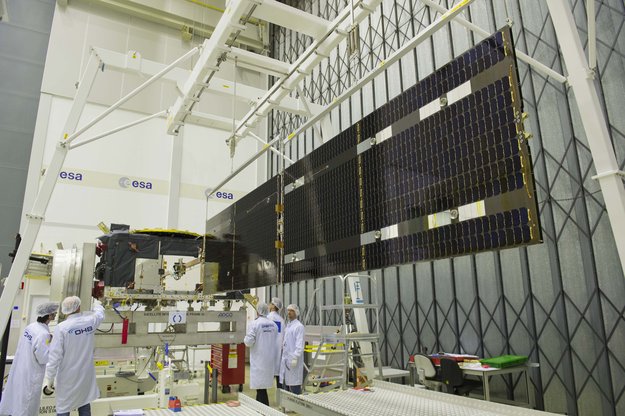
    In the photo above, deployment of the solar wings on the latest Galileo satellite is being checked at the European Space Agency’s technical hub in the Netherlands. The navigation satellite’s pair of 1 x 5-meter solar wings, carrying more than 2,500 gallium arsenide solar cells, will power the satellite during its 12-year working life.

    With the first four Galileo In-Orbit Validation satellites already in orbit, this is the first of the rest of Europe’s satnav constellation.

    A counterweighted rig supports the deployment; otherwise the delicate fold-out wings — designed for the weightlessness of space — would crumple under the pull of Earth gravity.

    These Full Operational Capability satellites provide the same operational services as their predecessors, but they are built by a new industrial team: OHB in Bremen, Germany, built the satellites with Surrey Satellite Technology Ltd. in Guildford, UK, contributing the navigation payloads.

    This satellite is the first of 22 ordered from OHB. It arrived at ESA’s ESTEC research and technical centre in Noordwijk in May to begin a rigorous campaign of testing in simulated launch and space conditions, guaranteeing its readiness for launch.

    The first test performed on the satellite once it came out of its container was a System Compatibility Test Campaign, linking it up with the Galileo Control Centres in Germany and Italy and ground user receivers as if it was already in orbit.

    Galileo’s wings with 30%-efficient solar cells were fitted at the end of June, supplied by Dutch Space in nearby Leiden. Future satellites will have their wings fitted at OHB before coming to ESTEC, but this first satellite offered an opportunity for Dutch Space engineers to train their OHB counterparts in the procedure.

    “The 22 Galileo FOC satellites are being produced and tested on a batch production basis, which is a new way of working for ESA,” explained Jean-Claude Chiarini, overseeing FOC satellite procurement for the Agency. “The concept is really to set up a steady flow of satellites from OHB to ESTEC and then Kourou for launch over the next few years.

    “The first four will undergo full validation testing, checking the underlying design is correct, in order to support the formal ground qualification of the design, with subsequent FOC satellites then going through acceptance testing, concentrating on checking workmanship,” Chiarini said.

    The FOC satellites, while resembling their predecessors, are designed with this production concept in mind. Hinged modules offer easy access to internal subsystems for rapid repair or potential replacement of units.

    The next satellite is due to arrive around the start of August. The battery of simulations includes vibration and acoustic testing, as well as thermal-vacuum testing — submitting them to the airlessness and temperature extremes of space for weeks at a time.

  • IRNSS-1A Reaches Preliminary Destination Orbit

    News courtesy of CANSPACE listserv.

    Following the July 1 launch of the Indian Regional Navigation Satellite System 1A satellite, five orbit maneuvers were to be conducted by the master control facility to position the satellite in its circular inclined geosynchronous orbit (IGSO) with an equator crossing at 55 degrees east longitude.

    Reports indicate that orbit raising maneuvers have been completed with a fifth apogee motor firing on July 6 at 16:57 IST or 11:27 UTC. All the spacecraft subsystems have been evaluated and are functioning normally.

    The satellite was reported to be in IGSO with a 27 degree inclination at 44 degrees east longitude.

    NORAD/JSpOC has released a two-line element set for the IGSO of the satellite with an epoch of a few days ago:

    1 39199U 13034A   13189.83931637  .00000103  00000-0  00000+0 0    55
    2 39199 027.0197 141.0618 0046168 179.3431 315.7902 01.00666774   276

    This data indicates that the sub-satellite equator crossing was about 47 degrees east longitude at the reference epoch. The satellite orbit equator crossing is drifting eastwards and should reach 55 degrees east longitude by about July 14.

  • Lockheed Martin GPS III Prototype Validates Test Facilities

    Lockheed Martin GPS III Prototype Validates Test Facilities

    Lockheed Martin’s GPS III Non-Flight Satellite Testbed (GNST) has successfully completed a series of high-fidelity pathfinding events which validate the process and facility for vehicle integration checkout, as well as signals interference testing, that the next-generation satellites of GPS III will go through before delivery for launch.

    An innovative investment by U.S. Air Force under the original GPS III development contract, the GNST is a full-sized GPS III satellite prototype which has helped to identify and resolve development issues prior to integration and test of the first GPS III space vehicle (SV 1). Following the Air Force’s rigorous “back-to-basics” acquisition approach, the GNST has gone through the development, test and production process for the GPS III program first, significantly reducing risk for the flight vehicles, improving production predictability, increasing mission assurance and lowering overall program costs.

    During this latest milestone, the GNST successfully completed thermal vacuum (T-Vac) chamber trail blazing, demonstrating facility, mechanical and electrical ground equipment integration, and ran a series of vehicle integration test procedures. The GNST also completed Passive Intermodulation (PIM) and Electromagnetic Compatibility (EMC) testing, which assures that multiple high-powered signals generated from the satellite’s navigation downlink transmissions, or transmitted from the hosted nuclear detection system payload on the satellite, do not interfere with each other or themselves.

    “As the GNST serves as a pathfinder for the GPS III program, its successful completion of this testing validates that development risks have been retired and our engineering and technology is sound for the flight vehicles being built,” explained Keoki Jackson, vice president for Lockheed Martin’s Navigation Systems mission area.

    The GNST is now being prepared for shipment to Cape Canaveral U.S. Air Force Station, Florida, for more risk reduction activities related to satellite launch.

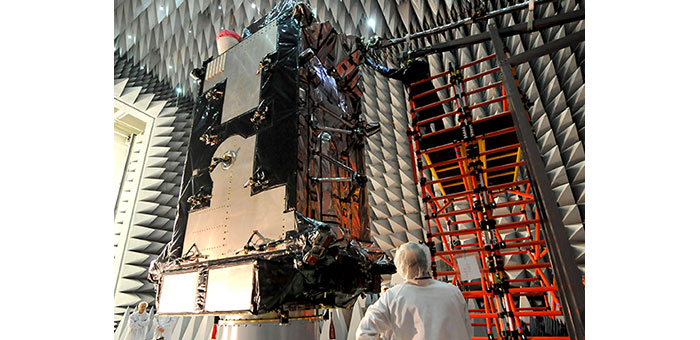
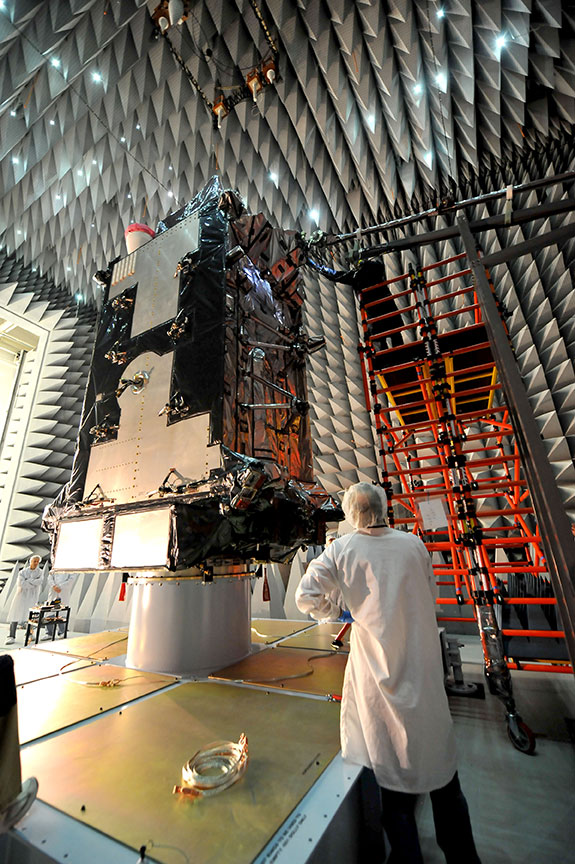
    The GPS III prototype in an anechoic chamber where it completed Passive Intermodulation (PIM) and Electromagnetic Compatibility (EMC) testing at Lockheed Martin’s GPS III Processing Facility outside of Denver, Colorado. Photo:  Lockheed Martin’s Navigation Systems
    The GPS III prototype in an anechoic chamber where it completed Passive Intermodulation (PIM) and Electromagnetic Compatibility (EMC) testing at Lockheed Martin’s GPS III Processing Facility outside of Denver, Colorado. Photo: Lockheed Martin’s Navigation Systems

    GPS III is a critically important program for the Air Force, affordably replacing aging GPS satellites in orbit, while improving capability to meet the evolving demands of military, commercial and civilian users. GPS III satellites will deliver three times better accuracy and — to outpace growing global threats that could disrupt GPS service — up to eight times improved anti-jamming signal power for additional resiliency. The GPS III will also include enhancements adding to the spacecraft’s design life and a new civil signal designed to be interoperable with international global navigation satellite systems.

    Lockheed Martin is currently under contract for production of the first four GPS III satellites (SV 1-4), and has receivedadvanced procurement funding for long-lead components for the fifth, sixth, seventh and eighth satellites (SV 5-8).

    The Lockheed Martin team remains on track to deliver the first GPS III satellite, with its enhanced capabilities over current orbiting systems, for launch availability in 2014.

    The GPS III team is led by the Global Positioning Systems Directorateat the U.S. Air Force Space and Missile Systems Center. Lockheed Martin is the GPS III prime contractor with teammates ITT Exelis, General Dynamics, Infinity Systems Engineering, Honeywell, ATK and other subcontractors. Air Force Space Command’s 2nd Space Operations Squadron (2SOPS), based at Schriever Air Force Base, Colorado, manages and operates the GPS constellation for both civil and military users.

  • 2C or Not 2C: The First Live Broadcast of GPS CNAV Messages

    By Oliver Montenbruck, Richard B. Langley, and Peter Steigenberger

    Over the past several years, some users of the GPS navigation system have already benefitted from the addition of various new signals in addition to the legacy C/A- and P(Y)-code. With the introduction of the Block IIR-M satellites in 2005, a new civil signal (L2C) was transmitted on the L2 frequency, and a new signal on a new frequency (L5) was introduced as a standard signal with the Block IIF satellites beginning in 2010. These new signals provide direct access to dual-frequency observations and thus enable improved ionospheric corrections for civil, including aeronautical, users. In addition, a new Civil Navigation (CNAV) broadcast message has been defined in the GPS Interface Specifications (IS-GPS-200 and IS-GPS-705).

    This message will be transmitted jointly on the L2C and L5 signals and provides a variety of useful new parameters. Compared to the legacy L1 C/A-code navigation message, the CNAV message also offers an increased flexibility concerning the type, sequence, and repeat rate of specific messages.

    CNAV messages have already been broadcast over the past two years by the Michibiki (QZS-1) satellite of the Japanese Quasi-Zenith Satellite System (QZSS), which shares many aspects of the GPS signal design. In contrast to this, Block IIR-M and IIF GPS satellites have only transmitted dummy messages so far and a fully operational CNAV transmission is only foreseen once the ongoing modernization of the GPS control segment has been completed.

    Triggered by various interest groups, the Global Positioning Systems Directorate has just conducted a first test campaign with live CNAV transmissions on L2C and L5 over the two-week period from June 15 to 29 (see Global Positioning System Modernized Civil Navigation (CNAV) Live-Sky Broadcast Test Plan.) It served as a first opportunity for end users and receiver manufacturers to test the decoding and use of the new messages under a wide range of different configurations.

    CNAV messages have a common length of 300 data bits and are identified by a message type number that signifies their contents. The messages presently defined for GPS are summarized in Table 1. For QZSS, complementary messages have been established, which enable, among other features, a rebroadcast of GPS-specific data to QZSS users.

    Table 1. Summary of CNAV message types transmitted by space vehicles (SVs). Messages marked by an asterisk were transmitted during the recent CNAV test campaign.

    Message

    Type

    CNAV Message Title

    Function/Purpose

    0*

    Default Default message (transmitted when no message data is available)

    10*

    Ephemeris 1 SV position parameters for the transmitting SV

    11*

    Ephemeris 2 SV position parameters for the transmitting SV

    12*

    Reduced Almanac Reduced almanac data packets for seven SVs

    13

    Clock Differential Correction SV clock differential correction parameters

    14

    Ephemeris Differential Correction SV ephemeris differential correction parameters

    15*

    Text Text (29 eight-bit ASCII characters)

    30*

    Clock, Iono & Group Delay SV clock correction parameters, ionospheric and group delay correction parameters (inter-signal correction parameters)

    31

    Clock & Reduced Almanac SV clock correction parameters, reduced almanac data packets for four SVs

    32*

    Clock & EOP SV clock correction parameters, Earth orientation parameters; Earth-centered, Earth-fixed to Earth-centered inertial coordinate transformation

    33*

    Clock & UTC SV clock correction parameters, Coordinated Universal Time parameters

    34

    Clock & Differential Correction SV clock correction parameters, SV clock and ephemeris differential correction parameters

    35*

    Clock & GGTO SV clock correction parameters, GPS to GNSS time-offset parameters

    36

    Clock & Text SV clock correction parameters, text (18 eight-bit ASCII characters)

    37

    Clock & Midi Almanac SV clock correction parameters, midi (mid-accuracy) almanac parameters

    Other than the legacy L1 navigation message, which adheres to a fixed order of subframes, the sequence of CNAV messages can be varied widely to provide users with an optimized set of low latency information and parameters that change infrequently. As a baseline, the two ephemeris message types 10 and 11 are combined with any of the clock-and-auxiliary data messages (types 30 through 37) to provide users with the orbit and clock data of the received satellites. With a transmission duration of 12 seconds per CNAV message on L2C, a minimum of 36 seconds is required to transfer this information to the user if no other messages are transmitted. On L5, which operates at twice the data rate, a new frame is transmitted once every 6 seconds yielding a minimum of 18 seconds for the broadcast of ephemeris and clock data.

    The recent test campaign started at 18:00 GPS Time on Saturday, June 15, 2013, with the transmission of message types 10, 11, 15, and 30 on a first space vehicle (PRN24) and included PRN12 from 18:42 onwards. Other space vehicles were sequentially phased in until all active IIR-M and IIF satellites (except for the recently launched IIF-4 satellite) transmitted CNAV on the supported signals. When the test ended exactly two weeks later (June 29, 18:00 GPST), all participating satellites were transmitting a complex master frame of 15 x 4 = 60 individual messages, which was repeated once every 12 minutes (on L2C). Each minor frame comprised the two ephemeris messages and at least one clock-data message (see Table 2).

    Table 2. Sequence of message types in a CNAV master frame.

    Message Types

    10

    11

    15

    30

    10

    11

    32

    33

    10

    11

    12

    35

    10

    11

    12

    30

    10

    11

    12

    33

    10

    11

    12

    35

    10

    11

    12

    30

    10

    11

    32

    33

    10

    11

    15

    35

    10

    11

    32

    30

    10

    11

    12

    33

    10

    11

    12

    35

    10

    11

    12

    30

    10

    11

    12

    33

    10

    11

    12

    35

    Other messages included a reduced almanac (message type 12) and a text message (message type 15) with dummy content (“THIS IS A GPS TEST MESSAGE.”)

    The CNAV data were recorded by selected multi-GNSS monitoring stations of the German Aerospace Establishment (Deutsches Zentrum für Luft- und Raumfahrt or DLR) and the University of New Brunswick (UNB), which were specifically configured to record raw GPS navigation frames in addition to the normal observation data. The stations are located at Singapore (SIN0); Sydney, Australia (UNX2); Maui, U.S.A. (MAO0); and Hartebeesthoek, South Africa (HRAG); as well as Fredericton, Canada (UNB) and are equipped with either Javad Delta-G2/G3TH or NovAtel OEM6 receivers. Following initial validation, the raw and decoded data from the CNAV test will be made available to interested users through the Multi-GNSS Experiment (MGEX) of the International GNSS Service (see http:/igs.org/mgex) to facilitate the development of user software and suitable data formats (such as an extended RINEX navigation message format).

    The CNAV orbit and clock data were updated once every two hours and offer a slightly higher bit resolution than their legacy counterparts. However, the accuracy of the ephemeris data has not yet been evaluated nor compared to that of the L1 C/A-code navigation data.

    As indicated above, the CNAV data can also provide a particularly compact form of almanac data known as the reduced almanac. It does not offer clock information (that is not normally required for a signal search) and assumes a circular orbit, which reduces the overall accuracy. Still, it can be transmitted (and repeated) in a much shorter time interval than the legacy almanac, which requires a total of 12.5 minutes. Each reduced almanac message (message type 12) provides orbit information for a total of seven satellites and it takes a set of five such messages to convey information for a complete constellation. For the master frame layout described above, the full constellation reduced almanac is repeated twice within 12 minutes on L2C (and half this time on L5).

    Novel types of CNAV data not covered by the legacy navigation message include the differential code biases (also known as inter-system corrections or ISCs), which are required for pseudorange-based positioning with signals other than the legacy P(Y)-code (in addition to the established Timing Group Delay parameter or TGD). An overview of TGD and ISC values broadcast by the various satellites participating in the CNAV test is given in Table 3.

    Table 3. Differential code biases (in nanoseconds) of GPS Block IIR-M and IIF satellites broadcast during the test campaign as part of the message type 30 CNAV messages.

    SV Type

    SVN

    PRN

    TGO

    ISC L1CA

    ISC L2C

    ISC L5I5

    ISC L5Q5

    IIR-M

    48

    07

    -10.71

    -0.84

    6.52

    IIR-M

    50

    05

    -10.24

    -0.32

    5.41

    IIR-M

    52

    31

    -13.04

    -0.55

    7.36

    IIR-M

    53

    17

    -10.24

    -0.84

    6.17

    IIR-M

    55

    15

    -10.24

    -0.47

    5.62

    IIR-M

    57

    29

    -9.31

    -0.76

    5.06

    IIR-M

    58

    12

    -12.11

    -0.76

    6.64

    IIF

    62

    25

    5.59

    -2.07

    -5.24

    -0.38

    -0.87

    IIF

    63

    01

    8.38

    -2.30

    -7.57

    0.38

    2.15

    IIF

    65

    24

    2.79

    -0.26

    -2.27

    2.27

    3.70

    Another important achievement is the provision of Earth orientation parameters (EOP) in message 32, which provides GPS users with access to the celestial reference frame.  EOPs were transmitted during the second test week and updated on a daily basis (see Table 4). Knowledge of these parameters is of particular interest for GPS-based orbit determination and navigation of spacecraft (in low Earth orbit), which is preferably referred to an inertial rather than an Earth-fixed coordinate system.

    Table 4. Daily Earth orientation parameters from the CNAV test campaign (pole coordinates and dUT1 (UT1-UTC) time differences and derivatives).

    Epoch (GPST)

    x_p

    (arcseconds)

    x_p_dot

    (arcseconds per day)

    y_p

    (arcseconds)

    y_p_dot

    (arcseconds per day)

    dUT1

    (seconds)

    dUT1_dot

    (seconds per day)

    June 22, 0:00

    0.13517

    0.00104

    0.39657

    -0.00054

    0.06341

    -0.00046

    June 23, 0:00

    0.13621

    0.00102

    0.39604

    -0.00056

    0.06295

    -0.00049

    June 24, 0:00

    0.13740

    0.00101

    0.39535

    -0.00058

    0.06231

    -0.00053

    June 25, 0:00

    0.13815

    0.00099

    0.39487

    -0.00060

    0.06164

    -0.00063

    June 26, 0:00

    0.13846

    0.00096

    0.39443

    -0.00062

    0.06078

    -0.00067

    June 27, 0:00

    0.13885

    0.00094

    0.39381

    -0.00064

    0.06004

    -0.00067

    June 28, 0:00

    0.13947

    0.00093

    0.39310

    -0.00066

    0.05909

    -0.00063

    June 29, 0:00

    0.13987

    0.00090

    0.39246

    -0.00068

    0.05842

    -0.00053

    Overall, CNAV offers exciting prospects for improved GPS utilization and users may look forward to the next test campaigns, which will tentatively be conducted once every six months.

    As a side note, it should be mentioned that individual satellites could be observed to transmit various types of non-standard CNAV messages as well as CNAV messages with improper data (such as an invalid week count) after the end of the main test campaign. Various receivers in the MGEX network, which were processing the received CNAV messages internally and which put full confidence in their proper contents, were mislead by such information. During the actual test campaign, all data appeared fully valid and no problems were reported by the stations.


    OLIVER MONTENBRUCK is the head of the GNSS Technology and Navigation Group at DLR’s German Space Operations Center in Oberpfaffenhofen, Germany.

    RICHARD B. LANGLEY is a professor in the Department of Geodesy and Geomatics Engineering at the University of New Brunswick, Fredericton, New Brunswick, Canada.

    PETER STEIGENBERGER is  a staff member in the Institut für Astronomische und Physikalische Geodäsie of the Technische Universität München (TUM) in Munich, Germany.
     

  • Geospatial Solutions, GPS World Cover Esri Survey Summit and International User Conference

    Geospatial Solutions Editor Eric Gakstatter, who is also a contributing editor to GPS World magazine, will be attending the 2013 Esri Survey Summit and Esri International User Conference, providing continuous new and analysis for the duration of both conferences. The conferences are being held this week in San Diego, California.

    On Tuesday at 1:30 p.m. in Room 24A of the San Diego Convention Center, Gakstatter will deliver a presentation entitled “High-Precision GPS/GNSS on your Smartphone, Handheld and Tablet,” discussing trends and new product innovations for sub-meter and centimeter mapping on smartphone, handheld and tablet devices, including Windows Mobile, Android and iOS (Apple) devices.

    Steve Copley, GPS World and Geospatial Solutions associate publisher and account executive, shared images of the event on his Twitter account. Here are a few of them:

    Photos: Erik Gakstatter