Category: GNSS

  • Leica GeoMos Scanning Works with MS50 for Deformation Monitoring

    Newly released Leica GeoMoS 6.0 software includes automatic scanning and deformation analysis integrating the new Leica Nova MS50 MultiStation to scan areas of inaccessible manmade and natural structures. The monitoring data is also processed automatically with the new n.Vec technology implemented by Leica Geosystems. Color-coded, visualized 3D deformation clouds enable easy analysis and interpretation of movements so users can make the right decisions to rectify static problems or protect peoples’ lives.

    Leica Geosystems announced  version 6.0 at a media event held during the HXGN Live conference in Las Vegas today.

    Leica GeoMoS Scanning is an automatic scanning solution fully integrated into Leica GeoMoS Monitoring Solution. This ensures fast integration with existing Leica GeoMoS projects and an easy start for new users, Leica said. In addition to total stations, GNSS, tilt and geotechnical sensors, highly detailed scanning can now be added to the automated measurement cycle. The new scanning module is easy to configure and provides the complete workflow for automatic acquisition and processing of the data to visualize deformations and to notify key personnel in the case of an event. With Leica GeoMoS Web, the data can be accessed anywhere at any time.

    Leica GeoMoS 6.0 enhances conventional monitoring methods with automatic scanning of surfaces with the Leica Nova MS50 MultiStation. Used for inaccessible places or locations where prisms cannot be installed, e.g. a road cover, a roof, a pipeline or a natural structure, Leica GeoMoS real-time scanning solution monitors any deformation and makes sure that no movement is undetected. The big advantage of using the Leica Nova MS50 MultiStation is that it combines laser scanning and prism monitoring, and therefore the measurements to stable control points guarantee highly accurate setup corrections, including orientation and translations. Additional imaging functionality complements the set by providing yet another information source for better deformation analysis. The implemented scan wizard allows the image-assisted definition of scan areas using different parameter settings and different scan result types. Once defined, the scan area can be scanned manually and via the automatic measurement cycle.

    Leica GeoMoS 6.0 enhances conventional monitoring methods with automatic scanning of surfaces with the Leica Nova MS50 MultiStation.
    Leica GeoMoS 6.0 enhances conventional monitoring methods with automatic scanning of surfaces with the Leica Nova MS50 MultiStation.

    The new scanning feature uses all current automatic functionalities such as automatic measurement cycle scheduling, real-time notification via e.g. SMS/email, automatic limit level check, etc. In addition, the embedded point cloud and image viewer assures powerful 3D visualization of all results using color-coded deformation clouds with a fully traceable history of deformations of the scanned area.

    The new n.Vec technology in Leica GeoMoS 6.0 provides automatic scan cloud processing to deliver the real-time information about deformations. The data can quickly and easily be interpreted for informed decisions. Leica Geosystems’ unique n.Vec processing technology uses normal vectors to determine movements in man-made and natural structures through color-coded deformation maps. The deformation maps are created by comparing normal vectors from a reference epoch and the current epoch. To ensure maximum deformation interpretation quality, in an iterative and fully automatic procedure, n.Vec removes non-surface related scan artifacts to ensure uncontaminated surfaces and hence correct normal vectors.
     

  • Navtech Offers Condensed GNSS Signals and Systems Course

    Navtech is offering a four-day version of Course 551, “Using Advanced GPS/GNSS Signals and Systems,” customized for those attending the ION GNSS+ 2013 conference.

    This course will help attendees develop proficiency with advanced receiver processing of current, modernized, and new signals from GPS, GLONASS, Galileo, BeiDou, and QZSS. It teaches systems engineering skills, along with techniques for receiver processing and for assessing processing performance. Review problems, worked in class, help students understand and apply the key concepts.

    Those who attend will become proficient with the essential aspects of using GPS and GNSS signals.

    Course days:
    Friday, Saturday, September 13-14
    Monday, Tuesday, September 16-17

    Instructor: Dr. John Betz, MITRE

    For more information, visit the Navtech website.

  • Embezzlement of GLONASS Funds Investigated

    The Russian Federal Security Service is investigating the embezzlement of billions of rubles from the construction of the GLONASS center in Korolyov, a town outside Moscow, the Izvestia newspaper reports.

    According to information shared by the Russian Legal Information Agency, the Investigative Committee’s department for the Moscow Region has launched a preliminary probe into the case.

    Construction of the GLONASS satellite navigation system control and support center began in June 2010 on the site used by TsNIImash, the head research company of Russia’s federal space agency. The center was supposed to hold equipment for collecting and processing the data supplied by the GLONASS global network.

    The construction was financed by a federal program, with 1.050 billion ($33.22 million) allocated for the project. By the end of 2010, it came to light that construction costs had been overstated, Izvestia reports. An expert appraisal revealed that the contractor had rigged the costs. The government did not allocate additional funds, so construction was suspended in December 2011 when the Federal GLONASS Program for 2002-2011 ended. The construction of the building has never been completed.

    In November 2012, the general designer of GLONASS, Yuri Urlichich, was dismissed from his post as a result of the scandal.

  • Navigation Center for India’s SatNav System Inaugurated

    isroiThe Indian Space Research Organization (ISRO) Navigation Centre, an important element of the Indian Regional Navigation Satellite System (IRNSS), was inaugurated May 28. The INC has been established at the Indian Deep Space Network complex at Byalalu, about 40 kilometers from Bangalore, India.

    IRNSS, an independent navigation satellite system being developed by India, will have a constellation of seven satellites that enables its users to determine their location and time accurately. These satellites will be positioned in geostationary and inclined geosynchronous orbits 36,000 kilometers above the Earth’s surface. IRNSS coverage will extend over India and the southeast Asia region. The satellites are equipped with high-precision atomic clocks and continuously transmit navigation signals to users.

    As the focal point of many critical operations of IRNSS, the ISRO Navigation Centre (INC) is responsible for providing the time reference, generation of navigation messages, and monitoring and control of ground facilities including ranging stations of IRNSS. It hosts several key technical facilities for supporting various navigation functions.

    Key to the navigation support is the time reference to which all ground systems and the satellite clocks are synchronized. This time reference is generated by the high-precision timing facility located at INC. This timing facility is equipped with high-stability, high-precision atomic clocks to provide stable and continuous time reference to the navigation system.

    IRNSS will have a network of 21 ranging stations geographically distributed primarily across India. They provide data for the orbit determination of IRNSS satellites and monitoring of the navigation signals. The data from the ranging/monitoring stations is sent to the data processing facility at INC where it is processed to generate the navigation messages. The navigation messages are then transmitted from INC to IRNSS satellites through the spacecraft control facility at Hassan/Bhopal. The data processing and storage facilities at INC enable swift processing of data and support its systematic storage.

    INC is connected to the ranging stations and to the satellite control facilities through two highly reliable dedicated communication networks consisting of satellite and terrestrial links. The hub for the satellite communication links is hosted at INC.

    The INC was inaugurated by V. Narayanasamy, minister of state in the Indian prime minister’s office. Speaking on the occasion, Narayanasamy said he appreciated the commitment and dedication of Indian space scientists in realizing the objectives of the country’s space programme. The minister also gave away various awards instituted by Astronautical Society of India (ASI) and ISRO.

  • The System: Galileo Leaves the Building

    In the early hours of May 15, Galileo’s first full operational capability (FOC) satellite left manufacturer OHB System AG’s integration hall in Bremen, Germany, after successfully completing integration and system testing. Later that same day, it arrived by road at the European Space Agency’s (ESA’s) technical center at Noordwijk in the Netherlands for a rigorous set of tests to check its readiness for launch. The tests will simulate different aspects of launch and space environment. The comprehensive test program will validate the new design and all the FOC satellites to follow.

    This first FOC satellite is functionally identical to the first four in-orbit validation (IOV) satellites already in orbit, but has been built by a separate industrial team. Like the other 21 FOC satellites so far procured by ESA, the satellite’s prime contractor is OHB System AG, and the navigation payload was produced by Surrey Satellite Technology Ltd. in Guildford, UK.

    Thermal vacuum testing at the European Space Research and Technology Centre (ESTEC) will simulate temperature extremes the satellites must endure in the airlessness of space throughout their 12-year working lifetimes. Without any moderating atmosphere, temperatures can shift hundreds of degrees from sunlight to shadow.

    Other activities on the schedule include shaker and acoustic noise testing — simulating the vibration and noise of launch — as well as electromagnetic compatibility and antenna testing, placing the satellite in chambers shielded from all external radio signals to reproduce infinite space and check that its various antennas and electrical systems are interoperable without harmful interference.

    “The Galileo FOC satellites provide the same capabilities as the previous IOV satellites, but with improved performance, such as higher transmit power,” explained Giuliano Gatti, the head of the Galileo Space Segment Procurement Office. “They are to all intents a new design that requires a full checkout before getting the green light for launch.”

    The second FOC flight model is due to arrive at ESTEC in early June, and the third in the middle of July. The first two satellites are to be placed in orbit on board a Soyuz launcher, with a scheduled lift-off from Kourou in French Guyana this fall, with two more due to follow by the end of the year.

    The first four Galileo IOV satellites, launched in 2011 and 2012, were provided by EADS Astrium with Thales Alenia Space Italy responsible for integrating the satellites and Astrium in Portsmouth, UK, providing the navigation payloads. They provided their first navigation fix in March 2013.

    The definition, development and in-orbit validation phases of the Galileo programme are being carried out by ESA and co-funded with the European Commission (EC).

    The subsequent FOC phase is managed and funded by the EC. The commission has delegated the role of design and procurement agent to ESA for the FOC phase. At the same time as the satellites are being assembled on a production-line basis, ground stations are also being established on European territories around the globe.

    Photo credit: Pat Corkery, United Launch Alliance.
    Photo credit: Pat Corkery, United Launch Alliance.

    GPS Leaves This Earth

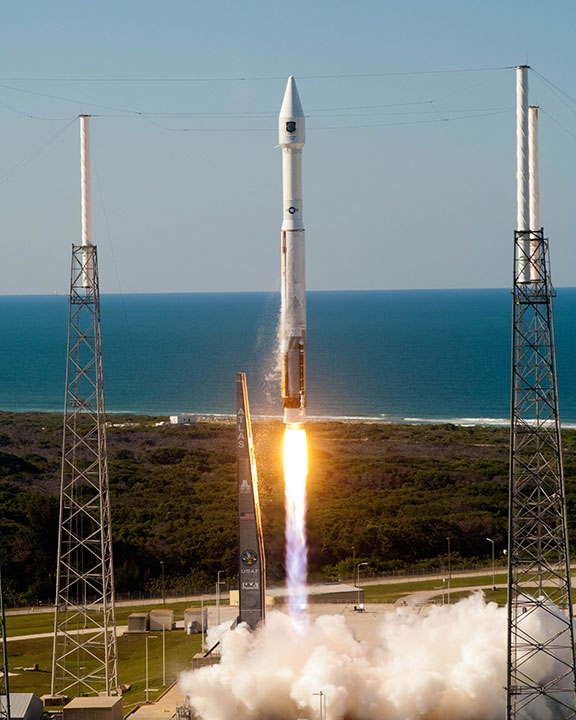
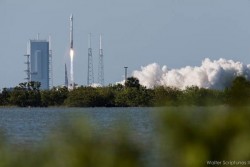
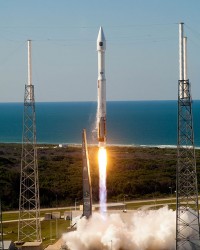
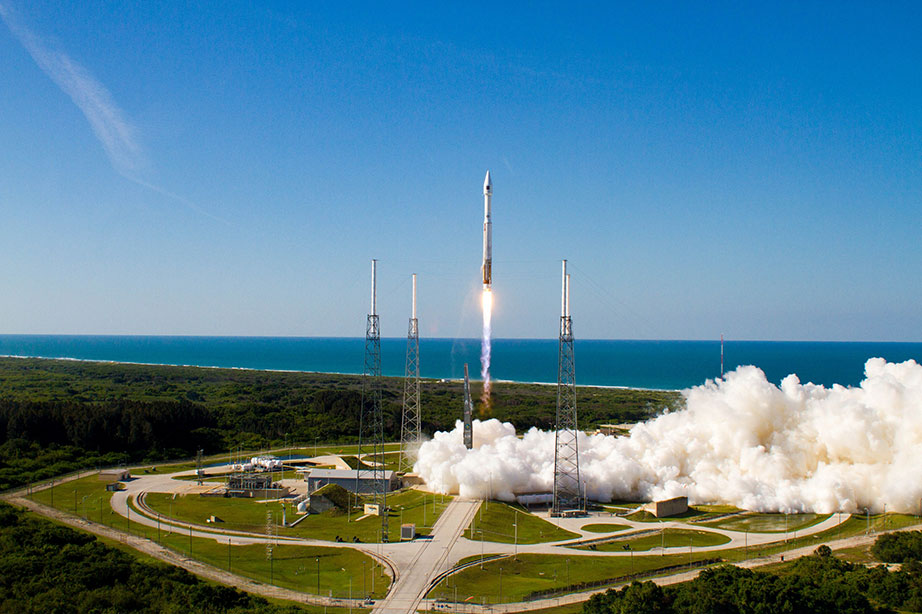
    A t 5:38 p.m. Eastern Daylight Time (21:38 UTC) on May 15,  the fourth GPS IIF satellite, Space Vehicle Number (SVN) 66 built by Boeing, ascended towards orbit aboard a United Launch Alliance Atlas V rocket at from Cape Canaveral Air Force Station, Florida.

    “The GPS constellation remains healthy and continues to meet and exceed the performance standards to which the satellites were built. Our goal is to deliver sustained, reliable GPS capabilities to America’s warfighters, our allies, and civil users around the world, and this is done by maintaining GPS performance, fielding new capabilities and developing more robust modernized capabilities for the future,” said Colonel Bernie Gruber, director of the U.S. Air Force Space and Missile Systems Center’s GPS Directorate.

    The new capabilities of the IIF satellites will provide greater navigational accuracy through improvements in atomic clock technology; a more robust signal for commercial aviation and safety-of-life applications, known as the new third civil signal (L5); and a 12-year design life providing long-term service. These upgrades deliver improved anti-jam capabilities for warfighters and improved security for military and civil users around the world, the Air Force said in a statement.

    The IIF-4 satellite is expected to complete testing in August, after which it will be utilized as a reserve or backup satellite. It becomes the fourth satellite in a 12-strong network of GPS IIF spacecraft manufactured by Boeing as lead contractor, the first of which was boosted into orbit in May 2010. The Air Force expects the first of the next-generation GPS IIIA satellites to enter service sometime in 2014.

    System Briefs

    GLONASS. The GLONASS 747 M-series satellite launched on April 26 has maneuvered into an orbital slot near GLONASS 728, the operational satellite in Plane 1, slot 2. 747 will presumably serve as a reserve until it replaces 728, unless another Plane 1 satellite expires first. The next Russian launch, a GLONASS-M trio, is scheduled for July 1. There are currently 24 operational GLONASS satellites.

    IRNSS. The first Indian Regional Navigation Satellite System satellite is expected to rise at the end of June. The IRNSS plans to orbit of seven: three geostationary and four geosynchronous, providing regional coverage via navigation signals in the L5 and S bands.

  • CNES Computes Real-Time Decimeter-Accuracy Orbits with Galileo

    The first four Galileo satellites used for in-orbit validation were launched in October 2011 and October 2012.They are now transmitting their signals on an operational basis. Thanks to the simultaneous use of these four satellites, the European Space Agency was able to compute the first autonomous Galileo-only fix using broadcast ephemerides in March 2013.

    Using data from the real-time service of the International GNSS Service (as supported by the Multi-GNSS Experiment), real-time protocols and new high-precision multiple signal messages and a new generation multi-constellation network of GNSS stations, the Centre National d’Etudes Spatiales (CNES) has been able for the first time to compute decimeter-accuracy Galileo orbits in real time.

    The networks used in this work include the CNES/Institut Géographique National REGINA (REseau Gnss pour l’Igs et la NAvigation) network and the Deutsches Zentrum für Luft- und Raumfahrt (DLR) and associated organizations CONGO (COoperative Network for GNSS Observation) network (real-time access courtesy of Oliver Montenbruck). The filter used for the multi-constellation real-time orbit determination is a CNES proprietary tool based on a Kalman filter.


    The CNES orbits have been compared to an accurate reference orbit computed by Technical University München (TUM) as part of the MGEX project. The following figure shows the 3D orbit differences for the two solutions (for the ProtoFlight Model (PFM) and Flight Model 2 (FM2) satellites), over the 10 days of the experiment. Excluding the first day during which the filter converges, the 3D root-mean-square orbit difference is about 15 centimeters. This demonstrates the feasibility of accurate real-time Galileo solutions using currently available networks and software tools.


  • u-blox Introduces High-Performance Parallel GPS/GLONASS Module

    Swiss u-blox introduces the surface-mount MAX-M5Q, a compact satellite positioning module that supports GPS and GLONASS, as well as Japanese QZSS satellite GNSS systems. High-performance GPS/GLONASS parallel operation is also supported to enhance positioning speed and accuracy.

    Designed for use in rugged environments and wide temperature range, MAX-M5Q is intended for industrial machine-to-machine (M2M) applications as well as Russia’s ERA-GLONASS emergency call system. MAX-M5Q enhances positioning in poor GNSS satellite visibility conditions as well as in high latitude and polar regions, u-blox said.

    “With parallel GPS/GLONASS operation, MAX-M5Q is able to track all 50 and more U.S. and Russian satellites to deliver incomparable speed, accuracy, and positional availability,” said Thomas Nigg, vice president of Product Marketing at u-blox, “Its compact size and high-reliability makes it an ideal positioning solution for mobile resource management and ERA-GLONASS emergency call applications.”

    With dimensions of 9.7 x 10.1 x 2.5 mm, MAX-M5Q is the newest member of u-blox’ MAX GNSS LCC module series. Additional features include autonomous A-GPS that reduces warm start TTFF by as much as 90%, and an embedded data logger which can store location information to internal Flash memory for up to 16 hours at 15 second intervals.

  • Update: GPS IIF-4 Successfully Launched from Cape Canaveral

    Update: GPS IIF-4 Successfully Launched from Cape Canaveral

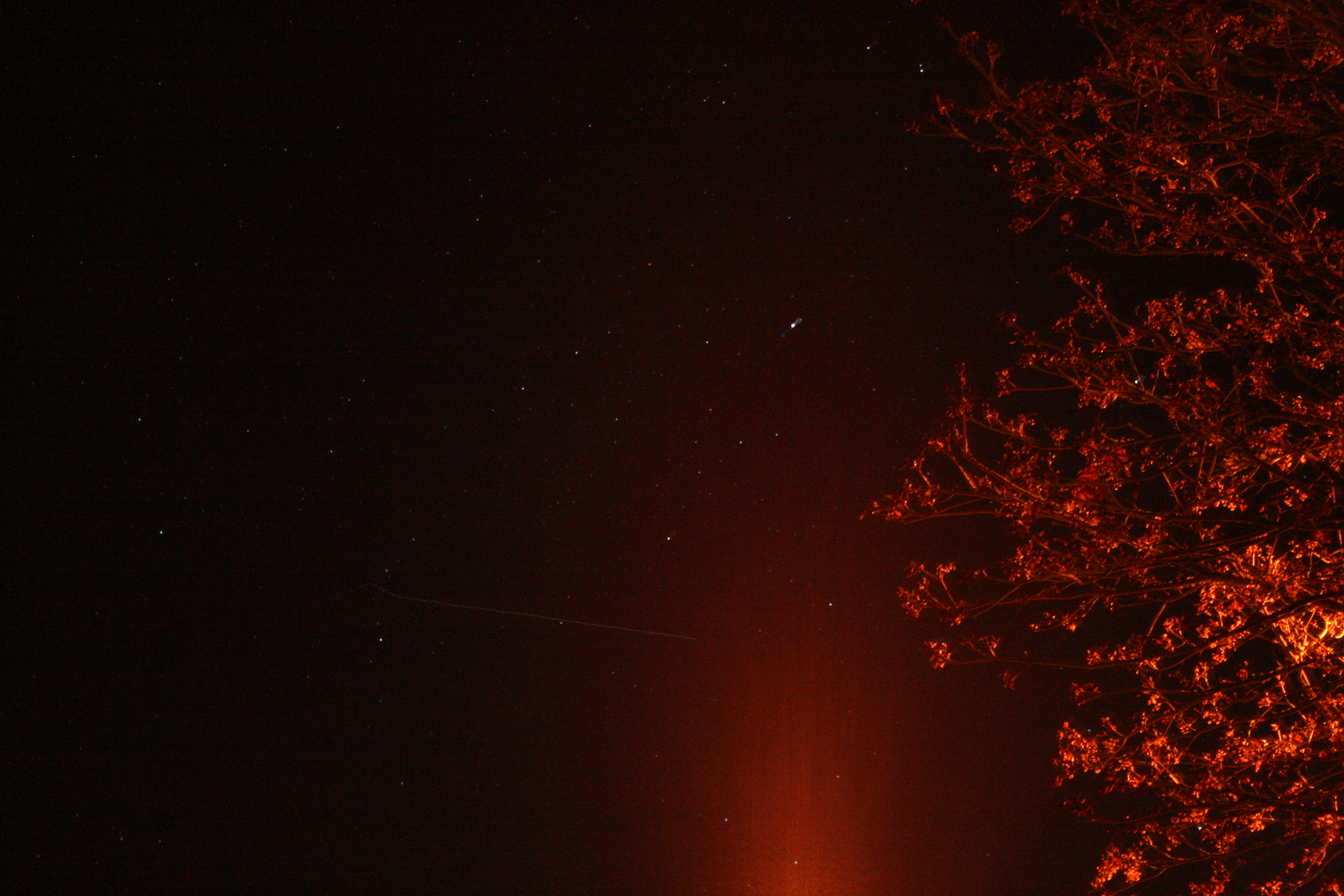
    UPDATE, May 24, by Richard Langley: The Centaur upper stage with the payload still attached was photographed from Tavistock, Devon, in the U.K. by Andy Smith. As can be seen from the ground trace figure in an earlier GPS World news item, the Centaur passed over the U.K. following MECO1, the first main engine cutoff. From Europe, the Centaur could be easily seen by reflected sunlight against the background stars. Its maximum (apparent) brightness magnitude has been estimated as -1 or -2. (Sirius, the brightest star in the night sky, has a magnitude of -1.5; Betelgeuse in the constellation Orion has a mean magnitude of about 0.4; and the limiting visual magnitude for the unaided eye is about 6.)

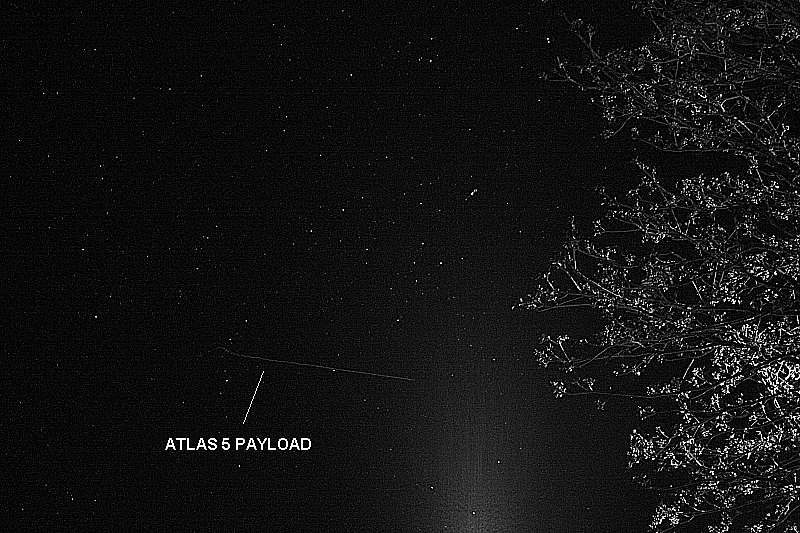
    Smith’s photograph was taken at 21:58:38 UTC (start) with a Canon EOS 450D Digital Rebel camera with an 18-55mm zoom lens. The camera settings were: focal length 55mm, aperture f/5.6, and an exposure of 8 seconds at an ISO value of 1600. Two images are shown below: the original, as obtained from the camera, and a greyscale image with edge enhancement.

    The Centaur can be seen traveling left to right and starts its track as it crosses the constellation of Cygnus. There’s a slight wobble at the beginning as the shutter release was pressed. The glow at the bottom of the frame is from a streetlight. The elevation angle of the Centaur was approximately 12 degrees.

    SVN66 will operate as PRN27 and it will eventually occupy the C-2 orbital slot, replacing SVN33/PRN03, a Block IIA satellite launched in 1996. SVN66 is currently in a drift orbit about 400 kilometers above the operational constellation. It should reach the C-2 slot within a few days from now. The satellite has already been added to the broadcast almanac although it has not yet started to transmit standard signals. It is currently marked as unhealthy in the almanac and will remain so, even after standard signals are switched on, until testing is completed sometime this summer.

    Centaur upper stage with the payload still attached. Photo credit: Andy Smith
    Centaur upper stage with the payload still attached, original photo. Photo credit: Andy Smith

    The same photo digitally enhanced:

    Photo credit: Andy Smith
    Digitally enhanced photo. Photo credit: Andy Smith

    Photo credit: Pat Corkery, United Launch Alliance.
    Photo credit: Pat Corkery, United Launch Alliance.

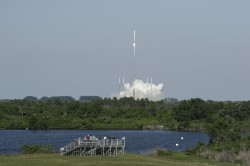
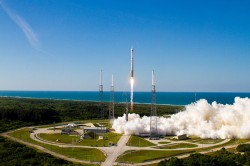
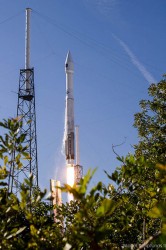
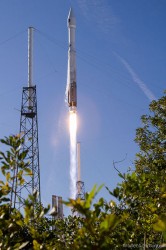
    A U.S. Air Force Global Positioning System satellite built by Boeing was successfully launched May 15. The fourth GPS IIF satellite, Space Vehicle Number (SVN) 66, was carried aboard a United Launch Alliance Atlas V Launch Vehicle at 5:38 p.m. EDT (21:38 UTC) May 15 from Cape Canaveral Air Force Station, Florida.

    The new capabilities of the IIF satellites will provide greater navigational accuracy through improvements in atomic clock technology; a more robust signal for commercial aviation and safety-of-life applications, known as the new third civil signal (L5); and a 12-year design life providing long-term service. These upgrades improved anti-jam capabilities for the warfighter and improved security for military and civil users around the world, the Air Force said in a statement.

    The Atlas rocket took off on schedule. The satellite was released from the Centaur upper stage at T+ 3 hours, 23 minutes and 52.8 seconds or about 01:02 UTC on May 16. Details on the Block IIF satellites and the Atlas rocket can be found here.

    “I’m extremely pleased with today’s launch and delighted to be part of this mission that enhances our nation’s critical GPS capability. Thanks to the superb efforts of the of the 45th and 50th Space Wings, United Launch Alliance, our industry partners, the Atlas V and GPS IIF launch teams, the GPS IIF-4 mission was successfully carried out,” said Col. Bernie Gruber, director of the Space and Missile Systems Center’s Global Positioning Systems Directorate.

    “The GPS constellation remains healthy and continues to meet and exceed the performance standards to which the satellites were built. Our goal is to deliver sustained, reliable GPS capabilities to America’s warfighters, our allies and civil users around the world, and this is done by maintaining GPS performance, fielding new capabilities and developing more robust modernized capabilities for the future,” said Colonel Gruber.

    Here are videos of the launch:


    Opening photo by Pat Corkery, United Launch Alliance.

    Photos show the launch of the U.S. Air Force’s GPS IIF-4 satellite from the Kennedy Space Center and Cape Canaveral Air Force Station.

  • Beidou to Ensure Information Security

    The chief designer of the BeiDou Navigation Satellite System said China will advocate the use of the system, which will be compatible with new devices, “so that Beidou can function properly and independently even if something goes wrong with the GPS.”

    Sun Jiadong, chief designer of BDS and an academician of the Chinese Academy of Sciences, made his comments in an interview with The Beijing News, as reported by the Chinese government’s website.

    He added that this compatibility is the only way to ensure the protection of national information. “Safety issues abound in economic areas,” said Sun. “Ordinary people may have few concerns about the security of information but it is of vital significance.”

    The development of Beidou also largely depends on the government’s involvement. “Even though the enterprises spare no effort in developing the system, the products they make would not be available for mass production, which will in turn be reflected by the prices. The government has to promote the research and development of the system,” Sun said. Sun cited the governments of Beijing, Shanghai, and Guangzhou as examples of local governments that were effectively helping to develop the BDS.

    The use of Beidou could go beyond basic navigation functions and extend to the civilian market. It would take longer for the BDS to be available for civilians, said Sun. The use of Beidou on mobile phones relies on the development of a small and power-efficient chip. Otherwise the phone cannot be used.

    When asked about when and how the cost of developing the BDS will be recovered, Sun reiterated that Beidou was developed to ensure the security of national information, and not to make profits.

    The Beidou global navigation system will be available by 2020 with the launching of more than 30 satellites.

  • Galileo Takes Center Stage at Fourth ESA Colloquium

    The fourth International Colloquium on Scientific and Fundamental Aspects of the Galileo Programme will be held in Prague, Czech Republic, December 4–6.

    Since 2007, the worldwide scientific community has met every two years to discuss the possibilities for boosting the scientific use of Galileo and for contributing to the development of the GNSS.

    The event is always organized in one of the 20 European Space Agency’s Member States, and makes an essential contribution to ESA’s implementation and definition of the evolution of the European GNSS. The gathering of major academic players provides a scientific reference for institutional executives and industry, as well as offering a unique platform for promoting innovative GNSS initiatives at large.

    The colloquium focuses on four major areas of research:

    • Scientific applications in meteorology, geodesy, geophysics, space physics, oceanography, land surface and ecosystem studies, using either direct or reflected signals, differential measurements, phase measurements, radio occultation measurements, using receivers placed on the ground, in aircraft or on satellites.
    • Scientific developments in physics, dealing with future GNSS, particularly in testing fundamental laws in astronomy and in quantum communication. Relativistic reference frames and relativistic positioning will be addressed.
    • Aspects of metrology such as reference frames, onboard and ground clocks, and precise orbit determination.
    • Scientific aspects of satellite navigation and positioning such as signal propagation, tropospheric and ionospheric corrections and the means to model and mitigate multipath and interference.

    The various possibilities to use navigation satellites such as Galileo for scientific purposes will be reviewed and the use of scientific applications to contribute to make the most of the present systems and define their evolution will be scrutinized.

    The conference is being organized as a series of plenary talks and two parallel half-day sessions.

    Online submission of abstracts is open until June 14 through the colloquium website, where other detailed information is also available.

  • Accord’s NexNav GPS Receiver Supports Freeflight with FAA’s Capstone Retrofit Project

    Accord Technology’s NexNav GPS receiver will be supporting FreeFlight Systems with its recently awarded FAA Capstone Retrofit Project. In March 2013, FreeFlight and Accord announced their collaboration to develop practical and cost-effective ARINC 429 WAAS GPS solutions that enable aircraft operators to meet ADS-B, RNP (0.3) and other performance-based navigation mandates, worldwide.

    The NexNav Circuit Card Assembly (CCA) will integrate with FreeFlight’s upgraded automatic dependent surveillance-broadcast (ADS-B) avionics to fulfill the requirements of the second phase of the FAA Capstone Project.

    “This is an excellent example of how we are working closely with FreeFlight Systems to create state-of-the-art NextGen solutions that are not only meeting upcoming mandate requirements but doing it in a cost effective manner,” stated Hal Adams, Chief Operating Officer for Accord Technology, LLC.

    The Accord Technology NexNav product line revolves around two key receivers, NexNav mini and NexNav MAX. The receivers are at the heart of embedded customer solutions whether as a Circuit Card Assembly (CCA) or embedded in the Line Replacement Unit (LRU) as a stand-alone GPS solution.

    NexNav mini was the industry’s first GPS receiver and sensor qualified to fully support the known worldwide and U.S. FAA ADS-B GPS source requirements The NexNav mini and MAX are compatible with EGNOS and other Satellite Based Augmentation Systems (SBAS) to the extent they are is compatible with WAAS.

  • Revised Kentucky and Tennessee USGS Maps Reveal New Design

    The United States Geological Survey announced that US Topo maps now have a crisper, cleaner design – enhancing readability of maps for online and printed use. Map symbols are easier to read over the digital aerial photograph layer whether the imagery is turned on or off. Improvements to symbol definitions (color, line thickness, line symbols, area fills), layer order, and annotation fonts are additional features of this supplemental release. Users can now adjust the transparency for some features and layers to increase visibility of multiple competing layers.

    USTopo

    According to the announcement, the new design is launched on new US Topo quadrangles for Kentucky (671 maps) and Tennessee (694 maps), which replace the first edition US Topo maps for those states. The replaced maps will be added to the USGS Historical Topographic Map Collection and are also available for free download from The National Map and the USGS Map Store website.

    “The new Kentucky and Tennessee US Topo maps demonstrate our commitment to improving the product design to meet our users’ needs”, said Mark DeMulder, Director of the USGS National Geospatial Program. “I encourage you to download these maps, compare them against the previous US Topo map and drop us your comments on the US Topo map product. Your input is important to us.”

    US Topo maps are updated every three years, with the initial round completed last September. Maps for Hawaii are currently in production with Alaska production starting later this year.

    Re-design enhancements and new features:

    • Crisper, cleaner design improves online and printed readability while retaining the look and feel of traditional USGS topographic maps
    • New functional road classification schema has been applied
    • A slight screening (transparency) has been applied to some features to enhance visibility of multiple competing layers
    • Updated free fonts that support diacritics
    • New PDF Legend attachment
    • Metadata formatted to support multiple browsers
    • New shaded relief layer for enhanced view of the terrain
    • Military installation boundaries, post offices and cemeteries

    US Topo maps are created from geographic datasets in The National Map, and deliver visible content such as high-resolution aerial photography, which was not available on older paper-based topographic maps. The new US Topo maps provide modern technical advantages that support wider and faster public distribution and on-screen geographic analysis tools for users.

    The new digital electronic topographic maps are delivered in GeoPDF image software format and may be viewed using Adobe Reader, available as a no cost download.