Category: GNSS

  • GNSS PPP Workshop Early Registration Extended to May 3

    The International Association of Geodesy, Natural Resources Canada, the International GNSS Service, and York University will be hosting GNSS Precise Point Positioning: Reaching Full Potential in Ottawa, Canada, June 12-14, 2013.

    The primary objective of this workshop is to provide a forum for international experts from academia, government and industry to discuss PPP-related matters, including data processing, error modelling, data products, dissemination, applications, and associated policy.

    The preliminary program is now available on the workshop website, along with details about accommodations and registration. Note that early registration has been extended until May 3, 2013.

    Given recent rapid developments in PPP technology, the objectives of this workshop will be to:

    1. Provide a forum for international experts from academia, government and industry to discuss PPP-related matters, including data processing, error modelling, data products, dissemination, applications, and associated policy.
    2. Define the current state of PPP performance and communicate global PPP activities and applications in all sectors.
    3. Identify and investigate the technical and non-technical issues that need to be addressed to improve the technology.
    4. Suggest PPP performance and utility in the next five to ten years.
  • Pacific PNT: GNSS, SBAS Updates

    The status of world GNSS, and augmentation systems in the Pacific region, highlighted the policy session of the Institute of Navigtion Pacific PNT Conference being held this week in Honolulu, Hawaii. Here are a few highlights:

    BeiDou-Logo-150x142BeiDou. Construction of the second phase of BeiDou has been completed; further launches for the third phase – constellation completion – are on hold until tests of the existing 14-satellite constellation are complete, according to Xiancheng Ding, Senior Advisor, China Satellite Navigation Office. As of December 27, 2012, BeiDou achieved full operational capability for most of the Asia-Pacific region. The full constellation is now expected to be completed by 2020.

    Other accomplishments include releasing the BeiDou Interface Control Document and manufacture of BeiDou chips for end-user applications. By the end of June, some manufacturers will release BeiDou chips in China, Ding said.

    Also in December, BeiDou introduced a new logo (at right).

    Yuanxi Yang (China National Administration of GNSS and Applications) presented statistics showing that BeiDou+GPS provides greater accuracy than GPS alone. For instance, the RMS of BeiDou+GPS kinematic positioning by using differential carrier phase is about 20 percent better than that of GPS alone, Yang said.

    By itself, existing BeiDou constellation system accuracy is better than 10 meters, timing better than 20 nanoseconds, and velocity accuracy is better than 0.2 meters/second.

    In all, BeiDou is composed of 14 satellites: five GEO, five IGSO, and four MEO. The full constellation (by 2020)  will consist of 35 satellites: 5 GEO and 30 non-GEO (a mixture of MEO and IGSO satellites).

    GPS. Keynote speaker David A. Turner (U.S. Department of State) shared his time with surprise GLONASS speaker Sergey Revnivykh (International Committee on GNSS, ICG). In his GNSS Policy and Program Update, Turner provided the dates by which three new civil signals will be on 24 GPS satellites.

    • The L2C signal is a developmental signal broadcasting from 10 GPS Satellites. It began launching in 2005 with GPS Block IIR(M) satellites, and is expected to be available on 24 satellites around 2018.
    • The L5 signal is a developmental signal broadcasting from three GPS satellites. It began launching in 2010 with Block IIF satellites, and is expected to be available on 24 GPS satellites around 2021.
    • The L1C signal begins launching in 2015 with GPS III; available on 24 GPS satellites around 2026.

    “We have an increasing number of signals, increasing capability, and increasing level of service as we continue to evolve the constellation,” Turner said.

    GLONASS. The next GLONASS satellite will be launched this Friday, April 26, Revnivykh said. This will be a GLONASS-M satellite, number 47. The first launch of a new generation GLONASS K satellite is scheduled for 2015.

    Revnivykh stressed GLONASS’ role as a global utility. “We consider international cooperation is essential for all GNSS, and we consider GLONASS an essential part of the international multi-GNSS system,” he said. He stressed the importance of compatibility and interoperability as key to this policy.

    In 2012, GLONASS performed with an average accuracy better than formally required, he said. GLONASS is in worldwide use, and positioning has improved by a factor of 10, from 35 meters to about 3 meters since the first satellites were launched. Using both GPS + GLONASS provides 1.5 times better high-precision measurements, Revnivykh said.

    The new GLONASS program for 2020 for GLONASS sustainment, development, and use includes GLONASS M, K1, and K2 satellites; the positioning accuracy objective is to go from the current 2.8 meters to 0.6 meters.

    Aviation. Chris Hegarty (MITRE) presented an FAA Navigation Programs Overview on behalf of the scheduled speaker Deborah Lawrence (FAA) who was unable to attend. He noted that United Airlines has begun GBAS operations in Houston.

    In answer to a funding question, he said, “The sequestration is not expected to have a positive effect on schedule, but the presented timeline for APNT is the FAA’s current best estimate. Congress has some tough decisions before them, and I wouldn’t want to speculate on potential schedule impacts. In the words of Yogi Berra, predicting is hard, especially when it involves the future.”

    Korean SBAS. Changdon Kee (Seoul National University) shared plans for a Korean SBAS. In South Korea, LPV availability is 49.4% compared to 90.6% in Japan. “Korea needs its own system,” Kee said.

    Phase 3 of the SBAS development could start by the end of September, depending on funding. It will include open service multifunctional GEO satellites interoperable with other SBASs. A pseudolite demonstration system will be completed in 2014, clearing the way for the beginning of Phase 3.

    In all, the system will include five reference stations, two master stations, two ground uplink stations, and two GEO satellites (the main GEO by 2018 and a backup by 2020).

    The Korean SBAS open service system will provide GPS L1 augmentation, begin operation in 2020, and support aviation, land and maritime users. A test operation system will provide GPS L1 and L5 augmentation. The system is expected to be fully operational by 2021, with service available throughout Asia.

    Michibiki-AlanJapan’s QZSS. Hiroyuki Noda (Office of National Space Policy, Japan) said three more satellites for this augmentation system will be launched by the end of the decade, with the service beginning in 2018. In September 2012, the Japan cabinet made the commitment to accelerate development of the system. The first satellite, launched in 2010 (QZS-1, aka Michibiki) is performing as expected.

    QZSS is expected to improve positioning availability from 90% to 99.8% in Japan. QZSS will not only improve positioning in the Asia-Pacific region, but is expected to improve the capacity to respond to natural disasters, Noda said.

  • Time to Hit Warp Speed, Galileo

    Report from ENC: Constellation Needs 22 Satellites in Three Years

    Launch, deploy, and operate “22 satellites in less than 3 years.” That’s two satellites every three months, leading to a four-at-once launch in 2014. And that’s the challenge that Europe and the European Space Agency (ESA) now face.

    This pointed call to action during the opening plenary of the European Navigation Conference (ENC) came from Didier Faivre, director of Galileo Programme and Navigation Related Activities at ESA. It was the only somber note sounded during the keynote speeches, which otherwise paraded the stirring recent accomplishments of the Galileo In-Orbit Validation (IOV) phase. IOV now concludes, and Galileo’s operational phase opens.

    The ENC takes place in Vienna, Austria this week (April 23–25), hosted by the Austrian Institute of Navigation. Privately and informally, a handful of knowledgeable conference attendees expressed confidence that OHB System can furnish the completed satellites, at least, according to schedule. OHB System is the prime contractor for  construction of 22 Full Operational Capability (FOC) Galileo satellites and is responsible for developing the satellite bus and for integrating the satellites. Surrey Satellite Technology Ltd. (SSTL) is developing and constructing the navigation payload and  assisting OHB with final satellite assembly.

    “Using only European tools and means, European ground infrastructure deployed on European territory, our conception, machine and design, is totally validated,” stated Faivre, referring to the recent Galileo-only positioning fix by ESA. The March 12, 2013, event marks “the end of the beginning,” and culminates 12 years of intense work at all levels of European industry.

    “Europe is at par with GPS” with performance as expected. “I hope that soon our U.S. colleagues will be jealous of our performance,” Faivre stated, implying yet again the persistent Galileo claim that the system will be more accurate than GPS. He returned to this theme with reference to Fugro’s accomplishment of real-time precise point positioning at the centimeter level.

    He acknowledged that “It’s a technological competition with the United States, Russia, and China,” even though all may be friendly and collegial.

    In that competitive light, “the success of Galileo will be measured by the number of users,” and not by the number of satellites, or the degree of accuracy, or the strength of the signal.

    Previously, the ENC audience had heard from Ingolf Schädler that “Europe has closed the gap with the technological superpowers,” in what “may be the most complex invention ever of mankind, the system of navigation that is GNSS.” He also made a proud reference to Austrian-produced signal generators aboard Galileo’s orbiting IOV satellites. Schädler is the deputy director general of innovation for the Austrian federal Ministry for Transport, Innovation and Technology.

    “We have reached cruising speed,” announced the third keynote speaker, Carlo des Dorides of the European GNSS Agency (GSA). He was referring explicitly to the re-positioning of the GSA headquarters from Brussels to Prague, but the remarks reverberated to the Galileo program as a whole.

    David Blanchard, deputy head of unit, EU Satellite Navigation Programmes for the European Commission, quoted an unnamed U.S. publication: “With the capability to make a position fix from four signal-broadcasting satellites, we can now say that Galileo has truly arrived.”

    That statement appeared in the May 2013 GPS World, an issue of the magazine that was distributed in conference bags to all attendees at the ENC.

    Blanchard then shifted the focus slightly from Galileo, to Galileo together with the European Geostationary Navigation Overlay Service (EGNOS), Europe’s satellite-based augmentation service that also broadcasts GPS corrections. “We have to make sure that all the capabilities afforded by EGNOS are realized.” He also made strong references to the EGNOS Data Access Service (EDAS).

    Blanchard cited a current ongoing study that shows that 6 to 7 percent of European gross domestic product (GDP) is dependent upon GNSS.

    “A gold mine within arm’s reach of European industry” was how Gard Ueland, head of Galileo Services, characterized the present situation. “Development of European downstream market is crucial; it also has to bring more benefits to European society.” Galileo Services will host a workshop of  industry stakeholders in late October, at the OHB System premises in Bremen, Germany. Watch GPS World Events calendar and news for an announcement with specific dates.

    Having attained altitude and cruising speed, the Galileo program must now shift to warp speed to hit its goals on time: 18 satellites in orbit by the end of 2014, and a total of 26 by the end of 2015. Early services by the end of 2014, and full services in 2016. Stable, continuous services, as Blanchard emphasized.

    Better go to overdrive.

  • Carlson Introduces SurvCE 3.0 Data Collection Software

    At the Carlson Software Annual User Conference, Carlson announced that the newest version of Carlson Software’s SurvCE 3.0 GPS/GNSS data collection software.

    Featuring hundreds of additions and improvements, Carlson SurvCE 3.0 supports the widest range of popular and new release RTK GPS and conventional/robotic total stations of any other data collection software on the market. Newest instrument drivers added for Total Stations and GPS receivers include: Geomax Zoom 80, Carlson CR2/CR5 robotic, Topcon PS, Sokkia SX/50RX and South OnBoard total stations, and 20 or more new models of GPS from Carlson, Hemisphere, Datagrid, Topcon, Leica, Altus, CHC, Hi-Target, Navcom, Stonex, Javad, Geomax, Satlab and even including the Spectra Epoch 50.

    SurvCE30

    “SurvCE 3.0 continues to set the standard in data collection,” says Carlson. “While Carlson is well known for its surveying and roading features, especially in the U.S. and Australia, the new options in SurvCE should also appeal very strongly to the European market with its emphasis on precision occupation for total stations, and expanded reporting of GPS localization and measurement data.”

    SurvCE 3.0 is available now in more than two dozen languages. These include: English, Spanish, French, French (Canadian), Portuguese, Czech, Dutch, simplified Chinese, Korean, Greek, Italian, Polish, Hungarian, Swedish, Latvian and more.

    Now over 12 years in production, with incremental updates along the way, Carlson SurvCE 3.0 features an optional icon-based interface and new Cloud-based messaging, file transfer, NGS monument recall, simplified stakeout methods and powerful GPS measurement averaging and blunder detection in the field (with accuracies in-between RTK and post-processing). The Carlson SurvCE 3.0 upgrade is offered for just $150 for Carlson customers already using SurvCE. The price to purchase SurvCE remains the same as it has since 2007.

    “The main and universal advantages of SurvCE are retained—a simple interface, quick learning curve, now even stronger graphics, and a rich set of features to complete any work from building and highway stakeout, to property surveying, TOPO, control, and GIS data collection,” adds Carlson.

    According to the announcement, those upgrading to SurvCE 3.0 will find new camera integration among its many improvements. This integration will provide the ability to attach pictures to points and lines and store in KMZ and EXIF files containing relevant data such as position and description.

    Other top new features include:

    • Ability to stake roads by complete LandXML Road Model—a new method augmenting “By Sections,” “By Templates,” and “From Map;”
    • Ability to use point “blocks” from drawings as point symbols or as objects to snap to for stakeout or for creating alignments, with GIS attributes associated with blocks recognized;
    • Large Point ID and Description Fields – expanded to 256 characters;
    • Use of RTCM 3.1 messages from virtual reference stations to auto-compute grid and geoid shifts.
  • First GPS Cell Phone on Display at Smithsonian

    WASHINGTON, D.C. — The first GPS-enabled cell phone, developed by Navsys Corporation, is now on display at the Smithsonian National Air and Space Museum’s Time and Navigtion exhibition, which opened today. This device marks an important step in GPS history that paved the way for positioning to become the integral component of communications technology that exists today, Navsys said.

    Navsys assisted in the development of the Colorado Department of Transportation’s Emergency Vehicle Location System Mayday platform in 1995. To address the need for faster notification and responsiveness during emergencies, Navsys was contracted to integrate GPS positioning into a cell phone so that location information could be sent to a communications center for mobile 911 calls.

    One of the enabling technologies Navsys developed for this system was LocaterNET. When activated by a user’s in-vehicle unit (IVU), LocaterNET collects a snapshot of raw GPS information. That information is then sent to a remote processing system to determine the user’s location. This technique allowed for low power consumption and processing requirements for the IVU, which is vital for small form factor personal navigation and communication devices.

    “We are honored to be a part of this exhibition and for the awareness it creates for how GPS technology has advanced many other technologies we use today,” said Alison Brown, president and CEO of Navsys.

    The Smithsonian exhibition covers a multitude of navigation and timing innovations and opens on April 12. A detailed description of the LocaterNET Mayday platform can be found here.

  • GIOVE-A Uses GPS Side Lobe Signals for Far-Out Space Navigation

    GIOVE-A Uses GPS Side Lobe Signals for Far-Out Space Navigation

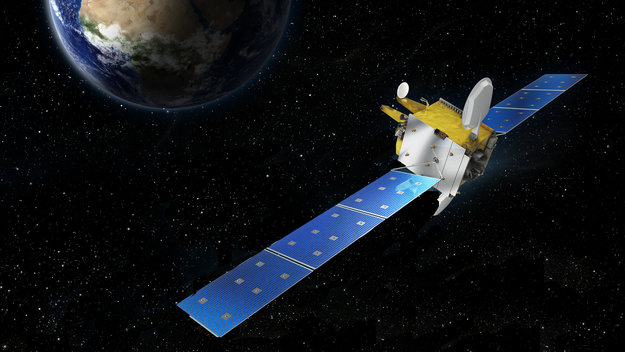
    The European Space Agency’s (ESA’s) retired GIOVE-A navigation mission has become the first civilian satellite to perform GPS position fixes from high orbit. Its results demonstrate that current satnav signals could guide missions much further away in space, up to geostationary orbit or even as far as the Moon.

    GIOVE-A has been able to fix its position, velocity and time from GPS signals, despite orbiting more than 1000 km above the downward-pointing U.S. satellites.

    “Satellite navigation has become almost as indispensable for most low-orbiting satellites as it is for car drivers and other terrestrial users,” said ESA’s Steeve Kowaltschek. “Satellites equipped with satnav receivers can continuously monitor their orbit in space, enabling largely autonomous operations with limited ground intervention. GIOVE-A’s three months of data show that future geostationary satellites could operate in the same way, bringing real competitive advantage to the multi-billion-euro telecommunications satellite market.”

    Launched in 2005 to claim radio frequencies and test hardware for Europe’s Galileo satnav constellation, the Galileo In-Orbit Validation Element-A, or GIOVE-A, mission far outlasted its original two-year design life. It was formally decommissioned by ESA in the middle of last year, once the first Galileo satellites completed their orbital commissioning. Having been moved into a graveyard orbit about 100 km above Galileo’s orbital altitude of 23 222 km, control was passed to its prime contractor Surrey Satellite Technology Ltd. of Guildford, UK.

    ESA had originally worked with SSTL to customize one of the company’s existing satnav receivers for testing on GIOVE-A, an activity supported through ESA’s Advanced Research in Telecommunications Systems (ARTES) program. In the event, the satnav receiver was activated for only 90 minutes during the very beginning of the satellite’s seven-year operational life, with GIOVE-A’s main tasks given priority. Once the formal mission was over, ESA and SSTL took the opportunity to switch the receiver on again.

    “We have been really encouraged by the initial results from our receiver,” said Martin Unwin at SSTL. “Our patience has finally been rewarded, and we would like to make the best of this unique opportunity.”

    SSTL is able to upload new software to the receiver in orbit, and has been able to apply sophisticated software algorithms to help detect faint satnav signals. Further work is planned to refine operation through the use of an accurate onboard clock and orbit-estimating algorithms.

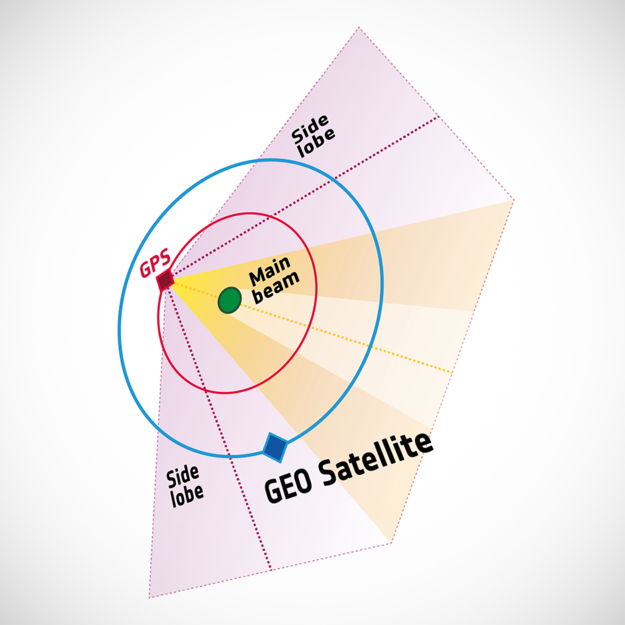
    GPS satellites – like those of Galileo, Russia’s Glonass or their Japanese, Chinese and Indian counterparts – aim their antennas directly at Earth. Any satellite orbiting above the GPS constellation can only hope to detect signals from over Earth’s far side, but the majority are blocked by the planet. For a position fix, a satnav receiver requires a minimum of four satellites to be visible, but this is most of the time not possible if based solely on front-facing signals. Instead, GIOVE-A has been able to make use of signals emitted sideways from GPS antennas, within what is known as ‘side lobes’. Just like a flashlight, radio antennas shine energy to the side as well as directly forward.
    GIOVE-A has been able to make use of signals emitted sideways from GPS antennas, within what is known as side lobes.

    GPS Side Lobes. GPS satellites — like those of Galileo, Russia’s Glonass or their Japanese, Chinese and Indian counterparts — aim their antennas directly at Earth. Any satellite orbiting above the GPS constellation can only hope to detect signals from over Earth’s far side, but the majority are blocked by the planet. For a position fix, a satnav receiver requires a minimum of four satellites to be visible, but this is most of the time not possible if based solely on front-facing signals.

    Instead, GIOVE-A makes use of signals emitted sideways from GPS antennas, within what is known as side lobes. Just like a flashlight, radio antennas shine energy to the side as well as directly forward.

    “These side lobes are not typically well measured because this is energy that doesn’t reach users on Earth,” explained Kowaltschek. “Antenna designers seek to minimize them, but the laws of physics mean they will always be present in some form. Measuring these GPS side lobes has shown them to be stronger than anticipated, and the combination of side lobes and signals spilling over from the other side of Earth mean that a position fix can be maintained throughout GIOVE-A’s orbit.”

    The satellite has also acquired detailed profiles of the signal side-lobe characteristics of the various GPS design blocks.

    Geostationary satellites reside in set orbital slots, some 80-km across, up in the 36,000-km-altitude belt. Chemical thruster firings are needed every fortnight or so to correct for drift, checked against radio ranging from the ground.

    Harnessing satnav would be a way of automating station-keeping functions. It also meshes with the current move to all-electric comsat designs, such as ESA’s Electra. Electric propulsion would do the job of conventional chemical thrusters, delivering more compact satellites capable of flying on cheaper launch vehicles while offering longer mission lifetimes. But electric propulsion provides lower thrust and therefore requires almost permanent ground ranging. Continuous position fixes via satnav could perform this task onboard, maintaining the orbit position with better accuracy.

    SmallGEO. (Image: ESA)
    SmallGEO. (Image: ESA)

    In addition, constant orbit determination and close-to-perfect time knowledge also improves pointing accuracy on comsats that use startrackers as their main attitude sensor.

    All-electric comsats using satnav could gradually steer themselves up to geostationary orbit following launch, further slashing the required launcher size, onboard fuel and ground support.

    “We envisage a future satnav receiver that can track not only GPS, but also Galileo and Glonass signals at high altitudes, meaning a near-continuous availability of accurate position and time for geostationary and other satellites,” says Martin.

    As a next step, a receiver will be flown on ESA’s SmallGEO telecom mission, due for launch in 2014. Building on the positive results of the GIOVE-A experiments, SmallGEO will be the first civilian mission to use satnav in geostationary orbit.

  • Lockheed Martin Team Completes Delta Preliminary Design for Next GPS III Satellite Capabilities

    Lockheed Martin has successfully completed a Delta Preliminary Design Review (dPDR) for the next Global Positioning System (GPS) III satellite vehicles planned under the U.S. Air Force’s GPS III program.

    The GPS III program will replace aging GPS satellites, while improving capability to meet the evolving demands of military, commercial and civilian users. GPS III satellites will deliver three times better accuracy and up to eight times improved anti-jamming signal power while enhancing the spacecraft’s design life and adding a new civil signal designed to be interoperable with international GNSS.

    The Air Force plans to purchase up to 32 GPS III satellites. Lockheed Martin is under contract for production of the first four GPS III satellites, and has received advanced procurement funding for long-lead components for the fifth, sixth, seventh and eighth satellites.  The successful dPDR addresses design modifications, agreed on by the Air Force and the Lockheed Martin-lead industry team, which will provide new capabilities for GPS III Space Vehicle 9 (SV09) and beyond, including the addition of a search and rescue satellite payload and a Laser Retroreflector Array (LRA). An innovative new waveform generator permits the addition of new navigation signals after launch to upgrade the constellation without the need to launch new satellites.

    “We have worked very closely with the Air Force and GPS community to make GPS III the most affordable and lowest risk solution for bringing new capabilities to the GPS constellation,” said John Frye, Lockheed Martin’s GPS III capability and affordability insertion manager. “The design modifications from this dPDR address ways to further reduce Air Force launch costs by $50 million per satellite through dual launch of two GPS III space vehicles on a single booster. This successful dPDR milestone sets the stage to proceed with SV09 design maturation.”

    From the beginning of the program, the Lockheed Martin team has remained focused on affordability for GPS III, the company said, while working to ensure the enhanced satellite system can evolve to continue to meet the world’s global navigation and timing needs for the next 30 years. To help reduce risks and cut costs, the GPS III team developed a GPS Non-Flight Satellite Testbed (GNST), which serves as the program’s ground pathfinder and vehicle demonstrator for the first complete satellite. The entire GPS III development and production sequence uses the GNST to provide space vehicle design level validation; early verification of ground support and test equipment; and early confirmation and rehearsal of transportation operations.

    Lockheed Martin team has met recent milestones and appears to be on track to deliver the first GPS III satellite, for launch availability in 2014.

    In February, the Lockheed Martin team successfully turned on power to the system module of the program’s first spacecraft, designated GPS III Space Vehicle 1 (SV01), demonstrating mechanical integration, validating the satellite’s interfaces, and leading the way for electrical and integrated hardware-software testing.  The satellite will complete its Assembly, Integration and Test (AI&T) in Lockheed Martin’s new GPS Processing Facility (GPF) designed for efficient and affordable satellite production.

    The GPS III team is led by the Global Positioning Systems Directorate at the U.S. Air Force Space and Missile Systems Center. Lockheed Martin is the GPS III prime contractor with teammates ITT Exelis, General Dynamics, Infinity Systems Engineering, Honeywell, ATK and other subcontractors. Air Force Space Command’s 2nd Space Operations Squadron (2SOPS), based at Schriever Air Force Base, Colorado, manages and operates the GPS constellation for both civil and military users.

  • ESA Telecom and Navigation Vehicle Ready for Test Driving

    The radio spectrum is about to get even busier, as Europe’s Galileo satnav system starts services, at the same time the European Space Agency (ESA) tests novel satellite-based telecommunication services. Supporting these developments from the ground, ESA’s new custom-built Telecommunications and Navigation Testbed Vehicle will measure the resulting signals from all over Europe.

    Adapted from a Mercedes Benz Sprinter van, this unique measurement vehicle has been delivered to ESTEC by Austria’s Joanneum Research institute. “This is a dual-purpose vehicle, suitable for both telecommunications and navigation system testing,” explained Simon Johns of ESA’s Radionavigation Systems and Techniques Section.

    “For navigation, we have the Galileo constellation coming on stream, as well as the stepping up of ESA’s GNSS Evolution programme — designing what comes next after Galileo’s first generation.”

    The four wheel-drive vehicle can host a three-person team, and is crammed with dedicated navigation and telecommunication monitoring equipment.

    Testbed vehicle screen.
    Testbed vehicle screen.

    “One of the main goals driving the design was to have an ‘easy to adapt’ test platform suitable to set up test campaigns for different mobile satellite systems and standards that would require different types of antennas and specific receiver/transmit equipment,” explained Olivier Smeyers of ESA’s Communication-TT&C Systems and Techniques Section.

    “On the telecommunications side, there is a continuous effort to enhance current and create new mobile satellite-based broadcast and interactive services via the evolution of current systems or developing new standards,” Smeyers said. “Testing in the field is an essential element for validating and eventually establishing evolved or new standards. The vehicle has built-in multimedia equipment, including storage and control computers, multimedia gateway, passenger LCD screens, cameras and microphones, to serve this purpose.”

    The vehicle features include two removable roof plates to mount specialized antennas (one currently hosts the antenna of a Broadband Global Area Network satellite terminal for Internet connectivity and multimedia and data streaming), an 8-meter-high telescopic mast capable of carrying 25 kilograms, a rubidium atomic clock synchronized to GPS time with nanosecond accuracy, a high-end spectrum analyzer and oscilloscope for signal measurements, and mobile temperature sensors to monitor the rack equipment.

    A fish-eye video camera incorporating onscreen GPS timing and positioning performs continuous recording of its surroundings — to throw light on high buildings, trees, or other factors that might affect results.

    Internal and external generators yield up to 5 kilowatts to keep everything running — sufficient power to supply two typical European households.

    “The challenge was to fit in all the equipment and provide the necessary power and air conditioning, while still weighing less than 3.5 tonnes,” said Thomas Prechtl of Joanneum Research. “Exceeding this weight would have meant drivers would have needed a special license, and potentially limited its operations in some European nations.”

  • Smithsonian Time and Navigation Exhibit Opens Friday

    Smithsonian Time and Navigation Exhibit Opens Friday

    A major exhibition opening April 12, “Time and Navigation: the untold story of getting from here to there,” explores how revolutions in timekeeping over three centuries have influenced how people find their way. This project is a unique collaboration between two of the Smithsonian’s largest and most popular museums: the National Air and Space Museum and the National Museum of American History.

    “Time and Navigation is an ambitious exhibit because it traces the development of very complicated technologies and makes us think about a subject we now take for granted,” said Gen. J.R. “Jack” Dailey, director of the museum. “Today, the technology needed to accurately navigate is integrated into mobile computers and phones: hundreds of years of technological heritage tell your handheld device where you are in a seamless manner. This opens up new possibilities and challenging questions for the next generation of scientists and explorers who visit this exhibit to start thinking about.”

    Don Jewell discussed the exhibit in depth in his March Defense PNT column.

    The gallery is organized into five sections and spans three centuries of efforts to travel on Earth and through the solar system. In each section the visitor will learn about pioneer navigators facing myriad issues, but one challenge always stands out: the need to know accurate time.

    Sections

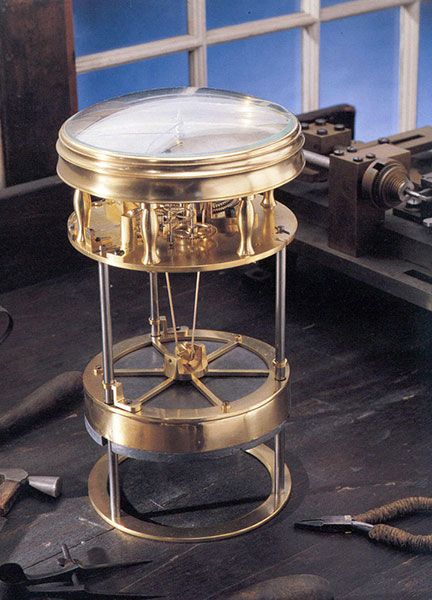
    This timekeeper was the first American-made marine timekeeper taken to sea. William Cranch Bond, a 23-year-old Boston clockmaker, crafted it during the War of 1812.
    This timekeeper was the first American-made marine timekeeper taken to sea. William Cranch Bond, a 23-year-old Boston clockmaker, crafted it during the War of 1812.

    Navigating at Sea is an immersive environment that suggests a walk through a 19th-century sailing vessel. Visitors will learn how centuries ago navigators at sea relied on chronometers and measurements of celestial objects to determine location. This section includes a mariner’s astrolabe, dating from 1602; a Ramsden sextant and dividing engine; several chronometers; a model of Galileo’s pendulum clock; and the earliest sea-going marine chronometer made in the United States, produced by Bostonian William Cranch Bond during the War of 1812. It also features an interactive display that allows visitors to use a sextant to navigate with the stars.

    Navigating in the Air relates how air navigators struggled with greater speeds, worse weather and more cramped conditions than their sea-going predecessors. It tells the story of the innovations that overcame these challenges, as represented the gallery’s largest artifact, the Lockheed Vega “Winnie Mae,” flown by Wiley Post and Harold Gatty, shattering the around-the-world record in 1931. Visitors will learn that Charles Lindbergh required navigational tutoring after he flew to Paris and how he paved the way for a new system of navigation in the process. A personal account by a WWII navigator highlights wartime innovations. This section ends with an explanation of how clocks with tiny quartz crystals opened an entirely new era of navigation in the form of LORAN (LOng RAnge Navigation).

    Wiley Post’s Winnie Mae circled the globe two times, shattering previous records. The first time was in 1931 with Weems associate Harold Gatty as lead navigator. The second was a solo flight in 1933 assisted by “Mechanical Mike,” one of the world’s first practical autopilots.
    Wiley Post’s Winnie Mae circled the globe two times, shattering previous records. The first time was in 1931 with Weems associate Harold Gatty as lead navigator. The second was a solo flight in 1933 assisted by “Mechanical Mike,” one of the world’s first practical autopilots.

    Navigating in Space traces how teams of talented engineers invented the new science of space navigation using star sightings, precise timing and radio communications. This section includes an Apollo sextant, a space shuttle star tracker, timing equipment used at a ground tracking station and a flight spare (duplicate spacecraft) of Mariner 10, the first spacecraft to reach Mercury.

    Inventing Satellite Navigation describes how traveling in space inspired plans to navigate from space. Innovators found that time from precise clocks on satellites, transmitted by radio signals, could be used to determine location. The U.S. military combined several breakthroughs to create the Global Positioning System. Some of the artifacts in this section are the NIST-7 atomic clock that served as the U.S. time standard in the 1990s, the navigation system from the nuclear submarine U.S.S. Alabama, a satellite from the Transit system used for global navigation before GPS and a test satellite global navigation built at the Naval Research Laboratory.

    An official DARPA photograph of Stanley at the 2005 DARPA Grand Challenge. Stanley, created by the Stanford University Racing Team, won the race.
    An official DARPA photograph of Stanley at the 2005 DARPA Grand Challenge. Stanley, created by the Stanford University Racing Team, won the race.

    Navigation for Everyone tells the stories of real people — a fireman, a farmer and a student — who use modern navigation technology in their everyday lives. It also addresses what might come next: the story is not over yet and many new technologies are being developed. This section includes a disassembled mobile phone with a diagram showing all its parts and depicts how hundreds of years of navigation technology are now in the palm of a user’s hand. It also features “Stanley,” the robot car that won the 2005 Grand Challenge, a robot race sponsored by the Defense Advanced Research Projects Agency.

    The exhibition is made possible through the support of Northrop Grumman Corporation; Exelis Inc.; Honeywell; National Geospatial-Intelligence Agency; U.S. Department of Transportation; Magellan GPS; National Coordination Office for Space-Based Positioning, Navigation and Timing; Rockwell Collins; and the Institute of Navigation.

    The National Air and Space Museum building on the National Mall in Washington, D.C., is located at Sixth Street and Independence Avenue S.W. The museum’s Steven F. Udvar-Hazy Center is located in Chantilly, Va., near Washington Dulles International Airport. The National Museum of American History collects, preserves and displays American heritage in the areas of social, political, cultural, scientific and military history.

  • TomTom Congestion Index shows that Moscow is the Most Congested City

    TomTom announces its annual 2012 Congestion Index, a report comparing congestion levels in 2012 versus 2011 in 161 cities and across five continents. The Annual Congestion Index finds Moscow the most congested city.

    According to the announcement, on average, journey times in Moscow are 66% longer during non-congested periods when traffic is flowing freely, and 106% longer during morning rush hour. TomTom’s Congestion Index, including individual continent and city reports, can be found at www.tomtom.com/congestionindex.

    TomTom’s Congestion Index is a barometer of congestion in urban areas. The Index is uniquely based on real travel time data captured by vehicles driving the entire road network. TomTom’s traffic database contains over six trillion data measurements and is growing by five billion measurements every day.

    The top ten most congested cities, ranked by overall Congestion Level, in 2012 are:

    1. Moscow 66%

    2. Istanbul 55%

    3. Warsaw 42%

    4. Marseille 40%

    5. Palermo 39%

    6. Los Angeles 33%

    7. Sydney 33%

    8. Stuttgart 33%

    9. Paris 33%

    10. Rome 33%
    “TomTom’s Annual Congestion Index provides accurate insight into the world’s most congested cities,” said Ralf-Peter Schäfer, Head of Traffic at TomTom. “This detailed knowledge of the entire road network helps businesses and governments to make more informed decisions about how best to tackle, and avoid congestion. TomTom’s world-class traffic information also helps drivers get to their destinations faster. Significantly, when used on a large scale, TomTom HD Traffic has the potential to ease congestion in cities and urban areas by routing drivers away from congested areas.”

    About the TomTom Congestion Index

    The methodology used in the Congestion Index compares measured travel times during non-congested periods (free flow) with travel times in peak hours. The difference is expressed as a percentage increase in travel time. The Index takes into account local roads, arterials, as well as highways. All data is based on actual GPS based measurements.

    As well as assigning and ranking the overall congestion levels of over 161 cities around the world, the report analyses the congestion levels in cities at different times of the day and on different days of the week. TomTom analysed capital cities as well as cities with a population of over 800,000. In addition, a selection of key cities with smaller populations was included based on their regional importance to the transportation network. The purpose of adding these smaller cities was to provide a better understanding of congestion levels within individual countries.

    Individual city reports include more detailed information such as the most congested day, time delay per year for commuters and congestion levels on main and secondary roads.

  • Japan to Expand QZSS with Three Birds, Ground Control

    The Japanese government has ordered three navigation satellites from Mitsubishi Electric Corp. to expand the Quasi-Zenith Satellite System (QZSS), reports Spaceflight Now. QZSS augments GPS navigation signals for users in the Asia-Pacific region.

    NEC Corporation has also been awarded a contract, for the Ground Control Segment.

    Japan’s Cabinet Office announced the QZSS expansion on March 29, approving a $526 million contract with Mitsubishi Electric for the construction of three satellites for launch before the end of 2017. Two of the spacecraft will be placed in inclined orbits, and one satellite will operate in geostationary orbit over the equator.

    Michibiki-Alan
    Michibiki, the website version.

    NEC Corp. will operate QZSS for 15 years under a $1.2 billion contract that covers the design, verification and maintenance of the QZSS ground system.

    Michibiki, launched in September 2010, is Japan’s first QZSS.

  • IGS Launches Real-Time Service

    The International GNSS Service (IGS), a worldwide federation of agencies involved in high-­precision Global Navigation Satellite System applications, has announced the launch of its Real-­Time Service (RTS). The RTS is a global-scale GNSS orbit and clock correction service that enables real‐time precise point positioning (PPP) and related applications requiring access to IGS low latency products.

    The RTS is offered in beta as a GPS-­only service for the development and testing of applications. The Russian GLONASS is initially provided as an experimental product and will be included within the service before the end of 2013 as the RTS reaches its full operating capability. Other GNSS constellations will be added as they become available.

    The RTS is operated as a public service. Users are offered free access through subscription. Interested parties are invited to visit the service’s website.

    GPS World published a detailed preview of the IGS RTS in Eric Gakstatter’s April Survey Scene e-newsletter.

    The IGS is a worldwide federation of more than 200 organizations that operate a cooperative global infrastructure to provide the highest-quality GNSS data products for scientific users. The IGS is a service of the International Association of Geodesy (IAG), one of the associations of the International Union of Geodesy and Geophysics (IUGG). It is also a service of the World Data System of the International Council for Science (ICSU/WDS).