Category: GNSS

  • Galileo, OneWeb and the UK’s sovereignty way forward

    Galileo, OneWeb and the UK’s sovereignty way forward

    A discussion with Admiral Lord West

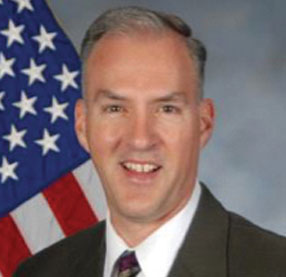
    Admiral Lord Alan West of Spithead has served the United Kingdom as First Sea Lord and led the government’s efforts for counter terrorism and cybersecurity. He has been a member of the House of Lords since 2007 and has stayed engaged with defence and maritime issues. RNT Foundation President Dana A. Goward spoke with him in early September about the UK’s way forward for GPS-like services.

    DG: The UK government has been talking for years about the nation’s vulnerability to disruption of space-based signals such as those from GPS and Galileo. What is being done about it?

    LW: Unfortunately, the government is not being as transparent as we might like on this. I do know from comments made in the House of Lords that there is a group developing a strategy. Also, that the Cabinet Office — our equivalent of the National Security Council in the United States — is deciding who is to be in charge and how things will be run.

    I have heard the strategy group will propose a mix of technologies such as has been discussed in the United States. The idea of having several different systems, I am sure, is so that something interfering with one won’t disrupt them all.

    This is all supposed to published in November. But I am concerned that government distractions with COVID, Afghanistan and other issues will delay that.

    DG: What about the OneWeb project?  That doesn’t seem to be waiting for a November announcement. And there is talk it may provide GPS-like timing and navigation services.

    LW: OneWeb is moving forward, but at present it is only about 5G and making it available more quickly and broadly. There may be a OneWeb Phase 2 that includes modified or additional satellites to provide positioning, navigation and timing (PNT), but that is to be decided.
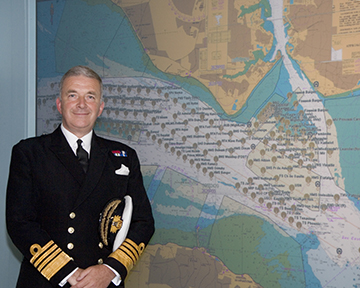
    Admiral Sir Alan West, then First Sea Lord, is pictured with the official chart of anchorages for the International Fleet Review. (Photo: DP Kilfeather's book Trafalgar 200 Through the Lens Queen Elizabeth II 80th Birthday Edition, CC BY-SA 2.5)
    Admiral Sir Alan West, then First Sea Lord, is pictured with the official chart of anchorages for the International Fleet Review. (Photo: DP Kilfeather’s book Trafalgar 200 Through the Lens, Queen Elizabeth II 80th Birthday Edition, CC BY-SA 2.5)

    DG: How about the UK rejoining Galileo?

    LW: Actually, that makes a lot of sense from a practical point of view for both the UK and Europe. Unfortunately, there were a lot of hurt feelings on the continent with Brexit, some EU leaders seemed to be in punishment mode, and expulsion from Galileo was part of the fallout. I think that in due course as tempers cool, we will fully re-engage with the European Space Agency.

    DG: So, no UK project for a GPS equivalent?

    LW: The government allocated £90 million to that, which enabled a thorough look at the idea but was woefully inadequate to even start a project. Doing a British version of GPS or Galileo would be hugely expensive and doesn’t make sense. There are better, cheaper ways of getting what we need.

    DG: And what does the UK need? What is the goal?

    LW: We need several things.

    First, we need a global capability that is ours, or that we are closely partnered in, to support the UK’s worldwide military and economic interests.

    We also need to have something in place so that, even if space is denied to us — and that is getting to be more and more of a threat each day — we can keep our industries, critical infrastructure and economy going at home.

    And third, we need a resilient PNT capability as a foundation for current applications, and to build on for such things as autonomy, intelligent transportation, and the like.

    DG: So how do you get there?

    LW: For the global bit, the OneWeb, and perhaps an even closer partnership with the United States on GPS.

    At home, we definitely need a sovereign capability for when space is denied by solar weather or our adversaries. Also to be a check on space signals because our adversaries and criminals are spoofing them more and more.

    I have always thought eLoran was a good choice. The UK pioneered its development and had the world’s first operational system in 2015. It is really hard to interfere with the signal, and there are other features that could be added to it that would make it even more robust.

    There was a very interesting report called MarRINav put out last year about what UK maritime needs to ensure it can navigate regardless of whether the satellites are working or not. They came up with a reasonably inexpensive combination of systems anchored by eLoran.

    By the way, it is interesting that the MarRINav study was funded by the European Space Agency. They seem to understand that satellites are not the be all and end all for PNT services.

    DG: That all seems pretty straightforward and the right thing to do. What’s standing in the way?

    LW: Well, so few people understand the problem. The population as a whole is almost completely unaware. At some level government understands all 13 of our critical infrastructure sectors could be impacted, but the people senior enough to drive action have dozens of other issues to deal with that probably seem more urgent.

    DG: I wonder what it will take to make it seem urgent enough.

    LW: Let’s hope the wakeup call is something short of a national disaster.

  • EAB Q&A: How should we secure PNT resilience?

    EAB Q&A: How should we secure PNT resilience?

    Two decades ago, the Volpe National Transportation System Center released its landmark report on the vulnerability of GPS. Have this study and its many successors helped move us to the necessary levels of PNT resilience? Have we done enough? What is left to be done?

    Bernard Gruber
    Bernard Gruber

    “This study and others underscore that safety must be maintained in the event of GPS loss. Among the many recommendations, I maintain that ‘systems and procedures to monitor, report, and locate unintentional [and intentional] interference should be implemented.’ Similar to GPS integrity monitoring, awareness of signal vulnerability ‘hot spots’ may allow an understanding of the RF landscape, and thus users may employ tactics, tools and techniques to combat against it. This ‘issue’ will not be solved with a singular solution; rather, continued education and urgency will produce innovative solutions over time. I just hope that a large ‘trigger event’ is not needed to do so.”
    — Bernard Gruber, Northrop Grumman

    Photo: Orolia
    John Fischer

    “We have widespread awareness now, but not enough implementation of safeguards. There is no one simple solution – a single alternative system to GPS is not the answer. Rather, the integration of several diverse alternative PNT sources will provide the necessary resiliency. DHS and NIST have taken the proper initial steps to set standards for resiliency, but the next step is implementation. Twenty years without a major incident has only reinforced complacency, but we can’t keep betting our luck will continue. We have everything we need now — the technology, the standards, the exec orders — let’s implement!”
    — John Fischer, Orolia

    Ellen Hall
    Ellen Hall

    “This study was instrumental in getting the U.S. government to face the fact that GPS is vulnerable on many fronts. It seems that the first response was to focus on making signals more robust and therefore less vulnerable. The backup systems, alternatives, or simply additional sensors have come onto the scene very slowly due to factors that include funding, politics, and difficulty in deployment on all platforms, where the costs could be astronomical. I hope that it doesn’t take a catastrophic event to force all factions to come together to find best solutions, but that is sadly often the case.”
    — Ellen Hall, Spirent Federal Systems

    GPS World Editorial Advisory Board

    Tony Agresta
    Nearmap

    Miguel Amor
    Hexagon Positioning Intelligence

    Thibault Bonnevie
    SBG Systems

    Alison Brown
    NAVSYS Corporation

    Ismael Colomina
    GeoNumerics

    Clem Driscoll
    C.J. Driscoll & Associates

    John Fischer
    Orolia

    Bernard Gruber
    Northrop Grumman

    Ellen Hall
    Spirent Federal Systems

    Jules McNeff
    Overlook Systems Technologies

    Terry Moore
    University of Nottingham

    Mitch Narins
    Consultant

    Bradford W. Parkinson
    Stanford Center for Position,
    Navigation and Time

    Stuart Riley
    Trimble

    Jean-Marie Sleewaegen
    Septentrio

    Michael Swiek
    GPS Alliance

    Julian Thomas
    Racelogic Ltd.

    Greg Turetzky
    Consultant

  • Orolia wins €70M in Galileo atomic clock contracts

    Orolia wins €70M in Galileo atomic clock contracts

    Orolia has been awarded €70 million in two contracts to provide atomic clocks for the first 12 satellites of the Galileo Second Generation System (G2S). The first was from the European Space Agency (ESA) and the second from Leonardo.

    Each of the new G2S satellites, designed to provide unprecedented accuracy worldwide, will contain three Orolia Rubidium Atomic Frequency Standards (RAFS) and two Orolia atomic clock physics packages integrated with Leonardo’s Passive Hydrogen Masers (PHM).

    “We are truly honored to be selected by the European Commission, ESA and Leonardo to continue to supply our advanced space atomic clocks for the next generation of Galileo,” said Jean-Yves Courtois, CEO of Orolia. “Our dedication, hard work and innovative design for all the clocks in the current Galileo constellation have contributed to the most accurate GNSS system in service today. We look forward to continuing to support the Galileo program with the most advanced GNSS timing technology available in the world.”

    Orolia’s RAFS is an ultra-stable rubidium atomic clock able to deliver a frequency stability of about 2 x 10-14 over averaging intervals of 10,000 seconds. The Leonardo PHM, with its excellent frequency stability performance, is the master clock for the Galileo satellite payload. The maser technology embedded on Galileo offers superior stability compared to all other types of clocks onboard navigation satellites, according to Orolia.

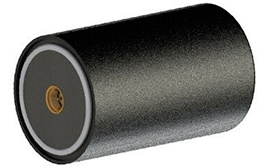
    The RAFS Flight Model atomic clock will fly aboard the second generation Galileo satellites. (Photo: Orolia)
    The RAFS Flight Model atomic clock will fly aboard the second generation Galileo satellites. (Photo: Orolia)

    Orolia has delivered more than 140 RAFS Flight Models worldwide, with 114 flying on GNSS satellites. In addition, 100 PHM Flight Models have been delivered worldwide, and 56 are flying on the current Galileo constellation.

    According to ESA, the G2S satellites will revolutionize the Galileo constellation, joining the 26 first-generation satellites currently in orbit. They will be much larger than the existing Galileo satellites, use electric propulsion for the first time, and feature a more powerful navigation antenna. The G2S constellation should achieve decimeter-scale positioning precision.

    In May, the European Commission and ESA announced the selection of Orolia to provide its Skydel GNSS signal simulation core engine for the G2S radiofrequency constellation simulator.

    The Galileo program is managed and funded by the European Union. The European Commission, ESA and EUSPA have signed an agreement by which ESA acts as design authority and system development prime on behalf of the commission and EUSPA as the exploitation and operation manager of Galileo.

  • Correcting errors, big and small

    Correcting errors, big and small

    Three decades after it first entered popular culture during the Gulf War, even a cursory review of articles about GPS aimed at a mass audience still will reveal a plethora of inaccuracies and misunderstandings, ranging from the trivial to the fundamental. Among my pet peeves, some for 20 years, are statements to the effect that GPS:

    1. is a tracking technology

    2. is the only such system

    3. is responsible for routing errors

    4. can operate indoors

    5. receivers “talk” to the satellites

    6. relies on triangulation

    7. has 24 satellites in orbit 

    (For those of you picking up this magazine who are new to satellite navigation, the correct versions of those statements are below.)

    Matteo Luccio
    Matteo Luccio

    Additionally, GPS is taken for granted, with hardly any recognition for the engineers, technicians, U.S. Air Force service members and others who make the miracle happen, and for the fact that U.S. taxpayers foot the nearly $2 billion annual bill for the system, which is offered free to users worldwide. (All GPS program funding comes from general U.S. tax revenues. The bulk of the program is budgeted through the U.S. Department of Defense, which has primary responsibility for developing, acquiring, operating, sustaining and modernizing GPS. The U.S. Department of Transportation is responsible for funding the extra costs associated with new, civilian GPS upgrades beyond the second and third civil signals, and agencies with unique GPS requirements are responsible for funding them.)

    While not as deadly as those about vaccines or as consequential as those about elections, misstatements about GPS lead to public confusion about threats to privacy and threats to the system. To help secure GPS, it behooves those of us who understand it the most to help educate the rest about it and correct misstatements, misunderstandings and misperceptions.

    Matteo Luccio | Editor-in-Chief
    [email protected]


    1. Tracking a person, vehicle or other object requires pairing a GPS receiver with a transmitter, typically a cellular phone.
    2. It is one of four complete global navigation satellite systems (GNSS), the other three being the Russian GLONASS, the European Galileo and the Chinese BeiDou-3. There are also two regional systems, one Indian and one Japanese.
    3. Routing errors are caused by bad map data or bad routing algorithms.
    4. It requires a clear view of at least four satellites, unimpeded by terrain, buildings, roofs or even dense tree canopies.
    5. GPS receivers are just that and have neither the need nor the ability to transmit messages back to the satellites.
    6. Triangulation determines position by measuring angles. By contrast, GNSS determine position by measuring distances (between receivers and satellites), which is called trilateration.
    7. The are currently 30 operational GPS satellites and the number varies as some satellites are temporarily removed from service, older ones are decommissioned, and new ones are placed in orbit. Find the current status of the constellation here.
  • Space Systems Command declares three GPS III space vehicles ‘Available for Launch’

    Space Systems Command declares three GPS III space vehicles ‘Available for Launch’

    The U.S. Space Force’s Space Systems Command recently declared GPS III SV06, SV07 and SV08 satellites “Available for Launch.” Here, the space vehicles await official call up for launch in Lockheed Martin’s GPS III Processing Facility in Waterton, Colorado. (Photo: Lockheed Martin)
    The U.S. Space Force’s Space Systems Command recently declared GPS III SV06, SV07 and SV08 satellites “Available for Launch.”
    Here, the space vehicles await official call up for launch in Lockheed Martin’s GPS III Processing Facility in Waterton, Colorado. (Photo: Lockheed Martin)

    The U.S. Space Force’s Space Systems Command recently declared the eighth GPS III satellite as “Available for Launch.” This significant accomplishment officially marks the third space vehicle within the GPS III program to be declared available for launch in the past three months.

    GPS III SV06, SV07, and SV08 are now awaiting official call up for launch in Lockheed Martin’s GPS III Processing Facility in Waterton, Colorado.

    “SV06, SV07, and SV08 AFL milestones in just three months prove that GPS III production continues to benefit from efficiencies with each satellite delivery,” said Col. Edward Byrne, chief of SSC’s Space Production Corps’ Medium Earth Orbit Space Systems Division.

    The first of the three recently completed satellites, SV06, is scheduled to launch in 2022 and will join the operational constellation of 31 GPS satellites.

    GPS III satellites deliver enhanced performance and accuracy through a variety of improvements, including increased signal protection and improved accuracy. GPS III also expands the civilian L5 signal, dubbed the “safety-of-life” signal, currently broadcast by the 12 GPS IIF satellites, but not yet operational, and delivers a new L1C signal designed to grant interoperability to similar international space-based positioning, navigation, and timing systems around the world.

    Space Systems Command, located at Los Angeles Air Force Base in El Segundo, California, is the U.S. Space Force’s Center of Excellence for acquiring and developing military space systems. SSC’s portfolio includes space launch, global navigation satellite systems, military satellite communications, a defense meteorological satellite control network, range systems, space-based infrared systems, and space domain awareness capabilities.

  • Maxtena intros multi-frequency antenna shaped for high-precision applications

    Maxtena intros multi-frequency antenna shaped for high-precision applications

    Maxtena has introduced a new multi-frequency antenna shaped for high-precision applications featuring L-band corrections.

    Photo: Maxtena
    Photo: Maxtena

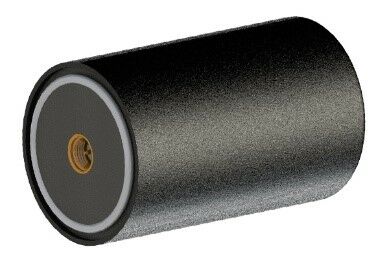
    The design will offer simultaneous GNSS reception on L1: GPS, GLONASS, Galileo, Beidou, L2: GPS L2C, Galileo E5B, and GLONASS L3OC, and L5: GPS + L-band corrections in a rugged, compact, and ultra-lightweight form factor. The antenna is well suited for high precision applications. The M9HCT-A-SMA is a great fit for the UAV markets, where high performance and low weight are driving features in antenna selection.

    The new rugged active helix antenna is designed and manufactured using automotive grade electronics for GIS, RTK and other GNSS applications.

  • National Academies proposes team to study FCC Ligado decision

    National Academies proposes team to study FCC Ligado decision

    NAS logoThe National Academies has announced its proposed team to examine the analysis and decision-making process by the Federal Communications Commission (FCC) in the matter of Ligado Networks.

    Individuals and organizations wishing to comment on the appropriateness of any of the members of that team or on any other aspect of this study have until Sept. 19.

    The April 2020 decision by the FCC has generated significant controversy and opposition within the public and Congress. This resulted in, among other things, seven separate petitions for reconsideration being filed, all of which are still pending, and several provisions in the National Defense Authorization Act for 2021. One of those provisions requires the Department of Defense to sponsor a study of the technical assumptions and analyses that went into the FCC’s decision to allow Ligado Networks to operate.

    According to the post on the National Academies website, the study will consider:

    1. Which of the two prevailing proposed approaches to evaluating harmful interference concerns — one based on a signal-to-noise interference protection criterion and the other based on a device-by-device measurement of the GPS position error — most effectively mitigates risks of harmful interference with GPS services and DOD operations and activities.
    2. The potential for harmful interference from the proposed Ligado network to mobile satellite services including GPS and other commercial or DOD services including the potential to affect Department of Defense (DOD) operations, and activities.
    3. The feasibility, practicality, and effectiveness of the mitigation measures proposed in the FCC order with respect to DOD devices, operations, and activities.”

    This announcement is the first significant public step for the effort which is expected to take approximately 12 to 18 months. Sources say that there will likely be public and classified versions of the report. The classified version is likely to take significantly longer to compile.

    Proposed study team members

    Chair: J. Michael McQuade

    Members:

    • Jennifer Lacroix Alvarez
    • Kristine M. Larson
    • John L. Manferdelli
    • Preston F. Marshall
    • Y. Jade Morton
    • Richard Reaser, Jr.
    • Jeffrey H. Reed
    • Nambirajan Seshadri
    • Stephen J. Stafford
    • Staff Officer: Jon Eisenberg

    Individuals and organizations wishing to comment on these proposed team members may do so through the project web page.


    Dana A. Goward is the President of the non-profit Resilient Navigation and Timing Foundation.

  • European project researches automated map creation for cars

    European project researches automated map creation for cars

    Image: DedMityay/iStock/Getty Images Plus/Getty Images
    Image: DedMityay/iStock/Getty Images Plus/Getty Images

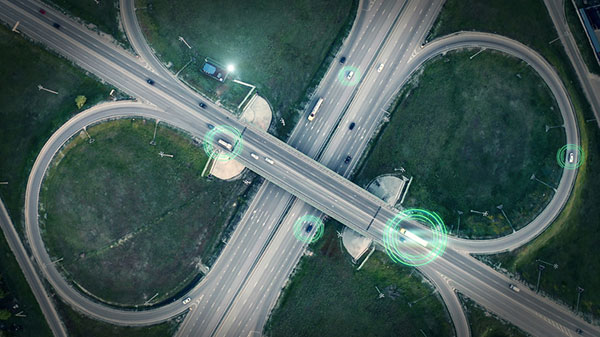
    A new European project is researching automated collection of geodata and production of high-definition maps.

    The GAMMS project is funded by the European Union Agency for the Space Programme (EUSPA), and will take place until the end of 2023. Galileo will be the main enabler of GAMMS, given its precise, multipath-resistant measurements and its upcoming high-accuracy service (HAS).

    A European consortium, led by the French map service provider GEOSAT, will investigate how the combination of self-driving mapping cars (autonomous mobile-mapping systems) and artificial intelligence-based mapping software can automate the production of high-definition maps.

    These maps are used by driverless vehicles and need to be provably accurate, complete and up to date. Fast, sustainable production of trustworthy maps is the goal.

    Consortium members include:

    • GEOSAT — map-making and machine learning
    • GeoNumerics — multi-sensor fusion and accurate navigation
    • Sensible4 — robotics and autonomous driving
    • DEIMOS Engenharia — GNSS and Galileo receiver development
    • EPFL — sensor and vehicle dynamic modelling
    • Solid Potato — multi-spectral laser scanning
    • PILDO Labs — regulatory specialists
    • ENIDE — communication specialists

    “It is as challenging as interesting to bring together the geodetic estimation methods with the navigation ones in multi-sensor systems powered by EGNSS and its differentiators, VDMs (vehicle data management systems) and visual features,” said Marta Blázquez, responsible for GAMMS at GeoNumerics. “GAMMS will boost the development of NEXA, our trajectory determination platform, and GENA, our adjustment platform for dynamic networks, in the direction of trustworthy navigation.”

    GeoNumerics is responsible for computing the mapping vehicle trajectory (a time series of position, velocity and attitude coordinates) by integrating the manifold of sensors available in a mapping vehicle.

    Measurements of inertial units and atomic clocks will be fused with measurements of all available navigation satellites (GPS, GLONASS, Galileo and BeiDou), odometers, cameras and laser scanners. For this purpose, GeoNumerics’ GENA and NEXA systems will be further developed to include new sensor mathematical models and to improve its robust estimation methods.

  • 61st CGSIC meeting scheduled for Sept. 21

    61st CGSIC meeting scheduled for Sept. 21

    CGSIC logo

    The U.S. Department of Transportation (DOT) and the U.S. Coast Guard Navigation Center (NAVCEN) will hold the 61st meeting of the Civil GPS Service Interface Committee (CGSIC) on Sept. 20-21.

    The meeting will be conducted at the St. Louis Union Station Hotel in St. Louis, Missouri, in conjunction with the Institute of Navigation’s 2021 ION GNSS+ conference.

    The 61st CGSIC meeting will also be broadcast live online to provide a virtual option. This is a unique opportunity for anyone in the world with access to a computer to attend these public meetings of the U.S. Civil GPS program. CGSIC meetings are free and open to the public.

    The three subcommittees of the CGSIC will meet on Sept. 20: Timing; International Information; and Surveying, Mapping, and Geosciences.

    Summaries of the subcommittee meetings will be presented to the CGSIC plenary session Sept. 21 with a keynote address by Juliana Blackwell, director of NOAA’s National Geodetic Survey (NGS).

    The CGSIC agenda in development can be found on the CGSIC section of GPS.gov.

  • With SV08, 3 GPS III satellites ready for launch

    With SV08, 3 GPS III satellites ready for launch

    The U.S. Space Force’s Space Systems Command recently declared GPS III SV06, SV07 and SV08 satellites “Available for Launch.” Here, the space vehicles await official call up for launch in Lockheed Martin’s GPS III Processing Facility in Waterton, Colorado. (Photo: Lockheed Martin)
    The U.S. Space Force’s Space Systems Command recently declared GPS III SV06, SV07 and SV08 satellites “Available for Launch.” Here, the space vehicles await official call up for launch in Lockheed Martin’s GPS III Processing Facility in Waterton, Colorado. (Photo: Lockheed Martin)

    The U.S. Space Force’s Space Systems Command has declared the eighth GPS III satellite “Available for Launch.” This milestone marks the third space vehicle within the GPS III program to be declared available for launch in the past three months.

    The next three GPS III satellites — SV06, SV07 and SV08 — are now awaiting official call up for launch in Lockheed Martin’s GPS III Processing Facility in Waterton, Colorado.

    “SV06, SV07, and SV08 AFL milestones in just three months prove that GPS III production continues to benefit from efficiencies with each satellite delivery,” said Col. Edward Byrne, chief of SSC’s Space Production Corps’ Medium Earth Orbit Space Systems Division.

    The first of the three recently completed satellites, SV06, is scheduled to launch in 2022 and will join the operational constellation of 31 GPS satellites.

    GPS III satellites deliver enhanced performance and accuracy through a variety of improvements, including increased signal protection and improved accuracy.

    GPS III also expands the civilian L5 signal, dubbed the “safety-of-life” signal, currently broadcast by the 12 GPS IIF satellites, but not yet operational, and delivers a new L1C signal designed to grant interoperability to similar international space-based position, navigation and timing (PNT) systems around the world.

    As a crucial technological foundation for internet, financial, transportation and agricultural operations, GPS delivers the gold standard in positioning, navigation, and timing services supporting U.S. and allied operations worldwide.

    Space Systems Command, located at Los Angeles Air Force Base in El Segundo, California, is the U.S. Space Force’s Center of Excellence for acquiring and developing military space systems. SSC’s portfolio includes space launch, global positioning systems, military satellite communications, a defense meteorological satellite control network, range systems, space-based infrared systems, and space domain awareness capabilities.

  • ISRO offers free online GNSS course for students, pros

    ISRO offers free online GNSS course for students, pros

    Logo: Indian Space Research OrganisationThe Indian Space Research Organisation (ISRO) is conducting a free online course on GNSS for students and professionals Sept. 13-24.

    The course is the 87th outreach program conducted by the Indian Institute of Remote Sensing (IIRS), an ISRO division.

    The GNSS course provides an introduction to GPS and GNSS, receivers, processing methods, errors and accuracy.

    Courses are also available on geographic information systems and remote sensing.

    Learn more at the website.


  • IEEE to develop PNT standard

    IEEE to develop PNT standard

    Photo: Konstik/iStock / Getty Images Plus/Getty Images
    Photo: Konstik/iStock / Getty Images Plus/Getty Images

    Accurate and reliable positioning, timing and navigation (PNT) technologies, such as GPS, have become “invisible utilities” that enable many critical applications, including the electric grid, telecommunications, agriculture and port operations. These systems, however, are vulnerable to accident and attack, including cyber threats and jamming.

    Therefore, the Science and Technology Directorate of the U.S. Department of Homeland Security and the National Risk Management Center of the Cybersecurity and Infrastructure Security Agency have been working in collaboration with industry and government stakeholders to develop the Resilient PNT Conformance Framework, which provides a common framework for defining resilient PNT systems and addresses strategic risks to U.S. national critical infrastructure. This work is now transitioning to the Institute of Electrical and Electronics Engineers (IEEE) as the Standards Working Group for Resilient PNT User Equipment (P1952) and will help serve as starting resources for the refinement and development of a standard.

    By creating common definitions for different levels of resilient PNT systems, this new standard will enable vendors to differentiate their products from non-resilient PNT systems, as well as enable end-users to make deliberate, risk-informed decisions as to which systems are most appropriate for their applications and needs. The development of this voluntary standard will help influence the future design, acquisition and deployment of resilient PNT systems within our national critical infrastructure.

    The IEEE standards process is an inclusive one, designed to gather many stakeholders interested in resilient PNT. If you would like to participate in the standards working group, just notify the group’s chair (Shelby Savage at [email protected]) or its secretary (Patricia Larkoski at [email protected]). Voting membership requires sufficient participation in work group meetings.


    The development of this voluntary standard will help influence the future design, acquisition and deployment of resilient PNT systems.


    After the standards working group votes to approve the draft standard, it will be submitted to the membership of the IEEE Standards Association (IEEE SA) for final approval. The IEEE Standards Balloting Center will then send an invitation to any SA members it knows to be interested in the subject matter of the proposed standard, and anyone answering the invitation affirmatively will have a right to vote on the final standard.

    Compared to the early days of GPS, PNT systems have become highly sophisticated pieces of equipment with a multitude of components, both hardware and software, along with associated vulnerabilities. Additionally, with a wide array of stakeholders and a variety of ideas on what PNT resilience means, getting consensus and developing such a standard would be challenging without an established process.

    To help address this challenge, DHS developed the Resilient PNT Conformance Framework with input from industry stakeholders to establish baseline concepts on the definition of resilience and necessary behaviors within resilient PNT systems. DHS designed this framework to be outcome-based and non-prescriptive, to encourage industry innovation.

    “To address security and resilience, GPS and PNT receivers need to be treated more like computers rather than radios,” said Ernest Wong, technical manager for the Science and Technology Directorate. “The refinement of the Resilient PNT Conformance Framework into industry standards will help to ensure that future PNT receivers are resilient and designed to withstand and recover from threats.”


    Editor’s Note: This article does not represent a formal position of P1952 Working Group, Communications Society Standards Committee, IEEE, or IEEE SA.