Category: GNSS

  • Seen + Heard: Quantum entanglement, robot dog, reversing earthquakes

    Seen + Heard: Quantum entanglement, robot dog, reversing earthquakes

    “Seen & Heard” is a monthly feature of GPS World magazine, traveling the world to capture interesting and unusual news stories involving the GNSS/PNT industry.


    Photo: Mt. Qomolangma/miljko /E+/Getty Images
    Photo: Mt. Qomolangma/miljko /E+/Getty Images

    Chinese surveyors take BeiDou to the top

    On May 6, more than 30 Chinese surveyors left base camp to summit Mount Qomolangma — known in the west as Mount Everest. The team is using both traditional and modern surveying and mapping technologies, and China’s BeiDou Navigation Satellite System (BDS) will be applied to the elevation survey for the first time. The previous survey in 2005 used GPS to measure the height (found to be 8,844.43 meters); this year’s survey uses all four GNSS, with BDS data as the main reference.


    Image: BlackJack3D/E+/Getty Images
    Image: BlackJack3D/E+/Getty Images

    Quantum entanglement

    In a paper published April 20 in Physical Review Letters, University of Arizona engineering and optical sciences researchers, in collaboration with engineers from General Dynamics Mission Systems, demonstrate how a combination of two techniques — radio frequency photonics sensing and quantum metrology — can give sensor networks a previously unheard-of level of precision. The work involves transferring information from electrons to photons, then using quantum entanglement to increase the photons’ sensing capabilities. The quantum-sensing paradigm could create opportunities to improve GPS receivers, astronomy laboratories and biomedical imaging capabilities, as well as improve the performance of any application that requires a network of sensors.


    Photo: 2010 Chile Earthquake/erlucho/iStock/Getty Images Plus/Getty Images
    Photo: 2010 Chile Earthquake/erlucho/iStock/Getty Images Plus/Getty Images

    Earthquake reversal

    Researchers evaluating movement of GNSS ground stations have discovered large-scale, back-and-forth ground movement preceding the 2010 seaquake off of Chile and the 2011 Tohoku-oki seaquake off of Japan. Researchers from the Geoforschungszentrum Potsdam (GFZ) with collaborators from Chile and the United States say both quakes showed multiple strange reversals of ground motion — an extremely slow “wobbling” of the continental plate — over a period of five months (for Japan) and seven months (for Chile). The discovery was made possible by the amount of data collected by the GNSS stations in both countries.


    Dogbot on patrol

    A robot dog from U.S.-based Boston Dynamics reminded visitors to Bishan-Ang Mo Kio Park in Singapore to maintain social distancing due to the coronavirus pandemic, reported the BBC in May. The dogbot is fitted with lidar to monitor how busy the park becomes. It also carried a loudspeaker to broadcast social-distancing messages.

  • New GPS ‘circle spoofing’ moves ship locations thousands of miles

    New GPS ‘circle spoofing’ moves ship locations thousands of miles

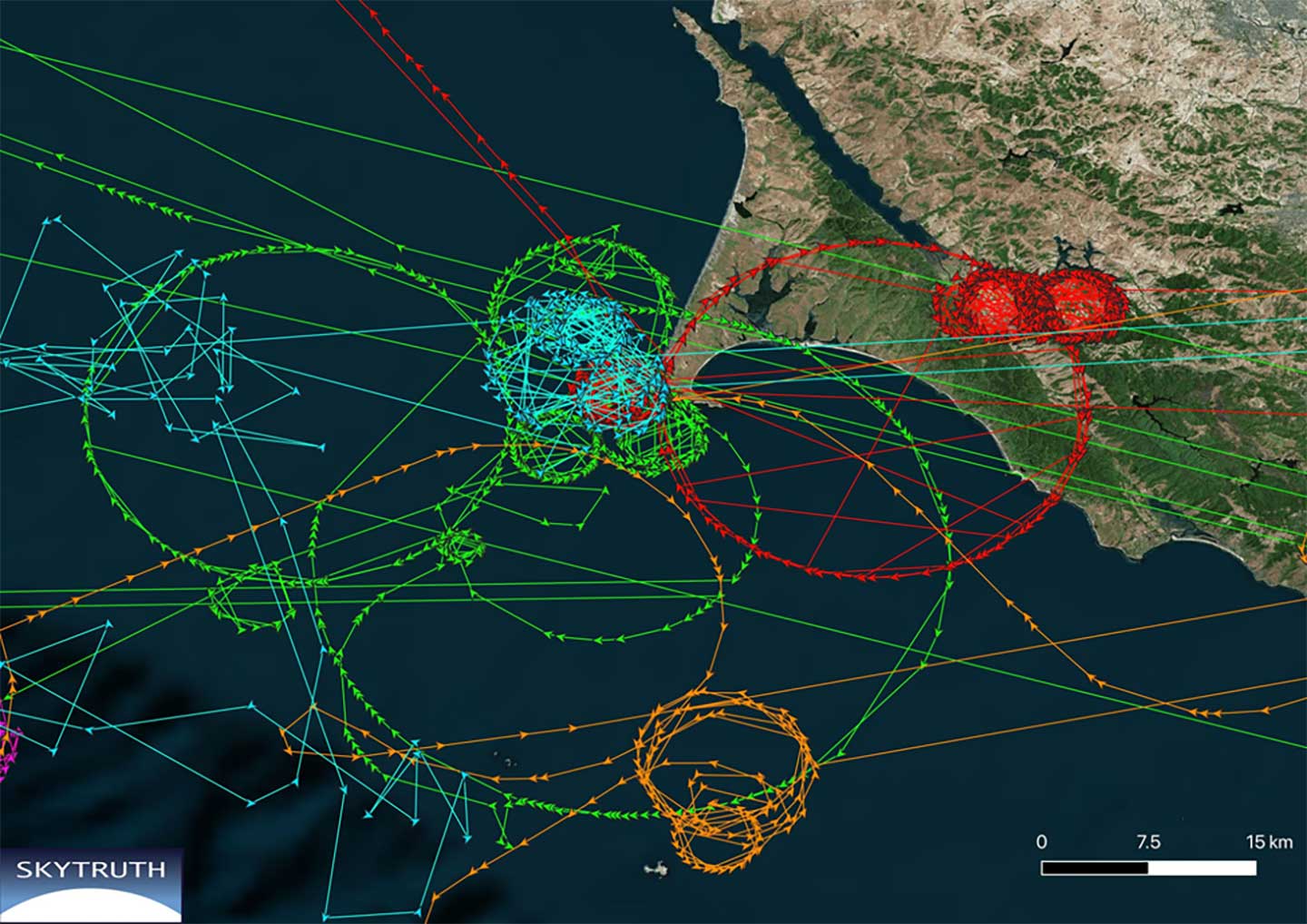
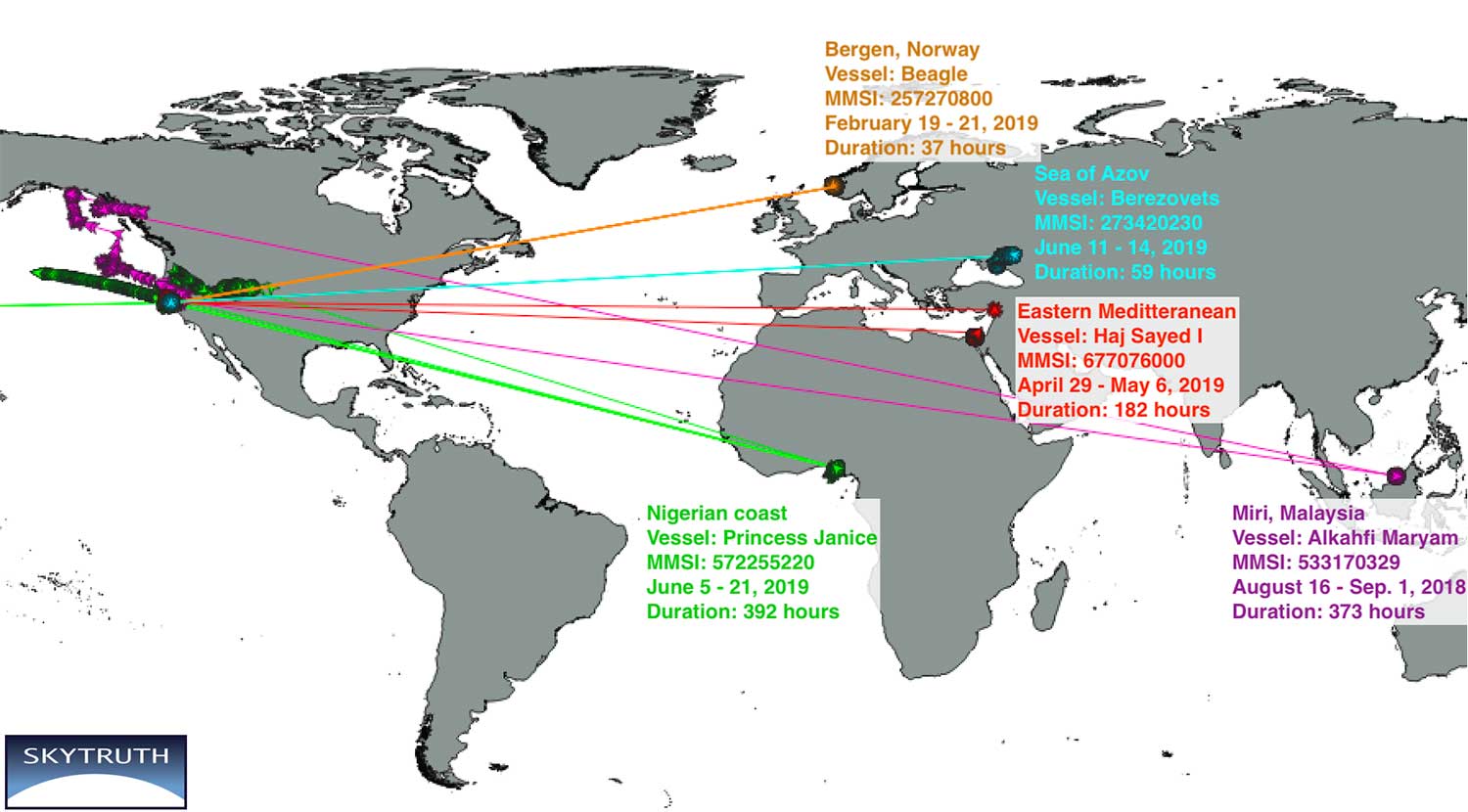
    New research by Bjorn Bergman of the environmental non-profit SkyTruth has found ships in various parts of the world reporting locations thousands of miles away and circling at precisely 20 knots.

    Bergman’s findings were first reported at the annual meeting of the Resilient Navigation and Timing Foundation on May 5.

    Bergman previously observed and reported on circling phenomena with GPS-based reporting systems from vessels and fitness trackers in China ports. It has also been observed in Tehran, Iran. In all those cases, though, it was clear that the real location was fairly nearby the false and circling locations.

    In the most recent observations, the actual locations of the ships were thousands of miles away. In most cases, literally halfway across the globe.

    Image courtesy of Skytruth and RNTF.
    Image courtesy of Skytruth and RNTF.

    Bergman said that he was able to verify the vessels’ approximate true location by examining the field of view of the satellite receiving the automatic identification system (AIS) position reports. The satellites are only able to see an area about 5,000 kilometers wide.

    A satellite that could only see the Gulf of Guinea in West Africa, for example, received GPS-based location data from a ship’s AIS that showed the vessel offshore of Point Reyes in northern California. The vessels’ true locations were also confirmed by their position reporting before and after the “displacement events.”

    Bergman was unsure if these errors are the result of the ships’ AIS systems or some fault or influence on GPS navigation receivers. It is clear that ongoing “circling” incidents in China are some form of GPS interference.

    GPS-based fitness tracker reporting was affected the same way and at the same time as those of receivers on vessels. Bergman has been able to find no similar supporting data for these long-range displacement and circling events.

    While Bergman was able to observe these events, he was at a loss to explain them. In previously observed cases it seemed clear a disruption device was nearby and affecting a large number of vessels. In these incidents, each vessel was the only one in its vicinity affected, and the vessels were separated by thousands of miles.

    Image courtesy of Skytruth and RNTF.
    Image courtesy of Skytruth and RNTF.

    Further hampering analysis, and making even speculation difficult, was the lack of commonality among the few cases observed.

    The vessels were of much different types and operations. Pilot boats, work boats, tugs, cargo and passenger vessels were all involved.

    The length of these disruptions also varied greatly. The shortest recorded was a reefer ship for less than half an hour. A crew boat was “displaced” for more than 16 days.

    While most of the vessels reported circling positions off the coast of Northern California, two were displaced to Madrid, one to the vicinity of Hong Kong, and one to the Chinese city of Shanwei. One even began reporting it was circling a location offshore of northern California, and subsequently reported circling positions that drifted east almost a thousand miles inland to Utah.

    A true mystery, the RNT Foundation is hoping to crowdsource ideas and share them with Bergman and other analysts. Anyone with insights or ideas about this mystery is encouraged to send them to [email protected].

    A video of Bjorn Bergman’s presentation at the RNT Foundation’s annual meeting is available on the foundation’s website and below. He has also posted a short paper on these events on SkyTruth’s website.

  • Focus Telecom installs GPSdome to protect Israel’s ‘national clock’

    Focus Telecom installs GPSdome to protect Israel’s ‘national clock’

    Photo: Inifidome
    Photo: InifiDome

    The national time system at Israel’s National Physics Laboratory (INPL) in Jerusalem is now protected by a GPSdome unit for cyber protection of GPS/GNSS signals, according to Israel’s Homeland Security, a private company established in 2012.

    Microchip partner Focus Telecom installed the GPSdome cyber protection system under a support and maintenance contract. GPSdome was developed by infiniDome, an Israeli startup.

    INPL’s Nadya Goldovsky will now test and measure the system for its ability to protect the GPS/GNSS satellite signals from jamming and other interference. Over the course of several months, Goldovsky will test the system’s ability to protect its four independent atomic clocks, which continuously supply Israel’s national time.

    The cyber protection system is designed to enable continuous, uninterrupted GPS/GNSS service, which allows for full operation of the clocks. During a GPS cyber-attack, infiniDome’s Communication Module will report it to infiniDome’s Cyber Security Cloud.

    “GPSdome is a cyber protection system developed based on military technologies and principals which was adapted to non-military, commercial use,” said Omer Sharar, infiniDome’s CEO. “Our systems are already deployed and operational in Israel at multiple sites in the defense/HLS sector, border protection, financial sector and telecom sector.”

    The company has signed a global distribution contract with an international PNT solution provider to sell its GPSdome systems in more than 120 countries, Sharar said.

  • Seven petitions call on FCC to reverse Ligado order

    Seven petitions call on FCC to reverse Ligado order

    Dozens of parties cite evidence of harmful interference and vast economic harm that FCC ignored in favor of dubious 5G marketing claims

    Dozens of private-sector interests will file Petitions for Reconsideration of the Federal Communications Commission’s (FCC) recent order to allow Ligado Networks to rezone its satellite spectrum holdings for terrestrial mobile use and “flip” them for a profit, according to the Washington, D.C.-based communications firm Glen Echo Group.

    Petitioners will ask the FCC to reconsider its decision, which has generated widespread opposition within the administration, on Capitol Hill and from other aviation and satellite spectrum users. Petitioners include:

    • Airline Pilots Association
    • Association of Equipment Manufacturers
    • Aviation interests (including the Cargo Airline Association, the International Air Transport Association and Airlines for America)
    • Iridium Communications
    • Lockheed Martin
    • Trimble
    • RNT Foundation

    The petitioners argue the FCC’s Order ignored or improperly disregarded the great majority of evidence, including technical analyses submitted by parties showing harmful interference, and relied instead on “easily disproven claims that Ligado will provide a so-called 5G service,” the Glen Echo Group stated in a press release.

    “The L-band is not included in any internationally recognized 5G standard, the spectrum is not harmonized regionally or globally for 5G, FCC’s 5G FAST Plan does not include Ligado or L-Band spectrum nor does the company have enough contiguous spectrum,” the release stated.

    Airlines for America. “Airlines for America (A4A) strongly supports a broad industry coalition that has led at least 32 U.S. Senators from both sides of the aisle to urge the FCC to stay and reconsider granting Ligado Networks’ petition to repurpose critical frequency spectrum for ‘5G’ terrestrial communications services. The FCC’s rushed order in April ignored testing protocols intended to protect critical users likely to be impacted, including aviation uses of Global Positioning Systems (GPS) for navigation, and satellite communications. Beyond industry opposition, the U.S. Department of Defense also strongly opposed the FCC’s action.

    “A4A is joining other industry constituents in directly petitioning the FCC to reverse its course, the effects of which could impact the safety of the flying public and impact operations, especially harmful outcomes in the recovery period following the COVID-19 pandemic.”

    Aerospace Industries Association. The association represents more than 300 companies.
    “Uninterrupted access to GPS is essential not only for our industry, but also for the American people, our national security, and the strength of the U.S. economy. This access is now threatened by the FCC’s decision to grant Ligado Networks’ application, despite years of evidence and the concerns outlined by several federal agencies about potential interference. With this motion, we are banding together to urge the FCC to reconsider this decision and allow safety and data to drive their decision-making on spectrum.”

    The International Air Transport Association (IATA), which represents some 290 airlines or 82% of global traffic said, “Approving Ligado’s spectrum for 5G poses a strong risk of interference with GPS signals, including the potential interruption of GPS signals at low altitudes. The FCC should reverse this decision.”

    Air Line Pilots Association (ALPA). President Capt. Joe DePete said, “Throughout its report and order, the FCC uses words like ‘possible’ and ‘feasible’ when talking about whether Ligado can operate. These are not the words you would want to hear your Captain use when talking about successfully completing your flight the next time you are sitting in the cabin. Aviation requires certainty and guaranteed performance from its systems. The FCC’s hasty, arbitrary, and incorrect decision will set a disastrous precedent that will impede ongoing work on spectrum sharing. The Ligado decision must be reversed immediately.”

    Aviation Spectrum Resources Inc. “In jointly filing a petition for reconsideration of the FCC’s recent decision on Ligado Networks’ proposal, ASRI joins the wider aviation community in expressing our view that the decision is based on a fundamentally flawed interpretation of the data that have been presented to the Commission. Among other deficiencies, the FCC’s decision ignores the FAA’s reservations cited by the Department of Transportation, having implications for many low-level aircraft operators including helicopters and UAVs. The FCC Order also seems to acknowledge the mounting evidence that aviation safety satellite communications will receive interference, but it relies on the completion of private negotiations to resolve these questions while giving Ligado a green light to proceed, rather than requiring specific mitigations itself. ASRI believes the FCC should revisit its decision in conjunction with aviation experts to ensure the safety of air transport, medivac and other essential aviation operators are not affected by this decision.”

    Iridium Communications. CEO Matt Desch said, “The FCC’s Ligado action prioritizes economic windfalls to a few speculators over safety of life, national security and important private sector companies whose customers would be most upended by their harmful interference.”

    RNT Foundation. President and Director Dana A. Goward said, “The FCC treated this like a commercial communications issue instead of a decision about safety-of-life navigation. They didn’t even consider the overall cost to the public in lost lives and property.”

    In addition to private sector interests, 14 federal agencies and numerous Republican and Democratic members of Congress oppose the FCC’s decision in favor of Ligado.


    Feature image: A-Digit/DigitalVision Vectors/Getty Images

  • Galileo-enabled receivers are increasing positioning

    Galileo-enabled receivers are increasing positioning

    Photo: Philipp Berezhnoy/iStock / Getty Images Plus/Getty Images
    Photo: Philipp Berezhnoy/iStock / Getty Images Plus/Getty Images

    Access to the Galileo signal in a multi-constellation environment is providing benefits and opportunities for businesses, thanks to the enhanced performance and increased accuracy on offer, said the European GNSS Agency (GSA).

    Swedish geographical information technology company SCIOR Geomanagement AB uses a variety of technology in its equipment, including drone aerial photography, terrestrial laser scanning, GNSS or combinations of these.

    SCIOR, a measurement technology producer, incorporates RTK processing techniques into its approach. The company also uses Galileo-enabled receivers to increase the positioning accuracy of its solutions.

    According to the company’s findings, which it presented at the 2019 Intergeo conference in Stuttgart, it has been achieving significantly enhanced performance and other benefits in its day-to-day activities from the use of Galileo-enabled equipment, GSA said.

    “Our experience with Galileo has shown an improvement in the density of the constellation of visible satellites, and thus an improvement in the time needed to obtain centimeter-level accuracy,” said Javier Corral, an engineer at SCIOR Geomanagement AB. “From my personal point of view, I would recommend using this constellation in combination with the other existing ones, since it provides you with a better and quicker performance.”

    According to GSA, the most significant performance improvements are observed at high latitudes and within forest environments. Even taking into account that better results can be obtained in open spaces, using multi-constellation GNSS with Galileo in the woods is sometimes the only way to obtain a satisfactory performance if there is no reference station close enough. performance will be even better in coming years as the number of Galileo satellites increases to reach full operation capability, allowing users to obtain their desired position accuracy and availability in a shorter period of time, GSA added.

  • Geoscience Australia seeks contractor for PNT capabilities

    Geoscience Australia seeks contractor for PNT capabilities

    Logo: Geoscience Australia

    Geoscience Australia is seeking a prime contractor for a new satellite-based augmentation system (SBAS) that Australia and New Zealand have committed to implement.

    The SBAS will improve position, navigation and timing (PNT) capabilities to end-users in Australia and New Zealand.

    The system, which will be called the Southern Positioning Augmentation Network, will augment standard positioning capability provided by GPS and Galileo across all of Australia and New Zealand, with expected user applications in agriculture, construction, resources, utilities and other industries; with decimeter accuracy.

    It will also support the aviation and road transport sectors, which have requirements for high-integrity positioning data with sub-meter level accuracy, Geoscience Australia said.

    Full operational capability will require a number of satellite payloads in geostationary orbit needed to broadcast data to users. These may be hosted payloads rather than dedicated SBAS satellites, Geoscience Australia added.

    This procurement process is administered by Geoscience Australia and is undertaken for the benefit of Geoscience Australia and its New Zealand counterpart, Land Information New Zealand.

  • 1 more BeiDou satellite starts operation in constellation

    1 more BeiDou satellite starts operation in constellation

    Photo: Xinhua News Agency
    Photo: Xinhua News Agency

    The 45th satellite of the BeiDou Navigation Satellite System — launched on May 17, 2019 — has started operation in the network after completing in-orbit tests, reports China’s Xinhua news service.

    The satellite will provide services in place of the third BeiDou satellite, a geostationary earth orbit satellite of the BDS-2 system, according to China’s Satellite Navigation System Management Office.

    The replacement will help reinforce the BDS-2 system and support a smooth transition from the BDS-2 system to the BDS-3 system. The third satellite — launched Jan. 17, 2010 — will stay in orbit after the replacement.

  • 32 US senators urge stay on FCC’s Ligado decision

    32 US senators urge stay on FCC’s Ligado decision

    Thirty-two United States senators wrote to the Federal Communications Commission (FCC) on May 15 expressing concerns with the commission’s determination on Ligado Networks. The senators also asked the FCC to address these concerns and stay their order while they were doing so.

    The five-member FCC voted unanimously in April to approve an order to allow Ligado Networks to deploy a low-power nationwide 5G network.

    “The hurried nature of the circulation and consideration of the Order itself — during a national crisis, no less — was not conducive to addressing the many technical concerns raised by affected stakeholders,” wrote the senators.

    The senators continued,

    “With this specific docket item pending before the FCC for almost 10 years, we are concerned with the pace by the Commission to push through an Order first announced on April 16, the approval for which was declared two business days later. We believe this accelerated timeline was not adequate to address the significant stakeholder concerns for an Order of this magnitude….”

    “We are concerned that the FCC has discounted testing and assessments conducted by nine federal agencies in the Interdepartment Radio Advisory Committee process — all expressing concerns that the Ligado plan would interfere with millions of GPS receivers and satellite services across the nation. Further, the FCC did not provide a technical forum to resolve the significant disconnects between this testing and Ligado’s privately funded testing…”

    “For these reasons, we urge the Federal Communications Commission to immediately stay and reconsider their Order on this matter, more fully consider the technical concerns raised by numerous federal agencies and private sector stakeholders, and outline a path forward that adequately addresses these concerns.”

    A Resilient PNT Foundation editorial on the organization’s website says the main problem seems to be misunderstanding about the differences between radionavigation and communication.

    “We share the concerns with the FCC’s actions that are outlined in this letter:

      • After ten years of deliberations a draft order was processed to a final decision within a couple days during a national crisis
      • The FCC discounted the testing done by the executive branch and did not say why
      • No technical forum was held to resolve the differences between Ligado’s and DoD/DoT’s testing
      • There was no public discussion of these differences and how they might be resolved

    “Undoubtedly, a lot of the differences between the FCC and the Executive Branch on this issue boil down to a lack of appreciation of the fundamental differences between wireless communication and radionavigation.” The Resilient PNT Foundation website provides a table outlining the differences.

    “When two parties start from completely different places, they are likely to talk past each other and end up in completely different places.

    “We think the Federal Communications Commission might not have fully appreciated the needs of radionavigation as a safety-of-life utility and wound up in the wrong place.

    “But that’s just us. A lot of folks think differently.

    “That’s why we are urging an independent technical review, with both communications and radionavigation experts, to inform public policy decisions on this before anything moves forward.

    “This is too important to get wrong.”


    Feature photos:
    Capitol building with flag/Andrea Izzotti/Shutterstock.com
    Capitol building at night/Brian Kinney/Shutterstock.com

  • Will Britain launch its own Galileo? Maybe not

    Will Britain launch its own Galileo? Maybe not

    When Brexit happened, many in Britain thought the country should have its own satellite navigation system, because it was no longer going to be a participant in Galileo, created and run by the European Union.

    Now the Telegraph reports that officials have concluded that such plans should be scrapped because the £5 billion project would be a waste of taxpayer funds.

    The Telegraph reports that members of the Cabinet Office and Department for Business are pressing ministers to shut down work on the program, which was set up after Brussels froze the U.K. out of the EU’s Galileo satellite program.

    In 2018, then-Prime Minister Theresa May announced £92m for a feasibility study into the U.K. satnav, reports Engineering & Technology. Much of that money has already been spent, it is believed. In March 2020, it was reported that the project had been delayed for at least six months over concerns about its scope and multi-billion-pound cost.

  • Garmin offers insights on active lifestyles during COVID-19

    Garmin offers insights on active lifestyles during COVID-19

    Photo: playb/E+/Getty Images
    Photo: playb/E+/Getty Images

    Garmin has released data that highlights activity trends throughout the COVID-19 pandemic.

    According to the company, the week President Donald Trump declared a national state of emergency marked a major shift in human activity.

    Garmin data pointed to a massive decline in the overall number of steps taken during the second two weeks of March in the U.S. This trend is consistent with the company’s global trend data in China, Italy and other countries where the coronavirus pandemic struck first.

    “We’re observing a remarkable shift in the types of activities people are doing, reflecting an unprecedented about-face when it comes to typical springtime exercise and activity,” Garmin said in a blog post.

    To paint a clear picture of the initial trends, Garmin engineers and data analysts looked at the percent change in activity levels in the United States for specific sports and exercises and compared the first half of March with the second half of March to determine increases and decreases. The results also are baselined against the same time period in 2019.

    Here’s an overview of how activity has changed.

    • Skiing and snowboarding: These activities are down 96%. This aligns with resorts closing because of the pandemic.
    • Cycling: Virtual cycling activity was up 64% in the second half of the month, a shift that appears even more atypical when comparing it to the same time period last year. March 2019 saw a 20% decline in the activity as cyclists naturally began to take their rides outside to enjoy the warmer weather, Garmin said.
    • Indoor/treadmill running: Indoor/treadmill running is down 44%. According to Garmin, this doesn’t mean this activity has come to a halt. Because gyms across the country are closed, a number of treadmills aren’t being used. In fact, virtual running saw a steep increase in the second half of March, and despite gym closures, overall indoor cardio is holding strong over 2019 levels and showing an 18% week-over-week increase from March 16 to March 30. This suggests more people are exercising, and they’re finding ways to do it from home, with and without their own equipment, Garmin said.
    • Lap swimming: Lap swimming is down 88%.
    • Walking: Walking is up 36% when comparing the front half of March to the back half of March. This surge is double the 18% increase observed over the same time period last year, Garmin reported.
    • Yoga: Garmin wearable device data shows an 11% increase in yoga activity, when comparing the front and back halves of the month. This is an increase in 2019 data, as well.
    • Golf: Golf has seen a 20% decline in activity for the second half of March. When comparing the same two time periods last year, golfing activity increased by 53%.
  • Galileo positioning aids with COVID-19 tracking apps

    Galileo positioning aids with COVID-19 tracking apps

    Image: ESA
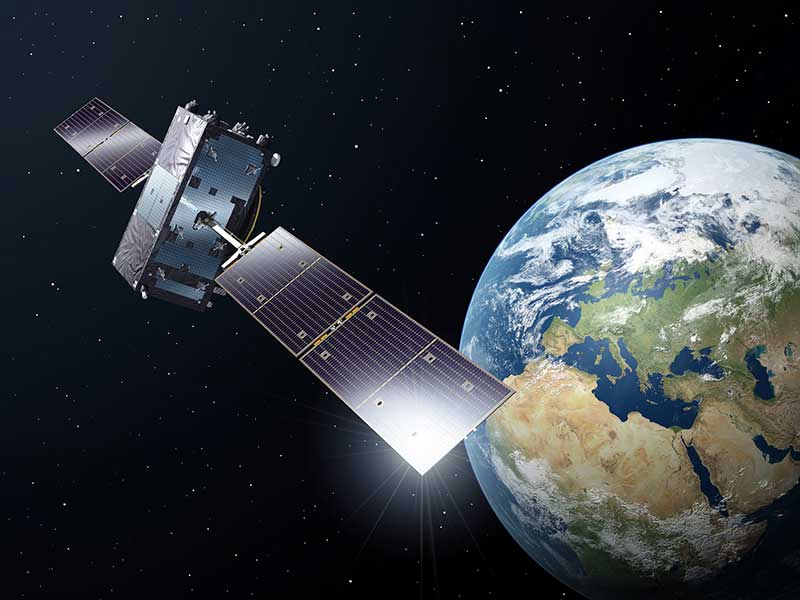
    An artist’s rendering of a Galileo satellite in orbit (Image: ESA)

    News from the European Space Agency

    As European governments plan their phased recoveries from the lockdown states triggered by the COVID-19 pandemic, the positioning delivered through satellite navigation is becoming more important than ever before, said the European Space Agency (ESA). Location is a key requirement when attempting to monitor and map the spread of a disease and satnav is one of the main tools supporting this, the agency added.

    Since the outbreak of the coronavirus, many applications have been developed that use satnav-based location data to monitor the global spread of the virus and map outbreaks.

    For example, Romanian company RISE developed an app called CovTrack, which monitors people in a user’s vicinity made identifiable via Bluetooth connections to the user’s mobile phone and stores the identification data of these devices.

    By pressing a button, users can access the database in which the unique identifiers of the mobile phones are registered (without having access to any personal data of these mobile phone users), to verify whether the persons with whom users came in contact have subsequently been confirmed with COVID-19, ESA said. If users have identified a potential contact, they can refer to the relevant authorities whether that contact requires inclusion among the monitored persons, or even testing for COVID-19.

    According to ESA, CovTrack, developed on a pro-bono basis, is a spin-off from the existing AGORA project for festival management, supported through ESA’s Navigation Innovation and Support Programme, focused on future navigation technologies.

    ESA, along with the European Global Navigation Satellite System Agency (GSA) and European Commission, put together a repository of these apps. The list, based on apps that are already working and available in app stores, includes practical apps that facilitate the daily lives of citizens. Check out the list here.

    Europe’s Galileo, currently embedded in over 1.3 billion smartphones and devices worldwide, is helping to increase satnav accuracy and availability, especially in urban areas, ESA added.

    In addition, GSA is developing its own Galileo-enabled application, Galileo for Green Lane, to monitor and ease the circulation of goods between European Union (EU) Member States while identifying potential congestion at Green Lane border crossings, thus ensuring EU citizens can access the needed supplies of critical goods.


    Check out more of GPS World’s coronavirus coverage here.

  • Space threat report catalogs China, Russia, jamming and GPS

    Space threat report catalogs China, Russia, jamming and GPS

    America’s space assets are in danger from an array of kinetic, non-kinetic, electronic and cyber threats. These are wielded by nation states, primarily China, Russia, Iran and North Korea, though there are other countries as well as non-state actors.

    On March 30, the Center for Strategic and International Studies (CSIS) Space Threat Assessment 2020 released a catalog that highlights the ways essential space-based services Americans rely upon can be degraded or eliminated. But it doesn’t do much to “assess threats.”

    That said, it is still an impressive, useful and informative document. Some of what it doesn’t say can be inferred, and it provides a clear conclusion for policy makers and others.

    Threat assessments are typically undertaken to:

    • Identify potential dangers,
    • Evaluate their credibility,
    • Weigh potential impact, and
    • Estimate the probability of the threat turning into an incident

    This CSIS report generally stops after accomplishing the first two tasks.

    Nonetheless, it is very instructive in a several ways.

    Interference with Space Systems

    First, it is packed with examples of how America’s adversaries have armed themselves, and stories about interference with space-based systems. Whether it is information about China training troops to use direct-ascent weapons, or reports about Russia’s mass GPS spoofing, the report’s matrix of threat categories is well supported by examples of real-world events.

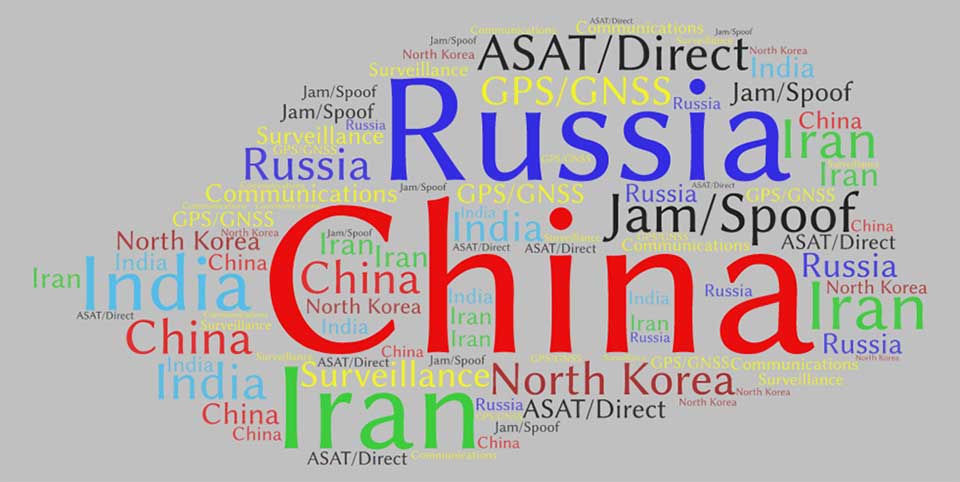
    Second, while the report doesn’t overtly rank threats and adversaries, it is possible to infer some generalities by the attention the report devotes to each. Among potential adversaries, China was mentioned the most by far — 429 times. It was followed by Russia (275), Iran (206), India (141), and North Korea (132).

    This word cloud from CSIS <em>Space Threat Assessment 2020</em> shows that China received by far the most mentions, followed by Russia. (Image: RNT Foundation)
    This word cloud from CSIS Space Threat Assessment 2020 shows that China received by far the most mentions, followed by Russia. (Image: RNT Foundation)

    Jamming and spoofing

    Jamming and spoofing seem to be the most credible threats and were mentioned 188 times, with ASAT and direct-ascent closely following with 179 mentions. This particular word count might not be reflective, though, as the report contains many more examples of real-world jamming and spoofing than ASAT and direct-ascent.

    And of all the types of satellites that could be threatened, GPS/GNSS was the clear leader at 98 mentions, with communications and surveillance coming in at 42 and three, respectively.

    In all fairness, at only 80 pages, it’s not possible for Space Threat Assessment 2020 to be an exhaustive analysis. And doing more would likely require making it classified. Then this exceptionally educational reference would not be nearly as available for the policy making audience that sorely needs it.

    And it does provide an excellent bottom line for those making macro-level decisions about space policy and budgets going forward. From the report’s “What to Watch” section:

    Electronic counterspace weapons continue to proliferate at a rapid pace in both how they are used and who is using them. Satellite jamming and spoofing devices are becoming part of the every-day arsenal for countries that want to operate in the gray zone — i.e., below the threshold of overt conflict. The jamming and spoofing of satellites has become somewhat common, and without strong repercussions these adverse activities could gradually become normalized…

    One should expect that the rate of satellite jamming and spoofing incidents will only increase as these capabilities continue to proliferate and become more sophisticated in the coming years.


    Dana A. Goward is president of the non-profit Resilient Navigation and Timing Foundation.