Tag: CYGNSS

  • Converging on the jammer: Dual-satellite GPS interference localization from space

    Converging on the jammer: Dual-satellite GPS interference localization from space

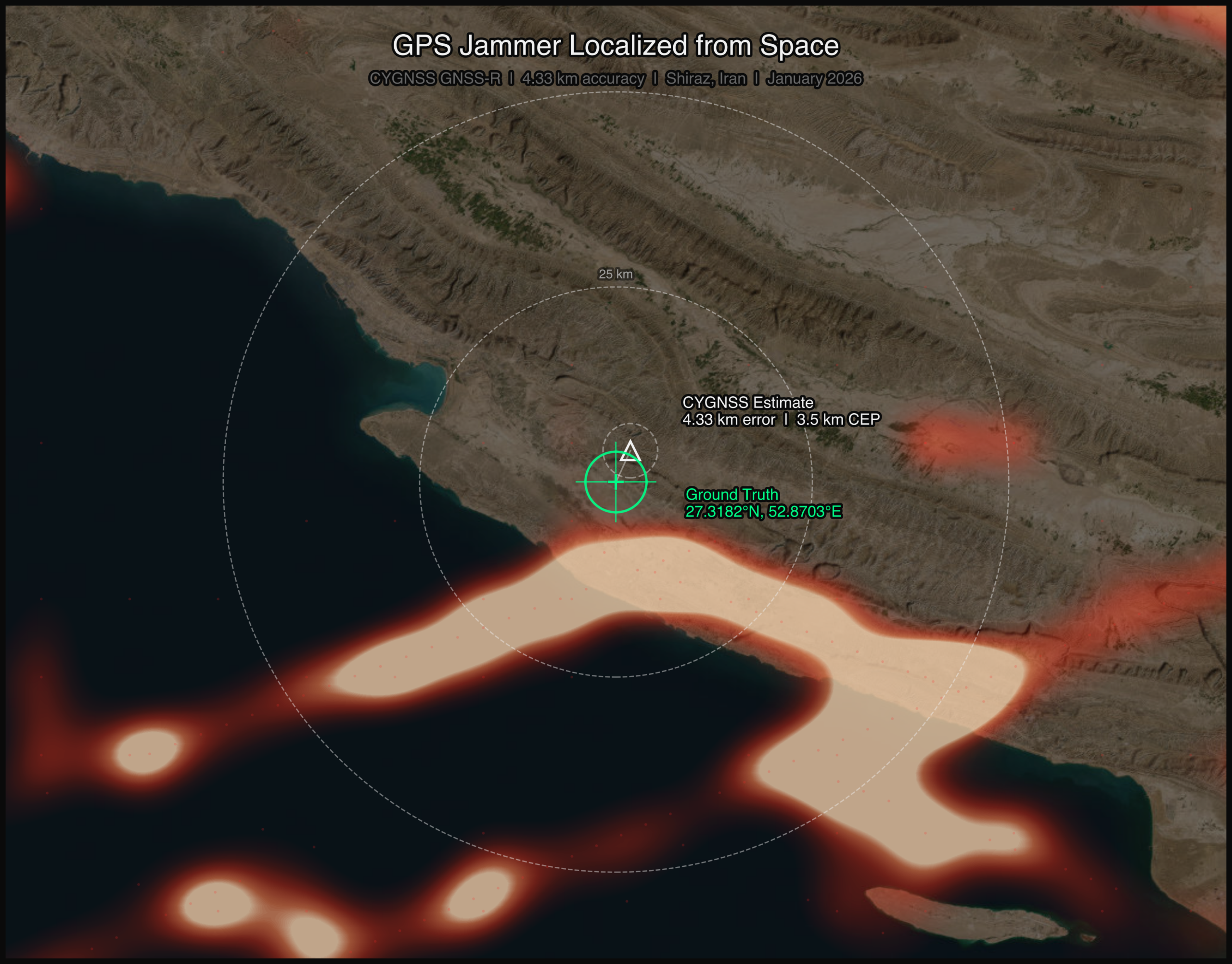
    On a January morning in 2026, a GPS jammer powered up near Shiraz, Iran. It was not the first, and it would not be the last. The Strait of Hormuz corridor has become one of the most persistently jammed airspaces on Earth. But this time, two satellites were watching from very different vantage points, and together they would demonstrate something new: that spaceborne sensors can localize a terrestrial GPS jammer to within a few kilometers, using physics alone.

    This article presents the first direct comparison of Cyclone Global Navigation Satellite System (CYGNSS) — a NASA GNSS reflectometry constellation — and NASA-ISRO Synthetic Aperture Radar (NISAR) — an L-band synthetic aperture radar for GPS jammer localization. The results challenge assumptions about which modality performs better and reveal that the answer depends on a question most analysts forget to ask.

    The setup: Known jammer, known position

    Validation requires ground truth. With help from the PNT community, we identified a GPS jammer operating near 27.32°N, 52.87°E (approximately 50 km southwest of Shiraz) that was active on Jan. 8 and Jan. 20, 2026, with confirmed quiet periods on Dec. 15 and Dec. 27, 2025. The jammer’s position was established through independent signals intelligence.

    This gave us a controlled experiment: two “jammer ON” dates and two “jammer OFF” baseline dates, with satellite coverage from both CYGNSS and NISAR spanning the full period.

    Two satellites, two physics

    CYGNSS is a constellation of eight microsatellites that measure GPS signals reflected off Earth’s surface. Each spacecraft carries a delay-Doppler receiver that maps reflected signal power across a grid of delay and Doppler bins, known as the delay-Doppler map, or DDM. When a terrestrial jammer is active, it floods the GPS band with noise, elevating the DDM noise floor and suppressing the coherent surface reflection. The effect is detectable hundreds of kilometers from the jammer, creating a wide-area footprint in the reflected signal data.
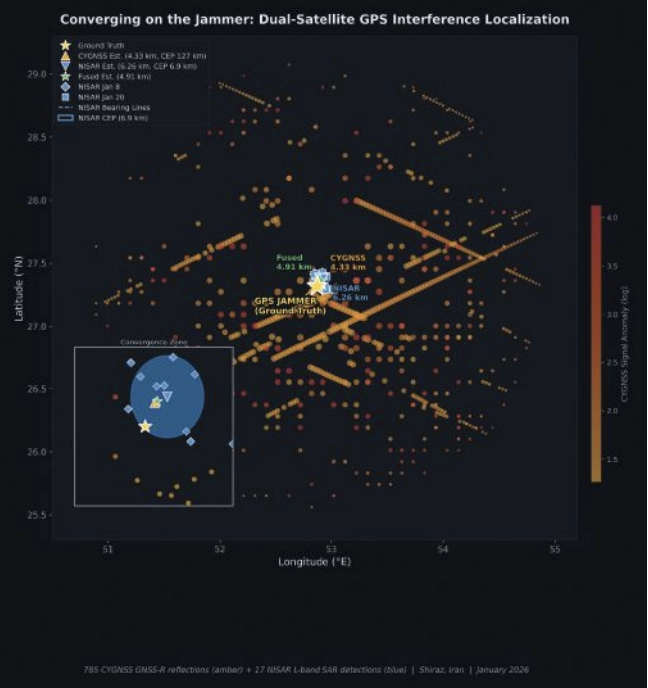
    FIGURE 1 Jammer localization tracks from both CYGNSS and NISAR satellite
constellations.
    FIGURE 1 Jammer localization tracks from both CYGNSS and NISAR satellite
    constellations. (All figures by Sean Gorman)

    NISAR operates an L-band SAR at 1.257 GHz, just 30 MHz from the GPS L2 frequency at 1.2276 GHz. When a GPS jammer’s broadband emissions leak into NISAR’s receive band, they create characteristic streaks in the SAR imagery. The streaks are elongated in the cross-track (range) direction, not along-track, a counterintuitive result that follows directly from SAR signal processing. In azimuth (along-track), the jammer is a fixed-point source with a valid Doppler history, so the SAR azimuth processor focuses it correctly, similar to any ground target. But in range (cross-track), the jammer’s broadband noise does not match the SAR’s chirp waveform, so range compression smears the energy across many range bins rather than compressing to a point. The result is a streak perpendicular to the flight direction, whose along-track centroid encodes the jammer’s latitude and whose cross-track extent encodes a range arc, which is the distance from the orbit ground track (FIGURE 1). The bearing of each streak encodes the jammer’s direction relative to the satellite’s ground track.
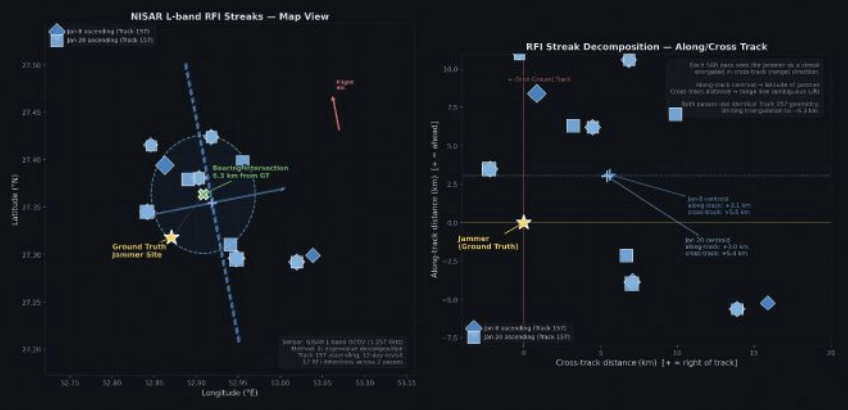
    FIGURE 2 Crosstrack visualization for NISAR RFI streaks.
    FIGURE 2 Crosstrack visualization for NISAR RFI streaks.

    The two sensors could hardly be more different. CYGNSS sees the jammer’s effect on reflected GPS signals, offering an indirect measurement spread across hundreds of specular reflection points. NISAR sees the jammer’s emissions directly in its own receiver, which is a more precise measurement, but only along the satellite’s narrow ground track. FIGURE 2 shows both detection sets converging on the jammer location.

    CYGNSS: 785 Detections, 4.33 km Error

    We processed all CYGNSS Level 1 data within 200 km of the jammer location on both ON and OFF dates. Four detection methods contributed observations:

    ■ DDM noise floor (419 detections): The pre-computed ddm_noise_floor variable, calibrated against the thermal noise reference, proved the strongest discriminator. Near-jammer values exceeded 15,000 counts against a ~10,000 mean background.

    ■ Spatial noise grid (299):A 10 km gridded analysis identified cells with anomalously elevated noise relative to adjacent cells.

    ■ SNR hole detection (66): Coherent surface reflections were suppressed near the jammer, creating spatial “holes” in the SNR field.

    ■ NBRCS drop (1): Surface reflectivity dropped approximately 16% near the jammer, though this method produced few threshold exceedances.

    Across four DDM channels per spacecraft and multiple passes, this yielded 785 total anomalous observations on the jammer-ON dates.
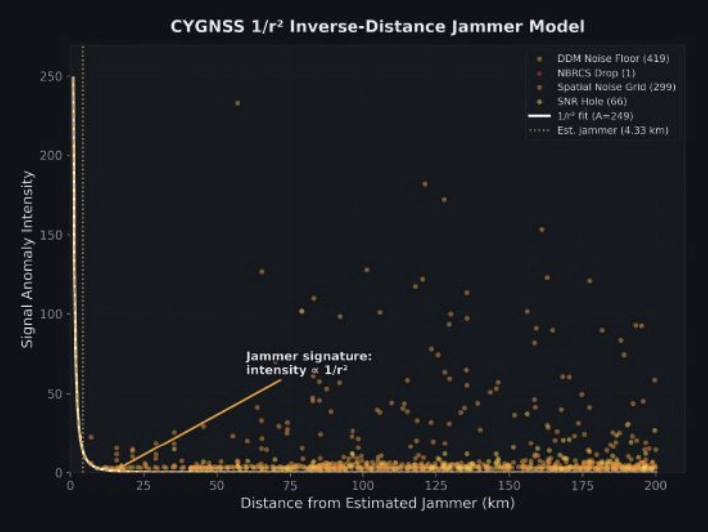
    FIGURE 3 Scatterplot of interference insensity versus distance for CYGNSS.
    FIGURE 3 Scatterplot of interference insensity versus distance for CYGNSS.

    Localizing using a simple centroid of all 785 detection positions placed the jammer 32.1 km from truth, with too many distant, low-SNR detections diluting the estimate.

    Instead, we fit a parametric 1/r² inverse-distance model:

    I(r)=Ar2

    where A is a free amplitude parameter and r is the distance from a candidate jammer position. We jointly optimized the jammer position and amplitude using SciPy’s Nelder-Mead optimizer across all 785 observations, weighted by intensity. The optimizer converged on a position 4.33 km from ground truth, providing a 27.7 km improvement over the centroid (FIGURE 3).

    The baseline: Zero false positives

    On the jammer-OFF dates (Dec. 15 and Dec. 27, 2025), the pipeline produced exactly zero detections using the same thresholds, geographic area and satellites: a completely clean result. This suggests that the 785 detections are unlikely to be sensor artifacts or geographic anomalies. They disappear when the jammer turns off.

    NISAR: 17 Detections, 6.26 km Error

    NISAR’s approach is fundamentally different. Rather than measuring hundreds of reflected signals across a wide area, it captures direct emissions in a narrow swath, but with far greater geometric precision.

    We processed NISAR L2 GCOV (geocoded covariance) products from Track 157, Frame 15 (ascending) for three dates: the Dec. 27 baseline and the Jan. 8 and Jan. 20 jammer-ON passes. The detection pipeline used eigenvalue decomposition of the polarimetric covariance matrix:

    1. λ₁ ratio thresholding: In jammer-contaminated pixels, the dominant eigenvalue λ₁ of the 2×2 [HH, HV] covariance matrix rises sharply relative to the scene mean, indicating an unpolarized additive source.
    2. Cross-polarization ratio (HV/HH): GPS jammer emissions are unpolarized, disproportionately elevating the HV channel. Anomalous HV/HH ratios flag contaminated azimuth lines.
    3. Iterative outlier trimming: Three rounds of 1.5σ clipping removed scattered false detections, leaving 17 high-confidence streak centroids.
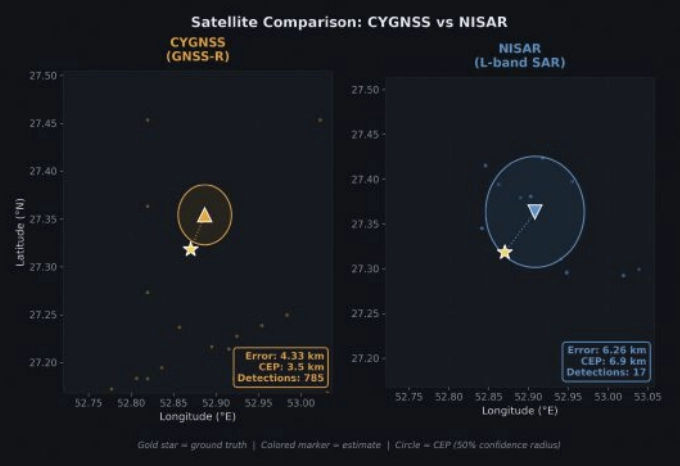
    FIGURE 4 Error and CEP Metrics Comparison for CYGNSS and NISAR.
    FIGURE 4 Error and CEP Metrics Comparison for CYGNSS and NISAR.

    With detections from two passes on different dates, we had two independent bearing lines. Each pass’s streak centroids defined an azimuth aligned cluster whose major axis pointed toward the jammer. A PCA fit to the two clusters extracted the bearing: 308.1° from the Jan. 8 pass and 316.2° from Jan. 20. Their intersection — computed via scipy optimization of the angular residual — landed 6.26 km from ground truth (FIGURE 4).

    The along-track/cross-track decomposition reveals why the 6.26 km error is a geometric ceiling for this dataset, not a processing limitation. Both passes come from the same Track 157 ascending orbit on a 12-day repeat cycle. The intensity-weighted along-track centroids land at +3.0 km and +3.1 km north of the jammer, a direct stable latitude measurement. The cross-track centroids land at +5.4 km and +5.6 km east of the orbit ground track, a range measurement. But because both passes share identical orbit geometry, the two range arcs are nearly parallel. The bearing difference between passes (308.1° vs 316.2°) is only 8.1°, producing a shallow intersection angle and poor cross-range resolution. A single descending pass, which would cross the ascending track at approximately 60-70°, would transform the geometry from two near-parallel lines to a genuine triangulation, potentially reducing the localization error to sub-2 km. Unfortunately, no descending NISAR pass covering this jammer site was available in the beta archive, which ends on Jan. 20, 2026.

    The CEP (circular error probable, the radius containing 50% of repeated estimates) was 6.88 km, meaning if we ran this analysis on many similar jammers, half our estimates would fall within ~7 km.

    Who wins?

    CYGNSS wins, and not just on accuracy.

    A naive confidence metric for the 1/r² fit would be the scatter of the 785 input detections (CEP = 127 km). But the detections are not the estimate; they are the inputs to a model fit. The relevant confidence question is: How stable is the fitted position?

    We answered this with a 500-iteration bootstrap: resample the 785 detections with replacement, re-run the 1/r² optimizer each time and measure the spread of the resulting position estimates. The bootstrap CEP, the median radial distance across 500 fitted positions, was 3.48 km. The optimizer converges stably to within a few kilometers of the same location regardless of which detections are included.

    This means CYGNSS achieves 4.33 km error with 3.48 km confidence, both better than NISAR’s 6.26 km error and 6.88 km confidence.

    The bootstrap CEP also reveals what the raw scatter obscures: the 1/r² fit is constrained primarily by the ~80 high-intensity detections within 30 km of the jammer. The remaining 700 distant, low-intensity detections contribute little to the position estimate — they are correctly downweighted by the intensity-weighted least squares. The fit’s stability comes from the physics: a 1/r² signal has steep gradients near the source, providing strong positional constraints where it matters most.

    Bayesian fusion: Can we get both?

    The obvious next question: Can we combine CYGNSS’s wide-area sensitivity with NISAR’s geometric precision? We implemented four fusion strategies, all designed to work without ground truth:

    ■ Bayesian Gaussian posterior: Model each sensor’s estimate as a 2D isotropic Gaussian with σ = CEP/1.1774. The posterior is the product of the two Gaussians: an analytical precision-weighted mean.

    ■ NISAR-prior constrained 1/r²: Re-run the CYGNSS optimizer with a Gaussian regularization term pulling toward the NISAR estimate, sweeping the regularization weight λ from 0.01 to 10.

    ■ NISAR-proximity re-weighted 1/r²: Apply a Gaussian kernel centered on the NISAR estimate to the CYGNSS detections before fitting, effectively upweighting observations consistent with the SAR result.

    ■ Joint CEP-balanced: Combine the CYGNSS gradient signal with NISAR cluster proximity, weighted by (σ_CYGNSS/σ_NISAR)².
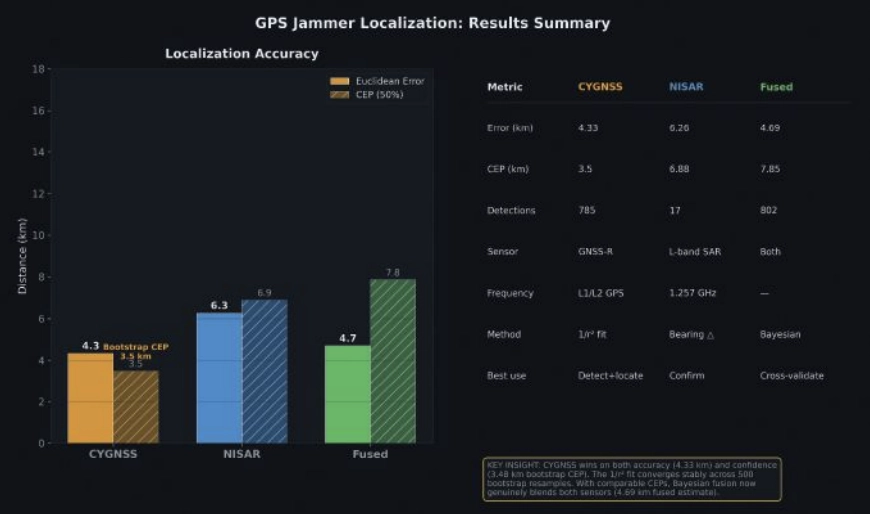
    FIGURE 5 Summary statistics for jammer localization with CYGNSS, NISAR and fused approach.
    FIGURE 5 Summary statistics for jammer localization with CYGNSS, NISAR and fused approach.

    With the bootstrap CEP, the precision ratio flips. The CYGNSS Gaussian (σ = 2.95 km) is now 2× tighter than NISAR (σ = 5.84 km). The Bayesian posterior, the precision-weighted mean, lands at 4.69 km, pulling toward CYGNSS’s better estimate while incorporating NISAR’s independent geometric constraint. FIGURE 5 shows the fusion: two comparable Gaussians whose product is tighter than either alone.

    The fused result (4.69 km error, 7.85 km CEP) is not quite as accurate as CYGNSS alone (4.33 km), because NISAR’s 6.26 km estimate pulls it slightly away from truth. But operationally, the fusion provides a cross-validated answer: two independent physics arriving at similar locations builds confidence that neither sensor is producing an artifact.

    The key insight is that the bootstrap CEP unlocked meaningful fusion. When the raw scatter CEP (127 km) was used, NISAR dominated the posterior 343:1 and fusion added nothing. With the fit-based CEP (3.48 km), both sensors contribute, and the posterior reflects genuine multi-modal evidence.

    Operational implications

    For CYGNSS: CYGNSS excels at both detection and localization. Its 785 detections across a 200 km radius, with zero false positives on baseline dates, provide unambiguous jammer detection. The 1/r² fit achieves 4.33 km accuracy with a bootstrap-verified 3.48 km CEP, meaning an analyst can trust the result to single-digit kilometer precision without ground truth. CYGNSS’s eight-satellite constellation also provides sub-daily revisit, enabling near-real-time monitoring.

    For NISAR: NISAR provides independent geometric confirmation. With just two passes over an active jammer, the bearing intersection achieved 6.26 km accuracy with a 6.88 km CEP. The 6.26 km result is constrained by orbit geometry, not by detection sensitivity. Our two ascending passes from Track 157 produced nearly parallel range arcs with only 8.1° of bearing separation. Adding a single descending pass would provide a crossing angle of 60° to 70° and could reduce localization error to sub-2 km — transforming NISAR from a confirming sensor into a precision localization tool in its own right. The limitation in this study was data availability: The NISAR beta archive contained only ascending Track 157 passes over the jammer site. NISAR’s 12-day repeat cycle and fixed ground track also mean the jammer must be active when the satellite passes overhead. NISAR’s current value is as a confirming sensor — when both modalities converge on the same location, confidence increases beyond what either achieves alone.

    For Fusion: With comparable CEPs (3.48 km vs 6.88 km), fusion now produces genuinely blended estimates. The Bayesian posterior at 4.69 km reflects real multi-sensor information. Future improvements, such as more NISAR passes with diverse bearings or CYGNSS multi-week accumulation, would tighten both estimates further.

    For the Adversary: These results demonstrate that GPS jammers operating in contested airspace are observable and localizable from orbit using openly available civilian satellite data. The 4.33 km CYGNSS result is approximately 2× better than the published state of the art for GNSS-R jammer localization (~9 km grid resolution, Chew et al., 2023) and the NISAR bearing intersection approach has not been previously demonstrated for jammer geolocation.

    Still broadcasting: Jammer persistence through conflict

    The validation analysis used January 2026 data. But on Feb. 28, armed conflict erupted in the region. Did the jammer survive?

    We ran the CYGNSS noise floor detection pipeline for each day from Feb. 28 through April 6, comparing against the December 2025 baseline. The answer is unambiguous: The jammer is not only still active — it is operating at dramatically higher power.
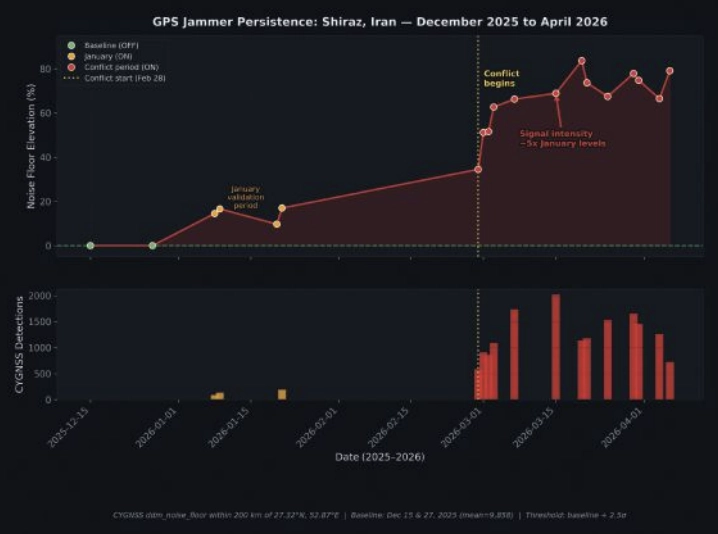
    FIGURE 6 A timeline of jammer activity for Shiraz, Iran, from December 2025 to
April 2026.
    FIGURE 6 A timeline of jammer activity for Shiraz, Iran, from December 2025 to
    April 2026.

    In January, the jammer elevated the CYGNSS noise floor by approximately 15% above baseline. By early March, days after the conflict began, noise elevation had jumped to 50% to 60%. By mid-March, it reached 70% to 84%, where it remained through early April. Detection counts tell the same story: 89 to 192 per day in January, rising to 1,000 to 2,000 per day during the conflict (FIGURE 6).

    The escalation was immediate. On Feb. 28, noise elevation was +34.5%, already double the January level. By March 3, it had reached +62.7%, and by April 6, it peaked at +79.1%. The signal has remained at 5× the January intensity through the most recent available data (April 6, 2026).

    Several interpretations are consistent with this pattern:

    ■ Power increase: The operator increased jammer output power, perhaps in response to the conflict or as a defensive posture against GPS-guided munitions.

    ■ Additional jammers: Multiple units may have been co-located or deployed nearby, creating an aggregate signature larger than any single device.

    ■ Duty cycle change: The jammer may have shifted from intermittent to continuous operation.

    What is clear is that the jammer we localized in January was not incapacitated by the conflict. It was amplified. CYGNSS’s sub-daily revisit capability makes this kind of persistent monitoring possible using entirely passive, civilian satellite data — no tasking, no cooperation with the target state and no risk to reconnaissance assets.

    Context and prior work

    CYGNSS-based RFI detection builds on work by Chew et al., 2023, who demonstrated grid-level jammer detection at approximately 9 km resolution using DDM noise floor anomalies. Our 1/r² parametric fit extends this from detection to localization, achieving sub-5 km accuracy by exploiting the physics of signal power decay.

    At the other end of the precision spectrum, Murrian et al., 2021, demonstrated ~220 m jammer localization using ISS-mounted Doppler measurements of raw intermediate-frequency (IF) data. This approach achieves an order of magnitude better precision than our methods but requires specialized hardware and raw signal access not available on current operational satellites.

    The NISAR bearing intersection approach demonstrated here is, to our knowledge, the first published use of L-band SAR RFI streaks for jammer triangulation. The key insight is that NISAR’s proximity to GPS L2 (just 30 MHz separation) makes it an unintentional but effective GPS interference sensor.

    Summary

    Two satellites, two physics, one jammer. CYGNSS sees the interference footprint across hundreds of kilometers and localizes the source through inverse-distance physics. NISAR sees the emissions directly in its SAR receiver and triangulates through bearing intersection. Both achieve sub-7 km accuracy independently; together, they cross-validate and build the confidence that operational use demands.

    The jammer near Shiraz is still there — louder than ever. The satellites are still watching.

    Chew, C., Shah, R., Zuffada, C., et al. (2023). “Demonstrating CYGNSS as
    a Tool for Detecting GNSS Interference on a Global Scale.” IEEE Journal of
    Selected Topics in Applied Earth Observations and Remote Sensing.

    Murrian, M.J., Narula, L., Iannucci, P.A., et al. (2021). “GNSS Interference
    Monitoring from Low Earth Orbit.” Navigation: Journal of the Institute of
    Navigation, 68(1).

    NASA JPL. (2024). “NISAR L-band SAR Technical Specifications.” NASA/
    ISRO SAR Mission Documentation.
    Closas, P., Fernández-Prades, C. (2023). “GNSS Interference Detection
    and Mitigation: A Survey.” Signal Processing, 206.
  • NASA loses contact with CYGNSS hurricane satellite

    NASA loses contact with CYGNSS hurricane satellite

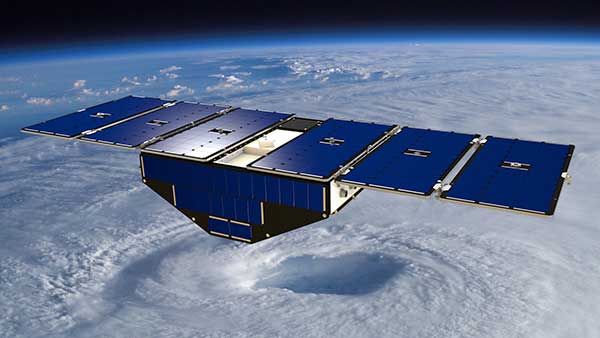
    Artist's concept of one of the eight CYGNSS satellites in orbit. (Image: NASA/University of Michigan)
    Artist’s concept of one of the eight CYGNSS satellites in orbit. (Image: NASA/University of Michigan)

    Since Nov. 26, NASA’s Cyclone Global Navigation Satellite System (CYGNSS) team has not been able to make contact with one of the eight CYGNSS spacecraft, FM06.

    The team is still working to acquire a signal and establish a connection.

    The other seven spacecraft continue to operate normally and have been collecting science measurements since the FM06 anomaly.

    CYGNSS is a constellation of eight small satellites taking measurements of ocean surface winds in and near the eye of the storm throughout the lifecycle of tropical cyclones, typhoons and hurricanes.

    If the team isn’t able to reestablish contact, loss of the FM06 satellite would primarily affect the constellation’s spatial coverage. However, the CYGNSS constellation can continue to meet its scientific requirements and objectives.

    CYGNSS was launched Dec. 15, 2016, and completed its prime mission science objectives on March 19, 2019. It has been operating in extended mission status since then.

  • NASA, New Zealand to collect climate data with commercial aircraft

    NASA, New Zealand to collect climate data with commercial aircraft

    NASA is partnering with the New Zealand Ministry of Business, Innovation and Employment, New Zealand Space Agency, Air New Zealand and the University of Auckland to install next-generation GNSS reflectometry receivers on passenger aircraft to collect environmental science data over New Zealand.

    The program is part of NASA’s Cyclone Global Navigation Satellite System (CYGNSS) mission, a constellation of eight small satellites launched in 2016 that use GPS satellite signals that reflect off Earth’s surface to collect science data.

    The CYGNSS satellites orbit above the tropics and their primary mission is to use GPS signals to measure wind speed over the ocean by examining GPS signal reflections off choppy versus calm water. This allows researchers to gain new insight into wind speed over the ocean and will allow them to better understand hurricanes and tropical cyclones.

    Measurements over land

    In addition to its primary over-water research capabilities, scientists have discovered that the CYGNSS technology is also capable of collecting valuable measurements over land, including of soil moisture, flooding, and wetland and coastal environments.

    “Partnering with New Zealand offers NASA and the CYGNSS team a unique opportunity to develop these secondary capabilities over land. Taken together over time, they’ll also have an important story to tell about the long-term impacts of climate change to these landscapes,” said Gail Skofronick-Jackson, CYGNSS program scientist at NASA Headquarters, Washington.

    The CYGNSS team, led by principal investigator Chris Ruf at the University of Michigan in Ann Arbor, has developed a next-generation GNSS reflectivity receiver with support from NASA’s Earth Science Technology Office. These receivers will be installed in late 2020 on one of Air New Zealand’s Q300 domestic aircraft.

    Artist's concept of one of the eight CYGNSS satellites in orbit. (Image: NASA/University of Michigan)
    Artist’s concept of one of the eight CYGNSS satellites in orbit. (Image: NASA/University of Michigan)

    Aircraft overlap satellite path

    As the aircraft traverses New Zealand, it will collect data from the land below, some of which will overlap with the flight paths of the CYGNSS satellites.

    This overlap, which will have frequent data observations from regular commercial flights, will provide the CYGNSS team a wealth of data to use to validate and improve the CYNGSS satellite observations, said Ruf.

    In addition, the varied New Zealand terrain will provide comparison points with data collected in similar terrains in other parts of the world.

    “As a result of this partnership, both Air New Zealand engineers and researchers across New Zealand will now have the opportunity to work with NASA on a world-leading environmental science mission,” said Peter Crabtree, general manager of Science, Innovation and International at New Zealand’s Ministry of Business, Innovation and Employment.

    Science Payload Operation Centre

    The University of Auckland will host the Science Payload Operation Centre, which will begin operations and data collection in late 2020.

    “Over time, the data that will be collected by these receivers could form one of New Zealand’s largest bodies of long-term environmental data, and as such it represents a wide range of research opportunities,” said radar systems engineer and project lead Delwyn Moller of the University of Auckland.

    Air New Zealand will be the first passenger airline to partner with NASA to collect data for a science mission. Air New Zealand has 23 Q300s in its fleet, and if the approach is successful, the airline will explore introducing the technology more widely.

    An Air New Zealand Bombadier Q300. (Photo: Air New Zealand/NASA)
    An Air New Zealand Bombadier Q300. (Photo: Air New Zealand/NASA)

    “As an airline, we’re already seeing the impact of climate change, with flights impacted by volatile weather and storms. Climate change is our biggest sustainability challenge, so it’s incredible we can use our daily operations to enable this world-leading science,” said Air New Zealand Chief Operational Integrity and Standards Officer Captain David Morgan.

  • Seen & Heard: Microsatellites, tethered drones and ladybugs

    “Seen & Heard” is a monthly feature of GPS World magazine, traveling the world to capture interesting and unusual news stories involving the GNSS/PNT industry.

    Tethered drone

    Spanish police used a tethered drone system for traffic monitoring, crowd control and surveillance of the UEFA Champions League Final, played June 1 at the Wanda Metropolitano stadium in Madrid. An Elistair tethered U06 Plus drone oversaw 67,000 fans in the stadium and 200,000 in nearby streets. Use of the drone was in response to a heightened terrorist threat level in Spain, making it part of the largest security operation for any sporting event in the Spanish capital. Continuously supplied with power, the drone maintained its position at 50 meters high for 8 hours.

    CYGNSS satellite launch. (Artist’s concept/NASA)
    CYGNSS satellite launch. (Artist’s concept/NASA)

    Tricky Signals

    NASA’s eight CYGNSS (Cyclone Global Navigation Satellite System) microsatellites collect radio signals from GPS beacons to characterize hurricanes. A month after launch in December 2016, the CYGNSS team noticed the signals were wavering when the U.S. began to boost the radio power on 10 GPS satellites as they passed over northern Syria. The swings don’t interfere with other scientific uses of GPS, but for CYGNSS the measurements of high winds varied by 5 meters a second or more — the difference between a category-2 and category-3 hurricane. After two years of work, the CYGNSS team has compensated by repurposing a secondary antenna on the satellites to measure GPS signal strength.

    The ladybug blob tracked by Doppler radar. (Image: National Weather Service)
    The ladybug blob tracked by Doppler radar. (Image: National Weather Service)

    Ladybug, ladybug, fly away home

    In this case, California. In June, a millions-strong swarm of ladybugs showed up on radar as a weather event when the insects took to the sky to hunt for aphids. One explanation for the unusual swarm is that a large population of ladybugs had been spread out in a mountainous area, and rising temperatures triggered their mass migration to valleys where they might find an abundance of aphids to eat.

    New Zealand joins Aussies on SBAS

    Land Information New Zealand (LINZ) will work with Australian counterpart Geoscience Australia to investigate ways to deliver a regional satellite-based augmentation system (SBAS) to significantly improve GPS accuracy. The proposed SBAS will support emergency helicopter crews, providing pilots with accurate vertical guidance for landing, enabling them to reach people faster in difficult terrain and bad weather. The SBAS will also improve the safety of self-driving cars. The new system will improve accuracy to less than a meter, and in some devices to 10 centimeters.

  • NASA launches micro satellites with GNSS receivers for remote weather sensing

    NASA launches micro satellites with GNSS receivers for remote weather sensing

    Surrey Satellite Technology’s Space GNSS Receiver Remote Sensing Instrument (SGR-ReSI) is the primary payload onboard NASA’s CYGNSS constellation, launched today, Dec. 15, from Cape Canaveral Air Force Station in Florida.

    The Cyclone Global Navigation Satellite System (CYGNSS) mission is part of the NASA Earth System Science Pathfinder Program that aims to improve extreme weather prediction by studying how tropical cyclones form.

    Artist's concept of one of the eight CYGNSS satellites in orbit. (Image: NASA/University of Michigan)
    Artist’s concept of one of the eight CYGNSS satellites in orbit. (Image: NASA/University of Michigan)

    The CYGNSS space segment consists of a constellation of eight micro satellites, each carrying the Surrey SGR-ReSI as the observatory payload in the form of a delay Doppler mapping instrument (DDMI). Making use of reflected global positioning signals, the DDMI collects ocean surface roughness data using a technique called GNSS reflectometry, providing CYGNSS with a new method for looking inside hurricanes. Wind speed will be estimated from this reflectometry data.

    “At the end of last year, we delivered the SGR-ReSI flight models, low-noise amplifiers, and antennas to Southwest Research Institute for final integration into the CYGNSS observatories — marking a significant hardware shipment out of our Englewood, Colorado, manufacturing facility,” said Clare Martin, vice president of programs at Surrey Satellite Technology U.S.. “All of us at Surrey are proud that our instrument is playing an integral role in this mission, and we will watch with great interest as the satellites are put to work.”

    The CYGNSS team is made up of the University of Michigan Department of Climate and Space Sciences and Engineering, Southwest Research Institute (SwRI), Surrey Satellite Technology and Sierra Nevada Corporation.

    Surrey Satellite Technology demonstrated the concept of GNSS reflectometry for the first time on its UK-DMC mission launched in 2003, and subsequently developed the SGR-ReSI, which is currently flying on Surrey’s TechDemoSat-1 mission.

    CYGNSS is NASA’s first Earth science small satellite constellation, designed to help improve forecasting hurricane intensity, hurricane tracks and storm surges.

    CYGNSS will measure previously unknown details crucial to accurately understanding the formation and intensity of tropical cyclones and hurricanes.

    “This is a first-of-its-kind mission,” said Thomas Zurbuchen, associate administrator for NASA’s Science Mission Directorate at the agency’s headquarters in Washington. “As a constellation of eight spacecraft, CYGNSS will do what a single craft can’t in terms of measuring surface wind speeds inside hurricanes and tropical cyclones at high time-resolution, to improve our ability to understand and predict how these deadly storms develop.”

    The CYGNSS mission is expected to lead to more accurate weather forecasts of wind speeds and storm surges — the walls of water that do the most damage when hurricanes make landfall.

    Using the same GPS technology that allows drivers to navigate streets, CYGNSS will use a constellation of eight micro satellite observatories to measure the surface roughness of the world’s oceans. Mission scientists will use the data collected to calculate surface wind speeds, providing a better picture of a storm’s strength and intensity.

    Unlike existing operational weather satellites, CYGNSS can penetrate the heavy rain of a hurricane’s eyewall to gather data about a storm’s intense inner core. The eyewall is the thick ring of thunderstorm clouds and rain that surrounds the calm eye of a hurricane. The inner core region acts like the engine of the storm by extracting energy from the warm surface water via evaporation into the atmosphere.

    The latent heat contained in the water vapor is then released into the atmosphere by condensation and precipitation. The intense rain in eyewalls blocks the view of the inner core by conventional satellites, however, preventing scientists from gathering much information about this key region of a developing hurricane.

    “Today, we can’t see what’s happening under the rain,” said Chris Ruf, professor in the University of Michigan’s Department of Climate and Space Sciences and Engineering and principal investigator for the CYGNSS mission. “We can measure the wind outside of the storm cell with present systems. But there’s a gap in our knowledge of cyclone processes in the critical eyewall region of the storm — a gap that will be filled by the CYGNSS data. The models try to predict what is happening under the rain, but they are much less accurate without continuous experimental validation.”

    The CYGNSS small satellite observatories will continuously monitor surface winds over the oceans across Earth’s tropical hurricane-belt latitudes. Each satellite is capable of capturing four wind measurements per second, adding as many as 32 wind measurements per second for the entire constellation.

    CYGNSS is the first complete orbital mission competitively selected by NASA’s Earth Venture program. Earth Venture focuses on low-cost, rapidly developed, science-driven missions to enhance our understanding of the current state of Earth and its complex, dynamic system and enable continual improvement in the prediction of future changes.

  • Wind-speed data based on ocean surface using GNSS-R

    Wind-speed data based on ocean surface using GNSS-R

    The National Oceanography Centre (NOC) has developed global wind speed products based on reflected GPS signals, using data from the UK TechDemoSat-1 satellite, reports Hydro International.

    The TechDemoSat-1 satellite, built by Surrey Satellite Technology Ltd. (Photo: SSTL)
    The TechDemoSat-1 satellite, built by Surrey Satellite Technology Ltd. (Photo: SSTL)

    The achievement demonstrates the potential of GNSS reflectometry (GNSS-R) to improve sampling of ocean surface winds, as well as improve weather monitoring and forecasting by complementing existing satellite measurements from scatterometers and radiometers.

    The GNSS-R receiver on TechDemoSat-1 is a precursor to eight similar receivers to be flown as a constellation for the NASA CYGNSS mission. CYGNSS — Cyclone Global Navigation Satellite System — will be launched Dec. 12 and will observe winds within cyclones, hurricanes and typhoons with unprecedented spatial and temporal sampling.

    CYGNSS will launch aboard the Pegasus XL rocket from Cape Canaveral Air Force Station in Florida. It will make frequent and accurate measurements of ocean surface winds throughout the life cycle of tropical storms and hurricanes.

  • Leadership Awards 2012: Pairing LEOs with GNSS Birds

    CYGNSS, Others Deliver Now and in Future for Global Weather Forecast

    Editor’s Note: This article reproduces the acceptance speeches given by the winners of GPS World’s 2012 Leadership Awards, at the Leadership Dinner in Nashville in September. The Leadership Dinner was sponsored by Lockheed Martin and Deimos Space.


    Martin Unwin, Surrey Satellite Technology Limited; Principal GNSS Engineer, winner in the Satellites category. He is a key member of the team that built the GIOVE-A satellite (recently retired) and is now working on the Galileo FOC satellites. He is also recognized for his work on space-borne receivers.

    Headshot: Martin Unwin, Surrey Satellite Technology, winner in the Satellites category.

    I feel privileged and honored to receive this award from GPS World, and I am truly sorry now that  I chose this year not to attend the ION-GNSS conference to receive it!

    With respect to the achievements in GIOVE-A and Galileo, I cannot claim this award on behalf of myself, but I will claim it on behalf of the people in Surrey Satellite Technology Limited (SSTL) who made the projects possible, and to those in the team here who have been working tirelessly to make the payloads and satellites happen. We are of course partnered with others in Europe that have been laboring equally hard, so it has been a true team effort.
    With respect to the spaceborne GPS and GNSS activities, my achievements have only been possible thanks to the top-class staff we have in the receivers team, and thanks are also due to the support we have had from the rest of SSTL.

    In the 20 years I have been in the company, Surrey Satellite Technology Ltd has grown from a small university-based department to a major player in the international space scene, and I am immensely proud to have been part of this story.

    A Few Words for the Future

    Whilst it cannot quite match the early heady days of GPS, I still think nevertheless we are entering an exciting time in the GNSS world. We have two operational systems, and within a few years, we will be seeing two more reaching operational capability. Dual- and even triple-frequency civil signals will soon become operationally available, and some very wide bandwidth signals will be sent down, in particular, by Galileo. There is bound to be a steep learning curve in understanding how to exploit these new signals, with a few crevasses to be negotiated during the climb. But these new signals are bound to lead to an expanded vista of increased accuracy and robustness, and undoubtedly some unexpected destinations.

    Taking perhaps the highest perspective, spaceborne remote sensing is a good example that has surprising relevance to the rest of us still on the ground. In this case, GNSS satellites are used as radar sources, and all that is required on a low-Earth orbiting (LEO) satellite to change the world is a GNSS receiver. GPS radio-occultation measurements from low-Earth orbit are now already the third most important data source for our global weather forecasts, thanks to the like of the COSMIC and MetOp satellites.

    Furthermore, a new constellation of satellites called CYGNSS has recently announced by NASA that will be using ocean-reflected GPS signals to probe inside hurricanes and typhoons, and for the first time will enable the sensing of the wide-scale ocean roughness, leading to improved global wind and wave knowledge. By adding to this spaceborne receiver the ability to accommodate signals from GLONASS, Galileo, and Compass, plus any other available GNSS-type signals, the number of measurements is instantly quadrupled, and a new capability in sensing the atmosphere, waves, and even ice and land is likely to be seen. Meteorologists already view GPS as an emerging utility for weather and climate sensing, but I think this new role for GNSS will be reinforced and expanded into yet another area where GNSS incontrovertibly, if indirectly, makes such a significant difference to our daily lives.

    As with many other applications where GNSS has become important or even critical to our modern world, this is, at the same time, both a blessing and a matter for some caution.