Tag: Denver

  • NGS presents the latest NSRS news at Geo Week 2026

    NGS presents the latest NSRS news at Geo Week 2026

    In my January 2026 GPS World newsletter, I noted that the National Geodetic Survey (NGS) convened the Federal Geodetic Control Subcommittee (FGCS) meeting with federal geospatial agencies to boost awareness and align efforts on National Spatial Reference System (NSRS) Modernization government-wide. Key steps include cultivating internal champions to champion the initiative, distilling complex topics for clear leadership briefings, and bringing together agencies, partners, and industry to collaboratively shape solutions. I also highlighted that on Feb. 17-18, NGS staff would be participating in Geo Week 2026 in Denver to engage geospatial product and service users and further coordinate on the modernization. NGS gave several presentations during GeoWeek that addressed many of my questions on the new modernized NSRS. This newsletter will highlight some of NGS’s presentations.


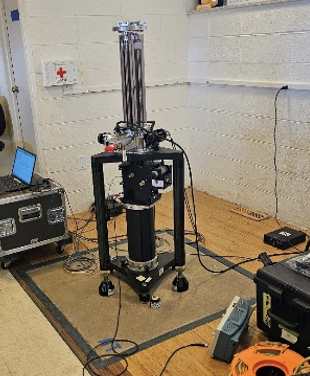
    First, a special shout-out to my dear friend and former colleague, Juliana Blackwell, retired Director of the National Geodetic Survey. NOAA’s Table Mountain Gravity Observatory in Boulder, Colorado — long known for its absolute gravity work — has been officially renamed the J. P. Blackwell Gravity Observatory. This well-earned tribute honors her outstanding dedication and visionary leadership at NGS. Congratulations, Juliana!

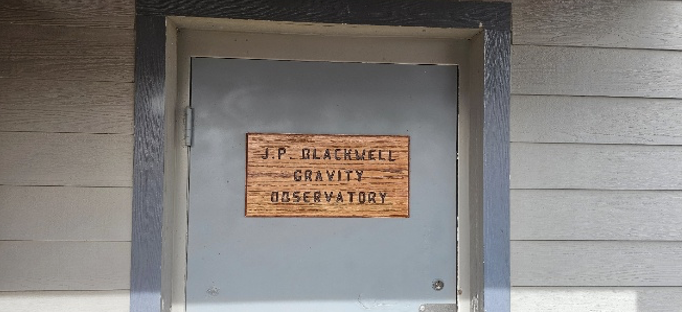
    J. P. Blackwell Gravity Observatory. (Photo: NGS)
    J. P. Blackwell Gravity Observatory. (Photo: NGS)
    J. P. Blackwell Gravity Observatory. (Photo: NGS)
    J. P. Blackwell Gravity Observatory. (Photo: NGS)
    J. P. Blackwell Gravity Observatory. (Photo: NGS)
    J. P. Blackwell Gravity Observatory. (Photo: NGS)

    NGS employees participated in the following sessions and meetings during GeoWeek 2026:

    • ASPRS NSRS Modernization Working Group Meeting
    • NSRS Modernization — The Latest Technical Updates
    • Preparing to Put the Modernized National Spatial Reference System into Practice
    • Roundtable — NSRS Modernization and Professional Societies

    As President of the American Association for Geodetic Surveying (AAGS), I participated in the session titled “Roundtable – NSRS Modernization and Professional Societies.” Dana J Caccamise II, NGS regional geodetic advisor, opened our session by describing the NGS Modernization Engagement Plan and Progress.  As I mentioned last month, Dana should get an award for the material he has prepared and for his work assisting agencies and professional organizations in preparing for the new NSRS. I highlighted Caccamise’s work in my October 2025 GPS World newsletter.


    All the NGS sessions provided the latest information on activities associated with NGS’s NSRS Modernization. Here are the specific questions I had going into the session, along with the clear answers provided by NGS personnel during their presentations and the follow-up Q&A:

    What NGS products and services will be available when federal agencies officially adopt the new NSRS?

    When the modernized NSRS is officially adopted (following FGCS approval and the transition to it becoming “the NSRS”), NGS will make available a full suite of updated tools, data access points, and services built around the new reference frames (e.g., NATRF2022 and variants), the North American-Pacific Geopotential Datum of 2022 (NAPGD2022), the State Plane Coordinate System of 2022 (SPCS2022), and associated geopotential models like GEOID2022. Key products expected to be operational and official include:

    • NCAT
    • NGS Maps
    • Geodetic Station Page
      • CORS
    • Geodetic Mark Page
      • Passive Marks
    • OPUS–Static 5.2
    • OPUS-Share

    What NGS products and services will NOT be available when federal agencies officially adopt the new NSRS?

    Upon official adoption of the modernized NSRS — after FGCS approval and the shift to the new system becoming “the NSRS” — several current products and services will no longer be part of the official modernized NSRS or will be discontinued in their present form. Key items not included or no longer supported in the modernized NSRS release include:

    • OPUS Projects 5 will not be supported
      • OPUS-Rapid Static (OPUS-RS) will not be supported (modernized OPUS-Static 5.2 is expected to handle a broader range of observations)
      • OPUS 6.0 and OPUS 6.1 will not be available

    What GNSS data will be included in the first iteration of the computation of Reference Epoch Coordinates (REC) for marks?

    At Geo Week 2026, NGS stated that its plans include providing Reference Epoch Coordinates (RECs) for certain legacy GNSS projects. Specifically, this includes:

    • GPS projects that were originally processed and published under the NAD 83 (2011) realization, and
    • Other GNSS projects will be officially published by NGS through the end of 2025\

    After the first iteration of Reference Epoch Coordinates, is NGS planning to perform future adjustments to determine REC and SEC of new marks? If so, what process will be used to establish RECs on new marks?

    Yes, NGS plans include performing future adjustments to compute Reference Epoch Coordinates (REC) for new marks. However, at this time, no final decision has been made on how often this will be performed.

    Has NGS changed how users need to submit data to incorporate leveling data into NAPDG2022?

    Yes, NGS has introduced changes to better integrate leveling data (differential height differences) into the modernized NSRS for computing orthometric Reference Epoch Coordinates (RECs) in NAPGD2022 (epoch 2020.00).

    As documented in Blueprint Document 3, when performing leveling projects, users will also be required to occupy a number of primary marks with GNSS.

    OPUS 6.1 is built for future expansion to support other geodetic measurements (classical, leveling)-no timeframe was given for this.

    Is NGS planning to officially adopt the new NSRS before users can submit data to NGS for technical review and publication in the NGS database?

    Yes, that is what NGS is saying at this moment (February 2026). OPUS Project 5 will not be supported and OPUS 6.1 will not be operational when the new NSRS is officially adopted.NGS is working on the OPUS 6 application and is trying to “minimize any gap in service.”

    Is NGS recommending using the OPUS-Share utility until users can submit data to NGS for technical review and publication in NGS database?

    Yes, that is what NGS is recommending at this moment (February 2026). 

    This is also stated in NGS’s Track Our Progress Webpage.

    OPUS-Projects 5 will not be included in the modernized NSRS. Instead, NGS will focus on both developing an improved software suite for OPUS, known as OPUS 6.0 and OPUS 6.1, and minimizing any gap in service in which the current OPUS-Projects functionality is not available for users to organize, process, adjust, and submit high-accuracy GPS surveys for use by NGS in expanding and improving the NSRS. As noted above, OPUS-Share will remain available as a means to submit data to NGS.

    When will OPUS 6.1 be available for users to submit data to NGS for technical review and publication in NGS database?  Is it weeks away, months away, or years away?

    NGS has not announced an official completion or release date for OPUS 6.0 and OPUS 6.1. However, they have indicated that active development is underway on this enhanced OPUS tool suite.  It’s not imminent— meaning not expected within several months—but it’s also not a distant, multi-year project.

    NGS is working on the application and is trying to “minimize any gap in service.”

    The NGS’s Track Our Progress Webpage states:

    “OPUS-Projects 5 will not be included in the modernized NSRS. Instead, NGS will focus on both developing an improved software suite for OPUS, known as OPUS 6, and minimizing any gap in service in which the current OPUS-Projects functionality is not available for users to organize, process, adjust, and submit high-accuracy GPS surveys for use by NGS in expanding and improving the NSRS. As noted above, OPUS-Share will remain available as a means to submit data to NGS.”

    What’s the cut-off date for users to submit projects via OPUS Project 5 so the data can be part of future computations of RECs?

    Current OPUS-Projects 5 is going to be supported until adoption of the new NSRS, with a deadline announced at least 6 months in advance.

    The NGS’s Track Our Progress Webpage states

    “Note: the current OPUS Projects 5 software will be supported until the modernized system is adopted, and a deadline for OPUS-Projects users to submit their surveys for publication will be announced with at least six months’ notice.”

    In the session “NSRS Modernization – The Latest Technical Updates,” the National Geodetic Survey (NGS) presented slides detailing the status and upcoming tasks for the modernized National Spatial Reference System (NSRS).  Key highlights from the presentation are summarized below.

    For the source of these slides and additional context, refer to the “Updates from the National Geodetic Survey at GeoWeek 2026” box.  NGS posts their presentations at here: https://geodesy.noaa.gov/web/science_edu/presentations_library/.


    Updates from the National Geodetic Survey at GeoWeek 2026

    (Selected Slides from the following presentations)

    • 2026 GeoWeek – NSRS Modernization – The Latest Technical Updates: The Why and How of NSRS mod – February 17, 2026 – Dru Smith
    • 2026 GeoWeek – Managing Modernization Rollout – February 17, 2026 – Seth Pollack
    • 106th Wyoming Engineering and Surveying (WES) Society Conference – February 5, 2026 – Brian Shaw
    • 2026 GeoWeek – Modernized Tools – February 17, 2026 – Brian Shaw

    2026 GeoWeek –   Updates to OPUS for Accessing the Modernized NSRS – February 17, 2026 – Dan Gillins


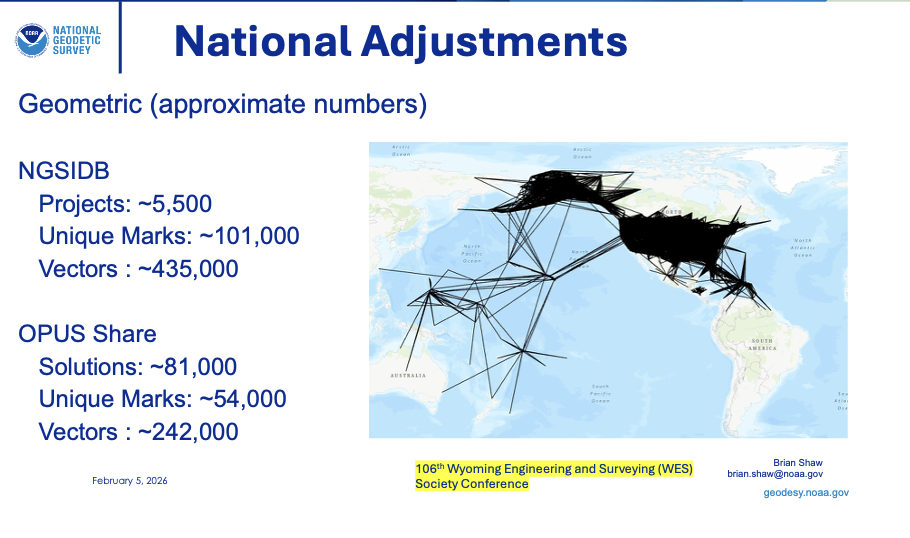
    During Dru Smith’s presentation, he mentioned what will be included in the first iteration of the computation of Reference Epoch Coordinates (REC) for marks. The slide states that more than 150,000 geometric (XYZ) coordinates and 1 million geopotential coordinates (that is, orthometric heights) will get reference epoch coordinates (REC), epoch 2020.00.  These will include data from NGS Integrated Database and from the OPUS Share database.
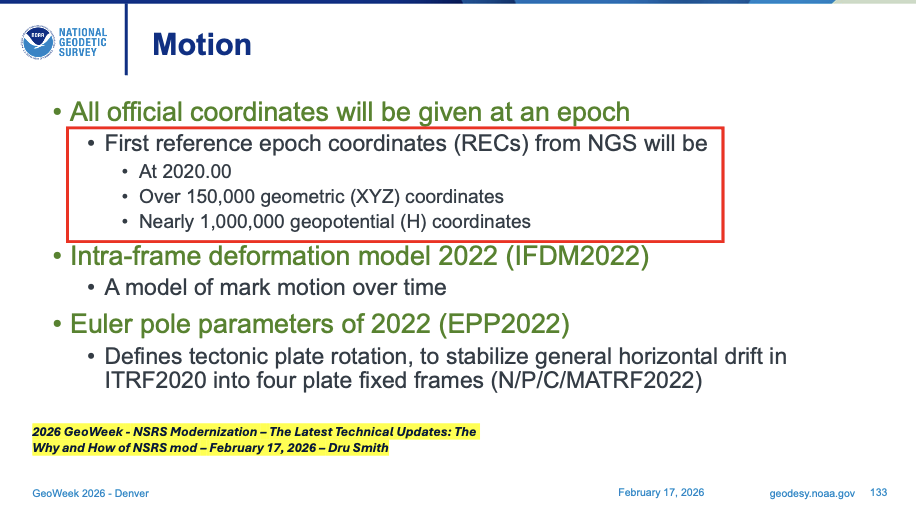
    First Reference Epoch Coordinates (REC). (Presented at GeoWeek 2026)
    First Reference Epoch Coordinates (REC). (Presented at GeoWeek 2026)
    First Reference Epoch Coordinates (REC). (Presented at 106th WES Society Conference)
    First Reference Epoch Coordinates (REC). (Presented at 106th WES Society Conference)

    In the GeoWeek 2026 presentation by Seth Pollack (from NOAA’s National Geodetic Survey), a slide outlined the NSRS modernization timeline.

    As detailed in the slide and consistent with NGS’s official rollout plan:

    • Beta products are currently being released incrementally on the beta site for public testing and feedback. This phased rollout began with initial beta releases in 2025 (following alpha in 2024) and continues through 2026, covering key components such as NAPGD2022, GEOID2022, SPCS2022, enhanced NCAT transformation tools, OPUS-Static updates, and forthcoming Data Delivery System features.
      • Each beta component, once released, undergoes public testing and stakeholder feedback, with overall testing continuing for at least 6 months after the final component is made available on the beta site.
    • Following sufficient testing—once all components appear stable and NGS has incorporated feedback—the Federal Geodetic Control Subcommittee (FGCS) will vote to recommend approval of the modernized NSRS. This vote is anticipated in late 2026 or early 2027.
    • Upon FGCS approval (and subsequent Federal Geographic Data Committee (FGDC) endorsement), NGS will probably publish a Federal Register Notice announcing the adoption.  At that point, the modernized NSRS becomes the official National Spatial Reference System, replacing the legacy system (NAD 83 realizations, NAVD 88, etc.).
      • While earlier NGS documentation targeted adoption likely in mid-to-late 2026 (post-FGCS vote), recent updates from GeoWeek 2026 sessions and related reports indicate the full official adoption and transition may extend into the first part of 2027, accounting for final testing, FGCS/FGDC processes, Federal Register steps, and a smooth handover to avoid disruptions.
    • The current NSRS remains official throughout this period. Users are encouraged to test beta products now and provide feedback to help refine the system.
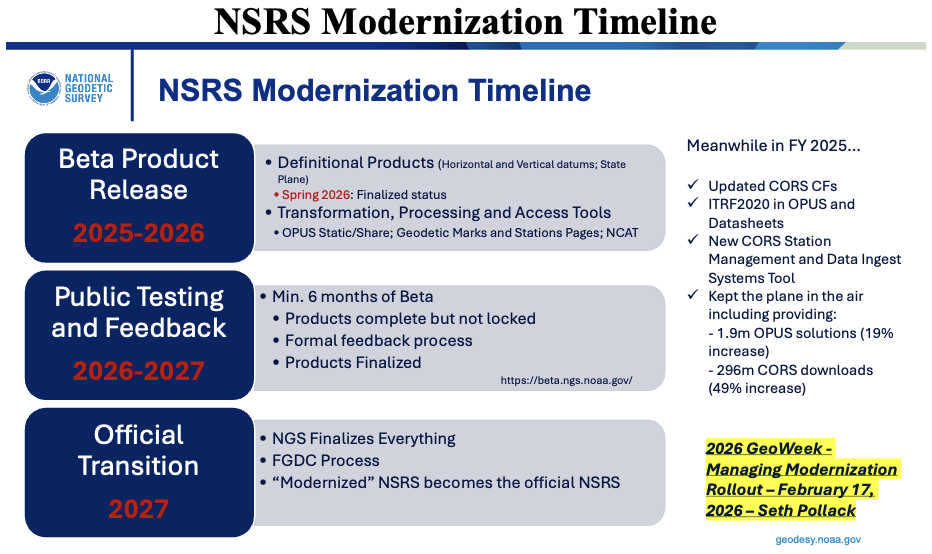
    NSRS Modernization Timeline. (Presented at GeoWeek 2026)
    NSRS Modernization Timeline. (Presented at GeoWeek 2026)

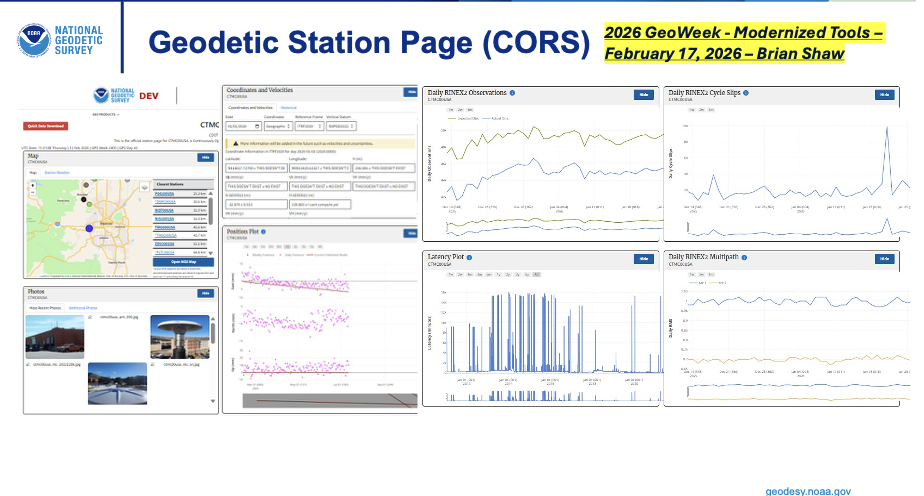
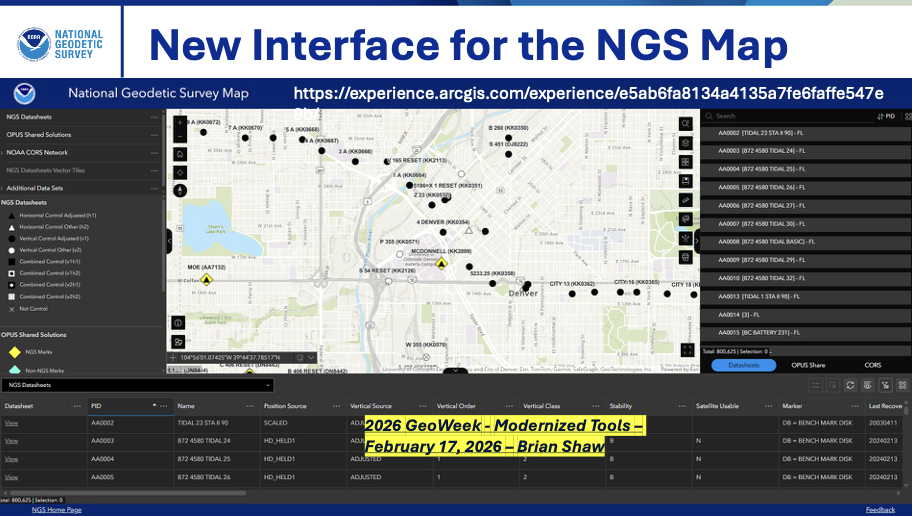
    Brian Shaw, NGS’s expert on GIS products and services, presented key updates on how users will access geodetic data in the modernized National Spatial Reference System (NSRS).

    He emphasized the introduction of a revamped Data Delivery System (DDS), which includes:

    • Geodetic Mark Pages — for passive marks. These replace the current ASCII-text datasheets with modernized, user-friendly pages featuring updated Reference Epoch Coordinates (RECs), integrated photos, graphics, maps, project details, and easier navigation.
    • Geodetic Station Pages — for active stations like those in the NOAA CORS Network (NCN). These provide updated versions of existing CORS pages, including modernized coordinate functions (e.g., Coordinate Functions or time-dependent positioning info) aligned with the new reference frames (NATRF2022, etc.).
    • Additionally, Shaw highlighted a new interface for the NGS Map (the interactive web map application), serving as an enhanced landing page within the DDS. This updated “NGS Map” (replacing or evolving the current version at https://noaa.maps.arcgis.com/apps/webappviewer/index.html?id=190385f9aadb4cf1b0dd8759893032db ) will provide better access to geodetic control data, CORS stations, and other layers, improving visualization and querying for surveyors, GIS professionals, and the public.
    • These changes are part of the broader DDS rollout, currently pending beta release (as of February 2026), aimed at making data more accessible, visually rich, and compatible with the modernized NSRS components (e.g., NATRF2022, NAPGD2022, SPCS2022). The DDS landing page will consolidate access, moving away from legacy datasheet formats toward dynamic, web-based delivery.
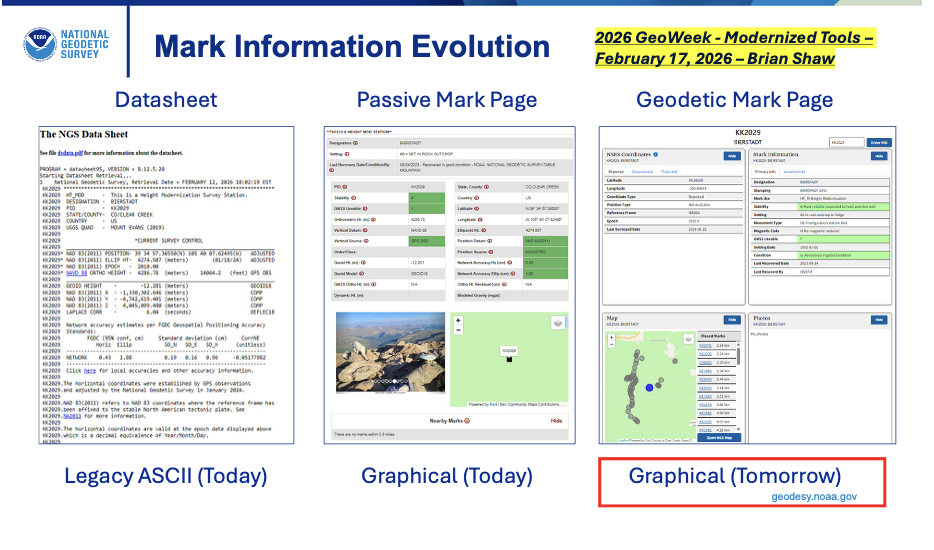
    Accessing Data from NGS. (Presented at GeoWeek 2026)
    Accessing Data from NGS. (Presented at GeoWeek 2026)
    Accessing Data from NGS. (Presented at GeoWeek 2026)
    Accessing Data from NGS. (Presented at GeoWeek 2026)
    Accessing Data from NGS. (Presented at GeoWeek 2026)
    Accessing Data from NGS. (Presented at GeoWeek 2026)

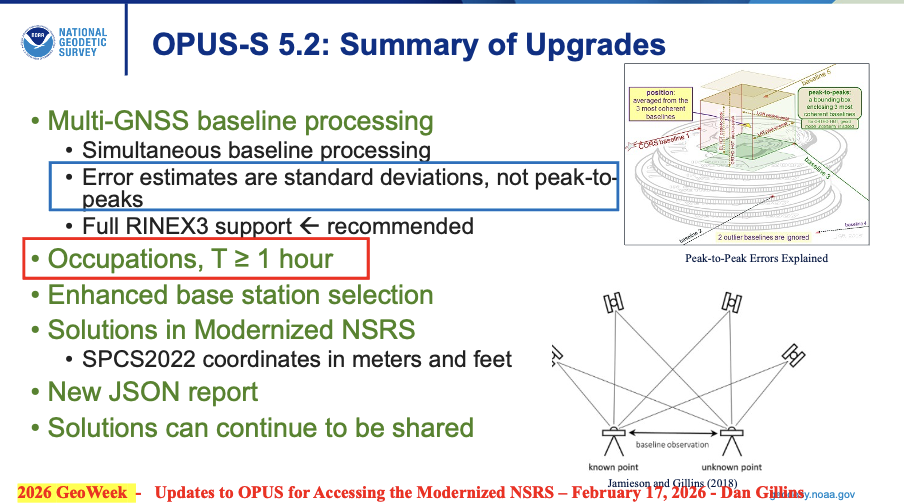
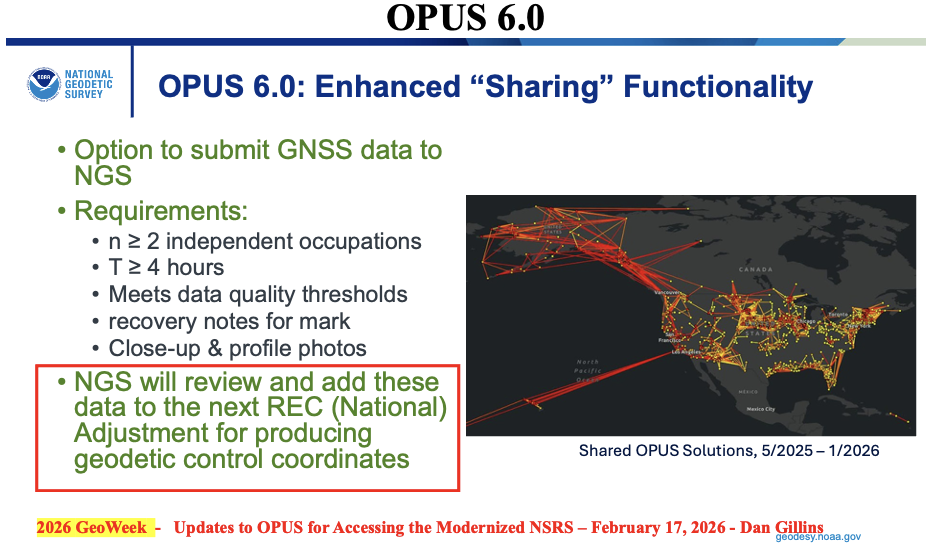
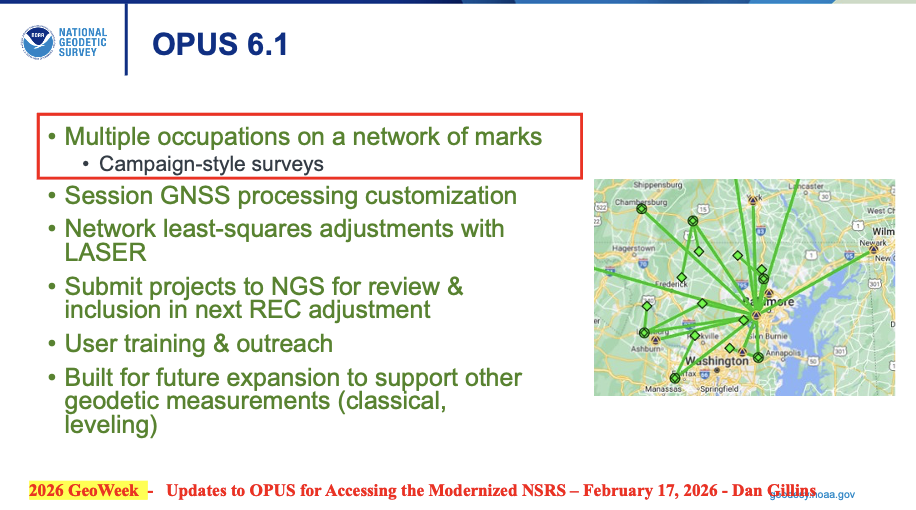
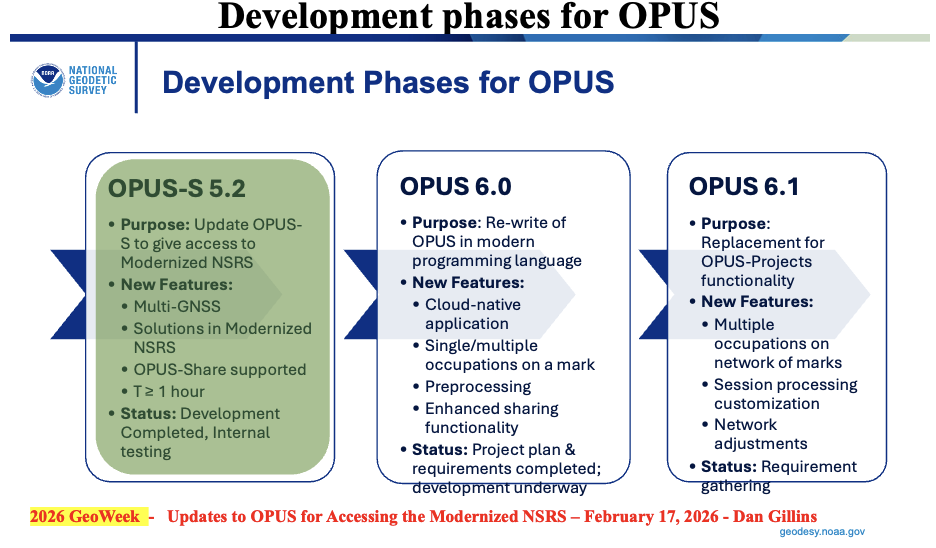
    During Dan Gillins presentation he highlighted that NGS has three development phases for OPUS underway to support the Modernized NSRS:

    OPUS-S 5.2: Multi-GNSS with similar functionality as current OPUS-S

    • Occupations – one hour or greater
    • Standard deviations estimate instead of peak-to-peak values

    OPUS 6.0: Rewrite of code base in cloud-native application

    • single/multiple occupations on a single mark
    • enhanced sharing functionality
    • Occupation Time – minimum of 4 hours
    • NGS will review and add these data to the next reference epoch coordinate (REC) adjustment

    OPUS 6.1: Extension of OPUS 6.0 for multiple marks in a network

    • Replace OPUS-Projects functionality
    • Multiple occupations on a network of marks (campaign-style surveys)
    • Will allow multiple occupations on a single mark – uploads ~10 data files on a mark
    • Built for future expansion to support other geodetic measurements (classical, leveling)
    I want to emphasize that, in my opinion, NGS is doing a fantastic job with the limited resources that they have.  That said, I still have an issue with adopting the new NSRS without having a process for users to submit data to NGS for review, approval, and publication by NGS.  This may not be an issue if NGS’s OPUS 6.1 is available soon after the new NSRS is adopted by the Federal Agencies.

    My August 2025 GPS World Newsletter discussed the OPUS products under development and, as I mentioned at that time, in my opinion, may be a problem for some users.  As I stated in my August newsletter, for the new NSRS to be successfully implemented by users, it is essential that all the necessary software tools are available to enable users to submit projects for review, approval and publication by NGS. 


    Excerpt from August 2025 GPS World Newsletter

    “The NGS News announcement provides a list of products that will be available and a list of products that will not be available when the new NSRS is adopted. Users need to understand what products will not be available after NGS officially adopts the new NSRS so they can determine what that means to their workflow process and client requirements.  In my opinion, for the new NSRS to be successfully implemented by users, it is essential that all the necessary software tools are available to enable users to submit projects for review, approval, and publication by NGS.  As many of you know, when I worked for NGS, I was the Project Manager of the North American Vertical Datum of 1988 (NAVD 88). That said, from my experience as the NAVD 88 Project Manager, having the appropriate tools available was important for users to implement NAVD 88.  As a matter of fact, NGS accepted and processed vertical control data in both NGVD 29 and NAVD 88 for a period to assist users in the implementation of the new vertical reference datum.”


    NGS does state that users will be able to submit data through OPUS and OPUS Share to obtain estimates of coordinates in the new NSRS.  Unfortunately, using OPUS-Share results that are NOT official NSRS coordinates published by NGS could lead to confusing results and potential lawsuits since NGS does not stand behind the results and recommends NOT using OPUS-Share results for geodetic control.

    This is NGS’s statement on OPUS-Share: Additionally, the popular function of “sharing” your solution with others (colloquially called “OPUS-Share”) will be retained, but with appropriate caveats that the shared solution should not be used as geodetic control. These shared solutions will be available through the geodetic mark pages of the DDS.

    Why should users use OPUS-Share to establish geodetic control when NGS advises against relying on OPUS-Share for establishing geodetic control?  OPUS-Share results are not officially submitted to NGS for review, approval, and publication on an NGS Datasheet. I don’t believe this approach will meet the needs of users who require their projects to be reviewed, approved, and published by NGS.

    Finally, as someone deeply invested in the geodetic community—having retired from NGS and followed NGS developments closely for years—my overall opinion on the NSRS modernization rollout plan for the remaining products is cautiously positive, but with some genuine concerns that I believe NGS and stakeholders should address head-on to ensure a smoother transition.

    The phased beta release approach (starting in 2025 and continuing through 2026) is smart and user focused. Releasing components incrementally on the beta site, allowing at least 6 months of public testing and feedback per major piece (and overall testing extending beyond the final release), shows NGS is prioritizing stability over speed. The emphasis on stakeholder input, FGCS approval (now looking like late 2026 or early 2027), and a multi-month transition to the official site align well with best practices for such a massive shift. It’s encouraging to see private industry partners (e.g., ESRI, Blue Marble) already engaging deeply and planning implementations—success will depend on industry buy-in.

    That said, here are my main thoughts and concerns I’d share directly with NGS (perhaps via [email protected], user forums, or upcoming webinars/Q&A sessions):

    Timeline uncertainty: Clearer, more frequent milestone updates (beyond the Track Our Progress page) would help manage expectations. For example, monthly or bimonthly “status dashboard” with remaining beta items and projected release windows would be invaluable.

    OPUS and processing continuity: The shift away from OPUS-Projects 5 toward OPUS 6 and OPUS-Share is logical for a modern GNSS-centric system, but the lack of a firm end-of-support date for legacy OPUS tools (beyond “at least 6 months’ notice”) creates planning headaches for firms with ongoing projects. NGS should commit to a longer grace period—or ideally a defined parallel support window—for legacy OPUS tools (particularly OPUS-Projects 5) after the official adoption of the modernized NSRS.

    Data access and usability in the new DDS: The revamped Geodetic Mark/Station Pages, updated NGS Map interface, and overall Data Delivery System sound promising (more visual, integrated RECs/SECs, photos, etc.), but surveyors rely heavily on reliable, scriptable access (e.g., for bulk queries or automation). If the new web-based system lacks robust APIs or export options comparable to current datasheets/legacy tools, it could hinder efficiency. Beta testers should push hard on this during the 6+ month window.

    Transformation tools and legacy data handling: Enhanced web-based tools are key for bridging old-to-new (NAD 83/NAVD 88 to NATRF2022/NAPGD2022), but users need confidence that transformations minimize errors, especially in deformation-prone areas.

    Communication and outreach: NGS has improved with webinars, the Presentations Library, and beta feedback channels, and more targeted outreach to state agencies, professional societies (NSPS, AAGS), and software vendors has helped. That said, many in the field still feel “in the dark” about practical impacts—case studies, training resources, and FAQs tailored to common workflows would go far.

    In summary, the plan is thoughtful and deliberate, reflecting lessons from past delays. If NGS maintains transparency, incorporates feedback aggressively during beta, and ensures vendor readiness, the modernized NSRS will be a major win for accuracy, sustainability, and GNSS alignment.

    I’d encourage anyone reading this (including NGS staff) to test the beta products actively, submit detailed feedback, and participate in forums/Q&As. The community input will make or break the success of this once-in-a-generation update.


  • Seen & heard: BeiDou birds and spoofing target airlines

    Seen & heard: BeiDou birds and spoofing target airlines

    “Seen & Heard” is a monthly feature of GPS World magazine, traveling the world to capture interesting and unusual news stories involving the GNSS/PNT industry.


    galitskaya/iStock/Getty Images Plus/Getty Images
    Image: galitskaya/iStock/Getty Images Plus/Getty Images

    The scooter burglar

    By using location data and a username from a Lime rental scooter, police have identified a man caught on video scootering around a Denver, Colorado, neighborhood loading up on stolen goods from surrounding homes, reported 9 News. Police obtained a search warrant for the scooter’s location data and account information. The suspect appears to have used his real name when renting the scooter to conduct the burglaries. 9 News is not naming the man identified as the scooter user as he hasn’t been arrested or charged. However, a background check on his name revealed he’s currently wanted on two theft cases that occurred in 2022, also in Denver.


    Doordashing goes wrong

    Image: ProjectB/E+/Getty Images
    Image: ProjectB/E+/Getty Images

    A DoorDash driver followed his navigation system into a wooded area and then into a body of water while attempting to deliver an order to a residential neighborhood in Middleton, Massachusetts, reported the Daily Caller. After following the navigation system straight into water, the driver called police. The Middleton Police Department is now charging the DoorDash driver for “negligent operation of a motor vehicle” and has put in a request to suspend the driver’s license.


    BeiDou birds

    Image: Paola Iamunno/iStock/Getty Images Plus/Getty Images
    Image: Paola Iamunno/iStock/Getty Images Plus/Getty Images

    Researchers at the Jiangxi Nanfengmian National Nature Reserve in China are utilizing BeiDou during bird banding to monitor their migration period from September to October. Bird banding involves attaching customized tags to birds’ legs or wings to track their movements and patterns. Out of 614 birds, 36 are being equipped with specially designed positioning devices that will continuously transmit data for researchers to analyze migration routes, stopping places, and migration time, according to a nature reserve official.


    Spoofing targets airlines

    Image: Chalabala/iStock/Getty Images Plus/Getty Images
    Image: Chalabala/iStock/Getty Images Plus/Getty Images

    More than 20 airline and corporate jets flying over Iran overnight on October 1, were targeted by spoofed GPS signals. The spoofed signals were sent from the ground, infiltrated the navigation systems of the jets, and steered them off course, reported The Times of India. According to the Ops Group, which runs a flight data intelligence crowdsourcing website, a majority of the GPS spoofing occurred in airway UM688 in Iran’s airspace. In response, the U.S. Federal Aviation Administration issued this warning to airlines: “Iraq/Azerbaijan — GPS jamming and spoofing poses safety risk.”

  • ION GNSS+ 2023: Day two recap

    ION GNSS+ 2023: Day two recap

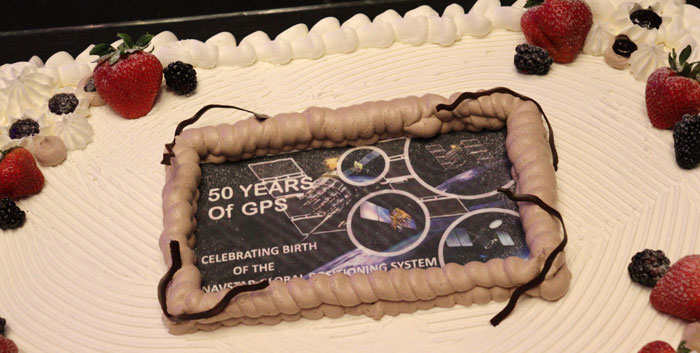
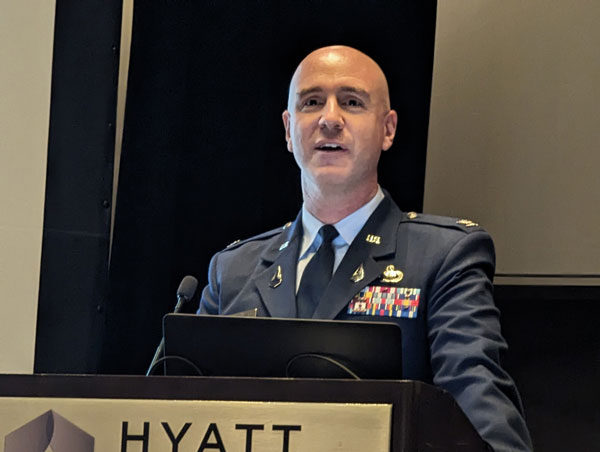
    ION GNSS+ 2023 is underway at the Hyatt Regency Denver at Colorado Convention Center. On the second day, industry leaders and show attendees gathered for the 63rd meeting of the Civil GPS Service Interface Committee. During a break, a cake was wheeled out to celebrate 50 years of GPS. GPS World staff wanted to highlight some key parts of the event.

    (Image: Matteo Luccio)

    (From left to right) Rick Hamilton, GPS Info Analysis Team Lead, U.S. Coast Guard; Harold “Stormy” Martin, Director, National Coordination Office for Space-Based Positioning, Navigation, and Timing; Dr. Bradford Parkinson, Edward Wells Professor, Emeritus, Aeronautics and Astronautics (Recalled), Co-Director, Center for Position, Navigation and Time, Stanford University; Capt. Scott Calhoun, Commanding Officer, U.S. Coast Guard Navigation Center (NAVCEN) and Karen Van Dyke Director, PNT and Spectrum Management, U.S. Department of Transportation, gathered around a cake to celebrate the 50th anniversary of GPS.

    Image: Matteo Luccio
    Image: Matteo Luccio

    Image: Matteo Luccio
    Image: Matteo Luccio

    A closer look at the 50 years of GPS cake. Learn more about the history of GPS here.

    Image: Matteo Luccio
    Image: Matteo Luccio

    Lt. Colonel Robert Wray, Commander, Second Space Operations Squadron, U.S. Space Force (second from left), who was featured on the May cover of GPS World. Click here to read our May cover story, featuring an exclusive interview with Lt. Colonel Wray about the training and duties of his team, the challenges they face, and more.

    Image: Matteo Luccio
    Image: Matteo Luccio

    Dr. Bradford Parkinson (left) and Dr. Robert Hampshire, Deputy Assistant Secretary of Research and Technology and Chief Science Officer, U.S. Department of Transportation (right). Click here to learn more about Dr. Bradford Parkinson, who is nicknamed “The father of GPS.”

    Image: Matteo Luccio
    Image: Matteo Luccio

    Col. Andy Menshner, GPS Space and Ground (SML), Space Systems Command, U.S. Space Force, speaking about GPS acquisitions and development updates during the Civil GPS Service Interface Committee.

    Image: Matteo Luccio
    Image: Matteo Luccio

    (Second from left) Karen Van Dyke, Director, PNT and Spectrum Manager, U.S. Department of Transportation Deputy Chair, serves as chair of the 63rd Civil GPS Service Interface Committee. Read more from the Department of Transportation here.

    Image: Matteo Luccio
    Image: Matteo Luccio

    Attendees gathered to hear speakers from the U.S. Department of Transportation, the U.S. Space Force, and other departments and agencies.

    Click here to stay up to date with our show coverage!

  • Join GPS World at ION GNSS+ 2023

    Join GPS World at ION GNSS+ 2023

    Image: ION website
    Image: ION website

    Institute of Navigation (ION) GNSS+ is the world’s largest technical meeting and showcase of GNSS technology, products and services. This year’s conference will bring together international leaders in GNSS and related positioning, navigation and timing fields to present new research, introduce new technologies, discuss current policy, demonstrate products and exchange ideas.

    ION GNSS+ 2023 is scheduled for September 11-15, at the Hyatt Regency in Denver, Colorado.

    GPS World, a proud media partner of ION GNSS+ 2023, will be attending the conference and will be located at booth 214 next to CAST Navigation.

    If you are attending the conference, feel free to stop by the GPS World booth.

    To view the full ION GNSS+ Technical Program click here.

  • Research roundup: Autonomous applications in transportation

    Research roundup: Autonomous applications in transportation

    Image: gorodenkoff/iStock/Getty Images Plus/Getty Images
    Image: gorodenkoff/iStock/Getty Images Plus/Getty Images

    GNSS researchers presented hundreds of papers at the 2022 Institute of Navigation (ION) GNSS+ conference, which took place Sept. 19–23, 2022 in Denver, Colorado, and virtually. The following four papers focused on autonomous applications in transportation. The papers are available here.

    Addressing integrity monitoring of autonomous navigation

    There are critical issues for the integrity monitoring of autonomous navigation applications, which include an adequate uncertainty budget in the observation domain, redundancy for the determination of the navigational states, and the capability of fault detection and exclusion.

    Several aspects are addressed in the paper, including how to: determine interval bounds to handle GNSS multipath effects in urban environments, realize fault detection and exclusion based on constraint satisfaction and set membership, and improve the detector using weighting models.

    The authors of the paper aim to contribute to the alternative integrity approach based on interval and set representations for bounding and propagating system uncertainty. Simulated and real-world experiments are carried out to demonstrate the feasibility of the authors’ proposed methods.

    The authors note that statistical evaluation of integrity will not always suffice due to the presence of remaining systematic uncertainty, but state the alternative integrity approach will contribute to future autonomous navigation applications.

    Su, Jingyao; Schön, Steffen; “Advances in Deterministic Approaches for Bounding Uncertainty and Integrity Monitoring of Autonomous Navigation.”

    Estimation and reference systems in automation

    For a high level of automation, estimation is crucial, and to achieve a full and reliable navigation evaluation, a trustable reference system needs to be developed.

    Although the presence of a reference system and of an inertial measurement unit with GNSS through the multi-sensor fusion scheme was integrated, in GNSS-denied or challenging environment the navigation solution could not be accurately estimated and still needs to be fixed.

    The authors of the paper propose new strategies to better estimate the lidar-based position uncertainty and to update the reference system.

    The first strategy proposed involves determining the appropriate position error covariance matrix, based on the Hessian matrix and the scale of covariance obtained from a normal distribution transform (NDT) scan matching technique and the geometric dilution of precision computed from the distribution of point cloud segments in each scan.

    In the second strategy proposed in the paper, the updated reference system was post-processed according to the loosely coupled INS/GNSS/NDT integration scheme with a forward and backward smoothing process.
    The results of the proposed strategies indicated that the updated reference system provides more reliable navigation estimation compared to an existing reference system from commercial software and can be used for accurate evaluation of positioning, navigation and timing with automated vehicle applications.

    Srinara, Surachet; Chiu, Yu-Ting; “Adaptive Covariance Estimation of Lidar-Based Positioning Error for Multi-Sensor Fusion Scheme with Autonomous Vehicular Navigation System.”

    Evaluating TerraStar-X

    GNSS performance using typical, low-cost GNSS devices in vehicles is not enough to achieve the positioning and availability needed for lane-level accuracy on autonomous vehicles. The antenna and receiver hardware available in standard vehicles limits the position accuracy and convergence performance. These limitations make the positioning more susceptible to error sources such as receiver multipath, noise, carrier tracking and stability.

    GNSS correction services with additional design considerations and sophisticated algorithms are needed to work within the constraints of automotive-grade GNSS devices to achieve the performance required for lane-level positioning.

    TerraStar X technology from NovAtel enables these applications. It includes an orbit and clock determination system (OCDS), which produces a set of corrections, precise satellite orbits and clocks, and satellite-specific biases for individual signals augmented by the computation of additional regional corrections.

    The authors of the paper outline the design and performance of the combined OCDS and regional correction system. They demonstrate the performance of the TerraStar X technology across a variety of applications.
    The addition of regional corrections enables automotive and mass-market applications to achieve in-lane positioning in seconds, using any dual-frequency, dual-constellation GNSS hardware. The result is software that provides a continuous stream of multi-constellation, multi-frequency GNSS corrections — enabling a correction service that makes the affordable GNSS device ecosystem possible.

    Regional corrections also improve the performance of survey-grade GNSS receivers.

    Mervart, Leos; Lukes, Zdenek; Alves, Paul; “TerraStar X Technology: Design of GNSS Corrections for Instantaneous Lane-Level Accuracy on Large Scale Connected Vehicles and Devices.”

    Solving the localization problem in autonomous driving

    The localization problem in autonomous driving imposes two criteria on the navigation solution: accuracy and reliability or integrity. According to the authors of this paper, solving the localization problem is a key requirement to enabling the development of autonomous platforms.

    This paper presents AUTO, a real-time integrated navigation system that tightly integrates INS, GNSS-RTK, odometer, and multiple radars sensors with high-definition maps to achieve a high-rate, accurate, continuous, and reliable navigation solution. It also shows how AUTO leverages a tight integration of imaging radars with other traditional sensors to provide a robust navigation solution with corresponding estimates of the uncertainty.

    The AUTO solution was tested in a variety of environments and locations, including a range of conditions such as winter weather, to assure the robustness and reliability required by autonomous applications.

    The results demonstrate the lane level accuracy of the solution in a variety of challenging urban and downtown environments. Additionally, the tight integration enables the determination of protection levels to describe upper bounds on the uncertainty.

    The results in the paper are illustrated using a Stanford Diagram, along with a user-defined alert limit to describe the solution integrity and availability. The proposed algorithm uses a map matching technique between the imaging radar data and a globally referenced high-definition map to better estimate the solution uncertainty and protection levels.

    AUTO’s tightly integrated approach to integrity monitoring means uncertainties and protection levels can be determined even in areas where the system may experience extended periods of GNSS unavailability.

    Krupity, Dylan; Chan, Billy; Ali, Abdelrahman; Salib, Abanob; Georgy, Jacques; Goodall, Christopher; “Integrity Monitoring and Uncertainty Estimation with AUTO’s Non-linear Integration of Multiple Imaging Radars and INS/GNSS for Autonomous Vehicles and Robots.”

  • XPONENTIAL 2023: Final thoughts

    XPONENTIAL 2023: Final thoughts

    AUVSI XPONENTIAL 2023 has officially concluded. GPS World had the opportunity to visit several booths during the conference and attend a variety of educational sessions while in the heart of beautiful, downtown Denver.

    See below for some takeaways from XPONENTIAL.

    "Protecting the Homeland: The future of C-UAS” was presented by industry leaders and highlighted capabilities available for detecting, intercepting, and mitigating UAS encroaching or threatening covered facilities, critical infrastructure, and other high-value targets in the National Airspace System.
    “Protecting the Homeland: The future of C-UAS” was presented by industry leaders and highlighted capabilities available for detecting, intercepting, and mitigating UAS encroaching or threatening covered facilities, critical infrastructure, and other high-value targets in the National Airspace System.

    GPS World stopped by infiniDome to hear more about its solutions, including GPSdome.
    GPS World stopped by infiniDome to hear more about its solutions, including GPSdome.

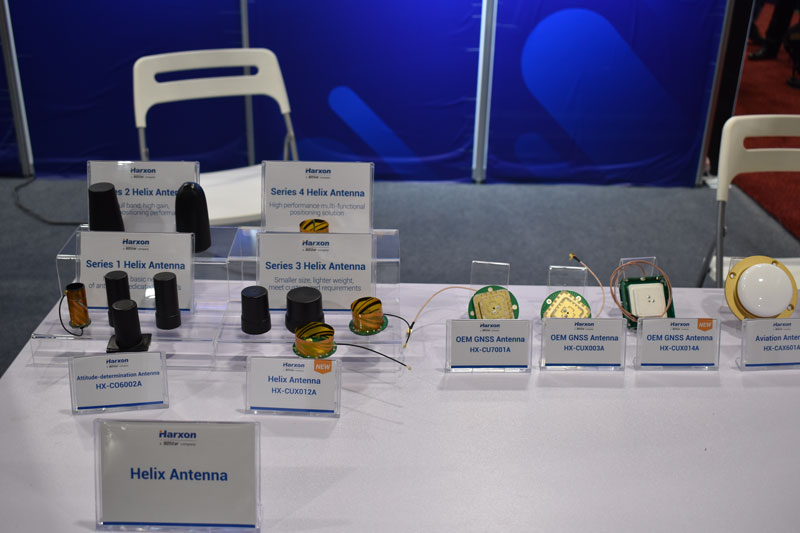
    Harxon had its new helix antenna series on display at its XPONENTIAL booth.
    Harxon had its new helix antenna series on display at its XPONENTIAL booth.

    “Autonomous Exploration and Mapping of Unknown Environments with UAS” dove into the development of simultaneous localization and mapping, world modeling and exploration-based planning algorithms. This session was led by Eric Thorn, manager in the Intelligent Systems Division at Southwest Research Institute.

    “Autonomous Exploration and Mapping of Unknown Environments with UAS” dove into the development of simultaneous localization and mapping, world modeling and exploration-based planning algorithms. This session was led by Eric Thorn, manager in the Intelligent Systems Division at Southwest Research Institute.

    Honeywell shared the ground station that it is developing.
    Honeywell shared the ground station that it is developing.

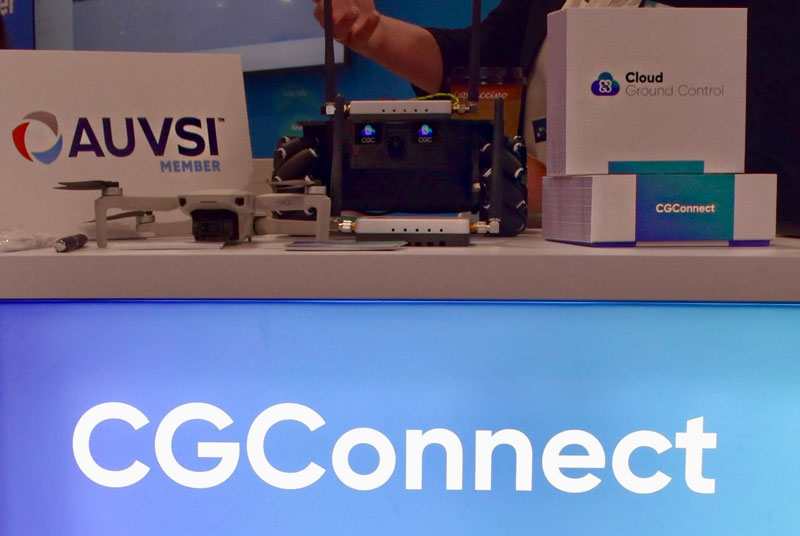
    While CGConnect has already been launched overseas by Advanced Navigation, its first debut in the United States was at XPONENTIAL.
    While CGConnect has already been launched overseas by Advanced Navigation, its first debut in the United States was at XPONENTIAL.

  • Winners named for AUVSI XCELLENCE Awards

    Winners named for AUVSI XCELLENCE Awards

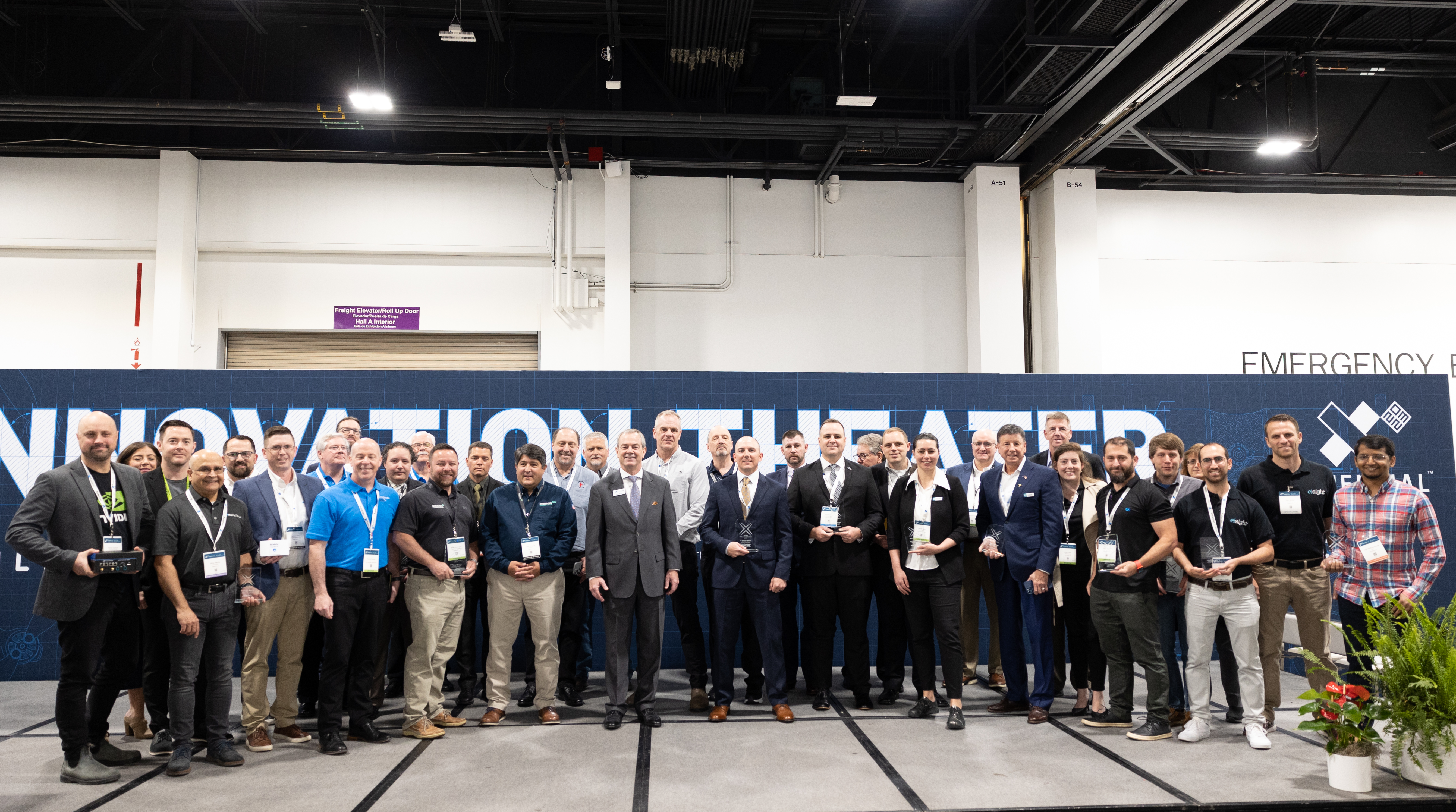
    AUVSI XCELLENCE Awards winners. (Image: AUVSI)
    AUVSI XCELLENCE Awards winners. (Image: AUVSI)

    The Association for Uncrewed Vehicle Systems International (AUVSI) has named the winners of the sixth annual AUVSI XCELLENCE Awards.

    The awards recognize the accomplishments of companies, organizations and individuals across the uncrewed systems community. The winners were recognized during an awards ceremony at XPONENTIAL 2023 which is being held this week at the Colorado Convention Center in Denver, Colorado. This year’s 50th anniversary event is co-hosted by Messe Düsseldorf North America.

    AUVSI’s XCELLENCE Awards honor innovators with a demonstrated commitment to advancing autonomy, leading and promoting safe adoption of uncrewed systems and developing programs that use these technologies to save lives and improve the human condition.

    These are the finalists in those categories:

    XCELLENCE in Academic Research

    First Place: University of Colorado Boulder, 20 Years of UAS Research XCELLENCE
    Second Place: Virginia Tech’s Mid-Atlantic Aviation Partnership, Robert Briggs
    Third Place: Ocean Alliance, Tagging Whales with Drones

    XCELLENCE in Innovation

    First Place: Skydio, Skydio Dock, Automated Inspections of Sites with Autonomous, Remote Drone Operations
    Second Place: Plus, PlusDrive, An Industry-defining Driver-in, Highly Automated Driving (HAD) Solution
    Third Place: Sentera, Eliminating Stitching with the Sentera DGR System

    XCELLENCE IN OPERATIONS – Enterprise Application

    Advanced Navigation's Cloud Ground Control featured at XPONENTIAL 2023.
    Advanced Navigation’s Cloud Ground Control featured at XPONENTIAL 2023.

    First Place: JobsOhio and the Ohio Department of Transportation, Propelling AAM in Ohio
    Second Place: Advanced Navigation, Cloud Ground Control
    Third Place: City of Pendleton, Pendleton UAS Range

    XCELLENCE IN TECHNOLOGY

    Enabling Components & Peripherals
    First Place: infiniDome, infiniDome’s GPSdome2
    Second Place: Elsight, Elsight Halo
    Third Place: MatrixSpace, MatrixSpace Networked Radar

    Hardware & Systems Design
    First Place: D-Fend Solutions, EnforceAir
    Second Place: Advanced Navigation, Hydrus
    Third Place: Connect Tech, Anvil Embedded System with NVIDIA  Jetson AGX Orin

    Software Design and Coding
    First Place: BlueSpace.ai, Scalable and Explainable AI for Autonomy, powered by 4D Predictive Perception
    Second Place: Skydio, Skydio Scout, Situational Awareness for Moving Convoys
    Third Place: AlarisPro, Inc., AlarisPro Safety Ecosystem (ASE) – Advancing UAS Reliability Through Shared Data Across UAS Operators and Manufacturers

    The infinidome booth at XPONENTIAL 2023 showcased its XCELLENCE award.
    The infiniDome booth at XPONENTIAL 2023 showcased their XCELLENCE award.

    XCELLENCE in Workforce Development

    First Place: Laurel Ridge Community College, Laurels Take Flight
    Second Place: DroneUp, with partner, Richard Bland College, Established the First Commercial Drone Workforce Training Program for College Credit
    Third Place: Embry-Riddle Aeronautical University Worldwide and Warren College, Better Together: Producing Effective Educational Opportunities for the UAS Workforce

    The recipients of the 2023 AUVSI XCELLENCE Humanitarian and Public Safety Awards have established themselves as leaders in the application of uncrewed technology to provide solutions to the world’s most pressing problems. Each awards category recognizes organizations that have made a significant impact using uncrewed systems to serve in humanitarian or public safety efforts. The six organizations will equally divide a $6,000 prize for their  humanitarian and public safety efforts.

    This year’s recipients are:

    XCELLENCE in Mission

    Humanitarian Project/Program
    First Place: ArroTech, Dr. Stephen Dunnivant
    First Place: MissionGO, Inc., Operation Healing Eagle Feather
    First Place: The David McAntony Gibson Foundation (GlobalMedic), GlobalMedic RescUAV Response to La Soufrière Volcano in Saint Vincent and the Grenadines

    Public Safety

    First Place: DRONERESPONDERS, DRONERESPONDERS Public Safety Alliance
    First Place: Texas Department of Public Safety, Texas Department of Public Safety
    First Place: United States Forest Service, Testing and Scaling New Technologies for Operations and Safer Mixed Airspace Ops

  • XPONENTIAL 2023: Day two recap

    XPONENTIAL 2023: Day two recap

    AUVSI XPONENTIAL is underway in Denver, Colorado, at the Colorado Convention Center. After the second day of touring the XPO Hall, GPS World staff wanted to highlight some key parts of the day.

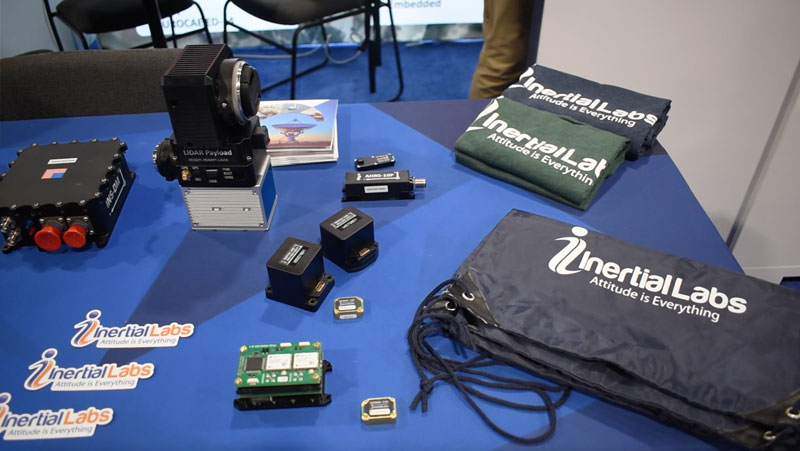
    Jamie Marraccini, president and CEO of Inertial Labs, sat down with GPS World for an exclusive interview regarding new upgrades to its products, its new partnership with Hesai Technology, and more. Check back soon for the video interview.
    Jamie Marraccini, president and CEO of Inertial Labs, sat down with GPS World for an exclusive interview regarding new upgrades to its products, its new partnership with Hesai Technology, and more. Check back soon for the video interview.

    GPS World visited the Omnetics booth and spoke with Bret Newton, Business Development.
    GPS World visited the Omnetics booth and spoke with Bret Newton, Business Development.

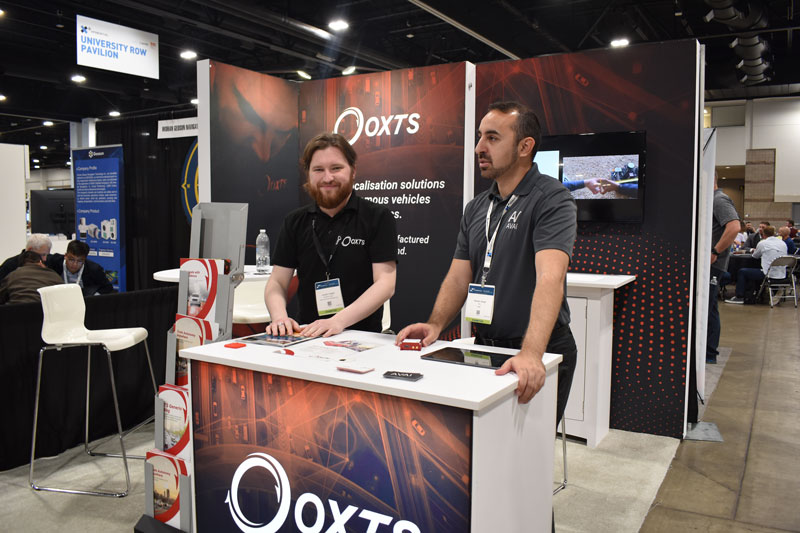
    Staff of OxTS, a GPS World marketing partner, at their booth.
    Staff of OxTS, a GPS World marketing partner, at their booth.

    Jia Xu, CTO and senior director of UAS/UAM engineering at Honeywell, gave GPS World an exclusive interview regarding the company’s most recent developments, partnerships and more. Check back soon for the video interview.
    Jia Xu, CTO and senior director of UAS/UAM engineering at Honeywell, gave GPS World an exclusive interview regarding the company’s most recent developments, partnerships and more. Check back soon for the video interview.

  • XPONENTIAL 2023: First day recap

    XPONENTIAL 2023: First day recap

    Attendees crowded the show floor during AUVSI XPONENTIAL day one.
    Attendees crowded the show floor during the first day of AUVSI XPONENTIAL 2023.

    AUVSI XPONENTIAL is underway in Denver, Colorado, at the Colorado Convention Center. After the first day of touring the XPO Hall of more than 600 exhibits and attending educational sessions lead by industry leaders and speakers, GPS World staff noticed a key theme: mitigating GNSS jamming and spoofing by advancing technology for UAVs.  

    Educational Sessions

    Photo:
    Franck Boynton, Vice President of NavTachGPS, highlighted Tallysman ‘s HC871SXF during his “Real World GPS/GNSS Protection from Start to Finish,” presentation.

    “Real World GPS/GNSS Protection from Start to Finish,” was presented by Franck Boynton, Vice President of NavTechGPS. He discussed why anti-jam equipment is needed and how to mitigate jamming. Boynton mentioned several anti-jam products, such as NovAtel’s OEM series product line, Septentrio’s AIM+, Tallysman’s HC871SXF and more.

    Additionally, GPS World contributing writer, Dana Goward, received a mention for his article regarding the GPS jamming incident on Jan 21, 2022, at Denver International Airport, which can be found here. Boynton also suggested checking out the RNT Foundation, which is a nonprofit, public benefit corporation that helps protect critical infrastructure by promoting resilient navigation and timing, of which Goward is the president and director.

    “The Importance of GNSS Security in UAV Applications,” featured a panel of speakers that included (from left to right) Captain Joe Burns, CEO of the Airo Group and member of the National Space-Based Positioning, Navigation and Timing Advisory Board, Jeff Horne, vice president of security at Skydio Abigail Smith, executive director of UAS security at the FAA, Gustavo Lopez, market access manager at Septentrio, and moderated by Michael Glutting, sales manager at Septentrio.
    “The Importance of GNSS Security in UAV Applications,” featured a panel of speakers that included (from left to right) Captain Joe Burns, CEO of the Airo Group and member of the National Space-Based Positioning, Navigation and Timing Advisory Board, Jeff Horne, vice president of security at Skydio Abigail Smith, executive director of UAS security at the FAA, Gustavo Lopez, market access manager at Septentrio, and moderated by Michael Glutting, sales manager at Septentrio.

    “The Importance of GNSS Security in UAV Applications,” featured a panel of speakers that included Abigail Smith, executive director of UAS security at the FAA, Captain Joe Burns, CEO of the Airo Group and member of the National Space-Based Positioning, Navigation and Timing Advisory Board, Gustavo Lopez, market access manager at Septentrio, Jeff Horne, vice president of security at Skydio, and moderated by Michael Glutting, sales manager at Septentrio. During the panel discussion, the speakers explained types of GPS interference, including jamming and spoofing, and the risk they pose to UAVs. The latest methods for strengthening both GNSS receivers and control units to design secure and robust UAVs was also discussed.

    Day-of highlights

    Maddie Saines, managing editor, and Jesse Khalil, digital media specialist, had the opportunity to stop by several booths in the XPO Hall on the first day of XPONENTIAL. A few highlights from the day included speaking with Ahmet Salih Erdem, deputy general manager at Tualcom, getting an in-depth look at SBG Systems’ Quanta Mirco and Ekinox Micro with Yoann Plenet, head of product management, and getting a first-hand look into the newest products from Tallysman Wireless — such as SSL889XF — from Ken MacLeod, product manager for Tallysman.

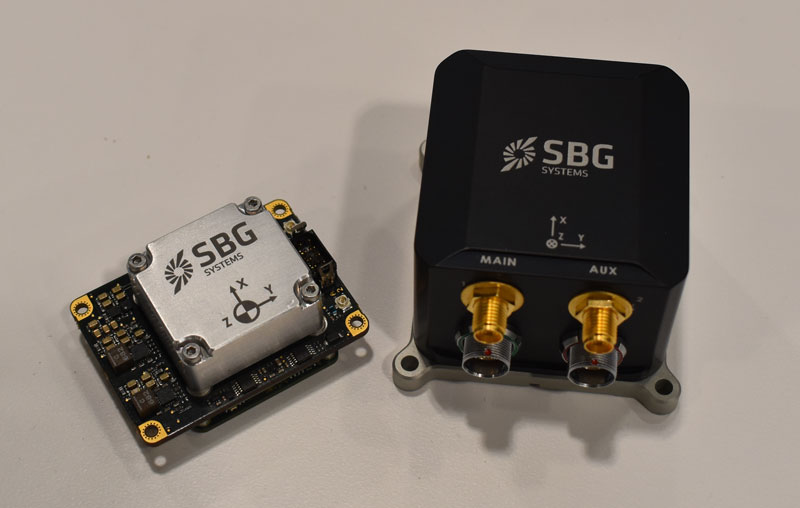
    SBG System's Qunata Mirco and Ekinox Micro.
    SBG System’s Quanta Mirco and Ekinox Micro.

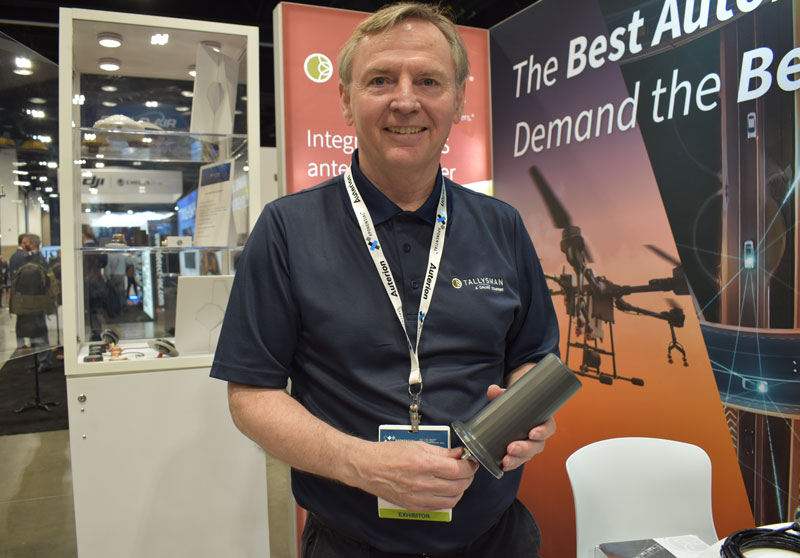
    Ken MacLeod, product manager for Tallysman, showcasing the SSL889XF.
    Ken MacLeod, product manager for Tallysman, showcasing the AJ977XF.

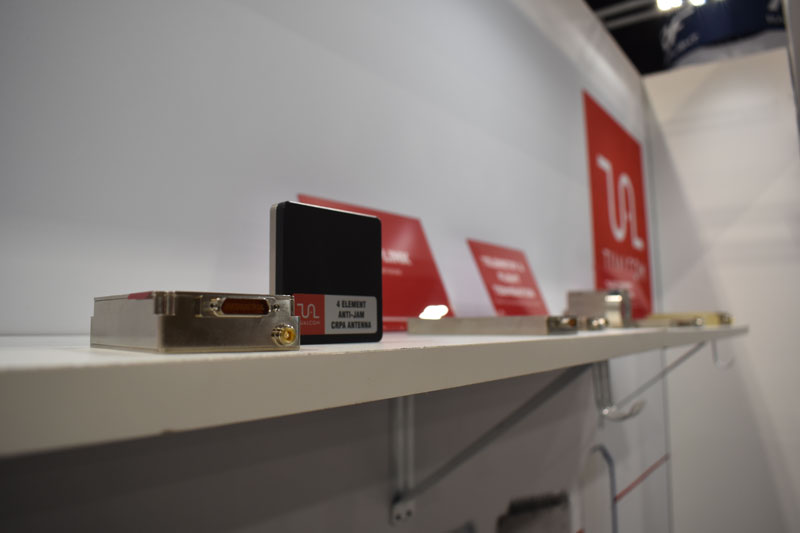
    Tualcom's booth at XPONENTIAL 2023 showcased new products such as ANTY, its GPS Anti-Jammer.
    Tualcom’s booth at XPONENTIAL 2023 showcased new products such as ANTY, its GPS anti-jamming device.

  • Qualcomm and FlightOps collaborate on UAV tech for first responders

    Qualcomm and FlightOps collaborate on UAV tech for first responders


    Image: Qualcomm
    Image: Qualcomm

    FlightOps is collaborating with Qualcomm Technologies to develop UAV automation technology designed specifically for first responders. FlightOps has integrated its advanced UAV automation technology onto the Qualcomm Robotics RB5 platform — which has 5G connectivity, on-device artificial intelligence, and heterogeneous computing capabilities.

    The integration of FlightOps’ technology onto the Qualcomm Robotics RB5 will enable the platform to automate critical tasks such as flight planning, monitoring and data collection, enabling first responders to focus on the mission at hand.

    The technology is being showcased during XPONENTIAL May 9-11. FlightOps is at booth 4041.

    The live remote flights, operated from Denver and flown in San Diego, will demonstrate the capabilities of the integrated product and how it can be used to improve response times as well as enhance situational awareness during emergencies.

  • BAE Systems and UST team up at XPONENTIAL


    Photo:
    UST and BAE Systems booths at AUVSI XPONENTIAL 2023. BAE sys

    Unmanned Systems Technology (UST), the global digital marketplace for unmanned systems, technology and software, is exhibiting alongside BAE Systems Digital Intelligence at AUVSI XPONENTIAL 2023 in Denver, Colorado, May 8-11.

    The collaboration aims to increase capabilities of uncrewed systems through user engagement. The BAE Systems Digital Intelligence team is available throughout XPONENTIAL, exhibiting alongside Unmanned Systems Technology at booth 4227.

    At the booth, the UST team will demonstrate KINETIC — an online demand generation solution for companies across the unmanned systems supply chain. Existing Kinetic partners attending the show will be introduced to the team responsible for small uncrewed systems programs at BAE Systems Digital Intelligence.

  • Finalists announced for AUVSI XCELLENCE Awards

    Finalists announced for AUVSI XCELLENCE Awards

    The Association for Unmanned Vehicles Systems International (AUVSI) has announced the finalists for its sixth annual XCELLENCE Awards. The winners will be announced during an awards ceremony at AUVSI XPONENTIAL 2023 at the Colorado Convention Center in Denver.

    The AUVSI XCELLENCE Awards honor innovators who demonstrate commitment to advancing technology, leading and promoting safe operations and developing programs that use unmanned systems to improve the human conditions.

    “XCELLENCE IN ACADEMIC RESEARCH”

    Neural10, Autonomous Navigation in GPS-Denied Zones
    Ocean Alliance, Tagging Whales with Drones
    University of Colorado Boulder, 20 Years of UAS Research XCELLENCE
    University of Michigan, Alireza Mohammadi
    Virginia Tech’s Mid-Atlantic Aviation Partnership, Robert Briggs

    “XCELLENCE IN INNOVATION”

    Austal USA, Austal MCS
    Plus, PlusDrive, An Industry-defining Driver-in, Highly Automated Driving (HAD) Solution
    Sentera, Eliminating Stitching with the Sentera DGR System
    Skydio, Skydio Dock, Automated Inspections of Sites with Autonomous, Remote Drone Operations
    UPS Flight Forward, Inc., Safety Management System First in the Industry Accepted by the FAA

    “XCELLENCE IN OPERATIONS”

    Enterprise Application

    Advanced Navigation, Cloud Ground Control
    City of Pendleton, Pendleton UAS Range
    JobsOhio and the Ohio Department of Transportation, Propelling AAM in Ohio

    “XCELLENCE IN TECHNOLOGY”

    Enabling Components & Peripherals

    Elsight, Elsight Halo
    infiniDome, infiniDome’s GPSdome2
    LEMO Corporation, LEMO M Series High Power
    MatrixSpace, MatrixSpace Networked Radar
    SBG Systems, Quanta Micro

    Hardware & Systems Design

    Advanced Navigation, Hydrus
    Connect Tech, Anvil Embedded System with NVIDIA® Jetson AGX Orin™
    D-Fend Solutions, EnforceAir
    ModalAI, Inc., VOXL 2: 16g Blue UAS Framework 2.0 Autopilot
    TOPODRONE, TOPODRONE AQUAMAPPER

    Software Design and Coding

    Advanced Navigation, Cloud Ground Control
    AlarisPro, Inc., AlarisPro Safety Ecosystem (ASE) – Advancing UAS Reliability Through Shared Data Across UAS Operators and Manufacturers
    BlueSpace.ai, Scalable and Explainable AI for Autonomy, powered by 4D Predictive Perception
    Skydio, Skydio Scout, Situational Awareness for Moving Convoys
    VOTIX, VOTIX

    “XCELLENCE IN WORKFORCE DEVELOPMENT”

    DroneUp, with partner, Richard Bland College, Established the First Commercial Drone Workforce Training Program for College Credit
    Embry-Riddle Aeronautical University Worldwide and Warren College, Better Together: Producing Effective Educational Opportunities for the UAS Workforce
    Fullerton College, Fullerton Drone Lab, Drone Piloting Registered Apprenticeship
    Laurel Ridge Community College, Laurels Take Flight
    National Robotics Education Foundation NREF, National Robotics Education Foundation (NREF)

    “XCELLENCE IN MISSION”

    Humanitarian Project or Program

    ArroTech, Rapid and Accurate Autonomous UXO Detection
    MissionGO, Inc., Operation Healing Eagle Feather
    Near Earth Autonomy, Autonomous Aerial Blood & Medical Supply Delivery to the Wounded
    The David McAntony Gibson Foundation (GlobalMedic), GlobalMedic RescUAV Response to La Soufrière Volcano in Saint Vincent and the Grenadines
    UCAL Fuel Systems Limited, Drone Based Disaster Relief

    Public Safety

    Brookhaven GA Police Department, Brookhaven Police sUAS Team
    DRONERESPONDERS, DRONERESPONDERS Public Safety Alliance
    Hidden Level, Inc., Airspace Monitoring Service (AMS)
    Texas Department of Public Safety, Texas Department of Public Safety
    United States Forest Service, Testing and Scaling New Technologies for Operations and Safer Mixed Airspace Ops