Tag: GNSS

  • The benefits of the multi-GNSS future

    Galileo, BeiDou, QZSS, IRNSS, and more join GPS and GLONASS to bring you wider, broader, greater, more accessible and above all more accurate PNT. How to get all that’s coming at you?

    Multi-GNSS paves the way for complete exploitation of new signals and constellations in navigation, surveying, geodesy and remote sensing.

    What exactly are the benefits of multi-GNSS, and how can you access them? For a start, download the multi-GNSS signal schema, and follow that up by attending a free webinar, “Multi-GNSS: Advantages, Challenges and Test Solutions.

    The free 1-hour webinar, which will take place at 1 p.m. Eastern [10 a.m. Pacific,  7 p.m. (1900h) Central European Time] on Thursday, Sept. 20, will review advantages of using multi-GNSS for the end-user and challenges in obtaining maximum efficiency when combining multiple constellations and signals. It will also discuss different approaches of testing GNSS receivers against jamming and spoofing attacks.

    You will learn:

    • Advantages of using multi-GNSS
    • Challenges when combining multiple constellations
    • Robustness of multi-GNSS receivers to jamming and spoofing
    • Test solutions for GNSS receivers.

    The webinar presents sponsored content by Skydel and Talen-X. Register for it here.

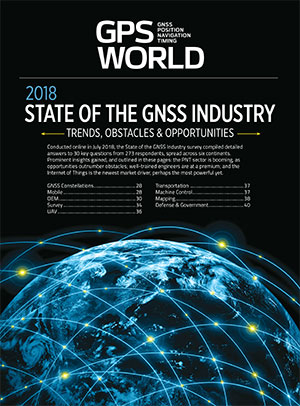
  • 2018 State of the GNSS Industry Report

    2018 State of the GNSS Industry Report

    Trends, Obstacles and Opportunities

    Cover: Toria/Shutterstock.com
    Cover: Toria/Shutterstock.com

    Conducted online in July 2018, the GPS World State of the GNSS Industry survey compiled detailed answers to 30 key questions from 273 respondents, spread across six continents.

    Prominent insights gained, and outlined in these pages: the PNT sector is booming, as opportunities outnumber obstacles; well-trained engineers are at a premium; and the Internet of Things is the newest market driver, perhaps the most powerful yet.


    Insights from the Report

    Opportunities for growth in the GNSS industry

    Wireless and consumer emerge as key players for growth

    GPS World report: Survey sector favors multi-GNSS

    GPS World survey: UAVs on a roll to dominance

    Information key to managing amid complex change for GNSS OEMs

    Inertial navigation emerges as winning co-star for transportation sector

    The current state of the Defense, Security and Government PNT sector

    GPS World survey: Capturing the world with maps

  • GPS World report: Survey sector favors multi-GNSS

    GPS World report: Survey sector favors multi-GNSS

    Health compares favorably with rest of industry

    2018 State of the GNSS Industry survey respondents who identified themselves as from the survey sector constituted 30% of the total, corresponding to the percentage of the magazine’s readership.

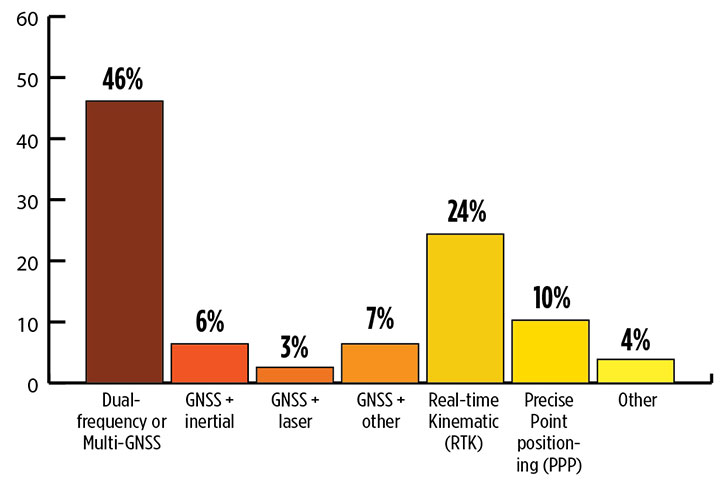
    What is the most promising and practical way to gain the increased accuracy that survey and other high-precision applications continue to demand? (Source: GPS World 2018 State of the Industry survey)
    What is the most promising and practical way to gain the increased accuracy that survey and other high-precision applications continue to demand? (Source: GPS World 2018 State of the Industry survey)

    Higher Accuracy. Regarding the most promising technology to get the increased accuracy that surveying continues to demand, the outright choice was “dual-frequency, dual- or multi-constellation GNSS,” with “real-time kinematic” coming in second. Surprisingly, the newest technology to be introduced to GNSS receivers, inertial correction, lagged at just over 5%.

    Inertial correction devices, which contain gyroscope and accelerometer technology, are now being installed in survey-grade receivers to increase accuracy and productivity. It’s a gamechanger in GNSS data collection for surveyors, so I am surprised by the survey results. These sensors work in conjunction with the receiver to more accurately collect positional information in relation to the point being acquired. While RTK positions are normally collected at 1-20 Hz, the inertial device works in tandem to further refine a more accurate location. As this technology becomes more publicized in phones and other devices, the surveying community will begin to take notice.

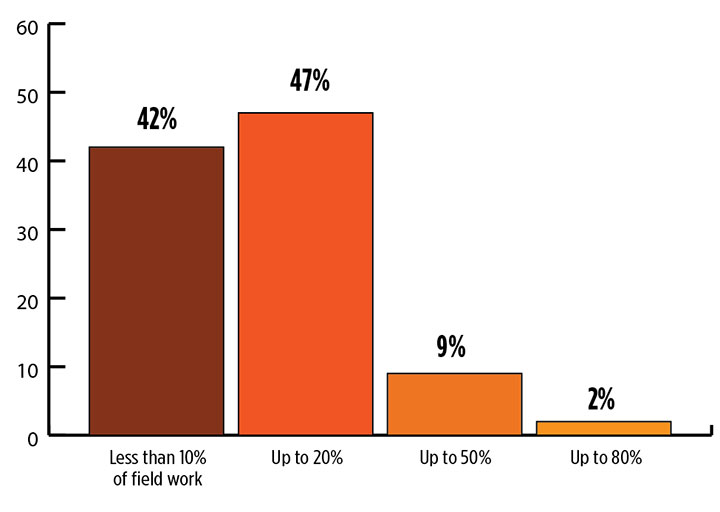
    What role will drones (UAVs) play during the next three years in the survey sector? (Source: GPS World 2018 State of the Industry survey)
    What role will drones (UAVs) play during the next three years in the survey sector? (Source: GPS World 2018 State of the Industry survey)

    Drones. Concerning the role that drones (UAVs) will play in the next three years, by a slim margin — 47% to 42% — respondents state that up to 20% of their work will be completed by UAVs vs. those who feel less than 10% of their work will be done by a drone. Only1.3% answered that UAVs will take over most of their work and displace surveyors in the field for specific survey tasks.

    I see UAVs becoming a standard equipment much like the EDM/total station and GNSS receivers, as it is clearly a unique tool for not just collecting visual images but as a remote sensing device. While it won’t replace workers in the field, it will allow crews to become more efficient, tech-savvy and valuable for human-only types of data collection.

    Business. A whopping 85% of the survey sector found this market either “very healthy, with strong growth” (37%) or “relatively healthy, with moderate growth” (48%). This compares with total of 79% across all GNSS industry sectors. So we’re on top! That is, we are doing comparatively well amid the rest of the GNSS industry — which itself is in very good shape indeed.

    Poll results reflect the positive nature of the surveying profession in relation to technology, specifically GNSS and the utilization of UAVs, in our every day work. Previously, introduction of new technology has been historically unreliable, less than user-friendly, and expensive. The trend with newer technologies, however, has been quite the opposite with shorter, easier learning curves and lower cost of entry. These factors have led more surveyors to upgrade their equipment, implementing newer technologies and thus creating more efficiency in the profession.


    For more results from the 2018 State of the GNSS Industry, see this page.


    TIM BURCH is a professional land surveyor and secretary, Board of Directors, National Society of Professional Surveyors.

  • Opportunities for growth in the GNSS industry

    Opportunities for growth in the GNSS industry

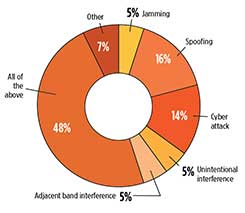
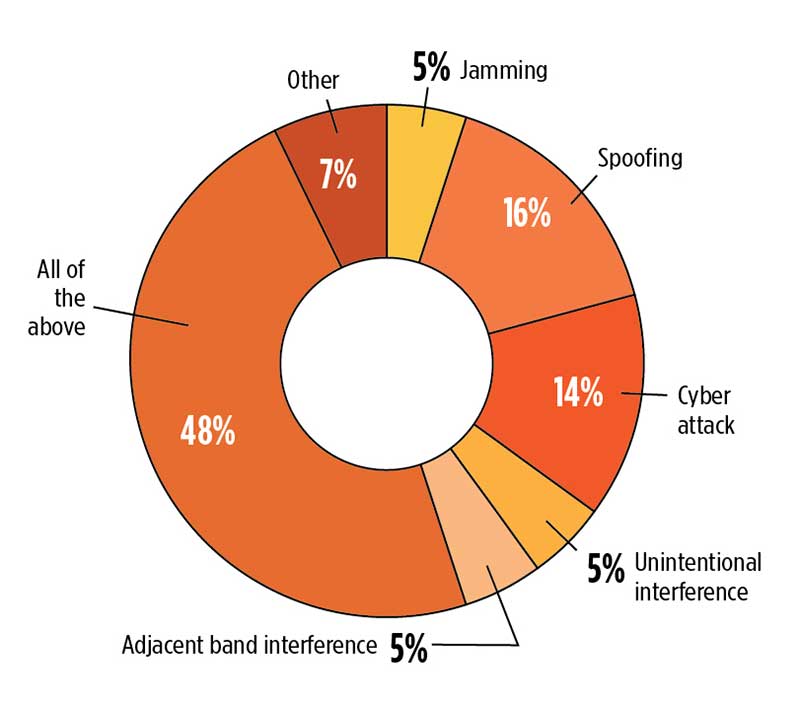
    What is the greatest threat to GNSS over the next three years? (Source: GPS World 2018 State of the GNSS Industry report)
    What is the greatest threat to GNSS over the next three years? Click to enlarge. (Source: GPS World 2018 State of the GNSS Industry report)

    When we designed the survey of the global PNT community for the 2018 State of the GNSS Industry report, we put a couple of new wrinkles into the online questionnaire. We wanted to know, succinctly, what you felt was the number one obstacle to growth for your organization. And, with the same brevity, what you saw as the number one opportunity for growth.

    The answers most frequently given within each sector — mobile, OEM, survey, UAV, transportation, machine control, mapping and defense & government — appear on those respective pages in this issue. They weren’t the only answers, by far.

    Obstacles to Growth

    Other stumbling blocks that were called out included security, competitors (sometimes mentioned by name), politics (sometimes mentioned by party), budgets, funding, understanding, ignorance, management, bureaucracy, age, and that enduring favorite, time.
    The most frequently cited obstacles to growth were:

    • regulation, and
    • the lack of qualified staff, personnel, engineers.

    One ingenious survey-taker somehow found a way to cram 21 words into an answer box meant for only one or two. “In my industry, deep technical talent that addresses the specific issues. Without that, the ‘big picture’ judgments are often just wrong.”

    This problem is not new, nor is it particular to the GNSS/PNT industry. The fact that it is with us year after year suggests that it is not getting enough effective attention. Talented engineers can be imported, yes, if the homegrown supply falls short. In the current political climate, this may not be a strategy with legs. Even given a totally benign immigration regulatory landscape, it is far from a panacea. More on this in a moment.

    Growth Opportunities

    Various flavors of technology integration, both multi-GNSS and non-GNSS, led the pack in nearly every sector. Other popular answers included customization, broadband, autonomous navigation, Galileo, international markets, alt-nav, Brexit, the Cloud, M-code, anti-jamming, connectivity, flexibility, more clients, and, in riposte to the aforementioned obstacle: training, education, or simply engineering.

    The great American thinker Margaret Mead said, “We are continually faced with great opportunities which are brilliantly disguised as unsolvable problems.”

    If your organization encounters this perennial problem, this shortage of qualified staff that stifles innovation, inhibits growth, and causes you to pass on new ventures that are just out of reach, here’s the biggest whopping opportunity of all: get involved with higher education and engineering graduate schools in your area.

    The talent is there. If you’re not out actively cultivating, encouraging, training and recruiting it, those bright young engineering people will be drawn instead to Internet ventures or gaming software or other industries that sap the soul but nourish the pocket — and those are your true competitors.

  • Septentrio launches AsteRx-i S GNSS+IMU receiver

    Septentrio launches AsteRx-i S GNSS+IMU receiver

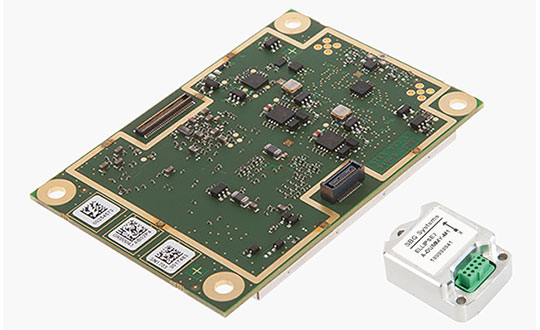
    GNSS receiver manufacturer Septentrio has added the AsteRx-i S to its GNSS/INS product portfolio.

    The AsteRx-i S combines Septentrio’s compact, multi-frequency multi-constellation GNSS engine with an ultralight external industrial-grade MEMS-based inertial measurement unit (IMU).

    Designed around demanding requirements for size, weight, power consumption and temperature variation, the AsteRx-i S is designed for various applications such as inspections with UAVs, UAS photogrammetry, automation, robotics and logistics.

    Calibrated for wide temperature ranges, the AsteRx-i S delivers accurate and reliable GNSS/IMU integrated positioning to the centimeter-level, as well as full attitude at high update rates and low latency, the company said.

    Key benefits for users include:

    • GNSS/INS positioning with 3D attitude: heading pitch and roll
    • Multi-constellation, multifrequency, all-in-view RTK receiver
    • AIM+ interference monitoring and mitigation system
    • High-update rate, low-latency positioning and attitude
    • Small and ultralight IMU (10 grams)
    • Robust calibration for wide temperature ranges

    “We are delighted to broaden our AsteRx-i GNSS/INS solutions range, bringing maximum flexibility and choice to our customers,” said Francesca Clemente, product manager at Septentrio. “Whether for direct georeferencing in mapping applications with UAVs, for managing containers in a port or for innovative small robots in agriculture, the compactness, affordability and robustness of the AsteRx-i range allows our customers to focus on their success.”

  • Opening presentations at ITSNT focus on PNT resilience

    Opening presentations at ITSNT focus on PNT resilience

    ITSNT logo

    Speakers and topics at the Nov. 13–16 International Technical Symposium on Navigation and Timing opening session have been announced.  They focus on comprehensive approaches for obtaining resilient PNT, supported by mega-constellations, and with new concepts to improve reliability.

    Logan Scott, a U.S. consultant specializing in radio frequency signal processing and waveform design, will speak on “Towards a Comprehensive Approach for Obtaining Resilient PNT.”

    As precise positioning and timing becomes ever more deeply embedded into worldwide critical infrastructure, numerous attacks have already been seen and the sophistication of attacks is growing. A layered defense with flexible responses provides the best hope for meeting the challenges of maintaining required navigation performance under adverse conditions.

    No single defense or offense, no matter how good, is capable of dealing with all threats.

    A comprehensive and integrated civil policy is needed that takes into account the nature of the threats, their motivations, their likely evolution, and the costs and approaches for mitigating them. This talk explores not only the technical countermeasures available to civil users but also the legal and social engineering approaches that can militate against jamming and spoofing. The importance of penetration testing is illustrated via real-world examples of what happens when receivers meet a threat for the first time. Effective strategies for civil applications are fundamentally different from those suitable for military applications. Specific and actionable recommendations at the policy, receiver and systems level will be made.

    Francis Soualle, a French engineer specializing in GNSS architectural concepts, orbit determination, signal design and receiver performances at Airbus Defense and Space, will address “Perspectives of PNT Services Supported by Mega-Constellations.”

    The development of so-called “Mega-Constellations” composed of several hundreds of spacecrafts, if not thousands, comprising low-Earth orbit (LEO)satellites among others, initially designed to provide communication services, could also support positioning, navigation and timing (PNT) applications.

    The architectural and technological specificities of LEO-based PNT systems could represent meaningful differentiators with regard to GNSSs and enhance their attractiveness. Hence, Doppler-based positioning techniques already proven in operational space systems, such as Argos or Cospas-Sarsat, shall strongly benefit of the geometry (i.e. velocity) and the large density of lines-of-sight. By combining range and range-rate positioning techniques, the availability for instantaneous and accurate positioning will thus be enhanced.

    The newly introduced Satellite Time & Location (STL) system, based on the Iridium constellation, and offering a global and resilient Timing and Position service will support this discussion.

    Finally, the main architectures for LEO-PNT systems will be described with special focus on the primary and ancillary payload units, but also on the supporting ground segment infrastructures.

    Karen van Dyke, director of PNT & Spectrum Management at the U.S. Dept. Of Transportation, will speak about “Resilient Positioning, Navigation, and Timing” and radiofrequency spectrum management services essential to critical infrastructure applications, including transportation for safety-of-life applications such as the Next Generation Air Transportation System (NextGen), Positive Train Control, and Intelligent Transportation Systems (ITS).

    Increasing occurrences of unintentional and intentional interference to GPS, including the spoofing of the signal have been observed. It is important to increase awareness of vulnerabilities of GPS, evaluate the impact, and to research complementary sources of PNT to increase resiliency and make intentional jamming and spoofing less desirable. Also, best practices should be adhered to for implementation and installation of GPS receivers in critical infrastructure applications.

    With an increased focus on autonomous vehicles for all modes of transportation, there is a need to focus on multi-sensor navigation technologies to ensure reliable operation of vehicles without a human in the loop. This research should be aligned with National PNT Architecture recommendations to overcome capability gaps predominantly resulting from the limitations of space-based PNT.

    As the civil lead for GPS, the U.S. Department of Transportation also has been conducting the GPS Adjacent Band Compatibility Assessment to understand the power levels that can be tolerated in the radiofrequency bands adjacent to GPS, given increasing demand for use of those adjacent frequency bands for non-space commercial applications. Van Dyke will address resilient PNT from the standpoint of both protecting GPS and GNSS from interference, as well as increasing resiliency by implementation of best practices and utilization of other PNT technologies.

    Matteo Paonni, scientific officer at the Joint Research Center of the European Commission in Italy, will deliver “New Concepts and Ideas to Improve the Reliability of PNT Services.”

    With early Galileo services already underway and full operational capability coming in 2020, a strong need for R&D activities in the field of navigation signal engineering has been identified by various programme stakeholders. Considering the long process required for introducing new signals and features in a system that is already deployed and finds itself in the exploitation phase, early R&D activities become essential to investigate potential evolutions and new concepts to improve the Galileo signals and services in the short, medium and long term.

    The presentation will provide some examples of recent R&D initiatives in this context. In particular, technical solutions developed in the context of the Future Navigation and Timing Evolved Signals (FUNTIMES) project will be presented. FUNTIMES is a European GNSS mission evolution study funded by the European Commission within the Horizon 2020 Framework for Research and Development. Main goals of the project was to identify, study and recommend mission evolution directions and to support the definition, design and implementation of the future generation of Galileo signals.


  • Ford details drone-based vehicle sensor backup

    Ford details drone-based vehicle sensor backup

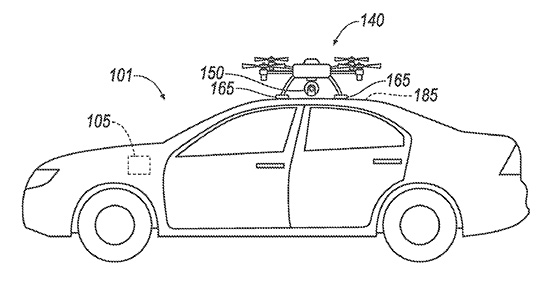
    Ford has applied for a patent that would send a drone to dock with an autonomous vehicle and act as a surrogate sensor if one of the car’s sensors failed. The UAV then uses its own sensors to guide the car to a repair facility.

    A UAV docks with a car. (Diagram: Ford’s patent application)
    A UAV docks with a car. (Diagram: Ford’s patent application)

    The filing from Ford Global Technologies, a subsidiary that manages and commercializes patents and copyrights, outlines the process.

    Once the vehicle registers a fault in one of its sensors, it uses a vehicle-to-vehicle (V2V) network to summon the drone, which flies to the vehicle, receives authorization, and then lands atop it. The UAV then serves as a replacement sensor while directing the vehicle to a nearby repair center to fix the car’s sensor.

    Ford developed the technology to aid autonomous vehicles that have lost a critical navigation sensor; autonomous cars use GNSS, short- and long-range radar, lidar, cameras and ultrasound.

  • New NovAtel system combines GNSS+INS in small package

    New NovAtel system combines GNSS+INS in small package

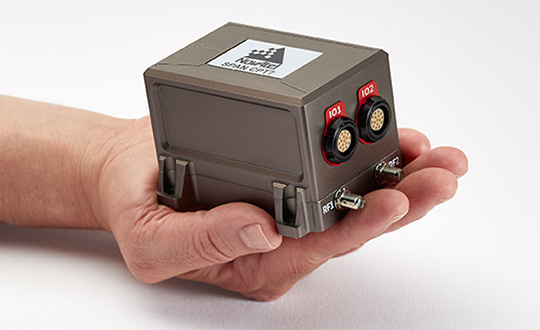
    NovAtel is now delivering its SPAN tightly coupled GNSS+INS navigation technology in a rugged, ultra-compact unit.

    Commercially exportable and designed for integration into a wide variety of applications, the high-performance SPAN CPT7 delivers assured positioning anywhere, in a package one-quarter the size of the company’s SPAN-CPT.

    SPAN technology leverages generations of precise positioning expertise and advanced algorithms to tightly couple GNSS and inertial navigation system (INS) measurements. The system enables continuous, robust positioning and fast reacquisition in challenging navigation environments where GNSS signals may be unreliable or unavailable for short periods.

    The new SPAN CPT7 also incorporates dual antennas to deliver instant alignment, along with interference detection and mitigation using NovAtel’s OEM7 Interference Toolkit (ITK) technology.

    Integrators can take advantage of a spectrum analysis function of ITK to identify interference within the GNSS frequency bands and whether interference is coming from the external environment or due to other components in an integration project, NovAtel said. Mitigation features within ITK allow developers to implement digital filters and eliminate the problem.

    Combining the multi-frequency, multi-constellation technology of the OEM7720 receiver board with ITK and the high-performing micro-electromechanical systems (MEMS) IMU, the SPAN CPT7 delivers anti-jamming functionality in an ultra-compact enclosure that fits in the palm of your hand. When paired with the GPS Anti-Jam Antenna (GAJT) in military applications, SPAN CPT7 is an integral part of assured position, navigation and timing (A-PNT).

    “The remarkable new SPAN CPT7 delivers solutions for defense, mobile mapping, and autonomous vehicle applications with more flexibility than ever before,” said Neil Gerein, director, product management, NovAtel. “This new product saves customers space and weight without compromising accuracy or performance.”


    Photo: NovAtel

  • Honeywell brings military precision navigation capabilities to commercial markets

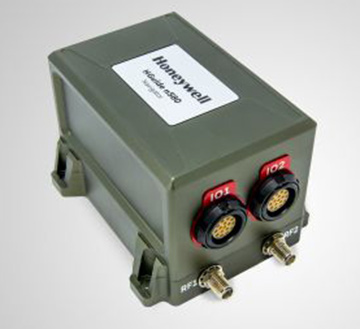
    Honeywell has produced a new inertial navigation unit that provides accurate navigation for customers across a broad range of industries including agriculture, robotics and autonomous vehicles, without compromising on size, cost or performance.

    The HGuideN580 inertial navigation technology improves accuracy in urban and rural environments. (Photo: Honeywell)

    The HGuide n580 is the first Honeywell-produced, industrial-focused navigation solution that uses both precision inertial measurement unit technology and GNSS to improve location accuracy even when facing natural and manmade obstacles.

    “The blend of inertial and satellite navigation capabilities provided by the HGuide n580 is especially important where precision is required in demanding environments — for example, autonomous cars traveling in cities, where our technology can extend the accuracy and performance of navigational systems while keeping passengers safe,” said Chris Lund, senior director, Navigation and Sensors, Honeywell Aerospace. “Honeywell’s history and expertise in navigation technology enables customers to implement this new wave of advanced technology into their own applications and operations.”

    Roughly the size of a deck of cards, the HGuide n580 gives Honeywell’s industrial customers the capabilities needed to navigate accurately in areas with limited satellite coverage, such as densely populated cities where tall buildings, underground tunnels, and multi-layer freeway stacks or bridges often create challenges to traditional GPS navigation.

    For a GPS unit to function properly, it requires a strong signal connection between the unit on the ground and multiple satellites in the sky to accurately orient its position. City infrastructure such as buildings and tunnels can temporarily block the signal between GPS unit receivers and satellites, creating urban canyons.

    With the HGuide n580 integrated system, Honeywell’s inertial measurement unit technology combines with GPS to act as a backup solution, which means the loss of GPS signal caused by an urban canyon does not result in a complete loss of navigation.

    To learn more about the new HGuide n580 solution and Honeywell’s other commercially available navigation technologies, visit the Honeywell Aerospace website.

  • Ceva releases Dragonfly NB2 for internet of things

    Ceva has launched the successor to its Ceva-Dragonfly NB1 solution targeting the NB-internet of things (IoT) market, the Ceva-Dragonfly NB2.

    The Dragonfly NB2 is a highly integrated and modular solution optimized for Cat-NB2 (3GPP Release 14 eNB-IoT) that can seamlessly be incorporated into chips and modules by the multitude of companies looking to address the large and fast-growing cellular IoT space.

    GNSS hardware package. For customers developing NB-IoT products that also require GNSS capabilities, Ceva-Dragonfly NB2 includes a new power-optimized GNSS hardware package, with GNSS RF receiver and multi-constellation digital front-end.

    The GNSS package speeds up both acquisition and tracking tasks by up to 8 times compared to Ceva-Dragonfly NB1, enabling a host of popular NB-IoT use cases, including people, livestock and asset tracking, and geo-fencing, the company said.

    IoT boom forecast. In the latest edition of the Ericsson Mobility Report, the forecast for cellular IoT increased significantly, almost doubling to 3.5 billion connections for 2023. The report cites large-scale deployments in China and increasing interest in eNB-IoT and Cat-M1 cellular IoT standards as the catalysts for 30 percent CAGR between 2017 and 2023.

    Ceva-Dragonfly NB2 is a licensable Rel14 compliant eNB-IoT solution and builds on the success of Ceva-Dragonfly NB1, which has been widely licensed for a range of use cases and emerging end markets, including smart cities, transport and logistics and consumer electronics. It is centered on the Ceva-X1 DSP/control processor featuring an enhanced Instruction Set Architecture and provides a unified processor environment for both physical layer and protocol stack workloads.

    The solution also includes a highly integrated, worldwide enabled RF transceiver, a power amplifier (PA) and all the associated hardware and software modules required to develop a complete eNB-IoT product, ensuring the lowest possible bill-of-materials (BOM) in the process.

    In addition to the performance improvements enabled by Release 14 including higher data rates and lower latency, Ceva-Dragonfly NB2 features a range of enhancements to ensure higher performance, added functionality and increased security for NB-IoT applications compared to its predecessor.

    A new power management solution, complete with intelligent sleep mechanisms ensures ultra-low sleep power consumption of a few microAmps, further improving the battery life critical to every NB-IoT device.

    The enhanced RF design is already silicon-proven at 55nm and 40nm processes, further lowering the entry barriers for customers with no previous cellular expertise to enter this burgeoning market.

    Ceva-Dragonfly NB2 also includes the fully optimized physical layer and protocol stack firmware designed for Release 14 Cat-NB2. The addition of an on-chip embedded flash memory and controller now allows full NB-IoT design on a single die which further reduces BOM and power consumption.

    Voice trigger. Ceva-Dragonfly NB2 also supports use cases requiring always-listening voice trigger, voice commands and sound sensing. The flexibility of the Ceva-X1 IoT processor allows for these sensing features to be implemented in software. The Ceva ClearVox voice front-end software package, for example, can be used to ensure clear and intelligible voice pickup for use cases such as emergency calls and voice panic buttons. In terms of security, Ceva-Dragonfly NB2 integrates a completely redesigned secure platform, including smart interfaces to connect USIM or eSIM. Ceva also offers other complementary technologies addressing massive IoT, such as Bluetooth 5 dual-mode and low energy and Wi-Fi 802.11n/ac/ax, for short range connectivity which customers can leverage for their product designs.

    “The widespread commercial deployment of NB-IoT is well underway across the globe and we’re proud to be at the forefront of technology innovation for long-range massive IoT,” said Michael Boukaya, vice president and general manager of the wireless business unit at Ceva. “With the introduction of Ceva-Dragonfly NB2, we have built on the considerable success we achieved with our first generation solution, and delivered a unique, silicon-proven eNB-IoT Release 14 solution for our customers that is unprecedented in terms of system completeness, performance and power efficiency.

    “Moreover, the option of power-optimized GNSS, voice and sensing capabilities vastly increases the breadth of use cases our customers can address with this licensable solution,” Boukaya said. “There is no other IP company in the world today that can come close to offering such a complete solution for eNB-IoT and we’re excited to closely partner with our customers to create a whole new wave of applications and devices for the infinite Internet of Things.”

    Ceva-Dragonfly NB2 is available for licensing now. Development kits and reference silicon will be available in the third quarter of this year.

  • Expert Opinions: How can we make autonomous cars safe?

    Expert Opinions: How can we make autonomous cars safe?

    Q: How can positioning technology ensure safety for passengers of autonomous cars and for others on or near the roadway?

    Paul Perrone, Founder/CEO, Perrone Robotics


    A:
    Satellite-based and local beacon-based positioning technologies offer the best opportunity for reliable and precise location determination of an autonomous vehicle. Alternate solutions like SLAM and lane keeping are decent augmentations, but suffer from the imprecision that comes from sensing in a large dynamic environment. As satellite and local beacon-based positioning technologies become increasingly more pervasive and accurate, this will continue to yield the most reliable and deterministic solution for safe localization of autonomous vehicles.


    Paul Groves, Senior Lecturer, University College London

    A: No matter how good it gets, positioning technology can never ensure the safety of autonomous car passengers and pedestrians. Knowing the position of each car is insufficient; you need to know where everything else is, including children, animals and temporary construction barriers. It is simply not practical to fit everyone and everything with a positioning device that transmits to every nearby vehicle. Collision avoidance therefore needs sensors such as radar and lidar.


    Zoltan Molnar, Functional Safety Manager, NovAtel

    A: Realization of safe autonomy requires the establishment of layers of protection using safety mechanisms without dependent faults. Absolute position provided by precise GNSS and inertial technology provides an independent reference for truth test of positioning solutions obtained with vision-based technologies. Vision-based solutions may incorporate common cause faults like sight obstruction, processing algorithms or similar. Absolute positioning can also contribute to realize near-real-time updated maps.