Tag: internet of things (IoT)

  • Iridium hybrid IoT module now commercially available

    Iridium hybrid IoT module now commercially available

    The Iridium 9604 module and development kit streamline global IoT development with integrated satellite, cellular and GNSS connectivity

    Iridium Communications has announced commercial availability of the Iridium 9604 module and Development Kit, giving developers, OEMs and solution providers a faster path to build and scale connected IoT solutions worldwide.

    Combining GNSS positioning, Iridium short burst data satellite connectivity, and LTE-M cellular, the Iridium 9604 module delivers a compact, integrated solution for global IoT deployments.
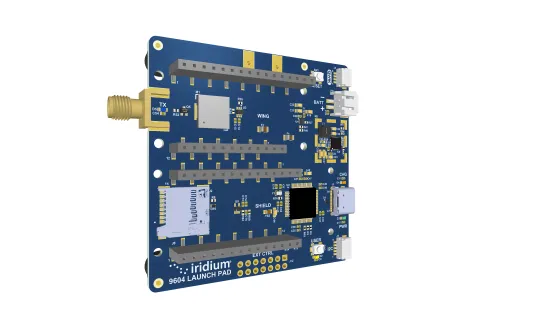
    The Iridium 9604 Development Kin, back side. (Credit: Iridium)
    The Iridium 9604 Development Kit, back side. (Credit: Iridium)

    Alongside the Iridium 9604 Development Kit, developers can rapidly prototype, test and validate hybrid satellite, cellular, and GNSS applications with resources that simplify integration and streamline deployment workflows.

    Built on the u-blox SARA-R5 platform, the Iridium 9604 is designed to reduce hardware complexity, lower integration costs, and accelerate time to market for connected solutions operating across industrial, infrastructure, transportation, mobility, utilities, maritime and remote-monitoring applications. The integrated design helps reduce board space requirements by 60 percent or more while simplifying RF routing, power architecture, and firmware development, Iridium said.

    Early developers and beta participants reported significant operational and economic benefits from the platform’s integrated architecture.

    “The Iridium 9604 has enabled us to develop a truly global asset tracking solution without relying on terrestrial network infrastructure. Its reliable coverage, compact form factor, and straightforward integration have significantly accelerated our development process and allowed us to focus on optimizing the end-user experience,” said Askar Gabit, CEO, GPSOne. “For applications in remote and challenging environments, the Iridium network provides the confidence that critical data can be delivered when it matters most.”

    The Iridium 9604 gives developers independent control over satellite, LTE-M and GNSS subsystems, enabling flexible implementation of failover logic, location-aware connectivity decisions, and application-specific routing strategies. A unified AT command set and comprehensive SDK resources further simplify development and integration.

    Built for scalable and power-sensitive IoT applications, the Iridium 9604 features a compact 16 x 26 x 2.4 mm form factor optimized for deployments where size, resiliency and efficiency are critical. The platform supports GPS, GLONASS, Galileo and BeiDou GNSS services alongside LTE-M (Cat-M1) and Iridium’s 100% global L-band satellite network.

    The Iridium 9604 represents the next evolution of Iridium’s broader IoT strategy, expanding beyond traditional satellite-only hardware to support unified, multi-mode connectivity architectures. The Iridium network now supports multiple IoT pathways, including dedicated Iridium SBD modules, Iridium NTN Direct standards-based direct-to-device capabilities, and larger payload connectivity through the Iridium Certus 9704 module.

    Operating on a global mobile satellite network, the Iridium 9604 delivers reliable connectivity across remote land areas, oceans, airways and polar regions where other networks are unavailable or unreliable.


  • Rx Networks launches corrections service

    Rx Networks launches corrections service

    Photo: RX Networks
    Photo: RX Networks

    Rx Networks, a GNSS data services provider, has released TruePoint | LITE, a correction service designed for power-conscious applications that require precise and reliable location data.

    TruePoint | LITE aims to deliver sub-meter and lane-level accuracy with global coverage for low-power usage. It is engineered with power efficiency in mind, focusing on applications such as smartphones, wearables, asset tracking and Internet of Things (IoT) devices.

    TruePoint | LITE uses patent-pending predictive technologies designed to reduce dominant GNSS ranging errors—including ionospheric, orbital, and clock errors—to ensure accurate GNSS positioning while minimizing data traffic and conserving battery life.

    TruePoint | LITE leverages proprietary predictive technologies to correct key GNSS ranging errors, particularly ionospheric range errors, according to the company.

  • u-blox introduces ultra-low-power asset tracking service for IoT

    u-blox introduces ultra-low-power asset tracking service for IoT

    Photo: u-blox
    Photo: u-blox

    u-blox has introduced CloudTrack, an end-to-end asset tracking service designed specifically for Internet of Things (IoT) applications. This comprehensive solution integrates ultra-low-power positioning, global connectivity and cloud integration into a single platform. CloudTrack aims to simplify IoT asset tracking by offering flexible, contractless per-location-request plans available worldwide, allowing users to manage their assets effortlessly.

    CloudTrack offers six times the energy savings compared to a standalone GNSS fix with a cold start while securely transmitting data over the internet. The system intelligently calculates position using a combination of data from GNSS, cellular, and Wi-Fi sources. This capability allows users to locate assets even in areas with poor or non-existent GNSS signal conditions and indoors, where obtaining a location fix can be challenging.

    With a single Thingstream SIM card operating globally, IoT devices can utilize one stock-keeping unit (SKU), eliminating the need for regional SKUs. The Thingstream cloud platform seeks to make it easy for businesses to transform and integrate their data with tracking dashboards, major cloud platforms and enterprise backend systems.

  • Topcon, Bentley Systems partner for GNSS technology integration

    Topcon, Bentley Systems partner for GNSS technology integration

    Photo: Topcon Positioning Systems
    Photo: Topcon Positioning Systems

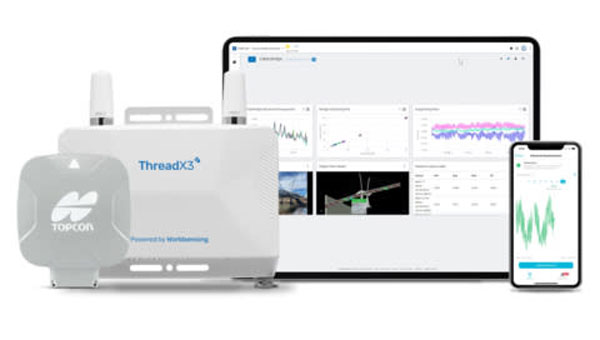
    Topcon Positioning Systems has entered a strategic partnership with Bentley Systems and Worldsensing to integrate Topcon’s GNSS technology into the companies’ software and connectivity solutions to improve geospatial data accuracy and operational efficiency.

    Under the agreement, Topcon’s web-based GNSS processing engine will be incorporated into Bentley’s iTwin internet-of-things (IoT) monitoring solutions, offering users real-time geospatial intelligence for better decision-making and operational effectiveness. According to Steve Bentley, senior director of infrastructure IoT at Bentley Systems, the system is designed to advance the capabilities of infrastructure digital twins.

    It is a connect-and-collect solution that allows for real-time detection and analysis of potential risks. GNSS technology is the core component, which aims to make ground-movement monitoring applications more cost-effective and efficient while reducing the initial investment required for GNSS monitoring.

    It is available for commercial use in the United States, Canada, Australia, Europe, the Middle East and Africa. According to Bentley Systems, the solution will expand its reach to South and Latin America.

  • Quectel unveils 5G and GNSS antennas

    Quectel unveils 5G and GNSS antennas

    Image: Quectel
    Image: Quectel

    Quectel Wireless Solutions has expanded its antenna portfolio with the introduction of 5G antennas and high-performing GNSS antennas, designed to improve positioning and navigation capabilities for Internet-of-Things (IoT) devices. 

    The YEGB000Q1A and YEGN000Q1A active GNSS L1 and L5 antennas are designed to precisely tap into L1 and L5 frequency bands, which is crucial for advanced navigation applications. These antennas, operating within the 1164-1189MHz and 1559-1606MHz frequency bands, are designed to support a variety of installation methods, catering to diverse application needs with options for screw mount, adhesive mount, magnetic mount and various cable connections. 

    Quectel’s GNSS antennas are part of a broader release that includes the YEMN016AA and YEMN017AA 5G 5-in-1 combination antennas, which also feature GNSS capabilities. 

    These GNSS antennas are crucial for applications that require high levels of navigation accuracy, such as autonomous vehicles, UAV delivery systems and precision farming. 

    In addition to the GNSS-focused antennas, Quectel introduced external 5G antennas, the YECN001J1A and YECT000WBA, designed for omnidirectional high-speed data transmission. They are compatible across 5G NR Sub-6 GHz, 4G, 3G, 2G and LPWA bands, offering flexibility and high efficiency for wireless communication devices. 

    Quectel provides extensive support for its antennas, including custom antenna solutions tailored to users’ specific needs. This support includes design, simulation, testing and manufacturing services to offer optimal integration with Quectel’s wide range of modules for IoT deployments. 

  • u-blox, CTT collaborate on penguin conservation effort

    u-blox, CTT collaborate on penguin conservation effort

    Image: u-blox
    Image: u-blox

    u-blox has partnered with Cellular Tracking Technologies (CTT), a specialist in wildlife telemetry and Internet of Things (IoT) solutions, in an initiative aimed at conserving Antarctic wildlife.

    The collaboration has introduced a cloud-based positioning solution to monitor the activities of Adélie penguins in Ross Island, Antarctica. The venture began when Point Blue, an American wildlife conservation organization, reached out to CTT to create a tracking mechanism that could study the movements of young Adélie penguins. These birds are among the five penguin species inhabiting Antarctica and are considered crucial for environmental studies due to their sensitivity to ecological shifts caused by climate change and human activities, such as commercial fishing.

    Due to the challenging conditions in Antarctica, tracking penguins required a device that was lightweight, non-intrusive, energy-efficient, and cost-effective in terms of data transmission. This was particularly important given the small size of the penguins, their rapid movement, and their extended underwater dives.

    u-blox provided its CloudLocate positioning service to meet these stringent requirements, which led to the development of CTT’s Penguin Iridium GNSS tracker. The tracker is fixed to the penguins’ backs and uses one of u-blox’s compact GNSS modules. The CloudLocate service processes the positioning calculation in the cloud rather than on the device to save energy and enable prolonged monitoring periods without the need for frequent device replacements.

    The tracker operates by sending a concise 50 B message, which captures essential location data during the brief moments when a penguin surfaces for air. This level of efficiency is critical in minimizing the costs associated with satellite connectivity, which is often prohibitively expensive in such remote regions.

    This partnership marks an advancement in wildlife conservation technology by allowing for non-invasive, continuous monitoring of Adélie penguins and providing vital data for assessing the impacts of environmental changes. CTT aims to extend this tracking solution to a wider range of wildlife research and conservation projects to demonstrate the potential for technological innovation to contribute significantly to ecological preservation efforts.

  • Abracon releases GNSS RF antennas

    Abracon releases GNSS RF antennas

    Image: Abracon
    Image: Abracon

    Abracon has introduced a new series of GNSS RF antennas designed to elevate location-based services with enhanced accuracy and precision. This new lineup aims to outperform conventional GPS technologies by offering faster signal acquisition, improved tracking capabilities and reduced power consumption.

    The antennas support a full spectrum of bands, including L1, L2, L5, and L-band data correction services. It can be used in a variety of sectors — such as agriculture, surveying, the Internet of Things (IoT), mapping, defense and aviation.

    The technology is designed to meet the rigorous demands for precise location data across various applications. These antennas offer multi-band and multi-constellation support to ensure broad compatibility. With centimeter-level accuracy, these antennas are crucial for aerospace, defense, asset tracking, geolocation, precision agriculture and industrial IoT.

  • DCU, Bentley partner for 3D smart city research initiative

    DCU, Bentley partner for 3D smart city research initiative

    Image: DCU
    Image: DCU

    Dublin City University (DCU) has partnered with Bentley Systems to create an advanced digital twin of its campus as part of its Smart DCU initiative. The partnership combines artificial intelligence (AI) and immersive digital twin technology. The campus will be used as a testing ground for innovative smart city solutions, with the aim of creating sustainable, efficient, and enjoyable urban spaces worldwide.

    Bentley’s open 3D and reality modeling technology can create a campus model intricately linked with Internet of Things (IoT) data, which results in an immersive digital twin on its iTwin Platform.

    The campus digital twin offers users a seamlessly interconnected and smart environment by integrating AI-powered analysis with a user-friendly interface for visualizing complex analytics. This allows for proactive problem-solving, optimization of resources, and informed decision-making intending to improve urban functionality and sustainability.

    The digital twin has inspired environmental initiatives and simplified data visualization on campus, empowering agencies, and individuals to implement intelligent processes that shape the future of their cities, DCU said.

  • Pasternack introduces IoT multiband antennas

    Pasternack introduces IoT multiband antennas

    Image: Pasternack
    Image: Pasternack

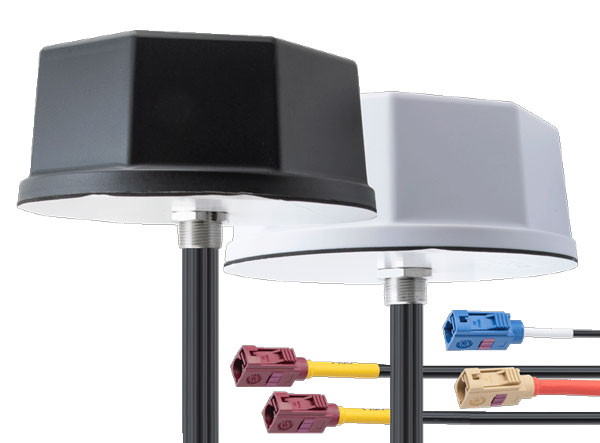
    Pasternack has launched its new line of IoT multiband combination antennas. Designed for vehicles, fleets and pivotal base stations, the technology aims to revolutionize how industries perceive and use mobile connectivity.

    The antennas integrate 4G, 5G, Wi-Fi and GPS bands to offer emergency teams, on-the-move fleets and first responders an unwavering link, even in harsh environments.

    Facilitated with both FAKRA and SMA connectors and extended 17-foot cable leads, users can seamlessly integrate the technology. It also has an IP69K rating, certifying it for both indoor and outdoor deployments.

    MIMO capabilities improve data transmission speeds and reliability, ensuring consistent high-bandwidth connections. The antenna’s GPS/GNSS component, enhanced with LNA and amplified by a 26 dB gain, offers users improved navigation and tracking precision.

  • Septentrio introduces new open-source projects

    Septentrio introduces new open-source projects

    Image: Septentrio
    Image: Septentrio

    Septentrio has introduced two new open-source hardware projects available to integrators of satellite-based positioning.

    By expanding their ecosystem of open-source hardware and software, Septentrio aims to make reliable GNSS positioning more accessible to integrators and developers.

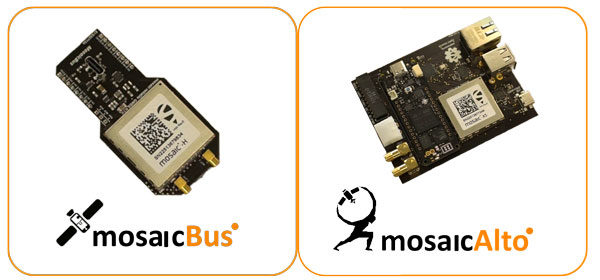
    The first project, mosaicBus, is a reference design of a board compatible with mikroBUS add-on board standards primarily used in embedded systems. MikroBUS enables easy plug-and-play sensor integration into development boards from major companies such as MikroElektronika, who developed the mikroBUS standard.

    The second project, called mosaicAlto, is a carrier board embedding the mosaic-X5 or mosaic-H GNSS receivers, which transforms Arduino Pro Portenta into a single-board computer with a GPS/GNSS receiver.

    The mosaicBus board can be used in applications such as automation, robotics or Internet of Things (IoT).

    Mosaic is a compact high-precision multi-frequency GPS/GNSS receiver module known for its performance in harsh environments and resilience to jamming and spoofing. The module is designed for systems where accuracy and reliability are required. It has been widely adopted through existing projects such as the mosaicHAT, a shield board for Raspberry Pi and Mowi, a wireless communication board using the mosaic receiver.

    In addition to hardware reference designs, Septentrio also supports ROS and several other UAV autopilots.

  • Rohde & Schwarz, Skylo partner to enhance NTN testing

    Rohde & Schwarz, Skylo partner to enhance NTN testing


    Image: Rohde & Schwarz
    Image: Rohde & Schwarz

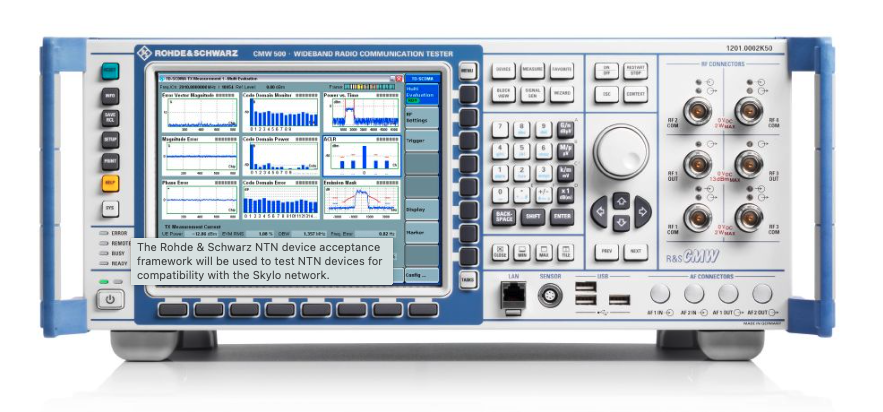
    Rohde & Schwarz has partnered with Skylo Technologies, a global software-defined non-terrestrial network (NTN) operator, to set up a device acceptance scheme for Skylo’s NTN.

    The proven device test framework from Rohde & Schwarz will be used to test NTN chipsets, modules and devices to validate their compatibility with the Skylo test specification.

    The collaboration aims to reinforce and expand the testing capabilities for NTN, ensuring that chipsets, modules and devices using the NTN Narrowband Internet of Things (NB-IoT) protocol integrate seamlessly with Skylo’s network and are 3GPP Release 17 compliant.

    The Rohde & Schwarz test framework is built on the R&S CMW500 wideband radio communication tester. The framework serves as the preferred choice for IoT testing, including research and development to GCF/PTCRB certification and carrier acceptance tests, covering both terrestrial and non-terrestrial IoT domains.

    With the R&S CMW500 software stacks, the new framework offers reliable and repeatable results. It comes with NTN Release 17 features as well as support for different orbits.

  • u-blox and ORBCOMM partner for integrated IoT communications

    u-blox and ORBCOMM partner for integrated IoT communications

    Image: metamorworks/iStock/Getty Images Plus/Getty Images
    Image: metamorworks/iStock/Getty Images Plus/Getty Images

    u-blox has partnered with ORBCOMM, a pioneer in Internet of Things (IoT) technology, to develop solutions for the convergence of terrestrial and satellite IoT communications markets.

    According to the Ericsson Mobility Report, the number of cellular IoT connections is projected to reach around 5.5 billion by 2028. The satellite IoT communications market is also expected to triple by 2025. Combining these two technologies will provide gap-free global connectivity for IoT communications, even in previously uncovered areas, making it more accessible for IoT deployers.

    With this partnership, u-blox will integrate ORBCOMM’s satellite communication protocols into its UBX-R52/S52 LPWA (low-power wide-area) modem SoC (system-on-a-chip) resulting in a smaller, less complex chipset that offers dual connectivity. This chipset will be used in future u-blox module products, enabling connected solutions across the globe.

    The collaboration between ORBCOMM and u-blox will meet the increasing demand for IoT solutions capable of connecting devices in remote locations, areas with poor cellular coverage and isolated environments. Various industrial IoT applications can benefit from these solutions, such as asset tracking, equipment tracking in agriculture and construction industries, and industrial sensors.

    “Pairing ORBCOMM’s satellite technology with u-blox’s innovative UBX-R52/S52 chipset will allow customers deploying IoT solutions in the supply chain, heavy equipment, and agriculture industries to benefit from ubiquitous coverage, device simplicity, along with optimal reliability and longevity,” said David Roscoe, ORBCOMM’s executive vice president of satellite communications and products.