Tag: oneNav

  • GPS World EAB Q&A: Which emerging sectors are driving the most demand for advanced PNT?

    GPS World EAB Q&A: Which emerging sectors are driving the most demand for advanced PNT?

    We asked our Editorial Advisory Board (EAB) which emerging sectors are driving the most demand for advanced positioning and timing solutions right now?

    Find their responses below.


    Paul McBurney, oneNav
    Paul McBurney

    “The defense sector needs an off-the-shelf GNSS module that is small, light and low power, yet also highly resilient — such as a military-grade location system — to satisfy the insatiable growth in drones. While this segment is about a tenth of the total commercial vehicle market, it is significant compared to the emerging autonomous driving segment, where the need for resilience is still trying to figure out the cost-benefit of mitigating intentional interference.”

    Jules McNeff, Overlook Systems Technologies
    Photo: Jules McNeff

    “If I had to pick newly emergent sectors with the highest need for precise and continuous PNT, I would say the autonomous system operations sector and portion of the artificial intelligence (AI) sector. AI cannot provide spatially or temporally ‘intelligent’ support if it does not have access to precise positioning and timing information from outside itself. PNT sources do not depend on AI, but ‘autonomous’ AI must have reliable PNT.

    MigueL Amor, Septentrio
    Miguel Armor

    “The primary driver is the broad adoption of autonomy and automation across industries such as construction, logistics, agriculture, infrastructure, defense, or even entertainment. Amplifying this demand is the proliferation of smaller and lighter UAVs, drones and robots. Where a single manned platform once required one navigation system, a drone swarm may require hundreds or thousands of units. It is the combination of these two forces, adopting autonomy and automation and multiplying platforms, that is driving demand growth.”

    Mitch Narins, Strategic Synergies
    Mitch Narins

    For many, the meaning of advanced positioning and timing solutions equates to solutions that provide higher accuracy and precision. For me, achieving an advanced PNT solution must require equal focus on the other PNT metrics — availability, integrity, continuity and coverage. Given the tumultuous state of the world these days, there is an emerging demand for solutions that enable resilient PNT in the defense sector, the commercial aviation and maritime sectors, in telecommunications and in power

  • Testing for Efficient Transportation in War Zones

    Testing for Efficient Transportation in War Zones

    The demand for efficient transportation systems extends beyond traditional development projects, such as subsea transportation tunnels or deployment scenarios where positioning technology delivers centimeter-level accuracy for fleet vehicles. In active conflict zones, positioning signals are more susceptible to jamming and spoofing, which disrupts civilians’ daily activities. 

    In the northern Israeli city of Haifa, after decades of relying on digital navigation, shopkeepers have started stocking paper maps again. The reason is not nostalgia, but survival in an age of electronic warfare.

    The coastal city has become a testing ground for advanced GNSS technologies, where traditional satellite navigation systems regularly fail due to sophisticated spoofing attacks. These attacks not only disrupt military operations but also affect every smartphone, smartwatch and navigation device that relies on standard GPS signals.

    Dror Meiri, business development and strategy advisor at oneNav, said that in Haifa, “You start driving. Everything is fine. You know that the drive is going to last for 37 minutes or so, and then all of a sudden, you lose your location.”

    Researchers from oneNav conducted a comprehensive GPS resilience test in an active conflict zone near Haifa. The company’s mission was to compare how different navigation technologies perform when under electronic attack.

    The Journey North 

    For the test, four devices were mounted side-by-side on a car dashboard: three leading smartphones and one device equipped with experimental L5-direct receiver technology. All four would make the same journey from south of Haifa toward the city center, passing through zones where GPS spoofing is known to occur.

    The drive began in an area free from interference, where all devices accurately displayed their location in northern Israel. But as the car moved north toward Haifa, it entered what researchers describe as a “spoofed zone” — an area where military defense systems actively jam and spoof GPS signals.

    While still physically driving through Haifa’s streets, the three commercial smartphones suddenly began displaying a location more than 100 km away in Beirut, Lebanon. A fitness smartwatch included in the test showed the same false location. Only the L5-direct enabled device maintained accuracy to within 1 m of the actual position.

    The Technical Challenge 

    OneNav explains the vulnerability stems from the aging L1 GPS signal on which most consumer devices rely. First deployed decades ago, L1 signals are relatively easy to spoof with commercially available equipment. According to U.S. Federal Communications Commission (FCC) documentation, spoofing has become so prevalent that it affects devices across vast geographical areas; in some cases, every smartphone and smartwatch tested was spoofed across distances exceeding 120 km.

    In response to the March 6 FCC inquiry on “Promoting the Development of Positioning, Navigation, and Timing Technologies and Solutions,” oneNav provided technical insights into spoofing vulnerabilities across different satellite navigation bands. The company explained that “spoofing in the L5 band will be much more difficult because the spoofing transmitter must have 10x wider bandwidth and 10x more precise spoofing correlator peaks to capture the L5 receiver. Spoofing transmitter power needs to be 20x higher in the L5 (GPS) band and 40x higher in the E5 band (Galileo) compared to spoofing L1C/A.”

    This technical assessment highlights why the newer L5 signal represents a significant advancement in navigation security. The enhanced signal architecture, with its wider bandwidth and more sophisticated coding structure, creates substantial barriers for potential attackers. The exponentially higher power requirements — 20 times greater for GPS L5 and 40 times greater for Galileo E5 compared to legacy L1 signals — combined with the demanding technical specifications, make widespread L5 spoofing both technically challenging and prohibitively expensive for most threat actors.

    Beyond the Battlefield 

    While Haifa’s situation is tied to regional security concerns, the implications extend far beyond conflict zones and affect autonomous vehicles, ride-sharing services, and logistics networks that have become essential infrastructure in modern cities. 

    “When I want to wait for a bus or public transportation, for gas or something like that, my phone tells me exactly where the bus is and how long it will take to reach the station,” Meiri said. “But the core system for that is the GPS, which is based on the bus, so the bus cannot send the right information to the server.”

    Local businesses are grappling with the unreliable GPS environment. According to oneNav researchers, companies in the region — including one that uses drones to clean windows on Haifa’s skyscrapers — face significant operational challenges when their navigation systems are deceived into believing they are operating in a different country entirely.

    Meiri, who conducted the oneNav test, notes the challenging conditions affecting transportation in Haifa could emerge in other urban areas as spoofing technology becomes more accessible.

    The ground transportation implications are particularly concerning for emergency services. When 911 calls are placed in areas experiencing GPS spoofing, emergency responders may be directed to locations hundreds of kilometers from the actual emergency. This challenge has prompted regulatory discussions about upgrading emergency location accuracy requirements. Current GPS emergency location systems can achieve accuracy within 50 m in ideal conditions, but dense urban environments and electronic warfare zones significantly degrade this performance.

    As spoofing technology proliferates beyond military applications, transportation systems worldwide may face the same navigational chaos currently seen in Haifa. 

  • OneNav L5-direct navigates through GPS interference in field trial

    OneNav L5-direct navigates through GPS interference in field trial

    For the first time, the oneNav L5-direct receiver was flown on a UAV through a simulated electronic warfare GPS signal interference field. The assessment took place Feb. 12 at the Emerging Technology Lab at U.S. Special Operations Command (USSOCOM). This non-classified evaluation replicated battlefield conditions, including variable speeds, altitudes, maneuvers and robust L5 signal interference.

    Assessment Setup

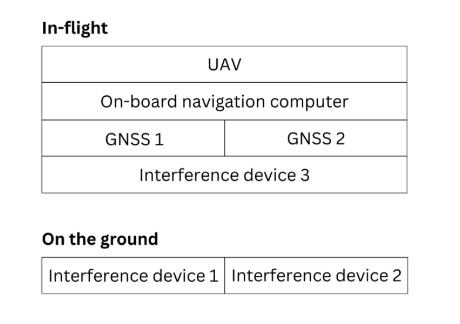
    The assessment included two GNSS devices secured to the UAV, an onboard navigation computer and an onboard interference device. Two additional interference sources were located on the ground.

    A simplified block diagram of the assessment setup. (Credit: oneNav)
    A simplified block diagram of the assessment setup. (Credit: oneNav)

    The onboard navigation computer integrated data from both GNSS receivers to determine and maintain the vehicle’s position and guide its movement. GNSS 1 was a competitor L1/L5 dual-band receiver that uses the L1C/A signal for initial acquisition before adding L5 signals. GNSS 2 was the oneNav L5-direct receiver, which exclusively utilized modern L5-band signals for both acquisition and tracking.

    Test Conditions and Results

    The in-flight assessment, conducted on a UAV under real-world dynamic and RF interference conditions, demonstrated that the oneNav L5-direct receiver operates independently of legacy GNSS signals such as L1 and L2. While conventional dual-band receivers require L1 acquisition before transitioning to L5 tracking, the oneNav solution used only modern L5 signals for both functions6.

    The Emerging Technology Lab implemented comprehensive RF interference protocols, including both ground-based and airborne signal interference across multiple L5 frequencies. The oneNav L5-direct receiver maintained tracking capabilities during L5/E5a signal interference centered at 1176.45 MHz. This performance is attributed to the receiver’s wideband RF front-end architecture, which enables simultaneous processing across an extensive frequency range. The system leverages Galileo’s dual sideband configuration (E5a and E5b), automatically transitioning to E5b when E5a experiences interference—a feature unique to the oneNav technology. A brief six-second delay was observed during this transition, reflecting a three-second lock loss on E5a followed by a three-second acquisition of E5b. The ability to track E5b signals, despite a 10 dB power differential, highlights the receiver’s sensitivity.

    L5-direct FPGA attached to the assessment UAV. (Credit: oneNav)
    L5-direct FPGA attached to the assessment UAV. (Credit: oneNav)

    Key Findings

    • The oneNav L5-direct GNSS receiver acquired, tracked and provided location data to the drone flight computer under actual flight dynamics and through L5 band signal interference.
    • Direct acquisition and tracking using only L5-band signals was demonstrated, confirming immunity to L1 signal interference.
    • The receiver demonstrated resilience to L5 in-band signal interference at typical electronic warfare power levels, quickly adapting by switching to the E5b sideband when E5a was disrupted.
    • The receiver maintained stability and responsiveness when both E5a and E5b sidebands were blocked.
    • Continuous tracking functioned well with the BeiDou constellation off and the almanac on or off6.

    Technical Background

    The oneNav L5-direct technology was originally developed for consumer applications such as wearables, phones and surface vehicles. Its adaptability allows for rapid customization and deployment across a range of platforms, including those requiring robust performance in challenging environments.

    Because the L5-direct receiver uses signals exclusively within the L5 band, it can leverage the advanced features of these signals. L5-band signals offer greater power and increased resistance to RF interference compared to L1 signals. Industry experts, including Prof. Brad Parkinson, recognize the advantages of L5-only receivers for jam resistance.

    Currently implemented on FPGA architecture, a future L5-direct ASIC is expected to deliver performance improvements, including enhanced acquisition and tracking capabilities.

  • oneNav debuts L5-direct ASIC receiver with advanced jamming resilience

    oneNav debuts L5-direct ASIC receiver with advanced jamming resilience

    oneNav has developed an L5-direct GNSS receiver ASIC, a breakthrough that enables devices to directly acquire and track L5-band satellite signals without relying on the older, more vulnerable L1 signals. The L5-direct receiver was rapidly designed and brought to market using the GlobalFoundries 22-nanometer FDX platform, which offers advanced mixed-signal integration and ultra-low power performance for both radio frequency and digital functions.

    The new receiver features a unique processor architecture, described as a “GPU for GNSS,” that eliminates dependence on L1 signals. This approach is designed to address critical vulnerabilities in aviation, defense and consumer navigation applications, where L1 signals are increasingly susceptible to jamming and spoofing. According to oneNav, the L5-direct technology is completely immune to L1 jamming and offers six to seven times greater resilience to interference and jamming in the L5 band compared to legacy solutions. It also delivers a tenfold improvement in measurement precision, faster initial location acquisition, enhanced accuracy in dense urban environments and reduced power consumption compared to L1-dependent receivers.

    L5-direct can be deployed across defense, national security, industrial and consumer markets, offering a significant boost in jamming resistance for GPS-based positioning and timing applications.

    “The need for ultra-low power consumption with high jamming resilience is acute in the rapidly growing unmanned vehicle segment, including drones,” said oneNav CEO Steve Poizner.

    Earlier this year, oneNav partnered with three military agencies to evaluate L5-direct in terrestrial, maritime and aerial environments under simulated electronic warfare conditions. The trials confirmed the technology’s immunity to L1 interference and demonstrated its superior resilience to L5 jamming.

    Key features of the GlobalFoundries 22FDX+ platform that enabled this innovation include optimized power-performance balance, advanced mixed-signal integration, ultra-low power consumption and enhanced RF performance, supporting a wide range of applications.

    The L5-direct technology is now available as licensable intellectual property and can be customized for use in a range of applications, from consumer wearables to unmanned aerial vehicles. It can also complement military-grade M-Code solutions for applications requiring high resilience, low power and rapid signal acquisition.

  • JNC 2024: oneNav

    JNC 2024: oneNav

    Paul McBurney, co-founder and CTO of oneNav, met with Matteo Luccio, GPS World editor-in-chief, to discuss the benefits oneNav’s L5-direct GNSS technology has for alternative navigation in military applications.

    Discover more about oneNav’s L5-direct GNSS technology.

  • oneNav’s L5-direct safeguards defense and location services

    oneNav’s L5-direct safeguards defense and location services

    Photo: oneNav
    Photo: oneNav

    oneNav has released the results of a test evaluating the resilience of its technology to widespread GPS interference. The testing was conducted in and around Haifa, Israel and focused on the performance of its L5-direct GPS receiver compared to GPS receivers in top smartphone and smartwatch brands.

    For this test, oneNav compared its L5-direct GPS receiver to receivers found in iPhone, Samsung Galaxy and Google Pixel smartphones and Garmin watches. While these receivers all experienced navigation failure due to GPS interference, oneNav’s L5-direct test solution maintained accurate location fixes despite active jamming and spoofing.

    This resilience is due to L5-direct’s ability to directly acquire L5 GPS signals and bypass the L1 GPS signal, which was first invented more than 50 years ago. While current commercial GPS receivers in smartphones, car navigation systems, and airplanes can process the L5 band, they can only do so in a hybrid system that must first acquire L1.

    According to the company, L5-band signals are 30 times harder to jam and interfere with than L1 and offer improved performance in difficult-to-navigate areas such as urban canyons and tree-covered regions.

    “We now have clear, indisputable evidence that L5-direct is resilient to widespread GPS jamming and can provide precision location in GPS-contested environments,” said, Steve Poizner oneNav CEO. “This test is a real-world validation of our first-of-its-kind technology and shows the potential for L5-direct to revolutionize how we use GPS for civilian and military purposes in Israel and globally.”

    While the field testing took place in Israel, GPS interference is a global security concern due to the increase in attacks on GPS systems worldwide. In Ukraine, Russia is countering American-made smart weapons on the battlefield through GPS-jamming technology and is accused of interfering with GPS navigation systems in more than 46,000 flights across Europe.

    oneNav’s IP core is available for evaluation and integration by select chip developer partners and its low-SWaP chips and modules will soon be available for select partners. L5-direct is compatible with all GNSS constellations.

  • oneNav L5-direct GNSS technology

    oneNav L5-direct GNSS technology

    Photo: oneNav
    Photo: oneNav

    oneNav L5-direct GNSS technology is the first and only commercial solution that directly acquires and tracks L5-band satellites. By fully eliminating reliance on the outdated L1 band, the L5-direct receiver is simpler, lower power, and better.  Compared to complex L1/L5 dual-band receivers:

    • L5-direct requires only a single antenna and RF chain for lower cost, smallest size and up to 3x lower power.
    • Has 8x better TTFF, and 2x more accuracy in dense urban areas.
    • Is immune to widespread L1-band jamming.

    Suitable for cellular, wearable, IOT, automotive, military, survey, and timing markets, oneNav technology is available in three distinct configurations:

      1. Licensable digital L5-direct IP core: A fully synthesizable RTL digital signal processing core includes a complete, scalable L5-direct measurement solution that has been fully simulated from 22 nm down to 4 nm.
      2. pREX SIP – Mixed signal hard macro in 22 nm GlobalFoundries silicon technology: The pREX SIP couples the L5-direct IP core with an RF front end that includes a highly optimized, low power amplifier, PLL and A/D converter. Implemented in GF22 FDX process and packaged in a SIP that can be soldered onto a PC board, or also as a hard macro for silicon platform integration.
      3. Position determination firmware:The position engine firmware converts L5-direct measurements into position, velocity, and time, and is provided as an embedded library for the platform microcontroller.

    oneNav can further customize any of these deliverables in partnership with a licensee to bring this performance to any end product. Click here to learn more.

  • L5-based oneNav outperforms Android smartwatch

    L5-based oneNav outperforms Android smartwatch

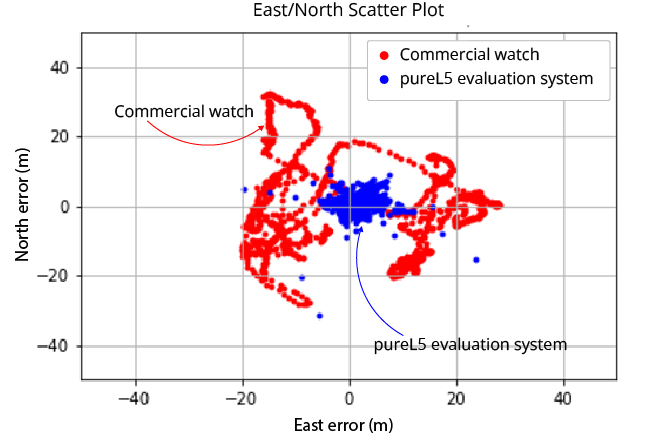
    OneNav’s pureL5 more accurate in urban testing without sensor augmentation

    Image: OneNav
    Image: OneNav

    OneNav is sharing side-by-side test results comparing its pureL5 GNSS receiver customer evaluation system to a leading Android smartwatch.

    OneNav is a Silicon Valley, California-based technology company designed to power high-performance positioning for location-dependent mobile services.

    In a challenging urban environment, oneNav averaged six times better accuracy than the smartwatch. Both units used commercial-wearable antennas for testing. While the oneNav system used only GNSS measurements, the smartwatch GNSS results were augmented by inertial sensors.

    At the 95th percentile, the pureL5 unit reported 8-meter accuracy compared to nearly 29-meter accuracy for the smartwatch; pureL5 accuracy includes artificial intelligence/machine learning algorithms that improve the system over time.

    “The L5 signal is more accurate and reliable than L1, it has higher power and wider bandwidth, and it is less jammable,” said Steve Poizner, co-founder and CEO of oneNav. “We looked at where the market is heading, with the wearables and tracking device markets exploding and the demand for higher accuracy increasing, and we asked, ‘Why keep two bands/two RF chains/two antennas when you can get superior performance with just L5?’”

    The oneNav team comprises top GNSS experts from Qualcomm, Apple, Intel, SnapTrack, SiRF, Trimble and eRide who have decades of GNSS and mobile industry experience. The team has expertise in GNSS system architecture, multipath mitigation, signal processing, ASIC design and AI/machine learning, and collectively has filed more than 300 career GNSS patents.

    Investors include Google Ventures, Norwest Venture Partners and GSR Ventures.

  • oneNav to open European office in Finland

    oneNav to open European office in Finland

    Advanced GNSS digital receiver IP core developer seeks to add expertise to global engineering team with the establishment of new subsidiary oneNav Finland Oy

    oneNav logoSilicon Valley, California-based technology company oneNav is opening its first European office in Tampere, Finland.

    oneNav Finland Oy will be led by Florean Curticapean, director of position engineering. He has more than two decades of professional experience in GNSS and mobile communications.

    oneNav is developing a next-generation GNSS receiver for smartphones, wearables and tracking and augmented reality (AR) devices. The oneNav pureL5 GNSS solution was built from the ground up to fully leverage the modernized E5/L5/B2 signaling band deployed on multiple constellations including GPS, Galileo and BeiDou.

    The new E5/L5/B2 signal has considerable benefit over the legacy L1 signal that has been used since the 1980s, according to oneNav. E5/L5/B2 enables higher precision and better multipath mitigation, improves coverage and reliability, and is a unified signal, ensuring global interoperability.

    The oneNav pureL5 system utilizes machine learning and artificial intelligence to improve its solution by removing reflected signal errors that most commonly cause GNSS inaccuracy in deep urban environments.

    Devices powered by oneNav’s technology will produce high accuracy in challenging signal conditions while benefiting from reduced component bulk and complexity, oneNav said.

    “Talent is the key to attract such investments, but this does not appear overnight or by accident. Our businesses are benefitting from many years of research and education at Tampere University, more specifically in the Electrical Engineering Unit, in fields such as GNSS, system-on-chip, network-on-chip, embedded processor architecture, software-defined radio and more,” said Oliver Hussey, senior business advisor for the Tampere subsidiary.

    Tampere is the host of the ICL-GNSS Conference, welcoming a global audience to address the latest research on wireless and satellite-based positioning techniques to provide reliable and accurate position information with low latency.

  • OneNav completes pureL5 field test using customer evaluation system

    OneNav completes pureL5 field test using customer evaluation system

    The commercially available L5-only GNSS solution includes machine-learning algorithms to leverage increased L5 signal-ranging precision in challenging signal conditions.

    oneNav logoOneNav has announced performance results from field testing its latest pureL5 customer evaluation system (CES) software in both open-sky and challenging signal environments.

    The patent-pending oneNav GNSS system, including a custom array processor and a library of machine-learning algorithms, demonstrated consistent sub-meter accuracy and rapid time-to-first-fix (<2 sec) in open-sky testing.

    In very challenging urban and deep urban canyon environments, the pureL5 CES field-test equipment outperformed the commercial precision L1 GNSS unit against which it was compared, demonstrating tracking of satellite signals as weak as –160 dBm.

    The oneNav system was able to acquire directly and track L5 signals in all environments with no L1 receiver present, greatly simplifying the RF front end and antenna subsystem and making the pureL5 solution suitable for space- and power-constrained mobile and internet of things (IoT) devices requiring reliable high performance.

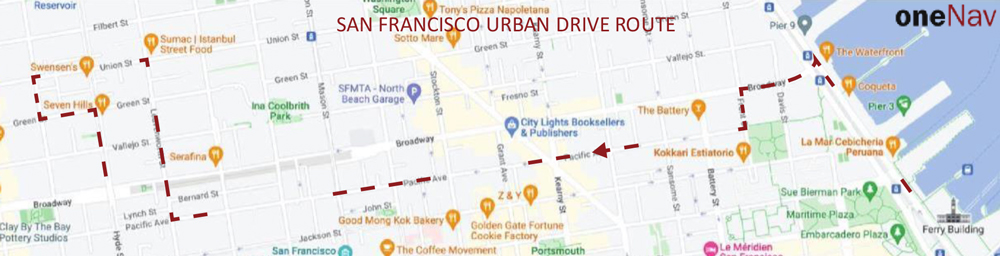
    Results of a representative urban drive test route are shown below (the map describes the route driven). During this test, the CES and the commercial precision L1 receiver were both connected to a common antenna, fixes were taken once/second, and the results were compared to a common ground truth position. On average, the oneNav system demonstrated a 55% improvement in accuracy over the precision.

    Image: oneNav
    Image: oneNav

    OneNav’s family of  algorithms improves pureL5 system performance by predicting whether the received signal is line of sight (LOS) and correcting non-line-of-sight (NLOS) signals to increase the number of measurements available for accurate positioning.

    The pureL5 algorithms characterize signal and multipath environments. Accordingly, algorithms developed in one deep urban area can be used to mitigate multipath in areas geographically different, but that present similar multipath signatures. This obviates the need for field-test teams to collect data in thousands of urban areas around the globe.

  • OneNav announces pureL5 GNSS digital IP core

    OneNav announces pureL5 GNSS digital IP core

    The PureL5 Customer Evaluation System is being tested by California and Chinese companies

    oneNav logoOneNav has announced the commercial availability of its pureL5 GNSS digital IP core.

    The pureL5 digital IP core’s architecture enables it to directly acquire and track L5 signals from GPS, Galileo, BeiDou, QZSS and GLONASS without any L1 aiding. This eliminates the entire L1 RF chain, saves space on the printed circuit board, and simplifies the RF front-end and antenna subsystem in smartphones, wearables and trackers.

    The pureL5 digital IP core’s massively parallel array processor searches the entire 1-millisecond L5 code space in parallel, delivering 1 second time to first fix (TTFF). The pureL5 digital IP core is 0.28mm2 in the 3-nm semiconductor process and consumes 4.7 mW of power in 1-Hz tracking mode.

    OneNav has delivered the pureL5 digital IP core register-transfer level (RTL) to its first system-on-chip (SOC) customer. IP core RTL verification and physical implementation are complete, and oneNav’s SOC licensee will tape out in the first quarter of this year. The pureL5 digital IP core RTL is available for customer licensing and shipment now.

    Customer Evaluation System. OneNav’s pureL5 Customer Evaluation System is being tested by companies in California and China. The system is available for smartphone and wearable OEMs and SOC providers who want to evaluate oneNav’s pureL5 in the field and the lab.

    PureL5 GNSS Features

    • Smaller footprint than L1+L5 hybrids, simplifying implementation in highly space-constrained devices such as 5G smartphones and wearables
    • Lowers bills of material (BOM) cost and simplifies the RF front-end and antenna subsystem by eliminating the entire L1 RF chain
    • No L1 aiding required: directly acquires L5/E5/B2 with 1-second TTFF
    • Less software complexity, simplifies RF coexistence engineering
    • Better interference resiliency
    • Scalable IP signal processing core is semiconductor process-node independent
    • Multi-constellation L5: Beidou, Galileo, GPS, QZSS, GLONASS.
  • OneNav unveils L5-only mobile GNSS receiver

    OneNav unveils L5-only mobile GNSS receiver

    Using artificial intelligence (AI), the oneNav receiver improves accuracy and reliability for location-dependent applications and services.

    A new L5-only GNSS receiver is now available from oneNav. The mobile receiver provides high location accuracy with half the footprint of existing solutions.

    OneNav has signed a strategic partnership agreement with In-Q-Tel Inc., providing U.S. intelligence and defense agencies with a GNSS technology solution that is the first of its kind, according to the company. The company also closed a $21 million Series B funding round, led by GV, with participation from Norwest Venture Partners and GSR Ventures, bringing total funding to $33 million.

    “Navigation satellite constellations are getting a major upgrade — L5 signaling. oneNav has built the first Pure L5 mobile receiver to leverage these modernized signals, and we will deliver our solution in a flexible licensing model, as a scalable and customizable IP core,” said Steve Poizner, co-founder and CEO of oneNav. “I’m proud to be working with such an outstanding team of GNSS experts, as well as our top-notch investors GV, Norwest and GSR.”

    “Pure L5 is a more cost-, size- and power-efficient method to enable the benefits of modernized signals compared to current hybrid solutions,” added Paul McBurney, oneNav co-founder and CTO.

    Other GNSS solutions that fuel location-based services — rideshare, smartphone navigation and 911 emergency calls — depend on L1 satellite signals developed in the 1970s. According to oneNav, legacy L1 systems can have significant accuracy deficiencies, especially in dense urban areas, placing users on the wrong side of the street or on the wrong block.

    L1 signals are also susceptible to jamming. Recently, satellite constellations have been upgraded with state-of-the-art L5 signaling. L5 enables higher accuracy, broadcasts in a protected frequency band, has modern error correction and is transmitted at higher power.

    OneNav’s Pure L5 solution is built from the ground up to fully leverage modernized L5 signals from the GPS, Galileo, Beidou and QZSS navigation satellite constellations. Unlike current L1+L5 hybrid solutions that must first acquire on L1, oneNav’s Pure L5 solution both acquires and tracks on the new L5 signals, without L1 aiding, thereby taking full advantage of L5 benefits.

    By eliminating the need for L1 circuitry, oneNav cuts GNSS RF size, power and cost in half. Supercharged by AI/machine learning, oneNav Pure L5 delivers much higher accuracy, even in challenging areas such as urban canyons. OneNav Pure L5 is ideal for highly space-constrained devices such as smartphones, wearables and IoT tracking modules. The solution is delivered in a semiconductor IP license package that includes register-transfer level (RTL), software and reference designs that can be integrated into a system on a chip (SOC) or built as a discrete chip.

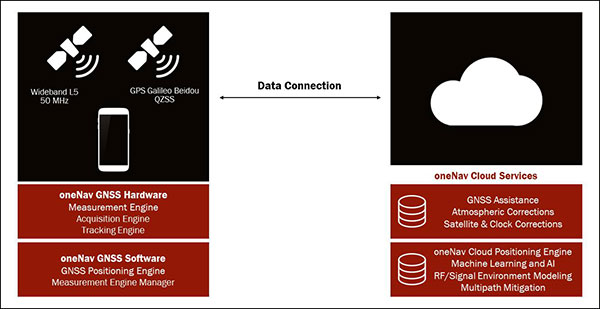
    The oneNav L5 mobile GNSS system architecture. (Image: oneNav)
    The oneNav L5 mobile GNSS system architecture. (Image: oneNav)

    Pure L5 Use Cases

    OneNav’s technology will dramatically improve location-based services that are used every day by individuals across the world to pinpoint their location. Common use cases include:

    • Rideshare. Today’s mobile positioning technologies often place users on the wrong side of the street, or on the wrong block, making rideshare services very difficult to use. oneNav enables riders to more effectively match up with their drivers in downtown areas and other heavily blocked environments.
    • Smartphone Navigation. It is sometimes difficult to establish your exact location, or to determine which way to turn when using a mobile navigation application in a dense urban area. oneNav’s high availability and precise accuracy enables reliable turn-by-turn directions.
    • Emergency Calls. First responders need to accurately pinpoint the location of accidents in order to get to the right place quickly. oneNav’s reliable positioning and high accuracy get the right location information to ambulances, fire and police, enhancing public safety.
    • Asset Tracking. COVID-19 has increased the need for supply-chain assets to be transported and tracked with precision. oneNav enables accurate position reporting for asset tracking and other IOT applications.

    “The mobile device industry — from phones to wearables — has made tremendous progress over the last 20 years,” said Karim Faris, GV general partner. “What’s surprising is that location-based services continue to have a significant margin of error, which can make all the difference when locating a rideshare passenger or pinpointing an emergency situation. With oneNav’s Pure L5 Mobile GNSS receiver, OEMs and application service companies will have the opportunity to provide their customers with state-of-the-art location-based services, driving competitive advantage.”