Tag: product showcase

  • Trimble Launches InSphere Data Marketplace of Geospatial Data

    The Trimble InSphere Data Manager provides efficient geospatial data management for an entire organization.
    The Trimble InSphere Data Manager provides
    efficient geospatial data management for an entire organization.

    Trimble has introduced a new Data Marketplace service for the Trimble InSphere geospatial information management platform. The InSphere Data Marketplace allows geospatial professionals to quickly search, locate and obtain spatial data on demand. InSphere users can now find and use additional free and premium spatial data layers, including aerial and satellite imagery, terrain, elevation and topographic maps, building footprints and other third-party data. In addition, new capabilities have been added to a variety of InSphere applications to streamline geospatial data access.

    “As the latest addition to the InSphere platform of applications, the Data Marketplace service plays an important role in our cloud-based geospatial information management platform. InSphere’s Data Marketplace is designed to help our customers find, manage and use spatial data critical to their business,” said Alain Samaha, business area director of software for Trimble’s Geospatial Division. “Giving our customers access to multiple layers of spatial information makes end deliverables more robust for their clients.”

    The Trimble InSphere Data Marketplace is a new application that is part of Trimble InSphere, a cloud-based platform of software, data, and services focused on the needs of geospatial professionals including surveyors, engineers and GIS professionals. InSphere’s web interface provides access to other productivity-enhancing applications such as Trimble InSphere Data Manager, Trimble InSphere Equipment Manager, Trimble TerraFlex and Trimble Access Services.

    The latest release also adds capabilities and enhancements to the applications within the InSphere platform:

    Trimble TerraFlex — Unified Geospatial Data Collection and Simplified Digital Forms 

    The TerraFlex application includes productivity enhancement features that enable a tighter integration for Esri’s ArcMap plugin and allow GIS users to bring in data directly from TerraFlex into an ArcMap project. The module includes Esri basemap support for access to a range of freely available Esri basemap layers, new export options for more flexibility for portable data formats, exchange, and full Windows 7 and 8 support on TerraFlex Mobile. This enables users a broader range of devices to select and use in the field for collecting asset information data. In addition, the TerraFlex user interface is now integrated into the Trimble InSphere platform, giving users a seamless experience between TerraFlex and other InSphere modules. A 30-day free trial is available online.

    InSphere Data Manager — Geospatial Information in One Place

    Data Manager now supports Trimble Business center version 3.2 files, increasing support for more data file formats that a user is able to upload and view within the module. A 90-day free trial is available online.

    InSphere Equipment Manager — Centrally Manage Equipment 

    The release expands the compatibility to add and manage more devices faster and easier. Users can now import a list of devices from an Excel spreadsheet to immediately begin managing devices in the module. In addition, Equipment Manager now supports Trimble Access Software version 2013.40 (and higher), increasing the number of devices that a user can manage. A 90-day free trial is available online.
  • Dual-Frequency Pinwheel Antenna Designed for Optimal Positioning 

    Dual-Frequency Pinwheel Antenna Designed for Optimal Positioning 

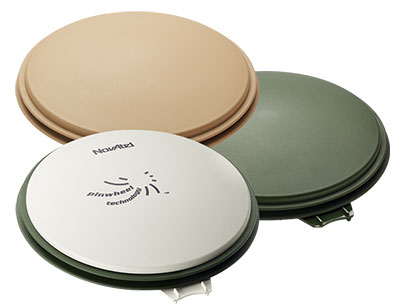
    The NovAtel GPS-702-GG-HV high-performance pinwheel antenna comes in three colors. Photo: NovAtel, Inc.
    The NovAtel GPS-702-GG-HV high-performance pinwheel antenna comes in three colors. Photo: NovAtel, Inc.

    NovAtel, Inc., has introduced the GPS-702-GG-HV to its line of high-performance Pinwheel antennas. Tracking L1/L2 GPS and L1/L2 GLONASS frequencies, customers can use the same antenna for GPS-only or dual constellation applications, reducing equipment costs and need for future redesign, the company said.

    With the same form-factor and choke ring performance as the company’s other pinwheel antennas, the GPS-702-GG-HV has been enhanced even further to provide the robustness needed for use under high-vibration conditions.

    The phase center of the antenna remains constant as the azimuth and elevation angle of the satellites change. Signal reception is unaffected by the rotation of the antenna or satellite elevation, so placement and installation of the antenna can be completed with ease. With the phase center in the same location for both the L1 and L2 signals and with minimal phase center variation between antennas, this antenna is designed for baselines of any length.

    Enclosed in a durable, waterproof housing, the GPS-702-GG-HV comes in three colors: NovAtel standard grey, as well as desert tan and olive drab for military customers. The antenna is available for order beginning September 12.

  • The Business & Product Showcase — September 2014

    The Business section from the September 2014 issue. Download the PDF here.

    Includes: Juniper Systems Rugged Handheld Company; JAVAD GNSS Introduces TRIUMPH-F1 UAV; CSR, Maestro Module; Spirent Location Availability for VoLTE E911 Calls Indoors; Carlson BRx5 Pole-Top Receiver; Trimble Rover 2 with Wireless Link; Mitre Detects Timing Spoofing Attacks; Avidyne Navigator Certification; Mobile Location Data Accuracy Guidelines; GigOptix Offers Dual-Mode GNSS RF Receiver; Precision Farming Projected to Grow at 13 Percent to 2018; Events

    PLUS: UAV/UAS Product Showcase, Unmanned Aerial Vehicles and Systems

  • Topcon Releases New UAS for Aerial Mapping

    Topcon Releases New UAS for Aerial Mapping

    Sirius-Topcon-UAS-O

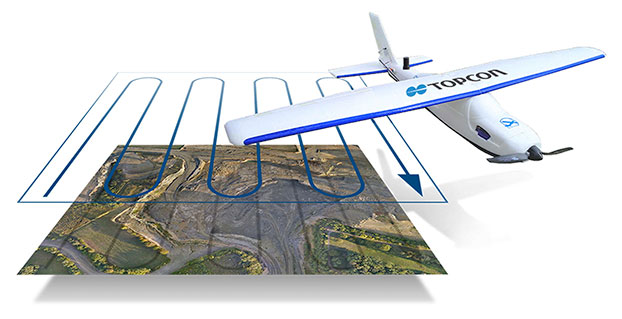
    Topcon Positioning Group has released two unmanned aerial systems (UAS) for mapping — the Sirius Pro and Sirius Basic. Both systems are designed to produce the most accurate solutions for the automated mapping of a wide range of sites — regardless of terrain — including construction sites, mines and quarries, and for use in land surveying, power line and pipeline inspection as well as precision agriculture field mapping.

    The fixed-wing systems resulted from a partnership with MAVinci GmbH, a UAS development company with which Topcon recently entered into a worldwide distribution agreement.

    “The Sirius Pro system is unique to the UAS marketplace. Instead of using traditional ground control points, Topcon combines RTK (real-time kinematic) GNSS solutions with precision timing technology to provide more accurate mapping results when compared to other products,” said Eduardo Falcon, executive vice president and general manager for the Topcon GeoPositioning Solutions Group.

    “The system is easy to use and rugged — allowing operators to use a simple hand launch with precise automatic operation from takeoff to landing, and it can be flown safely in nearly all weather conditions,” Falcon said.

    The Topcon Sirius Basic is an entry-level system offering many of the advantages of the Sirius Pro with options to upgrade. “The Sirius Basic shares the same hardware components of the Pro model, providing affordability with the same level of sturdiness and ease of operation,” said Falcon. “Additionally, when the need arises for the increased accuracy and productivity of the Pro system, a simple upgrade makes the transition practically effortless.”

    Both systems also offer autopilot assisted manual control, automatic flight planning and safety features.

  • GeCo in the Rockies Combines Two Geospatial Conferences

    GeCo in the Rockies — a combined conference of GIS in the Rockies and GeCo West — will be held September 22-26 in Grand Junction, Colorado.

    Two full days of presentations and workshops will showcase the projects, applications, and solutions of geospatial professionals. A special Technology Panel showcases innovators and leaders in the field, who will address “The Future of GIS.”

    LizardTech, a provider of software solutions for managing and distributing geospatial content, will exhibit at the conference and prsesent a workshop titled “Compressed Data Workflow in a GIS Environment” on September 23, hosted by LizardTech’s Regional Territory Manager Genie Hays.

    In the workshop, Hays will introduce the MrSID file format, which provides a complete geospatial workflow, from data acquisition, to access and delivery on desktop and mobile devices. She will demonstrate how to use MrSID files for imagery and LiDAR in industry tools. Her demonstrations of industry tools will include ArcMap, AutoCAD, Global Mapper, Q-GIS, GeoServer, Google Earth, ArcGIS Explorer Online, Trimble devices, UAV data samples, and more.

    “We are really excited to share with the GeCo attendees how they can make the most of MrSID data using common industry programs and applications,” Hays said.

    Other Conference Highlights

    The keynote speaker is the founder of What3Words, who will discuss the creation of a universal address system based on words rather than numbers. Also, GeCoX is a premier kick-off event highlighting short, focused talks about the changing technology landscape.

    Esri will provide a hands-on Learning Lab, with an introduction to ArcGIS software in a variety of self-paced training sessions.

    A networking social provides an opportunity to meet the leading businesses in the geospatial industry and learn more about the changing tools, software, hardware, and solutions, and a Student and Career Exploration Breakfast provides an interactive session with education and industry experts to learn, which personal and technical GIS skills are in demand for today’s GIS employee. The breakfast is open to all students for free.

    Learn more at the conference website.


  • GeCo in the Rockies Combines Two Geospatial Conferences

    GeCo in the Rockies — a combined conference of GIS in the Rockies and GeCo West — will be held September 22-26 in Grand Junction, Colorado.

    Two full days of presentations and workshops will showcase the projects, applications, and solutions of geospatial professionals. A special Technology Panel showcases innovators and leaders in the field, who will address “The Future of GIS.”

    LizardTech, a provider of software solutions for managing and distributing geospatial content, will exhibit at the conference and prsesent a workshop titled “Compressed Data Workflow in a GIS Environment” on September 23, hosted by LizardTech’s Regional Territory Manager Genie Hays.

    In the workshop, Hays will introduce the MrSID file format, which provides a complete geospatial workflow, from data acquisition, to access and delivery on desktop and mobile devices. She will demonstrate how to use MrSID files for imagery and LiDAR in industry tools. Her demonstrations of industry tools will include ArcMap, AutoCAD, Global Mapper, Q-GIS, GeoServer, Google Earth, ArcGIS Explorer Online, Trimble devices, UAV data samples, and more.

    “We are really excited to share with the GeCo attendees how they can make the most of MrSID data using common industry programs and applications,” Hays said.

    Other Conference Highlights

    The keynote speaker is the founder of What3Words, who will discuss the creation of a universal address system based on words rather than numbers. Also, GeCoX is a premier kick-off event highlighting short, focused talks about the changing technology landscape.

    Esri will provide a hands-on Learning Lab, with an introduction to ArcGIS software in a variety of self-paced training sessions.

    A networking social provides an opportunity to meet the leading businesses in the geospatial industry and learn more about the changing tools, software, hardware, and solutions, and a Student and Career Exploration Breakfast provides an interactive session with education and industry experts to learn, which personal and technical GIS skills are in demand for today’s GIS employee. The breakfast is open to all students for free.

    Learn more at the conference website.


  • Grasshopper3 Vision Camera Launched for Scientific Imaging

    PointGrey-Grasshopper3-Camera-W

    Point Grey, a designer and manufacturer of innovative, high-performance digital cameras, has added a 4.1-megapixel global shutter CCD to the Grasshopper3 family of high-quality, high-resolution USB 3.0 cameras.

    The new Grasshopper3 GS3-U3-41S4 models are based on color and monochrome versions of the Sony ICX808, a 1/1.8-inch global shutter EXview HAD CCD II sensor featuring 3.1 micron square pixels , and capable of  2048 x 2048 pixel resolution at 18 FPS.  The Sony ICX808 EXview HAD CCD II sensor provides excellent quantum efficiency of over 72% and its unique square aspect ratio makes it ideal for scientific applications such as microscopy and ophthalmology, and industrial applications such as AOI and electronics inspection, Point Grey said.

    Like all Point Grey USB 3.0 cameras, the Grasshopper3 uses a proprietary USB 3.0 link layer and frame buffer-based architecture for optimal performance and reliability. The Grasshopper3 uses an advanced image processing pipeline to enable look up table, gamma correction, pixel binning and USB3 Vision support.

    “We are excited to expand our Grasshopper3 USB3 Vision camera lineup with the latest sensor technology,” said Michael Gibbons, director of Sales and Marketing at Point Grey. “Applications such as ophthalmology rely on a square aspect ratio and will therefore benefit from the full resolution of the GS3-U3-41S4 camera.”

  • Topcon Offers 3D Indicate Grade System

    Topcon Offers 3D Indicate Grade System

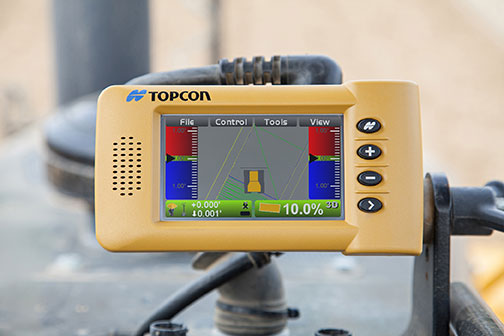
    I-33_Topcon-WTopcon Positioning Group has announced a multi-platform 3D indicate grade system, the i-33. The new system features GNSS technology and a graphical display designed to provide a powerful indicate system at an economical price.

    The i-33 allows for quick installation and easy operation on many types of grading and earth-moving machinery, according to Topcon. It is designed for use on a dozer, scraper or any type of machinery used for cut or fill operations.

    “The new system brings the productivity of GNSS-based 3D grade control for all types of applications,” said Kris Maas, Topcon’s manager of machine control product marketing.

    “Indicate GNSS systems have not been an economical reality for many contractors or types of work. In other words, the return on investment for a traditional 3D-MC system did not make it practical for bulk earthmoving or less utilized equipment,” Maas said. “With i-33, the game has changed. Its low cost and quick installation make it the perfect solution for use on multiple pieces of equipment or even sharing between machines. Basically, it eliminates over- or under-cutting and ensures material is moved exactly where it needs to be the first time.”

    The GX-30 graphical display control box keeps the operator “visually informed as to final grade so adjustments can easily be made, eliminating redundant passes and helping to further reduce the need for onsite grade checking,” Maas said.

    The system also includes the new MC-i3 GNSS receiver with Vanguard technology, offering single or dual GNSS antenna configurations, allowing the system to work in a wide variety of applications. The MC-i3 also allows connection to Topcon’s Sitelink3D site management solution that provides real-time data control, machine tracking, reporting and planning in one solution to maintain conformance and improve productivity through all job phases.

  • NovAtel Introduces New IMU to SPAN Line of GNSS Products

    NovAtel Introduces New IMU to SPAN Line of GNSS Products

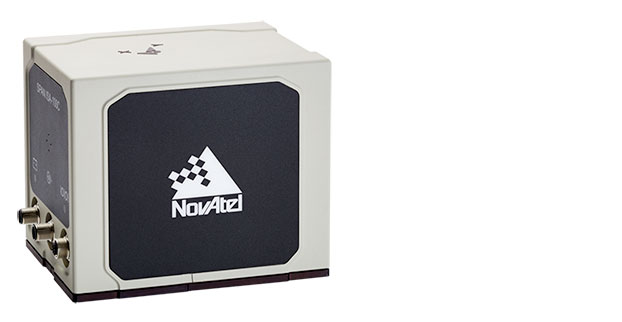
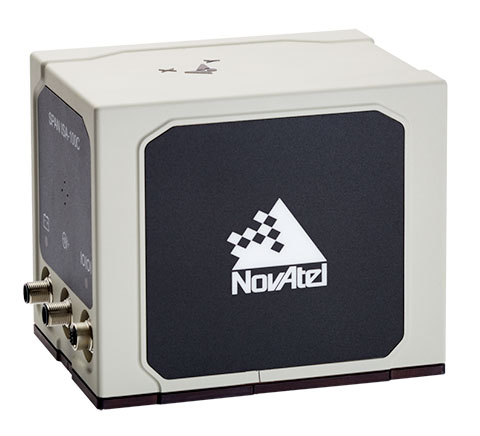
    NovAtel IMU-ISA-100C.
    NovAtel IMU-ISA-100C.

    NovAtel Inc. has added the IMU-ISA-100C as an inertial measurement unit (IMU) option to its SPAN GNSS+INS line of positioning products. The IMU-ISA-100C is a high-performance, near navigation-grade IMU designed for platform stabilization, general-purpose navigation, photogrammetry, remote sensing, and ground mobile-mapping applications.

    Commercially exportable, the IMU-ISA-100C integrates easily with a NovAtel SPAN capable receiver to provide a tightly coupled 3D navigation solution, NovAtel said. Offering customers continuous position, velocity and attitude (roll, pitch and azimuth) measurements, a SPAN system is stable and available even through periods when satellite signals are blocked or unavailable.

    With the IMU-ISA-100C, customers will receive near navigation-grade performance, at an affordable price point.  The product also features a new enclosure designed to maximize versatility for a range of applications.

    “The compelling aspect of this product is its value — it is a high-end SPAN solution, delivering extremely precise positioning, at an attainable price point,” said Siamak Akhlaghi, NovAtel’s product manager, SPAN. “And without the export constraints, it can be shipped internationally in a timely fashion.”

  • Motion Tracker for Industrial Applications

    Motion Tracker for Industrial Applications

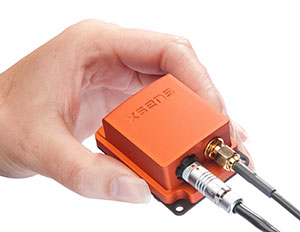
    MTi-G-700_hand-WThe MTi-G-700 by Xsens is a GPS-aided, IMU-enhanced GPS/INS that offers high-quality orientation and position. It makes use of sensory measurements from magnetometer, barometer, and a high-sensitivity GPS-L1 receiver to provide navigation estimates of position, velocity, and orientation at high data rates under high-dynamic conditions.

    The Xsens estimation engine (XEE) sensor-fusion framework enables the motion tracker to take advantage of different aiding sensor measurements and optimally fuse them to get robust tracking estimates. The MTi-G-700 has a u-blox 6 internal 50-channel L1C/A code receiver with 2-meter horizontal accuracy and 5-meter vertical accuracy; SBAS; a 4-Hz update rate; 27-second cold start-up time; and -161 dBM tracking sensitivity.

    The MTi is being used by customers for many maritime and oceanographic applications that require 3D orientation, 3D position, 3D velocity, and 3D dynamic data, such as a monitoring system in a barge master vessel where the MTi monitors the movement of a wave-compensated crane.

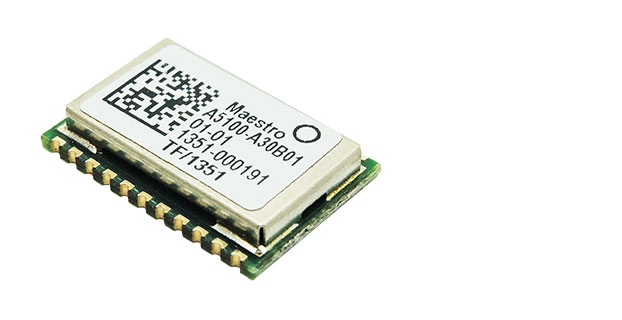
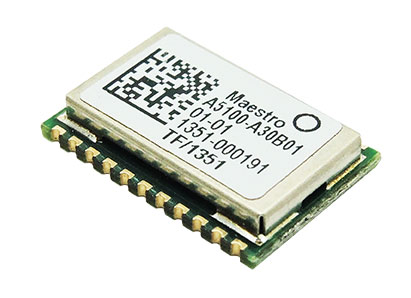
  • CSR, Maestro Offer High-Performance GNSS Module

    CSR, Maestro Offer High-Performance GNSS Module

    maestro-a5100-a-W

    Hong Kong-based Maestro Wireless Solutions, a manufacturer of location receivers, and CSR plc, a global provider of silicon and software solutions for location-aware applications, announce the immediate availability of the A5100-A, a next-generation SiRFstarV GNSS positioning module that combines high-performance GPS and GLONASS receiver technology in a small 10 x 15 mm package.

    The A5100-A is designed for a wide range of applications including wearable devices, cameras and automotive trackers.

    The A5100-A is the first release within Maestro’s new line of GNSS receivers. It achieves high accuracy with quad-constellation support, up to 30 percent faster time-to-first-fix (TTFF), and up to 20 percent lower power consumption using CSR’s TricklePower and Push-to-Fix (PtF) modes. The module also accelerates customer time to market and reduces development risks by integrating a number of features, including TCXO, SAW filter, RTC, antenna-control mechanism, and flash memory for future-proof upgrades, as well as offering a drop-in replacement capability for Maestro’s previous SiRFstar4 generation modules. The castellated-edge form factor also enables simpler manufacturing and reduces assembly cost, the companies said.

    Supporting all currently deployed GNSS, the A5100-A acquires and tracks all visible GPS, GLONASS, QZSS, and SBAS satellites. Concurrent GNSS performance enables the A5100-A to choose the best satellites from different constellations and deliver optimal location information. Immediate benefits are better coverage, enhanced stability, and accuracy in difficult environments, such as urban canyons, and stronger resilience to multipath and signal jamming. This ensures consumers maintain a position fix whether they’re in the middle of a busy city or in a remote rural location, the companies said.

    The A5100-A offers a range of other features including:

    • Direct to Battery connectivity: Connects directly to a rechargeable 1.8V-3.6V Lithium battery enabling system cost reduction and increased power efficiency.
    • Low Power technology: Optimized for power consumption by incorporating CSR’s PtF technology.  PtF rapidly establishes a valid position fix enabling the module to hibernate for longer periods of time, and adaptively changes power depending on the operating environment and motion conditions. Advanced algorithms and a powerful on-chip DSP processor maintain high accuracy (QoS) while achieving the lowest power level possible for the given environmental and motion conditions.
    • InstantFix Extended Ephemeris (EE): Accelerates TTFF for devices without internet connectivity such as cameras and wearable devices, by autonomously predicting EE for as long as three days and up to 31 days when connected to a network that supports SiRFInstantFix server generated extended ephemeris data (SGEE).

    “Maestro Wireless has worked closely with CSR for many years to design and commercialize highly accurate and reliable location products,” said Anthony Murray, senior vice president, Business Group at CSR. “But to win in today’s highly competitive consumer electronics market performance isn’t enough. That’s why we’ve worked with Maestro Wireless to develop a solution that excels in a range of performance metrics but also offers the small form factor essential for today’s compact devices and is highly integrated to help them get to market fast.”

    “The A5100-A is perfect for customers designing highly integrated products that need uncompromising performance but are pressured by the speed required to go-to market and lack of development resources,” said Olivier Bernard, EVP of Business Development at Maestro. “By combining low power consumption with high sensitivity, high jamming immunity and concurrent GNSS operation, and with its drop in upgrade path to the A2200-A, the A5100-A creates a fast and convenient route to the latest GNSS offering in the marketplace, to meet these needs quickly.”


  • DigitalGlobe Launches WorldView-3 High-Resolution Commercial Satellite

    DigitalGlobe, a  provider of commercial high-resolution Earth observation and advanced geospatial solutions, successfully launched WorldView-3, the company’s sixth and most advanced super-spectral, high-resolution commercial satellite.

    The satellite launched August 13 on a Lockheed Martin Atlas V rocket from Vandenberg Air Force Base in California.

    “The successful launch of WorldView-3 extends DigitalGlobe’s commanding technological lead and will enable us to help our customers see through smoke, peer beneath the ocean’s surface, and determine the mineral and moisture content of the Earth below — all with unprecedented clarity,” said Jeffrey R. Tarr, chief executive officer of DigitalGlobe.

    WorldView-3 will collect super-spectral imagery at 0.31 meter resolution — delivering five times the clarity of the company’s nearest competitor. In addition, WorldView-3 will offer the most spectral diversity available commercially, the company said, and will offer multiple shortwave infrared (SWIR) bands that allow for accurate imaging through haze, fog, dust, smoke and other air-born particulates. The satellite will also offer CAVIS — a cloud, aerosol, water vapor, ice and snow atmospheric correction instrument — which monitors the atmosphere and corrects data for an unprecedented level of consistency.

    “The unmatched abilities that WorldView-3 brings to our constellation will enable us to provide our customers with information and insight never before possible and advance our efforts to create a living digital inventory of the Earth,” Tarr said.

    The satellite and atmospheric monitoring instrument called CAVIS were built by Ball Aerospace. Exelis built the integrated, super-spectral payload consisting of a telescope, sensor and shortwave infrared system, making WorldView-3 the first commercial satellite to carry such capabilities. A United Launch Alliance Atlas V launch vehicle provided by Lockheed Martin Commercial Launch Services (LMCLS) delivered the satellite into orbit.