Tag: satellite launch

  • Galileo Initial Services looming

    With Galileo Initial Services at last on the horizon and a quadruple satellite launch scheduled for November, here’s hoping that Europe’s GNSS constellation will be delivering limited, but reliable, global PNT services before the year is out.

    The four Galileo satellites for Arianespace’s first Ariane 5 mission for the constellation are being prepared at ESA’s launch facility in French Guiana. The flight is scheduled for 17 November. However neither these four new satellites, nor the two orbited in May, are required to deliver Galileo Initial Services, which should be launched officially some time in November. Fingers crossed.

    The European GNSS Agency (GSA) is gearing up to assume its operational role for Galileo in early 2017. During the summer the GSA formally accepted their Loyola de Palacio facility in Madrid, Spain that houses the European GNSS Service Centre (GSC). This is a significant milestone in the development of the programme and its service provision as Galileo’s “door to the GNSS world” as GSA Executive Director Carlo des Dorides described the facility at the handover ceremony.

    GSA already oversees the operation and service provision for the European Geostationary Navigation Overlay Service (EGNOS) (since 2015) along with managing the security accreditation and general security provision for both programmes.

    The GSC offers over 1,100 square metres of space and currently employs over 40 people. Since 2013, the core team at GSC has been providing limited services and working as a precursor to GSC v1. Its key work includes supporting the lead up to Galileo Initial Services provision, along with operating the GSC Helpdesk, disseminating orbital products to the Search and Rescue (SAR) community, supporting GNSS-related research and industrial activity and monitoring user satisfaction. Once operational, GSC v1 will be connected to the Galileo core system, thus enabling the long anticipated Commercial Service. This service is expected to enter operations by mid-2017.

    Once the Galileo Operations Contract is awarded and Initial Services officially declared, the GSC is expected to see a significant increase in staff.

    Also in the summer CNES President and France’s inter-ministerial coordinator for European satellite navigation programmes Jean-Yves Le Gall was elected as the new chair of the GSA Administrative Board with Mark Bacon, representing the United Kingdom, elected as deputy chair.

    “I am honoured to have been elected chair of the GSA Administrative Board, with Galileo now poised to enter its operational phase,” said Le Gall. “This election confirms the desire of Member States to join forces on the cusp of a prolific period for European space as we move Galileo towards full operational capability.”

    Brexit blues?

    Mark Bacon added “I am very pleased to have been elected to work with the Board and I look forward to helping the GSA deliver on the Galileo and EGNOS programmes over the coming years.”  However the UK’s decision to leave the EU (Brexit) must make his position rather uncomfortable – and temporary – to say the least.

    The GSA Administrative Board is composed of representatives from each EU Member State, the European Commission, and the EU parliament. The Board meets three times per year to ensure that the Agency performs its tasks correctly. As things stand if the UK is no longer an EU Member State it must lose its representative(s) on the advisory board.

    However, the relationship between the UK and EU space programmes is, of course, subject to the Brexit negotiations. The UK will almost certainly remain a member of the European Space Agency (ESA) as this is a pan-European body not an EU agency, however when it leaves the EU the country will have to renegotiate terms if it wants to continue to participate in the key EU programmes such as Galileo GNSS and Copernicus Earth Observation system.

    The ESA is autonomous from the EU and should not be directly affected by Brexit confirmed Jean Bruston, head of ESA’s EU policy office at a media briefing in mid-September. But “As soon as it [Britain] is leaving the EU it is not participating in these programmes [Galileo / Copernicus] any longer,” he observed.

    In addition, UK-based companies hold contracts worth tens of millions of euros from ESA to supply hardware for the Copernicus and Galileo GNSS. “If nothing changes [and Brexit goes ahead], we would have to stop these contracts,” said Bruston bluntly.

    Of course, Britain could still contribute to Galileo and Copernicus if it negotiated a third-party agreement with the EU, as Norway and Switzerland (both non EU members) have done. The down side is that this may take some time to initiate, let alone complete, and if Britain sticks to its guns on issues such as free movement of people then the likelihood of a successful outcome for the UK is not high.

    In an interview with French media ESA director-general Jan Woerner reinforced Bruston’s views saying that “the UK will remain a member state of ESA, this is very clear” but also continuing “As we are also dealing with European programmes like Copernicus and Galileo, and also the question of UK citizens working on the continent and all these legal issues, we have to take this into account.”

    EU opportunity

    Many in ‘continental Europe’, as we Brits so often condescend to describe our fellow Europeans, will be more than happy to see the U.K. no longer participating in deciding key aspects of EU space and other policy areas.

    It is no coincidence that the European Commission has become much more vocal on plans for a European defence force since the Brits announced their departure. The U.K. has long been opposed to the concept of an ‘EU Army.’ However planning and military cooperation between Member States outside normal NATO channels has been increasing over many years. The small and discreet (so discreet that I didn’t realise the exact location of its HQ in Brussels until the recent terrorist incidents meant burly Belgian paratroopers were stationed outside and I asked them what they were guarding. Has to be said they were not discreet!) has seen its budget frozen for the last five years, but this may now change.

    The interface of EU space and defence policy – in particular ‘dual use’ issues – will also become simpler without the U.K.’s protests. A leaked draft of the upcoming EU Space Policy communication talked directly of dual-use synergies to reinforce security from space, in particular to reduce costs and improve efficiency, and that the next generation of EU GNSS and Copernicus programmes should be designed from the start to be more relevant for security purposes. Defence-related research is also slated for future Horizon 2020 calls.

    The draft policy document also underlines that with EU space programmes becoming fully operational, building stability, trust and confidence in users is a key objective. Current services must be fully deployed and their long-term continuity and evolution assured. This continuity should be driven by user needs and take into consideration the mid-term (hardly mid-term for Galileo!) evaluation of the programmes that should happen in 2017. For Galileo and EGNOS, the document looks to improvements in the current services, including greater robustness and performance, and provision of additional services, such as regional or timing services.

    California dreaming

    So with Brexit what is the U.K.’s GNSS – and space-related – industry and research community to do? Of course many of the UK industrial players are multi-national companies and internal transfer of people and/ or projects will overcome many issues. And bi-lateral collaborative agreements on exchange of talent and ideas between partners can also achieve the same results for smaller companies and research groups. However not having a seat in the policy process and the development of programmes will put ‘UK plc’ at a distinct disadvantage in my opinion.

    But U.K. leaders say that Brexit is an opportunity to be seized and that the U.K. should be looking to sell  goods and services in other global markets than the EU. Which is something most U.K. industry has been doing since trade/ time began. And in my experience U.K. business leaders have always been much more eager to go jump on a plane to the States or Australia than go visit their European neighbours – something to do with our renowned national language skills perhaps?

    Space is no exception – and one that has been shown to be a success in recent times. A helping hand is provided by InnovateUK, the U.K.’s government innovation agency, that is organising its third ‘Space Mission UK’ to the US in November. These are trade and investment missions specifically designed to support U.K. start-up companies to build world-leading space and satellite application businesses.

    Space Mission 1 visited Utah, LA and Silicon Valley in August 2015 and Space Mission 2 landed in Houston in November 2015. Space Mission 3 will visit San Francisco and LA from 5-11 November this year.

    Mission programmes are varied but typically include visits to companies working at the forefront of the sector, networking opportunities with investors and corporate venture people interested in space, visits to incubators, accelerators and technology hubs, and masterclasses on pitch development, business culture and market entry.

    The previous two Space Missions have had immediate impact for the companies involved, including securing over £1 million in investment, and initiating collaborations with major organisations such as NASA and (ironically) ESA, and winning contracts with the UK Ministry of Defence at home.

    GNSS-related companies in previous missions include Arralis who build high-end semiconductor chips but have also been funded to develop novel GNSS antennas, and an exciting data fusion start-up – Gyana – that takes complex inputs from multiple data sources, including satellite, to build simple to understand 3D situational images. The founder of the business, engineering graduate Joyeeta Das, has raised US $1.1m since the mission.

    You can find a complete list of companies who have participated on the previous missions here.

    The selection for Space Mission 3 has closed and I am told there is at least one GNSS applications company that has been chosen to be on the plane in November. Good luck to them all!

    Google emergency LBS upgrade

    E112 is a location-based version of the 112 universal European emergency number, where the telecommunication operator transmits location information to the emergency centre in parallel to the call itself. With more than 70 percent of calls to emergency services coming from mobile phones, getting help fast and efficiently to the caller can be challenging if they don’t know where they are. Now, in a major step forward for implementation, Google has created and rolled out in two European countries (U.K. and Estonia) its Emergency Location Service on Android, with other regions to follow. The feature, when supported by the caller’s network, sends the phone’s location to emergency services when the 112 (or equivalent) emergency number is dialed.

    Emergency Location Service is supported by more than 99 percent of existing Android devices (version 2.3 and above) through Google Play services. The service activates when supported by the mobile network operator or emergency infrastructure provider.

    The new geographical location system claims to identify the source of a mobile phone emergency call to typically within 0.003 square kilometres (less than half the size of a football field) instead of a current average of around 12 square kilometres.

    When an emergency call is made with an enabled Android smartphone, the phone automatically activates its location service and sends its position by text message to the 112 service. This usually takes less than 20 seconds. This text message is not visible on the handset and is not charged for.

    And the first European Galileo-ready smartphone has been launched with the Aquaris X5 Plus smartphone, produced by the Spanish technology company BQ, and based on the Galileo-supported Qualcomm Snapdragon 652 processor with Galileo capability accessible via a software update to be released in Quarter 4 2016.

    U.S.-based Qualcomm announced in June that it was adding support for Galileo across its Snapdragon processor and modern portfolios for smartphone, computing, automotive and IoT applications.

    As well as Galileo capability, the Aquaris X5 Plus is powered by the latest Google Android OS and has all the usual features of a top end smart phone including 16 mega pixel ‘back’ camera and support for 4k video recording with a stabiliser and fingerprint recognition for added security.

    If you want to take the pulse of the GNSS user technology industry and keep up with the latest trends then you’ll need to get your hands on the GSA’s GNSS User Technology Report due out at the beginning of October.

    The 2016 report will be launched on 4 October as part of the Horizon 2020 Space Information Days in Prague. This two-day GSA-hosted event will introduce the third call for GSA-funded Horizon 2020 research and innovation proposals for Galileo and EGNOS.

    The document will take an in-depth look at the latest state-of-the-art GNSS receiver technology, along with providing expert analysis on the various trends that are defining the future global GNSS technology landscape. The report will focus on three key areas: mass market solutions; transport safety and liability-critical solutions; and high precision, timing and asset management solutions.

    Pulsar GNSS for deep space

    The use of pulsars, highly magnetized, rotating neutron star that emits a beam of electromagnetic radiation with a very precise period, have been potential candidates for a deep space navigation system for many years. Now a paper from the U.K.’s National Physical Laboratory (NPL) and the University of Leicester shows that pulsars can be used to obtain position along a particular direction in space to an accuracy of two kilometres in the direction of the pulsar. Furthermore such a technology could operate autonomously and greatly increase the number and capabilities of space missions, the paper claims.

    To calculate their position a space craft would need to carry a small X-ray telescope. The method uses X-rays emitted from pulsars, which can be used to work out the position of a craft in space in 3 dimensions to an accuracy of 30 km at the distance of Neptune. Certain types of pulsar, called ‘millisecond pulsars’, emit pulses of radiation with the regularity and precision of an atomic clock and therefore could be used much like GNSNS in space.

    The paper, published in Experimental Astronomy[1], details simulations undertaken using data, such as the pulsar positions and a craft’s distance from the Sun, for an ESA feasibility study of the concept. The simulations took these data and tested the concept of triangulation by pulsars with current X-ray telescope technology and state-of-the art position, velocity and timing analysis. This generated a list of usable pulsars and measurements of how accurately a small telescope can lock onto these pulsars and calculate a location.

    The key finding was that at a distance of 30 astronomical units – the approximate distance of Neptune from the Earth – an accuracy of 2km or 5km can be calculated in the direction of a particular pulsar (PSR B1937+21) by locking onto the pulsar for ten or one hours respectively and that by locking onto three pulsars, a 3D location with an accuracy of 30km can be calculated.

    This is an improvement on the current navigation methods of the ground-based Deep Space Network (DSN) and European Space Tracking (ESTRACK) network as it could be autonomous with no need for Earth contact for months or years, if an advanced atomic clock is also on the craft. Also ESTRACK and DSN can only track a small number of spacecraft at any one time. It is also possible that the pulsar technique could be quicker.

    Dr Setnam Shemar from NPL commented: “How these [space]craft navigate will in future become a limiting factor to our ambitions. The cost of maintaining current large ground-based communications systems based on radio waves is high and they can only communicate with a small number of craft at a time. Using pulsars as location beacons in space, together with a space atomic clock, allows for autonomy and greater capability in the outer solar system.”

    This simulation uses real-world technology and proves its capabilities for this navigation task. The X-ray telescope can be launched into space due to its low weight and size and it will be flown on a mission to Mercury in 2018. Could we be seeing the emergence of a navigation technology that can enable a new era of space exploration?

    And with that look into the future it is time to say “adios” to this column. From now on my EAGER dispatches will be sprinkled through other GPS World imprints and platforms. I’ll be at the global geospatial fun-fest that is Intergeo in Hamburg in October and sniffing around the first Galileo ‘hackathon’ in Berlin in early November, so I hope to see many of you at those and subsequent Euro-GNSS events in the future.

    A bientot as they say in these parts.

    [1] Towards practical autonomous deep-space navigation using X-Ray pulsar timing’ Shemar, S., Fraser, G., Heil, L. et al. Exp Astron (2016). doi:10.1007/s10686-016-9496-z

  • November’s Galileo satellites arrive at Europe’s spaceport

    November’s Galileo satellites arrive at Europe’s spaceport

    One of four Galileo satellites being unloaded from its 747 after arriving at Cayenne–Félix Eboué Airport in French Guiana on Sept. 6. The satellites were then transported to Europe's Spaceport.
    One of four Galileo satellites being unloaded from its 747 after arriving at Cayenne–Félix Eboué Airport in French Guiana on Sept. 6. The satellites were then transported to Europe’s Spaceport.

    News from the European Space Agency


    A transatlantic flight delivered four Galileo satellites to French Guiana on Tuesday, in preparation for a shared launch this November by Ariane 5 — the first for Europe’s satnav constellation.

    The satellites’ odyssey began the previous day, when they left ESA’s technical center in Noordwijk, the Netherlands, where every Galileo satellite is tested.

    Each satellite was placed into protective containers before leaving the cleanroom environment of the test facility. These containers incorporate sophisticated environmental control, satellite monitoring systems and shock absorbers.

    Four Galileo satellites leaving ESA's technical centre in the Netherlands on Sept. 5, destined for Europe's Spaceport in French Guiana for a scheduled November launch.
    Four Galileo satellites leaving ESA’s technical centre in the Netherlands on Sept. 5, destined for Europe’s Spaceport in French Guiana for a scheduled November launch. (Photo: ESA)

    They were then driven by separate lorries to Luxembourg Findel Airport. On Tuesday morning they were flown by 747 aircraft to Cayenne–Félix Eboué Airport in French Guiana, touching down around 10:30 local time.

    They were taken to the S1A payload preparation building of the Guiana Space Centre, to be unboxed the following day.

    The building will remain their home as their launch campaign begins. The first activity is a ‘fit check’ with the dispenser that will release them into orbit from the rocket’s upper stage.

    The modified Ariane 5 that will carry the four Galileos into orbit arrived in French Guiana a fortnight ago.

    Elements of Galileo's specially customised Ariane 5 were unloaded from the MN Colibriroll-on/roll-off ship at French Guiana’s Pariacabo Port on Aug. 22.
    Elements of Galileo’s specially customised Ariane 5 were unloaded from the MN Colibriroll-on/roll-off ship at French Guiana’s Pariacabo Port on Aug. 22. (Photo: ESA)

    In development since 2012, this new variant has evolved from the Ariane 5 used to place ESA’s 20 tonne supply ferry for the International Space Station into low orbit.

    This new version will carry a lighter payload — four fully fuelled 738 kg Galileo satellites plus their dispenser — but must take it up to the much higher altitude of 23,222 km.

    November’s launch is a major step up for Galileo. The 14 Galileo satellites already in orbit have been launched two at a time, by Soyuz from French Guiana.

    Four Galileo satellites left ESA's technical centre in the Netherlands on Sept. 6, destined for Europe's Spaceport in French Guiana, scheduled for a November launch.
    Four Galileo satellites left ESA’s technical centre in the Netherlands on Sept. 6, destined for Europe’s Spaceport in French Guiana, scheduled for a November launch. (Photo: ESA)

    Having 18 satellites in orbit should enable initial Galileo operational services to begin, a decision that will be taken by the European Commission, the system’s owner.

    Two more Galileo launches by Ariane 5 are due in the next two years.

  • System of Systems: Galileo birds active, faulty launch victims still viable

    System of Systems: Galileo birds active, faulty launch victims still viable

    Galileo birds active

    Faulty launch victims still viable

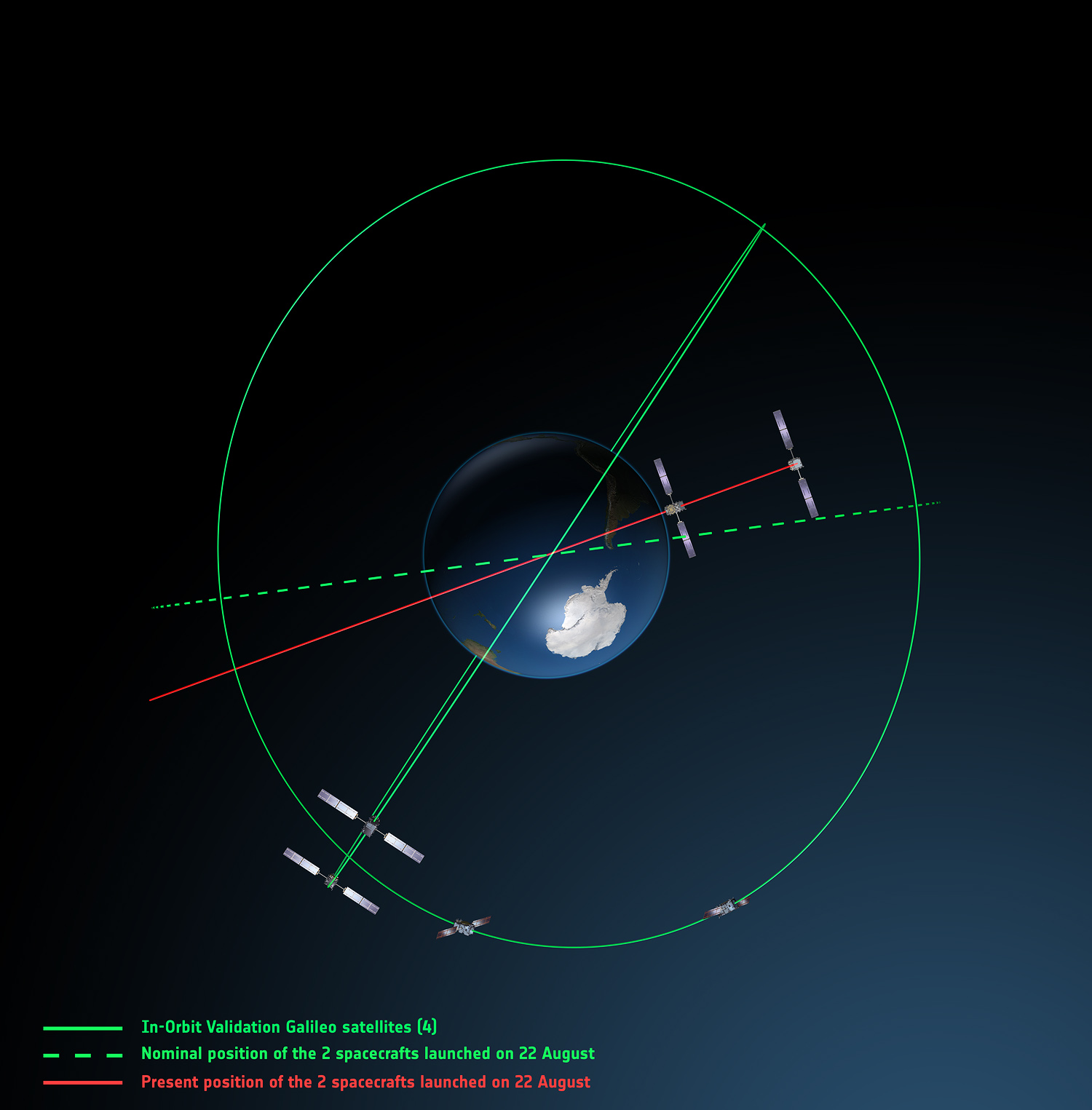
    Galileo orbits viewed from above.
    Galileo orbits viewed from above.

    Europe’s fifth and sixth Galileo satellites, salvaged from their faulty 2014 Soyuz launch, will begin broadcasting working navigation signals for test purposes, for the benefit of receiver manufacturers, service providers and scientific researchers. The European Commission will decide later whether the two satellites will become part of the operational Galileo constellation.

    The European Space Agency performed a complex series of in-orbit maneuvers to raise and circularize the two after they arrived in space too low and too elliptical for full Galileo use. Their initial orbits dipped the satellites too close to Earth to keep their antennas properly locked on the planet.

    “Once their orbits were modified, their navigation payloads could be turned on and in-orbit testing could take place,” explained Marco Falcone, head of the Galileo System Office. “The good news was their performance was excellent.

    “The navigation signals will include a signal health status reading that ‘signal component currently in test’ and its navigation data validity status will be ‘working without guarantee.’ In this way, these signals will not disturb the performance of any receivers using the Galileo signals coming from the other satellites. On the user community side, some application providers are interested in harnessing as many available satellites as possible for precision applications.”

    Testing will take place in two phases: initially their navigation signal will be updated via the Galileo ground segment every 14 hours or so. Later this year, the ground segment will be reconfigured to send updates more often, enhancing navigation precision, although they will remain outside the official constellation until decided otherwise.

    The two satellites are also midway through an ambitious space experiment to test Einstein’s General Theory of Relativity more precisely than ever before, by measuring how their onboard time varies in accordance with their altitude and therefore gravity, known as their gravitational redshift.

    New Activation. Galileo GSAT-0210 (PRN E01), one of two launched May 24, began dual-frequency broadcast on Aug. 17, transmitting E1 and E5a signals.


    GPS III launch RFP

    Competitive bids invited

    The U.S. Air Force released a Request for Proposal (RFP) in August for GPS III-3 launch services, scheduled to begin in 2019. The contract will be a standalone for a single GPS III launch.The United Launch Alliance (ULA) and Space Exploration Technologies (SpaceX) are expected to compete for the contract. In April, SpaceX was chosen to launch the GPS III-2 satellite in May 2018. ULA chose not to compete.

    The RFP seeks an Evolved Expendable Launch Vehicle (EELV) Launch Service. The Air Force’s acquisition strategy seeks a balance between mission success/operational needs and lowering launch costs, reintroducing competition for national security space missions.

    This is the second competitive launch service solicitation under the current procurement strategy. Previously, ULA was the only certified launch provider. In 2013, ULA was awarded a sole-source contract for launch services as part of an Air Force Block Buy of 36 rocket cores. In May 2015, SpaceX was certified for EELV launches, yielding two qualified launch service providers.


    M-code, OCX updates

    The Air Force awarded a $52.6 million contract to Raytheon for modernization of the Miniature Airborne GPS receiver 2000 (MAGR-2K): test and delivery of an M-code automatic dependent surveillance and broadcast-capable system. Congress has mandated the military buy only M-code GPS equipment by 2018. Last year, Rockwell Collins received a $36.6 million contract for such equipment.

    OCX.
    Raytheon is implementing changes to its GPS Next-Generation Operational Control System (OCX). “Momentum is very good” towards a December 2020 deadline for software delivery, said the program manager. A Pentagon review in July followed breach of a critical cost-growth cap. The complexity of cyber security requirements contributed to delays to date. The company expects to deliver Block 0 software in 2017, in conjunction with plans to launch GPS III satellites. However, the capability will not be turned on until 2018, when an OCX Block 0 launch-and-checkout capability for GPS III launches is to begin.

  • US Air Force releases GPS III-3 launch services RFP

    US Air Force releases GPS III-3 launch services RFP

    The Air Force has released a Request for Proposal (RFP) for launch services for the GPS III-3 mission, scheduled to launch in 2019. Proposals are due Sept. 19; the contract will be a standalone contract for a single GPS III launch.

    The United Launch Alliance (ULA) and SpaceX are expected to compete for the contract. In April, SpaceX was chosen to launch the GPS III-2 satellite in May 2018. ULA chose not to compete.

    The RFP seeks an Evolved Expendable Launch Vehicle (EELV) Launch Service. The draft RFP was released on June 14 to obtain industry feedback to inform the Final RFP.  After extensive industry engagements, the Final RFP was released on Aug. 3 with proposals due back to the Air Force no later than Sept. 19 in accordance with the solicitation instructions.

    After evaluating proposals through a competitive, best-value source selection process, the Air Force will award a firm-fixed price contract that will provide the government with a total launch solution including launch vehicle production, mission integration and launch operations for the GPS III-3 satellite.

    Artist's concept of the nextgen GPS III satellite (courtesy of the USAF).
    Artist’s concept of the nextgen GPS III satellite (courtesy of the USAF).

    The Air Force’s acquisition strategy for this solicitation achieves a balance between mission success/operational needs, and lowering launch costs, through reintroducing competition for national security space missions, the Air Force said in a press release.

    “Launch system certification is a key element (high technical bar) within this solicitation to provide insight into the technical capabilities and rigorous processes that demonstrate a launch vehicle contractor’s ability to design, develop, manufacture, and launch national security space missions and contributes to the overall flight worthiness process,” said Lt. Gen. Samuel Greaves, Space and Missile Systems Center commander and Air Force program executive officer for Space.  Prior to contract award, the contracting officer will verify that the Offeror has a certified launch system as part of a responsibility determination resulting in a high technical bar.

    “Through this competitive solicitation for GPS III launch services, we hope to continue fostering competition in order to promote innovation and reduce cost to the taxpayer while maintaining our laser focus on mission success,” Greaves said.

    GPS III is expected to provide improved anti-jamming capabilities as well as improved accuracy for precision, navigation, and timing. It will incorporate the common L1C signal which is compatible with the European Space Agency’s Galileo global navigation satellite system and compliment current services with the addition of new civil and military signals.

    The first GPS III satellite undergoes system-level thermal vacuum testing. (Photo: Lockheed Martin)
    The first GPS III satellite undergoes system-level thermal vacuum testing. (Photo: Lockheed Martin)

    This is the second competitive launch service solicitation under the current Phase 1A procurement strategy. The Phase 1A procurement strategy reintroduces competition for national security space launch services.  Under the previous Phase 1 strategy, ULA was the only certified launch provider. In 2013, ULA was awarded a sole-source contract for launch services as part of an Air Force “Block Buy” of 36 rocket cores that resulted in significant savings for the government through FY 2017.

    In May 2015, Space Exploration Technologies (SpaceX) was certified for EELV launches resulting in two launch service providers that are qualified to design, produce, qualify and deliver a launch capability and provide the mission assurance support required to deliver national security space satellites to orbit.

  • WorldView-4 satellite heads to Vandenberg for September launch

    Built by Lockheed Martin, the WorldView-4 satellite will expand DigitalGlobe’s constellation of high-accuracy, high-resolution satellites, and double the availability of 30-cm resolution imagery for commercial and government customers.
    Built by Lockheed Martin, the WorldView-4 satellite will expand DigitalGlobe’s constellation of high-accuracy, high-resolution satellites, and double the availability of 30-centimeter resolution imagery for commercial and government customers.

    Final preparations are underway at Lockheed Martin to ship DigitalGlobe’s WorldView-4 Earth imaging satellite to Vandenberg Air Force Base for a Sept. 15 launch.

    The Lockheed Martin team is completing final satellite testing and checkout before shipment. Testing includes calculating the weight and center of gravity of WorldView-4, completing a health check of major systems, and testing out image collection and downlinking capability.

    “The high-resolution and high-accuracy images taken by WorldView-4 will support DigitalGlobe’s worldwide customer base,” said Carl Marchetto, vice president and general manager of Lockheed Martin Commercial Space. “DigitalGlobe’s smart imagery serves hundreds of thousands of end-users charged with the safety and security of nations, and enables the maps and geospatial applications relied on by billions of consumers.”

    “Only the DigitalGlobe constellation, with the addition of WorldView-4, offers the highest quality, and most comprehensive global coverage of our changing planet through 2030, so our customers can be confident they will have the information to make critical decisions,” said Walter Scott, founder and chief technology officer, DigitalGlobe. “WorldView-4 will help us continue to transform the way we see the world, and advance our mission of keeping our planet and its people safe and secure.”

    Once launched, WorldView-4 will double DigitalGlobe’s coverage of the world’s highest resolution imagery and increase the rate at which it grows its 15-year library of time-lapse high-resolution imagery. WorldView-4 will orbit Earth every 90 minutes, traveling 17,000 miles per hour and capturing more 680,000 square kilometers of the Earth’s surface daily (19.5 terabytes) the equivalent of the land area of Texas.

    With an orbit approximately 400 miles from Earth, the satellite will be launched aboard a United Launch Alliance Atlas V rocket provided by Lockheed Martin Commercial Launch Services.

  • Air Force jam-proof test range ready; Galileo teendom

    Locatalite transceiver installation in the White Sands Missile Range Ultra High-Accuracy Reference System, provided by the U.S. Air Force for testing equipment under conditions of GPS jamming.
    Locatalite transceiver installation in the White Sands Missile Range Ultra High-Accuracy Reference System, provided by the U.S. Air Force for testing equipment under conditions of GPS jamming.

    Provides high-accuracy PNT even when GNSS jammed

    A critical capability to predict for GNSS chips and receivers —and for devices using alternative or back-up PNT technologies — is how they will actually perform without GPS.

    Filling this need, the U.S. Air Force 746th Test Squadron has declared Initial Operational Capability (IOC) for its new truth reference, the Ultra High-Accuracy Reference System (UHARS) at the White Sands Missile Range in New Mexico. Even when GPS — or any other GNSS system — is being completely jammed, UHARS provides extremely accurate positioning, navigation and time (PNT) over the large area that the system was designed to cover.

    “Initial testing shows that UHARS delivers accurate independent PNT as good as, or better than, the Air Force’s current Central Inertial and GPS Test Facility Reference System, so it is perfectly able to support current customer requirements,” said Jim Brewer, chief scientist of the 746th Test Squadron. “However, more data are required to tune the UHARS filter and optimize its accuracy to meet even tighter PNT requirements, which is our objective. When this is achieved, UHARS will deliver truth accuracy for next-generation military capabilities, and we will declare UHARS Full Operational Capability.”

    “UHARS is a rack-mounted, tightly integrated system of improved navigation sensors, a data acquisition system and a new post-mission Kalman filter, all of which need to work together,” said John Cao, technical director of the 746th. “It’s working very well, but once we completely measure and characterize the individual components and then tune and validate the filter, the complete system will provide a significantly more accurate reference solution for future airborne and land-based test vehicles in navigation warfare environments where modernized and legacy GPS signals are jammed from friendly or hostile systems.”

    LocataLite Transceivers. To achieve these accurate reference solutions, UHARS requires a core Non-GPS Based Positioning System (NGBPS) component capable of operating and providing sub-meter position accuracy in a GPS-denied (jamming) environment.

    The NGBPS subsystem of the UHARS program employs a network of ground-based LocataLite transceivers and test vehicle receivers manufactured by the Locata Corporation. The Locata network delivers centimeter-level positioning and navigation as well as nanosecond-level synchronization, which may be useful for military applications requiring precise time transfer in GPS-denied environments.

    White Sands is a U.S. Army rocket range of almost 3,200 square miles in parts of five counties in southern New Mexico. It is the largest military installation in the U.S.

    The LocataNet truth reference system can also provide a 2D solution to support ground-vehicle testing. Reportedly, the 2D solution, while also very good, has not yet been fully characterized. Once the filter has been fully tuned in this respect, White Sands could serve as a test facility for autonomous driving. It has many miles of paved highway, possibly in the hundreds of miles.

    The importance and uniqueness of White Sands as GPS test facility springs from the fact that it is illegal to jam GPS elsewhere without a special permit, making it extremely difficult to create a real-world test scenario to see how GPS and other PNT devices perform under denied or restricted circumstances. This is of critical importance for flight testing (UAVs and other avionics) for which the UHARS was primarily designed and optimized.

    Ligado study flawed, says NovAtel

    Method shows lack of understanding of GPS uses

    NovAtel Inc. has submitted comments to the Federal Communications Commission (FCC) regarding Ligado Networks LLC’s (formerly LightSquared) License Modification Applications.

    NovAtel raises deep concerns about the testing methodology used and conclusions presented by Ligado regarding the impact of its proposed usage of L-band frequencies for a terrestrial wireless network.

    In its filing, NovAtel identified serious flaws in the testing methodology used to evaluate high-precision receivers. Although high-precision receivers were used during the testing, the high-precision position modes that are used to achieve centimeter-level positioning accuracy required by many professional and safety-critical applications were not evaluated.

    The study shows a lack of understanding of the uses of the GPS by assuming that all applications require the same positioning accuracy, NovAtel said.

    The filing also raises a number of concerns about the potential harmful interference impact on GPS receiver performance. NovAtel is particularly concerned that Ligado has moved away from what it understood to be an agreed-upon standard that interference tolerance should be limited to a received interference signal power level that causes no more than 1-dB degradation in the received C/N0 level.

    NovAtel disagrees with the conclusion in the RAA Study that there is no meaningful correlation between a 1-dB change and GPS performance. NovAtel submits any interference must not exceed 1-dB degradation in received C/N0 if robust, precise positioning is to be maintained. Ligado has not yet proven that its use of the spectrum will not be detrimental to high-precision GNSS users, which is what the 1-dB C/N0 degradation metric ensures.

    “To date, Ligado has not proven that its use of the proposed spectrum can be made compatible with high-precision GNSS,” NovAtel said in a press release. “The interference impact on the other GNSS constellations such as Galileo, GLONASS and BeiDou has not been addressed. These constellations are increasingly used in combination with GPS for many high-precision applications. Proposed, unverified mitigation methods such as narrowband antennas are presented in the Ligado filing without explanation of who will be responsible for the cost of such design modifications and retrofit programs.”

    Galileo reaches teendom

    Europe’s 13th and 14th Galileo satellites lifted off at 08:48 GMT from Europe’s Spaceport in French Guiana atop a Soyuz launcher. (Photo: ESA)
    Europe’s 13th and 14th Galileo satellites lifted off at 08:48 GMT from Europe’s Spaceport in French Guiana atop a Soyuz launcher. (Photo: ESA)

    The Galileo constellation system now has 14 satellites in orbit after a May 24 double launch. Birds 13 and 14 lifted off together at 08:48 GMT (10:48 CEST, 05:48 local time) atop a Soyuz rocket from French Guiana. The twin Galileos were deployed into orbit close to 23,522 km altitude, inclined 57.394 degrees to the equator, 3 hours and 48 minutes after liftoff. Following days saw a careful sequence of orbital fine-tuning to bring them to their final working orbit, followed by a testing phase so that they can join the working constellation later this year.

    Marconi Prize awarded to Brad Parkinson

    The Marconi Society awarded its 2016 Marconi Prize to Bradford Parkinson. The annual prize recognizes major advances in information and communication science that benefit humanity: in this case, the difficult yet ultimately successful development of GPS. See gpsworld.com/marconi for details and a brief history.

  • User location data could support satellite launches

    User location data could support satellite launches

    Let’s look through the other end of the telescope this month. The satellites are nattering along, lining up in orderly fashion at the rocket pad, extending their solar arms smoothly in space once they arrive on orbit. The constellations accrue and new signals inch closer to maturity.

    The only blips on the horizon come from Ligado’s terrestrial impulse and a looming gap in GPS ground control. Just possibly, the latter might coincide with activation of the full European constellation and Galileo could come to the rescue of suitably equipped users who hunger for greater accuracy. This has been Galileo’s raison d’etre for two decades now, and it may actually be on the cusp of coming true.

    At any rate, back to the telescope’s other end. What might that be? Facebook.

    FB_Location-W“When you think back to the beginning of online advertising, this is what advertisers have been waiting for.” That is Facebook’s director of monetization product marketing — an actual job title, and a powerful one in time to come.

    All this — what advertisers have been waiting for — is made possible by GPS. Soon, by all GNSS. And by your smartphone.

    From a GNSS Design & Test point of view, this means we are about to see some real money come available for constellations. Fast-multiplying applications of position, navigation and timing data have always shaped GNSS evolution, to some degree. Making this latest development different by a degree of magnitude is its potential to alter the way GNSS policy is shaped and the way GNSS funding is provided.

    Facebook will soon roll out a new Store Visits metric for business clients: location data and purchases correlated to Facebook ad performance. Partnerships with point-of-sale systems like Square and Marketo will “prove” (let’s use that word loosely for now) who bought what after seeing Facebook ads.

    The way the company tells it, “While people use mobile in 45 percent of all shopping journeys, more than 90% of sales still happen in brick-and-mortar businesses.”

    Even if you don’t buy something, Facebook will know that you — assuming, and this is a big jump, that you are a Facebook user — visited a store by aligning GPS, beacon, Wi-Fi and other radio-frequency signals and cell-tower locations with brick-and-mortar coordinates. You may not be a Facebook user, but I’ll bet one of your loved ones is.

    With the new feature, instead of having to (gasp!) leave Facebook to visit an unfamiliar website for a store locator, users can view the address, hours, phone number and estimated travel time without exiting the social network.

    Cleveland_on_Facebook

    I know people who rarely or never leave Facebook. Do you? This is a plus for them.

    Facebook, one of the new corporate mega-giants, duels with Google, Apple and Microsoft over various pieces of digital turf. One of the most hotly contested treasures — the Holy Grail, in marketing execs’ terms — is the capture and use of user data. It is getting more than a little bit creepy.

    To date, the even-bigger giant that is advertising has used metrics such as ad views and clicks to measure effectiveness: how much an ad actually inspires purchase or response to other calls to action. I know this because I use these metrics, or someone in my organization does. Such metrics are now deemed “flimsy” by the standards of aligning GPS, beacon, Wi-Fi data and so on as outlined above.

    Facebook is not alone in exploring the fertile ground. Google recently launched ads that show maps of nearby locations, and the others surely do not lag far behind. For the moment, these massive integrators aggregate and anonymize the data to protect privacy, but that’s not to guarantee they would always do so. Currently, there’s no specific opt-out other than turning off location services for the app on the user’s device, which people might be reluctant to do if it degrades other app functionality.

    Let’s shield our eyes from the dark side for the moment, and consider what this means for GNSS.

    We, you and I, those of us in the PNT industry, have known for some time how integral to critical infrastructure GPS is and GNSS soon will be. But the vast public does not. And lawmakers, bless their little hearts, largely do not either. That will change when the desperate craving of large companies to reach billions of buyers enters the PNT arena.

    We can envision mega-marketing bolstered by alliance with the transportation industry, both ground and air, as driverless vehicles and drones become more commonplace. With powerful lobbying interests behind it, GPS might finally get some respect, and other systems around the world with it. Modernization might proceed more smoothly and quickly, without funding hiccups and capability gaps. That’s the bright side of all this.

    It reminds me of nothing so much as an old rock’n’roll song. In “Top of the Pops,” the Kinks sang:

    Now my agent called me on the telephone
    He said, son your record’s just got to number 1
    And you know what this means?

    This means you can earn some real money.

  • China adds 23rd satellite to BeiDou constellation

    China adds 23rd satellite to BeiDou constellation

    The 23rd BeiDou satellite lifts off.
    The 23rd BeiDou satellite lifts off.

    The Chinese Beidou system’s 23rd satellite was launched into orbit Sunday aboard a Long March 3C rocket.

    The Long March 3C rocket lifted off at 1530 GMT (11:30 a.m. EDT) from the Xichang launch base in southwestern China’s Sichuan province, according to the state-run Xinhua news agency.

    This is the third new satellite to join the fleet this year. The 21st satellite was launched in February, and the 22nd in March.

    The satellite was deployed into an elliptical orbit more than 22,000 miles (35,700 kilometers) above Earth. It will power its way into a circular geosynchronous orbit over the equator in the coming weeks.

  • Four-satellite Galileo Ariane 5 dispenser in place

    Four-satellite Galileo Ariane 5 dispenser in place

    News from the European Space Agency (ESA)

    A four-satellite dispenser for Galileo's Ariane 5 is shown during shaker testing at Airbus Defence and Space near Bordeaux, France. The dispenser has had four Galileo engineering models attached to it for test purposes. Copyright: ESA
    A four-satellite dispenser for Galileo’s Ariane 5 is shown during shaker testing at Airbus Defence and Space near Bordeaux, France. The dispenser has had four Galileo engineering models attached to it for test purposes.
    Copyright: ESA

    Following rigorous testing in France and Germany, a new type of dispenser designed to carry four navigation satellites into orbit at once is now in French Guiana, in place for Galileo’s first Ariane 5 launch later this year.

    The dispenser is an essential element of launch success, with a double role to play. It first must hold the quartet of satellites securely in place during the stresses of liftoff, and then the nearly four-hour long flight to medium-Earth orbit.

    Then, once the Ariane 5 EPS upper stage reaches its target altitude of 23,222 kilometers , the dispenser will release the four Galileo satellites using a pyrotechnic release system triggered by separate igniters, each one firing half a second after the other.

    The separated satellites are then pushed away from the dispenser in separate directions using a spring-based distancing system.

    The 447-kilogram dispenser, designed by Airbus Defence and Space, must support a satellite mass of 738 kilograms each – nearly three tons total.

    Made from a combination of metal and composite materials for maximum stiffness, the dispenser has undergone very comprehensive testing at Airbus Defence and Space near Bordeaux, France, and the IABG testing centre in Ottobrunn, Germany – using both Galileo engineering models and an actual flight satellite, including fit, shock and separation testing.

    A four-satellite dispenser for Ariane 5 Galileo launches with engineering models attached for test purposes. Copyright: CNES/ESA
    A four-satellite dispenser for Ariane 5 Galileo launches with engineering models attached for test purposes.
    Copyright: CNES/ESA

    The test campaign met all objectives, reports the ESA, confirming the behavior performs as predicted, after which the dispenser was shipped to Europe’s Spaceport in French Guiana.

    This fall, four Galileo satellites will be launched together for the very first time on a specially customized launcher — the Ariane 5 ES Galileo.

    In development since 2012, the new launcher variant has evolved from the Ariane 5 ES (Evolution Storable), used to place ESA’s 20,000-kilogram ATV supply vehicle into low-Earth orbit.

    This launder has to carry a lower mass payload – four fully fuelled 738-kilogram Galileo satellites plus their supporting dispenser – but needs to take it up to the much higher altitude of medium-Earth orbit, approximately 23,222 kilometers up.

    The target orbit is actually 300 kilometers below the Galileo constellation’s final working altitude, which leaves the Ariane’s EPS upper stage in a stable “graveyard orbit,” while the quartet of Galileos maneuver themselves up to their final set height.

    Once the Ariane 5 ES Galileo flight is complete, there should be 18 Galileo satellites in orbit.

  • GLONASS launches No. 53 to replenish constellation

    On May 29 a Soyuz-2.1b with upper stage Fregat and a GLONASS-M satellite (No. 53) successfully lifted off from Plesetsk Space Center. The satellite was placed into its preprogrammed orbit and registered by the facilities of the Titov Main Test and Space Systems Control Centre. Ground control established communications with it. The stable telemetry link shows that onboard satellite systems are functioning normally.

    According to Russian officials, an unexpected issue with the Fregat upper stage caused it to burn longer than planned to inject the satellite into its planed orbit. No further details were provided.

    The satellite is destined for a replenishment mission of the GLONASS constellation, currently at 25 operational satellites. Russian plans call for as many as eight satellites to be launched by the end of 2017 to replenish the  constellation. As part of that strategy, a Proton-M heavy carrier rocket with three GLONASS satellites aboard may take place by the end of this year.

    Below is a video of the launch.

  • Galileo 13 and 14 satellites ready for Tuesday launch

    Galileo 13 and 14 satellites ready for Tuesday launch

    Galileos 13 and 14 are scheduled to lift off at 08:48:43 GMT (05:48:43 local time, 10:48:43 CEST) on May 24 from Europe’s Spaceport in French Guiana atop a Soyuz launcher.

    The first three stages of the Soyuz rocket take the Galileo satellites and their Fregat upper stage into low orbit nine minutes after liftoff. Then the reignitable Fregat, as much a spacecraft as a rocket stage, takes over the task of hauling the satellites higher through a pair of burns.

    The satellites will be released in opposite directions by their dispenser once they reach their target 22,522-kilometer-altitude orbit 3 hours and 48 minutes after launch.

    On Wednesday, May 18, Europe’s latest Galileo satellites were placed atop their upper stage then enclosed within their protective rocket fairing. The encapsulation took place inside the Spaceport’s cleanroom, as a two-piece Soyuz fairing was closed around the satellites, attached to their carrier atop the Fregat upper stage.

    Europe's 13th and 14th Galileo satellites being encapsulated inside their launcher fairing. (Photo: ESA)
    Europe’s 13th and 14th Galileo satellites being encapsulated inside their launcher fairing. (Photo: ESA)

    The satellites had been installed on Fregat the previous day. This versatile upper stage will haul them the bulk of the way to their target 23,500-kilometer-altitude orbit.

    The sealed satellites, dispenser and upper stage are collectively known as the “upper composite.” Today, the plan is to roll out the first three stages of Galileo’s Soyuz to the launchpad, ready for mating with this upper composite.

    This will be the seventh Galileo launch, set to bring the number of satellites in space up to 14. Four more Galileos are planned to take flight in the autumn, launched for the first time on a customized Ariane 5 to bring the total number of satellites in the constellation to 18.

    Watch the launch live here. Streaming begins at 08:28 GMT (10:28 CEST) on 24  May for the liftoff, then resumes at 12:23 GMT (14:23 CEST) to cover the satellites’ separation.

    For other upcoming GNSS satellite launches, see this page.

    Early Operations Phase. According to the European Space Agency (ESA), a combined team of specialists is conducting final training at ESA’s ESOC mission control centre to prepare for the launch.

    The team comprises over 40 experts drawn from ESA and from France’s CNES space agency, supported by additional specialists at both agencies in areas such as flight dynamics and ground stations.

    Within the combined flight control team, each position is paired with its counterpart from the other agency and mixed CNESOC shifts will rotate to conduct operations around the clock.

    The same team conducts all the Galileo early operations alternately from ESOC and from the CNES control centre in Toulouse, France.

    By launch day, the teams will have completed a demanding series of joint simulation training sessions at ESOC, complemented by more specific training conducted separately at each control centre. Joint sessions are especially important to develop team bonds “on-console” — so individuals get to know who will be working beside them and can foster one-on-one teamwork and mutual support.

    Three Flight Operations Directors and three Spacecraft Operations Managers will work together with their teams in each of three shifts during the nine-day early operations phase. From left: Hélène Cottet (CNES), Remi Lapeyre (CNES), Liviu Stefanov (ESA), Christelle Crozat (ESA), Thomas Cowell (ESA) and Hervé Côme (ESA).
    Three Flight Operations Directors and three Spacecraft Operations Managers will work together with their teams in each of three shifts during the nine-day early operations phase. From left: Hélène Cottet (CNES), Remi Lapeyre (CNES), Liviu Stefanov (ESA), Christelle Crozat (ESA), Thomas Cowell (ESA) and Hervé Côme (ESA).


  • Galileo satellites 13 and 14 prepare for launch

    Another pair of Galileo navigation satellites is scheduled for launch by a Soyuz rocket on May 24 from Europe’s Spaceport in French Guiana, bringing the Galileo system a step closer to operational use.

    This video gives an overview of Galileo and shows Galileo 13 and 14 in preparation in Kourou. It includes an interview with Paul Verhoef, ESA director of the Galileo Programme and navigation-related activities.

    The European Commission asked the European Space Agency (ESA) to speed up the deployment of the constellation and to increase it’s robustness for delivering initial services, according to ESA.

    A total of 12 satellites has been deployed into orbit during the last four years — six in the last year alone.

    Learn more about the launch here.