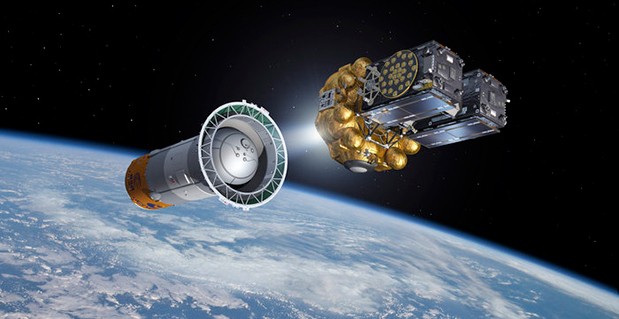
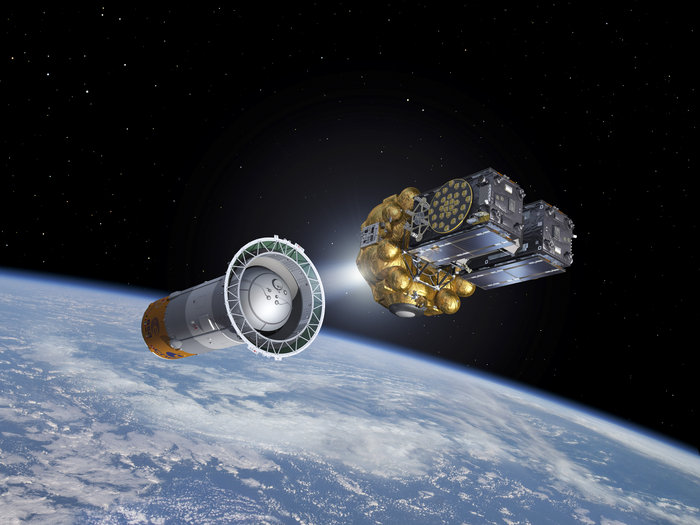
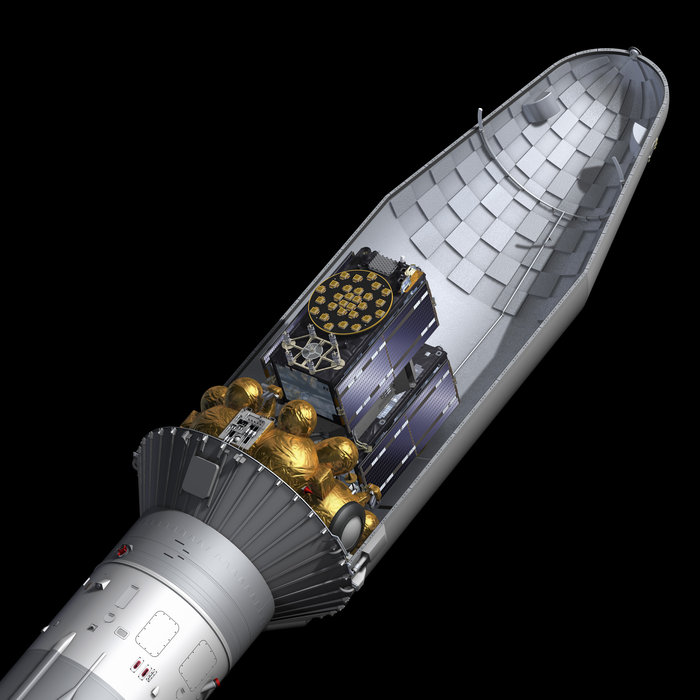
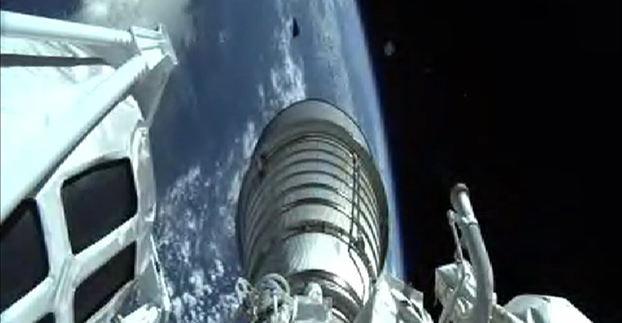
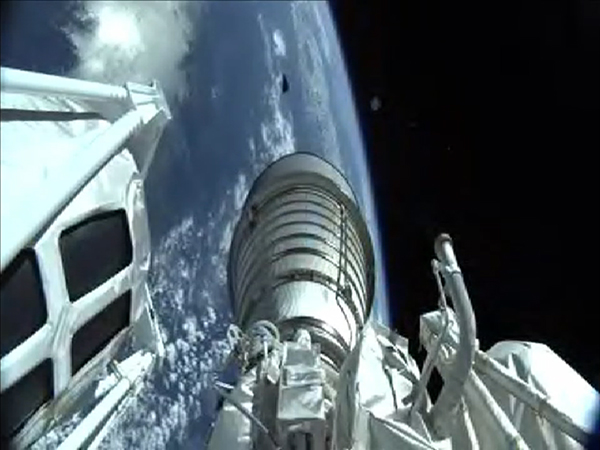
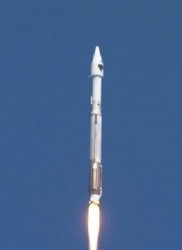
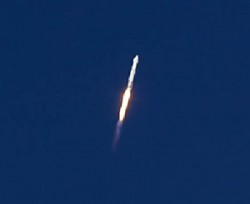
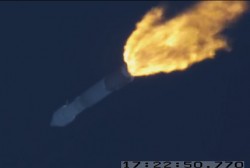
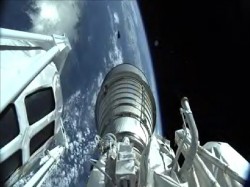
Artist’s view of Galileo satellites attached to their dispenser atop their Fregat upper stage separating from the Soyuz upper stage. The Fregat then flies them the rest of the way up to medium-Earth orbit. (courtesy of ESA)
News courtesy of the European Space Agency
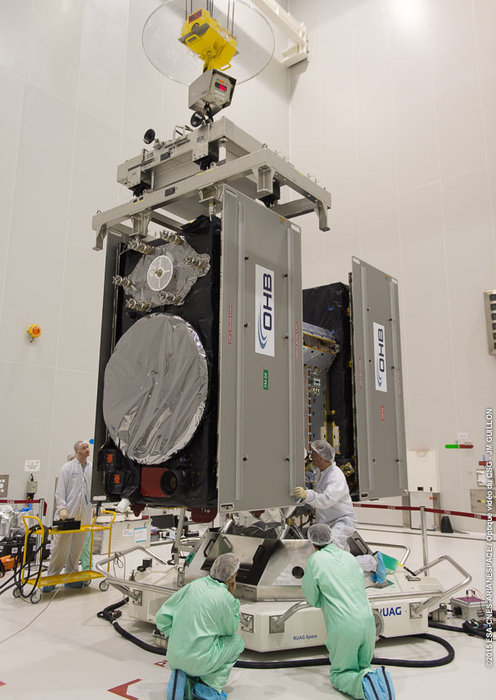
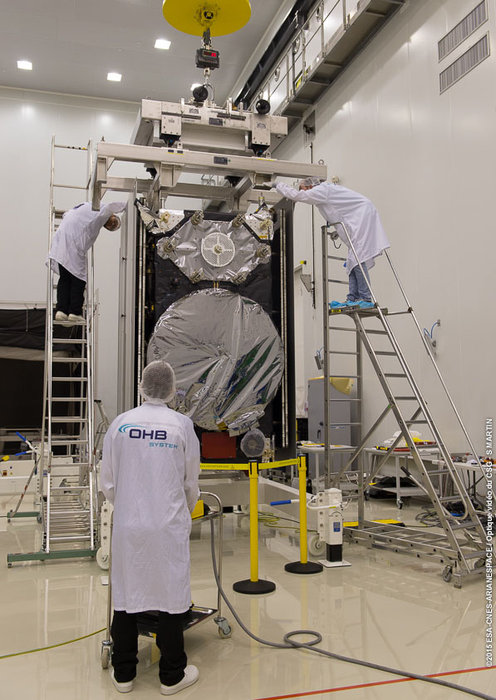
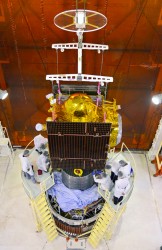
The seventh and eighth Galileo satellites being fitted together onto the dispenser, March 16-17. (Photo courtesy of ESA)
The seventh and eighth Galileo satellites, set for launch together in nine days’ time, have been fitted together onto the dispenser that will carry them during their flight to orbit.
The fueling of the two satellites was completed last week, leaving them ready to be placed into launch configuration. They were carefully lowered into place then attached to the dispenser. The operation went smoothly, the two satellites having previously gone through separate “fit checks” with the dispenser in advance of fueling.
The specially designed carrier will hold the satellites in place during their four-hour flight into orbit some 22,300 km above our planet. Then, at the correct altitude, the two satellites are sprung away in opposing directions. Next, the dispenser plus satellites will be placed onto the Fregat upper stage of their Soyuz ST-B launcher.
As much a spacecraft as a launch stage, the reignitable Fregat will haul the Galileo satellites most of the way up to their final orbital altitude, once the first three stages of the Soyuz have taken them up to their initial orbit.
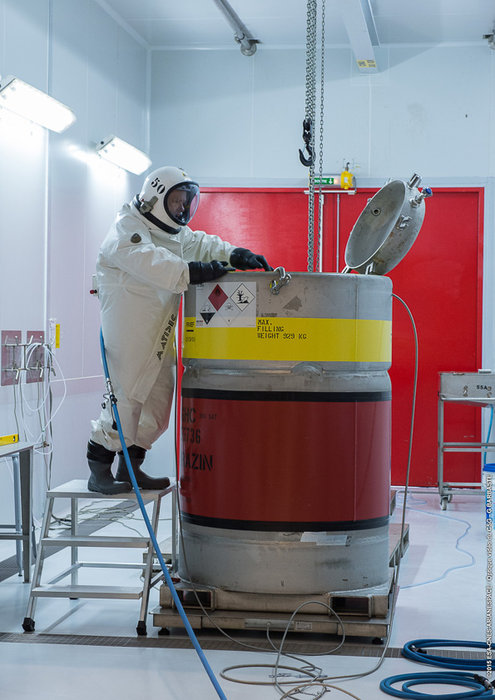
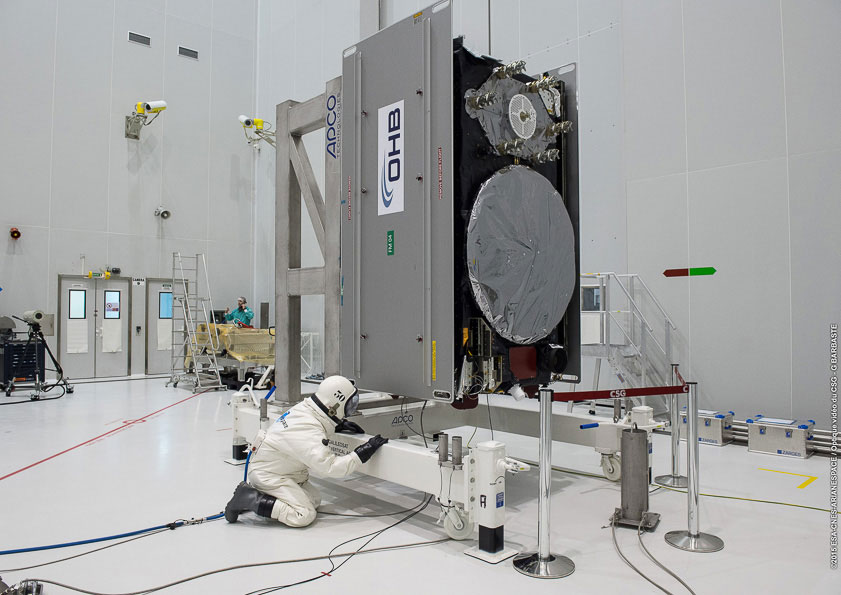
Fuel for the satellites is checked by an engineer in a protective SCAPE (Self Contained Atmospheric Protective Ensemble). (Photo courtesy of ESA)
Note the protective metal panels covering the solar wings folded against the sides of the Galileo satellites. Protecting these delicate solar arrays during handling on the ground, these panels will be removed ahead of launch.
The launch of the seventh and eighth Galileo satellites is scheduled for March 27.
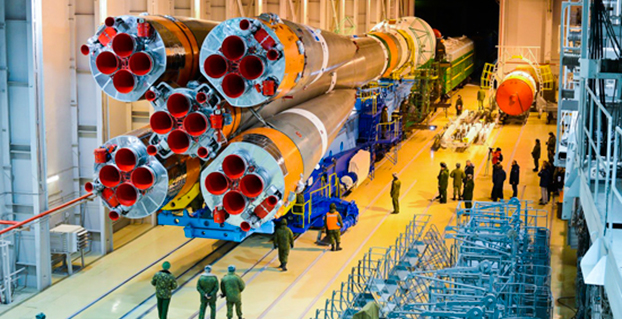
Soyuz’ Block I third stage is mated to the launcher at the Spaceport’s MIK integration building. Photo: Galileo
Preparations for Arianespace’s next Soyuz flight, which will lift into orbit two more Galileo satellites, are in full swing at multiple locations across the spaceport in French Guiana. Work includes a key integration step for the medium-lift launcher, plus the start-up of fueling for its Galileo satellite passengers.
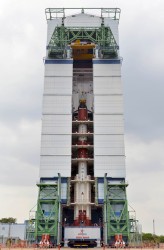
Soyuz’ Block I third stage was mated to the vehicle’s core during activity today in the MIK Launcher Integration Building, concluding its basic build-up. Once the checkout process is completed, Soyuz will be transferred to the launch pad, where it will receive the two Galileo spacecraft and the Fregat upper stage, all of which are well into preparation phases of their own.
Payload fueling began earlier this week, with Galileo 8 (Galileo FOC-FM4) — the fourth Galileo Full Operational Capability (FOC) satellite, and eighth overall — receiving its propellant load in the Spaceport’s S5A fueling and integration hall. After its sister Galileo FOC-FM3 (Galileo 7) co-passenger undergoes this same process, the two will be integrated side-by-side on a dispenser for their shared ride aboard Soyuz on March 27.
The fueling process followed the finalization last week of FM3 and FM4’s hardware and software, as well as the charging of their batteries — which will be relied upon during the short period from launch to unfurling of these spacecraft’s solar arrays in orbit.
The Galileo program is Europe’s initiative for satellite navigation, providing a highly accurate global positioning system under civilian control — to consist of 30 satellites in total, along with European control centers and a worldwide network of sensor and uplink stations.
Galileo’s FOC phase — during which the network’s complete operational and ground infrastructure will be deployed — is managed and funded by the European Commission, with the European Space Agency delegated as the design and procurement agent on the Commission’s behalf.
The FM3 and FM4 spacecraft were built by OHB System in Bremen, Germany. Their navigation payloads, which will generate the precision positioning measurements and services to users worldwide, were supplied by Surrey Satellite Technology Ltd. in Guildford, UK.
This upcoming mission is designated Flight VS11 in Arianespace’s numbering system. It will be the company’s fourth launch carrying spacecraft for the Galileo constellation, as well as the 11th flight of a workhorse Soyuz from French Guiana since the 2011 introduction.
the fourth Galileo Full Operational Capability (FOC) satellite is loaded with on-board propellant inside the S5A fueling and integration hall. Photo: Galileo
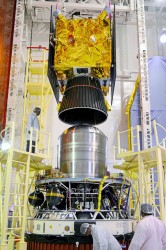
Galileo satellite being prepared for fit check. This testing, to ensure the seventh and eight Galileo satellites fit onto their dual-launch dispenser took place in mid-February 2015. The dispenser sits atop the Fregat upper stage of their Soyuz ST-B launcher. Photo: European Space Agency
By the European Space Agency
All the elements for this month’s Galileo launch are coming together at Europe’s Spaceport in French Guiana. As the two satellites undergo final testing and preparations, the first part of their Soyuz launcher has also been integrated.
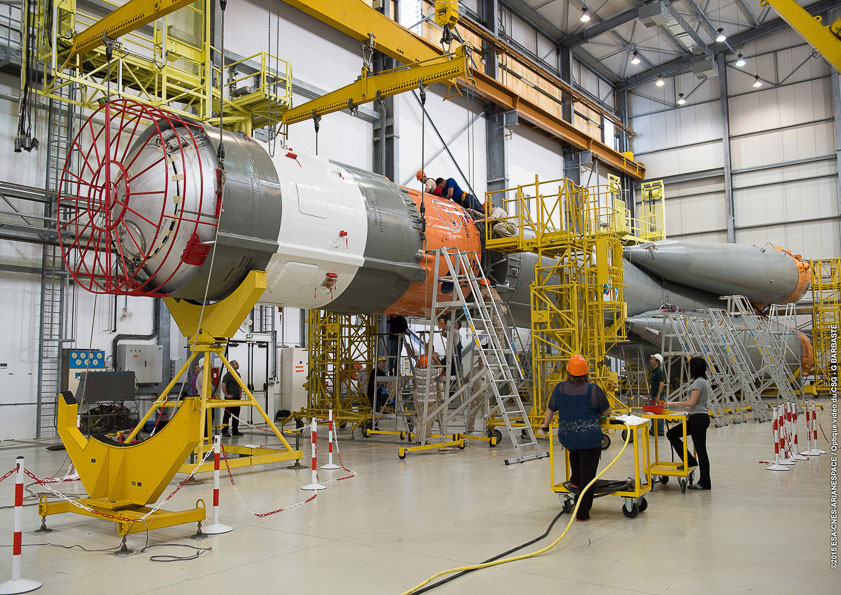
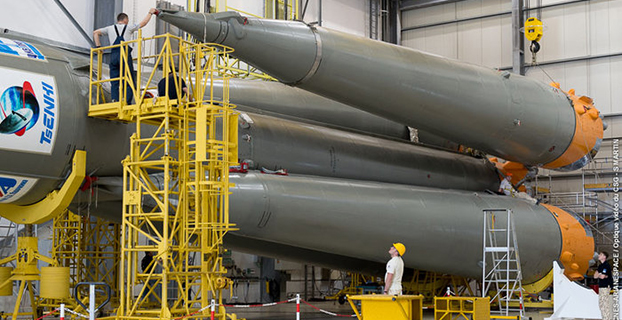
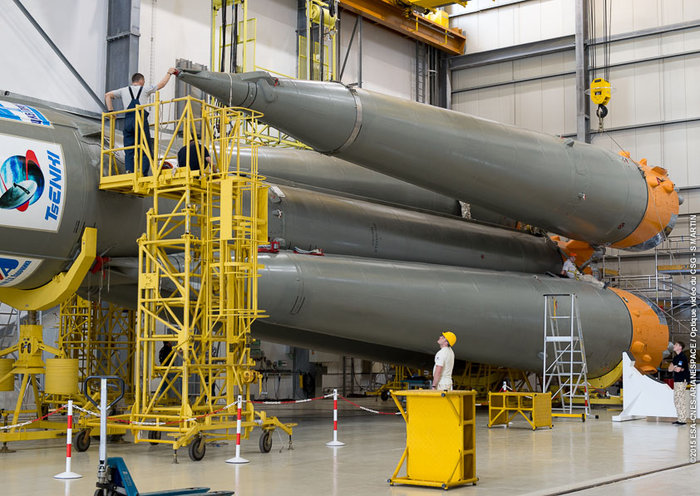
Assembly of the Soyuz ST-B’s first two stages, plus its four first stage boosters, took place at the Spaceport’s Soyuz Launcher Integration Building last week. Assembly takes place on a horizontal basis, in the Russian manner.
The next step will be the addition of the third stage, then the main part of the launcher will be complete, ready to be transported to the Soyuz launch pad and moved to the vertical position.
The final fourth stage of the Soyuz is the reignitable Fregat, which will transport the two satellites to their final 23,222-km altitude medium Earth orbit. This will be attached to the Soyuz on the launch pad, once the satellites, their dispenser and launch fairing have been mounted on it.
Since the seventh and eighth Galileo satellites arrived in French Guiana last month, they have undergone several tests – including one System Compatibility Test Campaign each, where they are linked up to the rest of the global Galileo ground segment as if they are already ‘live’ in orbit.
Assembly of seventh and eighth Galileo satellites’ Soyuz ST-B’s first two stages, plus its four first stage boosters, took place at the Spaceport’s Soyuz Launcher Integration Building in the first week of March 2015. Assembly takes place on a horizontal basis, in the Russian manner. Photo: European Space Agency
The all-important ‘fit check’ was passed in the middle of February. The two satellites were installed separately onto their dual-launch dispenser, to check they fitted correctly.
This dispenser has the task of holding them in place atop the Fregat during the launch and flight to their final orbit, then releasing them. They will be installed together later this month, after the satellites have been fueled.
Last week saw the finalization of their hardware and software, and the charging of their batteries — on which the satellites will be reliant from the short but crucial period from their launch to the unfurling of their solar arrays in orbit.
The pair of satellites is now ready to be transferred to the Spaceport’s S5A fueling facility, where they will receive the fuel to keep them controllable during their 12-year working lives.
After their fueling and final check, the pair of satellites will be in launch configuration. After a final review they will then become available for Arianespace teams to carry out the final preparation, known as Combined Operations, leading to the launch day.
The launch of the seventh and eighth Galileo satellites will take place on Friday, March 27.
Cutaway view of the Soyuz rocket fairing carrying a pair of Galileo satellites. Photo: European Space Agency
The Soyuz launcher for Arianespace’s upcoming mission with two European Galileo navigation satellites is taking shape at the Spaceport for a March 27 liftoff from French Guiana.
“During activity in the Spaceport’s Soyuz Launcher Integration Building, the medium-lift workhorse began to assume its iconic form with integration of the four first-stage strap-on boosters to the Block A core second stage,” Arianespace wrote in an statement.
“The next step will be the mating of Soyuz’ Block I third stage to the launcher’s core, completing the basic build-up, and readying the vehicle for its rollout to the launch pad — where the payload will be mated.”
The March 27 flight will be the 11th Soyuz flight from French Guiana since the launcher’s introduction at the Spaceport in October 2011. It is designated Flight VS11 in Arianespace’s numbering system for its launcher family, which also includes the heavy-lift Soyuz and lightweight Vega.
For the upcoming Soyuz mission, Arianespace will loft Galileo’s third and fourth Galileo Full Operational Capability (FOC) satellites to further expand the constellation. Flight VS11’s two satellites were built by OHB System, with Surrey Satellite Technology Ltd. supplying their navigation payloads.
Galileo’s complete operational network and its ground infrastructure will be deployed during the program’s Full Operational Capability phase, which is managed and funded by the European Commission. The European Space Agency has been delegated as the design and procurement agent on the Commission’s behalf.
The Indian Space Research Organization (ISRO) is expected to launch IRNSS-1D on March 9, reports The Times of India. IRNSS-1D is the fourth navigation satellite in the Indian Regional Navigational Satellite System, and will make the constellation operable.
The launch is tentatively planned for March 9 around 6:35 p.m. However, final go for the launch will be given by the ISRO’s Launch Authorization Board, which will meet March 6.
IRNSS-1D will be flown into space in the Indian Polar Satellite Launch Vehicle-XL.
The space segment of the IRNSS consists of seven satellites: three in geostationary orbit and four in inclined geosynchronous orbit. The ground segment consists of infrastructure for controlling, tracking and other facilities. The entire IRNSS constellation of seven satellites is planned to be completed by 2015.
Both IRNSS-1A and 1B are functioning satisfactorily from their designated geosynchronous orbital positions. The first three satellites in the IRNSS series were launched from Sriharikota on July 1, 2013, April 4, 2014, and October 16, 2014. IRNSS-1E and IRNSS-1F satellites are expected to be launched before year end.
IRNSS is an independent regional navigation satellite system designed to provide position information in the Indian region and 1,500 kilometers around the Indian mainland. IRNSS will provide two types of service: Standard Positioning Services (SPS) — provided to all users — and Restricted Services (RS), provided to authorized users.
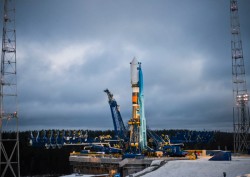
The second of two GLONASS-K1 satellites was launched from the snowy Plesetsk Cosmodrome on November 30 at 21:52 UTC. It joins the first GLONASS-K1 satellite launched on February 26, 2011.
According to the Roscosmos Information-Analytical Centre, the satellite, with serial number 12, is to be known by its in-orbit name of GLONASS 702. It is destined for orbital slot 9 in Plane 2.
The satellite will transmit five navigation signals in the L1, L2, and L3 bands. The satellite also carries a COSPAS/SARSAT transponder.
The satellite was launched on top of a Soyuz 2-1b booster. A statement from Roscosmos confirmed the 2,060-pound navigation satellite separated from the launcher in the correct orbit.
GLONASS-K satellites are designed to last longer, transmit more navigation signals, and launch on smaller rockets. Like the first Glonass K spacecraft, the second satellite will demonstrate new technologies that Russia plans to incorporate into GLONASS, according to Spaceflight Now.
Rollout:
Launch:
Gallery (photos from the Ministry of Defence of the Russian Federation.)
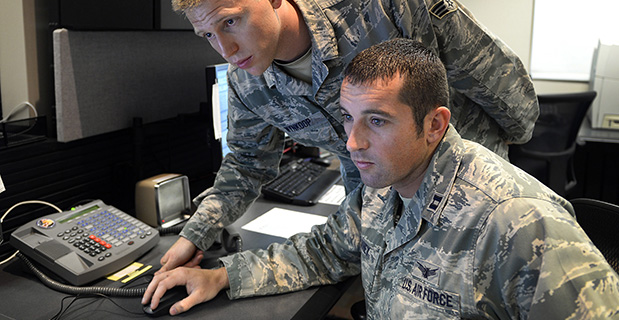
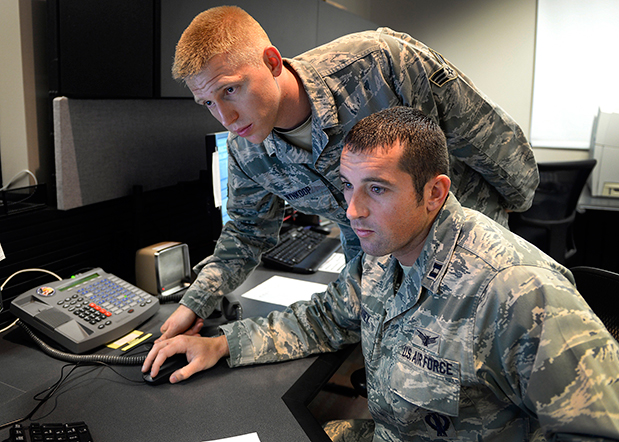
Capt. Jared Delaney, 19th Space Operations Squadron satellite vehicle operator, right, and Senior Airman Bryan Wynkoop, 19 SOPS satellite system operator, monitor telemetry during the GPS SVN-69 launch Oct. 29, 2014 at Schriever Air Force Base, Colo. (U.S. Air Force photo/Dennis Rogers).
The following story by Scott Prater appeared in the Schriever Sentinel, a weekly newspaper published by the Colorado Springs Military Newspaper Group. See http://www.schriever.af.mil/units/publicaffairs/ for further information.
By Scott Prater Schriever Sentinel
11/19/2014 – SCHRIEVER AIR FORCE BASE, Colo. — It’s been a busy year for members of the 19th Space Operations Squadron. As operators of the GPS launch and early orbit, anomaly-resolution and disposal system, 19 SOPS members executed a historically high number of satellite launches (four), and disposed of a legacy GPS vehicle, all within the past 10 months.
“The last time we launched four vehicles in one year was 1993,” said Maj. Kimberly Adams, 19 SOPS LADO flight commander. “We’re looking forward to a more normal [operations] tempo, in the coming year.”
Tensions were high Oct. 29 during the lift-off and early-orbit of SVN-69, a GPS Block IIF vehicle, when a CBS news crew captured film footage of the event on the operations floor here.
“That was out of the ordinary for sure,” Adams said. “Compound that anxiety with the knowledge that we had just completed final configuration of a GPS vehicle disposal not 48 hours prior and you can understand the type of month October was for us and our 2nd Space Operations Squadron teammates.”
Senior Airman Bryan Wynkoop, 19 SOPS satellite system operator, wouldn’t change a thing about the past few months of 2014.
“It’s exciting,” he said. “This sure beats working a regular job. The drama and importance of what’s taking place here is exactly what I signed up for.”
Adams and Wynkoop are Air Force Reservists, as are all 19 SOPS members. The squadron falls under the Air Force’s 310th Space Wing, headquartered at Schriever AFB, and works in partnership with 2 SOPS, the 50th Space Wing unit responsible for commanding and controlling the GPS constellation.
Adams says 19 SOPS was stood up precisely to conduct GPS launches, manage anomalies and process disposals.
“We start preparing for launch about 90 days out,” Adams said. “With so many launches so close together, we often began preparations for one launch before the previous one was off the pad.”
Their partnership with 2 SOPS has proved beneficial for both squadrons.
“This most recent launch was my seventh and Airman Wynkoop’s sixth,” said Adams, who is in her fifth year at 19 SOPS. “Active-duty Airmen typically reside on station for roughly three years, so oftentimes our 2 SOPS teammates are looking to us to provide continuity and experience.”
That continuity became crucial during disposal operations for SVN-33. It had been more than two years since the two squadrons had disposed of a vehicle and Wynkoop was one of the few Airmen at Schriever who was familiar with the operation’s intricacies.
“These events don’t happen often, so to have played a role in two huge events was something special for all of us who were here,” he said.
Less than 48 hours after SVN-33 had been fully configured for disposal, SVN-69 was standing on the launch pad at Cape Canaveral, Florida.
Adams, Wynkoop and their fellow 19 SOPS operators’ day started eight hours prior to the launch.
“Wynkoop had to set up communications links with our antenna at the Cape so we could get telemetry data from the satellite,” Adams said. “Once the rocket lifted off, I was performing communications checks and verifying that we were meeting all of our requirements.”
Then they waited.
Three and half hours after launch, SVN-69 separated from its booster rocket.
“At that point we obtained an initial state of health from the satellite to ensure everything was OK and then we started commanding,” Adams said.
Wynkoop explained that though he and his teammates are actually studying telemetry data through their monitors on the operations floor, it’s easy to envision what’s happening in space.
“The vehicle is spinning once it separates from the booster,” he said. “We then issue commands to slow the spin and deploy the vehicle’s solar arrays, antennas and other critical components. Later, we get the vehicle in a condition known as sun safe. Shortly after, the vehicle acquires Earth and is in a stable orbit in the GPS slot where it’s supposed to be.”
Now, it’s up to 2 SOPS to command and control the satellite, one of 39 on orbit. The squadron expects to receive satellite control authority of the spacecraft later this month and the next GPS launch is scheduled for March 2015.
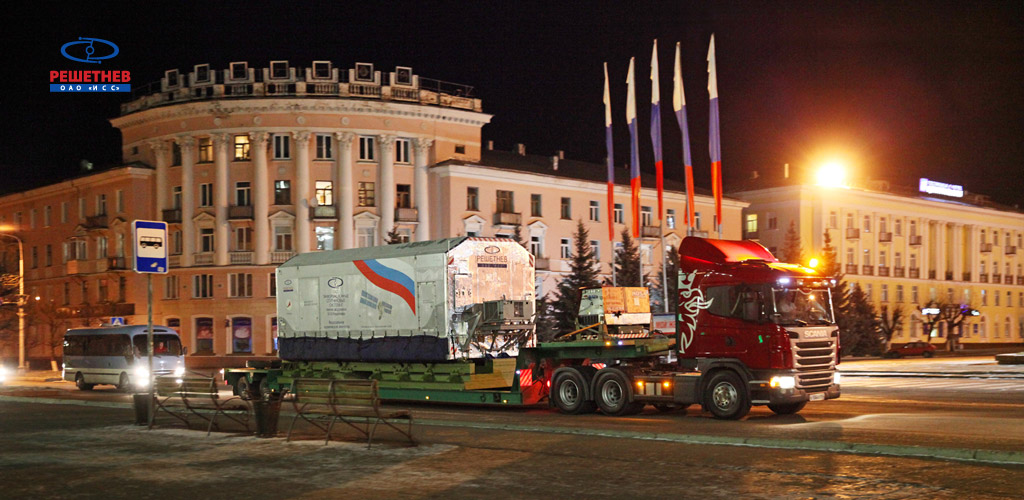
The second GLONASS-K1 satellite on its way to the Plesetsk Cosmodrome. Photo: CANSPACE Listserv
News courtesy of CANSPACE Listserv.
According to ISS Reshetnev, the manufacturer of GLONASS satellites, the second GLONASS-K1 satellite (serial number 12L) has just been delivered to the Plesetsk Cosmodrome. It is now being prepared for launch November 30. The launch date had previously been set as November 20.
Reshetnev made a number of production design changes to this GLONASS satellite, allowing an expansion of the functionality of the satellite and an improvement its performance. The satellite will transmit five navigation signals in three frequency bands: L1, L2, and L3. The satellite is built on the unpressurized Express-1000K platform. The designed lifetime of the satellite is 10 years.
The next GLONASS launch — the GLONASS-K1 satellite from Plesetsk scheduled for November 20 — is being insured for 2.17 billion rubles ($50 million US). The insurance is costing Russia 242 million roubles ($5.6 million US).
Russia has faced numerous technical difficulties in its launches. On May 15, a Proton-M satellite crashed. In 2013, Russia lost three GLONASS satellites when their launch aboard a Proton-M rocket went awry, sending the satellites crashing into the Baikonur Cosmodrome in Kazakhstan instead of aloft into space. In 2010, three other GLONASS satellites ended up in the Pacific Ocean aboard a Proton-M rocket.
The insurance covers the launch and flight tests of the carrier rocket Soyuz-2.1b, with the satellite GLONASS-K. Flight tests, according to the tender documentation, will last for three months.
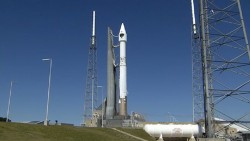
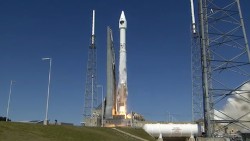
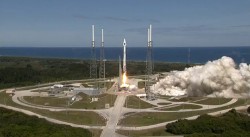
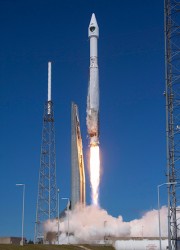
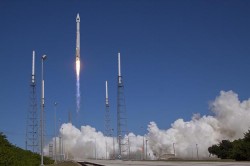
The U.S. Air Force launched the eighth GPS IIF satellite from Cape Canaveral Air Force Station in Florida today at 1:21 Eastern Time, as scheduled. An Atlas V 401 carried the GPS satellite aloft.
GPS IIF-8 is one of the next-generation GPS satellites, incorporating various improvements to provide greater accuracy, increased signals, and enhanced performance for users. With this eighth satellite now launched, only four more Block IIF satellites remain to be placed into orbit. Three are in storage awaiting launch, and one is in production.
“I’m delighted with the outcome of today’s launch. Thanks to the men and women of SMC, the 45th, 50th and 310th Space Wings; Boeing; ULA; the Aerospace Corporation; and the GPS IIF and Atlas V launch teams ceaseless efforts, commitment, dedication, and focus on mission success, we successfully launched the fourth GPS IIF space vehicle this year,” said Col. Bill Cooley, director of Space and Missile Systems Center’s Global Positioning Systems Directorate. “Today’s launch demonstrates our commitment to users around the globe that GPS is the gold standard for position navigation and timing and will continue to deliver capabilities for the foreseeable future,” he said.
After launch, the mission entered a coast phase that lasts about three hours. Following a short second burn of the RL10 engine, the Centaur second stage will deliver the Boeing-built GPS IIF-8 satellite to semi-synchronous orbit over the southern ocean north of Antarctica. Separation takes place about 3 hours, 24 minutes after liftoff.
GPS IIF-8 is the United Launch Alliance‘s fourth GPS launch this year. The mission marks ULA’s 89th mission launched since the company was founded in 2006.
GPS IIF-8 (SVN-69/PRN-03) will replace SVN-51 in the E plane slot 1. SVN-51 will be re-phased from E1 to an auxiliary node at E7 somewhere around SVN-54 currently on station at E4, according to the Air Force Second Space Operations Squadron (2 SOPS). SVN-38/PRN-08 will be taken out of the operational constellation prior to SVN-69 payload initialization and sent to Launch, Anomaly Resolution and Disposal Operations (LADO). PRN-08 will be assigned initially to SVN-49 and set to test.
SVN-38 was launched on November 5, 1997, successfully serving nearly 17 years, 9.5 years beyond its designed service life, due to the diligent efforts of the men and women of the U.S. Air Force. SVN-51 will remain in an auxiliary node once it completes its re-phase journey. The SVN-51 re-phase will take about six months after the initial burn occurs.
The third IRNSS satellite heads into orbit. Photo: ISRO
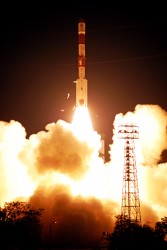
India has successfully launched IRNSS-1C, the third satellite in the Indian Regional Navigation Satellite System (IRNSS), early on October 16. The satellite was launched aboard the Polar Satellite Launch Vehicle (PSLV) C26 at 2002 GMT (4:02 p.m. EDT) from Satish Dhawan Space Centre, Sriharikota.
After the lift-off of PSLV-C26 with the ignition of the first stage, the important flight events — namely, stage and strap-on ignitions, heat-shield separation, stage and strap-on separations and satellite injection — took place as planned, according to the Indian Space Research Organization (ISRO). After a flight of about 20 minutes, 18 seconds, the IRNSS-1C satellite, weighing 1425 kg, was injected to an elliptical orbit of 282.56 km x 20,670 km, which is very close to the intended orbit.
After injection, the solar panels of IRNSS-1C were deployed automatically. ISRO’s Master Control Facility (at Hassan, Karnataka) assumed the control of the satellite. In the coming days, four orbit maneuvers will be conducted from the Master Control Facility to position the satellite in the geostationary orbit at 83 degrees East longitude.
IRNSS-1C is the third of the seven satellites constituting the space segment of the Indian Regional Navigation Satellite System. IRNSS-1A and IRNSS-1B, the first two satellites of the constellation, were successfully launched by PSLV on July 02, 2013, and April 04, 2014, respectively. Both IRNSS-1A and 1B are functioning satisfactorily from their designated geosynchronous orbital positions.
IRNSS is an independent regional navigation satellite system designed to provide position information in the Indian region and 1,500 kilometers around the Indian mainland. IRNSS will provide two types of services, namely, Standard Positioning Services (SPS) — provided to all users — and Restricted Services (RS), provided to authorized users.
A number of ground stations responsible for the generation and transmission of navigation parameters, satellite control, satellite ranging and monitoring, etc., have been established in as many as 15 locations across the country.
This is the 27th consecutively successful mission of the PSLV, which used the XL configuration of PSLV for the seventh time. Honorable Minister of State (Space) Jitendra Singh, witnessed the launch from the Mission Control Centre at SDSC, Sriharikota.
The next satellite of this constellation, IRNSS-1D, is scheduled to be launched by PSLV in the coming months. The entire IRNSS constellation of seven satellites is planned to be completed by 2015.
Below is a slideshow with images from the launch preparations and launch.
Nozzle end segment of PSLV-C26 being hoisted for assembly. Photo: ISRO
Nozzle end segment of PSLV-C26 being hoisted for assembly with launch pedestal. Photo: ISRO
IRNSS-1C being assembled with PSLV-C26 in the mobile service tower. Photo: ISRO
PSLV-C26 inside the mobile service tower prior to satellite integration. Photo: ISRO
IRNSS-1C being assembled with PSLV-C26. Photo: ISRO
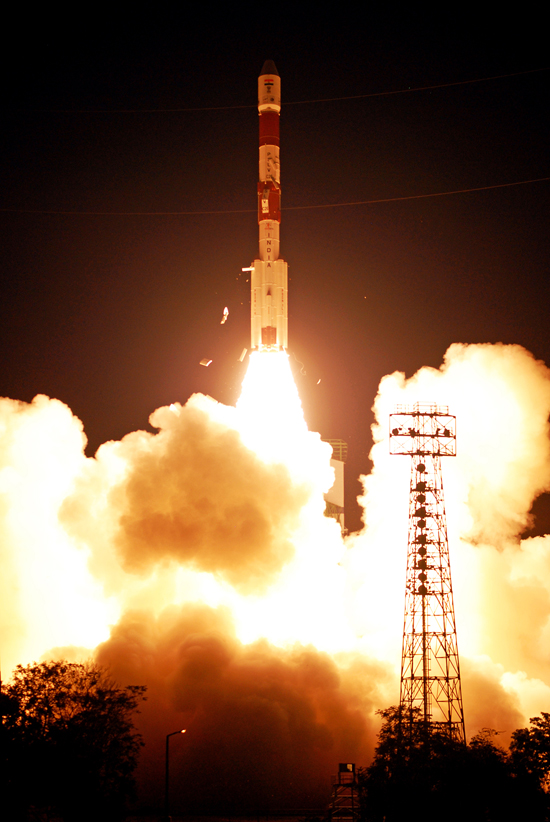
The PSLV-C26, carrying IRNSS-1C, lifts off. Photo: ISRO
Assembly of PSLV-C26, third and fourth Stages. Photo: ISRO
The third IRNSS satellite heads into orbit. Photo: ISRO
The seventh GPS-IIF satellite, SVN-68/PRN-09, launched on August 2, was set to healthy and usable Sunday night, according to Rick Hamilton, CGSIC executive secretariat of the USCG Navigation Center. The change brings the number of satellites transmitting the L2C signal to 13, and those transmitting the L5 signal to seven.
The next GPS-IIF satellite, IIF-8/SVN-69, is tentatively scheduled for launch on October 29.
Below is the full text of the Notice Advisory to Navstar Users (NANU).
NOTICE ADVISORY TO NAVSTAR USERS (NANU) 2014071
SUBJ: SVN68 (PRN09) USABLE JDAY 260/2026
1. NANU TYPE: USABINIT
NANU NUMBER: 2014071
NANU DTG: 172024Z SEP 2014
REFERENCE NANU: N/A
REF NANU DTG: N/A
SVN: 68
PRN: 09
START JDAY: 260
START TIME ZULU: 2026
START CALENDAR DATE: 17 SEP 2014
STOP JDAY: N/A
STOP TIME ZULU: N/A
STOP CALENDAR DATE: N/A
2. CONDITION: GPS SATELLITE SVN68 (PRN09) WAS USABLE AS OF JDAY 260