A SpaceX Falcon 9 rocket lifts off from Space Launch Complex 4E at Vandenberg Air Force Base, California, Jan. 14. (Photo: SpaceX)
Starting this month, the inspector general for the U.S. Pentagon will be reviewing how SpaceX’s rockets became certified to launch payloads for the U.S. Air Force, a decision made in May 2015.
“Our objective is to determine whether the U.S. Air Force complied with the Launch Services New Entrant Certification Guide when certifying the launch system design for the Evolved Expendable Launch Vehicle-class SpaceX Falcon 9 and Falcon Heavy launch vehicles,” wrote Michael J. Roark, deputy inspector general for Intelligence and Special Program Assessments, in a Feb. 11 memorandum to the Air Force.
In April 2016, the U.S. Air Force awarded SpaceX the first competitively sourced National Security Space (NSS) launch services contract in more than a decade, when the company won the GPS III Launch Services contract, fixed at $82,700,000.
Less than one year later, SpaceX was awarded a second contract for launch services to deliver a GPS III satellite to its intended orbit.
The evaluation will be performed at the Space and Missile Systems Center, a unit of Air Force Space Command, headquartered at Los Angeles Air Force Base in El Segundo, California. Additional locations may also be identified as part of the audit.
The latest four Galileo satellites have been given the green light to begin working alongside the rest of Europe’s satellite navigation fleet, giving a further boost to worldwide Galileo service quality.
Galileo has grown to become Europe’s single largest satellite constellation, built up over 10 launches over the course of this decade. The first of seven double-satellite Soyuz launches took place in 2011, with three sets of four-satellite Ariane-5 launches during the last three years.
The latest quartet of Galileo satellites were launched together by Ariane 5 on July 25, bringing the number of satellites in orbit to 26.
L-band antenna at Redu. (Photo: ESA)
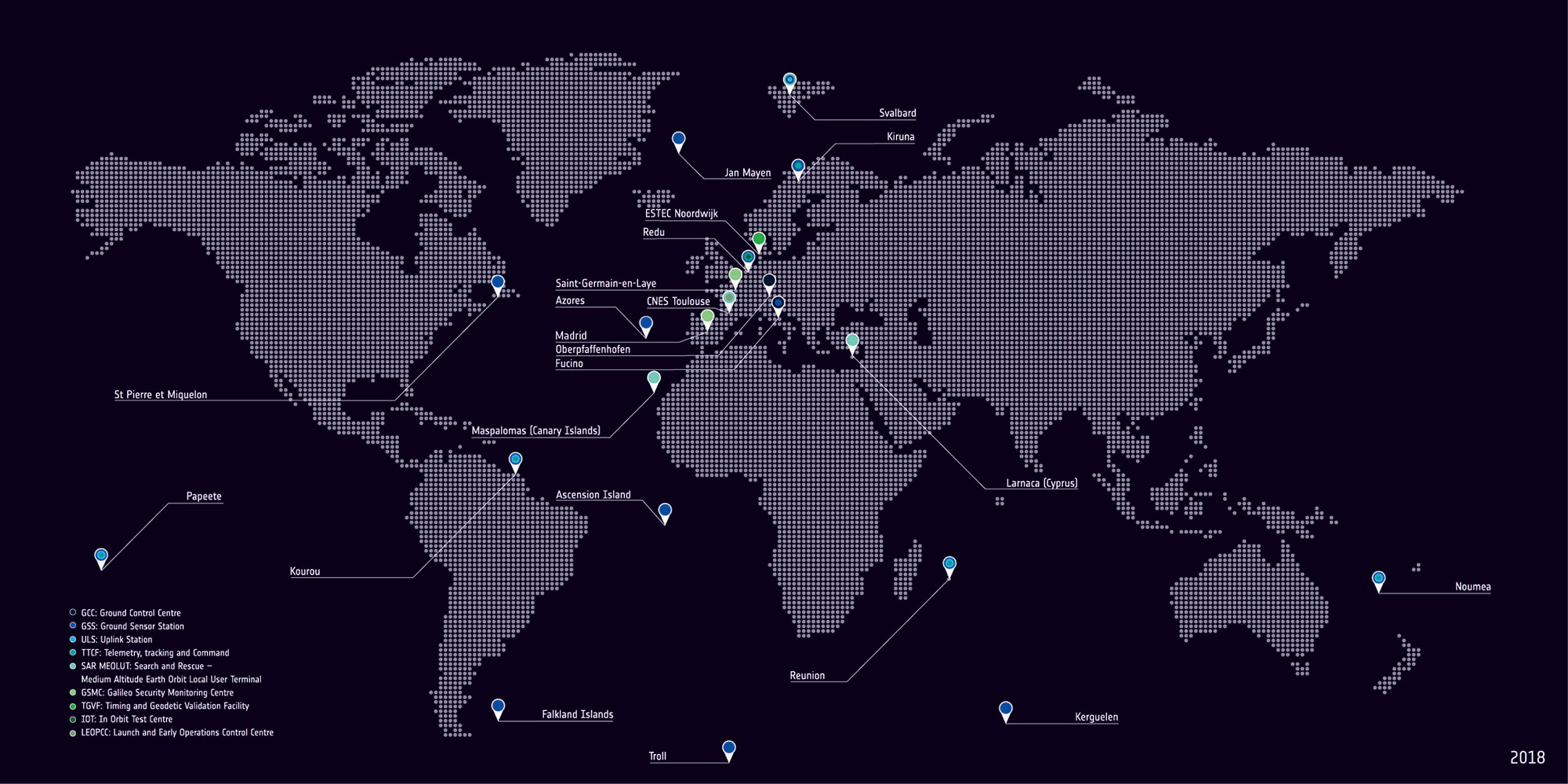
Once safely in orbit the satellites entered their in-orbit test commissioning, overseen by a combination of facilities across Europe.
The Launch and Early Operations Phase team of France’s CNES space agency in Toulouse worked together with the two Galileo control centres in Fucino, Italy, and Oberpfaffenhofen, Germany and ESA’s Redu centre in Belgium.
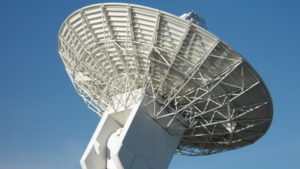
Redu’s 20-m antenna played an important part during in-orbit testing, allowing for high-resolution monitoring of the L-band navigation signal coming from each satellite.
The two control centres participated by testing their control of the satellites. The operations teams confirmed their fully-trained status and their readiness to manage the fleet now it has swelled to 26 satellites in total.
Galileo’s Control Centre in Fucino is used to oversee the satellites’ navigation payloads and services. (Photo: ESA)
David Sanchez-Cabezudo, ESA’s Galileo In-Orbit Testing manager commented: “All the lessons learned and experience gained in these last years through the Galileo satellite commissioning campaigns have led us to a high level of efficiency and effectiveness — not only in managing the technical aspects of the testing operations but the large number of interfaces at contractual and human levels. A complex network of teams has had to work together to make this activity work.”
Galileo satellites orbit in three orbital planes in medium Earth orbit, 23 222 km up. The result is that at least four Galileo satellites should be visible from any point on Earth — the minimum needed to achieve a position fix.
Galileo’s Control Centre in Oberpfaffenhofen in Germany oversees the Galileo satellite platforms. (Photo: ESA)
Oberpfaffenhofen Control Centre
Galileo Initial Services commenced on Dec. 15, 2016, with each new addition to the working constellation serving to enhance the stability and speed of the system.
A further 12 Galileo satellites are currently in production by the same industrial consortium — with OHB manufacturing the satellite platforms and Surrey Satellite Technology Ltd the navigation payloads.
The next Galileo launch is schedule for 2020, the same year that Full Operational Capability is set to start.
The Galileo programme is funded and owned by the EU. The European Commission has the overall responsibility for the programme, managing and overseeing the implementation of all programme activities.
ESA is entrusted with Galileo’s deployment, the design and development of the new generation of systems and the technical development of infrastructure. The definition, development and in-orbit validation phases were carried out by ESA, and co‑funded by ESA and the European Commission.
The European Global Navigation Satellite System Agency (GSA) ensures the uptake and security of Galileo. Galileo operations and provision of services became the responsibility of the GSA in July 2017.
SpaceX’s Falcon 9 rocket orbited the first GPS III satellite on Dec. 23, 2018. (Photo: USAF)
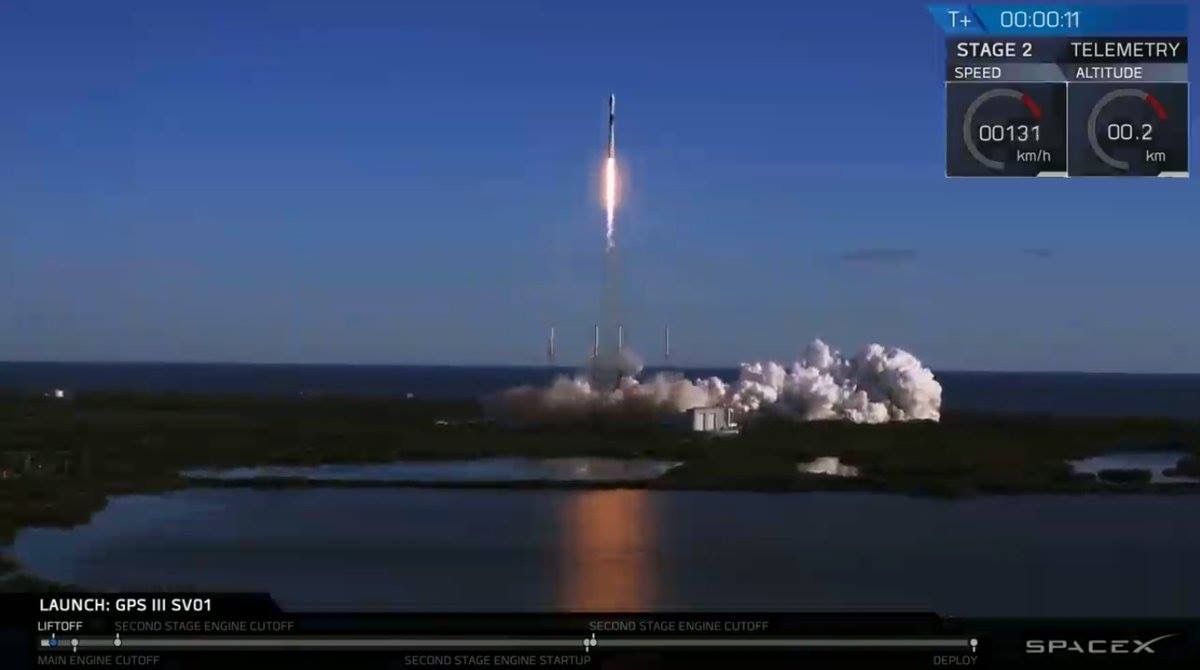
After several launch delays, the first GPS III satellite successfully deployed from a SpaceX Falcon 9 rocket, rising from Cape Canaveral on Dec. 23.
By Jan. 2, the satellite had circularized its orbit at an altitude of 12,550 miles to begin a period of checkout and testing that could last up to 18 months, before entering service. The satellite, built by Lockheed Martin, will serve in space for 15 years.
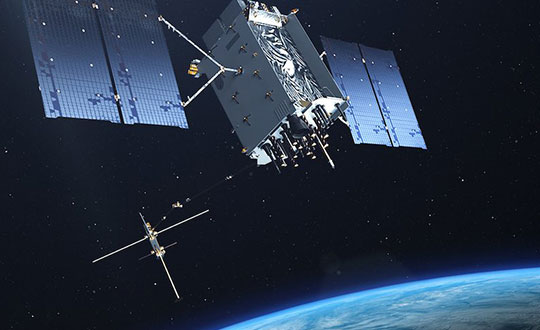
Known as GPS III SV01 and nicknamed “Vespucci,” it is the first in a new generation of GPS navigation stations with improved services and longer lifetimes to ensure the U.S. military-run network remains available to troops and civil users around the world for decades to come.
“Launch is always a monumental event, and especially so since this is the first GPS satellite of its generation launched on SpaceX’s first national security space mission,” said Lt. Gen. John Thompson, commander of the U.S. Air Force’s Space and Missile Systems Center and the Air Force’s program executive officer for space. “As more GPS III satellites join the constellation, it will bring better service at a lower cost to a technology that is now fully woven into the fabric of any modern civilization.”
The satellite’s earlier scheduled launch date of Dec. 18 was scrubbed, reportedly due to liquid oxygen thermal limit constraints aboard the SpaceX Falcon 9 Block 5 rocket’s first stage reaching safety limits.
A second attempt on Dec. 19 was also ruled out due to ongoing evaluations into the sensor issue. Then ensued three days of weather delay, awaiting favorable wind conditions, until Dec. 23.
After several delays, the first GPS III satellite has successfully deployed from the SpaceX Falcon 9 rocket, which launched from Cape Canaveral Air Force Station in Florida at 8:51 a.m. EST on Dec. 23. (Photo: Lockheed Martin)
GPS III SV01 was originally scheduled to ride aboard a United Launch Alliance (ULA) Delta IV M+ rocket. ULA and its prime partners, Lockheed-Martin and Boeing, have conducted every GPS satellite launch since the start of the program. However, due to an assortment of issues variously involving delayed technology development and lawsuits regarding competitive bidding, the Air Force re-opened the contract process as part of its Evolved Expendable Launch Vehicle (EELV) program — “evolved” signifying that the rocket can be recovered and reused.
Recycling Rockets. ULA did not bid on the re-opened contract, citing concerns over the selection process and potential risks with the anticipated lower launch cost. In 2016, the Air Force selected SpaceX to take over most GPS III launches.
SpaceX’s Falcon 9 for this launch used a new first stage core, the B1054. Although it has re-use capability, it flew in an expendable configuration this time, with no landing legs and no grid fins. It was disposed of into the Atlantic Ocean after separation from the second stage.
In other missions, after the satellite-bearing stage separates from the rest of the rocket, the remaining core launcher fires additional fuel to return intact to land or to sea aboard an Autonomous Spaceport Drone Ship (ASDS), a converted barge awaiting in the Atlantic or Pacific Ocean.
New Generation. The GPS III constellation, once fulfilled, will bring three times better accuracy and up to eight times improved anti-jamming capabilities. Spacecraft life will extend to 15 years, 25 percent longer than GPS satellites on-orbit today. GPS III’s new L1C civil signal also will make it the first GPS satellite broadcasting a compatible signal with other international global navigation satellite systems, like Galileo, improving connectivity for civilian users.
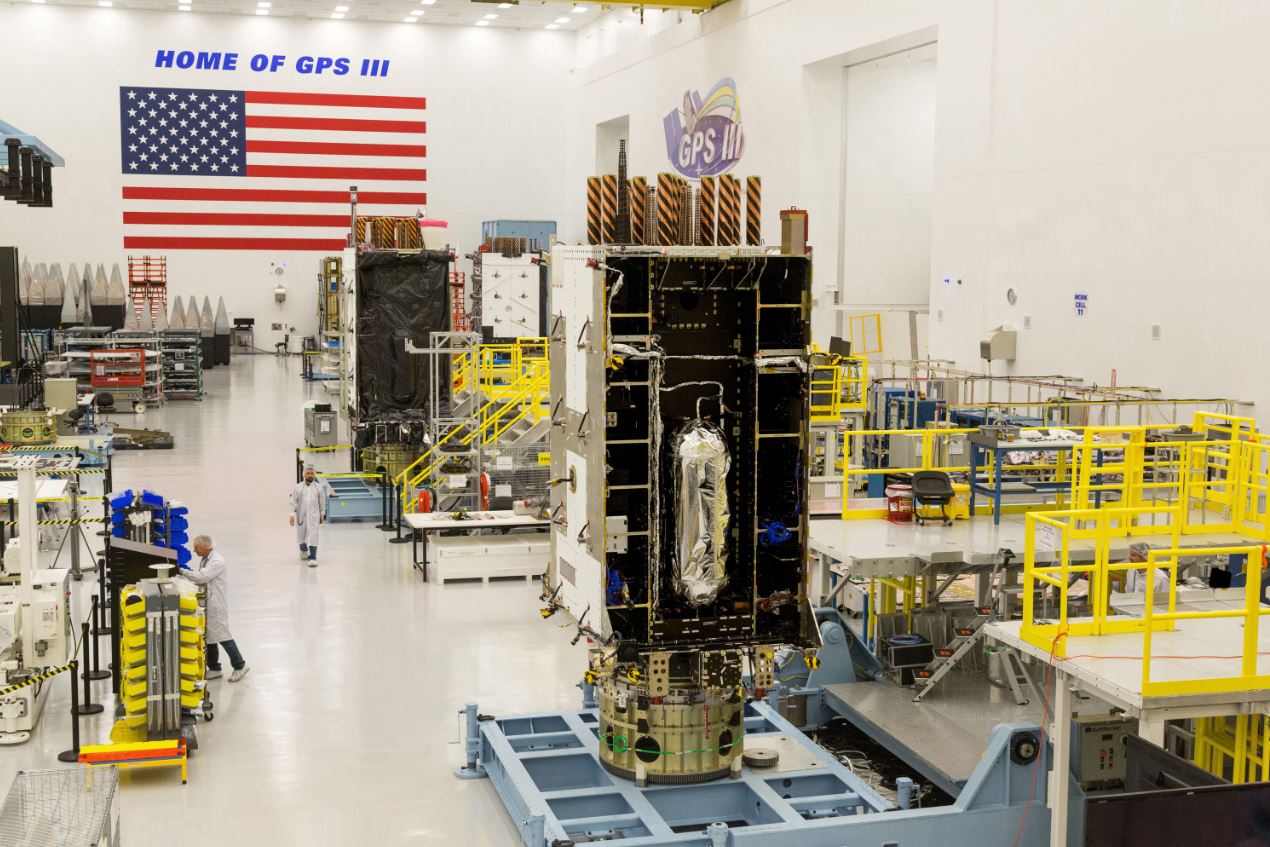
Lockheed Martin developed GPS III and manufactured GPS III SV01 at its GPS III Processing Facility near Denver. In September 2017, the Air Force declared the satellite “Available for Launch” (AFL) and had the company place it into storage.
In 2018, the Air Force called the satellite to Florida, and it was delivered on Aug. 20. At that time, the Air Force declared the second GPS III AFL and in November called it up for 2019 launch. GPS III satellites SV03-08 are now in various stages of assembly and test.
GPS III SV01 is now encapsulated and will be placed on the SpaceX rocket for Dec. 18 launch. (Photo: Lockheed Martin)
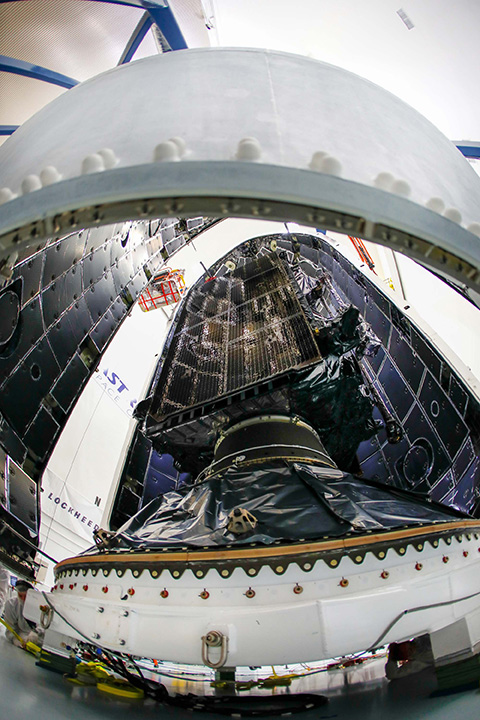
The U.S. Air Force’s first Lockheed Martin-built GPS III satellite is now encapsulated for its planned Dec. 18 launch from Cape Canaveral Air Force Station, Florida, on a SpaceX Falcon 9 rocket.
GPS III Space Vehicle 01 (GPS III SV01) underwent pre-launch processing, fueling and encapsulation at Astrotech Space Operations in Titusville, Florida. During encapsulation, GPS III SV01 was sealed in its launch fairing — an aerodynamic, nose-cone shell that protects the satellite during launch.
In the coming days, the fairing-enclosed satellite will be mounted to the rocket as launch preparations continue.
GPS III SV01 is the first of an entirely new design of GPS satellite that will help the Air Force modernize today’s GPS constellation with new technology and advanced capabilities.
GPS III has three times better accuracy and up to eight times improved anti-jamming capabilities. Spacecraft life will extend to 15 years, 25 percent longer than any of the GPS satellites on-orbit today. GPS III’s new L1C civil signal also will make it the first GPS satellite broadcasting a compatible signal with other international global navigation satellite systems, like Galileo, improving connectivity for civilian users.
“The world is dependent on GPS. More than four billion military, commercial and civilian users connect with signals generated by GPS satellites every day,” said Johnathon Caldwell, Lockheed Martin’s vice president for Navigation Systems. “The launch of GPS III SV01 will be the first step in modernizing the Air Force’s GPS constellation with the most powerful and resilient GPS satellites ever designed and built.”
Lockheed Martin developed GPS III and manufactured GPS III SV01 at its advanced $128-million GPS III Processing Facility near Denver. In September 2017, the Air Force declared the satellite “Available for Launch” (AFL) and had the company place it into storage.
In 2017, the Air Force “called up” the satellite for launch and Lockheed Martin delivered it to Florida on Aug. 20. The Air Force nicknamed the satellite “Vespucci” after Italian explorer Amerigo Vespucci.
GPS III SV01 is the first of 10 GPS III satellites originally ordered by the Air Force. GPS III SV03-08 are now in various stages of assembly and test. In August, the Air Force declared the second GPS III “AFL” and, in November, called GPS III SV02 up for 2019 launch.
In September, the Air Force selected Lockheed Martin for the GPS III Follow On (GPS IIIF) program, an estimated $7.2 billion opportunity to build up to 22 additional GPS IIIF satellites with additional capabilities.
GPS IIIF builds off Lockheed Martin’s existing modular GPS III, which was designed to evolve with new technology and changing mission needs. On Sept. 26, the Air Force awarded Lockheed Martin a $1.4 billion contract for support to start up the program and to contract the 11th and 12th GPS III satellite.
The launch and deployment of the 42nd and 43rd BeiDou satellites complete the basic BDS-3 constellation.
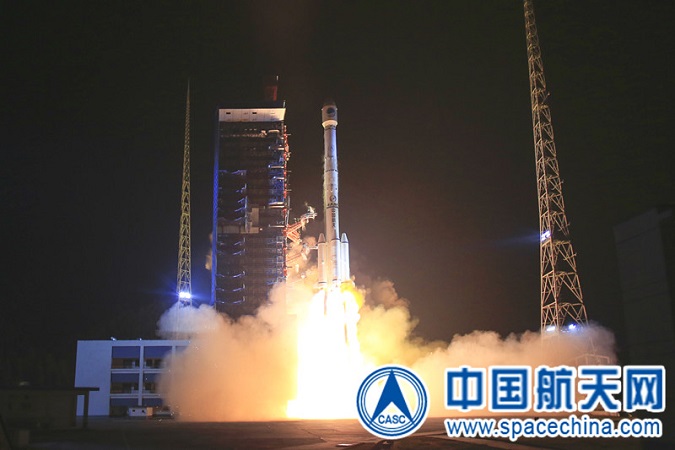
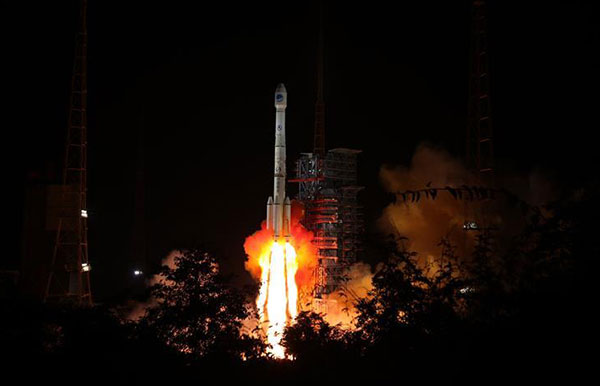
China has successfully sent twin BeiDou satellites into space by a Long March-3B launch vehicle (with an Expedition-1 upper stage) from the Xichang Satellite Launch Center, at 02:07 am, on Nov. 19. The twins, both medium Earth orbit (MEO) satellites, are the 42nd and 43rd of the BeiDou Navigation Satellite System (BDS), and the 18th and 19th of the BeiDou-3 family.
Photo: CASC screenshot
The satellites successfully entered their designated orbit after more than three hours of the launch, and will join the constellation with the 17 previously launched BDS-3 satellites, after completing in-orbit test.
The successful launch marks that the basic BDS-3 constellation has successfully been deployed. Networking of the constellation and assessment on its performances will be carried out in the near future.
Plans are for the BeiDou-3 constellation to be put into operation before the end of this year, to provide basic navigation services to countries and regions participating the Belt and Road initiative, which will be a key milestone for BDS in expanding service areas from regional to global.
The BDS-3 project was officially launched in 2009 with state approval, and a demonstration system was completed in 2016. Having verified the new-generation navigation signal system architecture, the BDS-3 development followed up with a three-step pattern, to construct its pilot, basic and nominal constellations respectively, according to the China Satellite Navigation Office,
On Nov. 5, 2017, the first pair of satellites for the BDS-3 constellation was launched from Xichang Satellite Launch Center. By the end of March 2018, a pilot constellation consisting of 8 BeiDou satellites was built.
At present, the project is progressing smoothly, and the basic constellation consisting of 19 BDS satellites will soon be operational. In the future, BDS with global coverage will be completed by the end of 2020.
Since November 2017, the past year has witnessed a highly intensive launch of the China’s BDS constellation. With the joint efforts of the whole team participating in this project, 11 launches have been completed within one year, while 19 BDS-3 satellites and 1 BDS-2 satellite have been successfully sent into space.
In particular, since July 2018, seven launches have been conducted to deliver 12 BDS satellites into orbit, with the shortest interval between launches being only 17 days. Both highly intensive and high success rate of launches set a new record in the history of the BDS constellation development.
The satellites and the launch vehicle (with an Expedition-upper stage) for this mission were developed by the China Academy of Space Technology and the China Academy of Launch Vehicle Technology respectively, both are affiliated to the China Aerospace Science and Technology Co., Ltd. The launch was the 291st mission of the Long March rocket series.
Currently, the BeiDou system comprises two families of operational navigation satellites; BeiDou-2, also known as Compass, presently consists of 15 operational satellites in Geostationary Orbit (GEO), Geosynchronous Orbit (GSO), Inclined Geosynchronous Orbit (IGSO) and Medium Earth Orbit (MEO).
The new BeiDou-3 series, on the other hand, only has operational MEO satellites at the moment, although China is testing the first BeiDou-3 GEO satellite (BeiDou-3G1) and plans to launch at least four GEO and GSO satellites in 2019.
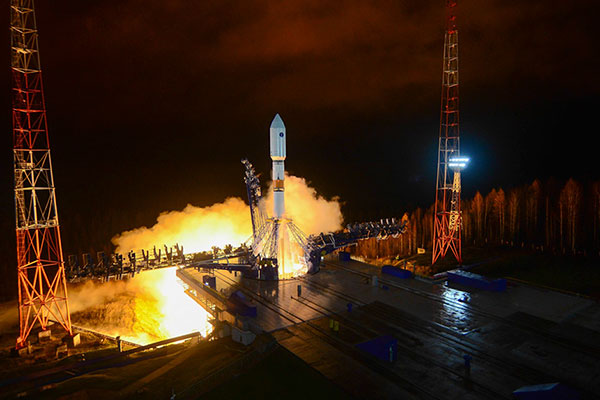
A GLONASS-M was launched Nov. 3 from the Plesetsk cosmodrome. (Photo: Russian Ministry of Defense)
A GLONASS-M satellite has safely entered its calculated orbit after a Nov. 3 launch, according to the Russian Ministry of Defense. The satellite is designated GLONASS-M 757.
The launch of the Soyuz-2.1B medium-range rocket took place Saturday, Nov. 3, at 23:17 Moscow time from the Plesetsk cosmodrome.
After separation from the third stage of the Soyuz-2 launch vehicle, the upper stage Frigate launched the navigation spacecraft into orbit.
The satellite will replenish the GLONASS constellation, which includes 27 satellites. One satellite is the newest model, GLONASS-K, and is undergoing flight tests. Another GLONASS-M is under maintenance.
A few minutes after launch, a steady telemetry connection was established and is being maintained with the satellite, which is functioning normally.
China has launched its first geostationary satellite for the BeiDou constellation, according to press reports.
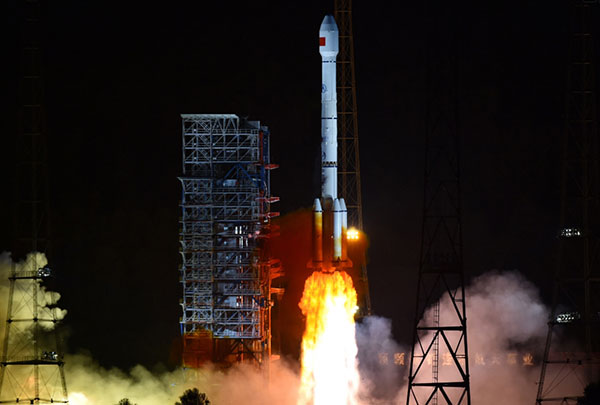
The successful launch of satellite G1Q took place at 15:57 UTC on Nov. 1 from the LC2 Launch Complex of the Xichang Satellite Launch Center, Sichuan province, using a Long March-3B/G2 (Chang Zheng-3B/G2) launch vehicle.
Beidou-3G satellites are the geostationary Earth orbit (GEO) component of the third phase of the Chinese Beidou satellite navigation system. The GEO satellites will be in high orbit, about 36,000 kilometers above the Earth, following the Earth’s rotation to view the same point on Earth continuously.
In addition to navigation services, the satellite will serve as a satellite-based augmentation system (SBAS) and provide short message services (Research Data Shared Service, RDSS).
The G1Q satellite is the 17th BeiDou-3 satellite and the 41st overall BeiDou satellite. Another pair of BeiDou-3 medium Earth orbit (MEO) satellites, M17 and M18, will be launched in mid-November.
The recent BeiDou launches will expand the system to global navigation coverage.
The G1Q satellite is based on the DFH-3B bus that features a phased array antenna for navigation signals and a laser retroreflector, and also is equipped with an apogee propulsion system for final orbit insertion. The satellite has a launch mass of about 4,600 kg.
China successfully launched a pair of BeiDou-3 navigation satellites into medium Earth orbits on Oct. 15, according to GB Times.
Four hours after the launch, the two satellites were inserted into their intended orbits, according to the China Aerospace Science and Technology Corporation (CASC). The satellites, numbered M15 and M16, are the 39th and 40th launched as part of China’s Beidou system, following the launch of the first in 2000.
Another pair of BeiDou satellites is expected to be launched in November, according to Richard Langley’s Upcoming Satellite Launches.
Liftoff of the Long March 3B rocket sending the Beidou-3 M15 and M16 satellites into orbit. (Photo: CALT)
For the Oct. 15 launch, a Long March 3B rocket with a Yuanzheng-1 upper stage lifted off from the Xichang Satellite Launch Centre in southwest China at 04:23 universal time (12:23 local, 00:23 Eastern).
The China Academy of Launch Vehicle Technology (CALT), which developed the Long March 3B rocket, reported that data logging and active tracking equipment was placed aboard for tests to determine to altitude and timing for future parachute landings for boosters.
Expended rocket boosters frequently land in or near populated areas downrange of Xichang. The trial phase of parachute booster landings is expected in 2019.
China successfully sent twin BeiDou navigation satellites into space on Aug. 25, aboard a single carrier rocket, according to news reports. The satellites are numbers 35 and 36 in the BeiDou navigation constellation.
China sends twin BeiDou-3 navigation satellites into space on a single carrier rocket from Xichang Satellite Launch Center in Xichang, southwest China’s Sichuan Province, Sept. 19, 2018. (Photo: Xinhua/Liang Keyan)
On Sept. 19, China successfully sent twin BeiDou-3 navigation satellites into space on a single carrier rocket, according to state news agency Xinhuanet.
This is the third launch of twin BeiDou-3 satellites in less than eight weeks. China launched two more pairs of BeiDou navigation satellites into space on July 29 and Aug. 25.
The Long March-3B carrier rocket lifted off from the Xichang Satellite Launch Center at 10:07 p.m. It was the 285th mission of the Long March rocket series.
The twin satellites are the 37th and 38th editions of the BeiDou navigation system. After a series of tests and evaluations, they will work together with 12 BeiDou-3 satellites already in orbit.
The twin satellites will provide danger alerts and navigation services for global users. A basic system with 18 orbiting BeiDou-3 satellites will be in place by the end of the year, which will serve countries participating in the Belt and Road Initiative.
The satellites and the rocket for Wednesday’s launch were developed by the China Academy of Space Technology and the China Academy of Launch Vehicle Technology, respectively.
Once the next-generation GPS III satellites begin launching in December, a series of updates to the current ground control system from Lockheed Martin will help the U.S. Air Force gain early command and control of the new satellites for testing and operations.
In 2016 and 2017, the Air Force placed Lockheed Martin under two contracts, called GPS III Contingency Operations (COps) and M-code Early Use (MCEU), which directed the company to upgrade the existing Architecture Evolution Plan (AEP) Operational Control System (OCS), which operates today’s GPS constellation.
The fourth Lockheed Martin-built GPS Ill satellite is fully integrated. (Photo: Lockheed Martin)
These upgrades to the AEP OCS are intended to serve as gap fillers prior to the entire GPS constellation’s operational transition to the next-generation Operational Control System (OCX) Block 1, now in development.
In April, the Air Force approved Lockheed Martin’s critical design for MCEU, essentially providing a green light for the company to proceed with software development and systems engineering to deploy the M-code upgrade to the legacy AEP OCS.
The Air Force gave a similar nod to COps in November 2016. COps is now on schedule for delivery in May 2019 and MCEU is scheduled for delivery in January 2020.
“The Air Force declared the first GPS III satellite Available for Launch last year, and it’s expected to launch later this year. Nine more GPS III satellites are following close behind in production flow,” explained Johnathon Caldwell, Lockheed Martin’s program manager for Navigation Systems. “GPS III is coming soon, and as these satellites are launched, COps and MCEU will allow the Air Force the opportunity to integrate these satellites into the constellation and to start testing some of GPS III’s advanced capabilities even earlier.”
MCEU Capabilities
Part of the Air Force’s overall modernization plan for the GPS, M-code is a new, advanced signal designed to improve anti-jamming and anti-spoofing, as well as to increase secure access to military GPS signals for U.S. and allied armed forces.
To accelerate M-code’s deployment to support testing and fielding of modernized user equipment in support of the warfighter, MCEU will upgrade the AEP OCS, allowing it to task, upload and monitor M-code within the GPS constellation.
MCEU will provide command and control of M-Code capability to eight GPS IIR-M and 12 GPS IIF satellites currently on orbit, as well as future GPS III satellites.
COps Capabilities
Following launch and check out, each future GPS III satellite will take its place in the GPS constellation. The COps modifications will allow the AEP OCS to support these more powerful GPS III satellites, enabling them to perform their positioning, navigation and timing missions for more than one billion civil, commercial and military users who depend on GPS every day.
Besides the addition of GPS III, COps will also continue to support all the GPS IIR, IIR-M and IIF satellites in the legacy constellation.
Lockheed Martin has a long history of supporting ground systems, providing operations, sustainment and logistics support for nearly 60 Department of Defense satellites, including GPS, often allowing them to double their on-orbit operational design life.
GPS III Satellites
Lockheed Martin also is under contract to develop and build 10 GPS III satellites, which will deliver three times better accuracy and provide up to eight times improved anti-jamming capabilities compared to current GPS satellites.
GPS III’s new L1C civil signal also will make it the first GPS satellite to be interoperable with other international global navigation satellite systems.
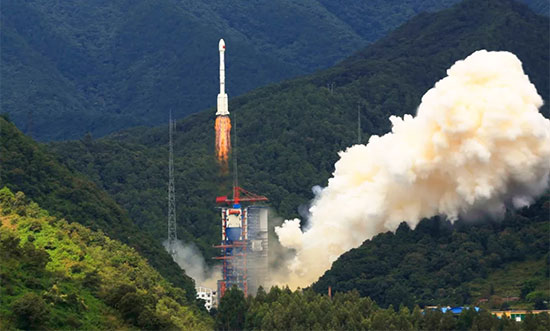
China launched two more BeiDou satellites on Aug. 25. (Photo: CCTV)
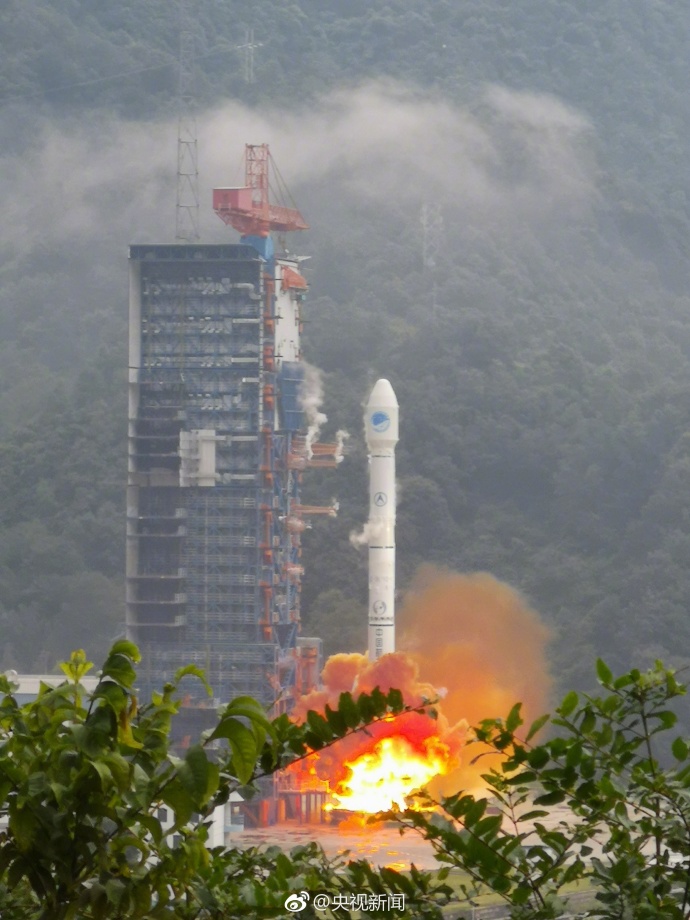
China successfully sent twin BeiDou navigation satellites into space on Aug. 25, aboard a single carrier rocket, according to news reports. The satellites are numbers 35 and 36 in the BeiDou navigation constellation.
Only a few weeks ago, China launched another pair of BeiDou-3 navigation satellites.
The Long March-3B carrier rocket lifted off from Xichang Satellite Launch Center in Southwest China’s Sichuan Province at 7:52 a.m. local time.
This was China’s 23rd orbital launch this year, surpassing the national record of 22 launches set in 2016. China Aerospace Science and Technology Corporation (CASC), the main contractor for the space program, is planning on 35 launches this year.
China launched two more BeiDou satellites on Aug. 25. (Photo: CCTV via Weibo)