A speaker from UAV manufacturer senseFly will appear on the free April 20 webinar, “From Flying Drones to Doing Business,” addressing ease of use for the user in business applications. The Switzerland-based company specializes in professional-grade UAVs for survey, mapping, precision agriculture and asset inspection. The company recently became the first drone operator to be granted anytime Beyond Visual Line of Sight (BVLOS) authorization in Switzerland.
Photo: senseFly
The webinar will cover a broad range of issues concerning sensor integration aboard a flying platform, and in particular their use for commercial purposes. Webinar attendees will have the opportunity to ask direct questions of the speakers, both upon registration and during the live event. Register free at env-gpsworld-integration.kinsta.cloud/webinar.
The senseFly speaker (name to be announced soon) will join a panel that consists of:
Gustavo Lopez, Product manager GNSS solutions for UAV applications, Septentrio; Jan Leyssens , Managing Director, Sales & Business Development, Airobot; and Zak Kassas, Assistant Professor in the Department of Electrical and Computer Engineering, University of California, Riverside.
Further speaker details:
Lopez: Septentrio is an leader in bringing high end GNSS technology when accuracy and reliability matters. Gustavo Lopez is Product manager for UAS applications at Septentrio. Since joining the company, he has held a number of R&D and product management roles. Gustavo holds a Bachelor of Computer Science degree from Monterrey’s Technology Institute and an MBA from United Business Institute
Leyssens: Airobot specializes in meeting safety demands for UAVs by providing intelligent safety components, specifically designed for drones, and in facilitating end-users’ success in completing their missions. Leyssens has Masters’ degrees in avionics, electrical engineering and business administration.
Kassas will present the research material from his cover story in the April issue of GPS World: “LTE Steers UAV — No GPS? No Problem! Signals of Opportunity Work in Challenged Environments.” Long-term evolution cellular can be exploited for accurate and resilient autonomous vehicle navigation in the absence of clear GNSS signals. Simulation and experimental results demonstrate that GPS-like performance can be achieved in the absence of GPS signals when cellular pseudoranges aid an inertial navigation system.
The Belgian dredging, environmental and engineering group DEME relies on the accuracy and reliability of the AsteRx family of precise GNSS positioning solutions from Septentrio.
DEME is using Septentrio’s AsteRx GNSS receivers to obtain centimeter-level accuracy for all its dredging and marine construction operations worldwide. These receivers are specifically designed to operate in difficult conditions, from dredging a few meters from the coastline to constructing wind turbines kilometers out at sea.
AsteRx-U dual-antenna receiver.
DEME began using Septentrio’s solutions more than 10 years ago. While dredging in the Belgian town of Oostende, DEME was unable to obtain a reliable RTK position from their GNSS equipment because of interfering radio signals from a local radio tower.
Septentrio worked with DEME to identify the source of the interference and modified a standard RTK receiver with special firmware to address the jamming problem. This case, along with others faced by Septentrio’s customers in the field, encouraged the development of a dedicated interference mitigation technology called AIM+, which is now standard in Septentrio’s GNSS solutions.
Septentrio’s AsteRx GNSS receivers have been deployed on DEME’s ships around the world. They have been vital to DEME for the success of projects such as the creation of Gateway Port in London, U.K.; the construction of Deurganckdok in Antwerp, Belgium; the Pearl Qatar City; the Thornton Bank Offshore Windfarm in Belgium; the extension of the Suez Canal in Egypt; and many more.
“’Creating land for the future’ is the slogan here at DEME and this is thanks, in part, to the accuracy and robustness of the solutions offered by Septentrio,” says Lorentz Lievens, head of the survey department.
“Jamming is a concern which DEME has seen more and more all over the world,” Lievens says. “Septentrio’s receivers are unique in that they continue to provide an accurate solution even in areas of high radio and ionospheric interference allowing DEME to deliver projects on time and on budget. Septentrio’s precise positioning solutions will remain vital for DEME to deliver quality and cost-effective operations around the world for many years to come.”
Pictured are the Three Sisters volcanoes in Central Oregon. Photo: USGS / Lyn Topinka
Septentrio has completed delivery of PolaRx5 multi-constellation GNSS reference receivers and antenna systems to the U.S. Geological Survey (USGS).
The monitoring systems will be deployed through the Volcano Hazards Program (VHP) for volcano monitoring stations in Alaska and at various international locations through the Volcano Disaster Assistance Program (VDAP) — a cooperative effort between the USGS and the U.S. Agency for International Development’s Office of U.S. Foreign Disaster Assistance.
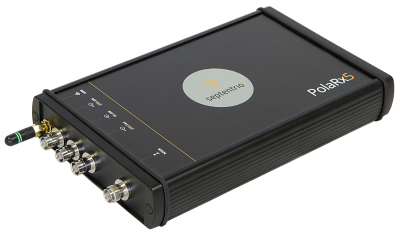
The PolaRx5 receivers take full advantage of the new 5.1.0 firmware which includes support for onboard PPP and dynamic response tuned for seismic applications. The PolaRx5 tracks all visible signals from Galileo, GPS, GLONASS, BeiDou, IRNSS and QZSS constellations. It provides measurement quality and robust interference mitigation through Septentrio’s patented AIM+ technology. The PolaRx5 supports these advanced features and more with a power consumption that is scalable from less than 2.0 watts.
“USGS and their partners will be among the first to exploit the PolaRx5’s seismic monitoring features,” said Neil Vancans, vice president of Septentrio Americas. “The PolaRx5 is Septentrio’s most complete GNSS receiver to date and provides the ideal upgrade for modernizing any continuously-operating reference station (CORS) network.”
Septentrio’s low-power AsteRx-m OEM GNSS board has been selected by Xeos Technologies for use in its new Resolute reference receivers. Designed for high-precision monitoring in low-power applications, the Resolute systems are aimed at structural monitoring and geodetic research in remote locations.
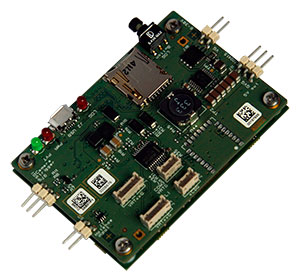
Smaller than a standard credit card, the AsteRx-m board provides centimeter-level dual-frequency L1/L2 GNSS positioning while consuming less than 0.6 W. It incorporates Septentrio’s proprietary tracking and positioning algorithms, providing high accuracy and robust performance in difficult environments.
The Xeos Resolute GNSS receiver is designed for applications such as critical infrastructure monitoring, subsidence monitoring and GPS geodesy in extreme polar environments. The small, lightweight and low-power monitoring station is suitable for solar-powered remote autonomous installations.
In addition to the Septentrio AsteRx-m GNSS board, the Resolute system features dual SD card storage of GNSS data and multiple telemetry options such as Iridium, cellular, Wi-Fi and wireless mesh networks for monitoring, control and data transmission. The Xeos Resolute also features multiple interfaces including USB, RS-232, RS-485, CANBUS and SDI-12.
“Field tests of the prototype Resolute stations have demonstrated reliable RTK centimeter-level performance for remote deformation monitoring,” said Paul Passmore, Xeos Technologies. “We look forward to presenting our test results at the American Geophysical Union Fall Meeting in San Francisco this week.”
“Xeos Technologies’ Resolute autonomous polar monitoring system is an ideal application for the AsteRx-m technology,” said Neil Vancans, vice president of Septentrio Americas. “The compact AsteRx-m delivers reliable centimeter-level L1/L2 RTK at under 0.6 W in extreme climatic conditions.”
“Building upon our polar Iridium telemetry products, we are teaming with Septentrio to offer a new line of high-performance, low-power GNSS products for remote applications” said Derek Inglis, president of Xeos Technologies.
Septentrio has released version 5.1.0 firmware for the PolaRx5 product line of GNSS reference receivers. The 5.1.0 firmware brings new features for file management, usability, security and seismic monitoring.
Septentrio’s PolaRx5 product line of GNSS reference receivers includes the PolaRx5 for CORS and network operations, the PolaRx5TR for time and frequency transfer and the PolaRx5S for space weather applications.
Improvements in precise point positioning (PPP) have opened the door on seismic monitoring using GNSS technology. As well as allowing precise measurement of long-term slow surface displacement, PolaRx5 now allows real-time recording of the high-frequency vibrations typically accompanying earthquakes. Firmware 5.1.0 introduces the support for on-board PPP and dynamic response tuned for seismic applications.
The 5.1.0 firmware release brings greater logging efficiency to the PolaRx5 users. Storage integrity is crucial for many applications. Retransmitting data can be an expensive business, especially when using Iridium telemetry. To improve archival functionality, Septentrio has developed a storage integrity feature to retransmit only the data which has been lost in the initial transmission. This avoids the common and unnecessary overhead of retransmitting complete files.
Preventing unauthorized access is a crucial aspect of cyber security. PolaRx5 product line is now equipped with firewall and IP filtering, SFTP and ssh keys. This complements and strengthens the user management and access level protection of the PolaRx5 product line.
Various independent tests have shown PolaRx5 consistently ranks highest among GNSS receivers in many areas of measurement quality, including lowest measurement noise and fewest number of cycle slips, and this at the lowest power consumption on the market. The PolaRx5 products offer robust and high-quality GNSS tracking of GPS, GLONASS, Galileo and BeiDou as well as regional satellite systems including QZSS and IRNSS.
Some of those who have recently deployed the PolaRx5 include the Oregon Department of Transport (DOT), UNAVCO, the Jet Propulsion Laboratory (JPL) and the SAPOS CORS network in Germany.
“The 5.1.0 PolaRx5 firmware continues Septentrio’s commitment to its customers.” stated Francesca Clemente, PolaRx Product Manager. She continued: “The new features of the 5.1.0 firmware complement existing standard features of the PolaRx5 GNSS receivers such as Advanced Interference Mitigation technology (AIM+) and the web UI offering full user control and status to make PolaRx5 the most complete GNSS reference station on the market today.”
Last year at InterGeo 2015, UAVs ruled, for at least the second year in a row, although some of its newest-thing gloss seemed to be wearing off. This year, sensor integration in both hardware and software is a dominant theme — and one with broader implications and applications.
GNSS positioning technology, aided in many cases by laser scanning, other imaging sensors, total stations, Lidar and camera systems, all collaborating as inputs to mobile mapping systems or machine-control systems, together form a durable platform for many present and future applications.
NavCom booth at InterGeo.
Among the GPS/GNSS companies exhibiting here: CHC Navigation, ComNav Technology, Eos Positioning Systems, Hemisphere GNSS, Navcom Technology, NovAtel, Septentrio, and Tallysman.
“I think it’s a must for every surveyor to participate and get updated with all the developments,” said Chryssy Potsiou, president of the International Federation of Surveyors (FIG), “to try to make the best combination of tools and software so that we can have the best output, in order to provide reliable services at affordable prices, in short time. The world needs solutions, cheap and fast.”
Smart Cities. Along with the roar of the four connected exhibition halls where many new products are being rolled out on this premier world stage, there is a lot of talk — a lot of talk — in the presentation auditoriums about vision, and smart cities, and connectedness in it many forms, electronic and otherwise.
The international trade fair for geodesy, geoinformation and land management, InterGeo can be overwhelming, with roughly 550 exhibits from 33 countries, and 16,000 visitors from 92 countries. It spans everything from surveying, geoinformation, remote sensing and photogrammetry to complementary solutions and technologies, processing, using and analyzing geodata over the Internet and exploring new applications and solutions — it’s all here. Themes include mobility, energy supply, climate protection, and liveable cities and rural areas. Citizen involvement, data protection, data security and e-government all play a key role in future developments. This year, the conference published a pre-show report on geodata and what it calls Business World 4.0.
Host city Hamburg, an economically strong, vibrant city and one of the top three shipping ports in Europe, embraced digital strategy at an early stage. Sustainable city planning, climate protection, an intelligent mobility concept and IT-controlled port management are all aspects of the city that could not work without geodata.
Making Connections. “Our [geospatial] industry is now more and more related, more and more embedded with many other disciplines,” said Nigel Clifford, CEO of Ordnance Survey UK, who gave one of the conference keynotes. “One of the key questions we are facing is: What skills will the workforce of the future need to have, in order to flourish in this interconnected world?
“Some of the more obvious ones are digital capability, looking at data sciences. Also we spoke about some of the softer skills: the ability to look across disciplines, the ability to work with different functions, and really importantly, the ability for our industry to explain its value and be part of the decision-making which is going on around us all the time.
“We’re beginning to see the first fruits of the Internet of Things. There may be some inflated expectations at this point. It’s our job to test that. I’m confident there are some brilliant use cases developing over the next five years in the fields of health, transport, and community engagement. Making a city more efficient, more livable, more secure, and more business-friendly, to draw tax dollars into the equation. What we’re able to do today is so much more data-rich, so much more connected, than we’ve ever been able to do before. ”
He cited pilot public-private partnership projects in Manchester and another unnamed UK city going forward in this regard, with involvement from Cisco, Siemens, and British Telecomm along with Ordnance Survey. “It’s a mixed economy coming together, because there isn’t one answer.”
Looking into the future, he said “Developing nations in particular require a fundamental geospatial fabric in order to boost themselves. I hope there will be a broadening of the focus from what we can do absolutely at the cutting edge of technology with reasonably affluent societies, to thinking about how we can take that into the less affluent societies, and raise all boats through the efforts of this great industry.”
Gorillas Enter Room. Intel has taken a stake in the commercial drone space with its new Falcon UAV. “Predominantly, we are looking at inspections, construction, agriculture, as well as 3D modeling.” The company was joined by Oracle and Autodesk as first-time exhibitors at the show, and they did not enter timidly; big stands.
UAV über Deutschland. In moves shadowing those in the United States, the German Minister for Transport spoke about introducing regulations to govern civil and commercial use of UAVs. The newly published draft foresees the introduction of mandatory registration for unmanned aerial systems. Pilots will need a valid license to fly drones above 100 meters.
Back again in Portland, Oregon, the 2016 Institute of Navigation’s ION GNSS+ conference was a great opportunity for the GNSS community to catch up on what’s been cooking in the industry, and of course who’s been doing what in the research community.
The attendees eagerly took to a wide range of technical paper presentation sessions, and from time to time came to take a look at what industry had to offer on the exhibit floor. Lots of engaging research reports, from work undertaken over the last year by academia, again drew a significant number of attendees from around the world.
On the other hand, industry continued the trend to go to trade shows in application sectors and pull back somewhat from ION GNSS+ as a place to look for product sales. So the number of companies on the ION show floor remained around the same or maybe a little less than in the previous few years. Nevertheless, the quality of the companies exhibiting remained high and there were some interesting newcomers.
A number of major GNSS receiver manufactures have pulled back from ION, so there were only two established U.S. companies and two new U.S. entrants at the show. On the other hand, GNSS simulation companies were at ION in force — eight all told, or twice as many as the receiver manufacturers present who have been their historic customers. But the trend in GNSS simulation now appears to be to move down stream towards the needs of integrators and systems outfits — in segments such as automotive, UAV and agriculture — with lower cost, very capable simulators.
Receiver makers roll out new tech
As a consequence, the NovAtel and Septentrio booths got a lot of attendee traffic, while BDStar (Unicore receivers and Harxon antennas) and ComNav also had a number of visitors to their booths. As usual, NavTech, who represent almost all the manufacturers, also had a busy exhibit.
OEM7600 dual-frequency receiver.
NovAtel chose to launch its OEM-7 series of GNSS receivers and a newly designed VEXXIS high-precision antenna at ION GNSS+, which is a somewhat refreshing return to the ION GNSS+ launch platform we used to see in the past. A new highly integrated ASIC at the heart of this receiver now provides, amongst other features, 555 channels, L-band support, inertial SPAN capability and an intriguing “Interference Toolbox”. The toolbox enables integrators to localize interference effects over a wide band — especially helpful for densely packed electronics, which you might expect in a UAV, for instance.
Interference Toolbox Screenshot.
Septentrio didn’t have a whole lot of new product announcements, but as usual the company has been working hard at improving existing capabilities on its receivers. The AsteRx4 receiver that uses a new ASIC has been available for a while, but it too boasts 544 channels — perhaps too many to actually be used in practice — robust heading, centimeter-level RTK and decimeter-level PPP (with TerraStar and Veripos corrections) with dual L-band channels, and an improved suite of advanced interference mitigation (AIM+) capabilities. This helps detection and removal of the effects of “chirp jamming” from low-power “cigarette-lighter” jammers — using signal analysis and adjustment of adaptive notch filters.
Septentrio did announce a new PolaRx5TR packaged time-and-frequency transfer receiver and a contract with the Jet Propulsion Laboratory (JPL) for reference stations and timing. A report by UNAVCO also found its way into my inbox, which related comparative testing of the PolaRx5 and other manufacturers’ receivers in connection with a UNAVCO RFP – Septentrio did O.K. and was selected as a preferred vendor, which no doubt influenced the JPL award and added to an already good first half year for the company.
The Septentrio PolaRX5TR.
BDStar had a range of GPS, GLONASS, Beidou receivers from its subsidiary Unicorecomm, along with an impressive selection of antennas from Harxon, another of its Chinese subsidiaries. Both product lines have done very well in the Chinese market, and BDStar would like to sell more in North America.
ComNav also displayed a similar range of GNSS receivers and antennas, with new versions of both since last year, and a strong desire to break through into the US market.
Simulators a big presence
Simulator companies at ION included the more established Spirent, Spectracom, CAST, IFEN and Rohde & Schwarz — we could even now consider RaceLogic/LabSat as a record-and-playback fixture in the market. But in the wings and making lots of waves at the show were Syntony from France and Skydel from Montreal, Canada.
Spirent brought its usual large-scale GNSS simulators to ION, but also featured an interference detection and software analysis suite, a 16-bit high-fidelity record/playback unit, along with a new multi-frequency simulator aimed at downstream integrators. The GSS200D Detector finds interference effects and is able to relate them to the threats in the environment around a receiver. The object is to help debug an installation by finding internal interferers. The analysis tools can also help differentiate between regular equipment interference and potential external jammers.
Spirent’s new GSS200D detector.
Spirent also displayed a record/playback unit that has 16-bit playback capability, enabling a user to record and review a particular interference event, and then feed their new commercial simulator in order to replicate the interference. So a passing isolated jamming event can be analyzed in detail. Multiple reruns are possible to confirm the effect on the target system, and following equipment modifications, prove that the problem has indeed been neutralized.
Spirent analysis tools.
RaceLogic introduced its new wideband LabSat 3 record/playback system for GPS L1, GLONASS L1, Galileo E1, BeiDou B1, QZSS and SBAS. Recording live signals for any or all of these signals then allows later playback of a canned sample for equipment debugging on the bench. The LabSat product line has been around for some time, and this addition increases the debug capability for downstream users at an affordable price in a very portable format. When used with the RaceLogic SatGen software system, the user has access to a powerful toolset for testing new GNSS devices.
LabSat 3 and SatGen test set-up.
Spectrcom displayed its multi-frequency, multi-constellation simulator and also featured a GNSS vulnerability test system for interference detection and system debugging. The company’s approach requires two simulators, both synchronized by an atomic clock, allowing a PC-based Test Scenario Control to generate reproducible interference effects for debugging.
CAST Navigation is already moving downstream quite quickly with its CAST-SGX handheld GNSS simulator. With a touchscreen display, this simplified L1 GPS simulator (with P-code option) is ideal for test-bench debugging.
Rohde & Schwarz had its usual array of high-end test equipment, with a test set-up aimed at demonstrating testing of a Wi-Fi indoor location application on a smartphone.
IFEN showed up with a completely re-engineered simulator with huge frequency/channel capacity. The Titan GNSS Simulator houses up to 8 RFSIM modules, each of which carries 32 configurable satellite signals. A fully configured Titan chassis can therefore provide 256 channels of GPS L1/L2/L5, GLONASS G1/G2/G3, Galileo E1/E5/E6, Beidou B1/B2/B3, IRNSS L5 and S-band, QZSS L1/L2/L5/LEX and all current L1/L5 SBAS signals. Titan also has up to four independent RF outputs.
IFEN Titan GNSS Simulator.
Skydel is one of the newcomers in GNSS simulation, but has made significant inroads first appearing last year at ION. Skydel now boasts a full-up, reconfigurable GPS, GLONASS, Galileo, Beidou “software” simulator which the company claims to sell at a 1/3 the price of a conventional hardware simulator. And during the year, Skydel teamed up with Talen-X in Ohio, who have embedded Skydel software-defined in a U.S.-sourced GPS/GLONASS/Galileo/Beidou simulator that can include GPS P/Y and M-code.
Broadsim from Talen-X powered by Skydel.
Syntony rises high by going under (the ground)
The noise in simulation at ION was, however, created by Syntony from Toulouse in France. Syntony recently won a 15-simulator order from OneWeb — the outfit that plans to launch a 640 internet connectivity satellite constellation through 2020. With funding secured from Virgin Group and Qualcomm in 2015, initial satellite build is underway at Airbus Defence and Space, launch services are contracted with Arianespace to provide 21 multi-sat launches on Soyuz beginning in 2017 with optional launch service with Virgin Galactic. So Syntony is likely going to be able to build, deliver and be paid for its 15 simulators, which will be used for testing GPS capability that is integrated into each comms satellite.
Syntony’s simulator is also software-defined and is reconfigurable. The software-defined heart of this system comes from a Syntony GPS/Galileo receiver, and a version of this receiver has now been sold for use in the Airbus Adeline re-usable space module. This receiver is a “multi-antenna receiver” in order to avoid signal or tracking loss while switching between antennas during the Safran launcher rotation. The catch here is that Syntony must develop this receiver to Airbus critical airborne software=qualification standards — no mean feat! Syntony is also providing a version of its Constellator simulator for testing this multi-antenna input receiver.
An ECHO record/playback system is also available, which includes high-fidelity 16-bit RF outputs.
Finally, Syntony was able to capture a proof-of-concept location infrastructure project for Stockholm, Sweden’s, underground metro. The metro stations are pretty deep underground, as they have been dug under the sea in and around Stockholm, and no one had been able to come up with a system that would enable emergency 911 calls with associated essential localized position information to be carried from within the stations. Syntony was able to provide a GPS-like signal infrastructure at the stations which is compatible with GPS-enabled smartphones. It worked well, and Syntony verified that there was no radiation of the signal outside any of the entrances to the test station — so no GPS interference. It actually worked so well that Syntony got the contract to equip all 50 metro stations in Stockholm, and the Syntony is now working to spread its system around the metros of all major cities, worldwide.
Defining the Galileo PRS signal…
Then I came across Fraunhofer towards the end of the show, and their posters about a Galileo PRS (Public Regulated Service) receiver. Now, we know that there has been significant discussion between the different security services of countries across the European Union, and its taken a lot of time to get to a definition of the PRS signal and who has access. So it wasn’t surprising that there was no hardware on the Fraunhofer booth; what’s surprising is that there was any mention of such a receiver being available and telling attendees at a conference in the U.S. that it’s available.
I talked to a couple of people at their booth, and indeed there is such a receiver, but they really couldn’t tell me anything about it because telling is strictly verboten! Another strange anomaly of the Galileo program — the participants seem to want to let the U.S. know that they have the capability for a special access service, and a receiver is available to work with it, but they can’t tell us anything about it. I guess the idea may be to rattle the cage of the U.S. P-code/M-code guys, and let them know Galileo has caught up at last… But Fraunhofer has an idea of how to make things available to, well, err …. to somebody. They have a concept to have cellphone users who want PRS to connect with their cloud receiver, and they will decode and provide PRS position back over the internet. That solves the whole security thing…. OK, that should do it.
Where inertial stands
I also made the rounds of the inertial and inertial/GPS guys at the show, and there were quite a few. From NorthropGrumman and Systron Donner and their mil-spec high-end FOG and RLG and Quartz MEMS tube-shaped inertial units — could they be for shells or missiles? — to Silicon Sensing’s MEMS accels and gyros and their move out of automotive and towards high-precision performance, to Sensonor’s high-performance commercial MEMS/GNSS units, there were actually only a few of the inertial-aiding outfits present. Yet everything we hear is that for anything that moves, we really should use integrated inertial/GNSS, and UAVs especially want lots of that! So this part of the business looks to be quite healthy too…
Now another ION GNSS+ conference has come and gone — and I was reminded that maybe I’ve actually been to 95 percent of the ION September conferences over the last 30 years. And as I write, the last of the late Friday paper sessions are crawling to a close.
ION still remains a good place to come and learn, a place to meet industry colleagues and a place to see a little of what industry is up to. Definitely worth the trip, and don’t forget your business cards next year.
Septentrio has received a contract to supply 35 high-precision GNSS receivers to the Jet Propulsion Laboratory (JPL) for use in the NASA Global GNSS network (GGN).
The NASA GGN is one of the world’s largest global GNSS tracking networks with nearly a hundred reference receivers deployed worldwide and is a participant in the International GNSS Service (IGS). The GGN is also the core tracking network of JPL’s Global Differential GPS (GDGPS) System, a highly available and reliable service providing mission-critical position, navigation and timing data, as well as environmental monitoring for industry and government operations.
The Septentrio PolaRx5 GNSS receiver.
Under the contract, Septentrio will supply 35 of its new-generation PolaRx5 GNSS receivers, including 25 reference stations and 10 timing instruments. Deliveries began in August and will be completed in September.
The PolaRx5 incorporates Septentrio’s most advanced multi-frequency GNSS engine, which tracks all major satellite signals including GPS, GLONASS, Galileo and BeiDou, as well as the regional QZSS and IRNSS satellite systems. It provides measurement quality and interference mitigation, and operates on less than two Watts when receiving GPS and GLONASS satellite signals.
“This major contract with JPL — a widely recognized industry leader in GPS and GNSS technology — is an important validation of Septentrio’s position as the number one preferred supplier of highly accurate GNSS receivers for scientific applications, and recognition of the superior performance of our next-generation GNSS receivers,” said Neil Vancans, vice president of Septentrio Americas.
Septentrio has launched its most advanced GNSS receiver for dedicated time and frequency transfer applications, the PolaRx5TR.
The PolaRx5TR is the newest addition to Septentrio’s PolaRx product line of GNSS receivers, which led to the selection of Septentrio as preferred vendor for reference stations to UNAVCO for 2015-2018.
The PolaRx5TR has 544 hardware channels and supports all major satellite constellations including GPS, GLONASS, Galileo, BeiDou, QZSS and IRNSS.
A calibration circuit is incorporated into the PolaRx5TR to measure and compensate for the internal delay. This feature removes the need for calibration using external equipment and ensures measurement latching is always accurately synchronized with the PPS input.
Septentrio’s newest receiver is compliant with the new-format CGGTTS version V2E of Consultative Committee for Time and Frequency (CCTF) recommendations. Also included as standard is Septentrio’s Advanced Interference Mitigation (AIM+) technology, giving outstanding interference robustness in difficult radio environments. Furthermore, up to eight independent logging sessions can be configured logging to either the 16-GB internal memory or to an externally connected device.
“Septentrio’s timing receivers have established themselves as trusted market leaders for time and frequency transfer applications,” said Francesca Clemente, product manager for the PolaRx product line. “The PolaRx5TR continues in this tradition with updated GNSS technology, compliance to new standards set by CCTF and an auto-calibration feature reducing initial setup times.”
Esri customers in the United States can now purchase Septentrio’s Altus NR2 high-accuracy GNSS receiver, according to an announcement today from the two partner companies.
The open-architecture Altus NR2 is fully compatible with Esri’s new version of Collector for ArcGIS, giving Esri users a powerful combination for GIS data gathering in applications requiring centimeter-level positioning, the companies said in a news release.
The intuitive web interface built into the NR2 allows for easy receiver configuration for Collector for ArcGIS using a standard web browser so that no additional device is needed to configure the receiver.
“This new reseller agreement builds on our longstanding strategic alliance with Septentrio to develop high-accuracy GNSS/GIS solutions optimized for easy integration with our ArcGIS Online platform,” said Jeff Shaner, product manager. “The Altus NR2 GNSS receiver, coupled with Collector for ArcGIS, provides a seamless solution for high-accuracy, offline field data collection using the ArcGIS platform.”
“We have worked closely with Esri to ensure our new-generation GNSS receiver technology integrates smoothly with Esri’s new high-accuracy Collector for ArcGIS,” said Neil Vancans, vice president of Septentrio Americas. “Our open architecture enables Esri users to record important parameters like height, horizontal coordinates, error variance and other attributes in the field using their familiar Collector workflows.”
The Altus NR2 offers advanced features such as dual cellular antennae with automatic switchover, built-in Wi-Fi, hot-swappable batteries and open architecture to Esri ArcGIS Online. It has been thoroughly tested with the new high-accuracy version of Collector for ArcGIS.
Septentrio’s advanced RTK engine delivers unbeatable accuracy at centimeter-level for GIS professionals in urban and regional planning, transportation, water industry, real estate, forestry, telecommunications and other sectors. The NR2’s integrated communication systems make for fast and easy field work. The Bluetooth module enables rapid data streaming into Collector. The built-in GSM/GPRS modem provides robust access to RTK data corrections, while the Wi-Fi provides access to Septentrio’s intuitive web user interface for easy status monitoring and straightforward configuration.
Septentrio will showcase its latest GNSS systems and software solutions for GIS professionals at the 2016 Esri User Conference in San Diego, June 28-30, with a special focus on the rapidly growing market for drone-based aerial survey.
The AsteRx-m UAS by Septentrio.
At center stage will be Septentrio’s suite of products designed specifically for aerial surveys. They include the compact AsteRx-m UAS onboard GNSS receiver and GeoTagZ high-accuracy drone positioning software, which is optimized for automatic interface with Esri ARCGis and Drone2Map platforms.
“Demand for drone imagery is booming in the GIS marketplace as a fast and efficient alternative to ground-based surveys for applications such as mapping, photogrammetry, infrastructure inspection and natural disaster monitoring,” said Neil Vancans, vice president of Septentrio Americas. “To meet that demand, we are bringing to market a range of hardware and software solutions that will make it easier than ever for Esri users to capture, georeference, process and visualize drone-captured imagery.”
Septentrio is also introducing new firmware for its versatile NR2 GNSS receivers and the PinPoint-GIS utility software for terrestrial applications. NR2 V1.2.0 offers a host of new connectivity features, including direct dial-up, dynamic DNS, base-rover Wi-Fi point-to-point connection and other new features that will streamline field work. PinPoint-GIS has also been enhanced to provide seamless integration with Esri’s Collector for ArcGIS.
“Septentrio is pioneering the way by which Esri users collect data,” said Gustavo Lopez, product manager at Septentrio. “GeoTagZ and PinPoint-GIS bring more accuracy and flexibility into the field by combining the power of Septentrio’s GNSS products with the user-friendly interface of Collector for ArcGIS. From the air to your own device, you are guaranteed accuracy and reliability in your GNSS positioning by using GeoTagZ to georeference aerial photos and PinPoint-GIS to harness the power of GIS data.”
Esri User Conference attendees are invited to visit Booth 2633 for a first-hand look at Septentrio’s solutions for the full range of aerial and ground-based GNSS solutions for GIS, including the new-generation APS-3G multi-constellation RTK receiver, which was just introduced to the market.
Septentrio will showcase its latest GNSS systems and software solutions for GIS professionals at the 2016 Esri User Conference in San Diego, June 28-30, with a special focus on the rapidly growing market for drone-based aerial survey.
At center stage will be Septentrio’s suite of products designed specifically for aerial surveys. They include the compact AsteRx-m UAS onboard GNSS receiver and GeoTagZ high-accuracy drone positioning software, which is optimized for automatic interface with Esri ARCGis and Drone2Map platforms.
“Demand for drone imagery is booming in the GIS marketplace as a fast and efficient alternative to ground-based surveys for applications such as mapping, photogrammetry, infrastructure inspection and natural disaster monitoring,” said Neil Vancans, vice president of Septentrio Americas. “To meet that demand, we are bringing to market a range of hardware and software solutions that will make it easier than ever for Esri users to capture, georeference, process and visualize drone-captured imagery.”
Septentrio is also introducing new firmware for its versatile NR2 GNSS receivers and the PinPoint-GIS utility software for terrestrial applications. NR2 V1.2.0 offers a host of new connectivity features, including direct dial-up, dynamic DNS, base-rover Wi-Fi point-to-point connection and other new features that will streamline field work. PinPoint-GIS has also been enhanced to provide seamless integration with Esri’s Collector for ArcGIS.
“Septentrio is pioneering the way by which Esri users collect data,” said Gustavo Lopez, product manager at Septentrio. “GeoTagZ and PinPoint-GIS bring more accuracy and flexibility into the field by combining the power of Septentrio’s GNSS products with the user-friendly interface of Collector for ArcGIS. From the air to your own device, you are guaranteed accuracy and reliability in your GNSS positioning by using GeoTagZ to georeference aerial photos and PinPoint-GIS to harness the power of GIS data.”
Esri User Conference attendees are invited to visit Booth 2633 for a first-hand look at Septentrio’s solutions for the full range of aerial and ground-based GNSS solutions for GIS, including the new-generation APS-3G multi-constellation RTK receiver, which was just introduced to the market.