Tag: tracking

  • Frozen Assets: GeoDecisions Platform Tracks Icebergs

    Frozen Assets: GeoDecisions Platform Tracks Icebergs

    Drifting tabular icebergs viewed from the Amundsen. (Photo courtesy of Greg McCullough, University of Manitoba)
    Drifting tabular icebergs viewed from the Amundsen. (Photo courtesy of Greg McCullough, University of Manitoba)

    A Canadian expedition team used GeoDecisions’ GeoILS platform to help track icebergs during a voyage to better understand how icebergs drift. An intelligent location server using the Esri ArcGIS platform, GeoILS enables users to monitor and locate assets and facilitate quick and coordinated responses.

    GeoDecisions, an information technology company specializing in geospatial solutions, partnered with Solara Remote Data Delivery Incorporated, Canada’s Carleton University and Esri during the project.
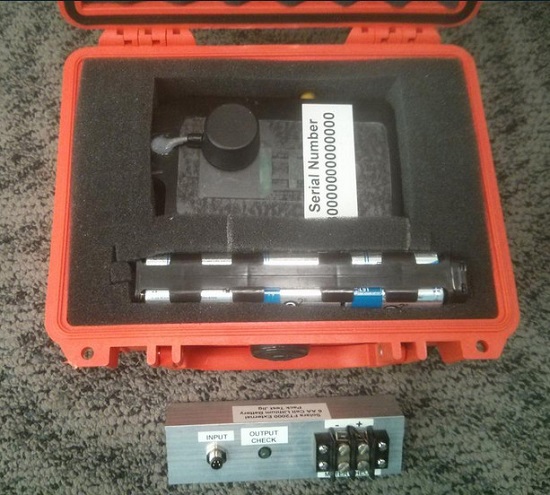
    The FT2000IB Solara tracker. (Photo by Tom Tessier)
    The FT2000IB Solara tracker. (Photo by Tom Tessier)

    Led by University of Manitoba Scientist David Barber, the crew of Canadian Coast Guard icebreaker Amundsen sailed off the coast of Newfoundland and Labrador to research ice hazard mitigation, the effects of climate change, and polar region technology requirements. GeoILS location intelligence helped crew members visualize, analyze, and leverage project-pertinent data.

    “During the expedition, researchers and scientists used GeoILS to assess drifting through sensor monitors attached to the icebergs,” said Brian Smith, vice president of commercial solutions with GeoDecisions. “In addition to reporting and notifications, GeoILS provided the project team with maps that were tailored by selecting desired iceberg information and the geographic area of interest based on user-defined criteria.”

    GeoDecisions’ data portal was used with Iridium Solara tracking devices during the iceberg research project. Two icebergs were outfitted with FT2000IB Solara trackers, explained Derek Mueller, assistant professor and physical geography program supervisor with Carleton University.
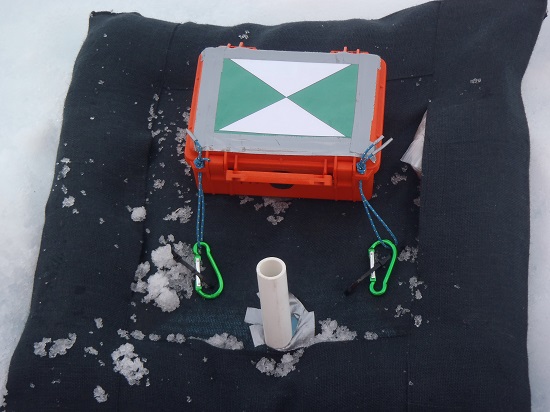
    THE GROUND control point and beacon. (Photo by Derek Mueller)
    THE GROUND control point and beacon. (Photo by Derek Mueller)

    For each iceberg, two beacons were attached for redundancy and to determine the iceberg’s rotation. Holes were drilled and stakes inserted, then GeoDecisions Platform Tracks Icebergs the trackers attached to the stakes.

    The trackers were also used as ground control points for photogrammetry, specifically the structure from motion ranging imaging technique.

    “GeoILS and the satellite tracking beacons worked very well during this project,” Mueller said. “Thanks to our partners’ efforts, we now have a great new suite of tools for examining our data.”

    “We are excited to provide tools to scientists who are gaining critical insights into the behavior of icebergs and global climate change,” said Tom Tessier, president of Solara Remote Data Delivery Incorporated.

    The last tracker stopped transmitting on June 13. “The others ended earlier, likely because the iceberg rolled or broke up,” Mueller said.

    The data will eventually be made public on the Polar Data Catalogue.
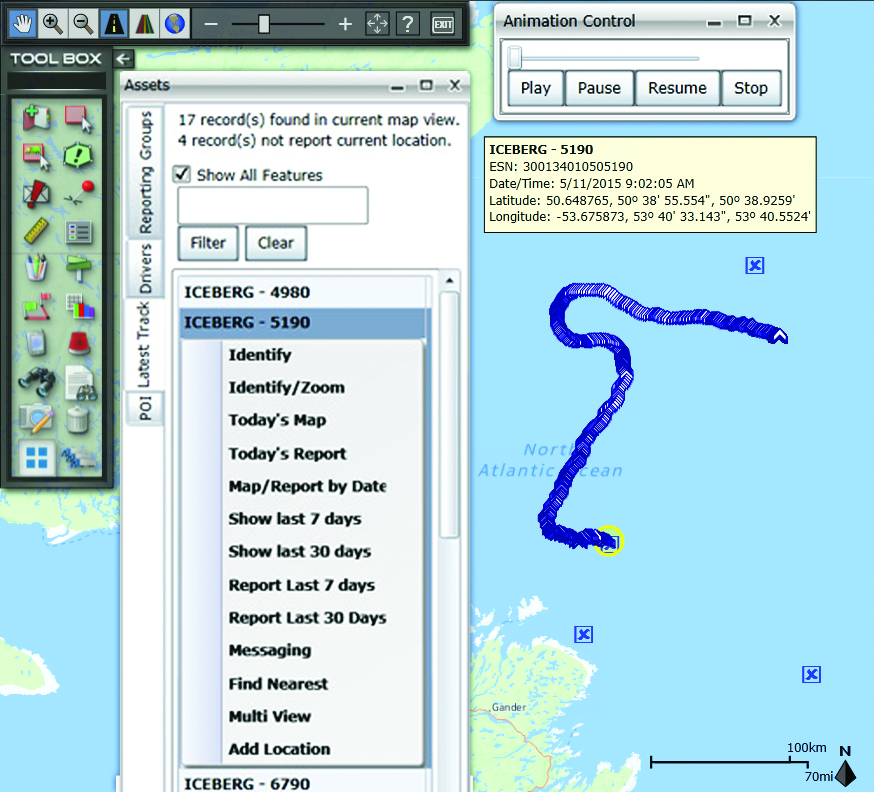
    A representative snapshot of GeoILS’ features and range of functionality used during the Canadian iceberg expedition.
    A representative snapshot of GeoILS’ features and range of functionality used during the Canadian iceberg expedition.
  • Next-Generation Tracker Debuts

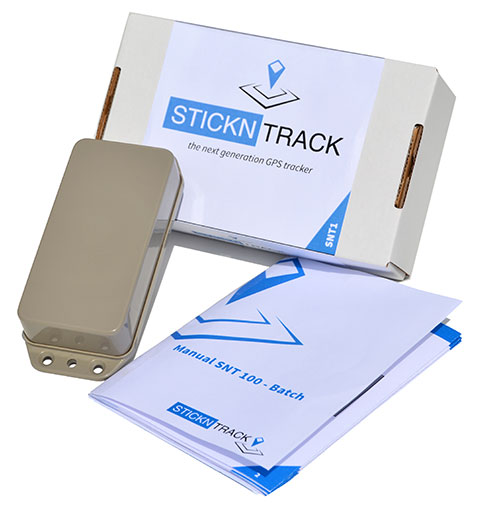
    Photo: StickNTrackStickNTrack — an award-winning low-power tracker from Sensolus — is now active in eight European countries.

    StickNTrack guards and tracks position, journeys, motion and status of any non-powered asset without the hassle of charging batteries, managing SIM cards or an intrusive installation, Sensolus said.

    StickNTrack’s web-based service platform is tailored for low-power asset tracking communicating over the French-based Sigfox. Because Sigfox is an ultra low-power communication network, it significantly reduces StickNTrack’s power needs so that it consumes up to 40 times less power and lowers life-cycle costs by 50 percent compared to existing compact GPRS/GPS products, Sensolus said.

    The tracker’s power can last up to five years. In the third quarter, an upgraded version will be released with extended battery lifetime up to nine years, according to Kristoff Van Rattinghe, who developed StickNTrack along with Laurence Claeys, Johan Criel and Koen Van Vlaenderen.

    Users can access the StickNTrack web portal with any smartphone running Android OS or iOS. The full feature set can be accessed on a tablet or laptop. Features include interactive timelines, intuitive geofencing, email alerting and optimized energy savings.

    The ruggedized, waterproof StickNTrack is 120 x 50 x 25 millimeters and weighs 255 grams. It can track assets on the water, such as yachts or buoys, providing automated logbooks, alerting users when assets enter or exit specific zones (such as harbors), and providing real-time journey information for those at home.

    StickNTrack’s developers took third place in the 2014 European Satellite Navigation Competition, after taking first in the Flanders regional competition. It also won the European Space Agency’s Innovation Award.

    Dubbed a “distruptive innovation” by the European Satellite Navigation Competition (ESNC), StickNTrack “opens up an abundance of new business opportunities in tracking trailers, containers, machinery, tools, bikes and more. Future accuracy and availability improvements based on GNSS will trigger additional advancements, such as by automating supply chains for packages and their delivery. Ultimately, stickNtrack is a next-generation location tracker that significantly lowers the barriers to embedding even more GNSS technology into our daily lives.”

    “Every day new types of non-powered assets are being connected to our service platform,” Van Rattinghe said. In the coming years, Sigfox aims to provide global coverage.

  • Antenova Launches Sinica Embedded Antenna for GNSS Devices

    Antenova Launches Sinica Embedded Antenna for GNSS Devices

    Antenova logoAntenova Ltd., manufacturer of antennas and RF antenna modules for M2M and the Internet of Things, has announced a new embedded GNSS antenna named Sinica, which operates on the 1559-1609 MHz satellite bands. The Sinica antenna uses a novel design approach and new materials to achieve high performance from an ultra low-profile antenna, Antenova said.

    Sinica is suitable for all positioning applications on the 1559-1609 MHz bands. It operates with all of the public satellite constellations — GPS, GLONASS, Baidou and Gallileo — which means it can provide accurate positioning combined with global coverage.

    The Sinica antenna is created from FR4 materials and new dielectric constant laminate substrates. It uses a new approach to antenna design, which has enabled the company to create an antenna with the high performance of a ceramic patch antenna, in a low profile part that can be placed neatly within a small printed circuit board, Antenova said.

    Sinica is designed for devices that need accurate positioning or tracking globally, which means it is suitable to use in drones, network devices and wearable electronics, or any other portable device or tracking application.

    Antenova’s product designers recently introduced the concept of “Design For Integration” (DFI), which considers how the antenna will operate when it is embedded with a manufacturer’s product. Antenova’s antennas are used within a customer’s design, so they are designed to provide superior RF performance from within the device, and to make the integration of the RF elements easier for the designer, the company said. In addition to this, Antenova provides its customers with technical support during the design, integration and testing phases.

    Earlier this year, Antenova announced three new families of antennas for the fast growing M2M, wireless and IoT sectors. Sinica belongs to the lamiiANT family of new antennas for these market sectors.

    The antennas are supplied on tape and reel and are available through distributors worldwide. Go to www.antenova-m2m.com for more details, or to request an evaluation board for the Sinica antenna.

  • Reyax Technology Develops 3G GNSS Tracking Platform Based on u-blox

    Photo: Reyax Technology

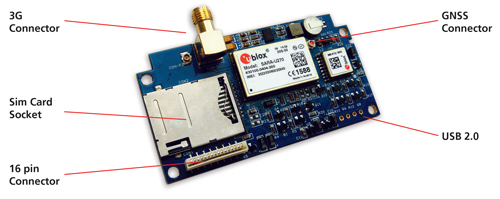
    Reyax Technology, a telematics tracking systems provider for the automotive industry, has developed an industrial high-integration 3G GNSS tracking platform, the Reyax RY277AI, which is fully based on technology from u-blox.

    “Our vehicle tracking platforms are dependent on highly accurate position data to deliver the performance crucial to meet the demands of our customers. u-blox’s highly reliable products as well as a flawless technical support were convincing,” said Ritchie Chang, general manager of Reyax Technology. “u blox’s MAX M8C positioning module and SARA U270 cellular module were the right choice for this new platform,” he added.

    RY277AI is designed for 3G telematics applications, in particular vehicle tracking, fleet management and insurance box. With both MAX-M8C and SARA U270 modules embedded, it also benefits from two of u blox’s GNSS and wireless technology services. With AssistNow, Assisted GNSS (A-GNSS) accelerates the calculation of a position by delivering satellite data to the GNSS receiver via wireless networks or the Internet, also ensuring faster TTFF (time to first fix).

    CellLocate, another of u-blox’s trademarked technologies, matches cellular positioning data with previously successful GNSS fixes in shielded environments such as indoors. This is especially useful in case of jammed GNSS signals and in M2M applications. Additionally, u-blox’s nested design enables hosting of next-generation wireless and positioning modules on the same PCB.

    “We are excited about this co-operation with Reyax Technology, the recognized leader in telematics tracking systems. Reyax-based solutions make full use of u-blox’s advanced positioning and cellular technologies to enhance vehicle tracking. This solution is an answer to the growing encouragements by the Taiwanese government to promote IoT/M2M applications and whose vision we share.” explained Ming Chiang, country manager of u-blox Taiwan.

    RY277AI comes in an LGA package, with a dimension of 70mm x 30mm x 7mm, and an operating temperature of -40~+85° C.

  • Augmented-Reality Golf Coverage Uses KVH IMU

    Augmented-Reality Golf Coverage Uses KVH IMU

    Photo: KVH Industries.

    Golf fans who watched televised coverage of the U.S. Open golf tournament June 18-21 got a new outlook on what the professional golfer is facing, thanks to a camera and augmented-reality tracking system that includes a 1750 inertial measurement unit (IMU) from KVH Industries.

    Called RangeFinder, the system was developed by Sportvision, Inc., creators of football’s Virtual Yellow 1st and Ten Line, in conjunction with FOX Sports, and it debuted during the broadcast of the 115th U.S. Open from Chambers Bay, in University Place, Wash.

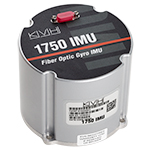
    The KVH 1750 IMU,
    The KVH 1750 IMU,

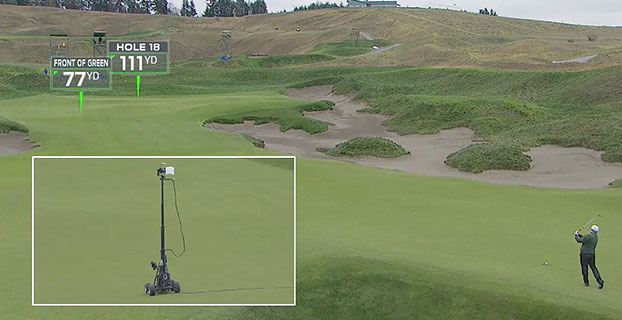
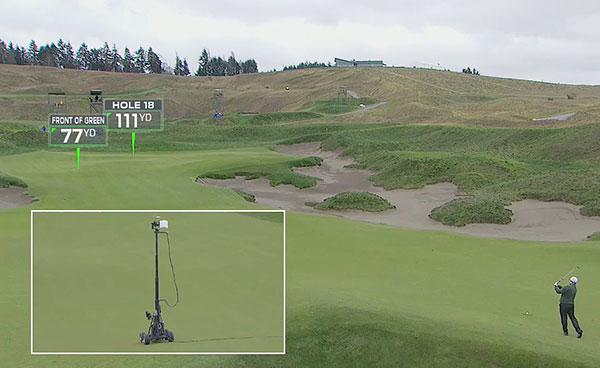
    At the heart of Sportvision’s RangeFinder system is a broadcast-quality camera with a KVH 1750 IMU mounted in a box at the top of the camera; the IMU works in conjunction with a GPS mounted at the base of the camera. By combining data from the IMU and the GPS, the RangeFinder system enables the measurement of the precise location and attitude of the camera; with that information, Sportvision technicians create augmented-reality graphics that indicate how far away a green, sand trap, obstacle or any other feature is located.

    “We selected KVH’s 1750 IMU due to its performance attributes, its size and weight, as well as its cost-effectiveness,” said Mike Jakob, Sportvision president and chief financial officer. “We know this IMU well for what it brings to some of our other products, and we appreciate the reliability and high quality.”

    KVH’s 1750 IMU incorporates three axes of KVH’s DSP-1750, a tiny fiber optic gyro, with three axes of accelerometer technology to create an advanced six-degrees-of-freedom sensor. Designed to integrate easily into demanding stabilization, pointing and navigation applications, the 1750 IMU enhances performance at a lower cost than competing systems, KVH said.

    “Our IMUs and other inertial sensors have been used in several of Sportvision’s innovative products, including the LiveLine system for America’s Cup yacht racing coverage, and we are thrilled to play a role in this new system for golf coverage,” said Martin Kits van Heyningen, KVH chief executive officer.

    The RangeFinder system is designed to enhance the television viewer’s enjoyment of golf competitions by providing more insight into the setting. “The camera is mounted on a mobile tower that can go vertical 20 feet in the air, and that gives the viewer a really unique perspective of the course,” said Ken Milnes, project manager for Sportvision. “With the camera fully instrumented, we can put augmented-reality graphics on the TV screen. We virtually insert a rectangular placard that the TV viewer sees, with a pointer arrow and the yardage to the hole or obstacle.”

    During the U.S. Open, the RangeFinder mobile camera towered were positioned on the fairway for a golfer’s second or third shot on a particular hole; the intent was to provide graphics on the approach shots to the green, rather than on a drive from the tee. Sportvision and FOX Sports worked together for more than a year to develop the new system.

    “For the TV viewer, RangeFinder gives them an angle behind the golfer that they have never seen before,” said Zac Fields, vice president for graphics and technology at FOX Sports Media Group. “One of the advantages of any sports telecast is being able to utilize technologies so the viewer can see things that the athlete cannot. RangeFinder is a great example of being able to provide that kind of insight. We tested this technology at a smaller tournament last month and the initial feedback was extremely positive.”

    KVH’s 1750 IMU marries the E•Core ThinFiber technology of KVH’s DSP-1750 FOG with very low noise, solid-state MEMS accelerometers to create a commercial-off-the-shelf IMU. The 1750 IMU offers exceptional precision in a very small form factor, designed for applications where space is limited such as unmanned and autonomous systems.

    The 1750 IMU is one of a series of three IMUs that KVH has developed to address a wide range of demanding applications, including autonomous vehicles; unmanned aerial surveillance, surveying, and mapping; autonomous research and exploration; humanoid robots; and oil and gas pipeline inspection equipment.

  • My Driving Pal Device Adopts Furuno Multi-GNSS Receiver

    My Driving Pal Device Adopts Furuno Multi-GNSS Receiver

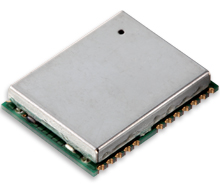
    The GN-87 multi-GNSS receiver by Furuno Electric Co.
    The GN-87 multi-GNSS receiver by Furuno Electric Co.

    Furuno Electric Co.’s latest multi-GNSS receiver module, the GN-87, has been adopted for use in the new My Driving Pal (MDP) device.

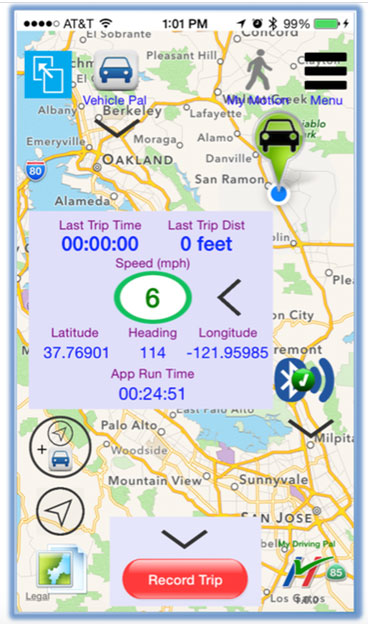
    The MDP device and app communicate with each other via Bluetooth low energy (BLE). When the MDP device and a phone running the MDP app are within range of each other (approximately 15 meters), the device keeps its internal GPS in idle mode. When the phone is out of Bluetooth range and the object that is carrying the MDP device is moving (for instance, under the seat of a stolen bicycle or in the pocket of a wandering child), the MDP device activates its built-in GNSS receiver and cellular modem, tracks the asset, and immediately notifies the user on a phone via remote push notification.

    The range is unlimited, because the MDP device will track the asset anywhere in the world, with an accuracy level of meters. To protect user’s privacy, all tracking data remains locally on the phone and is not transmitted to any backend server.

    Screengrab: My Driving PalIn April, the GN-87 receiver was adopted for the new quadcopter Bebop Drone, made by Parrot SA. The GN-87 provides positioning accuracy and smooth ground tracking because of its multi-GNSS technology, which allows it to receive more satellite data even in harsh environments such as urban canyons.

    My Driving Pal (MDP) is a technology startup based in Silicon Valley that develops advanced Internet of Things solutions. MDP’s mission is to improve road safety by enabling vehicle to vehicle and vehicle to infrastructure communications. A small percentage of new vehicles are connected, but still the vast majority have no connectivity, not including motorcycles and bicycles. The MDP product delivers a suite of security, monitoring, and tracking applications, from delivering remote notification on phone if interior temperature of car gets too high, to automatically tracking the bike, if it’s ever stolen.

    For more information on the MDP device (capabilities, availability, distribution, retail or partnerships), send an email to [email protected], or follow MDP on Facebook.


  • Fleetmatics’ Intelligent Routing Tool Coming This Summer

    Fleetmatics’ Intelligent Routing Tool Coming This Summer

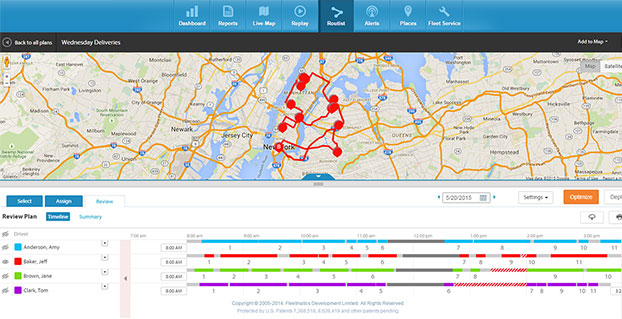
    Fleetmatics_Routist_Screen-O

    A new routing program from Fleetmatics Group is coming this summer. Fleetmatics Routist is an intelligent routing optimization solution that systematically builds the most cost-effective, customer-friendly routes for fleets.

    Fleetmatics Routist seamlessly calculates and deploys route plans to drivers in the field, and features real-time and historical data that gives users the most holistic view into routing performance, the company said.

    Fleetmatics Routist operates by taking locations, vehicles, time windows, technician skills, and costs and capacities into consideration, among other inputs, while remaining simple and intuitive for customers to use. Fleetmatics Routist also incorporates historical traffic data into its algorithm, elevating traffic and routing optimization effectiveness for customers operating in metropolitan areas.

    “Inefficient routing wastes minutes, miles and money, leaving on-time arrivals and important elements of customer satisfaction to chance,” said Jill Ward, president and chief operating officer of Fleetmatics. “Customers that choose Fleetmatics Routist won’t have to worry about manual or time-consuming routing, and we fully expect the benefits will extend to their customers, as well.”

    Fleetmatics Routist’s robust feature set, offered to customers as an add-on module, will integrate into the Fleetmatics REVEAL fleet management solution, helping it to become one of the most effective routing optimization solutions known to be available today. Customers can import work orders from electronic files or integration with their order management software, select the drivers involved in the plan, and get a cost efficient and customer satisfying route, Fleetmatics said.

    Route planners can make adjustments to the plan based on their own business insight, and then deploy to the field. Route plans can be delivered effortlessly to drivers via the Fleetmatics REVEAL Field Application for smartphone and mobile devices, via Garmin integrated devices or simple route sheets printed at the office.

    Once the routes are live, dispatchers and managers stay current on a driver’s progress against route stops in real-time on the Fleetmatics REVEAL live map and can make real-time adjustments as needed. When the day is done, actual versus plan analysis is available to compare the stops made by drivers against the work orders provided, so managers can provide appropriate coaching around route deviations and the impact of field activity on customer satisfaction.

    Register here to receive additional information and notice of Fleetmatics Routist’s availability.

  • McMurdo Opens Emergency Response Experience Center

    McMurdo Opens Emergency Response Experience Center

    Photo: McMurdo

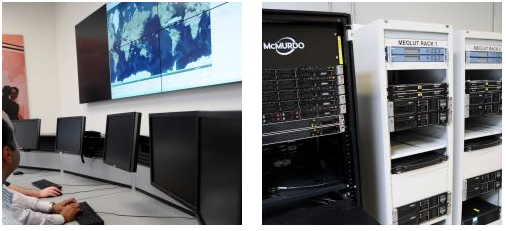
    McMurdo has opened an Emergency Readiness and Response Experience Center at its Washington, D.C., location. The center will showcase the latest innovations and technology developments for search and rescue (SAR) in an immersive experience with real-time demonstrations of the entire SAR process — from distress beacon activation to satellite-based location detection to emergency response coordination.

    The facility will feature a working MEOSAR (Medium Earth Orbit Search and Rescue) satellite-based search and rescue system, the next-generation version of the current Cospas-Sarsat satellite system that has saved more than 37,000 lives since 1982. When fully deployed in the next 3 to 5 years, MEOSAR will greatly improve the existing SAR process with global coverage, near instantaneous distress beacon detection and a unique Return Link Service feature that acknowledges distress signal receipt. MEOSAR’s advanced technologies will be able to accurately detect and locate a distress beacon signal almost instantaneously instead of taking up to 30 minutes today.


    For background on how GNSS satellites will be used in the MEOSAR system, see “The Distress Alerting Satellite System” Innovation article.


    Visitors to the center will gain an understanding of the different search and rescue technologies by taking part in various search and rescue scenarios. Participants will also have the opportunity to sit at the controls of mission control center and rescue coordination center systems, similar to the McMurdo solutions used around the world by NASA, National Oceanic and Atmospheric Administration (NOAA), Australia Maritime Safety Authority (AMSA), Maritime New Zealand (MNZ) and other SAR authorities.

    “This cutting-edge Experience Center allows us to demonstrate the incredible advancements being made in search and rescue all in a single location,” said Jean-Yves Courtois, CEO of McMurdo. “Our decades of experience in pioneering the latest SAR advancements, our leadership position as the only company that provides an end-to-end SAR ecosystem and our ongoing commitment to saving lives put us in the unique position to showcase these emergency readiness and response solutions for our customers, our partners and the industry.”

    Guests will also see SAR-enhanced applications such as fleet management, coastal surveillance and innovative partner solutions for aviation, fishing, maritime, military and other industries. Classroom training and other educational sessions led by industry experts and SAR specialists will take place at the new center.

    “The McMurdo Experience Center is unique in its ability to make the entire search and rescue process come to life, which we haven’t seen done before in a centralized setting,” said Bruce Reid, CEO, International Maritime Rescue Federation (IMRF). “We at the IMRF are delighted to be working with McMurdo on a variety of SAR training, education and awareness activities. Access to this location as a true center of excellence for the search and rescue sector can only enhance this activity.”

    Personalized, custom tours of the McMurdo Experience Center for customers, partners and press can be reserved.

    McMurdo products and services are used by some of the biggest names in the world including Airbus, Boeing, British Airways, Embraer, Southwest and United Airlines as well as the British Royal Navy, U.S. Coast Guard and numerous global search and rescue authorities. McMurdo was instrumental in the high-profile rescue of Clipper Round the World Race Sailor Andrew Taylor and was recently named as the official safety beacon partner of the hit reality series Deadliest Catch.

  • Antenova M2M Showcases Brevis GNSS Tracking Antenna

    Antenova M2M Showcases Brevis GNSS Tracking Antenna

    Antenova Brevis
    Antenova Brevis antenna is tiny at 11mm x 6mm.

    The Brevis GNSS antenna is the latest addition to Antenova’s gigaNOVA family of miniature antennas. The small antenna is designed to be used in portable handheld devices that have GNSS receivers — for example, in devices and applications that have a tracking capability or location accessories such as in transport, navigation, wearables and eHealth.

    The multi-GNSS antenna is designed for embedded applications, with a high efficiency-to-size ratio. It is intended for use in applications where there is no ground beneath the antenna. It has near omni-directional characteristics which will provide good performance for any device.

    The Brevis operates with the following GNSS bands: GPS, GLONASS, Galileo and BeiDou. Brevis GNSS is a low-profile, small-footprint antenna designed for surface-mount device (SMD) mounting, so it can simply be placed on a printed circuit board (PCB) to add wireless connections to any device.

    Full technical specifications for the Brevis GNSS antenna and contact details for regional distributors are available on Antenova’s website.

  • Ford, Telogis Expand Partnership to Commercial UK Customers

    Ford Motor Company and Telogis have expanded their exclusive partnership to bring Ford Telematics powered by Telogis to Ford’s commercial customers in the United Kingdom first, with other European markets to follow later this summer. Ford Telematics uses real-time information from Ford vehicles to enable businesses with workers in the field to have insight into vehicle location, driver behavior and fuel consumption.

    The telematics can save companies up to 20 percent on fuel, according to a 2012 Frost & Sullivan report.

    Since 2011, Telogis has been the exclusive technology provider to power Ford Telematics (formerly Ford Crew Chief) in the U.S. and Canada, with comprehensive and scalable telematics for commercial customers. The UK expansion of the Telogis-Ford partnership leverages the success of Ford Telematics in the U.S. and Canada and will meet the demand from current and new Ford customers in the UK for in the visibility into day-to-day operations including Ford vehicle diagnostics.

    “Ford Telematics is an innovative system that can deliver reductions in cost of ownership for businesses that operate Ford’s Transit commercial vehicles,” said Paul McDermott, manager, CV aftersales, Ford of Britain. “Real-time vehicle location and diagnostic data provides fleet customers with a powerful tool to manage their vehicles more effectively and also encourage safer driving.”

    Making its debut at the 2015 Commercial Vehicle Show, Ford Telematics will be available to fleet customers in May as a dealer-installed option, offered through Ford’s network of specialist Transit Centres.

    Ford Telematics functions by securely transmitting vehicle data and metrics from the vehicle to a dedicated Telogis website via an embedded cellular connection. The telematics system’s ability to access proprietary Ford vehicle data enables operators to track details such as oil change warnings, water contamination in diesel fuel, tire pressure, safety belt usage and airbag status.

    “The reality of being able to visualize field staff and the performance of each Ford vehicle — all on one screen — is here,” said Paul Reynolds, automotive director at Telogis. “This visibility enables Ford commercial customers to provide better service for their own customers and run their businesses more productively and efficiently — it’s no longer a ‘nice to have’ but a ‘have to have’ solution.”

    Based on the real-time data, the Ford Telematics powered by Telogis software platform delivers a comprehensive range of actionable business information that enables fleet managers to operate their vehicles in the most efficient way and to help ensure drivers are following safe and economical driving practices.

    Advances include a suite of more than 80 pre-loaded reports, integration with established business operating systems and fuel card services. Ford Telematics and the Telogis platform also allow for a BYOD (Bring Your Own Device) approach, helping to further reduce hardware costs and increase productivity.

    Ford Telematics is compatible with Ford’s latest range of Transit commercial vehicles — including the all-new Transit, Transit Custom, Transit Connect and Transit Courier — as well as the Ford Ranger pickup. Additionally, the same Telogis hardware can be fitted to any other vehicles on the fleet, regardless of manufacturer, allowing informed fleet managers to view the whole fleet in one place, with all the usual driver performance and vehicle tracking information that they expect.

    Ford Telematics also provides a gateway to the broader cloud-based Telogis platform that includes a suite of connected vehicle technologies including route optimisation and planning, commercial-grade navigation, work order management and mobile applications to drive additional efficiencies and productivity for mobile enterprises.

    “Ford Telematics is another example of Ford facilitating the delivery of smart technology to help our customers enjoy the highest quality, safest and most sustainable operation of commercial vehicles available today,” said Nick Themistocleous, director, Fleet Operations, Ford of Britain.


  • Google Patent Seeks to Link Robots via Smartphones

    Google Patent Seeks to Link Robots via Smartphones

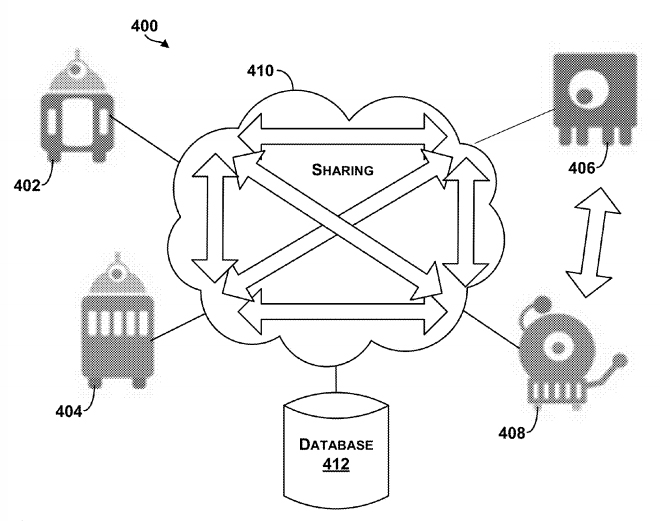
    The Google patent shows an example system in which robotic devices interact with the cloud and share information with other cloud computing devices.
    The Google patent shows an example system in which robotic devices interact with the cloud and share information with other cloud computing devices.

    In a patent awarded April 14, Google describes “systems and methods for allocating tasks to a plurality of robotic devices,” reports Nextgov.com.

    Google’s patent (Patent #9,008,839) outlines methods for connecting a series of robots over the cloud to complete tasks. A robotic device configured to perform a task could make use of a GPS receiver to determine its location. It might also use other sensors, such as a gyroscope or an accelerometer to measure movement. Other sensors could be encoders, infrared sensors, optical sensors, biosensors, Radio Frequency identification (RFID) systems, wireless sensors and compasses.

    The patent suggests that the robots could be controlled by a smartphone — from anywhere in the world.

    The patent could have value for Google’s self-driving car project, allowing the vehicles to communicate with each other.

    In another patent (Patent #US008996429), awarded on March 31, Google describes how a robot’s personality can be defined using sensors and the cloud. According to the patent, “methods and systems for robot and user interaction are provided to generate a personality for the robot.” One aspect includes basing the robot’s personality on identifying the user’s location.

    The personality and state may be shared with other robots so as to clone this robot within another device or devices. In this manner, a user may travel to another city, and download within a robot in that city (another “skin”) the personality and state matching the user’s “home location” robot. The robot personality thereby becomes transportable or transferable.

    Again, GPS is mentioned as a possible sensor for use either in the user’s smartphone, the robot, or both.

    So, in the future, when you leave home, you may be able to take an interactive non-human friend along. Talk about location-based services!


  • Fleetmatics Report Shows Retail Sales Correlate with Fleet Activity

    Fleetmatics has released the second edition of its FleetBeat Report, an in-depth analysis of tens of billions of data points extracted from thousands of commercial fleets managed using the company’s Software as a service (SaaS) platform over a span of four years. The report, “FleetBeat, Vol. 2: The Economy in Motion,” was co-authored by Stephen Fuller, Ph.D., professor and director of the Center for Regional Analysis at George Mason University.

    Fleetmatics says the data included in the report reveals that performance of small businesses in the services industry directly reflects the health of the economy.

    “It has long been said that retail sales trends are often impacted by the health of small business,” said Jim Travers, chairman and chief executive officer of Fleetmatics. “Fleetmatics is uniquely positioned to analyze small business services activity given we have one of the largest fleet management data clouds in the world. Also, our customers are typically in the earlier phases of consumer consumption, such as distribution of goods and home deliveries.”

    fleetmatics_infographic_fleetbeat2

    As outlined in the report, the data extracted from Fleetmatics fleet management data cloud suggests that performance of small business services companies can be a highly credible indicator of national and regional economic health, even under changing conditions. The report also looks at small business services performance and retail sales in four Metropolitan Statistical Areas (MSAs), and concludes that geographic features can significantly define regional small business activity profiles.

    “This is truly a groundbreaking new report, viewed from the perspective of the fleet management industry,” said Fuller. “Based on Fleetmatics’ FleetBeat second edition report, Fleetmatics data explains much of the variation and growth in retail sales. Furthermore, when comparing the Fleetmatics’ small business service fleet activity data with the retail sales data from Moody’s and the U.S. Bureau of Census, it’s clear the two data sets exhibit an extremely high correlation. I believe the ability to analyze real-time telematics data can now be considered an accurate data source on the small business flow of goods and service.”

    With a dataset of over 10.7 billion telematics-generated data points from commercial vehicles managed with the Company’s SaaS platform in the United States, the report used regression analysis to compare the data with national monthly retail sales data.

    There were eight telematics-derived, independent parameters considered in the analysis, both in aggregate and at the per vehicle level, including those related to mileage, number of vehicle stops, mileage per stop, number of active vehicle days per month and number of vehicles active in a month. The data was drawn from small business customers defined as entities having fleets from 5 to 100 vehicles, and only fleets from business types that were related to or supporting retail and service sectors were considered.

    The report also examined regional differences that drive activities of small business services companies in four markets: New York, Chicago, San Francisco and Miami. The result was an in-depth breakdown of the most prominent indicators of small business economic activity and correlation to retails sales in each core market.

    Fleetmatics’ first FleetBeat report highlighted the economic impact of telematics adoption and quantifiable benefits of business intelligence-driven fleet management. The report found that the total estimated economic impact of commercial fleet vehicles armed with telematics – assuming everyone had the same results as Fleetmatics’ optimized customers – would amount to $2.2 billion in fuel savings, a decrease in carbon dioxide emissions by 5 tons per year and $34.9 billion in total cost savings due to decrease in payroll hours.