Blog

  • Thales Avionics Tracks L1 Signal of First Galileo Satellite

    Following the recent launch of two Galileo in-orbit validation satellites, Thales Avionics of Valence, France, has successfully acquired and tracked the new L1 Open Service signal transmitted by one of the space vehicles (PRN 11) on Monday, December 12, at 13:30 (GMT). Thales Avionics has developed a Galileo receiver capable of processing the Open Service, Commercial Service, and Safety of Life service of the Galileo constellation.

    Figure 1 shows a screenshot of the receiver interface program highlighting the L1 signal energy (top right) and the pilot secondary code (bottom).

    Figure 1: Real-time measurements.

    The satellite Doppler and C/N0 values have been recorded and are provided below.

    The raw navigation message has been decoded. It contains INAV type 0 and INAV dummy data as shown in the next figure. These messages enable Galileo system time transfer.

    The signal modulation and characteristics show no discrepancy relative to the Galileo Open Service ICD released last year.

    The fact that only L1 frequency is broadcast for the moment prevents providsion of further  results based on dual-frequency measurements.

    Thales has developed a coherent processing of the Galileo E5 AltBOC(15,10) signal compatible with hardware architecture designed for independent processing of both E5a and E5b. This processing is fully compatible with the mismatch between the two RF channels on E5a and E5b, thanks to real-time calibration based on satellite signals. This processing only requires software implementation, without additional recurrent costs. The technique is relevant for future receivers operating in the E5 band, in order to significantly enhance the accuracy, with respect to thermal noise and multi-path, and to improve the cycle slip probability.

    Thales Avionics, involved for many years in GNSS receivers design and production, has developed a Galileo receiver capable of processing the Open Service, Commercial Service, and Safety of Life service of the Galileo constellation. This high-end receiver includes patented state of the art algorithms capable of processing up to four different frequencies.

  • A Nationwide RTK Network: A Great Idea, But…

    Gavin Schrock, LS, is a licensed surveyor, technology writer, and administrator of the Washington State Reference Network, a regional cooperative GPS network (RTN) in the Pacific Northwest. He has worked in surveying, mapping, data management, and GIS for over three decades in the civil, utility, and mapping disciplines. He has published in these fields and has taught these subjects at local, state, national, and international conferences.


    Some folks are proposing that a nationwide RTK Network (RTN) be piggy-backed on the controversial LightSquared communications network. That could be cool, if it can be done. No one is saying that it can’t be done, but there are reservations on whether it would be worth the massive investments needed to pull it off, and that there might be little gain at all over the existing presence of RTN in the U.S.

    RTN are arrays of continuously operating GNSS reference stations that can provide correctors for high precision positioning. Centimeter positions instantaneously; imagine what could be done with a capability like that. People have not only imagined such things, but have implemented over 100 of these in the U.S. and over 350 worldwide serving industries such as surveying, mapping, construction, precision agriculture, science, machine control, public safety, precise navigation. If you feel you have heard all of this before, you probably have, and chances are you might have heard this from an RTN junkie like me.

    I am a strong supporter, even a rabid supporter and promoter of the expansion of RTN and the many benefits that can be realized where RTN exist. I have bored many people to tears with my idealistic ramblings about RTN, and have seized opportunities to jump on any bandwagon that promotes more widespread or even nationwide RTN (e.g. On-Grid Goal, GPS World 2006). There are many countries that already have nationwide RTN like Japan, Germany, Denmark, Greece, and many others; but under completely different circumstances, and none piggybacked on communication network towers. So why haven’t we seen a nationwide RTN in the U.S.? There are a lot of good practical reasons why this has not happened, and likely won’t. It is not a matter of a single design or business model issue standing in the way, and likewise the solving of a single issue will not bring the entire dream to reality. There are far too many moving parts to an RTN; hurdles that would have to be overcome to realize a nationwide RTN. Examining those hurdles might bring us closer to visualizing the dream, but perhaps instead we should focus on what is realistically possible and provide the best possible amalgam of many well run RTN to provide the same utility.

    The Nationwide RTN Carrot. In the course of the past year, and the LightSquared broadband plan interference controversy, RTN have been mentioned in the context of both a reason to oppose the broadband plan in question, and by others as a reason to support the broadband plan. Some have suggested that the LightSquared plan in question would be the catalyst for a nationwide RTN, as it could possible fulfill the crucial communications element of an RTN, and have touted this as a carrot for approval of the entire broadband plan. The idea of piggybacking an RTN on a communications network towers is not a new idea, and it has been studied seriously by many folks, including myself. There have been GNSS manufacturers and mobile phone service providers who have looked at this idea; but none that have acted on the idea; for good reasons.

    I would really like to see a nationwide RTN, but this particular carrot is not backed up yet by a credible plan that has been formally proposed and presented for scrutiny, it does look mighty tasty at first glance. Are there too many compound assumptions being made with regards to this particular carrot? Or is there real potential for a grand RTN? The controversial broadband plan asks a lot of people to sacrifice a lot in direct costs and lost productivity during transition; so the various carrots being touted should be scrutinized very carefully. The first glance look at the assertion that a nationwide RTN could be piggybacked on the proposed LightSquared LTE build-out does appear to provide two key RTN elements: secure station sites (perhaps as many as 40,000 to choose from) with power and low-latency communications for both stations and rovers. But are tower sites really suitable? And can it be done with the tower sites alone? Can it be done in a manner that would greatly improve the coverage of RTN and at a dramatically lower cost? Let’s takes a closer look at what it would take to stake a nationwide RTN on an array of wireless communication towers before we jump to any conclusions.

    Secure sites with power. Yes, the proposed tower sites are essentially cellular tower sites with fences and reliable AC power. But the assumption that one can simply rely on tower sites only applies to the limited area of the country that will be covered by the terrestrial component, the rest would need new stand-alone CORS sites to be presumably served by the satellite component of the plan (not a good idea and adds more infrastructure costs).

    Tower mounts. A communications tower is subject to movement, and therefore not a good candidate for mounting a high-precision GNSS CORS antenna. Even as little as one centimeter of incidental movement (and much more in high winds) is not only not a good practice for an RTN station, it would compromise the relative integrity between RTN stations and the resultant real-time solutions. If you expect your rovers to achieve centimeter positions, the RTN stations must be stable to a few millimeters. But don’t cell towers already have GPS antennas on them? Yes, but these are typically tiny little single frequency units used to time the communications systems where positional precision is not a consideration.

    Co-Location at Tower Sites. You will not find very many RTN stations co-located at wireless communications tower sites, and those that are have been placed on stable ground mount far from tower (south side preferred for maximum constellation) to mitigate as much multipath from the tower as possible. Most tower sites are not big enough to accommodate this. It may take a separate lease of a fenced area far away from the tower. This greatly reduces the number of potential sites.

    Leases. Wireless communications  tower sites are mostly leased from local land owners, and the towers themselves are often owned by third parties from whom communications companies lease space on the towers. The LightSquared plan is not calling for wholly-owned and leased sites; other parties and leases will be required. For instance, Sprint has been proposed as a LightSquared partner for providing tower infrastructure. Site and tower owners want to make money from their property. Towers = more ongoing costs.

    Site Geology. Potential RTN station sites are carefully vetted for sources of incidental geological movement. For example, alluvial fans or slumping slopes are not good candidate sites. An RTN serves as the active control component of a geodetic reference framework; and strict criteria are followed. Tower sites are not necessarily vetted on the same criteria. The potential site list becomes even more narrow.

    Interference. While sources of interference from other radio frequency appurtenances on the towers might not be an issue, then there is the question (ironically) of the possible LightSquared interference as these stations would be at ground zero. Assuming that there are solutions for what is referred to as the lower 10MHz plan interference, what of the upper 10Mhz plan? Recent lower 10MHz filtering tests aside, the upper 10 MHz band plan has still not been taken off the table. No one has demonstrated any credible filtering plan (even LightSquared admits this is still theoretical or at least years away) for the upper 10MHz. Would the RTN stations be immune to such interference? Depending on how the upper band issue plays out, this idea (and viability of every other every other RTN, not to mention all high precision GPS in the U.S.) might be dead in the water.

    Geometry and Coverage. RTN stations are spaced as close as 30km or as far apart as 100km depending on what type of solution is being sought, terrain and elevation differences, tropospheric trends, redundancy considerations, and site suitability/availability as outlined above. With the LightSquared plan proposing as many as 40,000 possible tower sites it would otherwise  be possible to find enough in densely populated areas of the country to have decent geometry and coverage, but only if all of the other design criteria can be met. The point may be moot as tower sites overall are not good candidate sites and won’t cover the majority of the country without adding satellite communication-served sites.

    Geodesy. If the relative positional integrity of an RTN is not maintained, and elements like plate tectonics and ocean tide loading are not taken into account, the resultant solutions suffer. Poor geodesy renders an RTN useless for high precision positioning. There are amazing tools for monitoring, maintaining, and updating the geodesy of an RTN available in some of the commercial RTN operations software suites, but this proposal would be taking on an unprecedented huge and expensive geodetic burden – even if a fraction of the 40,000 sites are included. The National Geodetic Survey maintains system of 1,800 CORS maintained by over 200 different partnering organizations. Even with the most advanced tools and some of the finest geodetic minds in the world, maintaining the geodesy of these sites is straining the NGS resources. The threshold for update on NGS CORS is when its network integrity exceeds two centimeter horizontal by for centimeter vertical; completely unacceptable for the relative integrity that RTN requires. RTN operators maintain registration to the National Spatial Reference System via constraining to a minimum number of CORS, but then have to maintain a further level of relative integrity locally for the RTN to run. A nationwide RTN would need to be run as an array of sub-networks for independent geodetic regions; some RTN have to do this even within a single state to accommodate regions of varied tectonic velocity. A small army of geodesists would be needed to oversee a nationwide RTN resulting in another significant cost.

    Ubiquitous Communications. The term “ubiquitous” gets thrown around a lot with regards to the current plan. Go online and look at a population density map and then look at any of your favorite cellular coverage maps. Now look at a terrestrial component deployment map (Source: TMF Associates) for the proposed network from October 2010. It does not cover huge areas of the country; instead the satellite component of the proposed plan would need to be used. RTN CORS do not need a lot of bandwidth, but they do need low latency communications. Satellite communications links are rarely used for RTN. An RTN might get away with a few isolated high-latency satcomm served sites, but too many clustered together in a network solution do not work. Also notice the population map and the coverage map of some common cell/broadband providers look very similar; the profitable areas are targeted. Many companies are steadily deploying LTE broadband (LTE was not invented in the past year). While the plan calls for providing services to an admirable goal of 260 million potential subscribers, the remaining 50 million plus in rural areas will be left out as they have been by other carriers, or simply served by slower satellite communications.

    Nationwide does not really mean nationwide in the commercial communications business, and that would be the same for RTN. Communications networks get built where the potential subscriber base can support the investments. The same can be said for RTN. You will find RTN covering the same densely populated areas, or over areas where precision agriculture is being implemented. There are actually RTN and arrays of single-base RTK stations in places that are not covered well by broadband and would not likely be covered by this plan or the others. In these areas radio and satellite-based augmentation systems are the cost effective alternative. Even though the communications component of the plan (that might arguably be more bandwidth and possibly faster or cheaper) will not be much more ubiquitous in terms of RTN functionality than what is available now, there would still be big holes in a “nationwide” RTN.

    Wholesale. LightSquared plans to offer wholesale bandwidth. This might equate to any number of retail providers offering the bandwidth through proprietary or open source communications devices. LightSquared is promoting this as “the dumbest of pipes”; essentially a great big pipe of bandwidth, which is a cool idea and prime for a wholesale model. More options for communications through these retailers might arguably be a good thing for RTN users, but not necessarily for any entity trying to put together a nationwide RTN unless there was some kind of exclusive deal attached. Competition can lead to lower costs overall, but subscriptions are typically what the market can bear and that might not be stupendously lower than what we pay now because everyone in between needs to take a cut. One strong point of the model was supposed to be unified communications for RTN, but instead we may be looking at a fractured element. The potential RTN operator would have to deal with as many, if not more, wireless communications providers than currently exist.

    But in another potential model, if the RTN provider were also a LightSquared broadband retail “reseller”, that might be a key to streamlining the model. However, if every end user was to buy the same units or brand with built in broadband receivers from one of the preferred retailers (wishful thinking), that would streamline the model even more. There are too many existing RTN (some free or at nominal cost), and too much legacy equipment out there to expect users to accept and rapidly execute dramatic upgrades, replacements, or carrier changes unless the full LightSquared plan is approved and they are forced to upgrade.

    The Elastic and the Brittle. I hate to rain on anyone’s parade, but RTN are not the dramatic cash cow one might imagine. The worldwide experience of RTN is very similar in that there is a limited market for network corrections. Even if one was to count on signing up all of the current RTN users in the U.S., plus all of the precision agriculture market (and a mighty hard sell that would be as they have made some huge investments in their own systems), it is still unlikely that there would be enough revenue to fund the initial and ongoing infrastructure investments, and to sustain the ongoing costs of operations, geodesy, leasing, maintenance contracts, and account management. If anyone is entertaining thoughts of consumers paying extra for higher precision on their cell phones and car navigation devices they might be greatly mistaken. The consumer seems quite happy with accuracy on the order of a few meters, and multiple constellations and  modernization will be providing higher fidelity to them soon enough. One wireless service provider even experimented with delivering corrections to mobile phone users from the national RTN where they are based and found consumers in their test group to be indifferent and even thinking it was a silly idea.

    Private RTN have spread across areas of the U.S., somewhat organically as opportunities arise, partners are secured, and where the market can support them. Public and cooperative RTN have spread in areas where the sponsoring entities can realize cost-benefits from their investments like a state department of transportation for their own projects. Public RTN have often filled regions where a private network may not have otherwise been cost effective. Together public and private RTN have covered a substantial area of the U.S. The nature of RTN in the U.S. is a healthy elasticity which fits the market and needs. With RTN being narrow-margin enterprises, this is a good thing. Developing a huge single entity RTN on narrow margins leaves the entire enterprise quite brittle. Investors might view areas that have a low or negative return as not worth retaining or even building out in the first place. The cards are really stacked against a ubiquitous nationwide RTN, unless as some assert there were elements of overriding public interest to justify some level of public investment or partnering.

    RTN Coverage of the U.S. as a percentage of Total Area

    Infrastructure Investment. Typical RTN stations have cost between $10,000 and $50,000 each to establish and sites requiring satellite communications start at a minimum of $20,000. Let’s say for arguments sake that only 10,000 of the tower sites were utilized, with perhaps just as many in satellite communications-served sites also needed. That might not even exceed the coverage of existing RTN. Even so, at $10,000 each, that is $100,000,000 up front; not to mention the satellite communications-served sites on top of that. Some may question those costs, so let’s break them down. A RTN receiver has to be dual-frequency, multi-constellation, geodetic-grade, enable remote operations, and be paired with a geodetic-grade antenna. Sure, used receiver/antenna pairs can be had for as little as $2,000-$6,000. Let’s say for arguments sake a manufacturer was able to build and sell (or essentially give away) a new unit for the unlikely price of $2,000, there is still the cost of a stable ground mount, conduit, enclosures, labor, site selection, engineering, fuel, logistics, and contract management. These would very likely add up to $10,000. But let’s say for arguments sake this could be done for $8,000. It would still cost $80,000,000 up front, and maybe triple that to add enough satellite communications-served sites. One would have to question the robustness and viability of an RTN built so cheaply. Realistically, it would be more like $100,000,000 to $360,000,000 to build out.

    Ongoing Costs. Break even operations costs for an RTN average around $1,000-$4,000 per station annually. This includes hardware replacement, software contracts, operations staff, geodesy, training, support, billing, leases, power, communications, data processing, and more. Again, for arguments sake let’s say on a grand scale that cost could be brought down to $1,000 per station per year, that sill represents $8,000,000 to $10,000,000 per year, but more realistically like $15,000,000 to $20,000,000 annually with double or triple to that cost for satellite communications-served sites.

    Pricing Model. The carrot has been touted with assertions that the services would be provided at dramatically reduced costs for both communications and corrections. No one involved would be expected to give anything away. A fair price for all elements would be exacted like it would for any other enterprise. For existing RTN, price is not typically what holds back potential customers. The RTN’s in the U.S. charge very reasonable prices, and much lower than some RTN in other countries. The limitation is the existing and potential pool of users as a function of geographic area. To operate an RTN at greatly reduced prices does not work because many public RTN that initially offered free services are exploring at least nominal fees for the future. It does cost money to run an RTN. Even if a new cut-rate nationwide RTN were to assume it could assimilate all current RTN users, plus a substantial segment of agriculture users, it is likely that the revenues would not be able to justify covering more area of the country than existing RTN already do.

    What do we make of this carrot?

    I completely welcome this idea for consideration, but it needs to be examined seriously before any speculative cost benefits can be added to the value equations folks are presenting as rationale for approving the LightSquared plan. There are a lot of unknowns about what folks have in mind when they tout this piggyback-on-LightSquared-nationwide-RTN carrot.

    Too many unknowns encircle this carrot. If a credible plan were offered up for scrutiny and proposed coverage were shown, all of the design and business model issues I’ve outlined were addressed, the FCC approves the LightSquared LTE plan and there were investors who were willing to see modest returns at best, then I would be among the first to jump on the bandwagon, sing praises, and actively promote the idea.

    However, in light of the tremendous uncertainty we face not only in considering this carrot, but the fate of the broadband proposal it serves to sweeten, touting of this particular nationwide RTN proposal must be viewed at best with a not insignificant amount of skepticism and perhaps at worst be viewed as somewhat disingenuous. The seed for this carrot has not yet even been sown.

  • Directions 2012: A Look Ahead

    At the end of every year, I title this column Directions, in which I discuss significant developments, trends, technologies, companies, etc. in the GNSS industry. This year, two entities have captured my attention and I think have the potential to significantly transform the GNSS industry.

    The two entities I’m referring to are the U.S. Federal Communications Commission (LightSquared) and Europe’s GNSS Agency (Galileo).

    What conversation about GNSS today can we have without LightSquared being at its center? LightSquared, or rather the FCC’s looming decision about LightSquared’s proposal, has the potential to bring significant changes to the high-precision GNSS industry in 2012 and beyond.

    An FCC decision in favor of LightSquared can cause a paradigm shift in the GNSS competitive landscape in the North American market. By that, I mean significant market-share changes. The high-precision GNSS market is currently dominated by three key players: Trimble, Leica, Topcon. What if the FCC approves LightSquared’s plan, and thousands upon thousands of users need to upgrade their equipment? Will they purchase the same brand they currently own?

    The answer, in my opinion, really depends on how much of an upgrade is required. Since each GPS receiver model is designed differently, the extent of the upgrade can vary greatly among GPS receiver models. Some receivers may not require anything; some may require a new antenna design; and still others may require a new antenna design and new GPS receiver circuitry design.

    Since LightSquared’s plan has changed considerably over the past few months, and testing based on its latest plan isn’t complete (or even started in some cases) yet, it’s too early to say how particular receivers are going to be affected.  I’m sure each manufacturer has a good idea about each of their receiver models, but they aren’t talking yet.

    The current focus of testing is on the effects of the 10L (low) spectrum (10Mhz of spectrum at 1526-1536MHz), which is furthest from GPS L1 (centered at 1575.42MHz). If you recall, LightSquared’s initial plan was to roll out their service using the 10H (high) spectrum (1545-1555MHz), but that idea was abandoned in June 2011 when the Technical Working Group (TWG) testing clearly showed that GPS receivers, of all kinds, were jammed due to the 10H frequency being so close to GPS L1 and the signal being so strong compared to GPS, more than a billion times stronger.

    Since the original TWG testing was focused on 10H (with some 10L testing), the affect of rolling out LightSquared’s system on 10L is not fully known. Therefore, in September 2011 the FCC (via NTIA) ordered new testing focused solely on 10L. The testing for consumer-grade GPS (mobile phones, general navigation) was to be completed and analyzed by November 30, 2011. The NTIA has not released any information regarding the test results. My guess is that the testing will show that mobile phones and general navigation devices will be free of interference since those GPS receivers don’t need to use the entire GPS band (only 2MHz) like high-precision GPS receivers do (20+MHz), and aren’t designed to use GPS correction services broadcast in the MSS spectrum (such as OmniSTAR and Starfire).

    Separately, the DoD (Department of Defense) is conducting their own classified tests to understand the affect of 10L on military GPS receivers. We may hear bits and pieces of the results, but I’m guessing the DoD test results will largely remain classified and therefore not be made known to the general public. Interestingly enough, the DoD holds the most powerful LightSquared trump card, although we’ll likely never know if it was played.

    Besides the national security trump card the DoD could play, the Federal Aviation Adminstration (FAA) holds the slightly less powerful safety-of-life card that could trump LightSquared. The FAA is super-conservative (no one wants to be responsible for crashing an airliner) and their processes/procedures can take forever. A few weeks ago, I saw an FAA presentation with the following information:

    Next Steps:

    Preparing of NPEF Test report for NCO, EXCOM and NTIA/FCC

    Scope Next LightSquared Test Phase(s)

    – High Precision and Timing Receivers (different timelines)

    • Awaiting LSQ-provided High Precision and Timing Filters (November and March 2012 respectively), antennas and handsets.

    -Schedule

    • Tentatively, Spring of 2012
    • Test Test Types – Lab; Chamber; Live Sky; Aggregate Effects
    • Test Agency/Location – TBD

    -Funding – Cost Estimate; Source TBD


    LightSquared is fighting the time clock.

    Industry analyst Tim Farrar projects that LightSquared could run out of cash as early as April 2012. Wall Street isn’t helping, as the value of LightSquared’s debt has declined as much as 50 percent or more. Obviously, the company is scrambling. Last month, it told the FCC that the agency should ignore the opinions of other Federal agencies when evaluating their GPS-jamming problem.

    Another time crunch problem it has is its deal with Sprint. LightSquared isn’t “building towers,” at least for the bulk of their infrastructure. It is relying on an agreement with Sprint in which it will pay Sprint $9 billion over an 11-year period to use Sprint’s infrastructure, paying some $290 million up front.

    Sprint CFO Joseph Euteneuer, during Sprint’s 2Q 2011 Earnings Call, said “we’ve gotten the $290 million.” Furthermore, Euteneuer stated “…we will be getting pre-funding of any work that we would be doing for LightSquared.”

    Regarding the GPS-jamming problem, Euteneuer said “…we need clear GPS spectrum before we go forward. So we can get started with a lot of the planning and those things, but we need to get clearance on the spectrum before we start any heavy construction.”

    Sprint has the right to terminate the deal with LightSquared if LightSquared doesn’t receive FCC approval on the 20MHz (10L and 10H) of MSS spectrum by the end of this month. Clearly, that isn’t going to happen. Maybe Sprint will grant an extension to LightSquared, but it has to know the only thing LightSquared might bring to the table at this point is 10L sometime next year, and even that is a crap shoot given the huge cost that the Fed/state/local government agencies would incur in addition to private corporations, not to mention the DoD and FAA discussion above. Finally, Sprint has to know that there’s no chance for the 10H spectrum to be approved in the foreseeable future. The June 2011 Technical Working Group (TWG) test report clearly showed that 10H jams virtually all GPS receivers.

    That leaves LightSquared in a really tough spot, and is the reason its public relations campaign machine has really cranked up these past few months.

    Today (Wednesday, Dec. 7), LightSquared announced that “testing conducted by an independent laboratory has confirmed that several major high-precision receivers, including those developed by GPS pioneer, Javad GNSS, are 100 percent compatible with LightSquared’s network. These results show that LightSquared is well on its way to demonstrating that GPS interference issues have been resolved.” The message lacks specifics, and there has as yet been no verification of the unnamed independent lab’s results.

    LightSquared is taking the message this week to Capitol Hill trying to convince uninformed legislators and other public officials that the end is in sight. The problem is…it’s not true.

    Here’s why:
    1. LightSquared’s preliminary “independent testing” indicates that some receivers are tested to be 50 percent compatible with LightSquared’s network. Remember, we are only talking about 10L at this point, which is only half of LightSquared’s spectrum. Since LightSquared has not abandoned the 10H spectrum, it’s not true to say “100 percent compatible with LightSquared’s network.”
    2. These are newly-developed receivers, which means hundreds of thousands of high-precision receivers would be obsolete. Who will pay for replacing/upgrading them?
    3. LightSquared’s “independent testing” doesn’t include FAA (aviation) or DoD (military) testing.
    4. LightSquared’s “independent testing” doesn’t include LightSquared mobile devices (they don’t exist yet). As I’ve written before, they are potential portable GPS jammers.
    5. LightSquared’s “independent testing” announcement provides no details on GPS performance. A performance hit of 2 or 3 db of signal strength can make a significant difference when tracking in marginal GPS conditions.
    If you’d like to read a further (and more detailed) list of concerns, you might want to read Richard Keegan’s December 1, 2011 GPS World article.
    At the end of the day, LightSquared’s “independent testing” doesn’t address any of the outstanding issues. It’s just more public relations noise.


    Galileo – Europe’s satellite navigation system

    Unfortunately, the ongoing LightSquared debate has overshadowed one of the most important events in the history of GNSS, the launch of the first two operational Galileo satellites in October 2011.

    For more than a decade, Galileo has been discussed and debated, to the point that few believed it would ever come to fruition. Even today, some folks still don’t believe Galileo is real. Given the history and the current state of the European economy, I don’t blame them.

    However, the chips are down, and the stack is high. Europe is “all in.” As the Galileo folks head further down the road, it becomes much more difficult to pull back. The next launch of two Galileo sats is slated for next summer. The four are dedicated for In-Orbit Validation (IOV), but unlike the two Galileo test satellites that have been in orbit for several years (GIOVE-A, GIOVE-B), the latest IOV satellites will become part of the operational Galileo constellation of 30.

    Whereas I’m bullish on Galileo, the schedule is a bit more unpredictable. The European GNSS Agency (GSA) estimates that the first 18 Galileo satellites will be in orbit in the 2014/2015 timeframe. If they stick to it, it would have a profound effect on the GNSS industry fairly soon. As I’ve written before, Galileo supports the new L5 signal along with GPS; this means that L1/L5 dual-frequency, dual-constellation GNSS receivers will be low-cost and very accurate. Regardless if Galileo sticks to its schedule or not (not to mention  GPS sticking to its own schedule), when Galileo does finally have 18 satellites operating in orbit, it will change GNSS positioning forever.


    Webinar  – December 8, 2011

    I’m pleased to participate in a webinar  featuring Dr. Javad Ashjaee who is presenting his solution for the LightSquared interference problem. If you’re unable to attend, please register anyway and you will be emailed instructions on how to view the webinar at your convenience. It will be available for download within a few days of the live presentation.


    Thanks, and see you next time.

    Follow me on Twitter at http://twitter.com/GPSGIS_Eric
  • Beidou Launch Completes Regional Nav System

    The Beidou-2/Compass IGSO-5 (fifth inclined geosynchonous orbit) satellite was launched on December 1 from Xichang, China. Exact launch time was 21:07:04.189 UTC. The third stage of the CZ-3A rocket with the satellite attached achieved a geosynchronous transfer orbit and the satellite subsequently separated according to NORAD/JSpOC. As of December 7, the satellite is still in geosynchronous transfer orbit (GTO), orbiting the Earth about twice a day with a highly eliptic orbit. To get to geosynchronous orbit, the satellite's apogee kick motor will have to be fired. The satellite is not drifting to its intended orbit, for example, like a GLONASS satellite might.

    According to an announcement on the official government Beidou/Compass website, this launch completes the construction of the basic regional navigation system for service to China and will be operational by the end of the year. However, completion of the Phase II development, to provide service to the Asia/Pacific region, will require further satellite launches in 2012. Phase III global coverage, with a 30-satellite system, will be achieved by 2020 according to the website.

    The GNSS community outside China still awaits a Compass interface control document (ICD), which has been promised by the end of 2012.


  • Preparing for the Next Generation: The Multi-GNSS Asia Demonstration Campaign

    Rizos_HiRes
    Headshot: Chris Rizos

    By Chris Rizos, Co-chair, Steering Committee of Multi-GNSS Asia

    A dramatic increase over the next five years to roughly 100 GNSS satellites in the skies over Asia and Oceania makes that region the fastest growing area in GNSS. The Multi-GNSS Asia (MGA) initiative, a cooperative international demonstration campaign, seeks to take full advantage of this scientific and technical windfall, gaining early experience with the new signals and services of multi-constellation GNSS.

    The MGA organization is sponsored by Japan’s Aerospace Exploration Agency (JAXA), and seeks to promote the region as the “showcase of the new GNSS era” through this demonstration campaign. See an animation of the burgeoning satellite availability over the coming decade. The MGA demonstration campaign consists of a series of activities from 2010 to 2015.

    Figure 1. First frame of the satellite-availability animation at www.multignss.asia/campaign.html.
    Figure 1. First frame of the satellite-availability animation at www.multignss.asia/campaign.html.

    Infrastructure Deployment. JAXA is currently deploying a multi-GNSS monitoring (MGM) network, consisting of continuously operating reference stations equipped with multi-GNSS receivers, that will support the production of precise orbit and satellite clock offset information for the multiple constellations. The MGM-net will be deployed in two stages. The first 20 receivers supplied by JAXA will go to hosting countries and organizations in the Asia-Oceania region by early 2012, with an additional 40 available for deployment globally in 2013. The MGM-net is a component of the tracking network of the International GNSS Service (IGS) global multi-GNSS experiment (M-GEX, igs.org). Both MGM-net and M-GEX will include data and analysis centers and faciltate the sharing of information and resources among participating organizations.

The multi-GNSS tracking data will be available to everyone in the form of RINEX files.

    Projects. Joint experiments involving new or extended multi-GNSS applications, such as disaster management, intelligent transportation systems, precise positioning, and location-based services will be promoted among GNSS providers, receiver manufacturers, local service providers, government organizations, and universities in the Asia-Oceania region.

 Some of these will take advantage of the special characteristics of the first QZSS satellite, Michibiki. Several project proposals have been submitted over the last year; one of particular interest is a call by JAXA for a “Multi-GNSS Joint Experiment.” Such experiments could include using the broadcast augmentation message known as the L-band Experimental (LEX) signal, modulated on the L6/E6 frequency at 1278.75MHz, to support precise positioning. China has recently proposed a “BeiDou Application Demonstration & Experience Campaign” (BADEC) as an MGA project activity.

    Regional Workshops. An important MGA activity is the organization of an annual workshop to report on joint experiments and results and to promote new joint projects. The First Asia Oceania Regional Workshop on GNSS (AORWG), held in January 2010 in Bangkok, Thailand, drew 195 participants from 18 countries.

    The second AORWG took place that November in Melbourne, Australia, and drew 101 participants from 11 countries.

    The most recent AORWG was held November 1–3 this year on Jeju Island, South Korea, attracting 86 participants. Five demonstration projects were proposed by researchers from Japan, South Korea, Taiwan, Australia, and Malaysia, and were all endorsed by the MGA Steering Committee.

    They are:

    • Evaluation of Multi-GNSS for Precision Agriculture in Korea; Chungnam National University, Korea
    • Sustainable Resource Utilization by Precision Farming of Oil Palm Plantation; RTK-Auto Guided Oil Palm Planter; On-the-Go Soil ECa Mapping; University Putra Malaysia , Malaysia
    • Automated rice transplanter guided by using Multi-GNSS including QZSS; Agricultural Research Center, National Agriculture Research Organization , JAPAN
    • Joint QZSS/GPS positioning using L1/L5 band signals; National Cheng Kung University, Taiwan
    • Multi-GNSS Experiment; Royal Melbourne Institute of Technology University, Australia.

    The status of the MGM-net deployment and the results of the demonstration projects will be presented at the fourth AORWG scheduled for November 2012 in Kuala Lumpur, Malaysia.

    China’s BADEC. At the third AORGW, Dr. X. R. Dong, an expert from the International Cooperation Research Center of  China Satellite Navigation Office (CSNO), introduced plans for several long-term project activities under the banner of the BeiDou/GNSS Application Demonstration & Experience Campaign (BADEC). This is another important proposal from China, following the International GNSS Monitoring and Assessment Service (iGMAS) that has drawn attention and support from GNSS providers, users, and international organizations.

    A subgroup dealing with iGMAS is approved and setup by ICG-6; the sub-group is co-chaired by Dr. X. R. Dong, IGS and Satoshi Kogure from Japan. Besides continuing to advocate for iGMAS, the goals of BADEC include seeking to make the Asia-Oceania region a showcase of the new GNSS era, and including BeiDou-specific goals such as “welcome the introduction and utilization of BeiDou services,” “let users experience the Multi-GNSS including BeiDou,” and “encourage GNSS provider and users to carry out experiment and demonstration jointly.”

    Both IGMAS and BADEC will contribute to promote the GNSS open-service performance, compatibility, and interoperability, to be implemented through extensive international cooperation, especially with the IGS’s M-GEX and MGM-net.


    Chris Rizos is professor and head of the School of Surveying & Spatial Information Systems, University of New South Wales, Sydney, Australia. He is president of the International Association of Geodesy, serving from now into 2015.

  • Expert Advice: Test-Based Civil Receiver Certification

    Logan Scott
    Headshot: Logan Scott

    By Logan Scott

    Disaster-preparedness plans recognize the individual’s role in his or her own survival. When storms approach, have water, food, and basic survival gear on hand. It takes time for help to arrive.

    The civil GPS industry faces an oncoming storm of interference, and the receiver is the first line of defense. As we integrate GPS into all facets of our lives and infrastructure, we become more subject to disruptions, both unintentional and intentional. Newark International Airport now sees several jamming events per day. In Taiwan, one airport experiences an average of 117 events per day!

    How can civil PNT infrastructure be made more resilient?

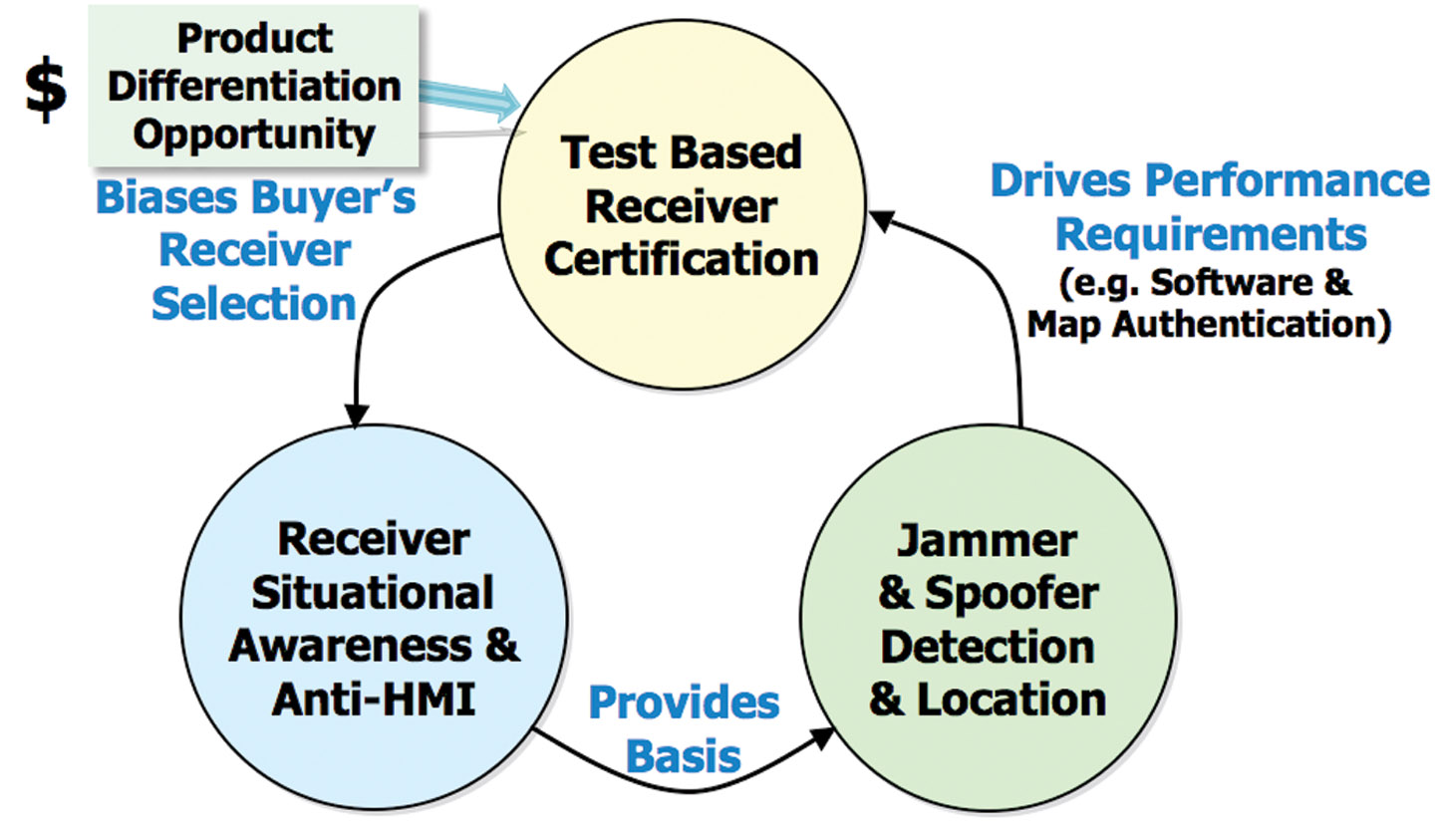
    Faced with jamming, spoofing, and cyber attacks, receivers must take basic precautionary measures. They must recognize jamming and spoofing attacks to avoid generating hazardously misleading outputs. Situational awareness is key. Accurate and specific alarms must be generated so users can take action and authorities can be notified. Regular threat-signature updates can improve situational awareness, much like antivirus updates on a computer. Fire alarms don’t put out fires but they do save lives and improve response time.

    Twenty years ago, computers rarely had firewall or antivirus protection. As GPS becomes more deeply integrated into communications-enabled systems, its utility increases exponentially but so does its vulnerability to cyber attack. When you update your GPS software or your maps, how do you know they have not been compromised? How do you know your receiver is authentic?

    slide15
    Figure 1. There are demonstrated, well known attacks that can cause receivers to output misleading information without warning. Many of these attacks can be detected using simple methods. Some receivers incorporate detection and countermeasures techniques. Many don’t. Receiver certification provides GPS buyers with a starting point for selecting GPS receivers. Certified receivers can accurately report on interference so it can be located and stopped.

    The U.S. Navy recently discovered counterfeit routers in several of their installations. Well-developed computer security methods such as the Trusted Platform Module found in more than 300 million computers can help secure GPS receivers without impeding innovation.

    The government can also play a role in improving receivers by providing an authenticatable civil signal structure. Well-documented Public Key Infrastructure methods such as digital signing and occasional, short-spread spectrum security-code bursts can be added to the new L1C signal. Receivers voluntarily using these signal features can establish signal provenance with extremely high confidence.

    The public, unclassified keys needed to process these features could be sold and used as a revenue source for the GPS system. Receivers that choose not to use these features can ignore them without adverse impact other than weaker security. The large numbers of in-theater military users who rely on civil signals would also stand to benefit.

    Finally, I would note that situationally aware receivers can provide specific and detailed reports about what they see. Interference-monitoring systems such as Patriot Watch will need detailed reports to sort and associate the multitude of reports they receive into a coherent picture of what is actually happening. To provide adequate geographic coverage, interference monitoring systems will need to accept reports from diverse receiver types on an opportunistic basis. In short, they will have to rely on crowdsourcing as a major operational input.

    As Brad Parkinson noted during my presentation of this material to the November 9 meeting of the National PNT Executive Committee Advisory Board (“Receiver Certification: Making the GNSS Environment Hostile to Jammers and Spoofers,” at www.pnt.gov/advisory/2011/11/), in the early days of electricity, a lot of houses burned down because of electrical problems. Underwriters Laboratories helped immensely by testing electrical equipment to make sure it was reasonably safe, and consumers looked for the UL label. A voluntary, basic receiver certification process similar to Underwriters Laboratories should be pursued to provide the user community with a basis for selecting receivers.


    Logan Scott has more than 32 years of military and civil GPS systems engineering experience. At Texas Instruments, he pioneered approaches for building high-performance, jamming-resistant digital receivers. While at Omnipoint, a cellular carrier, he developed cross-system interference mitigation strategies. He holds 33 U.S. patents.

  • Low-Complexity Spoofing Mitigation

    By Saeed Daneshmand, Ali Jafarnia-Jahromi, Ali Broumandan, and Gérard Lachapelle

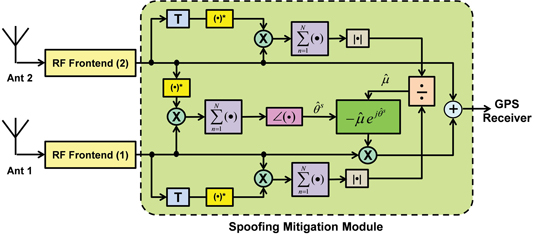
    Most anti-spoofing techniques are computationally complicated or limited to a specific spoofing scenario. A new approach uses a two-antenna array to steer a null toward the direction of the spoofing signals, taking advantage of the spatial filtering and the periodicity of the authentic and spoofing signals. It requires neither antenna-array calibration nor a spoofing detection block, and can be employed as an inline anti-spoofing module at the input of conventional GPS receivers.

    GNSS signals are highly vulnerable to in-band interference such as jamming and spoofing. Spoofing is an intentional interfering signal that aims to coerce GNSS receivers into generating false position/navigation solutions. A spoofing attack is, potentially, significantly more hazardous than jamming since the target receiver is not aware of this threat. In recent years, implementation of software receiver-based spoofers has become feasible due to rapid advances with software-defined radio (SDR) technology. Therefore, spoofing countermeasures have attracted significant interest in the GNSS community.

    Most of the recently proposed anti-spoofing techniques focus on spoofing detection rather than on spoofing mitigation. Furthermore, most of these techniques are either restricted to specific spoofing scenarios or impose high computational complexity on receiver operation.

    Due to the logistical limitations, spoofing transmitters often transmit several pseudorandom noise codes (PRNs) from the same antenna, while the authentic PRNs are transmitted from different satellites from different directions. This scenario is shown in Figure 1. In addition, to provide an effective spoofing attack, the individual spoofing PRNs should be as powerful as their authentic peers. Therefore, overall spatial energy of the spoofing signals, which is coming from one direction, is higher than other incident signals. Based on this common feature of the spoofing signals, we propose an effective null-steering approach  to set up a countermeasure against spoofing attacks. This method employs a low-complexity processing technique to simultaneously de-spread the different incident signals and extract their spatial energy. Afterwards, a null is steered toward the direction where signals with the highest amount of energy impinge on the double-antenna array. One of the benefits of this method is that it does not require array calibration or the knowledge of the array configuration, which are the main limitations of antenna-array processing techniques.

    Processing Method

    The block diagram of the proposed method is shown in Figure 2. Without loss of generality, assume that s(t) is the received spoofing signal at the first antenna.

     Figure 2. Operational block diagram of proposed technique. Source: Saeed Daneshmand, Ali Jafarnia-Jahromi, Ali Broumandan, and Gérard Lachapelle
    Figure 2. Operational block diagram of proposed technique.

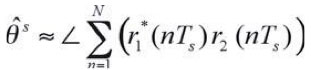
    The impinging signal at the second antenna can be modeled by E-1A, where θs and μ signify the spatial phase and gain difference between the two channels, respectively. As mentioned before, the spoofer transmits several PRNs from the same direction while the authentic signals are transmitted from different directions. Therefore, θs is the same for all the spoofing signals. However, the incident authentic signals impose different spatial phase differences. In other words, the dominant spatial energy is coming from the spoofing direction. Thus, by multiplying the conjugate of the first channel signals to that of the second channel and then applying a summation over N samples, θs can be estimated as
    E-1 Source: Saeed Daneshmand, Ali Jafarnia-Jahromi, Ali Broumandan, and Gérard Lachapelle(1)

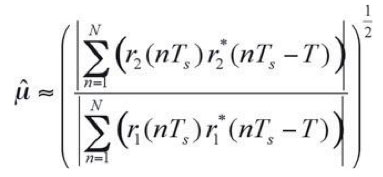
    where r1 and r2 are the complex baseband models of the received  signals at the first and the second channels respectively, and Ts is the sampling duration. In (1), θs can be estimated considering the fact that the authentic terms are summed up non-constructively while the spoofing terms are combined constructively, and all other crosscorrelation and noise terms are significantly reduced after filtering. For estimating μ, the signal of each channel is multiplied by its conjugate in the next epoch to prevent noise amplification. It can easily be shown that μ can be estimated as
    E-2a Source: Saeed Daneshmand, Ali Jafarnia-Jahromi, Ali Broumandan, and Gérard Lachapelle(2)
    where T is the pseudorandom code period. Having Screen shot 2013-01-09 at 2.57.07 PM and Screen shot 2013-01-09 at 2.57.12 PM a proper gain can be applied to the second channel in order to mitigate the spoofing signals by adding them destructively as
    E-2 Source: Saeed Daneshmand, Ali Jafarnia-Jahromi, Ali Broumandan, and Gérard Lachapelle(3)

    Analyses and Simulation Results

    We have carried out simulations for the case of 10 authentic and 10 spoofing GPS signals being transmitted at the same time. The authentic sources were randomly distributed over different azimuth and elevation angles, while all spoofing signals were transmitted from the same direction at azimuth and elevation of 45 degrees. A random code delay and Doppler frequency shift were assigned to each PRN. The average power of the authentic and the spoofing PRNs were –158.5 dBW and –156.5 dBW, respectively.

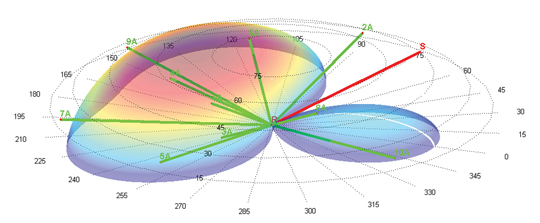
    Figure 3 shows the 3D beam pattern generated by the proposed spoofing mitigation technique. The green lines show the authentic signals coming from different directions, and the red line represents the spoofing signals. As shown, the beam pattern’s null is steered toward the spoofing direction.

    Figure 3. Null steering toward the spoofer signals. Source: Saeed Daneshmand, Ali Jafarnia-Jahromi, Ali Broumandan, and Gérard Lachapelle
    Figure 3. Null steering toward the spoofer signals.

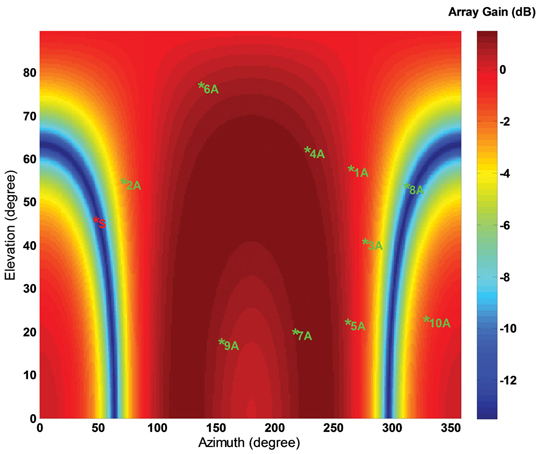
    In Figure 4, the array gain of the previous simulation has been plotted versus the azimuth and elevation angles. Note that the double-antenna anti-spoofing technique significantly attenuates the spoofer signals. This attenuation is about 11 dB in this case. Hence, after mitigation, the average injected spoofing power is reduced to –167.5 dBW for each PRN. As shown in Figure 4, the double-antenna process has an inherent array gain that can amplify the authentic signals. However, due to the presence of the cone of ambiguity in the two-antenna array beam pattern, the power of some authentic satellites that are located in the attenuation cone might be also reduced.

    FIGURE 4. Array gain with respect to azimuth and elevation. Source: Saeed Daneshmand, Ali Jafarnia-Jahromi, Ali Broumandan, and Gérard Lachapelle
    Figure 4. Array gain with respect to azimuth and elevation.

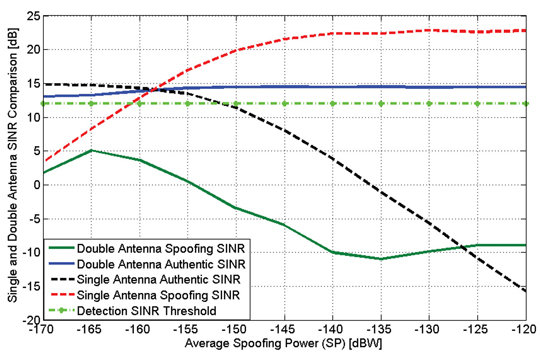
    Monte Carlo simulations were then performed over 1,000 runs for different spoofing power levels. The transmitted direction, the code delay, and the Doppler frequency shift of the spoofing and authentic signals were changed during each run of the simulation. Figure 5 shows the average signal to interference-plus-noise ratio (SINR) of the authentic and the spoofing signals as a function of the average input spoofing power for both the single antenna and the proposed double antenna processes. A typical detection SINR threshold corresponding to PFA=10-3 also has been shown in this figure.

     Figure 5. Authentic and spoofed SINR variations as a function of average spoofing power. Source: Saeed Daneshmand, Ali Jafarnia-Jahromi, Ali Broumandan, and Gérard Lachapelle
    Figure 5. Authentic and spoofed SINR variations as a function of average spoofing power.

    In the case of the single antenna receiver, the SINR of the authentic signals decreases as the input spoofing power increases. This is because of the receiver noise-floor increase due to the cross-correlation terms caused by the higher power spoofing signals. However, the average SINR of the spoofing signals increases as the power of the spoofing PRNs increase.

    For example, when the average input spoofing power is –150 dBW, the authentic SINR for the single-antenna process is under the detection threshold, while the SINR of the spoofing signal is above this threshold. However, by considering the proposed beamforming method, as the spoofing power increases, the SINR of the authentic signal almost remains constant, while the spoofing SINR is always far below the detection threshold.

    Hence, the proposed null-steering method not only attenuates the spoofing signals but also significantly reduces the spoofing cross-correlation terms that increase the receiver noise floor. Early real-data processing verifies the theoretical findings and shows that the proposed method indeed is applicable to real-world spoofing scenarios.

    Conclusions

    The method proposed herein is implemented before the despreading process; hence, it significantly decreases the computational complexity of the receiver process. Furthermore, the method does not require array calibration, which is the common burden with array-processing techniques.

    These features make it suitable for real-time applications and, thus, it can be either employed as a pre-processing unit for conventional GPS receivers or easily integrated into next-generation GPS receivers. Considering the initial experimental results, the required antenna spacing for a proper anti-spoofing scenario is about a half carrier wavelength. Hence, the proposed anti-spoofing method can be integrated into handheld devices.

    The proposed technique can also be easily extended to other GNSS signal structures. Further analyses and tests in different real-world scenarios are ongoing to further assess the effectiveness of the method.


    Saeed Daneshmand is a Ph.D. student in the Position, Location, and Navigation (PLAN) group in the Department of Geomatics Engineering at the University of Calgary. His research focuses on GNSS interference and multipath mitigation using array processing.

    Ali Jafarnia-Jahromi is  a Ph.D. student in the PLAN group at the University of Calgary. His  research focuses on GNSS spoofing detection and mitigation techniques.

    Ali Broumandan received his Ph.D. degree from  Department of Geomatics Engineering, University of Calgary, Canada. He is a senior research associate/post-doctoral fellow in the PLAN group at the University.

    Gérard Lachapelle holds a Canada Research Chair in wireless location In the Department of Geomatics Engineering at the University of Calgary in Alberta, Canada, and is a member of GPS World’s Editorial Advisory Board.

  • On the Edge: Go Big Green

    By Tracy Cozzens

    Nav On Time, a French Company located in Toulouse, has successfully completed a trial campaign of its Mow-By-Sat precision guidance on a commercial lawnmower. In August, the prototype of a GPS-guided robot lawnmower was installed on a golf driving range near Toulouse and tested in real conditions of use, day and night, maintaining a 25,000 square meter lawn since then. In a previous campaign, the mower covered more than 2.2 million yards — equal to1,250 miles or 2,000 kilometers — in 2,100 hours. (See videos of the mower in action at www.youtube.com/DSnavontime.)

    With such a success under its belt, Nav On Time is negotiating with different lawnmower manufacturers to bring a product to market. The autonomous lawnmowers already on the market, including machines commercialized by research partner BelRobotics, use underground wired perimeters for delimiting the lawn by an electromagnetic signal, the strength of which is measured by a mower-embedded sensor to determine its distance to the lawn’s limit. But that wire, and its required installation, are technical barriers for a lot of potential customers. Nav On Time is one of the companies developing solutions to get rid of the perimetric wire yet still be able to guide the mower autonomously with accuracy and efficiency.

    Between January 2009 and June 2010, Nav On Time coordinated the Mow-by-Sat project, a research and development effort that received funding from the European Union’s Seventh Framework Programme (FP7/2007–2013). Partners included Belrobotics of Belgium, a large lawn-maintenance robot manufacturer, and the University of Catania in Sicily, Italy, through its robotics research department.

    The Mow-by-Sat project (www.mow-by-sat.eu) was also undertaken to support development of a GNSS-based navigation and guidance system integrated into an autonomous lawnmower, paving the way for industrialization and commercialization of GNSS applications for a domestic service robot operating outdoors. Beyond this concrete application, the project aimed to increase the adoption of GNSS technologies in robotics applications, studying the benefits of European GNSS (especially EGNOS and Galileo).

    Mow-By-Sat uses a virtual fence to replace the wired boundary traditionally used in robot lawnmowers, which provides better flexibility for defining and modifying a mowing area. Mow-By-Sat enhances the machine’s efficiency by a factor of three, as full steering substitutes for the random operation mode, the company said.

    Built around a European GNSS L1 automotive receiver, the u-blox T, Mow-By-Sat uses L1 fixed / floating real-time kinematic (RTK) techniques. A tight coupling between the RTK positioning firmware and the guidance application software aids the mower’s precision. Nav On Time compared it to the challenges of aviation, where the required navigation performance depends on the flight phase.

    In its patented architecture, the module embedded in the rover is dumb, and the ground-based station acts as a remote control, ensures traffic management between several machines, and serves as a gateway for remote services such as installation, supervision, and surveillance, all accessible from the Internet. Nav On Time developed both the positioning firmware and guidance application software.

    According to Nav On Time CEO Michèle Poncelet, Mow-By-Sat offers significant competitive advantages to the machine manufacturer compared to expensive RTK solutions now on the market. She cited:

    • easy customization because of its open architecture,
    • an affordable solution for small and inexpensive mobile machines,
    • a technology enabler for replacing human-controlled and energy-consuming machines with smaller and cheaper machines that have a smaller carbon footprint.

    With six Engineers, Nav On Time, founded in 2007, is offering a product line dedicated to precision control solutions for small and inexpensive mobile machines, under a business-to-business model through industrial partnerships. According to Poncelet, its market stretches from human controlled machines (precision agriculture or crane collision avoidance) as driver’s assistance, to unmanned machines (autonomous lawnmowers, other unmanned ground vehicles, intelligent vehicles, and more generally service robots) with full steering.

    Other applications envisioned by Nav On Time include a golfball retrieval robot for driving ranges, a beach cleaner robot, and a surveillance robot — any application that requires passing through a pre-determined area in a methodical and systematic way.

    Breaking Ground

    It would seem mowing lawns isn’t a beloved pastime, as autonomous lawn mowers have been the subject of numerous research projects. For the past eight years, the Institute of Navigation has sponsored a Robotic Lawnmower Competition as a way to encourage college students to develop autonomous steering techniques. During the second ION Autonomous Lawnmower competition, Frank Van Graas, who accompanied the winning Ohio University team, told GPS World, “The centimeter-level positioning accuracy required for lawnmowers in the contest is actually more difficult than automatically landing an airplane.”

    One research project, carried out by Navcom Technology in 2005, resulted in an autonomous mower taking on the precise mowing techniques of baseball stadiums, with its checkered patterns. The Navcom project, documented by Michael Zeitzew in his paper “Autonomous Utility Mower,” used a series of beacons to augment GPS. Two off-the-shelf John Deere utility mowers were modified for X-by-wire control, and fixed navigation beacons were mounted around the stadium. Next, the field boundaries were surveyed and input into a map file, used to create the mower’s mission plan.

    “The use of GPS requires good sky visibility,” explained Zeitzew. “In this application, due to the stringent navigation accuracy requirements, an RTK-GPS solution is required, which requires the use of a base station. Because many of the baseball stadiums have high walls and other obstructions around the field, RTK-GPS is inadequate, even with augmentation by (affordable) inertial sensors or odometry sensors. This necessitated the use of alternative technology.”

    Navcom fielded two mower systems into professional baseball stadiums, one major league and one minor league. Both systems were used over the course of several weeks during the spring 2005 baseball season, and received positive reviews from the professional groundskeepers, who quickly grew comfortable using the machines. The project proved not only that autonomous mowers are possible even for large-scale sites such as a stadium, but that there is indeed a market for them.


  • Letters to the Editor: The Cost of Reliability

    Thanks to Richard Langley for the constellation update in November GPS World, from ION-GNSS. I’m a GPS constellation junkie, and if there was a history of each GPS space vehicle on orbit, I’d read them all. I love hearing the operational tidbits, about a IIF having problems with its cesium clock, or a reaction wheel failing, or how many spare SVs are on hand, and if SVs are slated to be disposed of, and so on. I’ve never been able to find a good centralized source of that type of information, as it seems to be something that just kind of leaks out into the industry press, from uncited sources. I’d been waiting for an update to The Almanac but it’s a moving target, so I understand why you don’t rush to update it every time a new SV is launched, or an SV’s clock changes. Especially with the increase in GNSS launches.

    So thanks for those new updates, and passing them along as they happen.

    A second thing, just kind of my musing of the state of the GNSS constellations, and how the U.S. GPS system is so much different than the others: The cost of reliability.

    With continued launches by Russia, the GLONASS system has, for all practical purposes, reached a fully operational status with 27 satellites set healthy, being commissioned or in flight tests. They are definitely putting far more SVs into orbit faster than the GPS program ever has. Over the years, they’ve put up so many satellites that they have three times as many disposed satellites (90) as they have operational (27) satellites.
    Compass has launched 13 satellites; at least eight are known to be usable.

    In the GPS constellation, there are still more SVs active on orbit than have been disposed of, in the entire history of the GPS program. Think about that for a minute.

    30 active satellites on orbit, and in the entire 40-year history of the program, only 29 have been disposed of. This is a testament to both the forward-thinking design of the GPS system by its many architects, contractors, and builders of the SVs and their payloads. And of course the Air Force that manages the constellation. The GPS system sets the standard for all other GNSS systems. It is not only the most accurate and dependable GNSS system in the world, it is also the most obsolete, in terms of age of spacecraft on orbit.

    The user segment enjoys reliability, at the expense of new features. Because the Block II and II-A satellites exceeded their design life, and now the last of the II-R satellites are reaching their design life, we don’t have all of the signals we could have from a more modernized constellation. Non-professionals like myself don’t have an operational L2C, for ionospheric correction in consumer-level devices. (Waiting on OCX.) We don’t have operational L5 (Waiting on OCX, again.) And what about all of those inter-satellite links for ranging that the IIR, IIR-M, and the IIF (and IIA as well?) satellites have? Are those waiting on OCX too?

    Originally, the IIF satellites were supposed to number 51. Then it was reduced to 33. Then 15. Now 12. 12 isn’t even enough to replace the entire remaining IIA fleet, while maintaining the current level of active SVs. Of course, it doesn’t make any sense to launch lots of IIF birds when GPS III is out there on the horizon, only three short years — we hope — away.

    If the II, IIA, IIR, and IIR-M GPS spacecraft would have had lifetimes similar to GLONASS satellites, the whole constellation would have either fallen into disrepair, or, more likely, been upgraded to IIF satellites a decade ago. And we’d have all of the modern signals that we could ever hope to need. Civilians have the same signals that we’ve had since the beginning of the GPS program. We could have had new signals years ago. but the old birds keep on flying, and so far, we only have two IIF satellites in orbit.

    — Jerry Pasker
    Monticello, Iowa

    Occupy GPS

    It occurred to me recently that maybe all these people all over the country are protesting the fact that 1 percent of the world’s GNSS receivers control 99 percent of the attention.

    While 99 percent of receivers actually outperform that select 1 percent in most metrics — time to fix, accuracy in cities, power consumption, sensitivity, dynamic range, jam immunity, and so on — because they live and work in cell-phones and tablets, they are poorly compensated and don’t always get the respect of their better-dressed cousins.

    — A Reader

  • The System: EGNOS Toolkits Enhance GPS Accuracy

    EGNOS Toolkits Enhance GPS Accuracy

    Free downloadable software Toolkits at www.egnos-portal.eu can help cell-phone and handheld receiver developers enhance location and timing applications with GPS corrrection data from the European Geostationary Navigation Overlay Service (EGNOS) satellite-based augmentation system.

    The Toolkits include software packages, demo applications, and supporting materials, enabling application developers, researchers, university students, and others to create, use, and maintain EGNOS-capable positioning applications.

    For handheld receiver manufacturers and mobile-phone developers, the Toolkit contains free source code for easy integration of EGNOS capabilities into a smartphone, and all the necessary files for the demonstration application, for use as a basis for a new application, as well as core libraries, to integrate enhanced EGNOS positioning capability into an existing application.

    For the simply curious, an EGNOS Toolkit provides a means of exploring and understanding the entire chain from the raw GNSS satellite signal to enhanced EGNOS positioning data.

    The development kit provides an easy way incorporate all EGNOS corrections and integrity capabilities, allowing developers to perform real EGNOS integration directly into a smartphone. It works with different operating systems, including Android, Apple, and RIM.

    Static and kinematic tests show that EGNOS performs well in both cases: “The EGNOS SDK provides an average increase of 30 percent in position accuracy over GPS alone,“ according to developer DKE Aerospace.


    EGNOS Software Development Kit provides a software receiver to enhance GPS positions, displaying position accuracy increases on average of 30 percent.


    DOT Blank Stare on LightSquared

    The U.S. Department of Transportation (DoT) responded to a Freedom of Information Act (FOIA) request by GPS World for its recommendations to the National Telecommunications and Information Administration (NTIA) regarding LightSquared interference with GPS. The DoT wrote, “We are withholding two pages [of thirteen relevant pages] in part and eleven pages in their entirety,” and enclosed two completely blacked-out pages.
    Kathy Ray, DoT FOIA officer, added,  “We have determined that the release of the redacted and withheld portions would foreseeably cause harm to the government’s deliberative process.”

    The blacked-out DOT letter is dated August 25, 2011. How it differs from the agency’s July 21 “LightSquared Impact Assessment,” publicly available courtesy of the U.S. House of Representatives Committee on Science, Space, and Technology, cannot, of course, be known.

    The Department of Homeland Security wrote in response to GPS World’s FOIA request, “We conducted a comprehensive search of files with the Science and Technology Directorate’s Homeland Security Enterprise and First Responders Group, and Cyber Security Division for records that would be responsive to your request. Unfortunately, we were unable to locate or identify any responsive records.”

    The National Institute of Standards and Technology of the Department of Commerce replied, “NIST has no documents that are responsive to your request.”

    The Department of the Interior provided the same documents that were previously made public by the House committee.

    The National Aeronautics and Space Administration made a similar determination, but did not send a document, referring instead directly to the committee’s public website.

    PNT Board Hears Proposal for LightSquared Solution

    The  November 9 meeting of the National Space-Based Position Navigation and Timing (PNT) Advisory Board in Alexandria, Virginia got several earfulls regarding the LightSquared/GPS controversy. One of seven speakers on a two-hour panel, Javad Ashjaee, president and CEO of JAVAD GNSS, demonstrated his company’s newly developed filter technology that he said could protect GPS receivers from LightSquared broadband network interference.

    As Ashjaee stated, the proposed solution does not protect against interference from the so-called high-10 signals, one of two bands (the other is known as the low-10) for which LightSquared has received a conditional waiver. Unless and until a solution for the terrestrial high-10 signals is found, LightSquared transmissions in that band will still interfere with the GPS signal. The technical solution proposed by JAVAD GNSS addressed only the low-10 band.


    Proposed filter to “harden” high-precision GPS receivers against Lightsquared Lower 10 (click to enlarge.)
    The JAVAD GNSS proposed fix consists, in simplified form, of a ceramic filter followed by a series of surface acoustic wave (SAW) filters.
    A PDF of Ashjaee’s 76-slide Powerpoint demonstration, without his verbal explanations and commentary, along with other presentations from the board meeting, are available at www.pnt.gov/advisory/2011/11/. A December 8 GPS World webinar reprised the same presentation, and the download at env-gpsworld-integration.kinsta.cloud/webinar includes audio of Ashjaee’s remarks.

    Ashjaee said that his company’s testing of its own filter methodology found no GPS signal loss due to a low-10 (10L) signal power of –10 dBm. An “Ultimate Test: Special Zero Baseline” put receivers on a Moscow skyscraper with multipath from both above and below. One antenna fed two receivers (zero baseline). One receiver used standard filtering and the other the new filters. He said that over 15 hours of testing the average carrier-phase error between the two receivers was 0.2 millimeters, and the average code difference was about 5 centimeters.

    JAVAD GNSS has started production of what Ashjaee calls “LightSquared-compatible” Triumph GNSS receivers. He brought 40 units to the PNT Board meeting. The company will begin manufacturing “LightSquared-integrated” receivers in May 2012, for RTK positioning using the proposed LightSquared broadband network for high-speed communication, if and when it is deployed.

    Fellow presenter Jim Kirkland, vice president and general counsel for Trimble Navigation, pointed out that such filters represented a potential solution only for one class of high-precision receivers. Whether it would work for other classes of high-precision receivers had yet to be verified. Kirkland said that even if further independent testing shows that the filter solution is viable at the lower 10 MHz of the spectrum, retrofits would be costly and time consuming.

    Questions regarding cost and responsibility of retrofit, should the solution prove practical, were not discussed at length at the meeting, nor was any solution proposed.

    LightSquared executive vice president Martin Harriman did not directly answer a question as to whether his company intends to develop the upper 10 MHz for which it has been given a conditional waiver.

    Scott Burgett, software engineering manager for Garmin International, said, “It is almost impossible to design new products compatible with LightSquared’s proposed system without knowing its technology’s end state.” He estimated 10–15 years to properly retrofit Garmin devices, which are widely distributed in general aviation, personal navigation, car navigation, and other sectors, so that they could coexist with LightSquared.

    The panel was moderated by Tom Stansell of Stansell Consulting, who concluded, “I think we learned, thanks to Javad, about a very clever solution to a particular problem for a particular range of products — the products he is most familiar with. It may or may not fit in some of the other applications.

    “What we have not addressed is the elephant in the living room,” Stansell continued. “That is the cost, and time delay, and changeover process if LightSquared is allowed to go forward. Will it be the lower 10, upper 10? That has to be resolved. There are very large questions remaining to be discussed, and [they] may or may not be fully solved in a short period of time.”

    Constellation Updates

    Where Is Compass ICD?

    The long-awaited signal interface control document (ICD) for China’s Beidou/Compass GNSS has not yet appeared, despite an announcement at the ION-GNSS conference by Chinese delegates that ICD document v1.0 will be published in 2011, “probably” in the month of October. When it does appear, it should be available for download on the Compass website, www.beidou.gov.cn (as yet without an English version), also at www.compass.gov.cn.

    The delay in publishing a document may reflect a system very much in formulation, with ongoing discussions among the principal parties to its design, with different views on system architecture and possibly even final signal structure. This was one possible conclusion that could be inferred — a dynamic system in formation and growing rapidly — from varying reports given by different Chinese representatives, governent and academic, at the ION Compass session.

    There was some disagreement among panelists at that time as to, for example, the final targeted number of satellites in the system: either 30, or 35.

    The ICD has been rumored to be available previously to receiver manufacturers within China, creating some disgruntlement among companies outside the country. One of the ION panelists affirmed that GPS/Compass chips and receivers are being actively developed by many Chinese manufacturers and research institutes.

    The next BeiDou/Compass launch, which will be for the system’s fifth inclined geosynchronous orbit satellite, is expected during the first few days of December, according to web discussions. As of press time for this magazine, there had been no official announcement on the Chinese official government BeiDou website, www.compass.gov.cn.

    The site has posted Chinese and English versions of a document titled “Report on the Development of BeiDou (COMPASS) Navigation Satellite System (V1.0)” by the China Satellite Navigation Office. The pages are viewable as separate images.

    Galileo Under Control

    Europe’s first two in-orbit validation satellites reached their final operating slotss 23,222 kilometers above Earth, have been activated, and are now undergoing tests of their navigation payloads, reports the European Space Agency (ESA).

    Marking the formal end of their Launch and Early Operations Phase, control of the satellites passed on November 3 from the French space agency (CNES) center in Toulouse to the Galileo Control Centre in Oberpfaffenhofen, Germany.

    Oberfaffenhofen, operated by the German Aerospace Center (DLR), will be in charge of the satellites’ command and control for the whole of their 12-year operating lives. The navigation signals are being checked out by ESA’s ground station in Redu, Belgium, where a 20-meter antenna measures the shape of the signals to a high degree of accuracy. Once the navigation payload is fully checked out and activated, a second Galileo Control Centre in Fucino, Italy, will oversee all navigation services. All activities are performed under contract to SpaceOpal, a joint subsidiary of DLR and the Italian company Telespazio.

    GLONASS as Expected

    The Satellite System Mission Control Center of the Russian Ministry of Defence, with the ISS-Reshetnev Information Computation Center, established communication with the three GLONASS satellites launched November 4. The satellites are earth- and sun-oriented, and their subsystems are functioning properly.

    According to NORAD tracking, the three satellites were inserted into Plane 1. This was expected as there are only seven active satellites in this plane, whereas the other two planes have a full complement of eight satellites. Orbit slot 3 in Plane 1 is currently vacant. According to Nikolay Testoyedov, ISS-Reshetnev general designer and director general, the new satellites will ensure the operation of a complete 24-satellite GLONASS constellation, and allow creating the necessary orbital reserve.

    GPS GEO-MEO Floated

    In a presentation titled “Analysis of Alternatives  for Future GPS Architecture; Considerations for Constellation Sustainment,” made to the U.S. PNT Advisory Board on November 9, Kirk Lewis, senior advisor from the Institute for Defense Analyses (IDA), put forth the concept of “boosting” GPS III payloads onto commercial geostationary Earth-orbit (GEO) satellites.

    After concluding that the current program of launches and orbit costs extending into the Block III-C generation is not sustainable, Lewis presented several alternatives, but quickly eliminated two that involved low-Earth-orbit satellites and non-space options, due to technical, scheduling, and performance issues. Remaining in play are “potential and realistic” GEO and mid-Earth orbit (MEO, the configuration of the present GPS constellation) options, used individually or in combination.

    IDA analysis found that two GEO satellites, separated by 15 degrees or more longitude, supplied almost the same signal performance as adding six MEO satellites. The presentation is available at www.pnt.gov/advisory/2011/11/.

  • Expert Advice: MSS Misinformation, and Ten Truths

    By Rich Keegan

    LightSquared is currently conducting a public campaign intended to persuade federal regulators to approve a nationwide broadband service that would be detrimental to users and applications that depend on GPS. The campaign relies on misinformation, revisionist history, half-truths, and clear misstatements of fact. To understand the effort to convince regulators and legislators that the experts are wrong, one must consider 10 basic truths.

    1: The MSS Band Was Not Meant for High-Powered Terrestrial Use. The FCC authorized use of ancillary terrestrial component (ATC) ground transmitters many years ago within the mobile satellite services (MSS) band. The LightSquared campaign claims that this proves the band was intended for primary high-powered terrestrial use. But note ATC means ancillary terrestrial component, not primary. The FCC allowed this use only to fill in small holes in coverage from satellites. The term MSS recognizes that the band was for use by low-powered satellites, not high-powered land transmitters.

    The FCC conditional waiver given to LightSquared, if allowed to stand, would completely change the nature of the band, converting it to primary terrestrial use by 40,000 or more high-powered ground transmitters. Many FCC statements preceding the conditional waiver make it clear that the LightSquared effort is precisely what the FCC said would not be permitted.

    2: Interference to GPS Has Not Been Resolved. LightSquared assured the GPS community when the conditional waiver was announced that all interference issues had been addressed, and its system would not interfere with GPS. It was immediately clear to GPS engineers that this was wrong, and subsequent testing ordered by the FCC, along with that done by manufacturers, federal agencies, and independent organizations, confirmed that the original LightSquared system would cause massive interference with all classes of GPS receivers.

    Faced with irrefutable evidence of massive interference, LightSquared revised its system design to propose initial use of only 10 MHz of spectrum farthest from the GPS band (Low 10) for an unspecified period of time, after which it would be allowed to add the closer 10 MHz (High 10). While it may be feasible in the future to develop GPS receivers that could tolerate Low 10, several things are reasonably clear:

    • High-precision receivers that can tolerate High 10 and work as well as the ones we now use can’t be built, now or in the foreseeable future. LightSquared’s claims that “we can innovate our way out of this” are wrong with respect to High 10. Filters that LightSquared presently touts to allow Low 10 would not work in the High 10 environment.
    • Based on limited testing and analysis, Low 10 causes less interference than the original plan of Low 10+High 10, but the Low 10 effects on many receivers, particularly high-precision receivers in many high-value applications, remains substantial.

    With this plan, LightSquared claims that 99 percent of existing GPS receivers would not suffer harmful interference. This conclusion relies on a definition of harmful interference of C/N0 degradation of 6 dB for general navigation devices (the GPS industry and FCC precedent require only 1 dB), and on testing cell-phone GPS with a simple pass/fail criterion, ignoring performance degradation and the fact that modern cell phones are much more like general navigation devices and PNDs than older cell phones. Slanted and unorthodox analytical parameters produced this rosy assessment.

    Based on evidence of Low-10 interference, the NTIA and FCC ordered more testing specifically focused on Low 10. In response to mounting evidence of interference at this level also, LightSquared has now offered a third version of its system architecture, using Low 10 and limiting power on the ground. From a GPS interference perspective, this power reduction is useful. However, the latest LightSquared plan does not fully address three key problems:

    • There has been no renunciation of High 10. LightSquared says that in 5–6 years it will need spectrum capacity beyond Low 10. It would be irrational to design receivers now that tolerated Low 10, only to find in a few years that the requirements had changed to require tolerance to High 10 also (which is not possible).
    • There will still be interference with GPS receivers of various important classes in the power-limited environment of the latest plan.
    • None of the evolving plans deals with the massive installed base of GPS receivers.

    3: The GPS Industry Did Not Know of a Spectrum Conversion. LightSquared claims that for many years GPS manufacturers were aware of the proposed ground transmitters and should have designed receivers to avoid picking up strong signals in this neighboring band. These claims of foreknowledge of a recent fundamental change in proposed use of the MSS band are fallacious.

    The U.S. GPS Industry Council at the time of the limited conditional approval of ATC transmitters (circa 2003) consisted of only two or three GPS manufacturers. It is clear from USGIC statements at the time that it did not anticipate a spectrum reallocation. In any case, it is a huge stretch to claim that USGIC represented all GPS manufacturers, let alone the entire GPS industry and users. The GPS industry had no indication that the FCC would ever radically reallocate MSS band for a stand-alone high-powered terrestrial network, prior to November 2010.

    As [GPS World survey editor] Eric Gakstatter has pointed out, a major change with the potential to affect all GPS users should follow certain guidelines. The Air Force GPS Directorate demonstrated this in handling a much less important change to GPS signals: discontinuing support for the semi-codeless technique used in most high-performance receivers. In 2008, it hired consultants to question all manufacturers and many users of GPS about the potential impact. It then proposed that the signal change would occur on December 31, 2020, giving more than 12 years to prepare for the change.

    Should we ask anything less from LightSquared’s far more radical proposal?

    The FCC has a process that would have been much more appropriate for a proposal to reallocate the MSS L-band to high-powered terrestrial use: Notice of Proposed Rulemaking. Had it followed this process, we might be having a productive discussion of technical aspects.

    4: GPS Receivers Properly Use the MSS L-Band. LightSquared asserts that GPS receivers intrude into LightSquared’s spectrum— a misleading claim. Many GPS receivers in fact have filters that do not block signals from the MSS band. There are several reasons for this:

    • So long as the MSS band was a satellite band for signals from space to Earth, the signals from other systems in that band were low-power and not harmful to GPS reception. GPS receiver designers relied on this and assumed this allocation of the band would continue. The ability to use filters that overlap into the MSS band has enabled both low-cost and high-precision GPS receivers.
    • High-precision receivers cannot produce accurate measurements without using wideband GPS signals that occupy most or all of the GPS band. “Brick wall” filters that could capture all the energy in the GPS band and none of the energy in the adjacent MSS band do not exist.
    • Lightsquared ignores hundreds of thousands of high-accuracy, high-value GPS receivers that receive signals from the MSS band, using it for its intended purpose — satellite to ground communication. Deere receivers use the StarFire system leasing use of transmitters on MSS band Inmarsat satellites. Trimble leases use of MSS band on LightSquared’s own satellites for OmniSTAR correction signals.
    • GNSSs worldwide are modernizing their signals; many of these new signals are wideband. To take advantage of them, modern receivers of all classes will be wideband, as high-precision receivers are now, and will suffer interference similar to that of high-precision receivers now.

    5: GPS Receivers Do Not Ignore Government Design Standards. LightSquared asserts that the fundamental GPS L1 signal specification mandates receiver design standards that the GPS industry has ignored, to save a few cents of cost. These claims are false. The GPS specification defines the signal-in-space and explicitly says that it is not a receiver design standard; it simply uses a nominal receiver design to be able to translate signal-in-space specification into navigation performance effects.

    6: Receiver Replacement Costs and Schedules Are Large. LightSquared has offered $50 million to fund retrofit or replacement of legacy government receivers impacted by its signals. General Shelton of the Air Force Space Command testified to Congress that it would take billions of dollars to replace or retrofit the government receivers. He also estimated a 10-year time frame to test and validate replacement receivers.

    LightSquared says it will not bear the costs of replacing commercial receivers since, it claims, manufacturers are responsible for the improper design of those receivers. This is wrong, as shown earlier. LightSquared should bear the cost of replacing commercial receivers, if allowed to proceed. A realistic time frame needed to replace high-accuracy, high-value commercial receivers is also about 10 years.

    LightSquared argues that in five years, most current GPS receivers will be obsolete. This is clearly not true. Many current high-precision receivers are already prepared to use modernized signals from GNSS constellations. The L1C GPS civil signal, for instance, will not be available on any satellite until 2014, and the full constellation of satellites with L1C will not be available until 2026. Therefore, many receivers in use now will continue to be in use for many more years than five.

    7: Other GNSS Are Also Affected. Because Galileo, Compass, and GLONASS use or will use signals similar to GPS, in the same band as GPS, they will suffer interference very similar to that suffered by GPS. Users will lose the benefits of these other constellations, as well as GPS.
    The United States has entered into formal obligations to protect some other GNSS signals; LightSquared signals are not compatible with these U.S. obligations.

    8: Handset Interference is a Serious Concern. LightSquared handsets do not yet exist, but testing to date makes it clear that the handset signals to communicate with LightSquared base stations also interfere with GPS receivers when they are nearby (a few meters). The interference to GLONASS reception is also likely to be harmful. The interference effects of a group of LightSquared handsets has not been fully evaluated, but will certainly create more interference for nearby receivers.

    Out-of-band emissions from LightSquared handsets, if as high as FCC power masks currently permit, would substantially interfere with all GPS receivers, possibly more than LightSquared base stations.

    9: The Solution Is Not a $6 Filter. LightSquared displayed a Deere high-precision receiver with a “$6 filter” and told Congress this proved it could be done inexpensively and quickly. The claim is based on half-truths.

    • The Low 10 signal can be filtered out using low-cost parts, but the effect on performance is not known. There is good technical reason to be concerned about degraded performance from this filtering.
    • The Deere receiver displayed is not capable of readily being retrofitted with LightSquared’s or any other filter. Like many high-precision units, it is an integrated, hermetically sealed device. Retrofitting would entail returning the unit to the factory, cutting open and discarding the case, replacing the antenna/preamp assembly with a redesigned antenna/preamp assembly, inserting the unit into a new case and sealing it, re-testing the unit, and returning it to the customer. A costly process.
    • Filtering is one element of a design, usually distributed across several stages of the receiver. Changing filtering requires a redesign that may stretch across the entire RF front end, and cannot be done casually.
    • The displayed filter’s specified insertion loss is 3 dB, well above what GPS designers normally accept, and would result in about 2 dB more loss of sensitivity than with current filters.
    • LightSquared has suggested moving StarFire and OmniSTAR augmentation signals to the top of the MSS band, very close to the GPS band, so that filters that included GPS could include them. This is a reasonable approach, but the “$6 filter” might not permit that, as it would excessively attenuate at least the StarFire signal.

    10: The GPS Industry Supports National Broadband. The GPS industry broadly supports the goal of extensive and pervasive national broadband, and of strong competition among providers. Pervasive broadband would be helpful for applications such as real-time kinematic (RTK) positioning. It would be beneficial to GNSS users to have broadband services available everywhere, but not if the cost is to degrade or deny GNSS service.

    LightSquared’s broadband services require terrestrial base stations and cannot be done with the LightSquared satellites. It is unlikely that low-population areas will be covered with terrestrial base stations due to the economics involved, but if broadband coverage is nationwide, then so too will be GPS interference.


    Rich Keegan is a senior principal engineer at NavCom Technology, Inc., a wholly owned subsidiary of Deere and Company.

  • Out in Front: Feds Playing Footsie

    I’ll be the first to say that I don’t know how Washington works.

    I don’t know if Washington works, but that’s another story.

    Lacking that knowledge, and a competent lawyer to pepper my filings with the requisite “Vaughn v. Rosen, 484 F.2d 820 (D.C. Cir. 1973), cert. denied, 415 U.S. 977 (1972) . . . claims of nonsegregability must be made with the same degree of detail” language, all my Freedom of Information Act (FOIA) requests for agency communications to the National Telecommunications Administration (NTIA) failed. My FOIA won-lost record stands at 0–7.

    The reason cited by the Department of Transportation for withholding 11 documents and blacking out in their entirety the two pages that it thoughtfully provided was that being any more forthcoming might “cause harm to the government’s deliberative process.” If government told the people what it was up to behind closed doors, the people might object. Shades of Tammany Hall. “I’ll decide what is in the best interest of the electorate.”

    Several government agencies, responding to a tasking by the National PNT Executive Committee, sent their thoughts on LightSquared and GPS to the NTIA, which shares responsibility for spectrum with the Federal Communications Commission. At last notice, the NTIA had not forwarded these communiques to the FCC, and it sure does not want to share them with anyone on the outside. The NTIA was first to rebuff my FOIA, followed by others. Only Interior and NASA provided substance, but in both cases the documents had already been released by a House committee.

    The Citizens for Responsibility and Ethics in Washington (CREW) knows the system a lot better than I do. Its well (or at least copiously) worded FOIA to the White House Office of Science and Technology Policy for documents related to LightSquared elicited several boxloads of same.

    A nonprofit organization, CREW uses research, media outreach, and litigation to force officials to act ethically and lawfully, and to bring unethical conduct to public attention.

    CREW is combing through the voluminous documents, as you may now also do. So far, I’ve seen effusive emails from White House staffers to corporate folks they may or may not already know, fawning all over themselves about economic benefits and job creation that a new generation of wireless technology might bring.

    Not a word yet about downside or job loss that undermining an infrastructure cornerstone will produce. In an election year, point to new or hypothetical blooms and hide the detritus.

    This just in: LightSquared formally notified the FCC that any determination must not be based on “the subjective views of the federal agencies involved.”

    Now I wonder what kind of thrall the company thinks it holds the FCC in, to instruct it so?