Category: GNSS

  • Two Galileo satellites scheduled for May launch

    News from the European Space Agency

    Another pair of Galileo navigation satellites is scheduled for launch by Soyuz rocket in May, ahead of a quartet on an Ariane 5 in the autumn, bringing the Galileo system a step closer to operational use.

    The European Commission asked ESA to look into the feasibility of a Soyuz launch in the first half of the year to speed up the deployment of the constellation and to increase its robustness for delivering initial services.
    One satellite is in storage at ESA’s technical centre in the Netherlands, having completed all its testing to clear it for flight, with another due to join it very soon.

    The satellite platforms are built by OHB in Bremen, Germany, with their navigation payloads coming from Surrey Satellite Technology Ltd in the UK, using a steady stream of high-technology equipment sourced from all across Europe.

    Once through testing, the satellites are flown to Europe’s Spaceport in French Guiana, to be launched two at a time on Soyuz rockets.

    Source: GPS World Staff
    Cutaway view of the Soyuz rocket fairing carrying a pair of Galileo satellites, seen atop the Fregat upper stage that flies them most of the way to their intended medium-altitude orbit. (ESA illustration)

    A total of 12 satellites has been deployed into orbit during the last four years — six in the last year alone.

    The Galileo production line has attained a steady rhythm, as has the environmental testing, so six satellites are available for launch this year, more than were initially planned.

    In the second half of the year, four satellites will be launched together for the very first time, on a customized “Ariane 5 ES Galileo.”

    In development since 2012, it is based on the Ariane 5 ES (Evolution Storable), previously used to place ESA’s 20-tonne ATV vehicle into low orbit for resupplying the International Space Station.

    This new variant will carry a lighter payload — four fueled 738 kg Galileo satellites plus their supporting dispenser — but will take it up to the much higher altitude around 23 222 km.

    The target orbit is actually 300 km below the Galileo constellation’s final working altitude. This leaves Ariane’s upper stage in a stable ‘graveyard orbit’, while the four satellites maneuver themselves up to their operating position.

    Following this first Ariane 5 flight, there should be 18 Galileo satellites in orbit.

  • State of global GNSS market available in 2016 report

    The Global GNSS Consumption 2016 Market Research Report, an in-depth study on the current state of the GNSS market, is now available, according to deepresearchreports.com.

    The report provides a basic overview of the GNSS industry, including definitions, classifications, applications and industry chain structure. Development policies and plans are discussed as well as manufacturing processes and cost structures.

    The report states the global GNSS market size and the segment markets by regions, types, applications and companies.

    The GNSS market analysis is provided for major regions, including the U.S., Europe, China and Japan. For each region, market size and end users are analyzed as well as segment markets by types, applications and companies.

    The report focuses on global major leading industry players with information such as company profiles, product picture and specifications, sales, market share and contact information. GNSS industry development trends and marketing channels also are analyzed. The feasibility of new investment projects and overall research conclusions also are discussed.

    The report also provides major statistics on the state of the industry.

  • NASA helps maintain International Terrestrial Reference Frame with GNSS

    News courtesy of NASA / Goddard Space Flight Center

    The surface of Earth is constantly being reshaped by earthquakes, volcanic eruptions, landslides, floods, changes in sea levels and ice sheets and other processes. Since some of these changes amount to only millimeters per year, scientists must make very precise measurements of the landscape and ocean in space and time in order to study their evolution and help mitigate their impacts.

    The foundation for these precision measurements is the terrestrial reference frame, which serves the same purpose as landmarks along a trail. Earth-orbiting satellites and ground-based instruments make use of this reference system to pinpoint their own locations and, in turn, those of the features they are tracking. It is also the hidden framework relied upon by aircraft to determine their locations and by mobile phone apps that provide maps and driving directions. And it is a fundamental reference for interplanetary navigation of spacecraft.

    NASA helps maintain the worldwide standard called the International Terrestrial Reference Frame, or ITRF, and recently contributed to an update issued by the International Earth Rotation and Reference Systems Service’s International Terrestrial Reference System Product Center at the Institut National de l’Information Géographique et Forestière (IGN) in Paris.

    “The new release lays the groundwork for more detailed studies than ever before of global changes in Earth’s ocean, ice sheets, land and atmosphere,” said Stephen Merkowitz, manager of NASA’s Space Geodesy Project at the Goddard Space Flight Center in Greenbelt, Md.

    Earth-observing satellites — such as the Jason 3 spacecraft, launched in January through a U.S.-European partnership, and the upcoming ICESat-2 mission — will be among the beneficiaries of the new standard.

    Officially called ITRF2014, the update released in late January is the ninth ITRF issued since 1992. More than a thousand observing stations run by NASA and other scientific institutions worldwide contributed to it, collecting data through 2014.

    Global in nearly every sense of the word, the ITRF is made up of specific geographic positions around the world, along with information about how each one drifts over time. This is important because the positions move relative to each other, with some drifting more rapidly than others. The reference frame includes details about how quickly and in which directions the positions are expected to move.

    Some of the drift happens because of the motion of Earth’s tectonic plates, which is well understood. Drift motions may also include the gradual rebounding of land that was covered by ice sheets during the last ice age, as well as land subsiding due to climatic effects or human activity, such as withdrawal of groundwater. Less predictable are changes due to earthquakes. Large quakes will cause a sudden shift in position and also may alter the drift rate or direction at that location. Recent versions of the reference frame have started to include these effects.

    “An important feature of the latest International Terrestrial Reference Frame is that the model has a more sophisticated way of incorporating the effects of earthquakes,” said Chopo Ma, a geophysicist at Goddard who was involved in producing and analyzing data for the latest reference frame.

    Helping to improve the ITRF is one of the primary goals of NASA’s Space Geodesy Project. Four measurement techniques are used by stations worldwide to collect data for the reference frame.

    In Satellite Laser Ranging, or SLR, precise measurements are made by sending short laser pulses from ground stations to Earth-orbiting satellites equipped with suitable reflectors. The distance is calculated from the time it takes for the pulse to complete the round trip back to the ground station.

    The second method is called Very Long Baseline Interferometry, or VLBI. Ground stations spread across the globe observe dozens of quasars, which are distant enough to serve as stable reference points. By carefully timing when the signals from the quasars are recorded by each station, the precise geometry of the antenna network can be deduced, and Earth’s orientation in space and its rotation rate can be measured.

    The technique known as Doppler Orbitography and Radiopositioning Integrated by Satellite, or DORIS, takes advantage of the Doppler effect, which is what we hear when an ambulance’s siren changes pitch as it drives toward or away from us. The frequency of a radio signal from a DORIS beacon experiences the same effect while traveling from Earth to an orbiting satellite. By measuring the frequency change, it’s possible to work backward to figure out the distance from the beacon to the satellite.

    The final method makes use of the Global Navigation Satellite System, known as GNSS — a network that includes GPS and other navigation satellites. Radio signals are broadcast by GNSS satellites and received at many locations worldwide.

    “The big advantage of GNSS is the dense network of stations distributed around the world,” said Richard Gross, who manages the Terrestrial Reference Frame combination center at NASA’s Jet Propulsion Laboratory (JPL) in Pasadena, Calif. “For the reference frame, on the order of a thousand GNSS stations contribute position measurements.”

    Because there are GNSS receivers at the stations that perform the other three measurement techniques, GNSS also provides a method for tying together all four approaches. And when scientists worldwide want to measure how the ground is moving, they access the reference frame by using GNSS to determine their positions.

    In preparation for the new reference frame, research teams worldwide carried out data analysis, looking at between 20 and 30 years of data for each method. Scientists at Goddard and the University of Maryland, Baltimore County, coordinated the data analysis for VLBI, SLR and DORIS, and JPL contributed GNSS data. All of the geodetic data for the reference frame have been archived at the NASA Crustal Dynamics Data Information System, located at Goddard, and distributed to users worldwide.

    Looking forward, NASA is upgrading the stations in its Space Geodetic Network. The Space Geodesy Project at Goddard is managing these upgrades, and work is already under way at stations in Hawaii and Texas. The upgraded stations will help fill in geographic gaps in the global system, helping to improve future versions of the reference frame.

    In addition, scientists are looking at other possible approaches for combining the four data types to produce an improved reference frame. Research on advancing the ITRF is conducted not only at IGN, but also at JPL’s Terrestrial Reference Frame combination center and at a similar center at the Deutsches Geodätisches Forschungsinstitut in Munich. Each center produces its own independent solution, which scientists will compare to see what they can learn from different approaches.

    “We renew the International Terrestrial Reference Frame every few years because it’s more than a set of geographical positions,” said Frank Lemoine, a Goddard scientist involved in producing and analyzing data for the new standard. “It’s a projection about what will happen to those positions in the future, and our ability to extend the reference frame into the future gets better and better over time.”

    — By Karen C. Fox, NASA Goddard Space Flight Center

  • World dodges GPS bullet

    World dodges GPS bullet

    It happened in the blink of an eye. Less than a blink. Far less, actually. Slightly more than one one-thousandth of an eye blink, according to calculations. In that amount of time, one of your eyelashes traverses 10 micrometers on its journey toward your lower eyelid.

    And yet it was long enough to throw computers and communications systems around the world out of whack, generate thousands of alarms, and pull engineers from their beds at 2 a.m.

    One occurrence might have been enough to do all that. I’m not sure. But it kept happening over and over again. Thus the alarms, the out-of-whackness, the sleep deprivation. At least it did not generate massive financial trading sell-offs, blow holes in national security, or shut down Facebook, Instagram and Snapchat. For that, we may be thankful.

    But it might have.

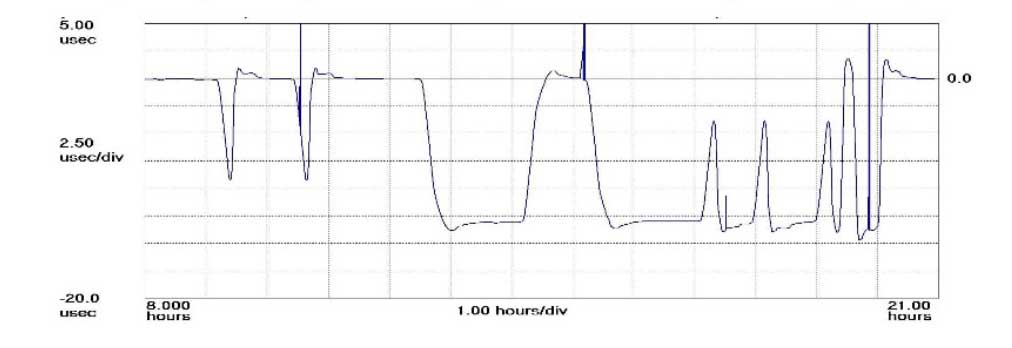
    The plot shows how the anomaly event impacted one GPS timing receiver during the day. (Click to enlarge | Chart: Chronos Technology)
    The plot shows how the anomaly event impacted one GPS timing receiver during the day. (Click to enlarge | Chart: Chronos Technology)

    “On 26 January at 12:49 a.m. MST, the 2nd Space Operations Squadron at the 50th Space Wing, Schriever Air Force Base, Colo., verified users were experiencing GPS timing issues. Further investigation revealed an issue in the Global Positioning System ground software which only affected the time on legacy L-band signals. This change occurred when the oldest vehicle, SVN 23, was removed from the constellation. While the core navigation systems were working normally, the coordinated universal time timing signal was off by 13 microseconds which exceeded the design specifications. The issue was resolved at 6:10 a.m. MST, however global users may have experienced GPS timing issues for several hours.” (This excerpt from an U.S. Air Force communiqué appears in a brief news account.)

    “The Joint Space Operations Center at Vandenberg AFB has not received any reports of issues with GPS-aided munitions, and has determined that the timing error is not attributable to any type of outside interference such as jamming or spoofing. Operator procedures were modified to preclude a repeat of this issue until the ground system software is corrected.”

    Companies and their time-servers around the world were subsequently hit by up to 12 hours of system warnings after 15 GPS satellites broadcast the wrong time, according to Chronos, a UK-based time-monitoring firm.

    Telecommunications companies constitute only a small part of industry users who rely on the highly precise accuracy of time measurements — supplied by GPS — to control data flow through their networks. Global financial networks and trading markets similarly depend on GPS, as do electrical power grids and many other sectors of critical national infrastructure. These companies and networks invest significantly in highly sophisticated equipment to monitor said timing accuracy as conveyed by GPS signals. Because billions, make that trillions — or actually even more — are riding on it.

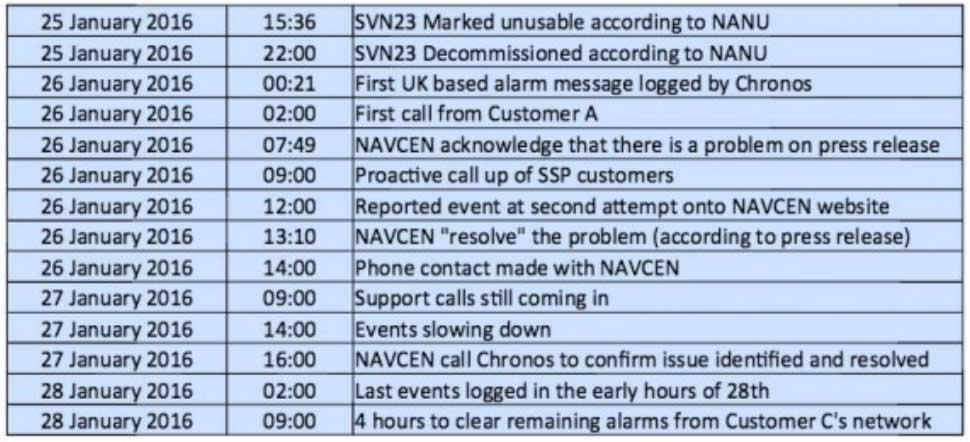
    A week after the eye blinks, Chronos Technology released a white paper describing the ensuing fallout for its clients, who are timing equipment users in more than 50 countries around the world. Table 1 from the white paper reports the experience of a few during the event. One company registered nearly 2,500 alarms from its timing equipment during the outage.

    Click to enlarge. (Table: Chronos Technology)
    Click to enlarge. (Table: Chronos Technology)

    At one point during the crisis, according to the white paper, “it appeared that the GPS error had cleared and the Chronos SSP Manager was able to force the units out of holdover. However the scale of the problem escalated as these sites went back into holdover along with dozens of other sites suffering GPS-based timing issues. It was apparent at this point that there was something amiss with the GPS constellation itself.”

    Later on, the report states, “This event linked to SVN23 has been one of the most significant service affecting issues for GPS timing users and sits alongside the April 1st 2014 GLONASS outage in scale — however its impact on global timing services is much more extreme.”

    Ominously, “Chronos is aware of other more catastrophic impacts to networks and non-telecom applications which were not under supply and support contracts.”

    As Loran Is Our Savior. At least one timing-reliant company was not disturbed by the problems, because it was testing an alternative timing service provided by enhanced Loran (eLoran) signals.

    Unfortunately for them — and for the rest of us — eLoran has a very uncertain future. In fact, they were lucky to have an eLoran signal at all on January 26, because it was supposed to have been turned off on December 31. Somebody must have forgotten to tell the operators at the Anthorn giant antenna field in Cumbria to go home.

    France, Norway, and the United Kingdom, three countries that had been keeping eLoran alive, officially abandoned the effort at the end of last year, reportedly because of lack of leadership from the United States.

    The U.S. government decommissioned all its Loran stations a few years ago, even going to the extent of blowing some of them up (perhaps to prevent them from falling into the hands of subversives). Despite a recent reinvigorated interest in enhanced Loran technology, it may be too little, too late.

    Whoa, Nellie. The first recorded use of the term “back-up technology” occurred in 1892, when farmers were urged not to prematurely abandon their mules in favor of John Froehlich’s new gasoline tractor.

    Dan Albone on his prototype Ivel Agricultural motor. (Photo: North Bedfordshire Gazette, 1903)
    Dan Albone on his prototype Ivel Agricultural motor. (Image: North Bedfordshire Gazette, 1903)

    That admonition, however prudent, has since passed from view. But the concept remains sound. It has surfaced many, many times in GPS World magazine. Certainly not the first incidence, but the farthest back that I can retrieve via search on our website, came in 2007 from Defense contributing editor Don Jewell. “Why do we need a backup? Here is a classic case in point.” He describes a Joint Navigation Conference briefing on a surprise jamming incident that had occurred in January of that year.

    In 2009, we reported on an Independent Assessment Team (IAT) report that “unanimously recommends that the U.S. government complete the eLoran upgrade and commit to eLoran as the national backup to GPS for 20 years.” The report was written in 2007, but quashed by the Department of Transportation and Department of Homeland Security (DHS) Executive Committees that commissioned it. Its public release came only after an extensive Freedom Of Information Act (FOIA) battle.

    The U.S. government proceeded, despite its paid experts’ recommendations, to blow up those old Loran stations. The current renewed interest and the Wildwood experiment are worthy — more than worthy. Can they prevail? Can they survive blind reliance on a single string of vulnerable technology?

    Indubitably, the critical role of GPS back-up was advanced prior to 2007, I just can’t document it this morning by deadline. For the sake of argument, let’s take April 12, 2007, as our start.

    We are now 3,229 days out. That’s 77,496 hours, or nearly 279 million seconds. Correct me if wrong, but that appears to make 21.5 million-million times the length of January’s GPS timing error. Surely sufficient to blink a few times, scratch one’s head, and wonder.

    Could there be a better way?

  • Team Schriever celebrates GPS heritage

    News from 50th Space Wing Public Affairs

    In honor of the space program that benefits more than 3 billion users worldwide, the 2nd and 19th Space Operations Squadrons celebrated the second annual GPS Heritage Gala Friday, Feb. 19, at the Space Foundation in Colorado Springs, Colorado.

    The two squadrons perform the satellite command and control mission for the GPS constellation. The gala celebrated GPS’s achievements as well as honored the people, both past and present, who enable the program’s success.

    Source: GPS World Staff
    Attendees give a standing ovation to Tech. Sgt. Israel Del Toro Jr. after he shared his story during the GPS Heritage Gala Del Toro was the guest speaker. (U.S. Air Force photo/Tech. Sgt. Julius Delos Reyes)

    Lt. Col. Todd Benson, 2 SOPS commander, opened the ceremony and said, “What an incredible evening. I think this is well deserved…This is a great opportunity to come together and I am truly humbled to be in a company of our guests tonight.”

    Benson also acknowledged the GPS milestones since last year’s gala, including the four spacecraft added to its now 41-satellite constellation.

    “My hat’s off to all of you who played a role in that,” he said.

    With the theme, “Setting the Gold Standard,” the event featured Tech. Sgt. Israel Del Toro Jr. as the keynote speaker. Del Toro is a Tactical Air Control Party specialist responsible for calling in airstrikes while on the frontline. He received severe burns when an improvised explosive device exploded near him while he was on a patrol in Afghanistan in 2005.

    He said GPS has come a long way. “People think it is just a navigation service, but they don’t realize the military aspect and how it impacts us.”

    Del Toro said, “I wouldn’t be here without GPS. A lot of my teammates would probably not be here without GPS. I want you to know that you make a big impact to us as operators. We truly respect you.”

    He also parted with a message of teamwork and hope to the GPS community.

    “When I got hurt, [my wife] saw every one of my teammates from all parts of the world visit me. She saw TACP Airmen I had just met a year prior at Osan Air Base, fly out to see me. She realized why I love the Air Force. We are family; we take care of our family. And I truly appreciate that,” Del Toro said.

    Del Toro also borrowed from Lou Gehrig’s farewell speech and said, “A lot of you may think I have gotten a bad break but I am the luckiest man out here because I work with the greatest men out there. I have a wife who gives me strength. I have a son who’s all my motivation. So yeah, I might have gotten a bad break, but I’ve got an awful lot to live for.”

    As part of the event, the 2 and 19 SOPS also presented the GPS Lifetime Achievement award to Jay Uebelhart for his continued 30 years of service to the success of GPS; and the 2015 Greatest Contributions to GPS Launch to Marc Drake for the launches of GPS SVN 71, 72 and 73 in 2015.

    Lt. Col. Samuel Baxter, 19 SOPS commander, concluded the event and said, “We truly love our job because we are entrusted with arguably the most famous satellite constellation there is. But more than that, we get to work with such dedicated people – Airmen, civilians, contractors. You all serve an important role.”

  • Expert Opinions: Optimum number of GNSS signals for PNT device

    Q: What is the optimum number of GNSS signals to include/process in a consumer-grade PNT device?

    Daniel Ammann Executive Vice President u-blox Group
    Daniel Ammann
    Executive Vice President
    u-blox Group

    A: The cost for including additional silicon to a receiver for processing more signals is low, thanks to multiplexing hardware and high clock speeds. Having more satellite measurements allows the receiver to be selective about which ones it actually uses for PVT calculations, so a number of 30 or higher is desirable. Such a high number, and especially if the signals come from multiple constellations, enables the receiver to have a good view on integrity, too.


    Gian Gherardo Calini Head of Market Development European GNSS Agency
    Gian Gherardo Calini
    Head of Market Development
    European GNSS Agency

    A: The answer depends on application and environment where the device will be used. With the increasing need for ubiquitous positioning in difficult environments like urban canyons, the minimum number of satellites from one constellation is not sufficient. The technology makes it possible today to achieve better performance using multiple constellations with low impact on power consumption, and this is where we see the future.


    Chaminda Basnayake Principal Engineer Renesas Electronics
    Chaminda Basnayake
    Principal Engineer
    Renesas Electronics

    A: Demand for more accuracy, availability, and reliability will drive design evolution. Sensor/map augmentations will likely drive system availability while depending on GNSS for better accuracy and reliability. As accuracy is a function of measurement quality and sky view — with the latter fixed for most use cases — placing more emphasis on minimizing errors appears ideal. Therefore, I see dual-constellation, dual-frequency GNSS as the optimal combination and the right balance between complexity versus performance.

  • Antennas: The unsung heroes of the GNSS industry

    By Tracy Cozzens
    Managing Editor

    Antennas. When I was a kid, antennas meant the pair of rabbit ears sitting on top of the family TV set. We had to constantly adjust the angles to get the best reception, using aluminum foil to improve the signal.

    Wow, how things have changed. Today, consumer users of smartphones, Fitbits, smartwatches, tablets and a hundred other electronic devices don’t even think about antennas. Most consumers probably haven’t given a thought to the fact that their favorite device contains an antenna.

    Unlike broadcast antennas back in the day, modern GNSS antennas in consumer devices are invisible to the consumer, but perform even in less-than-ideal conditions. Every year brings new improvements and smaller sizes.

    Then there are the external antennas, which grow more rugged to withstand the elements while receiving more signals from more constellations, such as BeiDou and Galileo.

    GPS World has traditionally published its Antenna Survey in February following the Receiver Survey in January. The first antenna survey appeared in 2001, nine years after we published our first receiver survey. Perhaps it took a few years to realize how critical antennas are in GNSS systems.

    As usual, the Antenna Survey encapsulates the important specifications on dozens of antennas, from stand-alone designs for high-precision commercial, defense and timing applications to micro antennas for integration into a variety of smartphones, UAVs and automobiles.

    This year, 30 antenna manufacturers provide all the details on their products. Check out the 20-page survey supplement, sponsored this year by NovAtel.

  • FY 2017 budget request includes $857 million for GPS

    The President’s Budget for Fiscal Year 2017 includes $847.362 million in Department of Defense funds and $10 million in Department of Transportation funds to sustain and modernize the Global Positioning System (GPS).

    Funds will go toward the GPS III program, including the new ground system (OCX), military user equipment, and wide-area augmentation through the Federal Aviation Administration (FAA).

    FY 2017 Program Element
    FY 2016
    Enacted
    FY 2017
    Request
    Space Procurement, Air Force: GPS III Satellites $199.218M $34.059M
    RDT&E, Air Force: GPS III Satellites $180.902M $141.888M
    RDT&E, Air Force: Next Generation Operational Control System (OCX) $350.232M $393.268M
    RDT&E, Air Force: Military GPS User Equipment $142.288M $278.147M
    DOT Research & Technology: Civil Signal Monitoring – Air Force – GPS $15M $10M

    By national policy, DOT provides resources to DOD for assessment, development, acquisition, implementation, operation, and sustainment of additional designated GPS civil capabilities beyond the second and third civil signals. In addition, the DOT budget includes the following GPS augmentations and activities.

    FY 2017 Program
    FY 2016
    Enacted
    FY 2017
    Request
    FAA Facilities & Equipment: Wide Area Augmentation System (WAAS) and GPS Civil Requirements Oversight $80.6M $85M
    FAA Facilities & Equipment: Wide Area Augmentation System (WAAS) GEO Satellite Leases $26.6M $26.6M
    DOT Research & Technology: Positioning, Navigation, and Timing (PNT) $1.61M $1.61M

    More details on the budget are available at GPS.gov.

  • Final GPS IIF satellite joins constellation

    The 50th Space Wing accepted satellite control authority of the final Global Positioning System GPS IIF satellite from the GPS Directorate during a ceremony held Feb. 12 at Schriever Air Force Base, Colorado.

    Following its launch from Cape Canaveral Air Force Station, Florida, Feb. 5, operators from the 50th and 310th Space Wings completed an extensive checkout of the satellite before placing it into its assigned orbital slot in the GPS constellation.

    Col. Steve Whitney, Space and Missile Systems Center’s director of the GPS Directorate, responsible for the acquisition of GPS satellites, started the ceremony by transferring satellite control authority of GPS IIF-12, as Space Vehicle Number 70, to the 14th Air Force.

    “The addition of the final GPS IIF satellite to the constellation is a colossal triumph, as GPS IIF capabilities are crucial to modernizing the GPS constellation. On-going modernization efforts provide the constellation with improved timing, additional civil signals and increased protection,” Whitney said. “GPS continues to be the ‘Gold Standard,’ providing precise positioning, navigation, and timing services to users around the globe.”

    “This launch of the last Block IIF GPS satellite marks a significant milestone for the program, which continues unprecedented support to our military forces and the general public,” said Lt. Gen. David J. Buck, 14th Air Force commander and commander of the Joint Functional Component Command for Space, U.S. Strategic Command.

    “The capabilities enabled by the position, navigation and timing signals of the GPS constellation are ingrained into the fabric of our daily lives. From paying at the gas pump, to ATM withdrawals and precision farming; international banking or international shipping, GPS enables the modern way of life,” said Buck. “It is also a critical component of delivering precise combat power in support of joint and coalition warfighter objectives, and I am pleased to make the constellation more robust and resilient than ever, ensuring we can continue to support America’s warfighters well into the future.”

    Buck’s comments were echoed by those who are now entrusted with the care and operation of the satellite.

    “It’s always a pleasure to transfer satellite control authority to the operators who will deliver those combat effects to the field,” said Col. DeAnna M. Burt, 50th Space Wing commander. “GPS is always a little bit different thanks to the billions of civilian users who also engage this global utility.”

    Daily operation of the satellite is delegated to the 2nd Space Operations Squadron. GPS IIF satellites provide improved signal capabilities and increased user accuracy for military and civil users.

    “We take great pride in commanding and controlling this constellation on a daily basis,” said Lt. Col. Todd Benson, on behalf of the 2nd and 19th Space Operations Squadrons. “This satellite is the last in a demanding schedule of IIF satellite launches; the units have teamed together to support six launches in just 18 months.”

    GPS IIF-12 (SVN-70) will replace the legacy SVN-41, which will be moved to another location and provide auxiliary support to the GPS constellation. The oldest GPS satellite in the constellation, SVN-23, has been removed from the broadcast almanac to make room for GPS IIF-12. Launched Nov. 26, 1990, SVN-23 was decommissioned after 25 years of service prior to the launch of GPS IIF-12.

    “GPS IIF-12 marks the 12th satellite launched in under six years, between May 2010 and Feb. 2016, and the seventh in the last 21 months,” stated Lt. Gen. Samuel Greaves, Space and Missile Systems Center commander and Air Force program executive officer for space. “This incredible track record is the result of the remarkable relationship between SMC, our operators within the 14th Air Force and our ULA/Boeing industry partners. Their continued tenacity and dedication to mission success ensures we continue to maintain a robust satellite constellation with modernized, more resilient GPS capabilities.”

  • GPS IIF-12 satellite is now active

    The last Block IIF satellite, launched on Feb. 9, is active. “All-in-view” tracking stations of the International GNSS Service (IGS) network have been receiving its signals since Feb 10.

    The satellite’s designation is PRN32/SVN70. That PRN is already included in the analysis by the Center for Orbit Determination in Europe (CODE).

    The IGS orbit products will now cover 57 satellites (32 GPS plus 25 GLONASS).

    http://www.aiub.unibe.ch/download/igsdata/y2016/odata2_d041.txt
    http://www.aiub.unibe.ch/download/igsdata/y2016/odata2_d042.txt

    CODE is a consortium of AIUB and the Swiss Federal Office of Topography (swisstopo, Wabern, Switzerland), the Bundesamt für Kartographie und Geodäsie (BKG, Frankfurt a. M., Germany), and the Institut für Astronomische und Physikalische Geodäsie, Technische Universität München (IAPG/TUM, Germany).

  • System of Systems: GPS III bidding, testing

    GPS III Bidding Opens — Again

    The GPS Directorate at the Space and Missile Systems Center (SMC) continues to look for someone to build 22 GPS III satellites in the near future.

    SMC issued a request for proposals on Jan. 8, with rather complicated terms. The first eight GPS III satellites are already under contract, and two have been built, but delivery and launch schedules have dragged. The Air Force incorporated several other payload requirements for the satellites, beyond those of new GPS signals themselves.

    This is the Air Force’s third effort to find a builder.

    The RFP is for “11+ Phase 1 Production Readiness Feasibility Assessment. “ It covers GPS III space vehicles 11 and beyond. The process, if followed as the Air Force envisions, will award up to three relatively small fixed-price contracts.

    According to an Air Force press release, “The scope of this effort includes the current GPS III SV01–08 technical baseline with the addition of redesigned Nuclear Detonation Detection System (NDS), Search and Rescue/GPS (SAR/GPS), and Laser Retroreflector Array (LRA) payloads, Unified S-Band (USB) compliance, Regional Military Protection capability No changes are allowed to the GPS Next Generation Operational Control System (OCX) or Military GPS User Equipment (MGUE) interfaces.”

    The first Air Force effort to recompete the contract for future GPS III satellites came in 2014. A 2015 initiative lowered the bar as far as requirements, but also lowered the award very dramatically, from $200 million each for two companies to $6 million each for three companies.

    The 2016 announcement appears to replicate the terms of the 2015 campaign. There has been no official explanation as to why the terms changed between 2014 and 2015, and why they did not between 2015 and 2016.


    First GPS III Satellite Passes Critical Test

    The first GPS III satellite has passed a critical on-ground, in-lab test, according to Lockheed Martin.

    Rick Ambrose, executive vice president of Lockheed Martin Space Systems, tweeted on Jan. 13 that the satellite had successfully completed its thermal vacuum test (TVAC).

    Lockheed Martin Space Systems is the prime contractor on the GPS III program to build a total of eight GPS IIIs. The contract includes options for up to four more satellites, and the Air Force has told Congress it expects to execute options for at least two of those satellites.

    The first GPS III satellite is expected to launch in 2017.


    USCG-Alert-W

    Coast Guard Issues Jamming Alert

    The U.S. Coast Guard issued a safety alert on Jan. 16, warning mariners of the potential detrimental impact to navigation caused by GPS interference or jamming. The warning emphasizes the importance of understanding how vessel equipment could be impacted by the loss of a GPS signal.

    The Coast Guard states that this past summer, multiple outbound vessels from a non-U.S. port suddenly lost GPS signal reception. The net effect was various alarms and a loss of GPS input to the ship’s surface search radar, gyro units and ECDIS, resulting in no GPS data for position fixing, radar over ground speed inputs, gyro speed input and loss of collision avoidance capabilities on the radar display.

    Fortunately, the vessels were able to safely continue theirvoyage using radar in heads up display, magnetic compass and terrestrial navigation. Approximately six nautical miles later, the vessels’ GPS units resumed operation. Although the vessels had back-up systems to allow a safe transit, the consequences could have been severe, warns the Coast Guard.


    IRNSS Launches Fifth Satellite

    The fifth satellite in India’s Regional Navigation Satellite System rode into orbit Jan. 20, joining a growing fleet of spacecraft to provide positioning services to users across South Asia.

    “With this satellite in place, within our country we will be able to get, 24 x 7, a good positional accuracy,” said A.S. Kiran Kumar, chairman of the Indian Space Research Organisation (ISRO).”

    IRNSS 1E will raise its orbit to an altitude of nearly 36,000 kilometers (22,300 miles) over the next few weeks, entering an orbit centered on 111.75 degrees east longitude and oscillating up to 28.1 degrees north and south of the Equator.

    Two more IRNSS spacecraft are due for launch bythe end of March to complete the constellation.

    The seven satellites — four in inclined geosynchronous orbits like the one intended for IRNSS 1E, and three in equatorial geostationary orbit — will give India an independent navigation system with coverage over Indian territory and regions extending up to 1,500 kilometers (932 miles) from its borders.

    India started launching its navigation satellites in 2013. Each spacecraft is designed to operate for 12 years.

  • Russia launches GLONASS-M 51 into orbit

    Russia launches GLONASS-M 51 into orbit

    GLONASS-M-51-launch-7

    A GLONASS-M satellite was launched into orbit on Feb. 7 at 03:21 Moscow time from the Plesetsk Cosmodrome spaceport, reports the Russian space agency Roscosmos.  The Russian Defense Ministry successfully launched GLONASS-M 51 (known as 751 in orbit) aboard a Soyuz-2.1b rocket with a Fregat upper stage.

    Three and a half hours after lift-off, the satellite separated from the upper stage and ground control established communications with it. The stable telemetry link shows that onboard satellite systems are functioning normally.

    According to the telemetry data received from GLONASS-M 51, the satellite is in good health. With all its mechanical subsystems successfully deployed, the satellite completed Earth and Sun acquisition. The Moscow-based System Control System and ISS-Reshetnev’s Information and Computation Center have begun satellite’s performance check-out.

    Status of the GLONASS constellation, shown here, indicates that the satellite is now in the commissioning phase.

    GLONASS-M 51 will replace a GLONASS satellite now operating three years past its design life.

    Based on the GLONASS system’s stable operation, there has been no need to launch new satellites to augment the system, said the satellite manufacturer. The most recent launch of a GLONASS satellite was performed in 2014.

    Eight GLONASS-M navigation satellites are being stored at ISS-Reshetnev Company awaiting launch.

    GLONASS orbital grouping provides a solution to problems of global positioning in the interests of the Russian Defense Ministry and civilian users. Access to civilian navigation signals of global navigation satellite system GLONASS is provided to Russian and foreign consumers free of charge and without restriction.