Category: GNSS

  • Leap Second Implementation Confuses Some Receivers

    The United States Civil GPS Service Interface Committee (CGSIC) has issued a notice about a problem some receivers are having implementing the correct time. The U.S. Coast Guard Navigation Center has received reports of synchronization issues since the implementation of a leap second on Jan. 21. Users experiencing this problem should contact the receiver manufacturer for a firmware or software update.

    Below is the text of the CGSIC notice:


    All CGSIC: 2015 GPS Future Leap Second Implementation

    The GPS 50 bit-per-second navigation message transmitted by each GPS satellite (specifically Page 18, subframe 4) includes the parameters needed to relate GPS time to UTC (Coordinated Universal Time).  That relationship is maintained through leap second implementation transitions by IS-GPS-200 compliant user equipment.  For leap second transition, user equipment must utilize the notice regarding a scheduled future delta time due to leap seconds (ÄtLSF), together with the week number (WNLSF) and the day number (DN), at the end of which the leap second becomes effective.

    On or about Jan. 21, 2015, those GPS navigation messages began to include future leap second data which indicates an increase in the leap second to become effective at the end of June 2015.  IS-GPS-200 revision H, dated 24 Sep 2013 paragraph 20.3.3.5.2.4 Coordinated Universal Time (UTC), documents the appropriate algorithm details to ensure correct utilization of the parameters above (including all potential truncated week number transitions and variations in time of processing relative to satellite upload timing near the future leap second effectivity).

    The data upload for the June 30 leap second, initiated with SVN48/PRN07 at 18:33:56z on Jan. 21, was correctly executed. However, there are several receivers brands/models that seem to be mishandling this information and applying the leap second now. This is creating a negative one-second offset in faulty receivers. The U.S. Coast Guard Navigation Center has reports of these receivers causing synchronization issues with radios, computer systems, and data logging equipment.

    Users experiencing issues with GPS receivers that began on Jan. 21 should contact the receiver manufacturer to determine if the latest firmware or software patch can correct the issue.

    V/R Rick Hamilton
    CGSIC Executive Secretariat GPS Information
    Analysis Team Lead USCG Navigation Center
    703-313-5930

  • The System: ESA’s Second FOC Moves Up

    The System: ESA’s Second FOC Moves Up

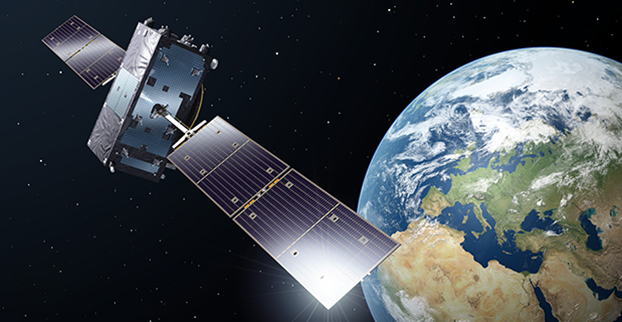
    The fifth Galileo satellite is now pointing toward Earth.
    Milena, or Galileo-FOC FM2, moves above the dangerous Van Allen Belt to rejoin Doresa, Galileo-FOC FM1, in a partially usable orbit. Photo: Galileo

    By Tim Reynolds, GPS World European correspondent

    Director General Jean-Jacques Dordain of the European Space Agency (ESA) announced Jan. 16 that the second errant full-operational capability (FOC) satellite, launched in August, had started its orbital change maneuver the previous day. He anticipated that the orbital change would be completed and the final orbit — “albeit somewhat lower in height than the one into which it was supposed to go” — achieved in “a few weeks.” He confirmed that both in-orbit FOCs work well, are fully operational, and provide excellent on-spec positioning data.

    Two more FOC satellites are ready for launch, and a third has undergone thermal vacuum testing. Dordain said four will be available to launch soon, and he anticipated up to six FOCs being ready for launch in 2015 [word came at press time that all 2015 launches would be aboard the previously problematic Soyuz vehicle, and not on heretofore reliable Ariane]. The previous plan had called for four in 2015, but the total now includes two that were held back from a December 2014 launch. The actual schedule and launch vehicles are still under discussion, according to Dordain; the European Commission (EC) will make a decision at the end of January on this. He refused to comment on what ESA would recommend to EC on this front.

    Read Tim Reynolds’ Brussels-based reporting the in EAGER quarterly enewsletter; free at gpsworld.com/subscribe.

    OCX, GPS III Pass Key Test

    Raytheon Company and Lockheed Martin successfully completed the fourth of five planned launch and early orbit exercises to demonstrate new automation capabilities, information assurance, and launch readiness of the next-generation GPS III Operational Control System (OCX).

    The completion is a key milestone towards end-to-end capability to automatically transfer data between Raytheon’s OCX and Lockheed’s GPS III satellite. One more readiness exercise, five launch rehearsals, and a mission dress rehearsal are planned before launch of the first GPS III with OCX.

    The exercise demonstrated mission planning and scheduling capabilities with the simulated Air Force Satellite Control Network (AFSCN) for the first time, including a replan scenario that would occur in the event of a launch slip.

    The system also automatically generated antenna pointing angles for the simulated AFSCN — until now, manually generated. Exercise 4 introduced maneuver planning and reconstruction capabilities, as well as advanced planning and scheduling with AFSCN assets. Automation of these capabilities will allow GPS operators to optimize system performance rather than focus on routine operations.

    Brigadier General Cooley

    Colonel William Cooley, director of the GPS Directorate, has been nominated to the rank of brigadier general, United States Air Force. He wrote a December GPS World article on “What It Takes to Make a Gold Standard.”

  • IS-GNSS 2015 Issues Call for Papers for Kyoto Conference

    The organizers of the International Symposium on GNSS (IS-GNSS 2015) are seeking paper submissions. The symposium will be held Nov. 16-19 in Kyoto, Japan.

    The International Symposium on GNSS is designed to bring together experts engaged in PNT and GNSS technologies — including industry professionals, practitioners, academics and researchers — to disseminate their latest research results and allow cross-disciplinary exchange of knowledge to further advance the fields.

    The program will include keynote addresses, oral presentations, interactive poster sessions, panel sessions, open interactive forums and an informative trade exhibition.

    The Asia and Pacific Rim meeting of the CGIC (Civil GPS Service Interface Committee) will be co-located with ISGNSS 2015 to help improve understanding of world trends in developing and deploying GNSS.

    Kyoto is the ancient capital of Japan and a top tourist destination, organizers said, with the conference scheduled during the best sightseeing season.

    Registration will open April 1, along with a hotel booking page. The logistic information will be announced later.

    A student scholarship is being offered to the student with the most promising paper. “If you have students, please encourage them to apply,” said Akio Yasuda, president of Institute of Positioning, Navigation and Timing of Japan.

    For more information on the conference, including sponsorships and exhibits, email [email protected].

  • 2, 4, 6, 8 — Who Do We Appreciate?

    Galileo, that’s who! For dogged determination and persistent pushing-forwardness in the face of adversity, obstacles, and the occasional technical difficulty. That there may be occasional confusion, as well, or mixed messages as to just what the future may bring, is certainly understandable. In fact, it is to be expected, given the circumstances.

    Let’s review the math.

    Two

    Two for the two launch vehicles that Galileo may use in the near future, Soyuz Fregat and Ariane 5. The Soyuz rocket can lift two satellites of the Galileo punching weight. The Ariane 5 rocket can carry four into space.

    Soyuz Fregat has a losing record so far with Galileo, being responsible for the August 2014 loosening of the first two full-operational capability (FOC) satellites into the dangerous Van Allen Belt. The first of these satellites has been successfully repositioned by the European Space Agency (ESA) into a mostly-but-not-totally useable orbit, and the second is currently en route to a similar spot.

    We do not wish to say we told you so, but we will. Back on March 26, 2014, we wrote on these virtual pages, “ESA’s year-end plan calls for two more dual-satellite launches in October and December on Russian Soyuz rockets — new partners to the Galileo dance, bringing perhaps new technical connectivity issues.”

    “Rockets are tricky,” said Tesla/SpaceX CEO Elon Musk, after his Falcon 9 Reusable rocket exploded over Texas at roughly the same time that Soyuz Fregat mis-delivered two Galileo satellites into wrong orbits.

    Musk meant tricky in actual operation, but we may also add, tricky in scheduling, in getting a cargo aboard a spacebound vehicle. Arianespace’s calendar is particularly filled with telecomm satellites impatient to be put aloft, with Ariane 5 being the preferred launcher of many. Soyuz availability, understandably, is somewhat more open.

    Four

    Four for the total of four Galileo satellites now orbiting and broadcasting useable signals at all times for all users. These four come from the in-orbit validation (IOV) generation.
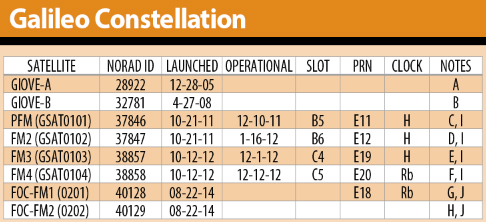
    Galileo-chart-Jan2015

    The two added FOC satellites, no longer in a bad orbit, now in a sort-of-pretty-good orbit, should be useable at some times, for some purposes, by some people. Peter Steigenberger and André Hauschild, researchers at the German Aerospace Center (DLR) / German Space Operations Center, wrote in this magazine in January that:

    “Despite the orbit injection error, the new Galileo FOC satellite has now been successfully activated and added to the Galileo constellation. Unfortunately, the current orbit is incompatible with the standard Galileo almanac format, which may cause restrictions for some commercial receiver types.

    “Nevertheless, the satellite can already be tracked by a wide range of geodetic receivers with existing firmware versions and it will, in fact, be possible to use the new satellite for diverse applications in surveying, precise positioning, and geodesy, as well as in general multi-GNSS studies. We now look forward to the activation of the second FOC satellite, which can be expected in early 2015 and will, for the first time, offer multi-frequency signals from a total of five Galileo satellites.”

    If you have four fully useable satellites and two partially useable satellites, what do you have? Does six = five functionally in this case? Or perhaps 5.5?

    Six

    Six for the oncoming new Galileo FOC satellites to be launched in 2015, according to some schedules and some official announcements.

    On a year-opening preview of operations given on Jan. 19, Thomas Reiter, Head of the European Space Operations Centre (ESOC) in Darmstadt, Germany, outlined the launch schedule for Galileo in 2015. Six new FOC satellites in total:

    • Galileo L4 with two on March 26
    • Galileo L5 with two in September
    • Galileo L6 with two in December.


    Now, six satellites divided by three launch dates gives two satellites per launch. Seeming to indicate a Soyuz rocket for all three dates. Reiter did not mention any rocket by name, but this would be the inference.

    That’s putting a brave face on the situation. Back in May, Russia suffered its fifth rocket launch crash in the past four years, raising serious concerns about the reliability of Russian rockets and launch procedures. Subsequently, the August Galileo launch that went so wrong was controlled by Arianespace, but it did use the Russian equipment.

    It strains credulity that an omission or oversight in the system thermal analysis  during stage design of a million-dollar rocket, designed to carry million-plus-dollar satellites in a 21st-century endeavor, could permit the creation of a thermal bridge between two feed lines, causing one of them to freeze during a crucial phase of space operations — but that is what apparently happened at some point at NPO Lavochkin in Russia, and that is what ultimately caused Galileo such misfortune. All parties concerned swear that this problem has been corrected in every other Soyuz Fregat, but who knows what other anomalies lie undiscovered therein?

    So putting all your 2015 money aboard Soyuzes is really rolling the marbles. Even if, as Elżbieta Bienkowska, Member of the EC in charge of Internal Market, Industry, Entrepreneurship and SMEs stated at this week’s 7th European Space Conference: EU Space Policy Confronted With the Rising Demand for Services and Applications, “We agreed to contract insurance for the next launches.”

    Eight

    Eight for the oncoming new Galileo FOC satellites to be launched in 2015, according to other schedules and other official announcements.

    “2015 will be a crucial year for the European space industry. We have big plans,” said Maros Sefcoviv, vice-president of the EC in charge of Energy Union, earlier at the very same 7th European Space conference, EU Space Policy Confronted With the Rising Demand for Services and Applications.

    “On the biggest one, we are planning five launches, which will bring up to space 10 satellites: eight for our Galileo constellation, and two for Copernicus. This is something that will put these programs over, I would say, over the edge, in a way, to be able to offer early services from Galileo, and to develop the program of Copernicus. It would prove the resilience and competitiveness of the European space industry, and its ability to serve the businesses, and what I think is most important, to offer new kinds of services to the citizens.”

    “For our flagship programs like Galileo and EGNOS, our priority must be to deliver services as soon as possible. That is why the satellites have to be delivered and operations must be ready as soon as possible.”

    Now, if you have eight satellites to go up in three launches, that would mean one of them has to go with four aboard. Thus, an Ariane 5 Galileo launch this year after all? Or possibly four Soyuz launches, although one more launch date could just just as hard to come by as a launch vehicle.

    Hard to tell. Very hard to tell. Extremely hard to tell, from the outside.

    Those who do not study history are condemned to repeat it, goes the dictum. Those who do study GNSS history, in this case, are likely only to repeat past pronouncements without any perceptible advance in clarity.

    Way, way back in March 2013, an EC program manager told GPS World, “Then, in 2014 [after four FOC satellites were to rise in 2013, which did not happen] we will see three Soyuz launches of two satellites each. We do not have the precise launch dates yet, but they are likely to be in April, June, and September. In December 2014, we expect to have the first launch using the Ariane 5 launcher, which is capable of deploying four satellites in one go. This means that by the end of 2014 Galileo will have deployed 18 satellites in orbit.”

    Now, the target has moved several times since then, and the schedule has slid accordingly.

    “In 2015, there will be two Ariane 5 launches, one in the middle of the year, one at the end, each carrying four satellites.”

    Six or Eight?

    Either number this year, we would surely appreciate. To return to Ms. Bienkowska, she left a little fudge room in her presentation: “We aim to launch at least six satellites this year.”

    Well, at least we are all moving forward. Resolutely.

    ——————————–

    I am indebted to Tim Reynolds, GPS World’s Brussels-based European correspondent, and to Peter de Selding, Paris bureau chief of SpaceNews, for their assistance in gathering diverse intelligence on this topic. Tim Reynolds will have an up-to-date view of this and other Galileo developments when we publish the next issue of the EAGER* newsletter at the end of March. Subscribe for free.

    * The European GNSS and Earth Observation Report
  • Chinese BeiDou/GPS Module Aims to Serve Civilians

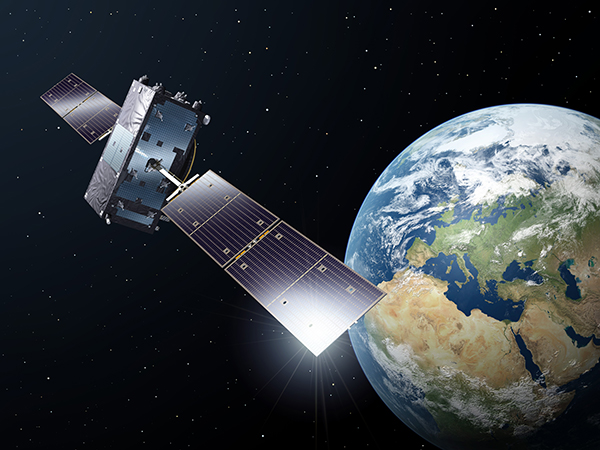
    A new module produced by a Chinese company combines GPS and BeiDou for civilian positioning, especially for automobiles. The module has been in development for years, and offers improved accuracy and reliability, according to its makers.

    “GPS is a single-mode application. But we what are offering with our new module now is a system that can combine Beidou and GPS services, so that the accuracy and reliability can be improved,” Lin Hongzheng, China Electronics Tech. Group Corporation, told CCTV.

    The module is expected to improve accuracy to better than one meter, which is now achievable by the current BeiDou system, according to the module’s developers. Ground stations would improve the accuracy even further. “Hopefully, it will be able to position vehicles in different lanes of a road,” said Hu Jinmin, Shenzhen Road Rover Technology.

    Pricing has always been a struggle for Beidou hardware, CCTV said. The market price of the new module has come down to less than 30 yuan, or US$5, similar to that of a GPS module.

    “This year, from modules to end products, the Beidou system is ready for massive production and ready to compete in the market,” Hongzheng told CCTV.

  • UBL Interactive Enters Data Agreement with NavAds for GPS Locations

    UBL Interactive, Inc. today announced a global data syndication agreement with Amsterdam-based NavAds to help businesses ensure their profiles appear in navigation services and devices.

    The NavAds agreement will improve the quality of the business listing information and the breadth of distribution for UBL customers. NavAds specializes in business listing insertion and advertising on navigation services such as TomTom, Garmin, Nokia HERE, Waze, Yandex, and others.

    UBL CEO, Doyal Bryant, said the partnership was significant not only because it addressed the growing use of mapping tools, but because it was a global arrangement. “UBL is focused on an increasingly mobile world, and services which are not confined by national borders. Navigation services are constantly changing and evolving and with our NavAds partnership, our customers can be assured anywhere globally, they will get the benefit of the most advanced distribution in the mapping space,” he said. “It extends our place as the global leader in business listing syndication, with more publishers and international local partnerships than any others in the space.”

    NavAds CEO, Lex ten Veen, said UBL would bring many new owner-verified business locations to the NavAds platform and network. “Businesses need to be found on these navigation devices, and NavAds can give UBL’s customers great confidence their visibility is fully optimized,” he said.

    The services will be integrated into UBL product sets immediately.

  • Funding Proceeds for More GLONASS-K1 Satellites

    News courtesy of CANSPACE Listserv.

    According to its in-house newspaper, Siberian Satellite, the joint-stock company “Information Satellite Systems – Academician M.F. Reshetnev” has signed two loan agreements with the Russian VTB Bank (formerly Vneshtorgbank) worth 2.5 billion rubles ($38 million) to finance the production of GLONASS-K navigation satellites.

    Presumably, this refers to the decision to produce more GLONASS-K1 satellites as recently announced.

    The Russian government owns 61% of VTB.

  • Second Wayward Galileo FOC Moving Higher

    Second Wayward Galileo FOC Moving Higher

    At a press conference on Jan. 16, Director General Jean-Jacques Dordain of the European Space Agency (ESA)  announced that the second errant full-operational capability (FOC) satellite, launched in August, had started its orbital change maneuver the previous day. He anticipated that the orbital change would be completed and the final orbit — “albeit somewhat lower in height than the one into which it was supposed to go” — achieved in “a few weeks.” He confirmed that both in-orbit FOCs are working well, fully operational, and providing excellent “on specification” positioning data.

    The fifth Galileo satellite is now pointing toward Earth.
    The first errant Galileo satellite is now pointing toward Earth.

    Two more FOC satellites are ready for launch, and a third has undergone thermal vacuum testing at ESA’s European Space Research and Technology Centre (ESTEC) facility in the Netherlands. Dordain said four would be available to launch soon, and he anticipated up to six FOCs being ready for launch during 2015.

    The previous plan had called for four for 2015, but the year’s anticipated total now includes the two that were held back from launch during a December 2014 window, so the total number is the same. The actual launch schedule and launch vehicles are still under discussion, according to Dordain, and he said the European Commission (EC) would make a decision at the end of January on this issue. He refused to be drawn out on what ESA would recommend to EC on this front.

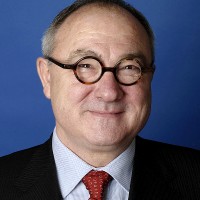
    Jean-Jacques Dordain
    Jean-Jacques Dordain

    “As you know, Soyuz did not place the first two FOC satellites in the right orbit. They only achieved very low orbits. This led and is still leading to delays in the deployment of the Galileo constellation. However, it’s not all bad news, because the two FOC satellites are working perfectly,” Dordain said.

    “One of the two has already had its orbit changed, last November, and once in its new orbit, we ran all the new payload tests, and all the data that we have show that the FOC payload is the best in orbit today of the Galileo satellites. We were able to achieve on-spec positioning with the first FOC and the IOV satellites. It provides us with highly accurate positioning data,” Dordain said.

    “Once we have both FOCs in their final orbits, not their nominal orbits, it’s true, but they are orbits that mean they will be usable for a long time, because they no longer go through the Van Allen belts.”

    A video of the news conference is available here. The Galileo portion of the 2-hour video begins at 11:45. The event took place at ESA-HQ, Paris, France.

  • Six Galileo Satellites Planned for 2015 Launch

    Six Galileo satellites are scheduled to be launched this year, European Space Agency (ESA) Director General Jean-Jacques Dordain said on January 16.

    “The launch of six satellites is scheduled for 2015. The [European] Commission will determine the terms of the launches at the end of January,” Dordain said at a press briefing. The satellites will be put into orbit by Ariane 5 and Soyuz carrier rockets.

    The Galileo project is jointly implemented by the European Union and the ESA.


  • Galileo Service Interruption Planned for System Upgrade

    Galileo Service Interruption Planned for System Upgrade

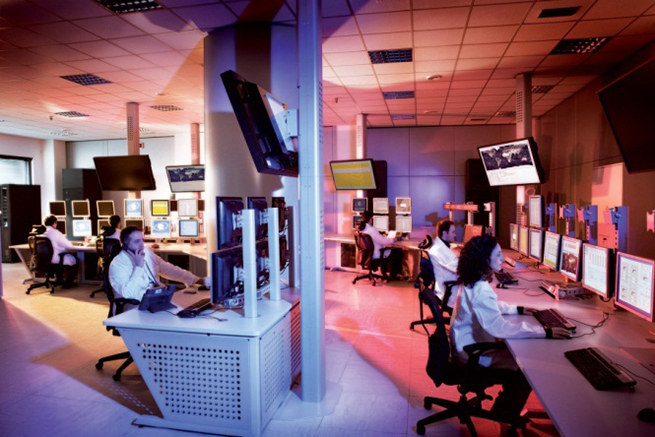
    Operators of Galileo's Ground Mission Segment at the Galileo Control Centre in Fucino, Italy. These operators oversee the navigation services of the Galileo constellation.
    Operators of Galileo’s Ground Mission Segment at the Galileo Control Centre in Fucino, Italy. These operators oversee the navigation services of the Galileo constellation. Photo: Galileo

    Galileo’s navigation messages will shortly stop being updated to enable the migration of a new release for Galileo’s ground mission segment, announced the European Space Agency.

    Although the actual navigation signals will continue to be transmitted, the generation and uplink of the navigation message — which renews the contents of the signal — will be interrupted during the last week of January for about five weeks.

    The accuracy of the navigation message received by users will slowly degrade, or in case of a reset in the satellite signal generator the message content will be dummy material. The users will be informed accordingly through a warning flag in the disseminated message, or through the online Notice Advisory to Galileo Users.

    “The main benefits of this migration from V1.2 to V2.0 of the Galileo Ground Mission Segment are better overall performance and availability, increased robustness and improved operability,” explained ESA’s Martin Hollreiser, who is overseeing the mission segment’s development with Thales Alenia Space France as prime contractor. “The latter is achieved through enhanced operator interfaces, increased access to performance data and the automation of procedures.

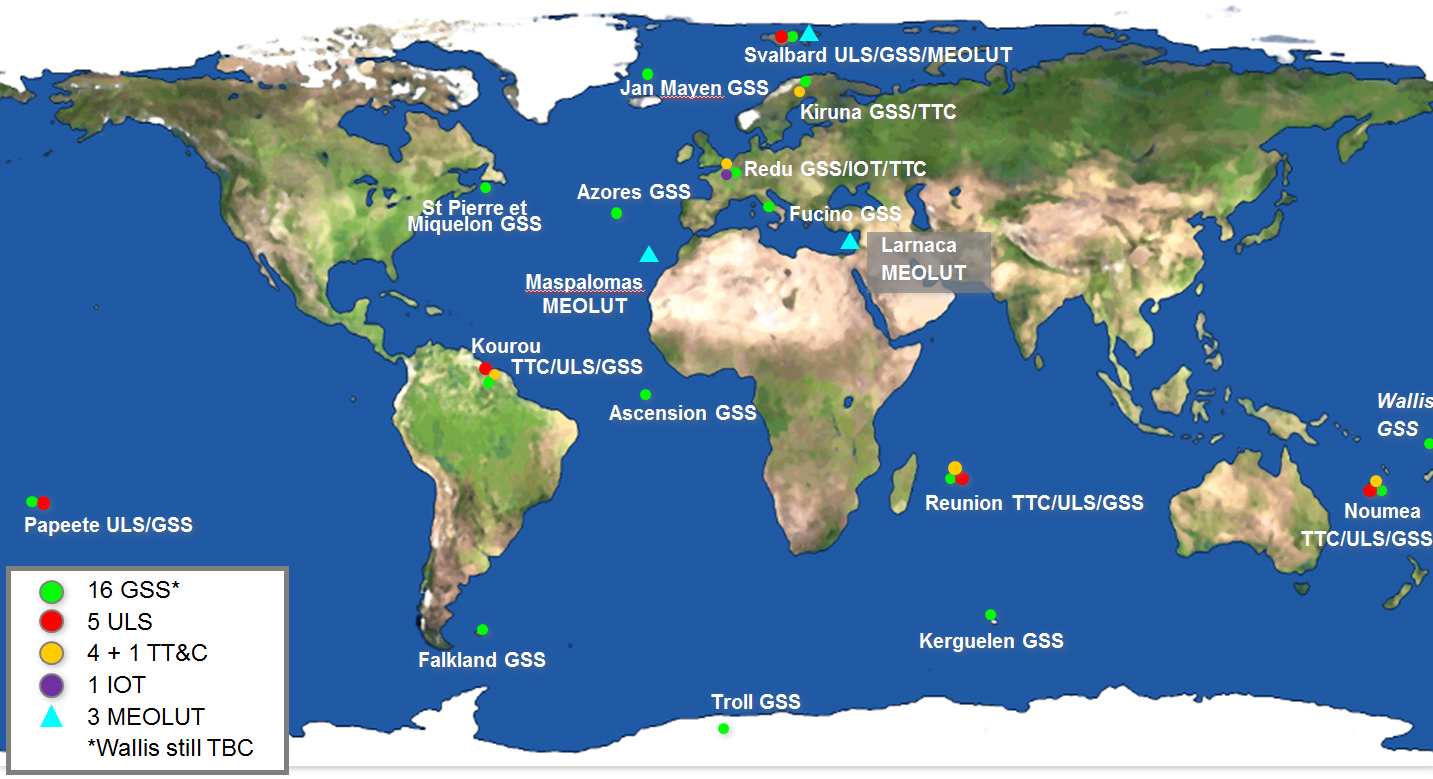
    “Various ‘non-conformances’ identified by operators over time have been fixed, while overall security has been further strengthened through treatment plans,” Hollreiser said. “This is in particular true for the Public Regulated Service, or PRS, the most secure Galileo class of signal. Finally, the number of Galileo Sensor Stations will increase from 12 to 15 worldwide and the number of Galileo Uplink Stations from four to five.

    “The new Sensor Stations will be on Santa Maria in the Azores, Ascension Island in the mid-Atlantic and Kiruna in the Swedish Arctic. The additional Uplink Station will be on Papeete, in French Polynesia. Such system improvements have always been part of our planning since the contract began in 2011.”

    Galileo’s worldwide ground mission segment is one of the most complex developments ever undertaken by ESA, with twin European Galileo Control Centres and a network of sensor and uplink stations deployed on remote sites across the world. They are all interconnected via a robust satcoms realtime network.

    While satellite control and housekeeping are performed by Galileo’s Ground Control Segment in Oberpfaffenhofen, Germany, the Ground Mission Segment that provides the navigation and timing services and related performances is operated from a separate centre in Fucino, Italy.

    Galileo’s ground segment encompasses twin European Galileo Control Centers and uplink stations on remote sites across the world. They are all interconnected via a robust satcom network. It includes Galileo Sensor Stations (GSSs) to provide coverage for clock synchronization and orbit measurements; uplink Stations (ULSs) to uplink navigation and integrity data to the Galileo satellite navigation payloads for rebroadcast to users; Telemetry, Tracking and Command Stations (TT&Cs) to manage the satellite platforms; an In-Orbit Test (IOT) site at Redu for satellite payload testing and a trio of Medium-Earth Orbit Local User Terminals (MEOLUTs) for search and rescue activities.
    Galileo’s ground segment encompasses twin European Galileo Control Centers and uplink stations on remote sites across the world. They are all interconnected via a robust satcom network. It includes Galileo Sensor Stations (GSSs) to provide coverage for clock synchronization and orbit measurements; uplink Stations (ULSs) to uplink navigation and integrity data to the Galileo satellite navigation payloads for rebroadcast to users; Telemetry, Tracking and Command Stations (TT&Cs) to manage the satellite platforms; an In-Orbit Test (IOT) site at Redu for satellite payload testing and a trio of Medium-Earth Orbit Local User Terminals (MEOLUTs) for search and rescue activities.

    A user’s satnav receiver needs signals from at least four satellites. It actually measures the time the signal takes to reach its antenna from the satellites, then converts time into distance to compute its spatial position as the intersection of the four resulting spheres. To reach sufficient level of precision, the time synchronization of the overall system clocks must stay accurate to a few billionths of a second, and any drift in satellite orbits must be corrected for.

    This is the task of the Ground Mission Segment in the control center, which continuously receives signal measurements from the sensor stations around the world. Based on these measurements, it computes exact satellite orbits and time synchronization for the satellites’ onboard atomic clocks.

    These corrections are incorporated into the ephemerides included in an updated navigation message, which is uplinked to the satellites for dissemination to the user. The updated ephemerides information in the navigation signal provides to the user receivers the information required to compute their exact position.

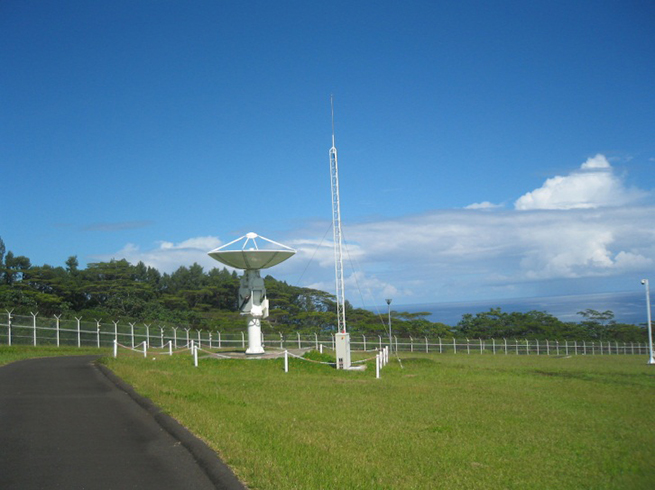
    The new Papette Uplink Station in Tahiti, French Polynesia, used for uplinking navigation messages for rebroadcast to users from Galileo satellites.
    The new Papette Uplink Station in Tahiti, French Polynesia, used for uplinking navigation messages for rebroadcast to users from Galileo satellites. Photo: Galileo
  • Terry Moore Considers Future of GNSS in RIN Lecture

    Terry Moore
    Terry Moore

    Professor Terry Moore explores “Where next for GNSS? ” in the Anderson Memorial Lecture at the Royal Institute of Navigation on March 2. Moore is the associate dean for infrastructure and director of the Nottingham Geospatial Institute, Faculty of Engineering, at the University of Nottingham.

    Moore will review the current status and proposed modernization of GPS with an emphasis on the benefits that the developments and new signals will bring to a variety of user domains. In a similar manner, the Russian GLONASS will also be described documenting the evolution to the system’s current status and the planned developments.

    The new European Galileo and Chinese BeiDou systems also will be described along with consideration of the international efforts directed towards interoperability of all the global systems. Other nascent and proposed systems will be introduced, such as IRNSS and QZSS.

    The lecture is presented by the Royal Institute of Navigation in conjunction with the RAF Cranwell Branch of the Royal Aeronautical Society. There is no charge for RIN or RAeS members, but RIN members who would like to attend should book through [email protected] to be informed of the security and entry arrangements. The lecture will be held at Whittle Hall, RAF Cranwell, Sleaford, Lincs, U.K.

    A member of the GPS World Editorial Advisory Board, Moore holds a B.Sc. degree in Civil Engineering and a Ph.D. degree in Space Geodesy from The University of Nottingham. He is a Fellow of the Royal Institute of Navigation, a former vice president and a member of its council. He is a member of the European Space Agency GNSS Scientific Advisory Committee and a member of the UK Space Agency Telecoms and Navigation Committee. He is also a member of The Institute of Navigation and a Fellow of the Royal Astronomical Society.

  • PNT Board Report: GPS Critical Infrastructure, Concern over International Signals

    Report on the 14th meeting of the National Space-based PNT Advisory Board in Washington, D.C., held December 10-11, 2014.

    By Ron Hatch

    Ron Hatch
    Ron Hatch

    The December meeting of the PNT Advisory Board meeting brought forth important developments and proposals for the protection of GPS as part of the U.S. critical national infrastructure. A separate presentation made by speakers from the National Telecommunications and Information Administration (NTIA) and the Federal Communications Commission (FCC), concerning possible limitations on the use of signals from other GNSS, generated some controversy, alarm, and extensive follow-on discussion by industry, users, and other concerned parties.

    Critical Infrastructure. Perhaps the most important presentation was that of Brad Parkinson, the acting chair, in his recap of the recommendations to be made by the Advisory Board to the PNT EXCOM.

    The first recommendation was a reiteration of the Advisory Board opinion that the GPS be designated as one of the “critical infrastructures” of the United States. This opinion was based upon the fact that 14 of the existing designated critical infrastructures involves the use of GPS. The feeling was that such a designation would enhance the attention focused upon ensuring GPS reliability.

    A second recommendation was that a comprehensive threat assessment to GPS operation be generated that can be used to assess its vulnerabilities. The remaining recommendations to the EXCOM were based upon the results of studies by the two working groups that were presented next.

    The two working groups of the advisory board, specifically the “Assured Availability and the “Economic Value of PNT” working groups, gave the next set of presentations. The Assured Availability working group was split into three sub-groups. The three aspects addressed were to “Protect,” “Toughen,” and “Augment.” The Protect working group recommended action to encourage the reversal of European initiatives to authorize pseudolites that broadcast within the GNSS L1 frequency band. Since such pseudolites would constitute authorized interference to standard GNSS receivers, it was recommended that our State Department encourage a reconsideration of the pseudolite proposals and that they be constrained to operate on a frequency outside the L1 frequency band.

    The Toughen working group looked at a number of measures by which GNSS receivers could be improved to better withstand intentional and unintentional interference. Phased array antennas, inertial aiding and various software tracking improvements were discussed. An invited presentation by Gary McGraw of Rockwell addressed some of these issues particularly from a military perspective. An additional invited presentation upon the requirements for precise time-keeping in trading of financial transactions was presented by Andrew Bach.

    The Augment working group discussed a number of ways in which the GNSS capabilities could be augmented. Prior recommendations that eLoran should be maintained as a backup was again strongly recommended. In addition, the ability to track other GNSS satellites in addition to GPS satellites was encouraged, even though it was recommended that special precautions and automated checks needed to be implemented in the light of the system failures that have been noted with the GLONASS satellites. A very interesting invited presentation by Robert Lutwak of the Defense Advanced Research Projects Agency (DARPA) described the continuing progress toward higher precision inertial sensors.

    The second working group, the Economic Value of PNT, reported on firmed up plans to strengthen the existing studies of the economic value of PNT by engaging the economists resident within the various cabinet departments within the EXCOM to which the Advisory Board reports. The detailed plans were given in a presentation by Irv Leveson that outlined the plans for “A Comprehensive Quantitative Economic Assessment of GPS.”

    It is not my intention to slight any of the other presentations, but I felt two of the remaining presentations were very important. Specifically, the presentation by Karen Van Dyke on Department of Transportation plans regarding “Adjacent L-Band Compatibility and GPS Signal Monitoring” was very encouraging. Among other items, it indicates that adjacent band-power limits will be carefully analyzed and tested to ensure that all existing applications of GPS will not be harmed.

    FCC on International Signal Use. The second presentation that I felt was very important was by Paige Atkins of the National Telecommunications and Information Administration (NTIA) and Ronald Repasi of the Federal Communications Commission (FCC). Their presentation was titled “NTIA/FCC Spectrum Management Perspectives.” The presentation  covered the background and intent of the various authorizing legislation. There were, however, some disturbing comments made.

    Specifically, the item on the slide about National Space Policy that had a major bullet: “Guidance to all departments and agencies – ‘maintain and enchance’ space-based PNT systems. To this end the U.S. shall (among other things)…” There were two sub-bullets.

    The first addressed GPS protection as a critical infrastructure component. The second sub-bullet stated “Foreign PNT services ‘may be used to augment and strengthen the resiliency of GPS.’” The verbal transcript is not yet available, but it seemed to me that Ron Repasi minimized this statement by indicating that resilience was subject to interpretation.

    The real alarm was in his following comments during the question-and-answer discussion, where he indicated that the use of GLONASS within U.S.-based receivers was not authorized and that, therefore, the frequency band they used was not necessarily subject to protection. In addition, it was indicated that three years ago, procedures were developed whereby one could apply for authorization to the use the GLONASS signals. To date, Ron Reposi indicated that no organization had applied for authorization to use GLONASS, and that therefore it was currently illegal to use it.

    Significant discussion was generated by the above, both following the presentation and the next day in a recap. From the discussion, it appears that a March 2011 regulation outlining the requirements for authorization of receiving “Earth stations” is being interpreted by the FCC as requirements for authorization of GLONASS receivers.

    [Editor’s note: The process for securing a waiver of FCC regulations requiring authorization to receive international RNSS satellite signals was identified in an FCC Public Notice released in 2011.  This process is initiated by National RNSS System providers, which have the satellite information needed to secure a waiver.  Members of the GPS Innovation Alliance (GPSIA, www.gpsalliance.org, formerly the U.S. GPS Industry Council) have stated that they remain fully committed to producing  multi-GNSS signal user equipment consistent with U.S. policy, and to working with the FCC and NTIA in considering these requests.]

    In light of the multitude of GLONASS receivers already in use, including a number of U.S. government and agency receivers, the discussion was primarily on what should be done next. The decision taken was not to panic, but to bring the problem to the attention of the various government departments represented on the EXCOM and proceed with some caution.

    The possibility was raised that NASA, in conjunction with the State Department and other interested parties, could seek a blanket authorization to use GLONASS within GPS receivers. This was discussed and presented as a possible way forward. Clearly, the issue is one that will be followed with great interest.

    For all the presentations at the December meeting, see the presentation slides here.