Category: GNSS

  • GPS III production update: On the road to a refreshed constellation

    GPS III production update: On the road to a refreshed constellation

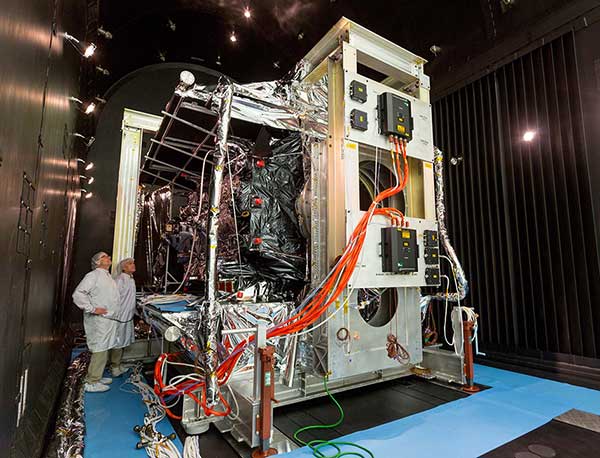
    Thermal Vacuum testing verifies that a satellite can operate in space’s extreme environment. (Photo: Lockheed Martin)
    Thermal Vacuum testing verifies that a satellite can operate in space’s extreme environment. (Photo: Lockheed Martin)

    With GPS III SV01 and SV02 now on orbit, GPS III satellites continue to roll off the production line at Lockheed Martin’s GPS III Processing Facility near Denver.

    Johnathon Caldwell, Lockheed Martin Space’s vice president for navigation systems, provided GPS World with an update to the entire GPS III family.

    SV01. The first GPS III satellite is in a holding state pending readiness by 2SOPS [the Second Space Operations Squadron] to take the vehicle onto the system for operational checkout, a transfer expected to take place later this year, Caldwell explained. The satellite completed on-orbit testing in July.

    “We’re in the process of getting the 2SOPS crews trained up to operate a GPS III vehicle,” Caldwell said. “By the end of this year, they will be able to take [SV01] into the constellation and start flying it as a live, set-healthy vehicle.”

    SV02. Launched Aug. 22, SV02 is following in the footsteps of its older sibling, with a quiet checkout and no major findings. Like SV01, once it completes testing, it will stay in temporary holding until 2SOPS is ready to bring it into the constellation.

    SV03. On May 27, the Air Force declared SV03 available for launch. It is now in final preparations for shipment, with an expected launch date in January 2020 aboard a Falcon 9 rocket.

    SV04. The Air force declared SV04 available for launch; it is now in storage awaiting a launch date.

    SV05. The fifth satellite is wrapping up environmental tests. Lockheed Martin anticipates that it will be available for launch early next year.

    SV06. The satellite has been moved into the thermal vacuum testing chamber and begun a rigorous testing campaign before it meets the harsh environment of space.

    SV07, SV08 and SV09 are on the assembly line.

    GPS IIIF Satellites. In 2018, the Air Force selected Lockheed Martin to build up to 22 GPS IIIFs, adding new features and resiliency to the original GPS III satellite design. The company has been on the path to meet the critical design review for the GPS IIIF spacecraft, which is due to take place next spring.

  • And ION’s prestigious awards go to…

    And ION’s prestigious awards go to…

    The Institute of Navigation (ION)’s Satellite Division presented two prestigious awards Sept. 20 at the ION GNSS+ Conference in Miami.

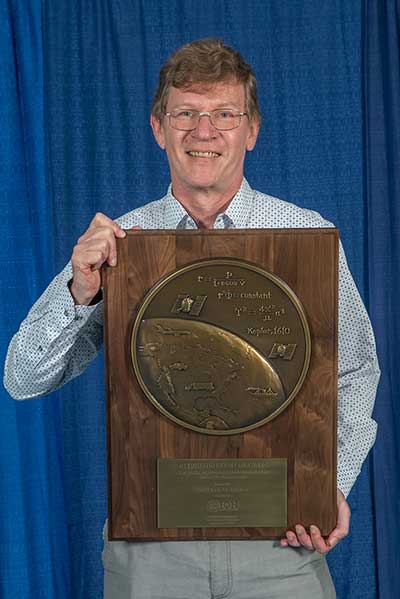
    Peter Teunissen receives the prestigious 2019 Johannes Kepler Award from ION's Satellite Division. (Photo: ION)
    Peter Teunissen receives the prestigious 2019 Johannes Kepler Award from ION’s Satellite Division. (Photo: ION)

    Peter Teunissen was honored with the career-highlight Johannes Kepler Award. The Johannes Kepler Award recognizes and honors an individual for sustained and significant contributions to the development of satellite navigation. It is the highest honor bestowed by the ION’s Satellite Division.

    Teunissen was recognized for his influential and groundbreaking contributions to the algorithmic foundations of satellite navigation, and for sustained dedication to the global education of the next generation of navigation engineers.

    Teunissen invented the Least Squares Ambiguity Decorrelation Adjustment (LAMBDA) method, the worldwide standard for ambiguity resolution, which revolutionized high precision GNSS positioning capabilities. LAMBDA has thus become an indispensable tool that is most widely used in land, air and space navigation; positioning and attitude determination; differential and network processing; and in surveying and geodesy. He also extended the method to MC-LAMBDA, a multivariate constrained resolution method for optimal GNSS attitude determination.

    Among others, Teunissen laid the mathematical and algorithmic foundation of reliability theory, which enables a proper understanding of the quality of different integer ambiguity resolution methods and a rigorous characterization of their failure rates, which even led to the development of an optimal test for ambiguity validation.

    His findings are particularly important for multi-GNSS processing, which require a proper understanding of individual system characteristics and their respective contributions to achieve navigation solutions of the highest precision and integrity.

    Teunissen has made contributions in the field of precise point positioning, the exploitation of triple-frequency observation, and the joint use of new GNSS such as Galileo, BeiDou and QZSS. Pioneering work in this area include the early setup of multi-GNSS receiver test beds in the Asia-Pacific area; the discovery and proper handling of mixed-receiver inter-satellite-type biases, which were vital to fully exploit ambiguity resolution in the regional, BeiDou-2 system; and the first demonstrations of mixed GPS/Galileo/IRNSS/QZSS L5 processing for precise positioning applications.

    Teunissen has made significant contributions to educating future generations. He is currently a Professor of Satellite Navigation at Delft University of Technology, The Netherlands and Curtin University, Australia.

    He received his Ph.D. at Delft University of Technology in Mathematical and Physical Geodesy. He holds several honorary professorships and fellowships of numerous international organizations, including Australia’s prestigious Federation Fellowship of the Australian Research Council.

    He has published more than 300 papers, seven books, is co-editor and author of the Handbook of Global Navigation Satellite Systems, and is a member of 13 editorial boards.

    He is a regular contributor to ION and ION programs. He is a Fellow of the ION, the RIN and the Royal Netherlands Academy of Sciences.

    Advanced RAIM topic earns Diaz the Parkinson Award

    Santiago Perea Diaz receives the 2019 Bradford W. Parkinson Award from ION's Satellite Division. (Photo: ION)
    Santiago Perea Diaz receives the 2019 Bradford W. Parkinson Award from ION’s Satellite Division. (Photo: ION)

    The Bradford W. Parkinson Award recognizes an outstanding graduate student in GNSS. It is presented in honor of Parkinson for his leadership in establishing the U.S. GPS and for his work on behalf of ION’s Satellite Division.

    Santiago Perea Diaz was recognized for graduate student excellence in GNSS in his thesis, “Design of an Integrity Support Message for Offline Advanced RAIM.”

    Any graduate student who is a member of the ION and is completing a degree program with an emphasis in GNSS technology, applications, or policy is eligible for the award.

  • Raytheon completes full GPS OCX design and development

    Raytheon completes full GPS OCX design and development

    Program enters integration and test phase on track to 2021 delivery

    Raytheon Company’s GPS Next-Generation Operational Control System, known as GPS OCX, has completed full software and hardware development and entered the system integration and test phase. The milestone keeps GPS OCX, the enhanced ground control segment of a U.S. Air Force-led effort to modernize America’s GPS system, on track to meet its June 2021 contractual delivery deadline.

    “GPS OCX is one of the largest, most complex software development programs in the Department of Defense, and we’re now in the home stretch toward full system delivery,” said Dave Wajsgras, president of Raytheon’s Intelligence, Information and Services business.

    The GPS OCX team completed development of 1.5 million lines of software code, supported by a pivot to leading-edge commercial software development processes that began in 2016. Additionally, the team’s information assurance best practices helped the program achieve the highest level of cybersecurity protections of any DoD space system.

    The U.S. Air Force used the cybersecure GPS OCX launch and checkout system, often referred to as Block 0, to launch the first modernized GPS III satellite into space in December 2018 and the second in August 2019.

    The team’s focus for the remainder of 2019 is the delivery of the system’s new modernized receivers, which will measure and monitor legacy military and civilian signals sent by the current GPS satellite constellation plus the new signals sent by the next-generation GPS IIIs.

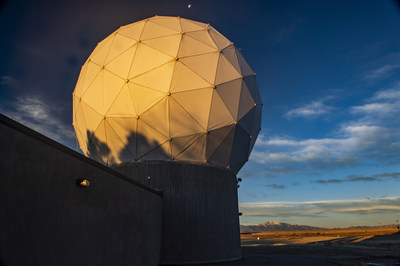
    Ground antenna at Schriever Air Force Base, home of the 50th Space Wing. (Photo: Raytheon)
    Ground antenna at Schriever Air Force Base, home of the 50th Space Wing. (Photo: Raytheon)
  • SXblue ToolBox Application now available on iOS

    SXblue ToolBox Application now available on iOS

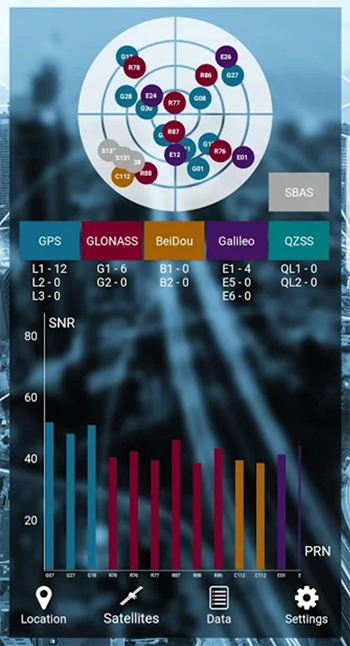
    Image: SXblue
    Image: SXblue

    Following the launch of its Android application in 2018, Geneq is now launching an iOS version of its SXblue ToolBox for iOS-compatible SXblue devices.

    The application was developed with special interest paid to raw data recording and NTRIP service connection.

    With the SXblue ToolBox iOS application, the user can analyze the position data provided by the SXblue receiver, as well as location metadata.

    More important for SXblue clients, the application can record, save and transfer raw data from the GNSS receiver, thereby allowing post-processing activities. The application also acts as a NTRIP client, capable of connecting to a NTRIP server for real-time kinematic (RTK) corrections, and thus allows the receiver to issue very accurate location information.

    Receiver configuration is easy through the application, with the ability to set up and save user-defined commands for subsequent use. The settings include constellation to be used, differential source, NTRIP login credentials list and more.

    In addition, the iOS application includes a series of audible and visual alarms that are user-configurable to determine the thresholds of information provided by the SXblue GNSS receiver.

    The main features of the iOS SXblue ToolBox application are:

    • Display of location information and quality of positioning data
    • Skyplot of all-in-view constellations: GPS, GLONASS, Galileo BeiDou, QZSS, SBAS
    • Recording of raw data and data transfer
    • NTRIP/DIP client to receive RTK corrections
    • Terminal to send commands and view the output data of the SXblue device
    • Audible and visual alarms
    • Activation of options and licenses via the application.
  • From animals to autonomy: RIN gathers experts for top conference

    From animals to autonomy: RIN gathers experts for top conference

    RIN logoThe Royal Institute of Navigation: International Navigation Conference will take place Nov. 18-21 at the Edinburgh International Conference Centre in Edinburgh, U.K.

    Navigation and Societal Benefits: From Animals to Autonomy
    The International Navigation Conference (INC) offers a unique format, with keynotes morning and afternoon each day, to set the scene for the more in-depth session papers.

    Resilient position and precise time are enabling the modern world. INC enables sharing of knowledge and experience to maximize the potential and positive impact of the industry.


    Plus:

    Pre-INC Training Seminar: Securing Positioning and Timing
    On Monday, Nov. 18, RIN is offering a one-day short course to build understanding of satellite navigation vulnerabilities and threats, plus steps to toughen and augment systems.

    Learn more, including presenters and to register.


    At INC, technology, system and application experts meet with cognitive neuroscientists, human factors, legal, ethical and regulatory experts. Participants feed insights from RIN’s world-leading animal navigation forum and conference, offering insights, perspective and contacts to improve attendees impact and effectiveness.

    INC creates value by bringing disciplines together to share knowledge, perspectives and insights. The RIN strives to make INC an enriching experience for all delegates, with a program designed to include plenty of time for networking, including social events on Monday, Tuesday and Wednesday evenings.

    RIN aims for each delegate to leave INC with new insights, ideas and contacts.

    Session Themes

    • Autonomy and Innovations in Robotics
    • Animal Navigation
    • Resilient PNT
    • Neuroscience and Cognition
    • Human Factors and Wayfinding
    • Innovation: Integrated Sensors and Indoor Navigation
    • Innovation: Artificial Intelligence
    • Innovative Navigation Solutions
    • User Sector Updates: CNI and Maritime
    • Scottish-led Innovation in Positioning, Navigation and Timing
    • Drone Regulation and Protection
    • UK Space and GNSS

    For more information, including the programme and keynote speakers, visit the event website.

  • China adds two more satellites to BeiDou constellation

    China adds two more satellites to BeiDou constellation

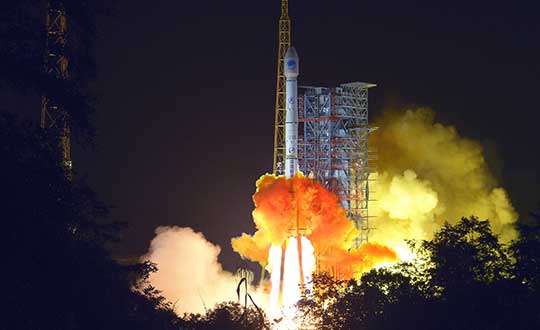
    Photo: Xinhua News Agency
    Photo: Xinhua News Agency

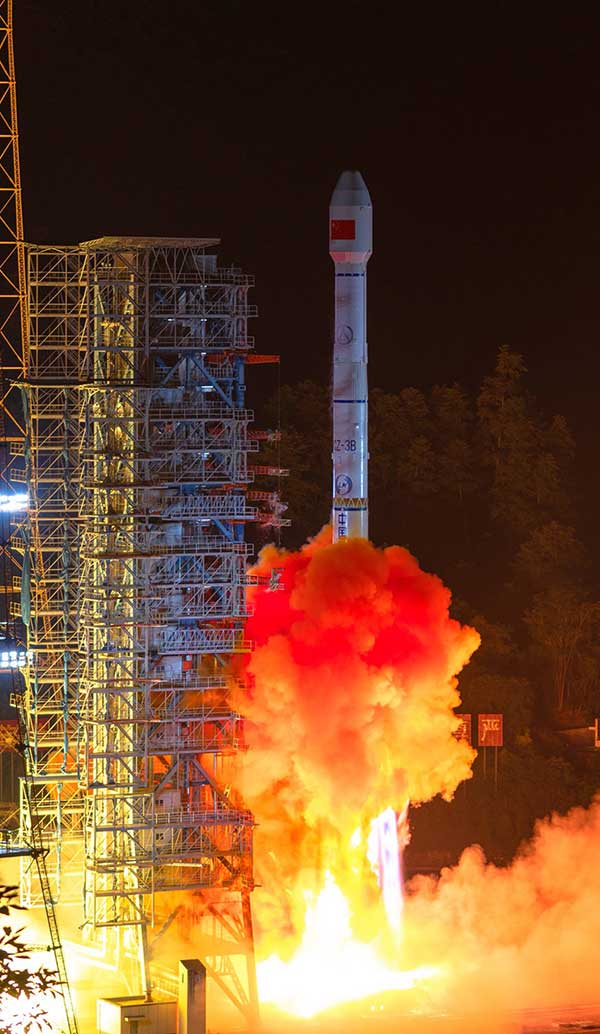
    China has launched two more BeiDou III satellites. The launch took place on Sunday, Sept. 22, using a Long March 3B rocket which lifted off from the Xichang space center at 2110 GMT (5:10 p.m. EDT), according to the Xinhua News Agency.

    The satellites have been confirmed as MEO23 and MEO24.

    About four hours after liftoff, the upper stage delivered the Beidou satellites into a nearly circular orbit with an average altitude of 13,500 miles (21,800 kilometers) and an inclination of 55 degrees.

    The satellites were produced by the China Academy of Space Technology, a government-owned satellite builder.

    With Sunday’s launch, China has added five new satellites to the Beidou network this year, halfway to its stated goal of 10 Beidou satellites this year.

    The satellites are the 47th and 48th spacecraft launched in the Beidou navigation program.


    Feature photo: Xinhua News Agency

  • GPS-based portable JPALS landing system sets up fast

    GPS-based portable JPALS landing system sets up fast

    Raytheon’s F-35 precision landing system can be set up anywhere in less than 1.5 hours

    A Raytheon Company team has conducted a rapid set-up demonstration of a land-based expeditionary version of its Joint Precision Approach and Landing System (JPALS) to a group of global military officials at Naval Air Station Patuxent River, Maryland.

    JPALS is a GPS-based precision landing system that guides aircraft to precision landings in all weather and surfaces conditions.

    “The entire system was fully operational in 70 minutes on Day One and 50 minutes on Day Two,” said Matt Gilligan, vice president at Raytheon’s Intelligence, Information and Services business. “Raytheon is offering the U.S. and its allies fast and accurate precision landing systems that support operations from bare-base locations.”

    During the demonstration, military officials from all four services, as well as representatives from Japan, United Kingdom, The Netherlands and Italy, watched multiple F-35Cs land on the same designated runway landing point every time over the course of six different approaches.

    This was the second proof-of-concept event in 2019 showing how F-35s can use a reconfigured mobile version of JPALS to support landings in austere environments.

    JPALS is a differential, GPS-based precision landing system that guides aircraft onto carriers and amphibious assault ships in all weather and surface conditions up to the rough waters of Sea State 5. It uses an encrypted, jam-proof data link to connect to software and receiver hardware on the aircraft and an array of GPS sensors, mast-mounted antennas and shipboard equipment.

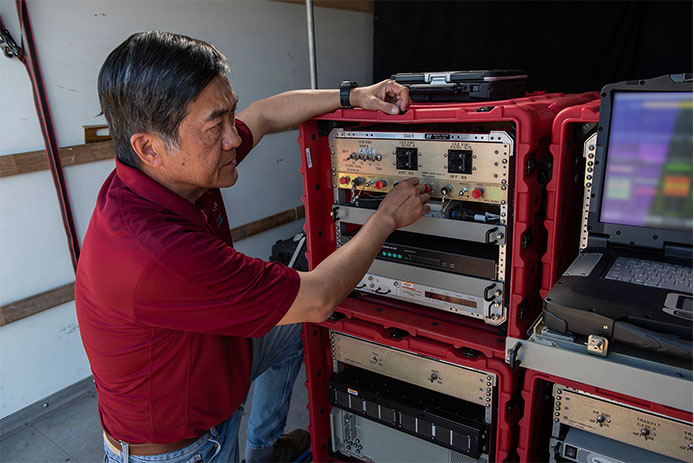
    A Raytheon technician operates the rapidly installed JPALS equipment during a demonstration at the Naval Air Station. (Photo: Raytheon)
    A Raytheon technician operates the rapidly installed JPALS equipment during a demonstration at the Naval Air Station. (Photo: Raytheon)
  • Live from Intergeo 2019

    Live from Intergeo 2019

    Logo: Intergeo 2019The GPS World staff reported live from Intergeo Sept. 17-19 in Stuttgart, Germany. The massive trade show, dubbed the “global hub of the geospatial community,” brings together more than 19,000 visitors from more than 114 countries and features approximately 640 exhibitors. Check out the latest industry news, as well as photos and videos from the event.

    News

    Videos

    Click the icon in the top right hand corner to choose the video you’d like to watch.

    Resources

    Past Coverage


    Featured photo: Allison Barwacz

  • GPS Innovation Alliance adds 4 affiliates

    GPS Innovation Alliance adds 4 affiliates

    Four national organizations join alliance dedicated to furthering GPS innovation, creativity and entrepreneurship 

    GPS Innovation AllianceThe GPS Innovation Alliance (GPSIA) has added four national organizations representing a variety of sectors. The organizations join GPSIA’s affiliates program by supporting the alliance’s goal of protecting, promoting and further enhancing GPS — one of the world’s most important enabling technologies.

    The new affiliates are:

    • American Council of the Blind (ACB)
    • U.S. Geospatial Executives Organization (U.S. GEO)
    • NENA: The 9-1-1 Association
    • Subsurface Utility Engineering (SUE) Association

    “The Alliance has grown in both size and ambition since its inception over six years ago and with increased adoption of GPS-enabled technologies, our dependence on GPS will only continue to grow,” said GPS Innovation Alliance Executive Director J. David Grossman. “Building on the launch of the bipartisan and bicameral GPS Caucus this past March, we look forward to working with these new affiliates in bringing heightened awareness to the critical importance of GPS to our nation’s economy.”

    These organizations join GPSIA’s existing affiliates including:

    • Association of Equipment Manufacturers (AEM)
    • American Trucking Associations (ATA)
    • Association for Unmanned Vehicle Systems International (AUVSI)
    • Boat Owner’s Association of the United States (BoatUS)
    • General Aviation Manufacturers Association (GAMA)
    • National Association of Manufacturers (NAM)
    • National Society of Professional Surveyors (NSPS)

    The following are comments from representatives of the newly announced affiliates:

    Clark Rachfal, Director of Advocacy and Governmental Affairs, American Council of the Blind (ACB)

    “Precise GPS technology is enabling a world where people who are blind may navigate their surroundings with greater confidence and live more independently. The American Council of the Blind is pleased to partner with the GPS Innovation Alliance to ensure this vital technology is available and accessible to all people who are blind in order to increase their economic opportunity and quality of life.”

    John M. Palatiello, Founder and President, U.S. Geospatial Executives Organization (U.S. GEO) 

    “The acquisition, processing, analysis, and application of geospatial data, and its use in geographic information systems (GIS) and other platforms, is greatly dependent on GPS and GNSS. U.S. GEO, representing executives of the nation’s geospatial firms, strongly supports our GPS system and is honored to be part of the GPS Innovation Alliance to assure its continued benefit to the U.S. economy and our quality of life.”

    Dan Henry, Director of Government Affairs, NENA: The 9-1-1 Association: 

    “Locating a 9-1-1 caller used to be as simple as searching a database for the street address associated with the caller’s phone number, but with over 80% of all 9-1-1 calls now coming from mobile phones, tracking down a caller’s location is no longer so easy. When callers are unable to convey their location to 9-1-1, public safety telecommunicators turn to mobile phones’ sophisticated location-finding system; GPS is the foundation of this system. 9-1-1 saves millions of lives every year — many of these lives would not have been saved if not for GPS.”

    John Berrettini, President, Subsurface Utility Engineering (SUE) Association

    “The SUE Association is comprised of firms, organizations and individuals engaged in the provision of subsurface utility engineering (SUE) services where the role of GPS/GNSS availability and utilization is vital to field data collection, analysis, and processing. Partnering with the GPS Innovation Alliance helps to meet our organizational charge to promote knowledge, best practices, and the exchange of information in the profession; ensure the protection of public health, welfare and safety; and educate clients and other stakeholders of the value and benefits of subsurface utility engineering services.”

    The GPS Innovation Alliance was founded by Deere & Company, Garmin International, Inc. and Trimble Inc. The alliance recognizes the ever increasing importance of GPS and other GNSS technologies to the global economy and infrastructure and is firmly committed to furthering GPS innovation, creativity and entrepreneurship by seeking to protect, promote and enhance the use of GPS.
  • Belize’s Great Blue Hole revealed in expedition survey

    Belize’s Great Blue Hole revealed in expedition survey

    Photo: JamieB333/Shutterstock.com
    Photo: JamieB333/Shutterstock.com

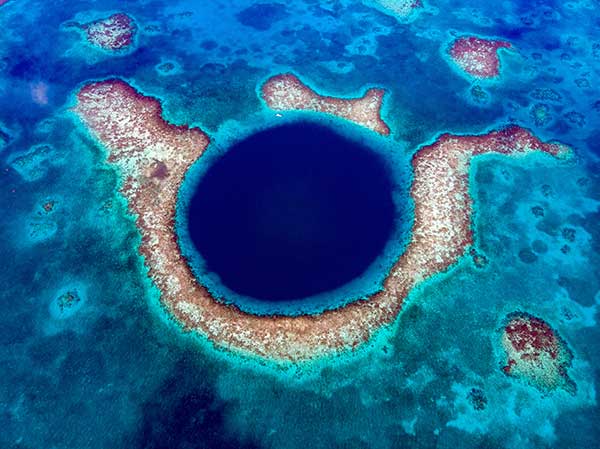
    A sonar survey, camera and sensor data of the world’s largest marine sinkhole is shining light on sea level and climate change over 100,000 years.

    From Nov. 27 to Dec. 13, 2018, the Blue Hole Belize Expedition mapped the sinkhole. Led by Aquatica Submarines, the team of scientists, explorers and film makers included Virgin ’s Sir Richard Branson and Fabien Cousteau, grandson of the conservationist Jacques Cousteau.

    Kongsberg used both surface and submarine-mounted sonar equipment.

    Sonar expert Mark Atherton from Kongsberg’s Canadian subsidiary Kongsberg Mesotech was a key member of the science-based sonar and scientific data collection team. Atherton operated the sonars aboard the Research Vessel Brooks McCall, contributing to an invaluable high-resolution map of the entire sinkhole.

    “By understanding the geological history and geometric structure at the Blue Hole we can contribute new data to the global scientific community studying sinkholes and cenotes,” he said.

    Photo: Aquatica Submarines
    Photo: Aquatica Submarines

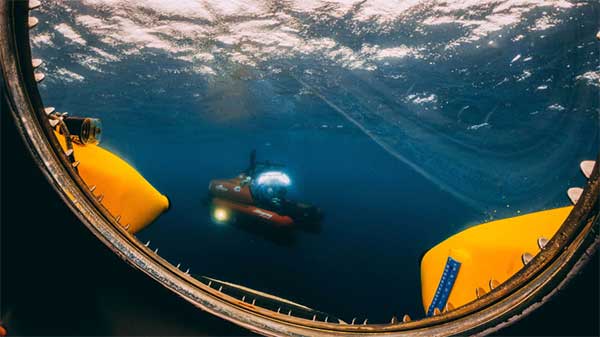
    Aquatica Submarine’s Stingray 500 submarine was used for sonar surveying, filming and dives. The team conducted more than 20 dives into the large sinkhole, taking videos and 3D images during each trip. They also completed a two-hour live broadcast featured on The Discovery Channel.

    A key outcome of the Expedition is creation of a complete 3D sonar map of the Blue Hole. The sonar map is enhanced with other passive submarine-collected environmental data. Once processed and collated, the data will be shared with the Government of Belize and the larger global scientific community as a legacy from the expedition.

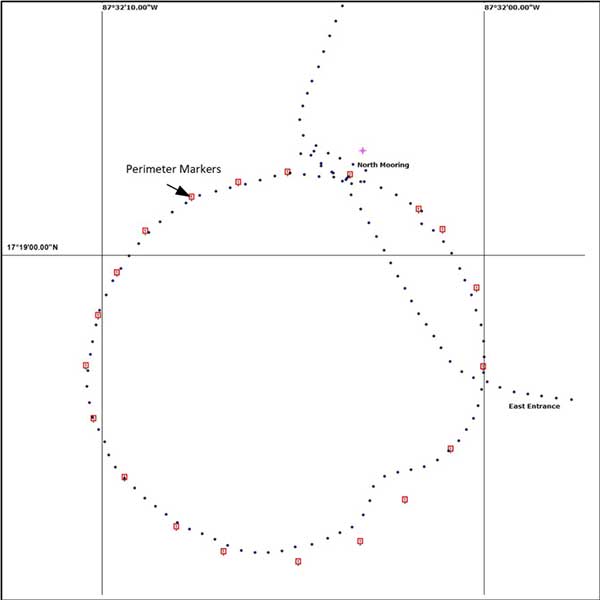
    Perimeter Markers: Using an SBG Systems Ellipse receiver positioned directly over suspended tripods, positions were locked in the MS1000 processing software the instant each tripod touched bottom. With no current within the Blue Hole and the tripod and sonar weighing 21.7 kg, there was no issue with offset position differences between the vessel and the tripod hanging plumb during deployment. (Image: Mark Atherton/Kongsburg)
    Perimeter Markers: Using an SBG Systems Ellipse receiver positioned directly over suspended tripods, positions were locked in the MS1000 processing software the instant each tripod touched bottom. With no current within the Blue Hole and the tripod and sonar weighing 21.7 kg, there was no issue with offset position differences between the vessel and the tripod hanging plumb during deployment. (Image: Mark Atherton/Kongsburg)
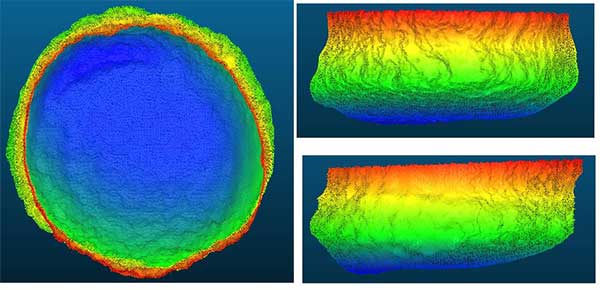
    Processed Scan Data: A dual-axis sonar (DAS) system collected point-cloud data to create a 3D representation of the Blue Hole. The unit was pole-mounted on the survey vessel with the GPS and motion reference unit directly over the scanner’s head. (Image: Mark Atherton/Kongsburg)
    Processed Scan Data: A dual-axis sonar (DAS) system collected point-cloud data to create a 3D representation of the Blue Hole. The unit was pole-mounted on the survey vessel with the GPS and motion reference unit directly over the scanner’s head. (Image: Mark Atherton/Kongsburg)
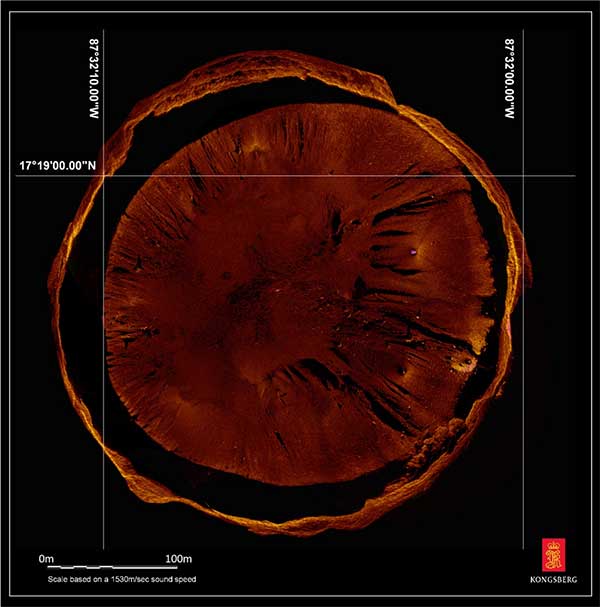
    Mosaic: GPS tripod position and target matching on overlapping scans were used to align the 50-, 75- and 100-meter-range data collected at 21 drop locations. This mosaic is a very close approximation of the bottom of the Blue Hole. (Image: Mark Atherton/Kongsburg)
    Mosaic: GPS tripod position and target matching on overlapping scans were used to align the 50-, 75- and 100-meter-range data collected at 21 drop locations. This mosaic is a very close approximation of the bottom of the Blue Hole. (Image: Mark Atherton/Kongsburg)
  • 1 billion now use Galileo smartphones

    1 billion now use Galileo smartphones

    The number of Galileo-enabled smartphones in use has soared to 1 billion in just 3 years.

    News from the European GNSS Agency

    The estimated number of Galileo-enabled smartphones in use has reached one billion. This significant milestone has been achieved in the week when the European GNSS Agency (GSA), responsible for operation of the Galileo programme, celebrates its 15th anniversary.

    The company BQ pioneered Galileo use in smartphones with its Aquaris X5 Plus in July 2016. Since then, market uptake of Galileo-enabled smartphones has been rapid as other manufacturers were quick to embrace the opportunities that Galileo offers.


    Global annual GNSS receiver shipments are forecast to grow from 1.8 billion units in 2019 to 2.7 billion units in 2029.


    Currently, 156 Galileo-enabled smartphone models available on the market. The “1 billion users” milestone is based on the number of smartphones using Galileo sold across the world. The actual number of Galileo users around the world is much larger. You can track which devices, including smartphones, are Galileo-enabled on the UseGalileo.eu site.

    Today, 95% of companies that produce smartphone chips for satellite navigation make chips that enable Galileo. According to figures in the latest GSA GNSS Market Report, which is to be published soon, global annual GNSS receiver shipments are forecast to grow continuously across the next decade, from 1.8 billion units in 2019 to 2.7 billion units in 2029. Most of these shipments are for receivers costing less than €5, and 90% of receivers in this price segment are used in smartphones and wearables.

    The number of Galileo-enabled smartphones in use has soared to 1 billion in just 3 years. (Image: GSA)
    The number of Galileo-enabled smartphones in use has soared to 1 billion in just 3 years. (Image: GSA)

    “Galileo is now providing high quality timing and navigation services to 1 billion smartphone users globally,” said Elżbieta Bieńkowska, commissioner for Internal Market, Industry, Entrepreneurship and SMEs. “This has been made possible by a truly European effort to build the most accurate navigation system in the world, with the support and dedication of the GSA. I am confident that our space industry will continue to thrive with more work, ideas and investment under the new EU Space Programme.”

    “One billion smartphone users is a significant milestone and a major achievement for the Galileo programme and for the GSA,” said GSA Executive Director Carlo des Dorides. “The GSA has worked tirelessly to build bridges with research and industry and create a strong community of service providers who trust Galileo and understand the technological innovation opportunities it brings.

    “Chipset and receiver manufacturers in particular have been quick to leverage Galileo’s outstanding performance,” des Dorides said. “These manufacturers believed in Galileo from the beginning, when Galileo was still an idea, and invested in the technology. It is thanks to them and the unique blend of expertise and knowledge of the GSA team that we are now celebrating 1 billion Galileo-enabled smartphones.”

  • European GNSS Agency celebrates 15 years

    European GNSS Agency celebrates 15 years

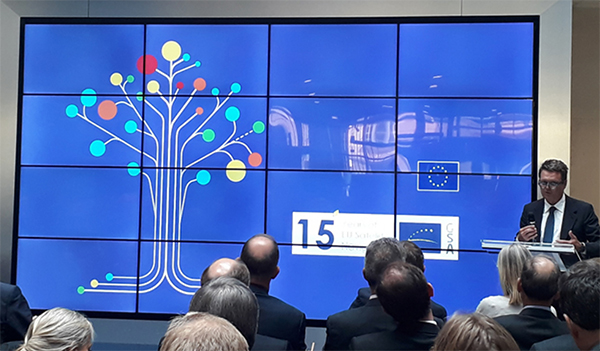
    GSA Executive Director Carlo des Dorides kicks off the celebration. (Photo: GSA)
    GSA Executive Director Carlo des Dorides kicks off the celebration. (Photo: GSA)

    News from the European GNSS Agency

    The European GNSS Agency (GSA) hosted a special event on Sept. 10 to mark the 15th anniversary of its creation. The agency was set up as the European GNSS Supervisory Authority in 2004 to oversee the development of the European space programmes EGNOS and Galileo.

    GSA Executive Director Carlo des Dorides welcomed special guests to the GSA’s Prague headquarters to celebrate the event, including European Commissioner Elżbieta Bieńkowska, Czech Transport Minister Vladimir Kremlik, French Space Agency (CNES) President and GSA Administrative Board Chair Jean-Yves Le Gall and European Space Agency Director General Jan Woerner, in addition to other EGNOS and Galileo stakeholders.

    “Over the last 15 years, the GSA has become one of the key players in building Europe’s independent capacity in satellite navigation,” said Commissioner Bieńkowska, responsible for Internal Market, Industry, Entrepreneurship and SMEs. While participating in the celebrations, the commissioner also presided over another historic milestone for both the Galileo programme and the GSA — the countdown to the 1 billionth Galileo-enabled smartphone sold.


    “GSA has been at the heart of the EGNOS and Galileo programmes over the past 15 years.” — Carlo des Dorides.


    Linking space to user needs

    GSA Executive Director Carlo des Dorides said: “It is an honour and a great pleasure to celebrate this important milestone with representatives from all our stakeholders — the Commission, users, industry and other institutional bodies. Their presence here clearly shows that the GSA is delivering on its mission – linking space to user needs”.

    “15 years ago, no one imagined how far the GSA and the EU satellite navigation systems EGNOS and Galileo would go. Now, no one can imagine Europe without Galileo and EGNOS, or Galileo and EGNOS without Europe. The GSA has been at the heart of these two programmes, accelerating progress in service provision, market uptake and guaranteeing operation security over the past 15 years. All that has been accomplished has been made possible thanks to the unique blend of expertise, dedication and commitment of the GSA’s staff,” des Dorides said.

    Speaking at the event, GSA Administrative Board Chair Jean-Yves Le Gall said: “Today thanks to the European Union’s impressive investment, the European Space Agency’s technical expertise and the GSA’s outstanding commitment, Galileo is offering the best localization available worldwide. The range of applications is vast. This is structuring our economy and the implementation of the public policies to ensure that European companies are taking full advantage of these fantastic services.”

    Czech Transport Minister Vladimir Kremlik noted the importance to the Czech capital of hosting the EU agency. “It has been fifteen years of hard work and continual development. By chance it is also seven years since the seat of GSA has been relocated from Brussels to Prague. I am very proud, that the Czech Republic is the hosting country of the seat of such an important European agency with real global reach,” the minister said.

    Looking to the future

    Galileo will soon reach its Full Operational Capability, a phase that will require new governance to comply with benchmarked standards for the management of operational satellite services. It was with this in mind that the European Parliament and the Council agreed on a new EU Space Programme Regulation establishing the EU Agency for the Space Programme (EUSPA) as the successor to the GSA.

    “In the new governance the Commission will continue to be responsible for managing the overall programme. The GSA, to be renamed the ‘EU Agency for the Space Programme,’ will increasingly support the exploitation and market uptake of EU space activities and play an increased role in ensuring the security of all programme components. The intergovernmental European Space Agency (ESA), given its expertise, will remain a major partner in the technical implementation of the EU space programme,” des Dorides said.