Category: GNSS

  • How resilient PNT protects global networks from attack or failure

    How resilient PNT protects global networks from attack or failure

    Time, time, time… See what resiliency brings

    With the smartphone revolution, we are increasingly reliant on today’s global technology networks. The importance of protecting data centers and mobile devices with resilient PNT can’t be overstated. But what is the best way to accomplish this?

    By Rohit Braggs, Orolia

    Connected devices and cloud applications are the primary technology sources for most people today, and an exponentially growing number of those devices are connected to data centers in some way. Across the world, you can drive past countless acres of data centers that are storing, updating and retrieving the world’s data.

    [Editor’s note: A complimentary webinar on Thursday, June 27, “Advanced Simulation Test Systems for Controlled Reception Pattern Antennas,” covers much of this material in greater technical detail. The full webinar is also available for download and viewing after that date.]

    GNSS signals localize and timestamp the data collected from connected devices scattered across the world in diverse time zones and locations. They also provide the critical time synchronization that supports high-efficiency data storage, routing and exchanges across multiple data centers in various locations.

    It is essential to protect data centers and their GNSS signal connections from system failure, jamming, spoofing, interference and denial of service. As the reliance on GNSS signals and the number of connected devices grow, so too does the threat of GNSS failure. False or unavailable positioning, navigation and timing (PNT) information at any point within this network can compromise security and completely disrupt user service.

    This article explores the role of data centers and how their constant connection to devices enables almost every digital technology that we use today. It identifies key reasons why we should protect this interconnected data system from GNSS signal interference and disruption, in addition to providing information on how to ensure continuous signal monitoring and protection with a practical, cost-effective approach.


    See also:

    The latest tech fights for GNSS resilience

    Is internet time good enough for cybersecurity?


    Global Technology Networks

    Data centers and connected devices affect nearly every aspect of our digital lives, from cloud software and applications to mobile phones and laptops. They store our personal documents, photo libraries and other priceless personal data. They also keep track of business documents, software licenses and other essential business information. In critical infrastructure, they support the daily operations of society’s most important services such as public utilities, banking and financial transactions, telecom, security, medical and defense systems, among others.

    Data centers use timestamps as a key mechanism to store, organize and retrieve data. In addition to categorizing data by authorized users and other relevant identification information, the timestamp enables data centers to monitor revisions and retrieve the most recent version of the data.

    A good example of timestamped data use is in cloud-based applications, accessed simultaneously by hundreds of thousands of users. In such environments, data is dynamic and changing frequently, which can lead to data conflicts. With accurate, reliable timestamps, a cloud-based application can resolve such conflicts to determine the order in which the data was received.

    Why do we need to protect data centers and connected devices from GNSS signal interference?

    GNSS signals are the quiet facilitators of many of our day-to-day tasks. In discussing why it is important to protect these signals, it is often easier to imagine what would happen without the accurate, reliable PNT information that these signals provide.

    We need to understand two key pieces of information to operate systems: location and time. We need to know exactly where data or assets are located, and we need reliable, consistent time references to synchronize the movement of data and assets for system operations.

    There are many documented examples of GNSS signal jamming, spoofing and denial of service attacks worldwide, and these are easy to find with a simple internet search. Here are a few examples of what can happen when the signal is compromised at a mobile or fixed location, but not taken offline. The user might still see that the signal is working, with no indication that the two critical pieces of information, location and time, are being disrupted:

    • Imagine that the timestamp on a security camera system was spoofed to show a different time than the actual time. Incorrect or missing timestamps on video from surveillance systems is the most common reason for video evidence being deemed as inadmissible in a court of law. A bad timestamp corrodes the credibility of the video as irrefutable evidence and makes it easy to dispute.
    • Imagine that a bad actor spoofed the time used by financial trading systems. Since these critical systems rely on GNSS-based time and synchronization, an attack on their underlying timing infrastructure could significantly impact the market and cause billions of dollars in damage.
    • What if the GPS guidance system on your phone or vehicle gave you wrong directions? You could get lost in a wilderness or encounter dangerous driving conditions by trusting the route shown on your device.
    • What if more people started using commercially available jammers? Some truck drivers have already been caught using unauthorized GPS jammers in their vehicles to avoid monitoring by their employers. In many cases, these deevices have affected nearby critical systems such as air traffic control, financial data centers, and other critical operations simply by being driven past with active jammers. The incidence of these disruptions is on the rise.
    • Imagine a secure facility using an access control system that is set to automatically lock and unlock doors at a specific time. If someone spoofed the time used by that system, they could trick the doors into unlocking and gain entry.

    We are also seeing an uptick in unintentional or environmental signal interference, which can occur in high-density development areas where various wireless transmitting systems can interfere with GNSS reception.

    Which technology solutions are best suited to protect data centers and GNSS signals?

    The first step toward protecting a GNSS-reliant system is to test the system for vulnerabilities. GNSS simulators and testing protocols can simulate a spoofing, jamming or denial of service attack to evaluate how the system responds to each situation. Knowing the system’s unique challenges and weaknesses can help resilient PNT experts design the best solution for that system.

    One of the most common configurations for a fixed site location includes a highly reliable network time server to ensure that accurate timestamps are applied to each data point. A time server that can identify erroneous or spoofed GNSS signals is recommended for any critical application. In addition, a time series database could be installed to categorize and organize the time-stamped data, while identifying any irregularities in the data.

    Once you have reliable timestamps and time server management systems, you also need to continuously monitor the signal to detect interference and raise an alarm. A GNSS signal monitoring system can let you know the minute your system is under attack. A GNSS threat classification system can identify the type of threat and mitigate it, depending on the nature of the threat, by filtering the signal to neutralize the interference.

    The best way to prevent GNSS jamming is to deny interfering signals access to the receiver in the first place. Smart antenna technology focuses antenna beams to track the good signals from the satellites and reject the bad signals from interferers. Less sophisticated solutions such as blocking antennas can be employed to reject terrestrial-based interference, which is where most GNSS interference sources exist, and they provide a good first-level protection.

    Continuous PNT access can also be achieved by using an alternative signal that operates separately from GPS/GNSS and is less vulnerable to the signal attacks that plague GNSS signals.

    Emerging PNT Technologies

    Over the next few years, new applications of mobile PNT data will further emphasize the need to maintain system integrity against threats. Here are a few examples of emerging technologies.

    5G is here for mobile Internet and telecom service, yet with the specific need for microsecond-level synchronization, the challenge to protect the fidelity of the time used in these systems will become more important.

    With rising awareness of the need to protect GNSS signals against threats, individuals will need to determine how they can protect their own GNSS-reliant systems as they navigate the Internet of Things and GIS enabled e-commerce. Personal PNT protection is an emerging technology area that could help protect people and their mobile devices on an individual basis, to ensure GNSS is there when it matters. Whether you are embarking on a remote hiking or sea expedition, sharing your coordinates with an emergency dispatcher after an accident, or simply trekking your way through a new city late at night, having resilient GNSS signal support is becoming a necessity.

    Alternative signals are now available, and these new signal options, such as STL (Satellite Time and Location), could play an important role in providing better privacy and security functionality. This signal diversity will help protect against threats and interference by adding resilience to the device’s ability to receive reliable PNT data.

    Another exciting technology development is the concept of smart cities, where technology has the opportunity to increase efficiency, reduce waste and provide many conveniences for the public. As we automate more city systems, it is essential to protect these systems from both accidental and malicious GNSS-based interference to ensure that these systems can make decisions based on reliable, precise PNT data.

    Intelligent Transportation Systems (ITS) have the capacity to transform how people and freight travel today, saving lives and bringing goods to market more efficiently than ever. The need to know exactly where a driverless vehicle is in relation to other vehicles at any moment in time is just one of the resilient PNT technology requirements that will rely on GNSS signals.

    Finally, authenticated time and location information can help increase cybersecurity for many applications, by limiting data access to a very specific window of time and only in a precise location. This is an area of cybersecurity which has the potential to add new layers of authentication to protect users and their data. With connected devices at the forefront of our access to the world, secure and reliable PNT technologies are more critical than ever.

    These are just a few examples among many of the new technology innovations that are in the works to provide us with new benefits in leaps and bounds.

    Protecting Our Virtual Brain

    Data centers are the technology hubs of today, and their constant connection to devices fuels our ability to access critical information instantly. This networked system serves as a virtual brain that holds our personal memories, charts our progress, enables us to share results and helps us deliver new technology advancements faster than we could ever do before.

    As we prepare to embrace our new technology, we should first address the PNT technology challenges of today and ensure that our GNSS signals are resilient and reliable. With this strong foundation in place, we can better protect our current systems and keep pace with evolving threats that would otherwise jeopardize the functionality, safety and security of these new capabilities.


    Rohit Braggs is the chief operating officer at Orolia. Based in Rochester, New York, he is responsible for the development and execution of the company’s global business strategy and corporate initiatives. He also serves on the board of directors for Satelles Inc., which provides time and location solutions over the Iridium constellation of low-Earth-orbiting satellites.


  • Editorial Advisory Board PNT Q&A: Keeping data safe

    Editorial Advisory Board PNT Q&A: Keeping data safe

    What is the best way to protect data centers and mobile devices from spoofing and jamming?

    Ellen Hall
    Ellen Hall

    “After speaking to our head of engineering, Roger Hart, he explained this as something akin to ‘What’s the best way to achieve world peace?’ As the strengths and vulnerabilities of static and mobile devices vary considerably, the best solution will be achieved through a tailored application of algorithms, antenna siting and design, multi-constellation, multi-frequency and non-GNSS inputs.”
    Ellen Hall
    Spirent Federal Systems


    Allison Brown
    Allison Brown

    “Spoofing and jamming presents a very credible threat today to users of GPS for navigation and perhaps the greatest threat is vulnerability within our national infrastructure to spoofing of GPS timing. Congress, recognizing this threat, has tasked the Department of Transportation (DOT) in the National Timing Resilience and Security Act of 2017 to provide a backup for the timing component of the GPS. Specifically this backup is to ‘ensure the availability of uncorrupted and non-degraded timing signals for military and civilian users if GPS timing signals are corrupted or otherwise unavailable.’ Although the act directed the DOT that this system should be operational in two years (2019), little progress appears to have yet been made in deploying a backup timing system. This system not only would reduce vulnerability to spoofing for timing users, but could also be used by mobile users for detection of spoofing, allowing for national alerting when jamming or spoofing is detected. These alerts, tied with a quick response mechanism for law enforcement to take action, would provide an effective method for protecting all GPS users nationwide from jamming or spoofing.”
    Alison Brown
    NAVSYS Corporation


    Jean-Marie Sleewaegen
    Jean-Marie Sleewaegen

    “Take full benefit of multi-frequency multi-constellation redundancy.  Perform signal monitoring and authentication using advanced receiver architectures and signal-based protection (e.g., Galileo’s Open Service Navigation Message Authentication). Foresee non-GNSS redundancy to bridge gaps, such as precise clocks for data centers or IMUs for mobile devices.”
    Jean-Marie Sleewaegen
    Septentrio


    Members of the EAB

    Tony Agresta
    Nearmap

    Miguel Amor
    Hexagon Positioning Intelligence

    Thibault Bonnevie
    SBG Systems

    Alison Brown
    NAVSYS Corporation

    Ismael Colomina
    GeoNumerics

    Clem Driscoll
    C.J. Driscoll & Associates

    John Fischer
    Orolia

    Ellen Hall
    Spirent Federal Systems

    Jules McNeff
    Overlook Systems Technologies, Inc.

    Terry Moore
    University of Nottingham

    Bradford W. Parkinson
    Stanford Center for Position, Navigation and Time

    Jean-Marie Sleewaegen
    Septentrio

    Michael Swiek
    GPS Alliance

    Julian Thomas
    Racelogic Ltd.

    Greg Turetzky
    Consultant

  • K2 will drive GLONASS under 1M

    K2 will drive GLONASS under 1M

    New GLONASS-K2 satellites will improve the accuracy of Russia’s satellite navigation system from 3-5 meters to less than 1 meter, said Chief Designer Mikhail Korablyov of the Joint Stock Company GLONASS, operator of the ERA-GLONASS traffic accident emergency response system, at a transport conference in Moscow in late May.

    Russia plans to launch the first K2 satellite in late 2019 or early 2020. By 2030 the GLONASS constellation will consist wholly of K2 space vehicles, 24 of them.

    The improved accuracy will better determine vehicle location in analyzing a traffic accident, according to Korablyov. It will not, however, be sufficient for lane-keeping and other advanced driver assistance systems, nor for more stringent autonomous driving requirements, at least according to emerging Western standards.

    “There are also tasks linked with the country’s defense, there are special precision weapons, the requirements for which already make up less than a meter,” Korablyov added.

    Yury Urlichich, First Deputy Director General, Roscosmos. (Photo: Roscosmos)
    Yury Urlichich, First Deputy Director General, Roscosmos. (Photo: Roscosmos)

    Numbers. Writing in the December 2018 issue of GPS World, Yury Urlichich, First Deputy Director General, Roscosmos State Space Corporation, gave a somewhat more precise figure for the new accuracy to be achieved via the K2 generation. “The new signals will allow lowering the hardware-dependent SC-user ranging error by an order of magnitude, reducing the influence of signal reflections from buildings, constructions and landscape (multipath effect), thus enabling their effective use for high-precision navigation with real-time errors below 0.1 m.

    “This SC will enable navigation not only using legacy FDMA signals available for users for more than 35 years, but simultaneously with a full row of CDMA signals in all GLONASS frequency bands: L1, L2 and L3.”

    Later in the same piece, Urlichich wrote “Mission Definition Requirements for Glonass-K2 define user range error to be 0.3 m, qualitatively improving GLONASS user performance.”

    The new K2 satellite will transmit nine navigation signals and will weigh about 1,800 kg, twice as much the latest GLONASS-K generation, known as K1. Of the 24 currently orbiting operational satellites, only two are K1 space vehicles. The other 22 are older GLONASS-M satellites.

    A Shock to the System. A bolt of lightning struck the rocket launcher for the latest GLONASS-M satellite to rise, on May 27. It did not adversely affect the bird’s journey to space, and all systems were found to be functioning properly once the satellite was released into preliminary orbit, Russian space officials said.

  • Jammers at dachas add to Russia’s ability to silence GPS

    A new investigative report by the Russian independent media group “The Project” into luxury dachas owned by high-ranking government officials revealed that most all include GNSS jammers among their amenities. Attempts by the journalists to photograph the dachas from the air using drones were routinely foiled by jamming.

    Most all nations’ military and security services have equipment that can block GPS and other satellite navigation signals over areas both large and small. Russia, though, has advanced this to a fine art which it regularly demonstrates.

    Russian forces always been proud of their electronic warfare capabilities. They see them as an essential counter to the effectiveness of western high-tech weapons. The news outlet “Sputnik” reported in 2015 Russian military claims that their ability in electronic warfare “makes aircraft carriers useless.”

    GPS is an underlying technology for many western weapons, and for much of the west’s critical networked infrastructure. As a result, jamming and spoofing GPS and other GNSS has long been a priority for Russian forces.

    In 1997 a Russian company offered a handheld four-watt GPS and GLONASS jammer that was effective at ranges of up to 150 to 200 kilometers. They also reported working with the Russian military on directional antennas for this jammer. These antennas would focus the disruption on a particular target while leaving most other users unaffected. The U.S. Army was sufficiently interested that, in 2002, they reportedly spent almost $200,000 to purchase the jammers for testing and evaluations.

    In 2016 Russia announced a program to add GPS jammers to more than 250,000 cell towers as a partial defense against a U.S. cruise missile attack.

    That same year a Moscow Times headline proclaimed, “Kremlin Eats GPS for Breakfast!” GPS users near the Kremlin had been regularly finding their cell phones reporting that they were 20 kilometers away at an international airport. This was playing havoc with Uber and Lyft drivers, as well as delivery services that depended upon satellite navigation. This spoofing, or sending false information to receivers, was reported to be an effort to protect the Kremlin and leaders from attack and surveillance by drones. Most drones are programmed at the factory with the locations of airports and to fly away from them. Convincing receivers near the Kremlin or elsewhere that they are really near an airport helps keep the area drone-free.

    Independent technologists in Moscow also reported that this spoofing employed a classic electronic warfare technique called “herding.” GPS L2 and L5 signals and Russia’s GLONASS satellite navigation signals were jammed. This forced receivers to rely upon the L1 signal which was spoofed.

    That same year this same kind of activity was also detected in the Black Sea. The RNT Foundation reported that over 600 ships had been “transported” to airport locations ashore. A subsequent report in 2019 by the non-profit group C4ADS revealed almost 10,000 instances of ships being spoofed in the Black Sea, the Baltic and in Russia’s west near Vladivostok between 2016 and 2018. It also drew a strong correlation between the movements of Russian President Vladimir Putin and the spoofing events.

    Russian jamming and spoofing has not been limited to its homeland. Vehicles, ships and aircraft in other nations, as well as in international waters and airspace, have been impacted. This despite Russia’s treaty obligations under the International Telecommunications Union radio regulations which provide that “All transmissions with false or misleading identification are prohibited.”

    The C4ADS report documented a massive Russian “smart jammer” operating almost continuously in Syria that had impact far beyond that nation’s borders. Smart jammers, by their definition, transmit messages that seem to be valid GPS signals, but with content that does not allow receivers to calculate a location. The operation in Syria has caused multiple warnings by the U.S. Maritime Administration of GPS disruptions in nearby international waters, and the European air traffic agency issuing warnings for international airspace in the eastern Mediterranean.

    The Baltic and Scandinavia have also seen Russian GPS jamming in recent years. In 2017 the Secretary General of NATO complained about Russian naval jamming that also degraded cell phone service in Latvia, Norway and Sweden.

    Early this year Norway protested Russian jamming in its far north, some of which was timed for NATO exercises. Five significant jamming events in the previous 17 months impacted, aviation, construction and other users.

    Russia regularly demonstrates that GNSS jamming and spoofing can be a useful tool for internal security and an effective method of power projection. Its actions, along with the portability and proliferation of jamming and spoofing equipment, are undoubtedly meant to remind the west that Russia can take away essential GNSS services at any moment with a just the flip of a switch.


    Dana A. Goward is the president of the Resilient Navigation and Timing Foundation, and is a regular contributor to GPS World.

  • ESA focuses on PNT vs GNSS, wants proposals

    ESA focuses on PNT vs GNSS, wants proposals

    Logo: ESA

    OK, perhaps the headline is a tad misleading. But in addition to its natural preoccupation with Galileo, the European Space Agency (ESA) has begun thinking and talking about PNT as a service and user needs. In 2018, the European Commission issued a memo saying that GNSS alone was not sufficient for many critical and fail-safe operations.

    ESA is now seriously considering how Galileo and other systems can provide users the PNT services and resilience they need, regardless of whether the signals come from space.

    They have also issued a permanent Request for Proposals in this area. From their website:

    The goal is to maintain and improve the capability and competitiveness of the industry of the participating States in the global market for Satellite Navigation, and more broadly PNT technologies and services. In this context, the wider ambition towards the overall PNT sector is justified by the necessity to facilitate cross-fertilisation between space-based and terrestrial positioning technologies.

    This programmatic action will ensure the readiness of the industry to effectively respond to emerging market opportunities by focusing its activities on products ready for the commercial or institutional market.

    The development of ad hoc technologies and product development activities along the whole Satellite Navigation value chain and more broadly PNT products can be proposed by industry to develop products aligned with their plans for future exploitation.

    Activities therefore shall have been identified by industry as having clear potential for being applied in the area of PNT. The activities may address completely new products of a disruptive nature, may be an upgrading or improvement of an existing product or may address a continuation of an activity funded in another framework within another European institutional programme, a national programme or an industrial/academic research programme. The activities shall aim at resulting in a product ready for commercial exploitation.

    Implemented through a continuous open call capable of stimulating unsolicited proposals, the eligibility of which will be indicated by the relevant participating State (i.e. support letter). The pre-commercial nature of this programme element will call for a co-funding approach to be envisaged.

    Proposals must be from companies in the EU states of AT, CA, CH, CZ, DK, ES, FR, FI, UK, IT, IE, NO, NL, PL, PT, RO, SE and DE.

    Proposers must first establish a ESA-STAR/EMITS username and password. More information can be found here.


    Dana A. Goward is the president of the Resilient Navigation and Timing Foundation, and is a regular contributor to GPS World.

  • GPS Directorate seeks comments on revision notices

    GPS Directorate seeks comments on revision notices

    The GPS Directorate is soliciting public comments on several Proposed Interface Revision Notices (PIRNs). Comments are due June 25.

    Download or view the proposed changes on GPS.gov. Minutes from the Public Interface Control Working Group meeting held in May 2019 are also available on GPS.gov.

    • PIRN-IS-200K-001, v2: Proposed Changes to IS-GPS-200K – Leap Second and Earth Orientation Parameters
    • PIRN-IS-705F-001, v2: Proposed Changes to IS-GPS-705F – Leap Second and Earth Orientation Parameters
    • PIRN-IS-800F-001, v2: Proposed Changes to IS-GPS-800F – Leap Second and Earth Orientation Parameters

    Documents affected:

    • IS-GPS-200: Navstar GPS Space Segment / Navigation User Segment Interfaces
    • IS-GPS-705: Navstar GPS Space Segment / User Segment L5 Interfaces
    • IS-GPS-800: Navstar GPS Space Segment / User Segment L1C Interfaces

    Download the comment form on GPS.gov and send comments to [email protected].

  • Lockheed delivers GPS III ground system upgrade, SV03 ready for launch

    Lockheed delivers GPS III ground system upgrade, SV03 ready for launch

    Technicians successfully integrated the U.S. Air Force’s third GPS III space vehicle (GPS III SV03) on August 14, 2017. (Photo: Lockheed Martin)
    Technicians successfully integrated the U.S. Air Force’s third GPS III space vehicle (GPS III SV03) on August 14, 2017. (Photo: Lockheed Martin)

    On May 22, Lockheed Martin delivered the GPS III Contingency Operations (COps) software upgrade to the U.S. Air Force’s current GPS ground control system.

    The upgrade will enable the Air Force to start commanding the new, next-generation GPS III satellites now coming off the production line and beginning to launch.

    And the new GPS III satellites are coming. The first GPS III satellite launched in December 2018; the second GPS III shipped to Cape Canaveral in March for a July launch; and on May 17, the Air Force declared the third new GPS III “Available for Launch” next.

    Ground System. The challenge was modernizing the current ground system — formally known as the GPS Architecture Evolution Plan Operational Control System (AEP OCS) — to fly the legacy constellation, as well as the new, modern GPS III satellites, until the next generation Operational Control System (OCX) Block 1, still in development, is delivered.

    To address this, in 2016, the Air Force contracted Lockheed Martin to develop the GPS III COps program. Currently, the AEP OCS controls 31 GPS IIA, IIR, IIR-M and IIF satellites launched between 1993-2016. With the AEP OCS’ new GPS III COps upgrade, the Air Force will be able to command and control both the legacy satellites, as well the more powerful GPS III satellites.

    Lockheed Martin shipped the U.S. Air Force’s first GPS III to Cape Canaveral, Florida ahead of its expected July launch. (Photo: Lockheed Martin}
    Lockheed Martin shipped the U.S. Air Force’s first GPS III to Cape Canaveral, Florida ahead of its expected July launch. (Photo: Lockheed Martin)

    “Positioning, Navigation and Timing is a critical mission for our nation and COps will allow the Air Force to gain early access to its new GPS III satellites,” said Johnathon Caldwell, Lockheed Martin’s vice president for Navigation Systems. “We just finished Final Qualification Testing and delivery on COps, and it will be integrated and installed on the AEP OCS over the summer. We look forward to the Air Force ‘flying’ a GPS constellation on the COps OCS which includes the new GPS III satellites, later this year.”

    Meanwhile, the first GPS III space vehicle (GPS III SV01), launched in December 2018, is finishing up pre-operational on-orbit check-out. It continues to be controlled by OCX Block 0 software installed at Lockheed Martin’s GPS III Launch and Checkout Center at the company’s Denver facility. GPS III SV01 is expected to be “handed over” to the COps OCS later this year after the legacy constellation is moved over to the updated AEP OCS.

    Lockheed Martin has sustained the AEP OCS since 2013. In November 2018, the company completed the AEP 7.5 upgrade — the largest architectural change in the systems history — replacing significant code, hardware and software to improve the system’s cybersecurity capabilities and positioning the Air Force to better operate in contested, degraded and operationally limited environments.

    In December 2018, the Air Force awarded Lockheed Martin the GPS Control Segment Sustainment II (GCS II) contract to continue to further modernize and sustain the AEP OCS through 2025. In 2020, the AEP OCS is expected to receive the M-Code Early Use (MCEU) upgrade, which will allow control of M-code, an advanced, new signal designed to improve anti-jamming and anti-spoofing, as well as to increase secure access to military GPS signals for U.S. and allied armed forces.

    Lockheed Martin is under contract to develop and build up to 32 GPS III/IIIF satellites. GPS III will deliver three times better accuracy and provide up to eight times improved anti-jamming capabilities. GPS III’s new L1C civil signal will make it the first GPS satellite to be interoperable with other international global navigation satellite systems. Additional “IIIF” capabilities, beginning at the 11th satellite, will include a fully digital navigation payload, Regional Military Protection, an accuracy-enhancing laser retroreflector array, and a Search & Rescue payload.

  • Mercury-ion atomic clock holds promise for greater GPS accuracy

    Mercury-ion atomic clock holds promise for greater GPS accuracy

    The National Aeronautic and Space Administration (NASA) is readying for an ultra-precise atomic clock that could not only transform the navigation of deep space missions, it could also improve the accuracy of GPS timing and thus GPS positioning. It is expected to launch in June.

    DSAC graphic: NASA:
    Drawing of the DSAC mercury-ion trap showing the traps and the titanium vacuum tube that confine the ions. The quadrupole trap is where the hyper-fine transition is optically measured and the multipole trap is where the ions are “interrogated” by a microwave signal via a waveguide from the quartz oscillator. (Image: NASA.)

    The Deep Space Atomic Clock (DSAC) is a very small (the size of a toaster) mercury-ion atomic clock that is as stable as a highly precise ground atomic clock, yet small enough to fly aboard a spacecraft, and rugged enough to operate in deep space. Current ground-based atomic clocks that locate and navigate deep space missions are too massive to fly in space themselves.

    Thus, tracking data from the far-flung spacecraft must be collected and processed on Earth, meaning a two-way tracking link. DSAC will enable NASA to improve tracking data precision by an order of magnitude for its deep space missions out to Jupiter, Saturn — and beyond.

    It could also be used to improve the accuracy of GPS. DSAC is more stable and accurate than the atomic clocks currently aboard GPS satellites. As system modernization proceeds, use of a DSAC aboard future satellites holds out many promises. DSAC technology uses the property of mercury ions’ hyperfine transition frequency at 40.50 GHz to steer the frequency output of a quartz oscillator to a near-constant value.

    The clock confines the mercury ions with electric fields in a trap and protects them by applying magnetic fields and shielding. It is anticipated that DSAC would produce only 1 microsecond of error over 10 years.

    For further details on NASA’s Deep Space Atomic Clock project and detailed callouts on the diagram above, look here.

  • Anti-jam, anti-spoof readied for European market

    New initiatives from the Navigation Innovation and Support Programme (NAVISP), a program of the European Space Agency (ESA), have targeted counter-jamming and counter-spoofing efforts, as Europe’s Galileo program gains progressive foothold in the marketplace, particularly in safety-critical systems such as driverless cars.

    “We are looking for new and disruptive ideas in navigation and that is why we created NAVISP,” said ESA Director General Jan Wörner.

    TeleConsult Austria is working with JH Joanneum University of Applied Sciences on the GNSS Interference Detection and Analysis System (GIDAS), to automatically detect, classify and pinpoint all intentional interference sources within a given area by monitoring all civil GNSS signals in real time.The aim is to build a multi-frequency scalable system. GIDAS plans to begin commercialization at the end of 2019.

    France Developpement Conseil has developed a hardened satnav module called DRACONAV, combining hardware and software to combat jamming and spoofing. Targeting intelligent transport applications, it seeks to identify cyber attacks and continue to provide authenticated positioning information as they occur.

    DRACONAV would deliver a level of confidence to let users know if they can continue relying on the data the module delivers, and yield an estimate of the receiver’s true position as the attack continues. A prototype design has undergone more than 3,000 kilometers of field tests and is moving to industrialization.

    Intecs Solutions of Italy has created G-Passion, using a software-defined radi

    o to analyze a few tens or hundreds of milliseconds of Galileo signals at a time, to tell the user whether or not the signal is authentic or spoofed.
    In Romania, InSpace Engineering’ MARGOT assesses the multipath and interference impact on PNT information in maritime environments.

    The Norwegian company SINTEF is developing its Advanced Radio Frequency Interference Detection, Alerting and Analysis System (ARFIDAAS) project, offering as wide a spectral coverage as possible — including all current GPS, Galileo and GLONASS signals — to identify disruptions due to intentional or unintentional interference.

    UK company Helix Technologies has developed compact helical antennas, built around a dielectric ceramic core, primarily for driverless cars. The multi-frequency design aims to reduce susceptibility to interference as well as multipath. Testing will soon get underway in several European cities.

  • More than 80 million BeiDou chips sold

    More than 80 million BeiDou chips sold

    Photo: Maridav/Shutterstock.com
    Photo: Maridav/Shutterstock.com

    When I was a kid, two of my hometown’s burger drive-ins attracted the hungry attention of my sister and myself, causing us to hound our parents to take us “out to dinner” upon the slightest pretext. Only one of them, however, boasted a sign claiming “400 million served.”

    This was a staggering number to an eight-year-old. I hypothesized that everyone in the world must have consumed several by now — a very good argument for me to have one tonight.

    The desire to provoke similar reasoning could form part of the motivation for the China Satellite Navigation Office to announce that sales of BeiDou-based chips have exceeded 80 million. Ran Chengqi, director of the CSNO, delivered the number in a report on the 10th China Satellite Navigation Conference held in Beijing on May 22.


    “It would be stretching a point to say that satnav chips are the burgers of the future, but it’s not an exaggeration to assert that they are becoming a commodity on the world market.”


    Now, 80 million falls short of 400 million, but that next hurdle is well within reach, considering the size, potential and explosive growth of the Chinese market, to say nothing of others along the Great Belt and Road, a global development area of infrastructure development and investments in 152 countries and organizations in Asia, Europe, Africa and the Middle East.

    The BeiDou number pales in comparison to the 3.15 billion units of total GNSS chips that global consumption is expected to hit in 2022. By a reasonable projection, BeiDou-enabled chips will by then constitute a major if not the lion’s share of that number.

    Of course, GPS-enabled chips will form a greater majority, if not the totality. All chips will — unless the world radically changes — be GPS-enabled to start, and then have some combination of other GNSS in addition.

    Big Numbers. Ran Chengqi further said that 22-nanometer dual-frequency BeiDou chips are ready for commercial applications.

    According to the China Global Television Network, 116 new positioning-capable cellphone models applied to enter the Chinese market in the first quarter of 2019; 82 of them carry BeiDou-enabled chips. The latest government report on the scale of China’s satnav industry anticipates it will reach 400 billion yuan (US$ 57.8 billion) by 2020.

    The news agency stated that more than six million vehicles in 36 cities use BeiDou; long-distance operations and precision farming help raise output by 5% while saving 10% of fuel costs; and more than 70,000 fishing vessels employ BeiDou’s short messaging service.

    BeiDou’s rapid success in a relatively short term echoes that of GPS and GNSS in general. It would be stretching a point to say that satnav chips are the burgers of the future, but it’s not any exaggeration or distortion to assert that they are becoming — if they have not already become — a commodity on the world market.

    By the way, those golden arches have since 1994 stopped counting and updating their published burger tally. All the signs simply say “billions and billions served.”

  • China plans to complete BeiDou-3 by 2020

    China plans to complete BeiDou-3 by 2020

    Photo: Xinhuanet
    Photo: Xinhuanet

    China is planning to complete its updated navigation constellation by 2020, according to China’s news service Xinhuanet.

    With 35 satellites, the completed BeiDou-3 will provide better coverage inside buildings and in urban canyons, according to researcher Jin Shuanggen, Shanghai Astronomical Observatory. Shuanggen was addressing the second Beidou Summit Forum.

    China has deployed three systems, BDS-1, BDS-2 and BDS-3, to provide accurate positioning and navigation services to the world, said Jin Shuanggen, a researcher at the Chinese Academy of Sciences, at the second China (Nanjing) BeiDou Satellite Navigation Application Expo and Beidou Summit Forum.

    The BDS system currently has 38 in-orbit satellites including 18 BDS-2 and 20 BDS-3.

    “Traditional satellites navigation service is hardly available in the interior of buildings, underground, underwater and other locations. The BDS system provides better accuracy in these locations,” he said.

    “BDS will play a large role as it is used in different scenarios including smart city, agriculture and meteorology, autopilot, and intelligent transportation,” said Jing Guifei, dean of BeiDou Belt and Road School of Beihang University.

    Along with the summit, a three-day exposition displayed BeiDou applications with more than 400 exhibitors. Fields covered included drones, autonomous ships, surveying and mapping, and intelligent robots and vehicles.

  • Tell us the future: State of the Industry survey open for input

    Tell us the future: State of the Industry survey open for input

    What technical and business challenges are getting your attention this year?

    What are the most important benefits of, and the key challenges posed by, new modernized GNSS signals? How are you driving business in today’s economy?

    What issues are you concerned about?  What solutions hold the most promise for positioning, navigation and timing (PNT) in challenged and indoor environments — regardless of which technology provides them?

    We want to know, and so does the rest of the industry.

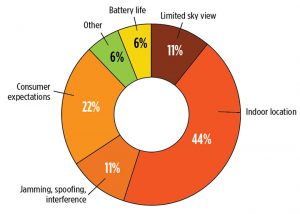
    What is the key challenge for positioning and navigation in the wireless and consumer space? (Source: GPS World 2018 State of the GNSS Industry survey)
    What is the key challenge for positioning and navigation in the wireless and consumer space? (Source: GPS World 2018 State of the GNSS Industry survey)

    GPS World is asking PNT professionals about the developing technology frontiers, the state of their business, the economic climate for products and services, driving market factors, the effects of jamming, the Issue of the Year — and more! Please give us your opinions in the 2019 State of the Industry survey. It should take less than 10 minutes, and your responses are confidential.

    A handful of lucky participants drawn at random will win TWO $100 gift cards good (virtually) anywhere.

    Complete the survey by June 30. Then look for a complete report of our findings in the September issue of GPS World.

    Thank you for taking the time to share your feedback and help us improve our magazine content, industry awareness — and your own business!

    While asking questions that have appeared in past State of the Industry surveys, to reveal industry changes that have taken place over the last five years, the 2019 Survey presents these new issues for your consideration:

    • With multiple constellations, signals and services now beginning to emerge, what are the challenges to keeping open and seamless access to these in the international marketplace ? 

    • Among the many benefits of modernized signals, which is the most important in your field of work?

    • Among the key challenges in utilizing modernized signals, which gets most of your attention? 

    The question above offers such answer choices as: increases die size without ability to increase chip cost; longer code sequences are difficult to acquire; increases RAM/ROM; increases number of RF channels; increases number of digital channels; higher CPU processing required; and software complexity with many signal types. 

    What one word would you use to describe your company’s No. 1 opportunity to grow in 2020? 

    What one word would you use to describe your company’s No. 1 obstacle to growth in 2020?

    Overall, the 2019 Survey covers such topics as:

    • Technology Trends.  PNT is rapidly diversifying among a number of complementary technologies, as GNSS looks to inertial, lidar, laser, cellular, WiFi and other beacons, signals of opportunity, low-Earth orbit satellite constellations and more. Different market sectors have, naturally, different requirements, and these lead to different integration combinations. Where do you see the most promise?
    • The Global Economy and how it affects business in your sector. Customers’ availability of capital to invest is top-of-mind for most industry professionals, whether designers, manufacturers, integrators, suppliers/dealers, or end users.
    • Industry Confidence in the road ahead. Sound business navigation requires a fluid, responsive combination of technology, capital, investment, and often most important, human capital. .
    • Issues of Concern. To what extent do industry leaders take into account the following as well as further factors?
      • Pricing and competitive issues;
      • GNSS jamming, spoofing, other RF interference;
      • Developing compatibility and interoperability of GNSS: GPS, GLONASS, BeiDou, Galileo;
      • Advantages and drawbacks of other positioning and navigation technologies.

    The survey report, complete with insightful articles and infographics, will appear in the September issue. Look for it!

    Please click here to begin the survey.