ABI Research’s competitive analysis evaluates GNSS IC vendors across innovation and implementation parameters
The GNSS market is slowly shifting in new directions, according to ABI Research. While the smartphone market continues to grow, new opportunities are also emerging in automotive, insurance, wearables, unmanned aerial vehicles (UAVs) and the Internet of Things (IoT).
Overall, the GNSS market is forecast to continue to grow strongly, with ubiquitous location and market-specific IC design as key differentiators.
In its latest competitive analysis of GNSS IC vendors, ABI Research evaluates a variety of innovation and implementation parameters to determine emerging competitive threats and technologies, the companies best positioned for success and those in danger of losing out.
Unchanged for the past three years, the market’s two top IC vendors remain Qualcomm and Broadcom, soon to be acquired by Avago. Both companies continually illustrate the ability to lead the way on cutting-edge innovation, which in turn drives their dominant market-share position, ABI Research said.
Beyond just GNSS, both companies also offer comprehensive location technology platforms in HULA (Broadcom) and Izat (Qualcomm), which will enable smartphone OEMs to begin offering ubiquitous location in 2016. Qualcomm’s work on LED/VLC and LTE Direct illustrates the gap that now exists between it and pure-play GNSS IC vendors.
u-blox, a well-established GNSS IC company, has shown continuous growth each year by implementing new technologies and making acquisitions, culminating in its first ever third place ranking, ABI Research said. The company continues to lead the way in its core markets, while also expanding into the emerging IoT space.
“The big surprise this year has been MediaTek dropping to fourth place,” said Patrick Connolly, principal analyst at ABI Research. “This is primarily due to a lack of new GNSS or indoor location products. However, this did not affect its IC market share, or its ability to win an important GNSS IC win with Fitbit in wearables. MediaTek has a history of delivering when its customers need new innovation. As a result, ABI Research expects new product announcements from the company in 2016, especially around indoor location.”
Ranking fifth, STMicroelectronics is seeing customers migrate to its TESEO III platform. Its modular, high-performance approach should also enable it to move beyond its traditional markets of automotive and recreational/fitness, especially as it has begun to leverage the company’s expertise in sensor fusion.
As new opportunities for GNSS continue to develop in markets such as wearables, IoT, personal tracking and UAVs, there will also be a number of new or emerging companies looking to claim a share in the stakes. Analysis findings point to the Chinese regional market as one such area that has potential to demonstrate strong growth trends in future years.
“There’s big opportunity for emerging Chinese start-ups, such as CEC Huada, to meet new, indigenous, market demand over the next 10 years, while also working their way toward becoming major international competitors,” concluded Connolly. “Additionally, Galileo Satellite Navigation, an emerging company focused in software GPS, is reporting impressive results in trials. As consumer electronics start supporting software GPS, it will be interesting to watch whether or not it can achieve volume shipments in 2016.”
These findings are part of ABI Research’s Location Devices Service, which includes research reports, market data, insights and competitive assessments.
Galileo Satellite Navigation Ltd. (GSN), an Israeli startup, is demonstrating a navigation solution that can “pull the sword out of the stone,” said Uri Michon, sales and marketing manager for GSN.
The company has developed its own GNSS software receiver, and is now in the final stage of integration to a Korean (long-term evolution) LTE integrated circuit (IC) manufacturer platform.
As opposed to a standard hardware receiver convention of one size fits all, GSN offers a tailor-made flexible solution that accommodates each customer’s use cases, performance needs and system resource tradeoff.
The receiver requires any regular RF front-end, simple glue logic and existing platform digital signal processor (DSP)/central processing unit (CPU). The receiver is hardware agnostic and has already been demonstrated working on CEVA, Cadence, ARM and Intel processors.
While reducing the need for an external IC, the customer gains the ability to install only the GNSS constellation required, reducing inventory and solution costs. The customer can also introduce upgrades (new constellation features) and updates when available.
GSN is targeting the cellular market, but the company said its flexibility and ability to create a low resource solution has its best fit for the rapdily evolving markets of machine-to-machine (M2M), the Internet of Things (IoT) and wearables.
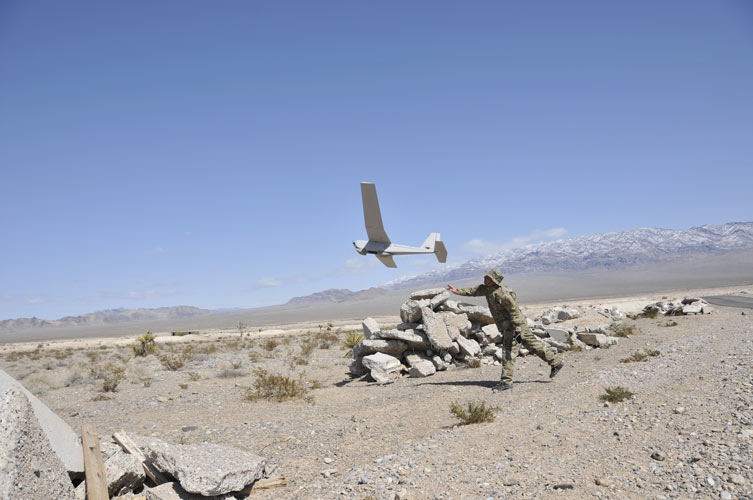
AeroVironment has received an order valued at $13 million for RQ-20A Puma AE small unmanned aircraft systems (UAS) and initial spares packages for the United States Marine Corps.
The Marine Corps employs the Puma AE system as the long-range solution for its small unit remote scouting system (SURSS), complementing the AeroVironment RQ-11B Raven and RQ-12A Wasp AE UAS.
The Puma AE unmanned aircraft system delivers situational awareness directly to its operator in ground, to help provide information superiority on the battlefield.
AeroVironment received the order from ADS Inc. on behalf of the U.S. Marine Corps through the Defense Logistics Agency Tailored Logistics Support program. Delivery is scheduled within 12 months.
The Puma AE weighs 13.5 pounds, operates for more than 210 minutes at a range of up to 15 kilometers, and delivers live, streaming color and infrared video as well as laser illumination from its pan-tilt-zoom Mantis i23 AE gimbaled payload.
Launched by hand and capable of landing on the ground or in fresh or salt water, the Puma AE provides portability and flexibility for infantry, littoral or maritime reconnaissance operations.
A proposed national drone registration system should be based on the pilot, not the craft, recommends an FAA task force. It should also be free, electronic and immediate, and not apply to UAVs weighing 250 grams or less.
In October, U.S. Transportation Secretary Anthony Foxx and Federal Aviation Administration (FAA) Administrator Michael Huerta announced the creation of the task force to develop recommendations for a registration process for unmanned aircraft systems (UAS).
The Task Force agreed that it was outside its scope to debate the Department of Transportation (DOT) Secretary’s decision to require registration of sUAS or the legal authority for the implementation of such a mandate.
Immediately following the DOT’s announcement in October, the FAA brought together retailers, pilots, industry representatives and others to talk about the proposal and submit comments on how the system should work.
Task force members interviewed FAA officials, met for three days and prepared final recommendations. They agreed on three basic requirements: Owners must fill out an electronic form, immediately receive a certificate of registration and number for use on all UAVs they own, and mark all applicable drones with a registered number.
The Task Force recommendations for the registration process are:
Fill out an electronic registration form through the web or through an application (app).
Immediately receive an electronic certificate of registration and a personal universal registration number for use on all sUAS owned by that person.
Mark the registration number (or registered serial number) on all applicable sUAS before their operation in the National Air Space (NAS).
The Task Force recommended an exclusion from the registration requirement for any small unmanned aircraft weighing a total of 250 grams or less. The exclusion was based on a maximum weight that was defined as the maximum weight possible including the aircraft, payload, and any other associated weight. In manned aircraft terms, it is the “maximum takeoff weight.”
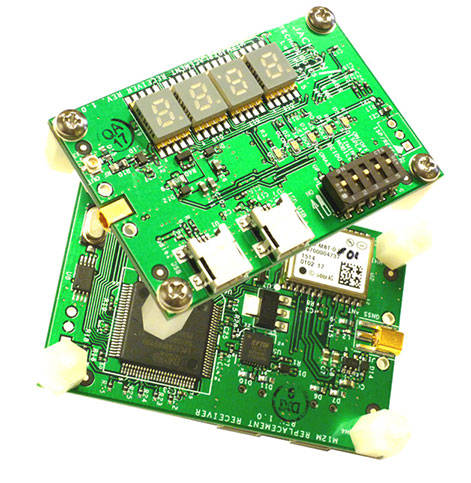
Jackson Labs Technologies Inc. has made available the M12M Replacement Receiver GNSS module that is form-fit-function compatible to the legacy Motorola M12M and M12+ timing and navigation receivers. It uses an eighth-generation GNSS timing-enabled receiver allowing 72 GNSS-channel reception with any two GNSS systems being received simultaneously.
The M12M adds configurability via USB ports as well as dual in-line package (DIP) switches and various status displays. GPS, GLONASS, BeiDou, QZSS and SBAS (WAAS/EGNOS/MSAS/GAGAN) signals can be received.
The module supports NMEA, Motorola binary and u-blox binary, as well as SCPI (GPIB) communication protocols for easy configuration and monitoring, and is designed to allow plug-and-play retrofit of equipment designed for the legacy Motorola receivers, as well as provide an easy design-in for new customer applications, the company said.
The M12M is certified to operate as a plug-and-play upgrade to legacy equipment such as the Symmetricom/Microsemi XLI server, as well as the Jackson Labs Technologies Fury GPSDO, requiring no setup or configuration to operate in those products, and can thus be used to retrofit products for GLONASS/BeiDou compatibility. In the process, the module enhances all performance parameters such as time to first fix; position, velocity and timing accuracy; tracking sensitivity; the addition of SBAS (differential compensation) capability; and the addition of external interfaces such as USB and a synthesized frequency output.
The module supports a satellite tracking sensitivity of down to -167 dBm, allowing indoor reception in typical environments, a 1PPS output with better than 5-nanosecond real-mean-squared (rms) stability (quantization corrected), and a positioning accuracy of typically better than 0.3 meters rms (survey-in) or better than 0.7-meter rms horizontal even in high-dynamic environments such as aircraft missions.
Dynamic auto Kalman filter configuration software allows using changing Kalman filter parameters in real time for improved accuracy, with filter parameters being automatically set dependent on actual mission dynamics. The GNSS timing receiver also supports Auto Survey (Survey-in) operation with Position Hold mode and TRAIM, allowing single-satellite timing reception in challenged or denied stationary environments.
The module integrates a UTC (GNSS)-synchronized NCO synthesizer with buffered output that can generate a user-adjustable frequency from 0.25 Hz to over 10 MHz with extreme frequency accuracy when locked to the satellites. Additional features include operation from various power sources such as USB, or 3V via the M12M compatible connector, as well as a 7-segment LED status display, and numerous DIP switches for easy software-less configuration of the operating modes and desired GNSS systems to be enabled, Jackson Labs said. The module displays Satellite Status information including signal strengths and systems received, and can thus be used as a handheld antenna- and satellite signal distribution-system monitor.
Various optional programs can be used to configure, control and monitor the unit such as GPSD/NTP, GPSCon, Z38xx, u-blox uCenter, TimeKepper, TeraTerm Pro, WinOncore-12 and others. The industry-standard SCPI software interface supports easy-to-use English-language commands such as GPS?, HELP?, and others to monitor and configure the unit, while all advanced GNSS receiver functions such as capturing carrier phase data, assisted start, satellite setup and gating, and health monitoring features are also supported.
M12M Replacement Receiver module samples ship from stock, and are priced at $220 each.
Routescene has jointly developed with Hanseatic Aviation Solutions an integrated fixed-wing UAV and LidarPod solution for surveying.
Following in-depth customer research, Routescene identified a gap in the market for an unmanned aerial 3D mapping solution capable of flying long distances, particularly for use in large countries with great expanses of remote land such as Australia, the United States, Canada and Eastern Europe. The integrated solution would be used for long-distance surveys, such as powerline inspections in the utilities sector, biomass mapping of forests and geophysical surveys.
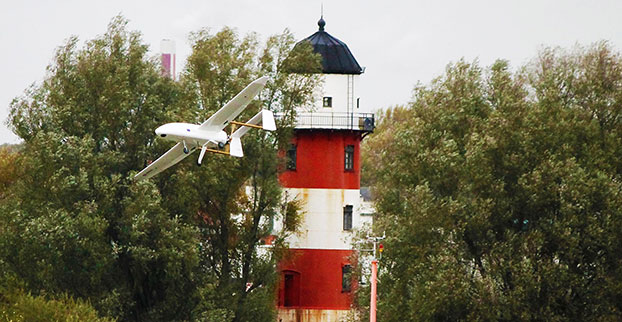
The successful maiden flight of the integrated Hanseatic S360 and Routescene LidarPod took place in July in Bremen, Germany, and demonstrated its capability by collecting sample data. German aviation authorities were so confident in the product, they gave Routescene permission to fly in the same circuit as manned aircraft.
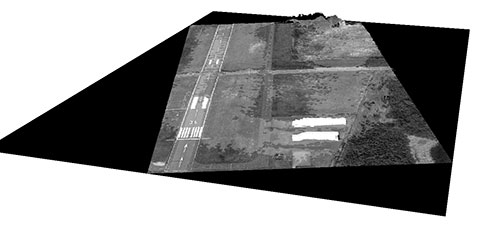
A 3D point cloud of the runway at Bremerhaven Airport.
Benefits
The LidarPod is integrated internally within the S360 itself, rather than being wing-mounted, reducing drag and enabling longer flight and survey times. Integration of the LidarPod into the nose cone minimizes noise and vibration traveling from the rear-mounted engine, ensuring the GNSS/INS is not adversely affected. It also enables more accurate positioning.
The S360 is fixed-wing and built for long-distance flights, with four-hour endurance in the standard configuration, along with long-range telemetry, an autopilot system and a mission planning tool. It works in up to Force 7 winds, extending the operational window in which surveys can be performed. Its significant payload capacity enables the integration of additional survey and geophysical sensors as well as the LidarPod. Because this is an internally integrated solution, it can be set up rapidly and is easy to deploy in the field, Routescene said.
Michael Schmidt, managing director of Hanseatic Aviation Solutions, and Gert Riemersma, CEO of Routescene, met for the first time at INTERGEO 2014. They immediately understood the potential power of a collaboration.
Routescene launched the LidarPod at that trade show. It quickly attracted wide interest and is now generating business across four continents, Routescene said.
After exploratory discussions with clients, the companies started development of the system in earnest at the start of 2015. “We have already seen significant interest from the forestry and geophysical exploration community,” Riemersma said.
The Federal Aviation Administration (FAA) wants unmanned aircraft owners to know that there’s no need to work with a “drone registration” company to help them file an application for a registration number.
Owners should wait until additional details about the forthcoming drone registration system are announced later this month before paying anyone to do the work for them.
The Task Force assigned to provide FAA Administrator Michael Huerta with recommendations on the registration process is still days away from delivering this information. But at least one company is already offering to help people register their drones — for a fee.
Speaking to the Task Force two weeks ago, Administrator Huerta told the group to provide guidance on a streamlined unmanned aircraft registration process that will be simple and easy to complete, and which types of UAS would need to be registered and which would not. The Task Force agreed and is working on recommendations for a system that is similar to registering any newly purchased product with its manufacturer, as well as a minimum weight for unmanned aircraft that must be registered.
Drone owners should visit FAA.gov for official updates on the unmanned aircraft registry.
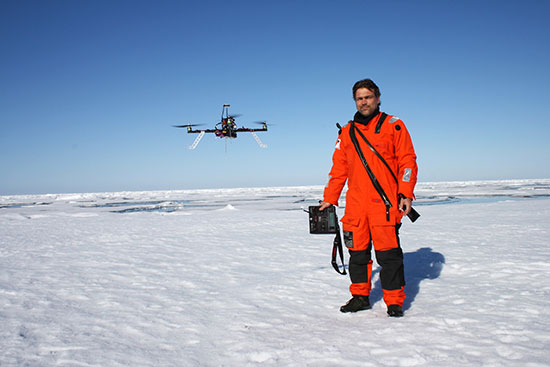
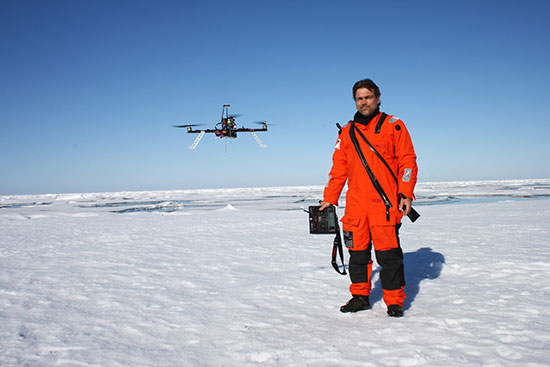
Researchers conducted an autonomous multicopter flight in the Arctic with its own test UAV platform that used a u-blox LEA-M8T GPS receiver. (Photo: Alfred-Wegener Institute)
How do you successfully pilot a UAV in the remote expanses of the Arctic Ocean when the compass can’t provide reliable positioning data? Engineers on board the Alfred Wegener Institute’s (AWI’s) research icebreaker Polarstern specially programmed a multicopter, allowing it to navigate despite the deviations produced by the Earth’s magnetic field near the North Pole. The researchers recently celebrated the copter’s first successful autonomous flight and landing on an ice floe.
“At high latitudes, autonomous navigation is a major challenge,” said Sascha Lehmenhecker, an engineer at AWI. “Navigation systems normally use magnetic sensors. But near the poles, the lines of the Earth’s magnetic field are nearly perpendicular to the ground, making precise navigation extremely difficult. That’s why commercial multicopter control systems aren’t well suited for use in polar regions.”
Ice Floe Landings
Lehmenhecker’s team refined the control systems for multicopters to land on ice floes and fly back to their “mother ship” autonomously several hours later. The particular task: both the ice floe and the ship are in motion. The ship has to continue on its scheduled course to conduct other research, while wind, waves and currents cause the ice floe to drift. It’s precisely the direction and speed with which it drifts that the multicopter needs to determine.
The team pursued two approaches. “In the first approach, the multicopter remains in constant contact with a receiving station, which uses the copter’s GPS data to calculate the discrepancies. In other words, the multicopter transmits its GPS position to the station, which in turn transmits back the corresponding, adjusted coordinates,” explained Lehmenhecker. “The second option: We use two onboard GPS receivers to calculate the actual change in the copter’s position. Though this is the better method, it’s also much more complex, and we’re still just starting to develop it.”
The system passed its first test, conducted on an ice floe in the arctic Fram Strait (79° N parallel). In the test, the team and copter were left on a floe, clear of magnetic interference produced by electric motors on board the Polarstern. The team manually flew the copter 3 kilometers out, to the edge of visual range, then activated the autonomous return program. The multicopter flew to the preset coordinates and safely landed on its own.
Underwater Assist
Lehmenhecker’s team came up with the idea for this development in connection with the use of sensitive devices under the ice, such as the torpedo-shaped autonomous underwater vehicle (AUV) Paul, which explores the ocean beneath the sea ice. “To optimally plan its dives, it’s important to have precise information on the movement of the sea ice,” Lehmenhecker said. Conventionally, this was achieved by deploying ice trackers on floes with the help of a Zodiac boat or helicopter — a difficult and time-consuming method. Further, the researchers generally try to avoid leaving the safety of the Polarstern wherever possible — jagged ice floes and polar bears present additional risks.
During 2012, the group first used a UAV to assist Paul. The UAV landed on the ice via remote control, then used GPS to determine its position and transmit the data back to the research ship, which was monitoring Paul’s dive. In this way, the multicopter took on an important role, offering navigational support for the AUV. Once each dive was complete, the ship had to return close to the multicopter’s position so the pilot could remotely guide it back to the ship, which was only possible in visual range.
Now, the new developments “will expand the service radius of our copters from visual range to as much as 10 kilometers,” Lehmenhecker said.
Storm Surge in downtown New York City in the aftermath of Hurricane Sandy. (Photo: USACE)
By JoAnne Castagna
U.S. Army Corps of Engineers
Hurricane Sandy led to one of the largest-scale U.S. evacuations in recent history, according to Edward Schneyer, director of Emergency Preparedness, Suffolk County (N.Y.) Office of Emergency Management.
“During Sandy, we rescued 250 people from their flooded homes, evacuated two major hospitals and several adult care homes,” Schneyer said.
Schneyer was able to do this effectively because his agency uses storm surge maps created by the U.S. Army Corps of Engineers, New York District. Storm surge is when a significant amount of water is pushed from the sea onto the land caused by a hurricane.
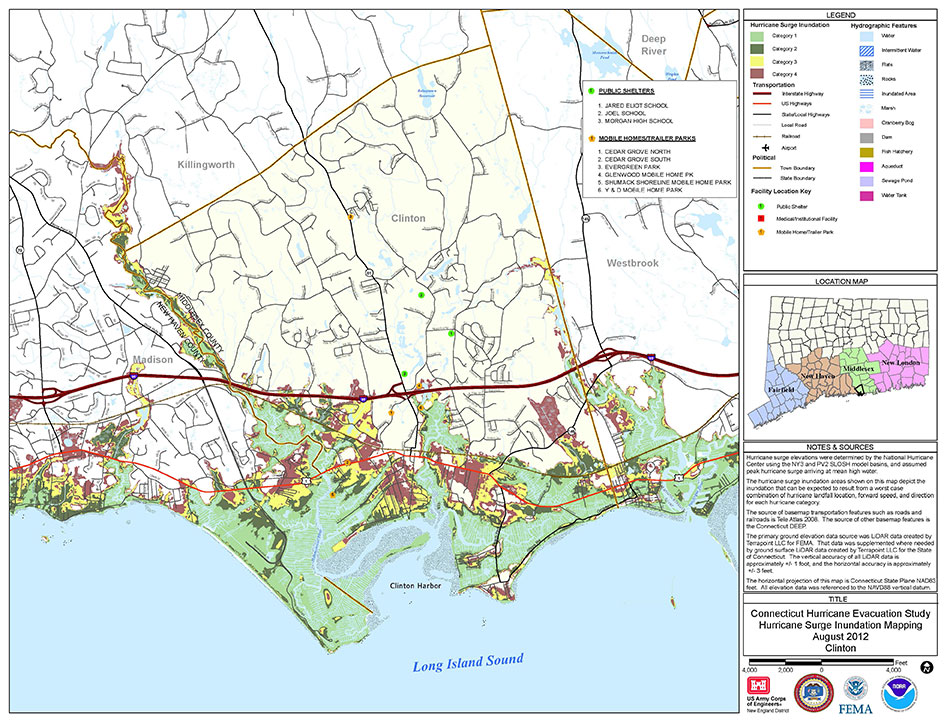
The maps provide emergency managers in hurricane-prone states with an understanding of storm surge potential that could occur for worst-case Category 1 to 4 storms, identifying areas from which people should evacuate if faced with the threat of storm surge.
The Army Corps is updating these maps with higher resolution modeling and topography performed by NOAA’s National Hurricane Center’s Storm Surge Unit, so agencies will have more accurate information to educate the public — reducing risk to themselves and their property.
Hazard Analysis
“Historically, 49 percent of human causalities from hurricanes are due to storm surge,” said Donald E. Cresitello, the Corps’ Hurricane Evacuation Study program manager for the New York District. “Other impacts like riverine flooding due to rainfall, falling trees due to high winds, and indirect impacts like carbon monoxide poisoning and electrocution can cause deaths. The development of these maps is the first step in the hazard analysis for the hurricane evacuation study process.”
The “New York Hurricane Evacuation Study Hurricane Surge Inundation Maps” are being produced in collaboration with the Army Corps’ New England and Baltimore Districts and provided to emergency managers. The Army Corps also guides emergency managers on using the maps in the decision-making software HURREVAC (Hurricane Evacuation), developed by Sea Island Software for the National Hurricane Program.
“Agency officials can use these maps to help reduce risk to the public,” Cresitello said. “They can use them for evacuation planning, to redefine their hurricane evacuation zones, identify where shelters should be located and identify where assets should be staged prior to impact from a storm.”
The new maps will not only show the extent of inland storm surge, but also the depth of the water — in ranges of feet — during different categories of storms, enabling emergency managers to better focus limited resources.
“In the initial stages of a response, our recovery resources are limited, especially for an event the size of Sandy. If resources are dispatched to areas that were not impacted, valuable time is lost mobilizing and reassigning those resources,” Schneyer said.
At press time, Schneyer’s agency is entering information from the maps into an interactive program viewable on its county’s website, so the public can see whether their home is in a storm surge zone and which designated shelter is nearby. During Sandy, people who should have evacuated were stranded and faced dangers such as electrocution from downed power lines and fires from gas leaks.
“This very valuable resource is an excellent tool for public education, emergency management planning, and emergency preparedness in general,” Schneyer said.
Connecticut shoreline: This example of a storm surge map shows the extent of surge that can be expected as a result of a worst-case scenrio that combines hurricane landfall location, forward speed and direction for each hurricane category. (Credit: USACE)
Using GIS to Create Higher Resolution Maps
Geographic information systems (GIS), which capture, store, analyze and display location information, are being used to create higher resolution storm surge maps.
To create the maps, the Corps of Engineers uses the SLOSH model (Sea, Lake, Overland Surges from Hurricanes) provided by the National Oceanic and Atmospheric Administration (NOAA). The SLOSH data is layered over lidar-based topography in Esri ArcGIS software.
“To come up with the actual depth of water through GIS, we are overlaying the data out of NOAA’s SLOSH model and subtracting out the ground elevations using digital elevation models and coming up with an actual depth of water in feet,” said Donald E. Cresitello, USACE Hurricane Evacuation Study program manager for the State of New York, U.S. Army Corps of Engineers, New York District.
JoAnne Castagna is a public affairs specialist and writer for the U.S. Army Corps of Engineers, New York District.
Avago Technologies Ltd. will move ahead with its merger with Broadcom Corporation, following a shareholder meeting Nov. 10 where shareholders overwhelmingly approved the business transaction.
Avago and Broadcom announced their merger agreement on May 28. The companies have received clearance on the proposed merger from the Committee on Foreign Investments in the United States and antitrust authorities in the United States, Japan and Taiwan.
Among other customary conditions to closing, the transaction remains subject to regulatory approvals from the European Commission and antitrust authorities in China and South Korea, all of which are progressing. Avago anticipates that these remaining approvals will be received and expects the transaction to close late in calendar year 2015 or early in 2016.
Avago Technologies is a designer, developer and global supplier of a broad range of analog semiconductor devices with a focus on III-V based products and complex digital and mixed signal CMOS based devices. Its product portfolio includes thousands of products in four primary target markets: wireless communications, enterprise storage, wired infrastructure and industrial, and other.
When Philadelphia welcomed Pope Francis during his September visit, Bentley Systems’ 3D reality modeling tools helped the event company plan the multi-faceted event, including the anchor event of the Eighth World Meeting of Families Congress.
In planning this massive and multi-faceted event, production company ESM Productions needed to coordinate with Philadelphia’s many public services, as well as the U.S. Secret Service, Pennsylvania state agencies, and the local Philadelphia Catholic Diocese. This coordination was made more effective through Bentley’s reality modeling technology, as well as services provided by a legion of Bentley colleague volunteers.
ESM had witnessed firsthand Bentley’s new reality modeling capabilities at a Bentley event that they produced, and was struck by its significant potential to accelerate their planning of the pope’s visit to Philadelphia.
Upon learning of this interest, Bentley Systems CEO Greg Bentley invited Bentley colleagues (and retirees) to donate their time and talent to a “pro bono” effort on the part of Bentley Systems to help assure its headquarters region’s successful hosting of the pope and the unprecedented number of expected visitors.
Some 30 colleagues participated in exploring how reality modeling could expedite the design and engineering of substantial temporary facilities for this highly visible, fast-tracked project, while supporting the extreme security workflows required.
“We wouldn’t be chosen to produce world-class events unless we did them well, and we do them well because we innovatively apply the appropriate and most effective technologies,” said Scott Mirkin, co-founder and executive producer of ESM Productions.”The minute we saw Bentley’s reality modeling in action, we knew it could provide breakthrough benefits — but given the exceptionally tight deadlines, we had limited time, in our own right, to experiment with it.”
Bentley colleagues offered their support and applied Bentley’s reality modeling, enabling the event organizing team to ensure that one of the country’s largest public events was executed successfully.
“In the end, we experienced dramatic risk reduction, better decision making, exceptional timeliness, and greater efficiency,” Mirkin said. “The goal we set with Bentley to test the applicability of reality modeling as a mission-critical event planning technology was completely validated, and we are now planning to offer this new value to our clients going forward.”
ESM Productions was so impressed by the benefits of reality modeling, the company is creating a documentary highlighting its use and outcomes, Mirkin said. See a preview below.
Bentley’s reality modeling process involved three steps:
Capture reality. Bentley’s ContextCapture software was used to build a highly detailed, photo-textured 3D “reality mesh” model from 28,000 digital photographs, with unprecedented geometrical accuracy. Base imagery was provided by Pictometry, high-resolution aerial photography was taken by helicopter by AEROmetrex, and ground footage was captured by Bentley volunteers — including building facades, street views, and the inside of the Cathedral Basilica of Saints Peter and Paul.
Engineer in context. The highly precise 3D model was populated with 2D and 3D maps and designs, resulting in a 28 GB dataset. The dataset was used to communicate the details for the 56,400 temporary structures, main and secondary stages and event seating, 33 miles of security barricade perimeter, special U.S. Secret Service security requirements, impact of local road closures to pedestrian traffic flows, and more.
Enliven the engineered environment. Bentley’s LumenRT software was used to add motion and additional content to simulate the expected operational experience, a great help to decision makers. The team added moving people in crowds, vehicles flowing in traffic, dynamic sunlight conditions, and seasonal trees and plants.
“This was a highly public and complex project, with many stakeholders and an impossible timeline. We got involved right in the middle of it,” said Buddy Cleveland, a recently retired Bentley senior vice president who led the Bentley team. “The papal visit required effective planning for the construction and management of temporary facilities and utilities amidst a busy urban infrastructure.”
Bentley created a comprehensive, highly detailed 3D model of Philadelphia that was visually realistic and dimensionally accurate, and then seamlessly integrated that model with engineering models produced by its tools. “Both ESM and Bentley are very grateful to our partners, Pictometry and AEROmetrex, who stepped up to provide the base imagery, aerial imagery, and processing with ContextCapture to create the initial reality mesh,” Cleveland said.
Four point clouds, nonregistered, of georeferenced images from four UAV flights.
By Christian Eling, Lasse Klingbeil, Markus Wieland, Erik Heinz and Heiner Kuhlmann
Direct georeferencing with onboard sensors is less time-consuming for data processing than indirect georeferencing using ground control points, and can supply real-time navigation capability to a UAV. This is very useful for surveying, precision farming or infrastructure inspection. An onboard system for position and attitude determination of lightweight UAVs weighs 240 grams and produces position accuracies better than 5 centimeters and attitude accuracies better than 1 degree.
Data acquisition from mobile platforms has become established in many applications recently, particularly using unmanned aerial systems (UASs). Unlike other mobile platforms, unmanned aerial vehicles (UAVs) can overfly inaccessible and also dangerous areas. Furthermore, they can get very close to objects to collect high-resolution data with low-resolution sensors, and they enable approach from all viewing directions without physical contact. UAVs now see use in precision farming for phenotyping or plant monitoring, and in infrastructure inspection and surveying.
Data acquisition from mobile platforms has become established in many applications recently, particularly using unmanned aerial systems (UASs). Unlike other mobile platforms, unmanned aerial vehicles (UAVs) can overfly inaccessible and also dangerous areas. Furthermore, they can get very close to objects to collect high-resolution data with low-resolution sensors, and they enable approach from all viewing directions without physical contact. UAVs now see use in precision farming for phenotyping or plant monitoring, and in infrastructure inspection and surveying.
This article addresses lightweight UAV use for mobile mapping and uses the term micro aerial vehicle (MAV) throughout. MAVs can generally be characterized as having a weight limit of 5 kilograms and a size limit of 1.5 meters.
We focus on the development of a real-time capable, direct georeferencing system for MAVs, since spatial and time restrictions often exclude the possibility of deploying ground control points for an indirect georeferencing. The demand for the real-time capability results from the aim to also use the georeferencing for autonomous navigation of the MAV and to enable a precise time synchronization of the onboard sensors. Furthermore, a real-time direct georeferencing also offers the opportunity to process collected mapping data during flight.
Mapping on demand. The goal of this research project, funded by the Deutsche Forschungsgemeinschaft (DFG), is to develop an MAV that can identify and measure inaccessible three-dimensional objects by use of visual information. A major challenge within this project comes with the term “on demand.” This means that apart from the classical mapping part, where 3D information is extracted from aerial images, the MAV is intended to fly fully autonomously on the basis of a high-level user inquiry. During the flight, obstacles must be detected and avoided. To extract semantic information that can be used to refine the trajectory planning, the mapping data has to be processed in real time. When the georeferencing information is used as initial values for the bundle adjustment, the image processing can be significantly accelerated.
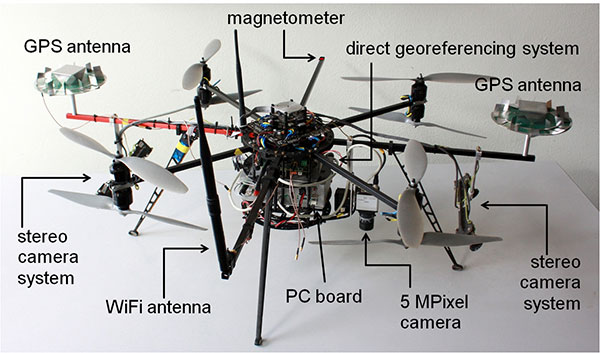
Figure 1 shows the current MAV platform developed in this project. We customized an MAV kit to a coaxial rotor configuration, replaced the centerplates with more stable carbon-fibre plates to stabilize the system, and installed the direct georeferencing and the mapping sensors. The two stereo camera pairs, pointing forward and backward, act as an additional sensory input for the position and attitude determination; the 5M-pixel industrial camera with global shutter is the actual mapping sensor. The PC board is used for onboard image processing, flight planning and machine control; the Wi-Fi module enables a connection to a ground station.
Figure 1. The MAV with mapping and georeferencing sensors, developed for the research project Mapping on Demand.
Although the direct georeferencing system must be small and lightweight, accuracy requirements for its position and attitude determination are high. Generally, these accuracy requirements are different for the machine control, navigation and mapping purposes.
In our project, the MAV is intended to maintain a safety distance of about 0.5 meter to obstacles. Hence, a position accuracy of 0.1 meter is sufficient for the navigation. The absolute attitude accuracy should be in the range of 1 to 5 degrees. For machine control, relative information is more important, and for this the accuracies should be slightly higher.
For mapping purposes, the positions and attitudes have to be known better, since the absolute georeference of the final product (for example, a high-resolution 3D model of a building) is based on the positions and attitudes from the direct georeferencing system. Therefore, the position accuracy should be in the range of 1–3 cm and the attitude accuracy should be better than 1 degree. The relative accuracy of the exterior camera orientation can be improved by a photogrammetric bundle adjustment, but systematic georeferencing errors should be avoided.
To summarize:
The weight of the system has to be less than 500 grams (g), to be applicable on MAVs.
Especially for the control and navigation, the system has to be real-time capable.
All sensors have to be synchronized and outages of single sensors should be bridgeable by other sensors.
The system is intended to provide accurate positions (σpos < 5 cm) and attitudes (σatt < 1 deg) during flights.
The integration of data from additional sensors, such as cameras, should be possible.
The ability to include additional sensors to the system was, apart from the size and the weight constraint, the main reason for developing a proprietary system instead of using a commercial unit with similar capabilities.
Direct Georefencing
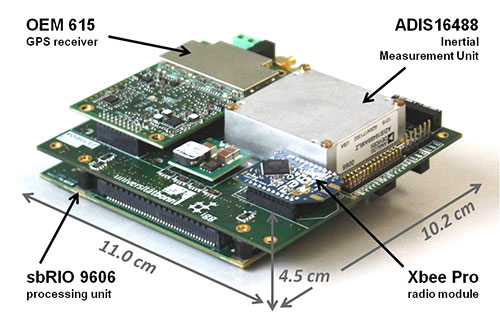
The current version of the system weighs 240 g without GPS antennas (see figure 2). To reduce weight, the antennas were dismantled, reducing their weight from 350 g to 100 g. However, since the antenna reference point got lost in this process, the antennas had to be recalibrated in an anechoic chamber for further use. By comparison to the original antennas, the dismantling led to significant changes in the phase center offsets (circa 4 cm in the Up, < 1 mm in the North and East component) and in the phase center variations (< 5 mm) of the antennas.
Figure 2. The direct georeferencing system.
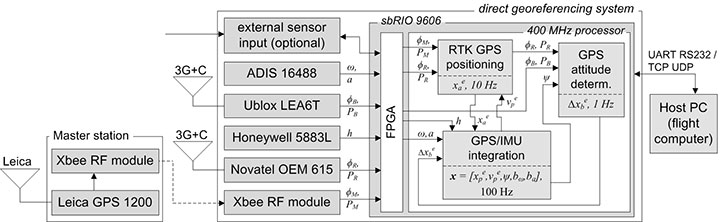
Figure 3 shows a flow chart of the direct georeferencing system with the sensors and the main calculation steps. The system consists of a dual-frequency GPS receiver, a single-frequency GPS receiver, an inertial measurement unit (IMU) and a magnetometer. The dual-frequency receiver is the main positioning device. Together with the GPS raw data from the master station (carrier phases ϕM, pseudoranges PM), which is transmitted via a radio module, the data of the dual-frequency receiver (ϕR, PR) is used for an RTK positioning, leading to centimeter position accuracies.
Figure 3. Flowchart of the direct georeferencing system.
In collaboration with the data of the single-frequency receiver (ϕB, PB), the data of the dual-frequency receiver is also used for GPS attitude determination. The corresponding GPS antennas of these two receivers form a short baseline (baseline length = 92 cm) on the MAV. The determination of the baseline vector in an e-frame (Earth-fixed) enables yaw and the pitch-angle determination.
The tactical-grade micro-electro-mechanical (MEMS) IMU, which includes three-axes gyroscopes, accelerometers and magnetometers, provides angular rates (ω), accelerations (a) and magnetic field observations (h) with high rates (100 Hz) for position and attitude determination. To be unaffected by the electric currents as much as possible, an additional magnetometer is placed on the outer end of one of the rotor-free MAV arms.
The direct georeferencing system further consists of a processing unit, which is a reconfigurable IO board, including a field programmable gate array (FPGA) and a 400-MHz processor. In this combination, the FPGA is used for fast parallel communication with the sensors. Afterwards, the preprocessed sensor data are provided to the 400-MHz processor via direct memory accesses, avoiding delays and supporting the system’s real-time capabilities. Finally, the actual position and attitude determination is carried out on the 400-MHz processor.
Methodologies
All position and attitude determination algorithms running on the system were developed in-house. Generally, the integration of these steps could be realized in one tightly coupled approach. Nevertheless, in the current implementation, we decided to separate the different raw data calculation steps, and we only use interactions at the level of parameters. This approach has the advantage that the integration is more reliable and more practical in the real-time programming.
GPS/IMU integration. In this calculation step, all available sensory input is fused to determine the best position and attitude of the system that is currently available. The GPS and the IMU measurements complement each other well, since the IMU provides short-term stable high-rate (100 Hz) data, and the GPS provides long-term stable low-rate (10 Hz) data.
The GPS/IMU integration can be separated into the strapdown algorithm (SDA) and the Kalman filter update. In the SDA, the high-dynamic movement of the system is determined integrating the angular rates and the accelerations of the MEMS IMU in real time. Because the SDA drifts over time, the long-term stable measurements of the magnetometer and the GPS receivers are needed to correct and bound the drift of the inertial sensor integration, which is realized in an error state Kalman filter.
In the GPS/IMU integration algorithms, the navigation equations of the body frame (b-frame) are expressed in an e-frame. Therefore, the full state vector x includes the position xep and the velocity vep, represented in the e-frame. For the attitude representation a quaternion q is used. Finally, the accelerometer bias bba and the gyro bias bbω are also estimated:
The observations in the measurement model are:
the RTK GPS position xea of the dual-frequency RTK GPS antenna reference point, expressed in the e-frame,
the GPS attitude baseline vector Δxeb, expressed in the e-frame,
the magnetic field vector hb, expressed in the b-frame.
Because the reference point of the RTK GPS antenna is not identical to the system reference point, a lever arm between the system and the antenna reference point must be regarded in the measurement model of the RTK GPS positions. From calibration measurements, the coordinates of the lever arm are precisely known in the b-frame.
In the SDA, a coupling between the accelerations, measured by the IMU, and the positions, measured by the RTK GPS, exists. Due to this coupling the yaw angle can be observed, but only in the presence of horizontal accelerations.
To determine an accurate and reliable yaw angle for every motion behavior, the short GPS baseline is realized on the MAV. A significant challenge in processing this baseline is the ambiguity resolution, because only single-frequency GPS observations can be used. Empirical tests have shown that the ambiguity resolution of a single-frequency GPS baseline generally takes several minutes. Among other strategies, we use the additional information from a magnetometer to improve the ambiguity resolution and to actually enable an instantaneous ambiguity fixing during kinematic applications.
Ferromagnetic material on the UAV and high electric currents of the rotors create significant disturbances of the magnetometer during flight. While the influence of the material can be compensated by calibration procedures, the influence of the dynamically changing electric currents are more challenging. To minimize them, the magnetometer is placed at the outer end of a rotor-free arm of the MAV. Also, the measurement model is arranged so that magnetic field observations only have an impact on the yaw determination in our algorithms.
RTK GPS Positioning. RTK GPS positions are calculated in real time with a rate of 10 Hz. These RTK algorithms are in-house developed, although commercial and open-source solutions are available. The main reasons for developing custom software are the following:
Integration of other sensors and/or solutions is possible, to improve ambiguity resolution and cycle-slip detection.
In commercial software, there is generally no access to the source code.
In the development of a real-time capable system, the software must meet the requirements of the operating system running on the real-time processing unit.
Generally, the RTK GPS algorithm complies with a single baseline determination (one master, one rover), where the master station remains ground-stationary and the rover is onboard the MAV.
To resolve the ambiguities and finally to determine the RTK GPS positions, the parameter estimation is performed in three steps: float solution, integer ambiguity estimation and fixed solution.
The float solution is realized in an extended Kalman filter (EKF). Beside the rover position, represented in the e-frame, the EKF state vector xSD also contains single-difference (SD) ambiguities N j on the GPS L1 and the GPS L2 frequencies. The reason for estimating SD instead of double-difference (DD) ambiguities is to avoid the hand-over problem that would arise for DD ambiguities, when the reference satellite changes.
To allow for an instantaneous ambiguity resolution, the observation vector l consists of DD carrier phases Φjkrm and DD pseudoranges Pjkrm on the GPS L1 and the GPS L2 frequencies.
In the current implementation, a random walk model is assumed as a dynamic model of the MAV in the EKF. Even if this is a simple model, it complies with the movement of the vehicle, when the process noise is chosen appropriately.
The float solution procedure provides real-valued ambiguities and their covariance matrix. These ambiguities now must be fixed to correct integer values, to fully exploit the high accuracy of the carrier phase observables. We applied the MLAMBDA method for integer ambiguity estimation.
Finally, a decision must be made whether or not the result of the integer ambiguity estimation can be accepted. This is done by the simple ratio test. With the ambiguities fixed, the final rover position xae is estimated with cm accuracies.
Usually, the time to fix the ambiguities with the algorithm takes a few epochs, but often the ambiguities can be fixed instantaneously. Once ambiguity resolution has been successful, the ambiguities can be held fixed, as long as no cycle slip or loss of lock of GPS signals occur.
Due to the GPS/IMU integration, we have a precise prediction of the RTK GPS positions between two epochs. Thus, the integration of the inertial sensor readings enables us to detect and also repair cycle slips very reliably.
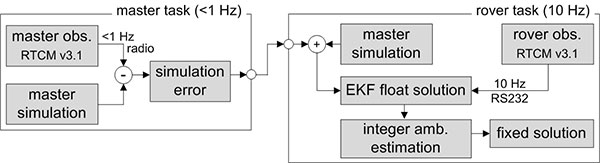
The observations of the master receiver must be transmitted via radio to the direct georeferencing system. In practice, this data transmission can only be realized with a rate of 1 Hz. To be less dependent on this potentially unreliable master data transmission and the lower sampling rate, simulated master observations are used for RTK GPS position determination. Hence, in the actual processing, the true master observations are only used to update the simulation errors in the master task (figure 4), which have to be applied to correct the simulation results in the rover task.
Figure 4. Task scheduling of the RTK GPS algorithms.
GPS attitude determination. The GPS baseline is determined at 1 Hz. In contrast to the RTK GPS positioning, both antennas of the attitude baseline are mounted on the MAV, so that the complete baseline is moving. Furthermore, the baseline length is constant and known from calibration measurements. The GPS attitude determination also consists of the three steps: float solution, integer ambiguity estimation and fixed solution.
The float solution is also based on an EKF where the single-frequency SD ambiguities N j of the attitude baseline are estimated. Further parameters in the state vector are the baseline parameters and the first deviation of the baseline parameters.
As observations DD carrier phases ΦjkAB and DD pseudoranges PjkAB on the GPS L1 frequency are used. To improve the ambiguity resolution, the attitude from the GPS/IMU integration is added to the observation vector, by transforming the known b-frame baseline parameters into the e-frame. Finally, also the known baseline length can be added as a constraint to the observation vector.
In the integer ambiguity estimation, we apply the MLAMBDA method again. Due to the prior information about the attitude of the baseline, the float ambiguities can already be estimated with high accuracies in the float solution. If the ambiguities could not be fixed with the MLAMBDA method, we consider the 10 best solutions for further processing. Unreliable ambiguity parameters are eliminated in a random order, and the MLAMBDA method is applied again. Afterwards we use the ambiguity function method and the known baseline length to exclude false candidates of the 10 best solutions.
If only one solution remains, the ambiguities can be fixed to integer values. Tests have shown that this approach leads to an instantaneous ambiguity resolution success rate of about 95 percent.
Similar to the RTK GPS positioning, the IMU readings are also used to detect cycle slips for the attitude baseline determination, when the ambiguities have been fixed successfully. With ambiguities fixed, the baseline parameters can be determined with millimeter to centimeter accuracies. This leads to yaw angle accuracies in the range of 0.2–0.5 degrees, when the attitude baseline has a length of 92 cm.
Applications and Results
As mentioned, one goal of Mapping on Demand is 3D reconstruction from visual information. The opening image shows such results. During four flights. images were collected with a sampling rate of 1 Hz, and the position and the attitude of the camera was determined in real time using the direct georeferencing system. A bundle adjustment was processed using these positions and attitudes as initial values. Afterwards, dense point clouds could be generated from the oriented images using an open-source software package (PMVS). Due to georeferencing of the collected images, the point clouds are also georeferenced. The image shows results of four flights in one scene, to demonstrate consistency of the georeferencing.
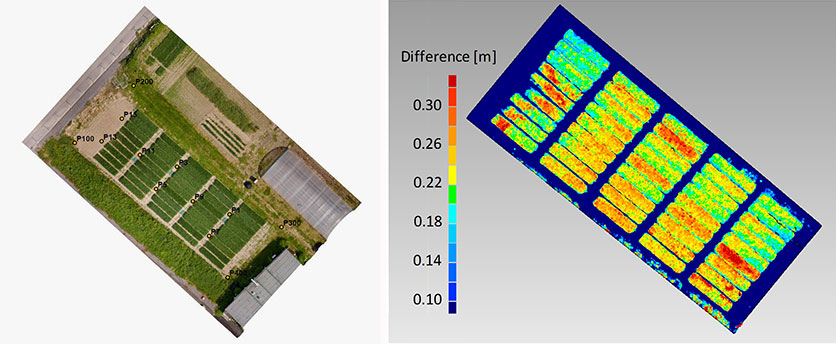
Agriculture. In figure 5, georeferenced images were taken during a flight over a wheat field. The same process was repeated after two weeks. The difference of the respective point clouds, which were determined using the software Photoscan by the company Agisoft, reveals the plant growth at an interval of two weeks. These results show that the determination of plant growth rates, which usually result from time-consuming field work, can be done easily and with high resolution using MAVs. With the use of a direct georeferencing system, this process becomes even more efficient because the deployment of ground control points can be omitted.
Figure 5. Orthophoto of a wheat field (left) and the difference of the vegetation height, determined from the results of two MAV flights at an interval of two weeks (right).
Portable laser scanning system. The small and lightweight design of the direct georeferencing system offers several other opportunities for various applications. One example is the use of the direct georeferencing system in combination with a small, lightweight and low-cost laser scanner.
Terrestrial laser scanning has become an established technology for 3D data acquisition in surveying and mapping because laser scanners provide high-resolution data with high accuracies at high speed. However, for measurement of a complex scene, the laser scanner generally has to be moved to different viewpoints, and all measured scenes have to be registered and georeferenced, a significant increased effort. In contrast, with a directly georeferenced kinematic laser scanning system, complex scenes can be measured with little effort.
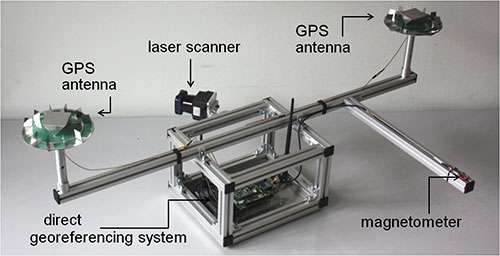
Figure 6 shows a portable laser scanning system we developed for kinematic laser scanning. It combines the direct georeferencing system with a low-cost, lightweight 2D time-of-flight laser scanner. Time synchronization and the point cloud calculation are directly realized on this unit.
Figure 6. A directly georeferenced portable laser scanning system for kinematic 3D mapping.
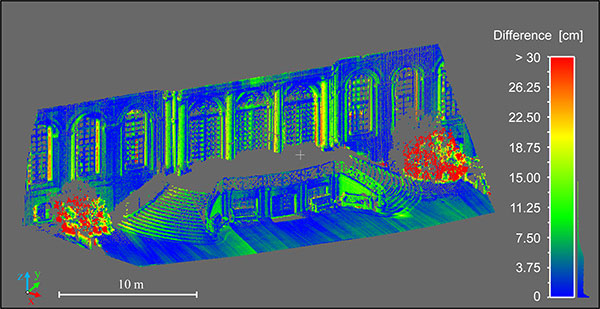
Figure 7 shows differences between a directly georeferenced point cloud, measured by the portable laser scanning system, and a terrestrial laser scanning point cloud, which was indirectly georeferenced using ground control points. Although there are some systematic errors visible, the differences are mostly less than 7.5 cm. The larger differences in the foreground (red) are a result of growing vegetation in the period between both scans. The systematic errors result from the system calibration between the laser scanner and the direct georeferencing system. We are working to improve these calibration methods.
Figure 7. Difference between the results of the directly georeferenced portable laser scanning system and the results of a terrestrial laser scan, which act as reference solution here.
Manufacturers
The MAV is based on a MikroKopter OktoXL assembly kit of HiSystems GmbH. It uses NavXperience 3G+C GPS antennas. The system consists of a dual-frequency NovAtel OEM 615 GPS receiver, a single-frequency u-blox LEA6T receiver, an Analog Devices ADIS 16488 IMU, a Honeywell HMC5883L magnetometer, an XBee Pro 868 radio module, a National Instruments sbRIO 9606 processing unit and a Hokuyo UTM30LXEW 2D time-of-flight laser scanner.
Christian Eling holds an MSc degree in geodesy and is a scientific assistant at the Institute of Geodesy and Geoinformation (IGG) of the University of Bonn.
Lasse Klingbeil received his Ph.D. in experimental physics in 2006. He heads the GNSS and mobile multi-sensor systems group in the IGG. Markus Wieland is a graduade mechanical engineer responsible for the mechanical and electrical design and for the control and readout of various sensor systems at the IGG.
Erik Heinz received his MSc in geodesy and geoinformation from the University of Bonn. He is a Ph.D. student at the IGG. Heiner Kuhlman is a full professor at the IGG. He has worked extensively in engineering surveying, measurement techniques and calibration of geodetic instruments.