Category: Uncategorized

  • Esri Maps Colleges and Universities Attended by American Presidents

    In honor of Presidents Day, Esri’s Presidential Colleges story map features colleges and universities attended by all 44 American presidents. Search by president or college, and discover the varied academic undergraduate experiences of each president.

    esri-presidents-day-W

  • ISRO to Launch Google’s Skybox Satellite This Year

    Skybox_Imaging_Google_Acquisition_WThe Indian Space Research Organization (ISRO) will launch Google’s Skybox Imaging satellite by the end of this year, according to The Asian Age.

    ISRO will launch its first U.S. satellite from the Satish Dhawan Space Center in Sriharikota, according to the news brief.

    Google acquired Skybox Imaging in August of 2014 to develop advanced GPS mapping using its own network of satellites, according to the company’s blog. The Asian Age says Skybox had previously entered into an agreement with Antrix Corporation.

    The article says the satellite will launch alongside a main payload this year.

  • PD Ports Uses GIS in New Ways for Hydrographic Surveys

    PDPorts-hydrographic-GIS-1

    PD Ports is streamlining the way it shares hydrographic data by using GIS software from British software developer Cadcorp. PD Ports is a port, shipping and logistics company headquartered in Middlesbrough, UK, where it owns and operates Teesport — a major deep-water complex and one of the largest container ports in the North of England.

    Teesport is a major deep-water complex and one of the largest container ports in the North of England, handling around 40 metric tons of cargo per year, according to Captain Jerry Drewitt, Harbor Master for Teesport and Hartlepool. “Our first priority is to ensure the safe movement of the considerable amount of river traffic handling this cargo. We rely a lot on hydrographic survey charts which provide an up-to-date record of the depth of the river in berths, approaches, and channels.

    “Until recently, our survey department not only carried out hydrographic surveys, but also produced the associated charts. This is changing as we have come to recognize that having surveyors spend time on creating cartography was an unnecessary step in the sharing of hydrographic data, and was actually delaying data publication.“

    Drewitt continues, “Hydrographic charts don’t only depict depth data. They also show topography and contextual data about features and boundaries along the river. The position of these features and their attributes, tend to be relatively stable — certainly when compared to the constantly changing topography of the riverbed. We wanted the survey department to concentrate on recording this more dynamic hydrographic data.”

    PDPorts-hydrographic-GIS-2“The less dynamic data — topography, assets, boundaries, Admiralty Charts, Ordnance Survey MasterMap, and aerial photography — can be managed as separate overlays in our GIS, Cadcorp SIS Map Modeller,” Drewitt said.

    “We now create composite hydrographic charts by displaying the hydrographic data the surveyors capture, against whatever reference layers are appropriate for a task in hand,” Drewitt said. “This is done in the knowledge that all features will be represented in their true location. We now take XYZ soundings directly from the survey department; drag and drop this data into the Cadcorp GIS, and pass it through a simple filter to indicate three categories of depth zones. Red indicates where the river is too shallow, blue where it is OK, and white where it too deep. “

    The outcome of these changes allows the harbor master to share information with the Vessel Traffic Service and pilots much more quickly than before. For example, whenever there is suspected slippage in the river bed, the survey department can be alerted to make a new survey of the affected area. The outcome of their echo-soundings will exported as XYZ files to Map Modeller. The GIS is used to delineate any areas which are deemed to be out of bounds. It is then a simple matter to insert a map into a Word document as a “Shoaling Notice” that can be distributed by email.

    Drewitt hopes his deputy harbor masters and pilots eventually will be able to accept map data from Teesport directly in digital form and in real time. However, for the moment, GIS is playing a transitional role somewhere between a map creator and a map viewer. This can be seen in current project where Captain Drewitt is using GIS to match vessels to available berths. He uses the GIS to create and display templates of vessels originally designed as DWG files in AutoCAD. By superimposing these templates, along with tugs and towlines, over maps and charts, it becomes possible to assess the maximum size of vessels that can be accommodated in different berths.

    “It is easy to generate a family of templates, and a simple matter to superimpose them against maps,” Drewitt said. “While I can’t yet share them online, I can take map representations to meetings, where the serve an important evidential role.”

    “GIS applications don’t have to be complex to deliver real business benefit,” said Mike O’Neil, CEO of Cadcorp. “Teesport have shown this. Their use of GIS isn’t about intricate analysis and modelling. On the contrary, it is about the value you get by bringing together different data sets, quickly and easily. The combined value of these different data sets is often much greater than the sum of its parts.”

  • Esri Launches Site to Find Open Data

    ArGIS-Open-Data-W

    Esri has launched a website to help citizens discover organizations sharing open data around the world and provide direct access to thousands of open government datasets. Citizens can search, download, filter, and visualize this data through their web browser or mobile device.

    Since July 2014, more than 1,200 organizations from all levels of government, including the National Geospatial-Intelligence Agency (NGA), and the cities of Raleigh, North Carolina; Tampa, Florida; Charlotte, North Carolina; and Muroran, Japanhave used Esri’s ArcGIS Open Data to configure custom open data sites to serve local citizens and businesses. Now the public can search across these sites to find authoritative data by location and topic.

    “We are excited about the large number of organizations currently sharing open data and believe we have a great opportunity to boost global support for open data and open knowledge,” said Andrew Turner, CTO of Esri’s DC R&D Center. “As more of the 380,000 organizations we work with across the globe begin to contribute open data, we will be able to help foster innovation by connecting the millions of datasets created by government agencies and shared through ArcGIS Open Data.”

    Any organization can make its data available through ArcGIS Open Data, and people can now discover this data by visiting opendata.arcgis.com.

  • Safe Software Offers Geospatial with Minecraft Webinar

    A city hall built in Minecraft. (Photo: Wikimedia Commons)
    A city hall built in Minecraft. (Photo: Wikimedia Commons)

    Safe Software is offering a webinar that discusses how the popular building game Minecraft offers a gaming approach to real-world geospatial scenarios. The presenters will discuss examples such as rapid design prototyping to increasing citizen and youth engagement, and helping urban planners create the perfect city block.

    The presenters say they also will show attendees how they can integrate GIS, CAD, and BIM data sources with Minecraft in an automated way.

    Minecraft has been downloaded more than 18 million times and is now being used in educational settings.

    Click here to learn about the webinar.

  • gvSIG Conference Sessions Now Available Online

    Presentations, posters and articles presented at the 10th International gvSIG Conference are now available online. The conference was held Dec. 3-5, 2014, in Valencia, Spain.

    Videos of sessions and workshops are also available online. All of the videos are available with both English and Spanish audio, except for three workshops given on Wednesday and Thursday that are only in Spanish.

    “With this publishing, we pretend to bring the Conference closer to the interested people that couldn’t attend the event, having the possibility to access the recording of the different sessions,” gvSIG organizers said.

  • New NovAtel RTK GNSS Receiver Offers Advanced Heading Capabilities

    New NovAtel RTK GNSS Receiver Offers Advanced Heading Capabilities

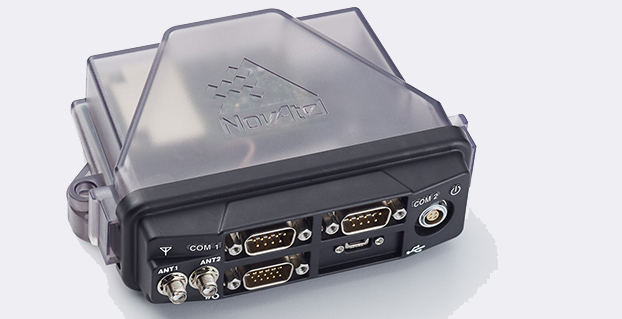
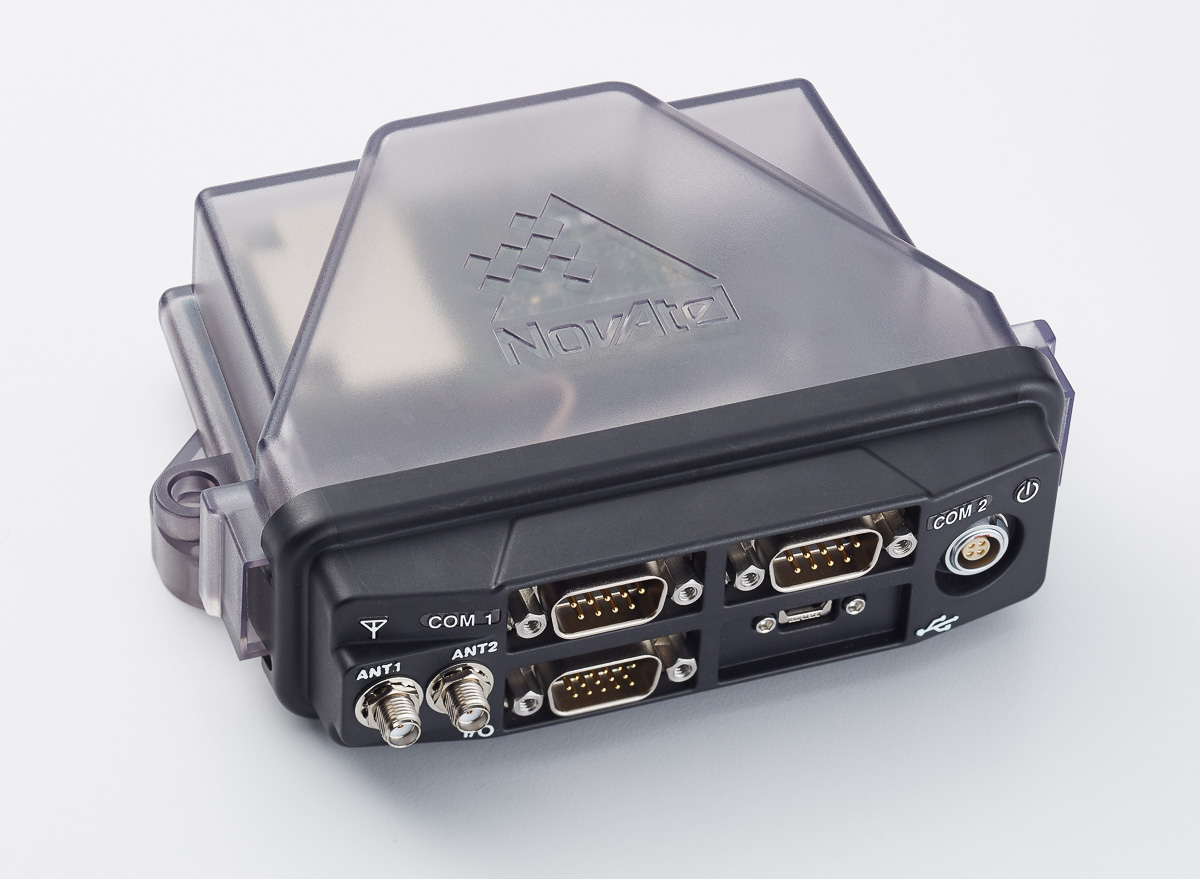
    NovAtel's FlexPak6D enclosed GNSS receiver.
    NovAtel’s FlexPak6D enclosed GNSS receiver.

    NovAtel Inc. has announced the FlexPak6D enclosed GNSS receiver, a flexible dual-antenna solution for application developers seeking a high-precision heading-capable positioning engine for space-constrained applications.

    Designed for efficient and rapid integration, the compact, lightweight receiver tracks GPS, GLONASS, Galileo and BeiDou. Antenna placement is flexible, which means the antenna baseline can be set according to space available on the vehicle and the heading accuracy required. In addition, the modular nature of the FlexPak6D’s OEM6 firmware provides users with the ability to configure the receiver for their unique application needs.

    Scalable for sub-meter to centimeter-level positioning, the FlexPak6D delivers NovAtel’s ALIGN precision heading and relative heading firmware, as well as its GLIDE firmware for smooth decimeter-level pass-to-pass accuracy, and RAIM for increased GNSS pseudorange integrity.

    “Our FlexPak6D builds on our popular lightweight FlexPak form factor,” said Jason Hamilton, vice president of marketing for NovAtel. “The modular, flexible design makes it easy to integrate into land, air and marine-based industries, particularly for low payload UAV and robotic applications.”

    The FlexPak6D will be available for shipping February 2, 2015.

  • The Business — February 2015

    The Business and Hey, AU sections from the February 2015 issue. Download the PDF.

    The Business includes:

    • GeoOptics Study Supports GNSS-RO
    • SkyTraq Offers Module for Wearables
    • Ford Autonomous Vehicle On the Way
    • U.S. Army Explores eLoran PNT
    • Briefs

    Hey, AU: Autonomous Unmanned includes:

    • FAA Grants UAS Exemptions
    • OriginGPS Module Powers Tiny Drone


  • OxTS Offers Core Module for Inertial, GNSS

    OxTS Offers Core Module for Inertial, GNSS

    Oxford-Oxts-Core_hand Photo: Oxford Technical Solutions
    Oxford Technical Solutions’ xOEMcore. Photo: Oxford Technical Solutions

    The xOEMcore, now being offered by Oxford Technical Solutions (OxTS), is an inertial navigation system that can also serve as a framework for other positioning systems.

    The xOEMcore is a combined six-axis inertial measurement unit and navigation system with sensor fusion in one compact OEM module. In its base form, the xOEMcore measures and outputs raw accelerations and angular rates with small, high-grade MEMS gyros and accelerometers. With a simple upgrade, the xOEMcore is turned into a full inertial navigation system, able to take aiding data from external sources such as GNSS and blend it in the on-board Kalman filter. It is desgined for integration inside any solution that requires robust, high-performance position and orientation.

    xOEMcore provides continuity from one point to the next, so detecting unexpected measurements from other devices is easy, the company said. It has deterministic error growth for accuracy, a high update rate and low delay, enabling easier control of vehicles and robots.

    As a framework, the xOEMcore can be merged other technologies, such as GNSS and vision positioning. The xOEMcore solves conflicts between the two systems, removing timing mismatches, delays, jumps and inconsistencies.

    The xOEMcore is small, light and low power. The inertial sensors have low drift rates — less than 5-meters drift after 60 seconds can be achieved in real-time with only odometer aiding. Heading, roll and pitch can be accurate to 0.05 degrees, exceeding magnetic heading and vertical reference system performance.

    For a demonstration or for more informtion, contact [email protected]..


  • Pirker Drone Case Reaches Settlement

    Aerial photographer Raphael Pirker has settled the civil penalty proceeding brought by the U.S. Federal Aviation Administration in 2013 concerning his flight of a styrofoam Zephyr II model aircraft (or “drone”) at the University of Virginia at Charlottesville in October 2011.

    The $1,100 settlement  “does not constitute an admission of any of the allegations in the case or an admission of any regulatory violation,” Pinker’s attorney Brendan Schulman said in a statement.

    On December 1, the National Transportation Safety Board ruled in favor of the FAA, when the FAA appealed a decision by an NTSB Administrative Law Judge in Huerta v. Pirker after the judge dismissed the FAA’s order requiring Pirker to pay a civil penalty of $10,000 for operating an unmanned aircraft in a careless or reckless manner at the University of Virginia in October 2011.

    Pinker was said to have been hired to supply aerial photographs and video of the university campus and medical center. He had argued that his aircraft, which was described as an UAS, was in fact a model aircraft.

    Schulman wrote: “We are pleased that the case ignited an important international conversation about the civilian use of drones, the appropriate level of governmental regulation concerning this new technology, and even spurred the regulators to open new paths to the approval of certain commercial drone operations.

    “The decision to settle the case was not an easy one, but the length of time that would be needed to pursue further proceedings and appeals, and the FAA’s new reliance on a statute that post-dates Raphael’s flight, have diminished the utility of the case to assist the commercial drone industry in its regulatory struggle.”

    Read the full settlement agreement below.

    pirker-faa-settlement.pdf

  • Drinking and Droning Has Consequences

    Drinking and Droning Has Consequences

    Firmware Fixes Coming from Phantom Maker DJI

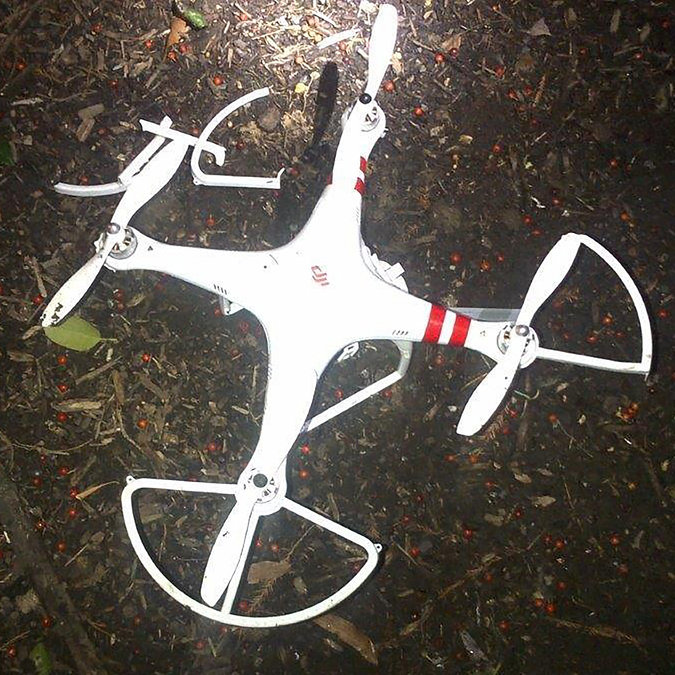
    A drone that crashed on the grounds of the White House had evaded radar detection. Photo: U.S. Secret Service
    The quadcopter that crashed on the White House lawn. Photo: U.S. Secret Service

    A government employee who crashed his friend’s drone on the White House lawn was apparently drinking while droning.

    The employee, who works for the National Geospatial-Intelligence Agency (NGA), was questioned Jan. 26 by the Secret Service as the operator of the drone involved in Monday’s incident at the White House. On Monday at 3 a.m., the drone quadcopter crashed on the White House lawn.

    The employee contacted authorities, according to the NGA. The employee was off duty and is not involved in work related to drones or unmanned aerial vehicles in any capacity at NGA, the agency said in a statement.

    “Even though the employee was using a personal item while off duty, the agency takes the incident very seriously and remains committed to promoting public trust and transparency,” the statement reads.

    The Secret Service is investigating the incident.

    Firmware to Force No-Fly Zone Compliance

    The drone is a Phantom made by Chinese company DJI. The company plans to roll out firmware within days to prevent any of its drones from flying over the D.C. area, in accordance with Federal Aviation Authority guidelines. This will help hobbyists who aren’t aware of or unable to comply with “no-fly zones,” such as the one that covers most of the D.C. area.

    Once updated, the DJI drones will not be able to take off from or fly into the nation’s capital or a 15-mile radius around it. GPS technology in the drones will be able to identify the no-fly zone, warn the operator and then stop at the no-fly zone’s border. DJI’s flight software currently prevents flights within a radius of major airports.

    “With the unmanned aerial systems community growing on a daily basis, we feel it is important to provide pilots additional tools to help them fly safely and responsibly,” said Michael Perry, DJI’s company spokesperson. “We will continue cooperating with regulators and lawmakers to ensure the skies stay safe and open for innovation.”

    The mandatory firmware update is for the Phantom 2, Phantom 2 Vision, and Phantom 2 Vision+ models. It adds a No-Fly Zone centered on downtown Washington, D.C., extending for a 15.5-mile radius in all directions. Phantom pilots in this area will not be able to take off from or fly into this airspace.

    “The restriction is part of a planned extension of DJI’s No Fly Zone system that prohibits flight near airports and other locations where flight is restricted by local authorities,” DJI said. “These extended no fly zones will include over 10,000 airports registered with the International Air Transport Association (IATA) and will expand no fly zones to ensure they cover the runways at major international airports.

    “DJI is also continuing to update its no-fly zone list in compliance with local regulations to include additional sensitive locations and to prevent flight across national borders. These new safety features will be released across DJI’s flying platforms in the near future.”

  • Trimble Unity Replaces Connect for Water, Wastewater and Stormwater Utilities

    Trimble Unity Replaces Connect for Water, Wastewater and Stormwater Utilities

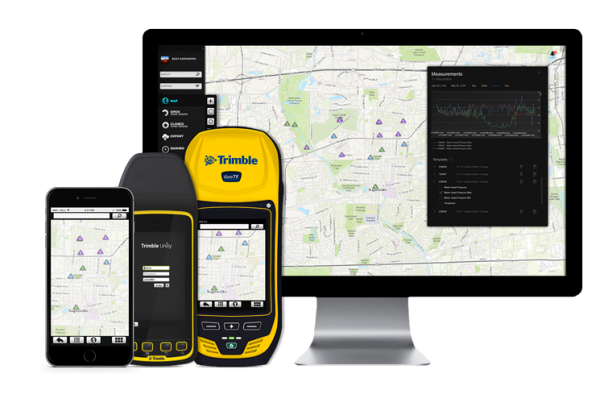
    Trimble-unity-Hardware
    Photo: Trimble

    Trimble introduced today its next generation suite of software applications for water, wastewater and stormwater utilities — Trimble Unity. Trimble Unity replaces Trimble Connect for Water and offers a unified cloud-based and mobile collaboration platform for smart water mapping and work management.

    Trimble Unity applications, or “apps,” support the following workflows:

    • Mapping: Field and office GIS visualization and mapping of assets with up to centimeter-level accuracies
    • Maintenance: GIS-based asset maintenance and inspection forms and business processes
    • Service: Customer field service work order and mobile workforce management
    • Metering: Smart water meter deployment, installation and maintenance
    • Monitoring: Visual and real-time monitoring of field operations and utility networks
    • Analytics: Dashboards and performance management reporting

    Trimble Unity represents a unified collaboration platform for managing critical utility assets and the work of water industry professionals. By integrating GIS and field operations, sensors and wireless communications, mobile workers and office professionals, field and back office enterprise systems, and utilities with their contractors, Trimble Unity provides the water industry with a comprehensive solution for regulatory reporting, improving operations, reducing cost and enhancing customer service, the company said.

    Trimble Unity is designed to automate a variety of industry workflows through individual “apps” offered within the software suite, enabling utilities to deploy smart meters, assess the condition of assets, repair leaks and reduce non-revenue water (NRW), and locate and map critical infrastructure using Trimble high-accuracy GNSS mapping technologies. The software can also assist utilities in reducing spills and environmental damage, extending the life of aging assets and helping improve worker safety and productivity.

    Through a Trimble Unity software-as-a-service (SaaS) subscription, organizations can provide a single solution for the office and the field, choosing any combination of Trimble and non-Trimble mobile devices, including iOS, Android, Windows Mobile and Windows 7/8 smartphone, tablets and laptops. The software also integrates the latest Esri ArcGIS Server, mobile and ArcGIS Online map services enabling organizations to leverage their existing investments in GIS technology.