Category: Uncategorized

  • Spirent Launches Multi-Frequency GNSS Record and Playback System

    Spirent Launches Multi-Frequency GNSS Record and Playback System

    spirent_Gss6425
    Photo: Spirent Communications

    Spirent Communications’ new  SS6425 multi-frequency GNSS record and playback (RPS) test system provides RF recordings for more constellations (GPS, GLONASS, Galileo, BeiDou, QZSS), more frequencies (L1, L2, L5), wider bandwidth (30MHz) and more features than the company’s previous systems, to support a wide range of positioning and timing test applications.

    The test system is self-contained and portable, enabling users to record and playback data in the field without the need for an additional PC or external power. With the GSS6425, it is simple to faithfully capture and replay complex signal conditions, such as urban environments, indoor spaces like airport terminals, and dense forests, Spirent said. Multiple environments can be brought into the lab and replayed in a repeatable and controlled manner, helping developers improve receiver and system performance.

    “Customers have told us they want to record multi-GNSS signals simultaneously, for example GPS, GLONASS and BeiDou,” said Rahul Gupta, product manager for Spirent’s positioning division. “They have also told us that capture and playback of other data, such as inertial or vehicle CAN bus is needed. The GSS6425 enables all this in a very capable, yet easy-to-use and self-contained unit.”

    Users can select and record three GNSS frequency bands at any one time, each with up to 30MHz bandwidth. If more than three concurrent channels are required, two GSS6425 units can be synchronized in a master and slave configuration. For example, survey-grade receiver developers can capture GPS L1, L2 and L5 signals, GLONASS L1 and L2, plus satellite-based augmentation system (SBAS) signals such as StarFire or OmniSTAR.

    The GSS6425 is also capable of recording additional sources including inertial and dead reckoning sensor outputs and vehicle CAN bus data. Data can be time-stamped and stored in the GNSS data file, ensuring synchronized playback. The GSS6425 can also record the GPS receiver 1pps (pulse per second) output for synchronization purposes. These features are particularly useful in developing hybrid receivers such as for automotive and indoor positioning applications, Spirent said.

    Key features include:

    • Multiple constellations and frequencies
      • GPS, GLONASS, Galileo, Beidou, QZSS
      • L1, L2, L5
    • Self-contained portable unit
    • No PC or external drives required
    • Control from front panel, webserver or scripts
    • OCXO used on record and playback for frequency stability
    • Internal 1TB hard drive with additional removable 1TB hard drive
    • Synchronization of two units in master/slave configuration to support total of 6 frequencies
    • Store asynchronous or synchronous external data at the same time as GNSS signals

    Recorder features:

    • Record any three RF grequencies simultaneously
    • Internal battery (up to 1.5 hr) and vehicle DC power adapter
    • 2-bit quantization
    • Single-touch record
    • Event markers

    Playback features:

    • Attenuation control per channel
    • Browser control over network
    • Multiple file playback
    • Start at any point in a file
    • Scripts allow inclusion in automatic test routines
  • Survey, GIS, GeoIntelligence Articles Available Again

    Are you looking for an article you read in GPS World or one of its newsletters? Because of a server move in 2012, much of our older content disappeared from the websites of both GPS World and its sister publication Geospatial Solutions. We have been working hard to again make this content available to our readers.

    As of today, we are happy to share that the following is again available:

    • Content of every issue of GPS World magazine from mid-2010 to the present (our archives have issues back to July 2009);
    • All columns from the Survey Scene newsletter, written by Eric Gakstatter;
    • All columns from the GSS Monthly and GSS Weekly newsletter written, by Eric Gakstatter;
    • All columns from the GeoIntelligence Insider newsletter, written by Art Kalinksi.

    Columns from our other newsletters are still being reposted; however, most of the columns from 2011 to the present are now available. These newsletters and authors include:

    If you are looking for a particular feature and are unable to find it, we will try to track it down for you. Please email [email protected] with any past-article requests.

  • Designing for the Future: Signal Simulation for Expanding GNSS

    Sponsored by: Hemisphere
    Broadcast Date: Thursday, May 16, 2013
    Moderator: Alan Cameron, Editor & Publisher, GPS World
    Speakers: Mark Sampson, LabSat Product Manager, RaceLogic; John Fischer, Chief Technology Officer, Spectracom; Markus Lörner, Product Manager, Rohde & Schwarz; Steve Hickling, Lead Product Manager, Spirent Communications; Mark Wilson, Vice President of Sales, IfEN GmbH

    Simulation and testing experts offer key technical insights on the intricacies and importance of product and signal testing, whether by simulator, record-and-replay, or in the field, in the increasingly complex environment of multiple modernizing and expanding GNSS signals, from GPS III to BeiDou, with Galileo coming on strong and GLONASS a perennial standby.

  • ION GNSS+ 2013 Program and Registration Available Online

    Registration is now open for the Institute of Navigation (ION) GNSS+ 2013 to be held September 16-20 (tutorials September 16 and 17) at the Nashville Convention Center in Nashville, Tennessee.

    ION GNSS+ 2013 is the 26th International Technical Meeting of the ION Satellite Division and the world’s largest technical meeting and showcase of GNSS technology, products and services.

    ION GNSS+ brings together international leaders in GNSS and related positioning, navigation and timing fields to present new research, introduce new technologies, update current policy, demonstrate products and exchange ideas. The addition of “+” to the conference name reflects the growing emphasis on GNSS and the rapidly evolving field of alternative navigation methods.

    This year’s conference will feature pre-conference tutorials September 16-17, policy and panel discussions, commercial and applications oriented sessions, and more than 250 technical papers on a diverse array of topics including:

    • Advanced Inertial Sensing and Applications
    • Advances in Military GNSS Systems and Applications
    • Algorithms and Methods
    • Alternatives and Backups to GNSS
    • Aviation Applications
    • Clock/Timing and Scientific Applications
    • Emerging GNSS (Galileo, COMPASS, QZSS, IRNSS) (both a Panel Discussion and a technical session)
    • Future PNT and Its Applications
    • Geodesy, Surveying and RTK for Civil Applications
    • GNSS Algorithms and Methods
    • GNSS and the Atmosphere
    • GNSS Compatibility, Interoperability, and Interchangeability
    • GNSS Ground Based Augmentation Systems (GBAS)
    • GNSS Simulation and Testing
    • GNSS Space Based Augmentation Systems (SBAS)
    • GNSS-MEMS Integration
    • GNSS Program Updates (Panel Discussion)
    • GPS and GLONASS Modernization
    • High Integrity Systems (Panel Discussion)
    • Indoor Navigation and Timing
    • Interference and Spectrum Issues
    • IP Policies Related to GNSS (Panel Discussion)
    • Land Based Applications
    • Marine Navigation and Applications
    • Multi-Constellation/Portable Navigation Devices
    • Multi-Sensor and Integrated Navigation in GNSS-Challenged Environments
    • New Products and Commercial Services (both a Panel Discussion and a commercial applications oriented session)
    • Next Generation GNSS Integrity
    • Non Traditional PNT Applications
    • Portable Navigation Devices
    • Precise Point Positioning
    • Receiver/Antenna Technology
    • Remote Sensing with GNSS and Integrated Systems
    • Safety Critical Applications
    • Software Receivers
    • Space Applications
    • Standalone GNSS Services in Challenging Environments
    • Timing and Scientific Applications
    • Unmanned GNSS (Panel Discussion)
    • Urban Navigation Technology

    New this year will be two For Official Use Only (FOUO) U.S. only sessions: Multi-Sensor Integrated Navigation and Networked-Related Navigation. These sessions are sponsored by the ION’s Military Division and The MITRE Corporation.

  • ION PTTI Seeks Abstracts for December Meeting

    Abstract submissions are now being accepted for the Institute of Navigation’s (ION) Precise Time and Time Interval Meeting (PTTI). The conference will take place December 2-5 (Tutorials December 2) at the Hyatt Regency Bellevue, Bellevue, Washington. The deadline for submitting abstracts is August 2.

    Instructions on submitting your abstract can be found at www.ion.org/ptti

    PTTI is an annual conference sponsored by ION with a technical program designed to disseminate and coordinate PTTI information at the user level, review present and future PTTI requirements, inform government and industry engineers, technicians, and managers of precise time and frequency technology and its problems, and provide an opportunity for an active exchange of new technology associated with PTTI.

    Click here for more information.

  • NIST Demos Transfer of Time Signals over Wireless Optical Channel

    By bouncing eye-safe laser pulses off a mirror on a hillside, researchers at the National Institute of Standards and Technology (NIST) have transferred ultraprecise time signals through open air with unprecedented precision equivalent to the “ticking” of the world’s best next-generation atomic clocks.

    Described in the April 28 issue of Nature Photonics, the demonstration shows how next-generation atomic clocks at different locations could be linked wirelessly to improve geodesy (altitude mapping), distribution of time and frequency information, satellite navigation, radar arrays and other applications. Clock signals of this type have previously been transferred by fiber-optic cable, but a wireless channel offers greater flexibility and the eventual possibility of transfer to and from satellites.

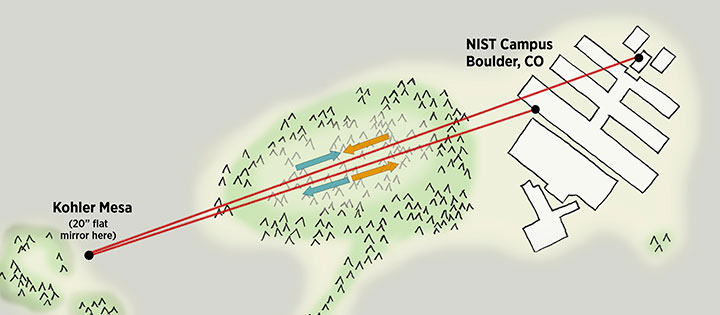
    NIST researchers transferred ultraprecise time signals over the air between a laboratory on NIST?s campus in Boulder, Colorado, and nearby Kohler Mesa. Signals were sent in both directions, reflected off a mirror on the mesa, and returned to the lab, a total distrance of approximately two kilometers. The two-way technique overcomes timing distortions on the signals from turbulence in the atmosphere, and shows how next-generation atomic clocks at different locations could be linked wirelessly to improve distribution of time and frequency information and other applications.
    NIST researchers transferred ultraprecise time signals over the air between a laboratory on NIST’s campus in Boulder, Colorado, and nearby Kohler Mesa. Signals were sent in both directions, reflected off a mirror on the mesa, and returned to the lab, a total distrance of approximately two kilometers. The two-way technique overcomes timing distortions on the signals from turbulence in the atmosphere, and shows how next-generation atomic clocks at different locations could be linked wirelessly to improve distribution of time and frequency information and other applications.

    The stability of the transferred infrared signal matched that of NIST’s best experimental atomic clock, which operates at optical frequencies. Infrared light is very close to the frequencies used by these clocks, and both are much higher than the microwave frequencies in conventional atomic clocks currently used as national time standards. Operating frequency is one of the most important factors in the precision of optical atomic clocks, which have the potential to provide a 100-fold improvement in the accuracy of future time standards. But the signals need to be distributed with minimal loss of precision and accuracy.

    The signal transfer demonstration was performed outdoors over a two-way wireless link using two laser frequency combs. A frequency comb generates a steady stream of ultrashort optical pulses with a spacing that can be synchronized perfectly with the “ticks” of an optical atomic clock. (Click here for more on how frequency combs work.) In the experiment, the two combs were synchronized to the same stable optical cavity, which serves as a stand-in for an optical atomic clock. Each comb pulse was sent from one of two locations on NIST’s campus in Boulder, Colorado, reflected off a mirror on a mesa behind the campus, and returned to the other site, traveling a total distance of two kilometers.

    Researchers measured travel times for pulses traveling in opposite directions between the two sites. The cumulative timing differences and frequency instabilities were infinitesimal, just one million-billionths of a second per hour, a performance level sufficient for transferring optical clock signals.

    The transfer technique overcomes typical wireless signal problems such as turbulence in the atmosphere—the phenomenon that makes images shimmer when it’s very hot outside. Because turbulence affects both directions equally, it can be cancelled out. The transfer technique can also withstand signal losses due to temporary obstruction of the light path. The method should be able to operate at much longer distances, possibly even over future ground-to-satellite optical communication links as an added timing channel, researchers say.

    The combs potentially could be made portable, and the low-power infrared light is safe for eyes. The research is funded in part by the Defense Advanced Research Projects Agency.

  • Riegl and Applanix Take Flight on UAV


    Riegl Laser Measurement Systems and Applanix Corporation announced today that the Applanix AP50 GNSS-inertial sensor system was successfully integrated with Riegl’s VQ-820-GU topo-bathymetric airborne laser scanner on board the Schiebel Camcopter S-100 UAV. The Riegl VQ-820-GU is specifically designed to survey sea beds and the grounds of rivers or lakes, and is well suited for combined land and hydrographic airborne survey.

    ap50
    Applanix AP50 GNSS-inertial system.

    The Applanix AP50 GNSS-inertial system is a GNSS-inertial sensor plus inertial measurement unit (IMU) in a compact form factor. It features a high-performance precision GNSS receiver and the Applanix IN-Fusion GNSS-inertial integration technology running on a powerful, dedicated inertial engine (IE) board.

    On board an unmanned aerial vehicle (UAV), the system is capable of penetrating areas that may be too dangerous for piloted aircraft or ground patrols. This can provide additional safety and security for its users.

    VQ-820-G_206x200px
    Riegl’s VQ-820-G airborne laser scanner.

    “We really appreciate the professional and amicable cooperation with Applanix, which allows us to offer user-friendly and powerful, fully integrated solutions for dynamic data acquisition to the marketplace,” said Jürgen Nussbaum, Riegl director of international sales.

    In addition, Applanix will be a Gold sponsor at Riegl LIDAR 2013, Riegl’s international user conference taking place in Vienna, Austria, June 25-27.

  • GNSS Constellation Update

    Original Broadcast Date: 10/25/12

    Summary: This month, a new GPS satellite was launched, India launched a new SBAS satellite, and two Galileo satellites are scheduled to launch. Last month, China launched two more BeiDou satellites. There’s a lot of activity of the satellite navigation industry. In the webinar, I will discuss what these new developments mean to the surveying/mapping user, as well as other current events.

    Speaker:
    Eric Gakstatter
    Contributing editor for survey and GIS

  • Topcon Announces MR-1 Precise Heading Solution

    Topcon Positioning Systems has released the MR-1 Heading System, an OEM GNSS solution for high-performance positioning and heading.

    Using the MR-1 receiver and Topcon’s MG-A8 antenna, the system provides “centimeter-accurate RTK positioning and better than 1/10 of a degree heading accuracy in challenging environments,” said Doug Langen, TPS GNSS product manager. “The rugged MR-1 receiver is water and dustproof and operates at a robust operational temperature range of -40°C to 75°C.”

    When combined with Topcon’s Quartz Lock Loop technology, the MR-1 offers continuous operation during “extreme vibration and shock, typical of intense dynamic environments,” he said.

    The MG-A8 antenna of the MR-1 Heading System is designed for moving platforms and provides multipath rejection. It also offers increased resistance to near-band interference from satellite communications systems commonly found in marine applications.

    Additional information is available at www.topconoemsolutions.com.

  • Aeroflex Adds Capability to Simulate WAAS LPV Approaches

    Aeroflex Incorporated, a wholly owned subsidiary of Aeroflex Holding Corp., has announced its capability to simulate WAAS (Wide Area Augmentation System) LPV (Localizer Performance with Vertical Guidance) approaches by adding this new feature to their GPSG-1000 Portable GPS Simulator.

    Aeroflex has developed the capability of simulating WAAS LPV approaches to expedite and validate the installation of WAAS-enabled navigation systems in aircraft. The GPSG-1000 offers the following features to installers of these systems:

    • Ability to perform structured, repeatable dynamic motion tests (actual flight) of a WAAS/LPV installation,
    • Ability to check and validate the sensitivity and dynamic range of an airborne GPS receiver, either statically or while in motion,
    • Reduce aircraft down time and flight demonstration time required by FAA,
    • Additional support data for documenting proper FAA processes of WAAS/LPV system upgrades or installs without leaving the hangar.

    New orders for the GPSG-1000 are ready for immediate delivery. For existing GPSG-1000 customers, a no-charge software upgrade will be available by mid-April 2013.

    The FAA created the WAAS program in 1992 to provide the necessary integrity to utilize GPS signals for precision approach. The WAAS consists of a network of precisely surveyed wide area reference stations (WRS). These reference stations monitor GPS satellites to determine errors in the GPS satellite signal. Each reference station relays the information about the GPS satellites to the WAAS wide area master stations (WMS). The master station then develops corrections to the GPS position information and provides timely notification of unreliable GPS data. These corrections are sent to ground uplink stations (GUS) where they are transmitted in the form of a WAAS correction message to a Geostationary Earth Orbit (GEO) satellite. The WAAS signal is then broadcast to users on the same frequency as GPS. This WAAS corrected signal provides three-dimensional guidance to aircraft.