Category: Uncategorized

  • Smart GEO Expo 2021 coming in July

    Smart GEO Expo 2021 coming in July

    Smart Geo 2021Smart GEO Expo 2021 takes place at the Coex Hall C3 and C4 in Seoul, South Korea, July 21-23. An online version will also be available.

    The Smart GEO Expo aims to promote spatial information industry development and support overseas expansion of domestic companies.

    The Smart GEO Expo has become an annual event since 2008, when separate events such as GIS Korea, Cadastral Innovation Expo and Measurement Day were integrated and expanded, owing to the reorganization of government departments related to spatial information.

    The expo includes an exhibition where host, organizers and many other geospatial information-related companies and agencies provide showcases. The event also includes the International Meeting for the Advancement of the Geospatial Information Cooperation for expansion of exchange and information sharing with foreign guests.

    Learn more on the expo website.

  • UAV Navigation autopilot powers Power4Flight engines

    UAV Navigation autopilot powers Power4Flight engines

    UAV Nav logoUAV Navigation’s range of Vector-autopilots is now integrated with Power4Flight’s IntelliJect EFI, designed for use in small-engine aerospace applications.

    Using the robust and extensive communication capabilities of UAV Navigation autopilots, the IntelliJect EFI’s engine control unit can communicate and deliver critical parameters through the CAN port. This way, the autopilot is able to automatically control and monitor the engine. The operator will be capable of controlling and receiving real-time status information from the engine in the UAV Navigation’s advanced ground-control station Visionair.

    The IntelliJect EFI is highly configurable for a variety of engine types (two-stroke, four-stroke, triples, twins and singles), including Power4Flight’s engines or any other manufacturer engine.

    Power4Flight propulsion systems and electronics are used in a wide range of unmanned aircraft systems. With this integration, the fuel injection systems of the American manufacturer will be able to send performance parameters, such as RPM, temperatures, pressures, throttle range and error to the autopilot, and receive commands.

  • How inertial and alternative PNT can mitigate GPS vulnerabilities

    How inertial and alternative PNT can mitigate GPS vulnerabilities

    Spirent Federal Systems logoWhile GPS will always be an integral and irreplaceable part of positioning, navigation and timing (PNT) technology,  assured PNT must take a layered approach for true resiliency.

    A GPS World webinar sponsored by Spirent Federal Systems will explore this topic. Registration is now open for the free webinar, which will be held June 24.

    Join experts from Spirent and Northrop Grumman as they examine

    • the future of inertial navigation in assured PNT and GPS augmentation
    • EGI-Modernization
    • coherent GNSS and inertial sensor emulation
    • exploring and simulating emerging alternative space-based PNT RF signals.

    Expert presentations will be followed by a question-and-answer session; questions will be accepted both before and during the webinar.

    To register for the webinar, visit this link. Registration is free.


    Content Marketing Webinar

    GPS Vulnerability Mitigation: Using Inertial & Alternative RF PNT

    Date: Thursday, June 24, 2021
    Time: 1 p.m. EDT / 10 a.m. PDT / 7 p.m. (1900h) Central European Time
    Duration: 60 minutes + extra time for Q&A
    Sponsored content by: Spirent Federal


    Speakers

    Photo:

    Jennifer Smith
    Director, Business Development
    Spirent Federal Systems

    Jennifer Smith joined Spirent Federal in 2004. Jen has responsibilities in business development as well as in general operations. She has experience in project management and contract negotiations.

    Smith has a B.A. and a J.D. and is a member of the Utah Bar Association.


    Photo: Naveen Joshi

    Naveen Joshi
    Director, BD & Strategy, Navigation & Cockpit Systems
    Northrop Grumman Mission Systems

    Naveen Joshi leads the Strategy and Business Development for Northrop Grumman’s Navigation and Integrated Cockpit business. He sets product strategy, shapes technology roadmaps, and advises Northrop Grumman leaders on the application of PNT technologies. His previous roles at Northrop include program director, program manager, engineering manager and various roles in engineering.

    Outside of Northrop Grumman, Joshi held roles in management consulting and eCommerce, and ran an entrepreneurial venture.

    Joshi earned a bachelor’s degree in computer science from Cornell University and an MBA from UCLA’s Anderson School of Management.

    Photo: Mark Holbrow

    Mark Holbrow
    Senior Director, Engineering & Product Development
    Spirent Communications

    Mark Holbrow’s 30-year professional career has concentrated on the innovative design, development, and successful commercialization of electronic test equipment.

    In his current role, he is responsible for the technical team management, new product design, and future direction of Spirent’s portfolio of world-leading positioning, navigation, and time (PNT) test solutions.

    Holbrow has a passion for the sometimes overlooked discipline of “test methodology” and thoroughly enjoys the technical and business development demands required to identify, and innovatively solve, complex test challenges.

    Photo: Roger Hart

    Roger Hart
    Director, Engineering
    Spirent Federal Systems

    Roger Hart joined Spirent Federal in 2015. Roger has responsibilities in engineering development and support, sales and customer training. He has worked in development of spacecraft navigation systems, including GPS, for civil, NASA and defense applications since 1986.

    Hart has a Bachelor of Arts in physics and Master of Science in mechanical engineering (space track) from Utah State University.

    To register for the webinar, visit this link. Registration is free.

  • Geoflex cloud-based geolocation company honored with award

    Geoflex cloud-based geolocation company honored with award

    Geoflex logoGeoflex, a geolocation company, won the Jury Award of SPRING 50, a competition of deep tech startups that took place on May 20 in Paris-Saclay, the largest French research cluster, located south of Paris.

    Geoflex is a cloud service operator that enhances GPS/GNSS-based applications to provide 4-centimeter positioning on land, at sea and in the air.

    Geoflex was initially selected among the 10 most promising companies within the 50 startups promoted at the event. All 10 startups founders were subsequently showcasing their companies in a 4 minutes pitch, and Geoflex’s CEO Romain Legros won this last leg of the competition.

    Geoflex’s hyper-geolocation service has been available globally since 2018. The service, which corrects inherent GNSS inaccuracies, is provided in real time or in post processing. It works across all types of GNSS hardware receivers and includes correction data for all constellations: GPS, GLONASS, Galileo and BeiDou and for all their frequencies.

    The technology was initially developed by the French space agency CNES in a 12-year research project. It is protected by seven patents licensed to Geoflex, which continues co-development of the technology with the CNES.

    Geoflex also has developed a positioning engine that includes sensor fusion with other technologies such as inertial, optical and communications. A hardware development kit is available.

  • Seen & Heard: S’mores, penguins and sinkholes

    Seen & Heard: S’mores, penguins and sinkholes

    “Seen & Heard” is a monthly feature of GPS World magazine, traveling the world to capture interesting and unusual news stories involving the GNSS/PNT industry.


    Screenshot: Missing Children Society of Canada
    Screenshot: Missing Children Society of Canada

    Network Tool Helps Find Children

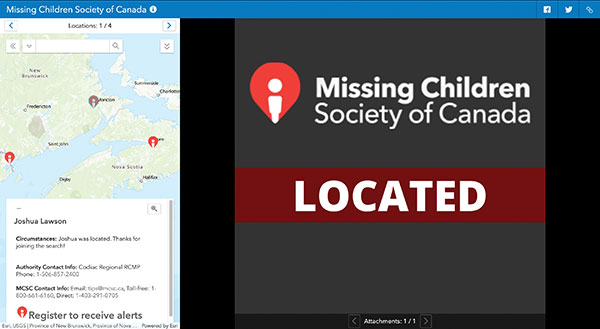
    Microsoft and Esri Canada have developed the Child Search Network to enhance Canada’s national strategy for missing children. The network provides police services with a quick way to share information and collaborate with others, as well as with the general public, to find missing children faster and reunite them with their families. Police can put out information on a missing child via a website and smart-phone app. Members of the public can then offer tips by downloading the MCSC rescue app to register to receive alerts and share any information they may have regarding a missing child or youth. The tool helps meet the “gap of response” for high-risk cases of missing children that do not meet the strict criteria for the AMBER Alert.


    Photo: Kroger
    Photo: Kroger

    S’more Delivery Options

    Grocery chain Kroger and Drone Express have launched a pilot delivery program in Centerville, Ohio, filling orders in as quickly as 15 minutes. Orders are sent to the customer’s smartphone location, which could include sending picnic supplies to a park or sunscreen to a beach. As part of the project, Kroger is selling bundled products within the payload weight — about five pounds, such as a S’mores bundle with graham crackers, marshmallows and chocolate.


    Photo: Photodynamic/iStock/Getty Images Plus/Getty Images
    Photo: Photodynamic/iStock/Getty Images Plus/Getty Images

    Multiple UAVs Shorten Penguin Survey

    One of the largest Adélie penguin colonies in the world was surveyed with multiple UAVs in March. Survey time was reduced from three days (with a single drone manually piloted) to under three hours. The work was led by a team of experts from Stanford University, Point Blue Conservation Science and Conservation Metrics. UgCS software by SPH Engineering was used to develop a system to autonomously survey the penguins. Thousands of high-resolution images were taken on each survey. An artificial intelligence model by Conservation Metrics is under development that will automatically identify and count adult penguins and their chicks. Using UgCS with a Stanford-provided planning algorithm, the survey team efficiently photographed more than 300,000 breeding pairs at Cape Crozier, Antarctica. The surveys will contribute to large-scale assessments of penguin populations and breeding success, key metrics for monitoring the health of the Antarctic marine ecosystem.


    Photo: Bryngelzon/E+/Getty Images
    Photo: Bryngelzon/E+/Getty Images

    Seeing Sinkholes with Satellites

    Synspective Inc. is offering a sinkhole-detection prediction tool using satellite imagery analysis. Part of the company’s Land Displacement Monitoring service, an algorithm uses data science and machine learning to detect spatial and temporal variations. It can identify areas where sinkholes are likely to occur, areas where cave-ins have occurred, and areas where cave-ins are in progress. The input data is automatically updated, and the platform handles the processing and analysis of the complex satellite imagery.

  • Telecom groups press president, Congress for GPS alternatives

    Telecom groups press president, Congress for GPS alternatives

    America urgently needs alternatives to GPS and the government must fund efforts to make that happen. So say separate documents sent to President Biden and senior members of Congress earlier this month.

    On May 6, the government’s National Security Telecommunications Advisory Committee (NSTAC) issued its “Report to the President on Communications Resiliency.” The next day the industry group Alliance for Telecommunications Industry Solutions (ATIS) sent letters to Congress. Both organizations identify the need for alternatives to GPS to support telecommunications and other critical infrastructure. Both also urge government funding for the effort.

    NSTAC is a federal advisory committee composed of 18 members from the telecommunications industry. Most are CEOs and very senior leaders in companies such as AT&T, Microsoft, and Iridium.

    This month’s NSTAC report highlights the critical role that PNT, especially timing, plays in telecommunications. It notes that widespread use of GPS makes the system vulnerable to a host of threats. To address this, the group recommends the administration consider an approach “similar to that reflected in the Resilient Navigation and Timing Foundation’s paper entitled “A Resilient National Timing Architecture.” Further, to enhance the ability of commercial entities to afford leveraging this architecture, the Administration should appropriate sufficient funds to lay the foundation for creating this timing architecture, with the Federal Government being the first customer for what will ultimately become a resilient, interconnected network for PNT delivery.”

    Federal funding is necessary, according to the board, because free GPS services eliminate market demand for alternatives.

    ATIS sent letters to leaders in the House and Senate citing an “urgent need” for funding deployment and adoption of GPS alternatives for use in critical infrastructures, including telecommunications.

    ATIS develops standards and other technical deliverables for information and communications technology (ICT) and services companies on a broad range of issues, including 5G and the Internet of Things (IoT).

    Network and system synchronization is key for telecommunications. At present this is done almost exclusively using signals from GPS. ATIS had previously documented in reports and letters to Congress the vulnerability of GPS signals and the need for complementary and alternative systems to use when GPS is not available.

    The letters outline the criticality of precision timing to critical infrastructure, industries, first responders, and U.S. government entities. They cite applications such as E9-1-1 and Assisted GPS used to find wireless handsets, as well as critical infrastructure networks, as some of the applications at risk.

    ATIS also endorsed the findings of a recent Department of Transportation (DOT) report to Congress. That report documented that there exist “suitable, mature and commercially available technologies” able to provide alternatives to GPS.

    Also mentioned was the appropriateness of government funding. “The role of government in protecting its citizens suggests an imperative to safeguard the capabilities of critical infrastructure industries by facilitating resilient PNT.”

    Some in previous administrations had questioned whether it was necessary and appropriate for the government to fund GPS alternatives. According to NSTAC and ATIS, the answer is “yes” to both.

    While the Biden administration has not made any official statements on the matter, reports of conversations with recent appointees seem to indicate that they agree with the need for government funding. There also seems to be bipartisan support for this view.

    As one example, Ms. Diana Furchtgott-Roth, a conservative economist who served in the Trump administration as the leader for civil PNT issues, supports government funding wholeheartedly. At a recent webinar she indicated that the national need is beyond the business model of any company. “Just as the government funds national defense, it should also provide a complement to GPS,” she said.

    The NSTAC “Report to the President on Communications Resiliency” can be found here.

    ATIS letters to members in the House can be found here, and to members in the Senate here.


    Dana A. Goward is President of the Resilient Navigation and Timing Foundation


    Featured image: AnuchaCheechang/iStock/Getty Images Plus/Getty Images
  • Thank you for registering.

    Thank you for registering for the upcoming webinar, “GPS Vulnerability Mitigation Using Inertial & Alternative RF PNT” sponsored by Spirent.

    A link to the live event will be sent to you two hours before the event. Your personalized event URL will be automatically generated by the ON24 system. To ensure receipt of the email, please whitelist this email address by adding it to your contacts: [email protected].

    This presentation will begin at 1 p.m. EDT / 10 a.m. PDT on Thursday, June 24th.  A recording will also be sent to you the following day so you can watch it on-demand.

    Audience members may arrive 15 minutes prior to live time. If you have any questions, please contact event producer Danielle Pesta at [email protected].

  • The women putting NV5 Geospatial GIS on the map

    Women make up more than half of NV5 Geospatial’s eGIS business unit, which collects and analyzes data to develop custom applications for government clients.

    Women make up more than half of the company's team. From left are Alexa Ramirez, Nicole Wigston, Danielle Comely and Cherie Jarvis. (Image: NV5 Geospatial)
    Women make up more than half of the company’s team. From left are Alexa Ramirez, Nicole Wigston, Danielle Comely and Cherie Jarvis. (Image: NV5 Geospatial)

    Even though women make up nearly half of the workforce, they are still highly underrepresented in the science, technology, engineer and math (STEM) field. In fact, the U.S. Census Bureau reports that while women have made gains since the 1970s, they still only account for about 27% of STEM workers.

    But one company bucking this trend is NV5 Geospatial, which was formed with the 2019 merger of global engineering firm, NV5 Global, and Quantum Spatial Inc., North America’s largest geospatial data firm. Quantum Spatial brought with it a long history of providing innovative remote sensing, acquisitions and analytics solutions that answer some of the toughest questions and deliver unique insights. It has become the go-to provider of geospatial services for a wide range of clients, including major government agencies, the military, utility companies, engineering and construction firms, and corporate organizations. These clients value the organization’s proprietary and ground-breaking approach of using geospatial information to plan, manage resources, mitigate risk and contribute to scientific understanding.

    Women make up more than half of NV5 Geospatial’s enterprise GIS (eGIS) business unit, which is responsible for collecting and analyzing data to develop custom applications for key government clients.

    In 2020, the company named Cherie Jarvis as director of the eGIS team, which has grown to include three female project managers and four analysts that bring diverse backgrounds – from marine biology and zoology to environmental science to geology – to their work.

    “Seeing so many women in GIS is not unusual for me because I think strong women attract other strong women,” Jarvis said. “The women on our team are not only experts in their field, but they are very detail oriented and have the technical, organizational and people skills to adeptly handle all the variables that come with the complex eGIS projects we manage.”

    Jarvis, a PMP, Scrum Master and Certified Scrum Product Owner, has led several award-winning projects, including a decision support tool to guide environmentally sound dredging of offshore sand shoals for the Bureau of Ocean Energy Management (BOEM) and the National Oceanic and Atmospheric Administration (NOAA), and a portal to access navigation-related data and tools for sediment and ecosystem management for the U.S. Army Corps of Engineers (USACE).

    Others on the team include:

    • Alexa Ramirez, senior project manager, PMP, GISP is a 13-year veteran of NV5 and its predecessor companies, where she previously specialized in lidar processing. She transitioned to the GIS team to create the data model for the BOEM Marine Minerals Information System (MMIS).
    • Danielle Comely, senior project manager, PMP, CSPO is an environmental scientist who recently joined NV5 from NOAA to work on BOEM, USACE and Southwest Florida Water Management District (SWFWMD) projects.
    • Ashley Reade, GIS analyst and one of the newest in the eGIS group, moved from the NV5 acquisition team to help manage MMIS and leverage her marine biology background to help assess fish habitat during dredging as part of the USACE South Atlantic Regional Biological Opinion (SARBO).
    • Liz Rodgers, senior GIS analyst, leveraged her degree in zoology to help build an environmental sensitivity index tool for NOAA and has been supporting work on USACE SARBO.
    • Emily Sandrowicz, GIS analyst, joined to work on MMIS, but moved to the geoESPIS (Environmental Studies Program Information System) project. She’s now pursuing her Master’s degree in GIS.
    • Maggie Satterfield, senior GIS analyst, brings a background in forestry to her work on the Bureau of Land Management (BLM) National Cultural Resources Information Management System (NCRIMS).
    • Nicole Wigston, senior project manager, PMP, CSM, brings a strong geography and technology background having previously worked for ESRI. She manages national data standardization projects for BLM and on projects automating NV5G internal data pipelines.
  • GPS World receives award for COVID-19 coverage

    GPS World, a business-to-business (B2B) media brand, was honored with a 2021 Azbee Award of Excellence from the American Society of Business Publication Editors (ASBPE). GPS World is published by North Coast Media, based in Cleveland, Ohio. Other NCM brands taking home awards were Pest Management Professional and Golfdom.

    GPS World received a regional bronze award for its online and social media coverage of how COVID-19 affected the GPS and GNSS industry throughout 2020. Our COVID-19 coverage can be seen here.

    Azbee Awards recognize the exceptional work of print and digital media in the professional publications industry. One of the most competitive award programs for trade media, the Azbees highlight editorial and design excellence in magazines, and digital and social media. More than 800 entries were submitted for this year’s Azbee Awards.

    “Year in and year out, our print and digital media are selected as content and design leaders,” said Kevin Stoltman, NCM president and CEO. “This is great news for our marketing partners. Our brands continue to be the most trusted in their respective industries because our print and digital content, and highly engaged audiences of qualified buyers, are unparalleled.”

  • Javad GNSS launches TRE-3S OEM board, evaluation kit

    Javad GNSS launches TRE-3S OEM board, evaluation kit

    Photo: Javad GNSS
    Photo: Javad GNSS

    Javad GNSS has launched its TRE-3S GNSS OEM board. It measures 100 x 80 mm, weighs 87 g and tracks 874 channels with all-in-view satellite tracking. At the heart of the board is the company’s new Triumph-3 chip.

    The board also includes numerous features to protect against interference and improve the signal output. These features include spectrum data output, spoofing detection, advanced multipath reduction, in-band interference rejection, GLONASS .2-mm dynamic calibration, heading determination, attitude determination and fast acquisition channels.

    The TRE-3S receives:

    • GPS L1/L2/L2C/L5
    • Galileo E1/E5A/E5B/AltBoc/E6
    • GLONASS L1/L2/L3
    • BeiDou B1/B1C/B2/B3
    • QZSS L1/L2/L5/L6 (L61/L62)
    • SBAS L1/L5

    The board has a 20-Hz update and real-time kinematic (RTK) rate for real-time positioning and raw data (code and carrier).

    Optional features include tracking QZSS L6 (LEX) and IRNSS L5/S-band, and a data update rate and RTK rate of 100 Hz. Finally, a conformal coating can be provided.

    Javad GNSS is offering a special in which customers who purchase the board can receive a second board and an evaluation kit for free. This way, customers can use one board for system integration in the field, and the other with the evaluation kit in the office or lab for testing and development.

    For full specifications of the TRE-3S, see this page.

  • Maxtena offers active multi-frequency antenna

    Maxtena offers active multi-frequency antenna

    Photo: Maxtena
    Photo: Maxtena

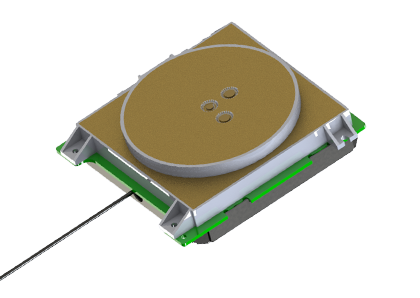
    The M9708CWT-UFL from Maxtena is an active multi-frequency, high-accuracy, GNSS antenna for the L1/L2/L5 GPS, Galileo, Beidou and GLONASS bands. The antenna is designed for applications requiring greater accuracy than L1-only antennas can provide.

    The antenna’s excellent radiation pattern, exceptional out-of-band rejection, minimal group delay variation, and low noise figure ensures optimal performance of GNSS systems, according to Maxtena.

    The M9708CWT-UFL is designed for applications requiring minimal integration effort or for retrofitting existing products. The antenna is mounted on the inside of the application’s housing, allowing it to be hidden. The antenna element is custom tuned to the enclosure.

    Features of the M9708CWT-UFL:

    • Low profile design
    • Concurrent GNSS reception on:
    • L1: GPS, GLONASS, Galileo, Beidou
    • L2: GPS L2C, Galileo E5B, and GLONASS L3OC
    • L5: GPS L5, Galileo E5A
    • Small form factor
    • GIS, RTK and other high-accuracy GNSS applications
    • Low power consumption
    • Minimal phase-center variation over azimuth and elevation
    • Negligible group delay variation
    • Custom tuned to applications enclosure
  • UAV Navigation provides flight-control solution for VTOL platforms

    UAV Navigation provides flight-control solution for VTOL platforms

    UAV Navigation has developed a flight-control solution specifically for vertical-take-off-and-landing (VTOL) fixed-wing drones.

    Interest in using VTOL platforms has grown in the past few years, according to the company. A hybrid between fixed-wing and rotary-wing platforms, VTOLs provide operators with versatility.

    The company’s fixed- and rotary-wing development teams worked together on the flight-control solution. Technological capabilities from other solutions — referenced navigation or the development of missions in environments without GNSS signals and under threat of jamming attack — have been incorporated in an organic way to facilitate a complete and reliable system.

    The hardware developed by UAV Navigation has the MIL-STD-810F and MIL-STD 461F certification, proving the system has been tested by an independent body that certifies its extraordinary behavior in adverse conditions.

    “Our extensive experience with fixed-wing and rotary-wing platforms allows us to know the strengths and challenges that these platforms face as a mission is performed,” said Miguel Ángel de Frutos, CTO of UAV Navigation. “Taking this as a starting point, we have managed to develop a specific solution for VTOL platforms that not only has the same technological capabilities as our existing solutions, but also enables missions to be carried out with the highest possible security.”

    One of the main challenges with VTOL platforms is the transition from vertical to horizontal flight and vice versa. UAV Navigation’s solution facilitates and automates this critical moment as much as possible, while optimizing battery use. A series of safety and emergency procedures allow the aircraft to always reach a safe landing zone and overcome possible errors in the engine.

    An adaptable VTOL software architecture allows users to customize and configure the solution through the ground control station.

    Partnership with AnsuR Technologies

    logosUAV Navigation is partnering with AnsuR Technologies to enable streaming high-definition (HD) video from small UAVs carrying a 200-kbps satcom terminal.

    With the partnership, the Asmira software solution fro AnsuR provides the ability to optimize sending video and images for satellite communications. Asmira, together with the Cobham Aviator UAV 200 and the antenna pointing solution Polar-300, provided by UAV Navigation, can deliver cost-effective high quality video transmission for small satellite platforms.

    Integrated into the platform’s onboard network, UAV Navigation’s Polar AHRS delivers the attitude and steering information of the platform so the Cobham device can establish contact with the satellite.

    The Polar AHRS, a device designed to meet the demanding needs of the aeronautical sector, includes all the necessary sensors in a compact device to provide precise information to the servos in a gimbal or an antenna, enabling its control. Once a stable satellite link is established, the Asmira software delivers HD-quality video at rates down to 100 kbps and can support SD quality below 50kbps.

    The partnership enables good-quality streaming for long-range surveillance, infrastructure monitoring and search-and-rescue missions where videos are critical.