Category: Uncategorized

  • Trimble launches usage-based service plan for Catalyst GNSS receiver

    Trimble launches usage-based service plan for Catalyst GNSS receiver

    Trimble Catalyst On Demand enables automated domain-level email address access, which streamlines license allocation for organizations with a large number of users. (Photo: Allison Barwacz)
    Trimble Catalyst On Demand enables automated domain-level email address access, which streamlines license allocation for organizations with a large number of users. (Photo: Allison Barwacz)

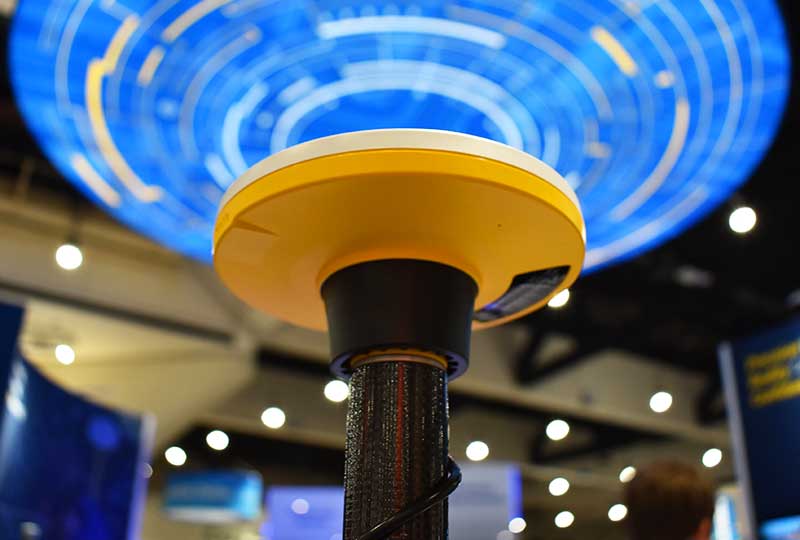
    Trimble’s Catalyst software-defined Global Navigation Satellite System (GNSS) receiver for Android phones and tablets is now available with a usage-based service plan: Trimble Catalyst On Demand.

    According to the company, the new service plan is focused on satisfying the requirements of a growing number of industries and organizations who recognize the benefits of using high-accuracy GNSS technology in the field, but need a more flexible payment model.

    Trimble Catalyst On Demand provides scalable access to RTK-quality GNSS positioning using an affordable pay-per-use hourly pricing model in addition to the current Catalyst monthly plans, the company added. The service also enables automated domain-level email address access, which streamlines license allocation for organizations with a large number of users.


    “Catalyst On Demand is Trimble’s response to the growing number of individuals and organizations needing flexible access to high-accuracy GNSS technology,” said Rachel Blair Winkler, business area manager, mapping and GIS, for Trimble. “By providing a usage-based payment model for Catalyst, we are empowering more users inside and outside the geospatial profession to record positions, navigate to points, measure relative distance and create digital maps. This results in better work and better decisions.”

    Trimble Catalyst service subscriptions and the Catalyst DA1 antenna are available through Trimble’s Authorized GIS Distribution Network.

  • Lidar USA integrates lidar scanners with heavy-lift drones

    Lidar USA integrates lidar scanners with heavy-lift drones

    Photo: LiDARUSA
    Photo: Lidar USA

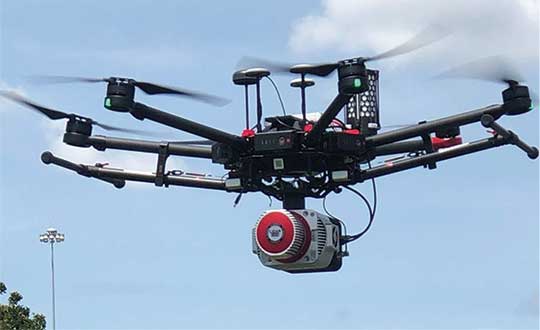
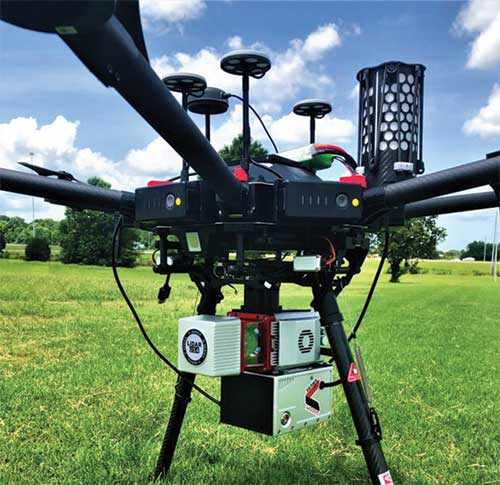
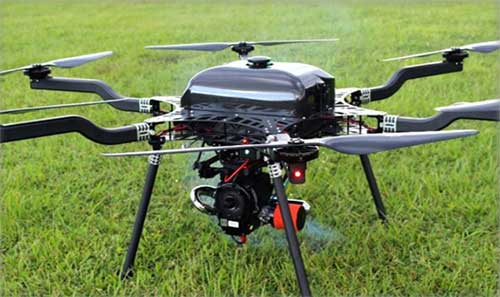
    Lidar USA is integrating its UAV scanning systems with the Harris Aerial H4/H6 Hybrid multicopters.

    As surveyors and mappers experience growth, they assume larger and larger projects, making longer flight times increasingly important. The Harris Hybrid can provide such flights with lidar and industrial-grade cameras, allowing for far greater coverage in a single flight.

    “The beauty of the Harris Hybrid, is that the pilot continues to enjoy the flexibility of a multicopter, availability of fuel, and relatively compact packaging at an affordable price,” said Jeff Fagerman, CEO of Lidar USA. “While it is louder than an all-electric system, for particularly large, rural projects it is a very nice solution.”

    Harris Aerial, a drone manufacturer near Orlando, Florida, builds and sells heavy-lift hybrid multicopters. These copters use a small generator running on 95 (or higher) octane fuel to power the UAV for up to 5 hours. The H6 can carry an A-series HD lidar system of 3 kg for 2.5 hours and a V-series of 5 kg up to 1.5 hours.

    For the lidar operator, most projects require only one or two flights. On projects that are relatively flat with a clear line of sight to the horizon in all directions, these systems can cover everything legally possible in a single flight.

    Lidar USA offers the Harris Aerial H4/H6 Hybrid an integrated package with any Lidar USA scanning system.

  • KVH launches TACNAV 3D inertial navigation system

    KVH launches TACNAV 3D inertial navigation system

    Photo: Allison Barwacz
    Photo: Allison Barwacz

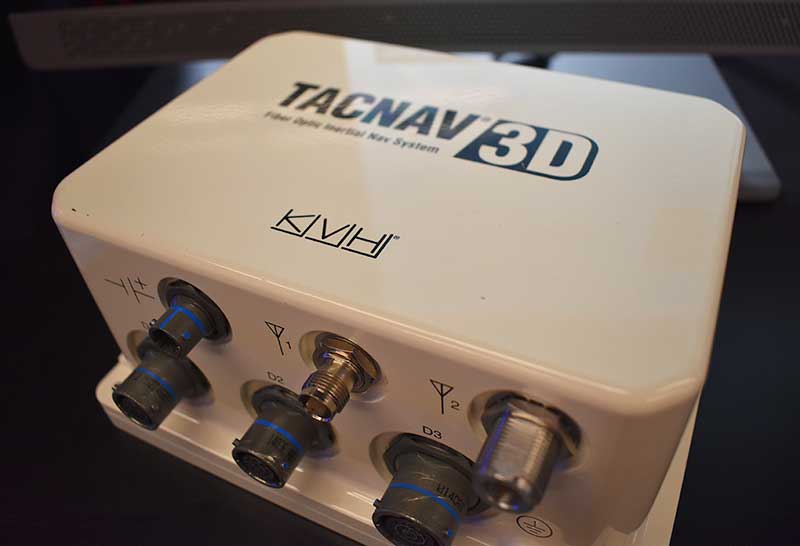
    KVH Industries released its TACNAV 3D inertial navigation system, which includes an embedded GNSS and optional chip-scale atomic clock.

    According to the company, the TACNAV 3D’s modular tactical design and flexible architecture allow it to function as either a standalone navigation solution or as the core of a multi-functional Battlefield Management System.

    TACNAV 3D can integrate with a number of military GNSS systems and features one pulse per second timing assurance during GNSS signal loss, the company added. It also includes an iridium transceiver option that transmits and receives vehicle position, waypoint, and target location to and from a command center or other vehicles. It can receive and transmit data over ethernet, CANbus or RS-422 serial data bus.


    “It incorporates a chip-scale atomic clock,” said Bill Houtz, business development — military and government for KVH Industries’ Inertial Navigation Group. “It has an embedded GPS, or we can work with other GPS external systems. It’s extremely flexible. It is an excellent SWAP-C alternative to the ring-laser gyros or other solutions on the market right now.”

  • Esri, Jane Goodall Institute partner to protect ecosystems

    Esri is partnering with the Jane Goodall Institute to develop a set of tools that will help communities map and manage the ecosystems around them through a collaborative design and planning approach, aided by GIS software.

    According to the partners, these tools will help communities map, monitor, and better manage their natural resources from community forests and wildlife reserves, to water catchment and flood control areas, as well as human settlement, agriculture and agroforestry spaces.

    The Jane Goodall Institute’s community-centered conservation approach — Tacare — partners local communities and governments to create sustainable livelihoods while planning for and advancing environmental protection. The Tacare approach also achieves conservation results and addresses environmental threats — including incompatible expansion of agriculture, human settlements, harvesting forest products, disease, wildlife trafficking and illegal bushmeat trade — by consulting communities about their needs and priorities, and working together to collaboratively plan for and implement land use practices that enable their own development.

    “A key component of our success is that we work to help villagers find ways to make livelihoods that do not destroy the environment, and help them understand that protecting the environment not only conserves wildlife, but their own future,” said Dr. Jane Goodall, DBE, founder of the Jane Goodall Institute and United Nations Messenger of Peace.

    The Jane Goodall Institute uses Esri’s ArcGIS platform and Survey123 mobile app to help communities and governments in western Tanzania, Uganda and other countries in Africa to plan, monitor and protect chimpanzee populations in local protected forests outside designated national parks.

    “Conservation at the community level is essential to sustaining our natural world,” said Jack Dangermond, Esri founder and president. “Protecting global ecosystems cannot work on a global scale unless it starts locally, which is why we are honored to work with our friend and partner, the Jane Goodall Institute, on this collaboration, leveraging their years of experience working at the local scale in pursuit of conservation, balanced with the needs of human communities.”

  • Aircraft lands autonomously without ground assistance

    A German research team successfully demonstrated a completely autonomous airplane landing in May, without assistance from any ground-based systems, fulfilling a key step towards autonomous air traffic and the much-bruited Urban Air Mobility (UAM).

    An optical reference system, encompassing a camera in the normal visible range and an infrared camera for conditions with poor visibility, combined with GPS to bring the modified Diamond DA42 in for a safe, unpiloted landing at the Diamond Aircraft airfield in Wiener-Neustadt, Austria.

    The team, from the Technical University of Munich (TUM) and the Technische Universität Braunschweig, formed the project they call C2Land with funding from the German federal government. Two 2019 conference papers by the researchers, cited at the end of this article, give the technical underpinnings of the C2Land system.

    What’s New

    Automatic landings by both commercial aircraft and small planes can and do take place at major airports with the Instrument Landing System (ILS) infrastructure to guide aircraft in with sufficient precision. Ground antennas send radio signals to the autopilot to make sure it navigates to the runway safely. Procedures in development to use GNSS alone to make autonomous landings also require a ground-based augmentation system.

    But systems such as these are too expensive for small airports that will conceivably carry the major share of UAM: automated air freight transport and autonomous flying taxis.

    What needs to happen before George Jetson air taxis become a reality?  UAM will take place in the zone 500 to 5,000 feet above ground, transporting one to five passengers or cargo over distances of five to 50 miles. The vision shared by most UAM stakeholders, a group that includes NASA and the FAA, involves vertical take-off and landing rather than conventional “glide” takeoff and landing, but precise navigation to the landing spot is critical in both cases.

    “Automatic landing is essential, especially in the context of the future role of aviation,” said Martin Kügler, research associate at the TUM Chair of Flight System Dynamics.

    Fly-by-wire systems, semiautomatic and typically computer-regulated systems for aircraft navigation, use GPS signals for positioning. But since GPS is susceptible to errors, interference, and obstruction, it is not solely sufficient for landing procedures. Current GPS approach procedures require that human pilots resume control over the aircraft at 60 meters altitude, and land the aircraft manually.

    To enable completely automated landings , the TU Braunschweig team designed an optical reference system: two cameras, one in normal visible range and one infrared camera for poor visibility conditions. Custom image processing software lets the system determine where the aircraft is relative to the runway based on the camera data it receives. Additional functions were integrated in the software, such as comparison of data from the cameras with GPS signals, calculation of a virtual glide path for the landing approach and flight control for various phases of the approach.

    Visual Recognition

    Test pilot Thomas Wimmer, who sat through the procedure with his hands folded, said “The cameras already recognize the runway at a great distance from the airport. The system then guides the aircraft through the landing approach on a completely automatic basis and lands it precisely on the runway’s centerline.”

    The researchers presented their system in two papers at the Institute of Navigation’s 2019 Pacific PNT Meeting in April:

    “Model-based Threshold and Centerline Detection for Aircraft Positioning during Landing Approach,” by S. Wolkow, M. Angermann, A. Dekiert, and Ulf Bestmann; and

    “Linear Blend: Data Fusion in the Image Domain for Image-based Aircraft Positioning during Landing Approach,” by M. Angermann, S. Wolkow, A. Dekiert, U. Bestmann, and P. Hecker.

    Summaries of each paper are here. The full papers are available at www.ion.org/publications/browse.cfm.
  • FAA restricts drones over additional military facilities

    FAA restricts drones over additional military facilities

    Photo: FAA
    Photo: FAA

    The Federal Aviation Administration has added new airspace restrictions — effective July 11 — on unmanned aircraft systems (UAS) attempting to fly over national-security-sensitive locations.

    The FAA has been cooperating with federal partners to address concerns about malicious drone operations by using the agency’s existing authority under Title 14 of the Code of Federal Regulations Section 99.7 (14 CFR § 99.7), Special Security Instructions, to establish UAS specific flight restrictions over select, national security sensitive locations.

    The FAA’s Notice to Airmen (NOTAM), FDC 8/3277, defines these special security instructions. The FAA published a NOTAM, FDC 9/3332, which alerts UAS operators and others in the aviation community of this change and points to FDC 8/3277.

    The additional 12 restricted locations requested by the U.S. Department of Defense are identified below.

    • Raven Rock Mountain Complex in Adams, PA
    • Lake City Army Ammunition Plant in Independence, MO
    • Pine Bluff Arsenal in White Hall, AR
    • Tooele Army Depot in Tooele, UT
    • Hawthorne Army Depot in Hawthorne, NV
    • Pueblo Chemical Depot in Pueblo, CO
    • Iowa Army Ammunition Plant in Middletown, IA
    • Watervliet Arsenal in Watervliet, NY
    • Blue Grass Army Depot in Richmond, KY
    • Letterkenny Army Depot in Chambersburg, PA
    • Rivanna Station in Charlottesville, VA
    • Maui Space Surveillance Site in Maui, HI

    UAS operators, in particular, are urged to review the special security instructions prescribed by FDC 8/3277 and the important supporting information provided by the FAA’s UAS Data Delivery System (UDDS) website.

    The UDDS website provides easy access to the text of FDC 8/3277 and other UAS-specific security NOTAMs; a current list of the airspace to which these special security instructions have been applied, supported by an interactive map and downloadable geospatial data; and other crucial details. A link to these restrictions is also included in the FAA’s B4UFLY mobile app.

    The new UAS flight restrictions highlighted above and by FDC 9/3332 are pending until they become effective on 07/11/2019. UAS operators should keep in mind that access to the airspace identified by FDC 8/3277 and UDDS is strictly controlled.

    Operators who violate these flight restrictions may be subject to enforcement action, including potential civil penalties and criminal charges.

    The FAA is continuing to consider additional requests by eligible Federal security agencies for UAS-specific flight restrictions using the agency’s 14 CFR § 99.7 authority as they are received. The FAA will announce any future changes, including additional locations, as appropriate.

    For further, broader information regarding flying drones in the National Airspace System, including frequently asked questions, please refer to the FAA’s UAS website.

  • Quectel launches dual-band GNSS module LC79D

    Quectel launches dual-band GNSS module LC79D

    Image: Quectel
    Image: Quectel

    Quectel Wireless Solutions has launched a compact dual-band GNSS module, the LC79D, that supports the L1 and L5 bands from navigation satellites to improve positioning accuracy.

    Featuring concurrent multi-constellation GNSS receivers on dual GNSS bands, LC79D uses L1 and L5 bands for GPS, Galileo and QZSS satellites, L1 band for GLONASS and BeiDou satellites, and L5 band for IRNSS satellites.

    Compared to GNSS modules that use the L1 band only, LC79D can generally increase the number of visible satellites, significantly improve positioning drifting when driving in rough urban canyons and enhance positioning accuracy.

    Embedded with a low-noise amplifier (LNA) and multi-tone active interference, the module provides higher sensitivity and reliable anti-jamming capability, ensuring exceptional acquisition and tracking performance even in weak signal areas. Multiple communication interfaces including UART and SPI simplify customer designs and accelerate time-to-market for customers’ products at reduced costs.

    With dimensions of 10.1 × 9.7 ×2.4 millimeters, the tiny LC79D meets the requirements of size-sensitive applications. Compact design, low power consumption and high performance make it suitable for vehicle, people and asset tracking as well as sharing economy applications.

    “The launch of LC79D shows Quectel’s global leading position to provide positioning modules for applications requiring higher accuracy and reliability, especially in rough environments with weak signals,” said Wang Min, automotive and GNSS product director at Quectel. “LC79D gives customers high-level integration and flexibility to realize precise positioning in real time.”

    The LC79D module was showcased at MWC Shanghai 2019 during June 26-28.

  • Seen & Heard: Buses use Galileo, stopping the bad guys

    Seen & Heard: Buses use Galileo, stopping the bad guys

    “Seen & Heard” is a monthly feature of GPS World magazine, traveling the world to capture interesting and unusual news stories involving the GPS/GNSS industry.

    Galileo guides Madrid metro buses

    Galileo and EGNOS are helping EMT Madrid to improve its services, reports the European GNSS Agency. Madrid is one of the first cities using Intelligent Transport Systems (ITS) with enhanced positioning services. Positioning units in 2,050 public buses mean customers know exactly where their ride is, and when it will arrive. Receivers in the buses use signals from EGNOS and Galileo.

    Drought fighters

    About 3,000 villages in the Karnataka state of India face serious water shortage. More than 2,000 tankers and 1,800 private bore wells have been hired to meet the need. To ensure the water gets to the right place, all tankers supplying water to drought-hit villages and towns are being equipped with GPS to prevent misuse. The trackers will show the movement of the tankers from the water source to the residential areas.

    Bangalore water jugs. (Photo: CamBuff/Shutterstock.com)
    Bangalore water jugs. (Photo: CamBuff/Shutterstock.com)

    Getaway car stopped in its tracks

    In March, a Florida Highway Patrol trooper darted a GPS tracker onto the back of a fleeing minivan during a 60 mph chase. As the pursuit carried over county lines, a trooper used his StarChase system to tag the minivan. The FHP used the tracking information to roll out a spike mat to stop the suspected felon. Only a few police agencies in the state have the technology, which is still being tested.

    Photo: Starchase
    Photo: Starchase

    Help for refugees

    Between 2013 and 2018, almost 70,000 children in Kenya died of diseases that could have been prevented with vaccines. Two Nairobi teenagers, Kunjal Bharatkumar and Supraja Sayee Srinivasan, paired a health website they created with small GPS devices, tested at Dadaab Refugee Complex. A mother gets a GPS bracelet and her baby a GPS necklace. The trackers turn on when it’s time to alert the mother that her child is due for its next vaccine. Then, mom can take her child to get the shots. If they miss their vaccine appointment, the GPS sends a signal to healthcare workers to provide vaccines. The website can create maps of active diseases.

    Dadaab Refugee Complex in Kenya. (Photo: iStock.com/sadikgulec)
    Dadaab Refugee Complex in Kenya. (Photo: iStock.com/sadikgulec)
  • L3Harris Technologies merger completed

    L3Harris Technologies merger completed

    The Harris-supplied navigation payload before integration into the second GPS III SV. (Photo: Harris)
    The Harris-supplied navigation payload before integration into the second GPS III SV. (Photo: Harris)

    L3Harris Technologies announced the successful completion of the all-stock merger between Harris Corporation and L3 Technologies on June 29. Headquartered in Melbourne, Florida, L3Harris becomes the sixth largest defense company in the U.S., and a top 10 defense company worldwide, with approximately $17 billion in revenue and 50,000 employees, including 20,000 engineers and scientists.

    Both companies have long been dominant presences in the U.S. GPS industry: Harris as a provider of the GPS satellite navigation payloads and geospatial intelligence software products, and L3 as a provider of military GPS user equipment and guided munitions. Both companies supply a wide range of other geospatially-related products as well.

    L3Harris has organized its operating businesses into four segments to best meet customers’ mission requirements and leverage the combined company’s broad technical capabilities:

    • Integrated Mission Systems — headquartered in Palm Bay, Florida, with approximately $4.9 billion in revenue. Includes intelligence, surveillance and reconnaissance; advanced electro optical and infrared solutions; and maritime power and navigation
    • Space and Airborne Systems — headquartered in Palm Bay, Florida, with approximately $4.0 billion in revenue. Includes space payloads, sensors and full-mission solutions; classified intelligence and cyber defense; avionics; and electronic warfare
    • Communication Systems — headquartered in Rochester, New York, with approximately $3.8 billion in revenue. Includes tactical communications; broadband communications; night vision; and public safety
    • Aviation Systems — headquartered in Arlington, Texas, with approximately $3.8 billion in revenue. Includes defense aviation products; security, detection and other commercial aviation products; air traffic management; and commercial and military pilot training

    Shares of Harris common stock, which traded on the NYSE under the ticker symbol “HRS,” began trading on July 2 under the ticker symbol “LHX.” L3 Technologies shares ceased trading upon market close on June 28 and have converted into 1.3 L3Harris shares for each L3 share.

    The merger comes at approximately the same time that two other leading GPS companies, Raytheon and United Technologies, itself a merger including the former Rockwell Collins, now Collins Aerospace, also merged.

  • 2019 GPS Public Interface Control meeting set for Sept. 25

    2019 GPS Public Interface Control meeting set for Sept. 25

    CGSIC logo

    On Sept. 25, the GPS Directorate will host the 2019 Public Interface Control Working Group and Open Forum to update the public on GPS public document revisions.

    The meeting will collect issues and comments for analysis and possible integration into future GPS public document revisions.

    The 2019 Public Interface Control Working Group and Open Forum are open to the general public. It can be attended in person or by dial-in connection.

    Documents Affected

    • IS-GPS-200: Navigation User Interfaces
    • IS-GPS-705: User Segment L5 Interfaces
    • IS-GPS-800: User Segment L1C Interface
    • ICD-GPS-870: NAVSTAR GPS Control Segment to User Support Community Interface

    Meeting Address: SAIC, 100 N Sepulveda Blvd., El Segundo, CA 90245, The Great Room

    Meeting Dial-in Number: 310-653-2663 Meeting ID: 20190925 Password: 123456.

    Documents and proposed changes and the official meeting notice are posted on GPS.gov.

  • Last call for State of the Industry — and $100 gift cards

    Last call for State of the Industry — and $100 gift cards

    Early polling results are in, and trends have emerged. Don’t absent yourself from this exercise in democracy. Make your views known on the state of the PNT industry before it’s too late — July 4 will be too late — and earn a chance at a $100 gift card.

    With such questions as “Is your organization taking steps to ensure continuity of PNT availability in the event of a disruption in GNSS service?” and “What is the biggest challenge for the UAV industry?,” the survey takes the pulse of engineers, executives, designers, integrators, product managers and more across the industry. We’re looking to the horizon, seeking to identify the challenges that will guide us all into the next Big Thing.

    Go to the 2019 State of the Industry Survey page and answer just slightly over 20 questions. Not only will you help create the future, you’ll help create your own chance at wealth. All who wish will be entered in a random drawing for two $100 gift cards.


  • Lidar USA now offers drone rescue parachute option

    Lidar USA now offers drone rescue parachute option

    Photo: LiDARUSA
    Photo: Lidar USA

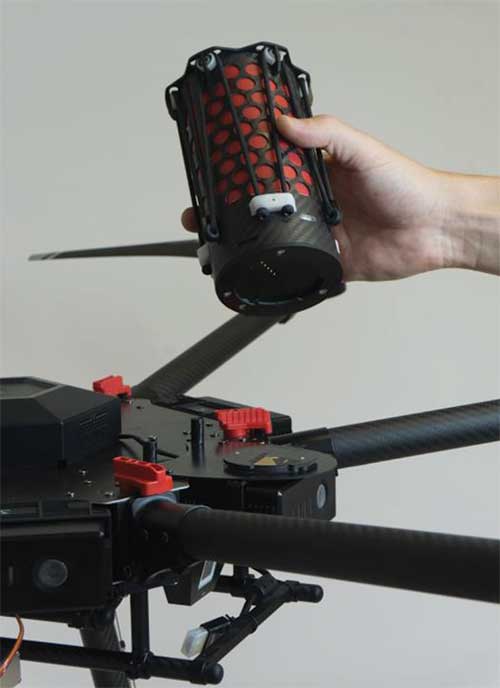
    Lidar USA is now offering the option of the Drone Rescue Systems parachute system with all of its DJI M600 UAVs.

    As UAVs become increasingly common for mapping applications, the likelihood of a crash increases. The number-one concern for any pilot should be the safety of all people in the vicinity. Equipment safety is number two.

    Any mapping-equipped drone will have enough weight to potentially harm a person even if falling from a low altitude flight. The Drone Rescue System greatly mitigates this danger and gives pilots the added assurance that, should the system fail, they have gone the extra mile to prevent harm to any bystanders.

    Effective as low as 10 meters with a descent of 3 meters per second, the equipment will land without a hard impact yet quickly enough to keep from being dragged far away.

    Photo: LiDARUSA
    Photo: Lidar USA

    Weighing in at 430 grams in a repackable canister 160 x 75 millimeters in size, the DRS-M600 is designed to auto-release using a patented, airplane-friendly ejection mechanism within milliseconds of detecting a system failure. The size and weight are a major bonus when combined with the airplane-friendly feature, especially for field workers, according to the company.

    “We performed our own tests of the Drone Rescue system to ensure the system really worked as advertised,” said Daniel Fagerman, CTO of Lidar USA. “We weren’t disappointed. While it’s an expensive test if it fails, the good news is it that the system worked as well as could be expected. The M600 incurred very little damage that was easily repaired. We feel confident this will be more than just an accessory for our clients but rather a necessity.”

    Lidar USA is offering the parachute option to any M600 owners. Watch a video of one of the company’s test flights.