Tag: OxTS

  • Launchpad: New antennas, scanners and survey applications

    Launchpad: New antennas, scanners and survey applications

    A roundup of recent products in the GNSS and inertial positioning industry from the June 2023 issue of GPS World magazine.


    SURVEYING
    OxTS Georeferencer 2.5

    Survey Software
    Georeference raw lidar data

    Georeferencer 2.5 featuring anyNAV software is suitable for survey applications. Users of Georeferencer 2.5 with the anyNAV feature enabled can boresight payloads and georeference lidar data using the user’s navigation data. The anyNAV software enables lidar surveyors to create accurate point clouds quickly. Georeferencer 2.5 now takes navigation data from third-party inertial navigation systems, which enables users to use that data to georeference raw lidar data from multiple sensor families. The resulting data can then be viewed in many point cloud viewer software packages.
    OxTS, oxts.com
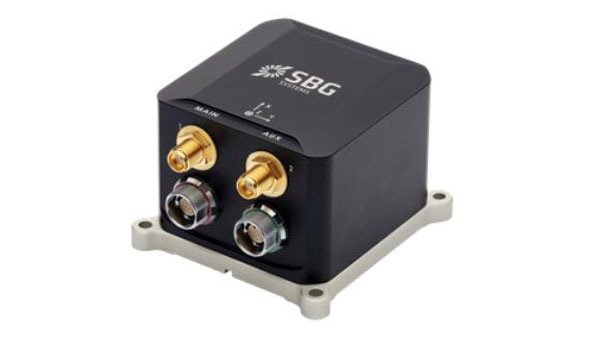
    Photo:

    Inertial Navigation Solution
    Designed to deliver accuracy in challenging environments

    Ekinox Micro combines a high-performance MEMS tactical inertial sensor with a quad-constellation, dual-antenna GNSS receiver, making it suitable for mission-critical applications. The device includes pre-configured motion profiles for land, air and marine applications, enabling the sensor and algorithms to be tuned for maximum performance in any condition. The device is designed for ease of use and integration, with simple connectors, a web configuration interface, datalogger, Ethernet connectivity, a PTP server, a REST API for configuration, and multiple input and output formats. Ekinox Micro is compatible with real-time kinematic (RTK) solutions and based on a tactical 0.8°/h class inertial measurement unit calibrated across the entire operating temperature range. It features accuracy roll/pitch of 0.015°, accuracy heading of 0.035°, and accuracy position of 1.2 m without any corrections or 1 cm in RTK. The device also meets the MIL-STD-461, MIL-STD-1275, and MIL-STD-810 standards.
    SBG Systems, sbg-systems.com
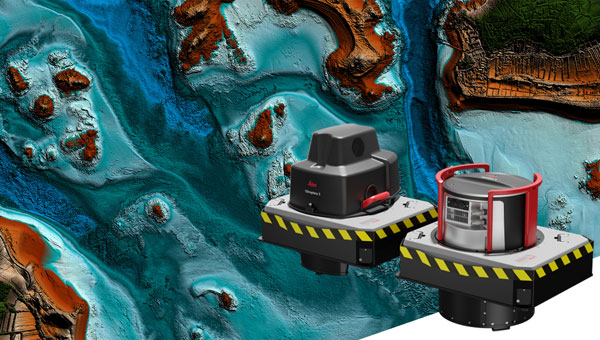
    Image: Hexagon

    Lidar Sensor
    High-performance airborne bathymetric solution for deep water surveying

    The HawkEye-5 increases survey efficiency by up to 25% compared to previous generations. The technology expands the capabilities of the Chiroptera-5 bathymetric lidar system, enhancing the productivity of applications such as nautical charting, environmental monitoring, and maritime surveillance in deep waters. The technology is designed to fit the Leica PAV100 gyro-stabilized mount, which isolates the sensor from unwanted aircraft movements — resulting in consistent data density and more efficient area coverage. The HawkEye-5 combined with the Chiroptera-5 features three lidar sensors, one four-band camera, and a QC camera to collect data from the seabed to land.
    Leica Geosystems, leica-geosystems.com
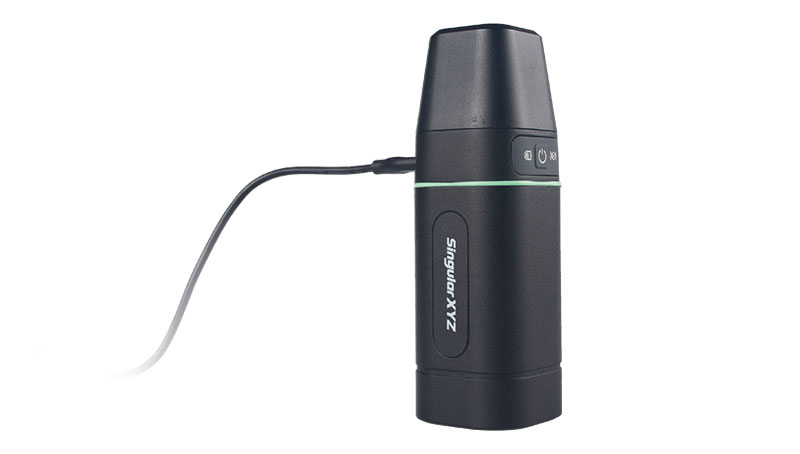
    Image: SingularXYZ

    GNSS Receiver
    Complete with network RTK rover

    The Sfaira One GNSS receiver is small and centimeter accurate. It provides users with an entry-level network real time kinematic (RTK) rover. Sfaira One is equipped with a GNSS module with 1,408 channels for GPS, BDS, GLONASS, Galileo and QZSS tracking — providing centimeter positioning in harsh environments. It also features advanced RTK and an anti-interference algorithm. The GNSS receiver connects via Bluetooth and can be configured to conduct surveying tasks on a smartphone. Additionally, Sfaira One supports SingularPad and SingularSurv software and is also compatible with mainstream field survey or GIS software. Sfaira One is IP65 dustproof and waterproof, which makes the receiver suitable for all weather conditions. It has a 4,800 mAh battery life with 16 hours working time and type-C interface that can be charged on-the-go with a power bank.
    SingularXYZ, singularxyz.com


    MAPPING
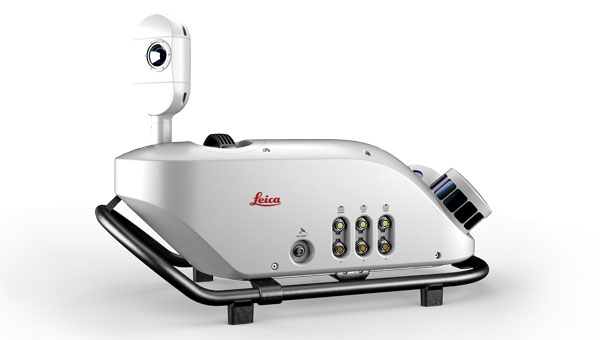
    Photo:

    Mobile Mapping Solution
    Built for large-scale infrastructure measurement and digital twin creation

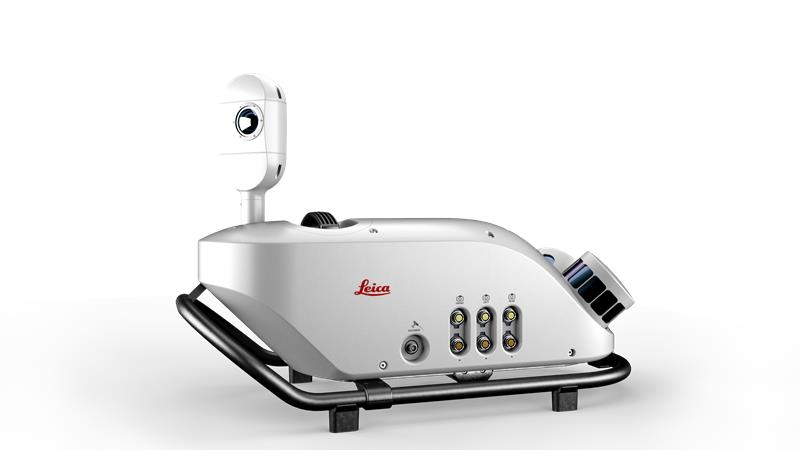
    The Pegasus TRK100 is small and light, making it easy to mount on any vehicle. The mobile mapping system features the same modular hardware approach that enables users to add more cameras to expand the range of use cases. With its advanced mapping capabilities, the Pegasus TRK100 enables GIS professionals to visualize and understand the location of assets to help make the right decisions, improve asset management, and support infrastructure building and maintenance. The Pegasus TRK100 combines artificial intelligence and a learning algorithm to enhance and optimize the clarity of points in post-processing for improved accuracy. The versatility of the Pegasus TRK100 suits a variety of applications in diverse industries, including telecommunications, utilities and road maintenance.
    Leica Geosystems, leica-geosystems.com


    OEM
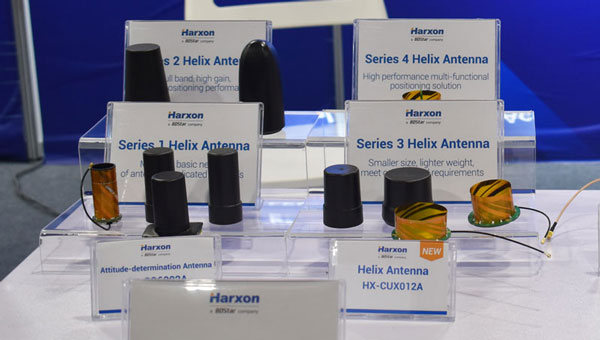
    Photo:
    Photo:

    Helix Antenna Series
    Suitable for unmanned system applications

    HX-CUX012A is designed with an extremely low profile, making it suitable for integration into UAVs, surveying and monitoring devices. It reduces the overall weight of applications, enables multipath mitigation and more. HX-CUX005A is a solution for integrated helix antenna applications. It is designed with the integration of a GNSS antenna and Bluetooth/Wi-Fi antenna, enabling communication and navigation without mutual interference. HX-CH7609A is a low profile and small size housed helix antenna. It has comprehensive GNSS support including GPS, GLONASS, Galileo, BeiDou, as well as L-band correction services. HX-CH7609A features centimeter phase center repeatability and high gain at a low elevation. With signal filtering and multipath rejection, it provides reliable and stable GNSS signals. HX-CHX600A is a high-performance helix antenna that receives GPS, Galileo, BeiDou, GLONASS, as well as L-band signals. With 4.2 dBi high gain, it provides suitable tracking performance at a low elevation angle. Its low noise figure design reduces transmission interference and improves signal quality.
    Harxon, en.harxon.com
    Credit: Tallysman Wireless

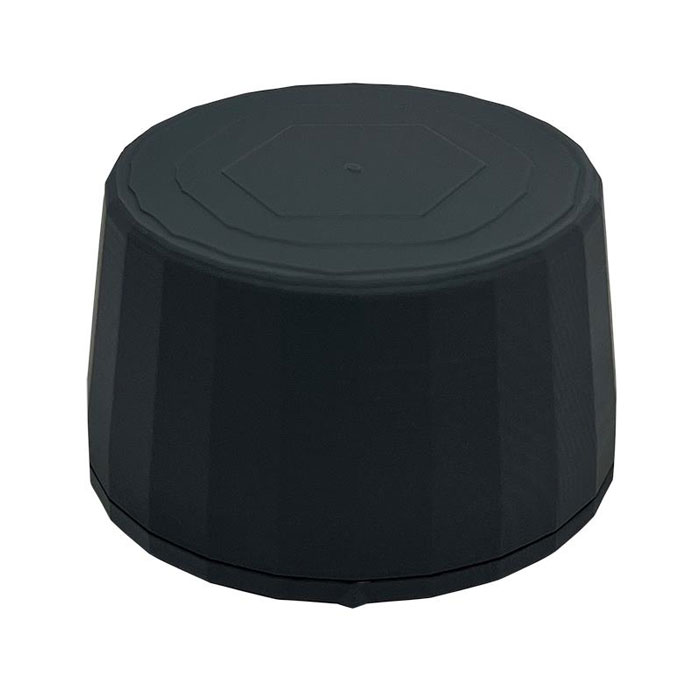
    Helical Antenna
    Suitable for UAV applications

    The HC990XF helical antenna is designed for precise positioning, covering the GPS/QZSS L1/L2/L5, QZSS L6, GLONASS G1/G2/G3, Galileo E1/E5a/E5b/E6, BeiDou B1/B2a/B2b/B3, and NavIC L5 frequency bands. This includes the satellite-based augmentation system (SBAS) available in the region of operation as well as L-band correction services. The HC990XF has a base diameter of 64 mm, is 37 mm tall and weighs 45 g. Its precision-tuned helical element provides full GNSS band coverage, suitable gain and axial ratio, and a tight phase center. The antenna base has an SMA (male) connector, three screw holes for secure attachment and an O-ring to waterproof the antenna connector. The HC990XF helical design does not require a ground plane, making it a suitable antenna for UAV applications.
    Tallysman Wireless, tallysman.com
    STMicroelectronics

    Inertial Module
    For automotive uses

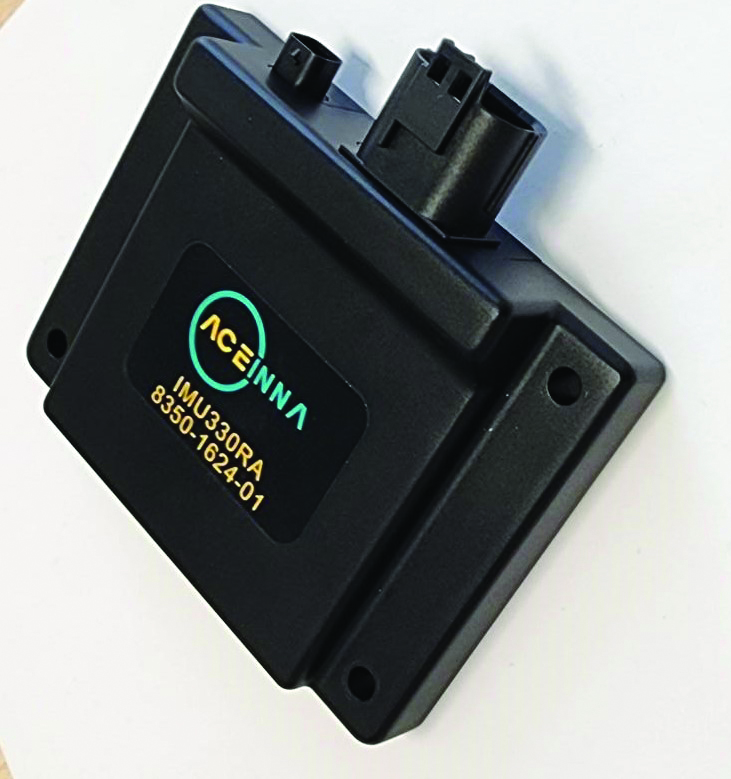
    The ASM330LHB automotive-qualified MEMS inertial-sensing module provides accurate measurements for a wide variety of vehicle functions. With the dedicated software provided, ASM330LHB also addresses functional-safety applications up to ASIL B1. ASM330LHB contains a 3-axis digital accelerometer and 3-axis digital gyroscope that provides a six-channel synchronized output. The module’s high-accuracy inertial measurements are used to improve the precise positioning of a vehicle. The accelerometer and gyroscope maintain high stability over time and temperature, and have very low noise for an overall bias instability of 3°/hour. Specified over the extended temperature range, -40°C to 105°C, the ASM330LHB has multiple operating modes that let designers optimize the data-update rate and power consumption.

    ASM330LHB can support advanced driver assistance systems or vehicle-to-everything communication, as well as help stabilize sensing systems such as radar, lidar and visual cameras, and assist semi-automated driving applications up to L2+. Additionally, ASM330LHB can be used to enable a variety of functionalities in the body of a vehicle. ASM330LHB was developed with the automotive functional-safety standard ISO 26262 — the ASIL B compatible software library has been certified independently by TÜV SÜD. By implementing dedicated safety mechanisms, including data integrity and accuracy, the library ensures compliance with ASIL B automotive systems.

    With the companion software engine, the ASM330LHB supports the growing adoption of automotive systems that require safety integrity up to level B. The combination of two ASM330LHB sensor modules for fail-safe redundancy delivers resilient contextual data for driver-assistance applications such as lane centering, emergency braking, cruise assistance and semi-automated driving. ASM330LHB is AEC-Q100 qualified and in production now in a 2.5 mm x 3.0 mm 14-lead VFLGA package.
    STMicroelectronics, st.com
    Credit: OxTS

    INS
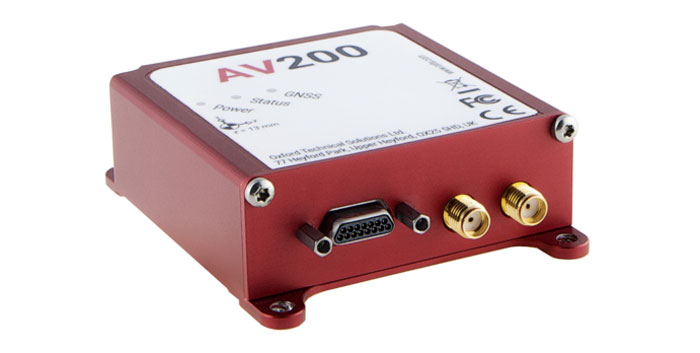
    Built for automation applications

    The AV200 is designed to give precise location data. It includes quad-constellation, dual-antenna, real-time kinematic (RTK) GNSS to provide users with position data as well as its temperature-calibrated, multi-core inertial measurement unit. These technologies give the AV200 position accuracy within 0.05 m, heading accuracy of 0.2°, and velocity accuracy of 0.2 km/h. The AV200 is built using the same technology that is commonly used for NCAP test validation, which has become the preferred technology for OEMs globally to test vehicles in both test-track and real-world scenarios.
    OxTS, oxts.com
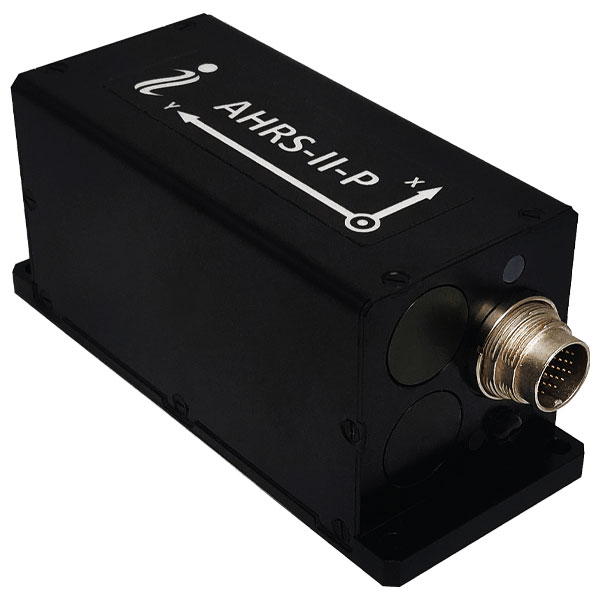
    Credit: Inertial Labs

    Reference System
    For attitude and heading

    AHRS-II-P is an enhanced, high-performance strapdown system that determines absolute orientation (heading, pitch and roll) for any mounted device. The AHRS-II-P can determine orientation for both motionless and dynamic applications. The AHRS-II-P contains a tactical-grade inertial measurement unit (IMU) consisting of three high-precision MEMS accelerometers, three advanced MEMS gyroscopes and a high-precision, gyro-compensated, embedded fluxgate compass. It also uses 8 mm fluxgate magnetometers. This device is suitable for a variety of devices such as UAVs, antennas, ships and robotic devices.
    Inertial Labs, inertiallabs.com

    GNSS Receiver
    For accurate positioning and heading
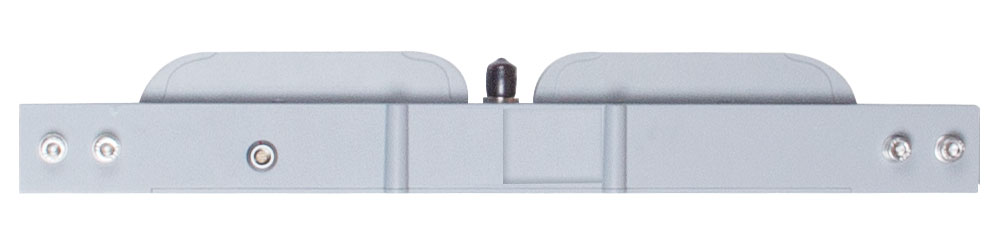
    As a high-precision integrated GNSS positioning and heading receiver, the A200 can track all existing and planned constellations — including GPS, BSD, GLONASS, Galileo, QZSS and SBAS — providing high-precision positioning and heading data for users. A200 is designed specifically for precision agriculture, machine control, fleet management, robot and other industries. The A200 is equipped with a K823 GNSS module. It also features 1,226 channels. The A200’s third generation IMU delivers fast initialization and ensures the output of heading during temporary GNSS signal loss. The built-in data link has low power consumption and a long working range. It also can be upgraded to a super-long-range data link module.
    ComNav Technology, comnavtech.com

  • What positioning technology is right for your UAV – GCPs, GPS, GNSS, PPK or RTK?

    What positioning technology is right for your UAV – GCPs, GPS, GNSS, PPK or RTK?

    What positioning technology is right for your UAV?

    One of the things to evaluate is accuracy. Accuracy is important for two reasons: you want your UAV to be where it’s supposed to be, and you want to be able to accurately georeference the data you’re gathering with your payload. But (as you will no doubt have already discovered), accuracy isn’t as simple as looking for a number. You’ll have spotted various abbreviations accompanying those numbers — GPS, PPK, RTK, and GCP most commonly, but you may also see GNSS thrown into the mix. In this article, OxTS will explain what these abbreviations mean, and what they mean for your UAV project.

    What are GCPs?

    GCPs stands for ground control points, and they are the most inexpensive method of ensuring your data is accurately georeferenced. They are physical targets that you place on the ground, and for which you know the coordinates. Once your UAV has finished its survey, those points can be used to reference the position of your UAV in the global frame.

    Image: OxTS

    The biggest drawback with GCPs is that they don’t help your UAV know its own position. GCPs only help provide your UAV with a general position reference. So, GCPs aren’t any use if you want your UAV to fly pre-programmed flight plans. For that, you’ll need a solution such as an inertial navigation system (INS) paired with a GNSS receiver. GCPs can also be time consuming to use and cause additional difficulties at the post-processing stage.

    What is GNSS?

    GNSS stands for global navigation satellite system, which are systems that use satellite-based radio navigation to provide positioning, navigation and timing anywhere on Earth. The U.S. GPS is one of four GNSS constellations; the other three are the Russian GLONASS, the Chinese BeiDou, and the European Galileo. There are also two regional satellite navigation systems — the Indian NavIC and the Japanese QZSS.

    Many UAVs will have a GNSS receiver built in — it’s what enables them to know where they are on the planet, after all. Using GNSS only, most UAVs can get accuracy of 3 m to 5 m. This level of accuracy isn’t too bad for some applications, but not accurate enough if you’re trying to use the position data for mapping activities.

    What is PPK?

    Most UAVs advertise their ability to perform PPK — which stands for post-processed kinematics. It’s a method of squeezing extra accuracy out of your GNSS signal. OxTS has a blog post here that describes how it works.

    The main thing to note about PPK is that you can’t use it in real time. UAVs with PPK capabilities can provide data that’s centimeter-level accurate in optimum conditions, but that accuracy can’t be used for navigating the drone itself. It also means that for activities that require centimetre-level accuracy in real time, PPK doesn’t deliver.

    What is RTK?

    RTK is the best you can get when it comes to position accuracy. RTK stands for real-time kinematic, and just like PPK it can use it to obtain centimeter-level accuracy — but, in real time, rather than in post-processing.

    For most mobile mapping activities RTK accuracy is the goal, particularly if you’re using a lidar sensor to create georeferenced pointclouds.

    Without RTK accuracy for the duration of your lidar survey, your point cloud may be unusable. The additional accuracy RTK offers could be used to tackle more challenging environments — providing that you have the tools to remain with RTK accuracy for as long as possible in the absence of GNSS.

    Most off-the shelf UAVs won’t have RTK capabilities built in; however, to get this level of accuracy, it’s likely that you’ll either need to purchase a top-of-the-range UAV or invest in a custom UAV (either built by you, or by a professional company).

    What’s right for me?

    If you’re involved in mobile mapping activities, then at the very least you will need PPK capabilities. Without those, you won’t be able to georeference your data with enough accuracy to be of use to anyone.

    When considering the difference between PPK and RTK, you need to consider:

    In what environment is your UAV operating? Do you need more accuracy than just a GNSS signal (remembering that PPK can only be applied after the survey takes place)?

    Is range of no particular importance – or is the payload on your drone sufficiently large that you need to calculate range very carefully? If so, RTK will give your UAV additional accuracy and, therefore, fuel efficiency.

    The final word in accuracy: gx/ix PPK and RTK from OxTS

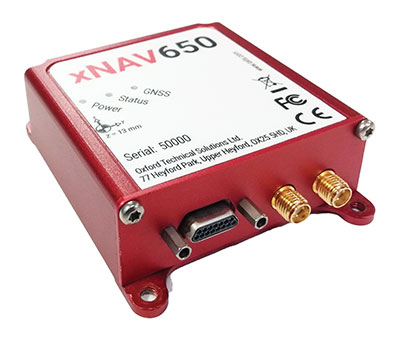
    If you read the blog post mentioned above, you’ll know that RTK (and PPK) rely on having an optimal number of satellites visible. If those satellites are lost, then so is RTK lock. That is, unless you use an OxTS INS with gx/ix tight coupling technology. Gx/ix allows our INS devices to maintain RTK and PPK level accuracy even if the number of visible satellites starts to drop. Essentially, it protects the accuracy of your scan for longer — and it is available on the OxTS xNAV650, our UAV-mountable INS.

    The OxTS xNAV650 INS combines a best-in-class inertial measurement unit, with a survey-grade GNSS receiver to output highly accurate navigation data (position, heading, pitch and roll). The xNAV650 is used across the world for applications where reliability and accuracy are critical.

  • XPONENTIAL 2023: Day two recap

    XPONENTIAL 2023: Day two recap

    AUVSI XPONENTIAL is underway in Denver, Colorado, at the Colorado Convention Center. After the second day of touring the XPO Hall, GPS World staff wanted to highlight some key parts of the day.

    Jamie Marraccini, president and CEO of Inertial Labs, sat down with GPS World for an exclusive interview regarding new upgrades to its products, its new partnership with Hesai Technology, and more. Check back soon for the video interview.
    Jamie Marraccini, president and CEO of Inertial Labs, sat down with GPS World for an exclusive interview regarding new upgrades to its products, its new partnership with Hesai Technology, and more. Check back soon for the video interview.
    GPS World visited the Omnetics booth and spoke with Bret Newton, Business Development.
    GPS World visited the Omnetics booth and spoke with Bret Newton, Business Development.
    Staff of OxTS, a GPS World marketing partner, at their booth.
    Staff of OxTS, a GPS World marketing partner, at their booth.
    Jia Xu, CTO and senior director of UAS/UAM engineering at Honeywell, gave GPS World an exclusive interview regarding the company’s most recent developments, partnerships and more. Check back soon for the video interview.
    Jia Xu, CTO and senior director of UAS/UAM engineering at Honeywell, gave GPS World an exclusive interview regarding the company’s most recent developments, partnerships and more. Check back soon for the video interview.
  • OxTS releases INS for automation

    OxTS releases INS for automation

    Credit: OxTS
    Credit: OxTS

    OxTS has released the AV200, its inertial navigation system (INS) built for automation applications.

    The AV200 is designed to reliably give precise location data. It includes quad-constellation, dual-antenna, real-time kinematic (RTK) GNSS, to provide users with position data as well as its temperature-calibrated, multi-core inertial measurement unit. These technologies give the AV200 position accuracy within 0.05 m, heading accuracy of 0.2°, and velocity accuracy of 0.2 km/h.

    The AV200 is built using the same technology that is commonly used for NCAP test validation, which has become the preferred technology for OEMs globally to test vehicles in both test-track and real-world scenarios.

    The AV200 has also been built specifically to address the realities of the autonomy market.

    OxTS is at XPONENTIAL May 9-11, at booth 2148.

  • OxTS product now available with additional features

    OxTS product now available with additional features


    OxTS Georeferencer 2.5
    Image: OxTS

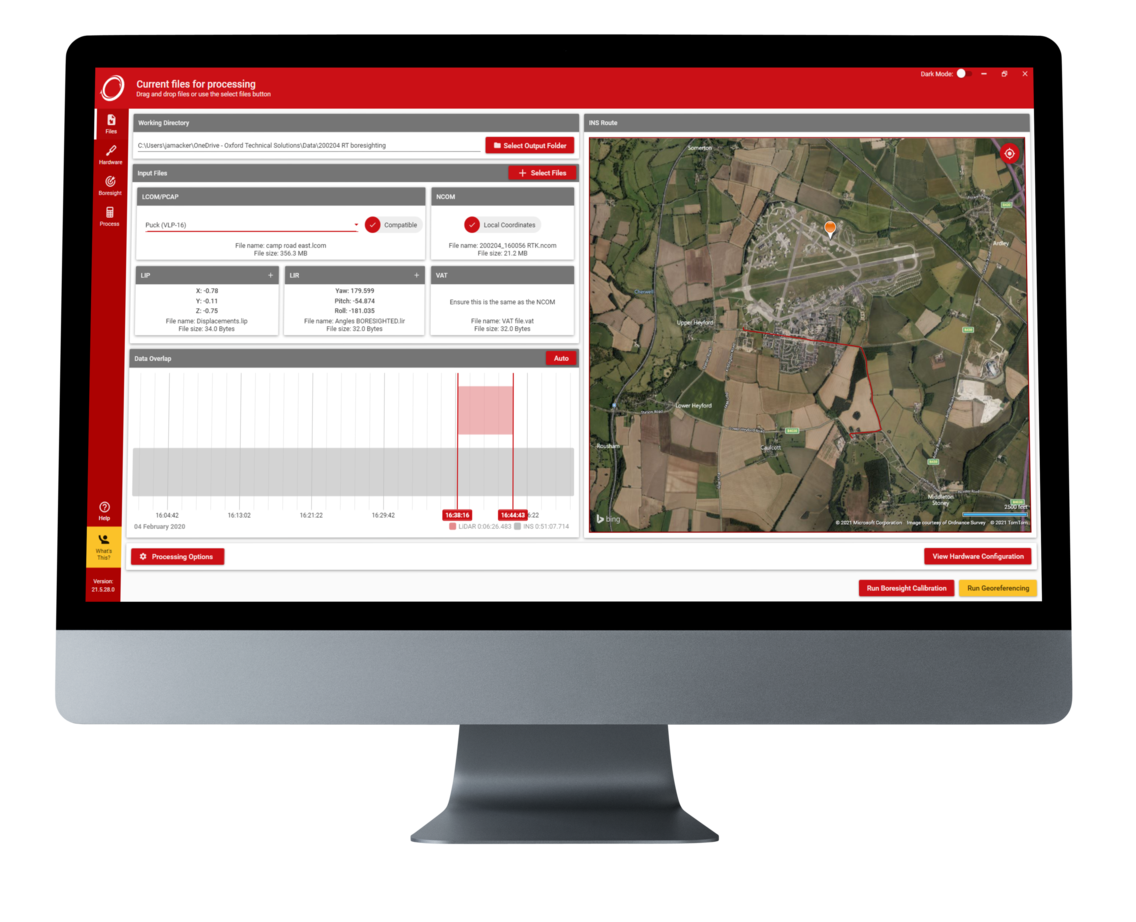
    OxTS has released its Georeferencer 2.5 with the anyNAV feature and eight lidar sensors from RoboSense. Georeferencer 2.5 featuring anyNAV software is suitable for survey applications.

    Users of Georeferencer 2.5 with anyNAV feature enabled can boresight payloads and georeference lidar data using the user’s navigation data. The anyNAV software enables lidar surveyors to create accurate pointclouds quickly.

    Georeferencer 2.5 now takes navigation data from third-party inertial navigation systems, which enables users to use that data to georeference raw lidar data from multiple sensor families. The resulting data can then be viewed in many pointcloud viewer software packages.

  • How to select an INS for mobile mapping

    How to select an INS for mobile mapping

    Image: OxTS
    Image: OxTS

    OxTS has shared this piece on OxTS.com.

    Mobile mapping is helping accelerate the progression of some of the most difficult engineering challenges on the planet, including those around autonomous driving and advanced surveying techniques, such as lidar.

    The complexity of those challenges means that the outputs from a mobile mapping inertial navigation system (INS) must be as accurate as possible. A high-performing INS will make the most of any available GNSS signals, with the aim of providing centimeter-level accuracy even in areas where GNSS performs poorly, for instance in urban canyons. It also offers important data on pitch, roll and heading, which maintains the integrity of survey data even as the vehicle moves across large areas.

    With such a wide variety of INS devices on the market, it can be difficult to narrow down the best option. It is important to establish criteria that will aid in evaluating the different INS propositions out there for mobile mapping projects.

    Image: OxTS
    Image: OxTS

    1) How tightly integrated are the inertial measurement unit (IMU) and GNSS data?

    INS is an essential element in providing accurate location data in as many environments as possible. Therefore, it is important to know how effectively the data from the IMU supports the GNSS data. In technical terms, this means evaluating whether the sensors are tightly integrated at all, and if so, how well.

    The reason GNSS struggles in urban canyons and under tree canopies is that it is unable to get the six satellite signals necessary for a real-time kinematic (RTK) lock. In this situation, the GNSS will give readings that may be incorrect, as it is essentially trying to solve an equation without having all the numbers.

    A tightly integrated GNSS and INS data stream will select the most reliable signals and use those to determine the position of the vehicle. If the data streams are not tightly integrated, then the INS’ ability to counteract GNSS issues is limited. Without accurate positioning, data scans will lose accuracy and even become completely incoherent the longer the user scans — making them unreliable at best, and unusable at worst.

    2) Trading off accuracy and cost

    Although accuracy is vital in mobile mapping, some INS devices will provide data that is far more accurate than the given job requires. Because greater accuracy equals greater cost, users may be paying more than necessary.

    With that being said, the scale of accuracy and cost is not linear. An INS half the price of the most expensive one on the market will not be half as accurate. Look at each offering carefully to see what it includes and decide what level of accuracy and features are vital to the task. Eliminating unnecessary levels of precision or additional software features that are not needed is an effective way to make some savings.

    3) How rugged is the device?

    Mobile mapping vehicles will likely be out in the dry, wet, hot, cold, mud and snow. These vehicles will almost certainly be used consistently for long periods of time. Thus, it is essential to know that none of these conditions will stop the INS from working at peak effectiveness. Look for the IP rating (IP65 is essential for being weatherproof and protecting against shocks and dust) and ask what the average lifespan of the product is.

    Image: OxTS
    Image: OxTS

    4) Can the device be properly calibrated?

    Any INS is only as good as its calibration. Without calibration, the sensors in any INS can become misaligned and therefore provide inaccurate readings. Talk to vendors about their calibration processes — do they work to a nationally recognized standard of calibration like ISO 17025? Do their calibrations account for variations in temperature or humidity?

    It is also worth considering how often sensors need recalibration. Recalibration is a chargeable service from most vendors, meaning the more the device needs recalibrating, the more the user will have to pay. This could also lead to delays if the user must send units abroad to have them recalibrated.

  • Mapping Marvel: Off the Beaten Path

    Mapping Marvel: Off the Beaten Path

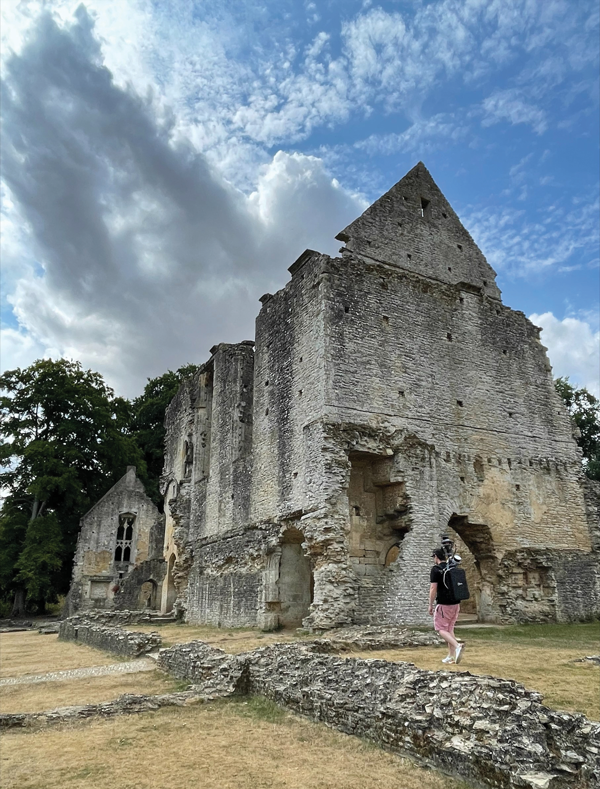
    Paris Austin, head of product – New Technology for OxTS, tries out the new backpack at historic Minster Lovell Hall. (Image: OxTS)
    Paris Austin, head of product – New Technology for OxTS, tries out the new backpack at historic Minster Lovell Hall. (Image: OxTS)

    More than 400,000 sites in the United Kingdom are on its historical registries. English Heritage site Minster Lovell Hall is located in Oxfordshire, also the home county of inertial navigation company OxTS. The picturesque ruins of Minster Lovell Hall, a 15th-century manor house, include the hall, a tower and a nearby dovecote.

    The hall was built in the 1430s by William, Baron of Lovell and Holand — one of the richest men in England. It was later home to Francis, Viscount Lovell, a close ally of Richard III. After changing hands several times, the hall was abandoned and eventually demolished in the 18th century, leaving the extensive remains that stand today.

    (Image:OxTS)
    (Image: OxTS)

    The buildings are grouped around a central courtyard in a plan characteristic of a late medieval manor house. For OxTS, the site proved suitable for testing its prototype backpack. The site features dense tree canopies on one side, tight doorways, narrow views of the sky, and plenty of height to test the angled mounting of the survey-focused lidar for when GNSS is denied. Open-sky areas allowed the OxTS team to return to real-time kinematic (RTK) surveying before moving on to another section of the site.

    Reconstruction drawing of Minster Lovell Hall as it might have appeared in the 15th century, by artist Alan Sorrell. (Image: English Heritage)
    Reconstruction drawing of Minster Lovell Hall as it might have appeared in the 15th century, by artist Alan Sorrell. (Image: English Heritage)

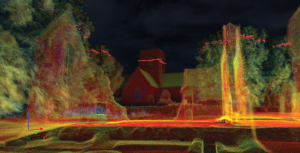
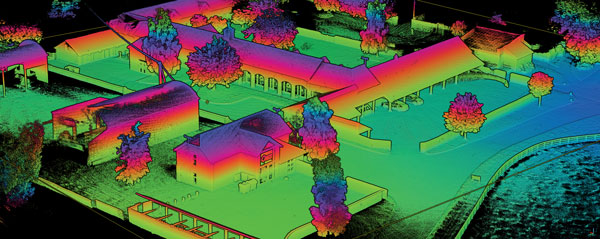
    The prototype backpack is based on the OxTS setup for vehicles but was created to enable quick data collection without a car. It is equipped with two Hesai lidar sensors, a new OxTS prototype inertial navigation system and an antenna. The team can connect it to a laptop for configuration and to optimize lever arms and the boresight. Once post-processed with OxTS Georeferencer software, the point cloud below was produced.

    OxTS designed the backpack to meet a growing need for localization and georeferencing in both GNSS-denied areas and those that cannot be reached by car, including the construction, environmental, conservation and heritage industries.

  • How navigation data is used for video game development

    How navigation data is used for video game development

    The realistic racetrack in the Assetto Corsa game. (Screenshot: Dronezone)
    The realistic racetrack in the Assetto Corsa game. (Screenshot: Dronezone)

    News from OxTS

    The possible applications for 3D point clouds are almost endless. When you think of lidar, the mind naturally wanders to applications of the autonomous vehicle navigation or geospatial survey type. In fact, navigation and lidar data are useful for all manner of applications—including video game development.

    When a new technology, such as lidar, is first brought to market, a number of factors affect its price. Initially, the cost-per-unit is likely to be high to ensure recovery of research and development costs. However, as technology ages and manufacturers innovate and bring out new versions, price invariably comes down.

    As this process occurs, it puts the technology into the hands of a much wider audience, increasing the number of new and innovative use cases.

    Point clouds are useful for many wide and varied applications. Autonomous vehicle developers may use point clouds to aid object detection and avoidance, while geospatial surveyors could use a point cloud to determine road degradation over time or monitor the rate of coastal erosion.

    These are however some of the more common use cases. But how can navigation data be used in applications such as video game development? Let’s first look at how navigation data works alongside lidar.

    Lidar and Inertial Navigation

    To create a 3D point cloud, users must combine the position, navigation and timing measurements from an inertial navigation system (INS) with raw lidar data. Without accurate INS data, it is impossible to create a point cloud. This is because the lidar sensor needs to know its position in space and time and its orientation.

    To avoid complicated software engineering work, simple-to-use software such as OxTS Georeferencer is available to georeference the lidar data. Once georeferencing is complete, OxTS Georeferencer will create a PCAP file that users can view in many point cloud viewer software applications.

    Enter Dronezone

    As lidar technology becomes more accessible, new and inventive ways to use point clouds are coming to light. OxTS partner Dronezone is one such company finding new uses for lidar.

    Dronezone builds and hires out professional unmanned aerial vehicles (UAVs). They build UAV payloads with Velodyne VLP-16 lidar sensors and OxTS INS devices they sell or rent to customers.

    Cover: Kunos Simulazioni
    Cover: Kunos Simulazioni

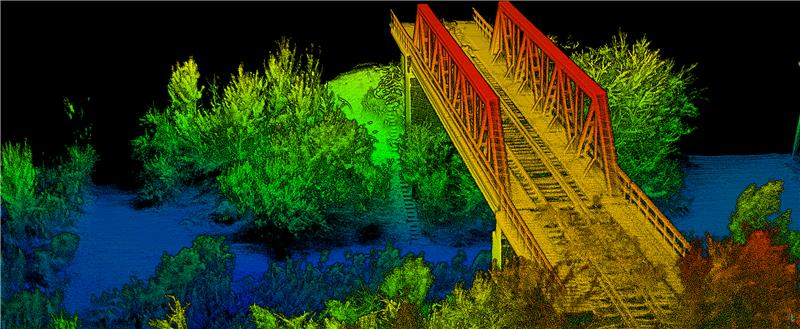
    Dronezone’s customers have used the payloads for a variety of projects. One used a payload to scan an aging railway bridge looking for possible weaknesses and deterioration over time. Besides geospatial mapping projects, Dronezone is seeing an increasing need to cater to niche applications.

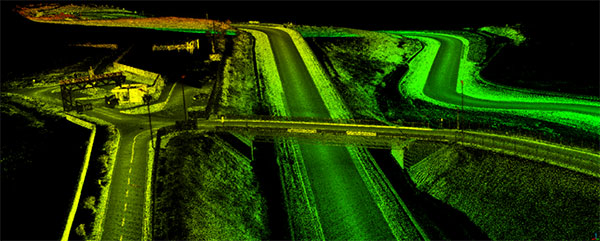
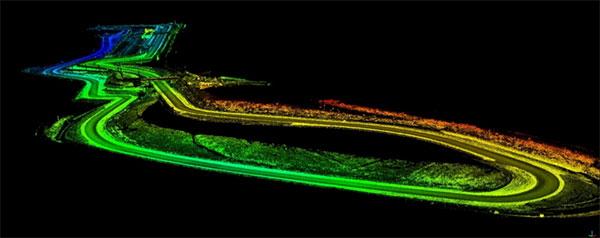
    Dronezone undertook surveying the Transylvania Motor Ring racetrack for a video-game developer Kunos Simulazioni, which publishes racing simulator “Assetto Corsa.” The company wanted an accurate digital representation of the track contours. The results, which you can see in the video and screenshots, are particularly impressive.

    Point cloud of the Transylvania Motor Ring. (Image: Dronezone)
    Point cloud of the Transylvania Motor Ring. (Image: Dronezone)
    Point cloud of the Transylvania Motor Ring. (Image: Dronezone)
    Point cloud of the Transylvania Motor Ring. (Image: Dronezone)

    Racing Simulator

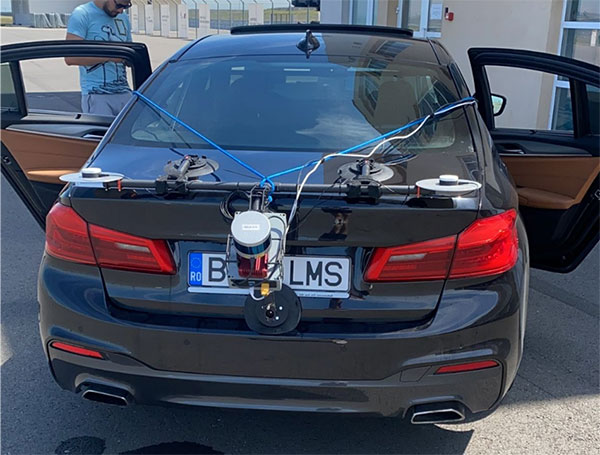
    For this project, Dronezone moved away from traditional UAV-based mapping. To survey the track precisely, the company used the flexibility of its UAV payload by repurposing the hardware for use on a car. With many off-the-shelf solutions, this wouldn’t have been possible. The setup enabled Dronezone to complete multiple laps of the track and create a high-density point cloud.

    “Using different components to build a UAV payload meant that Dronezone could reuse the hardware and build a different setup suitable for use on a car,” said Paris Austin, head of new product technology, OxTS. “It’s this flexibility that allows Dronezone to serve multiple applications.”

    To further improve results, Dronezone used the Boresight Calibration feature within OxTS Georeferencer to calibrate the coordinate frames of the lidar sensor and INS. This process, which involves a short survey of two retro-reflective targets, increases the clarity of the final results and eliminates blurring and double vision.

    The OxTS INS and lidar payload on an auto for racetrack mapping. (Photo: Dronezone)
    The OxTS INS and lidar payload on an auto for racetrack mapping. (Photo: Dronezone)

    The quality of the data produced has given Dronezone confidence it can win more business from the same customer to map further tracks for the game.

    This is just one example of the new and unique applications we’re developing alongside our customers.


    The original article appears on the OxTS website.

  • Ultra-wideband brings signals indoors

    Ultra-wideband brings signals indoors

    Other sources, such as lidar, can be used to aid navigation in the absence of GNSS signals. (Photo: OxTS)
    Other sources, such as lidar, can be used to aid navigation in the absence of GNSS signals. (Photo: OxTS)

    We discussed complementary PNT with Peter Rylands, senior product manager at OxTS.

    What are some of the most promising approaches to complementary PNT and how does simulation technology help?

    There are two approaches of particular interest. The first is looking at LEO satellite systems that can provide supplementary and potentially more secure methods of navigation, with global coverage from a single system. But these will still suffer from some of the issues GNSS systems experience, namely, what happens when you can’t obtain a signal?

    The second is the use of visual aiding through sensor fusion, such as lidar and cameras, that can provide relative positioning (or absolute positioning once you have a space mapped) using SLAM algorithms. While this may increase onboard hardware dependencies, it creates a localized navigation system that can be better protected from malicious actors.

    In contrast, closed-loop systems can look to an infrastructure-based system, allowing free movement within the specific area in which the infrastructure is located and a potentially more reliable source of PNT, especially indoors, where GNSS is not available. Ultra-wideband is definitely the up-and-coming technology here, but systems using Wi-Fi, cameras, Bluetooth and others also are being used.

    Simulation, as within many domains, allows users to test on a large scale with fewer barriers to entry than real-world testing and an ease in making iterative changes to find an optimal solution. Whether that is to benchmark performance in locations of interest or to change configuration settings to improve visibility or positioning, simulation allows you to do this without the expense of going straight into the environment itself or configuring the actual vehicle under test.

    How does OxTS fit in that mix?

    OxTS provides customers with the ability to navigate anywhere; whether for reference data in R&D, georeferencing for survey and mapping, or active navigation of autonomous solutions. To do this we provide an IMU-first offering that we then complement with other technologies. Traditionally, this is with GNSS, to form an INS that can provide centimeter-level accuracy. However, we are also aware of the vulnerabilities of GNSS. For us, this is when it becomes an unreliable source of PNT in denied areas, such as indoors, in urban canyons or under tree canopies.

    Because of this, we are also investigating and developing complementary solutions that can enhance our offering for users who need confidence in their position even when GNSS is not available. Whether that is through sensor fusion, our Pozyx UWB solution for indoor navigation or other proprietary software and firmware capabilities.

    What kinds of complementary PNT are most useful in addressing specifically the challenges posed by jamming and spoofing and how does simulation help?

    We need to look at systems that cannot be impacted by, or have mitigations from, the impact of jamming and spoofing. Solutions that are independent of radio communications or satellite use are then valuable in providing this layer of protection. This is where we could look toward OxTS’s use of IMU technology and visual aiding systems. Simulation technologies would then allow you to run hardware-in-the-loop testing, where the primary GNSS solution can have simulated jamming and spoofing to understand the performance of your complementary and protected systems when GNSS cannot be trusted.

  • OxTS: Meeting accuracy demands

    OxTS: Meeting accuracy demands

    Mobile mapping using an OxTS xNAV650 INS and lidar sensor. Photo: OxTS
    Mobile mapping using an OxTS xNAV650 INS and lidar sensor. Photo: OxTS

    We discussed mobile mapping with Jacob Amacker, application engineer, OxTS.

    How do you define “mobile mapping” as opposed to “surveying”?

    We use the two terms interchangeably. Each one has a different connotation depending on where you are in the world and both can be useful. We use them to cover a broad range of use cases, but “mobile mapping” is used more specifically for land-based mapping of the environment. A typical application might be a van equipped with an INS [inertial navigation system] and lidar sensors.

    “Surveying” can be used a bit more generally, applying to aerial or pedestrian-based mapping, but it does have the connotation of static mapping, which we do not typically handle.

    What are your main markets for mobile mapping?

    It is very hard to say. The world of mobile mapping is so diverse. However, lidar mapping could be seen as both the largest and the fastest-growing market in the surveying world as lidar has become widely affordable. Although our technology can be used with any surveying devices, at OxTS we particularly like to use lidar and are focusing on getting the best results from lidar data. This has included making our own point-cloud georeferencing software to maximize the potential of our navigation data in making point clouds.

    What are the main differences between your devices for aerial mapping and for ground-based mapping?

    We use the same INS device for both ground and aerial mapping. For use on manned aircraft, we would always recommend our highest accuracy system with the best IMU, the Survey+. The main source of inaccuracy in survey data will come from the IMU error over the range to the objects. Because most of this range is the aircraft’s altitude, this error is quite significant. For land-based mapping work, the measurements provided by the lighter and smaller xNAV650 are still suitable for many high-precision applications.

    GNSS-INS integration has been done for decades. What is new and what are the remaining challenges?

    It is now much more affordable to have very high-grade IMUs and GNSS receivers. Nevertheless, there will always be further improvements to be made to how the data streams are combined. On a similar note, other navigation aiding sources are increasingly being considered to supplement the IMU and the GNSS receiver — such as wheel speed sensors, lidar, camera odometry and others that can also be integrated to stabilize and improve the navigation data. Overall, it is very exciting what is yet to come out of INS technology. In recent years, it has become so good that people expect more and more from it, and this demand must be met. What happens when GNSS drops out? We are seeing increasing development to make the navigation data robust against challenges of any environment.

    Given the IMU’s drift, for how long can your system function at an acceptable level in case of a GNSS outage?

    It is difficult to put a number on what kind of drift is acceptable, as it depends on the application and the end-user requirements. Typically, half a meter of drift in one minute of GNSS-outage might be the goal for some of the higher-grade surveyors. Still others might only be satisfied with negligible drift.

    What keeps the INS and the lidar unit synchronized during a GNSS outage?

    The INS has an internal clock to keep the timing during a GNSS outage. Of course, this will not be as accurate as the atomic clocks on the satellites, but it is quite adequate to maintain survey-grade accuracy during GNSS outages. GNSS is still necessary to get the timing information in the first place, and this is a reliance that INS devices will want to remove in the future.

  • Simplifying the lidar survey requires unity of hardware and software

    Simplifying the lidar survey requires unity of hardware and software

    From OxTS 

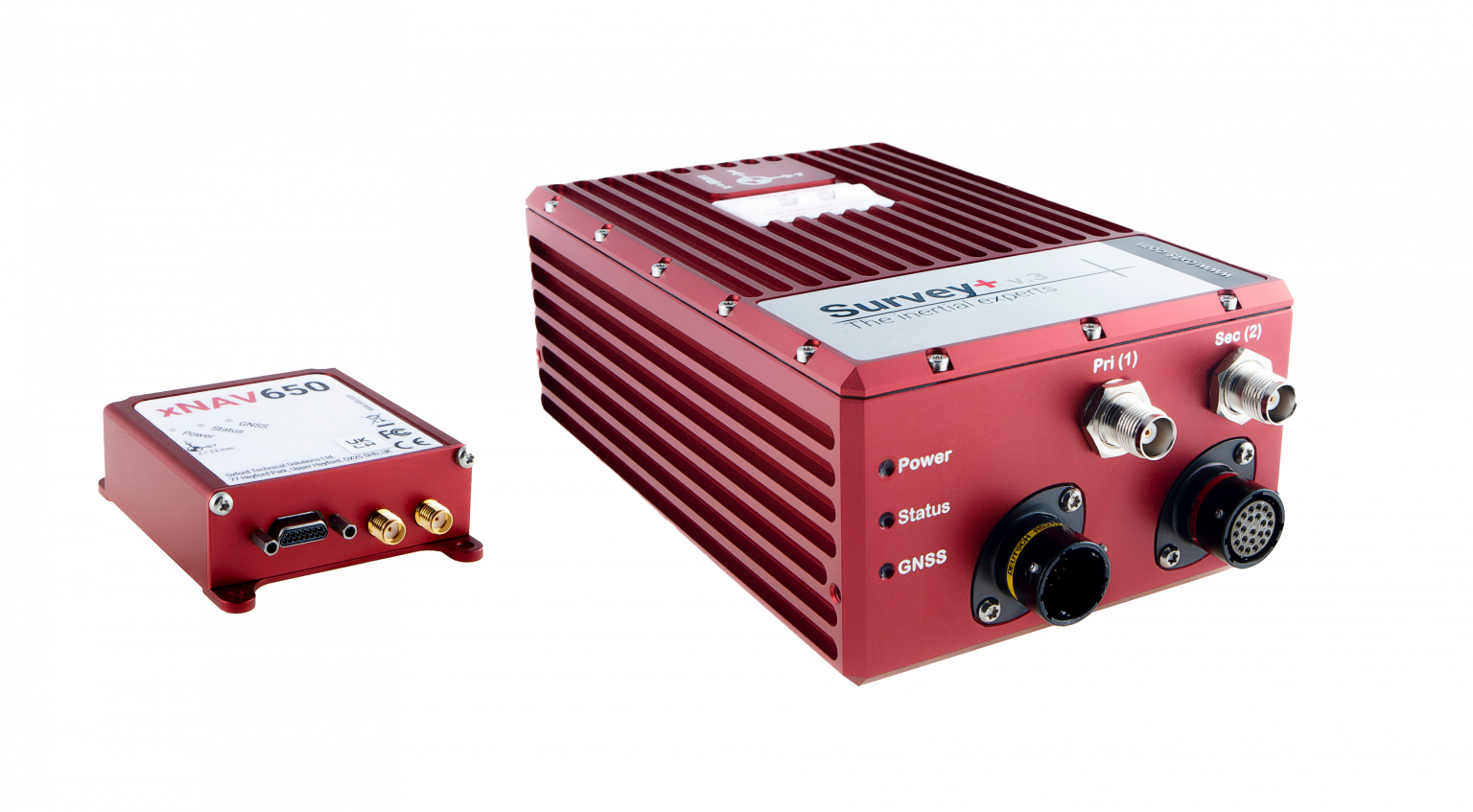
    OxTS manufactures inertial navigation systems (INS) and proprietary software on which survey professionals have come to rely. Our devices, the Survey+ and the xNAV650, output highly accurate position, heading and pitch/roll measurements. An advanced navigation engine combines streams of data from onboard inertial measurement units (IMUs) and GNSS receivers. This data can then be used in a multitude of applications including lidar survey, mobile mapping and open road positioning.

    Surveying, especially with a lidar sensor, can be a complicated art. There are many factors to consider even before you begin. However, system manufacturers involved in the survey industry, such as OxTS, are taking steps to simplify lidar survey.

    The end goal for many lidar surveyors is to create an accurate point cloud. However, to produce the best possible results, the hardware and software involved must be working together in unison.

    Hardware = lidar sensor and INS
    Software = georeferencing, post-process and configuration

    In this article, we have picked out a few of our favorite developments on the topic of simplifying lidar survey.

    Research and Development

    OxTS invests substantially in research and development to ensure that our hardware and software developments meet the ever-evolving demands of the survey industry. Many of the improvements generally center around improving accuracy, clarity of results and user experience. However, general industry demands also drive some development.

    For example, the increasing use of drones in surveying has increased demand for smaller and lighter INS hardware. Whilst developing smaller and lighter hardware is therefore important it cannot be to the detriment of reliability and accuracy. The xNAV650 was born from this industry demand.

    Although development of the xNAV650 was primarily driven by the needs of the survey industry (smaller/lighter hardware), other improvements OxTS has made to the software portfolio has focused on improving user experience.

    Photo:xNAV650 and Survey+ inertial navigation systems. (Photo: OxTS)
    xNAV650 and Survey+ inertial navigation systems. (Photo: OxTS)

    Precision Time Protocol (PTP)

    One of the major advances in OxTS INS technology over the past 12 months is PTP. The drive to include PTP capability on all OxTS Survey INS devices was the intention to help surveyors simplify the lidar survey set-up process.

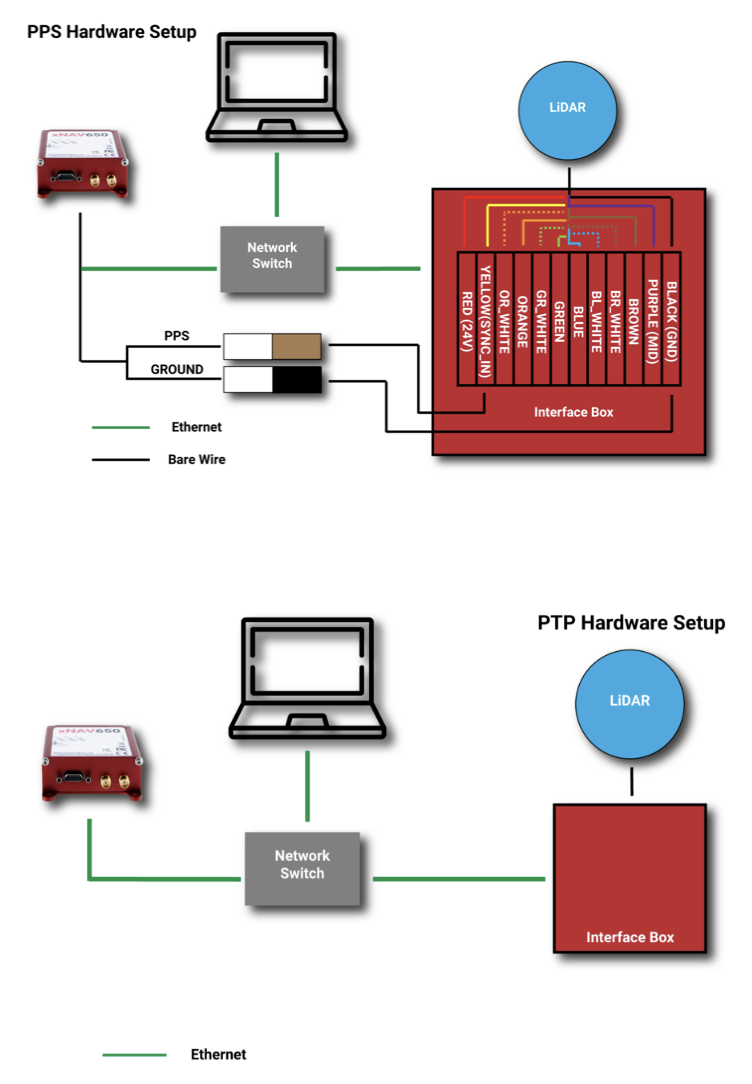
    When using compatible lidar sensors, such as those from Hesai and Ouster with an OxTS INS, surveyors no longer need to build complex wiring solutions. A simple ethernet ‘plug-and-play’ process is all that is required.

    The images below show a traditional PPS wiring set-up vs PTP:

    A traditional PPS wiring set-up vs PTP. (Image: OxTS)
    A traditional PPS wiring set-up vs PTP. (Image: OxTS)

    Software

    To get the desired outcome, an accurate georeferenced point cloud, from any lidar survey in a timely manner the software must be simple and straightforward to use. As the saying goes “complexity is the enemy of execution,” and this is what drives software development at OxTS.

    Once the lidar and INS are plugged in and ready to survey, configuration should be straightforward. A simple configuration wizard, such as the one available in NAVsuite (OxTS’ complimentary software toolbox) should structure the set-up process so that nothing is missed.

    NAVconfig – OxTS’ INS configuration software. (Image: OxTS)
    NAVconfig – OxTS’ INS configuration software. (Image: OxTS)

    The latest NAVsuite update (version 3.3) included a new PTP graphical user interface (GUI) to simplify survey set-up even further.

    Other tools are included within NAVsuite that allow users to analyze, troubleshoot and post-process their INS data. Read the NAVsuite for Survey and Mapping infosheet to find out more about these.

    OxTS Georeferencer

    OxTS Georeferencer. (Image: OxTS)
    OxTS Georeferencer. (Image: OxTS)

    Since its launch approximately two years ago, OxTS Georeferencer has gone through some major changes. The first version included compatibility with the Velodyne VLP-16 lidar sensor. This meant that users of the VLP-16 had a quick and simple way to georeference the lidar data.

    Over the course of the next 24 months, multiple new sensors have been introduced. Sensors from Hesai, Ouster, Livox and new Velodyne devices are now available, giving users more choice than ever before when it comes to choosing the hardware to do their job. Visit the OxTS Georeferencer product page for a complete list of available sensors.

    Furthermore, as well as the integration of new sensors, we have introduced a raft of new features to improve the user experience for professional lidar surveyors. These include:

    • a 3D hardware setup viewer to enable quick and intuitive survey configuration
    • multiple processing options that allow users to view and process only the areas of the point cloud that are of interest therefore minimizing the data size
    • the ability for users to process data in a range of coordinate systems including, local coordinates, ECEF, LLA (latitude, longitude and altitude)
    • processing advances that enable users to process data faster than ever before.

    Data-Driven Boresight Calibration

    One of the most challenging parts of the lidar survey set-up process is aligning the coordinate frames of the lidar and INS devices. Failure to align these with sufficient accuracy can lead to blurring and double-vision in point clouds.

    Many surveyors try to do this by eye, or by developing expensive CAD models, however there is a simpler, quicker and more cost-effective way – using data.

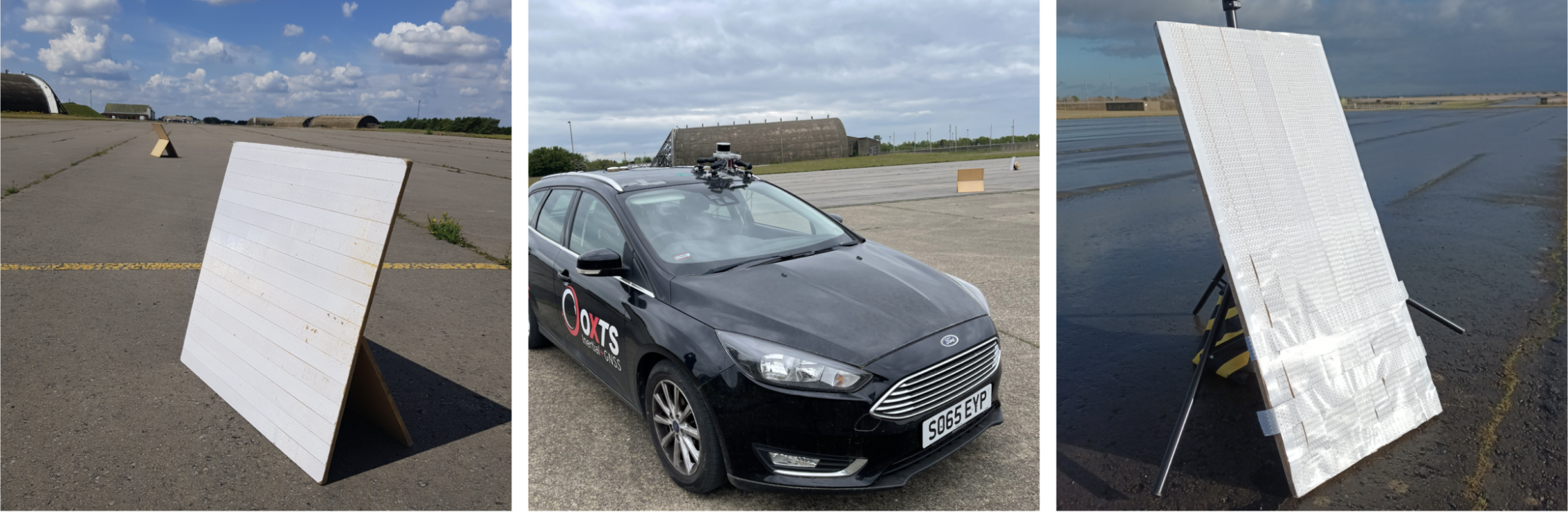
    Built into OxTS’ lidar georeferencing software OxTS Georeferencer, there is an optional boresight calibration tool. It requires the surveyor to survey two static “targets” (see the images below) from multiple distances and angles. The data is then calibrated, and the angle displacement calculated to a tenth of a degree.

    OxTS Georeferencer includes an optional boresight calibration tool. (Photos: OxTS)
    OxTS Georeferencer includes an optional boresight calibration tool. (Photos: OxTS)

    Once the initial boresight calibration has taken place, if the setup is not altered in any way, the coordinate frame alignment will be valid for any future survey.

    The Future

    In the coming weeks and months, the development of new hardware and software features will further streamline the survey process.

  • OxTS announces new xNAV650 post-processed specifications

    OxTS announces new xNAV650 post-processed specifications

    Photo: OxTS
    Photo: OxTS

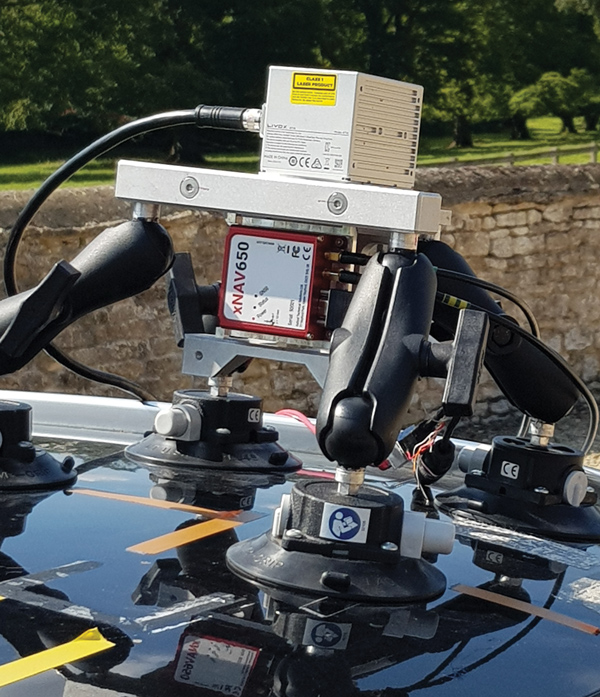
    In 2021, OxTS released its smallest, lightest and most affordable inertial navigation system (INS) to date — the xNAV650.

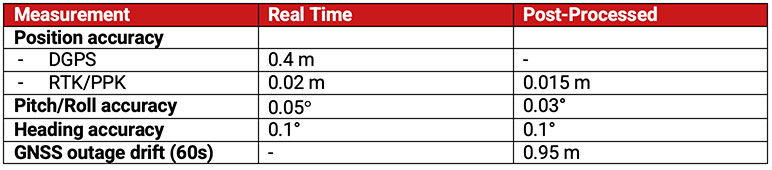
    At release, the xNAV650 detailed real-time specifications only. However, after additional testing, OxTS has announced post-processed specifications.

    Photo:

    Because of its small size and low weight, the xNAV650 is suitable for SWaP-constrained applications. It is also used in many mobile-mapping scenarios. Alongside OxTS Georeferencer, measurements created by the xNAV650 can be used to georeference point clouds from multiple lidar sensors.

    By announcing these new specifications, OxTS aims to keep surveyors informed of the performance they can expect from the xNAV650 in both real time and post-processing.

    OxTS has been manufacturing INS for more than 20 years. Their INS are widely used in both the automotive testing and survey and mapping industries.