The test flight of the first GLONASS-K2 satellite — a new generation GLONASS satellite with a design life of 10 years — is expected to take place from late 2017 to early 2018, RIA Novosti reports. The Russian news agency quoted Nikolai Testoyedov, CEO of Information Satellite Systems—Reshetnev, speaking at the 2015 Dubai Air Show.
According to Testoyedov, the GLONASS-K2 satellites had difficulty being equipped following international sanctions imposed on a number of electronic components. The first unit of the series has been built, he said.
Nine GLONASS-M satellites are currently in reserve, and another nine GLONASS-K1 satellites are in production, Testoyedov said. Mass production of GLONASS-K2 satellites is expected to take place following the test, so that by the end of 2018 GLONASS-K2 satellites would be subsequently mass produced, while maintaining the regular structure of the orbital group.
With a GLONASS-M lifetime of seven years, and GLONASS K-1 and GLONASS-K2 of 10 years, the GLONASS system will be updated through 2028-2030, concluded Testoyedov.
JSC “Russian Space Systems” (RCC), together with ISS Reshetnev, plan to remove imported components in construction of GLONASS satellites, according to an Izvestia article.
Production of the advanced GLONASS satellite “GLONASS-K” is scheduled to begin later this year.
According JSC CEO Andrew Tyulina, the company intends to stop the use of foreign electronic components as soon as possible. The plan is to have 80 percent of the satellites’ electronic components payload be domestically produced by 2019.
The move seems to be spurred by international sanctions in response to Russia’s occupation of Ukraine. Following the occupation, the United States began to prohibit supply of electronic components to Russia, and the British company E2V failed to get permission to import equipment for the Russian space observatory Spektr-UV, Izvestia reports. Russia had difficulty securing components before then, however. In 2013, as relations with the U.S. cooled following Russia’s harboring of Edward Snowden and events in Syria, the U.S. State Department did not authorize a supply of components for the spacecraft Geo-IK-2.
The expected component supplier will be the largest designer and manufacturer of electronic components in Russia, Roselectronika, an entity that unites 112 companies, research institutes and design bureaus. The total investment in Roselectronika will exceed 210 billion rubles to 2020, including provision for modernizing industrial sites that produce electronic payloads for space.
The Rohde & Schwarz CMW500 is being used to test the ERA-GLONASS system.
The Certification Center Svyaz-Certificate in Russia is now using the R&S CMW500 to certify ERA-GLONASS systems in line with the TR CU 018/2011 technical guideline. The independent Russian test lab is currently the only test lab in Russia accredited to certify these systems. The R&S CMW500 is a wideband radio communication tester.
Equipped with the R&S CMW-KA095 application software, the R&S CMW500 meets all requirements for testing ERA-GLONASS systems and provides reliable, reproducible tests in line with the Russian GOST R 55530 specification, Rohde & Scwarz said. In addition, the R&S CMWrun sequencer software (R&S CMW-KT110) makes the test solution fully automated and user-friendly.
Effective January 1, 2015, all new car models introduced to the Russian market must be equipped with an automatic ERA-GLONASS emergency call system.
The first GLONASS-K2 spacecraft will be launched into orbit in 2018, said Nicholas Testoyedov, the CEO of Information Satellite Systems Reshetnev, as reported by the Assotsiatsiya GLONASS/GNSS Forum.
“In 2018, we are preparing to launch the first satellite of the series GLONASS-K2,” Testoyedov said. “This satellite has advanced features. In the development of the navigation functions, new code division signals will be emitted, so it will provide more accurate positioning for users and more accurate tethering in those systems where important accurate time reference is required, such as in computer systems, connected devices, and so on.”
Testoyedov added that the GLONASS-K2 satellite will have equipment installed that makes it compatible with the international search and rescue system Cospas–Sarsat.
Budget Cuts. The budget of the GLONASS federal target program (FTP) for 2015 will be cut by more than 5 billion rubles, according to Russian news reports. After spending cuts, the budget for the current year will amount to 42.5 billion rubles, a cut of more than 10 percent, which is the average size of cuts for the entire “Space activities of Russia for 2013-2020” budget group.
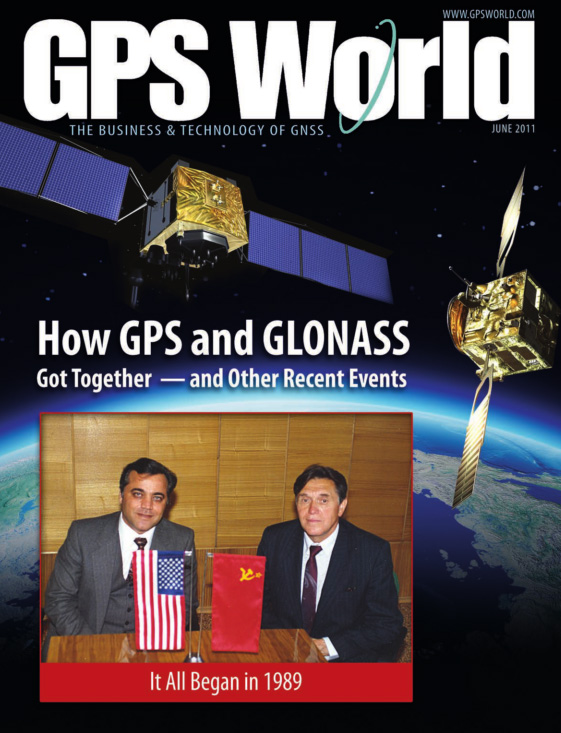
25 years ago, while the Soviet Union still existed, I began efforts that led me to become the first to combine United States’ GPS and Russia’s GLONASS satellites. Later I hosted many GPS and GLONASS authorities, fostered friendships among them, and promoted concepts such as “compatibility” and “interoperability” of satellite systems. See the details in the GPS World article, “How GPS and GLONASS Got Together.” The whole world now benefits from the combined GPS and GLONASS system.
As with GPS and GLONASS, we need to get together again. Just because I am passionate about technical issues does not mean that I ignore human issues. This time it is not about technology. This time it is about We the People.
For citizens of the United States, founded on this concept, it is inconceivable that we might one day wake up and learn that one of our States had been “gifted” to a neighboring country. But this is exactly what happened to the people of Crimea. Since 1784, Crimea was part of Russia and its people lived peacefully and happily as part of Russian culture and heritage. In 1954, approximately 75 % of the Crimea population were ethnic Russians. One day they woke up and learned that Nikita Khrushchev, the successor to Stalin, had “gifted” their land to Ukraine (reportedly for his own political gain).
Anyone familiar with the history of the Soviet Union knows that the people of Crimea were not able to raise objections. They were ruled under the dictatorship of Khrushchev who is known in the West for pounding his shoes on the table in the United Nations and threatening the United States. Those who claim Crimea does not belong as part of Russia give credence to the action of Khrushchev.
Should people have a ‘say’ or ‘voice’ in their future? Contrast the actions of Khrushchev in 1954 with that of Scotland and Quebec in more recent years. Crimeans had no choice about their fate, it was decided by the unilateral action of one man. Whereas, when some people in Scotland and Quebec wanted to secede, all people were allowed to vote to determine their fate.
After the collapse of the Soviet Union and the establishment of better relations between Russia and the Western world, East and West Germany rightfully reunified after an imposed ‘wrong’ of separation, but at no time did anyone come to the aid of the Crimean people to correct their ‘wrong’. Even worse, when the current issue surfaced, the US and Europe stood opposed to them.
It is not only my personal observation that Crimeans love their motherland of Russia. Forbes magazine contributor, Kenneth Rapoza, in his March 20, 2015 article writes that: “[…] poll after poll shows that the locals […] are all in agreement: life with Russia is better than life with Ukraine.”
The position of the West regarding Crimea has exacerbated the problem of Ukraine, and despite financial hardship in Russia, Putin’s popularity has skyrocketed while the United States’ standing has plummeted among the Russian people.
One can argue that President Putin and Russia could have used a better approach to help the people of Crimea achieve their goals and aspirations, but many believe that the West did not leave him a better choice. I don’t agree with many of President Putin decisions, but on this issue Vladimir Vladimirovich is exactly right.
I once worked to bring together GPS and GLONASS; I wish I had the opportunity to invite Presidents Obama and Putin to my California or my Moscow facilities to see if we could put an end to this situation.
Dr. Javad Ashjaee
JAVAD GNSS
March 21, 2015, San Jose, California
For the story of how Ashjaee “hosted many GPS and GLONASS authorities, fostered friendships among them, and promoted concepts such as compatibility and interoperability of satellite systems,” see the cover story of GPS World’s June 2011 issue, “How GPS and GLONASS Got Together.”
Rohde & Schwarz adds ERA GLONASS to its reliable test solution for in vehicle emergency call systems. Photo: Rohde & Schwarz
Effective January 1, 2015, all new car models introduced to the Russian market must be equipped with the automatic ERA-GLONASS emergency call system. Rohde & Schwarz now offers a standard compliant test solution for manufacturers and suppliers of these in-vehicle systems.
Rohde & Schwarz is demonstrating its ERA-GLONASS test setup at Mobile World Congress, being held this week in Barcelona, Spain.
The test setup consists of the R&S CMW500 wideband radio communication tester and R&S SMBV100A vector signal generator as a GNSS simulator. This setup allows manufacturers and suppliers of automatic in-vehicle systems (IVS) to perform reliable and reproducible pre-conformance tests on their ERA-GLONASS modules in the lab.
In the Russian Federation, ERA-GLONASS works much like the European Union’s eCall system. When an accident occurs, the IVS connects with a public safety answering point (PSAP) via the local wireless communications network and transmits a standardized minimum set of data (MSD). In addition to GLONASS or GPS coordinates, the MSD also contains data with information about the accident vehicle as specified in ERA-GLONASS. If no voice connection can be made or if data cannot be transferred via the voice channel, the MSD is sent to the PSAP via SMS. This fallback option is a special ERA-GLONASS feature. The Russian system is also certified for 2G and WCDMA networks.
Rohde & Schwarz developed its R&S CMW-KA095 application software to meet ERA-GLONASS requirements in line with Russia’s GOST specification. Based on the R&S CMW-KA094 eCall software, the R&S CMW-KA095 simulates a PSAP and controls the R&S CMW500 emulating a wireless communications network in the lab. The software also controls the GNSS simulator that supplies the coordinates required for vehicle localization. With this solution, users can verify whether their IVS modem is able to successfully initiate an emergency call, transmit the correct MSD and establish a voice connection with a PSAP. The results are interpreted in line with the GOST specification.
The ERA-GLONASS SMS protocol has also been integrated into the test solution, making it possible to test the SMS functionality of the IVS modem when no voice connection is available.
The test solution is fully automated because of the R&S CMWrun sequencer software. The R&S CMW-KT110 eCall/ERA-GLONASS test package provides a user-friendly, automated functional test in line with GOST55330, enabling users to verify the operability of an entire system in the lab and document it in a report.
Geography Paints Both Rosy and Grim Picture of the World
In the late ’80s, as a graduate student at UNC Charlotte, I was learning about “New Geography” using a cutting-edge technology called GIS (Geographic Information Systems). One of our professors coined a perfect definition of what made this New Geography different from traditional cataloging of locations and attributes. Quoting Dr. Gerald Ingalls, “Old geography dealt with the simple question: What is where? New geography, using analytical tools such as GIS, is now able to answer: Why what is where.” So knowing the quantifiable “why” hopefully gives us insight into ways to shape and mitigate geography-related problems.
It’s easy to focus on the technology aspects of GIS and forget the reason for our tradecraft. I was reminded of that reason when I recently read a book that took me back to our geospatial roots and demonstrates New Geography exceptionally well. The book, The Accidental Superpower by Peter Zeihan, effectively uses geography and analytics to explain how the world has been shaped and is evolving. In his book, Mr. Zeihan links many current geopolitical events to geography, demographics and the 1944 Bretton Woods settlement which to me is one of the clearest examples of American exceptionalism.
Bretton Woods
For those of you not familiar with Bretton Woods, it was pretty much the United States telling the rest of the world how things will be after the pending end of WWII. The U.S. had turned the tide of war, built up its own industrial power while not suffering home-front damage, and had fashioned the world’s strongest Navy. You can imagine the shock of world leaders when they learned that the U.S. was not looking for reparations or even new land other than enough to bury their dead. Instead, the U.S. was going to open its markets to the world, use its Navy to protect free trade, and even help rebuild devastated countries with programs like the Marshall Plan. All has been pretty good for the past 70 years as Bretton Woods created a global holiday from instability. However, according to Mr. Zeihan, the forces of geography, demographics and new technology will unravel Bretton Woods and slowly change the world.
The Bretton Woods Conference, 1944.
Geographic Factors in the Analysis
We all learned in high school geography that severe climates such as frigid or oppressive tropical climates stifle civilizations, while more temperate climates help civilizations advance. Those are very broad generalizations, but the world is more complex than that, and Peter Zeihan has woven detailed geography into a complex picture of the world. He cites many factors that uniquely and collectively benefit the United States but are shortcomings to a greater or lesser extent in other countries. Key factors included farmable land, rivers and coastal ports for economic trade, oil, industrial capacity, education, demographics and others. In the lottery of world geography, the U.S. has been blessed. I would add that the character of its citizens also plays a key role.
Although there are critics of some of Zeihan’s conclusions and predictions, there is no doubt that his book is an exceptionally detailed compendium of countries and the geopolitical pressures that affect them. He focuses strongly on the presence of rivers, since they provide very cheap transportation of commodities thus reducing the need for many transportation infrastructure projects. The book gets into great detail about countries that most of us can’t even point to on a world map such as Kazakhstan, Turkistan, Uzbekistan and other stans. He explains why many factors bode well for Uzbekistan, but not so much for Russia and China. He shows why Russia considers keeping Ukraine in its camp absolutely vital to its own survival.
One surprise was the case he built that Alberta, Canada, may be motivated to leave its non-supportive national government to join a more like-minded and geographically connected United States. This would completely open the U.S. market for Alberta grain and oil while providing seamless transportation throughout the U.S. Additionally, as a state, the Keystone pipeline would not fall under State Department or executive review.
Demographics
Mr. Zeihan addresses the importance of demographics using a well-known example, Japan. Low birth rates and limited immigration have placed Japan into the difficult position of supporting an increasingly older population with fewer and fewer young citizens. This inverted population pyramid is a pure numbers issue that cannot be solved quickly. He shows how many European countries are trending in the same direction on a slightly later schedule. Russia is suffering from both lower birth rates and decreased education of its population. By contrast, better birth rates and better educated immigrants are preventing an inverted pyramid here in the U.S.
Technology
Mr. Zeihan highlights technology as playing an important role in raising or lowering the importance of some geographic factors. Two in particular have snuck up on the radar: fracking and 3D printing. Who would have thought that the U.S. would be on a path to becoming the world’s largest energy producer thanks to fracking? This will obviously diminish our need for Mideast oil and have a very serious effect on small unfriendly oil producers such as Venezuela, who is already seeing a drop in sales of its relatively hard-to-refine black oil. (Note the political unrest there this week as oil revenues decline.)
I wrote about the potential impact on industry of 3D printing last year, and Peter Zeihan seems to share that opinion. As manufacturing moves closer to the consumer, jobs in China will decline, as will the need of transoceanic shipment of finished goods. The result: the U.S. will see a rebirth of local manufacturing.
Rings containing superconducting magnets will confine the plasma inside the reaction chamber. (Credit: Eric Schulzinger/Lockheed Martin)
If fracking and 3D printing are going to be significant factors, imagine what will happen to the world order if the recent announcement by Lockheed Martin that its researchers have cracked compact fusion comes to fruition. This was announced too late for inclusion in Mr. Zeihan’s book, but my guess is that he would consider it to be the quintessential game changer. It would affect many geographic factors — lower the cost of all transportation, expand industry, desalinate water cheaply, make marginal land farmable, negate the limitations of oil/gas access and do all of this while reducing pollution, increasing safety and eliminating the ability to militarize this form of nuclear power.
Conclusion
I was only able to touch on a few key points in Peter Zeihan’s book. The total picture is very complex. It was clearly well researched and logically thought through. I have only two criticisms. First, Mr. Zeihan stated that he has “always loved maps,” but this book has mediocre black-and-white maps that are less than ideal to display complex geography. It screams for decent color maps, if not in print at least as supplemental website PDFs.
Second, the book delves into significant predictions that I believe should be read with a very critical eye. There are many wild cards and personalities that can steer geopolitics. As a former analyst for the geopolitical security firm Stratfor, Mr. Zeihan worked for George Friedman, the co-author of the 1991 book The Coming War with Japan. I’m glad that didn’t come true.
I know that for many of you working in the intel community this will be very basic information and analysis that is your daily bread and butter. For the rest of us, it’s a good overview and I recommend getting this book. It will be a handy reference, if for no other reason than to sound knowledgeable at water cooler debates. However, I believe that its value is more serious than that and will prove repeatedly useful as an overarching insight as history unfolds.
Kalashnikov produces a well-known assault rifle. The acquisition of the UAV companyZALA Aero is part of the company’s development strategy through 2020, according to a statement released to Defense News.
“Based off Kalashnikov Concern and ZALA Aero company, we plan to develop and manufacture drones, mobile and earth-based management stations,” said Aleksey Krivoruchko, Kalashnikov Concern CEO.
“Our main product here will be intelligence-gathering pilotless airplanes, helicopters and aerostats. The decision to purchase control stake of ZALA Aero to widen our product line has been made as a part of the strategy of Kalashnikov corporate development through the year 2020 and as a part of the process of developing new sectors of our market.”
The UAVs will operate to secure state borders, intelligence gathering and rescue operations, as well as special operations, the report states.
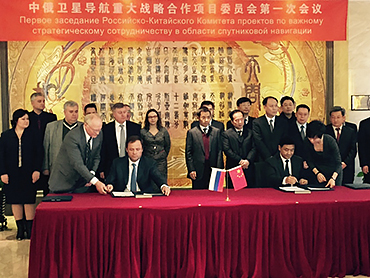
Russia and China have signed a cooperation agreement on satellite navigation, a Russian Space Agency spokesperson told RIA Novosti on Tuesday.
Roscosmos chief Igor Komarov met with Xu Dazhe, the leader of China’s National Space Administration, on an official visit in Beijing.
“The first provision to set up a committee and a protocol were signed during the first working session. Igor Komarov and Xu Dazhe discussed issues of bilateral cooperation in the field of electronic components for rocket construction and building rocket engines,” the spokesperson said.
A Russian-Chinese committee on satellite navigation was established in October 2014 at the meeting between Russia’s Deputy Prime Minister Dmitry Rogozin and his Chinese counterpart, Wang Yang.
In November, China North Industries Corporation (NORINCO) and the Russian GLONASS nonprofit partnership agreed to establish a joint venture to promote worldwide services based on GLONASS and BeiDou.
Russia and China also recently completed joint reconnaissance for the placement of GLONASS differential correction and monitoring stations in the Chinese cities of Urumqi and Changchun. Each country is expected to accommodate three such facilities.
Russia’s S7 Airlines has received approval for three Boeing 737-800s to perform landings using GNSS, becoming the country’s first carrier to do so, reports Air Transport World.
According to an S7 statement, more than 50 airports in Russia have installed equipment allowing global positioning landings (GLS). Russia’s State Air Transport Management Corp. plans to certify 10-15 airports per year for GLS landing.
“GLS will allow the airline to improve flights’ regularity, which is one of our priorities,” Globus Airline CEO Vadim Klebanov said. Globus Airline is a member of the S7 Group.
According to the GLONASS satellite manufacturer, the company will now produce nine GLONASS-K1 satellites rather than move to GLONASS-K2, because of the sanctions restricting the delivery of radiation-resistant electronic components from the West.
Nikolai Testoyedov, CEO of Information Satellite Systems Reshetnev, told the Russian magazine Vestnik GLONASS, “For a smooth transition to a multi-functional group and due to issues with the very complex GLONASS-K2 satellites, we decided to continue with the GLONASS-K1 intermediate range of satellites, and we are preparing for the launch of nine units of this series.”
He said the original plan was to launch two K1 satellites and then move to GLONASS-K2 satellites.
“In the beginning, really, we wanted after the two GLONASS-K1 satellites No. 11 and 12, to go for the launch of more advanced GLONASS-K2 devices. But, unfortunately, the plans had to be adjusted somewhat because of the sanctions restricting the delivery of radiation-resistant electronic components from the West. We have to put a hold on the in-depth development of technical and technological documentation and that delays us in terms of moving ahead by at least a year or two,”he said.
China North Industries Corporation (NORINCO) and the Russian GLONASS nonprofit partnership agreed to establish a joint venture to promote worldwide services based on GLONASS and BeiDou, according to a report in the Russian daily newspaper izvestia.
The two parties met November 11 in the Chinese city of Zhuhai. Under the agreement, the parties will identify existing technological competence that will be the foundation for the joint venture, and seek government support for joint initiatives to promote abroad.
Before the establishment of the joint venture, the parties agreed to establish a Russian-Chinese center for the implementation of satellite navigation technologies in the civil sphere. According to the agreement, “The center will be the controlling authority in determining the future direction of the joint venture and will deal with administrative issues related to the establishment of the future joint venture.”
Another topic at the meeting was the feasibility of establishing an international techno park dedicated navigation topics using GLONASS and BeiDou. China already has two specialized industrial park focused on developing technologies based on BeiDou.
NORINCOis a Chinese company that manufactures vehicles, machinery, optical-electronic products, oil-field equipment, chemicals, light industrial products, explosives and blast materials, and civil and military firearms and ammunition. NORINCO is also involved in domestic civil construction projects.