Tag: Russia

  • GPS Reflections Group Honored with Water Prize

    The GPS Reflections Group of University of Colorado-Boulder has been awarded the prestigious Prince Sultan Bin Abdulaziz International Creativity Prize for Water. The prize is awarded biannually to acknowledge innovative work that contributes to the sustainable availability of water and the alleviation of the global problem of water scarcity.

    The awards will be presented in a ceremony in Riyadh, Saudi Arabia, on December 16, concurrently with the 6th International Conference on Water Resources and Arid Environments (ICWRAE 6), December 16-18, 2014.

    Professors Kristine Larson and Eric Small developed a new method to measure water at the Earth’s surface. The research team discovered that standard geodetic GPS instruments are sensitive to hydrological influences. They subsequently developed a cost-effective technique, GPS Interferometric Reflectometry (GPS-IR), to measure soil moisture, snow depth, and vegetation water content around GPS antennas. GPS-IR has the advantage of relying on an existing GPS infrastructure installed by surveyors and geoscientists that covers an increasingly large portion of the global surface.

    Larson has written for GPS World magazine (see Innovation: How Deep Is That White Stuff?), and her team’s sea-level work has been reported here before.

    Larson and Small collaborated with scientists at the University Corporation for Atmospheric Research and the National Atmospheric and Oceanic Administration, also in Boulder.

    The team uses the GPS-IR technique to analyze data streams from existing GPS networks in near real-time. Data from hundreds of operational GPS sites are downloaded and processed, yielding estimates of hydrologic variables within 24 hours.

    Scientists and government agencies can access this information at the team’s web portal and use the data to improve monitoring and forecasting of hydrologic variables.
  • U.S. Still Not Allowing GLONASS Stations

    Pravda is reporting that the United States refused to negotiate with Russia to deploy GLONASS ground on its territory, citing an interview with Russian Deputy Prime Minister Dmitry Rogozin.

    Rogozin stressed that no negotiations were taking place. “We have made a statement in the spring. I offered to initiate talks with the United States to deploy GLONASS infrastructure in their territory, as long as negotiations go, hang the existence of infrastructure GPS stations on the territory of the Russian Federation,” Rogozin said.

    Russian specialists are excluding use of the GPS stations on Russian territory for military purposes, he said, adding that he would not reveal how this was accomplished.

    “I will not expand on how we did it for obvious reasons, but we did it,” said Rogozin. “We do not want to cut off the nose to spite our face to deprive our users of the ability to work with GLONASS and GPS. Why should we create fewer opportunities for our own people? But we have completely destroyed any prospect, even an indirect one, for the use of the American navigation system for our high-precision guidance weapons,” said the official.

    At the same time, it was reported that Russia and China would discuss possible joint projects in the field of space exploration. According to Rogozin, the two countries cooperate in the field of space, working on “possible joint projects in the field of space exploration.” The official said that China and Russia were having a “pretty tumultuous relationship,” and “we would like to say a big thank you to Western countries for their active development.”

  • Russia to Insure Next GLONASS Launch

    The next GLONASS launch — the GLONASS-K1 satellite from Plesetsk scheduled for November 20 — is being insured for 2.17 billion rubles ($50 million US). The insurance is costing Russia 242 million roubles ($5.6 million US).

    Russia has faced numerous technical difficulties in its launches. On May 15, a Proton-M satellite crashed. In 2013, Russia lost three GLONASS satellites when their launch aboard a Proton-M rocket went awry, sending the satellites crashing into the Baikonur Cosmodrome in Kazakhstan instead of aloft into space. In 2010, three other GLONASS satellites ended up in the Pacific Ocean aboard a Proton-M rocket.

    The insurance covers the launch and flight tests of the carrier rocket Soyuz-2.1b, with the satellite GLONASS-K. Flight tests, according to the tender documentation, will last for three months.

  • Russian State Bank to Support GLONASS Projects

    Russian companies looking to develop GLONASS products and services can soon tap into an 8-billion-ruble fund. Russian state development bank Vnesheconombank (VEB) plans to offer financial support for projects using GLONASS, pending government approval, according to the Russian news agency Ria Novosti.

    VEB’s sister fund, VEB Innovations, will set up the GLONASS Fund in the fourth quarter of this year, with funds made available by next February-March. The fund will include 5 billion rubles ($122 million) from VEB and 3 billion rubles ($73.1 million) from private investors.

    The project is designed to expand GLONASS market share, both to acquire advanced technology and attract new customers. It aims to support small companies with new, innovative ideas. Its goals will include the creation of an investment model that will ensure that the most promising and viable projects reach market, from conception to production.

    Assistance will be sought from specific European, North American and Asian technology companies, including Norway’s Q-free, Switzerland’s Saphyrion, Slovakia’s Sygic, the Netherlands’ AND, France’s Benomad, and the Germany companies Peiker, Init and IVU. Each of these companies is involved in navigation, with hardware, software, GIS and mapping software, telematics or dispatching. The GLONASS Fund concept says that by using these technologies for the development of new domestic products and services, GLONASS can achieve technical superiority in all the major segments of the global navigation and information market.

    The fund’s support will include contacts with Russian trade representatives abroad to promote the Russian products in markets such as India, Latin America and the Middle East.

  • Improper Fuel Line Installation Led to Incorrect Galileo Orbit

    The cause of two Galileo satellites being released into the wrong orbit August 22 can be traced to improper installation of a hydrazine fuel line, according to Space News and the GalileoGNSS blog.

    The hydrazine fuel line was installed too close to a supercold helium line on the Fregat upper stage, which caused the hydrazine to freeze long enough to upset the Fregat stage’s orientation and cause the two satellites’ release into an orbit that is both too low and in the wrong inclination, officials said as reported on the websites.

    No official report has been issued; the board of inquiry is expected to release its findings this week. 

    The Euro-Russian inquiry board looking into the cause of the failure has discovered that one in four Fregat upper stages at prime contractor NPO Lavochkin in Moscow had the same fuel-line installation, according to the reports. “We have to assume that this was a practice that had gone on in perhaps a quarter of the Fregat stages produced in the past decade, but that it had not affected our launches up to now because of mission-specific aspects like coast time between burns, the number of burns and so on, which can influence the effect of the helium on the hydrazine,” one official is quoted as saying. “In any case, we’d like Arianespace, which currently has almost no inspection rights on the Soyuz, to be given more say in quality assurance.”

    In the stages without the installation issue, the hydrazine and helium lines were separated so that the supercold helium could not freeze the hydrazine. The design did not foresee any problem in putting the lines together, but in fact that is a problem for some missions.

    European Union government and officials are debating how to proceed, the reports said. The options are to continue, as scheduled, with the December launch of two more Galileo satellites aboard a Soyuz Fregat rocket, or to wait until next spring or summer and launch four Galileo satellites on a heavy-lift Ariane 5 vehicle.

    As for the two wayward satellites, in a presentation to the 65th International Astronautical Congress in Toronto September 30, OHB’s Galileo deputy program manager, Kristian Pauly, said he was optimistic that once the satellites’ perigee is raised and their orbit made less eccentric, they can be fitted at least partially into the Galileo program and perform a navigation function, Space News reported. OHB System is the prime contractor for the full operational capability (FOC) satellites.

    The first priority, Pauly said, is to take the two satellites out of regular contact with the Van Allen belts and adjust their Earth sensors to their new, unplanned view of Earth — which is much closer given the lower altitude.

    Pauly did not speculate on what the Galileo launch schedule would be. He said that OHB’s delivery schedule will not change much. “We have a delivery schedule that is extremely challenging and we will keep to it,” he said.

  • Pratap Misra Honored with ION Kepler Award 

    Pratap Misra Honored with ION Kepler Award 

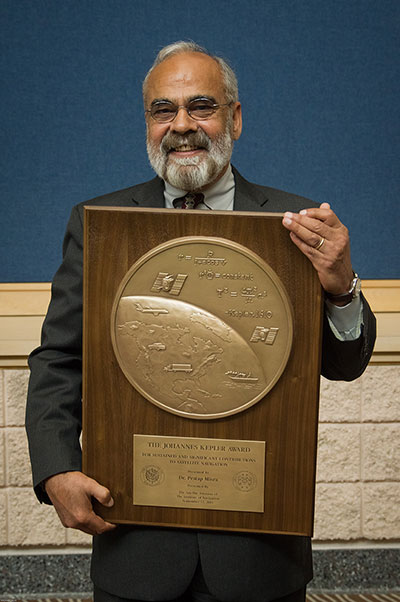
    Pratap Misra, 2014 Kepler Award recipient.
    Pratap Misra, 2014 Kepler Award recipient.

    The Institute of Navigation’s (ION) Satellite Division awarded Pratap Misra its Johannes Kepler Award on September 12 at the ION GNSS+ Conference in Tampa, Florida, for his contributions to satellite navigation education, the understanding of GLONASS, and receiver autonomous integrity monitoring.

    Misra is credited with tracking GLONASS satellites using the AF Deep Space Tracking Network to determine their orbits in the coordinate frame used by GPS, while the satellites broadcast their positions in the Soviet coordinate frame. Misra is recognized for his ground-breaking work on navigation with combination of GPS and GLONASS signals and is the western world’s leading expert on what’s now the Russian satellite navigation system. He was a technical advisor to the Federal Aviation Administration for many of the bilateral and multi-lateral committees that worked on the development of GPS/GLONASS spectrum sharing and avionics.

    Additionally, Misra has worked on receiver autonomous integrity monitoring (RAIM), and contributed a novel approach that does not require the simplifying assumption of Gaussian errors. He was also the first to provide a RAIM algorithm that leveraged the receiver clock to put a bound on the vertical position error. These algorithms are expected to play a significant role in the upcoming multi-constellation environment.

    Misra is a research associate professor of Mechanical Engineering at Tufts University, and is well known for the textbook that he co-authored with Professor Per Enge of Stanford University, Global Positioning System: Signals, Measurements and Performance. Misra is a past chair of the ION Satellite Division and has held numerous volunteer positions within ION, most recently focusing on the support of student programs. He is both an ION Fellow (2003) and IEEE Fellow (2007).

    The Kepler Award recognizes and honors an individual for sustained and significant contributions to the development of satellite navigation. It is the highest honor bestowed by the ION’s Satellite Division.

  • Roscosmos Chief Discusses Plans for GLONASS Stations in China

    The chief of Russia’s space agency Roscosmos has discussed plans for bilateral cooperation in space with his Chinese counterparts in Beijing, according to the ITAR-TASS news agency.

    “On Thursday, the chief of Roscosmos held a meeting with the head of China’s Satellite Navigation Office Ran Chengqi. The officials discussed Russian-Chinese cooperation on navigation satellite systems GLONASS and Beidou, in particular, the placement of Russian stations in China and Chinese stations in Russia,” the Roscosmos press service said.

    The two sides agreed to establish a sub-commission for cooperation in the sphere of satellite navigation under the bilateral commission in charge of preparing regular meetings of the two countries’ prime ministers.

    Earlier, Roscosmos deputy chief Sergei Savelyev said that Moscow this year would sign an agreement with Beijing on deploying GLONASS and Beidou stations in China and Russia respectively. Each country will accommodate three such facilities.

  • Russia Launches Single GLONASS Satellite

    Russia Launches Single GLONASS Satellite

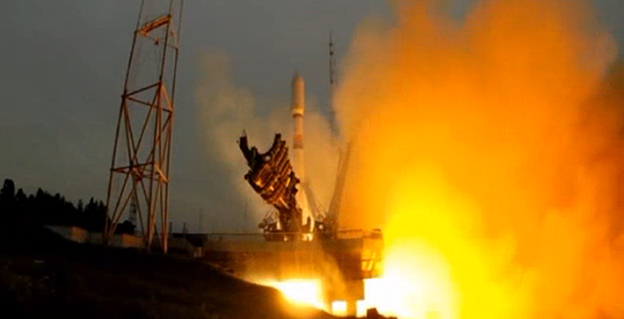
    GLONASS-launch-OA single GLONASS-M satellite was launched from the Plesetsk Cosmodrome on Saturday, June 14, at 17:16 UTC. The satellite, GLONASS-M 55 (with designation 755 once operational and also known as Kosmos 2500), was inserted into the GLONASS constellation’s Plane 3 and will occupy orbital slot 21, according to ISS Reshetnev, the manufacturer of the satellite.

    Reshetnev also reported that the satellite is equipped with an experimental payload capable of transmitting signals in the L3 frequency band. The L3 signal, centred at 1202.025 MHz , is CDMA unlike the GLONASS legacy FDMA signals. The experiment will include flight testing of the new equipment and evaluation of its accuracy characteristics. The GLONASS-K1 test satellite also transmits an L3 signal.

    A video of the launch can be viewed on the Zvezda (meaning “Star”) TV network run by the Russian Ministry of Defence.

  • Russia Turns IGS Data Back on — Sort of

    On June 2, GPS World reported that GPS tracking stations co-sponsored by U.S. interests but located in Russia had stopped making their data available to scientists and others.

    Now, “It looks like the tap has been turned back on, at least at slow flow,” reports Richard Langley, GPS World Innovation editor and University of New Brunswick professor. “Hourly and daily data files from the affected stations are once again being sent to IGS data archive centres. Grigory Steblov of the Geophysical Survey of the Russian Academy of Sciences has reported that ‘the transmission of the data from NEDA [North Eurasian Deformation Array] GPS sites [had] been temporarily suspended due to technical reasons.’

    Now, after reorganization, the data flow is being resumed on hourly basis.”

    Langley stresses, however, that the real-time flow of data from the NEDA stations has not been turned back on, which is important for some applications.

  • Russia Turns off Data from IGS GPS Tracking Stations

    As announced by Russian Deputy Prime Minister Dmitry Rogozin on May 13, 2014, GPS tracking stations co-sponsored by U.S. interests have stopped making their data available to scientists and others.

    The tap on the flow of data from 11 stations was turned off starting on May 31. The data flow included hourly and daily data files from the stations as well as the real-time flow of data over the Internet.

    In an item entitled “On Execution of the Instructions of the Government of the Russian Federation,” the website of Roscosmos, the Russian Space Agency, reported:

    “In accordance with the instructions of the Government of the Russian Federation, the Russian Space Agency in conjunction with the Federal Agency scientific organizations on June 1, 2014, implemented measures to avoid the use of information from the global seismographic network stations operating on the signals of the GPS system and located in the Russian Federation, for purposes not covered by existing agreements, including military uses.” (As translated by Google Translate.)

    It should be pointed out that none of the affected stations contribute to the day-to-day running of GPS; that is, they are not part of the GPS command and control network. They are stations participating in the work of the International GNSS Service, which provides data and products to scientists and other researchers for different purposes including geodesy, geodynamics, orbital mechanics, and atmospheric studies.


    It is believed that the Russian move is a tit-for-tat exercise in response to sanctions by western countries following recent events in Ukraine. However, the Russians say that the action was initiated by the refusal of the U.S. to enter into negotiations on the placement of Russian-operated GLONASS tracking stations on U.S. territory. Russia wishes to expand its global network of differential correction and monitoring stations, which could conceivably be also used to supply data for GLONASS command and control purposes.

    What isn’t widely known is that Roscosmos already uses sites on U.S. territory for monitoring the availability and health of the GLONASS satellites as the map below clearly shows.


  • Russian Proton-M Crashes, Loses Another Payload

    In 2013, Russia lost three GLONASS satellites when their launch aboard a Proton-M rocket went awry, sending the satellites crashing into the Baikonur Cosmodrome in Kazakhstan instead of aloft into space. Before that, in 2010, three other GLONASS satellites ended up in the Pacific Ocean aboard a Proton-M rocket.

    This week, on  May 15, another Proton-M satellite crashed, this time with the Ekspress-AM4R telecommunications satellite aboard.

    Launch of the Proton-M rocket took place from Launch Pad 39 at the Baikonur Cosmodrome at 21:42 GMT. However, an unspecified failure was noted during third stage flight. The rocket and satellite are lost, according to a NASA Spaceflight article.

  • GLONASS Loses Control Again

    GLONASS Loses Control Again

    The GLONASS constellation has suffered a major problem for the second time this month.

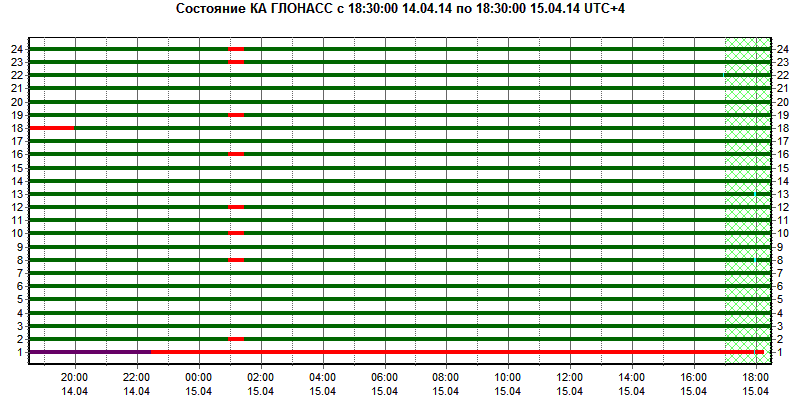
    On Monday, April 14, eight GLONASS satellites were simultaneously set unhealthy for about half an hour, meaning that most GLONASS or multi-constellation receivers would have ignored those satellites in positioning computations. In addition, one other satellite in the fleet was out of commission undergoing maintenance. This might have left too few healthy satellites to compute GLONASS-only receiver positions in some locations.

    glonass_problem

    The unhealthy status of the satellites was noted in the monitoring information provided by the Roscosmos GLONASS Information-Analytical Centre website. The problem was also reported by The Moscow Times, an English-language daily published in Russia.