Blog

  • Siemens offers breakthrough time synchronization to fortify digital substations

    Siemens offers breakthrough time synchronization to fortify digital substations

    Siemens has unveiled its latest innovation for energy infrastructure: the Siprotec 5 Precision Time Protocol (PTP) Grandmaster Clocks (GMC).

    Built to secure the backbone of modern power grids, the GMC ensures resilient, fail-safe time synchronization for digital substations, safeguarding critical protection functions from disruption, shielding against external disturbances, and strengthening cybersecurity to boost overall grid reliability.

    Avoiding GNSS disruptions. Conventional digital substation architectures often rely on redundant GNSS-based grandmaster clocks. However, even with redundancy, they remain vulnerable: disturbances to GNSS signals, whether from natural phenomena like solar storms or intentional interference such as jamming and spoofing, can cause disruptive “‘jumps” in the time base. Such disruptions force merging units to resynchronize, temporarily disabling critical protection functions and can lead to unnecessary removal of equipment from service or even cause false tripping events, impacting grid stability and increasing operational costs. Siemens’ new solution mitigates these risks, ensuring uninterrupted, secure operation. 

    Siemens’ solution separates sample synchronization from global time synchronization using specialized internal time sources. The Siprotec 5 devices, equipped with integrated PTP Grandmaster Clocks compliant with IEEE 1588v2/PTP standard, operate independently from external GNSS signals, using internal oscillators as time references for precise synchronization.

    Changeover technology. A key feature of this approach is Siemens’ patent-pending Seamless PTP grandmaster changeover technology, built into Siprotec 5 devices. This ensures that when primary clocks return, they first align with active backup clocks before resuming their role. In doing so, disruptive time base jumps during switchovers are prevented, keeping protection functions continuously available. 

    The specialized synchronization enables process bus networks in digital switchgears to operate autonomously without external access points, significantly strengthening cybersecurity by isolating the process bus from the station bus network. 
  • SPH Engineering’s new high-resolution GPR antennas for UAVs extend subsurface mapping

    SPH Engineering’s new high-resolution GPR antennas for UAVs extend subsurface mapping

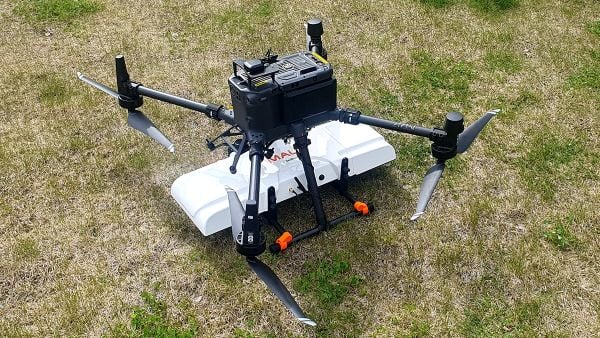
    SPH Engineering is offering two new ground-penetrating radar systems optimized for UAV integration: MALÅ GeoDrone 600 and Zond Aero 600 NG.

    Both 600 MHz antennas significantly enhance high-resolution subsurface investigations with drones, supporting applications in engineering surveys, utility mapping, archaeology, environmental studies and geophysical research. They enable surveyors to capture consistent, high-quality subsurface data in areas difficult, slow, or unsafe to access with traditional ground instruments.

    Operating at 600 MHz, the antennas offer a balance between penetration depth and fine near-surface resolution. Typical penetration from the drone is up to 2 meters, depending on the surface conditions, while SPH Engineering’s True Terrain Following ensures stable antenna height to maintain data quality and repeatability.

    Compared to ground-based carts or vehicle systems, the UAV-borne configuration enables operators to:

    • Survey rocky, uneven, vegetated, or steep terrain
    • Achieve consistent grid spacing and uniform antenna coupling
    • Cover large areas significantly faster than manual GPR methods
    • Improve safety by reducing personnel exposure in risky field conditions

    The MALÅ GeoDrone 600 combines the reliability of MALÅ instrumentation with SPH Engineering’s fully integrated drone workflow. Designed for precision engineering, utility detection, and geophysical mapping, the antenna produces clear, high-quality radargrams suitable for detailed structural assessment and shallow subsurface characterization.

    Key Specifications

    • Central frequency: 600 MHz
    • Operating Bandwidth: 250-900 MHz
    • Typical penetration: up to 2 m (soil-dependent)
    • Sampling: MALÅ HDR technology
    • Antenna design: Shielded
    • Weight: 2.7 kg
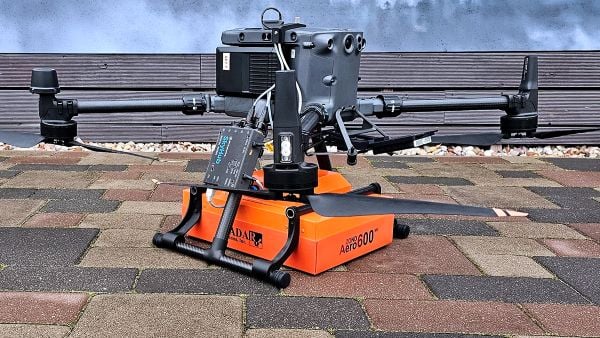
    The Zond Aero 600 NG antenna package. (Photo: SPH Engineering)
    The Zond Aero 600 NG antenna package. (Photo: SPH Engineering)

    The Zond Aero 600 NG is a next-generation shielded antenna designed specifically for airborne GPR operations. It offers a strong signal-to-noise ratio, improved ground coupling at low altitudes, and robust performance over natural terrain, making it particularly suitable for geophysical research, archaeology and environmental geoscience.

    Key Specifications

    • Central frequency: 600 MHz
    • Operating Bandwidth: 300-950 MHz (-12 dB)
    • Typical penetration: up to 2 m (soil-dependent)
    • Sampling: Real-Time Sampling (RTS) with high hardware stacking
    • Antenna type: Shielded
    • Weight: 1.7 kg

    Both antennas are fully compatible with SPH Engineering’s UgCS flight planning software and the SkyHub drone onboard computer, enabling:

    • Automated terrain-following flights over complex topography
    • Precise altitude control for optimal GPR signal geometry
    • Synchronized GNSS + radar trace logging (for Zond Aero 600, MALÅ GeoDrone 600 has built-in data recorder).
  • New data collection and mobile mapping software used in surveying and mapping projects

    New data collection and mobile mapping software used in surveying and mapping projects

    1. Data collection software

    Intuitive workflows require minimal training

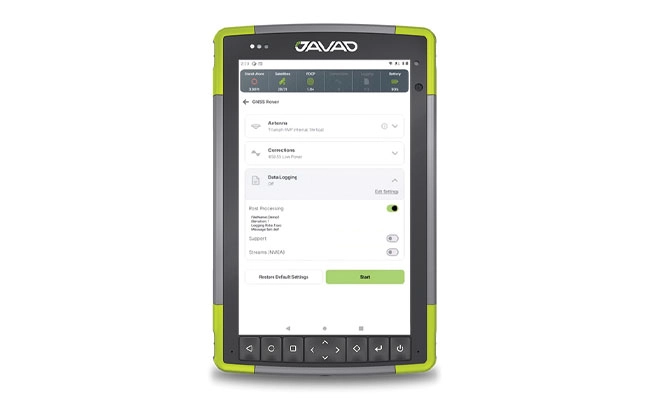
    JAVAD Data Collector (JDC) is designed to run seamlessly on any Android device and interface seamlessly with JAVAD GNSS smart antennas. JDC features simple, intuitive workflows that require minimal training, making it accessible for users of all skill levels.

    The software includes a Signal Bar for a quick view of receiver status, ensuring users can easily monitor their equipment’s performance. Its easy navigation allows users to move through the software efficiently. It is designed to streamline operations of customers ranging from individual surveyors to large surveying firms, making it easier to deploy and manage receivers across teams of any size with minimal training. JDC is available for download through the company website.

    JAVAD GNSS, javad.com

    2. Mobile mapping system 

    Lidar collects 2 million points per second

    Photo:
    Photo: CHC Navigation

    The AU20 MMS is a vehicle-mounted mobile mapping system designed for accurate and efficient collection of 3D spatial data. It combines high-performance lidar technology, versatile sensor support and intelligent data processing to provide a practical and flexible solution for professionals in road surveying, asset management and infrastructure documentation. Its lidar system uses fourth-generation real-time waveform processing to achieve a scan rate of 2 million points per second and 200 revolutions per second, producing point cloud data with 5 mm accuracy and 3 mm precision. This level of detail allows for the identification of fine surface characteristics and features, supporting comprehensive asset inventories and condition assessments. The system’s long-range, multi-cycle laser technology enables high-density data capture up to 250 m in vehicle-mounted applications.

    CHC Navigation, CHCNAV.com 

  • The latest on defense/PNT product developments

    The latest on defense/PNT product developments

    1. Anti-jamming antenna

    For defense, marine and critical infrastructure 

    Photo: Calian, GNSS
    Photo: Calian, GNSS

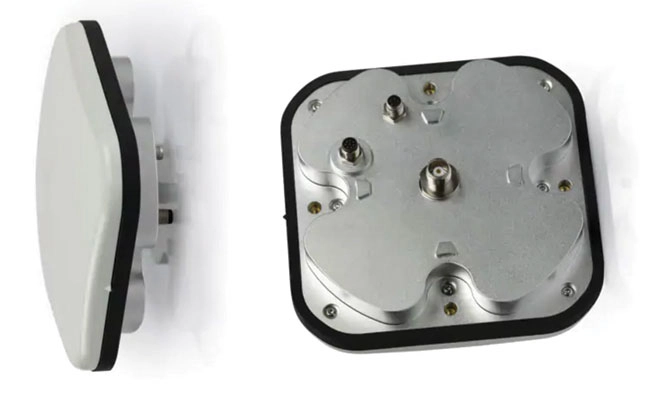
    The CR8894SXF+ is an advanced controlled reception pattern antenna (CRPA) for anti-jamming. It is engineered to provide efficient interference protection and real-time situational awareness across critical infrastructure, marine and defense environments where GNSS continuity is mission critical. It is specifically designed to provide a low-power and lightweight solution in a compact size. It features advanced in-band null forming to protect GPS L1/L2 and Galileo E1/E5b signals, helping ensure resilient positioning, navigation and timing in environments with contested, congested or degraded radio frequency conditions. The antenna incorporates Calian’s eXtended Filtering interference mitigation technology to maintain performance and reliability when RF threats are present. The CRPA supports in-band null-forming of 20 dB to 40 dB and out-of-band rejection up to 80 dB across 700 MHz to 2,500 MHz. It includes two independent low-noise amplifier channels, allowing continued operation if one signal band is compromised. The antenna forms nulls in both upper (L1/E1) and lower (L2/E5b) GNSS bands to actively suppress jamming sources. A serial output interface provides real-time feedback, enabling users to monitor RF conditions and system status. 

    Calian GNSS, calian.com

    2. PNT System

    Integrates GNSS receiver, INS, atomic clock 

    Photo:
    Photo: Safran Electronics & Defense

    The BlackNaute autonomous positioning, navigation and timing (PNT) system integrates Safran’s HRG dual-core inertial navigation technology, the Skylight multi-mode GNSS receiver board, and an atomic clock to offer navigation resilience in challenging electronic warfare environments. BlackNaute’s built-in atomic clock is designed to maintain precise timing, which is essential for secure communications and collaborative combat operations. The system features advanced anti-jamming and anti-spoofing algorithms, which have been validated in more than 16,000 operational cases. These capabilities allow BlackNaute to detect compromised signals and automatically switch to autonomous and trusted navigation and timing sources to ensure continuity of operations. Its modular design allows it to be adapted across a variety of platforms. Airbus Helicopters has selected the NH90 to be equipped with this new Embedded GNSS and Time INS (EGTI). 

    Safran Electronics & Defense, safran.com

    3. Interference detection

    Suite enhanced for greater accuracy, coverage and insight 

    Photo:
    Photo: US Navy

    HawkEye 360’s GNSS-I Detection suite includes powerful enhancements to its GNSS interference detection capabilities. The upgrades — designed with defense, intelligence and national security operations in mind — offer unprecedented accuracy, coverage and insight into global GPS jamming and spoofing threats. The update includes a new wider frequency algorithm that better distinguishes individual emitters, incorporates GPS spoofing detection, and is terrain adjusted for better geolocation accuracy, delivering greater situational awareness and more precise geolocation of interference sources worldwide. The enhanced product suite supports strategic decision-making by providing timely, precise insight into potential signal disruptions, enabling stakeholders to better assess risk, respond confidently, and maintain operational continuity in dynamic environments.

    HawkEye 360, he360.com

    4. VTOL UAS

    For complex intelligence, surveillance and reconnaissance missions 

    Photo: ESEN-UAS
    Photo: ESEN-UAS

    The GöKHUN unmanned aerial system (UAS) is a tactical vertical take-off and landing (VTOL) drone system developed for versatile missions on land or at sea. GöKHUN combines the compact mobility of a NATO Class I UAV with the performance data of a Class II tactical system. It uses the SP 210 FI GS 2-stroke engine from Sky Power International. With a take-off weight of up to 110 kg and a maximum fuel and payload capacity of 26 kg, the GöKHUN can remain in the air for up to 16 hours with a minimum payload. Even with a demanding sensor load of 12 kg, it can achieve a flight duration of around nine hours, making it suitable for long-endurance reconnaissance and surveillance missions. The GöKHUN’s cruising speed is between 96 and 158 km/h. The maximum range with direct line-of-sight is over 150 km, with the system reaching a service ceiling of approximately 5,500 m.

    ESEN, esensi.com.tr 

  • Precision cards and spoofing mitigation

    Precision cards and spoofing mitigation

    1. PRECISION CARD 

    High-accuracy positioning with the mosaic-X5 

    Photo:
    Photo: Gateworks

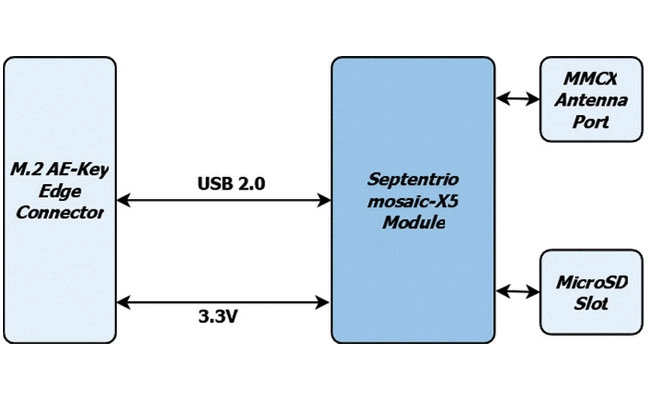
    The M.2 card GW16160 is the first Septentrio-based product from Gateworks, a U.S.-based manufacturer of single-board computers. The GW16160 provides reliable high-accuracy positioning powered by the mosaic-X5 GNSS module, a high-quality positioning solution for autonomous robots, UAVs and industrial mission-critical applications. The GW16160 allows engineers to integrate high-accuracy GNSS into edge systems without bulky external receivers or complex RF design. This ultra-low power card features an M.2 A/E-Key interface with USB 2.0 connectivity for plug-and-play integration. 

    Gateworks, gateworks.com; Septentrio, septentrio.com

    2. SPOOFING MITIGATION 

    Can protect GPS, BeiDou and Galileo signals

    Photo:
    Photo: Trimble

    The Trimble RTX-NMA (Navigation Message Authentication) mitigates spoofing attacks on GPS and BeiDou signals. RTX-NMA leverages the Trimble RTX correction service and enhances the security and integrity of GNSS navigation messages for all Trimble ProPoint receivers. Used in conjunction with Galileo OSNMA, users now have three constellations protected from spoofing attacks. Trimble RTX-NMA seeks to detect both fake GNSS signals and faulty ephemeris data through real-time authentication that ensures navigation messages from multiple RTX reference station receivers are genuine and trustworthy. It also encompasses faulty ephemeris detection, preventing unreliable data from being included in the correction stream. Enhanced security through advanced cryptographic techniques like AES encryption, and stream authentication, take it a step further. Trimble RTX-NMA is  compatible with various Trimble GNSS receivers using firmware version 6.40 or greater.

    Trimble, trimble.com 

  • Launchpad: The latest defense, OEM and surveying & mapping products

    Launchpad: The latest defense, OEM and surveying & mapping products

    Click below to read a roundup of recent products in the GNSS and inertial positioning industry from the October 2025 issue of GPS World magazine.

    Defense

    • Anti-jamming antenna: For defense, marine and critical infrastructure 
    • PNT system: Integrates GNSS receiver, INS and atomic clock 
    • Interference detection: Suite enhanced for greater accuracy, coverage and insight 
    • VTOL UAS: For complex intelligence, surveillance and reconnaissance missions 

    OEM

    • Precision card: High-accuracy positioning with the mosaic-X5 
    • Spoofing mitigation: Can protect GPS, BeiDou and Galileo signals

    Machine Control

    • Autonomous steering package: Allows upgrades of older machinery for small farms 

    Surveying and Mapping

    • Data collection software: Intuitive workflows require minimal training
    • Mobile mapping system: Lidar collects 2 million points per second
  • GPS Editorial Advisory Board: Expert takes on GNSS protection

    GPS Editorial Advisory Board: Expert takes on GNSS protection

    Among the technical approaches being researched this year for GNSS/PNT protection, which do you consider most effective or promising?

    Photo: Jules McNeff
    Photo: Jules McNeff

    “The simple answer is what I have been saying many times before. The most effective way to back up GPS/GNSS is to use the terrestrial technology available from eLoran.  It is affordable, long-range, precise and essentially unjammable. However, it’s not what I would call ‘promising’ because that’s not what the government wants to hear. In fact, the government is in the process of dismantling the existing Loran infrastructure that could easily be recapitalized as autonomous eLoran stations. eLoran could provide robust nationwide timing and positioning preservation, including in the northern Pacific Ocean and Alaska, as well as across the Arctic, with Canada, to link up with our allies in the UK and Europe, who are also investing in eLoran. There is no real commercial market in the far north and there are no commercial systems proposed that can provide such coverage in those areas where we are facing challenges from Russia and China today and that will only increase into the future.”

    Jules McNeff


    Allison Brown
    Allison Brown

    L-band jamming and spoofing is now prevalent in many parts of the world. It has now been confirmed that space-based jammers have been active, as well as conventional terrestrial jamming.  Anti-jam solutions can only provide protection up to a certain jammer power level and are not a ‘silver bullet’ solution. Moreover, nulling of space-based jammers will also have the effect of nulling parts of the sky where GPS satellites are in view, degrading performance by reducing DOP. Alternative PNT solutions that are not relying on L-band signals are the most effective solution for operations in highly contested, jammed or spoofed L-band environments.”

    Allison Brown


    Photo: Mitch Narins headshot
    Mitch Narins

    “I believe that both orbital and ground-based PNT systems, operating in tandem and integrated properly, are the ultimate solution for critical infrastructure applications, but to get there, ‘the budget-office-inspired problem’ of having to pick one and only one must be abandoned: prevention is usually cheaper than curation. Only after space-based and ground-based PNT designers, developers, regulators and users understand and welcome the essential nature of PNT source diversity will we actually achieve the resilient PNT capabilities that we all need.”

    Mitch Narins

  • FAA warns pilots of risks in flying over Venezuela

    FAA warns pilots of risks in flying over Venezuela

    The U.S. Federal Aviation Administration (FAA) has warned all pilots to “exercise caution” when flying in the airspace over Venezuela “due to the worsening security situation and heightened military activity,” reports ABC News. Possible risks include GNSS jamming and spoofing.

    The FAA message said the unspecified threats “could pose a potential risk to aircraft at all altitudes” as well planes taking off and landing in the country and even aircraft on the ground.

    The warning comes as the Trump administration has ramped up pressure on Venezuelan President Nicolás Maduro. The Trump administration also has carried out a series of strikes on small boats in the Caribbean Sea and eastern Pacific Ocean that it accuses of ferrying drugs to the U.S., killing more than 80 people since the campaign began in early September.

    The U.S. military has conducted bomber flights up to the coast of Venezuela, sometimes as part of a training exercise to simulate an attack, and sent the aircraft carrier USS Gerald R. Ford into the region.

    The Ford aircraft carrier and several destroyers were just the latest addition to the largest U.S. force assembled in the Caribbean Sea near Venezuela in generations. The Trump administration does not see Maduro, who faces charges of narcoterrorism in the U.S., as the legitimate leader of the South American country.

  • GNSS increasingly essential for Indonesia

    GNSS increasingly essential for Indonesia

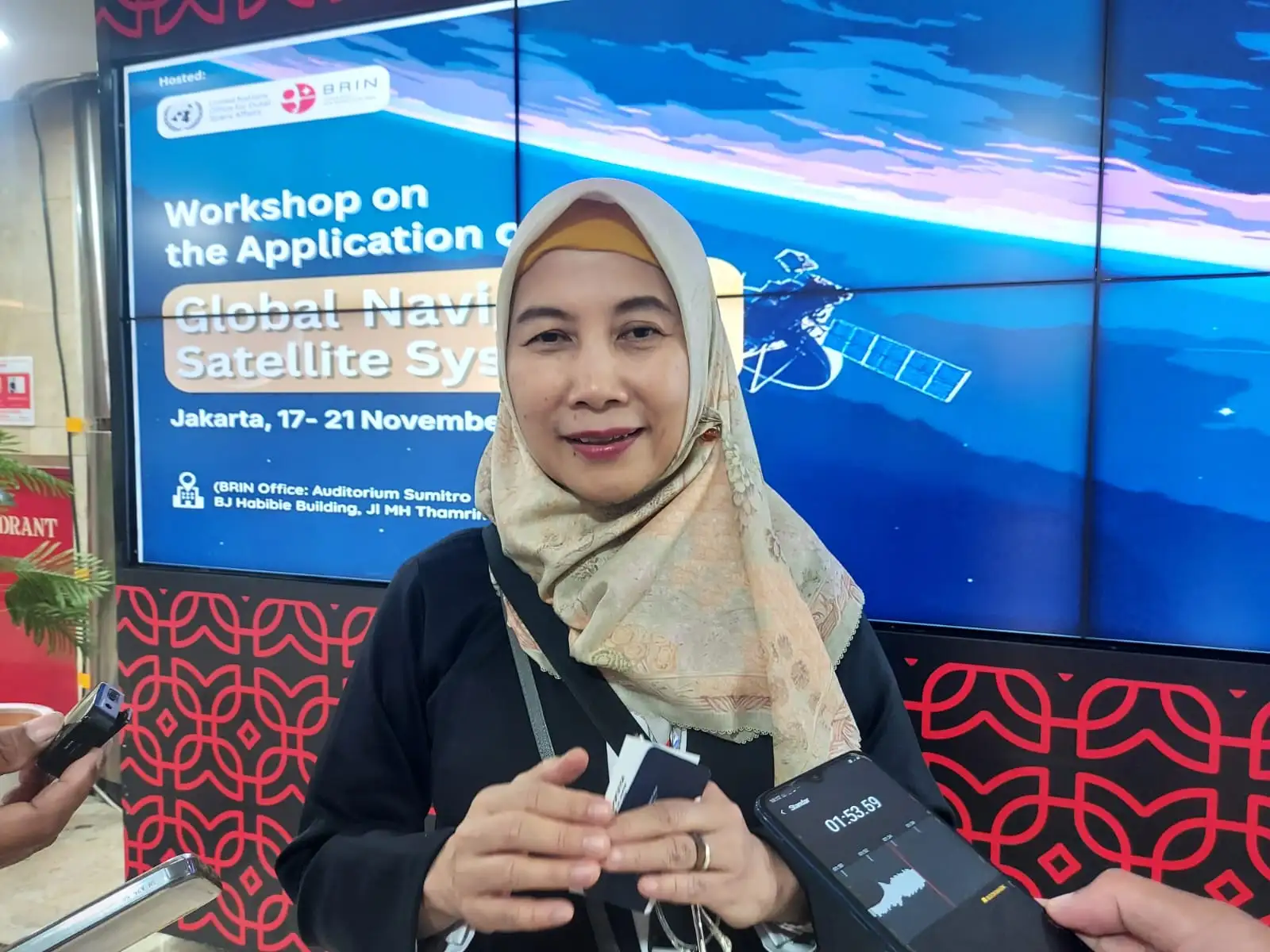
    The 2025 Global Navigation Satellite Systems (GNSS) Workshop in Jakarta, Indonesia, emphasized one important message: navigation satellite data has become a fundamental necessity in modern life, yet Indonesia remains completely dependent on systems owned by other countries.

    The workshop was held by the National Research and Innovation Agency (BRIN) in collaboration with the University of Indonesia (UI) and the United Nations Office for Outer Space Affairs (UNOOSA), at the BJ Habibie BRIN Building, Nov. 17–21.

    “Indonesia cannot just be a market. In the future, we must also become a producer of satellite services and have our own satellite industry.”

    Navigation satellites are a “silent technology” whose contribution is rarely recognized, yet they support almost all location- and time-based activities, explained Rr. Erna Sri Adiningsih, director of the Secretariat of the Indonesian Space Agency (INASA). “When we use Google Maps, search for addresses, find directions or positions, everything relies on data from navigation satellites,” she said. Even robotics, drones, aviation systems, and global time synchronization operate thanks to satellite navigation services.

    Therefore, she emphasized that disruptions to the navigation system would have direct implications for public activities. “If a navigation satellite operator stops operating or malfunctions, most of our communication devices will cease to function. Time won’t synchronize, location won’t be read, and robotics and drones won’t operate,” she said.

    Adiningsih added that the workshop is crucial for connecting operators with users. “We want to ensure that the needs of users from various countries are understood,” she said.

    The 2025 GNSS Workshop is a strategic platform for bringing together the GNSS operator community with national stakeholders such as the Ministry of Transportation, AirNav Indonesia, academia and the industrial sector. BRIN itself operates the experimental A1, A2 and A3 satellites, but does not yet have a navigation satellite.

    Crucial time for increased capacity

    Indonesia, Adiningsih said, is at a crucial point in increasing its capacity. Despite having the capability to build micro-satellites for earth monitoring and privately operated communications satellites, navigation satellite technology requires mastery of a different system. “Indonesia has never built a navigation satellite. We are still in the stage of utilizing the data, not building the satellites,” she said.

    Augmentation. The development of navigation augmentation systems for aviation, drones and maritime transportation currently relies on ground-based equipment managed by the Geospatial Information Agency (BIG). These are expensive and have limited coverage. “If we use a satellite system, one system can be used across the entire region without having to install ground-based equipment,” Adiningsih said.

    Therefore, Indonesia requires integrated policies and support from various ministries and agencies. The national space program already has a clear direction through Space Policy 2045, including a target for technological independence. “Indonesia cannot just be a market. In the future, we must also become a producer of satellite services and have our own satellite industry,” she emphasized.

    Adiningsih hopes that the five-day workshop will not only serve as a forum for sharing experiences but also open up opportunities for international collaboration in the development of satellite navigation technology and systems. “With humanity’s increasing dependence on satellite data, Indonesia must begin building its capabilities so that it is not completely dependent on other countries,” she said.

  • Tern IDPS selected to accelerate autonomous satellite-free positioning

    Tern IDPS selected to accelerate autonomous satellite-free positioning

    Tern has been named a winner of the U.S. Army’s xTechOverwatch for Unmanned Systems competition. TERN was selected from morethan 600 companies after hands-on Soldier testing at the Bush Combat Development Complex in Bryan, Texas, Oct. 27-29.

    Tern developed an AI-powered Independently Derived Positioning System (IDPS) for position and navigation.

    xTechOverwatch is the Army’s premiere event for accelerating autonomous systems, giving
    soldiers the opportunity to use emerging technologies in real-world training environments and
    provide critical feedback that drives iterative improvement.

    The system has been tested across multiple tactical platforms in both on- and off-road environments, including active conflict zones.

    Tern will now integrate IDPS directly with Army Transformation in Contact formations, where active-duty units will continue to validate the system in operational scenarios in 2026.

    How IDPS works

    IDPS has been proven to deliver uninterrupted, high-accuracy navigation in environments where GPS fails — tunnels, dense urban canyons, remote terrain, and GPS-denied zones. Tested by the U.S. Department of Transportation, it has sustained ±4-meter accuracy over extended distances without any satellite input, completing more than180 continuous miles GPS-free and performing flawlessly under live GPS spoofing in a conflict zone.

    Tern’s IDPS gives the Army the ability to navigate their vehicles without the use of any
    satellites, signals or infrastructure, using only map data and the sensors already on board.
    Designed by former special operators who spent years navigating contested terrain without
    satellite support, and developed with AI experts behind some of the fastest recognition systems
    in the world, IDPS maintains precise, real-time location even when GNSS is jammed or
    spoofed. The system has been tested across multiple tactical platforms in both on- and off-road environments, including active conflict zones.

    Base maps. IDPS has a clear understanding of the roads ahead using preloaded map data — either publicly available or proprietary. This built-in knowledge means it can follow a logical path, even in places where satellites can’t reach, keeping navigation steady from the first turn to the final destination.

    IDPS can stand alone or be configured to power a location manager and integrate with widely used navigation applications such as Google Maps, Waze, OSM, ESRI, ArcGIS and Apple Maps.

    Sensor data. TERN’s IDPS leverages data from sensors already built into modern vehicles, such as wheel speed, steering angle, and  3D motion data , making these existing sensors smarter. Because this information comes directly from the vehicle, it works anywhere the vehicle can operate, making it a reliable foundation for location tracking in any environment, eliminating the need for additional expensive hardware, such as LEO satellites or terrestrial beacons. With a light computing and processing load, IDPS is can be a hardware or software based solution.

    Artificial intelligence. IDPS uses a proprietary AI engine to fuse map data and sensor inputs into a real-time position. TERN’s  advanced adaptive weighting algorithms measure and interpret the data from vehicle sensors and recalibrates those inputs in real-time, applied against the base maps to increase accuracy.  Constantly self-healing, IDPS predicts, confirms, and refines the vehicle’s location, learning from each movement to maintain pinpoint accuracy without satellites.

  • Honeywell authorized for US M-code military navigation solution

    Honeywell authorized for US M-code military navigation solution

    Honeywell has received U.S. government authorization for the remaining variants of its M-code GPS Inertial Navigation System (EGI), which will help enable more secure and precise navigation for military aircraft worldwide.

    Honeywell was awarded the MSO-c145b authorization by the Precise Position Equipment Certification Office (PECO) for its smaller form factor embedded GPS EGI, known as the FALCN. Honeywell received the same authorization for its large form factor system last year.

    With this new qualification, all of Honeywell’s EGI offerings are certified and approved by the U.S. government, and it can now offer solutions on platforms such as the collaborative combat aircraft and fixed-wing advanced fighters.

    Reliable on-board navigation systems, such as the GPS EGI, are critical to ensuring mission success and operational safety for military and civilian operators. These systems are not just tools for determining location, but essential for strategic planning, coordination and effective execution of tasks, especially in complex and high-risk environments. Accurate navigation enables personnel to operate with precision, even in GPS-denied or contested areas, contributing directly to the safety and effectiveness of military operations.

    “Our innovative EGI offerings will enable aircraft platforms to meet the latest M-code mandates and to navigate both in contested environments and off of GPS constellations with military waveforms, all while protecting warfighters with the most advanced technology in the market,” said Matt Picchetti, vice president and general manager, Honeywell Aerospace.

    The advent of GPS M-code receivers is the greatest advance in military positioning, navigation and timing since GPS was originally fielded in the early 1980s. With Honeywell’s FALCN-M now upgraded with M-code capability, aviators will be protected from GPS jamming and spoofing threats, further enabling them to confidently conduct military operations in highly contested environments.

    Honeywell is a leader in EGI technologies for military applications and, since the mid-1990s, has provided more than 60,000 EGI units for fighter, transport, vertical takeoff and landing, and rotary-wing aircraft — spanning more than 70 aircraft types to more than 30 allied countries. Honeywell’s EGI family includes the H-764, in use on most military aircraft, and the FALCN, providing all the features and performance of the H-764 in a smaller package. The H-764 legacy offering uses a larger chassis to maintain commonality with legacy aircraft.

  • Seen and Heard: GNSS, weather data, map updates and pollinators

    Seen and Heard: GNSS, weather data, map updates and pollinators

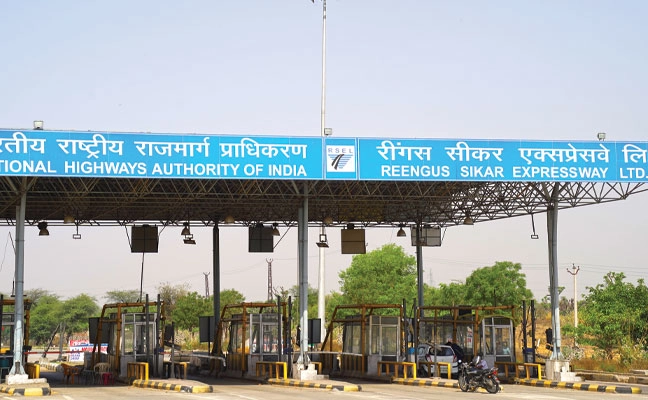
    India gives up on GNSS tolling

    Instead, the ANPR-FASTag hybrid system will continue to rely on ground-based high-speed cameras to identify vehicles and radio-frequency-identification FASTag readers to charge them.

    The Ministry of Road Transport and Highways is proceeding with corridor projects relying on automatic number-plate recognition (ANPR) and FASTag systems, which don’t require vehicles to stop. A GNSS toll system tracks the exact location of the vehicle and calculates the distance traveled on a toll roll, ensuring that users end up paying for just the distance they actually traveled.

    For several years, the Indian government had intended to implement a GNSS-based toll system based on real-time location tracking. Now, it looks like these plans have been scrapped.

    Promoting precious pollinators

    Washington State University (WSU) is leading the Pacific Northwest Pollen Atlas (bees.wsu.edu) to map and describe pollen. It aims to determine pollinator health and thus food humans eat that depend on pollination. Honey bees and other pollinators collect pollen from plants within a two-mile radius of their hive.

    “We hope to create a database of plants and share the nutrient content in their pollen so gardeners can plant a healthy variety,” said Priya Chakrabarti Basu, WSU assistant professor, Entomology.

    Researchers will map pollen varieties collected by citizen scientists in every Washington county over a four-year period and colleagues around the Pacific Northwest are also recruiting to increase the project’s scope. Expected to take decades to complete, the efforts are part of Basu’s larger effort to map pollen nutrition across North America.

    How’s the weather out there?

    High-resolution atmospheric data is the missing link in forecasting weather. A new approach sharpens GNSS tomography, while showing how the model makes decisions — a transparency critical for building trust as AI enters weather forecasting.

    By revealing the hidden details of storms and humidity patterns, the new method can give forecasters the tools needed to anticipate extreme events with greater confidence, according to researchers at Wrocław University, Poland. The team described their deep-learning framework in a paper published in Satellite Navigation in August.

    With sharper GNSS tomography, meteorologists can feed more accurate humidity fields into both physics-based and AI-driven forecasting models, significantly improving storm prediction and early-warning systems.

    Africa is really huge

    Photo: Equal Earth, Strebe / CC BY-SA 4.0
    Photo: Equal Earth, Strebe / CC BY-SA 4.0

    A Correct the Map campaign aims to replace the 16th-century Mercator map because it doesn’t show the true size of Africa, which is three times as large as Europe. Supporters say the historic map — created to guide European explorers — promotes a false view of the continent and its size, fostering a false impression that Africa is “marginal.”

    In August, the 55-country African Union endorsed the campaign to have organizations around the world replace the Mercator with alternatives such as the 2018 Equal Earth projection. The African Union is expected to make an official decision to adopt the Equal Earth map in February. The campaign also asks the United Nations and the BBC to adopt the Equal Earth map.