Wherobots and Felt have entered a strategic partnership aimed at modernizing the geospatial data stack.
The integration combines Wherobots’ spatial intelligence lakehouse and compute engine with Felt’s collaborative mapping platform, connecting large-scale data engineering with interactive, map-based applications. The partnership allows organizations to move from processing petabyte-scale geospatial datasets in the cloud to exploring insights in a collaborative mapping environment without transferring large datasets between systems.
Organizations are handling growing volumes of location-based data, and analyzing that data has historically required specialized GIS software or custom applications that were difficult to connect with modern data systems. The integration lets users create live, interactive visualizations for uses ranging from mapping fields and creating vegetation indexes to building AI-enabled user experiences and automated workflows that monitor climate risks.
Agricultural company puts partnership to the test
Leaf Agriculture, which provides a unified API for agriculture organizations and farms working with telemetry data from tractors and field sensors, is already using both platforms together.
The company uses Wherobots to create data products from a large data lake of agricultural, parcel and tractor telemetry datasets. It recently announced a new product, LeafLake, built on that foundation. Leaf then uses Felt to build interactive maps based on the spatial data processed within Wherobots. Rather than relying on in-person screen-sharing sessions, the team now distributes maps via links viewable from any device. Here is an example of one of Leaf’s interactive maps.
“Wherobots and Felt’s new integration allows organizations to move seamlessly from processing petabytes of raw geospatial data in the cloud to visualizing actionable insights in a browser-based, collaborative environment — all without the friction of traditional desktop-based tools,” said Rachel Zack, chief strategy officer and co-founder at Felt. “For modern enterprises who rely on geographic information, this is the complete, end-to-end spatial data infrastructure that makes working with GIS data at scale finally feel effortless.”
“As climate impacts intensify — from fires to floods — maps are no longer optional; they’re critical tools for understanding a rapidly changing world,” said Mo Sarwat, CEO of Wherobots. “Yet building and scaling them has traditionally required heavy engineering effort, especially for teams working with satellite and drone data. Through our partnership with Felt, AWS users can now access, analyze and visualize spatial data directly from S3, eliminating infrastructure complexity and accelerating decision-making when it counts most.”
For more details, please see the Wherobots blog post here.
In the Jan.-Feb. 2026 edition of GPS World magazine, we asked our experts, with the increase in reported GNSS jamming incidents affecting commercial aviation, what technical approaches show the most promise for ensuring reliable PNT?
Check out their responses below:
Mitch Narins
Mitch Narins, Strategic Synergies
“Aviation encompasses a diverse range of applications and missions, requiring support from various positioning, navigation and timing (PNT) solutions. As with most challenges, employing multiple strategies often yields optimal outcomes, particularly in scenarios where a one-size-fits-all approach is impractical. I firmly believe in the enduring importance of the guidance historically imparted to navigators: to ‘utilize all available means.’
However, it is crucial to recognize that GNSS jamming is not the primary concern. Fortunately, aviation has historically and continues to rely on resilient ground-based alternatives, although many of these systems have been in service for several decades and require upgrades and replacements. The more pressing issue for aviation and other PNT applications lies in spoofing. I strongly advocate for the abandonment of the concept of employing a single, non-resilient solution for critical functions, a practice once referred to as ‘GPS sole-means.’”
Miguel Armor
Miguel Amor, Septentrio
“Ensuring reliable navigation and timing in the presence of increasing GNSS jamming requires both stronger technology and faster modernization in aviation. Today, the most effective protection is a layered approach, starting with advanced interference mitigation at the receiver level. Modern anti-jamming algorithms and robust signal processing, combined with multi-frequency and multi-constellation capabilities, provide important diversity and allow systems to continue operating even in difficult RF environments. CRPA antennas also further improve resilience by enabling spatial filtering and adaptive nulling, suppressing jammers before they impact the receiver.”
Paul McBurney
Paul McBurney, oneNav
“Controlled Reception Pattern Antennas (CRPAs) and adoption of L5. As discussed by Brad Parkinson, Ph.D., at the most recent National Space-based PNT Advisory Board (PNTAB) meeting, the CRPA is the big-hammer anti-jam solution. It’s great to hear that the ITAR restrictions have been removed. For commercial aviation, the long pole to deployment is likely dependent on an FAA certification procedure. The other advice from PNTAB is that L5 has a much smaller denial radius. So, once again, the U.S. Government and FAA are on the critical path: We need L5 to be declared healthy and usable, which likely requires an upgrade of RTCA MOPS.”
The FGCS meeting took place on Wednesday, Jan. 21, 2026. This session was highly informative and played a key role in aligning federal agency engagement strategies and self-assessments in preparation for the final adoption of the modernized NSRS and its associated new datums.
Advancing the use of authoritative geodetic control
Facilitating the modernization of the NSRS across agencies
Recommending the official adoption of the modernized NSRS by the FGDC as the foundational basis for geodetic control throughout the United States.
The agenda for the Jan. 21 meeting is detailed in the section titled “Federal Geodetic Control Subcommittee Meeting.” This gathering supported broader efforts to raise awareness, ensure coordination and prepare agencies for the upcoming transition to the modernized NSRS, with formal approval and release anticipated later in 2027.
Federal Geodetic Control Subcommittee Meeting
January 21, 2026
Agenda:
MC: Christine Gallagher
Time
Topic
Presenter
1:00 – 1:15 pm
Welcome and Introductions
Daniel Roman
1:15 – 1:20 pm
National Geodetic Survey (NGS) Update
Marian Westley
1:20 – 1:30 pm
Geodetic Control Theme Update and its Modernization Timelines
Daniel Roman
1:30 – 2:00 pm
NGS Modernization Engagement Plan and Progress
Dana J Caccamise II / Christine Gallagher
2:00 – 2:15 pm
Bureau of Ocean Energy Management / Kearns & West
Andy Archer / Kyle Vint
2:15 – 2:30 pm
US Census National Spatial Reference System (NSRS) Modernization Preparation
Vince Ossier / Josh Coutts
2:30 – 2:40 pm
Break
2:40 – 2:55 pm
US Department of Transportation NSRS Modernization Preparation
Amy Nelson / Derald Dudley
2:55 – 3:10 pm
American Society for Photogrammetry and Remote Sensing & National Society of Professional Surveyors Working Groups
Chris Parrish / Linda Foster
3:10- 3:50 pm
Discussion: Q&A from Agency presentations. What hurdles to implementation do you see or anticipate? Share your insights from internal working groups
Group Discussion Moderator: Dana J Caccamise II and Daniel Roman
3:50 – 4:00 pm
Closing Remarks
Daniel Roman
Adjourn to Silver Branch
The meeting lasted three hours and covered a lot of material. Below are highlights; contact FGCS for the full meeting recording.
Christine Gallagher, NGS, opened the FGCS session and introduced Dan Roman, NOAA’s National Geodetic Survey senior advisor for geodesy.
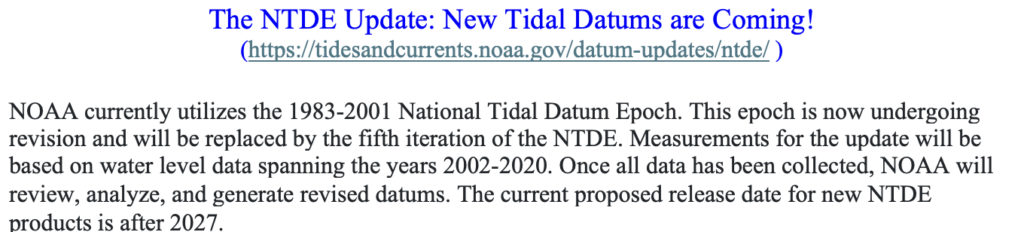
Westley’s remarks were brief but important. She noted CO-OPS manages tide gauges and is updating several datums in partnership with NGS, including the Great Lakes International Great Lakes datum. She said the United States and Canada, along with NOS and other federal agencies such as the Corps of Engineers, are heavily involved in Great Lakes management. She also reported that CO-OPS is updating the National Tidal Datum Epoch (current NTDE: 1983-2001) and is working closely with NGS to tie the updated NTDE to the new NSRS. See the image titled “The NTDE Update: New Tidal Datums are Coming!“
During Roman’s comments, he highlighted the agencies and professional societies participating in the meeting presentations and provided an update on the latest rollout schedule for the modernized NSRS.
He emphasized that this Jan. 21, FGCS meeting marks the start of a broader coordination process. The primary purpose of this high-level session was to facilitate the sharing of experiences, strategies, and best practices among federal agencies as they prepare for NGS’s NSRS modernization and the transition to the new reference frames and datums.
Roman noted that future FGCS meetings will shift to a more technical and detailed focus. These subsequent sessions will allow agencies to present their self-assessment results, outline implementation strategies, and discuss progress toward adopting the modernized NSRS.
Key objectives across these meetings include:
Collecting questions and feedback from participants,
Understanding user needs and required accuracy levels,
Identifying anticipated challenges during the transition,
Exploring opportunities for federal agencies to collaborate and support one another throughout the implementation process.
This series of FGCS engagements aims to ensure coordinated, informed, and effective preparation across the federal government ahead of the final adoption and full rollout of the modernized NSRS.
Here are a few key points based on Dan’s remarks:
Today’s presentations provide a broad overview of geospatial data modernization to inform departments about actions they may need to take and to start a dialogue about what each department is doing.
NGS encourages agencies to form working groups; those groups must define their own requirements and create migration plans, including assessing existing data, required accuracies, and the tools needed based on product accuracy statements. [Note: My October 2025 GPS World newsletter highlighted organizations that are forming 2022 Reference Working Groups.] NGS will designate points of contact to facilitate discussions and planning.
FGCS provides guidance on using geodetic data with various tools, models, and SOPs. User needs vary by accuracy: e.g., a 3-meter horizontal allowance (aids to navigation) is straightforward, while 3-centimeter requirements (e.g., FEMA Elevation Certificate) need more precise methods.
Several beta products released in July 2025 are being finalized, enabling the private sector to integrate them into services. NGS is currently developing models and software to transform coordinates from the old datum to the new one. These models are expected around March, and in June/July NGS anticipates releasing an updated Beta NCAT tool to transform coordinates to the new datum. This tool will help users understand differences in local datums.
Final steps include FGCS recommendations for FGDC to adopt the new NSRS and to publish a Federal Register notice on the adoption of the modernized NSRS, anticipated to be completed in early 2027.
After Dan Roman’s comments, Dana J Caccamise II gave a presentation describing NGS Modernization Engagement Plan and Progress. Dana should get an award for material he has prepared and for his work to assist agencies and professional organizations in preparing for the new NSRS. In my October 2025 GPS World Survey Scenenewsletter, I highlighted the work of Dana J. Caccamise II, NGS regional geodetic advisor. Dana has developed vital guidance materials shared with federal agencies — such as the Federal Geographic Data Committee (FGDC) and professional organizations including the National Society of Surveyors (NSPS), American Society of Photogrammetry and Remote Sensing (ASPRS), and American Association for Geodetic Surveying (AAGS).
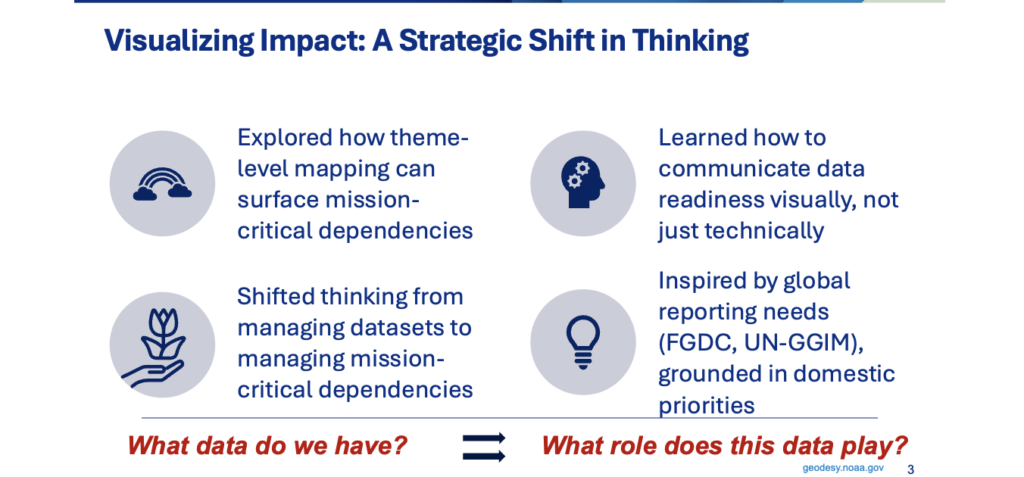
Here are a few key points based on Dana’s presentation titled “Visualizing Impact: Preparing for NSRS Modernization Through Geospatial Readiness and Collaboration.”
Caccamise said that what started as a focused task quickly grew into a broader strategic effort. He shared insights to encourage thinking about NSRS modernization not merely as a technical update but as a strategic business decision that will shape how agencies create, manage, and share basic data across programs, systems, and partnerships.
Caccamise briefly provided details to the U.S. Census. Before diving into modernization, he offered a personal glimpse of what it’s like to do a federal detail across agencies, noting he was fortunate to do a detail with the Census not long ago.
Image: FGCS Jan. 21, 2026, Public Meeting
Drawing on his experience, Caccamise emphasized the importance of cross-agency readiness and of building resilient trust and communication structures. While on detail at the Census, he was regularly surprised by new challenges, which made the work engaging; he strongly recommended that others take a detail at another agency if they have the opportunity. A key takeaway was the value of visualizing impact: beyond cataloging geospatial datasets, users must identify which support critical decisions, which are shared across agencies, and which risk becoming outdated if you don’t adapt. Mapping themes and workflows revealed real dependencies and, more importantly, vulnerabilities. That detail shifted his focus from “what data do we have” to “what roles does this data play.”
Image: FGCS Jan. 21, 2026, Public Meeting
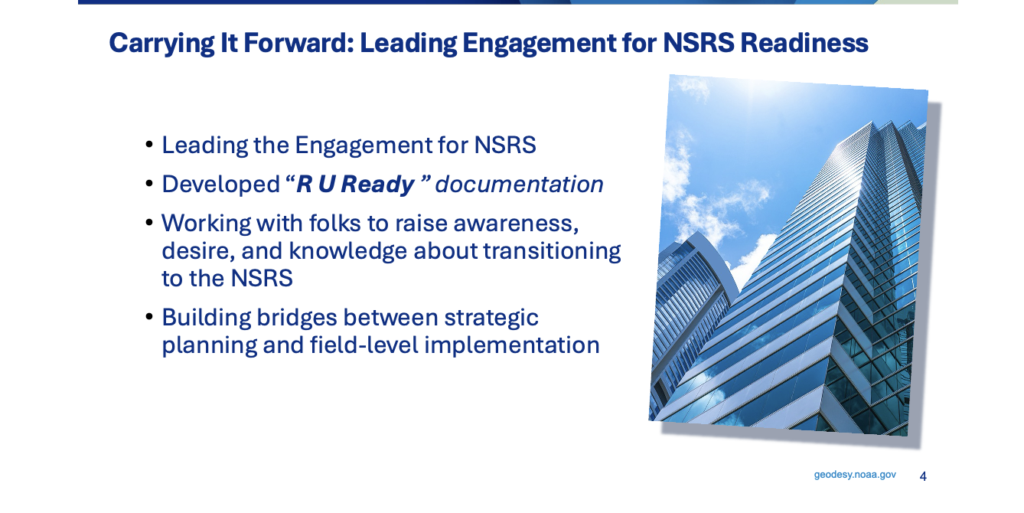
Efforts around NSRS modernization include a key product developed by Caccamise: the Ready Package. Designed to help agencies assess their readiness for NSRS modernization, the package includes communication tools, technical checklists, and talking points to support agency staff.
Image: FGCS Jan. 21, 2026, Public Meeting
He mentioned that from field-level GIS technicians to senior policy leads, everyone needs to understand what’s changing and why it matters. A key part of engagement is meeting people where they are. Dana has worked with agency partners to raise awareness, build interest, and strengthen understanding — not just of technical changes but of the organizational shifts needed for a smooth transition.
For agencies whose statistical workflows depend on spatially referenced data, that means ensuring location-based datasets remain accurate, comparable over time, and interoperable across programs when the reference system changes. Ultimately, this is about more than new coordinates: it’s about linking strategic planning to operational implementation, from data collection and integration to interagency coordination and informed decision-making.
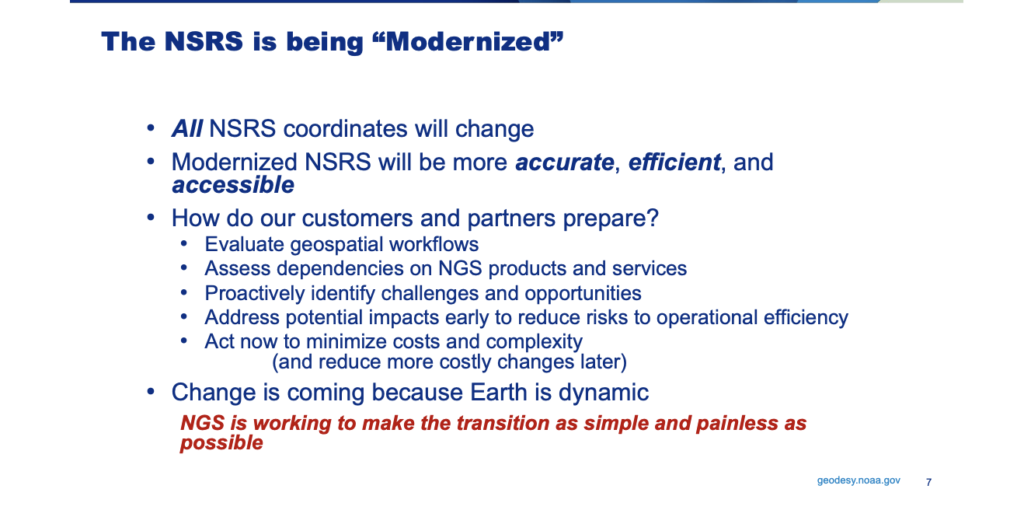
He mentioned that the big question he’s hearing from many organizations is: how should customers and partners prepare for modernization? He provided the following advice. Start by evaluating your geospatial workflows to understand how the transition will affect data management, operations, and decision-making. Assess dependencies on NGS products and services to ensure continued access and interoperability and proactively identify challenges and opportunities – he mentioned that NGS can’t do this for you because each agency’s situation is unique. Address potential impacts early to reduce operational risk by finding weak points before they cause surprises. Act now: preparing early will minimize future cost and complexity.
Image: FGCS Jan. 21, 2026, Public Meeting
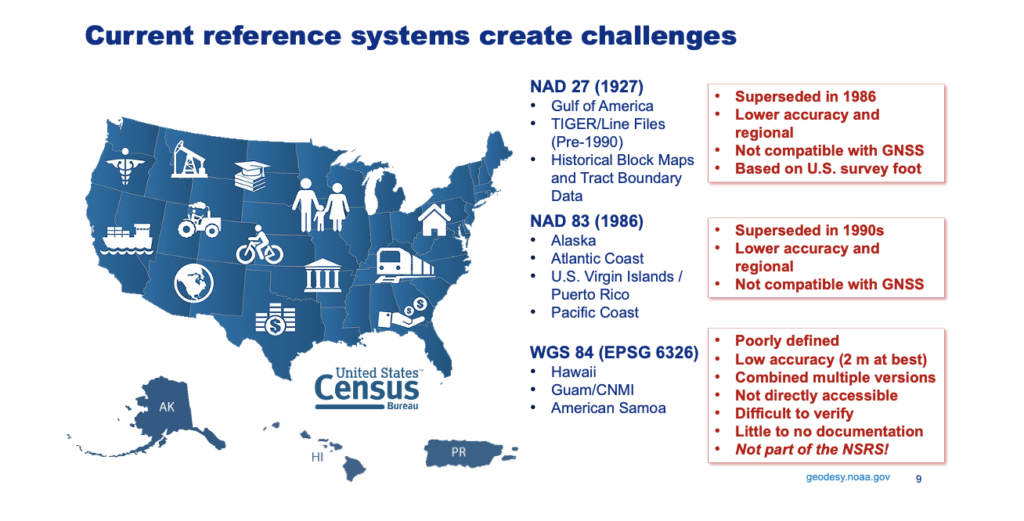
For example, working with the Census under the current national spatial reference system highlights the geographic scope of some operational areas, which span multiple tectonic plates as modeled in the modernized NSRS. Even small regional differences can affect how location-based data are collected, integrated, and compared — especially for programs that need consistent, long-term geospatial baselines. Today, federal agencies commonly use three reference systems — NAD27, NAD83, and WGS84, which complicates geospatial data management.
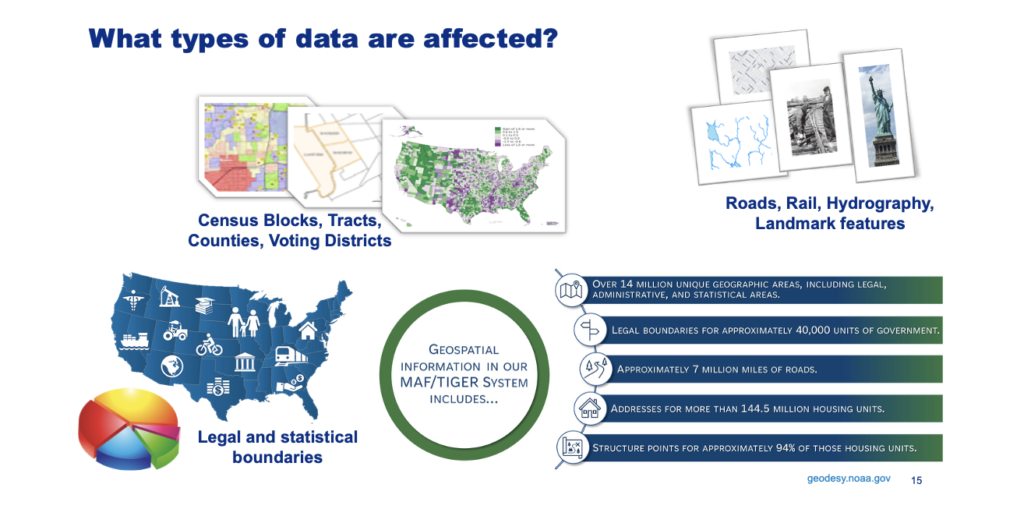
The Census is a major user and producer of geospatial data, relying on GIS to support operations. This includes the MAF/TIGER geographic database, which contains roads, rail lines, hydrography, landmark features, and legal and statistical boundaries.
Along with many other critical datasets, the Census’s collaborative spatial and statistical research is more effective and interoperable when grounded in a common reference system, such as the National Spatial Reference System.
Image: FGCS Jan. 21, 2026, Public Meeting
Because these datasets are inherently geospatial, many, especially those requiring high positional accuracy or relying on external references such as airborne or satellite data, will be affected by NSRS modernization. The update will enable more consistent data stewardship and support integrated spatial analytics, helping align with individual agency spatial data strategies. Bureau-level geospatial work becomes more effective and future-ready when supported by a modern, shared spatial reference system like the NSRS.
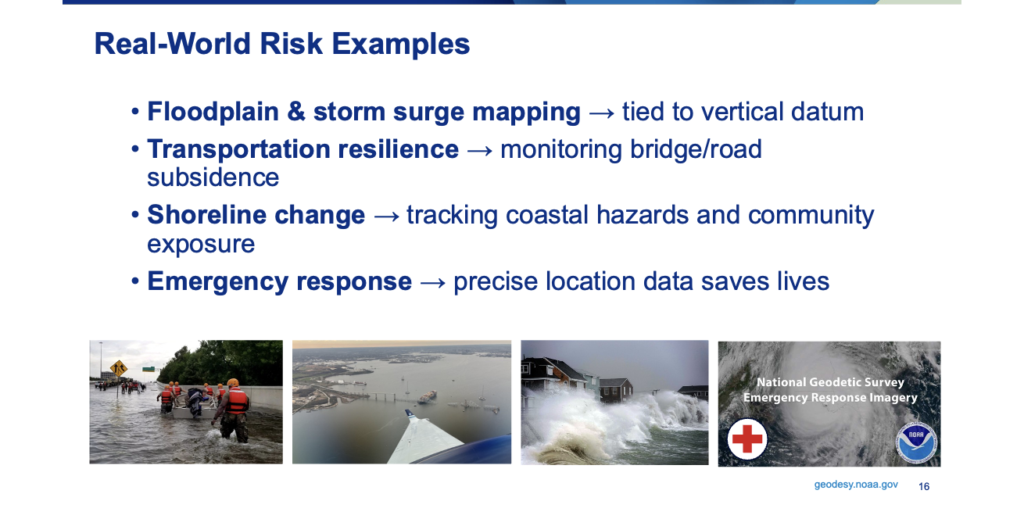
One of the biggest risks is cultural, not technical. If the NSRS is treated as just another dataset, rather than an enabling framework, the foundation for other systems weakens. When the NSRS is recognized as the framework, everything built on it has a solid base. You can’t manage risk if you can’t measure it—and the NSRS is how we measure. Here are a few practical examples.
Floodplain mapping and storm surge models depend on accurate vertical data. Errors of even a foot can leave neighborhoods unprotected or cause unnecessary regulation.
In transportation, subsidence is a hidden risk: roads and bridges may seem fine until precise geometric monitoring reveals sinking.
Shoreline change is a growing challenge; coastal communities need accurate shoreline monitoring for planning and insurance.
In public safety, emergency response relies on precise locations — from 911 calls to field deployments. Seconds and meters matter when lives are on the line.
Image: FGCS Jan. 21, 2026, Public Meeting
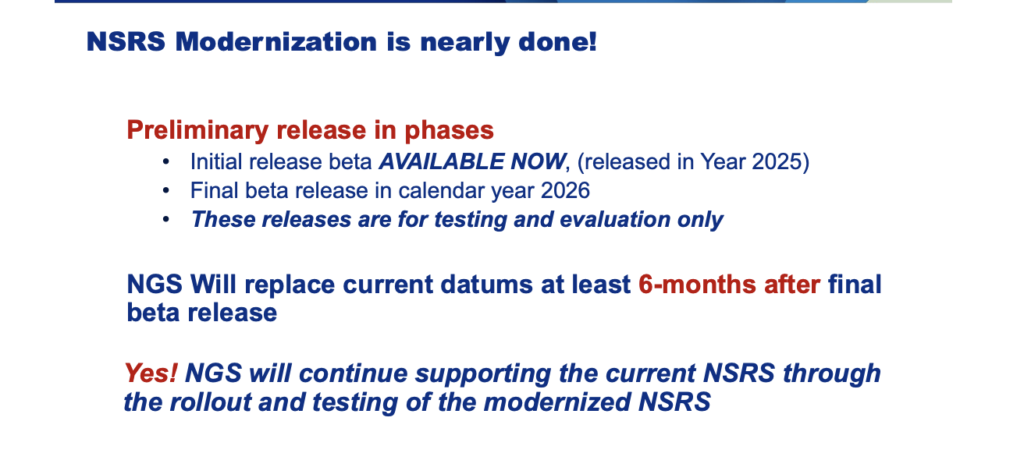
As Roman mentioned, Caccamise also stated that the modernized NSRS is being released in phases. Initial beta releases are available now for testing and evaluation—not final production. NGS plans to release the remaining components in beta during this calendar year. The modernized NSRS will replace the current datums at least six months after the final preliminary component is released, giving partners time to review the beta and provide feedback. Near the end of this period, FGCS will convene to discuss and socialize the modernization details and the planned datum replacement.
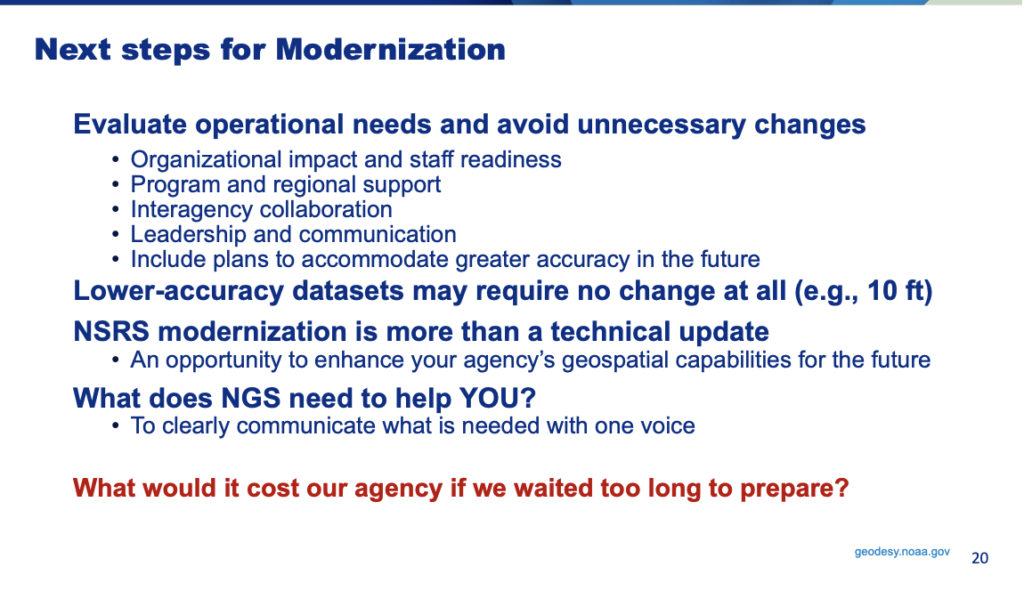
Next steps for your agency’s modernization:
Evaluate operational needs and identify changes that aren’t necessary.
Assess organizational impacts and staff readiness—are teams prepared for modernization?
Determine how existing programs and regional support will be affected.
Collaborate with partner agencies to align shared datasets, reduce redundancy, and maximize efficiency.
Prioritize leadership and communication to ensure the organization understands the changes.
Plan for future improvements in spatial accuracy, even if you don’t need them immediately.
Image: FGCS Jan. 21, 2026, Public Meeting
As noted by Dan Roman, Dana Caccamise also highlighted that many lower-accuracy datasets may not require coordinate changes beyond updating their metadata—typically those with spatial accuracy on the order of 10 ft or worse. However, he also noted an important caveat: many operational workflows don’t actively read or enforce metadata. In those cases, the risk is not the dataset itself but the accuracy context that becomes embedded as data moves through systems.
An early, critical step is therefore to identify not only which datasets are likely unaffected but also how those datasets are consumed, transformed, and reused. That approach prevents unnecessary work and avoids unintended downstream impacts. Remember: NSRS modernization is more than a technical update, it’s an opportunity to strengthen your agency’s future geospatial capabilities.
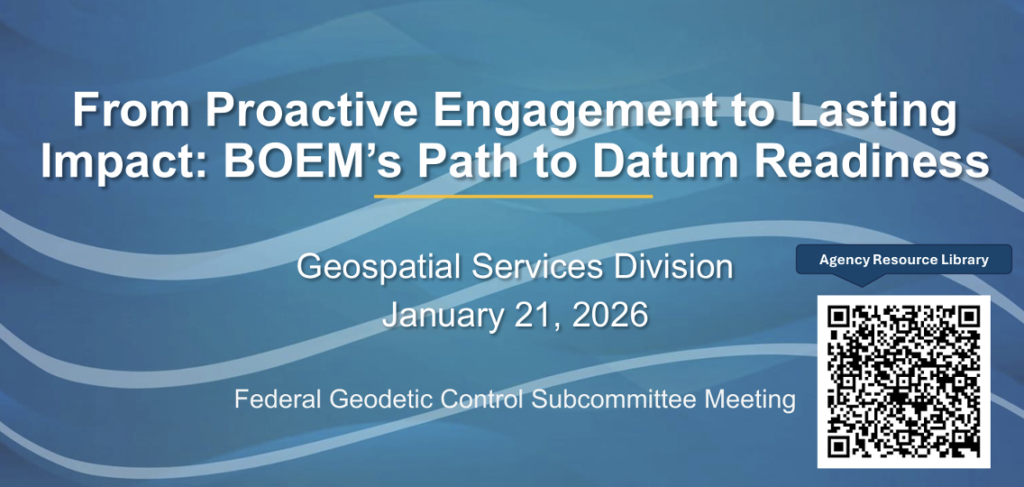
Now, I know this newsletter is long, but I would like to highlight one more presentation that I believe provides a model for other agencies to follow. That is, the presentation of the Department of Interior’s Bureau of Ocean Energy Management (BOEM) activities presented by Kyle Vint (Vice President, Kearns & West) – “From Proactive Engagement to Lasting Impact: BOEM’s Path to Datum Readiness.”
Image: FGCS Jan. 21, 2026, Public Meeting
Kearns & West is a communications and engagement specialization firm. The materials that they develop to support internal communications and outreach within an organization are available for other organizations. They provided a QR code for others to access their resources.
Vint outlined BOEM’s operating context and described how the agency is proactively addressing NSRS modernization, including several strategies.
Image: FGCS Jan. 21, 2026, Meeting
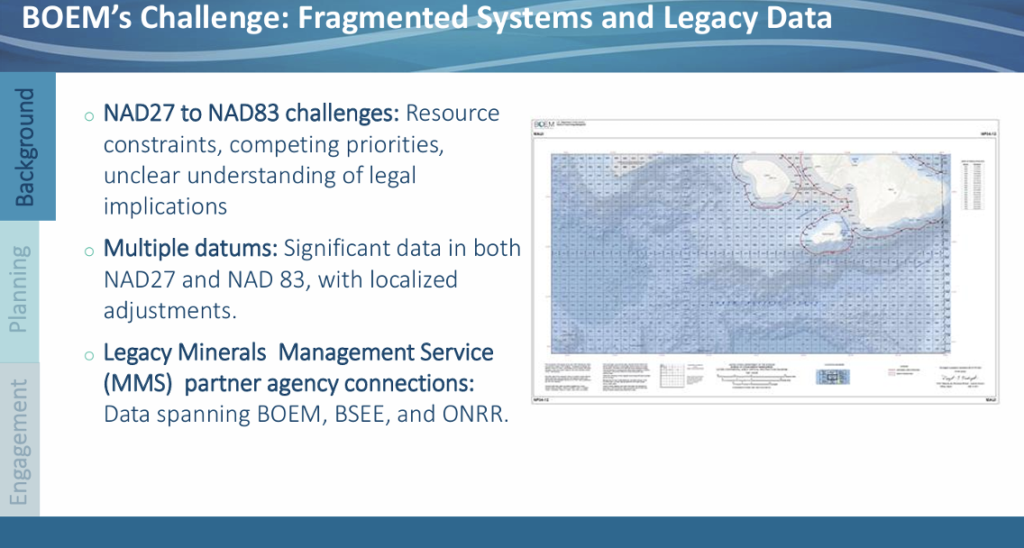
BOEM’s challenges are partly historical: until about 2010, it was part of a parent agency that has since split into three separate agencies. That fragmentation means BOEM must coordinate data and change management not only internally but across three agencies that share data centers and geospatial datasets. BOEM relies on authoritative geospatial data to manage offshore energy and mineral activities on the Outer Continental Shelf; BOEM’s Geospatial Services Division supports this by maintaining leases and boundaries that underpin program decision-making. Because the ocean serves many purposes, BOEM relies on multiple layers of information from different agencies to support those decisions.
BOEM’s path to modernization is further complicated by internal organizational factors. The agency struggled with the NAD27-to-NAD83 transition due to resource constraints and misunderstandings — some staff believed modernization would alter legal lease blocks, which they expected to be immutable — so the transition was not fully implemented.
Image: FGCS January 21, 2026, Meeting
BOEM holds large datasets in both NAD27 and NAD83, fragmenting its workflow. Maintaining and converting between multiple reference systems is labor-intensive and introduces inconsistencies.
BOEM must dedicate substantial staff time to managing data in multiple reference systems. BOEM’s Geospatial Services Division recognized early that continuing workarounds would increase risk over time, so they began proactive modernization planning.
The Geospatial Services Division saw this as more than a technical issue — it’s also a people, communication, and resourcing challenge. BOEM shifted from fragmented efforts to a proactive, multi‑year planning approach emphasizing governance, leadership buy‑in, and clear communication. The Geospatial Services Division established a milestone‑based approach for consistent messaging and coordination across stakeholders and offers internal expertise to support programs and regions as they assess costs and technical complexity.
Their strategy seeks common ground to pool resources for shared problems and to use the Geospatial Services Division as an internal augmentation so individual offices aren’t forced to opt out. This reduces cost uncertainty and enables realistic planning for timelines and required participants.
Image: FGCS January 21, 2026, Public Meeting
As part of the process, user personas were created to identify who would struggle with each step and who would benefit from early, sustained engagement. For each group, they defined the value of participating and explained why they were invited.
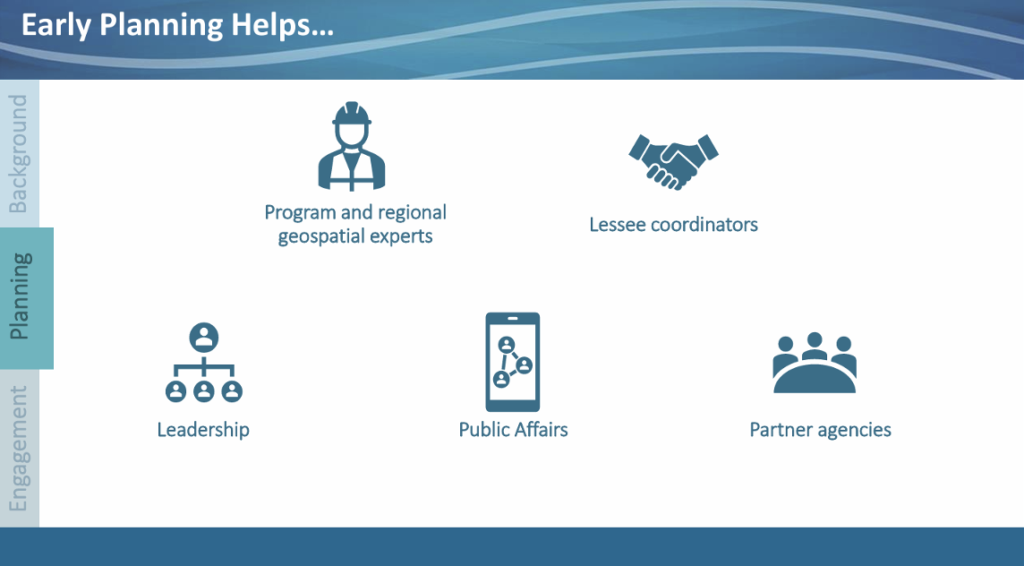
BOEM leaderships were treated like investors—they ensured they brought geospatial experts to meetings so questions could be answered, and so leadership had actionable budget information for long‑term planning. At the program and regional level, data experts who know existing datasets, reference systems, dependent applications, and potential workflow challenges were part of the process.
They also documented internal roles so others can model the approach. The Geospatial Services Division coordinates the effort across the organization. Program and regional experts provide domain knowledge. Kearns & West (technical and communications contractors) supported messaging, prepared materials, and ran meetings so BOEM staff could focus on the conversation. Clear roles and sustained engagement have been critical in this multi‑year planning effort.
Image: FGCS January 21, 2026, Public Meeting
The team developed a Survey and sent it to each program and region to gather resource requirements. The survey asked what data they have and its characteristics, which applications or workflows depend on that data and could be affected by modernization, and what technical resources they expect will be needed to support budgeting.
Image: FGCS January 21, 2026, Meeting
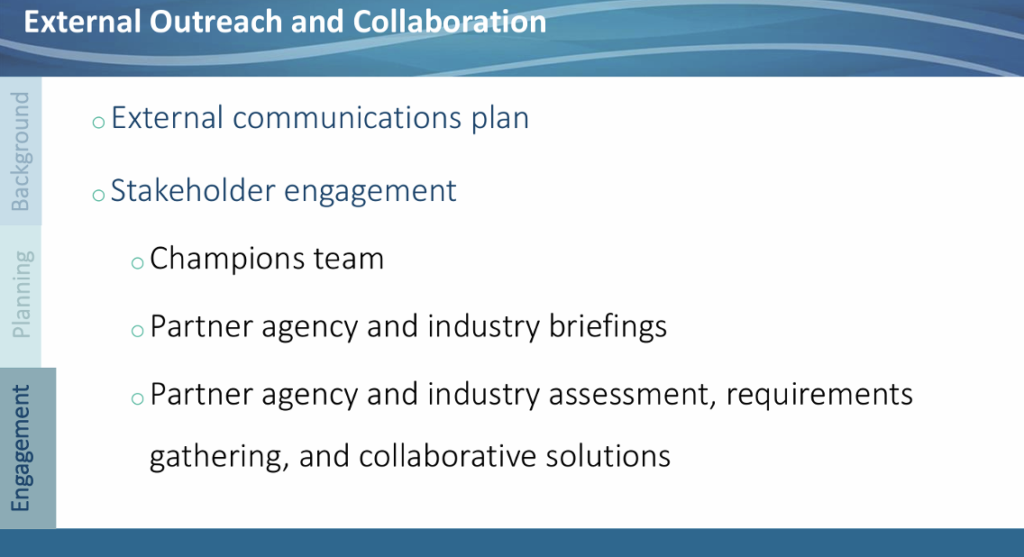
As part of the process, they are building internal champions to advocate for the effort, simplifying complex issues so staff can brief leadership, and convening agencies, partners, and industry to co-create solutions.
Tokyo-based satellite company ArkEdge Space Inc. has signed letters of intent with three international organizations to develop a PNT satellite network in low-Earth orbit (LEO).
The agreements with TrustPoint Inc., the Royal Institute of Navigation in the United Kingdom and FrontierSI aim to strengthen satellite-based PNT capabilities for civil, commercial and security applications.
The collaboration represents an early phase in ArkEdge Space’s effort to build international partnerships for PNT infrastructure. The company, which designs and operates small satellite constellations, said the project will focus on improving resilience of positioning and timing systems that support critical infrastructure.
The partners plan to examine policy frameworks and national PNT strategies as the project moves into a demonstration phase. ArkEdge Space said it will expand its network of international partners to support the development of space-based positioning systems.
“By working together, this collaboration represents an important step as we accelerate the development of resilient, trusted PNT capabilities that support critical infrastructure and informed decision-making worldwide,” ArkEdge Space CEO Takayoshi Fukuyo said.
TrustPoint has transmitted its first Low-Earth Orbit Navigation System (LEONS) time-transfer and tracking signals from a ground node to spacecraft in orbit. The milestone advances the development of commercial navigation infrastructure independent of GPS.
GNSS satellites require knowledge of their own time and orbital position to provide accurate data to Earth-based users. Most LEO spacecraft currently rely on GPS or medium-Earth orbit (MEO) signals for that information. Interference and jamming are increasingly affecting these LEO connections, degrading or blocking signals.
LEONS provides GPS-independent time transfer and orbit tracking. Initially developed for TrustPoint’s planned constellation, the system can be adapted for other LEO operators requiring timing and navigation for their spacecraft. The ground-to-space infrastructure is designed to support a GPS-independent PNT layer in orbit.
“With the pace of modern threats accelerating, the difference between concepts and capabilities matters,” said Nicole Hilliard, director of government programs at TrustPoint. “This milestone demonstrates that commercial partners can field resilient, GPS-independent PNT capabilities that strengthen national security architectures and justify continued investment in companies that deliver.”
The demonstration supports TrustPoint’s participation in the SpaceWERX AltPNT Challenge, which awarded the company two contracts to develop alternative PNT capabilities. The program seeks to deploy new options for precise, dual-use PNT systems.
Throughout the past several decades, GNSS has become one of the most significant technologies in modern engineering, supporting transportation, communications, finance, emergency response, and critical infrastructure [1]. Its precision, global reach, and reliability have enabled entire industries to scale in ways that would otherwise have been impossible. Yet as GNSS is used more deeply in autonomy-driven and safety-critical domains, the limitations of relying on a single-layer PNT architecture are becoming increasingly apparent.
Urban canyons degrade satellite geometry and tracking performance; intentional and unintentional interference is now commonplace [2]; spoofing has shifted from a theoretical concern to an operational reality; and indoor environments, which are essential for robotics, logistics, and emergency services, remain largely outside GNSS’s physical reach. These challenges are not shortcomings of GNSS itself. They reflect what the system was originally designed to provide: a globally available positioning and timing reference, not the entire resilience burden for every PNT-dependent application.
In parallel, communications technologies have undergone rapid transformation. The evolution from LTE to 5G, and soon to 6G, has introduced wider bandwidths, massive MIMO antenna arrays, improved network synchronization, and dense deployment across urban and indoor environments [3]. At the same time, LEO broadband constellations have matured into powerful satellite infrastructures capable of delivering strong signals, rapid Doppler dynamics, and frequent visibility. Although these systems were built primarily for data connectivity, their physical characteristics naturally lend themselves to positioning and timing.
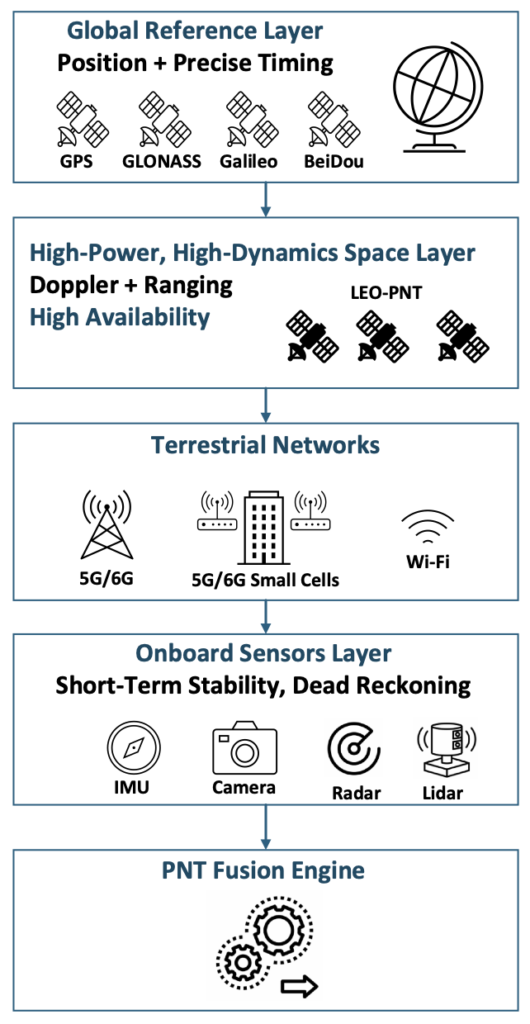
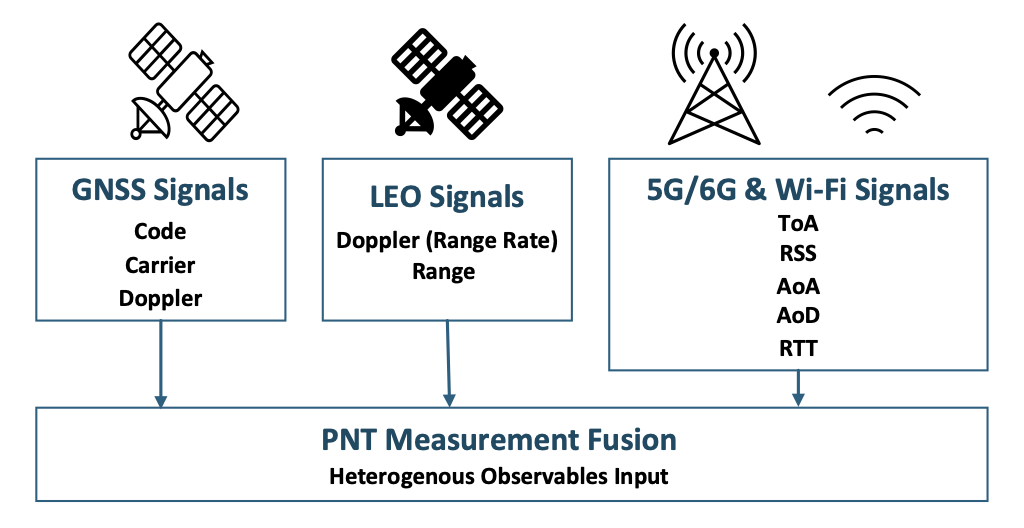
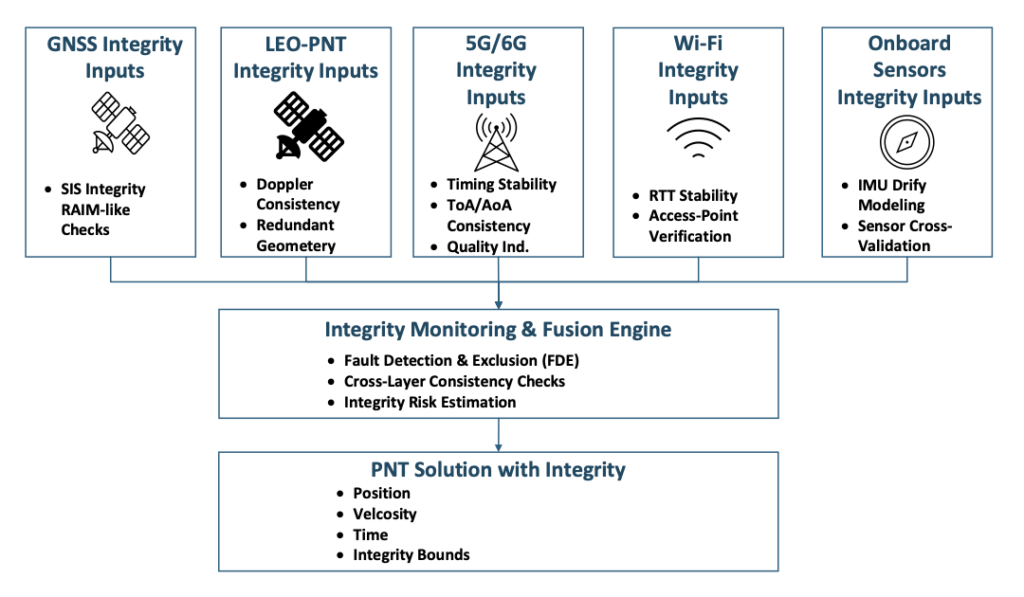
Taken together, these developments point toward a new direction for resilient PNT: a multi-layer architecture in which GNSS serves as the global reference layer and is complemented by high-power, high-dynamics LEO satellites, terrestrial 5G/6G networks and Wi-Fi systems, and a suite of onboard sensors that provide short-term stability and dead-reckoning capability. Figure 1 illustrates this emerging architecture and highlights how each layer contributes specific observables, coverage strengths, and levels of robustness. The remainder of this article examines the physical foundations of communications-based PNT, the role of LEO as an augmentation space segment, the engineering challenges inherent in multi-source navigation, and the system-level architecture that is now taking shape to deliver resilient and ubiquitous PNT.
Figure 1. Multi-layer architecture for resilient PNT. (All figures provided by the author)
2. 1 Growing Dependence on PNT and GNSS Vulnerability
Nearly every sector of modern life depends on GNSS-based positioning and timing. As reliance grows, exposure to GNSS limitations grows with it. Dense urban environments create severe multipath and signal blockage; jamming and spoofing incidents are now regularly reported near conflict zones and busy ports [4]; and autonomy concepts in aviation and ground mobility increasingly assume reliable PNT even when GNSS performance is degraded or unavailable.
GNSS will remain the global reference layer, but it was never intended to carry the full burden of these mission-critical demands on its own. A complementary set of technologies is needed, systems that continue to function in GNSS-challenged environments and provide redundancy when satellite signals are unavailable, corrupted, or intermittent.
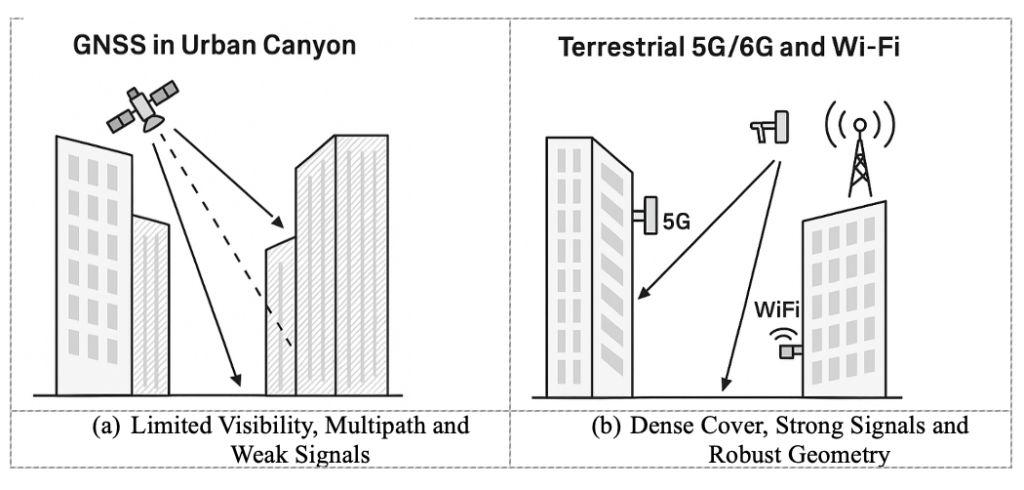
Error! Reference source not found. illustrates this challenge in a representative urban-canyon environment. Tall buildings restrict line-of-sight to GNSS satellites and generate strong multipath reflections, resulting in weak and unreliable signals (Figure 2a). By contrast, terrestrial networks such as 5G/6G and Wi-Fi maintain strong signal levels and robust geometry because their transmitters are embedded within the built environment, often only tens or hundreds of meters away (Figure 2b). This complementary coverage is a fundamental motivation for integrating communications signals into future PNT architectures.
Figure 2. Comparison of GNSS and terrestrial network coverage in urban canyons.
2.2 Communication Networks Have Quietly Become PNT-Capable
Modern communication networks have evolved far beyond their original purpose of data transport [5]. Several physical-layer characteristics now make 5G, Wi-Fi 7, and future 6G systems surprisingly well suited to PNT:
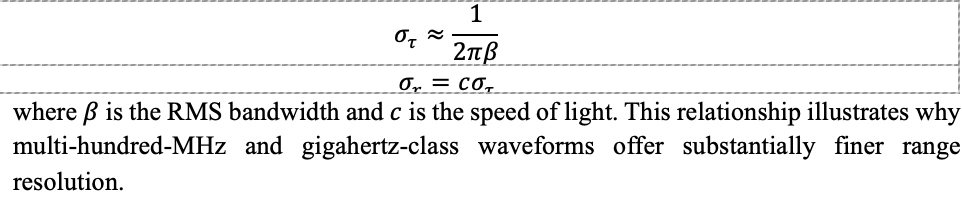
Wideband signals. Wi-Fi 7 supports 320-MHz channels and 5G FR2 offers up to 400 MHz, with multi-GHz bandwidths anticipated for 6G [6]. Wider bandwidth directly improves time-of-arrival (ToA) precision. The ToA uncertainty can be approximated by:
Massive MIMO. Multi-element antenna arrays estimate angle-of-arrival (AoA) and angle-of-departure (AoD), effectively turning base stations into spatial sensors capable of separating line-of-sight from multipath.
Dense deployment. Unlike GNSS satellites, orbiting at roughly 20,000 km, terrestrial networks are woven directly into the environment. Small cells and access points provide excellent geometry in exactly the locations where GNSS performance is weakest, including city centers, campuses, factories, and warehouses.
High signal power. Terrestrial signals arrive at the receiver tens of decibels stronger than GNSS, improving indoor penetration, acquisition speed, and robustness to interference.
These features were introduced to enhance connectivity, yet they collectively create an RF landscape that is inherently PNT-capable.
2.3 The Rise of LEO Constellations as a Complementary Space Layer
A third major driver behind communications-enabled PNT is the rapid proliferation of LEO satellite constellations. Broadband systems such as Starlink and OneWeb, together with several emerging PNT-dedicated LEO constellations, offer distinct advantages [7]:
Stronger received power. LEO satellites operate at altitudes of roughly 500–1,200 km, far closer than GNSS satellites at 20,000 km or higher, resulting in significantly stronger received signals.
Rapid Doppler dynamics. The relative motion of LEO satellites produces large, fast-varying Doppler shifts, which improve observability of user velocity and, over short intervals, position.
Large constellation sizes. Hundreds or thousands of satellites create rich geometry and frequent visibility, enhancing availability and resilience.
Although many LEO systems were designed primarily for communications, their signals can already be exploited opportunistically for positioning and timing. Purpose-built LEO-PNT systems extend these capabilities by offering wideband navigation signals, multi-frequency operation, and security features intended specifically for resilient PNT [7].
These characteristics make LEO a natural augmentation layer, strengthening GNSS performance and providing additional robustness in degraded, obstructed, or contested environments.
3. Technical Foundations of Communications-Based PNT
Modern communication and LEO satellite systems provide a diverse set of physical-layer measurements that can be fused with GNSS to create a resilient, multi-layer PNT solution. These observables go well beyond traditional GNSS code and carrier measurements and include Doppler, ranging, time-of-arrival, round-trip time, angle-of-arrival, angle-of-departure, and received signal strength. Figure 3 summarizes this heterogeneous measurement landscape and shows how each layer contributes distinct observables to the fusion engine.
Figure 3. PNT measurement diversity across GNSS, LEO-PNT, and terrestrial networks.
3.1 High-Resolution Ranging from Wideband Waveforms
Ranging accuracy is fundamentally linked to signal bandwidth. GNSS signals typically occupy 1–20 MHz, whereas modern communication waveforms may span hundreds of megahertz. Wider bandwidth enables finer temporal resolution, allowing receivers to separate closely spaced multipath components and improve time-of-arrival (ToA) precision [6].
In practice, Wi-Fi 7 and 5G FR2 waveforms can support sub-meter ranging in favorable conditions and substantially enhance relative positioning indoors and in dense urban environments. Techniques such as two-way ranging, cooperative localization, and inertial smoothing can extend performance even further. As shown in Error! Reference source not found., these wideband ToA and RTT observables form an essential input to the PNT measurement fusion layer.
3.2 Spatial Sensing with Massive MIMO
Massive MIMO arrays are one of the most powerful enablers of communications-based PNT. By comparing the phase and amplitude across many antenna elements, base stations estimate angles of arrival (AoA) and departure (AoD), turning terrestrial infrastructure into distributed RF sensor arrays [8].
Angle-based measurements offer several important benefits:
Improved localization geometry in 3D urban canyons
Ability to distinguish line-of-sight (LOS) from multipath
High update rates suitable for UAVs and advanced air mobility (AAM) platforms
A simplified Cramér–Rao lower bound (CRLB) illustrates how antenna geometry and signal power influence the accuracy of AoA estimation:
3.3 Infrastructure Density and Geometric Strength
From a PNT perspective, measurement geometry can be as important as measurement precision. Dense deployments of base stations, small cells, and access points give 5G, 6G, and Wi-Fi networks inherently strong geometric diversity, especially in environments where GNSS geometry collapses.
In indoor settings or street canyons, a receiver may have ten or more RF sources within a few hundred meters. This density improves dilution of precision (DOP), increases redundancy, and enables fallback positioning even when GNSS availability drops to zero. Within the multi-layer architecture described in Figure 1, terrestrial networks therefore provide crucial observability in GNSS-restricted environments.
3.4 High Signal Power and Robust Tracking
Terrestrial and LEO communication signals enjoy a link-budget advantage of roughly 50–100 dB over GNSS. This additional power yields several practical benefits:
Better performance with small or non-ideal antennas
Increased resilience to interference and jamming
Faster acquisition and re-acquisition after outages
More reliable tracking under fast dynamics or partial obstruction
In many scenarios, 5G, Wi-Fi, and LEO signals remain trackable long after GNSS signals fall below usable thresholds, providing essential continuity for navigation filters and multi-sensor fusion engines.
3.5 Timing and Synchronization in Communication Networks
Modern wireless networks rely on tight synchronization for scheduling, beamforming, and coordinated MIMO. They obtain timing from GNSS, fiber distribution, and packet-based protocols such as IEEE 1588 Precision Time Protocol (PTP) [9]. As these timing infrastructures mature, communication networks increasingly become timing providers rather than solely timing consumers.
Although terrestrial networks do not yet match the long-term stability of GNSS-disciplined oscillators, they provide valuable short-term holdover and regional timing continuity. These capabilities play an important role in multi-layer PNT systems, particularly during GNSS outages.
4. Engineering Challenges and Limitations
Although communications-based PNT provides powerful complementary capabilities, significant engineering challenges remain. These challenges do not diminish the value of multi-layer PNT; rather, they highlight the technical rigor required to deploy these systems reliably on a scale.
4.1 Multipath and Non-Line-of-Sight Propagation
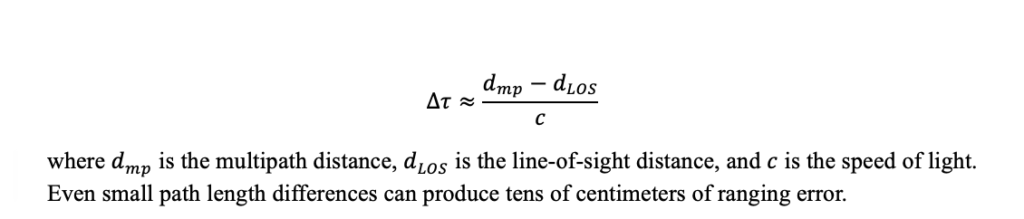
For terrestrial PNT, multipath and non-LOS propagation remain the dominant contributors to ranging and angle errors. Buildings, vehicles, reflective indoor structures, and metallic industrial environments introduce secondary paths that bias ToA, RTT, AoA, and Doppler measurements. A simplified model of multipath-induced ToA bias is:
Massive MIMO beamforming, high-resolution channel estimation, and machine-learning LOS classifiers can mitigate these errors, but performance is highly environment-dependent and cannot be guaranteed in all cases. Figure 3, introduced earlier, highlights how diversity in measurement types helps reduce susceptibility to any single error mechanism.
4.2 Synchronization Constraints and Timing Drift
Communication networks require precise time alignment for scheduling, beamforming, and coordinated MIMO. However, network clocks do not yet match the long-term stability of GNSS-disciplined oscillators. Backhaul delay variability, oscillator drift, and partial GNSS visibility at base stations introduce timing uncertainty that must be explicitly modeled in a PNT fusion engine.
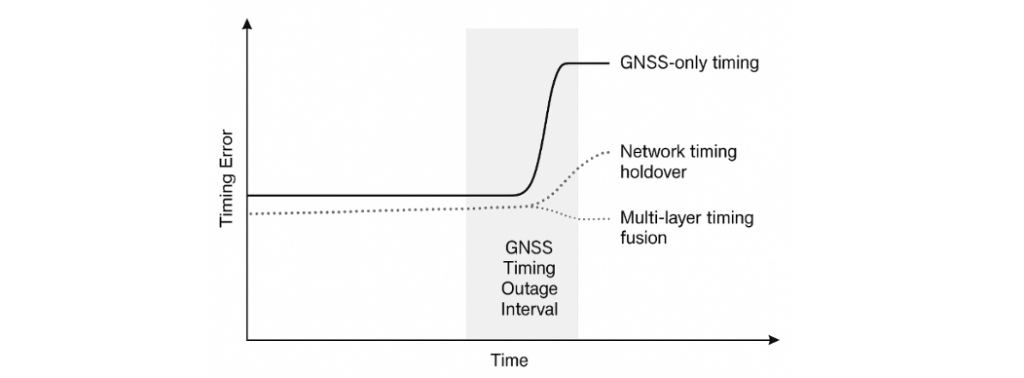
Figure 4 illustrates timing error growth during a GNSS outage, comparing:
GNSS-only timing, which diverges quickly without satellite visibility
Network timing holdover, which slows but does not halt drift
Multi-layer timing fusion, which maintains the lowest error accumulation
These behaviors demonstrate why communication-based timing is best used as a complementary layer rather than a standalone reference.
Figure 4. Timing error comparison during a GNSS timing outage.
4.3 Waveform and Structural Limitations
Modern communication waveforms such as OFDM were optimized for throughput and spectral efficiency, not navigation. Several characteristics constrain raw positioning performance:
Finite pilot density limits effective ranging bandwidth
High peak-to-average power ratio (PAPR) stresses nonlinear receivers
4.4 Coverage Variability and Regulatory Constraints
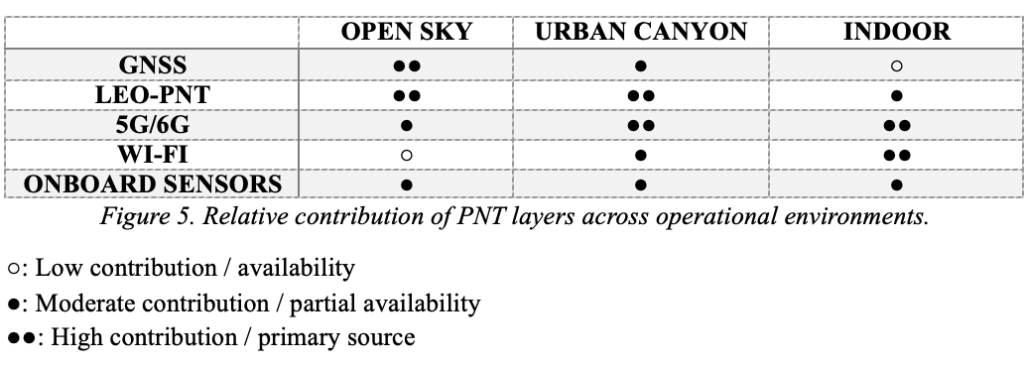
Terrestrial network density varies sharply by geography. Urban cores, industrial sites, and indoor campuses enjoy strong 5G/6G and Wi-Fi coverage, whereas rural, maritime, and mountainous regions may see limited improvements without LEO-PNT augmentation. Spectrum policy, privacy rules, and operator-controlled access to timing and positioning features further constrain how widely these capabilities can be exposed. Figure 5 summarizes the relative contribution of each PNT layer—GNSS, LEO-PNT, terrestrial networks, and onboard sensors—across open-sky, urban, and indoor environments.
Figure 5. Relative contribution of PNT layers across operational environments.
4.5 Security and integrity
As communication signals begin supporting navigation functions, they must meet higher standards for robustness, integrity, and security. PNT observables are vulnerable to spoofing, replay, meaconing and cyber-attacks on timing sources [10]. GNSS experience demonstrates the value of:
Cross-layer consistency checks
Cryptographic authentication
Fault detection and exclusion (FDE)
Monitoring for anomalies in Doppler, timing, or angle domains
Redundancy across multiple constellations and layers.
These functions are visualized in Figure 6, which illustrates how a multi-layer PNT system performs integrity monitoring across heterogeneous measurements.
5. A Multi-Layer Architecture for Future PNT
The earlier sections described why GNSS alone cannot meet emerging PNT requirements and how communications and LEO signals provide new sources of observability. Building on those foundations, Figure 1 introduces a multi-layer architecture in which GNSS, LEO-PNT, terrestrial networks, and onboard sensors cooperate to deliver resilient positioning and timing. This section outlines the role of each layer and how they integrate into a unified system.
5.1 GNSS as the Foundational Global Layer
GNSS will continue to provide the global reference frame, absolute positioning, and precise timing that anchor the entire architecture. Its worldwide availability, mature error modeling, and extensive user base make it the natural reference for other layers to align with whenever GNSS is available and reliable. In this sense, GNSS remains the “truth model” for time and coordinates, even as additional layers enhance resilience.
5.2 LEO-PNT as the High-Power, High-Dynamics Space Layer
LEO satellites provide diversity in orbit, signal power, geometry, and dynamics. Their lower altitude results in significantly stronger signals and rapid Doppler variations that improve motion observability. These characteristics reinforce GNSS performance in interference, urban canyon, and high-dynamics environments. As shown in Figure 3, LEO adds Doppler-based range-rate observables that are particularly valuable for maintaining continuity when GNSS quality fluctuates.
5.3 Terrestrial Networks as the Urban and Indoor Layer
5G, Wi-Fi 7, and future 6G networks form the densest PNT-capable infrastructure ever deployed. Their wideband signals, massive MIMO arrays, and strong received power position them as the dominant layer for indoor and urban navigation. Where GNSS geometry collapses, terrestrial networks provide ToA, AoA, AoD, RTT, and coverage exactly where users most often need it. Figure 5 highlights how their contribution becomes primary indoors and highly complementary in urban canyons.
5.4 Onboard Sensors and Local References
IMUs, odometry, barometers, cameras, radar, and lidar provide short-term stability and immediate awareness of the immediate environment, independent of external RF conditions. These sensors bridge outages and reduce reliance on any single external signal source. Their role within architecture mirrors their role in autonomy today: providing the continuity needed when GNSS, LEO, or terrestrial signals fluctuate. Together with RF observables, they form a robust solution space consistent with the measurement diversity shown in Figure 3.
5.5 Fusion, Standards, and System Engineering
Realizing a multi-layer PNT system is fundamentally a system-engineering effort. Success depends on:
Common timing and reference frameworks across GNSS, LEO, and terrestrial layers
Standardized quality indicators and integrity metrics
Interfaces that expose PNT-relevant observables from communication networks while respecting privacy and operational constraints
Cross-layer consistency checks that ensure no single measurement dominates unchecked
Standards bodies, including 3GPP, IEEE and aviation authorities, are beginning to address these needs, but operationalizing multi-layer PNT at scale will require continued collaboration across industries. Figure 6 illustrates how integrity information from each layer contributes to fault detection, cross-checking, and integrity-bound estimation within the fusion engine.
Figure 6. Integrity monitoring in multi-layer PNT architecture.
6. Conclusion
The era of single-layer PNT is coming to an end. As reliance on precise positioning and timing accelerates across aviation, ground autonomy, critical infrastructure, and networked systems, GNSS alone cannot shoulder the growing resilience burden. Fortunately, a rich set of complementary technologies already surrounds us. Dense terrestrial networks, emerging LEO constellations, and increasingly capable onboard sensors provide observables that naturally augment GNSS and extend PNT into environments where satellite signals struggle.
The opportunity now is to treat communications and PNT not as separate domains but as elements of a unified system. A multi-layer architecture — such as the one outlined in this article — offers stronger availability, improved measurement diversity, and inherent resilience against interference, outages, and environmental constraints. The key challenge ahead lies not in inventing new signals, but in system engineering: establishing shared timing frameworks, standardizing measurement interfaces, ensuring integrity across heterogeneous sources, and building trust in signals not originally designed for navigation.
Most of the technical ingredients are already in place. The next decade will determine how effectively industry, government, research institutions, and standards bodies can integrate them into certifiable, interoperable, and widely deployable solutions. If successful, multi-layer PNT will become a foundational capability — providing trustworthy positioning and timing wherever future autonomous systems, vehicles, and critical infrastructure require it.
Happy New Year! I’ve always felt that a fresh calendar represents a world of new opportunities, and I wish you all a fantastic 2026. For many, this is a season for reflection and self-improvement, with goals typically centered on fitness, faith, personal growth or career milestones.
As regular readers of this newsletter know, my primary focus over the past year has been to champion the importance of geodesy and to prepare the geospatial community for the National Geodetic Survey’s modernized National Spatial Reference System (NSRS).
To see how modern tech would handle such a specialized professional niche, I asked the AI chatbot Grok: “What would be a good New Year’s resolution for a user of the National Spatial Reference System?”
The response was quite insightful. Take a look at what it suggested below.
What would be a good New Year’s Resolution for a user of the National Spatial Reference System? (Grok’s Response)
Fun and Practical New Year’s Resolutions for NSRS Users
As we head into 2026, the modernization of the NSRS is in full swing. NOAA’s National Geodetic Survey (NGS) released the first beta products in June 2025, with ongoing rollouts and testing throughout the year. The full transition to new frames like NATRF2022 and NAPGD2022 is expected soon, bringing centimeter-level accuracy aligned with GNSS and global standards—but it requires preparation.
Here are some timely, geodesy-inspired New Year’s resolutions tailored for surveyors, GIS professionals, engineers, and anyone relying on the NSRS:
Fully transition workflows to the modernized NSRS. Commit to updating software, processes, and datasets for the new terrestrial reference frames and geopotential datum. Test tools on the NGS Beta site and provide feedback to help shape the final rollout.
Achieve new heights (and accuracies) in 2026. Embrace NAPGD2022 for more precise orthometric heights. Resolve to reprocess key projects with updated transformations (via NCAT or VDatum) and say goodbye to NAVD 88 quirks.
Stay grounded in best practices. Incorporate the latest NGS guidelines, like NOS NGS 92 standards for GNSS surveys. Attend webinars and workshops, or review resources, to keep your positioning sharp.
Contribute to the system. Submit high-quality GNSS data via OPUS-Share or participate in crowdsourced efforts to improve the network. Help make the NSRS even more robust for everyone.
Measure progress monthly. Track how the modernization impacts your work—review coordinate shifts, audit legacy data, and plan for smoother integrations in future projects.
These resolutions blend practicality with the spirit of improvement that defines geodesy. Happy New Year—may your positions be accurate, your elevations precise, and your datums forever modernized! For the latest updates, check geodesy.noaa.gov.
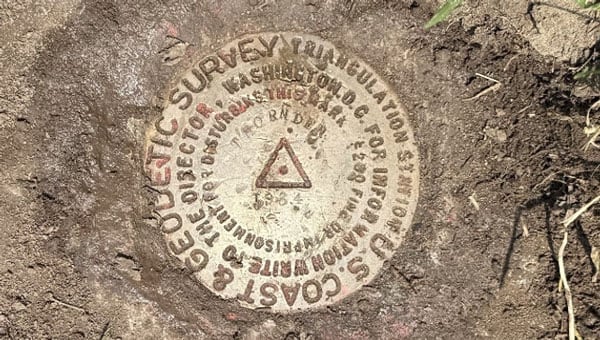
It’s no surprise that Grok highlighted the NSRS modernization; it even incorporated a photo of a geodetic benchmark I took for my July 2025 GPS World Survey Scenenewsletter.
Understanding that most AI chatbots personalize results using past interactions (unless disabled), I wanted to test this. After clearing my cache and deleting all previous Grok interactions, I posed the question again.
You can find that second, impersonalized response below.
Second Response from Grok
What would be a good New Year’s Resolution for a user of the National Spatial Reference System? Grok’s Second answer.
Here are some practical, realistic, and useful New Year’s resolutions tailored for someone who regularly works with the NSRS whether you’re a surveyor, GIS professional, geodesist, engineer or data manager:
“This year, I will stop mixing epochs without documenting them.” Resolve to always record the reference epoch (e.g., 2010.0, 2020.00) when I use NAD83(2011), NAD83(CORS96), NAD83(2011) epoch-specific coordinates, or when I transform to ITRF2020/2020.0. Bonus: add epoch to layer names and metadata.
“I will run OPUS or CSRS-PPP at least once a month to keep my local control fresh.” Make it a habit to periodically re-observe a trusted point and submit it to NOAA’s OPUS (or CSRS-PPP in Canada) to verify that my local network hasn’t drifted too far from the national datum.
“I will finally transition at least one active project to the modern NSRS (NAD83(2011)/NAVD88 → NATRF2022 / NAPGD2022).” Pick one ongoing or new project and do the full datum shift. Learn the tools (NADCON5, VERTCON3, GEOID18 → GEOID2022) and document what changed.
“I will replace every ‘NAD83’ label that doesn’t specify an epoch or realization with something more precise.” No more generic “NAD83” in reports, plats, or metadata. Aim for “NAD83(2011) epoch 2010.0” or “NAD83(2011) CORS-derived” — or better yet, start using NATRF2022 when appropriate.
“I will learn to use the NGS Coordinate Conversion and Transformation Tool (NCAT) fluently.” Commit to doing at least 5 conversions or transformations per month in NCAT instead of relying on old software or hand-calculated factors.
“I will check the NGS Data Explorer / Datasheet for every benchmark or CORS I plan to use — before I use it.” No more assuming a published value is still good. Make it a 2-minute ritual to look up the latest adjusted position and velocity.
“I will attend at least one NGS webinar or read one Bluebook chapter in 2026.” The NGS webinar series is free and excellent. Pick one session (e.g., on GEOID2022, NATRF2022 implementation, or GNSS vector processing) and actually watch it.
“I will prepare a small ‘before/after’ datum comparison report for my organization or clients.” Quantify what the 2022–2025 NSRS modernization means in your typical project area (horizontal shift, orthometric height change). Even a one-page summary builds understanding and credibility.
“I will stop treating GEOID18 as the final word and start using GEOID2022 for new work.” Especially important for projects that will live past 2025, as NGS is phasing out support for older geoids.
Pick one or two that feel achievable and most relevant to your day-to-day work. My personal favorite starter resolution for most NSRS users in 2026: “In 2026, I will clearly label the datum, realization, epoch, and geoid model on every deliverable I produce.”
That one habit alone dramatically reduces confusion downstream.
I really appreciate Grok’s responses because they address crucial issues that many geospatial users either overlook or take for granted, emphasizing the importance of proper documentation and associated metadata.
Key Resolution Examples:
Specificity: “I will replace every ‘NAD83’ label that doesn’t specify an epoch or realization with something more precise.”
Verification: “I will check the NGS Data Explorer / Datasheet for every benchmark or CORS I plan to use — before I use it.”
It is important to note that the AI chatbot assumes the modernized NSRS has already been adopted, which, as of January 2026, is not the case. This highlights that AI still has limitations and requires human oversight.
I challenge you to ask your own AI chatbot a similar, niche question related to your profession and compare its responses.
Beyond the specific technical corrections, Grok provided excellent general advice for any geospatial professional. Take, for example, action items 1 and 5 from its first response:
Transition Workflows: Commit to fully updating software, processes, and datasets to align with the new terrestrial reference frames and geopotential datum.
Measure Progress Monthly: Track the real-world impact of modernization by reviewing coordinate shifts, auditing legacy data, and planning for smoother integrations in upcoming projects.
Even though the modernized NSRS has not yet been officially adopted as of January 2026—with official release and FGCS approval expected later this year—following these steps now ensures you are prepared for the official transition when it occurs.
To help your team prepare for the official transition later this year, I’ve included a box titled “Questions to Guide a Self-Assessment of Your Operation and Products.” These questions, originally featured in my October newsletter, are designed to ensure your organization is fully equipped to implement the new NSRS the moment it is adopted.
Are you generating or using geospatial data (or doing both)?
If so, your workflows are likely dependent on geodetic control tied to one or more NGS products. The upcoming NSRS update will affect these dependencies. (See the box titled “List of NGS Products and Services.”)
Do you know if your mission, project, or datasets depend on NGS products?
Identifying whether and how your entity relies on NGS products is a critical first step in assessing potential impacts.
What are your accuracy, precision, and shelf-life requirements for geospatial data?
Understanding your mission’s specific data requirements ensures you can evaluate whether NSRS modernization will meet your operational needs without unnecessary adjustments. This should include plans to accommodate greater accuracy in the future.
Do you know how your entity accesses and utilizes geospatial data?
Are you obtaining it directly from NGS or indirectly through third-party vendors (e.g., RTN systems, GIS platforms, GNSS companies)?
Many entities rely on geodetic control without realizing it. NGS’s foundational data and frameworks are often invisible and seamlessly embedded within the tools and services offered by third-party vendors, such as GIS platforms, survey equipment, and software providers. These vendors, in turn, depend heavily on NGS products like the NSRS to ensure their tools are accurate and functional. Understanding this indirect reliance is crucial for preparing your workflows and ensuring continuity as the NSRS is modernized.
Where does your entity fit in with the geodetic workflow?
Does your entity create integral products (e.g., GNSS data, Lidar data) on which other products depend?
Evaluating these dependencies will help you determine the scope of NSRS modernization impacts.
What are your project requirements for data accuracy and longevity?
Assess whether your data accuracy thresholds and long-term usability align with the modernized NSRS.
Have you evaluated workflows and identified potential impacts in areas affected by significant ground movement (e.g., regions with tectonic shifts, vertical land motion, and, most notably, subsidence)
Identifying potential risk or disruption areas can guide prioritization and help mitigate impacts on critical operations.
While the original meeting scheduled for October 15, 2025, was canceled due to the Federal Government Shutdown, it has been officially rescheduled for Wednesday, January 21, 2026. This meeting will be critical for aligning agency engagement strategies and self-assessments ahead of the final adoption of the new datums.
Increase awareness of the National Spatial Reference System (NSRS) Modernization rollout schedule and engagement strategy, including self-assessment and interaction between official departmental working groups and an NGS point of contact.
Within other Departments, connect decision-makers to those who accomplish NSRS modernization tasks and designate points of contact to interface with NGS capacity-building efforts.
Share experiences and strategies among federal agencies concerning NSRS Modernization self-assessment and preparation.
(New) Formally transition the foundational beta products (released in May 2025) from preliminary to final.
Gather questions, discuss anticipated challenges, and identify opportunities to support each other through this transition.
The FGCS plays a central role in coordinating geodetic activities across the federal government, including the development of standards and the promotion of the use of authoritative geodetic control (e.g., CORS, geoids) to ensure that geospatial data is accurate, accessible, and interoperable, and to advance the modernization of NSRS across agencies and recommend the adoption of the modernized NSRS by FGDC as the official basis for geodetic control in the United States. It is my understanding that this meeting is open to the public (virtually) for listening and observation. The box titled “Federal Geodetic Control Subcommittee Meeting” provides the agenda of the January 21, 2026, meeting.
Federal Geodetic Control Subcommittee Meeting Agenda held January 21, 2026.
To join the meeting virtually, registration is required. You can find all the necessary details and a direct link to sign up in the box titled “Registration for the Virtual Attendance of the Meeting.”
NOAA’s National Geodetic Survey (NGS) invites you to the upcoming Federal Geographic Data Committee (FGDC) Federal Geodetic Control Subcommittee (FGCS) meeting.
In October 2025, NSPS held its Fall meeting. The box titled “Excerpts from 2025 NSPS Fall Meeting Report: October 17, 2025” contains excerpts from the report provided by Richard Kleinmann, Wisconsin NSPS Director, on the working group’s activities being performed by the National Society of Professional Surveyors (NSPS) Professional Standards NSRS Modernization Subcommittee.
Submitted by: Richard Kleinmann PLS, Wisconsin NSPS Director
Subcommittee Purpose: To promote awareness, adoption, and readiness for the implementation of the Modernized National Spatial Reference System (NSRS) in cooperation with the National Geodetic Survey (NGS) and other geospatial groups.
Activities: NSPS leadership and the NSRS Modernization Subcommittee continue to work closely with NGS to promote awareness, adoption, and readiness for the new 2022 datums, which are expected to be approved sometime in 2026. Due to federal funding challenges occurring in 2025, NSPS felt it necessary to intensify its support of NGS and the modernization of the NSRS which was the genesis of this subcommittee.
The NSRS Modernization Subcommittee is also working on a series of documents originally developed by Dana J. Caccamise of NGS intended to be used by Federal Agencies in the transition to the new datums. We are adapting the documents to change the “voice” from NGS to NSPS and the intended audience to state, regional, county and local agencies, as well as private practitioners, to help them transition smoothly to the modernized NSRS. At this point, the document package includes:
Briefing materials for agency coordination (Presentation Template)
These document resources are being developed with the hope to share them via NSPS social media outreach efforts and possibly a geospatial information “hub” shared by NSPS and other geospatial organizations.
Proposed Whitepapers/Use Case Reports: The intent of these whitepapers is to is to provide a somewhat higher-level view of how the transition to the new datums/frames can be accomplished by showing what tools are available and what to consider when designing a project approach. Our hope is to promote the adoption of the new datums and share the benefits of doing so. Basically, adopting a “be prepared, not scared” attitude. We are looking for people willing to share their solutions so others can benefit from their experience and be more likely to be early adopters. It is not our intent to develop detailed step by step recipes that can be blindly followed because every geographic region has their unique circumstances that need to be considered but the white papers will instead supply the foundation for them to confidently build a project approach that works in their situation.
Coordination with other working groups: NSPS is looking forward to coordinating with similar Working Groups that NGS has encouraged to be formed by the American Society for Photogrammetry and Remote Sensing (ASPRS) and the American Association for Geodetic Surveying (AAGS). There are several Task Forces and Committees formed on the state level that are also working on adoption and implementation issues specific to their states. Together, these efforts aim to build understanding, reduce uncertainty, and support the geospatial community’s successful implementation of the updated reference framework. NSPS and NGS have committed to having a significant presence at Geo Week in Denver, Colorado, on February 16-18, 2026.
As mentioned in the working group’s report, “As an outgrowth of interaction between NSPS & NGS during NGS quarterly meetings and at geospatial events such as the ESRI User Conference and Geo Week, the NSPS leadership team and subsequently the NSRS Modernization Subcommittee began developing a suite of resources — including an ArcGIS StoryMap with several resources useful for the transition. See the link for the NSPS ArcGIS Story map here: https://share.google/oOAIapPQnux5q8nwl.
The box titled “NSPS ArcGIS Story Map” offers a detailed look at this resource, which visually illustrates the impact and benefits of the upcoming NSRS modernization.
NSPS ArcGIS Story Map
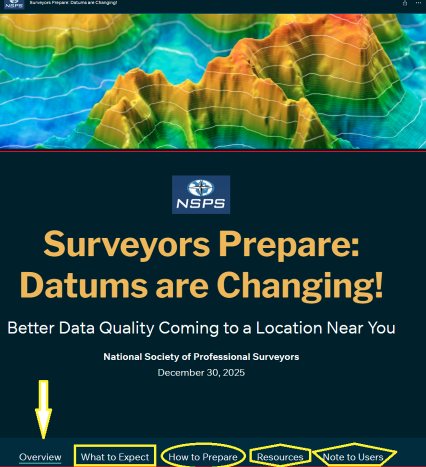
The website has five buttons:
Overview
What to Expect
How to Prepare
Resources
Note to Users
The section titled “The Overview Section” details the essential information — who, what, where, when, and why — regarding the new, modernized NSRS. Additional information is available on the website.
Overview
WHO: The National Geodetic Survey (NGS), located within the National Oceanic and Atmospheric Administration (NOAA) of the United States government. The NGS is responsible for defining, maintaining, and providing access to the country’s positioning infrastructure called the National Spatial Reference System (NSRS).
WHAT: Is updating the NSRS – horizontal (geometric, NAD 83) and vertical (geopotential, NAVD 88 and local island vertical datums PRVD02, USVI09, ASVD02, GUVD04, HAWAII – Local Tidal) geodetic datums, an effort that has been underway since 2007.
WHERE:The North American, Pacific, Caribbean, and Marianas plates.
WHEN: Now – rollout is underway. An updated Federal Register Noticewas released on October 9, 2024. Alphaand Betaproducts are being released, with full replacement of the NSRS anticipated in 2026.
WHY: These datums have been in use since GPS was in its infancy – i.e., for decades, and there are known limitations that the new system addresses:
NAD 83 is not as geocentrically defined as today’s positioning technologies demand, meaning not referenced to the center of Earth’s mass, by about 2.24 meters based on the latest international estimates. This is problematic when using Global Navigation Satellite Systems (GNSS), which orbit about and provide positions relative to the center of the Earth.
NAD 83 grouped the North American and Caribbean plates in its definition. The updated system has broken those two plates out (because we now understand how to measure how the plates rotate individually) in addition to the Pacific and Marianas plates included in NAD 83, resulting in definitions for four Terrestrial Reference Frames (TRFs): NATRF2022, PATRF2022, MATRF2022, and CATRF2022.
Continental drift and vertical land movement were not accounted for in the existing NSRS. Reference epochs (timestamps, for instance) for coordinates have been introduced for survey data to help us better understand movement or change over time.
Based on current international geoid estimates, NAVD 88 is biased by approximately 1.5 meters and tilted by 1 meter coast-to-coast.
There are currently multiple vertical datums. The new system will consist of one.
NAD 83 and NAVD 88 were designed independently, resulting in reduced accuracy. In the new system, they were designed together, resulting in better integration and higher accuracy.
GEOID 18 and previous models were hybrid models “warped” to match leveled benchmarks. GEOID2022 will be a more consistent and stable model as it is a purely gravimetric geoid model.
Currently, both physical marks and continuously operating GNSS stations are relied upon for the existing NSRS. Physical marks degrade and are destroyed over time, negatively affecting height and position data. The modernized NSRS will rely exclusively on GNSS stations.
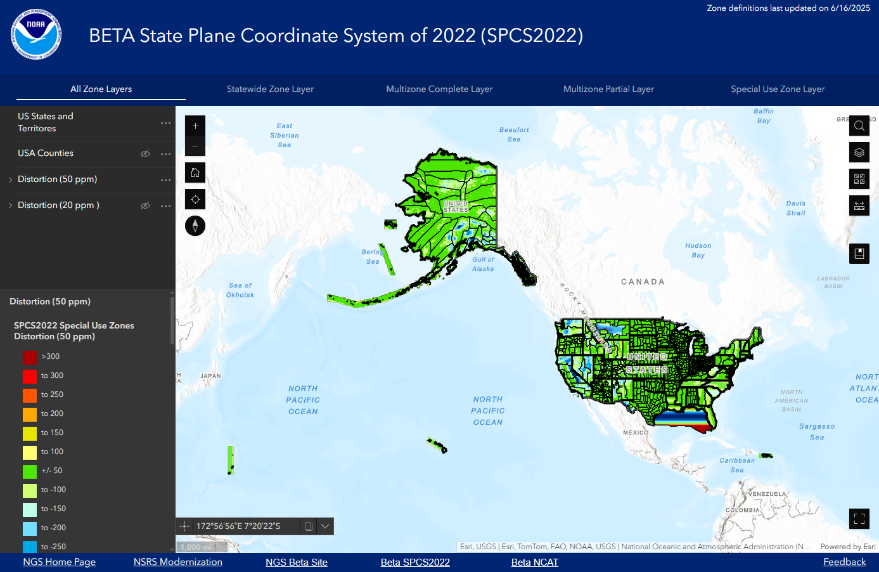
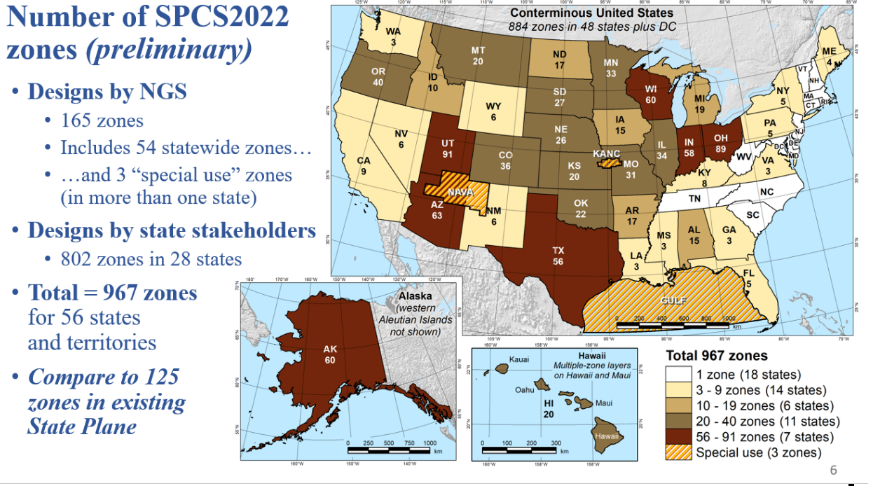
State Plane Coordinate System 83 (SPCS 83) includes high levels of distortion for many areas. The modernized SPCS2022 minimizes distortion or scale error (the difference between ground and grid measurements) at the topographic surface rather than the reference ellipsoid surface, and is designed to minimize distortion in populated or high-use areas.
An important change between SPCS 83 and the upcoming SPCS2022 is that only the international foot (1 foot = 0.3048 meter, exactly) will be supported, which differs from SPCS 83, with some states officially using the international foot while others use the U.S. survey foot (1 foot = 1200/3937 meters). This is consistent with the deprecation of the U.S. survey footinitiated by the National Institute of Standards and Technology (NIST) at the end of December 2022.
The website makes it easy to spread the word about NSRS modernization. By clicking the share button on the right side of the page, you can access several ways to distribute the story map with colleagues or on social media.
The Sharing the NSPS ArcGIS Story Map includes more details — it even includes an embedded QR code that you can scan to open the map directly on your mobile device.
You can access it on your mobile device using the code below.
NSPS ArcGIS Story Map QR Code
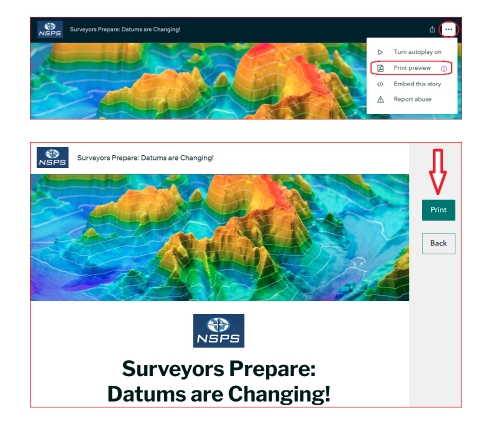
For those who prefer a physical copy or a clean PDF, the site also offers a print-friendly version. See the box titled “NSPS ArcGIS Story Map – Print View” for instructions on how to access it. This 15-page document provides all the same information as the interactive site in a consolidated, easy-to-read format.
NSPS ArcGIS Story Map – Print View
As highlighted in the NSPS working group’s October report, both NSPS and NGS are committed to a major presence at Geo Week in Denver, Colorado, from February 16–18, 2026.
A key session, “NSRS Modernization – The Latest Technical Updates,” is currently scheduled for February 17, 2026, at 2:00 PM. For more details on the presentation and speakers, refer to NSRS Modernization – The Latest Technical Updates below.
2:00 PM – 3:30 PM MT
Bluebird Ballroom 1A
The National Spatial Reference System (NSRS) is undergoing a major transformation to provide more accurate, accessible, and consistent geospatial reference data across the United States. This session will present the latest technical updates on NSRS modernization, including advancements in geodetic reference frames, updated survey standards, and enhanced tools for positioning and measurement. Attendees will learn how these changes impact surveying, mapping, infrastructure, and engineering projects, and gain practical guidance for integrating modernized NSRS data into workflows. This session is essential for professionals seeking to stay current with the evolving national geospatial reference framework.https://mail.google.com/mail/u/0/#search/lfoster%40esri.com/FMfcgzQcqtcPbfppZtnTpZZWDMkQcXfk?projector=1&messagePartId=0.1
I wish you all a prosperous 2026 filled with wonderful new relationships, exciting opportunities, and continued happiness and success.
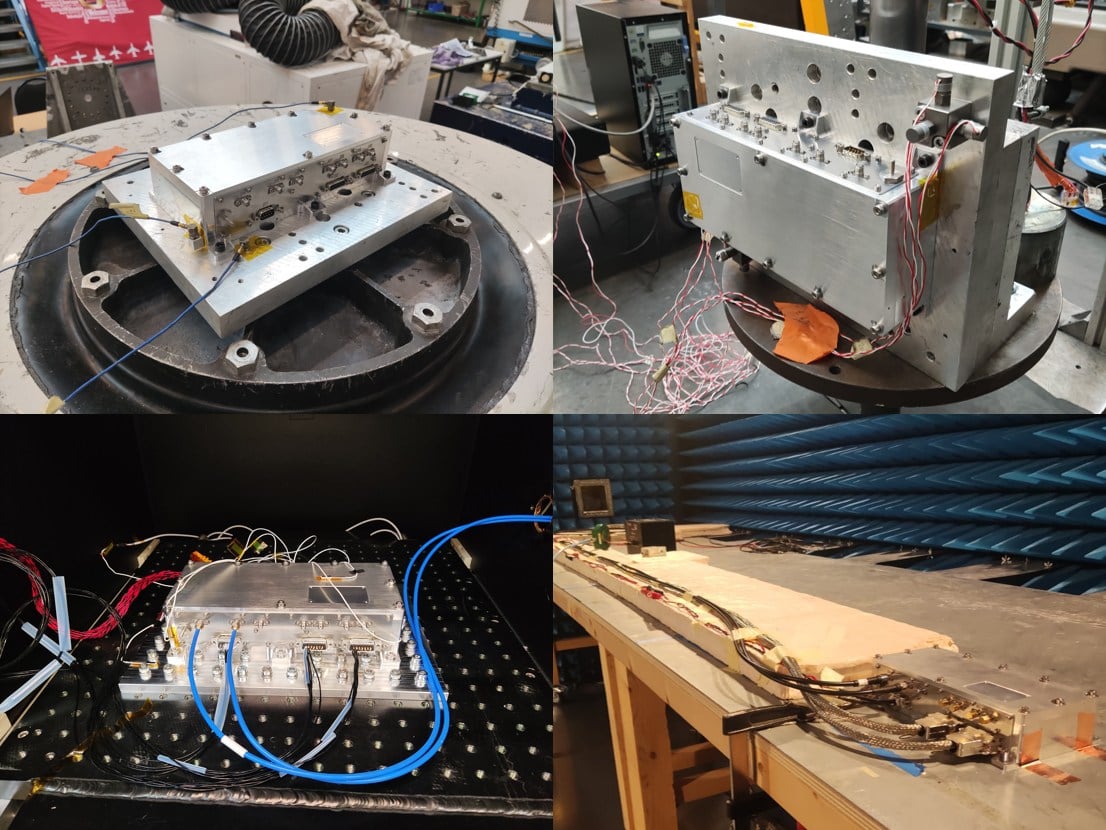
SpacePNT SA, a global provider of high-accuracy, radiation-tolerant spaceborne GNSS receiver equipment for missions ranging from Earth to cislunar orbit, has completed extensive qualification testing of its second-generation product, including vibration, shock, thermal vacuum and electromagnetic compatibility tests.
The multi-frequency, multi-GNSS receiver resulted from two European Space Agency (ESA) ARTES Competitive & Growth (C&G) development projects supported by ESA and the Swiss Space Office.
The first project enabled SpacePNT to develop an industrialized second-generation product for large-scale production targeting low-Earth orbit, LEO position-navigation-timing and geostationary orbit telecommunications constellations. The receiver includes a proprietary Precise Orbit Determination algorithm that provides sub-decimeter real-time positioning and timing aboard spacecraft. The company validated the POD algorithm in a hardware-in-the-loop environment and retrofitted it into two first-generation flight models delivered to a customer for satellite integration.
Under the second project, SpacePNT developed a Radiation Hardiness Assurance approach for long-duration missions in harsh radiation environments. ESA’s GENESIS satellite mission, which will operate in a challenging medium Earth orbit environment, will be the first to use this RHA approach. SpacePNT will supply the mission’s GNSS receiver equipment.
Though the second-generation receiver uses largely the same hardware, software and firmware technology as the company’s flight-proven first-generation product, SpacePNT performed a complete qualification campaign to validate design changes.
After passing all qualification and performance tests, SpacePNT will begin manufacturing first flight models of its second-generation products for several customers. The receivers will fly on demanding Earth observation, in-orbit servicing and space exploration missions at altitudes from LEO through medium Earth orbit, geosynchronous transfer orbit, geostationary orbit and lunar distances.
The views expressed herein do not reflect the official opinion of the European Space Agency.
Voyant Photonics has released new versions of its Carbon lidar platform, adding 32-line and 64-line variants designed for compact, cost-sensitive and compute-limited systems.
The new models, which will be displayed at CES 2026 (booth 4875, Las Vegas Convention Center West Hall), complement existing 128-line configurations and are optimized for industrial autonomy, robotics, drones and smart infrastructure applications.
Building on the same semiconductor foundation as Voyant’s flagship Carbon platform, the new versions offer lower data rates and simplified integration while maintaining core FMCW advantages including velocity measurement, interference immunity and high dynamic range.
“With these additions, we’re extending our FMCW lidar to applications where cost and compute budgets are essential and where historically the only available options were over-engineered sensors built for automotive and not designed with industrial needs in mind,” said Clément Kong, vice president of sales at Voyant Photonics. “Carbon 32 and Carbon 64 make it possible for developers to embed true 4D perception in the smallest and most constrained devices, accelerating the shift from autonomous vehicles to autonomous everything.”
Platform capabilities
The Carbon family uses Voyant’s proprietary silicon-photonics architecture that integrates beam steering and coherent detection on a single photonic chip, enabling mass-production economics, reduced calibration drift and unit-to-unit consistency.
The new variants include high-precision depth sensing and real-time velocity measurement, exceptional ambient light immunity and compact design for industrial and mobile environments.
With line resolutions spanning 32, 64 and 128, original equipment manufacturers and system integrators can tailor performance, bandwidth and compute load to specific use cases, from robotics and automated guided vehicles to drones and embedded edge platforms.
According to the company, Voyant’s commercialization strategy focuses on transforming lidar from a niche automotive sensor into a core component of machine perception across industries. Its chip-scale FMCW technology delivers both motion and depth per pixel, enabling spatial reasoning capabilities for industrial automation, robotics, smart infrastructure, logistics and defense.
By partnering with semiconductor foundries and leveraging the global photonics supply chain, Voyant aims to achieve scalability and cost efficiency, opening markets previously closed to traditional time-of-flight lidar solutions.
“We’re entering a new era of physical AI, where devices and machines interpret and interact with the world around them,” said Clément Nouvel, CEO of Voyant Photonics. “Voyant’s vision is to make high-performance 4D sensing as ubiquitous and affordable as any other embedded component, bringing real-world autonomy to every sector.”
My May 2025GPS World newsletter highlighted the American Association for Geodetic Surveying (AAGS) “Certificate for Geodetic Surveying” Program. This newsletter will update readers on the program. As I mentioned in the May 2025 newsletter, the Certificate for Geodetic Surveying program is designed to meet the needs of surveyors and others who perform spatial analyses and computations using geodetic methods.
Some of you may not be familiar with AAGS. The American Association for Geodetic Surveying (AAGS) aims to guide the community of geodetic, surveying and land information data users into the 21st century by working together to develop new educational programs — such as presentations, seminars, and workshops on geodetic surveying — and by publishing articles and papers that share the latest scientific and technological advances, along with advice for cost-effective, efficient implementation. AAGS also encourages a deeper understanding of geodesy by offering educational materials in geodesy, geodetic surveying and related fields.
The AAGS Board meets on the second Wednesday of each month at 4:00 p.m. (Eastern Time). Please visit the AAGS website and consider joining our monthly board meetings — a forum to share ideas and learn about geospatial products and services. All are welcome. To be added to the attendee list, email me at [email protected].
Here’s the latest on the certification program: AAGS has developed questions covering the seven core areas of minimum competence in geodetic certification: (1) Geometric Geodesy, (2) Physical Geodesy, (3) Accuracy and Error, (4) Temporal Aspects, (5) Global Navigation Satellite Systems, (6) Geodetic Survey Networks, and (7) Standards and Guidelines. For details on each topic, see my May 2025 GPS World newsletter. The information below includes examples the Board is considering for the exam.
In the ECEF coordinate system, the X and Y axes define
minor axis of a reference ellipsoid
spin axis of the Earth
prime meridian and north pole
|equatorial plane
Physical Geodesy
The term ‘deflection of the vertical’ applies to what?
Error introduced when the curvature of the earth is not accounted for
The angular difference between the perpendicular to a reference ellipsoid and perpendicular to the field of gravity at a location.
The distortion induced on the Earth’s gravitational field by a large mass beneath the surface
The difference between true and geodetic North at a location.
Accuracy and Error
A __________________ is the difference between the observed value and the most probable value.
blunder
residual
standard deviation
systematic error
Temporal Aspects
What is the purpose of National Geodetic Survey’s EPP model?
To transform ITRF coordinates to NAD 83 (2011) Epoch 2010.00.
To transform ITRF coordinates to a 2022 Terrestrial Reference Frames Epoch 2020.0 (a way of describing a plate’s rotation).
To transform ITRF coordinates to WGS84 Epoch 2020.00.
Global Navigation Satellite Systems (GNSS)
The satellite ______________________ sets up an arbitrary threshold below which GPS satellites should not be measured.
azimuth
inclination angle
mask angle
zenith angle
Geodetic Survey Networks
In a GPS network adjustment, primary reason for the minimally constrained adjustment is to ensure that
a) the baseline components are free of large errors
b) the control point coordinates have no errors
c) the degree of freedom of adjustment is correct
d) integer ambiguities have been determined correctly
Standards and Guidelines
Which of the following statements about the State Plane Coordinates System (SPCS) is false?
Eliminates having individual adjacent surveys based on different assumed coordinates
Extensive highway projects can start at one control point and close on another at some distance away.
If a monument is lost, one can use other SPCS monuments to recover the lost monument.
Since SPCS utilizes a “developable surface” to project ground points onto a plane, the resulting projection is “distortion free”
The draft questions are under expert review to ensure they target the right geodetic concepts and effectively assess the knowledge needed by those creating geospatial products and services. Our aim isn’t to make everyone a geodesist, but to ensure anyone producing geospatial products understands enough geodesy to create, depict, and document them correctly. AAGS is partnering with NSPS to implement the program, aiming for a 2026 launch. I’ll share updates in future emails.
We’ve discussed producing shorter YouTube sessions focused on key concepts from the seven competency areas of the geodetic certification program. These would complement the existing member-only educational videos on the AAGS website. For details, see the Resources tab on the AAGS website.
YouTube of Real-Time GNSS Networks: RTN Alignment — User Perspective and Managing RTNs.
New 4-Part Educational Video Series on Real-Time GNSS Networks (RTNs) – RTN Alignment The American Association for Geodetic Surveying (AAGS) is pleased to share a comprehensive four-part video series focused on Real-Time GNSS Networks (RTNs) and RTN Alignment — a topic that continues to grow in importance as more agencies, universities, and private organizations operate or rely on RTNs. This series brings together academic researchers and industry practitioners to provide clear user-level guidance and practical network-management insights grounded in current research and real-world field experience. Part 1 — RTN Alignment-User Perspective: Lecture : https://lnkd.in/eMuBqRkz Chase Simpson (Assistant Professor of Practice, Oregon State University) explains RTN fundamentals, field procedures, accuracy expectations, and how to combine real-time GNSS with conventional surveying. Part 2 — RTN Alignment-User Perspective: Q&A: https://lnkd.in/e_5vcM7Y A panel discussion addressing weighting strategies, redundant observations, GEOID2022 implications, and best practices for verifying RTN accuracy in the field. Part 3 — Managing RTNs: Lecture: https://lnkd.in/eV5P-daq William Ohene (PhD Student, Oregon State University) presents new research on monitoring core station stability, detecting reference station issues, and aligning RTNs with the National Spatial Reference System (NSRS). Part 4 — Managing RTNs: Q&A: https://lnkd.in/ejpkJq2Z A follow-up discussion on operational considerations for RTN managers, network density, coordinate updates, and improving user confidence across real-time networks.
Why AAGS is sharing this series As part of our mission to support professional education and strengthen the geodetic surveying community, AAGS is committed to providing accessible, high-quality resources on emerging practices, technologies, and research.
This RTN series supports surveyors, geodesists, GIS professionals, and RTN operators who rely on accurate real-time positioning.
AAGS extends our appreciation to: • Lecturer: Chase Simpson • Lecturer: William Ohene • Moderator: Dave Zilkoski • Panel contributors: Karen Meckel, Müge Albayrak, and Brian Weave
We hope this series supports your professional practice, education initiatives, and technical development.
Please feel free to share your thoughts or questions — we welcome community discussion.
As noted, AAGS members can access educational material on the AAGS website covering geodetic topics that will help answer many exam questions. Numerous external resources are also available. For example, NOAA’s National Geodetic Survey (NGS) offers webinars, online lessons, and educational videos, and GeoLearn provides continuing education courses for surveyors.
Please visit the AAGS website and consider attending our monthly Board meetings. If you’d like to attend, want more information about AAGS, are interested in serving on a committee, or wish to collaborate on YouTube sessions about geospatial topics, email me at [email protected].
JAVAD Data Collector (JDC) is designed to run seamlessly on any Android device and interface seamlessly with JAVAD GNSS smart antennas. JDC features simple, intuitive workflows that require minimal training, making it accessible for users of all skill levels.
The software includes a Signal Bar for a quick view of receiver status, ensuring users can easily monitor their equipment’s performance. Its easy navigation allows users to move through the software efficiently. It is designed to streamline operations of customers ranging from individual surveyors to large surveying firms, making it easier to deploy and manage receivers across teams of any size with minimal training. JDC is available for download through the company website.
The AU20 MMS is a vehicle-mounted mobile mapping system designed for accurate and efficient collection of 3D spatial data. It combines high-performance lidar technology, versatile sensor support and intelligent data processing to provide a practical and flexible solution for professionals in road surveying, asset management and infrastructure documentation. Its lidar system uses fourth-generation real-time waveform processing to achieve a scan rate of 2 million points per second and 200 revolutions per second, producing point cloud data with 5 mm accuracy and 3 mm precision. This level of detail allows for the identification of fine surface characteristics and features, supporting comprehensive asset inventories and condition assessments. The system’s long-range, multi-cycle laser technology enables high-density data capture up to 250 m in vehicle-mounted applications.
Among the technical approaches being researched this year for GNSS/PNT protection, which do you consider most effective or promising?
Photo: Jules McNeff
“The simple answer is what I have been saying many times before. The most effective way to back up GPS/GNSS is to use the terrestrial technology available from eLoran. It is affordable, long-range, precise and essentially unjammable. However, it’s not what I would call ‘promising’ because that’s not what the government wants to hear. In fact, the government is in the process of dismantling the existing Loran infrastructure that could easily be recapitalized as autonomous eLoran stations. eLoran could provide robust nationwide timing and positioning preservation, including in the northern Pacific Ocean and Alaska, as well as across the Arctic, with Canada, to link up with our allies in the UK and Europe, who are also investing in eLoran. There is no real commercial market in the far north and there are no commercial systems proposed that can provide such coverage in those areas where we are facing challenges from Russia and China today and that will only increase into the future.”
—Jules McNeff
Allison Brown
“L-band jamming and spoofing is now prevalent in many parts of the world. It has now been confirmed that space-based jammers have been active, as well as conventional terrestrial jamming. Anti-jam solutions can only provide protection up to a certain jammer power level and are not a ‘silver bullet’ solution. Moreover, nulling of space-based jammers will also have the effect of nulling parts of the sky where GPS satellites are in view, degrading performance by reducing DOP. Alternative PNT solutions that are not relying on L-band signals are the most effective solution for operations in highly contested, jammed or spoofed L-band environments.”
— Allison Brown
Mitch Narins
“I believe that both orbital and ground-based PNT systems, operating in tandem and integrated properly, are the ultimate solution for critical infrastructure applications, but to get there, ‘the budget-office-inspired problem’ of having to pick one and only one must be abandoned: prevention is usually cheaper than curation. Only after space-based and ground-based PNT designers, developers, regulators and users understand and welcome the essential nature of PNT source diversity will we actually achieve the resilient PNT capabilities that we all need.”